Toyota Supra (2023 year). Manual in english - page 20
 

  Index      Toyota     Toyota Supra (2023 year). Manual in english


Search            copyright infringement  


Content      ..     18      19      20      21     ..


Toyota Supra (2023 year). Manual in english - page 20


316

5-1. MOBILITY

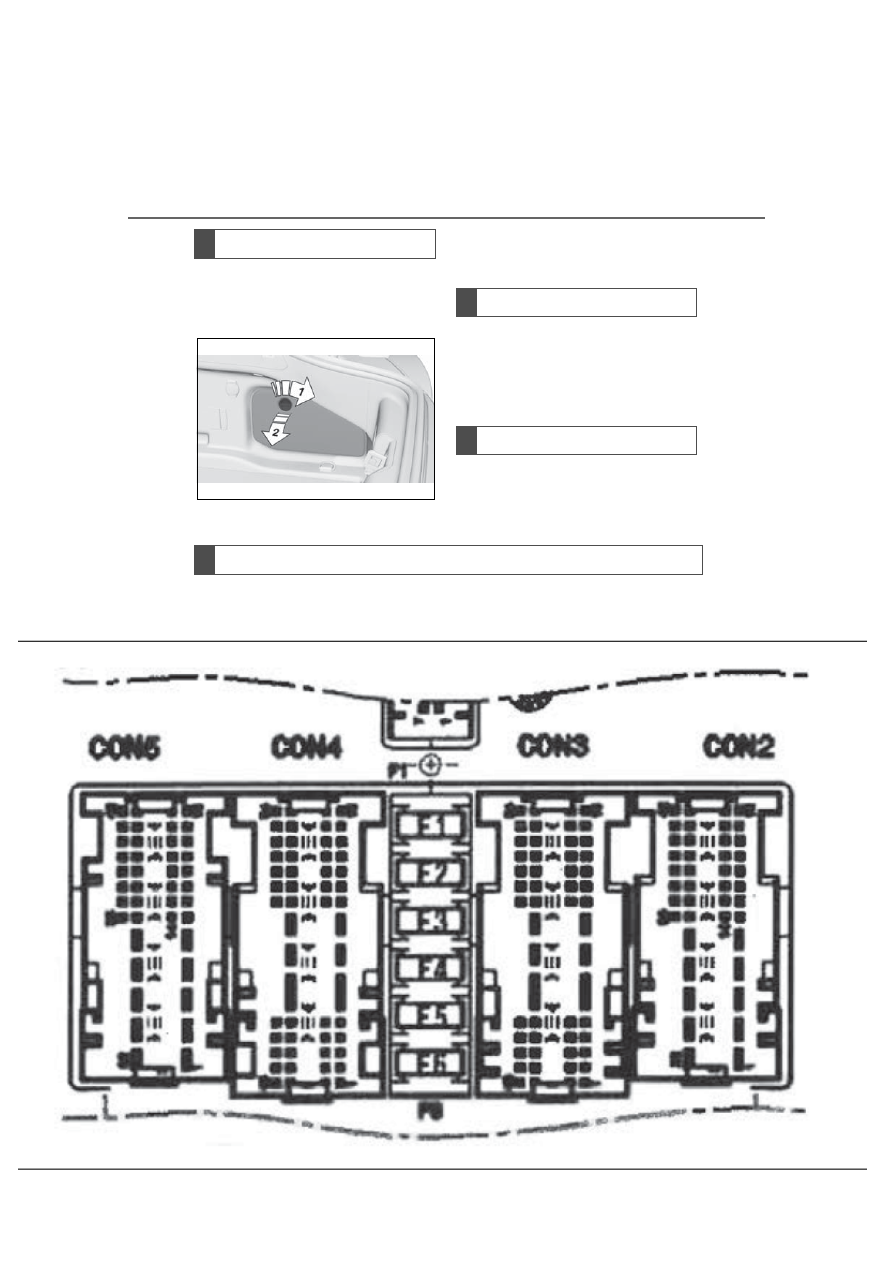
The fuses are located in the 
cargo area on the right side 
behind a cover.

Unlock the cover of the right 

side panel, arrow 

1

, and fold 

open, arrow 

2

.

Additional fuse boxes are 
located in the vehicle. In the 
case of a malfunction, contact 
your Toyota dealer.

The vehicle manufacturer rec-
ommends that you have your 
Toyota dealer replace the fuses.

BDC

In the cargo area

Additional fuse boxes

Replacing fuses

Fuse informations

Fuse values

F: Fuse
[A]: Ampere (Fuse - Value)
*: Spare Slot

F28

F28, F32

F3, F40, F204

F40

F231

F48, F50, F52, F265, 
F269

F55, F56, F64, F65, F67, 
F68

F75

F1, F57, F210

F215, F217

F59

F36, F244

F34, F73

F36, F63

319

5-1. MOBILITY

5

MOBILITY

F206, F244, F271

F20, F21

F3

F2

F254

F2

F2, F29

F2

F1, F59, F60, F76, F204, 
F208, F209, F255

F212

F1, F32, F59, F212, 
F214, F215, F216, F217, 
F218, F220

F214

F39

F252

F32, F70, F209

F46, F273

F3, F254

F4, F5, F6, F244

F51

F4

F69, F70

F203, F206, F209, F271

F1, F3, F39

F36, F61, F62, F67, F68, 
F71

F4

F67, F68

Symbol Meaning

VSC Vehicle Stability 
Control System

Parking brake

Air conditioning

Blower motor, Interior 
ventilation

Rear window heating

320

5-1. MOBILITY

Seat heating

Seat setting

Crash-security module

Switching center column, 
Light switch element, 
steering Operating panel 
Audio

HiFi amplifier, Video mod-
ule TV

Rear-view mirror

Overhead function cen-
ter, Exterior door handle 
electronics

Instrument cluster

Additional battery: Dual 
Accumulator System 
(DSS)

Fuel pump control elec-
tronics, Natural Vacuum 
Leak Detection, Gas gen-
erator for battery safety 
terminal, Remote control 
receiver

Electric window opener

Heating and air-condi-
tioning system

Vehicle's diagnostic port 
(interface)

Symbol Meaning

Interior lights in the boot

Vertical Dynamic platform

Vertical Dynamic platform

Vertical Dynamic platform

Mono Camera (Kafas)

Head Unit

Active Sound Design

USB Hub

Body Domain Controller

Controller (Toyota Supra 
Command)

Electric fan (air cooler), 
Controlled differential 
lock

12 V socket, Cigarette 
lighter

Interior lights in the boot

Door lock, Exterior door 
handle electronics, 
Telematic Communica-
tion Box

Electronic gear box con-
trol

Symbol Meaning

321

5-1. MOBILITY

5

MOBILITY

This chapter describes all stan-
dard, country-specific and 
optional features offered with 
the series. It also describes fea-
tures and functions that are not 
necessarily available in your 
vehicle, e.g., due to the selected 
options or country versions. This 
also applies to safety-related 
functions and systems. When 
using these functions and sys-
tems, the applicable laws and 
regulations must be observed.

Telematic Communica-
tion Box, Exterior door 
handle electronics

Electric fan, Rear Power 
distributor

Engine control

Switching center column, 
Light switch element, 
Body Domain Controller

Control panels centre 
console, Interior light in 
the glove box, Interior 
light, Interior light in the 
sunvisor, Exterior mirror, 
Selector lever

Telematic Communica-
tion Box, Exterior door 
handle electronics pas-
senger side

Switcher block driver's 
door, Exterior mirror

Symbol Meaning

Breakdown assistance

Vehicle features and 
options

If a malfunction occurs 
while driving

WARNING

If a malfunction occurs while driv-

ing, immediately stop the vehicle 

in a safe place.

322

5-1. MOBILITY

WARNING

If a warning light illuminates or 

flashes, or a warning message is 

displayed, immediately stop the 

vehicle in a safe place. Do not 

open the hood to inspect the 

engine, as doing so may lead to 

serious injury, such as steam 

burns. If a warning message is 

displayed, perform the necessary 

procedures according to the dis-

played message or explanation in 

the owner’s manual.

These warning messages indicate 

that a malfunction has occurred in 

a system or function of the vehi-

cle. If you continue to drive the 

vehicle, the engine may stop sud-

denly, possibly leading to an acci-

dent. Also, even if no warning 

lights are illuminated or messages 

are displayed, if any abnormal 

sounds, smells or vibrations are 

detected, or of the engine stops 

suddenly, refrain from opening the 

hood to inspect the engine and 

consult your Toyota dealer.

WARNING

If you hear a loud noise or feel 

something impact the underside 

of the vehicle while driving, imme-

diately stop the vehicle in a safe 

place.

After stopping the vehicle in a 

safe place, check the underside of 

the vehicle for any leaking brake 

fluid, oil or fuel. If any fluid is leak-

ing, stop driving immediately and 

have the vehicle inspected by 

your Toyota dealer.

Brake and fuel lines run under the 

floor of the vehicle. If any of these 

lines are damaged, the brakes 

may fail or leaking fuel may ignite 

and cause a fire.

WARNING

During normal driving, do not turn 

off the engine. Turning the engine 

off while driving will not cause loss 

of steering or braking control, but 

the power assist to these systems 

will be lost. This will make it more 

difficult to steer and brake, so you 

should pull over and stop the 

vehicle as soon as it is safe to do 

so.

WARNING

While driving, if a tire has been 

punctured or has ruptured, firmly 

grip the steering wheel, gradually 

reduce the vehicle speed and 

stop the vehicle in a safe place. 

Avoid sudden braking and steer-

ing operations as doing so may 

cause you to lose control of the 

vehicle. Gradually reduce the 

vehicle speed and stop the vehi-

cle in a safe place.

323

5-1. MOBILITY

5

MOBILITY

If you have been involved in a 
collision, perform the following:

1

Immediately leave the vehi-
cle and move to a safe place 
in order to avoid secondary 
collisions. Make sure to turn 
the engine switch off to help 
prevent the vehicle from 
catching fire. If the airbags 
have deployed (inflated), the 
airbag related parts will be 
extremely hot. Avoid touching 
the parts with your hands or 
any part of your body.

2

If someone has been injured, 
contact emergency services 
and request assistance. If 
someone has no obvious 
external injuries, but they 

may have a head injury, keep 
their airway open while mov-
ing them as little as possible. 
If there is danger of the vehi-
cle being involved in a sec-
ondary collision, move the 
injured person to a safe place 
while keeping them as hori-
zontal as possible.

The button is located in the cen-
ter console.
The red light in the button 
flashes when the hazard warn-
ing flashers are activated.

*

: if equipped

WARNING

If you have been involved 
in a collision

Hazard warning flashers

Warning triangle*

324

5-1. MOBILITY

1

Unlock the cover, arrow 

1

and fold open, arrow 

2

.

2

Remove the warning triangle.

Contact the roadside assis-
tance if assistance is needed in 
the event of a breakdown.

In the event of a breakdown, 
data on the vehicle's condition is 
transmitted to the roadside 
assistance.
Roadside assistance can also 

be contacted via a vehicle mes-
sage, refer to page 141.

Active Toyota Supra Connect 
contract.

Cellular network reception.

Standby state is switched on.

Via Toyota Supra Command:

1

"Toyota Supra Connect"

2

"Toyota Supra Assistance"

3

"Roadside assistance"

A voice connection is established.

In case of an emergency, an 
emergency call can be triggered 
automatically by the system or 
manually.

Only press the SOS button in an 
emergency.
The automatic emergency call 
establishes a connection with 
the Toyota Emergency Call Cen-
ter.

Roadside assistance

Concept

General information

Functional requirements

Starting roadside assis-
tance

Emergency call

Automatic emergency call

Concept

General information

325

5-1. MOBILITY

5

MOBILITY

For technical reasons, the emer-
gency call cannot be guaran-
teed under unfavorable 
conditions.

Active Toyota Supra Connect 
contract.

Standby state is switched on.

The automatic emergency call 
is functional.

The SIM card integrated in 
the vehicle has been acti-
vated.

Under certain conditions, for 
instance if the airbags trigger, an 
emergency call is automatically 
initiated immediately after an 
accident of corresponding 
severity. Automatic emergency 
call is not affected by pressing 

the SOS button.

1

Tap the cover.

2

Press and hold the SOS but-
ton until the LED in the area 
of the button illuminates 
green.

The LED is illuminated green 
when an emergency call has 
been initiated.

If a cancel prompt appears on the 
Control Display, the emergency call 
can be aborted.
If the situation allows, wait in your 
vehicle until the voice connection 
has been established.

The LED flashes green when 
a connection to the Toyota 
Emergency Call Center has 
been established.

The Toyota Emergency Call Center 
then makes contact with the occu-
pants of the vehicle and initiates 
further steps to help.
Even if you are unable to respond, 
the Toyota Emergency Call Center 
can take further steps to help you 
under certain circumstances.
For this, data is transmitted to the 
Toyota Emergency Call Center 
which serves to determine the nec-
essary rescue measures. E.g., the 
current position of the vehicle, if it 
can be established.
Even if the Toyota Emergency Call 
Center is no longer heard through 
the loudspeakers, the Toyota Emer-

Overview

SOS button.

Functional requirements

Automatic triggering

Manual triggering

326

5-1. MOBILITY

gency Call Center may still be able 
to hear the occupants of the vehi-
cle.

The Toyota Emergency Call 
Center ends the Emergency 
call.

If the battery is discharged, the 
engine can be started using the 
battery of another vehicle and 
two jumper cables. Only use 
jumper cables with fully insu-
lated clamp handles.

1

Check whether the battery of 
the other vehicle has a volt-
age of 12 volts. The voltage 
information can be found on 
the battery.

2

Switch off the engine of the 
assisting vehicle.

3

Switch off any electronic sys-
tems/power consumers in 
both vehicles.

The starting aid terminal in the 
engine compartment acts as the 
positive battery terminal.
A special connection on the 
body in the engine compartment 
acts as the negative battery ter-
minal.
Additional information:
Overview of engine compart-
ment, refer topage 299.
Open the cover of the positive 
battery terminal.

Before you begin, switch off all 
unnecessary electronic sys-
tems/power consumers, such as 
the radio, on the assisting and 
receiving vehicle.

1

Open the cover of the starting 
aid terminal.

Jump-starting

General information

Safety information

WARNING

Contact with live components can 

lead to an electric shock. There is 

a risk of injuries or danger to life. 

Do not touch any components 

that are under voltage.

WARNING

If the jumper cables are con-

nected in the incorrect order, 

sparking may occur. There is a 

risk of injury. Pay attention to the 

correct order during connection.

NOTICE

In the case of body contact 

between the two vehicles, a short 

circuit can occur during 

jump-starting. There is a risk of 

damage to property. Make sure 

that no body contact occurs.

Preparation

Starting aid terminals

Connecting the cables

327

5-1. MOBILITY

5

MOBILITY

2

Attach one terminal clamp of 
the positive jumper cable to 
the positive terminal of the 
battery, or to the correspond-
ing starting aid terminal of the 
vehicle providing assistance.

3

Attach the terminal clamp on 
the other end of the cable to 
the positive terminal of the 
battery, or to the correspond-
ing starting aid terminal of the 
vehicle to be started.

4

Attach one terminal clamp of 
the negative jumper cable to 
the negative terminal of the 
battery, or to the correspond-
ing engine or body ground of 
assisting vehicle.

5

Attach the second terminal 
clamp to the negative termi-
nal of the battery, or to the 
corresponding engine or 
body ground of the vehicle to 
be started.

Never use spray fluids to start 
the engine.

1

Start the engine of the assist-
ing vehicle and let it run for 
several minutes at an 
increased idle speed.

2

Start the engine of the vehicle 
that is to be started in the 
usual way.

If the first starting attempt is not 

successful, wait a few minutes 

before making another attempt in 

order to allow the discharged bat-

tery to recharge.

3

Let both engines run for sev-
eral minutes.

4

Disconnect the jumper 
cables in the reverse order.

Check the battery and recharge, 
if needed.

Starting the engine

Tow-starting and towing

Safety information

WARNING

Due to system limits, individual 

functions can malfunction during 

tow-starting/towing with the Toy-

ota Supra Safety systems acti-

vated. There is a risk of an 

accident. Switch all Toyota Supra 

Safety systems off prior to 

tow-starting/towing.

Manual transmission

Safety information

NOTICE

The vehicle can become dam-

aged when lifting and securing it.
There is a risk of damage to prop-

erty.

Lift the vehicle using suitable 

means.

Do not lift or secure the vehicle 

by its tow fitting, body parts, or 

suspension parts.

328

5-1. MOBILITY

A broken-down vehicle can be 
towed or pushed.
Follow the following instructions:

Make sure that the standby 
state isswitched on; other-
wise, the low beams, tail 
lights, turn signals, and wipers 
may be unavailable.

Do not tow the vehicle with 
the rear axle tilted, as the 
front wheels could turn.

When the engine is stopped, 
there is no power assistance. 
Consequently, more effort 
needs to be applied when 
braking and steering.

Larger steering wheel move-
ments are required.

The towing vehicle must not 
be lighter than the vehicle 
being towed; otherwise, it will 
not be possible to control han-
dling.

Do not exceed a towing 
speed of 30 mph/50 km/h.

Do not exceed a towing dis-
tance of 30 miles/50 km.

Additional information:
Rolling or pushing the vehicle, 
refer topage 131.

The vehicle should only be 
transported on a loading plat-
form.

The vehicle is not permitted to 
be towed.

Towing or pushing the vehi-
cle

Tow truck

Automatic transmission: 
transporting the vehicle

General information

Safety information

NOTICE

The vehicle can be damaged 

when towing the vehicle with a 

single lifted axle. There is a risk of 

damage to property. The vehicle 

should only be transported on a 

loading platform.

NOTICE

The vehicle can become dam-

aged when lifting and securing it.
There is a risk of damage to prop-

erty.

Lift the vehicle using suitable 

means.

329

5-1. MOBILITY

5

MOBILITY

To remove a broken-down vehi-
cle from the hazardous area, 
push it for a short distance at a 
speed of no more than 6 mph/10 
km/h.
For rolling or pushing the vehi-
cle, refer to page 134.

The vehicle should only be 
transported on a loading plat-
form.

Switch on the hazard warning 
system, depending on local reg-
ulations.
If the electrical system has 
failed, clearly identify the vehicle 
being towed by placing a sign or 

a warning triangle in the rear 
window.

The tow fittings used should be 
on the same side on both vehi-
cles.
Should it prove impossible to 
avoid mounting the tow bar at 
an offset angle, please follow 
the following:

Maneuvering capability is lim-
ited going around corners.

The tow bar will generate lat-
eral forces if it is secured with 
an offset.

NOTICE

Do not lift or secure the vehicle 

by its tow fitting, body parts, or 

suspension parts.

Pushing the vehicle

Tow truck

Towing other vehicles

General information

Safety information

WARNING

If the approved gross vehicle 

weight of the towing vehicle is 

lighter than the vehicle to be 

towed, the tow fitting can tear off 

or it will not be possible to control 

the vehicle's response. There is a 

risk of an accident. Make sure 

that the gross vehicle weight of 

the towing vehicle is heavier than 

the vehicle to be towed.

NOTICE

If the tow bar or tow rope is 

attached incorrectly, damage to 

other vehicle parts can occur. 

There is a risk of damage to prop-

erty. Correctly attach the tow bar 

or tow rope to the tow fitting.

Tow bar

330

5-1. MOBILITY

Observe the following notes 
when using the tow rope:

Use nylon ropes or straps, 
which will enable the vehicle 
to be towed without jerking.

Make sure the tow rope is not 
twisted when fastening.

Check the fastening of the 
tow fitting and tow rope in reg-
ular intervals.

Do not exceed a towing 
speed of 30 mph/50 km/h.

Do not exceed a towing dis-
tance of 3 miles/5 km.

When starting to tow the vehi-
cle, make sure that the tow 
rope is taut.

The screw-in tow fitting should 
always be carried in the vehicle.
The tow fitting can be screwed 
in at the front or rear of the vehi-
cle.

The tow fitting is found in the 
onboard vehicle tool kit, refer to 
page 312.
Observe the following notes 
when using the tow fitting:

Use only the tow fitting pro-
vided with the vehicle.

Turn the tow fitting at least 5 
turns clockwise and screw it 
in as far as it will go. If neces-
sary, tighten with a suitable 
object.

After use, unscrew the tow fit-
ting counter clockwise.

Use the tow fitting for towing 
on paved roads only.

Avoid lateral loading of the 
tow fitting, for instance do not 
lift the vehicle by the tow fit-
ting.

Check the attachment of the 
tow fitting in regular intervals.

Tow rope

Tow fitting

General information

Safety information

NOTICE

If the tow fitting is not used as 

intended, there may be damage 

to the vehicle or to the tow fitting. 

There is a risk of damage to prop-

erty. Follow the notes on using the 

tow fitting.

331

5-1. MOBILITY

5

MOBILITY

Press on the mark on the edge 
of the cover to push it out.
For covers which have an open-
ing instead of a marking, pull the 
cover out by the opening.

Do not tow-start the vehicle.
Start the engine by jump-start-
ing, refer to page 326, if possi-
ble.
Have the reasons for the start-
ing difficulties corrected by your 
Toyota dealer.

This chapter describes all stan-
dard, country-specific and 
optional features offered with 
the series. It also describes fea-
tures and functions that are not 
necessarily available in your 
vehicle, e.g., due to the selected 
options or country versions. This 
also applies to safety-related 
functions and systems. When 
using these functions and sys-
tems, the applicable laws and 
regulations must be observed.

Regularly remove foreign 
objects such as leaves in the 
area below the windshield when 
the hood is raised.
Wash your vehicle frequently, 
particularly in winter. Intense 
soiling and road salt can dam-
age the vehicle.

Screw thread for tow fit-
ting

Tow-starting

Care

Vehicle features and 
options

Washing the vehicle

General information


Content      ..     18      19      20      21     ..