Toyota Supra (2023 year). Manual in english - page 19
 

  Index      Toyota     Toyota Supra (2023 year). Manual in english


Search            copyright infringement  


Content      ..     17      18      19      20     ..


Toyota Supra (2023 year). Manual in english - page 19


300

5-1. MOBILITY

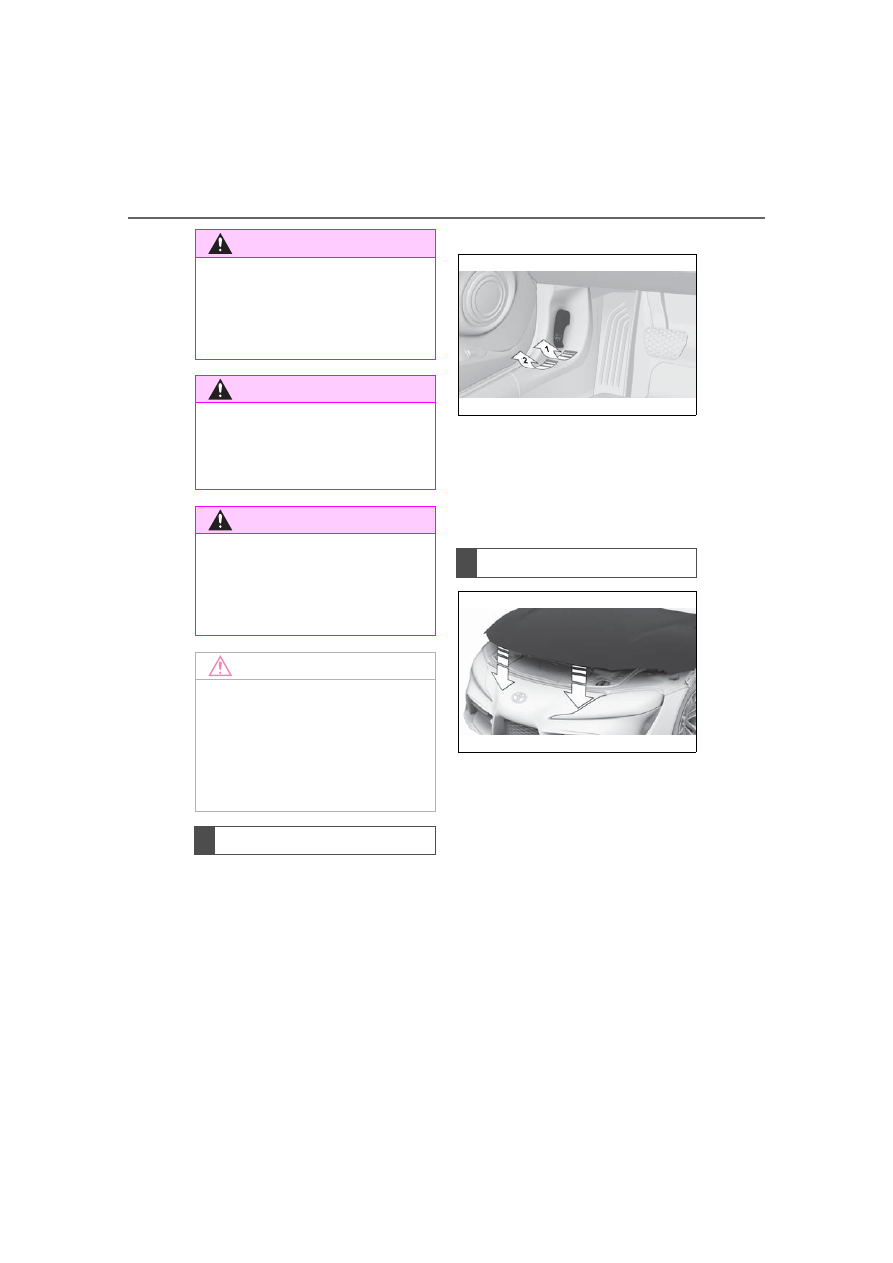
1

Pull lever, arrow 

1

.

Hood is unlocked.

2

After the lever is released, 
pull the lever again, arrow 

2

.

Hood can be opened.

3

Be careful of protruding parts 
on the hood.

Energetically close the hood 
from approx. 20 in/50 cm.
The hood must engage on both 
sides.

WARNING

There are protruding parts, for 

instance locking hook, on the 

inside of the hood. There is a risk 

of injury. If the hood is open, pay 

attention to protruding parts and 

keep clear of these areas.

WARNING

An incorrectly locked hood can 

open while driving and restrict vis-

ibility. There is a risk of an acci-

dent. Stop immediately and 

correctly close the hood.

WARNING

Body parts can be jammed when 

opening and closing the hood. 

There is a risk of injury. Make sure 

that the area of movement of the 

hood is clear during opening and 

closing.

NOTICE

Folded-away wipers can be 

jammed when the hood is 

opened. There is a risk of damage 

to property. Make sure that the 

wipers with the wiper blades 

mounted are folded down onto the 

windshield before opening the 

hood.

Opening

Closing

301

5-1. MOBILITY

5

MOBILITY

This chapter describes all stan-
dard, country-specific and 
optional features offered with 
the series. It also describes fea-
tures that are not necessarily 
available in your vehicle, for 
instance, due to the selected 
options or country versions. This 
also applies to safety-related 
functions and systems. When 
using these functions and sys-
tems, the applicable laws and 
regulations must be observed.

Depending on the region, many 
gas stations sell fuel that has 
been customized to winter or 
summer conditions. Fuel that is 
available in winter,for instance 
helps make a cold start easier.

For the best fuel consumption, 
the gasoline should be sul-
fur-free or very low in sulfur con-
tent.
Fuels that are marked on the 

gas pump as containing metal 
must not be used.
Fuels with a maximum ethanol 
content of 10 %, i.e. E10, may 
be used for refueling.
To achieve nominal values for 
mileage and consumption, fol-
low the specified fuel quality in 
the sales literature.

Ethanol should meet the follow-
ing quality standards:
US: ASTM 4806–xx
CAN: CGSB-3.511–xx
xx: comply with the current valid 
standard in each case.
The use of fuels of minimum 
quality has no influence on the 
service life of the engine.

Operating materials

Vehicle features and 
options

Fuel recommendation

General information

Gasoline

General information

Safety information

WARNING

The use of poor-quality fuels may 

result in harmful engine deposits 

or damage. Additionally, problems 

relating to drivability, starting and 

stalling, especially under certain 

environmental conditions such as 

high ambient temperature and 

high altitude, may occur.

302

5-1. MOBILITY

2.0 models

Toyota recommends AKI 91.

3.0 and 3.0 Premium models

Toyota recommends AKI 93.
Refuel with this gasoline to 
achieve the rated performance 
and consumption values.

The minimum grade is AKI 87.
If you use gasoline with this min-
imum AKI Rating, the engine 
may produce knocking sounds 
when starting at high external 
temperatures. This has no effect 
on the engine life.

This chapter describes all stan-
dard, country-specific and 
optional features offered with 
the series. It also describes fea-
tures that are not necessarily 
available in your vehicle, for 

WARNING

If drivability problems are encoun-

tered, we recommend switching 

to a high quality gasoline brand 

and a higher octane grade - AKI 

number - for a few tank fills. To 

avoid harmful engine deposits, it 

is highly recommended to pur-

chase gasoline from Top Tier 

retailers.

Failure to comply with these rec-

ommendations may result in the 

need for unscheduled mainte-

nance.

NOTICE

Even small quantities of the 

wrong fuel or wrong fuel additives 

can damage the fuel system and 

engine. Furthermore, the catalytic 

converter is permanently dam-

aged. There is a risk of damage to 

property. Do not refuel or add the 

following in the case of gasoline 

engines:

• Leaded gasoline.

• Metallic additives, for instance 

manganese or iron.

Do not press the Start/Stop button 

after refueling with the wrong fuel. 

Contact your Toyota dealer.

NOTICE

Incorrect fuels can damage the 

fuel system and the engine. There 

is a risk of damage to property. Do 

not use fuels with a higher per-

centage of ethanol than recom-

mended. Do not refuel with fuels 

containing methanol, e.g. M5 to 

M100.

NOTICE

Fuel that does not comply with the 

minimum quality can compromise 

engine function or cause engine 

damage. There is a risk of dam-

age to property. Do not fill with 

fuel that does not comply with the 

minimum quality.

Recommended fuel grade

Minimum fuel grade

Engine oil

Vehicle features and 
options

303

5-1. MOBILITY

5

MOBILITY

instance, due to the selected 
options or country versions. This 
also applies to safety-related 
functions and systems. When 
using these functions and sys-
tems, the applicable laws and 
regulations must be observed.

The engine oil consumption is 
dependent on your driving style 
and driving conditions.
Therefore, regularly check the 
engine oil level after refueling by 
taking a detailed measurement.
The engine oil consumption can 
increase in the following situa-
tions, for example:
• Sporty driving style.
• Break-in of the engine.
• Idling of the engine.
• With use of engine oil types 

that are classified as not suit-
able.

Different vehicle messages 
appear on the Control Display 
depending on the engine oil 
level.

The electronic oil measurement 
has two measuring principles:
• Monitoring.
• Detailed measurement.
When making frequent 
short-distance trips or using a 
sporty driving style, for instance 
when taking curves aggres-
sively, regularly perform a 
detailed measurement.

Concept

The engine oil level is monitored 
electronically while driving and 
can be shown on the Control 
Display.
If the engine oil level is outside 
its permissible operating range, 
a vehicle message is displayed.

Functional requirements

A current measured value is 
available after approx. 30 min-
utes of normal driving.

General information

Safety information

NOTICE

An engine oil level that is too low 

causes engine damage. There is 

a risk of damage to property. 

Immediately add engine oil.

NOTICE

Too much engine oil can damage 

the engine or the catalytic con-

verter. There is a risk of damage 

to property. Do not add too much 

engine oil. When too much engine 

oil is added, have the engine oil 

level corrected by your Toyota 

dealer.

Electronic oil measure-
ment

General information

Monitoring

304

5-1. MOBILITY

Displaying the engine oil 
level

Via Toyota Supra Command:

1

"My Vehicle"

2

"Vehicle status"

3

 "Engine oil level"

The engine oil level is displayed.

System limits

When making frequent 
short-distance trips or using a 
sporty driving style, it may not 
be possible to calculate a mea-
sured value. In this case, the 
measured value for the last, suf-
ficiently long trip is displayed.

Concept

The engine oil level is checked 
when the vehicle is stationary 
and displayed via a scale.
If the engine oil level is outside 
its permissible operating range, 
a vehicle message is displayed.

General information

During the measurement, the 
idle speed is increased some-
what.

Functional requirements

• Vehicle is parked in a horizon-

tal position.

• Manual transmission: gear-

shift lever in idle position, 
clutch and accelerator pedals 
not depressed.

• Automatic transmission: 

selector lever in selector lever 
position N or P and accelera-
tor pedal not depressed.

• Engine is running and is at 

operating temperature.

Performing a detailed mea-
surement

Via Toyota Supra Command:

1

"My Vehicle"

2

"Vehicle status"

3

 "Engine oil level"

4

"Measure engine oil level"

5

"Start measurement"

The engine oil level is checked 
and displayed via a scale.

Only add engine oil when the 
message is displayed in the 
instrument cluster. The quantity 
to be added is indicated in the 
message shown on the Control 
Display.
Only add suitable types of 
engine oil, refer to page 305.
Safely park the vehicle and 
switch off drive-ready state 
before adding engine oil.
Take care not to add too much 
engine oil.

Detailed measurement

Adding engine oil

General information

305

5-1. MOBILITY

5

MOBILITY

The oil filler neck is located in 
the engine compartment, refer 
to page 299.

1

Open the hood, refer to page 
300.

2

Open the lid counterclock-
wise.

3

Add engine oil.

4

Close the cap.

The engine oil quality is critical 
for the life of the engine.
Only add the types of engine oil 
which are listed.

Safety information

WARNING

Operating materials, for instance 

oils, greases, coolants, fuels, can 

contain harmful ingredients. 

There is a risk of injuries or dan-

ger to life. Follow the instructions 

on the containers. Avoid the con-

tact of articles of clothing, skin or 

eyes with operating materials. Do 

not refill operating materials into 

different bottles. Store operating 

materials out of reach of children.

NOTICE

An engine oil level that is too low 

causes engine damage. There is 

a risk of damage to property. 

Immediately add engine oil.

NOTICE

Too much engine oil can damage 

the engine or the catalytic con-

verter. There is a risk of damage 

to property. Do not add too much 

engine oil. When too much engine 

oil is added, have the engine oil 

level corrected by your Toyota 

dealer.

Overview

Adding engine oil

Engine oil types to add

General information

Safety information

NOTICE

Oil additives can damage the 

engine. There is a risk of damage 

to property. Do not use oil addi-

tives.

NOTICE

Incorrect engine oil can cause 

malfunctions in the engine or 

damage it. There is a risk of dam-

age to property. When selecting 

an engine oil, make sure that the 

engine oil has the correct oil rat-

ing.

306

5-1. MOBILITY

Up to 1 US quart/liter of an 
engine oil with the following oil 
specification can be topped up:

If an engine oil suitable for con-
tinuous use is not available, up 
to 1 US quart/liter of an engine 
oil with the following oil rating 
can be added:

API grade

Viscosity grade (SAE)

More information about suitable 
oil ratings and viscosity grades 
of engine oils can be requested 
from your Toyota dealer.

The vehicle manufacturer rec-
ommends that you have your 
Toyota dealer change the 
engine oil.

This chapter describes all stan-
dard, country-specific and 
optional features offered with 
the series. It also describes fea-
tures that are not necessarily 
available in your vehicle, for 
instance, due to the selected 
options or country versions. This 
also applies to safety-related 
functions and systems. When 
using these functions and sys-
tems, the applicable laws and 
regulations must be observed.

Coolant consists of water and 
additives.
Coolant consists of water and 
coolant additive. Not all com-

Suitable engine oil types

Gasoline Engine

Toyota Genuine Motor Oil SN 

0W-20 C5 for GR Toyota Supra

BMW Longlife-17 FE+ 0W-20

Alternative engine oil types

API SN PLUS

API SP

SAE 0W-20.

SAE 0W-30.

Engine oil change

NOTICE

Engine oil that is not changed in 

timely fashion can cause 

increased engine wear and thus 

engine damage. There is a risk of 

damage to property. Do not 

exceed the service data indicated 

in the vehicle.

Coolant

Vehicle features andop-
tions

General information

307

5-1. MOBILITY

5

MOBILITY

mercially available additives are 
suitable for the vehicle. The 
vehicle manufacturer recom-
mends using coolant with the 
BMW LC-18 specification. Do 
not mix additives of different col-
ors. Observe the water - additive 
mixture ratio of 50:50. Informa-
tion about suitable additives is 
available from your Toyota 
dealer.

Depending on the motorization, 
there are up to two coolant res-
ervoirs in the engine compart-
ment. Check and top up the 
coolant levels on a regular 
basis.

The coolant may be overfilled in 
the coolant reservoir when the 
vehicle is delivered from the fac-
tory. The normal coolant level is 
achieved by operating the vehi-
cle for a longer period.
The coolant level is indicated 
using the maximum mark in the 
filler neck of the coolant reser-
voir.
Additional information:
For an overview, refer to page 
299.

1

Let the engine cool.

2

Open the hood, refer to page 
300.

3

Turn the lid of the coolant 
reservoir slightly counter-
clockwise to allow any 
excess pressure to dissi-
pate, then open it.

4

Open the coolant reservoir 
lid.

5

The coolant level is correct 
when it is just below the max-
imum mark in the filler neck.

Safety information

WARNING

With the engine hot and the cool-

ing system open, coolant can 

escape and lead to scalding. 

There is a risk of injury. Only open 

the cooling system with the 

engine cooled down.

WARNING

Additives are harmful and incor-

rect additives can damage the 

engine. There is a risk of injury 

and risk of damage to property. 

Do not allow additives to come 

into contact with skin, eyes or arti-

cles of clothing. Use suitable addi-

tives only.

Coolant level

General information

Checking the coolant level

308

5-1. MOBILITY

6

Close the cap.

1

Let the engine cool.

2

Open the hood, refer to page 
300.

3

Turn the lid of the coolant 
reservoir slightly counter-
clockwise to allow any 
excess pressure to dissi-
pate, then open it.

4

Open the coolant reservoir 
lid.

5

If the coolant is low, slowly 
add coolant up to the speci-
fied level; do not overfill.

6

Close the cap.

7

Have the cause of the cool-
ant loss eliminated as soon 
as possible.

Comply with the relevant envi-
ronmental protection regulations 
when disposing of coolant and 
coolant additives.

All washer nozzles are supplied 
from one reservoir.
Use a mixture of tap water and 

windshield washer concentrate. 
If desired, a windshield washer 
concentrate containing anti-
freeze can be used.
Recommended minimum fill 
quantity:0.2 US gal/1 liter.

Adding

Disposal

Washer fluid

General information

Safety information

WARNING

Some antifreeze agents can con-

tain harmful substances and are 

flammable. There is a risk of fire 

and a risk of injury. Follow the 

instructions on the containers. 

Keep antifreeze away from igni-

tion sources. Do not refill operat-

ing materials into different bottles. 

Store operating materials out of 

reach of children.
United States: the washer fluid 

mixture ratio is regulated by the 

U.S. EPA and many individual 

states; do not exceed the allow-

able washer fluid dilution ratio lim-

its that apply. Follow the usage 

instructions on the washer fluid 

container.

WARNING

Washer fluid can ignite and catch 

fire on contact with hot engine 

parts. There is a risk of injury or 

risk of damage to property. Only 

add washer fluid when the engine 

is cooled down. Next, fully close 

the lid of the washer fluid reser-

voir.

309

5-1. MOBILITY

5

MOBILITY

The washer fluid reservoir is 
located in the engine compart-
ment.

The use of undiluted windshield 
washer concentrate or alco-
hol-based antifreeze can lead to 
incorrect readings at tempera-
tures below +5°F/-15°C.

This chapter describes all stan-
dard, country-specific and 
optional features offered with 
the series. It also describes fea-
tures and functions that are not 
necessarily available in your 
vehicle, e.g., due to the selected 
options or country versions. This 
also applies to safety-related 
functions and systems. When 
using these functions and sys-
tems, the applicable laws and 
regulations must be observed.

The maintenance system pro-
vides service notifications and 
thereby provides support in 
maintaining road safety and the 
operational reliability of the vehi-
cle.
In some cases, scopes and 
intervals of the maintenance 
system may vary according to 
the country version. Replace-
ment work, spare parts, fuels 
and lubricants, and wear materi-
als are calculated separately. 
Further information is available 
from a Toyota dealer.

NOTICE

Silicon-containing additives in the 

washer fluid for the water-repel-

ling effect on the windows can 

lead to damage to the washing 

system. There is a risk of damage 

to property. Do not add sili-

con-containing additives to the 

washer fluid.

NOTICE

Mixing different windshield 

washer concentrates or antifreeze 

can damage the washing system. 

There is a risk of damage to prop-

erty. Do not mix different wind-

shield washer concentrates or 

antifreeze. Follow the information 

and mixing ratios provided on the 

containers.

Overview

Malfunction

Maintenance

Vehicle features and 
options

Maintenance system

310

5-1. MOBILITY

Condition Based Service CBS 
determines the maintenance 
recommendation using sensors 
and special algorithms that take 
into account the driving condi-
tions of the vehicle.
The system makes it possible to 
adapt the amount of mainte-
nance corresponding to your 
user profile.

Information on service notifica-
tions, refer to page 148, can be 
displayed on the Control Dis-
play.

Storage periods during which 
the vehicle battery was discon-
nected are not taken into 
account.
If this occurs, have a Toyota 
dealer update the time-depen-
dent maintenance procedures, 
such as checking brake fluid 
and, if necessary, changing the 
engine oil and the microfil-
ter/activated-charcoal filter.

Please consult “Owner's War-
ranty Information Booklet” or 
“Owner's Manual Supplement” 
for additional information on ser-
vice and maintenance work.
The manufacturer of your vehi-
cle recommends that mainte-
nance and repair be performed 
by a Toyota dealer. Records of 
regular maintenance and repair 
work should be retained.

Scheduled maintenance should 
be performed at specified inter-
vals according to the mainte-
nance schedule.
For details about maintenance 
items and schedules, refer to 
the "Scheduled Maintenance 
Guide" or "Owner's Manual Sup-
plement".

Devices connected to the OBD 
socket trigger the alarm system 
when the vehicle is locked. 
Remove any devices con-
nected at the OBD socket 

Condition Based Service 
CBS

Concept

General information

Storage periods

"Owner's Warranty Infor-
mation Booklet" or 
"Owner's Manual Supple-
ment"

Scheduled maintenance

Socket for OBD Onboard 
Diagnosis

General information

311

5-1. MOBILITY

5

MOBILITY

before locking the vehicle.

There is an OBD socket on the 
driver's side for checking the pri-
mary components in the vehi-
cle's emissions.

Safety information

NOTICE

The socket for Onboard Diagno-

sis is an intricate component 

intended to be used in conjunction 

with specialized equipment to 

check the vehicle’s primary emis-

sions system. Improper use of the 

socket for Onboard Diagnosis, or 

contact with the socket for 

Onboard Diagnosis for other than 

its intended purpose, can cause 

vehicle malfunctions and creates 

risks of personal and property 

damage. Given the foregoing, the 

manufacture of your vehicle 

strongly recommends that access 

to the socket for Onboard Diagno-

sis be limited to your Toyota 

dealer or other persons that have 

the specialized training and 

equipment for purposes of prop-

erly utilizing the socket for 

Onboard Diagnosis.

Position

Emissions

• The warning light 

lights up:

Emissions are deterio-
rating. Have the vehi-
cle checked as soon 
as possible.
• The warning light 

flashes under certain 
circumstances:

This indicates that 
there is excessive mis-
firing in the engine.
Reduce the vehicle 
speed and have the 
system checked imme-
diately; otherwise, seri-
ous engine misfiring 
within a brief period 
can seriously damage 
emission control com-
ponents, in particular 
the catalytic converter.

312

5-1. MOBILITY

This chapter describes all stan-
dard, country-specific and 
optional features offered with 
the series. It also describes fea-
tures and functions that are not 
necessarily available in your 
vehicle, e.g., due to the selected 
options or country versions. This 
also applies to safety-related 
functions and systems. When 
using these functions and sys-
tems, the applicable laws and 
regulations must be observed.

The onboard vehicle tool kit is 
located under a cover on the 
right side of the cargo area.
Unlock the cover of the right 
side panel, arrow 

1

, and fold 

open, arrow 

2

.

1

To change the wiper blades, 
fold up the wiper arms, refer 
to page 130.

2

Stop the vehicle.

Replacing components

Vehicle features and 
options

Onboard vehicle tool kit

Wiper blades

Safety information

NOTICE

The window may sustain damage 

if the wiper falls onto it without the 

wiper blade installed. There is a 

risk of damage to property. Hold 

the wiper firmly when changing 

the wiper blade. Do not fold or 

switch on the wiper without a 

wiper blade installed.

NOTICE

Folded-away wipers can be 

jammed when the hood is 

opened. There is a risk of damage 

to property. Make sure that the 

wipers with the wiper blades 

mounted are folded down onto the 

windshield before opening the 

hood.

NOTICE

When replacing the wiper blades, 

perform the procedure quickly 

and do not leave the wiper arms 

lifted without the wiper blades for 

longer than necessary.

Replacing the front wiper 
blades

313

5-1. MOBILITY

5

MOBILITY

3

Lift the wiper all the way off of 
the windshield.

4

Press the button, arrow 

1

and pull out the wiper blade, 
arrow 

2

.

5

Insert the new wiper blade 
and press it on until it you 
hear it snap into the holder.

6

Fold down the wipers.

Lights and bulbs make an 
essential contribution to vehicle 
safety.
All headlights and lights are 
made using LED technology.
The manufacturer of the vehicle 
recommends that you let your 

Toyota dealer perform the work 
in case of a malfunction.
Focused laser light can irritate 
or permanently damage the ret-
ina of the eye. Thereis a risk of 
injury. The vehicle manufacturer 
recommends having work on 
the lighting system, including 
bulb replacement, performed by 
your Toyota dealer.

Condensation can form on the 
inside of the headlight glass in 
cool or humid weather. When 
driving with the lights switched 
on, the condensation evapo-
rates after a short time. The 
headlight glass does not need to 
be changed.
If despite driving with the head-
lights switched on, increasing 
humidity forms, for instance 
water droplets in the light, have 
the headlights checked.

Lights and bulbs

General information

Headlight glass

Safety information

WARNING

Focused laser light can irritate or 

permanently damage the retina of 

the eye. There is a risk of injury. 

The manufacturer of your vehicle 

recommends that the work on the 

lighting system including bulb 

replacement be performed by 

your Toyota dealer.

314

5-1. MOBILITY

The battery is maintenance-free.
More information regarding the 
battery can be requested from 
your Toyota dealer.
The manufacturer of your vehi-
cle recommends that you have 
your Toyota dealer register the 
vehicle battery to the vehicle 
after the battery has been 
replaced. Once the battery has 
been registered again, all com-
fort features will be available 
without restriction and any vehi-
cle messages displayed which 
relate to comfort features will 
disappear.

The installed battery is designed 
specifically for this vehicle. If an 
inappropriate battery is used, 
operation of the Auto Start Stop 
function may be restricted in 
order to protect the battery. 
Also, the battery may deterio-
rate faster than normal and the 

engine may not be able to be 
restarted. Contact your Toyota 
dealer for details.

Make sure that the battery is 
always sufficiently charged to 
guarantee that the battery 
remains usable for its full ser-
vice life.

Charge the battery when accel-
eration is insufficient.
The following circumstances 
can have a negative effect on 
the performance of the battery:

Frequent short-distance 
drives.

The vehicle is not used for 
more than a month.

WARNING

Intensive brightness can irritate or 

damage the retina of the eye. 

There is a risk of injury. Do not 

look directly into the headlights or 

other light sources. Do not 

remove the LED covers.

Vehicle battery

General information

When replacing the bat-
tery

Safety information

WARNING

Vehicle batteries that are not com-

patible can damage vehicle sys-

tems and impair vehicle functions. 

There is a risk of personal and 

property damage. Only vehicle 

batteries that are compatible with 

your vehicle type should be 

installed in your vehicle. Informa-

tion on compatible vehicle batter-

ies is available at your Toyota 

dealer.

Charging the battery

General information

A discharged battery is 
indicated by a red indi-
cator light.

315

5-1. MOBILITY

5

MOBILITY

Charge the battery only when 
the engine is off and via the 
starting aid terminals, refer to 
page 326, in the engine com-
partment.

After a power loss, some equip-
ment needs to be newly initial-
ized or individual settings 
updated, for example:

Memory function: store the 
positions again.

Time: update.

Date: update.

Maintain the battery in an 
upright position for transport and 

storage. Secure the battery so 
that it does not tip over during 
transport.

The fuses are located at differ-
ent places in the vehicle.

The fuses are located in the 
car's interior in the front passen-
ger floor area behind a cover.

Loosen fasteners, arrows, and 
open cover.
The fuse box is located on the 
front right.

Safety information

NOTICE

Battery chargers for the vehicle 

battery can work with high volt-

ages and currents, which means 

that the 12 volt on-board network 

can be overloaded or damaged. 

There is a risk of damage to prop-

erty. Only connect battery char-

gers for the vehicle battery to the 

starting aid terminals in the 

engine compartment.

Charging the battery

Power failure

Disposing of old batteries

Have old batteries dis-
posed of by your Toyota 
dealer or take them to a 
collection point.

Fuses

General information

Safety information

WARNING

Incorrect and repaired fuses can 

overload electrical lines and com-

ponents. There is a risk of fire. 

Never attempt to repair a blown 

fuse. Do not replace a nonworking 

fuse with a substitute of another 

color or amperage rating.

In the car's interior


Content      ..     17      18      19      20     ..