Toyota Supra (2023 year). Manual in english - page 14
 

  Index      Toyota     Toyota Supra (2023 year). Manual in english


Search            copyright infringement  


Content      ..     12      13      14      15     ..


Toyota Supra (2023 year). Manual in english - page 14


217

3-1. CONTROLS

3

CON

T

ROLS

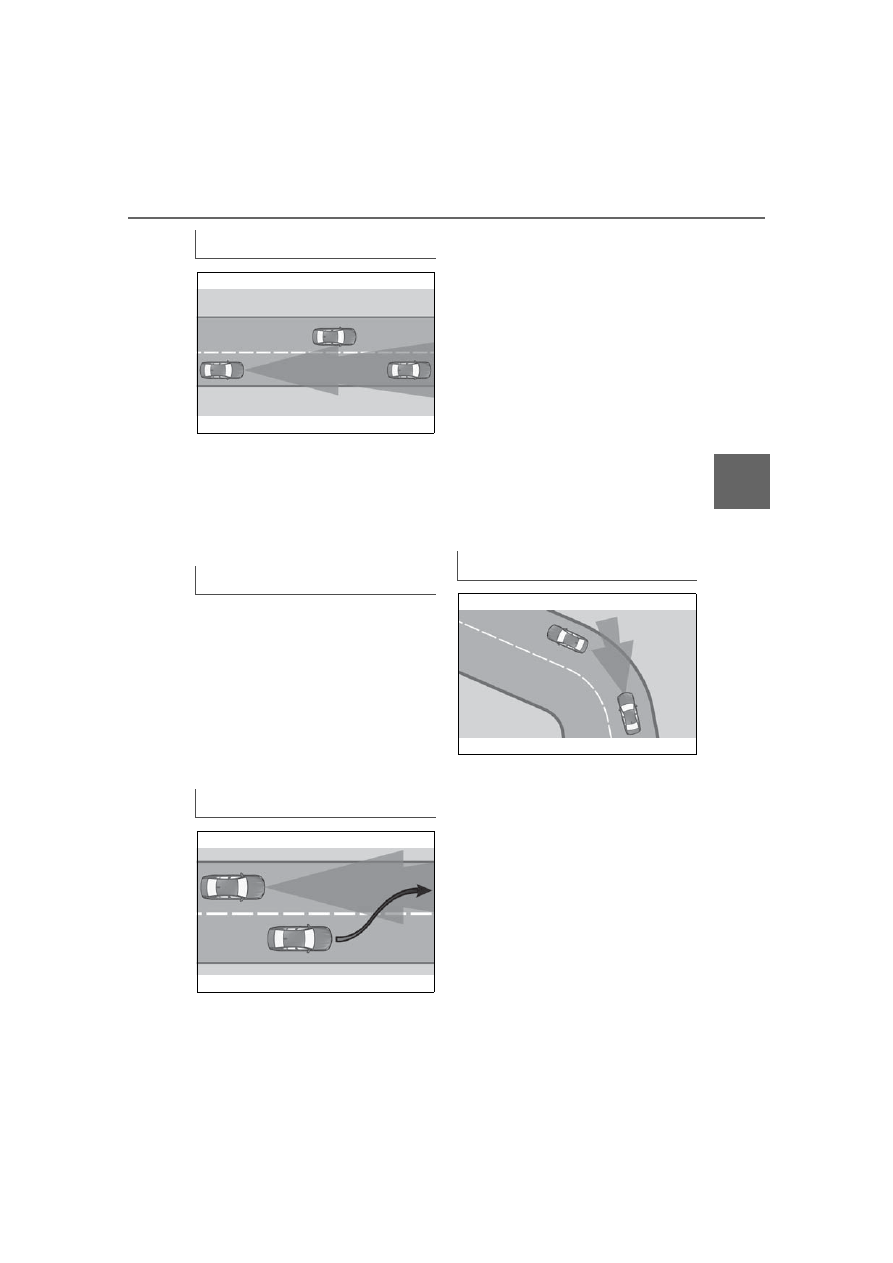
The detection capacity of the 
system and the automatic brak-
ing capacity are limited.
Two-wheeled vehicles for 
instance might not be detected.

The system does not decelerate 
in the following situations:

For pedestrians or similarly 
slow-moving road users.

For red traffic lights.

For cross traffic.

For oncoming traffic.

If a vehicle driving ahead of you 
suddenly swerves into your 

lane, the system may not be 
able to automatically restore the 
selected distance. It may not be 
possible to restore the selected 
distance in certain situations, 
including if you are driving sig-
nificantly faster than vehicles 
driving ahead of you, for 
instance when rapidly approach-
ing a truck. When a vehicle driv-
ing ahead of you is reliably 
detected, the system requests 
that the driver intervene by brak-
ing and carrying out evasive 
maneuvers, if needed.

When the desired speed is too 
high for a curve, the speed is 
reduced slightly. Because 
curves may not be anticipated in 
advance, drive into a curve at an 
appropriate speed.
The system has a limited detec-
tion range. Situations can arise 
in tight curves where a vehicle 
driving ahead will not be 
detected or will be detected very 
late.

Detection range

Deceleration

Swerving vehicles

Cornering

218

3-1. CONTROLS

When you approach a curve the 
system may briefly report vehi-
cles in the next lane due to the 
bend of the curve. If the system 
decelerates you may compen-
sate it by briefly accelerating. 
After releasing the accelerator 
pedal the system is reactivated 
and controls speed inde-
pendently.

In some situations, the vehicle 
cannot drive off automatically; 
for example:

On steep uphill grades.

From bumps in the road.

In these cases, step on the 
accelerator pedal.

The following restrictions can 
occur under unfavorable 
weather or light conditions:

Poorer vehicle recognition.

Short-term interruptions for 
vehicles that are already rec-
ognized.

Drive attentively, and react to 
the current traffic situation. If 
necessary, intervene actively, 
for instance by braking, steering 
or evading.

The desired speed is also main-
tained downhill. The speed may 
not be maintained on uphill 
grades if the engine power is 
insufficient.

When the systems in the vehicle 
e.g., Speed Limit Info, detect a 
change of the speed limit along 
the route, this new speed value 
ca be applied for the following 
systems:

Manual Speed Limiter.

Cruise Control.

Dynamic radar cruise control 
with full-speed range.

The speed value is suggested 
as the new desired speed to be 
applied. To apply the speed 
value, the corresponding system 
must be activated.

Driving off

Weather

Engine power

Speed Limit Assist

Concept

219

3-1. CONTROLS

3

CON

T

ROLS

Via Toyota Supra Command:

1

"My vehicle"

2

"Vehicle settings"

3

"Speed Assistant"

4

"Notes on speed limits"

Select the desired setting:

"adjust manually": detected 
speed limit can be applied 
manually.

"Show current limit": detected 
speed limits are displayed in 
the instrument cluster without 
being applied.

"Off": Speed Limit Assist will 
be switched off.

A message is indicated in the 
instrument cluster when the sys-
tem and cruise control are acti-
vated.

Safety information

WARNING

The system cannot serve as a 

substitute for the driver’s personal 

judgment in assessing the traffic 

situation. Based on the limits of 

the system, it cannot inde-

pendently react to all traffic situa-

tions. There is a risk of accident. 

Adjust driving style to traffic condi-

tions. Watch the surrounding traf-

fic situation closely, be ready to 

take over steering and braking at 

any time, and actively intervene 

where appropriate.

WARNING

The desired speed can be incor-

rectly adjusted or called up by 

mistake. There is a risk of an acci-

dent. Adjust the desired speed to 

the traffic conditions. Watch traf-

fic closely and actively intervene 

where appropriate.

Overview

Buttons on the steering 
wheel

Button

Function

Apply suggested speed 
manually.

Switching on/off and 
adjusting

Displays in the instrument 
cluster

Symbol

Function

Indicator light illumi-
nates green, together 
with the symbol for a 
cruise control system:
Speed Limit Assist is 
active and detected 
speed limits can be 
applied manually for 
the displayed system.

220

3-1. CONTROLS

It is possible to set whether the 
speed limit will be accepted 
exactly, or with a tolerance.
Via Toyota Supra Command:

1

"My vehicle"

2

"Vehicle settings"

3

"Speed Assistant"

4

"Adjust speed limits"

5

Confirm the desired setting.

Speed Limit Assist is based on 
the Speed Limit Info system.
Thus, also observe the system 
limits of the Speed Limit Info 

system, refer to page P.205

Parking Sensor is a support 
when parking. Objects that you 
are approaching slowly in front 
of or behind the vehicle are indi-
cated by signal tones and a dis-
play on the Control Display.
Depending on the equipment 
version: Obstacles at the side of 
the vehicle that are detected by 
the side ultrasonic sensors may 
also be reported by the side pro-
tection, refer to page 225, func-
tion.

The ultrasound sensors for dis-
tance measurements are 
located in the bumpers and pos-
sibly on the sides of the vehicle.
The range, depending on the 
obstacle and environmental 
conditions, is approx. 6 ft/2 m.
An acoustic warning sounds in 
case of an impending collision at 
a distance to the object of 
approx. 27 in/70 cm.
For objects behind the vehicle, 
the acoustic warning is already 
issued at a distance to the 
object of approx. 5 ft/1.50 m.

Detected change of a 
speed limit with imme-
diate effect.

Indicator light illumi-
nates green: the 
detected speed limit 
can be applied with the 
SET button.
As soon as the speed 
limit has been applied, 
a green checkmark is 
displayed.

Taking over the sug-
gested speed

As soon as the SET icon 
lights up, press the button.

Setting the speed adjust-
ment

System limits

Symbol

Function

Parking Sensors

Concept

General information

221

3-1. CONTROLS

3

CON

T

ROLS

The system is controlled using 
the following sensors:
• Ultrasonic sensors in the 

bumpers.

Additional information:
Sensors of the vehicle, refer to 
page 42.

The system switches on auto-
matically in the following situa-
tions:

If selector lever position R is 
engaged when the engine is 
running.

Depending on the equipment 
version: while approaching 
detected obstacles if the 
speed is slower than approx. 
2.5 mph/4 km/h. The activa-
tion distance depends on the 
situation in question.

You may switch automatic acti-
vation when obstacles are 
detected on and off.
Via Toyota Supra Command:

1

"My vehicle"

2

"Vehicle settings"

3

"Parking"

4

Where applicable: "Automatic 
Parking Sens. activation"

Safety information

WARNING

The system cannot serve as a 

substitute for the driver’s personal 

judgment in assessing the traffic 

situation. Based on the limits of 

the system, it cannot inde-

pendently react to all traffic situa-

tions. There is a risk of accident. 

Adjust driving style to traffic condi-

tions. Check surrounding traffic 

and vehicle's surroundings 

closely and actively intervene 

where appropriate.

WARNING

Due to high speeds when Parking 

Sensors is activated, the warning 

can be delayed due to physical 

circumstances. There is a risk of 

injury or risk of damage to prop-

erty. Avoid approaching an object 

too fast. Avoid driving off fast 

while Parking Sensors is not yet 

active.

Overview

Button in the vehicle

Park assistance button

Sensors

Switching on/off

Switching on automatically

222

3-1. CONTROLS

5

"Automatic Parking Sensors 
activ."

Depending on equipment, an 
additional camera view is also 
switched on.

The system switches off when a 
certain driving distance or speed 
is exceeded.
Switch the system back on, if 
needed.

On: the LED lights up.

Off: the LED goes out.

The rearview camera image is 
displayed if the reverse gear is 
engaged when pressing the 
park assistance button.
Depending on the equipment 
version, the system cannot be 
switched off manually if the 
reverse gear is engaged.

General information

An intermittent tone indicates 
when the vehicle is approaching 
an object. For instance, if an 

object is detected to the left rear 
of the vehicle, a signal tone 
sounds from the left rear 
speaker.
The shorter the distance to the 
object, the shorter the intervals.
If the distance to a detected 
object is less than approx. 8 
in/20 cm, a continuous tone is 
sounded.
If there are objects in front of 
and behind the vehicle at the 
same time, with a distance 
smaller than approx. 8 in/20 cm, 
an alternating constant tone will 
sound.
Automatic transmission: the 
intermittent tone and constant 
tone are switched off if the 
selector lever position P is 
engaged.
The intermittent tone is switched 
off after a short time when the 
vehicle is stationary.
If an object approaches when 
the vehicle is stationary, the 
acoustic signal is reactivated.

Volume

The Parking Sensor signal tone 
volume can be adjusted.
Via Toyota Supra Command:

1

"My vehicle"

2

"System settings"

3

"Tone"

4

"Volume settings"

5

"Parking Sens."

Automatic deactivation 
during forward travel

Switching on/off manually

Press the park assistance 
button.

WARNING

Signal tones

223

3-1. CONTROLS

3

CON

T

ROLS

6

Set the desired value.

The approach of the vehicle to 
an object is shown on the Con-
trol Display. Objects that are far-
ther away are already displayed 
on the Control Display before a 
signal sounds.
The display appears as soon as 
Parking Sensor is activated.
The range of the sensors is rep-
resented in the colors green, 
yellow and red when obstacles 
are detected.
Pathway lines are faded in for 
better estimation of the required 
space.
When the image of the rearview 
camera is displayed, the switch 
can be made to Parking Sensor 
or to a different view with obsta-
cle markings as needed:

1

Press the Controller to the 
left, if needed.

2

E. g. "Park. sensors only"

RCTA (Rear cross traffic alert) 
function, refer to page 230: 
depending on the equipment, it 

is warned in the Parking Sensor 
display against vehicles 
approaching in the front or rear 
from the side.

The emergency braking function 
of Parking Sensor initiates an 
emergency braking in case of 
acute risk of collision.

Due to system limits, a collision 
cannot be prevented under all 
circumstances.
The function is available from 
walking speed while backing up 
or rolling backward.
A press of the accelerator pedal 
interrupts the braking interven-
tion.
After emergency braking to a 
stop, further creeping toward an 
obstacle is possible. To creep 
toward the obstacle, lightly 
press the accelerator pedal and 
release it again.
If the accelerator pedal is heav-
ily depressed, the vehicle drives 
off as usual. Manual braking is 
possible at any time.

Visual warning

Depending on the equip-
ment version: emergency 
brake function, Parking 
Sensors with emergency 
braking function

Concept

General information

224

3-1. CONTROLS

The system uses the ultrasound 
sensors of Parking Sensor and 
parking assistant.

Via Toyota Supra Command:

1

"My vehicle"

2

"Vehicle settings"

3

"Parking"

4

"Park. Sens. w. em. braking 
funct."

5

"Park. Sens. w. em. braking 
funct."

The system warns of obstacles 
on the side of the vehicle.

The system uses the ultrasound 
sensors of Parking Sensor and 
parking assistant.

To protect the sides of the vehi-
cle, obstacle markings are dis-
played on the sides of the 
vehicle.

Color markings: warning 
against detected obstacles.

Gray markings, hatched area: 
no obstacles were detected.

No markings, black area: the 

Safety information

WARNING

The system cannot serve as a 

substitute for the driver’s personal 

judgment in assessing the traffic 

situation. Based on the limits of 

the system, it cannot inde-

pendently react to all traffic situa-

tions. There is a risk of accident. 

Adjust driving style to traffic condi-

tions. Check surrounding traffic 

and vehicle's surroundings 

closely and actively intervene 

where appropriate.

Activating/deactivating the 
system

Side parking aid

Concept

General information

Safety information

WARNING

The system cannot serve as a 

substitute for the driver’s personal 

judgment in assessing the traffic 

situation. Based on the limits of 

the system, it cannot inde-

pendently react to all traffic situa-

tions. There is a risk of accident. 

Adjust driving style to traffic condi-

tions. Check surrounding traffic 

and vehicle's surroundings 

closely and actively intervene 

where appropriate.

Display

225

3-1. CONTROLS

3

CON

T

ROLS

area next to the vehicle was 
not yet captured.

The system only displays sta-
tionary obstacles that were pre-
viously detected by sensors 
while passing them.
The system does not detect 
whether an obstacle moves later 
on. If the vehicle is stationary, 
the markings are shown in black 
after a certain time. The area 
next to the vehicle must be 
newly captured.

Additional information:
• Ultrasonic sensors, refer to 

page 42.

The detection of objects with 
ultrasonic measurements can 
run into physical limits, e.g., in 
the following situations:

With obstacles and persons at 
the edge of the lane.

Low objects already dis-
played, for instance curbs, 
can move into the blind area 
of the sensors before or after 
a continuous tone sounds.

Reaching the system limits can 
cause false warnings.
To prevent false alarms, switch 
off Automatic Park Sensors 
activ. on obstacle detection, 
refer to page 227, for instance in 
automatic vehicle washes.

A vehicle message is displayed.

Parking Sensor has failed. Have 
the system checked by your 
Toyota dealer.

Limits of side parking aid

System limits

Safety information

WARNING

The system is designed to oper-

ate in certain conditions and cir-

cumstances. Due to conditions or 

other factors, the system may not 

respond. There may be a risk of 

accident or risk of damage to 

property. Actively intervene as 

needed. Refer to the information 

in this Owner’s Manual regarding 

the scope of the system’s opera-

tion and limitations.

System limits of the sensors

Limits of ultrasonic measure-
ment

False warnings

Malfunction

White symbol is displayed, 
and the range of the sen-
sors is dimmed on the 
Control Display.

226

3-1. CONTROLS

The rearview camera provides 
assistance in parking and 
maneuvering backwards. The 
area behind the vehicle is 
shown on the Control Display.
Additionally, assistance func-
tions can be shown in the dis-
play, e.g., help lines.

The system is controlled by the 
following sensors:
• Rearview camera.
Additional information:
Sensors of the vehicle, refer to 
page 42.

The system is switched on auto-
matically if selector lever posi-
tion R is engaged when the 
engine is running.

The system switches off when a 
certain driving distance or speed 

Rearview camera

Concept

Safety information

WARNING

The system cannot serve as a 

substitute for the driver’s personal 

judgment in assessing the traffic 

situation. Based on the limits of 

the system, it cannot inde-

pendently react to all traffic situa-

tions. There is a risk of accident. 

Adjust driving style to traffic condi-

tions. Check surrounding traffic 

and vehicle's surroundings 

closely and actively intervene 

where appropriate.

Overview

Depending on the vehicle 
equipment: button in the 
vehicle

Park assistance button

Sensors

Switching on/off

Switching on automatically

Automatic deactivation 
during forward travel

227

3-1. CONTROLS

3

CON

T

ROLS

is exceeded.
Switch the system back on, if 
needed.

On: the LED lights up.

Off: the LED goes out.

The parking assistance func-
tions are shown on the Control 
Display.

If the rearview camera view is 
not displayed, change the view 
via Toyota Supra Command:

1

If necessary, tilt the controller 
to the side.

2

 "Rear view camera"

The rearview camera image is 
displayed.

The rearview camera is 
switched on.

Keep the recording range of 
the camera clear. Protruding 
cargo or roof rack systems 
can limit the detection range 
of the camera.

More than one assistance func-
tion can be active at the same 
time.
The assistance functions can be 
manually activated.

1

Move the Controller to the 
right, if needed.

2

With corresponding equip-
ment:

3

With corresponding equip-
ment: 

 "Camera image"

 "Parking aid lines".

Pathway lines and turning radius 
lines are displayed, refer to page 

228

.

 "Obstacle marking".

Depending on the vehicle equip-
ment, the obstacles detected by 
Parking Sensors are displayed, 
refer to page 

229

, by markings.

Pathway lines

Depending on the vehicle 
equipment: switching on/off 
manually

Press the park assistance 
button.

Switching the view via Toy-
ota Supra Command

Functional requirements

Display on the Control Dis-
play

General information

Parking aid lines

228

3-1. CONTROLS

Pathway lines help you to esti-
mate the space required when 
parking and maneuvering on 
level roads.
Pathway lines depend on the 
steering angle and are continu-
ously adjusted to the steering 
wheel movements.

Turning radius lines

Turning radius lines can only be 
superimposed on the camera 
image together with pathway 
lines.
Turning radius lines show the 
course of the smallest possible 
turning radius on a level road.
Only one turning radius line is 
displayed after the steering 
wheel is turned past a certain 
angle.

Parking using pathway and 
turning radius lines

1

Position the vehicle so that 
the red turning radius line 
leads to within the limits of 
the parking space.

2

Turn the steering wheel to 
the point where the green 
pathway line covers the cor-

responding turning radius 
line.

Depending on the vehicle equip-
ment, obstacles behind the vehi-
cle are detected by the Parking 
Sensors.
Obstacle markings can be faded 
into the image of the rearview 
camera.
The colored thresholds of the 
obstacle markings match the 
markings of the Parking Sen-
sors.

With the rearview camera 
switched on:

1

Move the Controller to the 
left, if needed.

2

"Camera image"

3

"Brightness"

"Contrast"

Obstacle marking

Setting brightness and 
contrast via Toyota Supra 
Command

229

3-1. CONTROLS

3

CON

T

ROLS

4

Set the desired value.

Additional information:
• Cameras, refer to page 42.

If the camera is deactivated, for 
instance if the trunk lid is open, 
the camera image is displayed 
hatched in gray.

Very low obstacles as well as 
high, protruding objects such as 
ledges may not be detected by 
the system.
Depending on the vehicle equip-
ment, some assistance func-
tions also consider data from the 
Parking Sensors.
Follow the notes in the Parking 
Sensors chapter.
The objects displayed on the 
Control Display may be closer 
than they appear. Do not esti-
mate the distance from the 
objects on the display.

*

: if equipped

At blind driveways or when driv-
ing out of diagonal parking 
spaces, approaching cross traf-
fic is detected sooner by the 
system than is possible from the 
driver's seat.

Two radar sensors in the rear 
bumper monitor the area behind 
the vehicle.
The system indicates approach-
ing traffic.

System limits

System limits of the sensors

Deactivated camera

Detection of objects

RCTA (Rear cross traffic 
alert) function*

Concept

General information

Safety information

WARNING

The system cannot serve as a 

substitute for the driver’s personal 

judgment in assessing the traffic 

situation. Based on the limits of 

the system, it cannot inde-

pendently react to all traffic situa-

tions. There is a risk of accident. 

Adjust driving style to traffic condi-

tions. Watch the surrounding traf-

fic situation closely, be ready to 

take over steering and braking at 

any time, and actively intervene 

where appropriate.

230

3-1. CONTROLS

The system is controlled by the 
following sensors:
• Radar sensors, side, rear.
Additional information:
Sensors of the vehicle, refer to 
page 42.

1

 Press park assistance 

button.

2

Move the Controller to the 
left.

3

 "Settings"

4

"Cross traffic alert"

5

"Cross traffic alert"

Or via Toyota Supra Command:

1

"My vehicle"

2

"Vehicle settings"

3

"Parking"

4

"Cross traffic alert"

5

"Cross traffic alert"

If the system was activated on 
the Control Display, it is auto-
matically switched on as soon 
as Parking Sensors or Pan-
orama View is active and a gear 
is engaged.
If reverse gear is engaged, the 
rear system is switched on.

The system is automatically 
switched off in the following situ-
ations:

When the speed exceeds 
walking speed.

When a certain driving dis-
tance is exceeded.

With an active parking opera-
tion of the parking assistant.

The respective display is called 
up on the Control Display. A sig-
nal tone may sound and the light 
in the exterior mirror may flash.

Overview

Button in the vehicle

Park assistance button

Sensors

Switching on/off

Activating/deactivating the 
system

Switching on automatically

Switching off automatically

WARNING

General information

231

3-1. CONTROLS

3

CON

T

ROLS

The light in the exterior mirror 
flashes if vehicles are detected 
by the rear sensors and your 
own vehicle is moving back-
wards.

In the Parking Sensors view, the 
respective boundary area 
flashes red, if vehicles are 
detected by the sensors.

In addition to the optical indica-
tor, a warning signal sounds if 
your own vehicle moves into the 
respective direction.

Additional information:
• Radar sensors, refer to page 

42.

The system may not be fully 
functional in the following situa-
tions:

In tight curves.

When crossing objects move 
at a very slow or a very fast 
speed.

If other objects are in the cap-
ture range of the sensors, that 
hide cross traffic.

Light in the exterior mirror

Display in the Parking Sen-
sors view

Acoustic warning

System limits

System limits of the sensors

Functional limitations

232

3-1. CONTROLS

This chapter describes all stan-
dard, country-specific and 
optional features offered with 
the series. It also describes fea-
tures and functions that are not 
necessarily available in your 
vehicle, e.g., due to the selected 
options or country versions. This 
also applies to safety-related 
functions and systems. When 
using these functions and sys-
tems, the applicable laws and 
regulations must be observed.

The chassis components are 
optimized for the vehicle and its 
scope of application and thereby 
ensure the best possible Driving 
Dynamics.

*

: if equipped

The Adaptive variable suspen-
sion is an intelligent, controllable 
sport chassis/suspension.
The suspension reduces body 
movements with a sporty driving 
style or on an uneven road.

The intelligent control of the 
chassis increases the driving 
dynamics and driving comfort 
depending on the road condition 
and driving style.

The system offers different 
shock absorber settings rang-
ing from comfortable travel to 
sporty driving.
The shock absorbers are 
adjusted depending on the 
selected driving mode as well as 
the road condition and driving 
style.
Additional information:
Sport mode switch, refer to page 
137.

Driving comfort

Vehicle features and 
options

Chassis components

Adaptive variable suspen-
sion*

Principle

General information

Tuning


Content      ..     12      13      14      15     ..