Toyota C-HR (2023 year). Manual in english - page 11
 

  Index      Toyota     Toyota C-HR (2023 year). Manual in english


Search            copyright infringement  


Content      ..     9      10      11      12     ..


Toyota C-HR (2023 year). Manual in english - page 11


196

3-2. Opening, closing and locking the doors

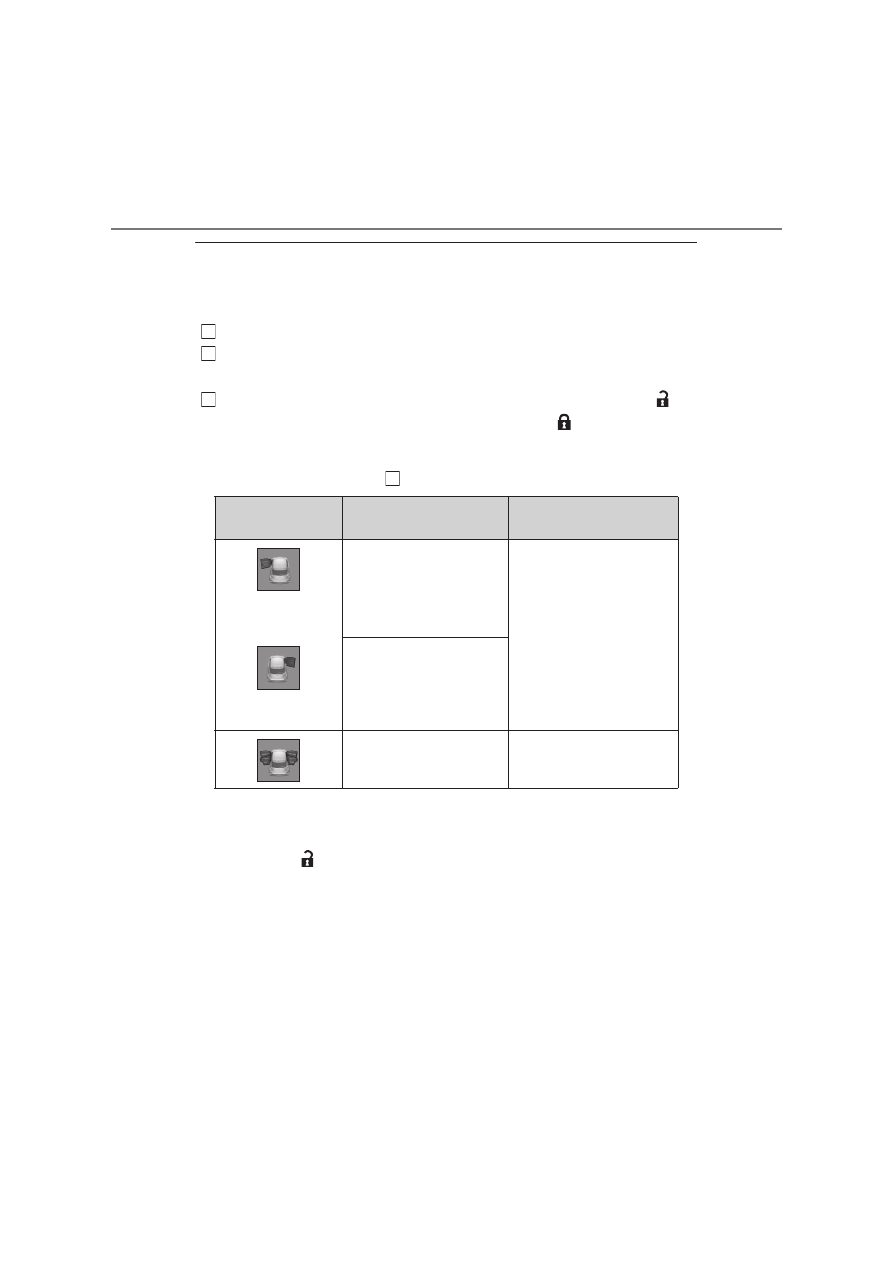
Switching the door unlock function (vehicles with a smart entry & start
system equipped with entry function)

It is possible to set which doors the entry function unlocks using the wireless
remote control. 

Turn the power switch off.
Cancel the intrusion sensor of the alarm system to prevent unintended trig-
gering of the alarm while changing the settings. (if equipped) (

P. 150)

When the indicator light on the key surface is not on, press and hold 

 for

approximately 5 seconds while pressing and holding 

.

The setting changes each time an operation is performed, as shown below.
(When changing the setting continuously, release the buttons, wait for at least
5 seconds, and repeat step 

.)

For  vehicles  with  an  alarm:  To  prevent  unintended  triggering  of  the  alarm,
unlock the doors using the wireless remote control and open and close a door
once after the settings have been changed. (If a door is not opened within 30
seconds after 

 is pressed, the doors will be locked again and the alarm will

automatically be set.)
In a case that the alarm is triggered, immediately stop the alarm. (

P. 146)

1

2

3

3

Multi-information 

display

Unlocking function

Beep

(Left-hand drive 

vehicles)

Holding  the  driver’s
door  handle  unlocks
only the driver’s door.

Exterior: Beeps 3 times 
Interior: Pings once

(Right-hand drive 

vehicles)

Holding  the  front  pas-
senger’s  door  handle
unlocks all the doors.

Holding  a  door  handle
unlocks all the doors.

Exterior: Beeps twice
Interior: Pings once

197

3-2. Opening, closing and locking the doors

3

O

p

er

ati

on 
of e
ac

h c
o

m

pon
ent

Open door warning buzzer

If the vehicle speed reaches 5 km/h (3 mph), a buzzer sounds to indicate that
the door(s) is not fully closed. 
The open door(s) is displayed on the multi-information display.

Conditions affecting the operation of the smart entry & start system

P. 208

Customization

Some functions can be changed. (

P. 779)

WARNING

To prevent an accident

Observe the following precautions while driving the vehicle.
Failure to do so may result in a door opening and an occupant falling out,
resulting in death or serious injury.

Ensure that all doors are properly closed and locked.

Do not pull the inside handle of the doors while driving.
Be especially careful for the front doors, as the doors may be opened even
if the inside lock buttons are in locked position.

Set the rear door child-protector locks when children are seated in the rear
seats. 

198

3-2. Opening, closing and locking the doors

WARNING

When opening or closing a door

Check the surroundings of the vehicle such as whether the vehicle is on an
incline,  whether  there  is  enough  space  for  a  door  to  open  and  whether  a
strong  wind  is  blowing.  When  opening  or  closing  the  door,  hold  the  door
handle tightly to prepare for any unpredictable movement.

When using the wireless remote control and operating the power win-
dows 

Operate the power window after checking to make sure that there is no pos-
sibility of any passenger having any of their body parts caught in the side
window. Also, do not allow children to operate the wireless remote control. It
is  possible  for  children  and  other  passengers  to  get  caught  in  the  power
window.

When closing the rear door

Take  extra  care  to  prevent  your  fingers,
etc., from being caught. Failure to do so
may result in death or serious injury.

199

3

3-2. Opening, closing and locking the doors

O

p

er

ati

on 
of e
ac

h c
o

m

pon
ent

Back door

Entry  function  (vehicles  with  a  smart  entry  &  start  system
equipped with entry function)

Carry the electronic key to enable this function.

Press  the  button  to  unlock
the back door.

The door cannot be unlocked for
3  seconds  after  the  door  is
locked.

Press  the  button  to  lock  the
back door.

Check  that  the  door  is  securely
locked.

Wireless remote control

P. 192

Door lock switches

P. 194

The  back  door  can  be  unlocked/locked  and  opened/closed  by
the following procedures.

Unlocking and locking the back door

200

3-2. Opening, closing and locking the doors

Raise the back door while pushing
up the back door opener switch.

The  back  door  cannot  be  closed
immediately  after  the  back  door
opener switch is pushed.

Lower  the  back  door  using  the
back door handle, and make sure
to push the back door down from
the outside to close it.

Be careful not to pull the back door
sideways  when  closing  the  back
door with the handle.

Operation signals

The  emergency  flashers  flash  to  indicate  that  the  doors  have  been  locked/
unlocked using the entry function or wireless remote control. (Locked: once;
Unlocked: twice)

Open door warning buzzer

If the vehicle speed reaches 5 km/h (3 mph), a buzzer sounds to indicate that
the door(s) is not fully closed.
The open door(s) is displayed on the multi-information display.

Luggage compartment light

The luggage compartment light turns on when the back door is opened.

Opening the back door from outside the vehicle

When closing the back door

201

3-2. Opening, closing and locking the doors

3

O

p

er

ati

on 
of e
ac

h c
o

m

pon
ent

If the back door opener is inoperative

The back door can be opened from the inside.

Using a screwdriver, remove the cover.
To  protect  the  cover,  place  a  rag
between  the  flathead  screwdriver  and
the cover as shown in the illustration.

Loosen the screw.

Turn the cover. 

Move the lever.

1

2

3

4

202

3-2. Opening, closing and locking the doors

WARNING

Caution while driving

Keep the back door closed while driving. 
If the back door is left open, it may hit near-by objects while driving or lug-
gage may be unexpectedly thrown out, causing an accident. 
In addition, exhaust gases may enter the vehicle, causing death or a seri-
ous health hazard. Make sure to close the back door before driving.

Before driving the vehicle, make sure that the back door is fully closed. If
the back door is not fully closed, it may open unexpectedly while driving,
causing an accident.

Never let anyone sit in the luggage compartment. In the event of sudden
braking or a collision, they are susceptible to death or serious injury.

When children are in the vehicle

Observe the following precautions. 
Failure to do so may result in death or serious injury.

Do not allow children to play in the luggage compartment. 
If  a  child  is  accidentally  locked  in  the  luggage  compartment,  they  could
have heat exhaustion or other injuries.

Do not allow a child to open or close the back door. 
Doing  so  may  cause the  back  door  to  move  unexpectedly,  or cause  the
child’s hands, head, or neck to be caught by the closing back door.

203

3-2. Opening, closing and locking the doors

3

O

p

er

ati

on 
of e
ac

h c
o

m

pon
ent

WARNING

Operating the back door

Observe the following precautions.
Failure to do so may cause parts of the body to be caught, resulting in death
or serious injury.

Remove  any  heavy  loads,  such  as  snow  and  ice,  from  the  back  door
before opening it. Failure to do so may cause the back door to suddenly
shut again after it is opened.

When  opening  or  closing  the  back  door,  thoroughly  check  to  make  sure
the surrounding area is safe. 

If anyone is in the vicinity, make sure they are safe and let them know that
the back door is about to open or close.

Use caution when opening or closing the back door in windy weather as it
may move abruptly in strong wind.

The back door may suddenly shut if it is
not  opened  fully.  It  is  more  difficult  to
open  or  close  the  back  door  on  an
incline  than  on  a  level  surface,  so
beware  of  the  back  door  unexpectedly
opening or closing by itself. Make sure
that  the  back  door  is  fully  open  and
secure  before  using  the  luggage  com-
partment. 

When closing the back door, take extra
care  to  prevent  your  fingers,  etc.,  from
being caught.

When closing the back door, make sure
to press it lightly on its outer surface. If
the  back  door  handle  is  used  to  fully
close  the  back  door,  it  may  result  in
hands or arms being caught.

204

3-2. Opening, closing and locking the doors

WARNING

Do not pull on the back door damper stay to close the back door, and do
not hang on the back door damper stay. 
Doing so may cause hands to be caught or the back door damper stay to
break, causing an accident.

If a bicycle carrier or similar heavy object is attached to the back door, it
may suddenly shut again after being opened, causing someone’s hands,
head or neck to be caught and injured. When installing an accessory part
to the back door, using a genuine Toyota part is recommended.

NOTICE

Back door damper stays

The  back  door  is  equipped  with  damper  stays  that  hold  the  back  door  in
place.
Observe the following precautions.
Failure to do so may cause damage to the back door damper stay, resulting
in malfunction.

Do not place your hand on the damper stay or apply lateral forces to it.

Do not attach any foreign objects, such
as stickers, plastic sheets, or adhesives
to the damper stay rod.

Do not touch the  damper stay rod  with
gloves or other fabric items.

Do  not  attach  any  accessories  other
than  genuine  Toyota  parts  to  the  back
door.

205

3

3-2. Opening, closing and locking the doors

O

p

er

ati

on 
of e
ac

h c
o

m

pon
ent

Smart entry & start system

Locks and unlocks the doors (vehicles with an entry function) 
(

P. 191)

Locks and unlocks the back door (vehicles with an entry function)
(

P. 199)

Starts the hybrid system (

P. 303)

Antenna location

The  following  operations  can  be  performed  simply  by  carrying
the electronic key on  your person, for example in your pocket.
The driver should always carry the electronic key.

Antennas  outside  the  cabin  (vehicles
with an entry function)
Antennas inside the cabin
Antenna  outside  the  luggage  compart-
ment (vehicles with an entry function)

206

3-2. Opening, closing and locking the doors

Effective range (areas within which the electronic key is detected)

When starting the hybrid system or changing power switch modes
The system can be operated when the electronic key is inside the vehi-
cle.

Alarms and warning messages

A combination of exterior and interior buzzers as well as warning messages
shown on the multi-information display are used to prevent theft of the vehicle
and  accidents  resulting  from  erroneous  operation.  Take  appropriate  mea-
sures based on the displayed message.
When only an alarm sounds, circumstances and correction procedures are as
follows.

When  locking  or  unlocking  the  doors
(vehicles with an entry function)
The  system  can  be  operated  when
the  electronic  key  is  within  about
0.7 m (2.3 ft.) of an outside front door
handle  and  the  back  door.  (Only  the
doors detecting the key can be oper-
ated.)

Alarm

Situation

Correction procedure

Exterior 

buzzer

sounds  once  for  5
seconds

An  attempt  was  made  to
lock the vehicle while a door
was open.

Close  all  of  the  doors
and  lock  the  doors
again.

Interior 

buzzer

sounds repeatedly

The  power  switch  was
turned 

to  ACCESSORY

mode while the driver’s door
was  open  (or  the  driver’s
door  was  opened  while  the
power 

switch 

was 

in

ACCESSORY mode).

Turn  the  power  switch
off  and  close  the
driver’s door.

207

3-2. Opening, closing and locking the doors

3

O

p

er

ati

on 
of e
ac

h c
o

m

pon
ent

When “Entry & Start System Malfunction. See Owner’s Manual.” is dis-
played on the multi-information display

The system may be malfunctioning. Have the vehicle inspected by any autho-
rized  Toyota  retailer  or  Toyota  authorized  repairer,  or  any  reliable  repairer
immediately.

Battery-saving function

The battery-saving function will be activated in order to prevent the electronic
key battery and the 12-volt battery from being discharged while the vehicle is
not operated for a long time.

In  the  following  situations,  the  smart  entry  &  start  system  may  take  some
time to unlock the doors.
• The  electronic  key  has  been left  within  approximately  2  m  (6  ft.)  of  the

outside of the vehicle for 10 minutes or longer.

• The smart entry & start system has not been used for 5 days or longer.

If the smart entry & start system has not been used for 14 days or longer,
the doors cannot be unlocked at any doors except the driver’s door. In this
case,  hold  the  driver’s  door  handle,  or  use  the  wireless  remote  control  or
mechanical key to unlock the doors.

Electronic Key Battery-Saving Function

When battery-saving mode is set, battery
depletion  is  minimized  by  stopping  the
electronic key from receiving radio waves.

Press 

  twice  while  pressing  and

holding 

. Confirm that the electronic

key indicator flashes 4 times.
While the battery-saving mode is set, the
smart  entry  &  start  system  cannot  be
used. To cancel the function, press any of
the electronic key buttons.

208

3-2. Opening, closing and locking the doors

Conditions affecting operation

The smart entry & start system uses weak radio waves. In the following situa-
tions, the communication between the electronic key and the vehicle may be
affected, preventing the smart entry & start system, wireless remote control
and immobilizer system from operating properly. (Ways of coping: 

P. 744)

When the electronic key battery is depleted

Near a TV tower, electric power plant, gas station, radio station, large dis-
play, airport or other facility that generates strong radio waves or electrical
noise

When  carrying  a  portable  radio,  cellular  phone,  cordless  phone  or  other
wireless communication device

When  the  electronic  key  is  in  contact  with,  or  is  covered  by  the  following
metallic objects
• Cards to which aluminum foil is attached
• Cigarette boxes that have aluminum foil inside
• Metallic wallets or bags
• Coins
• Hand warmers made of metal
• Media such as CDs and DVDs

When other wireless keys (that emit radio waves) are being used nearby

When  carrying  the  electronic  key  together  with  the  following  devices  that
emit radio waves
• Portable radio, cellular phone, cordless phone or other wireless commu-

nication devices

• Another electronic key or a wireless key that emits radio waves
• Personal computers or personal digital assistants (PDAs)
• Digital audio players
• Portable game systems

If window tint with a metallic content or metallic objects are attached to the
rear window 

When  the  electronic  key  is  placed  near  a  battery  charger  or  electronic
devices

When parking at a meter

209

3-2. Opening, closing and locking the doors

3

O

p

er

ati

on 
of e
ac

h c
o

m

pon
ent

Note for the entry function

Even when the electronic key is within the effective range (detection areas),
the system may not operate properly in the following cases:
• The electronic key is too close to the window or outside door handle, near

the ground, or in a high place when the doors are locked or unlocked.

• The electronic key is near the ground or in a high place, or too close to

the rear bumper center when the back door is opened.

• The electronic key is on the instrument panel, floor, or in the door pockets

or glove box when the hybrid system is started or power switch modes
are changed.

Do not leave the electronic key on top of the instrument panel or near the
door pockets when exiting the vehicle. Depending on the radio wave recep-
tion conditions, it may be detected by the antenna outside the cabin and the
door will become lockable from the outside, possibly trapping the electronic
key inside the vehicle.

As long as the electronic key is within the effective range, the doors may be
locked or unlocked by anyone. However, only the doors detecting the elec-
tronic key can be used to unlock the vehicle.

Even if the electronic key is not inside the vehicle, it may be possible to start
the hybrid system if the electronic key is near the window.

The  doors may  unlock  or  lock if  a large  amount of  water  splashes  on  the
door handle, such as in the rain or in a car wash when the electronic key is
within  the  effective  range.  (The  doors  will  automatically  be  locked  after
approximately 30 seconds if the doors are not opened and closed.)

If the wireless remote control is used to lock the doors when the electronic
key  is  near  the  vehicle,  there  is  a  possibility  that  the  door  may  not  be
unlocked by the entry function. (Use the wireless remote control to unlock
the doors.)

Touching the door lock sensor while wearing gloves may delay or prevent
lock operation. Remove the gloves and touch the lock sensor again.

If the door handle becomes wet while the electronic key is within the effec-
tive range, the door may lock and unlock repeatedly. In that case, follow the
following correction procedures to wash the vehicle.
• Place the electronic key in a location 2 m (6 ft.) or more away from the

vehicle. (Take care to ensure that the key is not stolen.)

• Set the electronic key to battery-saving mode to disable the smart entry &

start system. (

P. 207)

210

3-2. Opening, closing and locking the doors

If the  electronic key  is inside the  vehicle and a  door handle becomes  wet
during a car wash, a message may be shown on the multi-information dis-
play and a buzzer will sound outside the vehicle. To turn off the alarm, lock
all the doors.

The  lock  sensor  may  not  work  properly  if  it  comes  into  contact  with  ice,
snow, mud, etc. Clean the lock sensor and attempt to operate it again.

A sudden approach to the effective range or door handle may prevent the
doors from being unlocked. In this case, return the door handle to the origi-
nal position and check that the doors unlock before pulling the door handle
again.

If there is another electronic key in the detection area, it may take slightly
longer to unlock the doors after the door handle is gripped.

Fingernails may scrape against the door during operation of the door han-
dle. Be careful not to injure fingernails or damage the surface of the door.

When the vehicle is not driven for extended periods

To  prevent  theft  of  the  vehicle, do  not  leave  the  electronic key  within  2  m
(6 ft.) of the vehicle.

The smart entry & start system can be deactivated in advance. (

P. 779)

To operate the system properly

Make sure to carry the electronic key when operating the system. Do not get
the electronic key too close to the vehicle when operating the system from the
outside of the vehicle.
Depending on the position and holding condition of the electronic key, the key
may not be detected correctly and the system may not operate properly. (The
alarm may go off accidentally, or the door lock prevention function may not
operate.)

211

3-2. Opening, closing and locking the doors

3

O

p

er

ati

on 
of e
ac

h c
o

m

pon
ent

If the smart entry & start system does not operate properly

Locking and unlocking the doors: Use the mechanical key. (

P. 744)

Starting the hybrid system: 

P. 745

Customization

Settings (e.g. smart entry & start system) can be changed. 
(Customizable features: 

P. 779)

If the smart entry & start system has been deactivated in a customized
setting

Locking and unlocking the doors:
Use the wireless remote control or mechanical key. (

P. 192, 744)

Starting the hybrid system and changing power switch modes: 

P. 745

Stopping the hybrid system: 

P. 304


Content      ..     9      10      11      12     ..