Toyota 4Runner (2023 year). Manual in english - page 32
 

  Index      Toyota     Toyota 4Runner (2023 year). Manual in english


Search            copyright infringement  


Content      ..     30      31      32      33     ..


Toyota 4Runner (2023 year). Manual in english - page 32


516

7-2. Steps to take in an emergency

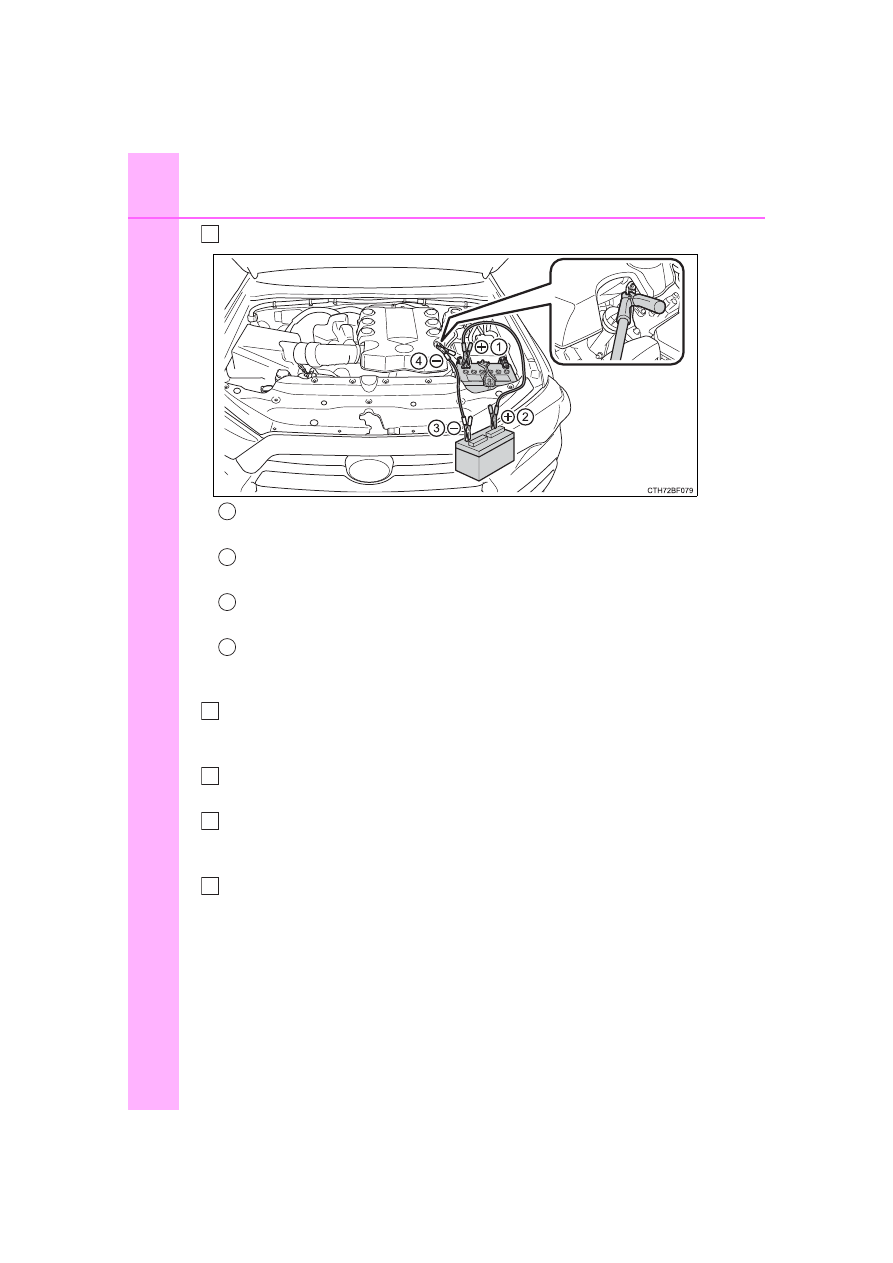
Connect the jumper cables according to the following procedure:

Connect a positive jumper cable clamp to the positive (+) battery
terminal on your vehicle.
Connect the clamp on the other end of the positive cable to the
positive (+) battery terminal on the second vehicle.
Connect a negative cable clamp to the negative (-) battery termi-
nal on the second vehicle.
Connect  the  clamp  at  the  other  end  of  the  negative  cable  to  a
solid, stationary, unpainted metallic point away from the battery
and any moving parts, as shown in the illustration.

Start the engine of the second vehicle. Increase the engine speed
slightly  and  maintain  at  that  level  for  approximately  5  minutes  to
recharge the battery of your vehicle.
Open  and  close  any  of  the  doors  of  your  vehicle  with  the  engine
switch off.
Maintain  the  engine  speed  of  the  second  vehicle  and  turn  the
engine  switch  to  IGNITION  ON  mode,  then  start  the  vehicle’s
engine.
Once the vehicle’s engine has started, remove the jumper cables in
the exact reverse order from which they were connected.

Once  the  engine  starts,  have  the  vehicle  inspected  at  your  Toyota
dealer as soon as possible.

3

1

2

3

4

4

5

6

7

517

7-2. Steps to take in an emergency

7

Wh
en tro

uble

 a

ris

es

Starting the engine when the battery is discharged 

The engine cannot be started by push-starting.

To prevent battery discharge

Turn off the headlights and the audio system while the engine is off.

Turn off any unnecessary electrical components when the vehicle is running
at a low speed for an extended period, such as in heavy traffic.

Charging the battery

The  electricity  stored  in  the  battery  will  discharge  gradually  even  when  the
vehicle is not in use, due to natural discharge and the draining effects of cer-
tain electrical appliances. If the vehicle is left for a long time, the battery may
discharge,  and  the  engine  may  be  unable  to  start.  (The  battery  recharges
automatically during driving.)

When recharging or replacing the battery

In some cases, it may not be possible to unlock the doors using the smart
key system when the battery is discharged. Use the wireless remote control
or the mechanical key to lock or unlock the doors.

The engine may not start on the first attempt after the battery has recharged
but will start normally after the second attempt. This is not a malfunction.

The engine switch mode is memorized by the vehicle. When the battery is
reconnected, the system will return to the mode it was in before the battery
was discharged. Before disconnecting the battery, turn the engine switch off.
If you are unsure what mode the engine switch was in before the battery dis-
charged, be especially careful when reconnecting the battery.

Make sure that the key is not inside the vehicle when recharging or replac-
ing  the  battery. The  key  may  be  locked  in  the  vehicle  if  the  alarm  is  acti-
vated. (

P. 80)

518

7-2. Steps to take in an emergency

WARNING

Avoiding battery fires or explosions

Observe the following precautions to prevent accidentally igniting the flam-
mable gas that may be emitted from the battery:

Make sure each jumper cable is connected to the correct terminal and that
it is not unintentionally in contact with any other than the intended terminal.

Do not allow the other end of the jumper cable connected to the “+” termi-
nal to come into contact with any other parts or metal surfaces in the area,
such as brackets or unpainted metal.

Do not allow the + and - clamps of the jumper cables to come into contact
with each other.

Do  not smoke,  use matches, cigarette lighters  or  allow  open flame near
the battery.

Battery precautions

The  battery  contains  poisonous  and  corrosive  acidic  electrolyte,  while
related parts contain lead and lead compounds. Observe the following pre-
cautions when handling the battery:

When working with the battery, always wear safety glasses and take care
not to allow any battery fluids (acid) to come into contact with skin, clothing
or the vehicle body.

Do not lean over the battery.

In  the  event  that  battery  fluid  comes  into  contact  with  the  skin  or  eyes,
immediately wash the affected area with water and seek medical attention.
Place a wet sponge or cloth over the affected area until medical attention
can be received.

Always wash your hands after handling the battery support, terminals, and
other battery-related parts.

Do not allow children near the battery.

NOTICE

When handling jumper cables

When connecting the jumper cables, ensure that they do not become entan-
gled in the cooling fans or engine drive belt.

519

7-2. Steps to take in an emergency

7

Wh
en tro

uble

 a

ris

es

The  needle  of  the  engine  coolant  temperature  gauge  (

P.  88)

enters the red zone or a loss of engine power is experienced.
(For example, the vehicle speed does not increase.)

Steam comes out from under the hood.

Stop the vehicle in a safe place and turn off the air conditioning sys-
tem, and then stop the engine.
If you see steam: 
Carefully lift the hood after the steam subsides.
If you do not see steam:
Carefully lift the hood.
After  the  engine  has  cooled
down  sufficiently,  inspect  the
hoses and radiator core (radia-
tor) for any leaks.

Radiator
Cooling fan

If a large amount of coolant leaks,
immediately  contact  your  Toyota
dealer.

The coolant level is satisfactory
if  it  is  between  the  “F”  and  “L”
lines on the reservoir.

Reservoir
“F” line
“L” line
Radiator cap

If your vehicle overheats

The following may indicate that your vehicle is overheating:

Correction procedures

1

2

3

1

2

4

1

2

3

4

520

7-2. Steps to take in an emergency

Add  engine  coolant  if  neces-
sary. (

P. 414)

Water  can  be  used  in  an  emer-
gency if engine coolant is unavail-
able.

Start the engine to check that the radiator cooling fan operate and
to check for coolant leaks from the radiator or hoses.
If the fan are not operating: 
Stop the engine immediately and contact your Toyota dealer.
If the fan are operating: 
Have the vehicle inspected at the nearest Toyota dealer.

5

WARNING

When inspecting under the hood of your vehicle

Observe the following precautions. 
Failure to do so may result in serious injury such as burns.

If steam is seen coming from under the hood, do not open the hood until
the steam has subsided. The engine compartment may be very hot.

Keep hands and clothing (especially a tie, a scarf or a muffler) away from
the fans and belts.

6

7

Do not loosen the radiator cap and the
coolant  reservoir  cap  while  the  engine
and radiator are hot.
High  temperature  steam  or  coolant
could spray out.

521

7-2. Steps to take in an emergency

7

Wh
en tro

uble

 a

ris

es

NOTICE

When adding engine coolant

Wait until the engine has cooled down before adding engine coolant.
When adding coolant, do so slowly. Adding cool coolant to a hot engine too
quickly can cause damage to the engine.

To prevent damage to the cooling system

Observe the following precautions:

Avoid contaminating the coolant with foreign matter (such as sand or dust
etc.).

Do not use any coolant additives.

522

7-2. Steps to take in an emergency

Stop the engine. Set the parking brake and shift the shift lever to P.
Remove the mud, snow or sand from around the stuck tire.
Place wood, stones or some other material under the tires to help
provide traction.
Restart the engine.
Shift the shift lever to D or R position and carefully apply the accel-
erator to free the vehicle.

Turn off TRAC and VSC if these functions are hampering your attempts to
free the vehicle. (

P. 324)

If the vehicle becomes stuck

Carry out the following procedures if the tires spin or the vehicle
becomes stuck in mud, dirt or snow:

WARNING

When attempting to free a stuck vehicle

If you choose to push the vehicle back and forth to free it, make sure the
surrounding area is clear to avoid striking other vehicles, objects or people.
The vehicle may also lunge forward or lunge back suddenly as it becomes
free. Use extreme caution.

When shifting the shift lever

Be careful not to shift the shift lever with the accelerator pedal depressed.
This  may  lead  to  unexpected  rapid  acceleration  of  the  vehicle  that  may
cause an accident resulting in death or serious injury.

NOTICE

To avoid damaging the transmission and other components

Avoid  spinning  the  wheels  and  depressing  the  accelerator  pedal  more
than necessary.

If  the  vehicle  remains  stuck even  after  these procedures  are  performed,
the vehicle may require towing to be freed.

When a warning message for the automatic transmission fluid temperature
is displayed while attempting to free a stuck vehicle, immediately remove
your foot from the accelerator pedal and wait until the warning message
disappears. Otherwise, the transmission may become damaged. 
(

P. 488)

1

2

3

4

5

524

8-1. Specifications

*

1

: Unladen vehicle

*

2

: With 5 occupants

*

3

: With 7 occupants

*

4

: TRD-PRO

Maintenance data (fuel, oil level, etc.)

Dimensions and weights

Overall length

189.8 in. (4820 mm)

Overall width

75.8 in. (1925 mm)

Overall height


*

1

70.1 in. (1780 mm)

Wheelbase

109.8 in. (2790 mm)

Tread

Front

63.2 in. (1605 mm)

Rear

63.2 in. (1605 mm)

Vehicle capacity weight
(Occupants + luggage)

880 lb. (395 kg)

*

2

1000lb. (455 kg) 

*

4

1165 lb. (525 kg)

*

3

Trailer weight rating
(trailer weight + cargo weight)

5000 lb. (2270 kg)

Seating capacity

Seating capacity

Vehicle without third 

seats

Vehicle with third 

seats

 5 (Front 2, Rear 3)

 7 (Front 2, Rear 5)

525

8-1. Specifications

8

Vehi

cl

e specificatio

ns

Vehicle identification number

The  vehicle  identification  number  (VIN)  is  the  legal  identifier  for
your  vehicle.  This  is  the  primary  identification  number  for  your
Toyota. It is used in registering the ownership of your vehicle.
This number is stamped on the
top left of the instrument panel.

This number is also on the Cer-
tification Label.

Engine number

The engine number is stamped
on the engine block as shown.

Vehicle identification

526

8-1. Specifications

Engine

Model

1GR-FE

Type

6-cylinder V type, 4-cycle, gasoline

Bore and stroke

3.70 

 3.74 in. (94.0 

 95.0 mm)

Displacement

241.4 cu.in. (3956 cm

3

)

Valve clearance
(engine cold)

Automatic adjustment

Drive belt tension

Automatic adjustment

Fuel

Fuel type

Unleaded gasoline only

Octane rating

87  (Research  octane  number  91)  or
higher

Fuel tank capacity 
(Reference)

23.0 gal. (87.0 L, 19.1 Imp. gal.)

527

8-1. Specifications

8

Vehi

cl

e specificatio

ns

*

: The engine oil capacity is a reference quantity to be used when changing

the engine oil. Warm up and turn off the engine, wait more than 5 minutes,
and check the oil level on the dipstick.

Engine oil selection

“Toyota  Genuine  Motor  Oil”  is  used  in  your  Toyota  vehicle.  Use
Toyota approved “Toyota Genuine Motor Oil” or equivalent to sat-
isfy the following grade and viscosity.
Oil grade: ILSAC GF-6A multigrade engine oil
Recommended viscosity: SAE 0W-20
SAE  0W-20  is  the  best  choice
for  good  fuel  economy  and
good starting in cold weather.
If  SAE  0W-20  is  not  available,
SAE  5W-20  oil  may  be  used.
However,  it  must  be  replaced
with SAE 0W-20 at the next oil
change.
Oil viscosity (0W-20 is explained here as an example):

• The  0W  in  0W-20  indicates  the  characteristic  of  the  oil  which

allows cold startability. Oils with a lower value before the W allow
for easier starting of the engine in cold weather.

• The 20 in 0W-20 indicates the viscosity characteristic of the oil

when the oil is at high temperature. An oil with a higher viscosity
(one  with  a  higher  value)  may  be  better  suited  if  the  vehicle  is
operated at high speeds, or under extreme load conditions.

Lubrication system

Oil capacity
(Drain and refill 

 reference

*

)

With filter
Without filter

6.6 qt. (6.2 L, 5.5 Imp. qt.) 
6.0 qt. (5.7 L, 5.0 Imp. qt.)

Outside temperature

528

8-1. Specifications

How to read oil container label: 
The  International  Lubricant  Specification  Advisory  Committee
(ILSAC) Certification Mark is added to some oil containers to help
you select the oil you should use.

Cooling system

Capacity

11.1 qt. (10.5 L, 9.2 Imp. qt.)

Coolant type

Use either of the following:

• “Toyota Super Long Life Coolant” 
• A similar high-quality ethylene glycol-

based  non-silicate,  non-amine,  non-
nitrite,  and  non-borate  coolant  with
long-life  hybrid  organic  acid  technol-
ogy

Do not use plain water alone.

Ignition system

Spark plug

Make
Gap

DENSO SK16HR11
0.043 in. (1.1 mm)

NOTICE

Iridium-tipped spark plugs

Use only iridium-tipped spark plugs. Do not adjust the spark plug gap.

529

8-1. Specifications

8

Vehi

cl

e specificatio

ns

*

: Voltage checked 20 minutes after the engine and all the lights are turned

off.

*

: Your Toyota vehicle is filled with “Toyota Genuine Transfer Gear oil LF” at

the factory. Use Toyota approved “Toyota Genuine Transfer Gear oil LF” or
an equivalent of matching quality to satisfy the above specification. Please
contact your Toyota dealer for further details.

Electrical system

Battery

Open voltage

*

 at 

68

F (20

C):

12.3 V or higher
If  the  voltage  is  lower  than  the  standard
value, charge the battery.

Charging rates

5 A max.

Transfer (4WD models)

Oil capacity

Part-time 4WD models

1.1 qt. (1.0 L, 0.9 Imp. qt.)

Full-time 4WD models

1.5 qt. (1.4 L, 1.2 Imp. qt.)

Oil type

*

Toyota  Genuine  Transfer  gear  oil  LF  or
equivalent

Recommended oil viscosity

SAE 75W

530

8-1. Specifications

*

: Your Toyota vehicle is filled with “Toyota Genuine Differential Gear Oil” at

the factory. Use Toyota approved “Toyota Genuine Differential Gear Oil” or
an equivalent of matching quality to satisfy the above specification. Please
contact your Toyota dealer for further details.

*

: Your Toyota vehicle is filled with “Toyota Genuine Differential Gear Oil” at

the factory. Use Toyota approved “Toyota Genuine Differential Gear Oil” or
an equivalent of matching quality to satisfy the above specification. Please
contact your Toyota dealer for further details.

Front differential (4WD models)

Oil capacity

Part-time 4WD models

1.6 qt. (1.55 L, 1.4 Imp. qt.)

Full-time 4WD models

1.5 qt. (1.40 L, 1.2 Imp. qt.)

Oil type and viscosity

*

Toyota Genuine Differential gear oil LT 
75W-85 GL-5 or equivalent

Rear differential

Oil capacity

Vehicles without a rear differential lock

2.9 qt. (2.70 L, 2.4 Imp. qt.)

Vehicles with a rear differential lock

2.8 qt. (2.65 L, 2.3 Imp. qt.)

Oil type and viscosity

*

Toyota Genuine Differential gear oil LT 
75W-85 GL-5 or equivalent

531

8-1. Specifications

8

Vehi

cl

e specificatio

ns

*

: The fluid capacity is a reference quantity. If replacement is necessary, con-

tact your Toyota dealer.

*

1

: Minimum pedal clearance when depressed with a force of 110 lbf (490 N,

50 kgf) while the engine is running.

*

2

: Parking brake pedal travel when depressed with a force of 67 lbf (300 N,

30 kgf).

Automatic transmission

Fluid capacity

*

11.3 qt. (10.7 L, 9.4 Imp. qt.)

Fluid type

Toyota Genuine ATF WS

NOTICE

Transmission fluid type

Using  transmission  fluid  other  than  the  above  type  may  cause  abnormal
noise or vibration, or damage the transmission of your vehicle.

Brakes

Pedal clearance

*

1

2WD models

3.36 in. (86 mm) Min.

4WD models

3.54 in. (90 mm) Min.

Pedal free play

Less than 0.04 

 0.24 in. (1 

 6 mm)

Brake pad wear limit

0.04 in. (1.0 mm)

Parking brake lining wear limit

0.04 in. (1.0 mm)

Parking brake pedal travel

*

2

 7 clicks

Fluid type

SAE J1703 or FMVSS No.116 DOT 3


Content      ..     30      31      32      33     ..