Toyota Yaris Cross (2022 year). Manual in english - page 7
 

  Index      Toyota     Toyota Yaris Cross (2022 year). Manual in english


Search            copyright infringement  


Content      ..     5      6      7      8     ..


Toyota Yaris Cross (2022 year). Manual in english - page 7


112

n

2-1. Instrument cluster

Selected drive mode

Average speed vehicle speed 

since the vehicle was started.

Elapsed time since the engine 

was started

Cruising range

Fuel consumption

1

Press the “HOME” button.

2

Select “Vehicle” on the “Home” 
screen.

If a screen other than “Fuel consump-

tion” is displayed, select “Fuel con-
sumption”.

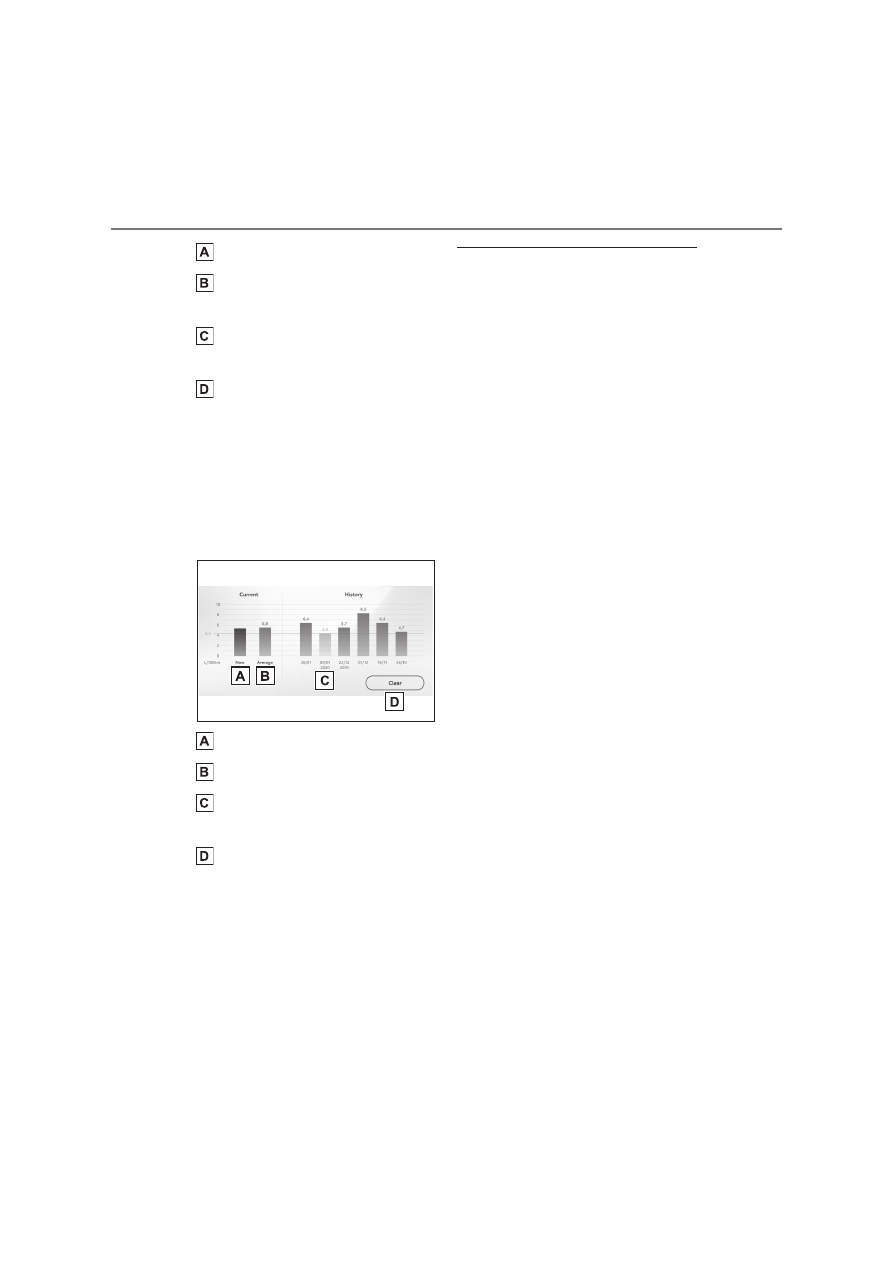
Current fuel consumption

Latest fuel consumption

Previous fuel consumption 

record

Resetting the history data

The average fuel consumption his-
tory is divided by color into past 
averages (blue) and lowest aver-
age (green).

The image is an example only, and may 
vary slightly from actual conditions.

Updating the history data

Update the latest fuel consumption by 
resetting “Total average” on multi-infor-

mation display to measure the current 

fuel consumption again.

Resetting the data

The fuel consumption data can be 

deleted by selecting “Clear”.

Cruising range

Displays the estimated maximum dis-
tance that can be driven with the quan-

tity of fuel remaining.

This distance is computed based on 
your average fuel consumption. As a 

result, the actual distance that can be 

driven may differ from that displayed.

3

113

n

3

Before dri

ving

Before driving

3-1. Key information

Keys..................................

114

3-2. Opening, closing and locking 

the doors

Side doors ........................

119

Back door .........................

123

Smart entry & start system

136

3-3. Adjusting the seats

Front seats........................

141

Rear seats ........................

142

Head restraints .................

144

3-4. Adjusting the steering wheel 

and mirrors

Steering wheel..................

148

Inside rear view mirror ......

149

Outside rear view mirrors .

150

3-5. Opening and closing the win-

dows

Power windows.................

153

114

n

3-1. Key information

3-1.Key information

The following keys are provided 
with the vehicle.

Vehicles without a smart entry & 
start system (type A)

Key (with a wireless remote con-

trol function)

Operating the wireless remote control 
function (→P.116)

Key (without a wireless remote 

control function)

Key number plate

Vehicles without a smart entry & 
start system (type B)

Key (with a wireless remote con-

trol function)

Operating the wireless remote control 
function (→P.116)

Key number plate

Vehicles with a smart entry & 
start system

Electronic keys

• Operating the smart entry & start sys-

tem (

P.136)

• Operating the wireless remote control 

function (

P.116)

Mechanical keys

Key number plate

When riding in an aircraft

When bringing a key with wireless 

remote control function onto an aircraft, 
make sure you do not press any buttons 

on the key while inside the aircraft cabin. 

If you are carrying the key in your bag, 
etc., ensure that the buttons are not 

likely to be pressed accidentally. Press-

ing a button may cause the key to emit 
radio waves that could interfere with the 

operation of the aircraft.

Key battery depletion (vehicles 

without a smart entry & start sys-
tem)

The standard battery life is 1 to 2 
years.

The battery will become depleted 
even if the key is not used. The follow-

ing symptoms indicate that the key 

Keys

The keys

115

3

n

3-1. Key information

Before dri

ving

battery may be depleted. Replace the 
battery when necessary. (

P.378)

• The wireless remote control does not 

operate.

• The detection area becomes smaller.

Key battery depletion (vehicles 

with a smart entry & start system)

The standard battery life is 1 to 2 

years.

If the battery becomes low, an alarm 

will sound in the cabin and a message 

will be shown on the multi-information 
display when the engine is stopped.

To reduce key battery depletion when 
the electronic key is to not be used for 

long periods of time, set the electronic 

key to the battery-saving mode. 
(

P.137)

As the electronic key always receives 
radio waves, the battery will become 

depleted even if the electronic key is 

not used. The following symptoms 
indicate that the electronic key battery 

may be depleted. Replace the battery 

when necessary. (

P.378)

• The smart entry & start system or the 

wireless remote control does not oper-

ate.

• The detection area becomes smaller.

• The LED indicator on the key surface 

does not turn on.

To avoid serious deterioration, do not 

leave the electronic key within 1 m (3 
ft.) of the following electrical appli-

ances that produce a magnetic field:

• TVs
• Personal computers

• Cellular phones, cordless phones and 

battery chargers

• Recharging cellular phones or cord-

less phones

• Table lamps
• Induction cookers

If the electronic key is near the vehicle 
for longer than necessary, even if the 

smart entry & start system is not oper-

ated, the key battery may become 
depleted faster than normal.

Replacing the battery

P.378

If “New Key Registered Contact 

Your Dealer if You Did Not Register 

a New Key” is shown on the multi-
information display (vehicles with a 

smart entry & start system)

This message will be displayed each 
time the driver’s door is opened when 

the doors are unlocked from the outside 

for approximately 10 days after a new 
electronic key has been registered.

If this message is displayed but you 

have not had a new electronic key regis-
tered, ask any authorized Toyota retailer 

or Toyota authorized repairer, or any reli-

able repairer to check if an unknown 
electronic key (other than those in your 

possession) has been registered.

If a wrong key is used

The key cylinder rotates freely, isolated 
from the internal mechanism.

NOTICE

To prevent key damage

Do not drop the keys, subject them 
to strong shocks or bend them.

Do not expose the keys to high 
temperatures for long periods of 

time.

Do not get the keys wet or wash 

them in an ultrasonic washer etc.

Vehicles with a smart entry & start 

system: Do not attach metallic or 

magnetic materials to the keys or 
place the keys close to such materi-

als.

Do not disassemble the keys.

Do not attach a sticker or anything 
else to the surface of the key.

116

n

3-1. Key information

The keys are equipped with the fol-
lowing wireless remote control:

Vehicles without a smart entry & 
start system

Locks the doors (

P.119)

Closes the windows

*1

 (

P.119)

Unlocks the doors (

P.119)

Opens the windows

*1

 (

P.119)

Vehicles with a smart entry & 
start system

Locks the doors (

P.119)

Closes the windows

*1

 (

P.119)

Unlocks the doors (

P.119)

Opens the windows

*1

 (

P.119)

Opens and closes the power 

back door

*2

 (

P.126)

*1

: This setting must be customized at 

any authorized Toyota retailer or 

NOTICE

Vehicles with a smart entry & start 

system: Do not place the keys near 
objects that produce magnetic 

fields, such as TVs, audio systems 

and induction cookers, or medical 
electrical equipment, such as low-

frequency therapy equipment.

Carrying the electronic key on 

your person (vehicles with a 

smart entry & start system)

Carry the electronic key 10 cm (3.9 

in.) or more away from electric appli-

ances that are turned on. Radio 
waves emitted from electric appli-

ances within 10 cm (3.9 in.) of the 

electronic key may interfere with the 
key, causing the key to not function 

properly.

In case of a smart entry & start 

system malfunction or other key-

related problems (vehicles with a 
smart entry & start system)

P.437

When an electronic key is lost 

(vehicles with a smart entry & 

start system)

P.436

Wireless remote control

117

3

n

3-1. Key information

Before dri

ving

Toyota authorized repairer, or any 
reliable repairer.

*2

: If equipped

Conditions affecting the operation 

of the wireless remote control 

(vehicles without a smart entry & 
start system)

The wireless remote control function 

may not operate normally in the follow-
ing situations:

When the wireless key battery is 
depleted

Near a TV tower, electric power plant, 
gas station, radio station, large dis-

play, airport or other facility that gen-

erates strong radio waves or electrical 
noise

When carrying a portable radio, cellu-
lar phone or other wireless communi-

cation devices

When the wireless key is in contact 

with, or is covered by a metallic object

When another wireless key (that emits 

radio waves) is being used nearby

If window tint with a metallic content or 

metallic objects are attached to the 

rear window

Conditions affecting the operation 
of the smart entry & start system or 

wireless remote control (vehicles 
with a smart entry & start system)

P.138

1

Releasing

To release the key, press the button

2

Folding

To stow the key, press the button then 
fold the key.

To take out the mechanical key, 
slide the release lever 

 and take 

the key out.
The mechanical key can only be 
inserted in one direction, as the key 
only has grooves on one side. If the 
key cannot be inserted in a lock cyl-
inder, turn it over and re-attempt to 
insert it.
After using the mechanical key, 
store it in the electronic key. Carry 
the mechanical key together with 
the electronic key. If the electronic 
key battery is depleted or the entry 
function does not operate properly, 

Using the key (vehicles with-
out a smart entry & start 
system)

Using the mechanical key 
(vehicles with a smart entry 
& start system)

118

n

3-1. Key information

you will need the mechanical key. 
(

P.437)

If you lose your mechanical keys

P.436

Certification for the wireless 

remote control

P.497

119

3

n

3-2. Opening, closing and locking the doors

Before dri

ving

3-2.Opening, closing and locking the doors

Using the entry function (vehi-
cles with a smart entry & start 
system)

Carry the electronic key to enable 
this function.

1

Grip the front door handle to 
unlock all the doors.

Make sure to touch the sensor on the 
back of the handle.
The doors cannot be unlocked for 3 
seconds after the doors are locked.

2

Touch the lock sensor (the 
indentation on the side of the 
front door handle) to lock all the 
doors.

Check that the door is securely locked.

Wireless remote control

Vehicles without a smart entry & 
start system

1

Locks all the doors

Check that the door is securely locked.

Press and hold to close the windows.

*

2

Unlocks all the doors

Press and hold to open the windows.

*

Vehicles with a smart entry & 
start system

1

Locks all the doors

Check that the door is securely locked.

Press and hold to close the windows.

*

2

Unlocks all the doors

Press and hold to open the windows.

*

*

: This setting must be customized at 

any authorized Toyota retailer or 
Toyota authorized repairer, or any 
reliable repairer.

Side doors

Unlocking and locking the 
doors from the outside

120

n

3-2. Opening, closing and locking the doors

Key

Turning the key operates the doors 
as follows:

Vehicles without a smart entry & 
start system

1

Locks all the doors

Turn and hold to close the windows.

*

2

Unlocks all the doors

Turn and hold to open the windows.

*

*

: This setting must be customized at 

any authorized Toyota retailer or 
Toyota authorized repairer, or any 
reliable repairer.

Vehicles with a smart entry & 
start system

The doors can also be locked and 
unlocked with the mechanical key. 
(

P.437)

Operation signals

Vehicles without a smart entry & start 

system

The emergency flashers flash to indicate 
that the doors have been 
locked/unlocked using the wireless 
remote control. (Locked: Once; 
Unlocked: Twice)

Vehicles with a smart entry & start 

system

The emergency flashers flash to indicate 

that the doors have been 
locked/unlocked using the entry function 
or wireless remote control. (Locked: 
Once; Unlocked: Twice)
A buzzer sounds to indicate that the win-
dows are operating.

Security feature

Vehicles without a smart entry & start 
system

If a door is not opened within approxi-

mately 30 seconds after the vehicle is 
unlocked using the wireless remote con-

trol, the security feature automatically 

locks the vehicle again.

Vehicles with a smart entry & start 

system

If a door is not opened within approxi-
mately 30 seconds after the vehicle is 

unlocked using the entry function or 

wireless remote control, the security fea-
ture automatically locks the vehicle 

again. (However, depending on the loca-

tion of the electronic key, the key may 
be detected as being in the vehicle. In 

this case, vehicle may remain 

unlocked.)

When the door cannot be locked by 
the lock sensor on the surface of 

the front door handle (vehicles with 

a smart entry & start system)

If the doors cannot be locked by touch-

ing the lock sensor with a finger, touch 

the lock sensor with the palm of your 
hand.
If you are wearing gloves, remove them.

Door lock buzzer (vehicles with a 

smart entry & start system)

If an attempt to lock the doors using the 

121

3

n

3-2. Opening, closing and locking the doors

Before dri

ving

entry function or wireless remote control 
is made when a door is not fully closed, 

a buzzer will sound continuously for 5 

seconds. Fully close the door to stop the 
buzzer, and lock the doors again.

Alarm (if equipped)

Locking the doors will set the alarm sys-

tem. (

P.77)

Conditions affecting the operation 
of the smart entry & start system or 

wireless remote control

Vehicles without a smart entry & start 
system

P.117

Vehicles with a smart entry & start 
system

P.138

If the smart entry & start system or 

the wireless remote control does 
not operate properly

Vehicles without a smart entry & start 

system

Replace the key battery with a new one 
if it is depleted. (

P.378)

Vehicles with a smart entry & start 

system

Use the mechanical key to lock and 
unlock the doors. (

P.437)

Replace the key battery with a new one 
if it is depleted. (

P.378)

If the battery is discharged (vehi-

cles with a smart entry & start sys-
tem)

The doors cannot be locked and 

unlocked using the entry function or 
wireless remote control. Lock or unlock 

the doors using the mechanical key. 

(

P.437)

Rear seat reminder function

In order to remind you not to forget 

luggage, etc., in the rear seat, when 
the engine switch is turned to OFF 

after any of the following conditions 

are met, a buzzer will sound and a 
message will be displayed on the 

multi-information display for approxi-
mately 6 seconds.

• The engine is started within 10 min-

utes after opening and closing a rear 
door.

• A rear door has been opened and 

closed after the engine was started.

However, if a rear door is opened and 
then closed within approximately 2 sec-
onds, the rear seat reminder function 
may not operate.

The rear seat reminder function deter-

mines that luggage, etc., has been 
placed in a rear seat based on open-

ing and closing of a rear door. There-

fore, depending on the situation, the 
rear seat reminder function may not 

operate and you may still forget lug-

gage, etc., in the rear seat, or it may 
operate unnecessarily.

The rear seat reminder function can 
be enabled/disabled. (

P.457)

Customization

Some functions can be customized. 

(

P.457)

WARNING

To prevent an accident

Observe the following precautions 

while driving the vehicle.
Failure to do so may result in a door 

opening and an occupant being 

thrown out of the vehicle, resulting in 
death or serious injury.

Ensure that all doors are properly 
closed and locked.

Do not pull the inside door handle 
while driving.

Be especially careful of the front 

doors, as the doors may be opened 
even if the inside lock buttons are in 

the locked position.

Set the rear door child-protector 

locks when children are seated in 

the rear seats.

122

n

3-2. Opening, closing and locking the doors

Door lock switches (to 
lock/unlock)

1

Locks all the doors

2

Unlocks all the doors

Inside lock buttons

1

Locks the door

2

Unlocks the door

The front doors can be opened by pull-
ing the inside handle even if the lock 
buttons are in the lock position.

Locking the front doors from the 

outside without a key

1

Move the inside lock button to the 
lock position.

2

Close the door while pulling the door 

handle.

Vehicles without a smart entry & start 
system

The door cannot be locked if the key is 

in the engine switch.

Vehicles with a smart entry & start 

system

The door cannot be locked if the engine 
switch is in ACC or ON, or the electronic 

key is left inside the vehicle.
The key may not be detected correctly 
and the door may be locked.

Open door warning buzzer

If a door or the back door is not fully 

closed, a buzzer will sound when the 
vehicle speed reaches 5 km/h (3 mph).
The open door(s) or back door is indi-

cated on the multi-information display.

WARNING

When opening or closing a door

Check the surroundings of the vehicle 
such as whether the vehicle is on an 

incline, whether there is enough 

space for a door to open and whether 
a strong wind is blowing. When open-

ing or closing the door, hold the door 

handle tightly to prepare for any 
unpredictable movement.

When using the wireless remote 
control or the key and operating 

the power windows

Operate the power windows after 
checking to make sure that there is no 

possibility of any passenger having 

any of their body parts caught in the 
windows. Also, do not allow children 

to operate the wireless remote control 

or the key. It is possible for children 
and other passengers to get caught in 

the power windows.

Unlocking and locking the 
doors from the inside

123

3

n

3-2. Opening, closing and locking the doors

Before dri

ving

The door cannot be opened from 
inside the vehicle when lock is set.

1

Unlock

2

Lock

These locks can be set to prevent chil-
dren from opening the rear doors. Push 
down on each rear door switch to lock 
both rear doors.

Rear door child-protector 
lock

Back door

The back door can be 
locked/unlocked and 
opened/closed by the follow-
ing procedures.

WARNING

Observe the following precautions.

Failure to do so may result in death or 
serious injury.

Before driving

Make sure that the back door is 

fully closed. 

If the back door is not fully closed, it 
may open unexpectedly while driv-

ing and hit near-by objects or lug-

gage in the luggage compartment 
may be thrown out, causing an 

accident.

Do not allow children to play in the 

luggage compartment.

If a child is accidentally locked in 
the luggage compartment, they 

could get heat exhaustion or other 

injuries.

Do not allow a child to open or 

close the back door.
Doing so may cause the back door 

to operate unexpectedly, or cause 

the child’s hands, head, or neck to 
be caught by the closing back door.

Important points while driving

Keep the back door closed while 

driving.

If the back door is left open, it may 
hit near-by objects or luggage in the 

luggage compartment may be 

thrown out, causing an accident.

Never let anyone sit in the luggage 

compartment. 
In the event of sudden braking, sud-

den swerving or a collision, they are 

susceptible to death or serious 
injury.

124

n

3-2. Opening, closing and locking the doors

WARNING

Back door handles

Do not hang any object to the back 
door handles.

If any object is hung, the back door 

may suddenly shut, causing parts of 
the body to be caught, resulting in 

death or serious injury.

Operating the back door

Observe the following precautions.

Failure to do so may cause parts of 
the body to be caught, resulting in 

death or serious injury.

Remove any heavy loads, such as 

snow and ice, from the back door 

before opening it. Failure to do so 
may cause the back door to sud-

denly shut again after it is opened.

When opening or closing the back 

door, thoroughly check to make 

sure the surrounding area is safe.

If anyone is in the vicinity, make 

sure they are safe and let them 
know that the back door is about to 

open or close.

Use caution when opening or clos-

ing the back door in windy weather 

as it may move abruptly in strong 
wind.

Vehicles without power back door: 

The back door may suddenly shut if 

it is not opened fully. It is more diffi-
cult to open or close the back door 

on an incline than on a level sur-

face, so beware of the back door 
unexpectedly opening or closing by 

itself. Make sure that the back door 

is fully open and secure before 
using the luggage compartment.

Vehicles with power back door: The 
back door may suddenly shut if it is 

not opened fully, while on a steep 

incline. Make sure that the back 
door is secured before using the 

luggage compartment.

When closing the back door, take 

extra care to prevent your fingers, 

etc., from being caught.

Vehicles without power back door: 

When closing the back door, make 
sure to press it lightly on its outer 

surface. If the back door handle is 

used to fully close the back door, it 
may result in hands or arms being 

caught.

125

3

n

3-2. Opening, closing and locking the doors

Before dri

ving

Using the entry function (vehi-
cles with a smart entry & start 
system)

Carry the electronic key to enable 
this function.

1

Unlocks all the doors

The door cannot be unlocked for 3 sec-
onds after the door is locked.

2

Locks all the doors

Check that the door is securely locked.

Wireless remote control

P.119

Key

P.120

Operation signals

P.120

Security feature

P.120

Door lock switches

P.122

Open

Raise the back door while pushing 
up the back door opener switch.

The back door cannot be closed imme-
diately after the back door opener 
switch is pushed.

WARNING

Do not pull on the back door 

damper stay (vehicles without 
power back door) (

P.126) or back 

door spindle (vehicles with power 

back door) (

P.133) to close the 

back door, and do not hang on the 

back door damper stay (vehicles 

without power back door) or back 
door spindle (vehicles with power 

back door). 

Doing so may cause hands to be 
caught or the back door damper 

stay (vehicles without power back 

door) or back door spindle (vehicles 
with power back door) to break, 

causing an accident.

If a bicycle carrier or similar heavy 

object is attached to the back door, 

it may suddenly shut again after 
being opened, causing someone’s 

hands, head or neck to be caught 

and injured. When installing an 
accessory part to the back door, 

using a genuine Toyota part is rec-

ommended.

Unlocking and locking the 
back door from the outside

Unlocking and locking the 
back door from the inside

Opening/closing the back 
door (vehicles without 
power back door)

126

n

3-2. Opening, closing and locking the doors

Close

Lower the back door using a back 
door handle, and then push the 
back door from the outside to close 
it.
Be careful not to pull the back door 
sideways when closing the back 
door with the handle.

Open door warning buzzer

P.122

Luggage compartment light

The luggage compartment light turns 
on when the back door is opened.

If the luggage compartment light is left 
on when the engine switch is turned 

off, the light will go off automatically 

after 20 minutes.

Using the wireless remote 
control

Press and hold the switch.

*

A buzzer sounds and the power back 
door automatically opens/closes.

Unlock the back door before operating.

Pressing the switch while the power 
back door is opening/closing stops the 

NOTICE

Back door damper stays

The back door is equipped with 
damper stays that hold the back door 

in place.

Observe the following precautions.
Failure to do so may cause damage 

to the back door damper stay, result-

ing in malfunction.

Do not attach any foreign objects, 

such as stickers, plastic sheets, or 
adhesives to the damper stay rod.

Do not touch the damper stay rod 
with gloves or other fabric items.

Do not attach any accessories 
other than genuine Toyota parts to 

the back door.

Do not place your hand on the 

damper stay or apply lateral forces 

to it.

Opening/closing the back 
door (vehicles with power 
back door)

127

3

n

3-2. Opening, closing and locking the doors

Before dri

ving

operation. When the switch is pressed 
again during the halted operation, the 
back door will perform the reverse 
operation.

*

: This setting must be customized at 

any authorized Toyota retailer or 
Toyota authorized repairer, or any 
reliable repairer.

Opening/closing the back door 
from the inside

Press and hold the switch.

A buzzer sounds and the power back 
door automatically opens/closes.

Unlock the back door before operating.

Pressing the switch while the power 
back door is opening/closing stops the 
operation. When the switch is pressed 
again during the halted operation, the 
back door will perform the reverse 
operation.

Opening/closing the back door 
from the outside

Open

When the back door is unlocked: Press 
the back door opener switch.
When the back door is locked: While 
carrying the electronic key on your per-
son, press the back door opener 
switch.
A buzzer sounds and the power back 
door automatically opens.
Pressing the switch while the power 
back door is opening/closing stops the 
operation.

Close

Press the switch.
A buzzer sounds and the power back 
door automatically closes.
Pressing the switch while the power 
back door is operating will stop the 
operation. When the switch is pressed 
again during the halted operation, the 
back door will perform the reverse 
operation.


Content      ..     5      6      7      8     ..