Toyota RAV4 (2022 year). Manual in english - page 27
 

  Index      Toyota     Toyota RAV4 (2022 year). Manual in english


Search            copyright infringement  


Content      ..     25      26      27      28     ..


Toyota RAV4 (2022 year). Manual in english - page 27


433

5-8. Media operation

5

A

ud

io

*

: This function is not made avail-

able in some countries or areas.

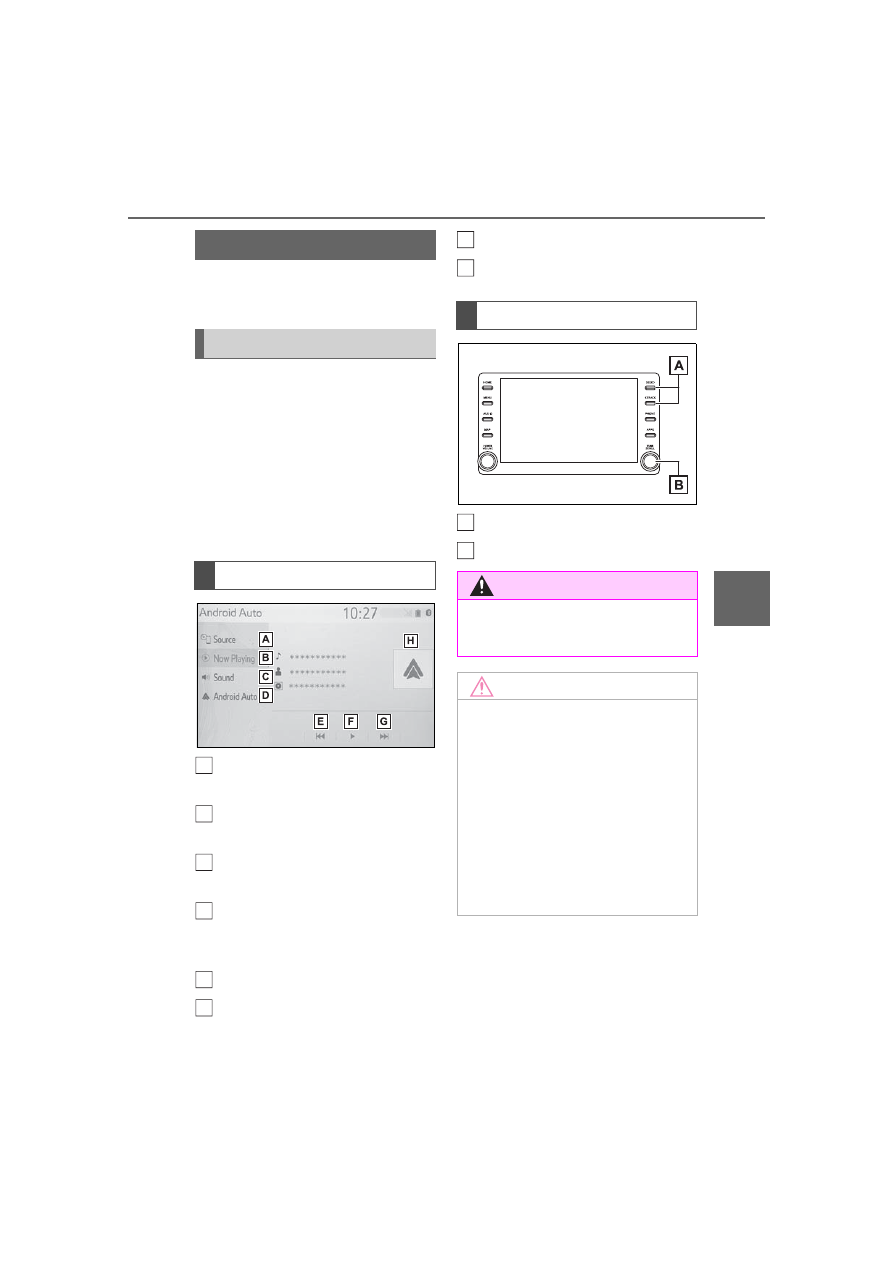
The Android Auto operation 
screen can be reached by the 
following methods: 

P.417

Connecting an Android device 
(

P.418)

When an Apple CarPlay con-
nection is established, this 
function will be unavailable.

Select to display the audio 
source selection screen.

Select to return to the top 
screen.

Select to display the sound 
setting screen. (

P.418)

Select to display the audio 
control screen of Android 
Auto.

Select to change the track.

Select to play/pause.

Select to change the track.

Displays cover art

Press to change the track.

Turn to change the track.

Android Auto

*

Overview

Control screen

A

B

C

D

E

F

Control panel

WARNING

Do not connect smartphone or 

operate the controls while driv-

ing.

NOTICE

Do not leave your smartphone 

in the vehicle. In particular, high 

temperatures inside the vehicle 

may damage the smartphone.

Do not push down on or apply 

unnecessary pressure to the 

smartphone while it is con-

nected as this may damage the 

smartphone or its terminal.

Do not insert foreign objects into 

the port as this may damage the 

smartphone or its terminal.

G

H

A

B

434

5-8. Media operation

The Bluetooth

®

 audio operation 

screen can be reached by the 
following methods: 

P.417

Connecting a Bluetooth

®


audio device (

P.436)

Depending on the type of por-
table player connected, some 
functions may not be avail-
able and/or the screen may 
look differently than shown in 
this manual.

When an Apple Car-
Play/Android Auto connec-
tion is established, Bluetooth

®


audio will be suspended and 
become unavailable.

*

*

: This function is not made avail-

able in some countries or areas.

Select to display the audio 
source selection screen.

Select to return to the top 
screen.

Select to display a song list 
screen.

Select to display the play 
mode selection screen.

Select to display the portable 
device connection screen. 
(

P.436)

Select to display the sound 
setting screen. (

P.418)

Select to set repeat playback. 
(

P.435)

Select to change the track.
Select and hold to fast 
rewind.

Select to play/pause.

Select to change the track.
Select and hold to fast for-
ward.

Select to set random play-
back. (

P.435)

Bluetooth

®

 audio

The Bluetooth

®

 audio sys-

tem enables users to enjoy 
listening to music that is 
played on a portable player 
on the vehicle speakers via 
wireless communication.
This audio/visual system 
supports Bluetooth

®

, a wire-

less data system capable of 
playing portable audio 
music without cables. If 
your device does not sup-
port Bluetooth

®

, the 

Bluetooth

®

 audio system 

will not function.

Overview

Control screen

A

B

C

D

E

F

G

H

I

J

K

435

5-8. Media operation

5

Audio

Select to change the album.

Displays cover art

Press to change the track.
Press and hold to fast for-
ward/rewind.

Turn to move up/down the 
list. Also, the knob can be 
used to enter selections on 
the list screens by pressing it.

The track or album currently 
being listened to can be 
repeated.

1

Select 

.

Each time 

 is selected, the 

mode changes as follows:

When random playback is off

• all repeat 

 track repeat 

 album 

repeat 

 off

When random playback is on

• all repeat 

 track repeat 

 off

Tracks or albums can be auto-
matically and randomly 

selected.

1

Select 

.

Each time 

 is selected, the 

mode changes as follows:

• random (1 album random) 


album random (all album random) 

 off

Depending on the Bluetooth

®


device that is connected to the 

system, the music may start play-
ing when selecting 

 while it is 

paused. Conversely, the music 
may pause when selecting 


while it is playing.

In the following conditions, the 

system may not function:

• The Bluetooth

®

 device is turned 

off.

• The Bluetooth

®

 device is not con-

nected.

• The Bluetooth

®

 device has a low 

battery.

When using the Bluetooth

®

 audio 

and Wi-Fi

®

 Hotspot functions at 

the same time, the following prob-

lems may occur:

• It may take longer than normal to 

connect to the Bluetooth

®

 device.

• The sound may cut out.

It may take time to connect the 
phone when Bluetooth

®

 audio is 

being played.

For operating the portable player, 

see the instruction manual that 

comes with it.

If the Bluetooth

®

 device is discon-

nected due to poor reception from 
the Bluetooth

®

 network when the 

engine switch is in ACC or ON, 

the system automatically recon-

nects the portable player.

If the Bluetooth

®

 device is discon-

Control panel

Repeating

Random order

L

M

A

B

436

5-8. Media operation

nected on purpose, such as it was 

turned off, this does not happen. 

Reconnect the portable player 

manually.

Bluetooth

®

 device information is 

registered when the Bluetooth

®


device is connected to the 
Bluetooth

®

 audio system. When 

selling or disposing of the vehicle, 
remove the Bluetooth

®

 audio 

information from the system. 

(

P.413)

In some situations, sound output 
via the Bluetooth

®

 audio system 

may be out of sync with the con-

nected device or output intermit-

tently.

To use the Bluetooth

®

 audio 

system, it is necessary to regis-
ter a Bluetooth

®

 device with the 

system.

Registering an additional 
device

1

Display the Bluetooth

®

 audio 

control screen. (

P.434)

2

Select “Connect”.

3

Select “Add Device”.

When another Bluetooth

®

device is connected, a confir-
mation screen will be dis-
played. To disconnect the 
Bluetooth

®

 device, select 

“Yes”.

WARNING

Do not operate the player’s con-

trols or connect to the 
Bluetooth

®

 audio system while 

driving.

Your audio unit is fitted with 
Bluetooth

®

 antennas. People 

with implantable cardiac pace-

makers, cardiac resynchroniza-

tion therapy-pacemakers or 

implantable cardioverter defibril-

lators should maintain a reason-

able distance between 
themselves and the Bluetooth

®


antennas. The radio waves may 

affect the operation of such 

devices.

Before using Bluetooth

®


devices, users of any electrical 

medical device other than 

implantable cardiac pacemak-

ers, cardiac resynchronization 

therapy-pacemakers or implant-

able cardioverter defibrillators 

should consult the manufacturer 

of the device for information 

about its operation under the 

influence of radio waves. Radio 

waves could have unexpected 

effects on the operation of such 

medical devices.

NOTICE

Do not leave your portable 

player in the vehicle. In particu-

lar, high temperatures inside the 

vehicle may damage the porta-

ble player.

Registering/Connecting a 
Bluetooth

®

 device

437

5-8. Media operation

5

Audio

4

Follow the steps in “Register-
ing a Bluetooth

®

 phone for 

the first time” from step 

5

(

P.386)

Selecting a registered device

1

Display the Bluetooth

®

 audio 

control screen. (

P.434)

2

Select “Connect”.

3

Select the desired device to 
be connected.

4

Check that a confirmation 
screen is displayed when the 
connection is complete.

If an error message is dis-
played, follow the guidance 
on the screen to try again.

438

5-9. Audio/visual remote controls

5-9.Audio/visual remote controls

Some parts of the audio/visual 
system can be adjusted using 
the switches on the steering 
wheel.

Volume control switch

“MODE” switch

 switch

Volume control switch

• Press: Volume up/down
• Press and hold (0.8 sec. or 

more): Volume up/down con-
tinuously

“MODE” switch

AM/FM/SXM

*1

• Press: Change audio modes
• Press and hold (0.8 sec. or 

more): Mute/pause

*2

 (Press 

and hold again to resume)

USB

*3, 4

, iPod/iPhone (Apple 

CarPlay)

*4

, Bluetooth

®


audio

*3, 4

, Android Auto

*3

Toyota Apps

*3, 4

• Press: Change audio modes

• Press and hold (0.8 sec. or 

more): Pause (Press and hold 
again to resume the play 
mode.)

*1

:This function is not made avail-

able in some countries or areas.

*2

:If cached radio is enabled, press-

ing and holding the “MODE” 
switch pauses the broadcast. 
(Press and hold again to play 
back the cached radio program.)

*3

:When an Apple CarPlay connec-

tion is established, this function 
will be unavailable.

*4

:When an Android Auto connec-

tion is established, this function 
will be unavailable.

 switch

AM/FM

• Press: Preset channel 

up/down

• Press and hold (0.8 sec. or 

more): Seek up/down

• Press and hold (1.5 sec. or 

more): Seek up/down continu-
ously while the switch is being 
pressed

• Press and hold (1.5 sec. or 

more): Fast channel up/down

SXM

*1

• Press: Preset channel 

up/down

• Press and hold (0.8 sec. or 

more): Seek for stations in the 
relevant program type/chan-
nel category

• Press and hold (1.5 sec. or 

more): Fast channel up/down

Steering switches

Steering switch operation

A

B

C

439

5-9. Audio/visual remote controls

5

Audio

USB

*2, 3

, iPod/iPhone (Apple 

CarPlay)

*3

, Bluetooth

®


audio

*2, 3

• Press: Track/file up/down
• Press and hold (0.8 sec. or 

more): Fast forward/rewind

Android Auto

*2

• Press: Track up/down

*1

:This function is not made avail-

able in some countries or areas.

*2

:When an Apple CarPlay connec-

tion is established, this function 
will be unavailable.

*3

:When an Android Auto connec-

tion is established, this function 
will be unavailable.

440

5-10. Audio settings

5-10.Audio settings

1

Press the “MENU” button.

2

Select “Setup”.

3

Select “Audio”.

4

Select the desired items to 
be set.

Select to set the common 
settings. (

P.440)

Select to set the radio set-
tings. (

P.440)

1

Display the audio settings 
screen.

P.440

2

Select “Common”.

3

Select the desired items to 
be set.

Select to set the cover art 
display on/off.

Select to prioritize the display 
of information from the 
Gracenote database.

Select to change the screen 
size.

*

 (

P.419)

Select to display the image 
quality adjustment screen.

*


(

P.420)

*

: Only in USB video mode

1

Display the audio settings 
screen

P.440

2

Select “Radio”.

3

Select the desired number of 
preset radio stations dis-
played on the screen.

Setup

Detailed audio settings can 
be programmed.

Displaying the audio set-
tings screen

Audio settings screen

A

B

Common settings

Radio settings

A

B

C

D

441

5-10. Audio settings

5

Audio

1

Select “Manage Smart 
Favorites”.

2

Select the desired channel to 
be set.

Displays the registered preset 

channels.

Up to 20 channels can be regis-

tered.

1

Select “Number of Radio Pre-
sets”.

2

Select the button with the 
desired number to be dis-
played.

Manage smart favorites

Setting the number of radio 
presets

442

5-11. Tips for operating the audio/visual system

5-11.Tips for operating the audio/visual system

The use of a cellular phone inside 

or near the vehicle may cause a 

noise from the speakers of the 

audio/visual system which you are 

listening to. However, this does 

not indicate a malfunction.

Usually, a problem with radio 
reception does not mean there 
is a problem with the radio 

 it 

is just the normal result of condi-
tions outside the vehicle.
For example, nearby buildings 
and terrain can interfere with FM 
reception. Power lines or phone 
wires can interfere with AM sig-
nals. And of course, radio sig-
nals have a limited range. The 
farther the vehicle is from a sta-
tion, the weaker its signal will 
be. In addition, reception condi-
tions change constantly as the 
vehicle moves.
Here are some common recep-
tion problems that may not indi-
cate a problem with the radio as 
described.

FM

Fading and drifting stations: 
Generally, the effective range of 

FM is about 25 miles (40 km). 
Once outside this range, you 
may notice fading and drifting, 
which increase with the distance 
from the radio transmitter. They 
are often accompanied by dis-
tortion.
Multi-path: FM signals are 
reflective, making it possible for 
2 signals to reach the vehicle’s 
antenna at the same time. If this 
happens, the signals will cancel 
each other out, causing a 
momentary flutter or loss of 
reception.
Static and fluttering: These 
occur when signals are blocked 
by buildings, trees or other large 
objects. Increasing the bass 
level may reduce static and flut-
tering.
Station swapping: If the FM sig-
nal being listened to is inter-
rupted or weakened, and there 
is another strong station nearby 
on the FM band, the radio may 
tune in the second station until 
the original signal can be picked 
up again.

AM

Fading: AM broadcasts are 
reflected by the upper atmo-
sphere 

 especially at night. 

These reflected signals can 
interfere with those received 
directly from the radio station, 
causing the radio station to 
sound alternately strong and 
weak.

Operating information

NOTICE

To avoid damage to the 

audio/visual system, be careful 

not to spill beverages over the 

audio/visual system.

Radio

443

5-11. Tips for operating the audio/visual system

5

Audio

Station interference: When a 
reflected signal and a signal 
received directly from a radio 
station are very nearly the same 
frequency, they can interfere 
with each other, making it diffi-
cult to hear the broadcast.
Static: AM is easily affected by 
external sources of electrical 
noise, such as high tension 
power lines, lightening or electri-
cal motors. This results in static.

SiriusXM

*

Cargo loaded on the roof lug-
gage carrier, especially metal 
objects, may adversely affect 
the reception of SiriusXM Sat-
ellite Radio.

Alternation or modifications 
carried out without appropri-
ate authorization may invali-
date the user’s right to 
operate the equipment.

*

: This function is not made avail-

able in some countries or areas.

Certification

Use of the Made for Apple 
badge means that an acces-
sory has been designed to 
connect specifically to the 
Apple product(s) identified in 
the badge, and has been cer-
tified by the developer to meet 
Apple performance stan-
dards. Apple is not responsi-
ble for the operation of this 
device or its compliance with 
safety and regulatory stan-
dards. Please note that the 
use of this accessory with an 
Apple product may affect 
wireless performance.

iPhone, iPod, iPod classic, 
iPod nano, iPod touch, and 
Lightning are trademarks of 
Apple Inc., registered in the 
U.S. and other countries.

Compatible models

The following iPod touch

®

 and 

iPhone

®

 devices can be used 

with this system.
Made for
• iPhone X
• iPhone 8
• iPhone 8 Plus
• iPhone 7
• iPhone 7 Plus
• iPhone SE

iPod/iPhone

444

5-11. Tips for operating the audio/visual system

• iPhone 6s
• iPhone 6s Plus
• iPhone 6
• iPhone 6 Plus
• iPhone 5s
• iPhone 5c
• iPhone 5
• iPod touch (6th generation)
• iPod touch (5th generation)

This system only supports audio 

playback.

Depending on difference between 

models or software versions etc., 

some models might be incompati-

ble with this system.

This device supports high-reso-
lution sound sources.
The definition of high-resolution 
is based on the standards of 
groups such as the CTA (Con-
sumer Technology Association).
Supported formats and play-
able media are as follows.

Supported formats

WAV, FLAC, ALAC, OGG Vor-
bis

Playable media

USB

*

: USB video only

High-resolution sound 
source

File information

Compatible USB devices

USB communi-
cation formats

USB 2.0 HS (480 
Mbps)

File formats

FAT 16/32

Correspon-
dence class

Mass storage 
class

Compatible audio format

Compatible compressed files

Item

USB

Compatible file 

format

MP3/WMA/AAC

WAV(LPCM)/FL

AC/ALAC/OGG 

Vorbis

Compatible file 

format (video)

*

MP4/AVI/WMV

Folders in the 

device

Maximum

3000

Files in the 

device

Maximum

9999

Files per folder

Maximum

255

445

5-11. Tips for operating the audio/visual system

5

Audio

*1

:Only compatible with Windows 

Media Audio Standard

*2

:Sound source of 48kHz or more 

is down-converted to 
48kHz/24bit.

*1

:Variable Bit Rate (VBR) compati-

ble

*2

:Only compatible with Windows 

Media Audio Standard

Corresponding sampling fre-
quency

File type

Frequency (kHz)

MP3 files: 
MPEG 1 LAYER 
3

32/44.1/48

MP3 files: 
MPEG 2 LSF 
LAYER 3

16/22.05/24

WMA files: 
Ver. 7, 8, 9

*1


(9.1/9.2)

32/44.1/48

AAC files: 
MPEG4/AAC-LC

11.025/12/16/

22.05/24/32/

44.1/48

WAV (LPCM) 
files

*2

8/11.025/12/16/

22.05/24/32/

44.1/48/88.2/
96/176.4/192

FLAC

*2

8/11.025/12/16/

22.05/24/32/

44.1/48/88.2/
96/176.4/192

ALAC

*2

8/11.025/12/16/

22.05/24/32/

44.1/48/64/

88.2/96

OGG Vorbis

*2

8/11.025/16/

22.05/32/44.1/

48

Corresponding bit rates

*1

File type

Bit rate (kbps)

MP3 files:
MPEG 1 LAYER 
3

32 - 320

MP3 files:
MPEG 2 LSF 
LAYER 3

8 - 160

WMA files: Ver. 
7, 8

CBR 48 - 192

WMA files:
Ver. 9

*2

 (9.1/9.2)

CBR 48 - 320

AAC files:
MPEG4/AAC-LC

8 - 320

OGG Vorbis

32-500

File type

Quantization bit 

rate (bit)

WAV (LPCM) 
files

16/24

FLAC

ALAC

Compatible channel modes

File type

Channel mode

MP3 files

Stereo, joint ste-
reo, dual chan-
nel and 
monaural

WMA files

2ch

446

5-11. Tips for operating the audio/visual system

MP3 (MPEG Audio Layer 3), 
WMA (Windows Media Audio) 
and AAC (Advanced Audio 
Coding) are audio compres-
sion standards.

This system can play 
MP3/WMA/AAC files on USB 
memory.

MP4, WMV and AVI files can 
use the following resolutions: 
128x96, 160x120, 176x144 
(QCIF), 320x240 (QVGA), 
352x240 (SIF), 352x288 
(CIF), 640x480 (VGA), 
720x480 (NTSC), 720x576 
(PAL)

When naming an 
MP3/WMA/AAC file, add an 
appropriate file extension 
(.mp3/.wma/.m4a).

This system plays back files 
with .mp3/.wma/.m4a file 
extensions as 
MP3/WMA/AAC files respec-
tively. To prevent noise and 
playback errors, use the 
appropriate file extension.

MP3 files are compatible with 
the ID3 Tag Ver. 1.0, Ver. 1.1, 
Ver. 2.2 and Ver. 2.3 formats. 
This system cannot display 

album title, track title and art-
ist name in other formats.

WMA/AAC files can contain a 
WMA/AAC tag that is used in 
the same way as an ID3 tag. 
WMA/AAC tags carry infor-
mation such as track title and 
artist name.

The emphasis function is 
available only when playing 
MP3 files.

This system can play back 
AAC files encoded by iTunes.

The sound quality of 
MP3/WMA files generally 
improves with higher bit rates.

m3u playlists are not compati-
ble with the audio player.

MP3i (MP3 interactive) and 
MP3PRO formats are not 
compatible with the audio 
player.

The player is compatible with 
VBR (Variable Bit Rate).

When playing back files 
recorded as VBR (Variable Bit 
Rate) files, the play time will 
not be correctly displayed if 
the fast forward or reverse 
operations are used.

It is not possible to check fold-
ers that do not include 
MP3/WMA/AAC files.

MP3/WMA/AAC files in fold-
ers up to 8 levels deep can be 
played. However, the start of 
playback may be delayed 

AAC files

1ch, 2ch (Dual 
channel is not 
supported)

WAV (LPCM)/

FLAC/ALAC/

OGG Vorbis

2ch

File type

Channel mode

447

5-11. Tips for operating the audio/visual system

5

Audio

when using USB memory 
containing numerous levels of 
folders. For this reason, we 
recommend creating USB 
memory with no more than 2 
levels of folders.

The play order of the USB 
memory with the structure 
shown above is as follows:

The order changes depending 
on the personal computer and 
MP3/WMA/AAC encoding 
software you use.

Compatible video format

Format

Codec

MPEG-4

Video codec:

H.264/MPEG-
4 AVC

MPEG4

Audio codec:

AAC

MP3

Corresponding 
screen size:

MAX 1920 


1080

Corresponding 
frame rate:

MAX 60i/30p

448

5-11. Tips for operating the audio/visual system

ID3 tag

This is a method of embed-

ding track-related information 
in an MP3 file. This embed-
ded information can include 
the track number, track title, 
the artist’s name, the album 
title, the music genre, the year 
of production, comments, 
cover art and other data. The 
contents can be freely edited 
using software with ID3 tag 
editing functions. Although 
the tags are restricted to a 
number of characters, the 
information can be viewed 
when the track is played back.

WMA tag

WMA files can contain a 
WMA tag that is used in the 
same way as an ID3 tag. 
WMA tags carry information 
such as track title and artist 
name.

MP3

MP3 is an audio compression 
standard determined by a 
working group (MPEG) of the 
ISO (International Standard 
Organization). MP3 com-
presses audio data to about 
1/10 the size of that on con-
ventional discs.

WMA

WMA (Windows Media Audio) 
is an audio compression for-
mat developed by Microsoft

®

It compresses files into a size 
smaller than that of MP3 files. 
The decoding formats for 

AVI Container

Video codec:

H.264/MPEG-
4 AVC

MPEG4

WMV9

WMV9 
Advanced pro-
file

Audio codec:

AAC

MP3

WMA9.2 (7, 8, 
9.1, 9.2)

Corresponding 
screen size:

MAX 1920 


1080

Corresponding 
frame rate:

MAX 60i/30p

Windows Media 
Video

Video codec:

WMV9

WMV9 
Advanced pro-
file

Audio codec:

WMA9.2 (7, 8, 
9.1, 9.2)

Corresponding 
screen size:

MAX 1920 


1080

Corresponding 
frame rate:

MAX 60i/30p

Terms

Format

Codec


Content      ..     25      26      27      28     ..