Subaru BRZ (2023 year). Manual in english - page 10

BSD/RCTA (If Equipped)
275
following two conditions: (1) This device
Canada-spec. models
may not cause harmful interference, and
(2) this device must accept any interfer-
ence received, including interference that
may cause undesired operation.
7
702884
702883
- CONTINUED -
276
BSD/RCTA (If Equipped)
Mexico-spec. models
Do not expose the bumper near
the radar sensors to strong
Certificado de homologacion:
impacts. If a sensor becomes
RLVCOSR15-0442
misaligned, a system malfunction
may occur, including the inability
Continental SRR3-A
to detect vehicles entering the
detection areas. If any strong
Este equipo opera a titulo secundario,
consecuentemente, debe aceptar
shock is applied to the bumper,
interferencias perjudiciales incluyendo
be sure to contact your SUBARU
equipos de la misma clase y puede no
dealer for inspection.
causar interferencias a sistemas operando
Do not disassemble the radar
a titulo primario.
702808
sensors.
702185
CAUTION
NOTE
■ Handling of Radar Sensors
To ensure correct operation of the
If the radar sensors require repair or
BSD/RCTA, observe the following
replacement, or the bumper area
precautions.
around the radar sensors requires
repair, paintwork or replacement, con-
Always keep the bumper surface
tact your SUBARU dealer for assis-
near the radar sensors clean.
tance.
Do not affix any stickers or other
items on the bumper surface near
the radar sensors. For details,
consult your SUBARU dealer.
Do not modify the bumper near
the radar sensors.
Do not paint the bumper near the
702807
radar sensors.
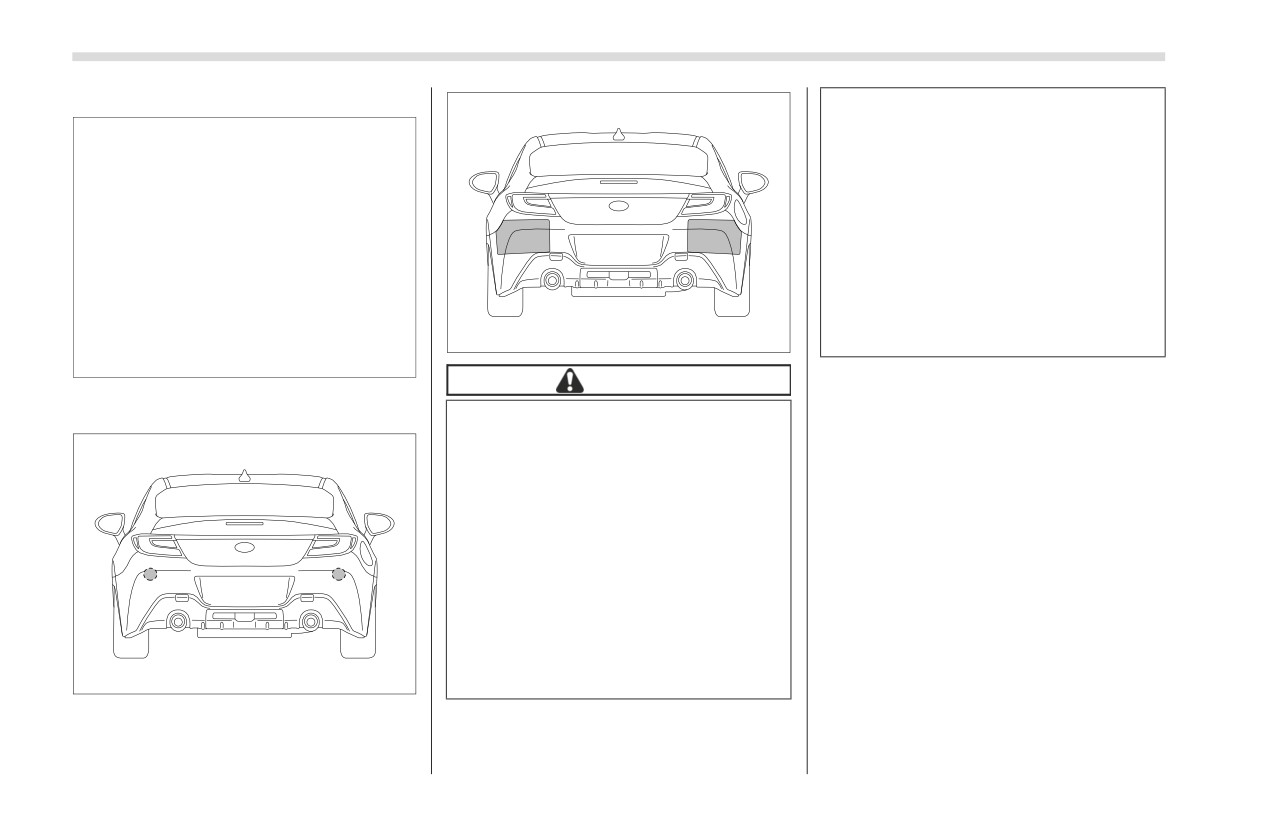
Radar sensors
The radar sensors, one on each side of
the vehicle, are mounted inside the rear
bumper.
Reverse Automatic Braking (RAB) System (If Equipped)
277
7-21. Reverse Automatic
There are some cases in which
NOTE
the vehicle cannot avoid colli-
The Reverse Automatic Braking (RAB)
Braking (RAB) System (If
sion, because the system opera-
system records and stores the follow-
Equipped)
tion has limitations. The warning
ing data when automatic braking oper-
sound or automatic braking may
ates. It does not record conversations,
Reverse Automatic Braking (RAB) is a
personal information or other audio
be delayed or may not operate at
system designed to help avoid collisions
all even when an obstacle is
data.
or reduce collision damage when
present.
Distance from the object
reversing the vehicle. If a wall or an
obstacle is detected in the reversing direc-
Make sure to set the Automatic
Vehicle speed
tion, the system will notify the driver with a
Braking to OFF when the vehicle
Accelerator pedal operation status
warning sound and may activate the
is on the free roller or on the
Brake pedal operation status
vehicle’s brakes automatically.
chassis dynamometer. Other-
Select lever position
wise, the vehicle may move and it
Outside temperature
may cause an accident.
The sensitivity setting of the sonar
WARNING
sensors
Make sure to set the Automatic
Reverse Automatic Braking
Braking to OFF when towing the
SUBARU and third parties contracted
(RAB) is not a system intended to
vehicle. Otherwise, the vehicle
by SUBARU may acquire and use the
replace the driver’s responsibility
7
may move and it may cause an
recorded data for the purpose of vehi-
to check their surroundings for
accident.
cle research and development.
vehicles or obstacles to avoid a
SUBARU and third parties contracted
collision.
The system is not designed to
by SUBARU will not disclose or pro-
detect people
(including chil-
The driver is responsible for
vide the acquired data to any other
dren), animals or other moving
driving safely. Before reversing,
third party except under the following
objects.
be sure to first depress the brake
conditions.
pedal and visually check the
Depending on the vehicle condi-
The vehicle owner has given his/her
surroundings.
tion or the surrounding environ-
consent.
ment, the sonar sensor’s ability
The disclosure/provision is based
to detect objects may become
on a court order or other legally
unstable.
enforceable request.
Data that has been modified so that
the user and vehicle cannot be identi-
fied is provided to a research institu-
- CONTINUED -
278
Reverse Automatic Braking (RAB) System (If Equipped)
tion for statistical processing or similar
purposes.
1
■ Reverse Automatic Braking
(RAB) System Overview
4
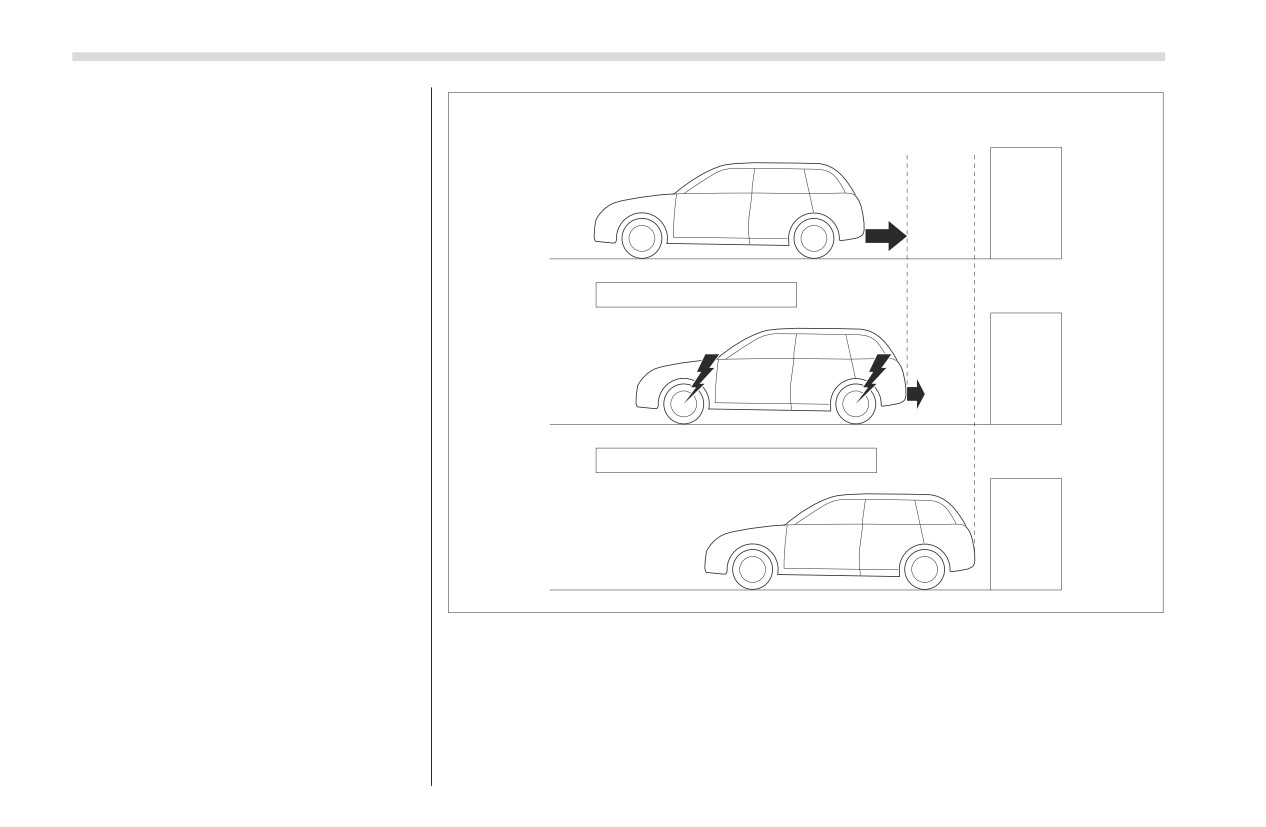
The Reverse Automatic Braking (RAB)
system will operate the following 2 func-
tions using 4 sonar sensors.
Sonar Audible Alarm function
2
Object Close Behind
The Reverse Automatic Braking (RAB)
system detects objects rearward and
warns the driver by warning message on
the center information display and
4
warning beeps.
Automatic Braking function
The Automatic Braking function detects
objects rearward and if there is a high risk
3
Apply Brake To Hold Position
of a collision, the system decelerates the
vehicle and controls the braking to reduce
damage.
4
702041
1) When reversing
2) When either strong automatic braking or torque control is applied to prevent collision (in this
case, short warning beeps or continuous warning beeps will sound)
3) When the vehicle is stopped by the system (in this case, the continuous beep will remain
sounding)
4) Object (e.g., a wall)
Reverse Automatic Braking (RAB) System (If Equipped)
279
NOTE
WARNING
In the following cases, the Reverse
If your vehicle is trapped on a rail-
Automatic Braking (RAB) system will
road crossing and you are trying to
not operate. Promptly contact a
escape by reversing through the
SUBARU dealer to have the system
crossing gate, the system may rec-
inspected.
ognize the crossing gate as an
-
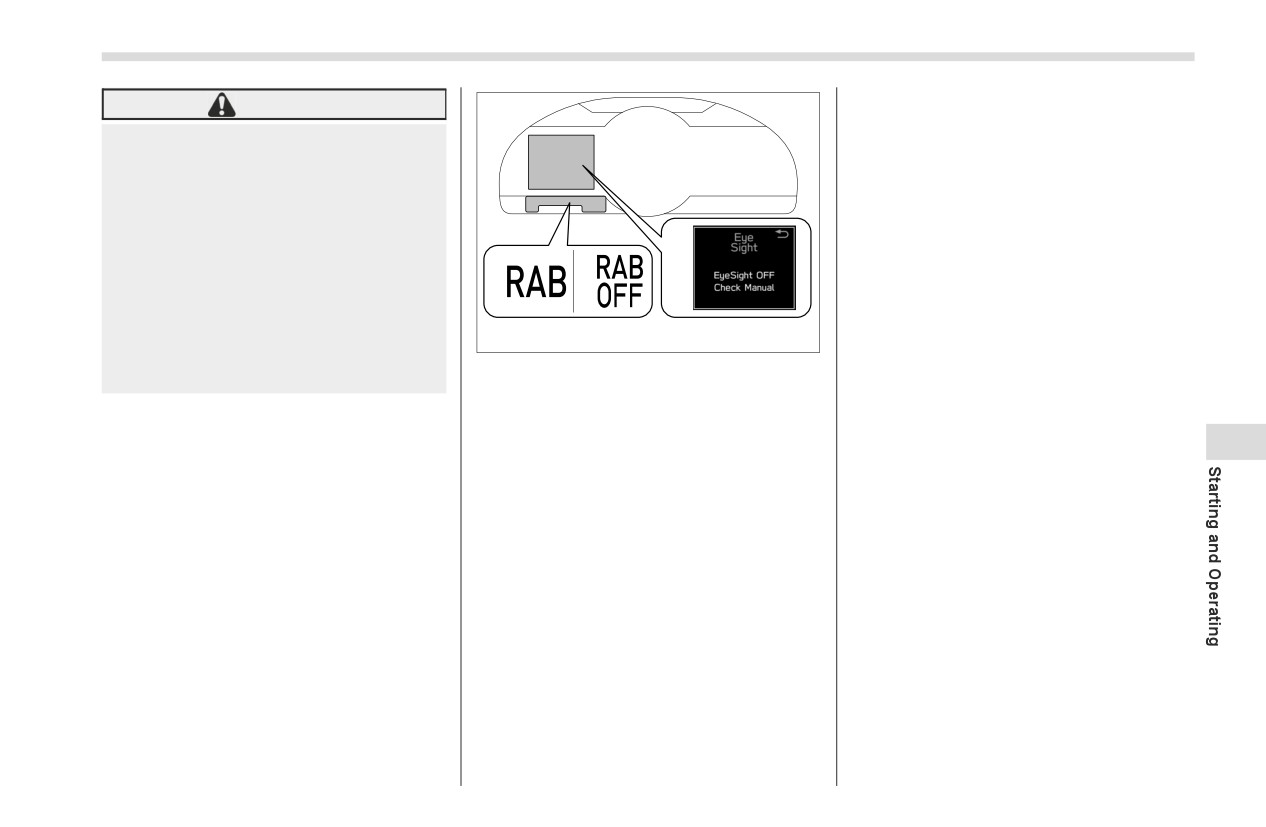
The EyeSight warning indicator
1
obstacle and brake may activate. In
is illuminated.
2
3
this case, remain calm and either
-
The RAB warning indicator is
continue to depress the accelerator
illuminated.
pedal or cancel the system. To can-
In the following cases, the Reverse
cel the system, refer to "Canceling
Automatic Braking
(RAB) system
702885
the Reverse Automatic Braking
cannot be operated.
(RAB) System Operation" ) P285.
1)
EyeSight warning indicator
-
The RAB OFF indicator is illumi-
2)
RAB warning indicator
nated.
3)
RAB OFF indicator
In the following cases, the functions
■ Operating Conditions
may not be able to properly work.
The ignition switch is in the “ON” posi-
7
The Reverse Automatic Braking (RAB)
Promptly contact a SUBARU dealer to
tion.
system will operate when all of the
have the system inspected.
following conditions are met.
The EyeSight warning indicator is off.
-
A sticker, paint, or a chemical is
The RAB warning indicator is off.
applied to the sonar sensors or the
The RAB OFF indicator is off.
rear bumper near the sonar sensor.
-
The rear bumper is modified.
The select lever is in the “R” position.
-
The rear bumper has been
Sonar Audible Alarm function
removed and attached.
The Sonar Audible Alarm is set to “ON”.
-
The ground clearance is
The vehicle speed is from 0 to 9 mph (0
changed due to the vehicle’s
to 15 km/h).
loading condition or modification.
Automatic Braking function
-
There is damage to the sonar
sensors or the rear bumper near the
The Automatic Braking is set to “ON”.
sonar sensor.
The vehicle speed is from 1 to 9 mph
(1.5 to 15 km/h).
- CONTINUED -
280
Reverse Automatic Braking (RAB) System (If Equipped)
-
The rear bumper is exposed to
-
Pedestrians.
-
A sound wave with a frequency
strong impact, or the rear bumper is
-
Moving
objects
including
similar to the vehicle’s system is
deformed.
moving vehicles.
transmitted near by.
On a steep hill, the system’s auto-
-
Objects which absorbs sound
-
A vehicle equipped with the
matic braking ability will be reduced.
waves such as cloth or snow.
same system is reversing toward
The system is designed to avoid
-
Objects whose surface has a
your reversing direction.
collisions by automatic hard braking
diagonal angle.
Weather conditions:
when the vehicle’s reversing speed is
-
Objects that are low to the
-
Extremely high or extremely low
less than approximately 3 mph (5 km/
ground such as parking blocks.
temperatures in which the area near
h). However, the system does not guar-
-
Objects that are high above the
the sonar sensor becomes too hot
antee that the vehicle will be able to
ground such as objects hanging
or too cold to operate.
avoid collisions in any situation.
from above.
-
The sonar sensors or the rear
If the vehicle is reversed at an
-
Objects that are out of range of
bumper near the sonar sensors are
extremely slow speed, the driver’s
the center of the vehicle in the hori-
exposed to heavy rain or a signifi-
operation may be prioritized. In this
zontal direction.
cant amount of water.
case, automatic braking will not
-
Objects that are not perpendic-
-
Fog, snow or sandstorm, etc.
operate.
ular to the ground.
-
Air is moving rapidly such as
The system may not be able to
-
The surface of the object is
when a strong wind is blowing.
detect and apply the brake with the
uneven or wavy.
Parts attached to the rear bumper
following objects.
When reversing the vehicle, the
near the sonar sensor:
-
Sharp or thin objects such as
functions may not be able to work
-
Commercial electronic parts (fog
poles, fences and ropes which may
properly or may cause a system
light, fender pole, radio antenna) or
not reflect the sound wave emitted
malfunction if the following conditions
commercial attachment parts (trailer
from the sonar sensor.
exist.
hitch, bicycle carrier, bumper guard)
-
Objects that are too close to the
High frequency sound from other
are attached.
rear bumper when the select lever is
sources are nearby:
-
Parts that emit high frequency
set to the “R” position.
-
Horn sound from another
sound, such as a horn or speaker,
-
Objects with a surface which
vehicle.
are attached.
may not reflect the sound wave
-
Engine sound from other vehi-
Vehicle conditions:
emitted from the sonar sensor such
cles.
-
Ice, snow or mud is adhered to
as a chain link fence.
-
Sound of an air brake.
the sonar sensors or the rear
Objects the system is not designed
-
Vehicle detection equipment or a
bumper near the sonar sensor.
to detect and apply brake.
sonar from another vehicle.
Reverse Automatic Braking (RAB) System (If Equipped)
281
-
The vehicle is significantly
inclined.
-
The ground clearance is signifi-
cantly reduced due to the vehicle’s
loading condition, etc.
-
When the sonar sensor is
misaligned due to a collision or an
accident.
Surrounding environment:
-
A cloth banner, flag, hanging
branch or railroad crossing bars are
present in the reversing direction.
702035
702037
-
When reversing on a gravel or
grassy area.
-
When reversing in an area where
objects or walls are adjacent to the
vehicle such as narrow tunnels,
narrow bridges, narrow roads or
7
narrow garages.
-
Wheel track or hole is present in
the ground of the reversing direc-
tion.
-
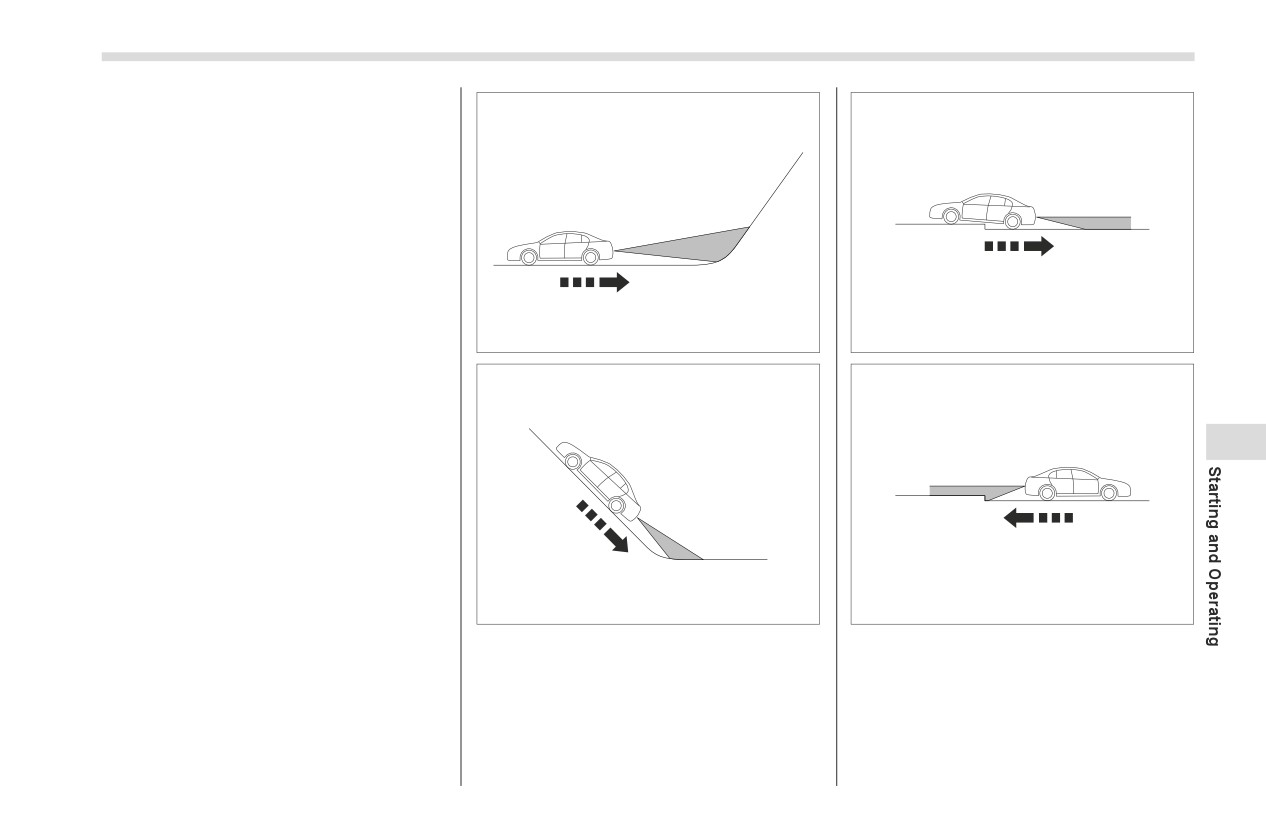
When reversing over a drainage
cover (grating cover).
702036
702388
-
The path of the reversing direc-
-
Reversing in a garage with a low
tion is inclined such as on a steep
ceiling or a tunnel.
uphill.
-
A curb or step is present in the
-
When reversing downhill.
reversing direction.
-
There is a patch of snow rear-
ward.
-
There is a puddle of water.
- CONTINUED -
282
Reverse Automatic Braking (RAB) System (If Equipped)
-
There is an obstacle that is next
NOTE
to an object.
It may take time to display the wall and
-
Going back along a wall.
sound warning beeps after the object
-
The area where the road starts
was recognized by the Sonar Audible
touching dirt and snow
Alarm function.
-
When reversing on an uneven
road.
In circumstances such as the
following, it may not be possible to
avoid a collision even when the system
operates normally.
-
Roads are slippery.
-
The tire air pressure is not
correct.
-
The tires have become worn.
-
Tire chains are installed.
-
Tires which are not the desig-
nated size are installed.
-
Emergency
repairs
were
performed using a puncture repair
kit.
-
The suspension was modified.
-
Vehicle driving is unstable due to
accident or malfunction.
-
The brake warning light is illumi-
nated.
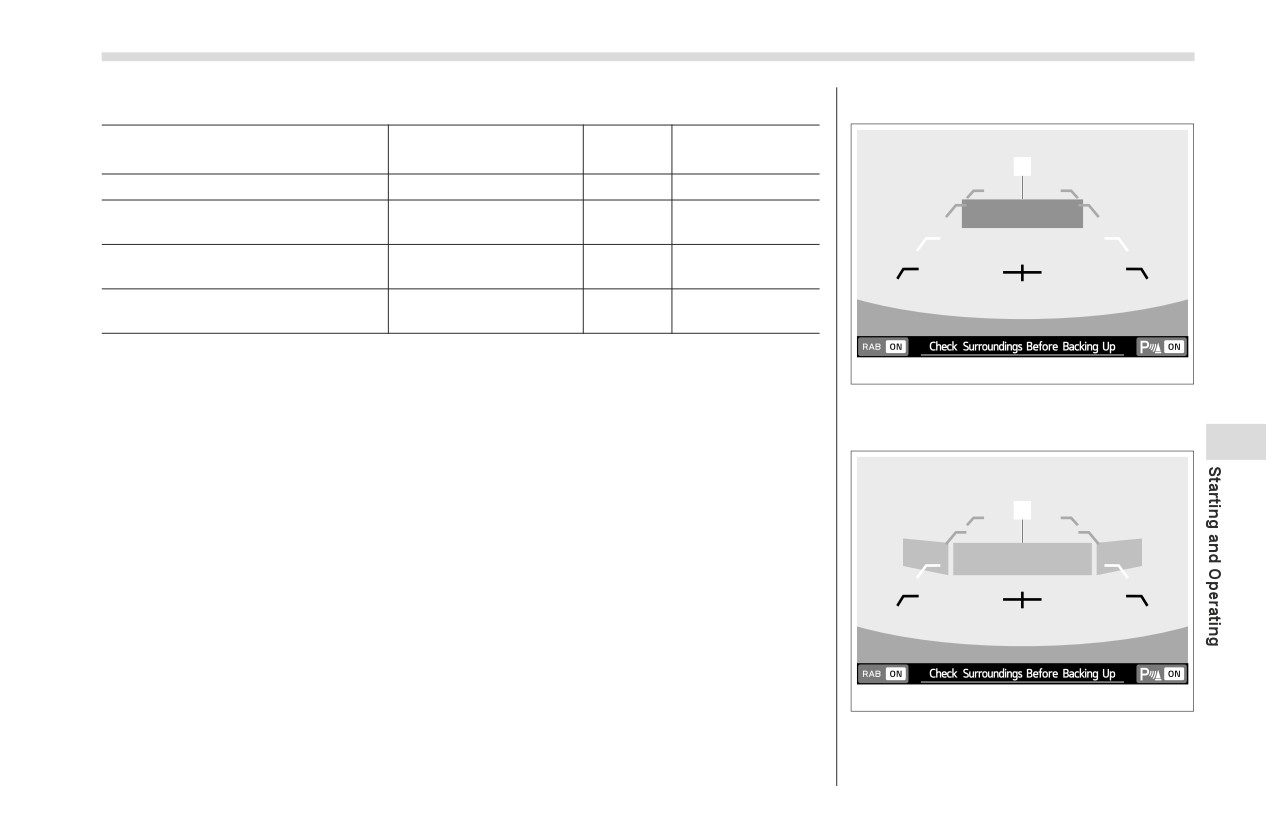
■ Sonar Audible Alarm func-
tion
When Reverse Automatic Braking (RAB)
system is in operation, an audible warning
beeps will sound in 3 levels to warn the
driver of a potential collision.
Reverse Automatic Braking (RAB) System (If Equipped)
283
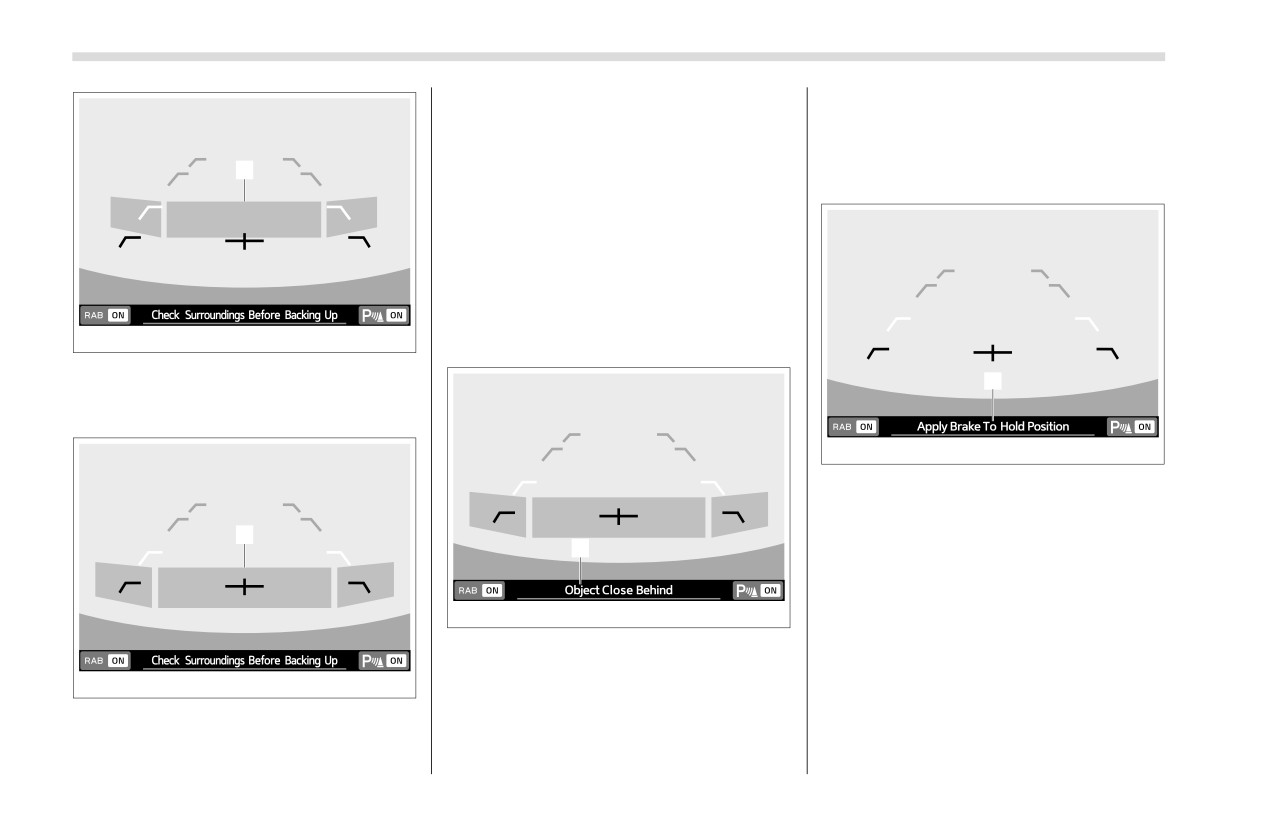
Guideline of detecting range
▼ Obstacle detected and alert level
Range of detected
Distance
Alert level
Alarm pattern
object*
indicator
1
Long proximity (object detected)
35 in (90 cm) or more
Green
No warning sound
Medium proximity alert (approaching
28 to 35 in (70 to 90 cm)
Yellow
Short beeps
the object)
Short proximity alert (approaching
20 to 28 in (50 to 70 cm)
Orange
Rapid short beeps
closer to the object)
Closest proximity alert (too close to
20 in (50 cm) or less
Red
Continuous beep
the object)
*: Range of detection may vary depending on the environmental condition.
702886
Long proximity alert (object detected)
1) Green: 35 in (90 cm) or more
7
1
702887
Medium proximity alert
(approaching the
object)
1) Yellow: 28 to 35 in (70 to 90 cm)
- CONTINUED -
284
Reverse Automatic Braking (RAB) System (If Equipped)
When an object is detected in the
either strong automatic braking or torque
reversing direction, the range of detected
control will be applied to prevent collision.
object will be shown on the center infor-
At this time, a warning message is also
mation display.
displayed on the combination meter
1
A warning alarm will sound and,
display (color TFT).
depending on the speed, either torque
control to generate engine braking or
automatic braking will be applied.
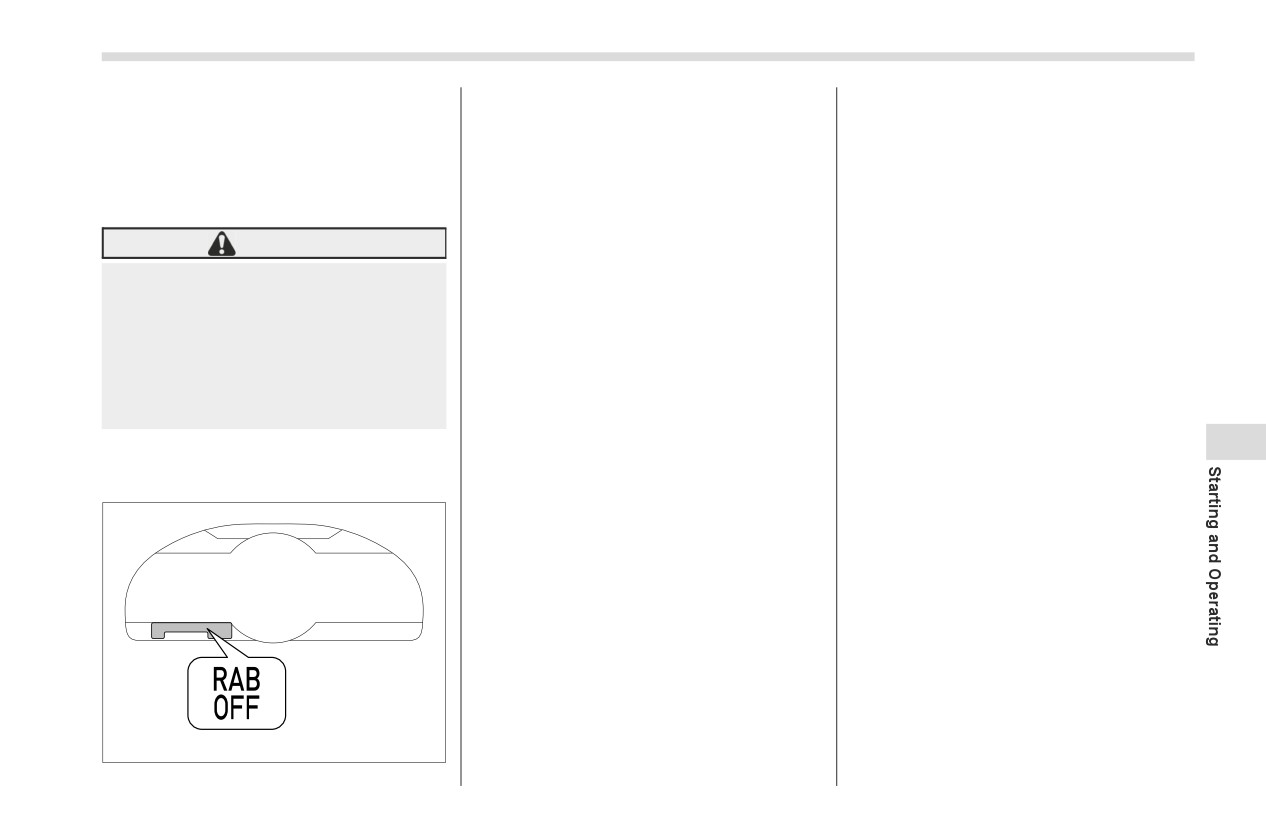
■ Automatic Braking function
Operation
702888
▼ Object close behind warning
Short proximity alert
(approaching the
object closer)
1
1) Orange: 20 to 28 in (50 to 70 cm)
702891
Depress brake pedal warning
1) Warning message
1
Make sure to depress the brake pedal
1
once the vehicle has been stopped by
automatic braking. Until the brake pedal is
depressed, a message will be displayed
702890
on the center information display and the
Automatic braking warning
continuous beep will remain sounding.
1) Warning message
At this time, a warning message is also
702889
displayed on the combination meter
If the system determine the risk of collision
display (color TFT).
Closest proximity alert
(too close to the
with the object. Short warning beeps or
object)
continuous warning beeps will sound and
1) Red: 20 in (50 cm) or less
Reverse Automatic Braking (RAB) System (If Equipped)
285
NOTE
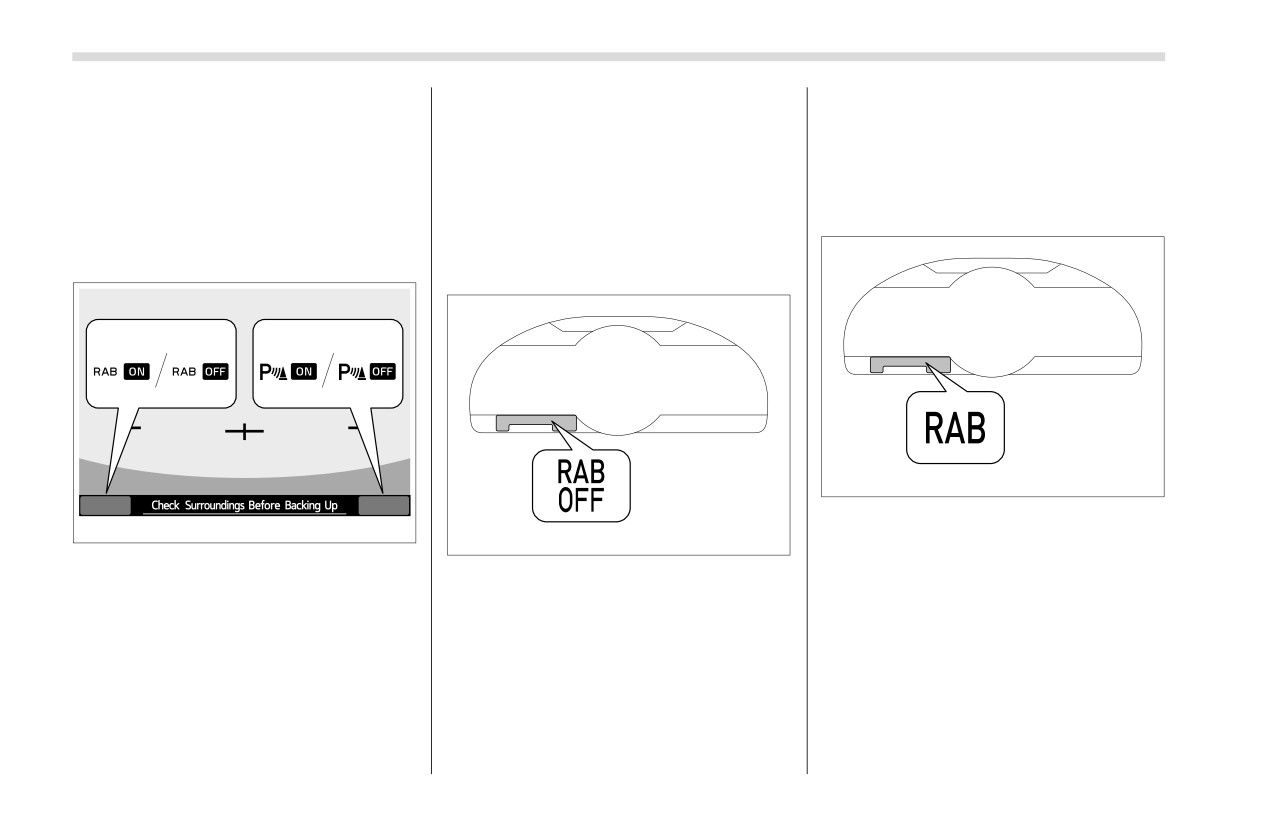
After the brake pedal is depressed, the
-
When the TRAC mode and
RAB OFF indicator will illuminate and the
Vehicle Stability Control
(VSC)
The Sonar Audible Alarm function and
system will temporarily stop operating.
mode are turned off
Automatic Braking function are differ-
The RAB OFF indicator will turn off when
-
When in TRACK mode and the
ent in operation conditions. Therefore
the select lever is shifted to a position
Pre-Collision Braking System has
there are cases in which only one of
other than the “R” position.
been turned off
these functions will activate.
The system will operate again the next
WARNING
time the select lever is shifted to the “R”
■ Canceling the Reverse Auto-
position.
matic Braking (RAB) System
Depress the brake pedal immedi-
Operation
ately after the system stops the
NOTE
vehicle by automatic braking.
The Reverse Automatic Braking (RAB)
The Reverse Automatic Braking
Depending on the conditions of the
system can be temporarily canceled by
(RAB) system will be disabled in the
road surface and tires, the vehicle
any of the following operation.
following situations.
may not remain stopped, possibly
While the vehicle is stopped by the
-
When 3 seconds pass after the
leading to an accident.
operation of automatic braking, the brake
vehicle is stopped
pedal is depressed.
-
When any door is opened
▼ After the vehicle is stopped by the
-
When the RAB warning indicator
While the vehicle is stopped by the
7
system
is illuminated
operation of automatic braking, the accel-
-
When the RAB OFF indicator is
erator pedal is depressed.
illuminated
The accelerator pedal is depressed
The Reverse Automatic Braking
continuously (In this case, limited acceler-
(RAB) system may stop operating
ation will be canceled and the vehicle will
temporarily in the following cases and
continue reversing.)
the RAB OFF indicator will illuminate.
The select lever is shifted to a position
-
Ice, snow or mud is adhered to
other than the “R” position.
the sonar sensors or the rear
bumper near the sonar sensor
NOTE
-
Objects are too close to the rear
The system will be canceled if the
bumper when the select lever is set
object is no longer detected.
to the “R” position
702810
-
The system detects sounds of a
similar frequency to the RAB sonar
- CONTINUED -
286
Reverse Automatic Braking (RAB) System (If Equipped)
■ Reverse Automatic Braking
Touch the ON setting key to turn the
Warning volume
setting OFF.
Sonar Audible Alarm
(RAB) System ON/OFF
When the OFF setting is shown, the corre-
Automatic Braking
Setting
sponding setting is OFF.
For details, refer to "Car settings" ) P165.
While the select lever is shifted to the “R”
Touch the OFF setting key to turn the
position, the below functions of the
setting ON.
■ RAB Warning Indicator
Reverse Automatic Braking (RAB) system
When the Automatic Braking function are
can be set by operating the center infor-
turned OFF, the following indicator(s) will
mation display.
illuminate.
1
2
3
4
702811
If the Reverse Automatic Braking (RAB)
702892
system malfunctions, the above indicator
702810
1) ON setting key of Automatic Braking
illuminates on the combination meter.
function
The RAB OFF indicator will turn off when
Contact the nearest SUBARU dealer for
2) OFF setting key of Automatic Braking
the corresponding function is turned ON.
details.
function
3) ON setting key of the Sonar Audible
NOTE
■ Handling of the Sonar
Alarm function
When the settings cannot be changed,
Sensors
4) OFF setting key of the Sonar Audible
the ON/OFF setting key will be grayed
Alarm function
The 4 sonar sensors are located in the
out.
rear bumper. To ensure the proper opera-
When the ON setting key is shown, the
Also, the following settings can be
tion of the Reverse Automatic Braking
corresponding setting is ON.
changed by operating the center informa-
(RAB) system, observe the following
tion display.
precautions.
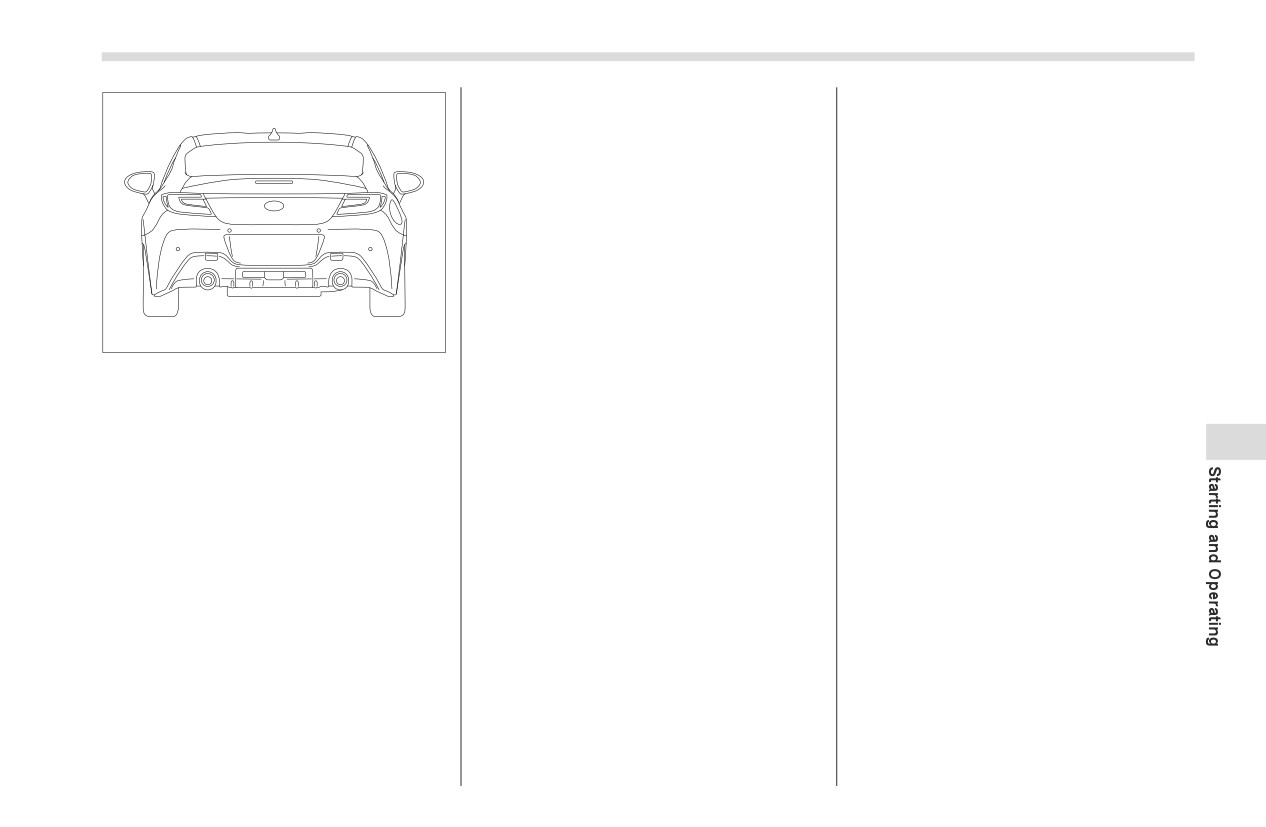
Reverse Automatic Braking (RAB) System (If Equipped)
287
bumper, contact a SUBARU dealer to
have the system inspected.
Do not disassemble the sonar sensors.
NOTE
If the sonar sensors require repair or
replacement, or if the area of the rear
bumper near the sonar sensors
requires repair, paintwork or replace-
ment, contact your SUBARU dealer for
assistance.
702995
Do not affix any stickers or other items
on the sonar sensor or the bumper
surface near the sonar sensors.
Always keep the sonar sensor and the
7
rear bumper surface near the sonar
sensors clean.
Do not modify rear bumper.
Do not paint the bumper near the sonar
sensors.
Do not apply high pressure water to the
sonar sensors with a high pressure car-
washing machine.
Do not apply strong impacts to the rear
bumper near the sonar sensors. If a
sensor becomes misaligned, a system
malfunction may occur, including inability
to detect objects in the reversing direction.
If any strong impact is applied to the rear
- CONTINUED -
Driving Tips
8-1. New Vehicle Break-In Driving - the First
Driving on Snowy and Icy Roads
295
1,000 miles (1,600 km)
290
Corrosion Protection
296
Snow Tires
296
8-2. Fuel Economy Hints
290
Tire Chains
297
8-3. Engine Exhaust Gas (Carbon Monoxide)
290
Rocking the Vehicle
297
8-4. Catalytic Converter
291
8-9. Loading Your Vehicle
297
8-5. Periodic Inspections
292
Vehicle Capacity Weight
298
8-6. Driving in Foreign Countries
292
GVWR and GAWR (Gross Vehicle Weight Rating
8-7. Driving Tips
292
and Gross Axle Weight Rating)
299
8-8. Winter Driving
293
8-10. Trailer Towing
299
Operation during Cold Weather
293
8
290
New Vehicle Break-In Driving - the First 1,000 miles (1,600 km)
8-1. New Vehicle Break-In
8-2. Fuel Economy Hints
8-3. Engine Exhaust Gas
Driving - the First 1,000 miles
(Carbon Monoxide)
The following suggestions will help to
(1,600 km)
save your fuel.
WARNING
Select the proper gear position for the
The performance and long life of your
speed and road conditions.
Never inhale engine exhaust gas.
vehicle are dependent on how you handle
and care for your vehicle while it is new.
Avoid sudden acceleration or decelera-
Engine exhaust gas contains
Follow these instructions during the first
tion. Always accelerate gently until you
carbon monoxide, a colorless
1,000 miles (1,600 km):
reach the desired speed. Then try to main-
and odorless gas which is
tain that speed for as long as possible.
dangerous, or even lethal, if
Do not race the engine. And do not
Do not pump the accelerator and avoid
inhaled.
allow engine speed to exceed 4,000 rpm
racing the engine.
Always properly maintain the
except in an emergency.
Avoid unnecessary engine idling.
engine exhaust system to prevent
Do not drive at one constant engine or
engine exhaust gas from entering
vehicle speed for a long time, either fast or
Keep the engine properly tuned.
the vehicle.
slow.
Keep the tires inflated to the correct
Never run the engine in a closed
Avoid starting suddenly and rapid
pressure shown on the tire inflation pres-
space, such as a garage, except
acceleration, except in an emergency.
sure label, which is located on the driver’s
for the brief time needed to drive
Avoid hard braking, except in an emer-
center pillar. Low pressure will increase
the vehicle in or out of it.
gency.
tire wear and fuel consumption.
Avoid remaining in a parked
Use the air conditioner only when
The same break-in procedures should be
vehicle for a long time while the
necessary.
applied to a newly installed or overhauled
engine is running. If that is
engine or when brake pads are replaced
Keep the front and rear wheels in
unavoidable, then use the ventila-
with new ones.
proper alignment.
tion fan to force fresh air into the
Avoid carrying unnecessary luggage or
vehicle.
cargo.
Always keep the front ventilator
inlet grille free from snow, leaves
or other obstructions to ensure
that the ventilation system
always works properly.
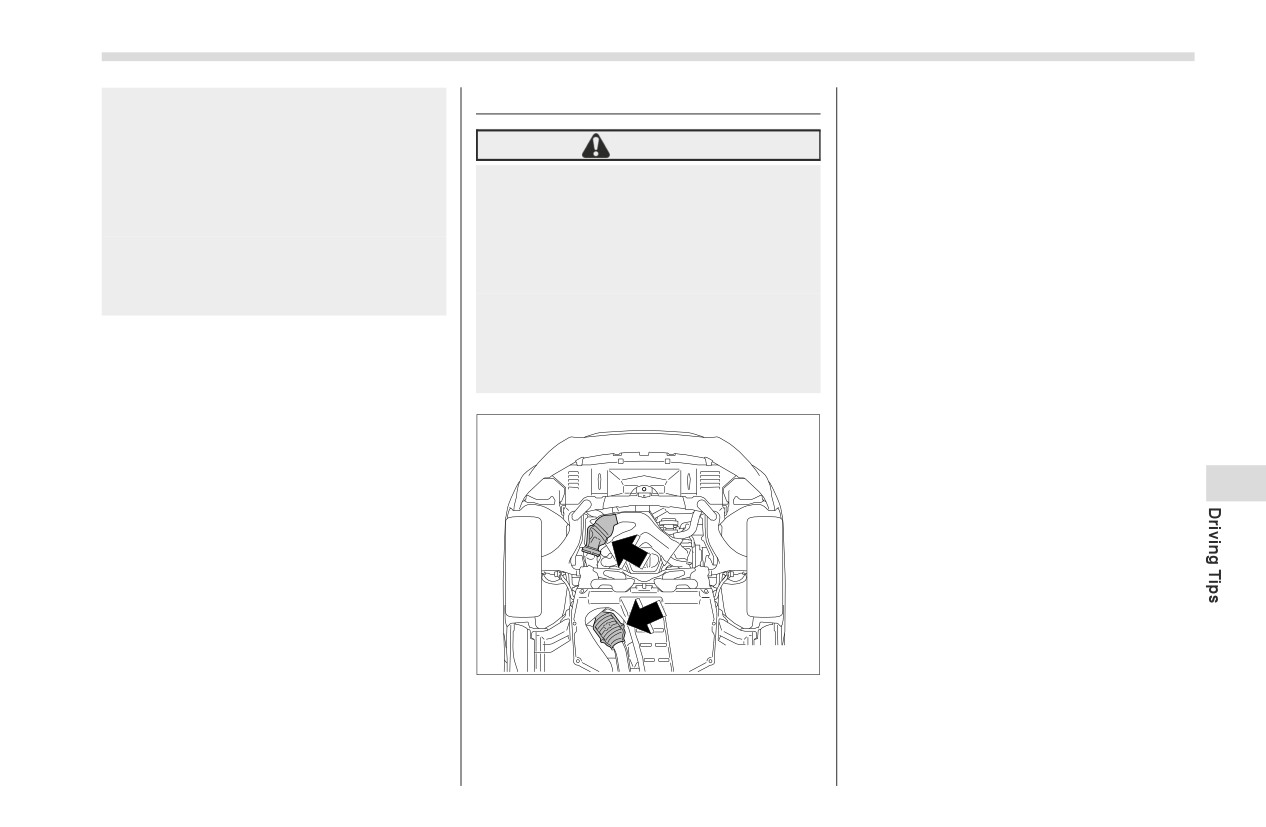
Catalytic Converter
291
If at any time you suspect that
8-4. Catalytic Converter
To avoid damage to the catalytic
converter:
exhaust fumes are entering the
vehicle, have the problem
Use only unleaded gasoline. Even a
WARNING
checked and corrected as soon
small amount of leaded gasoline will
as possible. If you must drive
Avoid fire hazards. Do not drive
damage the catalytic converter.
under these conditions, drive
or park the vehicle anywhere near
Never start the engine by pushing or
only with all windows fully open.
flammable materials (e.g. grass,
pulling the vehicle.
paper, rags or leaves), because
Keep the trunk lid closed while
Avoid racing the engine.
the catalytic converter operates
driving to prevent exhaust gas
at very high temperatures.
Never turn off the ignition switch while
from entering the vehicle.
the vehicle is moving.
Keep everyone and flammable
materials away from the exhaust
Keep your engine tuned-up. If you feel
NOTE
pipe while the engine is running.
the engine running rough (misfiring, back-
firing or incomplete combustion), have
The exhaust gas is very hot.
Due to the expansion and contraction
your vehicle checked and repaired by an
of the metals used in the manufacture
authorized SUBARU dealer.
of the exhaust system, you may hear a
Do not apply undercoating or rust
crackling sound coming from the
prevention treatment to the heat shield of
exhaust system for a short time after
catalytic converter and the exhaust
the engine has been shut off. This
system.
8
sound is normal.
Do not drive with an extremely low fuel
level.
801224
The catalytic converter is installed in the
exhaust system. It serves as catalyst to
reduce HC, CO and NOx in exhaust
gases, thus providing cleaner exhaust.
292
Periodic Inspections
8-5. Periodic Inspections
8-6. Driving in Foreign Coun-
8-7. Driving Tips
tries
To keep your vehicle in the best condition
WARNING
at all times, always have the recom-
When planning to use your vehicle in
mended maintenance services listed in
Always maintain a safe driving
another country:
the maintenance schedule in the
speed according to the road and
Confirm the availability of the correct
“Warranty and Maintenance Booklet”
weather conditions in order to
fuel. Refer to "Fuel Requirements"
performed at the specified time or mileage
avoid having an accident on a
) P223.
intervals.
sharp turn, during sudden
Comply with all regulations
and
braking or under other similar
requirements of each country.
conditions.
When replacing or installing
tire(s), all four tires must be the
same for the following items.
(a) Size
(b) Speed symbol
(c) Load index
(d) Circumference
(e) Construction
(f) Manufacturer
(g) Brand (tread pattern)
(h) Degrees of wear
For items (a) to
(c), you must
obey the specification that is
printed on the tire inflation pres-
sure label. The tire inflation pres-
sure label is located on the
driver’s center pillar.
Winter Driving
293
Whenever strong crosswinds are
8-8. Winter Driving
If all four tires are not the same in
items (a) to (h), serious mechani-
present, slow down sufficiently to
cal damage could be caused to
maintain control of your vehicle.
■ Operation during Cold
the drivetrain of the car, and
Never to drive through pools and
Weather
affect the followings.
puddles, or roads flooded with
Carry some emergency equipment, such
water. Water entering the engine
-
Ride
as a window scraper, a bag of sand,
air intake or the exhaust pipe or
flares, a small shovel and jumper cables.
-
Handling
water splashing onto electrical
Check the battery and cables. Cold
-
Braking
parts may damage your vehicle
temperatures reduce battery capacity.
-
Speedometer/Odometer cali-
and may cause it to stall. In this
The battery must be in good condition to
bration
case, contact your SUBARU
provide enough power for cold winter
-
Clearance between the body
dealer immediately. Regardless
starts.
of its depth, it can wash away the
and the tires
It normally takes longer to start the engine
ground from under your tires,
It also may be dangerous and
in very cold weather conditions. Use an
resulting in possible loss of trac-
lead to loss of vehicle control,
engine oil of a proper grade and viscosity
tion and even vehicle rollover.
and it can lead to an accident.
for cold weather. Using heavy summer oil
In a rollover crash, an unbelted
will make it harder to start the engine.
person is significantly more likely
Keep the door locks from freezing by
to die than a person wearing a
CAUTION
8
squirting them with deicer or glycerin.
seat belt. The driver and all your
After driving on gravel roads or
Forcing a frozen door open may damage
passengers should fasten their
rough roads, check the undercar-
or separate the rubber weather strips
seatbelts before starting to drive
riage of the vehicle body for any
around the door. If the door is frozen, use
in order to minimize the chance of
damage, deformation, or paint
hot water to melt the ice, and afterwards
serious injury or death.
removal. If you notice any irregulari-
thoroughly wipe the water away.
Do not make sharp turns or quick
ties, contact a SUBARU dealer for
Use a windshield washer fluid that
an inspection as soon as possible.
maneuvers unless absolutely
contains an antifreeze solution. Do not
unavoidable. Such actions are
use engine antifreeze or other substitutes
dangerous as you may lose
because they may damage the paint of
control, possibly resulting in a
the vehicle.
rollover which could cause death
If you fill the windshield washer tank with
or serious injury.
a fluid with a different concentration from
- CONTINUED -

294
Winter Driving
the one used previously, purge the old
▼ Before driving your vehicle
CAUTION
fluid from the piping between the wind-
Before entering the vehicle, remove any
shield washer tank and washer nozzles by
Do not use the parking brake
snow or ice from your shoes because that
operating the washer for a certain period
when parking for long periods in
could make the pedals slippery and
of time. Otherwise, if the concentration of
cold weather since it could freeze
driving dangerous.
the fluid remaining in the piping is too low
in that position.
While warming up the vehicle before
for the outside temperature, it may freeze
When the vehicle is parked in
driving, check that the accelerator pedal,
and block the nozzles.
snow or when it snows, raise the
brake pedal, and all other controls operate
wiper blades off the glass to
smoothly.
CAUTION
prevent damage to them.
Clear away ice and snow that has accu-
Adjust the washer fluid concen-
Under either of the following
mulated under the fenders to avoid
tration appropriately for the
conditions, icing may develop on
making steering difficult. During severe
outside temperature. If the
the brake system, which could
winter driving, stop when and where it is
concentration is inappropriate,
cause poor braking action.
safe to do so and check under the fenders
sprayed washer fluid may freeze
-
When the vehicle has been left
periodically.
on the windshield and obstruct
parked after use on roads
your view, and the fluid may
▼ Parking in cold weather
heavily covered with snow
freeze in the windshield washer
-
When the vehicle has been left
tank.
WARNING
parked during a snowstorm
State or local regulations on vola-
tile organic compounds may
Snow can trap dangerous exhaust
Check for snow or ice buildup on
restrict the use of methanol, a
gases under your vehicle. Keep
the suspension, disc brakes and
common windshield washer anti-
snow clear of the exhaust pipe and
brake hoses underneath the vehi-
freeze additive. Washer fluids
from around your vehicle if you
cle. If there is caked snow or ice,
containing non-methanol anti-
park the vehicle in snow with the
remove it, being careful not to
engine running.
damage the disc brakes and
freeze agents should be used
brake hoses and ABS harness.
only if they provide cold weather
protection without damaging
your vehicle’s paint, wiper blades
or washer system.
Winter Driving
295
When parking for long periods in cold
■ Driving on Snowy and Icy
Avoid shifting down abruptly. Such
weather, you should observe the following
behavior can cause the wheels to lock,
Roads
tips.
possibly leading to loss of vehicle control.
An anti-lock brake system
(ABS)
1. For MT models, place the shift lever in
WARNING
enhances your vehicle’s braking perfor-
the “1” or “R” position. For AT models,
Do not use the cruise control on
mance on snowy and icy roads. For infor-
place the select lever in the “P” position.
slippery roads such as snowy or icy
mation about braking on slippery
2. Use tire stops under the tires to
roads. This may cause loss of vehi-
surfaces, refer to "ABS (Anti-Lock Brake
prevent the vehicle from moving.
cle control.
System)" ) P245 and "Vehicle Stability
Control (VSC)/TRAC System" ) P247.
▼ Refueling in cold weather
For AT models, use the Snow mode when
To help prevent moisture from forming in
CAUTION
driving on snowy or icy roads. For details
the fuel system and the risk of its freezing,
about how to use the mode, refer to
Avoid prolonged continuous driving
use of an antifreeze additive in the fuel
"Driving Mode Select Switch
(If
in snowstorms. Snow will enter the
tank is recommended during cold
Equipped)" ) P241.
weather.
engine’s intake system and may
hinder the airflow, which could
Use only additives that are specifically
▼ Wiper operation when snowing
result in engine shutdown or even
designed for this purpose. When an anti-
breakdown.
Before driving in cold weather, make sure
freeze additive is used, its effect lasts
the wiper blade rubbers are not frozen to
8
longer if the tank is refilled whenever the
the windshield.
fuel level reaches half empty.
To prevent skidding and slipping, avoid
If the wiper blade rubbers are frozen to the
sudden braking, abrupt acceleration, high-
If your SUBARU is not going to be used for
speed driving, and sharp turning when
windshield, use the defroster with the
an extended period, it is best to have the
driving on snowy or icy roads.
airflow selection in “
” and the tempera-
fuel tank filled to capacity.
ture set for maximum warmth until the
Always maintain ample distance between
wiper blade rubbers are completely
your vehicle and the vehicle ahead of you
thawed. Refer to "Climate Control Panel"
to avoid the need for sudden braking.
) P198.
To supplement the foot brake, use the
Snow stuck on the wiper arm prevents the
engine brake effectively to control the
wiper from working effectively. If snow is
vehicle speed. (Shift into a lower gear
stuck on the wiper arm, pull off the road to
when necessary.)
a safe place, then remove it. If you stop
the vehicle at road side, use the hazard
- CONTINUED -
296
Winter Driving
warning flasher to alert other drivers.
■ Snow Tires
-
Ride
Refer to "Hazard Warning Flasher"
-
Handling
) P127.
WARNING
-
Braking
We recommend use of non-freezing type
When replacing or installing
-
Speedometer/Odometer cali-
wiper blades (winter blades) during the
winter tire(s), all four tires must
bration
seasons you could have snow and
freezing temperatures. Blades of this type
be the same for the following
-
Clearance between the body
items.
give superior wiping performance in
and the tires
snowy conditions. Be sure to use blades
(a) Size
It also may be dangerous and
that are suitable for your vehicle.
lead to loss of vehicle control,
(b) Speed symbol
and it can lead to an accident.
CAUTION
(c) Load index
Do not use a combination of
radial, belted bias or bias tires
During high-speed driving, non-
(d) Circumference
since it may cause dangerous
freezing type wiper blades may not
(e) Construction
handling characteristics and lead
perform as well as standard wiper
to an accident.
blades. If this happens, reduce the
(f) Manufacturer
vehicle speed.
(g) Brand (tread pattern)
In winter, it may be possible to enhance
NOTE
(h) Degrees of wear
performance through use of tires
designed specifically for winter driving
When the season requiring non-freez-
For items (a) to
(c), you must
conditions.
ing type wiper blades is over, replace
obey the specification that is
them with standard wiper blades.
If you choose to install winter tires on your
printed on the tire inflation pres-
vehicle, be sure to use the correct tire size
sure label. The tire inflation pres-
■ Corrosion Protection
and type.
sure label is located on the
Refer to "Corrosion Protection" ) P334.
You must install four winter tires that are of
driver’s center pillar.
the same size, construction, brand and
If all four tires are not the same in
load range and you should never mix
items (a) to (h), serious mechani-
radial, belted bias or bias tires since this
cal damage could be caused to
may result in dangerous handling charac-
the drivetrain of the car, and
teristics. When you choose a tire, make
affect the followings.
sure that there is enough clearance
between the tire and vehicle body.
Loading Your Vehicle
297
Remember to drive with care at all times
use it on the rear wheels only. Always
8-9. Loading Your Vehicle
regardless of the type of tires on your
use the utmost care when driving with
vehicle.
a traction device. Overconfidence
WARNING
because you are using a traction
■ Tire Chains
device could easily lead to a serious
Never allow passengers to ride on a
accident.
folded rear seatback or in the trunk.
CAUTION
Doing
so
may
result
in
serious
■ Rocking the Vehicle
injury.
Tire chains cannot be used on your
If you must rock the vehicle to free it from
vehicle because of the lack of clear-
snow, sand, or mud, depress the acceler-
ance between the tires and vehicle
ator pedal slightly and move the shift
body.
lever/select lever back and forth between
“1” (MT model)/“D” (AT model) and “R”
NOTE
repeatedly. Do not race the engine. For
When tire chains cannot be used, use
the best possible traction, avoid spinning
of another type of traction device
the wheels when trying to free the vehicle.
(such as spring chains) may be
When the road surface is extremely slip-
acceptable if use on your vehicle is
pery, you can obtain better traction by
recommended by the device manufac-
starting the vehicle with the transmission
8
turer, taking into account tire size and
in 2nd than in 1st (MT models).
road conditions. Follow the device
If your vehicle is a AT model, Snow mode
100094
manufacturer’s instructions, espe-
can be used. For details about how to use
cially regarding maximum vehicle
the mode, refer to "Driving Mode Select
speed.
WARNING
Switch (If Equipped)" ) P241.
To help avoid damage to your vehicle,
Never
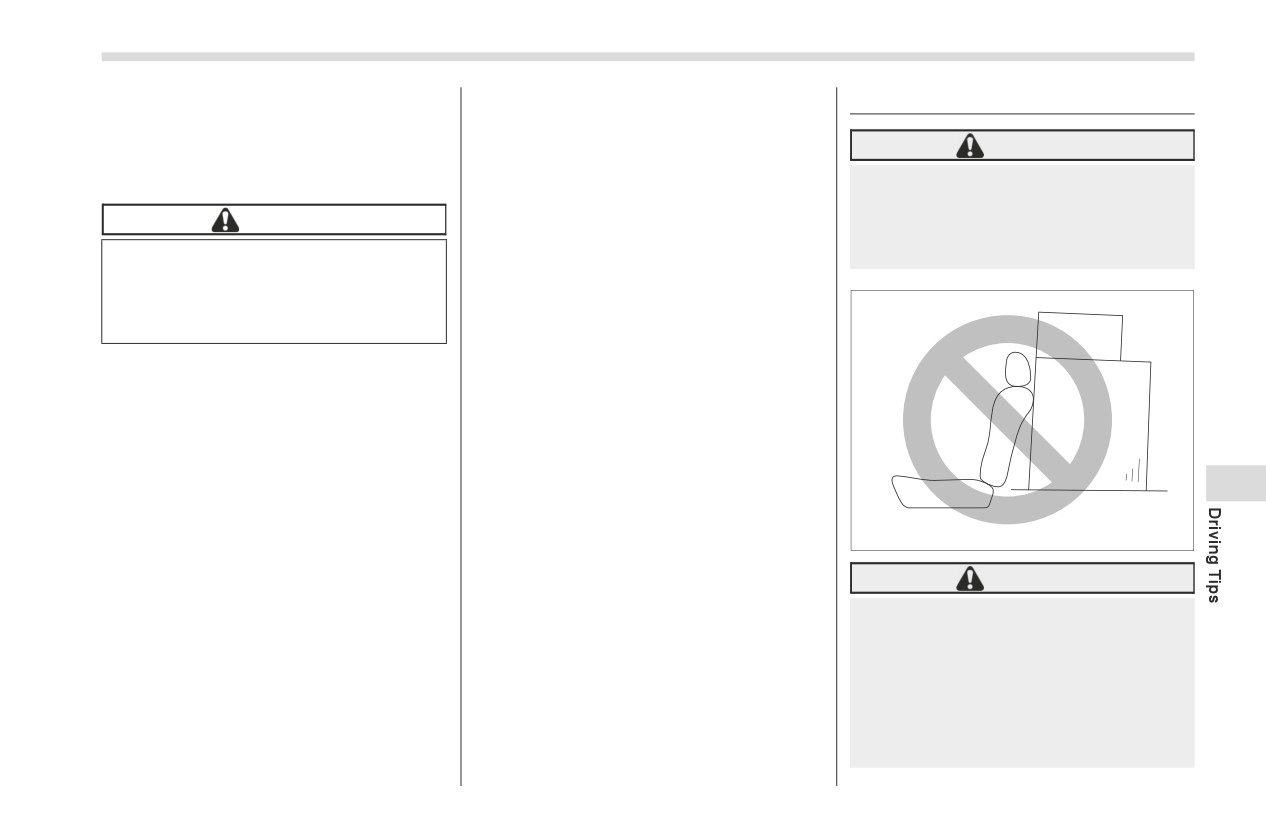
stack luggage
or
other
drive slowly, readjust or remove the
cargo higher than the top of the
device if it is contacting your vehicle,
seatback because it could tumble
and do not spin your wheels. Damage
forward and injure passengers in
caused to your vehicle by use of a
the event of a sudden stop or
traction device is not covered under
accident. Keep luggage or cargo
warranty.
low, as close to the floor as
Make certain that any traction device
possible.
you use is an SAE class S device, and
- CONTINUED -
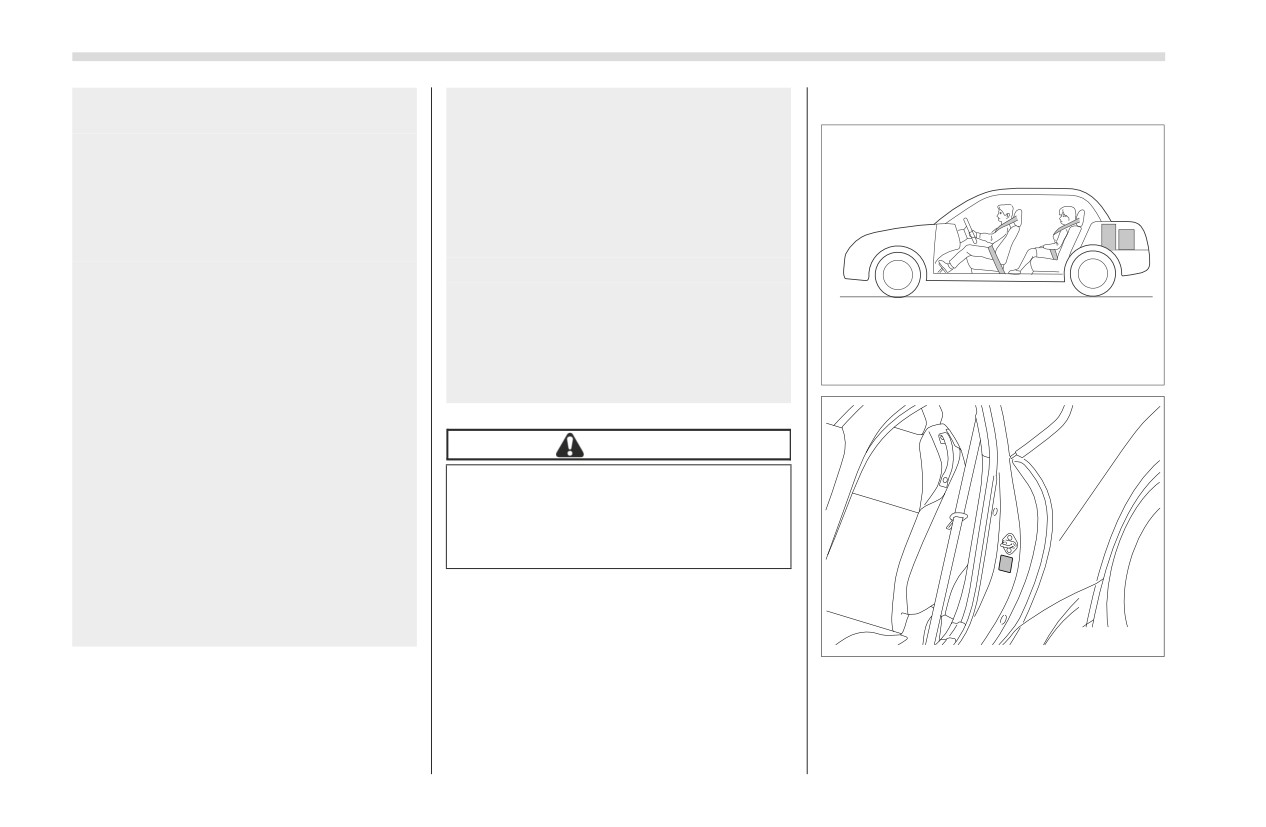
298
Loading Your Vehicle
Stow cargo and luggage in the
Do not place cargo or luggage in
■ Vehicle Capacity Weight
trunk whenever possible.
or on the following locations as
To prevent cargo and luggage
the item may get under the clutch,
from sliding forward during
brake, or accelerator pedal and
braking, do not stack anything in
prevent the pedals from being
the enlarged trunk. Keep cargo
depressed properly, block the
and luggage low, as close to the
driver’s vision, or hit the driver or
floor as possible.
passengers, causing an accident:
When you carry something inside
-
At the feet of the driver
the vehicle, secure it whenever
-
On the front passenger or rear
you can to prevent it from being
seats (when stacking items)
thrown around inside the vehicle
-
On the rear shelf
during sudden stops, sharp turns
-
On the instrument panel
D00250
or in an accident.
-
On the dashboard
Secure long items properly to
prevent them from shooting
forward and causing serious
CAUTION
injury during a sudden stop.
Do not carry spray cans, containers
Never exceed the maximum load
with flammable or corrosive liquids
limit. If you do, some parts on
or any other dangerous items inside
your vehicle can break, or it can
the vehicle.
change the way your vehicle
handles. This could result in loss
of control and cause personal
NOTE
injury. Also, overloading can
For better fuel economy, do not carry
shorten the life of your vehicle.
unneeded cargo.
801321
The load capacity of your vehicle is deter-
mined by weight, not by available cargo
space. The maximum load you can carry
in your vehicle is shown on the tire infla-
tion pressure label attached to the driver’s
side center pillar. It includes the total
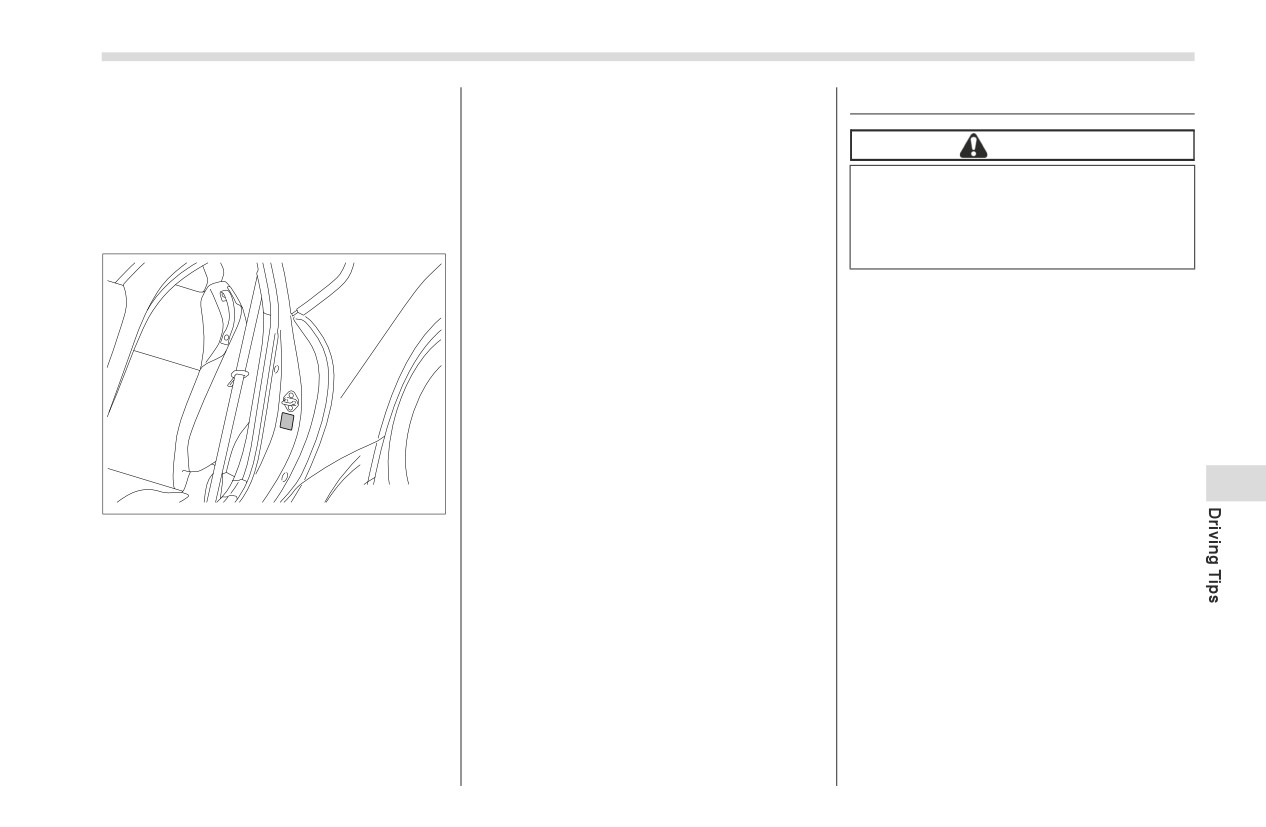
Trailer Towing
299
weight of the driver and all passengers,
In addition, the total weight applied to
8-10. Trailer Towing
their belongings, and any optional equip-
each axle (GAW) must never exceed the
ment.
GAWR. The front and rear GAWs can be
CAUTION
adjusted by relocating luggage inside the
■ GVWR and GAWR (Gross
vehicle.
Your vehicle is neither designed nor
Vehicle Weight Rating and
Even if the total weight of your luggage is
intended to be used for trailer tow-
lower than the vehicle capacity weight,
ing. Therefore, never tow a trailer
Gross Axle Weight Rating)
either front or rear GAW may exceed the
with your vehicle.
GAWR, depending on the distribution of
the luggage.
SUBARU assumes no responsibility for
When possible, the load should be evenly
injuries or vehicle damage that may result
distributed throughout the vehicle.
from trailer towing, from any trailer towing
If you carry heavy loads in the vehicle, you
equipment or from any errors or omissions
should confirm that GVW and front and
in the instructions accompanying such
rear GAWs are within the GVWR and
equipment. SUBARU warranties do not
GAWR by putting your vehicle on a
apply to vehicle damage or malfunction
vehicle scale, found at a commercial
caused by trailer towing.
weighing station.
Do not use replacement tires with a lower
8
801321
load range than the originals because
Certification label
they may lower the GVWR and GAWR
limitations. Replacement tires with a
The certification label attached to the
higher load range than the originals do not
driver’s side center pillar shows GVWR
increase the GVWR and GAWR limita-
(Gross Vehicle Weight Rating) and
tions.
GAWR (Gross Axle Weight Rating).
The GVW (Gross Vehicle Weight) must
never exceed the GVWR. GVW is the
combined total of weight of the vehicle,
fuel, driver, all passengers, luggage, and
any optional equipment. Therefore, the
GVW changes depending on the situation.
In Case of Emergency
9-1. If You Park Your Vehicle in an Emergency
302
If No Steam Is Coming from the Engine
9-2. Maintenance Tools
302
Compartment
319
Models with Flat Tire Repair Kit
303
9-6. Towing
320
Models with Spare Tire
303
Towing Hook and Tie-Down Hooks/Holes
320
9-3. Flat Tires
303
Using a Flat-Bed Truck
324
Changing a Flat Tire
303
Towing with All Wheels on the Ground
324
Sealing a Flat Tire (Models with the Flat
9-7. Access Key Fob - If Access Key Fob Does
Tire Repair Kit)
306
Not Operate Properly
325
Tire Pressure Monitoring System (TPMS)
Locking and Unlocking
326
(If Equipped)
315
Switching Power Status
326
TPMS Screen (If Equipped)
316
Starting Engine
326
9-4. Jump Starting
316
9-8. Malfunctions of the Center Information
Battery Precautions
316
Display
327
How to Jump Start
317
9-9. If Your Vehicle Is Involved in an Accident
328
9-5. Engine Overheating
319
To Restart the Engine When Involved in an
If Steam Is Coming from the Engine
Accident
328
Compartment
319
9
302
If You Park Your Vehicle in an Emergency
9-1. If You Park Your Vehicle
NOTE
9-2. Maintenance Tools
in an Emergency
When the hazard warning flasher is on,
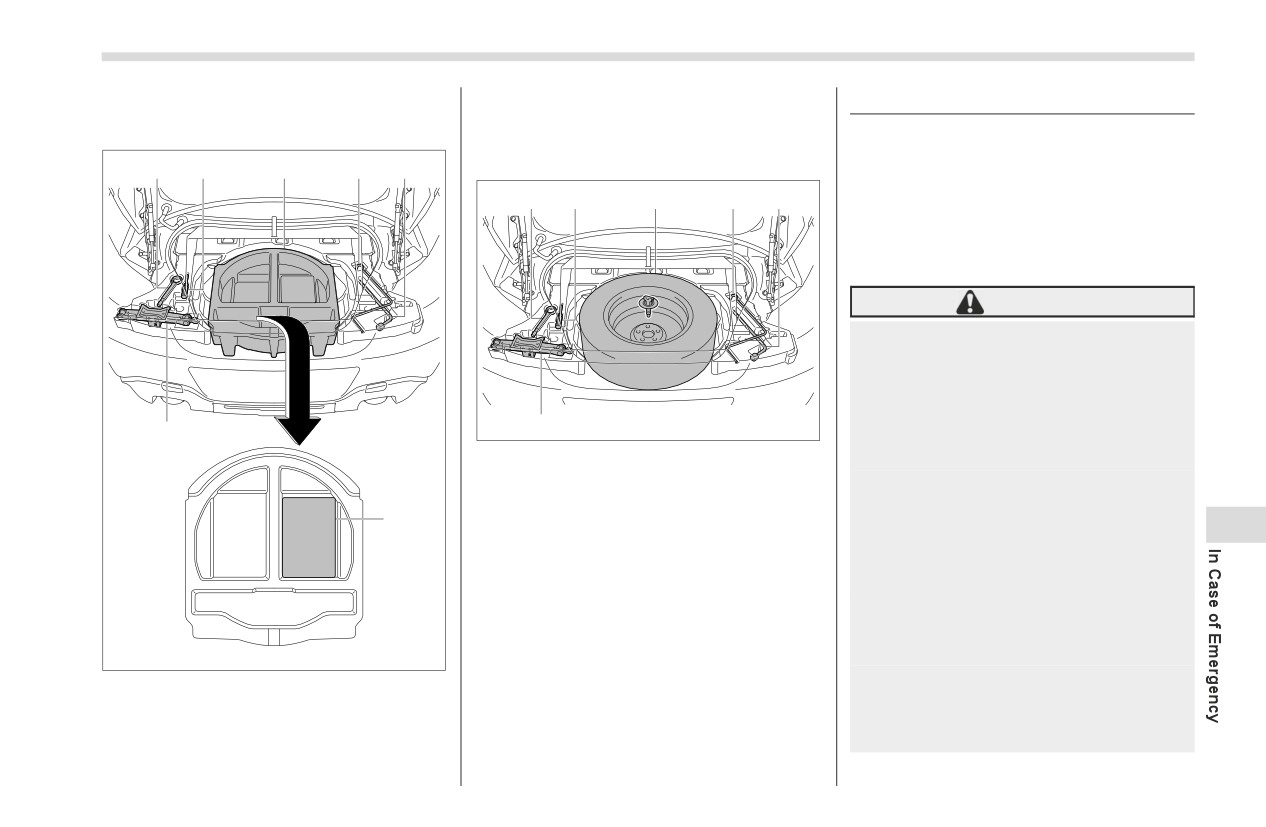
Your vehicle is equipped with the following
the turn signals do not work.
maintenance tools.
Jack
Jack handle
Screwdriver
Towing hook (eye bolt)
Wheel nut wrench
901197
The hazard warning flasher should be
used in day or night to warn other drivers
when you have to park your vehicle under
emergency conditions.
Avoid stopping on the road. It is best to
safely pull off the road if a problem occurs.
The hazard warning flasher can be acti-
vated regardless of the ignition switch
position.
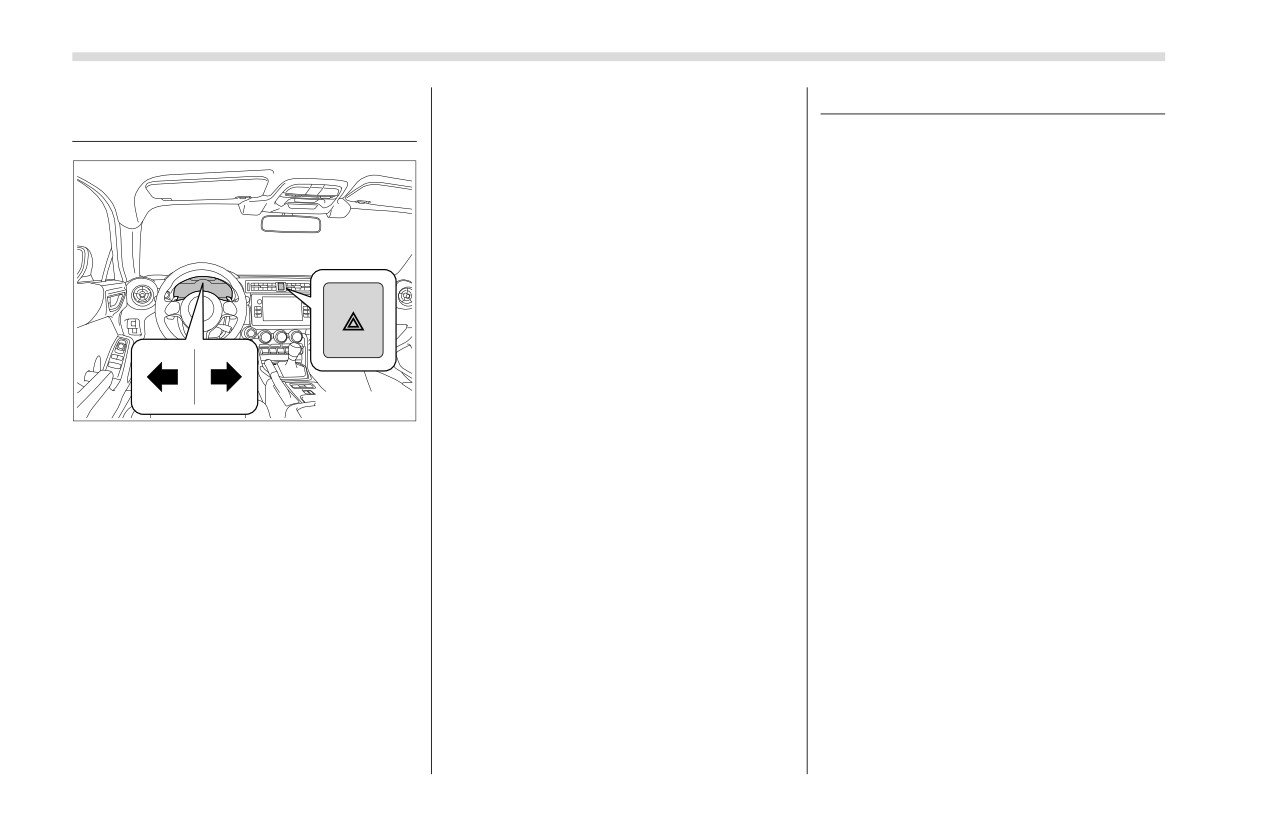
Turn on the hazard warning by pressing
the hazard warning flasher switch. Turn it
off by pressing the switch again.
When the hazard warning flasher are
flashing, the corresponding turn signal
indicator will also flash.
Flat Tires
303
6) Screwdriver
■ Models with Flat Tire Repair
9-3. Flat Tires
7) Flat tire repair kit
Kit
If you have a flat tire while driving, never
■ Models with Spare Tire
brake suddenly; keep driving straight
5
6
1
2
3
ahead while gradually reducing speed.
5
6
1
2
3
Then slowly pull off the road to a safe
place.
■ Changing a Flat Tire
WARNING
Use only the jack and the jack
handle provided with your
vehicle. The jack supplied with
the vehicle is designed only for
changing a tire. Never get under
901216
4
4
the vehicle while supporting the
1)
Spare tire
vehicle with this jack.
2)
Jack handle
Do not jack up the vehicle on an
3)
Wheel nut wrench
incline or a loose road surface.
4)
Jack
7
The jack can come out of the
9
5)
Towing hook (eye bolt)
jacking point or sink into the
6)
Screwdriver
ground and this can result in
serious injury or death.
Before jacking up the vehicle, be
sure that there are no occupants
901198
or cargo on board.
1)
Under-floor storage compartment
Do not jack up the vehicle with an
2)
Jack handle
object on or underneath the jack.
3)
Wheel nut wrench
The jack can be unstable and this
4)
Jack
can result in a severe accident.
5)
Towing hook (eye bolt)
- CONTINUED -
304
Flat Tires
NOTE
5. Take out the jack, jack handle and
Always turn off the engine before
wheel nut wrench.
raising the flat tire off the ground
Contact a SUBARU dealer when jack-
using the jack. Never swing or
ing up the vehicle using a garage jack.
The tools and the spare tire are stored
push the vehicle supported with
under the floor of the trunk. Refer to
1. Park on a hard, level surface, when-
the jack. The jack can come out of
"Maintenance Tools" ) P302.
ever possible, then stop the engine.
the jacking point due to a jolt and
this can result in serious injury or
2. Set the parking brake securely and
NOTE
death.
shift the shift lever in reverse (MT models)
Make sure that the jack is well lubri-
or the select lever to the “P” (Park) posi-
All passengers must exit the
cated before using it.
tion (AT models).
vehicle before you raise it with
the jack. Raising the vehicle with
3. Turn on the hazard warning flasher
someone inside of it could result
and unload all occupants and luggage
in serious injury or death.
from the vehicle.
Do not start the vehicle while it is
supported by the jack. Doing so
could result in serious injury or
death.
CAUTION
901295
Do not hit and bend the disc rotor
backing plate when removing and
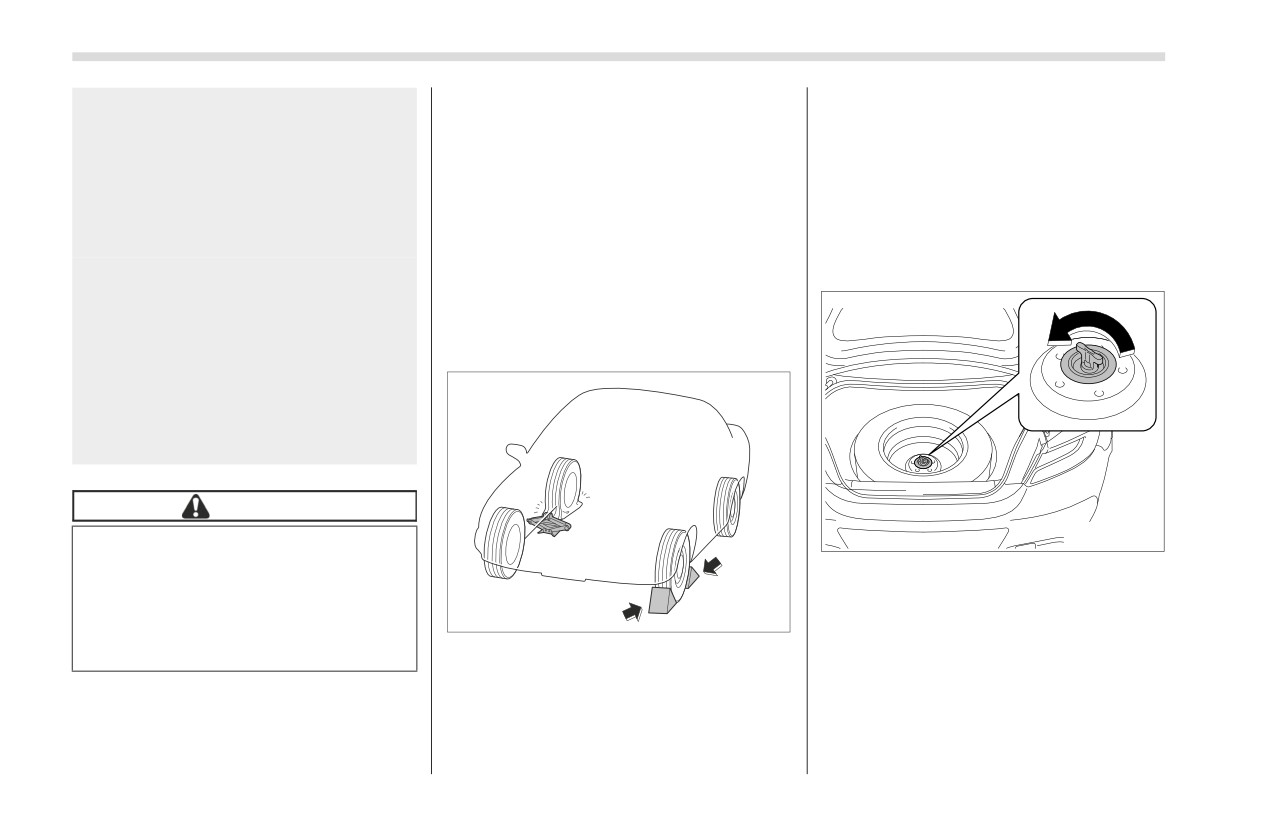
6. Models with spare tire: Take out the
installing the tire. A bent backing
under-floor storage compartment and turn
plate may scrape against the disc
the attaching bolt counterclockwise, then
901050
rotor and cause noise while the
take the spare tire out.
vehicle is in motion.
4. Put wheel blocks at the front and rear
of the tire diagonally opposite the flat tire.
Flat Tires
305
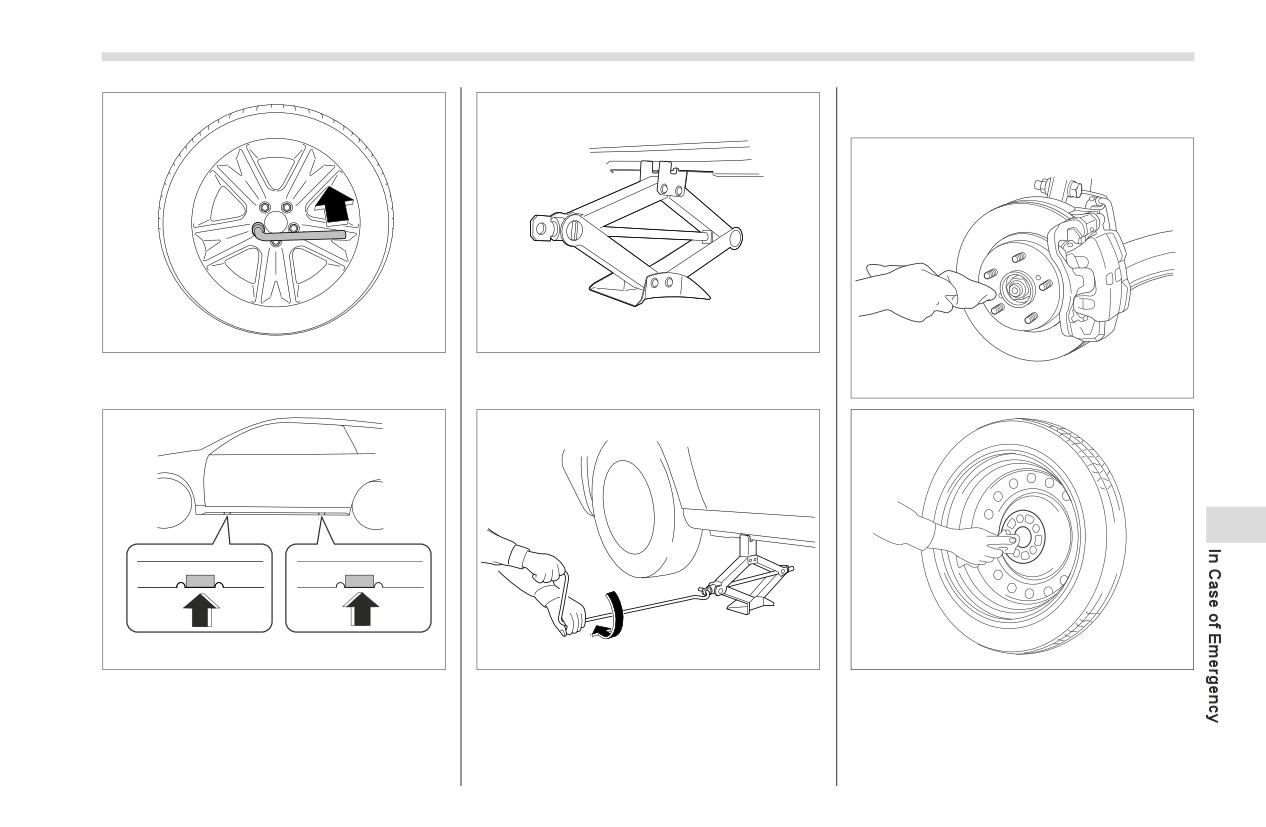
10. Remove the wheel nuts and the flat
tire.
900836
901041
7. Loosen the wheel nuts using the wheel
Turn the jackscrew by hand until the jack
900009
nut wrench but do not remove the nuts.
head engages firmly into the jack-up point.
9
900635
901006
600162
8. Place the jack under the side sill at the
9. Insert the jack handle into the jack-
11. Before putting the spare tire on, clean
front or rear jack-up point closest to the flat
screw, and turn the handle until the tire
the mounting surface of the wheel and
tire.
clears the ground. Do not raise the vehicle
hub with a cloth.
higher than necessary.
- CONTINUED -
306
Flat Tires
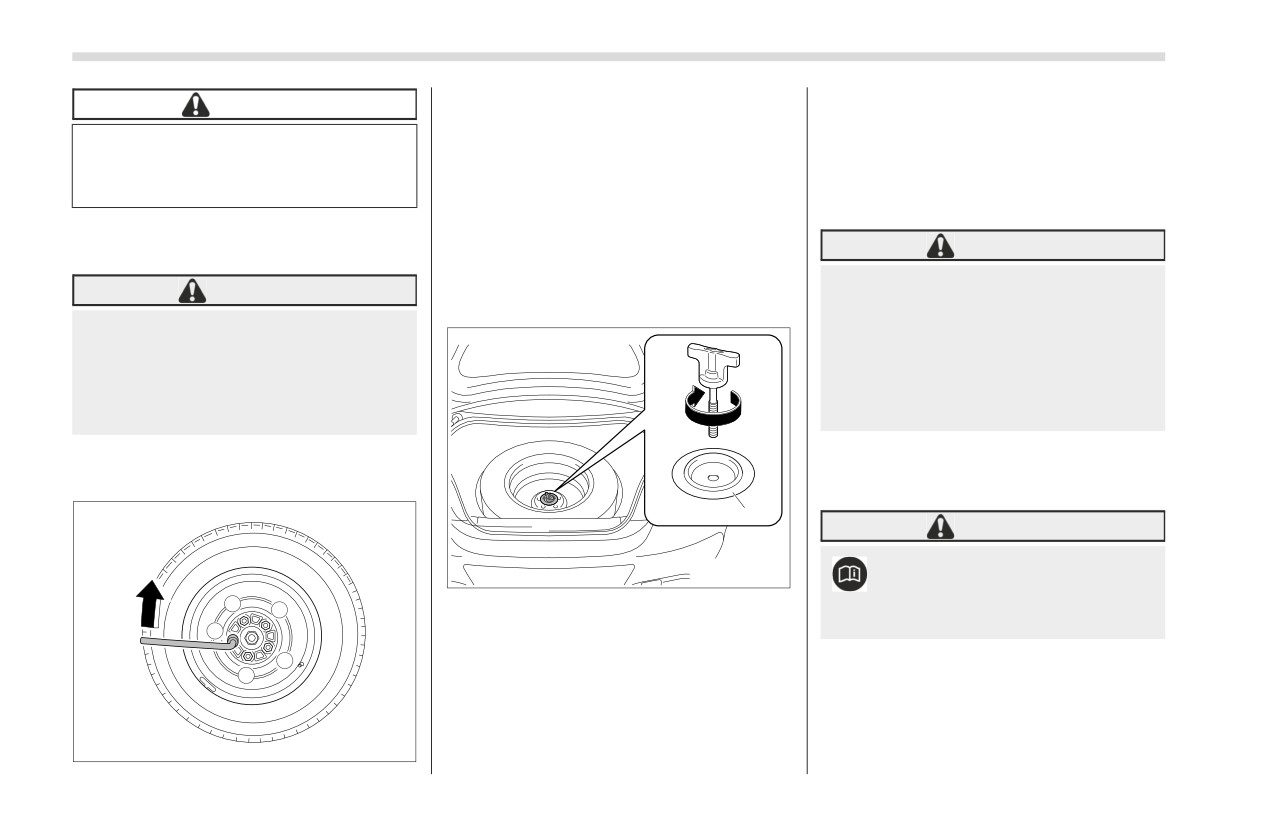
14. Use the wheel nut wrench to securely
NOTE
CAUTION
tighten the wheel nuts to the specified
If you cannot fix the flat tire firmly, try
torque, following the tightening order in
If the threaded part was damaged,
turning the support holder upside
the illustration.
you should immediately contact
down.
your SUBARU dealer.
For the wheel nut tightening torque, refer
16. Store the jack, jack handle and wheel
to "Tires" ) P385. Never use your foot on
nut wrench in their storage locations.
the wheel nut wrench or a pipe extension
12. Put on the spare tire. Replace the
on the wrench because you may exceed
WARNING
wheel nuts. Tighten them by hand.
the specified torque. Have the wheel nut
torque checked at the nearest automotive
Never place a tire or tire changing
WARNING
service facility.
tools in the passenger compartment
Do not use oil or grease on the
after changing wheels. In a sudden
wheel studs or nuts when the spare
stop or collision, loose equipment
tire is installed. This could cause
could strike occupants and cause
the nuts to become loose and lead
injury. Store the tire and all tools in
to an accident.
the proper place.
13. Turn the jack handle counterclockwise
■ Sealing a Flat Tire (Models
to lower the vehicle.
with the Flat Tire Repair Kit)
1
WARNING
901296
Read these instructions and
4
1) Support holder
warnings carefully before sealing a
2
flat tire.
1
15. Models with spare tire: Store the flat
5
tire in the spare tire compartment. Install
3
with the support holder facing upward and
secure the flat tire by firmly tightening the
attaching bolt.
600192