Subaru Ascent (2023 year). Manual in english - page 4
92
SRS airbag (Supplemental Restraint System airbag)
24
Side impact sensor (front door left-hand
In a moderate to severe frontal collision,
side)
the following components deploy.
25
Side impact sensor (front door right-hand
side)
. SRS frontal airbag for driver
26
Lap belt pretensioner (front passenger’s
. Front passenger’s SRS frontal airbag
side)
. SRS knee airbag for driver
27
Lap belt pretensioner (driver’s side)
. SRS curtain airbag*1
28
Side impact sensor (backward of rear
wheel house right-hand side)
*1: When an offset frontal collision that is severe
29
Side impact sensor (backward of rear
enough to deploy the front airbag occurs.
wheel house left-hand side)
30
Second-row seatbelt pretensioner (right-
These components supplement the seat-
hand side)
belts by reducing the impact to the
31
Second-row seatbelt pretensioner (left-
occupant’s head, chest and knees.
hand side)
32
Front passenger’s seat position sensor
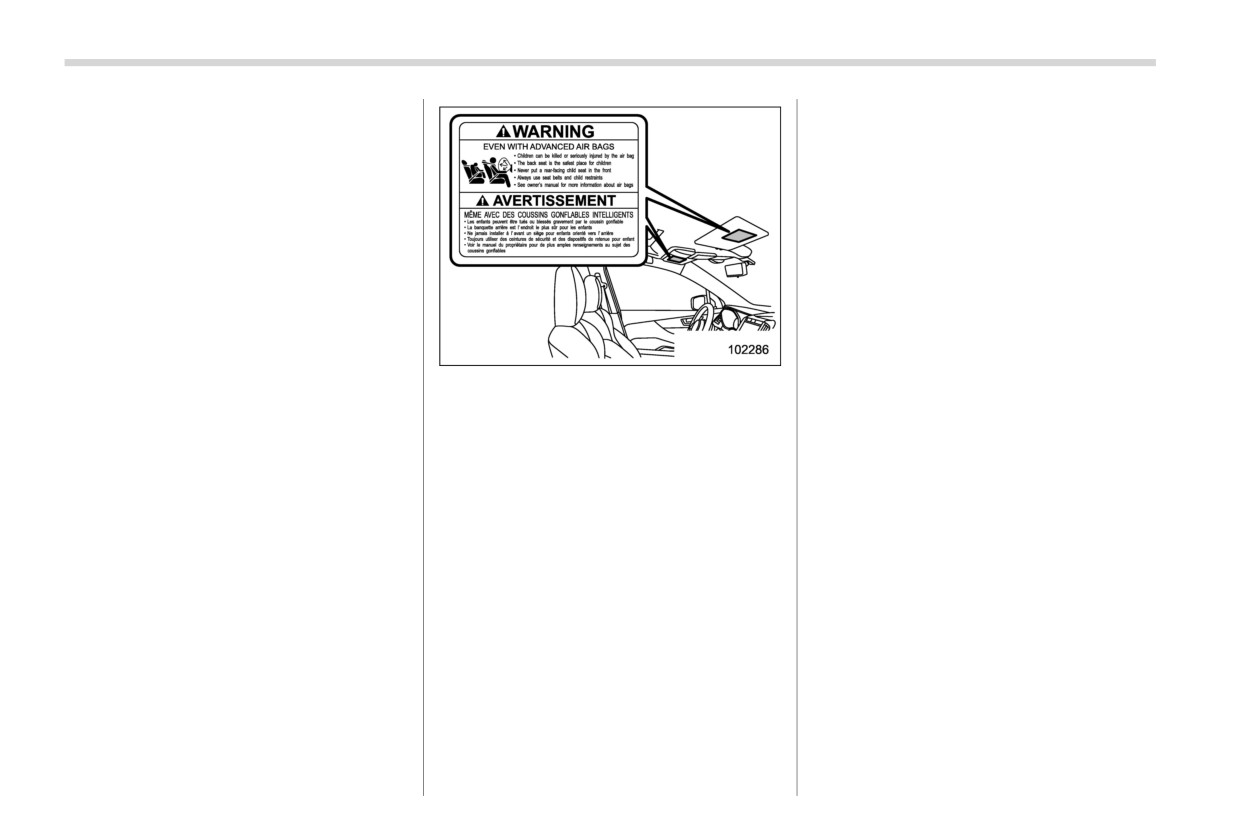
This vehicle has warning labels on the
NOTE
driver’s and front passenger’s sun visors
Only the driver’s SRS frontal airbag and
beginning with the phrase “EVEN WITH
front passenger’s SRS frontal airbag
& SUBARU advanced frontal
ADVANCED AIR BAGS” and a tag at-
are controlled by the SUBARU ad-
airbag system
tached to the glove box lid beginning with
vanced frontal airbag system.
This vehicle is equipped with a SUBARU
the phrase
“Even with Advanced Air
advanced frontal airbag system that com-
Bags”. Make sure that you carefully read
! Driver’s SRS frontal airbag
plies with the new advanced frontal airbag
the instructions on the warning labels and
The driver’s SRS frontal airbag uses a dual
requirements in the amended Federal
tag.
stage inflator. The inflator operates in
Motor Vehicle Safety Standard (FMVSS)
Always wear your seatbelt. The SUBARU
different ways depending on the severity
No. 208.
advanced frontal airbag system is a
of impact.
The SUBARU advanced frontal airbag
supplemental restraint system and must
! Front passenger’s SRS frontal air-
system automatically determines the de-
be used in combination with a seatbelt. All
bag
ployment force of the driver’s SRS frontal
occupants should wear a seatbelt or be
airbag at the time of deployment as well as
The front passenger’s SRS frontal airbag
seated in an appropriate child restraint
whether or not to activate the front
uses a dual stage inflator and an actuator.
system.
passenger’s SRS frontal airbag and, if
The inflator and the actuator operate in
For the locations of the SRS airbags, refer
activated, the deployment force of the SRS
different ways depending on the severity of
to “Components” FP90.
frontal airbag at the time of deployment.
impact.
SRS airbag (Supplemental Restraint System airbag)
93
sioners” FP61.
Do not use the front passenger’s
seat with the head restraint re-
CAUTION
moved.
Do not leave any articles on the
Observe the following precautions.
front passenger’s seat or the
Failure to do so may prevent the
seatbelt tongue and buckle en-
SUBARU advanced frontal airbag
gaged when you leave your vehi-
system from functioning correctly
cle.
or cause the system to fail.
Do not put sharp object(s) on the
Do not apply any strong impact to
seat or pierce the seat uphols-
the front passenger’s seat such
tery.
as by kicking.
Do not place a magnet near the
Do not let rear passengers rest
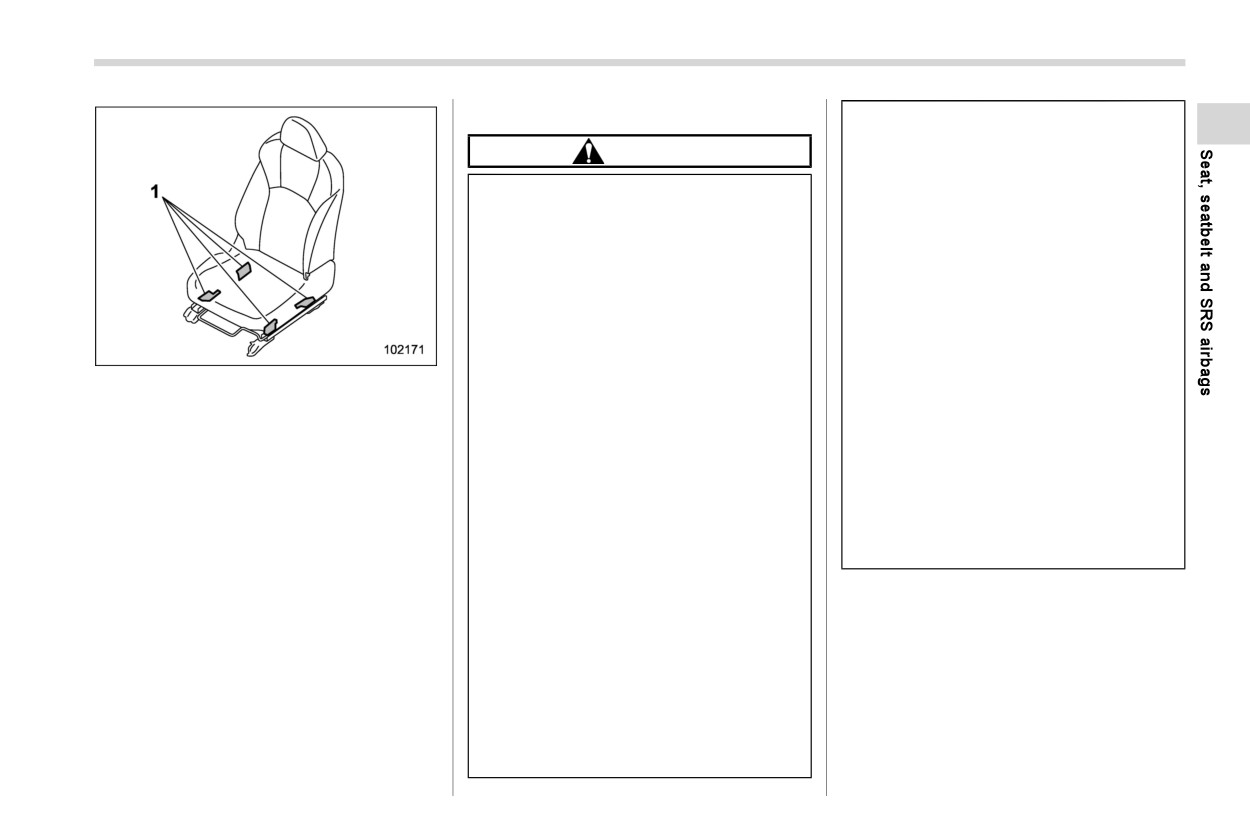
1
Occupant detection sensors
seatbelt buckle and the seatbelt
their feet between the front seat-
retractor.
The occupant detection sensors are in-
back and seat cushion.
stalled between the seat and seat rails,
Do not spill liquid on the front
Do not use front seats with their
backward-forward position and
and monitor the physique and posture of
passenger’s seat. If liquid is
seatback not being locked into
the front passenger. Using this informa-
spilled, wipe it off immediately.
place securely. If any of them are
tion, the occupant detection system deter-
Do not remove or disassemble
not locked securely, adjust them
mines whether the front passenger’s SRS
the front passenger’s seat.
again. For adjusting procedure,
frontal airbag should be deployed or not.
Do not install any accessory
refer to “Manual seat” FP33.
The occupant detection system may not
(such as an audio amplifier) other
inflate the front passenger’s SRS frontal
than a genuine SUBARU acces-
airbag even when the driver’s SRS frontal
sory under the front passenger’s
airbag deploys. This is normal. In this
seat.
case, although the front passenger’s SRS
Do not place anything (shoes,
frontal airbag does not operate, the front
umbrella, etc.) under the front
passenger’s seatbelt pretensioner oper-
passenger’s seat.
ates with the driver’s seatbelt preten-
Do not place any objects (books,
sioner. For details about the seatbelt
etc.) around the front passen-
pretensioner, refer to
“Seatbelt preten-
ger’s seat.
- CONTINUED -
94
SRS airbag (Supplemental Restraint System airbag)
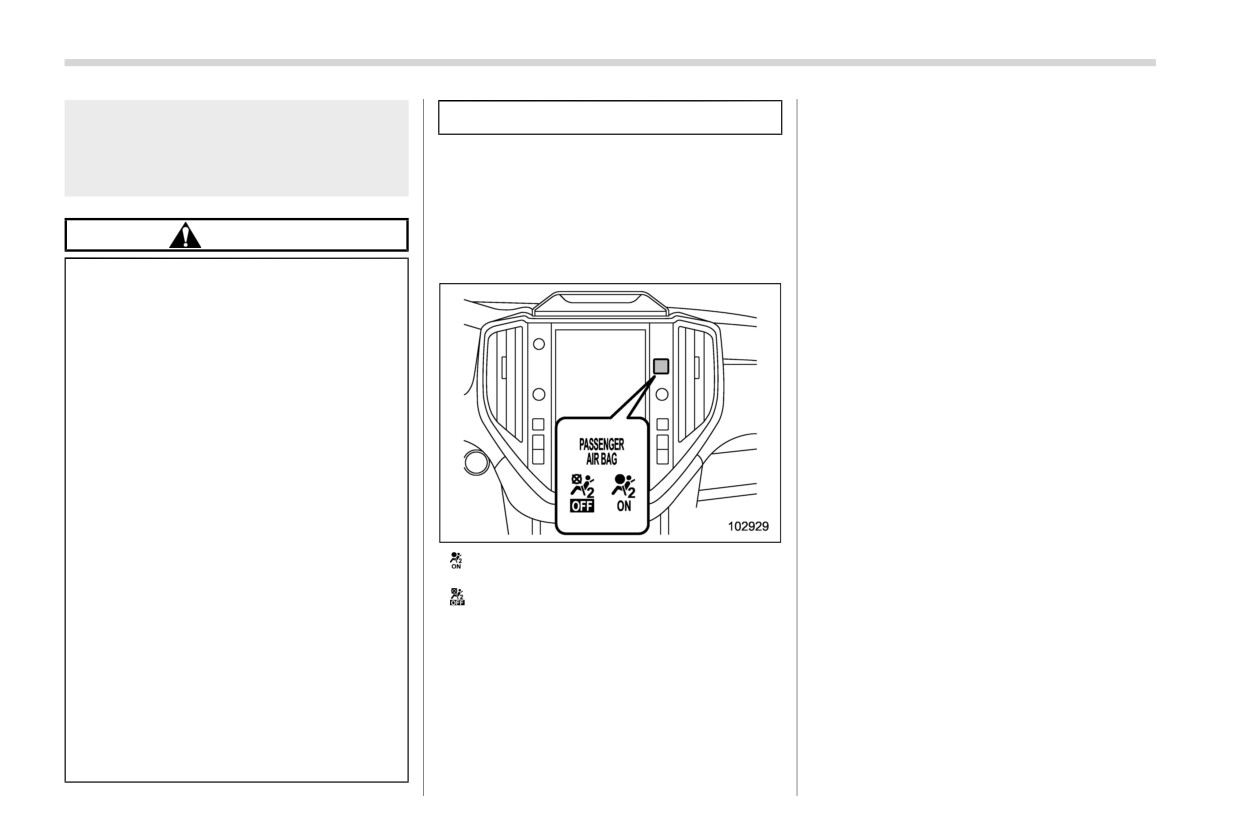
! Passenger’s frontal airbag ON and
! Occupant detection system
OFF indicators
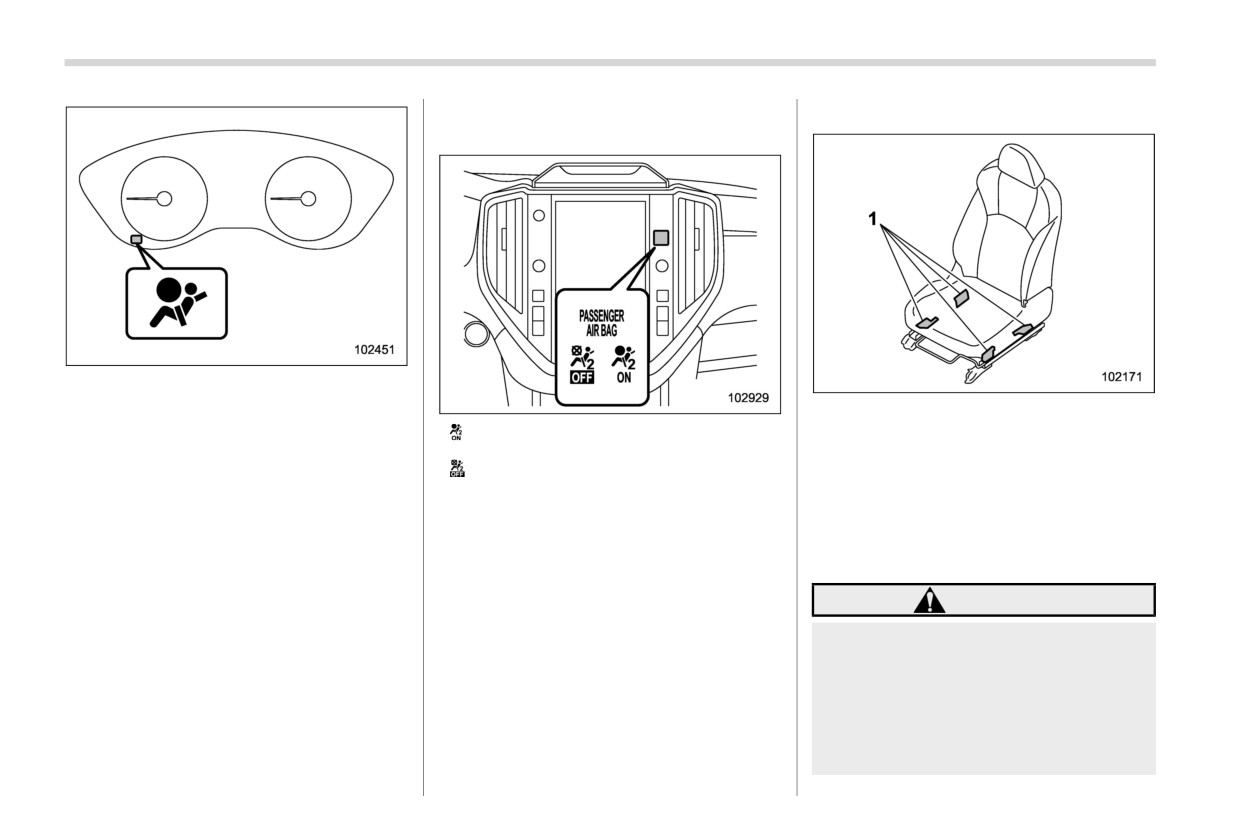
SRS airbag system warning light
If the seatbelt buckle switch and/or front
1
Occupant detection sensors
passenger’s occupant detection system
: Front passenger’s frontal airbag ON in-
The occupant detection sensors are in-
have failed, the SRS airbag system warn-
dicator
stalled between the seat and seat rails,
ing light will illuminate. If the SRS airbag
: Front passenger’s frontal airbag OFF
indicator
and monitor the physique and posture of
system warning light illuminates, immedi-
the front passenger. Using this informa-
ately stop the vehicle in a safe place, and
Refer to “Front passenger’s frontal airbag
tion, the occupant detection system deter-
consult a SUBARU dealer.
ON and OFF indicator lights” FP176.
mines whether the front passenger’s SRS
If your vehicle has sustained impact, this
frontal airbag should be deployed or not.
may affect the proper function of the
SUBARU advanced frontal airbag system.
WARNING
Have your vehicle inspected at your
SUBARU dealer. Do not use the front
Do not kick the front passenger seat
passenger’s seat while driving the vehicle
or subject it to severe impact. Other-
to your SUBARU dealer.
wise, the SRS airbag system warn-
ing light may illuminate to indicate a
malfunction of the front passenger
occupant detection system. In this
case, immediately stop the vehicle
SRS airbag (Supplemental Restraint System airbag)
95
in a safe place, and consult a
! Conditions in which front passen-
SUBARU dealer.
ger’s SRS frontal airbag is not
activated
The front passenger’s SRS frontal airbag
will not be activated when any of the
following conditions are met regarding
the front passenger’s seat:
. The seat is empty.
. The seat is equipped with an appro-
priate child restraint system and an
infant or a child is restrained in it. (See
WARNING that follows.)
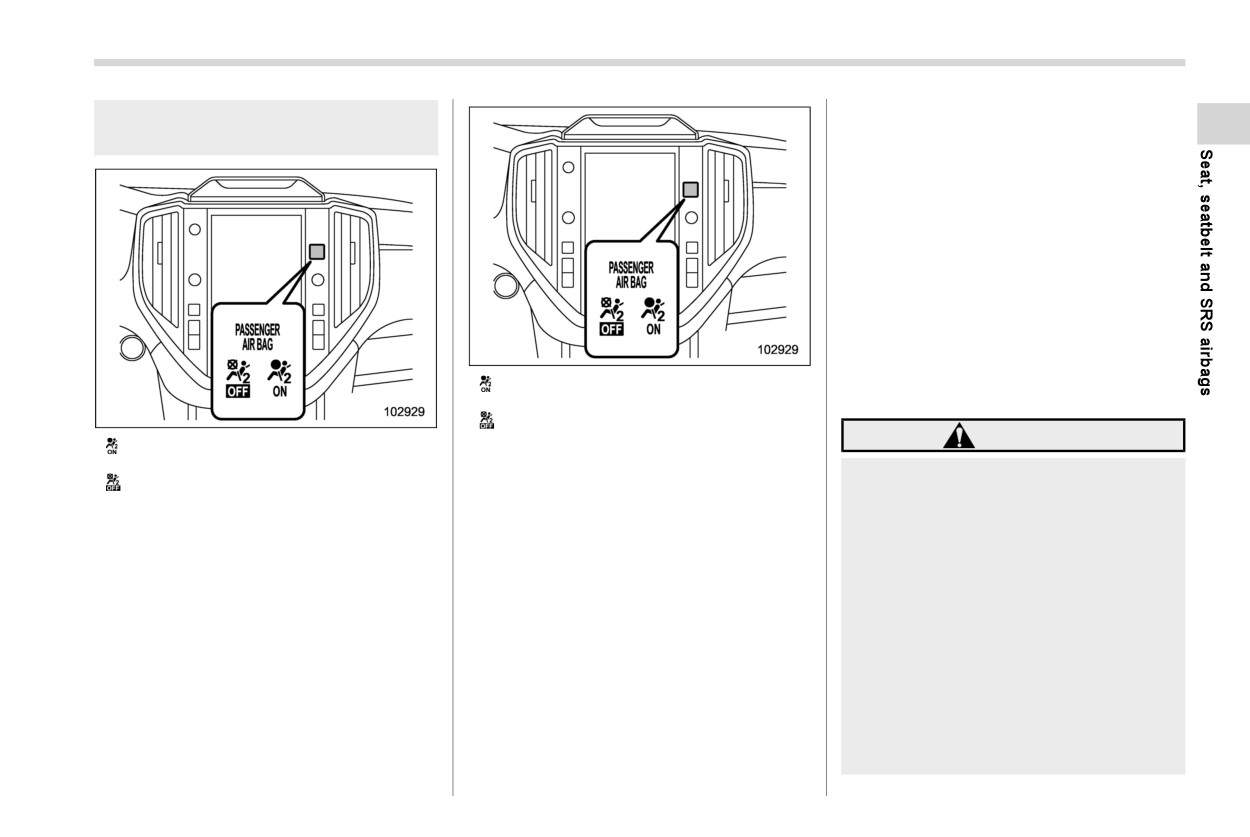
: Front passenger’s frontal airbag ON in-
. The front passenger’s occupant detec-
dicator
tion system is malfunctioning.
: Front passenger’s frontal airbag OFF
indicator
WARNING
: Front passenger’s frontal airbag ON in-
dicator
Also, if luggage is placed on the front
NEVER INSTALL A CHILD RE-
: Front passenger’s frontal airbag OFF
passenger’s seat, this may adversely
indicator
STRAINT SYSTEM IN THE FRONT
affect the ability of the system to determine
PASSENGER’S SEAT EVEN IF THE
If
the front passenger’s frontal airbag ON
deployment. This may prevent the front
FRONT PASSENGER’S SRS FRON-
and OFF indicators do not work properly,
passenger’s frontal airbag ON and OFF
TAL AIRBAG IS DEACTIVATED. Be
do not allow anyone to sit on the front
indicators from working properly. Check
sure to install it in the REAR seat in a
passenger’s seat and have the occupant
that the indicators work properly.
correct manner. Also, it is strongly
detection system checked by your
When the OFF indicator turns off and the
recommended that any child re-
SUBARU dealer.
ON indicator illuminates, the front passen-
straint system (including any boost-
ger’s frontal airbag may deploy during a
er seat) be installed in the REAR
collision. Remove luggage from the front
seat, and that even children who
passenger’s seat.
have outgrown a child restraint
system be also seated in the REAR
seat. This is because children sitting
in the front passenger’s seat may be
- CONTINUED -
96
SRS airbag (Supplemental Restraint System airbag)
killed or severely injured should the
the seatback.
well as the child restraint system
front passenger’s SRS frontal airbag
installation procedures in
“Child re-
deploy. REAR seats are the safest
straint systems” FP65, correctly install
! If the front passenger’s frontal
place for children.
the child restraint system.
airbag ON indicator illuminates
and the OFF indicator turns off
4. Turn the ignition switch to the “ON”
even when an infant or a small
position and make sure that the front
CAUTION
passenger’s frontal airbag ON indica-
child is in a child restraint sys-
tem (including booster seat)
tor turns off and the OFF indicator
When the front passenger’s seat is
illuminates.
occupied by an infant in an appro-
priate child restraint system, ob-
If the ON indicator still remains illuminated
serve the following precautions.
while the OFF indicator is turned off, take
Failure to do so may interfere with
the following actions.
the proper operation of the occupant
. Ensure that no article is placed on the
detection system, activating the
seat other than the child restraint
front passenger’s SRS frontal airbag
system and the child occupant.
even though that seat is occupied by
. Ensure that the backward-forward po-
an infant in the child restraint sys-
sition and seatback of the front pas-
tem.
senger’s seat are locked into place
. Do not place any article (includ-
securely by moving the seat back and
ing electronic devices) on the
forth.
seat other than the infant in the
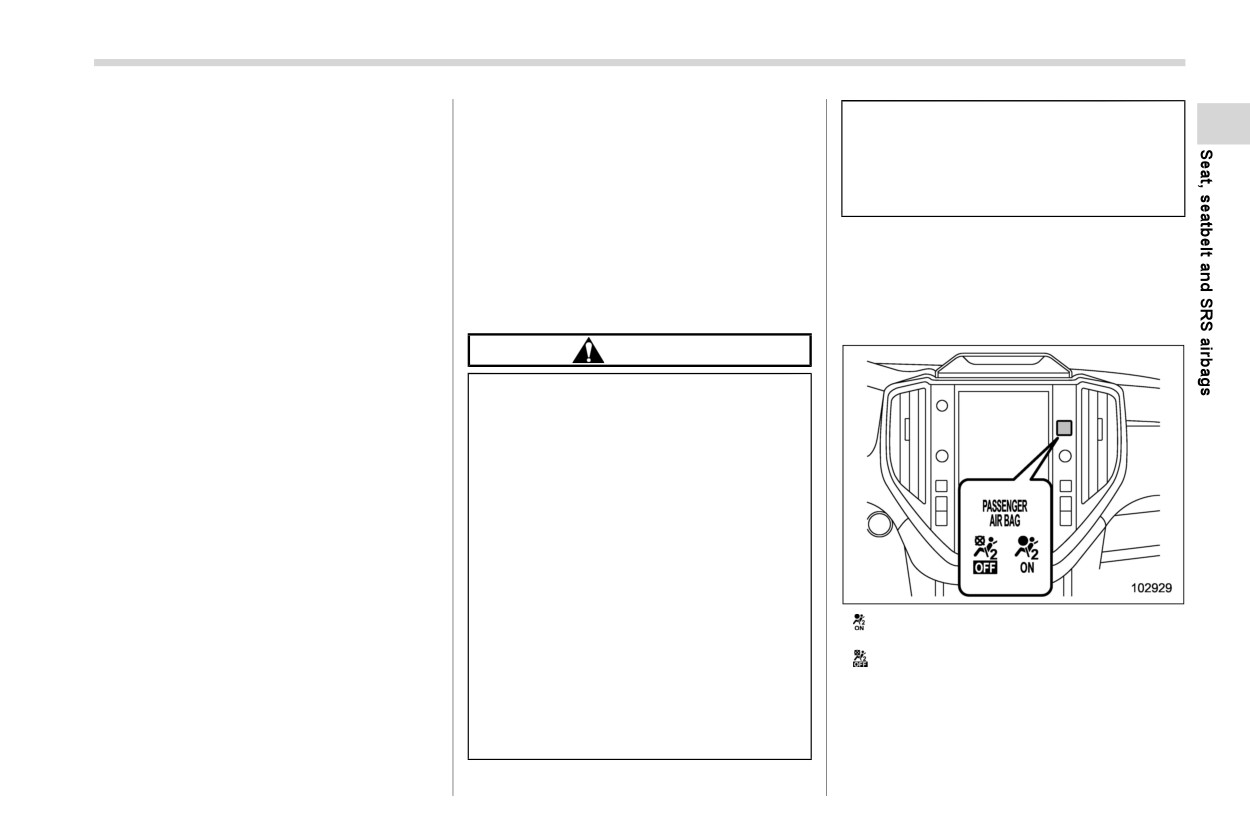
: Front passenger’s frontal airbag ON in-
If the ON indicator still remains illuminated
child restraint system.
dicator
while the OFF indicator turns off after
. Do not place more than one infant
: Front passenger’s frontal airbag OFF
taking the relevant corrective actions
in the child restraint system.
indicator
described above, relocate the child re-
. Do not install any accessories
1.
Turn the ignition switch to the “LOCK”/
straint system to the rear seat and im-
such as a table or TV onto the
“OFF” position.
mediately contact your SUBARU dealer
seatback.
for an inspection.
2.
Remove the child restraint system from
. Do not allow the rear seat occu-
the seat.
NOTE
pant to place his/her hands or
3.
By referring to the child restraint
legs on the front passenger’s
When a child who has outgrown a child
manufacturer’s recommendations as
seatback, or allow him/her to pull
restraint system or a small adult is
SRS airbag (Supplemental Restraint System airbag)
97
seated in the front passenger’s seat,
! Conditions in which front passen-
Do not squeeze any article be-
the SUBARU advanced frontal airbag
ger’s SRS frontal airbag is activated
tween the front passenger’s seat
system may or may not activate the
and side trim/pillar, door or cen-
The front passenger’s SRS frontal airbag
front passenger’s SRS frontal airbag
ter console box. This may lift the
will be activated for deployment upon
depending on the occupant’s seating
seat cushion.
impact when any of the following condi-
posture. Children should always wear a
tions are met regarding the front passen-
seatbelt when sitting in the seat irre-
ger’s seat.
! If the passenger’s frontal airbag
spective of whether the airbag is deac-
. When the seat is occupied by an adult.
OFF indicator illuminates and the
tivated or activated. If the front passen-
ON indicator turns off even when
. When certain items (e.g. jug of water)
ger’s SRS frontal airbag is activated
the front passenger’s seat is
are placed on the seat.
(the ON indicator remains illuminated
occupied by an adult
while the OFF indicator turns off), take
CAUTION
the following action.
. Ensure that no article is placed on
When the front passenger’s seat is
the seat other than the occupant.
occupied by an adult, observe the
following precautions.
If the ON indicator still remains illumi-
nated while the OFF indicator turns off
Failure to do so may lessen the load
despite the fact that the actions noted
on the front passenger’s seat, deac-
above have been taken, seat the child in
tivating the front passenger’s SRS
the rear seat and immediately contact
frontal airbag despite the fact that
your SUBARU dealer for an inspection.
the seat is occupied by an adult.
Even if the system has passed the
This may result in personal injury.
dealer inspection, it is recommended
. Do not allow the rear seat occu-
that on subsequent trips the child
pant to lift the front passenger’s
always take the rear seat.
: Front passenger’s frontal airbag ON in-
seat cushion using his/her feet.
dicator
Children who have outgrown a child
: Front passenger’s frontal airbag OFF
. Do not place any article under the
restraint system should always wear the
indicator
front passenger’s seat, or
seatbelt irrespective of whether the airbag
squeeze any article from behind
This can be caused by the adult incorrectly
is deactivated or activated.
and under the seat. This may lift
sitting in the front passenger’s seat.
the seat cushion.
1. Turn the ignition switch to the “LOCK”/
“OFF” position.
- CONTINUED -
98
SRS airbag (Supplemental Restraint System airbag)
2. Ask the front passenger to set the
If the OFF indicator still remains illumi-
seatback to the upright position, sit up
nated while the ON indicator remains off,
straight in the center of the seat
ask the occupant to move to the rear seat
cushion, correctly fasten the seatbelt,
and immediately contact
your
SUBARU
position his/her legs out forward, and
dealer for an inspection.
adjust the seat to the rearmost posi-
tion.
3. Turn the ignition switch to the “ON”
position.
If the OFF indicator remains illuminated
while the ON indicator remains off, take the
following actions.
1.
Turn the ignition switch to the “LOCK”/
“OFF” position.
2.
Make sure that the front passenger
does not use a blanket, extra seat
cushion, seat cover, extra seat heater
or massager, etc.
3.
If wearing excessive layers of clothing,
the front passenger should remove any
unnecessary items before sitting in the
front passenger’s seat, or should sit in
a rear seat.
4.
Turn the ignition switch to the “ON”
position and wait 6 seconds to allow
the system to complete self-checking.
Following the system check, both
indicators turn off for 2 seconds. Now,
the ON indicator should illuminate
while the OFF indicator remains off.
SRS airbag (Supplemental Restraint System airbag)
99
! Operation
The SRS airbags can function only when
the ignition switch is in the “ON” position.
The SUBARU advanced frontal airbag
system is designed to determine the
activation or deactivation condition of the
front passenger’s SRS frontal airbag de-
pending on the characteristic of item(s) or
person on the front passenger’s seat
monitored by the front passenger’s occu-
pant detection sensors. For this reason,
only the driver’s SRS frontal airbag may
deploy in the event of a collision, but this
does not mean failure of the system.
If the following sensors detect a predeter-
mined amount of force during a frontal
collision, the control module sends signals
to the airbag module(s)
(only driver’s
module or both driver’s and front passen-
ger’s modules) instructing the module(s) to
inflate the SRS frontal airbag(s).
. The front impact sensors
. The impact sensors in the airbag
control module
On the driver’s side, the SRS knee airbag
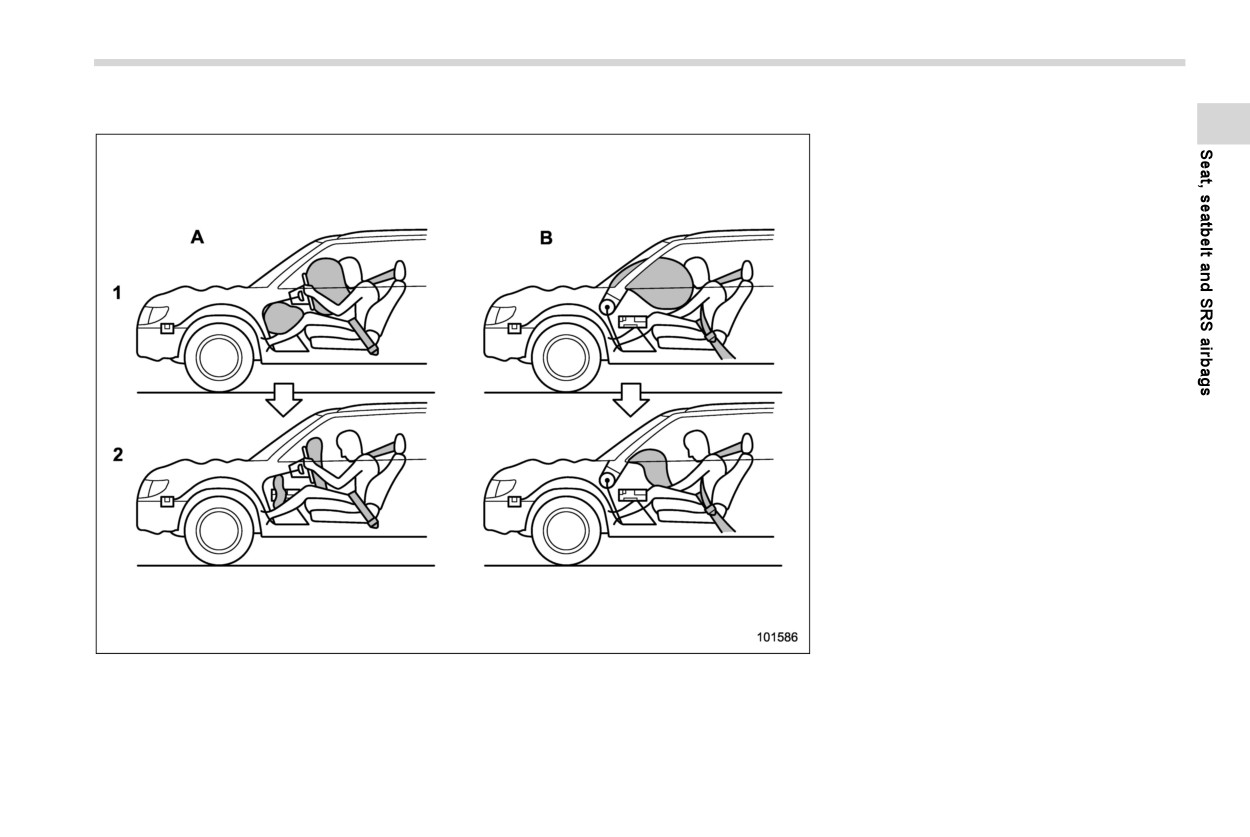
A
Driver’s side
also inflates with the SRS frontal airbag.
B
Passenger’s side
1
SRS AIRBAGs deploy as soon as a collision occurs.
2
After deployment, SRS AIRBAGs start to deflate immediately so that the driver’s vision is not
obstructed.
- CONTINUED -
100 SRS airbag (Supplemental Restraint System airbag)
The driver’s and front passenger’s SRS
would not protect the occupant in those
CAUTION
frontal airbags use dual stage inflators.
situations.
The two inflators of each airbag are
Do not touch the SRS airbag system
SRS airbag deployment depends on the
triggered either sequentially or simulta-
components around the steering
level of force experienced in the passen-
neously, depending on the severity of
wheel and dashboard with bare
ger compartment during a collision. That
impact, in the case of the driver’s SRS
hands right after deployment. Doing
level differs from one type of collision to
frontal airbag and depending on the
so can cause burns because the
another, and it may have no bearing on the
severity of impact and the characteristic
components can be very hot as a
visible damage done to the vehicle itself.
of item(s) or person on the seat in the case
result of deployment.
of the front passenger’s SRS frontal air-
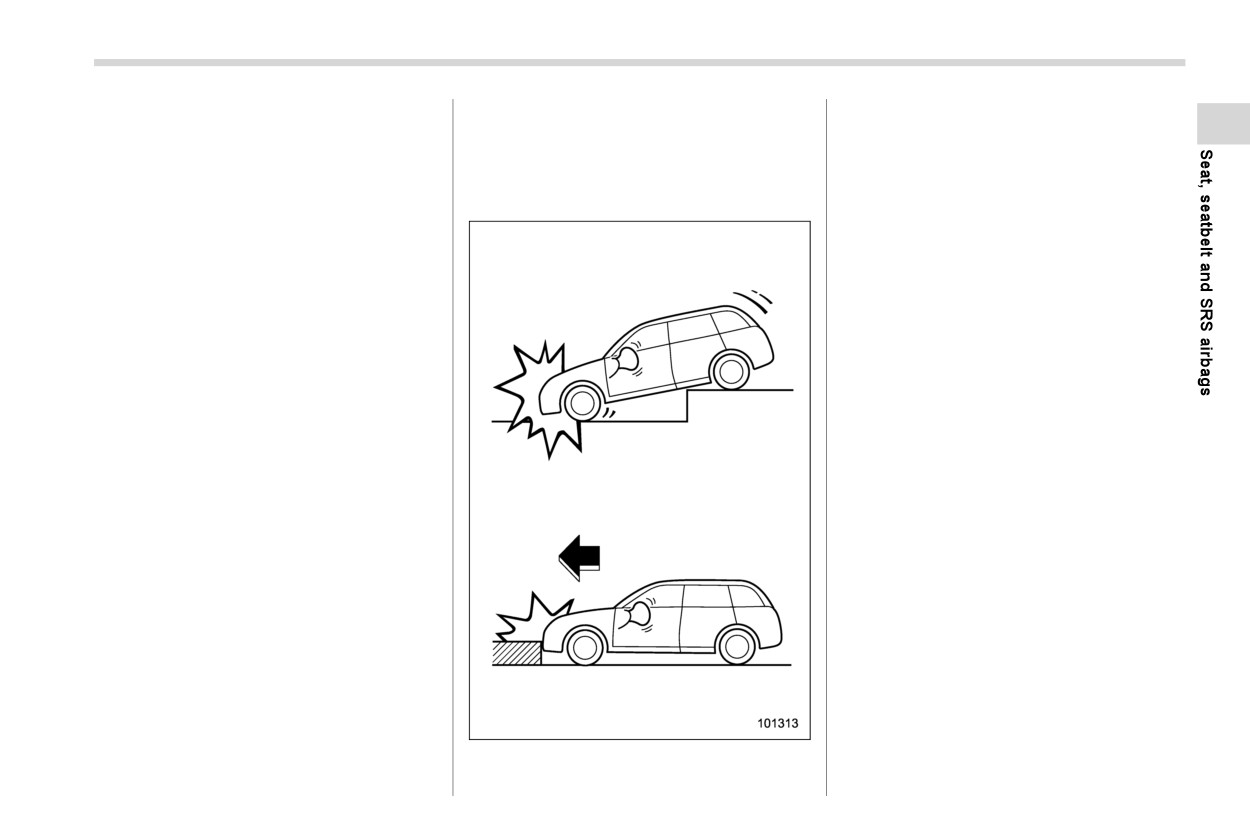
! Example of accident in which the
bag.
driver’s/driver’s and front pas-
! Example of the type of accident
! After deployment
senger’s SRS frontal airbag(s)
The driver’s SRS frontal airbag and front
will most likely deploy
After deployment, the SRS airbag imme-
passenger’s SRS frontal airbag are de-
diately starts to deflate so that the driver’s
signed as follows.
vision is not obstructed and the driver’s
. To deploy in the event of an accident
ability to maintain control of the vehicle is
involving a moderate to severe frontal
not impaired. The time required from
collision
detecting impact to the deflation of the
. To function on a one-time-only basis
SRS airbag after deployment is shorter
than the blink of an eye.
The driver’s SRS frontal airbag and front
passenger’s SRS frontal airbag are not
Both when only the driver’s SRS frontal
designed as follows.
airbag deploys and the driver’s and front
. To deploy in most lesser frontal im-
passenger’s SRS frontal airbags deploy,
pacts*1
the driver’s and front passenger’s seatbelt
pretensioners operate at the same time.
. To deploy in most side or rear impacts
or in most rollover accidents*2
When the SRS airbag deploys, a sudden,
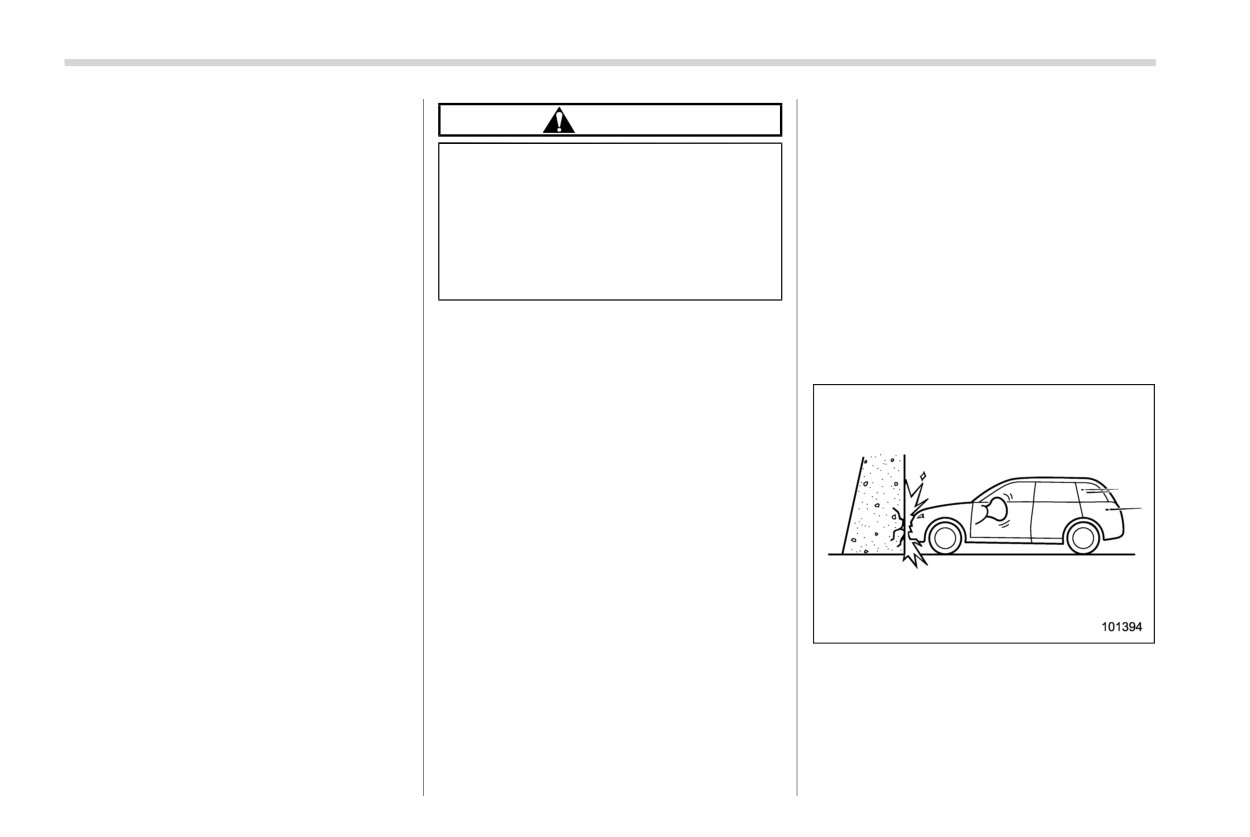
A head-on collision against a thick con-
*1: Because the necessary protection can be
fairly loud inflation noise will be heard and
crete wall at a vehicle speed of 12 to 19
achieved by the seatbelt alone.
some smoke will be released. These
mph (20 to 30 km/h) or higher activates
occurrences are a normal result of the
*2: Because deployment of only the driver’s
only the driver’s SRS frontal airbag or both
deployment. This smoke does not indicate
SRS frontal airbag or both the driver’s and
driver’s and front passenger’s SRS frontal
a fire in the vehicle.
front passenger’s SRS frontal airbags
airbags. The airbag(s) will also be acti-
SRS airbag (Supplemental Restraint System airbag)
101
vated when the vehicle is exposed to a
! Examples of the types of acci-
Only the driver’s SRS frontal airbag or both
frontal impact similar in fashion and
dents in which it is possible that
driver’s and front passenger’s SRS frontal
magnitude to the collision described
the driver’s/driver’s and front
airbags may be activated when the vehicle
above.
passenger’s SRS frontal
sustains a hard impact in the undercar-
airbag(s) will deploy
riage area from the road surface (such as
when the vehicle plunges into a deep ditch,
is severely impacted or knocked hard
against an obstacle on the road such as
a curb).
- CONTINUED -
102 SRS airbag (Supplemental Restraint System airbag)
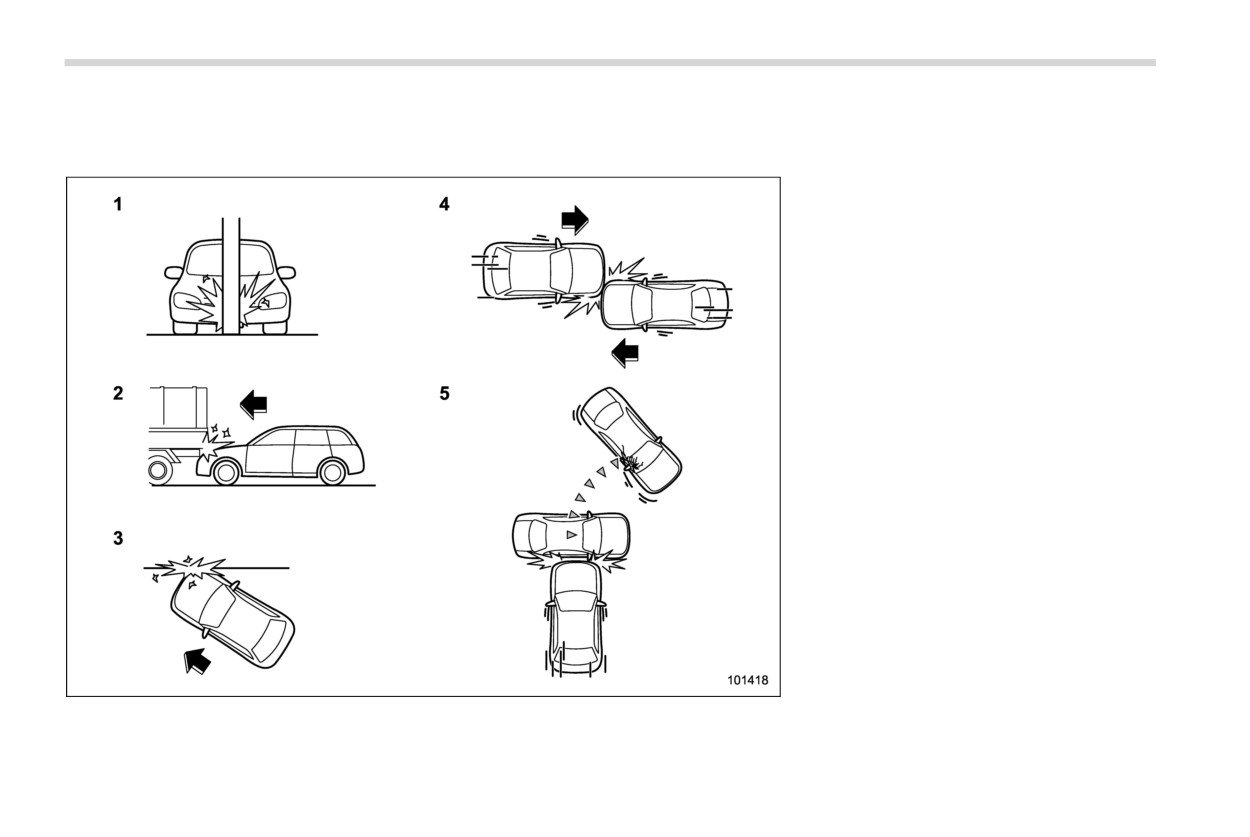
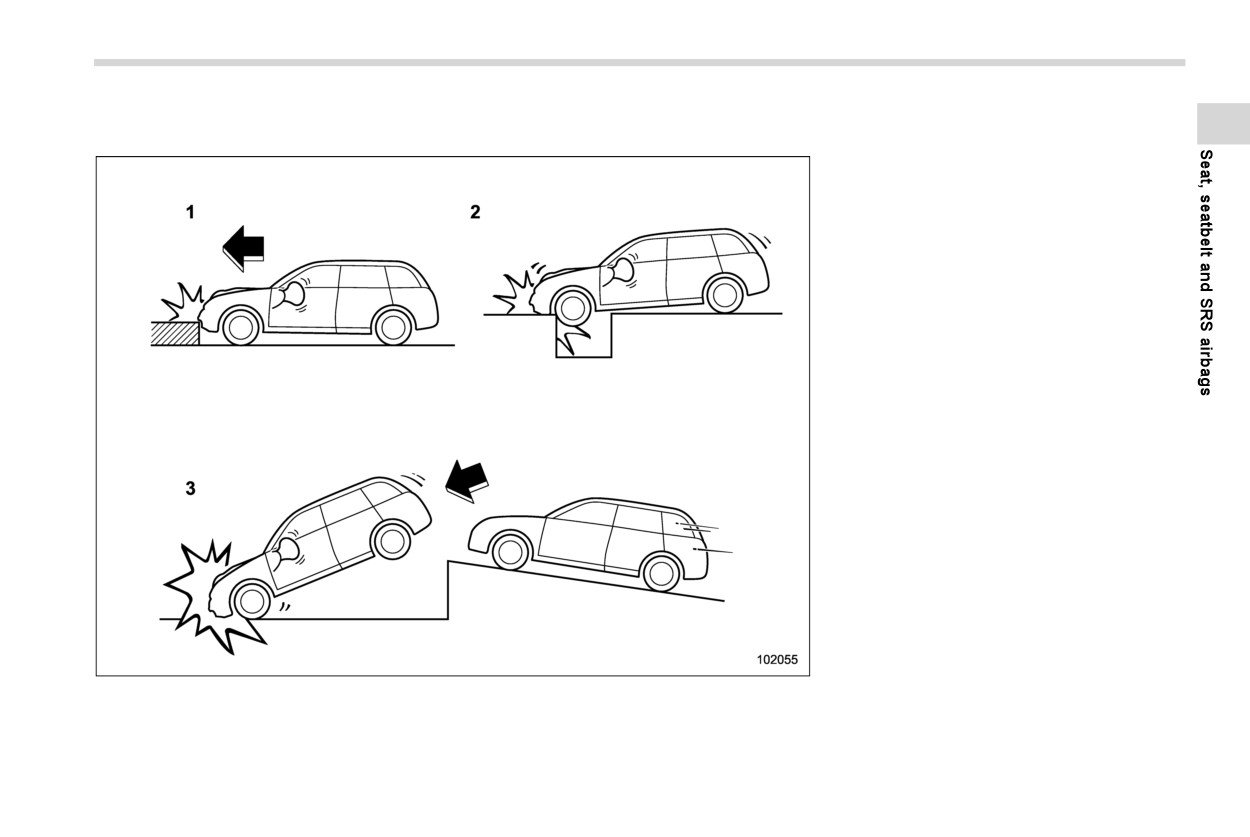
! Examples of the types of accidents in which deployment of the driver’s/driver’s and front passenger’s SRS frontal
airbag(s) is unlikely to occur
1
The vehicle strikes an object, such as a
telephone pole or sign pole.
2
The vehicle slides under the load bed of a
truck.
3
The vehicle sustains an oblique offset
frontal impact.
4
The vehicle sustains an offset frontal
collision.
5
The vehicle strikes an object that can
move or deform, such as a parked
vehicle.
There are many types of collisions which
might not necessarily require deployment
of driver’s/driver’s and front passenger’s
SRS frontal airbag(s). In the event of
accidents like those illustrated, the dri-
ver’s/driver’s and front passenger’s SRS
frontal airbag(s) may not deploy depend-
ing on the level of accident forces involved.
SRS airbag (Supplemental Restraint System airbag)
103
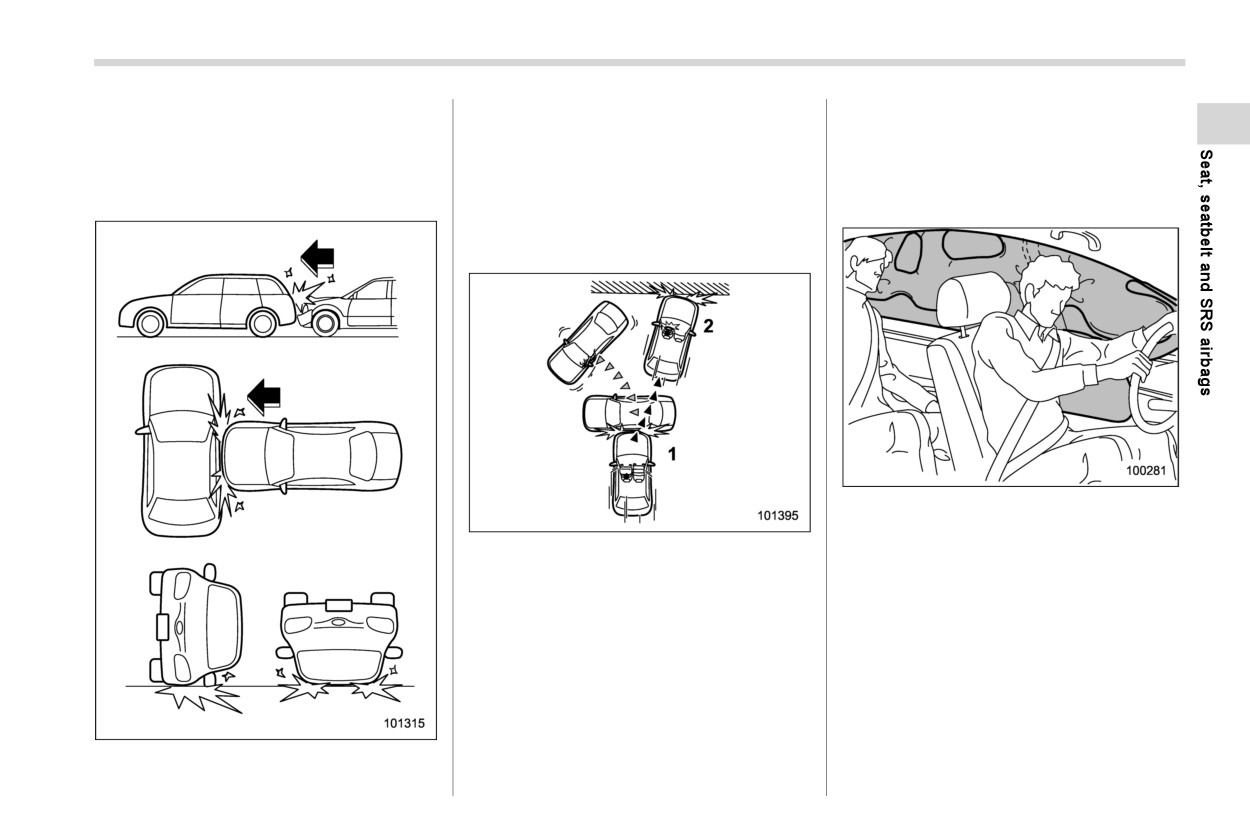
! Examples of the types of acci-
frontal airbags are not designed to deploy
passenger’s SRS frontal airbags is/are
dents in which the driver’s/dri-
in most of the following cases.
activated on the first impact, it/they will
ver’s and front passenger’s SRS
. If the vehicle is struck from the side or
not be activated on the second impact.
frontal airbag(s) are not de-
from behind
& SRS side airbag and SRS
signed to deploy in most cases
. If the vehicle rolls onto its side or roof
curtain airbag
. If the vehicle is involved in a low-speed
frontal collision
! SRS side airbag
The SRS side airbag is stored in the door
1
First impact
side of each front seat seatback, which
2
Second impact
bears an “SRS AIRBAG” tag.
In an accident where the vehicle is
In a moderate to severe side impact
impacted more than once, the driver’s
collision, the SRS side airbag on the
and/or front passenger’s SRS frontal
impacted side of the vehicle deploys
airbag(s) will deploy only once.
between the occupant and the door panel
Example: In the case of a double collision,
and supplements the seatbelt by reducing
first with another vehicle, then against a
the impact on the occupant’s chest and
concrete wall in immediate succession,
waist. The SRS side airbag operates only
The driver’s and front passenger’s SRS
once either or both of the driver’s and front
for front seat occupants.
- CONTINUED -
104 SRS airbag (Supplemental Restraint System airbag)
! SRS curtain airbag
! Operation
! After deployment
Your vehicle is equipped with a SUBARU
The following SRS airbags are active only
After the deployment, the SRS side airbag
SRS curtain airbag system that complies
when the ignition switch is in the “ON”
immediately starts to deflate. The time
with the Federal Motor Vehicle Safety
position.
required from detection of an impact to
Standard (FMVSS) No. 226.
. Driver’s SRS side airbag
deflation of an SRS side airbag after
The SRS curtain airbag on each side of the
. Front passenger’s SRS side airbag
deployment is shorter than the blink of an
cabin is stored in the roof side (between
eye.
. SRS curtain airbag (right-hand side)
the front pillar and a point over the rear
. SRS curtain airbag (left-hand side)
The SRS curtain airbag remains inflated
seat). An “SRS AIRBAG” mark is located
for a while following deployment then
at the top of each center pillar.
When the following sensors detect a
slowly deflates.
In a moderate to severe side impact
certain amount of impact to the side of
collision, the SRS curtain airbag on the
the vehicle or detect that the vehicle is
The SRS side airbag and SRS curtain
impacted side of the vehicle deploys
leaning, airbag control units send signals
airbag deploy even when no one occupies
between the occupant and the side win-
to the airbag control modules to deploy the
the seat on the side on which an impact is
dow and supplements the seatbelt by
airbags.
applied.
reducing the impact on the occupant’s
. The side impact sensors
When the SRS side airbag and SRS
head.
. The impact sensor in the airbag control
curtain airbag deploy, a sudden, fairly loud
In a rollover, SRS curtain airbags on both
module
inflation noise will be heard and some
sides of the vehicle deploy between the
. The rollover sensor in the airbag control
smoke will be released. These occur-
occupant and the side window and supple-
module
rences are a normal result of the deploy-
ment the seatbelt by reducing the impact to
ment. This smoke does not indicate a fire
the occupant’s head.
SRS airbags are controlled by their airbag
in the vehicle.
control units and deploy as necessary to
In an offset frontal collision, SRS curtain
effectively protect passengers depending
CAUTION
airbags on both sides of the vehicle deploy
on the accident type. Therefore, these
between the occupant and the side win-
airbags may deploy simultaneously.
Do not touch the SRS side airbag
dow and supplement the seatbelt by
system components around the
reducing the impact to the occupant’s
For the locations of the sensors and
front seat seatback with bare hands
head and chest.
control modules, refer to “Components”
right after deployment. Doing so can
FP90.
cause burns because the compo-
nents can be very hot as a result of
deployment.
SRS airbag (Supplemental Restraint System airbag)
105
After deployment, do not touch any
SRS side airbag and SRS curtain airbag
part of the SRS curtain airbag sys-
deployment depend on the level of force
tem (from the front pillar to the part
experienced in the passenger compart-
of the roof side over the rear seat).
ment during a side impact collision. That
Doing so can cause burns because
level differs from one type of collision to
the components can be very hot as a
another, and it may have no bearing on the
result of deployment.
visible damage done to the vehicle itself.
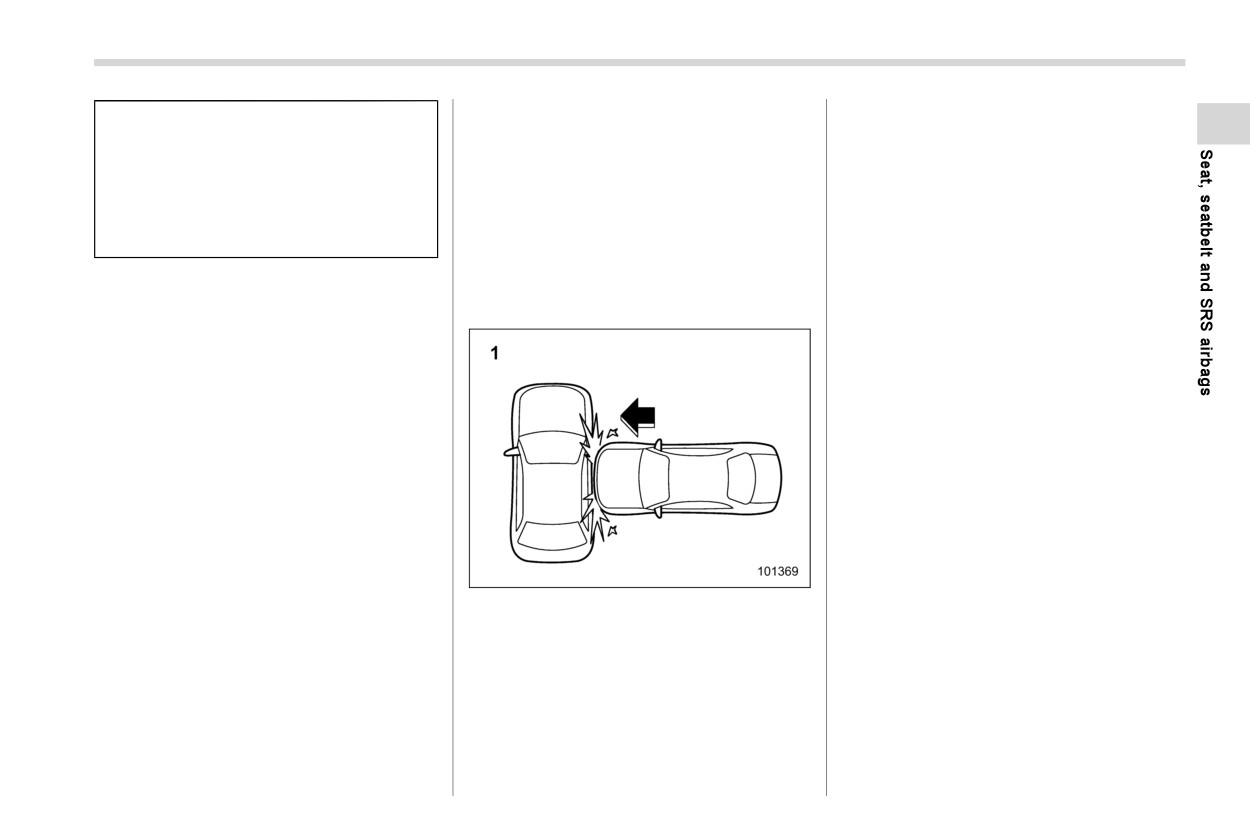
! Example of the type of accident in
! Example of the type of accident
which the SRS side airbag will
The SRS side airbag and SRS curtain
most likely deploy
airbag are designed as follows:
. To deploy in the event of an accident
involving a moderate to severe side
impact collision
. To function on a one-time-only basis
The SRS side airbag and SRS curtain
airbag are not designed to deploy in the
following cases:
. In most lesser side impacts
. In most frontal or most rear impacts
(because the SRS side airbag and SRS
curtain airbag deployment would not
protect the occupant in those situa-
1
A severe side impact near the front seat.
tions)
The SRS curtain airbags are also de-
signed to deploy when the vehicle is in an
extremely inclined state such as during a
rollover. They are not designed to deploy in
most lesser inclined state.
- CONTINUED -
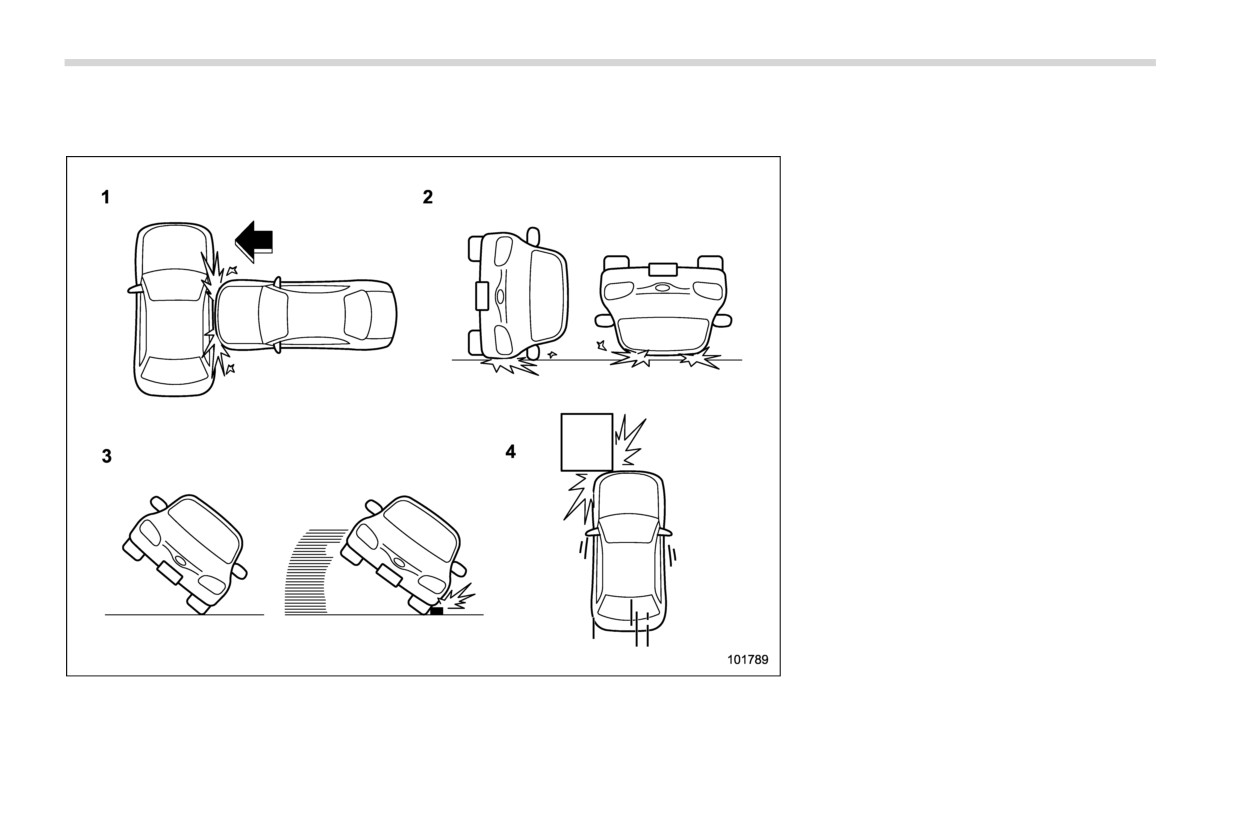
106 SRS airbag (Supplemental Restraint System airbag)
! Examples of the types of accidents in which the SRS curtain airbag will most likely deploy
1
The vehicle is involved in a severe side
impact near the front seat or the rear seat.
2
The vehicle rolls onto its side or the roof.
3
The angle of vehicle tip-up is marginal or
the skidding vehicle’s tires hit a curbstone
laterally.
4
An offset frontal collision that is severe
enough to deploy the front airbag.
SRS airbag (Supplemental Restraint System airbag)
107
! Examples of the types of accidents in which it is possible that the SRS side airbag and the SRS curtain airbag will deploy
1
Hitting a curb, edge of pavement or hard
surface
2
Falling into or jumping over a deep hole
3
Landing hard or vehicle falling
It is possible that the SRS side and curtain
airbags will deploy if a serious impact
occurs to the underside of your vehicle.
Some examples are shown in the illustra-
tion.
- CONTINUED -
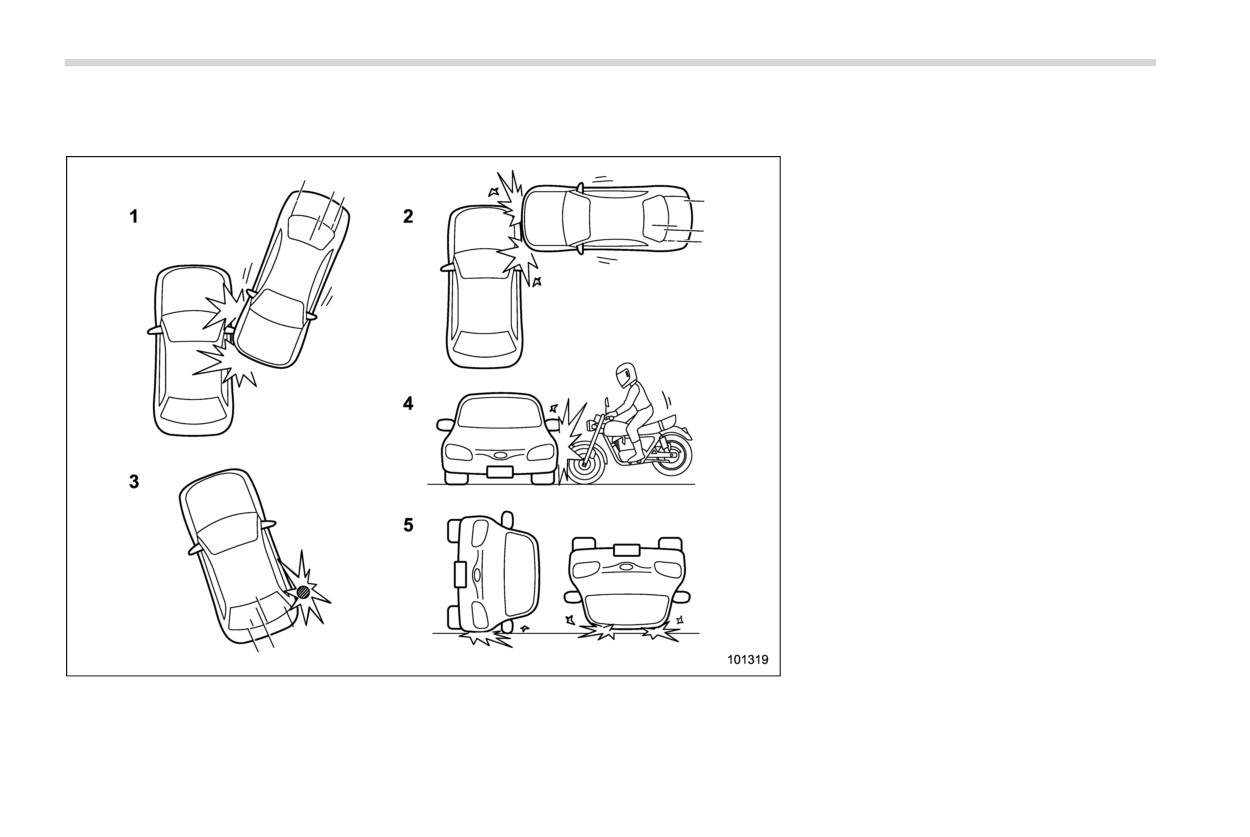
108 SRS airbag (Supplemental Restraint System airbag)
! Examples of the types of accidents in which the SRS side airbag is unlikely to deploy
1
The vehicle is involved in an oblique side-
on impact.
2
The vehicle is involved in a side-on
impact in an area outside the vicinity of
the passenger compartment.
3
The vehicle strikes a telephone pole or
similar object.
4
The vehicle is involved in a side-on
impact from a motorcycle.
5
The vehicle rolls onto its side or the roof.
There are many types of collisions which
might not necessarily require SRS side
airbag deployment. In the event of acci-
dents like those illustrated, the SRS side
airbag may not deploy depending on the
level of accident forces involved.
SRS airbag (Supplemental Restraint System airbag)
109
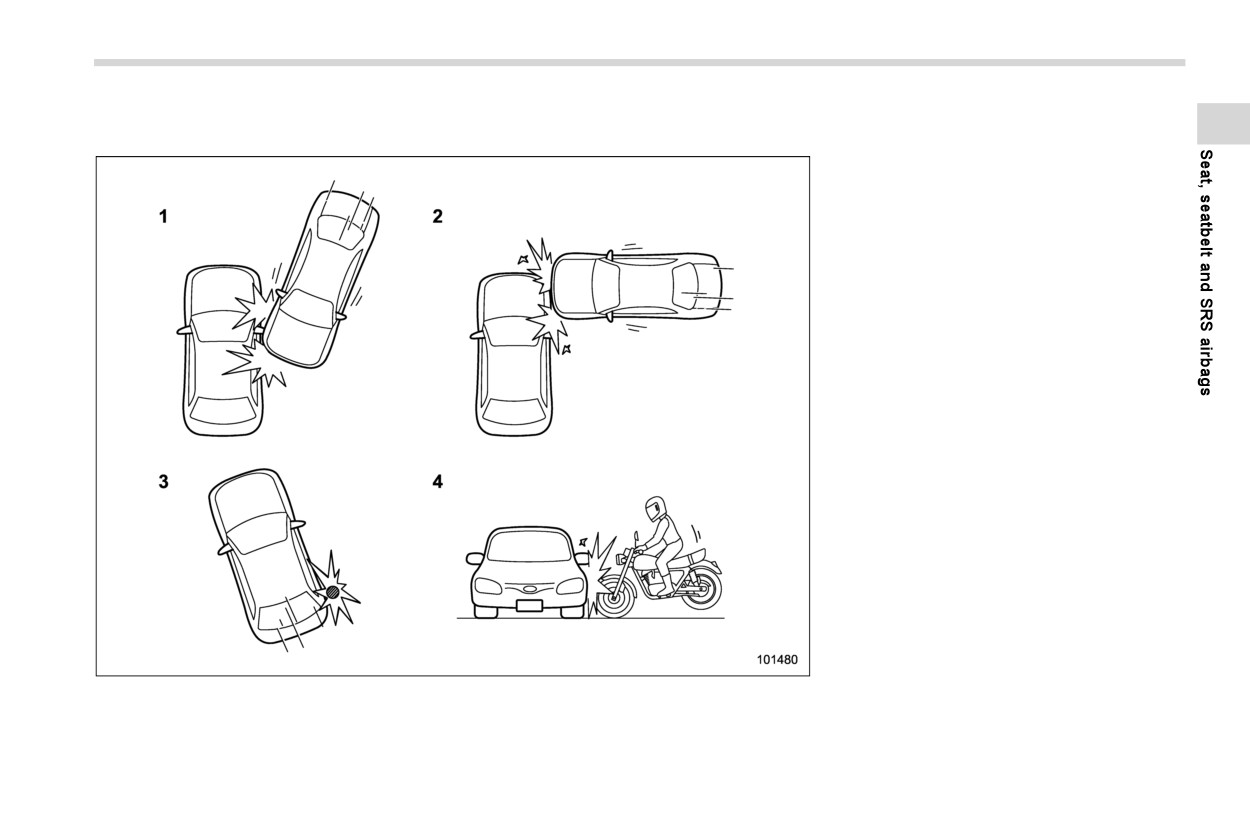
! Examples of the types of accidents in which the SRS curtain airbag is unlikely to deploy
1
The vehicle is involved in an oblique side-
on impact.
2
The vehicle is involved in a side-on
impact in an area outside the vicinity of
the passenger compartment.
3
The vehicle strikes a telephone pole or
similar object.
4
The vehicle is involved in a side-on
impact from a motorcycle.
There are many types of collisions which
might not necessarily require SRS curtain
airbag deployment. In the event of acci-
dents like those illustrated, the SRS
curtain airbag may not deploy depending
on the level of accident forces involved.
- CONTINUED -
110 SRS airbag (Supplemental Restraint System airbag)
ary).
same direction, once the SRS side airbag
! Examples of the types of acci-
2
The vehicle is struck from behind.
and SRS curtain airbag are activated on
dents in which the SRS side
3
The vehicle pitches end over end.
airbag and SRS curtain airbag
the first impact, they will not be activated
are not designed to deploy in
In the event of accidents like those
on the second.
most cases
illustrated, the SRS side airbag and SRS
curtain airbag are not designed to deploy
& SRS airbag system monitors
in most cases.
SRS airbag system warning light
1
First impact
A diagnostic system continually monitors
2
Second impact
the readiness of the SRS airbag system
A
SRS curtain airbag
(including seatbelt pretensioners) with the
B
SRS side airbag
ignition switch in the “ON” position. The
In an accident where the vehicle is struck
SRS airbag system warning light will show
from the side more than once, the SRS
normal system operation by illuminating
side airbag and SRS curtain airbag deploy
for approximately
6 seconds when the
only once.
ignition switch is turned to the
“ON”
position.
Example: In the case of a double side
The diagnostic system monitors the com-
impact collision, first with one vehicle and
ponents to ensure normal operation. For
1
The vehicle is involved in frontal collision
immediately followed by another from the
information on the components the system
with another vehicle (moving or station-
SRS airbag (Supplemental Restraint System airbag)
111
monitors, refer to “Components” FP90.
& SRS airbag system servicing
Under the center of the instru-
Note that the diagnostic system does not
ment panel
monitor the SRS airbag system warning
WARNING
On both the right and left sides at
light itself.
the front of the vehicle
When discarding an airbag mod-
Steering wheel and column and
WARNING
ule or scrapping the entire vehi-
nearby areas
cle damaged by a collision, con-
If the warning light exhibits any of
sult your SUBARU dealer.
Bottom of the steering column
the following conditions, immedi-
and nearby areas
The SRS airbag has no user-
ately stop the vehicle in a safe place,
serviceable parts. Do not use
Top of the dashboard on front
and consult a SUBARU dealer. Un-
electrical test equipment on any
passenger’s side and nearby
less a technician checks and repairs
circuit related to the SRS airbag
areas
the system as needed, the seatbelt
pretensioners and/or the SRS airbag
system. For required servicing of
Each front seat and nearby area
the SRS airbag, consult your
will not operate properly in the event
Inside each center pillar
nearest SUBARU dealer. Tamper-
of a collision, which may result in
ing with or disconnecting the
Inside each front door
injury.
system’s wiring could result in
In each roof side (from the front
. Flashing or flickering of the warn-
accidental inflation of the SRS
pillar to a point over the rear seat)
ing light
airbag or could make the system
Between the rear seat cushion
. No illumination of the warning
inoperative, which may result in
and rear wheel house on each
light when the ignition switch is
serious injury.
side
first turned to the “ON” position
Under the second-row center
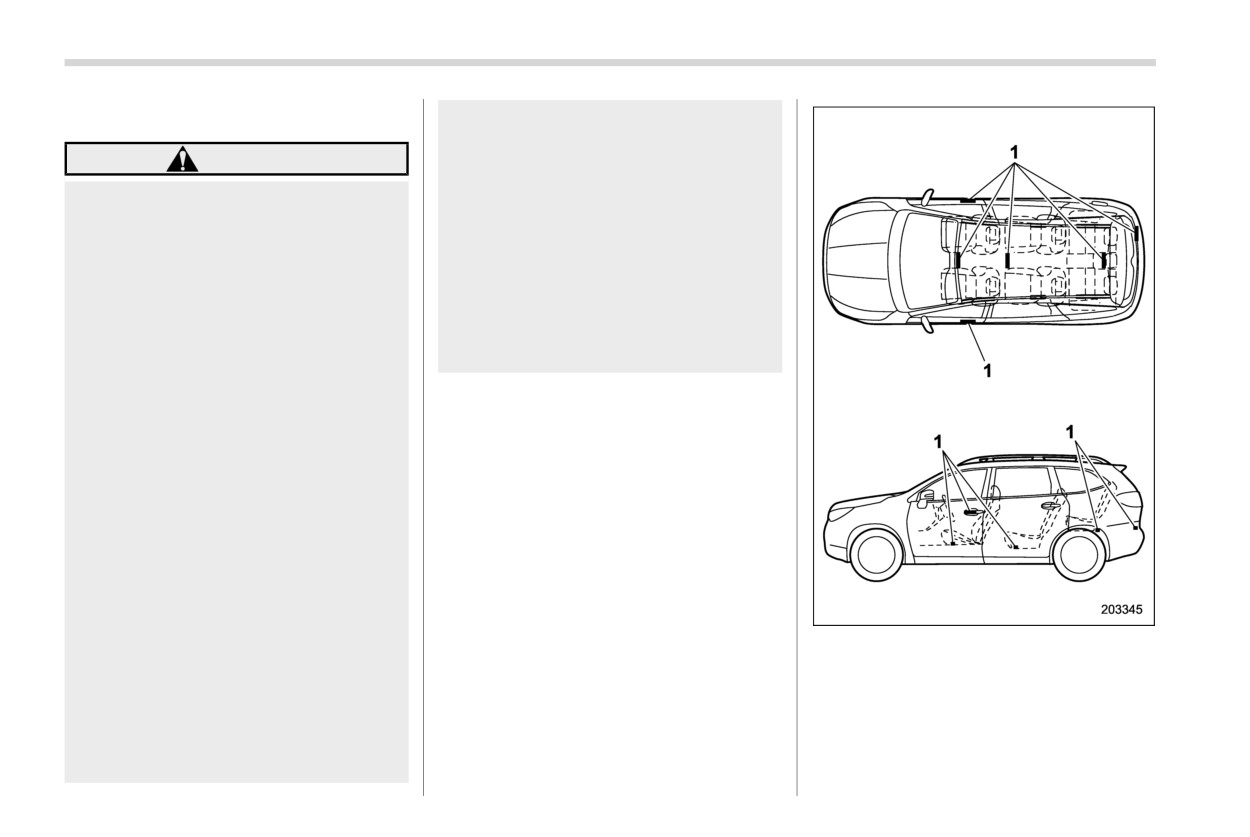
. Continuous illumination of the
CAUTION
seat
warning light
. Illumination of the warning light
If you need service or repair in areas
In
the event that the SRS airbag is
while driving
indicated in the following list, have
deployed, replacement of the system
the work performed by an author-
should be performed only by an author-
ized SUBARU dealer. The SRS air-
ized SUBARU dealer. When the compo-
bag control module, impact sensors
nents of the SRS airbag system are
and airbag modules are stored in
replaced, use only genuine SUBARU
these areas.
parts.
- CONTINUED -
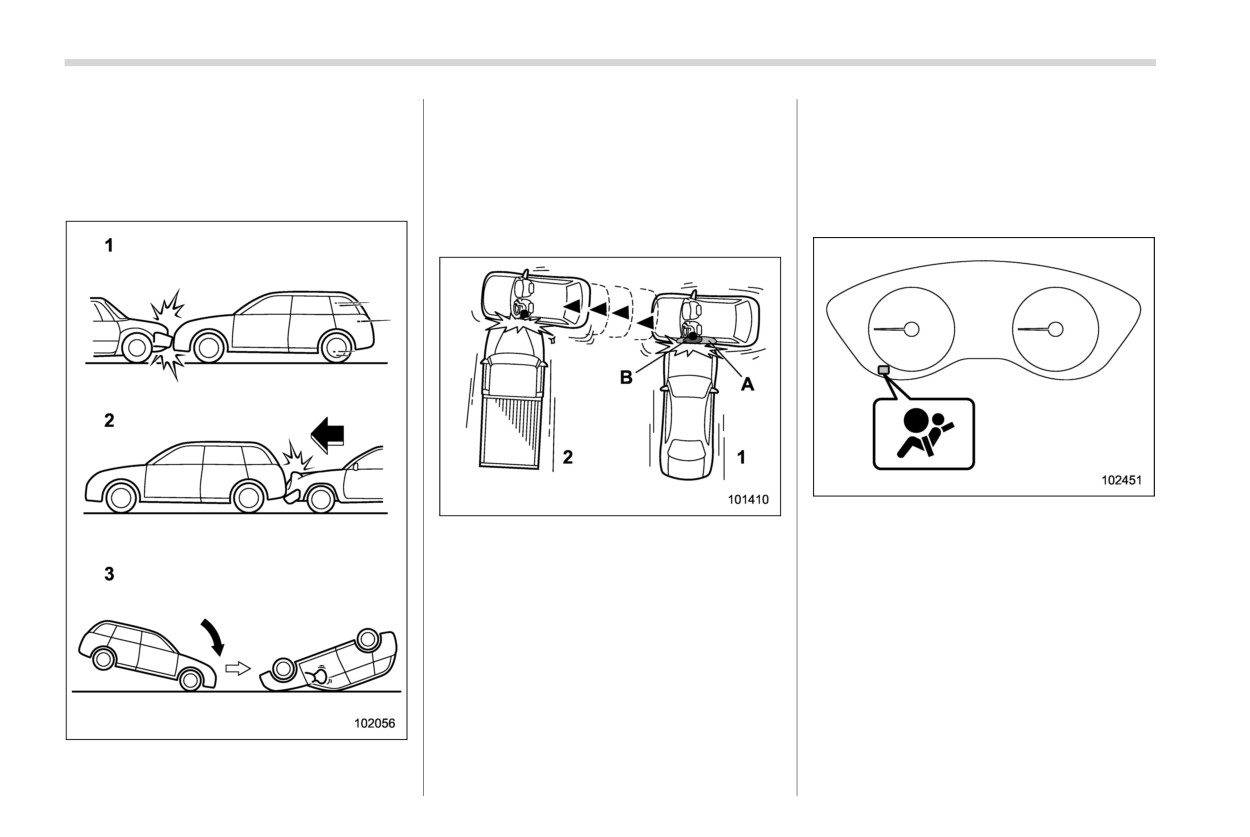
112 SRS airbag (Supplemental Restraint System airbag)
NOTE
& Precautions against vehicle
- Installation of additional elec-
modification
trical/electronic equipment
In the following cases, contact your
such as a mobile two-way
SUBARU dealer as soon as possible.
radio on or near the SRS air-
The front part of the vehicle was
WARNING
bag system components and/
involved in an accident in which only
To avoid accidental activation of
or wiring is not advisable. This
the driver’s SRS frontal airbag or
the system or rendering the sys-
could interfere with proper
both driver’s and front passenger’s
tem inoperative, which may re-
operation of the SRS airbag
SRS frontal airbags did not deploy.
sult in serious injury, no modifi-
system.
The pad of the steering wheel, the
cations should be made to any
- Modifications on or inside the
cover over the front passenger’s
components or wiring of the SRS
SRS frontal airbag, or either roof
front door panels for the pur-
airbag system.
pose of a speaker replace-
side (from the front pillar to a point
This includes following modifica-
ment or sound insulation.
over the rear seat) is scratched,
tions.
cracked, or otherwise damaged.
The impact sensors, which detect
The center pillar, front door, rear
-
Installation of custom steering
the pressure of an impact, are
wheel house or rear sub frame, or
wheels
located in the doors. Do not
an area near these parts, was in-
-
Attachment of additional trim
modify any components of the
volved in an accident in which the
materials to the dashboard
doors or door trims, such as the
SRS side airbag and SRS curtain
addition of door speakers for
-
Installation of custom seats
airbag did not deploy.
example. Any modifications to
–
Replacement of seat fabric or
The fabric or leather of either front
the doors will cause the airbag
leather
seatback is cut, frayed, or otherwise
system to become inoperative or
damaged.
-
Installation of additional fabric
result in unintended airbag de-
The rear part of the vehicle was
or leather on the front seat
ployment.
involved in an accident in which no
-
Attachment of a hands-free
SRS airbag was deployed.
microphone or any other ac-
CAUTION
cessory to a front pillar, a
center pillar, a rear pillar, the
Do not perform any of the following
windshield, a side window, an
modifications. Such modifications
assist grip, or any other cabin
can interfere with proper operation
surface that would be near a
of the SRS airbag system.
deploying SRS curtain airbag.
SRS airbag (Supplemental Restraint System airbag)
113
Attachment of any equipment
& How to contact the vehicle
<Guam>
(bush bar, winches, snow plow,
manufacturer concerning
Shen’s Corporation dba Prestige Automo-
skid plate, etc.) other than genu-
modifications for persons
biles
ine SUBARU accessory parts to
with disabilities that may af-
491 East Marine Corps Drive, Dededo,
the front end.
Guam 96929
fect the advanced airbag
Modification of the suspension
671-633-2698
system
system or front end structure.
Changing or moving any parts of the front
<Canada>
Installation of a tire of different
seats, rear seat, seatbelts, front bumper,
Subaru Canada, Inc.
size and construction from the
front side frame, radiator panel, instrument
Consumer Support Department
tires specified on the vehicle
panel, combination meter, steering wheel,
560 Suffolk Court, Mississauga, Ontario
placard attached to the driver’s
steering column, tire, suspension or floor
L5R 4J7
door pillar or specified for indivi-
panel can affect the operation of the
dual vehicle models in this Own-
1-800-894-4212
SUBARU advanced airbag system. If you
er’s Manual.
have any questions, you may contact the
There are currently no SUBARU distribu-
Attachment of any equipment
following SUBARU distributors.
tors in any other U.S. territories. If you are
(side steps or side sill protectors,
in such an area, please contact the
<Continental U.S., Alaska and the District
etc.) other than genuine SUBARU
SUBARU distributor or dealer from which
of Columbia>
accessory parts to the side body.
you bought your vehicle.
Subaru of America, Inc.
Always consult your SUBARU dealer if you
Customer Advocacy Department
want to install any accessory parts on your
One Subaru Drive
vehicle.
P.O. Box 9103
Camden, NJ 08101-9877
1-800-SUBARU3 (1-800-782-2783)
<Hawaii>
Subaru Hawaii
2850-A Pukoloa St.,
Honolulu, HI 96819
877-215-0338
Keys and doors
Setting audible signal operation
135
2-1. Keys
116
Key number plate
116
Replacing the battery
136
Replacing lost transmitters
136
2-2. Keyless access with push-button start
2
Certification for remote keyless entry system
136
system (if equipped)
117
Safety precautions
118
2-5. Door locks
137
Locking and unlocking from the outside
137
Locking and unlocking by holding the access
key fob
120
Locking and unlocking from the inside
138
Unlock using PIN Code Access
124
Automatic door locking/unlocking
139
Power saving function
126
Key lock-in prevention function
140
Power saving function of access key fob
127
Battery drainage prevention function
140
Disabling keyless access function
127
2-6. Alarm system
142
Selecting audible signal operation
130
Alarm system operation
142
Selecting hazard warning flasher operation
130
Arming the system
142
Warning chimes and warning indicator
130
Disarming the system
143
When access key fob does not operate
Alarm system setting
144
properly
130
If you have accidentally triggered the alarm
Replacing battery of access key fob
130
system
144
Replacing access key fob
130
Valet mode
144
Certification for keyless access with
2-7. Child safety locks
145
push-button start system
130
2-8. Windows
145
2-3. Immobilizer
132
Power window operation
146
Security indicator light
132
Initialization of power window (windows with
Key replacement
132
off delay function)
148
Certification for immobilizer system
132
2-9. Rear gate
148
2-4. Remote keyless entry system
133
Manual rear gate
148
Locking the doors
135
Power rear gate (if equipped)
149
Unlocking the doors
135
2-10. Moonroof (if equipped)
157
Unlocking the rear gate
135
Sunshade switch
157
Selecting hazard warning flasher operation
135
Moonroof switch
158
Vehicle finder function
135
2-11. Rear door window sunshades
Sounding a panic alarm
135
(if equipped)
159
116 Keys
The valet key fits only the ignition switch
& Key number plate
2-1. Keys
and door locks. You can keep the glove
The key number is stamped on the key
box locked when you leave your vehicle
NOTE
number plate attached to the key set. Write
and valet key at a parking facility.
down the key number and keep it in
For models with “keyless access with
another safe place, not in the vehicle. This
push-button start system”, refer to
NOTE
number is needed to make a replacement
“Keyless access with push-button start
Locking/unlocking using the remote
key if you lose your key or lock it inside the
system” FP1 17.
keyless entry system can also be con-
vehicle. Refer to
“Key replacement”
trolled with the buttons on the key. For
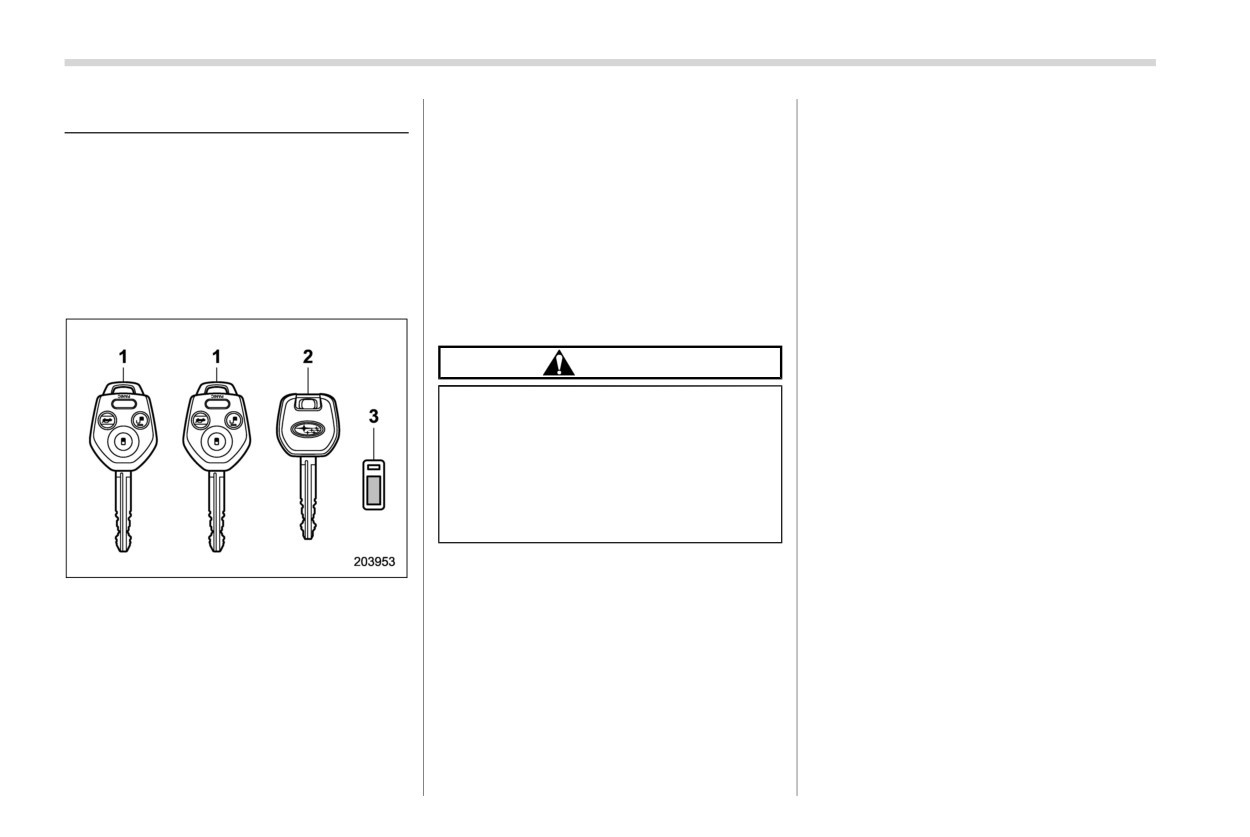
The following keys are provided with the
FP132.
details, refer to “Remote keyless entry
vehicle.
system” FP133.
CAUTION
Do not attach a large key holder or
key case to either key. If it bangs
against your knees while you are
driving, it could turn the ignition
switch from the “ON” position to
the
“ACC” or “LOCK” position,
thereby stopping the engine.
1
Master keys
2
Valet key
3
Key number plate
These keys can be used in the following
locations.
. Ignition switch
. Driver’s door
. Glove box (except the valet key)
Keyless access with push-button start system
117
. Starting and stopping the engine. For
2-2. Keyless access with
details, refer to “Starting and stopping
push-button start system (if
engine (models with push-button start
equipped)
system)” FP346.
. Arming and disarming the alarm sys-
The following access
key fobs
are
pro-
tem. For details, refer to “Alarm system”
vided with the vehicle.
FP142.
NOTE
. Locking/unlocking using the remote
keyless entry system can also be
controlled with the buttons on the
access key fob. For details, refer to
“Remote keyless entry system”
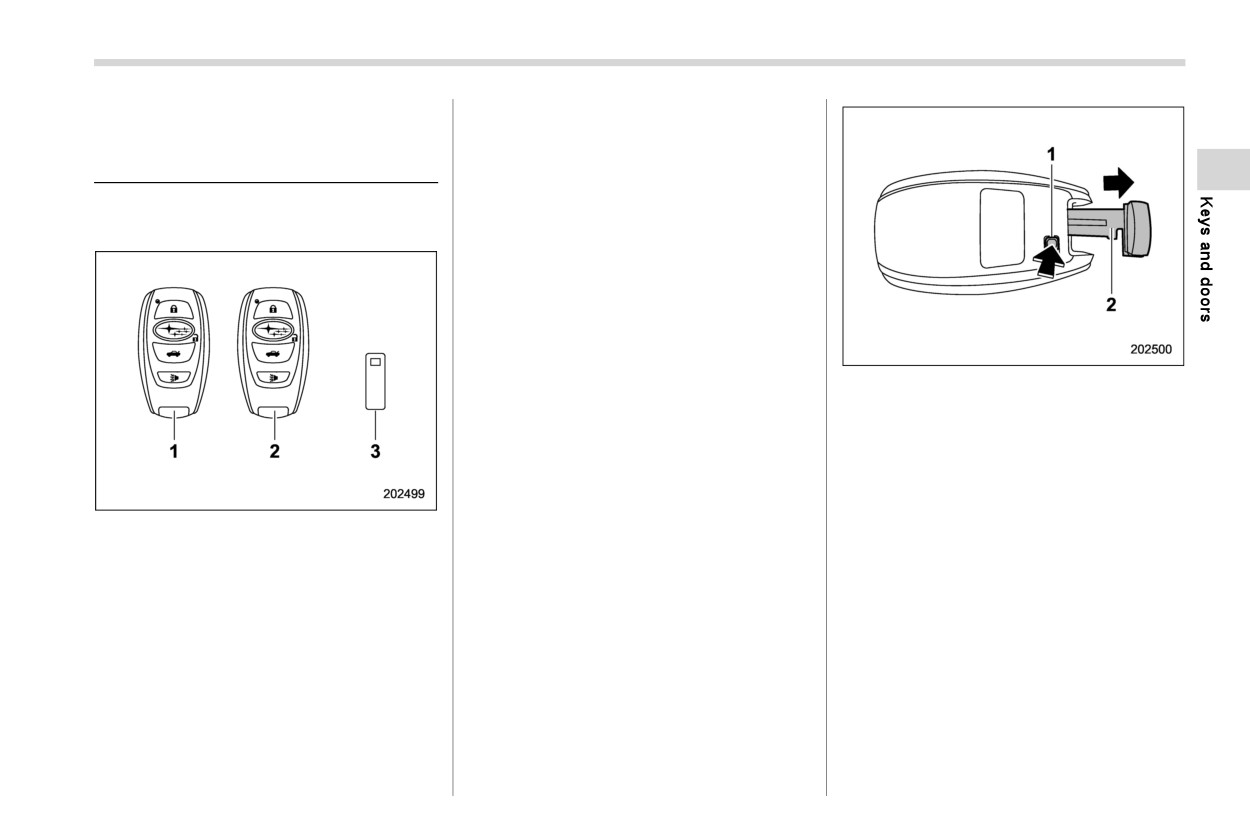
1
Release button
FP133.
2
Emergency key
. Carefully store the key number plate
While pressing the release button of the
supplied with the access key fob. It
access key fob, take out the emergency
is necessary for vehicle repair and
key.
additional registration of access key
The emergency key is used for the follow-
fobs. For details, refer to
“Key
ing operations.
1
Access key fob (main)
replacement” FP132.
2
Access key fob (sub)
. Locking and unlocking the driver’s door
An emergency key is attached to each
3
Key number plate
. Locking and unlocking the glove box
access key fob.
The “keyless access with push-button start
NOTE
system” allows you to perform the follow-
The glove box can be kept locked when
ing functions when you are carrying the
you leave your vehicle and the access
access key fob.
key fob (with the emergency key re-
. Locking and unlocking of the doors,
moved) at a parking facility.
rear gate and fuel filler lid. For details,
refer to
“Locking and unlocking by
holding the access key fob” FP120.
- CONTINUED -
118 Keyless access with push-button start system
& Safety precautions
start system”
The keyless access with push-
WARNING
button start system uses radio
waves of the following fre-
If you wear an implanted pace-
quency* in addition to the radio
maker or an implanted defibrilla-
waves used for the remote key-
tor, stay at least 8.7 in (22 cm)
less entry system. The radio
away from the transmitting an-
waves are periodically output
tennas installed on the vehicle.
from the antennas installed on
The radio waves from the trans-
the vehicle as shown in
the
mitting antennas on the vehicle
following illustrations.
could adversely affect the opera-
* Radio frequency:
134 kHz
tion of implanted pacemakers
and implanted defibrillators.
If you wear electronic medical
equipment other than an im-
planted pacemaker or an im-
planted defibrillator, before using
the keyless access with push-
button start system, refer to
“Radio waves used for the key-
less access with push-button
start system” mentioned later,
and contact the electronic medi-
cal equipment manufacturer for
more information. The radio
1
Antennas
waves from the transmitting an-
tennas on the vehicle could ad-
versely affect the operation of the
electronic medical equipment.
“Radio waves used for the key-
less access with push-button
Keyless access with push-button start system
119
may damage the battery or
the operation of the airplane. In a
CAUTION
cause circuit malfunctions.
bag, take measures to prevent
Never leave or store the access
the buttons from being pressed
-
Do not wash the access key
key fob inside the vehicle or
accidentally.
fob in an ultrasonic washer.
within
6.6
ft
(2
m) around the
-
Do not leave the access key
vehicle (e.g., in the garage). The
fob in humid or dusty loca-
NOTE
access key fob may be locked
tions. Doing so may cause
inside the vehicle, or the battery
The operational/non-operational
malfunctions.
may discharge rapidly. Note that
setting for the keyless access func-
the push-button ignition switch
-
Keep the access key fob away
tion can be changed. For the setting
may not turn on in some cases
from magnetic sources.
procedure, refer to “Disabling key-
depending on the location of the
-
Do not leave the access key
less access function” FP127.
access key fob.
fob near a personal computer
For detailed information about the
or home electrical appliance.
operation method for the push-but-
The access key fob contains
ton ignition switch while the keyless
electronic components. Observe
-
Do not leave the access key
access function is switched to the
the following precautions to pre-
fob near a battery charger or
non-operational mode, refer to “Ac-
vent malfunctions.
any electrical accessories.
cess key fob - if access key fob does
-
It is recommended to have the
-
Do not apply metallic window
not operate properly” FP464.
access key battery replaced at
tint or attach metallic objects
The keyless access with push-but-
an authorized SUBARU dealer
to the windows.
ton start system uses weak radio
to avoid the risk of damage.
-
Do not fit non genuine acces-
waves. The status of the access key
-
Do not get the access key fob
sories or parts.
fob and environmental conditions
wet. If the access key fob gets
may interfere with the communica-
If
the access key fob is dropped,
wet, wipe it off immediately
tion between the access key fob and
the integrated emergency key in-
and let it dry completely.
the vehicle under the following con-
side may become loose. Be care-
ditions, and it may not be possible to
-
Do not apply strong impacts to
ful not to lose the emergency key.
lock or unlock the doors or start the
the access key fob.
When traveling in an airplane, do
engine.
-
Never leave the access key
not press the button of the ac-
- When operating near a facility
fob in direct sunlight or any-
cess key fob. If any button of the
where strong radio waves are
where that may become hot,
access key fob is pressed, radio
transmitted, such as a broadcast
such as on the dashboard. It
waves are emitted and may affect
- CONTINUED -
120 Keyless access with push-button start system
station and power transmission
If an access key fob is lost, it is
Do not leave the access key fob in
lines
recommended that all of the remain-
the following places.
-
When products that transmit
ing access key fobs be reregistered.
- On the instrument panel
radio waves are used, such as
For reregistration of an access key
- On the floor
an access key fob or a remote
fob, contact a SUBARU dealer.
- Inside the glove box
transmitter key of another vehi-
For a spare access key fob, contact a
- Inside the door trim pocket
cle
SUBARU dealer.
- On the rear seat
-
When carrying the access key fob
Up to 7 access key fobs can be
- In the cargo area
of your vehicle together with the
registered for one vehicle.
access key fob or the remote
Do not leave the access key fob in
If you do, the following situations
transmitter of another vehicle
the storage spaces inside the vehi-
may occur.
-
When the access key fob is
cle, such as the door pocket, dash-
- The access key fob is mistakenly
placed near wireless communi-
board or inside the corner of the
locked inside the vehicle.
cargo area. Vibrations may damage
cation equipment such as a cell
- A false warning issues although
the key fob or turn on the switch,
phone
no malfunction actually occurs.
possibly resulting in a lockout.
-
When the access key fob is
- No warning issues even when a
After the vehicle battery is dis-
placed near a metallic object
malfunction occurs.
charged or replaced, initialization
-
When metallic accessories are
of the steering lock system may be
attached to the access key fob
required to start the engine. In this
& Locking and unlocking by
-
When carrying the access key fob
case, perform the following proce-
holding the access key fob
with an electronic appliances
dure to initialize the steering lock.
such as a laptop computer
When the access key fob is carried within
(1) Turn the push-button ignition
-
When the battery of the access
the operating range, the doors, the rear
switch to the “OFF” position.
key fob is discharged
gate and the fuel filler lid can be locked/
For details, refer to “Switching
unlocked just by touching the door handle.
The access key fob is always com-
power status” FP167.
municating with the vehicle and is
(2) Open and close the driver’s
NOTE
continuously using the battery.
door.
The vehicle can also be locked/un-
Although the life of the battery varies
(3) Wait for approximately 10 sec-
locked with the remote keyless entry
depending on the operating condi-
onds.
system. For details, refer to “Remote
tions, it is approximately 1 to 2 years.
keyless entry system” FP133.
If the battery becomes fully dis-
When the steering is locked, the initi-
charged, replace it with a new one.
alization is completed.
Keyless access with push-button start system
121
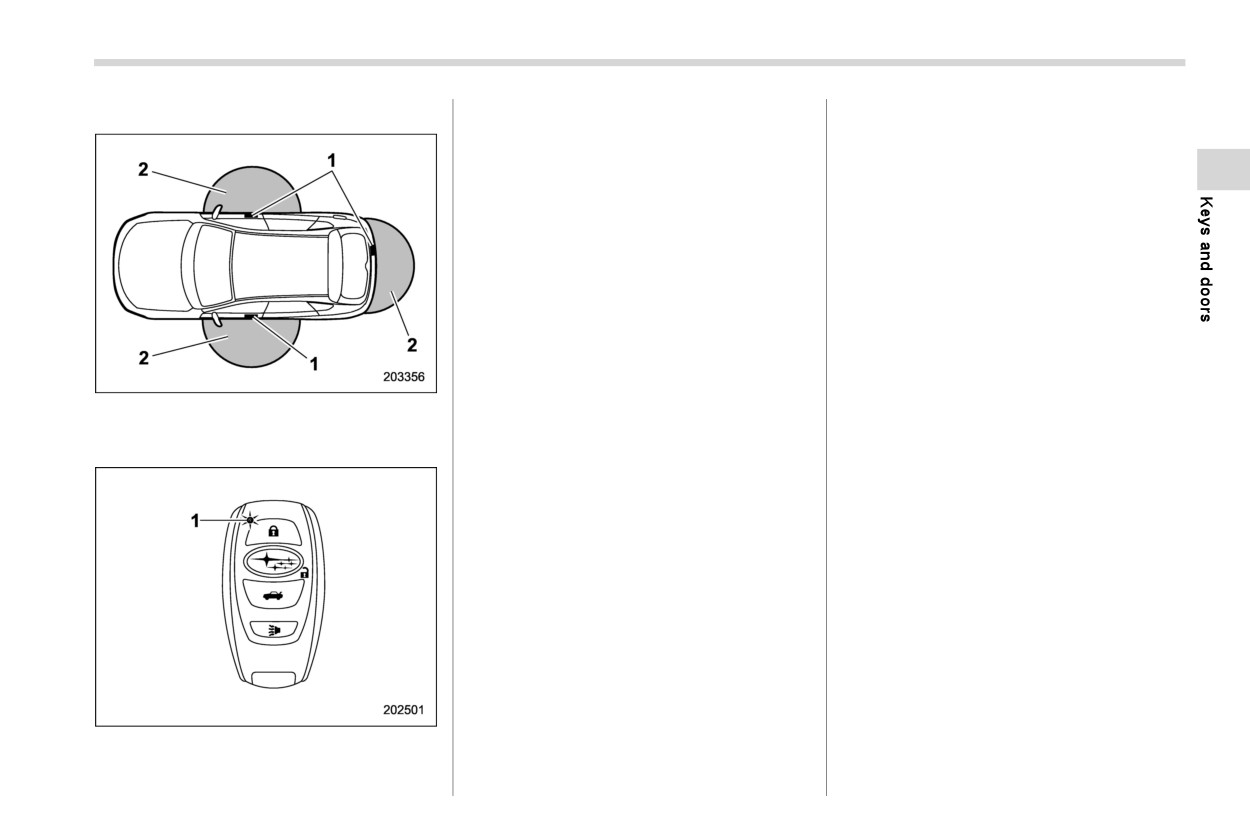
! Operating ranges
When the access key fob is within either of
It is not possible to lock the doors,
the operating ranges of the front doors, the
rear gate and fuel filler lid using the
LED indicator on the access key fob
keyless access function when the
flashes. When the keyless access func-
access key fob is inside the vehicle.
tions are disabled, the LED indicator does
However, depending on the status of
not flash unless a button on the access key
the access key fob and the environ-
fob is pressed.
mental conditions, the access key
fob may be locked inside the vehicle.
NOTE
Before locking the vehicle, make
If the access key fob is placed too
sure that you have the access key
close to the vehicle body, the key-
fob.
less access functions may not oper-
When the battery of the access key
ate properly. If it does not operate
fob is discharged, or when operating
properly, repeat the operation from
it in a location with strong radio
farther away.
waves or noise (e.g., near a radio
1
Antennas
If the access key fob is placed near
tower, power plant, broadcast sta-
2
Operating range (approximately 16 to 32
in (40 to 80 cm))
the ground or in an elevated location
tion or an area where wireless equip-
from the ground, even if it is in the
ment is used), or while talking on a
indicated operating range, the key-
cell phone, the operating ranges
less access function may not oper-
may be reduced, or the keyless
ate properly.
access function may not operate.
When the access key fob is within
In such a case, perform the proce-
the operating range, it is possible for
dure described in
“Locking and
anyone, even someone who is not
unlocking” FP464.
carrying the access key fob, to
The doors may lock or unlock when
operate the keyless access function.
the car is being washed or exposed
Note that the keyless access func-
to a significant amount of water that
tion can be operated only by the
contacts the door handle while the
door handle, door lock sensor, rear
key fob is still in the operating range.
gate opener button or rear lock
button in the operating range in
! How to lock and unlock
1
LED indicator
which the access key fob is de-
It is possible to perform the following
tected.
operations when you are carrying the
- CONTINUED -
122 Keyless access with push-button start system
access key fob.
- An electronic chirp sounds five
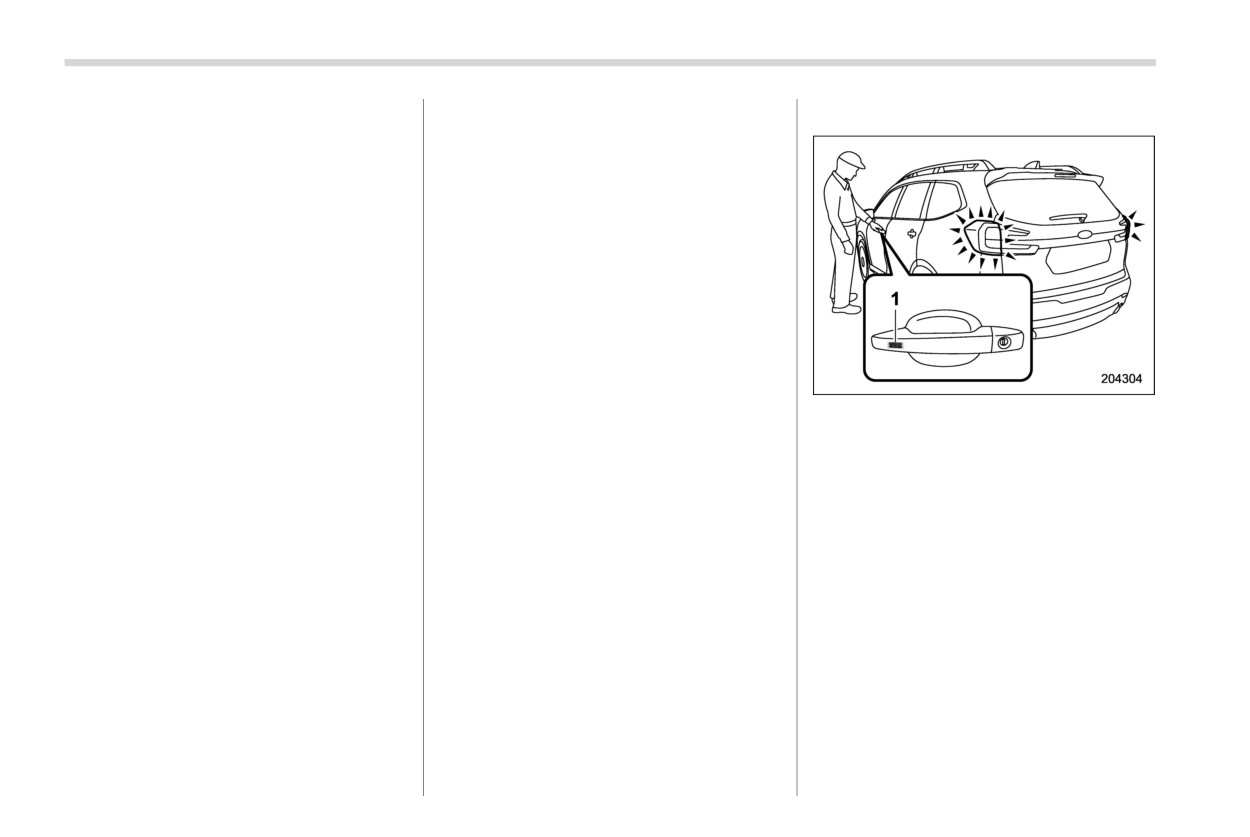
! Locking with the door lock sensor
. Lock and unlock the doors.
times.
. Lock and unlock the rear gate.
- The hazard warning flashers
flash five times.
. Lock and unlock the fuel filler lid.
It is possible to lock the doors even
NOTE
when one of the doors is open. After
It is not possible to lock the doors,
performing the locking procedure,
rear gate and fuel filler lid using the
close the opened door or rear gate to
keyless access function when the
lock it.
Within 3 seconds after locking the
push-button ignition switch is in the
“ACC” or “ON” position. Refer to
doors and the rear gate using the
“Switching power status” FP167.
keyless access function, it is not
If the door handle is gripped with a
possible to unlock doors and/or the
gloved hand, the door lock may not
rear gate using the keyless access
be released.
function.
1
Door lock sensor
If the door lock sensor is touched
When locking, be sure to carry the
access key fob to prevent locking
Carry the access key fob, close all doors
three times or more repeatedly, the
the access key fob in the vehicle.
including the rear gate and fuel filler lid,
system will ignore the sensor opera-
The setting of the hazard warning
and touch the door lock sensor on the door
tion.
flasher operation can be changed by
handle. All doors including the rear gate
When performing the locking proce-
operating the center information dis-
and fuel filler lid will be locked. Also, an
dure too quickly, locking may not
play. For details, refer to “Car set-
electronic chirp will sound once and the
complete. After performing the lock-
tings” FP215. Also, the setting of
hazard warning flashers will flash once.
ing procedure, it is recommended to
the hazard warning flasher opera-
pull the REAR door handle to con-
tion can be changed by your
firm that the doors have been
locked.
SUBARU dealer. Contact your
If any of the doors (or the rear gate)
SUBARU dealer for details.
are not fully closed, the following
will occur to alert you that the doors
(or the rear gate) are not properly
closed.