Subaru Ascent (2023 year). Manual in english - page 3
62
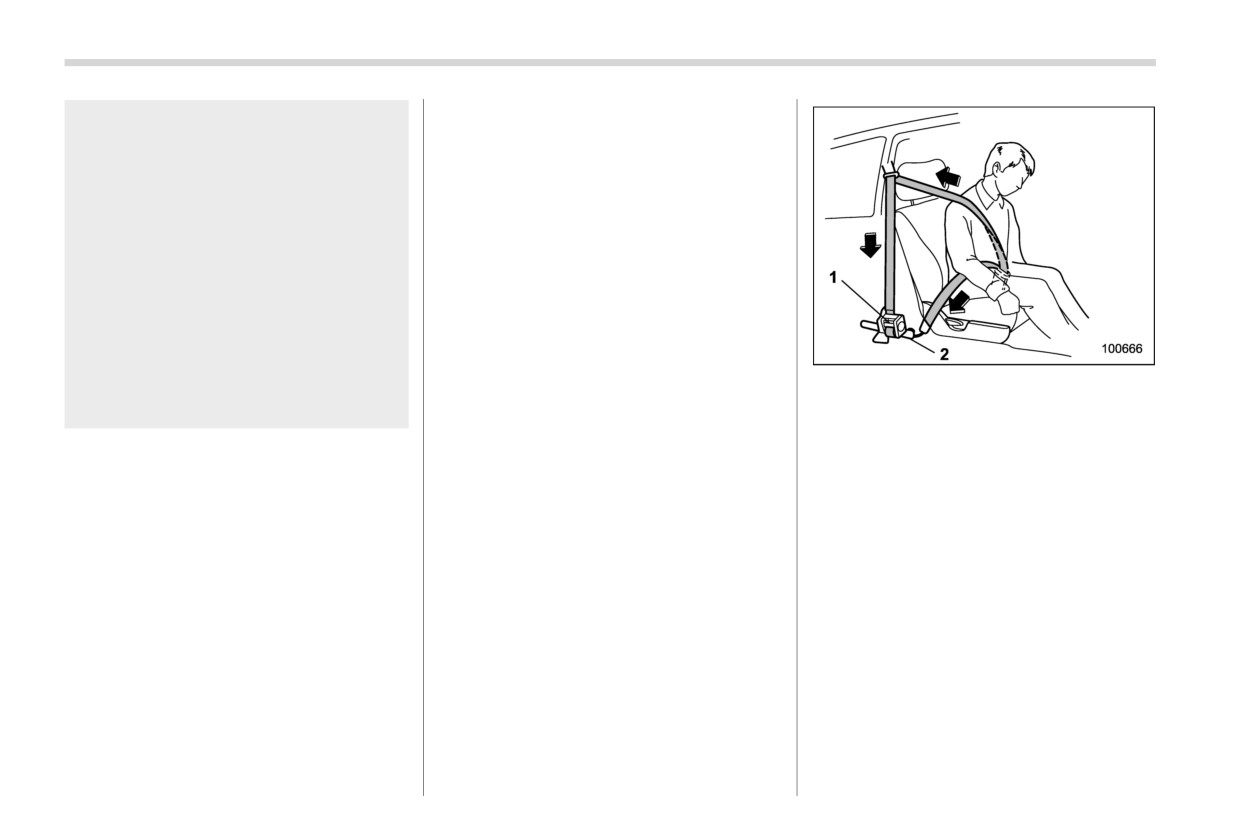
Seatbelt pretensioners
or could make the system inop-
. If a seatbelt that has a seatbelt
erative, possibly resulting in ser-
pretensioner does not retract or
ious injury. Seatbelt preten-
cannot be pulled out due to a mal-
sioners have no user-serviceable
function or activation of the preten-
parts. For required servicing of
sioner, contact your SUBARU dealer
seatbelt retractors equipped with
as soon as possible.
seatbelt pretensioners, consult
. If the seatbelt retractor assembly or
your SUBARU dealer.
surrounding area has been da-
maged, contact your SUBARU deal-
When discarding seatbelt retrac-
er as soon as possible.
tor assemblies equipped with
. When you sell your vehicle, we urge
seatbelt pretensioners or scrap-
you to inform the buyer that the
ping the entire vehicle due to
vehicle is equipped with seatbelt
collision damage or for other
pretensioners. Also, notify the buyer
1
Seatbelt retractor assembly
(shoulder
reasons, consult your SUBARU
of the contents in this section.
belt pretensioner and adaptive force
dealer.
limiter)
2
Lap belt pretensioner
& Seatbelt with shoulder belt
NOTE
When the seatbelt pretensioners are acti-
and lap belt pretensioners
. Seatbelt pretensioners are not de-
vated, an operating noise will sound and a
NOTE
small amount of smoke will be released.
signed to activate in minor impacts
or in rear impacts.
This section is applicable to the follow-
These occurrences are normal and not
. Pretensioners are designed to func-
ing components.
harmful. This smoke does not indicate a
tion on a one-time-only basis. In the
. Driver’s seatbelt
fire in the vehicle.
event that a pretensioner is acti-
. Front passenger’s seatbelt
Once the seatbelt pretensioner has been
vated, the driver’s, front passen-
activated, the seatbelt pretensioner re-
ger’s and second-row (window-side)
mains locked. Consequently, the seatbelt
seatbelt retractor assemblies should
cannot be pulled out and retracted and
be replaced only by an authorized
therefore must be replaced.
SUBARU dealer. When replacing
! Shoulder belt pretensioner
seatbelt retractor assemblies, use
The shoulder belt pretensioner instanta-
only genuine SUBARU parts.
neously pulls the belt to eliminate slack if a
certain level of force is detected during
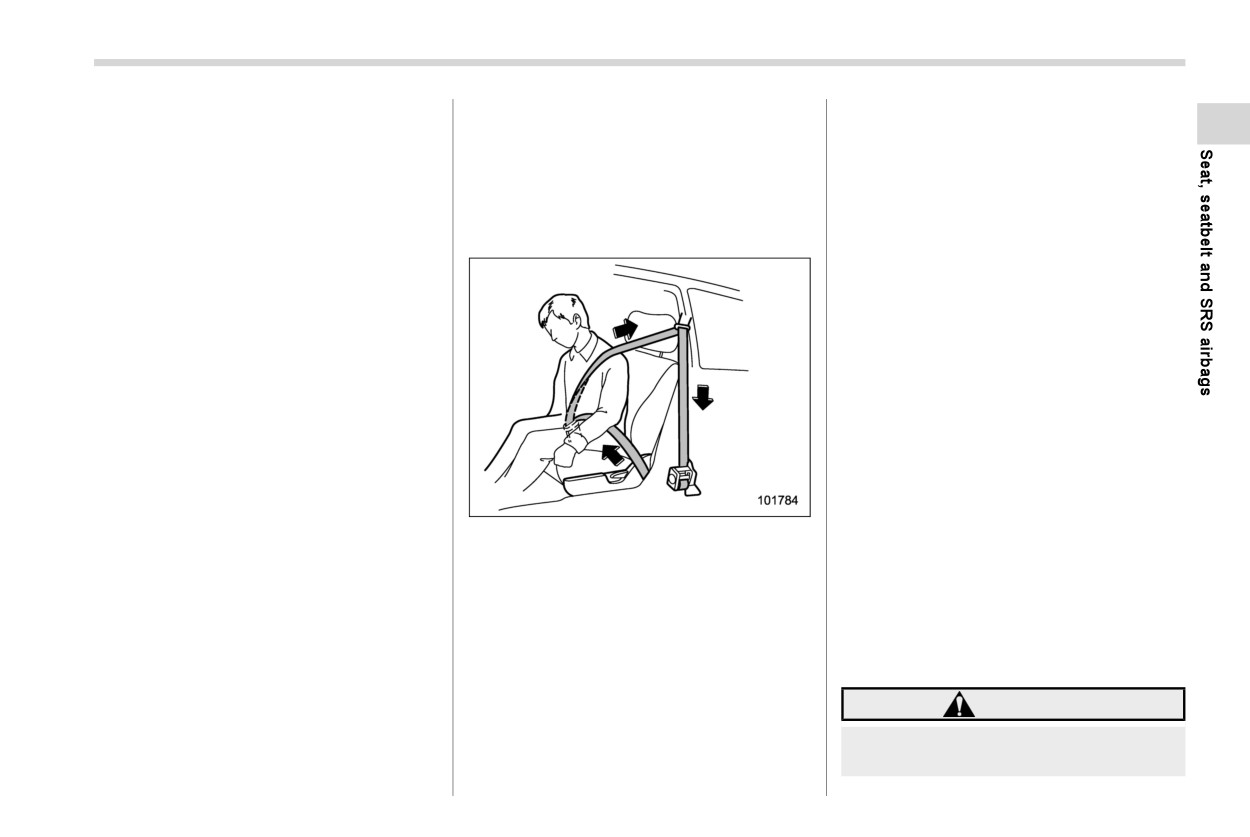
Seatbelt pretensioners
63
frontal, side or rollover accidents. As a
& Seatbelt with shoulder belt
event of a collision.
result, the seatbelt restrains the front seat
pretensioner
When a seatbelt pretensioner is activated,
occupant more effectively.
NOTE
an operating noise will be heard and a
The front shoulder belt pretensioner in-
small amount of smoke will be released.
cludes a tension reducing device which
This section is applicable to the follow-
These occurrences are normal and not
limits the peak forces exerted by the
ing components.
harmful. This smoke does not indicate a
seatbelt on the occupant in the event of a
. second-row (window-side) seatbelt
fire in the vehicle.
collision.
The adaptive force limiter will reduce the
Once the seatbelt pretensioner has been
load to suit the body size of the occupant
activated, the seatbelt retractor remains
as detected by the occupant detection
locked. Consequently, the seatbelt can not
sensor (front passenger’s seatbelt).
be pulled out and retracted and therefore
must be replaced.
! Lap belt pretensioner
The shoulder belt pretensioner is supple-
& System monitors
mented by a lap belt pretensioner, which is
A diagnostic system continually monitors
located at the base of the center pillar. The
the readiness of the seatbelt pretensioner
lap belt pretensioner instantaneously pulls
with the ignition switch in the “ON” position.
the belt to eliminate slack if a certain level
The seatbelt pretensioners share the
of frontal collision force is detected. As a
control module with the SRS airbag
result, the seatbelt restrains the front seat
If the sensor detects a certain predeter-
system. Therefore, if any malfunction
occupant more effectively.
mined amount of force during frontal or
occurs in a seatbelt pretensioner, the
side collisions or rollover accidents, any
SRS airbag system warning light will
seatbelt that has a seatbelt pretensioner is
illuminate. For details, refer to “SRS airbag
quickly drawn back in by the retractor to
system monitors” FP1 10.
take up the slack so that the belt more
effectively restrains the seat occupant.
& System servicing
The second-row seatbelt (window-side)
WARNING
pretensioners include a tension reducing
device which limits the peak forces exerted
. When discarding a seatbelt re-
by the seatbelt on the occupant in the
tractor assembly or scrapping
- CONTINUED -
64
Seatbelt pretensioners
the entire vehicle damaged by a
NOTE
dual vehicle models in this Own-
collision, consult your SUBARU
er’s Manual.
If the front or side part of the vehicle is
dealer.
damaged in an accident to the extent
Tampering with or disconnecting
that the seatbelt pretensioner does not
the system’s wiring could result
operate, contact your SUBARU dealer
in accidental activation of the
as soon as possible.
seatbelt pretensioner and/or
SRS airbag or could make the
& Precautions against vehicle
system inoperative, which may
modification
result in serious injury. Do not
use electrical test equipment on
Always consult your SUBARU dealer if you
any circuit related to the seatbelt
want to install any accessory parts to your
pretensioner and SRS airbag sys-
vehicle.
tems. For required servicing of
the seatbelt pretensioner, con-
CAUTION
sult your nearest SUBARU deal-
Do not perform any of the following
er.
modifications. Such modifications
can interfere with proper operation
of the seatbelt pretensioners.
CAUTION
. Attachment of any equipment
For the locations of the sensors and
(bush bar, winches, snow plow,
control modules, refer to “Compo-
skid plate, etc.) other than genu-
nents” FP90.
ine SUBARU accessory parts to
If you need service or repair in those
the front end.
areas or near the front seatbelt
. Modification of the suspension
retractors, have the work performed
system or front end structure.
by your authorized SUBARU dealer.
. Installation of a tire of different
size and construction from the
tires specified on the vehicle
placard attached to the driver’s
door pillar or specified for indivi-
Rear Seat Reminder
65
situation, there is the possibility that
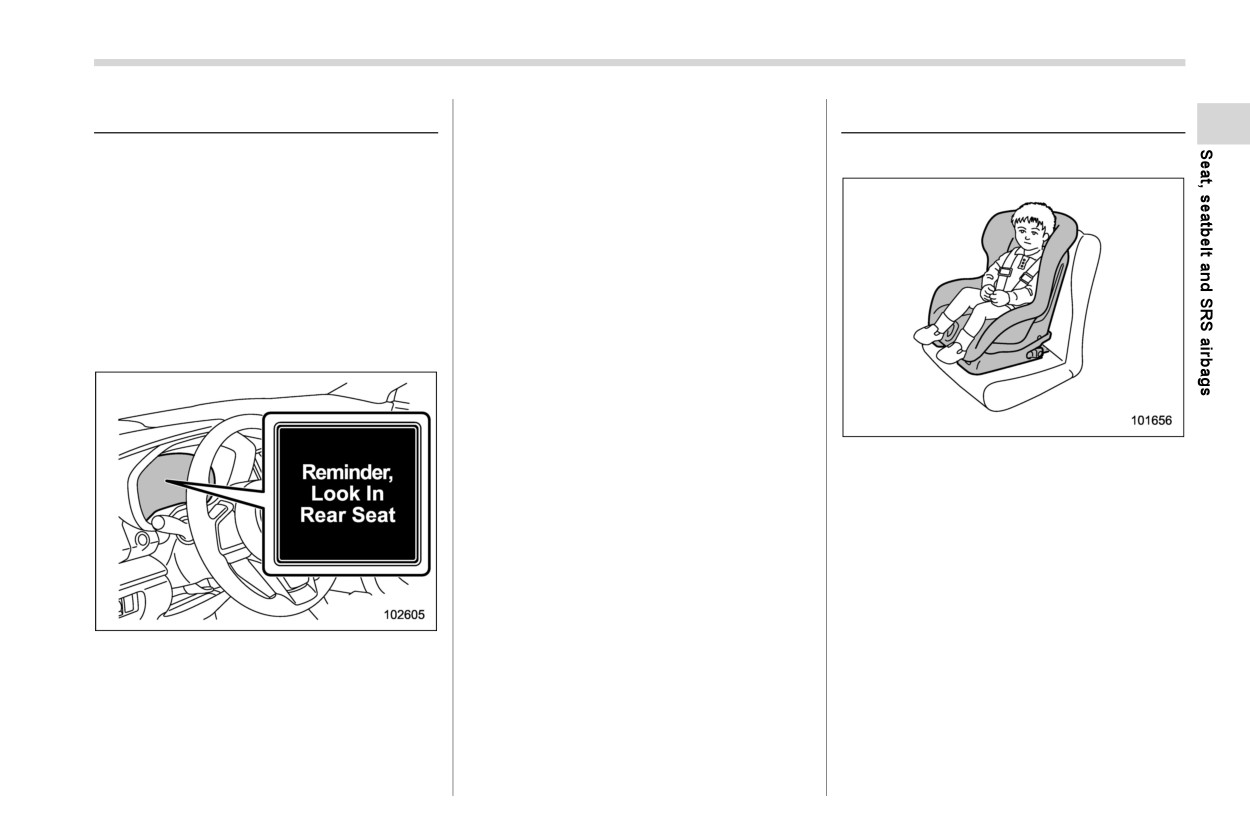
1-6. Rear Seat Reminder
1-7. Child restraint systems
the following phenomenon may oc-
cur.
& Safety precautions
This function prompts the driver to confirm
- It may alert the driver even if there
the presence of passengers and cargo in
are no passengers or cargo in the
the rear.
rear seat.
This function will be activated when the
- It may not alert the driver even if
rear doors are opened and closed.
there are passengers and cargo
It alerts the driver by warning messages on
in the rear seat.
the combination meter display (color LCD)
This function can be set to on or off
and beeps when the ignition
switch is
by the “Car settings”. For details,
turned from the “ON” position to the “OFF”
refer to “Car settings” FP215.
position.
The ON/OFF setting will not be
changed even if the ignition switch
is turned to the “OFF” position.
The ON/OFF setting will be returned
to the default setting if the battery is
Infants and small children should always
removed.
be seated in an infant or child restraint
system in the rear seat while riding in the
vehicle.
You should use an infant or child restraint
system that meets Federal Motor Vehicle
Safety Standards or Canada Motor Vehi-
cle Safety Standards, is compatible with
your vehicle and is appropriate for the
NOTE
child’s age and size.
. This function does not directly de-
All child restraint systems are designed to
tect
passengers and cargo in
the
be secured in vehicle seats by lap belts or
rear seat.
the lap belt portion of a lap/shoulder belt
. This function detects the opening
(except those described in “Installation of
and closing of the rear doors. In this
child restraint systems by use of lower and
- CONTINUED -
66
Child restraint systems
top tether anchorages (LATCH)” FP76).
Children could be endangered in an
accident if their child restraint systems
are not properly secured in the vehicle.
When installing the child restraint system,
carefully follow the manufacturer’s instruc-
tions.
According to accident statistics, children
are safer when properly restrained in the
rear seating positions than in the front
seating positions.
All U.S. states and Canadian provinces
require that infants and small children be
WARNING
WARNING
restrained in an approved child restraint
system at all times while the vehicle is
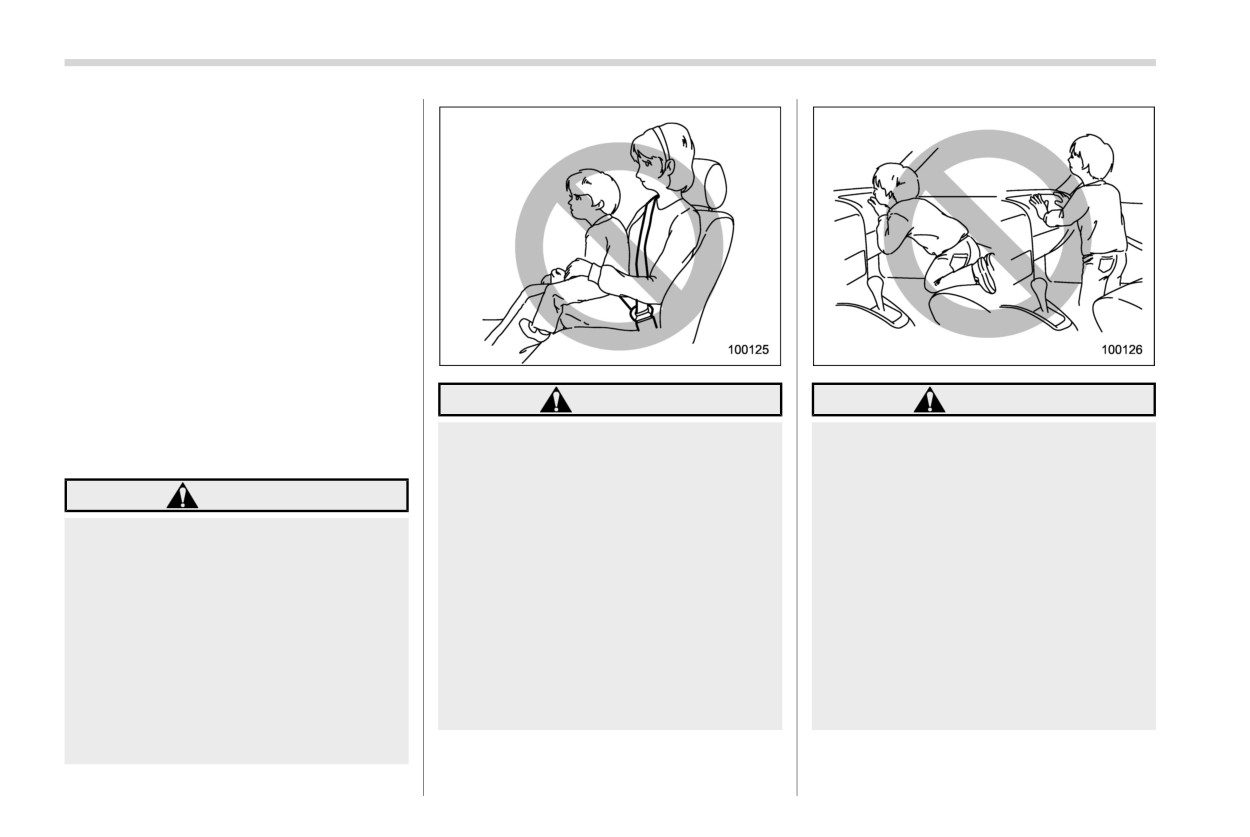
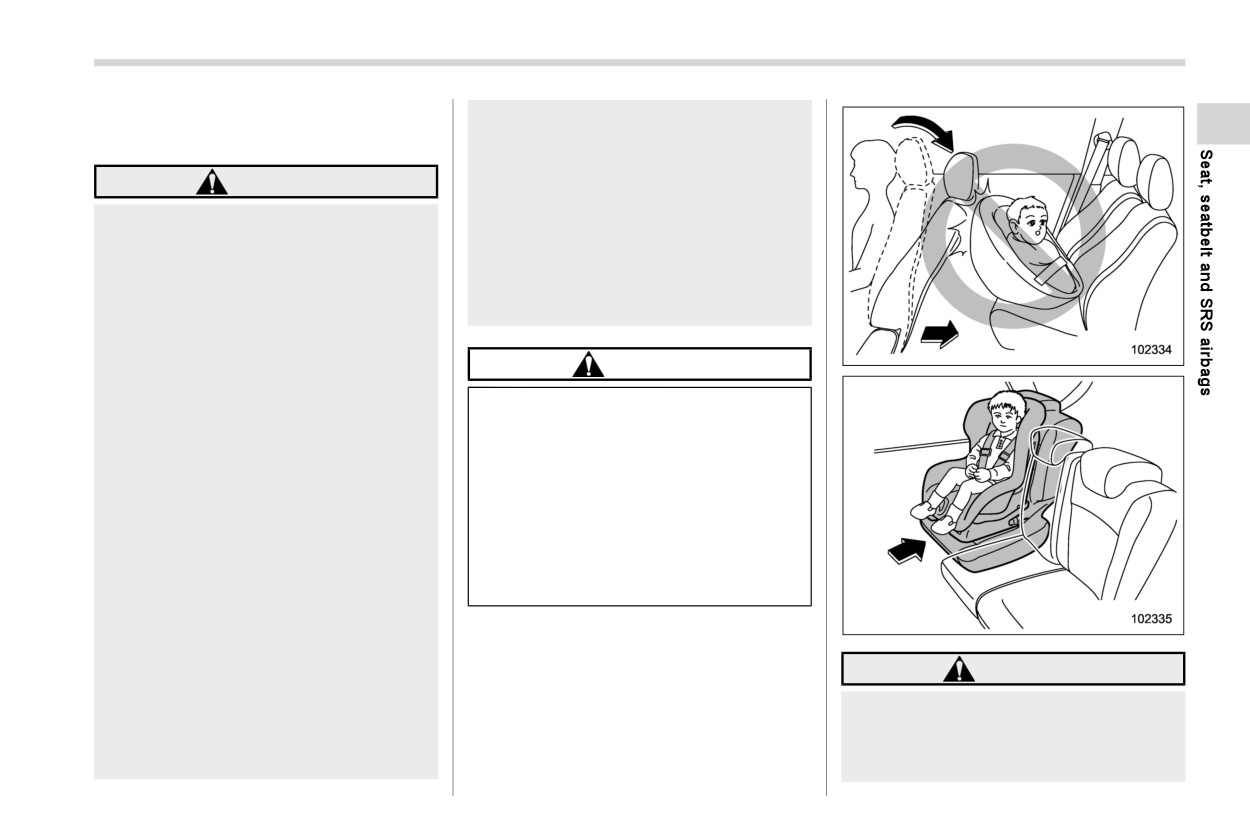
Never let a passenger hold a child on
Children should be properly re-
moving.
his or her lap or in his or her arms
strained at all times. Never allow a
while the vehicle is moving. The
child to stand up, or to kneel on any
WARNING
passenger cannot protect the child
seat. Unrestrained children will be
(or infant) from injury in a collision,
thrown forward during sudden stop
. Before installing a child restraint
because the child will be caught
or in an accident and can be injured
system, be sure to confirm that
between the passenger and objects
seriously.
the seatback is securely locked
inside the vehicle.
Additionally, children standing up or
into place. Otherwise, in an acci-
Additionally, holding a child in your
kneeling on or in front of the front
dent, serious injury or death
lap or arms in the front seat exposes
seat are exposed another serious
could result.
that child to another serious danger.
danger. Since the SRS airbag de-
. Do not leave children in the car
Since the SRS airbag deploys with
ploys with considerable speed and
unattended. High interior tem-
considerable speed and force, the
force, the child could be injured or
peratures may cause heat stroke
child could be injured or even killed.
even killed.
and dehydration that result in
serious injury or death.
Child restraint systems
67
& Safety tips for installing child
swerving, or accidents.
restraint systems
. Do not leave an unsecured child
restraint system in your vehicle.
WARNING
Unsecured child restraint sys-
tems can be thrown around in-
Child restraint systems and seat-
side of the vehicle in a sudden
belts can become hot in a vehicle
stop, turn or accident; they can
that has been closed up in sunny
strike and injure vehicle occu-
weather; they could burn a small
pants as well as result in serious
child. Check the child restraint
injuries or death to the child.
system before you place a child
in it.
Do not use a seatbelt extender. If
CAUTION
a seatbelt extender is used when
When you install a child restraint
installing a child restraint sys-
system, follow the manufacturer’s
tem, the seatbelt will not securely
instructions supplied with it. After
hold the child restraint system.
installing the child restraint system,
Use of a seatbelt extender could
check to ensure that it is held
cause death or serious injury to
securely in position. If it is not held
children or other passengers in
tight and secure, the danger of your
sudden braking, swerving, or
child suffering personal injury in the
accidents.
event of an accident may be in-
Attach the child restraint system
creased.
to the anchors properly. When
using the LATCH anchors, be
sure that there are no foreign
& Where to place a child re-
objects around the anchors.
straint system
WARNING
Make sure the child restraint
system is securely attached.
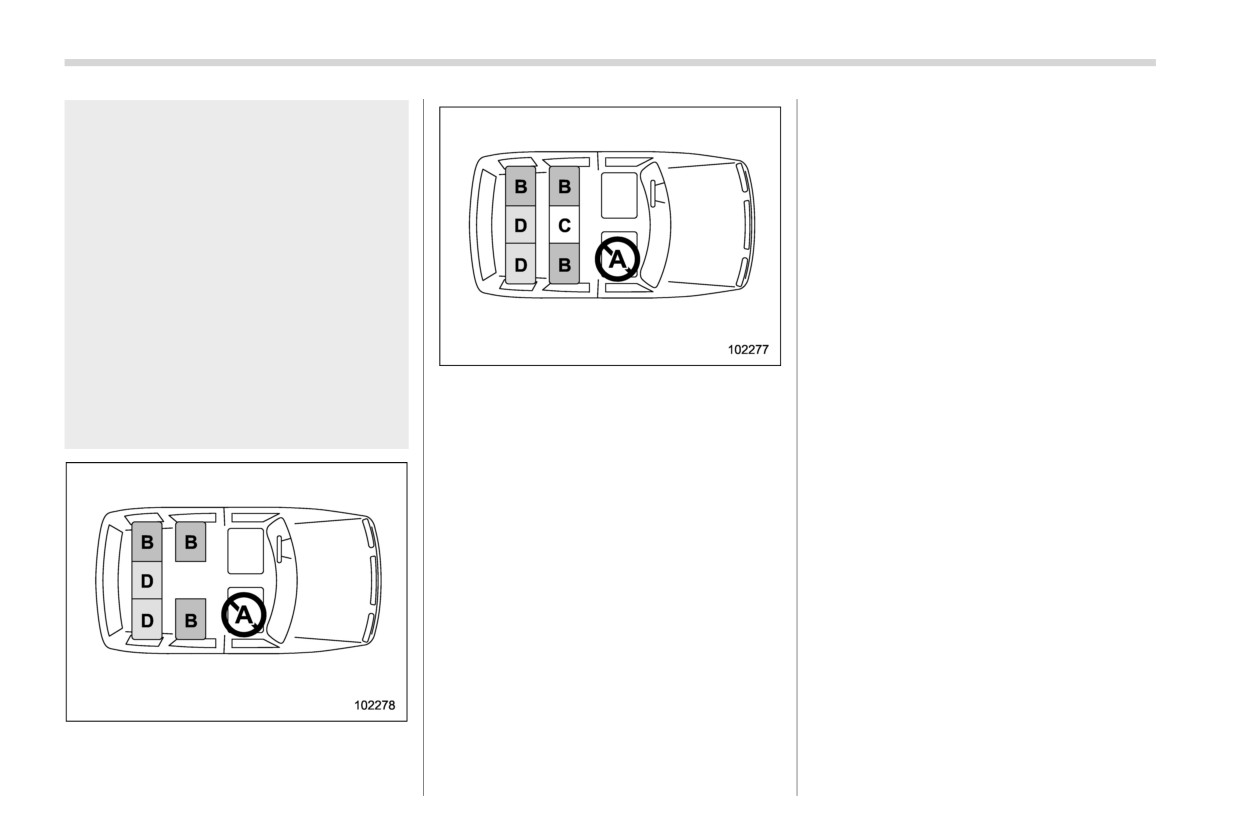
The following descriptions are SUBARU’s
Several
types of child
restraint
Otherwise it may cause death or
recommendations on where to place a
systems may conceal the buckle
serious injury to children or other
child restraint system in your vehicle.
of the neighboring seat. If the
passengers in sudden braking,
occupant of the neighboring seat
- CONTINUED -
68
Child restraint systems
cannot correctly fasten the seat-
. Top tether anchorages
belt, that person must move to a
Some types of child restraint systems
different seat. If the seatbelt can-
might not be able to be secured firmly
not be correctly fastened, there is
due to projection of the seat cushion.
the risk of serious injury or death
in the event of sudden braking or
In this seating position, you should use
a collision.
only a child restraint system that has a
bottom base that fits snugly against the
If the child restraint system can-
contours of the seat cushion and can be
not be correctly installed be-
securely retained using the seatbelt.
cause it contacts the driver’s
When a child restraint system is installed
seat, move the child restraint
using the third-row seat lower anchorages,
system to a different seat. If it
do not sit in the third-row center seat.
cannot be installed in a different
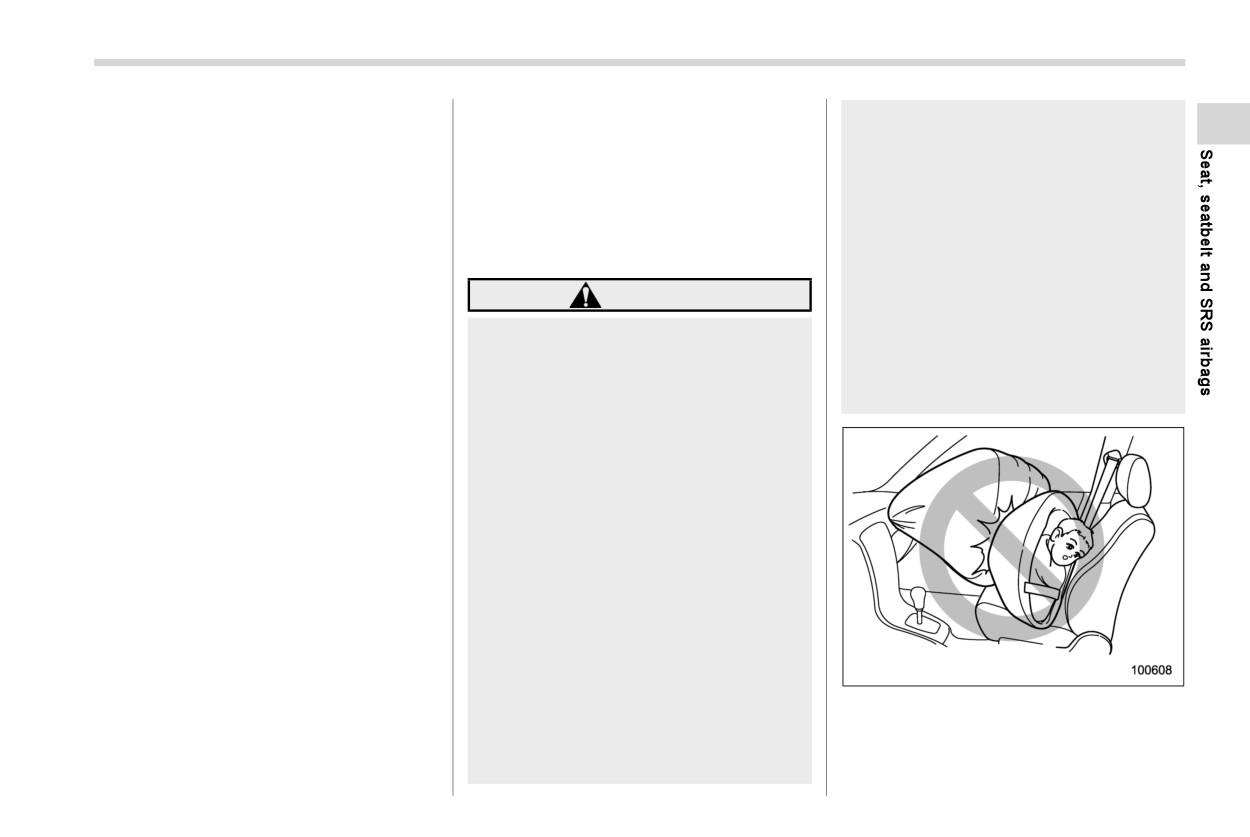
Eight seater
seat (other than the driver’s seat),
C: Applicable only for eight seaters
adjust the front seat
so
that
A: Front passenger’s seat
In this position, the following equipment is
contact does not occur.
You should not install a child
restraint
provided for installing a child restraint
system (including a booster seat) due to
system.
the hazard to children posed by the
. ALR/ELR seatbelts
passenger’s airbag.
. Lower anchorages (bars)
B: Second-row seat window-side seat-
. Top tether anchorages
ing position, third-row seat left-side
seating position
Some types of child restraint systems
Recommended positions for all types of
might not be able to be secured firmly
child restraint systems.
due to projection of the seat cushion.
In these positions, the following equipment
In this seating position, you should use
is provided for installing a child restraint
only a child restraint system that has a
system.
bottom base that fits snugly against the
contours of the seat cushion and can be
. Automatic Locking Retractor/Emer-
securely retained using the seatbelt.
gency Locking Retractor
(ALR/ELR)
Seven seater
seatbelts
The second-row center seat includes low-
er anchorages, and the lower anchorages
. Lower anchorages (bars)
Child restraint systems
69
on the center side of the second-row left
If the child restraint system is not correctly
children are safer when properly
seat can be used to install a child restraint
fixed in place
(for example, if a child
restrained in the rear seating
system.
restraint system can be moved more than
positions than in the front seating
When a child restraint system is installed in
1 in (2.5 cm) from side to side), the child
positions.
the second-row center seat using the
restraint system should be moved to a
Do not use lower anchorages
lower anchorages, do not sit in the
window-side seat position of the second-
(bars) for a seat in the center
second-row left seat.
row seat or to a left side seat of the third-
seating position unless a child
row seat.
If a child restraint system is not correctly
restraint system manufacturer’s
fixed in place
(for example, if a child
instructions permit and specify
WARNING
restraint system can be moved more than
using anchors spaced as far
1 in (2.5 cm) from side to side), the child
apart as those in this vehicle.
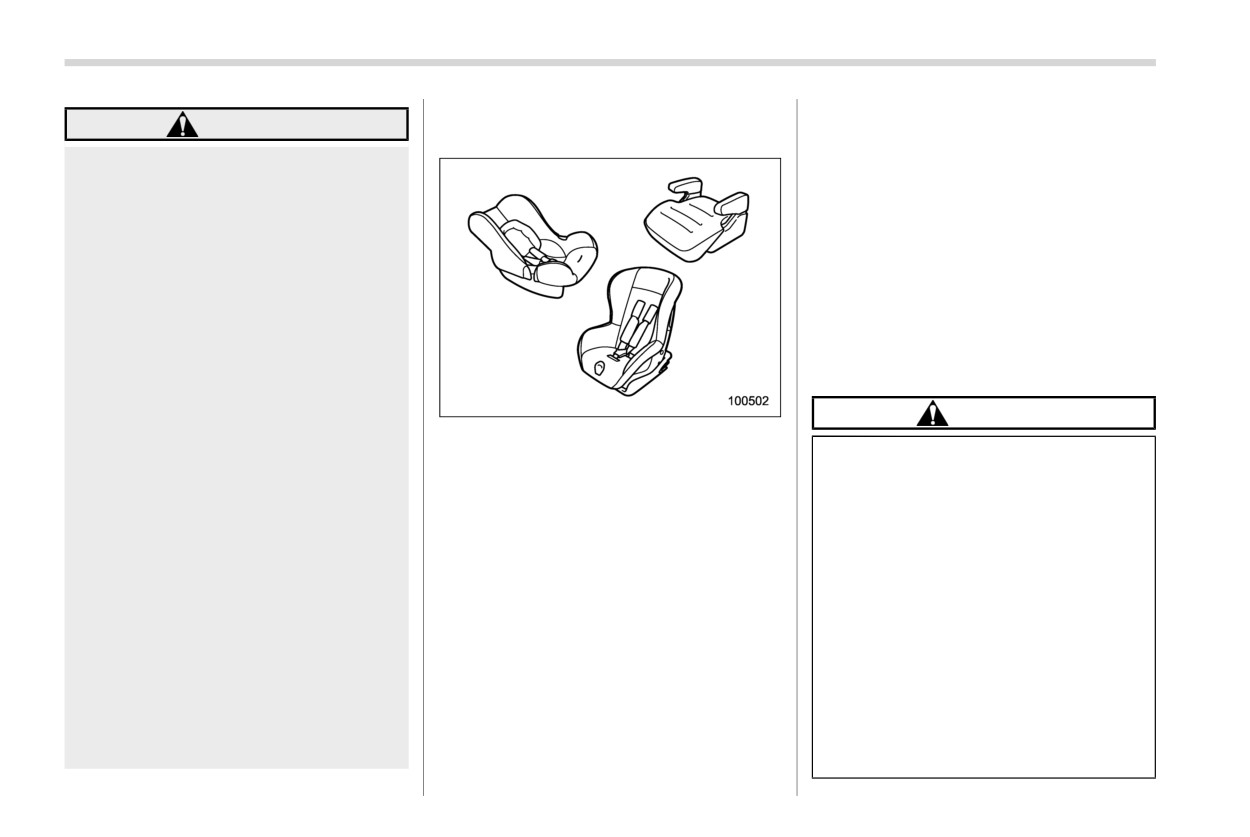
Even with advanced airbags, chil-
restraint system should be moved to a
dren can be seriously injured by
Do not connect two or more lower
window-side seat position of the second-
the airbag. Seat children in the
hooks onto the same anchorage
row seat or to a left side seat of the third-
rear seat properly restrained at
(bar).
row seat.
all times. The SRS airbag deploys
D: Third-row center and right seat
with considerable speed and
positions
force and can injure or even kill
children, especially if they are not
In this position, the following equipment is
restrained or improperly re-
provided for installing a child restraint
strained. Because children are
system.
lighter and weaker than adults,
. ALR/ELR seatbelts
their risk of being injured from
. Top tether anchorages
deployment is greater.
Some types of child restraint systems
For that reason, be sure to secure
might not be able to be secured firmly
ALL types of child restraint sys-
due to projection of the seat cushion.
tems (including forward facing
In this seating position, you should use
child restraint systems) in the
only a child restraint system that has a
REAR seats at all times. You
bottom base that fits snugly against the
should choose a restraint system
contours of the seat cushion and can be
which is appropriate for the
securely retained using the seatbelt.
child’s age, height and weight.
According to accident statistics,
- CONTINUED -
70
Child restraint systems
& Choosing a child restraint
Also it is important for you to make sure
WARNING
system
that the child restraint system is compa-
tible with the vehicle in which it will be
SINCE THIS VEHICLE IS
used.
EQUIPPED WITH A PASSEN-
GER’S SRS AIRBAG, NEVER IN-
NOTE
STALL A CHILD RESTRAINT
Some sizes of child restraint systems
SYSTEM IN THE FRONT PAS-
may not fit the vehicle seat. Before
SENGER’S SEAT. DOING SO
purchasing a child restraint system,
RISKS SERIOUS INJURY OR
check whether it fits on the vehicle seat.
DEATH TO THE CHILD BY PLA-
CING THE CHILD’S HEAD TOO
CLOSE TO THE SRS AIRBAG.
& Installing child restraint sys-
Do not allow children to lean their
tems with ALR/ELR seatbelt
heads or any other parts of their
bodies against the door or the
CAUTION
area of the seat, front and rear
Choose a child restraint
system that
is
pillars or roof side rails. The SRS
appropriate for the child’s age and size
When you install a child restraint
side airbags and SRS curtain
(weight and height) in order to provide the
system, follow the manufac-
airbags deploy even if children
child with proper protection. The child
turer’s instructions supplied with
are seated in the child restraint
restraint system should meet all applicable
it. After installing the child re-
system, and the impact could
requirements of Federal Motor Vehicle
straint system, check to ensure
cause death or serious injury to
Safety Standards for the United States or
that it is held securely in position.
If it is not held tight and secure,
the child.
of Canada Motor Vehicle Safety Standards
for Canada. It can be identified by looking
the danger of your child suffering
To secure the child restraint sys-
for the label on the child restraint system or
personal injury in the event of an
tem, be sure to comply with all
the manufacturer’s statement of compli-
accident may be increased.
installation instructions provided
ance in the document attached to the
When installing a child restraint
by the child restraint system
system.
system in the rear center seating
manufacturer.
position, set both seatbacks to
Not doing so could result in death
the original position. Otherwise,
or serious injury to children in a
sudden stop or accident.
the child restraint system cannot
be securely restrained, which
Child restraint systems
71
may result in death or serious
NOTE
injuries in the event of sudden
If the child restraint system cannot be
stop, sudden steering maneuver
installed because it contacts the head
or an accident.
restraint, remove the head restraint.
For details, refer to “Head restraints”
! Installing a rearward facing child
FP47.
restraint system
WARNING
NEVER INSTALL A CHILD RE-
STRAINT SYSTEM IN THE FRONT
PASSENGER’S SEAT. DOING SO
RISKS SERIOUS INJURY OR
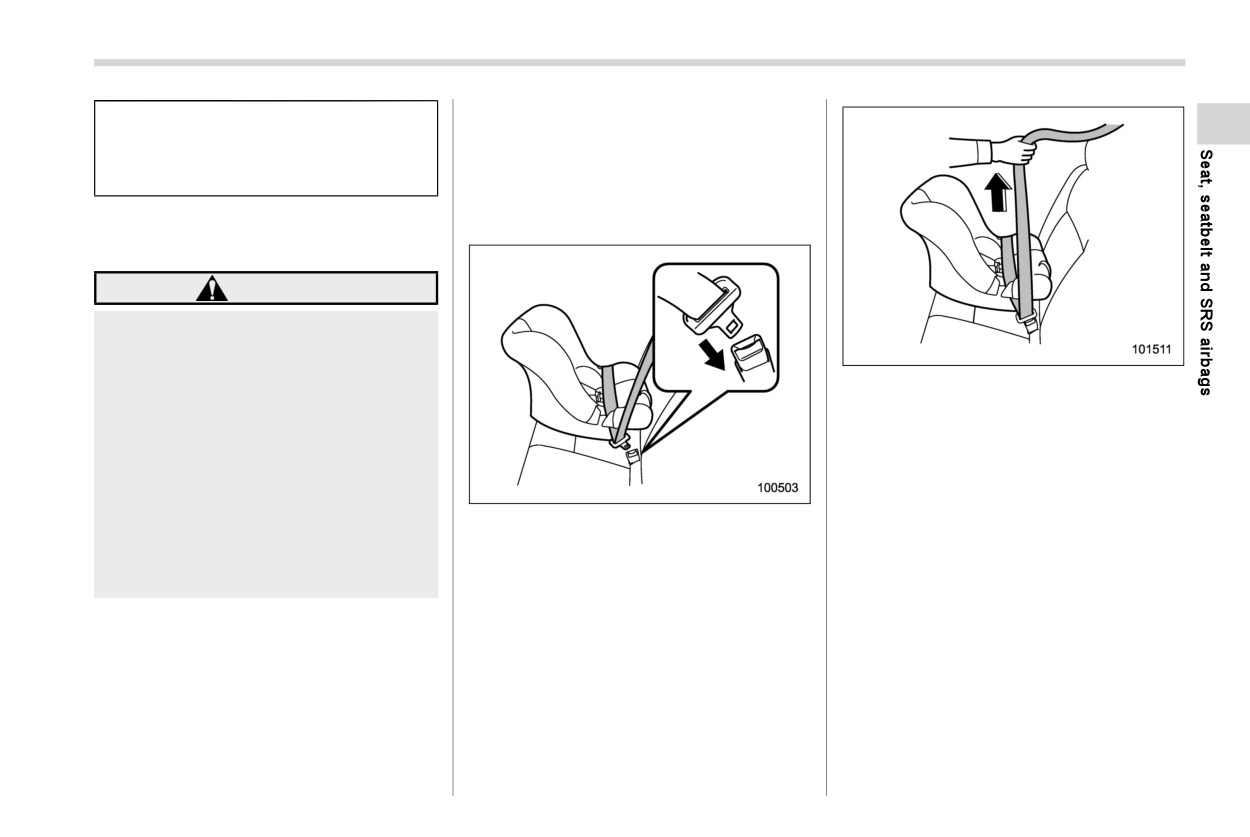
5.
Take up the slack in the lap belt.
DEATH TO THE CHILD BY PLA-
6.
If using the seatbelt in the ALR mode is
CING THE CHILD’S HEAD TOO
recommended by the manufacturer’s
CLOSE TO THE SRS AIRBAG.
instructions supplied with the child
Before installing a child restraint
restraint system, perform the following
system, be sure to confirm that
procedure.
the seatback is securely locked
(1) Pull out the seatbelt fully from the
3.
Run the lap and shoulder belt through
into place. Otherwise, in an acci-
retractor to change the retractor
or around the child restraint system
dent, serious injury or death
over from the Emergency Locking
following the instructions provided by
could result.
Retractor (ELR) to the Automatic
its manufacturer.
Locking Retractor (ALR) mode.
4.
Insert the tongue plate into the buckle
1.
If the seat is equipped with a slide
(2) Allow the belt to rewind into the
until you hear a click.
mechanism, set the seat as far back as
retractor. As the belt is rewinding,
possible.
clicks will be heard which indicate
2.
Place the child restraint system in the
the retractor functions as ALR.
rear seating position.
- CONTINUED -
72
Child restraint systems
! Installing a forward facing child
restraint system
WARNING
NEVER INSTALL A CHILD RE-
STRAINT SYSTEM IN THE FRONT
PASSENGER’S SEAT. DOING SO
RISKS SERIOUS INJURY OR
DEATH TO THE CHILD BY PLA-
CING THE CHILD’S HEAD TOO
CLOSE TO THE SRS AIRBAG.
Before installing a child restraint
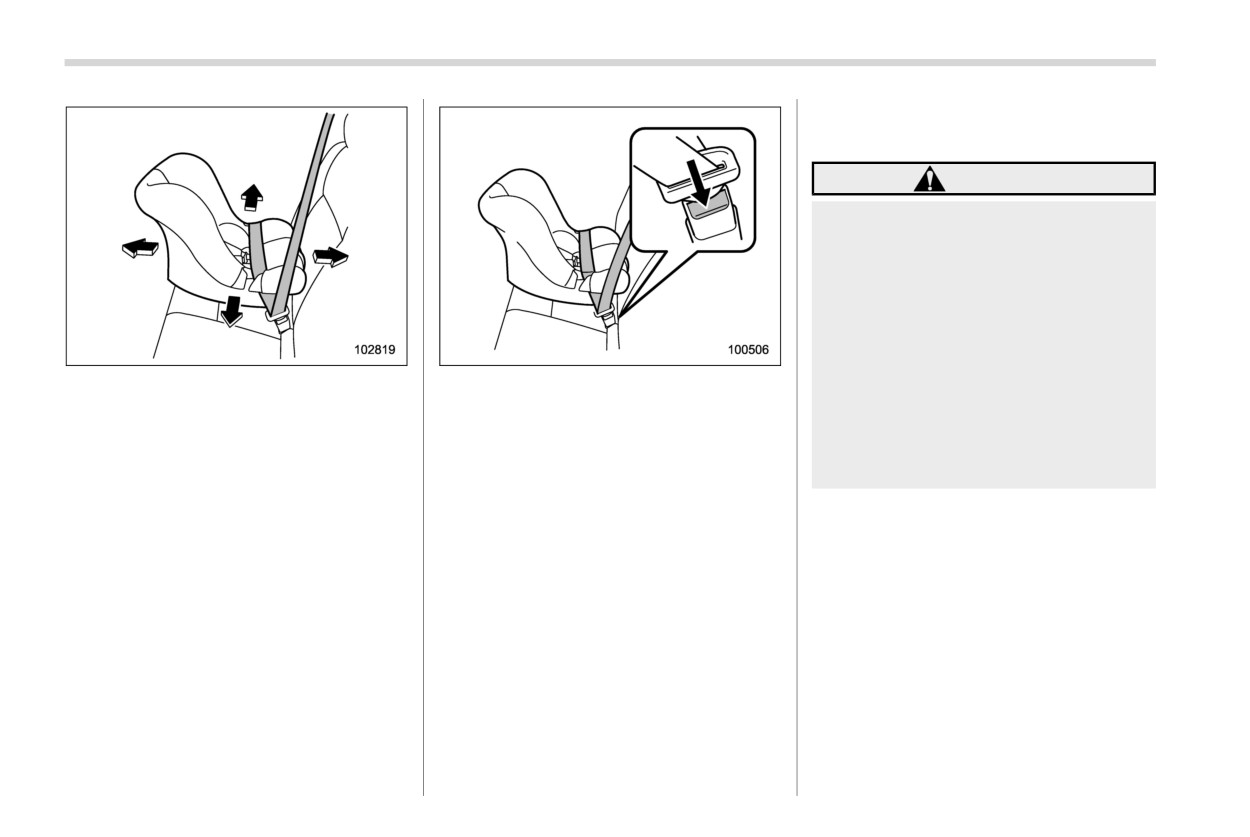
7.
Before having a child sit in the child
9.
To remove the child restraint system,
system, be sure to confirm that
restraint system, try to move it back
press the release button on the seat-
the seatback is securely locked
and forth and right and left to check if it
belt buckle and allow the belt to retract
into place. Otherwise, in an acci-
is firmly secured. Sometimes a child
completely. The belt will return to the
dent, serious injury or death
restraint system can be more firmly
ELR mode.
could result.
secured by pushing it down into the
seat cushion and then tightening the
1.
If the seat is equipped with a slide
NOTE
seatbelt. It should not be possible to
mechanism, set the seat as far back as
When the child restraint system is no
move the child restraint system more
possible.
longer in use, remove it and restore the
than 1 in (2.5 cm) in any direction along
2.
Place the child restraint system in the
ELR function of the retractor. That
the seatbelt path.
rear seating position.
function is restored by allowing the
8.
If the seatbelt has been set to the ALR
seatbelt to retract fully.
3.
If there is a gap between the child
mode in step 7, pull at the shoulder
restraint system and the seatback,
portion of the belt to confirm that it
adjust the seatback angle until good
cannot be pulled out (ALR properly
contact is achieved.
functioning).
4.
If the child restraint system makes
contact with the head restraint of the
rear seating position where the child
restraint system is to be installed, raise
Child restraint systems
73
the head restraint to the extended
position. If the child restraint system
still makes contact, remove the head
restraint. For details, refer to
“Head
restraints” FP47.
CAUTION
Store the head restraint that has
been removed in the cargo area. Do
not place the head restraint in the
passenger compartment to prevent
it from being thrown around in the
passenger compartment in a sud-
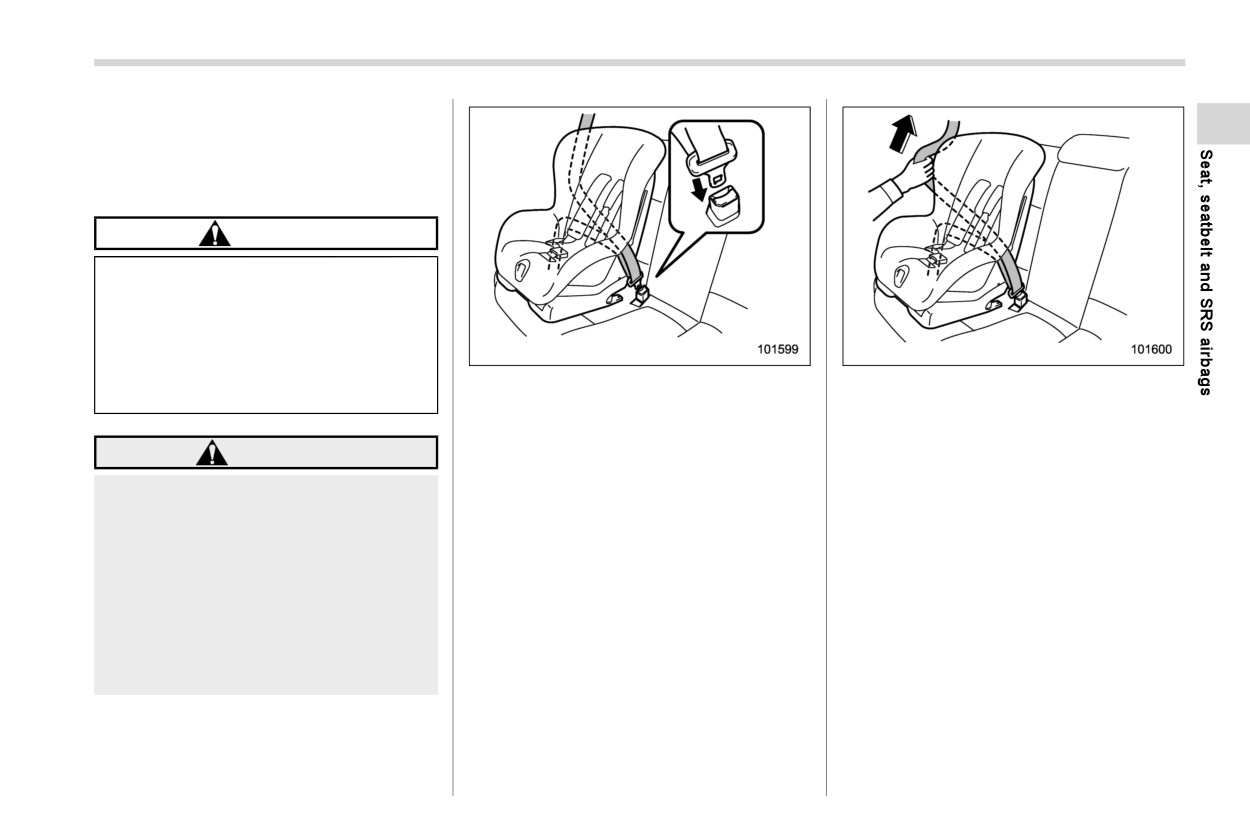
5.
Run the lap and shoulder belt through
7.
Take up the slack in the lap belt.
den stop or a sharp turn.
or around the child restraint system
8.
Pull out the seatbelt fully from the
following the instructions provided by
retractor to change the retractor over
its manufacturer.
from the Emergency Locking Retractor
WARNING
- When a child restraint system is
(ELR) to the Automatic Locking Re-
When you intend to install a child
installed on the third-row center
tractor (ALR) function. Then, allow the
restraint system on the rear center
seating position, pass the third-row
belt to rewind into the retractor. As the
seating position, if the child restraint
center seatbelt through the comfort
belt is rewinding, clicks will be heard
system does not fit snugly against
guide properly. For details, refer to
which indicate the retractor functions
the contours of the rear center seat
“Third-row center seatbelt” FP57.
as ALR.
cushion, install the child restraint
6.
Insert the tongue plate into the buckle
system on the window-side seating
until you hear a click.
position to be safe. For details, refer
to “Where to place a child restraint
system” FP67.
- CONTINUED -
74
Child restraint systems
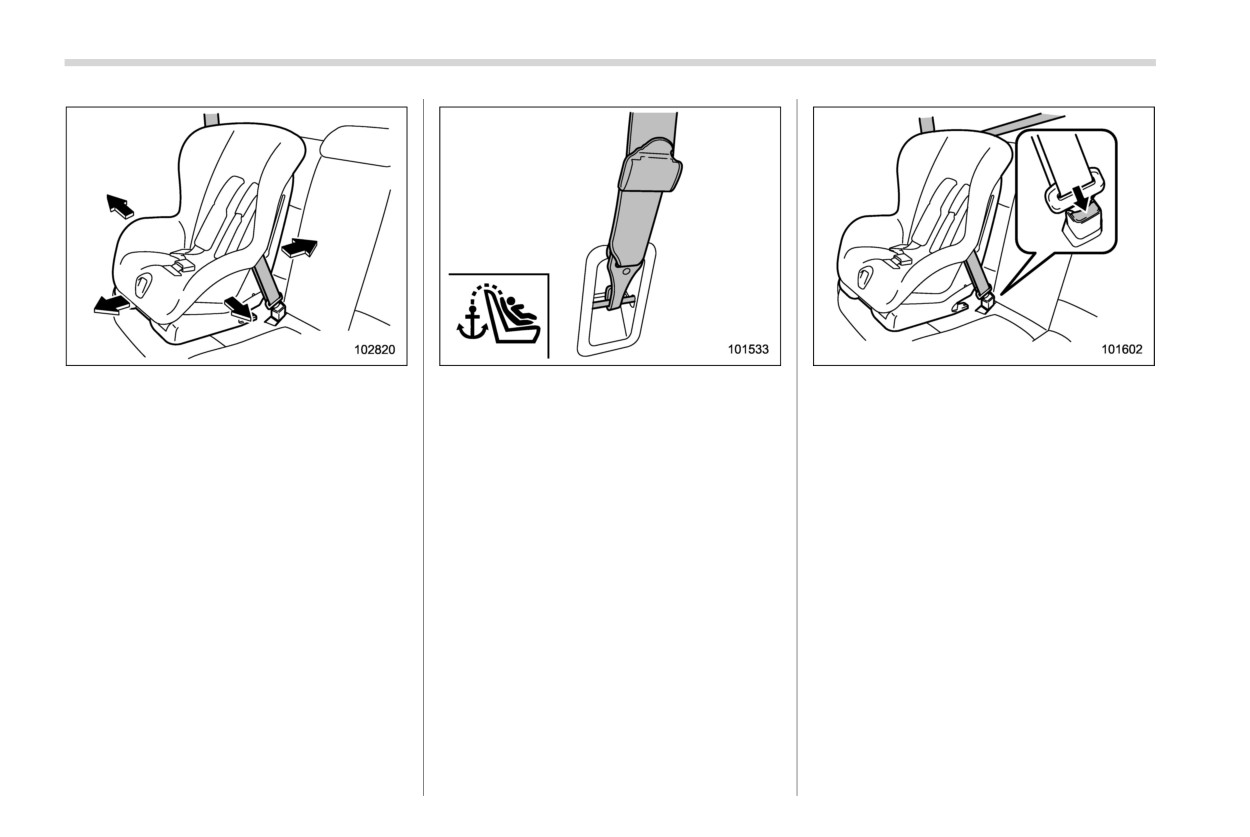
9. Before having a child sit in the child
11. Latch the top tether hook onto the top
12. To remove the child restraint system,
restraint system, try to move it back
tether anchorage that is located behind
press the release button on the seat-
and forth and right and left to check if it
the second-row and third-row seat and
belt buckle and allow the belt to retract
is firmly secured. Sometimes a child
tighten the top tether firmly. For addi-
completely. The belt will return to the
restraint system can be more firmly
tional instructions, refer to “Top tether
ELR mode.
secured by pushing it down into the
anchorages” FP81.
seat cushion and then tightening the
- If the child restraint system is
NOTE
seatbelt. It should not be possible to
installed with the head restraint left
When the child restraint system is no
move the child restraint system more
in place, pass the top tether hook
longer in use, remove it and restore the
than 1 in (2.5 cm) in any direction along
between the head restraint stays.
ELR function of the retractor. That
the seatbelt path.
function is restored by allowing the
10. Pull at the shoulder portion of the belt
seatbelt to retract fully.
to confirm that it cannot be pulled out
(ALR properly functioning).
75
Child restraint systems
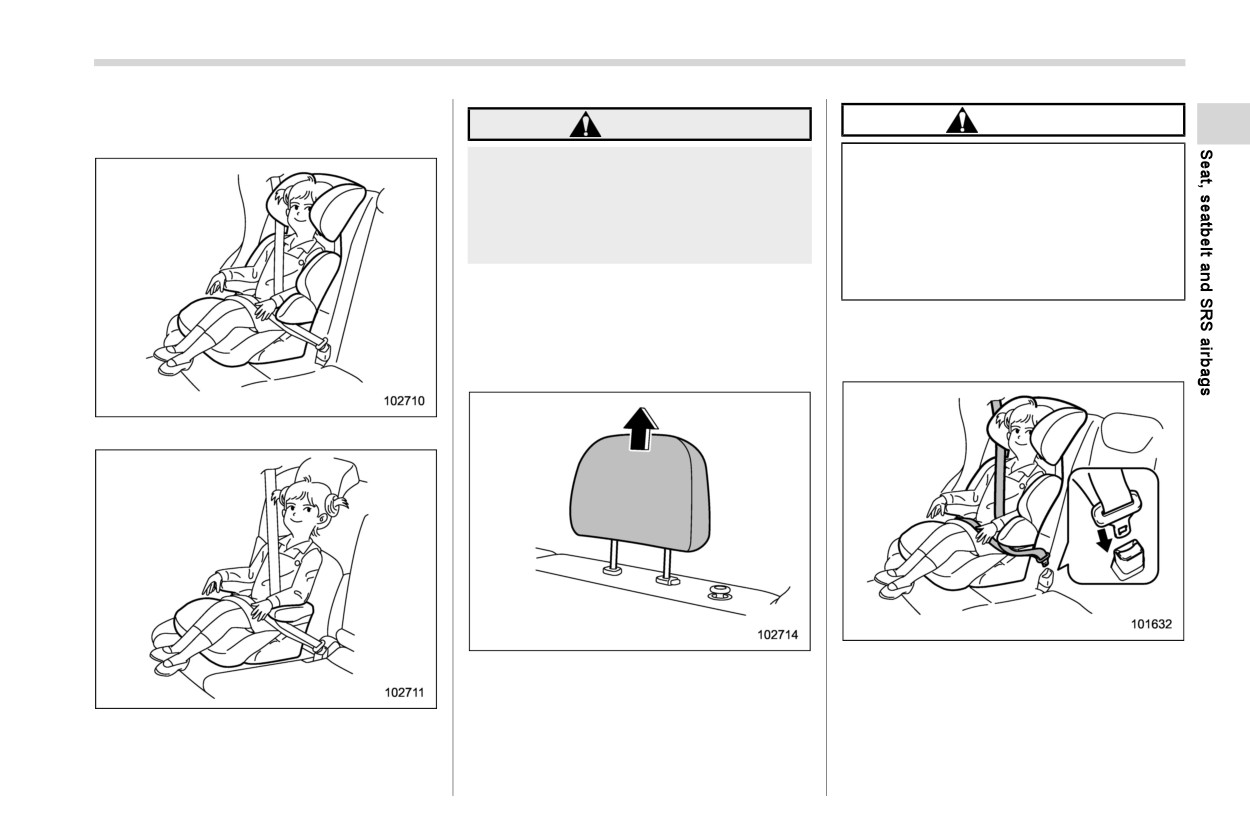
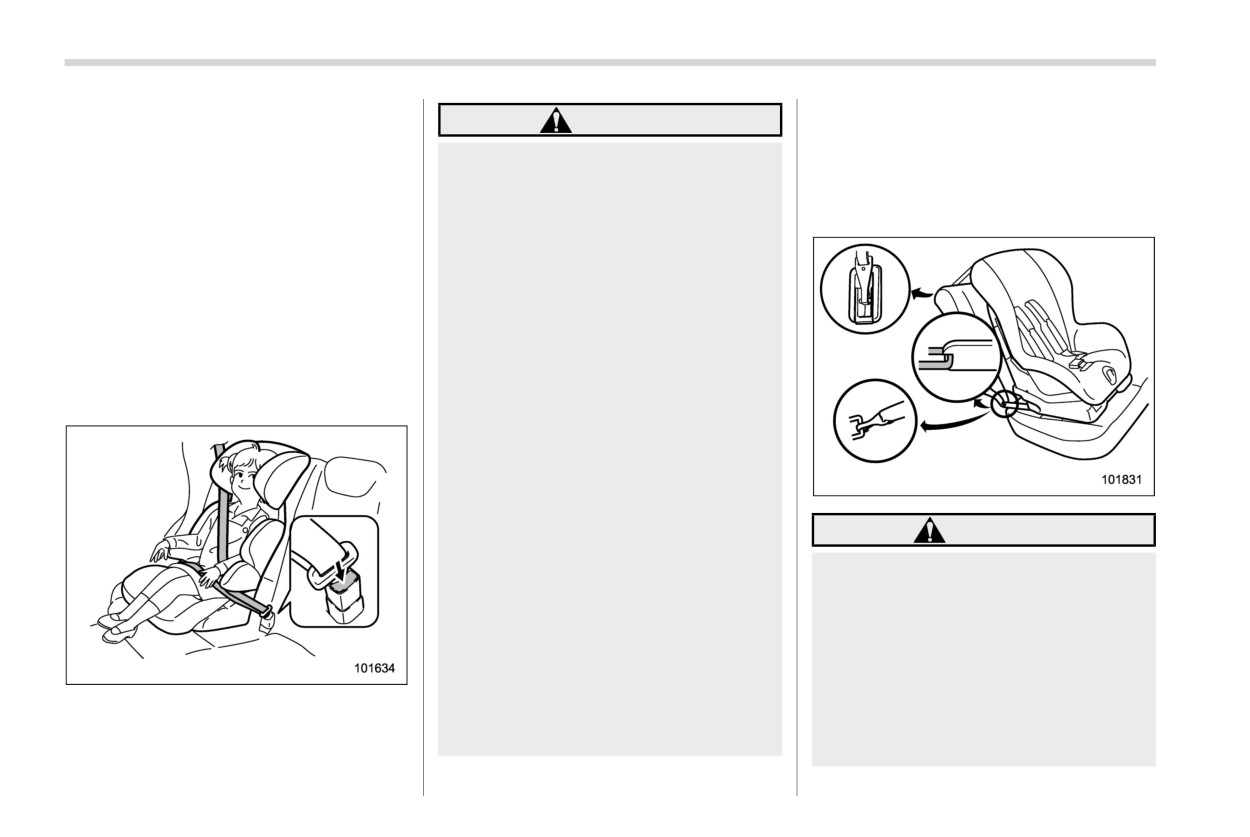
& Installing a booster seat or
WARNING
CAUTION
booster cushion
Store the head restraint that has
Before installing a booster seat/
cushion, be sure to confirm that the
been removed in the cargo area. Do
seatback is securely locked into
not place the head restraint in the
place. Otherwise, in an accident,
passenger compartment to prevent
serious injury or death could result.
it from being thrown around in the
passenger compartment in a sud-
den stop or a sharp turn.
1. If the seat is equipped with a slide
mechanism, set the seat as far back as
For booster cushion:
possible.
Raise the head restraint to the extended
2. Adjust the head restraint as follows.
position. Do not remove the head restraint.
For booster seat:
Booster seat
3. Place the booster seat/cushion in the
Raise the head restraint to the extended
rear seating position and sit the child
position. If the booster seat still makes
on it. The child should sit well back on
contact, remove the head restraint. For
Booster cushion
the booster seat/cushion.
details, refer to “Head restraints” FP47.
4. If there is a gap between the child
restraint system and the seatback,
- CONTINUED -
76
Child restraint systems
adjust the seatback angle until good
& Installation of child restraint
WARNING
contact is achieved.
systems by use of lower and
5. Run the lap and shoulder belt through
Never use a belt that is twisted or
top tether anchorages
or around the booster seat/cushion
reversed. In an accident, this can
(LATCH)
and the child following the instructions
increase the risk or severity of
provided by its manufacturer. For
injury to the child.
! Lower and top tether anchorages
booster seat/cushion with a belt guide,
Never place the shoulder belt
use the seatbelt through the belt guide.
under the child’s arm or behind
6. Insert the tongue plate into the buckle
the child’s back. If an accident
until you hear a click. Take care not to
occurs, this can increase the risk
twist the seatbelt.
or severity of injury to the child.
Make sure the shoulder belt is positioned
The seatbelt should fit snugly in
across the center of child’s shoulder and
order to provide full restraint.
that the lap belt is positioned as low as
Loose fitting belts are not as
possible on the child’s hips.
effective in preventing or redu-
cing injury.
Place the lap belt as low as
possible on the child’s hips. A
high-positioned lap belt will in-
crease the risk of sliding under
WARNING
the lap belt and of the lap belt
sliding up over the abdomen, and
Attach the child restraint system
both can result in serious injury
to the
anchors properly. When
or death.
using
the LATCH anchors, be
Make sure the shoulder belt is
sure that there are no foreign
positioned across the center of
objects around the anchors.
child’s shoulder. Placing the
Make sure the child restraint
shoulder belt over the neck may
system is securely attached.
7.
To remove the booster seat/cushion,
result in neck injury during sud-
Otherwise, it may cause death or
press the release button on the seat-
den braking or in a collision.
serious injury to children or other
belt buckle and allow the belt to retract.
passengers in sudden braking,
Child restraint systems
77
swerving, or accidents.
system (Lower Anchors and Tethers for
CHildren).
. When installing a child restraint
system using LATCH anchors
with the rear seatbelt fastened,
ensure that the rear seatbelt does
not become caught in the child
restraint system or the lower
LATCH anchorages.
NOTE
The seatbelt warning system of the rear
seats detects if any of the seats are
Second-row seat (bench seat)
occupied by a passenger. Installing a
child restraint system in the rear seat-
ing area, using the LATCH anchors,
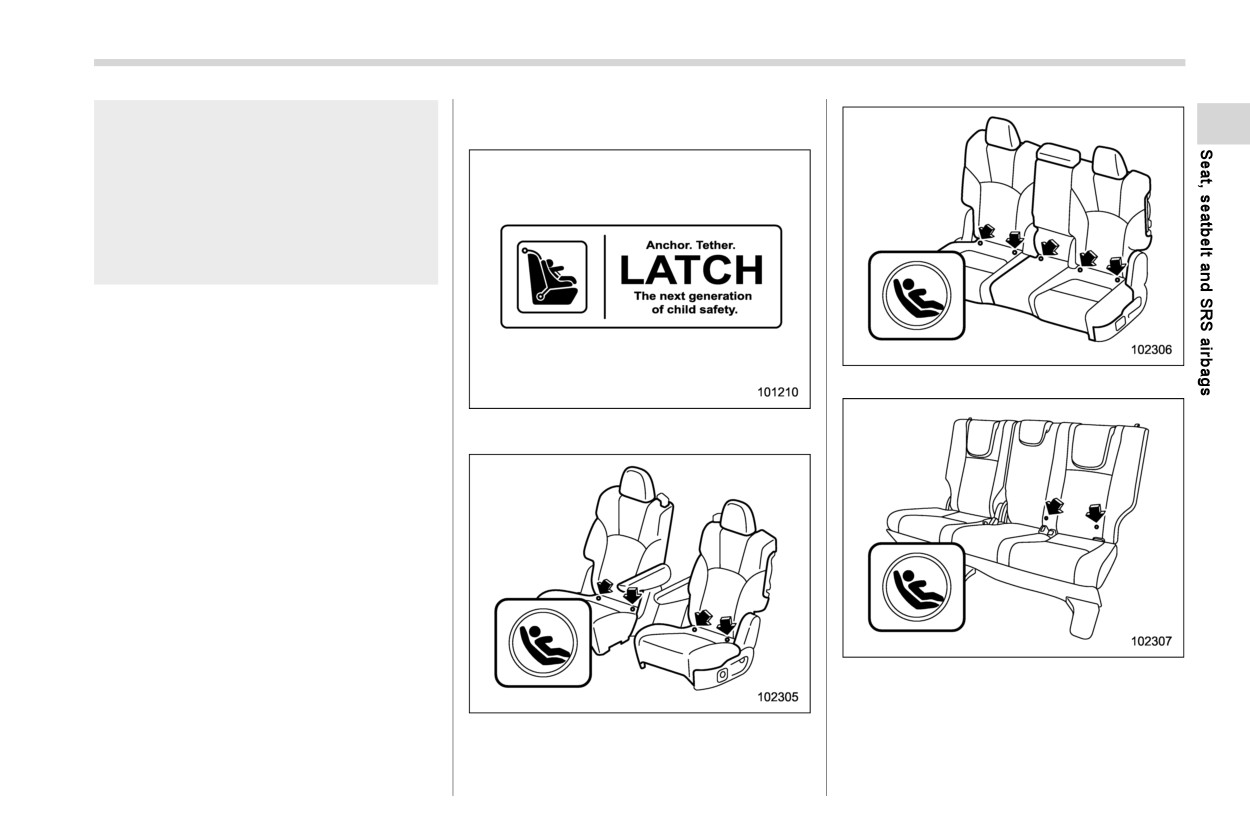
! Lower anchorages
may result in the activation of the
passenger seatbelt warning light and
chime. Fastening the rear seatbelt prior
to installing the child restraint system
will avoid activating the passenger
seatbelt warning light and chime.
For details, refer to “Rear passenger’s
seats” FP174.
Some types of child restraint systems can
be installed on the rear seat of your vehicle
without use of the seatbelts. Such child
Third-row seat
restraint systems are secured to the
dedicated anchorages provided on the
Second-row seat (captain seat)
seat. The lower and top tether anchorages
are sometimes referred to as the LATCH
- CONTINUED -
78
Child restraint systems
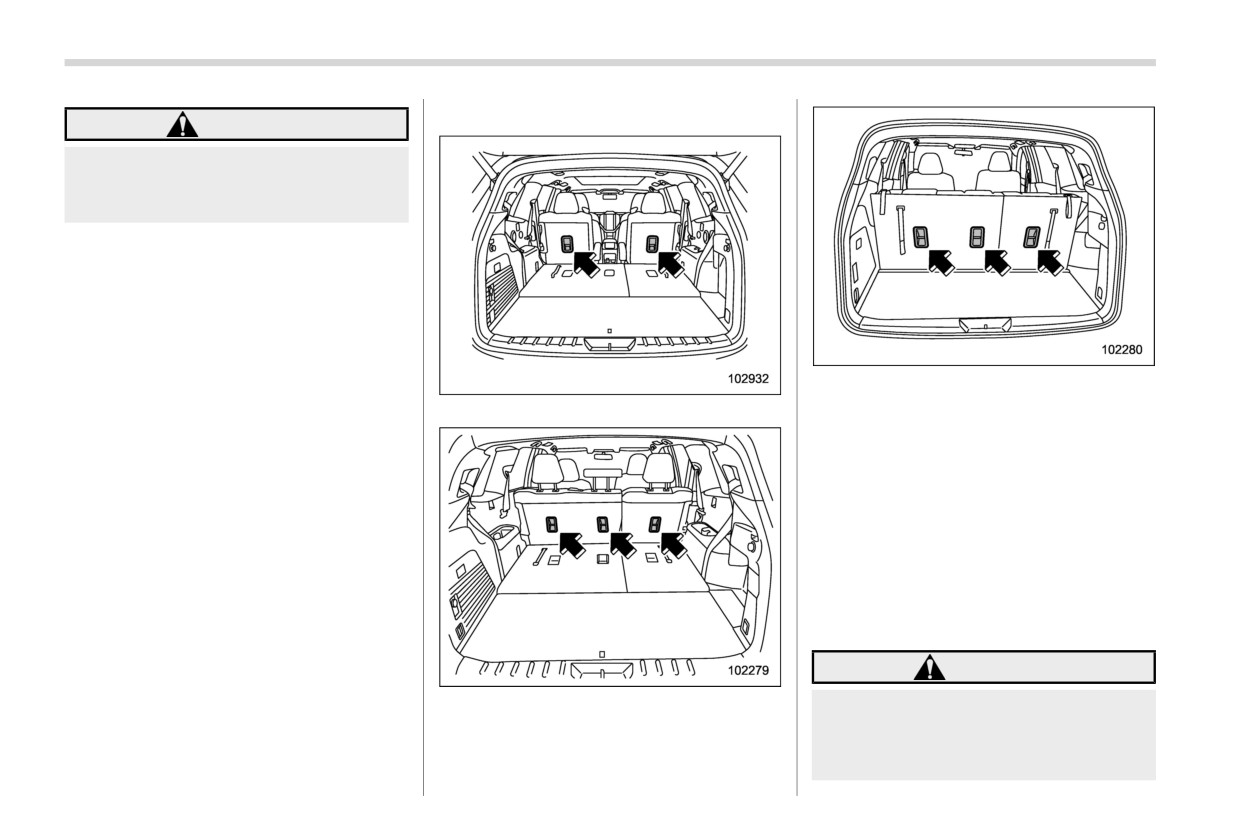
! Top tether anchorages
WARNING
Do not connect two or more lower
hooks onto the same anchorage
(bar).
The lower anchorages (bars) are used for
installing a child restraint system and are
located in the second-row and third-row
left side seats.
There are 2 lower anchorages at each of
the second-row captain seat. There are a
total of 5 lower anchorages at the second-
Third-row seat
row bench seat. The second lower ancho-
rage from the left side is used for both the
Second-row seat (captain seat)
The top tether anchorages are provided at
left side seat and center seat. There are 2
the locations shown in the above illustra-
tion. Use the tether anchorage of each
lower anchorages at the third-row left side
seat. For details, refer to
“Top tether
seat.
anchorages” FP81.
Each lower anchorage is located where
the seat cushion meets the seatback.
! To install a child restraint system
using lower and top tether an-
chorages
To install a child restraint system using
lower and top tether anchorages, perform
the following procedure.
WARNING
Second-row seat (bench seat)
Before installing a child restraint
system, be sure to confirm that the
seatback is securely locked into
place. Otherwise, in an accident,
Child restraint systems
79
serious injury or death could result.
Second-row seat
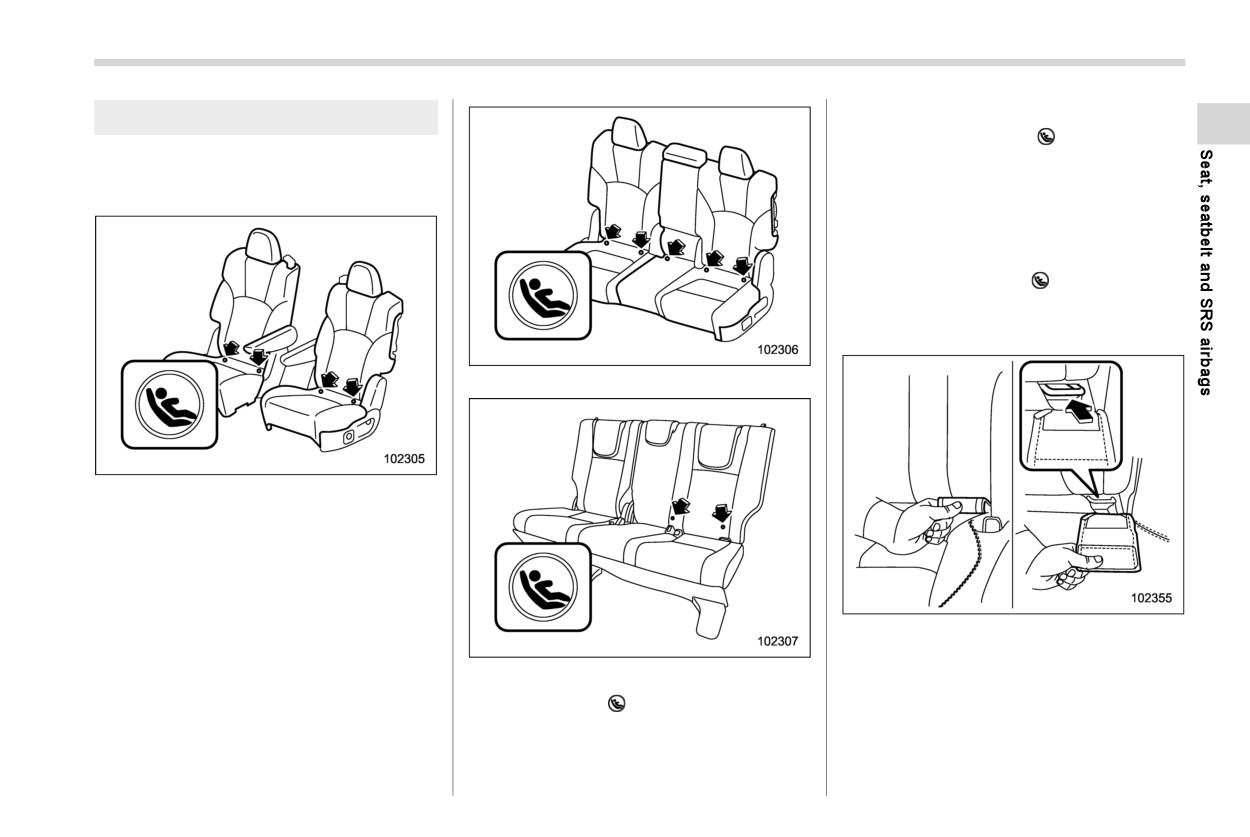
You will find marks “
” at the second-
1. If the seat is equipped with a slide
row seat cushion. These marks indi-
mechanism, set the seat as far back as
cate the positions of the lower an-
possible.
chorages (bars). Each lower ancho-
rage is located behind the cover of
seatback bottom.
Third-row seat
You will find marks “
” at the bottom of
the third-row seat seatbacks. These
marks indicate the positions of the
lower anchorages (bars).
Second-row seat (bench seat)
Second-row seat (captain seat)
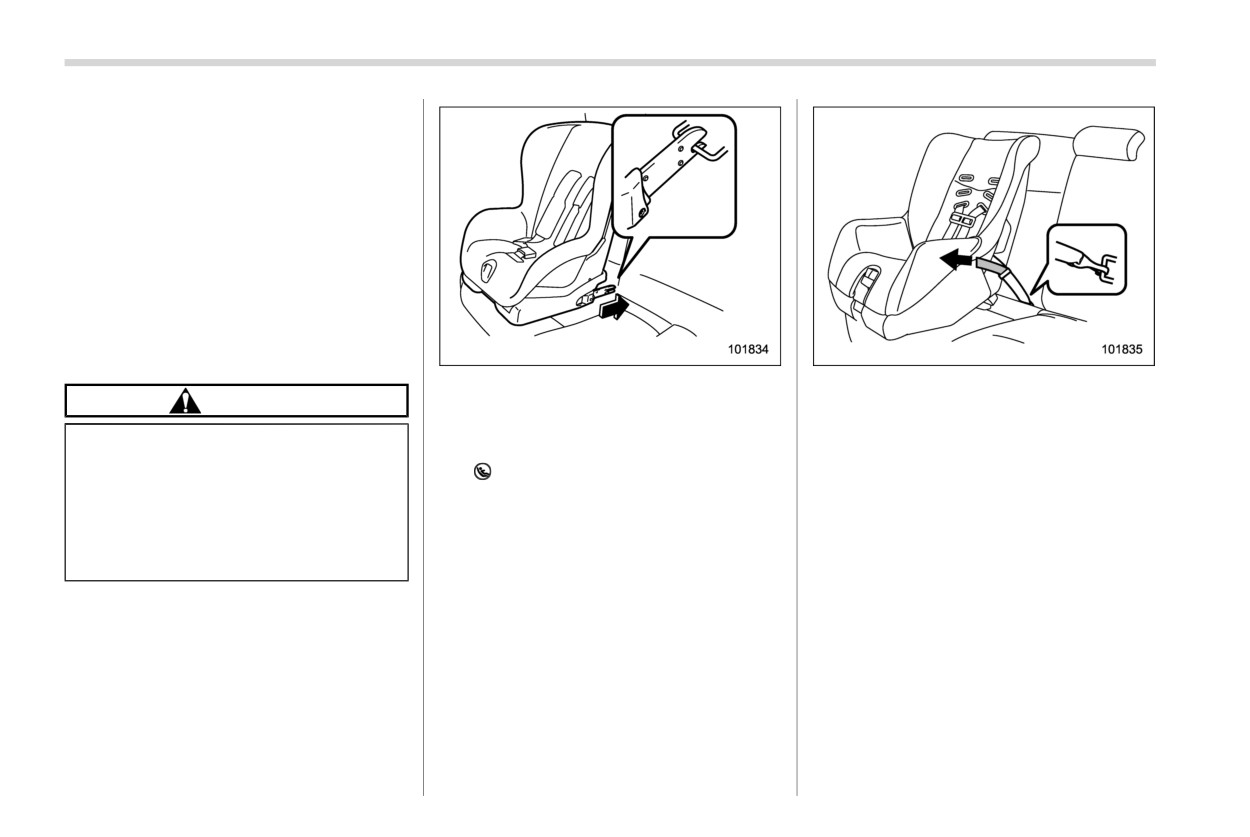
3. For second-row seat, peel off the
anchorage cover completely from the
Third-row seat
selected side of the second-row seat-
2. Refer to the “
” marks to position the
back to expose the anchorages (bars)
lower anchorages (bars). The location
to be used for installation of the child
of the symbols may vary according to
restraint system.
the vehicle model.
If it is hard to install the child restraint
- CONTINUED -
80
Child restraint systems
system because the anchorage cover
returns to the original position, press
the anchorage cover to the seat cush-
ion until it is flat.
4. If the child restraint system makes
contact with the head restraint of the
rear seating position where the child
restraint system is to be installed, raise
the head restraint to the extended
position. If the child restraint system
still makes contact, remove the head
restraint. For details, refer to
“Head
restraints” FP47.
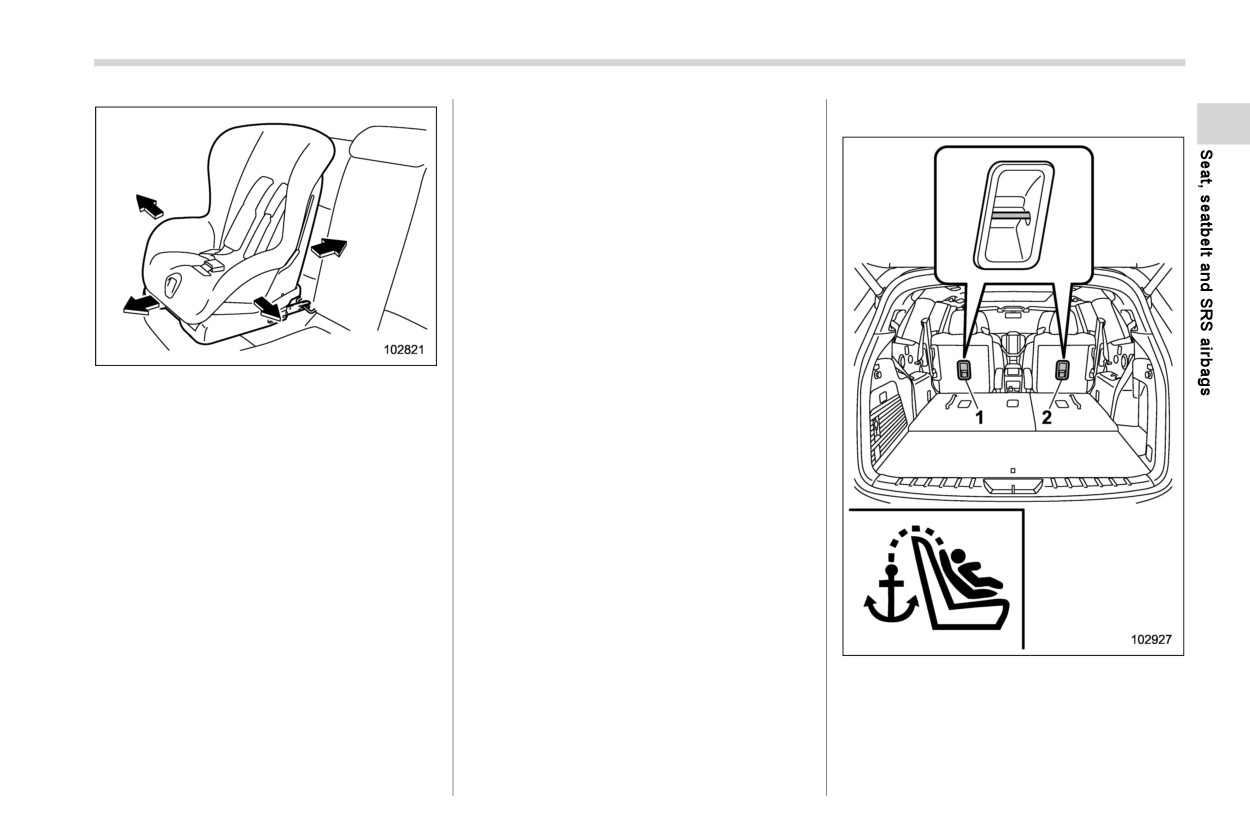
5.
While following the instructions sup-
7.
If your child restraint system is a
CAUTION
plied by the child restraint system
flexible attachment type (which uses
manufacturer, connect the lower hooks
tether belts), push the child restraint
Store the head restraint that has
onto the lower anchorages located at
system into the seat cushion and pull
been removed in the cargo area. Do
“
” marks on the bottom of the rear
both left and right lower tether belts up
not place the head restraint in the
seatback. When the hooks are con-
to secure the child restraint system by
passenger compartment to prevent
nected, make sure the adjacent seat-
taking up the slack in the belt.
it from being thrown around in the
belts are not caught.
8.
Latch the top tether hook onto the top
passenger compartment in a sud-
6.
If there is a gap between the child
tether anchorage that is located behind
den stop or a sharp turn.
restraint system and the seatback,
the rear seat and tighten the top tether
adjust the seatback angle until good
firmly. For additional instructions, refer
contact is achieved.
to “Top tether anchorages” FP81.
Child restraint systems
81
SUBARU recommends that you check
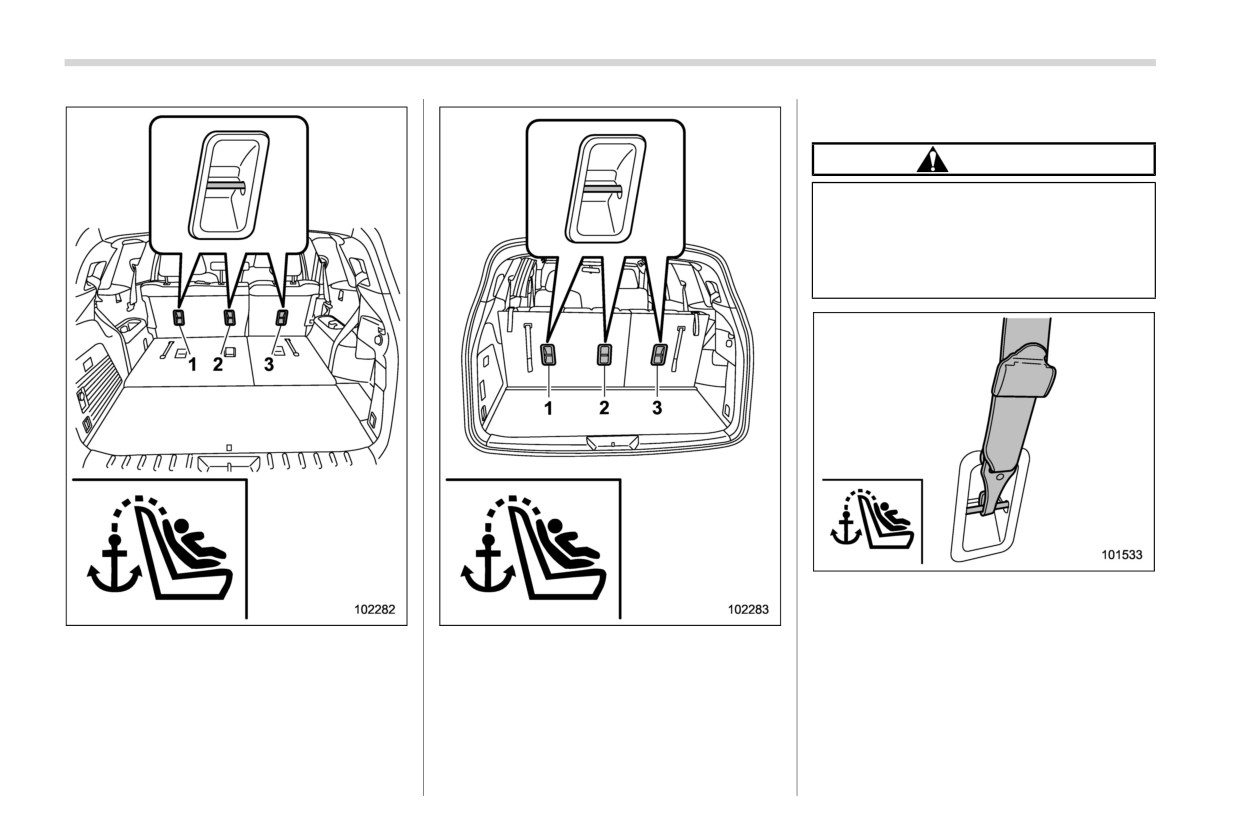
! Anchorage location
with a certified Child Passenger Safety
Technician to ensure the proper installa-
tion of your child restraint system. For
more information, and to locate the closest
inspection location in the U.S., refer to the
National Highway Traffic Safety Adminis-
tration
(NHTSA) website. In Canada,
check with Transport Canada.
& Top tether anchorages
Your vehicle is equipped with five or six top
tether anchorages so that a child restraint
system having a top tether can be installed
9.
Before having a child sit in the child
in the rear seat. When installing a child
restraint system, try to move it back
restraint system using top tether, proceed
and forth and right and left to check if it
as follows, while observing the instructions
is firmly secured. Sometimes a child
by the child restraint system manufacturer.
restraint system can be more firmly
secured by pushing it down into the
Since a top tether can provide additional
seat cushion. It should not be possible
stability by offering another connection
to move the child restraint system
between a child restraint system and the
more than 1 in (2.5 cm).
vehicle, we recommend that you use a top
10. To remove the child restraint system,
tether whenever one is required or avail-
follow the reverse procedures of in-
able.
stallation.
Second-row seat (captain seat)
1
For left seat
2
For right seat
- CONTINUED -
82
Child restraint systems
! To hook the top tether
CAUTION
Always raise the head restraint
when mounting a child restraint
system with a top tether. Failure to
do so may prevent the top tether
from being fastened tightly.
1. Attach the top tether hook to the
appropriate top tether anchorage.
Second-row seat (bench seat)
Third-row seat
2. Tighten the top tether securely.
1
For left seat
1
For left seat
SUBARU recommends that you check
2
For center seat
2
For center seat
with a certified Child Passenger Safety
3
For right seat
3
For right seat
Technician to ensure the proper installa-
Three top tether anchorages are installed
tion of your child restraint system. For
on the back side of the rear seatback.
more information, and to locate the closest
SRS airbag (Supplemental Restraint System airbag)
83
inspection location in the U.S., refer to the
& General precautions regard-
1-8. SRS airbag (Supplemen-
National Highway Traffic Safety Adminis-
ing SRS airbag system
tal Restraint System airbag)
tration
(NHTSA) website. In
Canada,
check with Transport Canada.
WARNING
Supplemental Restraint System
(SRS)
name is used because the airbag system
To obtain maximum protection in
supplements the vehicle’s seatbelts.
the event of an accident, the
This vehicle is equipped with a supple-
driver and all passengers must
mental restraint system which consists of
always wear seatbelts when in
seven airbags.
the vehicle. The SRS airbag is
designed only to be a supplement
The configurations are as follows.
to the primary protection pro-
. Driver’s and front passenger’s frontal
vided by the seatbelt. It does not
airbags
eliminate the need to fasten seat-
. Driver’s and front passenger’s side
belts. In combination with the
airbags
seatbelts, it offers the best pro-
. Curtain airbags (for driver, front pas-
tection in case of a serious acci-
senger, and window-side rear passen-
dent.
gers)
Not wearing a seatbelt increases
. Knee airbag for driver
the chance of severe injury or
death in a crash even when the
These SRS airbags are designed only
vehicle has the SRS airbag sys-
as a supplement to the primary protec-
tem.
tion provided by the seatbelt.
The system also controls seatbelt preten-
For instructions and precautions
sioners. For operation instructions and
concerning the seatbelt system,
precautions concerning the seatbelt pre-
refer to “Seatbelts” FP52.
tensioner, refer to “Seatbelt pretensioners”
The SRS side airbags and SRS
FP61.
curtain airbags are designed only
to be a supplement to the primary
protection provided by the seat-
belt. They do not eliminate the
need to fasten seatbelts. It is also
- CONTINUED -
84
SRS airbag (Supplemental Restraint System airbag)
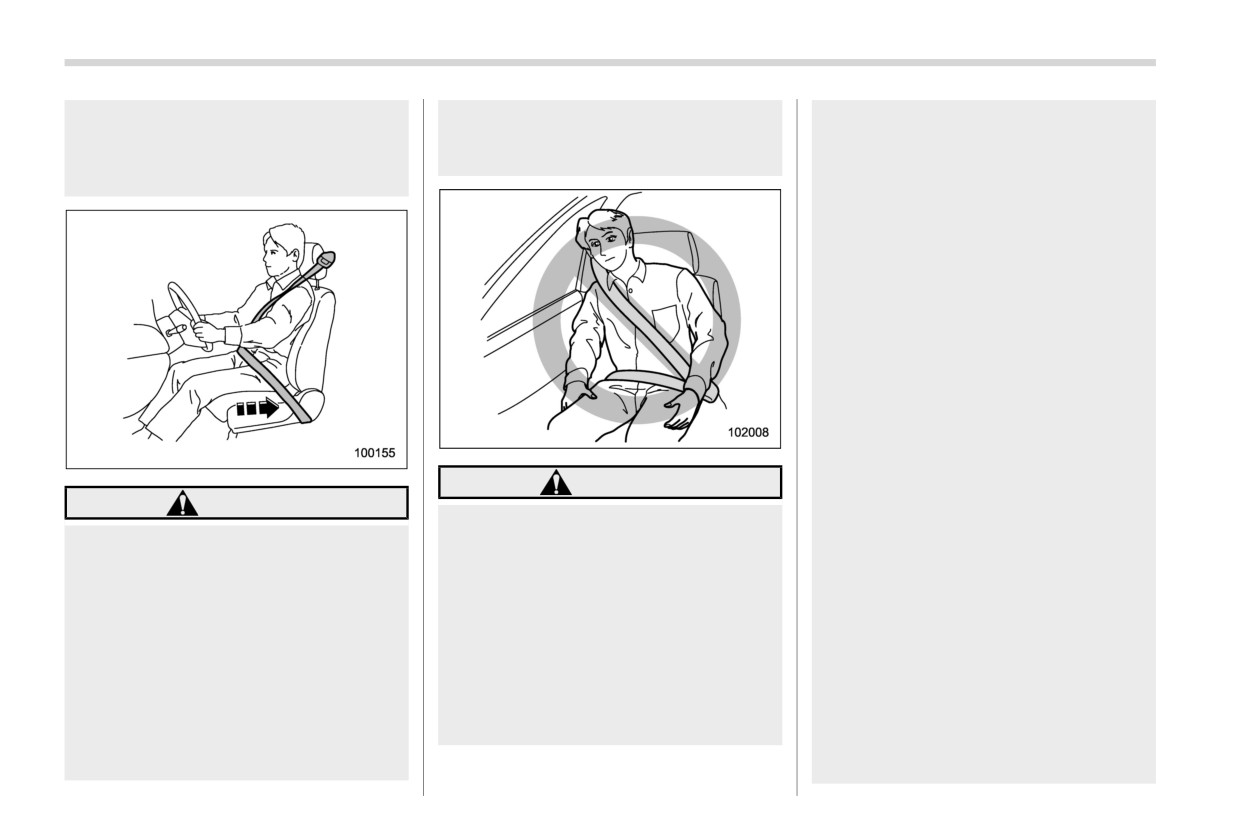
important to wear a seatbelt to
senger should move the seat as far
Since your vehicle is equipped
help avoid injuries that can result
back as possible and sit upright and
with SRS curtain airbags, do not
when an occupant is not seated
well back in the seat.
sit or lean close to the front or
in a proper upright position.
rear door on either side. Do not
put body parts out of the window.
The SRS curtain airbags on both
sides of the cabin are stored in
the roof side (between the front
pillar and a point behind the rear
quarter glass), and they provide
protection by deploying rapidly
in the event of a side impact,
rollover or an offset frontal colli-
sion. However, the force of its
deployment can injure an occu-
pant whose body is too close to
an SRS airbag.
Do not sit or lean unnecessarily
WARNING
close to the SRS airbag. Because
WARNING
the SRS airbag deploys with
Do not sit or lean close to either
considerable speed and force to
The SRS airbags deploy with con-
front door. The SRS side airbags
protect in high speed collisions,
siderable
speed and force. Occu-
are stored in both front seat
the force of an airbag can injure
pants who are not seated in the
seatbacks next to the door, and
an occupant whose body is too
proper upright position when the
they provide protection by de-
close to an SRS airbag.
SRS airbag deploys could suffer
ploying rapidly in the event of a
serious injury. Because the SRS
side impact collision. However,
It is also important to wear seat-
airbag needs enough space for
the force of SRS side airbag
belts to help avoid injuries that
deployment, the driver should al-
deployment can injure an occu-
can result when the SRS airbag
ways sit upright and back in the seat
pant whose body is too close to
contacts an occupant not in their
as far from the steering wheel as
an SRS airbag.
proper position.
practical while still maintaining full
Even when properly positioned,
vehicle control, and the front pas-
there remains a possibility that
SRS airbag (Supplemental Restraint System airbag)
85
an occupant may suffer minor
propelled inside the vehicle,
. If the SRS airbag deploys, fuel
injury, such as
abrasions and
causing injury.
supply will be cut off to reduce the
bruises to the
face or arms,
risk of fire caused by leaking fuel.
because of the SRS airbag de-
For details about restarting of the
ployment force.
CAUTION
engine, refer to “If your vehicle is
involved in an accident” FP468.
When the SRS airbag deploys,
some smoke will be released.
& General precautions regard-
This smoke could cause breath-
ing SRS airbag system for
ing problems for people with a
history of asthma or other breath-
accessories and any objects
ing trouble. If you or your pas-
sengers have breathing pro-
blems after SRS airbag deploys,
get fresh air promptly.
A deploying SRS airbag releases
hot gas. Occupants could get
burned if they come into direct
contact with the hot gas.
WARNING
NOTE
Keep arms away from either front
. When you sell your vehicle, we urge
door
or its internal trim. They
you to inform the buyer that the
could be injured in the event of
vehicle is equipped with SRS air-
SRS side airbag deployment.
bags. Also, notify the buyer of the
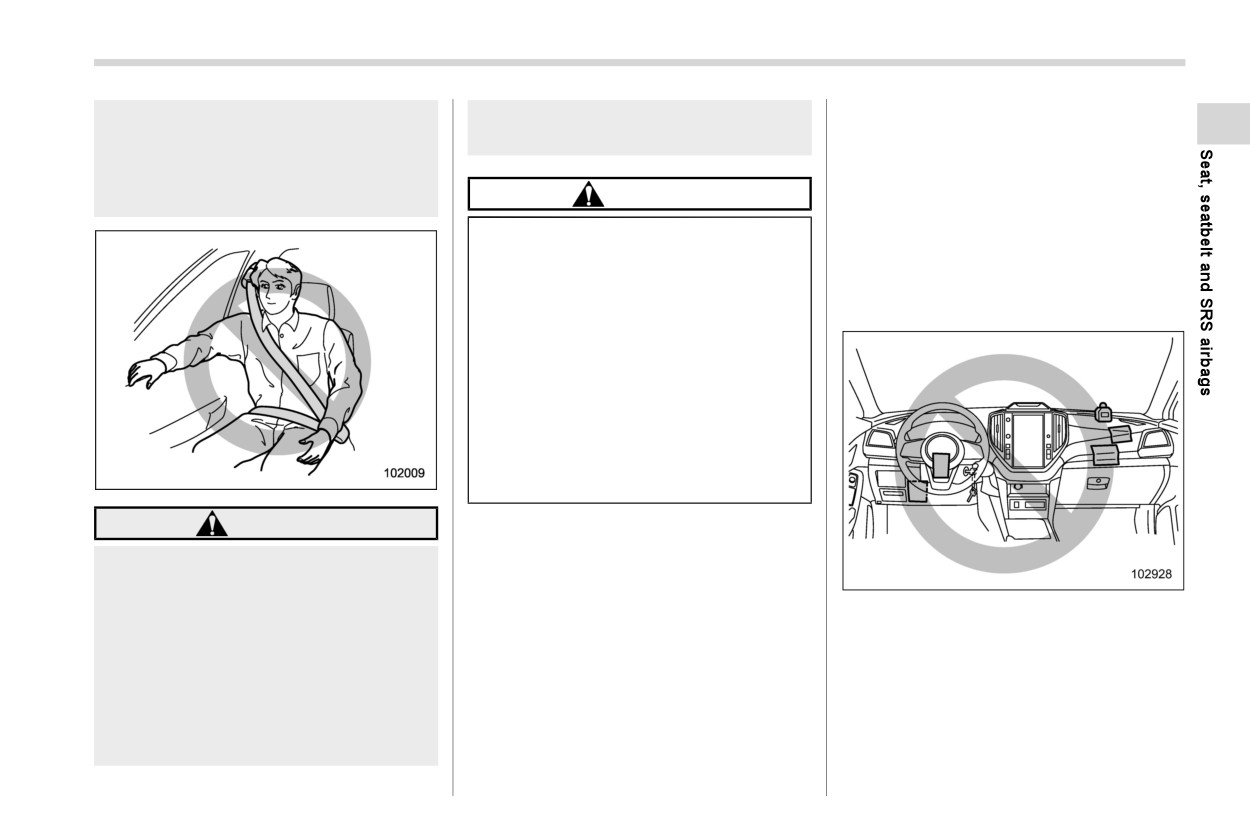
Do not place any objects over or
applicable section in this Owner’s
near the SRS airbag cover or
Manual.
between you and the SRS airbag.
If the SRS airbag deploys, these
objects could interfere with its
proper operation and could be
- CONTINUED -
86
SRS airbag (Supplemental Restraint System airbag)
deploys, those objects could in-
the SRS airbag deploys, those ob-
terfere with its proper operation
jects could become projectiles that
and could be propelled inside the
could seriously injure vehicle occu-
vehicle, causing injury.
pants.
. The key must not be attached to
heavy, sharp or hard acces-
sories, or another key. If the SRS
knee airbag deploys, those ob-
jects could interfere with its
proper operation and could be
propelled inside the vehicle and
cause injury.
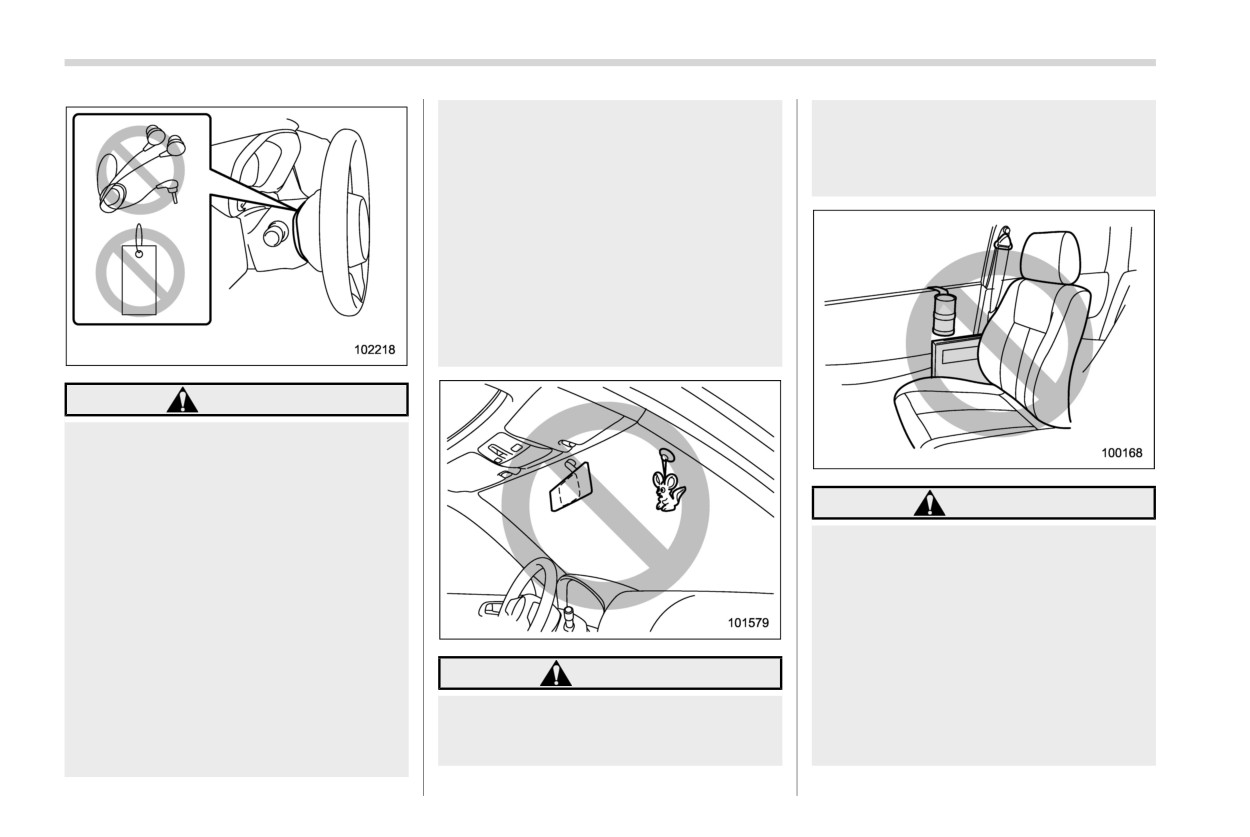
WARNING
Do not put any objects (including
straps or cords) over the steering
wheel pad, column cover, or
dashboard.
WARNING
- These objects could be en-
Do not attach accessories to the
tangled with the steering
door trim or near either SRS side
wheel, preventing the SRS
airbags and do not place objects
frontal airbag, etc. from oper-
ating properly.
near the SRS side airbags. In the
event of SRS side airbag deploy-
- If the SRS frontal airbag de-
ment, they could be propelled
ploys, these objects could be
dangerously toward the vehicle’s
propelled inside the vehicle,
WARNING
occupants and cause injuries.
causing injury.
Do not attach accessories to the
Do not attach a hands-free micro-
Do not put any objects under the
windshield or fit an extra-wide mir-
phone or any other accessory to
driver’s side of the instrument
ror over the inside rear view mirror. If
a front pillar, a center pillar, a rear
panel. If the SRS knee airbag
SRS airbag (Supplemental Restraint System airbag)
87
pillar, the windshield, a side win-
ment of the SRS curtain airbags,
face on or near the SRS side
dow, an assist grip, or any other
they could cause serious injuries by
airbag. They could prevent prop-
cabin surface that would be near
coming off the coat hooks and being
er deployment of the SRS side
a deploying SRS curtain airbag. A
thrown through the cabin or by
airbag, reducing protection avail-
hands-free microphone or other
preventing deployment of the cur-
able to the front seat’s occupant.
accessory in such a location
tain airbags.
. Do not install a seat cover unless
could be propelled through the
Before hanging clothing on the coat
it is a genuine SUBARU seat
cabin with great force by the
hooks, make sure there are no sharp
cover exclusively designed for
curtain airbag, or it could prevent
objects in the pockets. Hang cloth-
use with the SRS airbag. Even
correct deployment of the curtain
ing directly on the coat hooks with-
when using a genuine SUBARU
airbag. In either case, the result
out using hangers.
seat cover, the SRS side airbag
could be serious injuries.
system may not function nor-
mally if the seat cover is not
installed correctly.
& General precautions regard-
ing SRS airbag system and
children
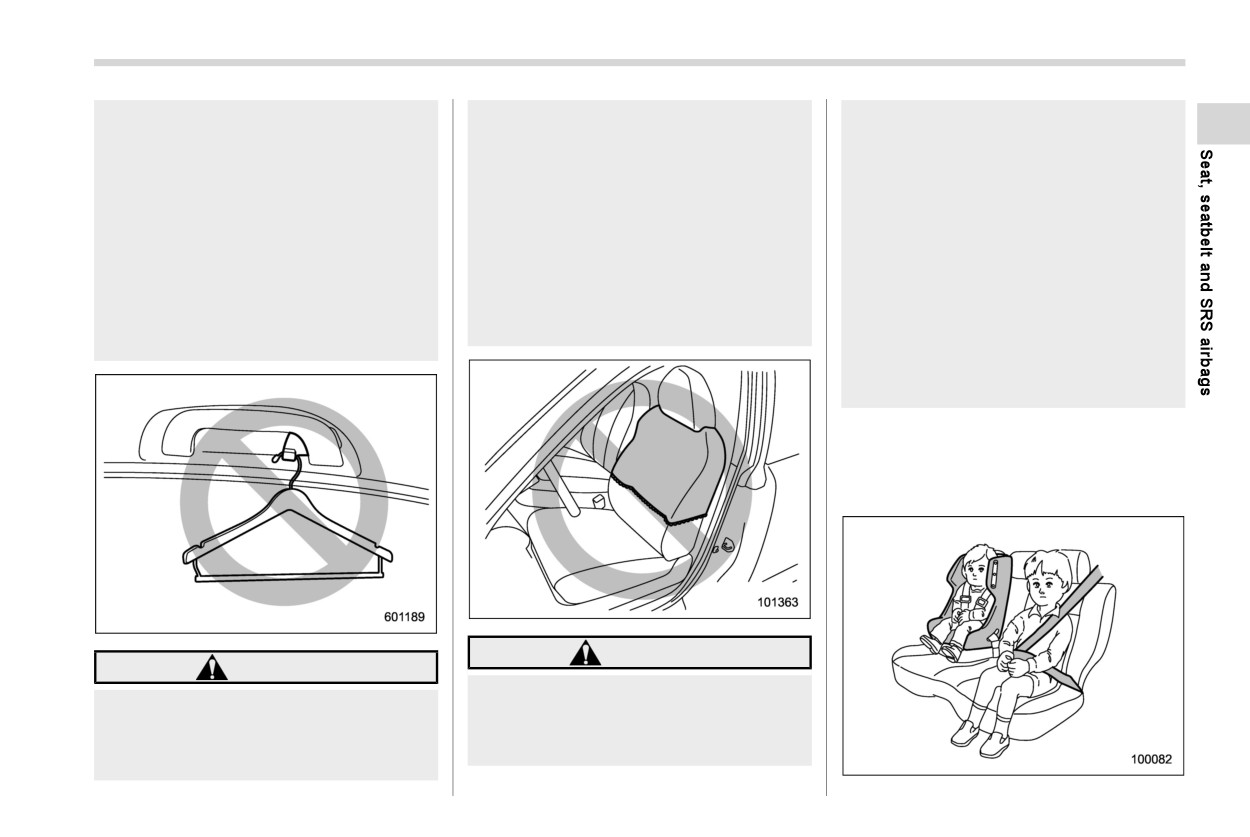
WARNING
WARNING
. Do not put any kind of clothes or
Do not hang coat hangers or other
other objects over either front
hard or pointed objects on the coat
seatback and do not attach labels
hooks. If such items were hanging
or stickers to the front seat sur-
on the coat hooks during deploy-
- CONTINUED -
88
SRS airbag (Supplemental Restraint System airbag)
For instructions and precautions
WARNING
concerning the child restraint sys-
tem, refer to
“Child
restraint
sys-
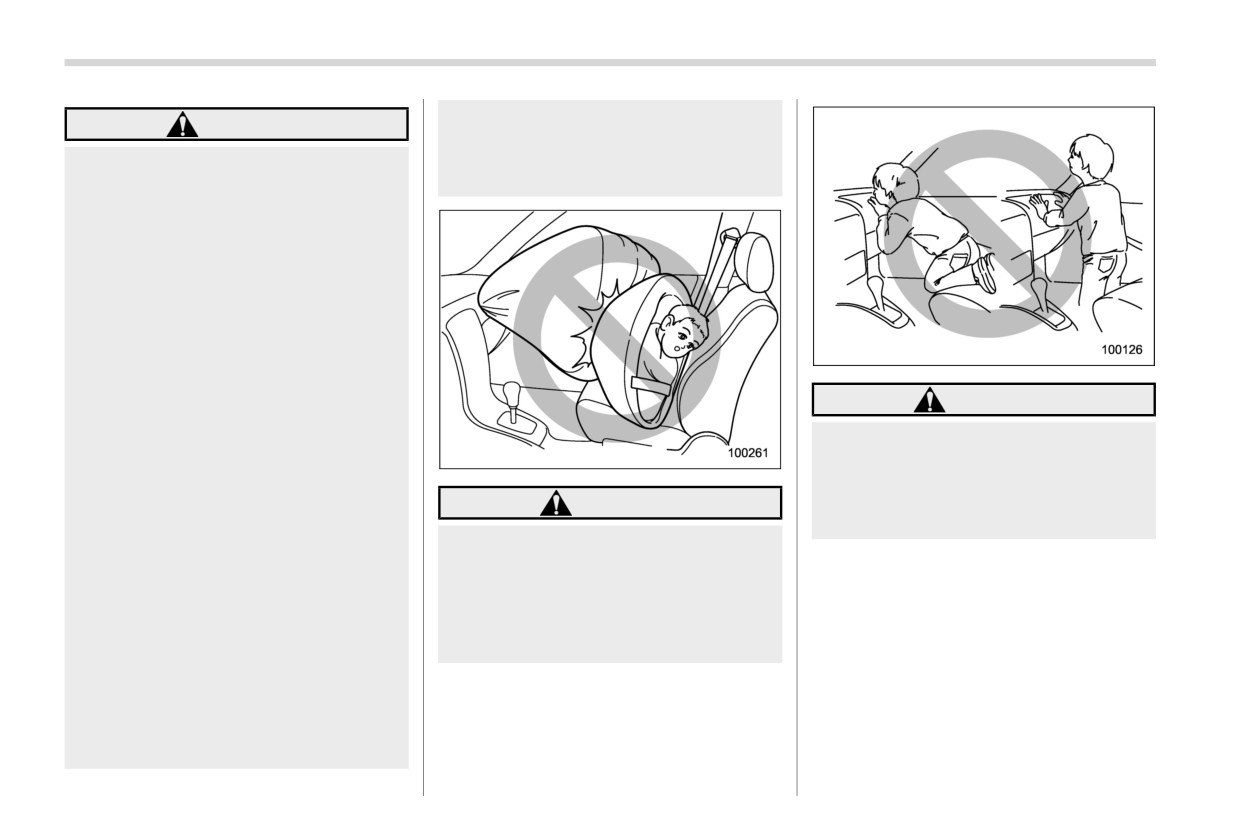
Seat children in the rear seat prop-
erly restrained at all times. The SRS
tems” FP65.
airbag deploys with considerable
speed and force and can injure or
even kill children, especially if they
are not restrained or improperly
restrained. Because children are
lighter and weaker than adults, their
risk of being injured from deploy-
ment is greater.
For that reason, we strongly recom-
mend that ALL children (including
WARNING
those in child restraint systems and
those that have outgrown child
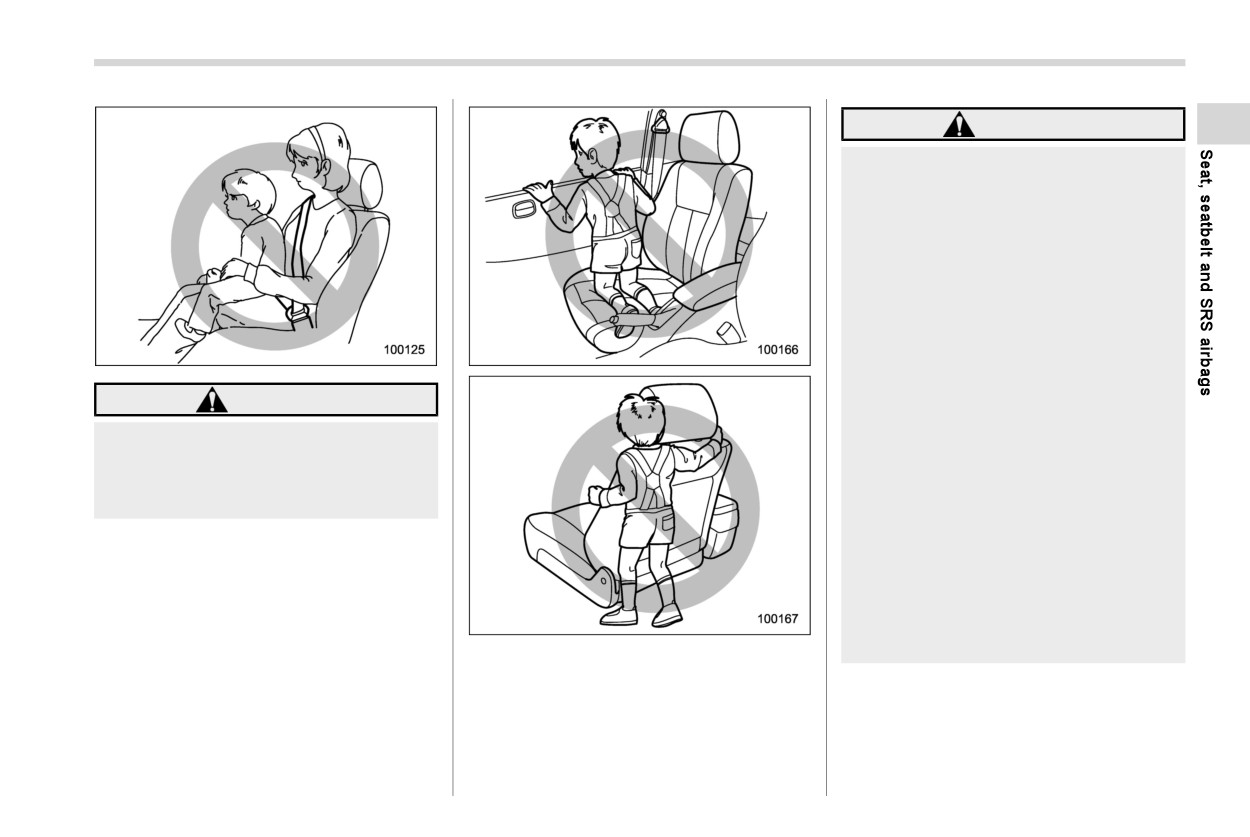
Never allow a child to stand up or
restraint devices) sit in the REAR
kneel on the front passenger’s seat.
seat properly restrained at all times
The SRS airbag deploys with con-
in a child restraint device or in a
siderable force and can injure or
WARNING
seatbelt, whichever is appropriate
even kill the child.
for the child’s age, height and
NEVER
INSTALL A CHILD
RE-
weight.
STRAINT SYSTEM IN THE FRONT
Secure ALL types of child restraint
SEAT. DOING SO RISKS SERIOUS
devices (including forward facing
INJURY OR DEATH TO THE CHILD
child restraint systems) in the REAR
BY PLACING THE CHILD’S HEAD
seats at all times.
TOO CLOSE TO THE SRS AIRBAG.
According to accident statistics,
children are safer when properly
restrained in the rear seating posi-
tions than in the front seating posi-
tions.
SRS airbag (Supplemental Restraint System airbag)
89
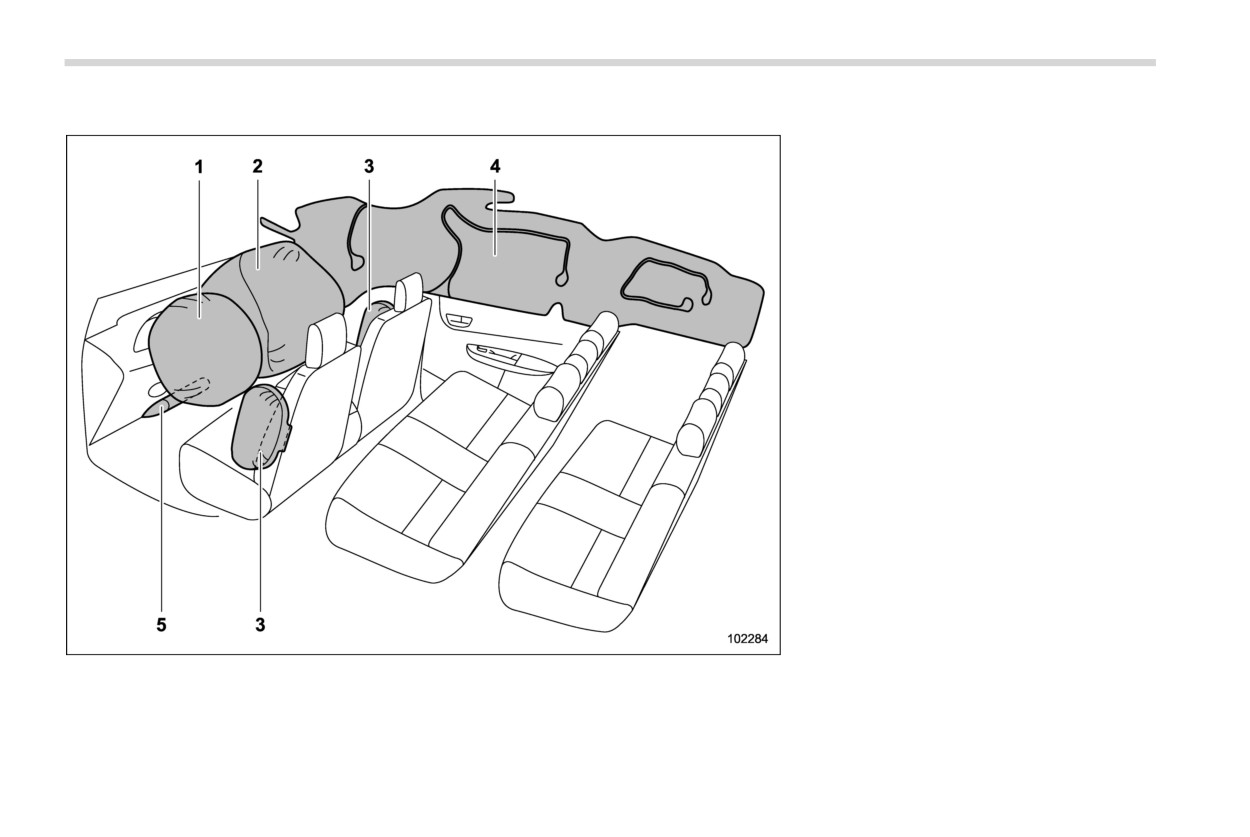
WARNING
Never allow a child to do the
following.
- Kneel on any passenger’s seat
facing the side window.
- Wrap his/her arms around the
front seat seatback.
- Put his/her head, arms or
other parts of the body out of
the window.
In the event of an accident, the
force of SRS side airbag and/or
WARNING
SRS curtain airbag deployment
could injure the child seriously
Never hold a child on your lap or in
because his/her head, arms or
your arms. The SRS airbag deploys
with considerable force and can
other parts of the body are too
injure or even kill the child.
close to the SRS side airbag and/
or SRS curtain airbag.
Since your vehicle is also
equipped with a front passen-
ger’s SRS frontal airbag, children
should be placed in the rear seat
anyway and should be properly
restrained at all times.
- CONTINUED -
90
SRS airbag (Supplemental Restraint System airbag)
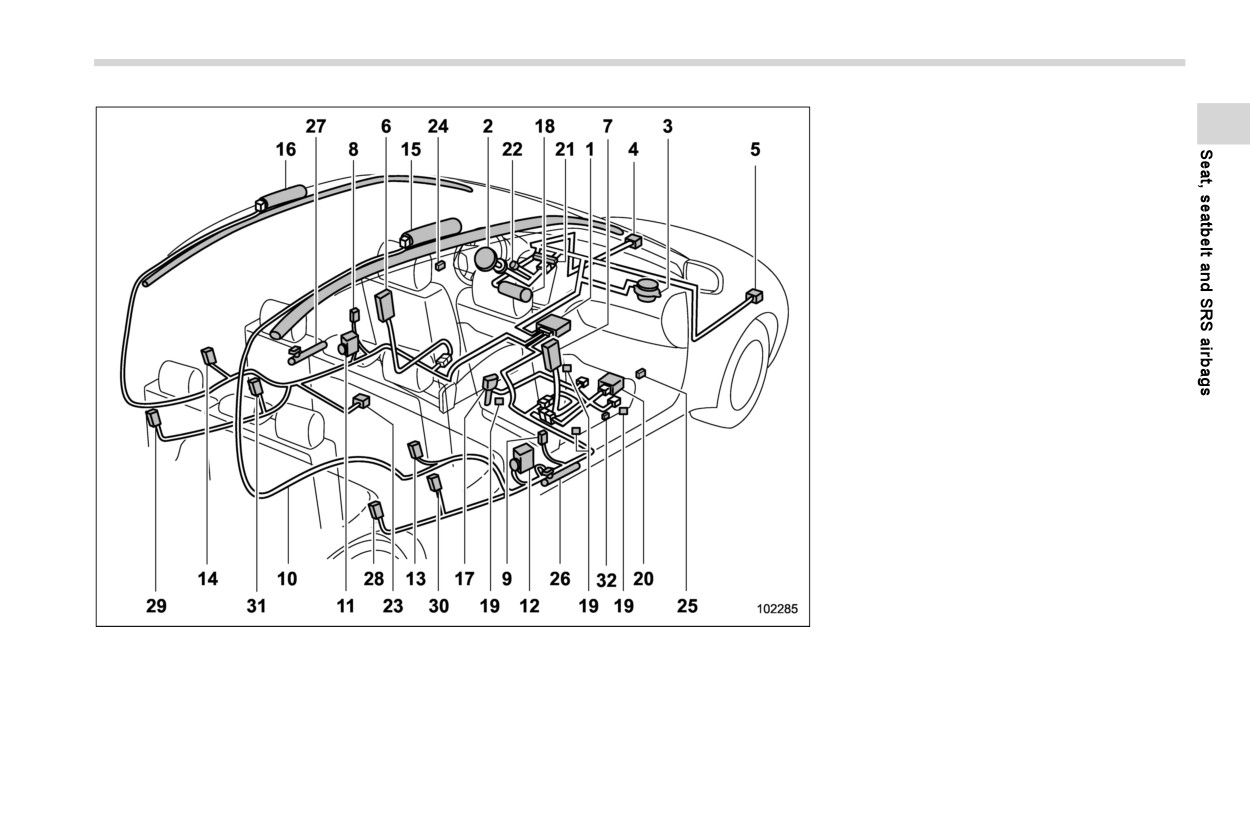
& Components
The SRS airbags are stowed in the
following locations.
Driver’s SRS frontal airbag: In the center
portion of the steering wheel which bears
an “SRS AIRBAG” mark.
Front passenger’s SRS frontal airbag:
Under the top of the dashboard. An “SRS
AIRBAG” mark is located at the right
corner of the dashboard.
SRS side airbag: In the door side of each
front seat seatback which bears an “SRS
AIRBAG” tag.
SRS curtain airbag: In the roof side
(between the front pillar and a point behind
the rear quarter glass), “SRS AIRBAG”
marks are located at the top of each center
pillar.
SRS knee airbag: Under the steering
column which bears an “SRS AIRBAG”
mark.
1
Driver’s SRS frontal airbag
2
Front passenger’s SRS frontal airbag
3
SRS side airbag
4
SRS curtain airbag
5
SRS knee airbag
SRS airbag (Supplemental Restraint System airbag)
91
1
Airbag control module (including impact
sensor and rollover sensor)
2
Frontal airbag module (driver’s side)
3
Frontal airbag module (front passenger’s
side)
4
Front impact sensor (left-hand side)
5
Front impact sensor (right-hand side)
6
Side airbag module (driver’s side)
7
Side airbag module (front passenger’s
side)
8
Side impact sensor (center pillar left-
hand side)
9
Side impact sensor (center pillar right-
hand side)
10
Airbag wiring
11
Seatbelt pretensioner and adaptive force
limiter (driver’s side)
12
Seatbelt pretensioner and adaptive force
limiter (front passenger’s side)
13
Side impact sensor
(forward of rear
wheel house right-hand side)
14
Side impact sensor
(forward of rear
wheel house left-hand side)
15
Curtain airbag module (right-hand side)
16
Curtain airbag module (left-hand side)
17
Seatbelt buckle switch (front passenger’s
side)
18
Knee airbag module (driver’s side)
19
Front passenger’s occupant detection
sensors
20
Front passenger’s occupant detection
control module
21
Front passenger’s frontal airbag ON and
OFF indicator
22
SRS airbag system warning light
23
Side impact sensor (under the second-
row center seat)
- CONTINUED -