Subaru Ascent (2023 year). Manual in english - page 1
1
Warranties
& Warranties except for U.S.A.
How to use this Owner’s
and Canada
Manual
& Warranties for U.S.A.
All warranty information, including details
SUBARU vehicles distributed by Subaru of
of coverage and exclusions, is in the
& Using your Owner’s Manual
America, Inc. and sold at retail by an
“Warranty and Maintenance Booklet”.
Before you operate your vehicle, carefully
authorized SUBARU dealer in the United
Read these warranties carefully.
read this manual. To protect yourself and
States come with the following warranties:
extend the service life of your vehicle,
. SUBARU Limited Warranties
follow the instructions in this manual.
. Federal Emission Control Systems
Failure to observe these instructions may
Warranties
result in serious injury and damage to your
. California Emissions Control Sys-
vehicle.
tems Warranties
This manual is composed of fourteen
chapters. Each chapter begins with a brief
All warranty information, including applic-
table of contents, so you can usually tell at
ability, details of coverage and exclusions,
a glance if that chapter contains the
is in the
“Warranty and Maintenance
information you want.
Booklet”. Read these warranties carefully.
Chapter 1: Seat, seatbelt and SRS air-
& Warranties for Canada
bags
SUBARU vehicles distributed by Subaru
This chapter informs you how to use the
Canada, Inc. and sold at retail by an
seat and seatbelt and contains precau-
authorized SUBARU dealer in Canada
tions for the SRS airbags.
come with the following warranties:
Chapter 2: Keys and doors
. SUBARU Limited Warranty
This chapter informs you how to operate
. Emission Control System Warranty
the keys, locks and windows.
Chapter 3: Instruments and controls
All warranty information, including applic-
This chapter informs you about the opera-
ability, details of coverage and exclusions,
tion of instrument panel indicators and how
is in the “Warranty and Service Booklet”.
to use the instruments and other switches.
Read these warranties carefully.
- CONTINUED -
2
Chapter 4: Climate control
Chapter 12: Specifications
WARNING
This chapter informs you how to operate
This chapter informs you about dimen-
the climate control.
sions and capacities of your SUBARU.
A WARNING indicates a situation in
Chapter 5: Audio
Chapter 13: Consumer information and
which serious injury or death could
reporting safety defects
result if the warning is ignored.
This chapter informs you about your audio
system.
This chapter informs you about Uniform
Chapter 6: Interior equipment
tire quality grading standards and Report-
CAUTION
ing safety defects.
This chapter informs you how to operate
interior equipment.
Chapter 14: Index
A CAUTION indicates a situation in
Chapter 7: Starting and operating
This is an alphabetical listing of all that’s in
which injury or damage to your
this manual. You can use it to quickly find
vehicle, or both, could result if the
This chapter informs you how to start and
something you want to read.
caution is ignored.
operate your SUBARU.
Chapter 8: Driving tips
For EyeSight system:
This chapter informs you how to drive your
For details about the EyeSight system,
NOTE
SUBARU in various conditions and ex-
refer to the Owner’s Manual supplement
A NOTE gives information or sugges-
plains some safety tips on driving.
for the EyeSight system.
tions about how to make better use of
Chapter 9: In case of emergency
your vehicle.
Depending on specifications, the vehicle
This chapter informs you what to do if you
shown in the illustrations may differ from
have a problem, such as a flat tire or
your vehicle in terms of equipment.
engine overheating.
Chapter 10: Appearance care
& Safety warnings
This chapter informs you how to keep your
You will find a number of WARNINGs,
SUBARU looking good.
CAUTIONs and NOTEs in this manual.
Chapter 11: Maintenance and service
These safety warnings alert you to poten-
This chapter informs you when you need to
tial hazards that could result in injury to you
take your SUBARU to the dealer for
or others.
scheduled maintenance and informs you
Please read these safety warnings as well
how to keep your SUBARU running
as all other portions of this manual care-
properly.
fully in order to gain a better understanding
of how to use your SUBARU vehicle safely.
3
& Safety symbol
& Abbreviation list
Abbreviation
Meaning
You may find several abbreviations in this
Lower anchors and tethers for
LATCH
children
manual. The meanings of the abbrevia-
tions are shown in the following list.
LED
Light emitting diode
Abbreviation
Meaning
MIL
Malfunction indicator light
ABS
Anti-lock brake system
Methylcyclopentadienyl man-
MMT
ganese tricarbonyl
A/C
Air conditioner
OBD
On-board diagnostics
AKI
Anti knock index
RAB
Reverse Automatic Braking
ALR
Automatic locking retractor
RON
Research octane number
Automatic locking retractor/
ALR/ELR
Emergency locking retractor
Steering Responsive Head-
SRH
light
AVH
Auto Vehicle Hold
You will find a circle with a slash through it
Supplemental restraint sys-
AWD
All-wheel drive
SRS
tem
in this manual. This symbol means “Do
Blind Spot Detection/Rear
not”, “Do not do this”, or “Do not let this
BSD/RCTA
TIN
Tire identification number
Cross Traffic Alert
happen”, depending upon the context.
Tire pressure monitoring sys-
Continuously variable trans-
TPMS
CVT
tem
mission
DRL
Daytime running light
Electronic brake force distri-
EBD
bution
ELR
Emergency locking retractor
GAW
Gross axle weight
GAWR
Gross axle weight rating
GPS
Global positioning system
GVW
Gross vehicle weight
GVWR
Gross vehicle weight rating
INT
Intermittent
4
Vehicle symbols
Safety precautions when
The SRS airbags deploy with
considerable speed and force.
driving
Occupants who are not seated
These are some of the symbols you may
in the proper upright position
see on your vehicle.
& Seatbelt and SRS airbag
when the SRS airbag deploys
For warning and indicator lights, refer to
could suffer very serious injuries.
“Warning and indicator lights” FP24.
WARNING
Because the SRS airbag needs
Mark
Name
enough space for deployment,
All persons in the vehicle must
fasten their seatbelts BEFORE
the driver should always sit up-
WARNING
right and well back in the seat as
the vehicle starts to move. Other-
wise, the possibility of serious
far from the steering wheel as
injury becomes greater in the
practical while still maintaining
CAUTION
full vehicle control and the front
event of a sudden stop or acci-
passenger should move the seat
dent.
Read these instructions care-
as far back as possible and sit
fully
To obtain maximum protection in
upright and well back in the seat.
the event of an accident, the
driver and all passengers must
Wear eye protection
For instructions and precautions, carefully
always wear seatbelts when in
read the following sections.
the vehicle. The SRS (Supple-
. For the seatbelt system, refer to “Seat-
Battery fluid contains sulfuric
mental Restraint System) airbag
acid
belts” FP52.
does not replace the safety ben-
. For the SRS airbag system, refer to
efits of wearing a seatbelt. Used
in combination with the seat-
“SRS airbag (Supplemental Restraint
Keep children away
belts, the SRS airbag offers vehi-
System airbag)” FP83.
cle occupants the best possible
Keep flames away
protection in the event of a ser-
ious accident.
Not wearing a seatbelt increases
Prevent explosions
the chance of severe injury or
death in a crash even when the
vehicle has the SRS airbag.
5
& Child safety
with considerable speed and
They could accidentally injure
force and can injure or even kill
themselves or others through
WARNING
children, especially if they are not
inadvertent operation of the ve-
restrained or improperly re-
hicle. Also, on hot or sunny days,
Never hold a child on your lap or
strained. Because children are
temperature in a closed vehicle
in your arms while the vehicle is
lighter and weaker than adults,
could quickly become high en-
moving. The passenger cannot
their risk of being injured from
ough to cause severe or possibly
protect the child from injury in a
deployment is greater.
fatal injuries to them.
collision, because the child will
NEVER INSTALL A CHILD RE-
When leaving the vehicle, close
be caught between the passen-
STRAINT SYSTEM IN THE FRONT
all windows and lock all doors.
ger and objects inside the vehi-
PASSENGER’S SEAT. DOING SO
In models with power rear gate,
cle.
RISKS SERIOUS INJURY OR
when it operates, the rear gate
While riding in the vehicle, infants
DEATH TO THE CHILD BY PLA-
moves with remarkable force. It is
and small children should always
CING THE CHILD’S HEAD TOO
possible to be injured if anyone is
be seated in the REAR seat in an
CLOSE TO THE SRS AIRBAG.
caught in or hit by the rear gate so
infant or child restraint system
Always turn the child safety locks
be sure to obey the following
which is appropriate for the
to the
“LOCK” position when
cautions.
child’s age, height and weight. If
children sit in the rear seat.
- Check that there are no chil-
a child is too big for a child
Serious injury could result if a
dren around the rear gate
restraint system, the child should
child accidentally opens the door
before operating the power
sit in the REAR seat and be
and falls out. Refer to
“Child
rear gate.
restrained using the seatbelts.
safety locks” FP145.
According to accident statistics,
- Do not allow children to oper-
children are safer when properly
Always lock the passenger’s win-
ate the power rear gate.
dows using the lock switch when
restrained in the rear seating
children are riding in the vehicle.
positions than in the front seating
For instructions and precautions, carefully
Failure to follow this procedure
positions. Never allow a child to
read the following sections.
could result in injury to a child
stand up or kneel on the seat.
. For the seatbelt system, refer to “Seat-
operating the power window. Re-
belts” FP52.
Seat children in the REAR seat
fer to “Windows” FP145.
properly restrained at all times in
. For the child restraint system, refer to
Never leave unattended children,
a child restraint system or in a
“Child restraint systems” FP65.
adults or animals in the vehicle.
seatbelt. The SRS airbag deploys
- CONTINUED -
6
. For the SRS airbag system, refer to
inlet grille free from snow, leaves
severity of that injury.
“SRS airbag (Supplemental Restraint
or other obstructions to ensure
Please don’t drink and drive.
System airbag)” FP83.
that the ventilation system al-
. For the power rear gate, refer to “Power
ways works properly.
Drunken driving is one of the most frequent
rear gate” FP149.
If at any time you suspect that
causes of accidents. Since alcohol affects
exhaust fumes are entering the
all people differently, you may have con-
& Engine exhaust gas (carbon
vehicle, have the problem
sumed too much alcohol to drive safely
monoxide)
checked and corrected as soon
even if the level of alcohol in your blood is
as possible. If you must drive
below the legal limit. The safest thing you
WARNING
under these conditions, drive
can do is never drink and drive. However if
only with all windows fully open.
you have no choice but to drive, stop
Never inhale engine exhaust gas.
drinking and sober up completely before
Keep the rear gate closed while
Engine exhaust gas contains
getting behind the wheel.
driving to prevent exhaust gas
carbon monoxide, a colorless
from entering the vehicle.
and odorless gas which is dan-
& Drugs and driving
gerous, or even lethal, if inhaled.
Always properly maintain the en-
& Drinking and driving
WARNING
gine exhaust system to prevent
engine exhaust gas from entering
There are some drugs (over the
WARNING
the vehicle.
counter and prescription) that can
delay your reaction time and impair
Never run the engine in a closed
Drinking and then driving is very
your perception, judgment and at-
space, such as a garage, except
dangerous. Alcohol in the blood-
tentiveness. If you drive after taking
for the brief time needed to drive
stream delays your reaction time
them, it may increase your, your
the vehicle in or out of it.
and impairs your perception, judg-
passengers’ and other persons’ risk
ment and attentiveness. If you drive
Avoid remaining in a parked ve-
after drinking - even if you drink just
of being involved in a serious or fatal
hicle for a lengthy time while the
accident.
a little - it will increase the risk of
engine is running. If that is un-
being involved in a serious or fatal
avoidable, then use the ventila-
If you are taking any drugs, check with
accident, injuring or killing yourself,
tion fan to force fresh air into the
your doctor or pharmacist or read the
your passengers and others. In
vehicle.
literature that accompanies the medication
addition, if you are injured in the
Always keep the front ventilator
to determine if the drug you are taking can
accident, alcohol may increase the
7
impair your driving ability. Do not drive
possible, you should share the driving with
from modification may not be cov-
after taking any medications that can make
others.
ered under warranties.
you drowsy or otherwise affect your ability
to safely operate a motor vehicle. If you
& Modification of your vehicle
have a medical condition that requires you
& Use of cell phones/texting
to take drugs, please consult with your
WARNING
and driving
doctor.
Do not remove the genuine SUBARU
Never drive if you are under the influence
CAUTION
navigation and/or audio system.
of any illicit mind-altering drugs. For your
Doing so could cause the following
Do not talk on a cell phone or text
own health and well-being, we urge you
functions to be inoperable.
while driving; it may distract your
not to take illegal drugs in the first place
. Combination meter display (color
attention from driving and lead to an
and to seek treatment if you are addicted
LCD)
accident. If you use a cell phone to
to those drugs.
talk or text, first pull off the road and
. Rear view image and help lines
park in a safe place. In some States/
& Driving when tired or sleepy
. Vehicle settings
Provinces, it may be lawful to talk on
. Front and Rear Climate control
a phone while driving, but only if the
WARNING
. Front seat heater and ventilation
phone is hands-free.
When you are tired or sleepy, your
. Clock
reaction time will be delayed and
. Surround View Monitor
& Driving vehicles equipped
your perception, judgment and at-
tentiveness will be impaired. If you
with navigation system
drive when tired or sleepy, your,
CAUTION
your passengers’ and other per-
WARNING
sons’ chances of being involved in
Your vehicle should not be modified
Do not allow the monitor to distract
a serious accident may increase.
other than with genuine SUBARU
your attention from driving. Also, do
parts and accessories. Other types
Please do not continue to drive but instead
of modifications could affect its
not operate the controls of the
find a safe place to rest if you are tired or
performance, safety or durability,
navigation system while driving.
The loss of attention to driving could
sleepy. On long trips, you should make
and may even violate governmental
lead to an accident. If you wish to
periodic rest stops to refresh yourself
regulations. In addition, damage or
operate the controls of the naviga-
before continuing on your journey. When
performance problems resulting
- CONTINUED -
8
tion system, first take the vehicle off
cold. Use a pressure gauge to adjust the
the instructions and precautions in order to
the road and stop it in a safe
tire pressures to the values shown on the
prevent serious injury or death due to loss
location.
tire inflation pressure label. For detailed
of control, rollover and other accidents.
information, refer to
“Tires and wheels”
Refer to “On-road and off-road driving”
FP495.
FP420.
& Driving with pets
WARNING
& Attaching accessories
Unrestrained pets can interfere with your
driving and distract your attention from
Driving at high speeds with
driving. In a collision or sudden stop,
WARNING
excessively low tire pressures
unrestrained pets or cages can be thrown
can cause the tires to deform
Do not attach any accessories,
around inside the vehicle and hurt you or
labels or stickers
(other than
your passengers. Besides, the pets can be
severely and to rapidly be-
properly placed inspection stick-
hurt under these situations. It is also for
come hot. A sharp increase in
ers) to the windshield. Such
their own safety that pets should be
temperature could cause tread
items may obstruct your view.
properly restrained in your vehicle. Re-
separation, and destruction of
strain a pet with a special traveling harness
If it is necessary to attach an
the tires. The resulting loss of
accessory (such as an electronic
which can be secured to the rear seat with
a seatbelt or use a pet carrier which can be
vehicle control could lead to
toll collection
(ETC) device or
secured to the rear seat by routing a
an accident.
security pass) to the windshield,
seatbelt through the carrier’s handle.
consult your SUBARU dealer for
Never restrain pets or pet carriers in the
details on the proper location.
front passenger’s seat. For further infor-
& On-road and off-road driving
Do not connect any unauthorized
mation, consult your veterinarian, local
accessories or devices to the
This vehicle is classified as a utility vehicle.
animal protection society or pet shop.
data link connector (OBDII port).
Utility vehicles have a significantly higher
This connector should be used
rollover rate than other types of vehicles.
& Tire pressures
only with compatible diagnostic
Your vehicle has a higher ground clear-
Check and, if necessary, adjust the pres-
ance and higher center of gravity, making it
devices for inspection and main-
tenance by an authorized service
sure of each tire and the spare
(if
more likely to roll over than ordinary
technician using authorized ser-
equipped) at least once a month and
passenger cars. It also handles and
vice tools. Connecting unauthor-
before any long journey.
maneuvers differently from other passen-
ized devices, such as a driver-
ger cars. For this reason, please read
Check the tire pressure when the tires are
behavior tracking device, may
carefully the following section and follow
9
adversely affect vehicle systems,
General information
& Event data recorder
including safety systems, or al-
This vehicle is equipped with an event data
low others to access information
& California Perchlorate Advi-
recorder (EDR). The main purpose of an
stored in your vehicle. The use of
sory
EDR is to record, in certain crash or near
unauthorized devices may also
Certain vehicle components, such as air-
crash-like situations, such as an air bag
cause unexpected malfunctions,
bag modules, seatbelt pretensioners and
deployment or hitting a road obstacle, data
such as a drained battery, or may
keyless entry transmitter batteries, may
that will assist in understanding how a
damage vehicle systems. The
contain perchlorate material. Special
vehicle’s systems performed. The EDR is
manufacturer’s warranty will not
handling may apply for service or vehicle
designed to record data related to vehicle
cover any part that malfunctions,
end of life disposal. See www.dtsc.ca.gov/
dynamics and safety systems for a short
fails, or is damaged due to the
hazardouswaste/perchlorate.
period of time, typically 30 seconds or less.
use
of an unauthorized device
The EDR in this vehicle is designed to
with the data link connector.
record such data as:
& Noise from under the vehicle
. How various systems in your vehicle
NOTE
were operating;
You may hear a noise from under the
. Whether or not the driver and passen-
vehicle approximately 5 to 10 hours
ger safety belts were buckled/fastened;
after the ignition switch is turned to the
. How far
(if at all) the driver was
“LOCK”/“OFF” position. However, this
depressing the accelerator and/or
does not indicate a malfunction. This
brake pedal; and,
noise is caused by the operation of the
. How fast the vehicle was traveling.
fuel evaporation leakage checking sys-
tem and the operation is normal. The
These data can help provide a better
noise will stop after approximately 15
understanding of the circumstances in
minutes.
which crashes and injuries occur. NOTE:
EDR data are recorded by your vehicle
only if a non-trivial crash situation occurs;
no data are recorded by the EDR under
normal driving conditions and no personal
data (e.g., name, gender, age, and crash
location) are recorded. However, other
parties, such as law enforcement, could
- CONTINUED -
10
combine the EDR data with the type of
personally identifying data routinely ac-
quired during a crash investigation.
To read data recorded by an EDR, special
equipment is required, and access to the
vehicle or the EDR is needed. In addition
to the vehicle manufacturer, other parties,
such as law enforcement, that have the
special equipment, can read the informa-
tion if they have access to the vehicle or
the EDR.
Table of contents
Seat, seatbelt and SRS airbags
1
Keys and doors
2
Instruments and controls
3
Climate control
4
Audio
5
Interior equipment
6
Starting and operating
7
Driving tips
8
In case of emergency
9
Appearance care
10
Maintenance and service
11
Specifications
12
Consumer information and reporting safety defects
13
Index
14
12
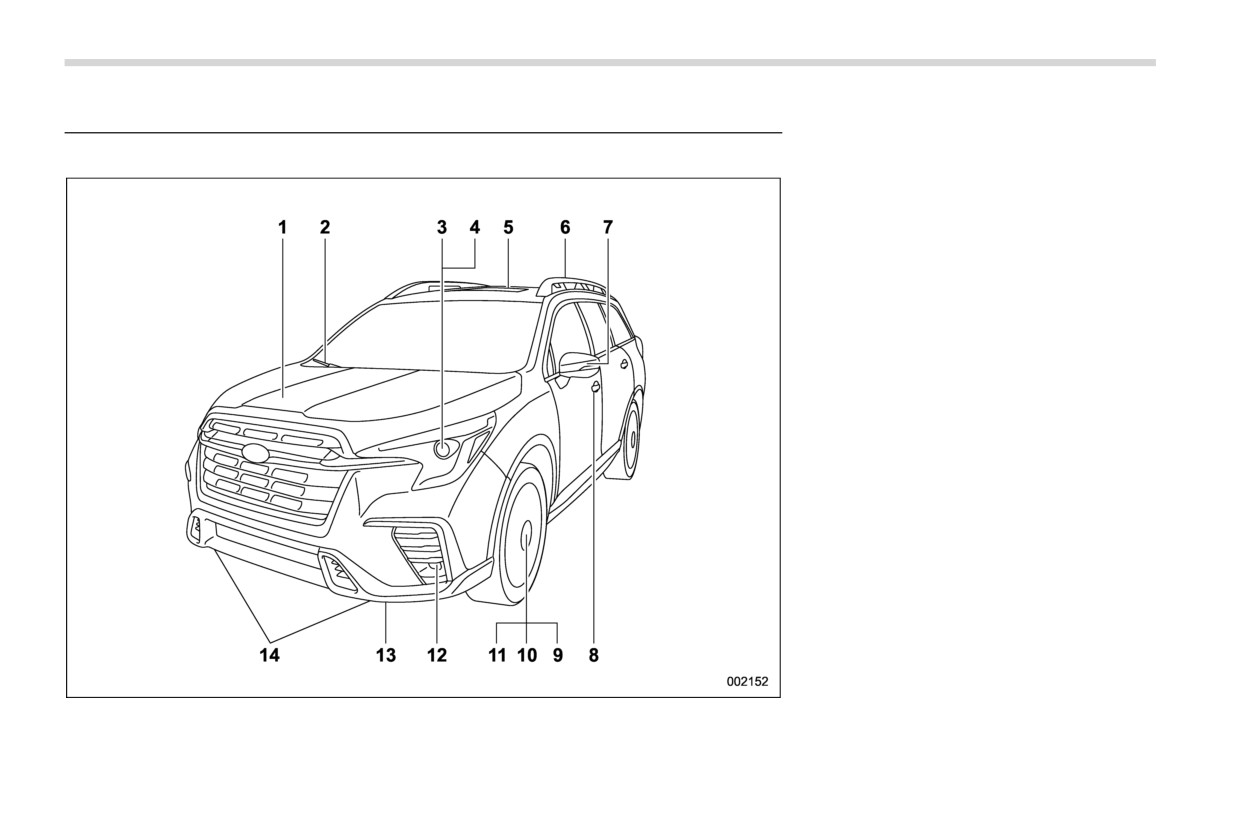
Illustrated index
& Exterior
1
Engine hood (page 483)
2
Front wipers (page 243)
3
Headlights (page 231)
4
Replacing bulbs (page 511)
5
Moonroof (page 157)
6
Roof rails (page 428)
7
Outside mirrors (page 269)
8
Door locks (page 137)
9
Tire pressure (page 498)
10
Flat tires (page 452)
11
Snow tires (page 425)
12
Fog lights (page 239)
13
Towing hook (page 460)
14
Tie-down hooks (page 460)
13
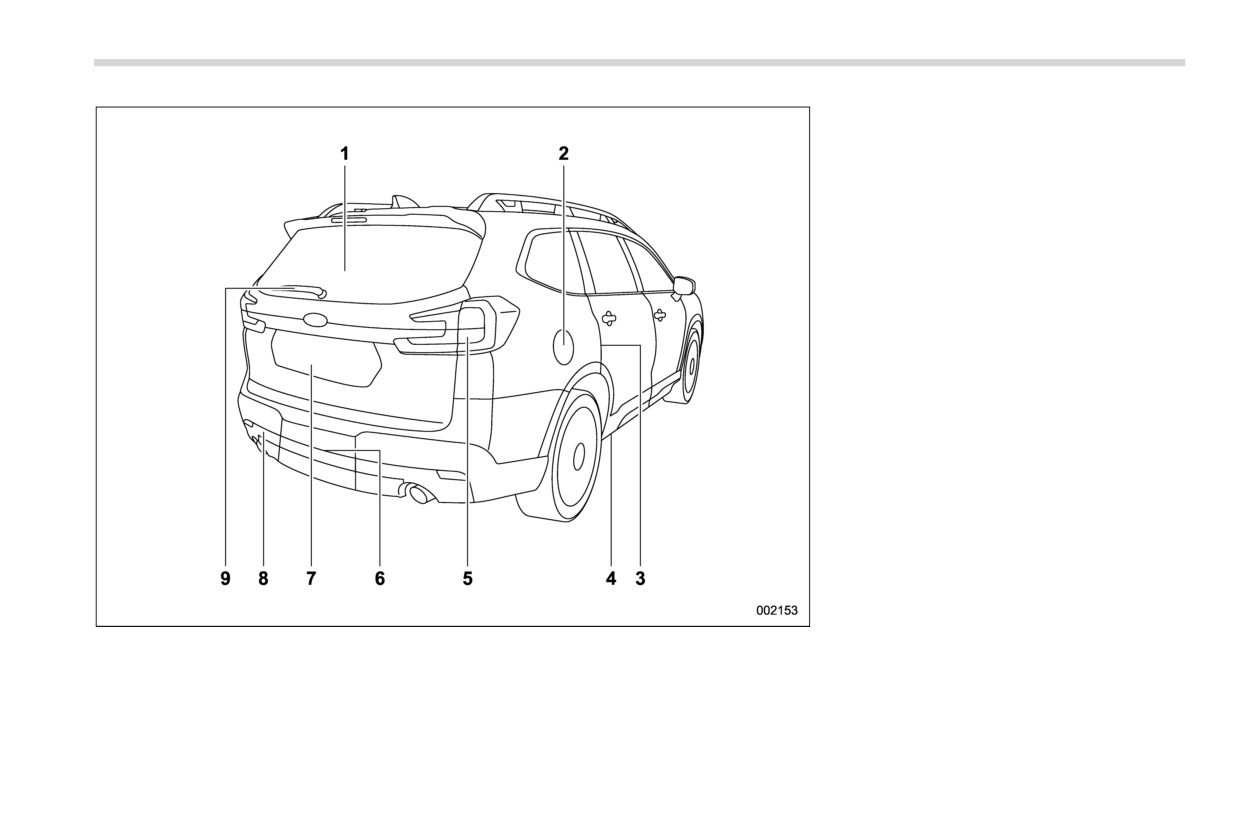
1
Rear window defogger (page 273)
2
Fuel filler lid and cap (page 338)
3
Child safety locks (page 145)
4
Tie-down hole (page 460)
5
Replacing bulbs (page 513)
6
Trailer hitch (page 432)
7
Rear gate (page 148)
8
Towing hook (page 460)
9
Rear window wiper (page 245)
- CONTINUED -
14
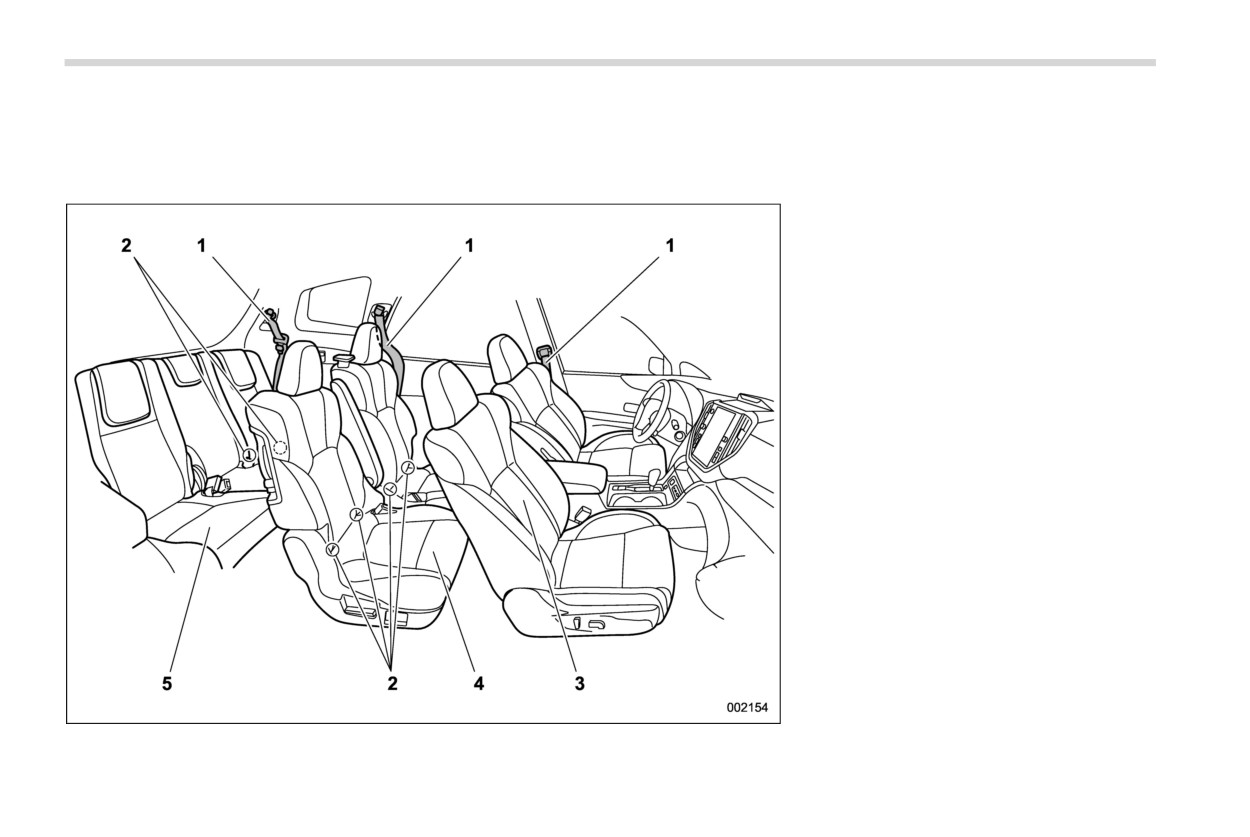
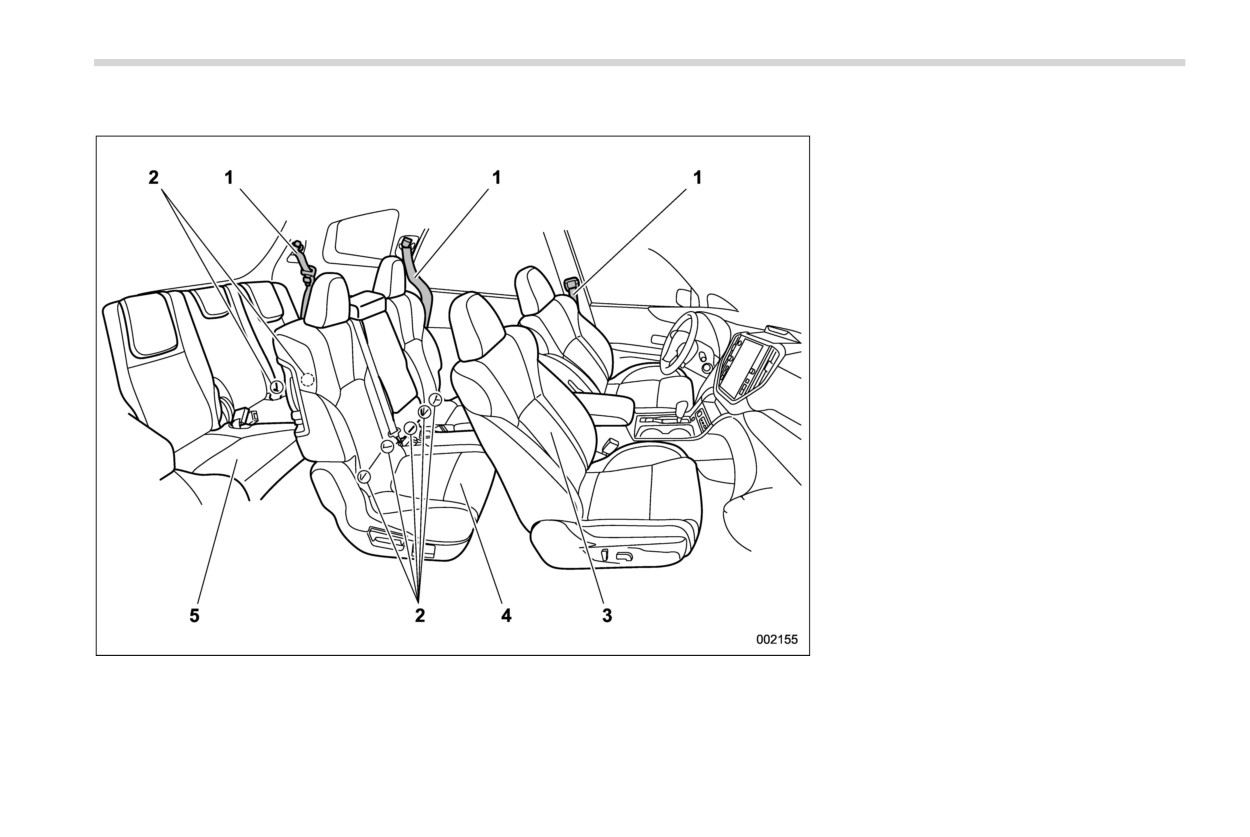
& Interior
! Passenger compartment area
! Second-row captain seat models
1
Seatbelts (page 52)
2
Lower anchorages for child restraint
system (page 76)
3
Front seats (page 30)
4
Second-row seats (page 39)
5
Third-row seats (page 43)
15
! Second-row bench seat models
1
Seatbelts (page 52)
2
Lower anchorages for child restraint
system (page 76)
3
Front seats (page 30)
4
Second-row seats (page 39)
5
Third-row seats (page 43)
- CONTINUED -
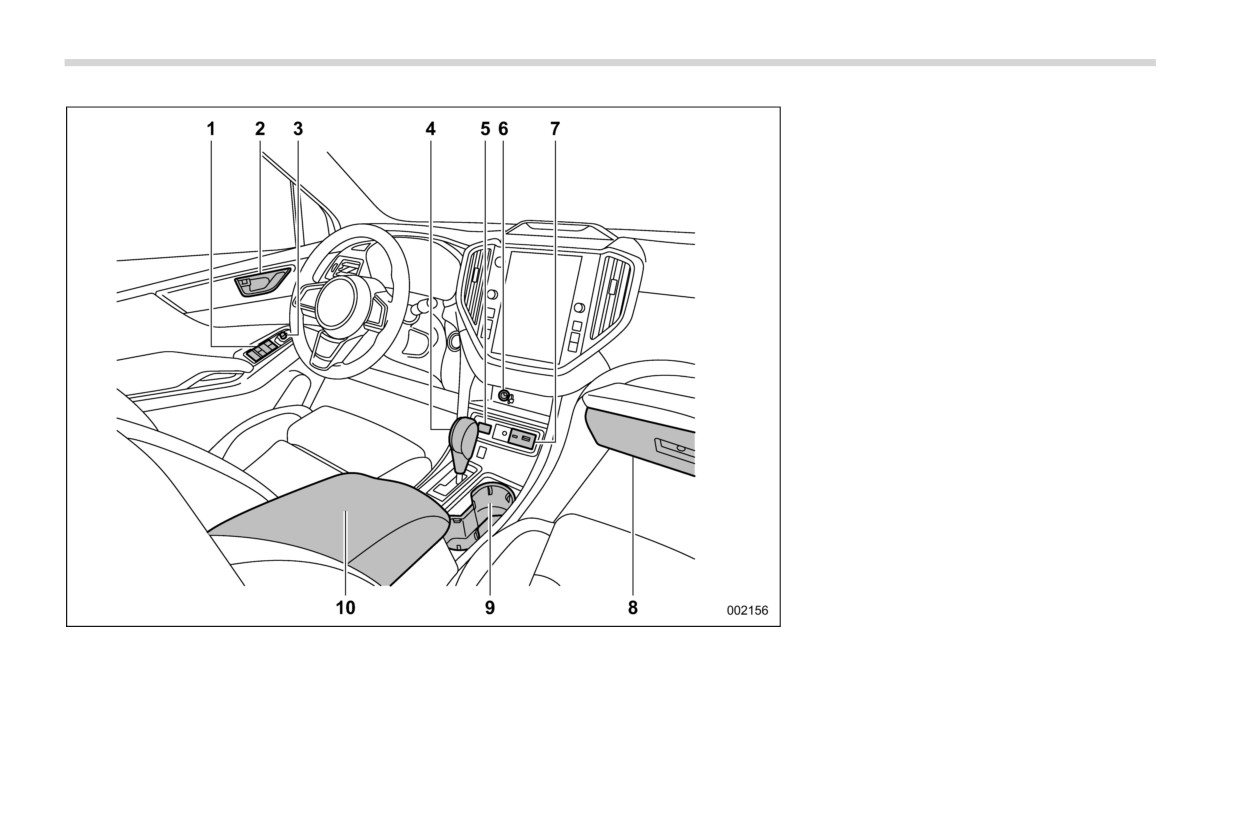
16
1
Power windows switches (page 145)
2
Door locks (page 138)
3
Remote control mirror switch (page 269)
4
Select lever (page 357)
5
View monitor switch (page 320)
6
12 V power outlet (page 310)
7
USB power supply (page 312)
8
Glove box (page 307)
9
Cup holder (page 308)
10
Center console (page 308)
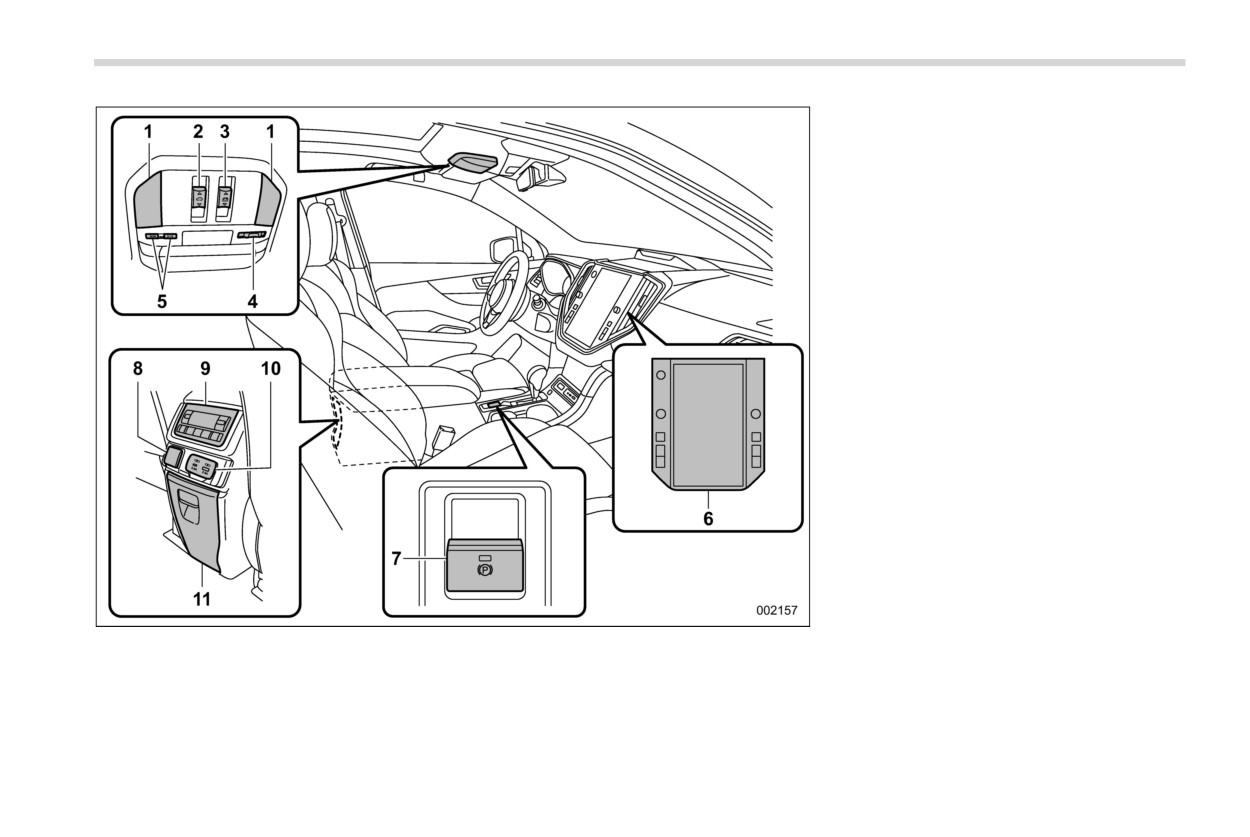
17
1
Map light switches (page 302)
2
Moonroof switch (page 158)
3
Sunshade switch (page 157)
4
Door interlock switch (page 302)
5
Button for SUBARU STARLINK
6
Center Information Display (CID) (page
201)/Climate control (page 280)/Audio*/
Navigation system*
7
Electronic parking brake switch
(page
374)
8
120 V power outlet (page 311)
9
Rear climate control panel (page 283)
10
USB power supply (page 312)
11
Cup holder (page 308)
*: For details about how to use the audio and
navigation system, refer to the separate
navigation/audio Owner’s Manual.
NOTE
For models with SUBARU STARLINK:
Refer to the Owner’s Manual supple-
ment for SUBARU STARLINK.
- CONTINUED -
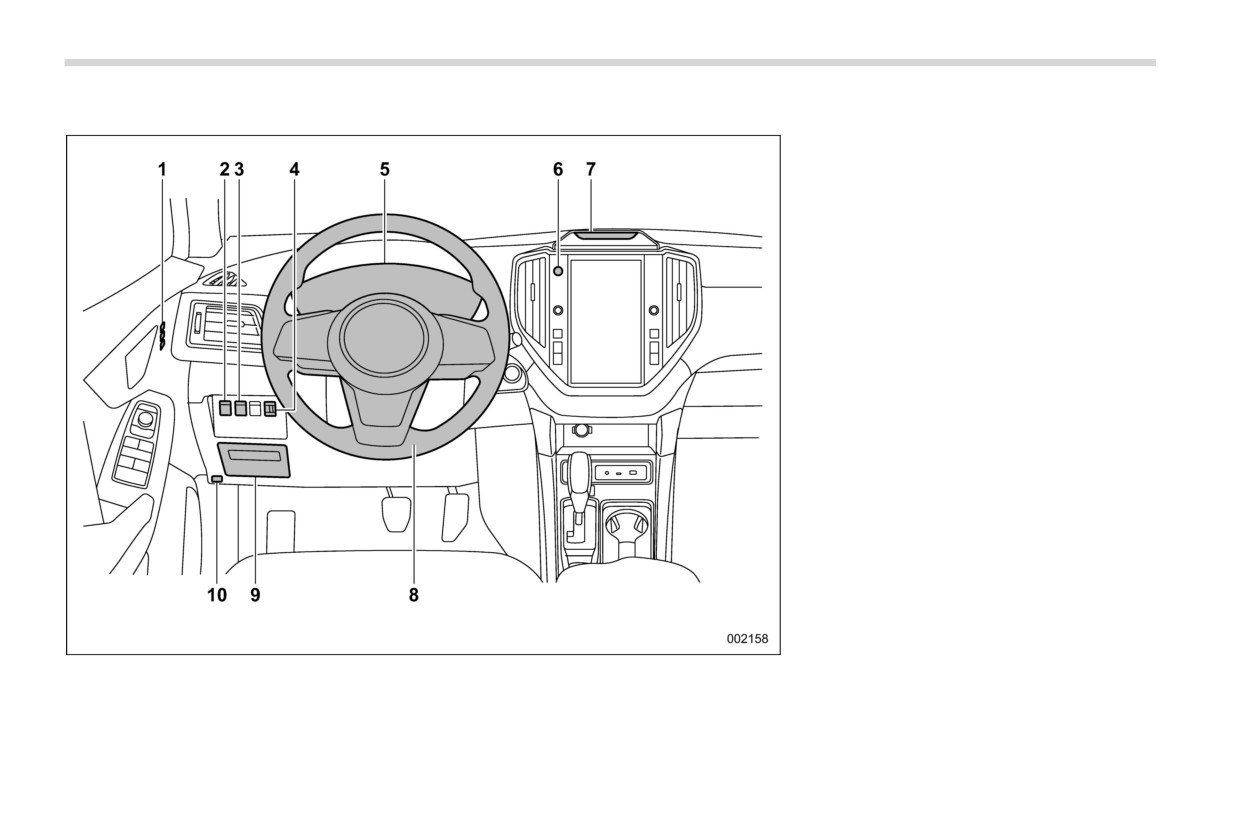
18
& Instrument panel
1
Seat position memory switch (page 35)
2
Power rear gate switch (page 149)
3
One-touch Interior Illumination switch
(page 304)
4
Illumination brightness control dial (page
171)
5
Combination meter (page 168)
6
Hazard warning flasher switch
(page
168)
7
Camera for Driver Monitoring System
(page 402)
8
Tilt/Telescopic steering wheel (page 274)
9
Fuse box (page 510)
10
Hood release knob (page 483)
NOTE
About the EyeSight system: Refer to
the Owner’s Manual supplement for the
EyeSight system.
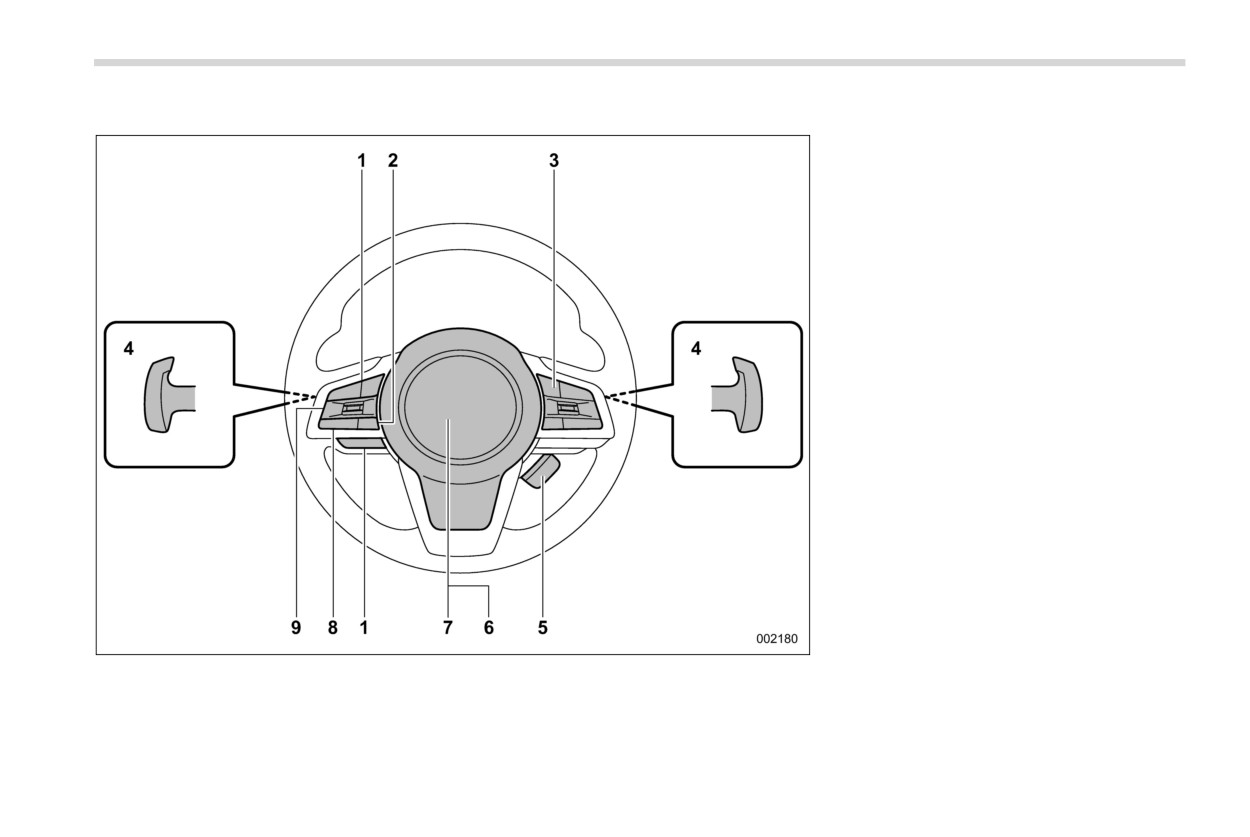
19
& Steering wheel
1
Audio control switch*1
2
Talk switch for voice command system*1
3
Cruise control switches*2
4
Shift paddles (page 359)
5
Heated Steering Wheel switch
(page
275)
6
SRS airbag (page 83)
7
Horn (page 276)
8
Hands-free phone switch*1
9
Control switches for combination meter
display (color LCD) (page 195)
*1: For details about how to use the switches,
refer to the separate navigation/audio
Owner’s Manual.
*2: For details about how to use the switches,
refer to the Owner’s Manual supplement
for the EyeSight system.
- CONTINUED -
20
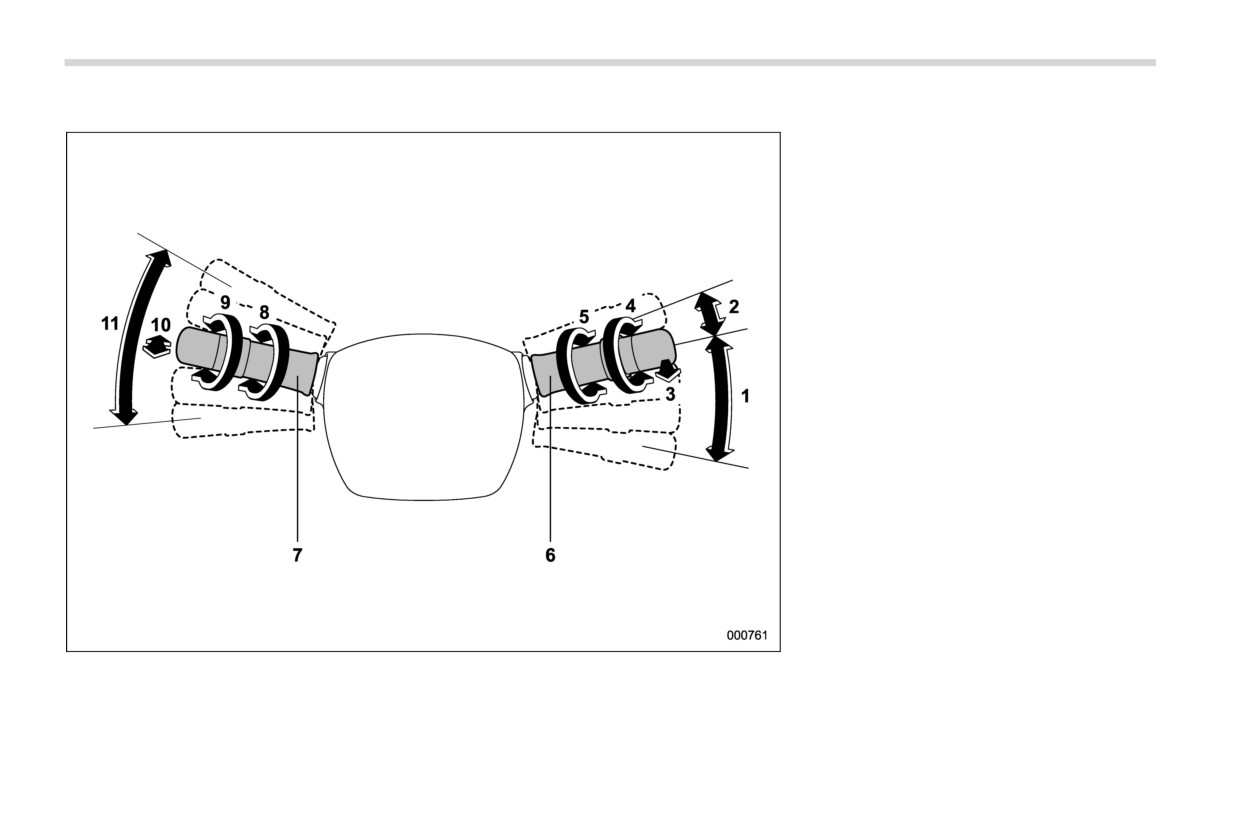
& Light control and wiper control levers/switches
1
Windshield wiper (page 241)
2
Mist (page 243)
3
Windshield washer (page 245)
4
Rear window wiper and washer switch
(page 245)
5
Wiper intermittent time control switch
(page 244)/Sensor sensitivity control
(page 244)
6
Windshield wiper and washer switches
(page 243)
7
Light control switch (page 231)
8
Fog light switch (page 239)
9
Headlight ON/OFF/AUTO (page 231)
10
Headlight flasher High/Low beam change
(page 234)
11
Turn signal lever (page 240)
21
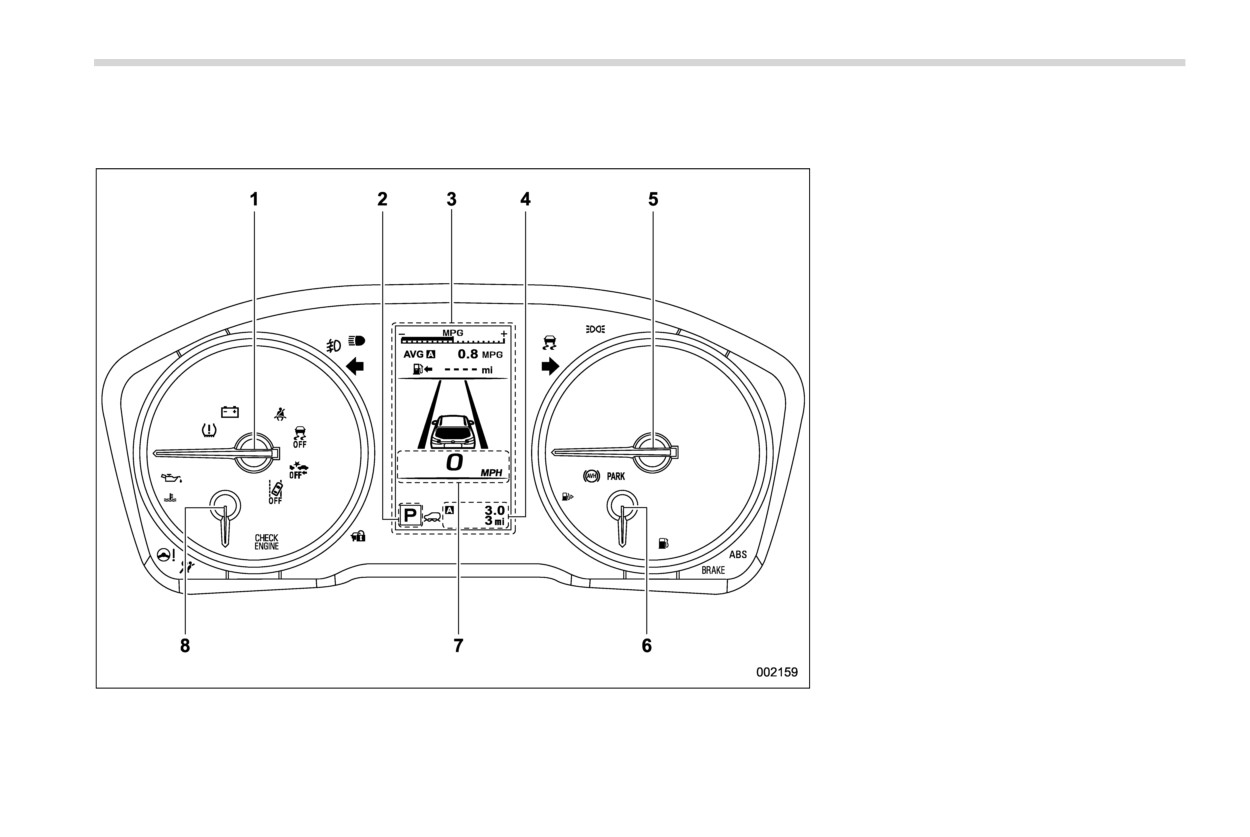
& Combination meter
! U.S.-spec. models
1
Tachometer (page 168)
2
Select lever/gear position indicator (page
191)
3
Combination meter display (page 194)
4
Trip meter and odometer (page 169)
5
Speedometer (page 168)
6
Fuel gauge (page 170)
7
Digital speed screen (page 198)
8
Engine coolant temperature gauge (page
170)
The illustration above is a typical example. For some models, the combination meter may be
slightly different than that shown in the illustration.
- CONTINUED -
22
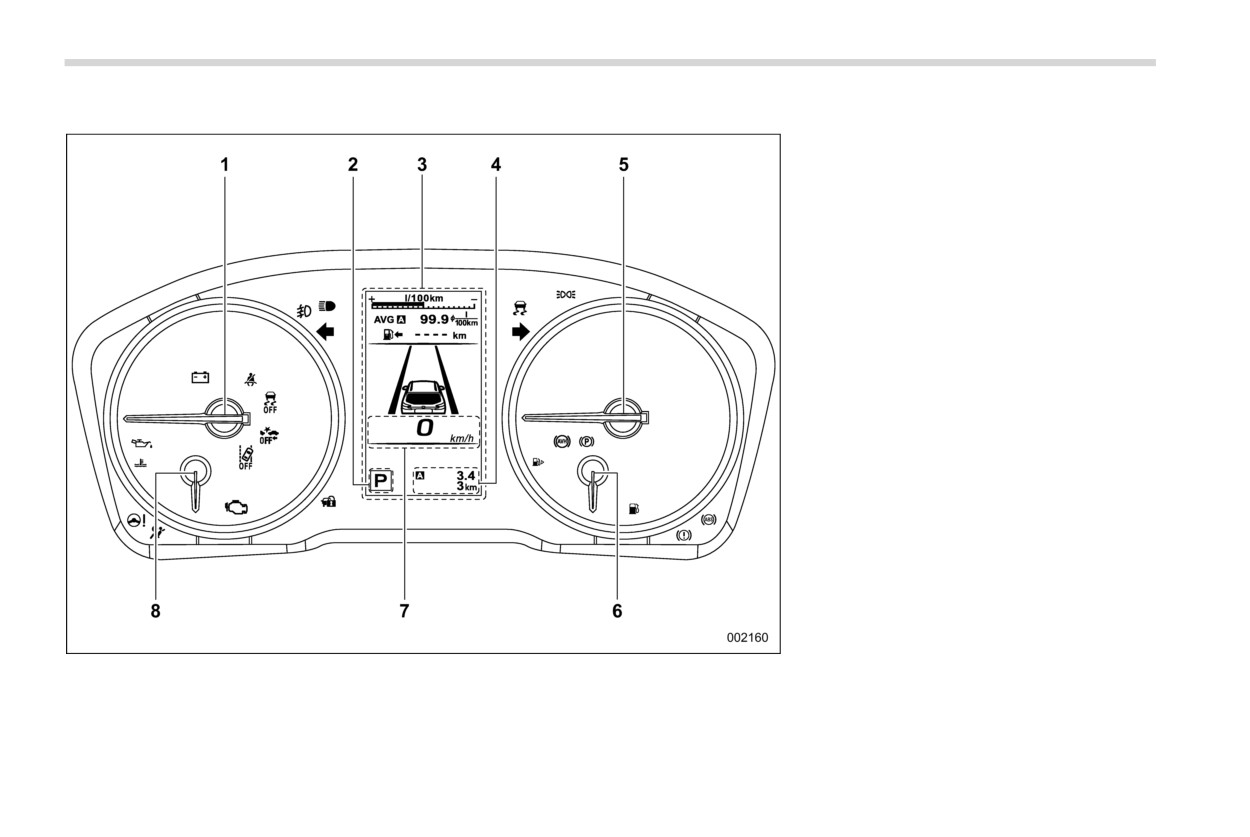
! Except U.S.-spec. models
1
Tachometer (page 168)
2
Select lever/gear position indicator (page
191)
3
Combination meter display (page 194)
4
Trip meter and odometer (page 169)
5
Speedometer (page 168)
6
Fuel gauge (page 170)
7
Digital speed screen (page 198)
8
Engine coolant temperature gauge (page
170)
The illustration above is a typical example. For some models, the combination meter may be
slightly different than that shown in the illustration.
24
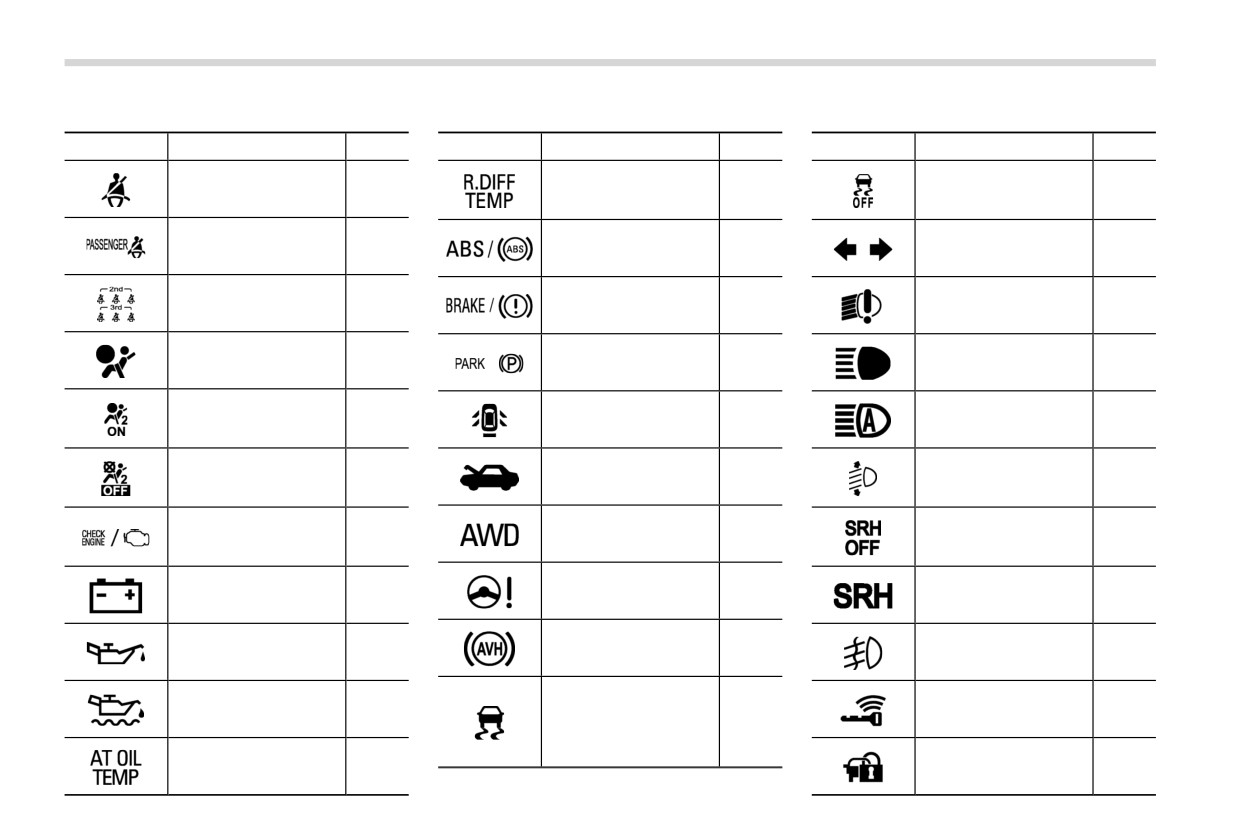
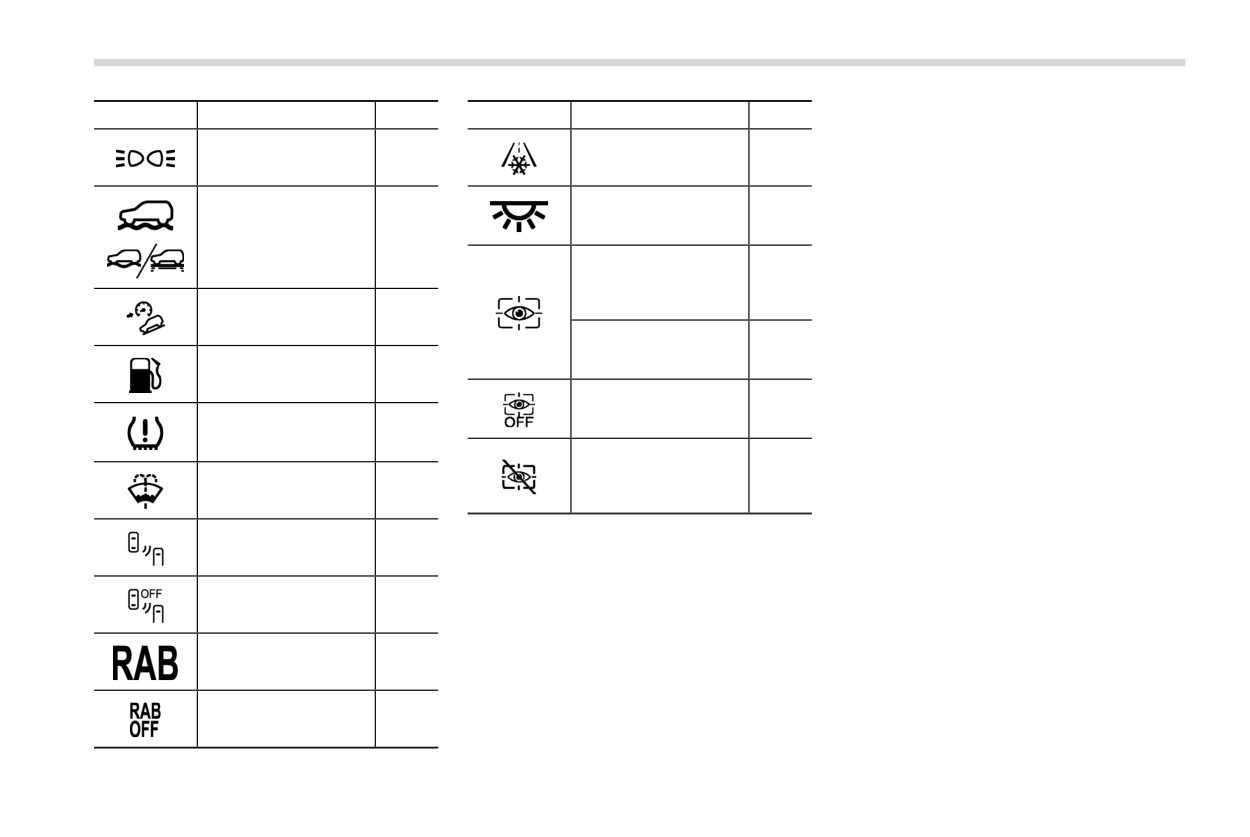
& Warning and indicator lights
Mark
Name
Page
Mark
Name
Page
Mark
Name
Page
Rear differential oil
Vehicle Dynamics
Seatbelt warning light
173
temperature warning
178
Control OFF indicator
185
light (if equipped)
light
Front passenger’s
Turn signal indicator
173
ABS warning light
180
191
seatbelt warning light
lights
Rear seatbelt warning
Brake system warning
LED headlight warning
174
181
191
light
light
light
SRS airbag system
Electronic parking
High beam indicator
175
/
181
191
warning light
brake indicator light
light
Front passenger’s
Door open warning
High beam assist indi-
frontal airbag ON indi-
176
183
191
light
cator light
cator
Front passenger’s
Automatic headlight
Engine hood open
frontal airbag OFF in-
176
183
beam leveler warning
191
warning light
dicator
light
CHECK ENGINE
Steering Responsive
warning light/Malfunc-
176
AWD warning light
183
Headlight OFF indica-
191
tion indicator light
tor light
Power steering warn-
Steering Responsive
Charge warning light
177
184
192
ing light
Headlight warning light
Oil pressure warning
Auto Vehicle Hold in-
Front fog light indicator
177
183
192
light
dicator light
light (if equipped)
Vehicle Dynamics
Engine low oil level
Access key warning
177
Control warning light/
186
warning light
Vehicle Dynamics
184
indicator (if equipped)
Control operation indi-
cator light
AT OIL TEMP warning
178
Security indicator light
190
light
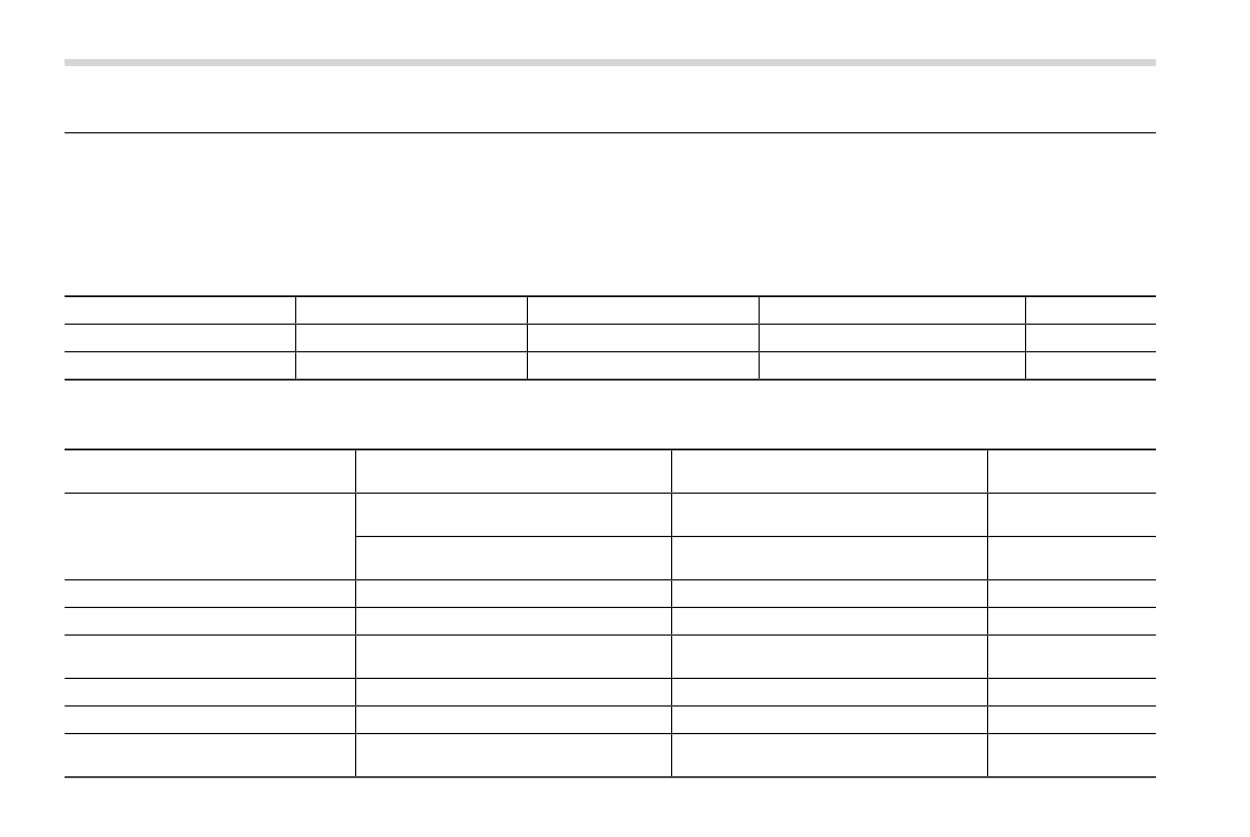
25
Mark
Name
Page
Mark
Name
Page
Headlight indicator
Icy road surface warn-
192
193
light
ing indicator
One-touch Interior Illu-
mination indicator (if
194
equipped)
X-MODE indicator
192
Driver Monitoring Sys-
tem operation indicator
193
light (green) (if
Hill descent control in-
equipped)
192
dicator
Driver Monitoring Sys-
tem warning light (yel-
193
low) (if equipped)
Low fuel warning light
183
Driver Monitoring Sys-
tem OFF indicator light
193
Low tire pressure
(if equipped)
warning light
179
(U.S.-spec. models)
Driver Monitoring Sys-
tem temporary stop in-
193
Windshield washer
dicator light (if
178
fluid warning light
equipped)
BSD/RCTA warning
192
indicator (if equipped)
BSD/RCTA OFF indi-
192
cator (if equipped)
RAB warning indicator
193
(if equipped)
RAB OFF indicator (if
193
equipped)
26
Function settings
& Function settings and adjustments on the center information display
Setting adjustments can be manually changed within the center information display to meet your personal requirements. Refer to
“Center information display (CID)” FP201.
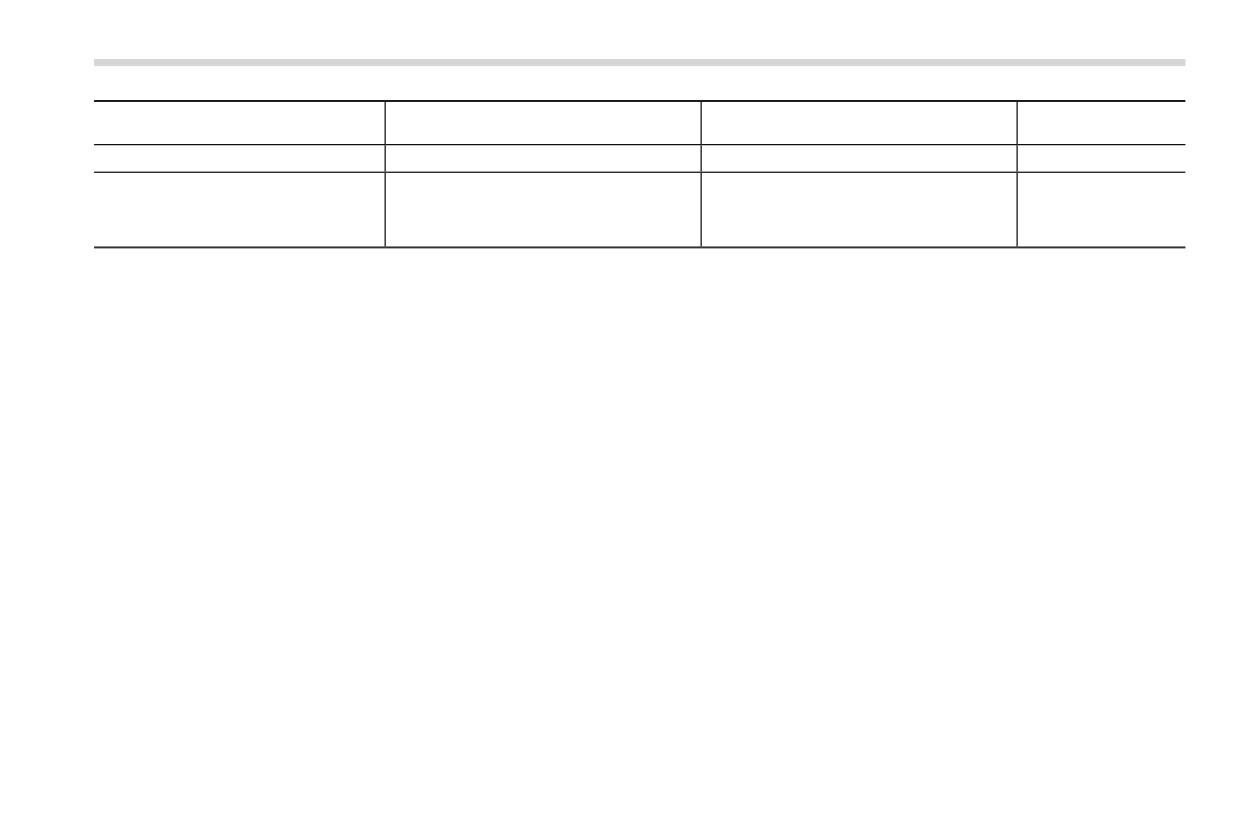
& Individual settings and adjustments excluding center information display
For setting adjustments to the following items, refer to the appropriate page for details.
Item
Function
Available settings
Factory default setting
Page
Alarm system
Alarm system
Operation/Non-operation
Operation
144
Remote keyless entry system
Audible signal
Operation/Non-operation
Operation
135
& Function settings and adjustments performed by a dealer
Factory default
Item
Function
Available settings
setting
Monitoring start delay time (after closing
0 seconds/30 seconds
30 seconds
doors)
Alarm system
Map lights/Dome light/Cargo area light
ON/OFF
OFF
illumination
Keyless access with push-button
Audible signal volume*2
Level 1 to 7
Level 5
Remote keyless entry system
Audible signal volume*2
Level 1 to 7
Level 5
Remote power rear gate open func-
Operation of power rear gate opening by
Non-operation/Pressing twice/Pressing
Pressing and holding
tion*1
remote transmitter/access key fob
and holding
Key lock-in prevention
Key lock-in prevention
Operation/Non-operation
Operation
Battery drainage prevention function
Battery drainage prevention function
Operation/Non-operation
Operation
Sensitivity of the operation of the auto
Auto dimmer cancel
OFF/Min/Low/Mid/Hi/Max
Mid
dimmer cancel
27
Factory default
Item
Function
Available settings
setting
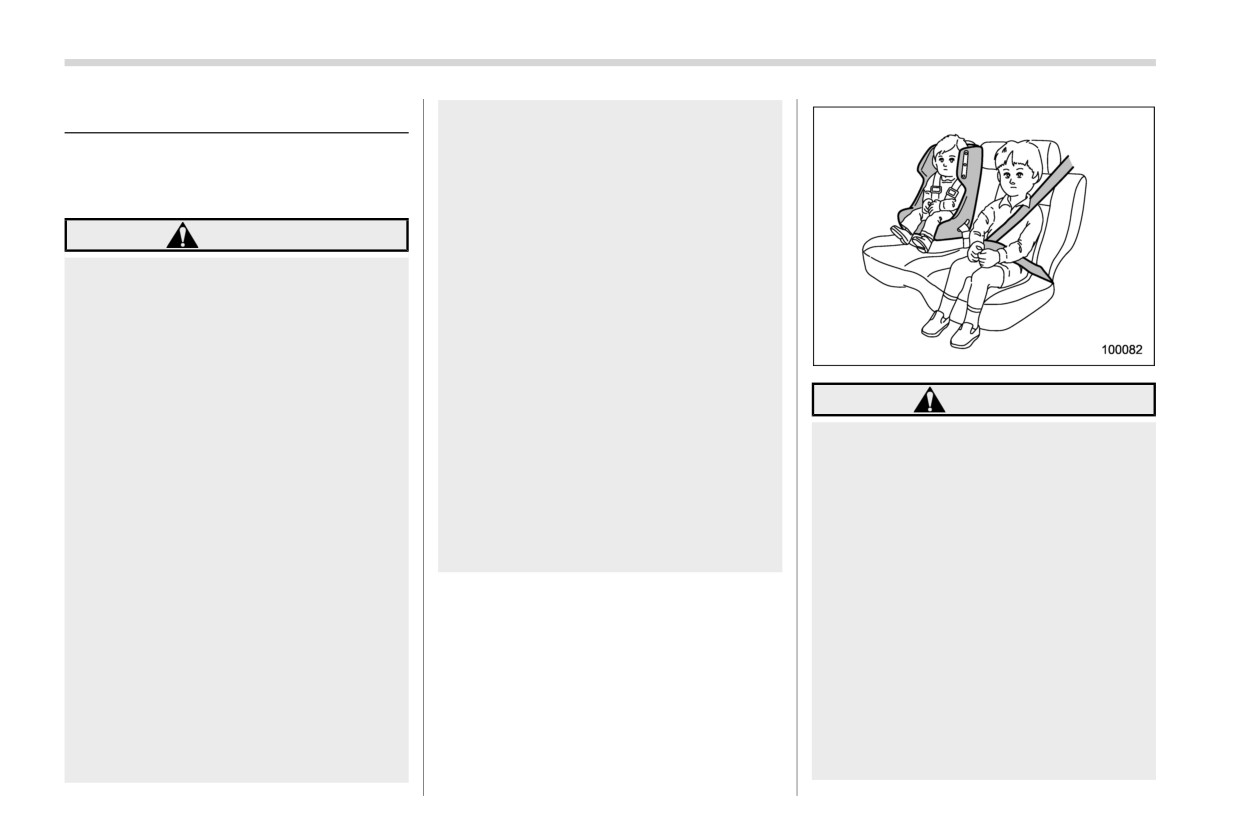
High beam assist function*1
High beam assist function
Operation/Non-operation
Operation
U.S.-spec. models:
Reverse gear interlocked rear wiper op-
Non-operation
Reverse gear interlocked rear wiper*1
Operation/Non-operation
eration
Other models: Op-
eration
*1: If equipped
*2: The audible signal volume cannot be set under level 5 for the warning chime.
Seat, seatbelt and SRS airbags
1-1. Seats
30
1-7. Child restraint systems
65
1
Safety tips
30
Safety precautions
65
Manual seat (if equipped)
33
Safety tips for installing child restraint systems ...67
Power seat (if equipped)
34
Where to place a child restraint system
67
Second-row seats
39
Choosing a child restraint system
70
Third-row seats
43
Installing child restraint systems with ALR/ELR
seatbelt
70
Head restraints
47
Installing a booster seat or booster cushion
75
1-2. Seat heater (if equipped)
50
Installation of child restraint systems by use of
Front seat heater
51
lower and top tether anchorages (LATCH)
76
Second-row seat heater
51
Top tether anchorages
81
1-3. Seat ventilation (if equipped)
52
1-8. SRS airbag (Supplemental Restraint
1-4. Seatbelts
52
System airbag)
83
Seatbelt safety tips
52
General precautions regarding SRS airbag
Emergency Locking Retractor (ELR)
54
system
83
Automatic Locking Retractor/Emergency
General precautions regarding SRS airbag
Locking Retractor (ALR/ELR)
54
system for accessories and any objects
85
Seatbelt warning light and chime
55
General precautions regarding SRS airbag
Passengers seatbelt reminder
55
system and children
87
Fastening the seatbelt
55
Components
90
Seatbelt maintenance
61
SUBARU advanced frontal airbag system
92
1-5. Seatbelt pretensioners
61
SRS side airbag and SRS curtain airbag
103
Seatbelt with shoulder belt and lap belt
SRS airbag system monitors
110
pretensioners
62
SRS airbag system servicing
111
Seatbelt with shoulder belt pretensioner
63
Precautions against vehicle modification
112
System monitors
63
How to contact the vehicle manufacturer
System servicing
63
concerning modifications for persons with
Precautions against vehicle modification
64
disabilities that may affect the advanced
airbag system
113
1-6. Rear Seat Reminder
65
30
Seats
1-1. Seats
upright position and a collision
occurs, the risk of sliding under
& Safety tips
the lap belt and of the lap belt
sliding up over the abdomen will
! Safety tips for seat
increase, and both can result in
serious injury or death.
WARNING
The SRS airbags deploy with
considerable speed and force.
Never adjust the seat while driv-
Occupants who are not seated
ing, as personal injury or loss of
in the proper upright position
vehicle control may occur.
when the SRS airbag deploys
Before adjusting the seat, ensure
could suffer very serious injuries.
nothing is blocking the adjusting
Because the SRS airbag needs
mechanism.
enough space for deployment,
WARNING
After adjusting the seat, move it
the driver should always sit up-
back and forth to ensure the seat
right and well back in the seat as
Seat children in the rear seat prop-
is securely locked. If it is not, it
far from the steering wheel as
erly restrained at all times. The SRS
may move suddenly or the seat-
practical while still maintaining
airbag deploys with considerable
belt may not operate properly.
full vehicle control, and the front
speed and force and can injure or
passenger should move the seat
Do not put objects under the front
even kill children, especially if they
as far back as possible and sit
seats. They may interfere with the
are not restrained or improperly
front seat locking mechanism
upright and well back in the seat.
restrained. Because children are
and cause an accident.
lighter and weaker than adults, their
Seatbelts provide maximum re-
risk of being injured from deploy-
straint when the occupant sits
ment is greater. For that reason, we
back and upright in the seat. To
strongly recommend that ALL chil-
reduce the risk of sliding under
dren (including those in child re-
the seatbelt in a collision, the
straint systems and those that have
front seatbacks should always
outgrown child restraint devices) sit
be used in the upright position
in the REAR seat properly restrained
while the vehicle is running. If the
at all times in a child restraint device
front seatbacks are not in the
or in a seatbelt, whichever is appro-
Seats
31
priate for the child’s age, height and
weight. Secure ALL types of child
restraint devices (including forward
facing child restraint systems) in the
REAR seats at all times.
NEVER INSTALL A CHILD RE-
STRAINT SYSTEM IN THE FRONT
PASSENGER’S SEAT. DOING SO
RISKS SERIOUS INJURY OR DEATH
TO THE CHILD BY PLACING THE
CHILD’S HEAD TOO CLOSE TO THE
SRS AIRBAG.
According to accident statistics,
children are safer when properly
WARNING
WARNING
restrained in the rear seating posi-
tions than in the front seating posi-
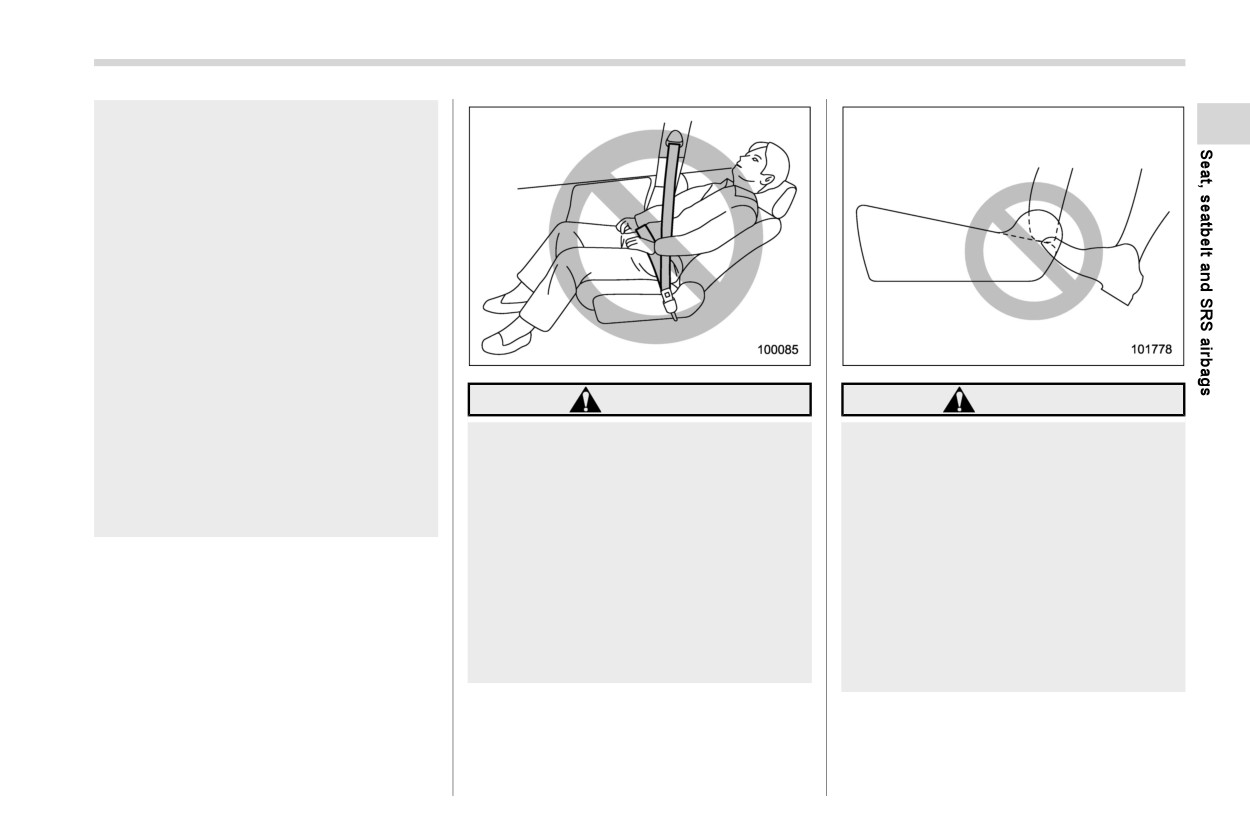
To prevent the passenger from slid-
Do not let rear passengers rest their
tions. For instructions and precau-
ing under the seatbelt in the event of
feet between the front seatback and
tions concerning child restraint sys-
a collision, always put the seatback
seat cushion. Doing so may interfere
tems, refer to “Child restraint sys-
in the upright position while the
with the proper operation of the
tems” FP65.
vehicle is in motion. Also, do not
following systems and could result
place objects such as cushions
in serious injury.
between the passenger and the seat-
. Occupant detection system
back. If you do so, the risk of sliding
. SRS side airbag
under the lap belt and of the lap belt
sliding up over the abdomen will
. Seat heater (if equipped)
increase, and both can result in
. Power seat (if equipped)
serious injury or death.
. Seat ventilation (if equipped)
- CONTINUED -
//////////////////////