Peugeot 5008 (2024 year). Manual in english - page 8
 

  Index      Manuals     Peugeot 5008 (2024 year). Manual in english


Search            copyright infringement  


Content      ..     6      7      8      9     ..


Peugeot 5008 (2024 year). Manual in english - page 8


226

In the event of a breakdown

Follow the instructions provided by the 

manufacturer of the charger.

Never reverse polarities.

It is not necessary to disconnect the 

battery.

►  Switch the ignition off.

►  Switch off all electrical consumers (audio 

system, lighting, wipers, etc.).


►  Switch off charger 

B

 before connecting 

the cables to the battery, so as to avoid any 

dangerous sparks.

►  Ensure that the charger cables are in good 

condition.

►  Lift the plastic cover on the (+) terminal, if the 

vehicle has one.

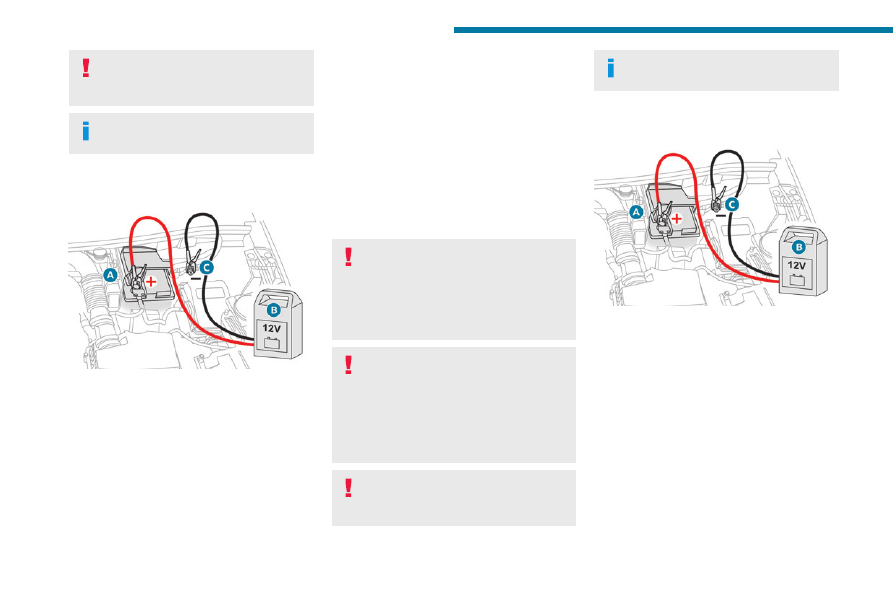
►  Connect the cables of charger 

B

 as follows:

•  the positive (+) red cable to the (+) terminal 

of battery 

A

.

•  the negative (-) black cable to earth point 

C


on the vehicle.

►  At the end of the charging operation, switch 

off charger 

B

 before disconnecting the cables 

from battery 

A

.

Charging the 48 V battery using a 

12 V battery charger

If the start fails, refer to the paragraph "

Starting 

using another battery

" and follow the 

recommended procedure.

In case of failure, especially after long storage, 

the 48 V battery may be discharged and require 

a charging process.

Do not try to charge the hybrid system 

directly.

The hybrid system is connected to the 12 V 

network through the DC/DC converter. Any 

operation may affect the overall behaviour of 

the system.

Only use a specific 12 V battery charger 

capable of maintaining 13.5 V with a high 

level of current 40-50 A (approx. 600 W).

To charge the vehicle's battery yourself, use 

only a charger compatible with lead-acid 

batteries with a nominal voltage of 12 V.

Never use a 24 V or higher battery booster.

Follow the instructions provided by the 

manufacturer of the charger.

Never reverse polarities.

It is not necessary to disconnect the 

battery.

►  Switch the ignition off.

►  Switch off all electrical consumers (audio 

system, lighting, wipers, etc.).


►  Switch off charger 

B

 before connecting the 

cables to the 12 V battery, so as to avoid any 

dangerous sparks.

►  Ensure that the charger cables are in good 

condition.

►  Lift the plastic cover on the (+) terminal, if the 

vehicle has one.

►  Connect the cables of charger 

B

 as follows:

•  the positive (+) red cable to the (+) terminal 

of battery 

A

,

•  the negative (-) black cable to earth point 

C


on the vehicle.

►  Open the driver's door and turn the ignition 

on 

without pressing the brake pedal

 (to wake 

up the vehicle).

227

In the event of a breakdown

8

The hybrid system will automatically start 

charging the 48 V battery after 1 minute with 

a 12 V power supply higher than 13.5 V. The 

current supplied by the battery charger should be 

about 30-50A.

When the appropriate energy level is reached 

in the 48 V battery (between 30 to 40 minutes 

depending on 12 V battery state of charge), the 

hybrid system automatically stops the charging 

process of the 48 V battery.

►  At the end of the charging operation, switch 

off charger 

B

 before disconnecting the cables 

from 12 V battery 

A

.

►  Refit the plastic cover to the (+) terminal, if 

the vehicle has one.

►  Operate the starter on the vehicle and let the 

engine run.

►  Wait for it to return to idle.

►  Allow the engine to run for at least 

20 minutes, with the vehicle stationary (in a 

ventilated area to avoid accumulation of exhaust 

gases), so that the 48 V battery reaches an 

adequate state of charge.

With rechargeable hybrid 

engines

The rechargeable hybrid system has two 

accessory batteries: one at the front and one at 

the rear of the vehicle.

Replacing the accessory batteries

Contact a PEUGEOT dealer or a 

qualified workshop.

Jump-starting another vehicle

Do not start or jump-start another vehicle 

using the vehicle’s accessory batteries.

Accessing the accessory batteries

Front

The front battery is located under the bonnet.


For access to the (+) terminal:

►  Release the bonnet by pulling the internal 

release lever, then the external safety catch.

►  Raise the bonnet.

(+)

 Positive terminal with a quick-release 

terminal.

(-)

 Negative terminal.

As the battery's negative terminal is not 

accessible, a remote earth point is located near 

the battery.

Rear

The rear battery is located in the boot.

To reach the battery:


►  Lift the boot floor.

(+)

 Positive terminal, protected by a red plastic 

cover (not accessible).

(-)

 Negative terminal with a black quick-release 

connector.

Charging the front battery using a 

battery charger

For optimum service life of the front battery, it 

is essential to maintain an adequate state of 

charge.

In some circumstances, it may be necessary to 

charge the front battery:

–  When using the vehicle mainly for short 

journeys.

–  If the vehicle is to be taken off the road for 

several weeks.

Consult a PEUGEOT dealer or a qualified 

workshop.

To charge the vehicle's front battery 

yourself, use only a charger compatible 

228

In the event of a breakdown

with lead-acid batteries with a nominal voltage 

of 12 V.

Follow the instructions provided by the 

manufacturer of the charger.

Never reverse polarities.

It is not necessary to disconnect the 

battery.

►  Switch the ignition off.

►  Switch off all electrical consumers (audio 

system, lighting, wipers, etc.).


►  Switch off charger 

B

 before connecting 

the cables to the battery, so as to avoid any 

dangerous sparks.

►  Ensure that the charger cables are in good 

condition.

►  Lift the plastic cover on the (+) terminal, if the 

vehicle has one.

►  Connect the cables of charger 

B

 as follows:

•  Positive (+) red cable to the (+) terminal on 

battery 

A

.

•  Negative (-) black cable to earth point 

C

 on 

the vehicle.

►  At the end of the charging operation, switch 

off charger 

B

 before disconnecting the cables 

from battery 

A

.

Disconnecting/reconnecting the 

accessory batteries

Procedure for disconnecting/reconnecting the 

accessory batteries in the event of long-term 

immobilisation of the vehicle.

Before disconnecting the accessory batteries:

►  Open the driver's door and boot.

►  Close all other doors.

►  Switch off all electrical consumers (audio 

system, wipers, lamps, etc.).

►  Switch off the ignition and wait for the 

READY

 indicator lamp to go out.

►  Observe a waiting time of 4 minutes.

Never reverse the order of the steps for 

disconnecting and reconnecting the 

accessory batteries - risk of irreversible 

damage!

Disconnection

Rear battery:

►  Disconnect the 

(-)

 terminal using the black 

quick-release connector.

Front battery:


►  Disconnect the 

(+)

 terminal by disconnecting 

the red quick-release clamp:

•  Raise lever 

A

 fully to release clamp 

B

.

•  Remove clamp 

B

 by lifting it off.

Reconnection

Front battery:

229

In the event of a breakdown

8


►  Connect the 

(+)

 terminal by connecting the 

red quick-release clamp:

•  Raise lever 

A

 fully.

•  Refit open clamp 

B

 on the 

(+)

 terminal.

•  Push clamp 

B

 fully down.

•  Lower lever 

A

 to lock clamp 

B

.

Rear battery:

►  Connect the 

(-)

 terminal using the black 

quick-release connector.

Following reconnection

After reconnecting the battery, turn on the 

ignition and wait 1 minute before starting the 

engine, to enable the electronic systems to 

initialise.

For right-hand drive versions, when the 

total distance recorder has reached 

62 miles (100 km), you must wait 

approximately 15 minutes before starting the 

engine.

If minor problems nevertheless persist following 

this operation, contact a PEUGEOT dealer or a 

qualified workshop.

Referring to the relevant section, reinitialise 

certain equipment:

–  Remote control key or electronic key 

(depending on version).

–  Sunroof and electric blind.

–  Electric windows.

–  Date and time.

–  Preset radio stations.

After reconnecting the battery, the 

message "

Collision risk detection 

system fault

" is displayed on the instrument 

panel when the ignition is switched on. This 

operation is perfectly normal. The message 

will disappear while driving.

Towing the vehicle

Procedure for having your vehicle towed or 

for towing another vehicle using a removable 

mechanical device.

General recommendations

Observe the legislation in force in the country where you are driving.

Check that the towing vehicle is heavier than the towed vehicle.

The driver must remain at the wheel of the towed vehicle and must have a valid driving licence.

When towing a vehicle with all four wheels on the ground, always use an approved towbar; ropes and straps are prohibited.

The towing vehicle must move off gently.

When the vehicle is towed with its engine off, there is no longer braking and steering assistance.

A professional recovery service must be called in the following cases:

–  broken down on a motorway or main road;

–  not possible to put the gearbox into neutral, unlock the steering, or release the parking brake;

–  not possible to tow a vehicle with an automatic gearbox, with the engine running;

–  towing with only two wheels on the ground;

230

In the event of a breakdown

–  four-wheel drive vehicle;

–  no approved towbar available.

Special feature of towing for hybrid 

vehicles

With both rear wheels on the ground:

 it 

is only authorized for short distances (about 

9 miles (15 km)) and at reduced speed 

(maximum 15 mph (25 km/h)).

With all four wheels on the ground:

 the 

vehicle can be towed a maximum of 0.06 mile 

(100 metres) at a maximum speed of 6 mph 

(10 km/h) (automatic gearbox in mode 

N

 and 

N

 displayed in the instrument panel).

Rechargeable hybrid vehicles

Before any intervention, with the ignition 

on, depress the brake pedal and select mode 

N

, then switch off the hybrid system (

READY


indicator lamp off).

Always call on professionals for recovery of 

the vehicle on a flatbed lorry or trailer.

Use the towing eye 

only

 to free the vehicle 

if it is stuck, or to secure it for recovery on a 

flatbed lorry or trailer.

Towing constraints

Type of vehicle

(engine/gearbox)

Front wheels on the 

ground

Rear wheels on the 

ground

Flatbed

4 wheels on the ground 

with towbar

Internal combustion/Manual


Internal combustion/Automatic


Hybrid/Automatic


Rechargeable hybrid 2WD


Rechargeable hybrid 4WD


2WD:

 2-wheel drive.

231

In the event of a breakdown

8

4WD:

 4-wheel drive.

In case of battery or electric parking brake failure, it is essential to call a professional using flatbed recovery vehicles (excluding manual gearbox).


Accessing the tools


Depending on version, the towing eye is stored 

either in the interior trim of the boot sill, left-hand 

side, or in a bag behind the left-hand rear seat.

The towing eye is stored in a tool box, under the 

boot floor.

For more information on accessing the 

Tool kit

refer to the corresponding section.

Towing your vehicle

To access the front screw thread:


►  Unclip the cover by pressing at its top left-

hand corner.

To be towed:

►  Screw the towing eye in fully.

►  Install the towbar.

►  Put the gearbox into neutral.

Failure to observe this instruction could 

result in damage to certain components 

(e.g. braking, transmission) and to the 

absence of braking assistance the next time 

the engine is started.

Automatic gearbox

Never tow the vehicle with the driving 

wheels on the ground and the engine off.

232

In the event of a breakdown

►  Unlock the steering and release the parking 

brake.

►  Switch on the hazard warning lamps on both 

vehicles in accordance with the legislation in 

force in the country in which you are driving.

►  Move off gently, drive slowly and only for a 

short distance.

Towing another vehicle

To access the rear screw thread:


►  Unclip the cover by pressing at its left-hand 

section.

►  Pull the cover downwards.

To tow:

►  Screw the towing eye in fully.

►  Install the towbar.

►  Switch on the hazard warning lamps on both 

vehicles.

►  Move off gently, drive slowly and only for a 

short distance.

233

Technical data

9

Engine technical data and 

towed loads

Engines

The engine characteristics are given in the 

vehicle's registration document, as well as in 

sales brochures.

Only the values available at the time of 

publication are presented in the tables.

Contact a PEUGEOT dealer or a qualified 

workshop to obtain missing values.

The maximum power corresponds to the 

value type-approved on a test bed, as 

defined by the Regulation EU 715/2007.

For more information, contact a PEUGEOT 

dealer or a qualified workshop.

Weights and towed loads

The weights and towed loads relating to 

the vehicle are indicated on the registration 

document, as well as in sales brochures.

These values are also indicated on the 

manufacturer's plate or label.

For more information, contact a PEUGEOT 

dealer or a qualified workshop.

The GTW (Gross Train Weight) and towed load 

values indicated are valid up to a maximum 

altitude of 1,000 metres. The towed load value 

must be reduced by 10% for each additional 

1,000 metres of altitude.

The maximum authorised nose weight 

corresponds to the weight permitted on the 

towball.

When exterior temperatures are high, the 

vehicle performance may be limited in 

order to protect the engine. When the exterior 

temperature is higher than 37°C, reduce the 

towed weight.

Towing even with a lightly loaded vehicle 

can adversely affect its road holding.

Braking distances are increased when towing 

a trailer.

When using a vehicle to tow, never exceed 

a speed of 62 mph (100 km/h) (observe the 

local legislation in force).

234

Technical data

Engines and towed loads - Petrol

Engines

PureTech 130 S&S BVM6

PureTech 130 S&S EAT8

Gearboxes

BVM6

(Manual 6-speed)

EAT8

(Auto. 8-speed)

Codes

EB2ADTS MB6 STT

EB2ADTS ATN8 STT

Model codes

HNSM/C

HNSM/S

HNSU/C

HNSC/C

HNSU/S

HNSC/S

Body styles

3008

5008

3008

5008

Cubic capacity (cc)

1,199

1,199

Max. power: EC standard (kW)

96

96

Fuel

Unleaded

Unleaded

Braked trailer (within the GTW limit) (kg)

on a 10% or 12% gradient

1,400

1,280

1,150

950

Unbraked trailer (kg)

690

690

690

750

Maximum authorised nose weight (kg)

80

72

80

72

235

Technical data

9

Engines

THP 150 EAT6

THP 165 EAT6

PureTech 180 S&S EAT8

Gearboxes

EAT6

(Auto. 6-speed)

EAT6

(Auto. 6-speed)

EAT8

(Auto. 8-speed)

Codes

EP6FDTMD AT6III

EP6FDTM AT6III

EP6FADTXD ATN8 STT

Model codes

5GXV/C

5GXV/S

5GYV/C

5GYW/C

5GYZ/C

5GSD/C

5GYV/S

5GYW/S

5GYZ/S

5GFU/C

5GFU/S

Body styles

3008

5008

3008

5008

3008

5008

Cubic capacity (cc)

1,598

1,598

1,598

Max. power: EC standard (kW)

110

121.4

133

Fuel

Unleaded

Unleaded

Unleaded

Braked trailer (within the GTW limit) (kg)

on a 10% or 12% gradient

600

600

600

1,550*

600

1,350*

1,500

1,400

Unbraked trailer (kg)

600

600

600

600

750

750

Maximum authorised nose weight (kg)

80

72

80

72

80

72

*  For Australia only.

236

Technical data

Engines and towed loads – BlueHDi Diesel

Engines

BlueHDi 130 S&S EAT8

Gearboxes

EAT8

(Auto. 8-speed)

Codes

DV5RC ATN8 STT

Model codes

YHZU/C

YHZU/S

Body styles

3008

5008

Cubic capacity (cc)

1,499

Max. power: EC standard (kW)

96

Fuel

Diesel

Braked trailer (within the GTW limit) (kg)

on a 10% or 12% gradient

1,300

1,200

Unbraked trailer (kg)

750

750

Maximum authorised nose weight (kg)

80

72

237

Technical data

9

Engines and towed loads - Hybrid

HYBRID 136 e-DCS6

Codes

EB2LTDH2 EDCT6

Model codes

MR...

HPYE/C

HPYE/S

Body styles

3008

5008

Braked trailer (within the GTW limit) (kg)

on a 10% or 12% gradient

1,250

1,050

Unbraked trailer (kg)

750

600

Maximum authorised nose weight (kg)

70

70

Petrol engines

PureTech 136

Gearboxes

Electric dual-clutch automatic 6-speed

Cubic capacity (cc)

1,199

Max. power: EC standard (kW)

100

Fuel

Unleaded

Electric motor

Technology

Synchronous with permanent magnets

Max. power: EC standard (kW)

21

Traction battery

Technology

Lithium-Ion

Voltage (Volts DC)

48

Installed capacity (kWh)

0.9

238

Technical data

Engines and towed loads - Rechargeable hybrid

HYBRID 180 e-EAT8

HYBRID 225 e-EAT8

HYBRID4 300 e-EAT8

Codes

EP6FADTXDHPE EATN8 

FWD

EP6FADTXDHPD EATN8 

FWD

EP6FADTXHPP EATN8 AWD

Model codes

M4...

DGLU/C

DGZU/C

5GBU/C

Braked trailer (within the GTW limit) (kg)

on a 10% or 12% gradient

1,250

1,250

1,250

Unbraked trailer (kg)

600

750

750

Maximum authorised nose weight (kg)

70

70

70

Petrol engines

PureTech 150

PureTech 180

PureTech 200

Gearboxes

Electric automatic 8-speed

Electric automatic 8-speed

Electric automatic 8-speed

Cubic capacity (cc)

1,598

1,598

1,598

Max. power: EC standard (kW)

110

132

147

Fuel

Unleaded

Unleaded

Unleaded

Electric motor(s)

Technology

Synchronous with permanent magnets

Max. power: EC standard (kW)

81

81

Front: 81

Rear: 83

Traction battery

Technology

Lithium-Ion

Voltage (Volts AC)

240-400

240-400

240-400

Installed capacity (kWh)

12.4

14.2

14.2

Combined power (kW)

133

165

220

239

Technical data

9

Dimensions (mm)

These dimensions have been measured on an 

unladen vehicle.

3008


5008


240

Technical data


Identification markings

Various visible

 markings for vehicle identification 

and vehicle search.


A. Vehicle Identification Number (VIN), under 

the bonnet.

Stamped on the chassis.

B. Vehicle Identification Number (VIN), on the 

dashboard.

Printed on an adhesive label visible through the 

windscreen.

C. Manufacturer's label.

Affixed to the right-hand door.

Bears the following information:

–  Manufacturer’s name.

–  European whole vehicle type approval 

number.

–  Vehicle Identification number (VIN).

–  Gross vehicle weight (GVW).

–  Gross train weight (GTW).

–  Maximum weight on the front axle.

–  Maximum weight on the rear axle.

D. Tyres/paint code label.

Affixed to the driver's door.

Bears the following information about the tyres:

–  Tyre pressures, unladen and laden.

–  Tyre specification, made up of the dimensions 

and type as well as the load and speed indices.

–  Spare tyre inflation pressure.

Also indicates the paint colour code.

The vehicle may be originally equipped 

with tyres with higher load and speed 

indices than those indicated on the label, 

without affecting tyre pressure (on cold tyres).

In the event of a change in the type of tyres, 

contact a PEUGEOT dealer for the tyre fits 

approved for the vehicle.

241

PEUGEOT Connect Radio

10

PEUGEOT Connect 

Radio

Multimedia audio system - 

Applications - Bluetooth

®


telephone

The functions and settings described 

vary according to the vehicle version and 

configuration, as well as the country of sale.

For safety reasons and because they 

require sustained attention by the driver, 

the following operations must be carried out 

with the 

vehicle stationary

 and the ignition 

on:

–  Pairing the smartphone with the system via 

Bluetooth.

–  Using the smartphone.

–  Connecting to the CarPlay

®

 or Android 

Auto applications (certain applications stop 

displaying when the vehicle is moving).

–  Changing the system settings and 

configuration.

The system is protected so that it only 

operates in the vehicle.

The message 

Energy economy mode

 is 

displayed when the system is about to go into 

standby.

The system’s Open Source Software 

(OSS) source codes are available at the 

following addresses:

https://www.groupe-psa.com/fr/oss/

https://www.groupe-psa.com/en/oss/

First steps

With the engine running, a press mutes 

the sound.

With the ignition off, a press turns the system on.

Increase or decrease the volume using 

the wheel or the "plus" or "minus" buttons 

(depending on the equipment).

Use the buttons on either side of or below the 

touch screen to access the menus, then press 

the virtual buttons on the touch screen.

Depending on the model, use the "Source" and 

"Menu" buttons on the left of the touch screen to 

access the menus, then press the virtual buttons 

on the touch screen.

At all times it is possible to display the rolling 

menus by pressing the screen briefly with three 

fingers.

All touch-sensitive areas on the screen are 

white.

On pages with multiple tabs at the bottom of the 

screen, you can switch between pages either 

by tapping the tab for the desired page or by 

swiping the pages to the left or right with your 

finger.

Press in the shaded area to go back up a level 

or confirm.

Press the back arrow to go back a level or 

confirm.

The touch screen is of the "capacitive" 

type.

To clean the screen, use a soft, non-abrasive 

cloth (e.g. spectacles cloth) with no additional 

product.

Do not use sharp objects on the screen.

Do not touch the screen with wet hands.

Certain information is displayed permanently in 

the upper bar of the touch screen:

–  Air conditioning status information (depending 

on version), and direct access to the 

corresponding menu.

–  Radio Media and Telephone menu status 

information.

–  Privacy status information.

–  Access to the touch screen and digital 

instrument panel settings.

Audio source selection (depending on 

equipment):

–  FM/DAB/AM radio stations (depending on 

equipment).

–  Telephone connected via Bluetooth and 

Bluetooth multimedia broadcast (streaming).

–  USB Memory stick.

–  Media player connected via the auxiliary 

socket (depending on equipment).


242

PEUGEOT Connect Radio


In the "Settings" menu, it is possible to 

create a profile for an individual or for a 

group of people with shared interests, and 

configure a wide range of settings (radio 

presets, audio settings, ambiences, etc.). 

Settings are applied automatically.

In very hot conditions, the volume may 

be limited to protect the system. It may 

enter standby mode (with the screen and 

sound off) for 5 minutes or more.

The system will resume normal operation 

when the temperature in the passenger 

compartment has dropped.

Steering mounted controls

Steering mounted controls - 

Type 1


Radio:

Select the previous/next preset radio 

station.

Select the previous/next item in a menu or a list.

Media:

Select the previous/next track.

Select the previous/next item in a menu or a list.

Radio:

Short press: display the list of radio 

stations.

Long press: update the list.

Media:

Short press: display the list of folders.

Long press: display the available sorting options.

Change audio source (radio; USB; AUX if 

equipment connected; CD; streaming).

Confirm a selection.


Increase volume. 

Decrease volume. 

Mute/restore sound by simultaneously 

pressing the increase and decrease 

volume buttons.

Steering mounted controls - 

Type 2


Voice commands

:

This control is located on the steering wheel or 

at the end of the lighting control stalk (depending 

on equipment).

Short press, smartphone voice commands via 

the system.

Increase volume. 

Decrease volume.

Mute by pressing the volume increase 

and decrease buttons simultaneously 

(depending on equipment).

Restore the sound by pressing one of the two 

volume buttons.

Media

 (short press): change the 

multimedia source.

Telephone

 (short press): start telephone 

call.

Call in progress

 (short press): access 

telephone menu.

Telephone

 (long press): reject an incoming call, 

end call; when no call is in progress, access 

telephone menu.

Radio

 (rotate): automatic search for the 

previous/next station.

Media

 (rotate): previous/next track, move in a 

list.

Short press

: confirm a selection; if nothing 

selected, access to presets.

Radio

: display the list of stations.

Media

: display the list of tracks.

Radio

 (press and hold): update the list of 

stations received.

243

PEUGEOT Connect Radio

10

Menus

Applications


Access configurable equipment.


Radio Media


Select an audio source or radio station. 

Telephone


Connect a mobile phone via Bluetooth

®

.

Run certain applications from a 

smartphone connected via CarPlay

®

 or Android 

Auto.

Settings


Configure a personal profile and/or 

configure the sound (balance, ambience, 

etc.) and the display (language, units, date, time, 

etc.).

Driving


Activate, deactivate or configure certain 

vehicle functions.

Navigation


Configure the navigation and select your 

destination via CarPlay

®

 or Android Auto.

244

PEUGEOT Connect Radio

Air conditioning


21,5

18,5


Manage various temperature and air flow 

settings.

Applications

Viewing photos

Insert a USB memory stick in the USB port.

To protect the system, do not use a USB 

hub.

The system can read folders and image files in 

the formats: .tiff; .gif; .jpg/jpeg; .bmp and .png.

Press 

Applications

 to display the main 

page.

Press "

Photos

". 

Select a folder. 

Select an image to view. 

Press this button to display the details of 

the photo.

Press the back arrow to go back a level. 

Managing messages

Press 

Applications

 to display the main 

page.

Press "SMS". 

Select the "SMS” tab. 

Press this button to select the display 

settings for messages.

Press this button to search and select a 

recipient.

Select the "Quick messages” tab. 

Press this button to select the display 

settings for messages.

Press this button to write a new message. 

Press the bin alongside the selected 

message to delete it.

Press this button alongside the selected 

message to display the secondary page.

Press this button to edit and modify the 

existing text.

Press this button to write a new message. 

Press the bin to delete the message. 

Radio

Selecting a station

Press 

Radio Media

 to display the main 

page.

Press one of the buttons to perform an 

automatic search for radio stations.

Or

Move the slider to manually search for 

frequencies up or down.

Or

Press the frequency. 

Enter the FM and AM waveband values 

using the virtual keypad.

Press "

OK

" to confirm.


Radio reception may be affected by the 

use of electrical equipment not approved 

by the Brand, such as a USB charger 

connected to the 12 V socket.

The exterior environment (hills, buildings, 

tunnels, basement car parks, etc.) may 

block reception, including in RDS mode. 

This phenomenon is perfectly normal in the 

context of radio wave transmission, and 

in no way indicative of an audio system 

malfunction.

245

PEUGEOT Connect Radio

10

Changing the waveband

Press 

Radio Media

 to display the main 

page. 

Press the "

OPTIONS

" button to access the 

secondary page.

Press "

Band

" to change waveband. 

Press in the shaded area to confirm.


Presetting a station

Select a radio station or frequency.

Make a short press on the star outline. If 

the star is solid, the radio station is 

already preset.

Or

Select a radio station or frequency.

Press "

Preset

".

Make a long press on one of the buttons 

to preset the station.

Activating/Deactivating RDS

RDS, if activated, allows you to continue 

listening to the same station by automatically 

retuning to alternative frequencies.

Press 

Radio Media

 to display the main 

page.

Press the "

OPTIONS

" button to access the 

secondary page.

Activate/deactivate "

RDS

". 

Press in the shaded area to confirm.


RDS station tracking may not be 

available nationwide, as many radio 

stations do not cover 100 % of the country. 

This explains the loss of reception of the 

station during a journey.

Displaying text information

The "Radio Text" function displays information 

transmitted by the radio station relating to the 

station or the currently playing song.

Press 

Radio Media

 to display the main 

page.

Press the "

OPTIONS

" button to access the 

secondary page.

Activate/deactivate "

News

". 

Press in the shaded area to confirm.


Playing TA messages

The TA (Traffic Announcement) function gives 

priority to TA alert messages. To operate, this 

function needs good reception of a radio station 

that transmits this type of message. While traffic 

information is being broadcast, the current 

media is automatically interrupted so that the 

TA message can be heard. Normal play of the 

previously playing media resumes at the end of 

the message.

Press 

Radio Media

 to display the main 

page.

Press the "

OPTIONS

" button to access the 

secondary page.

Activate/deactivate "

TA

". 

Press in the shaded area to confirm.


Audio settings

Press 

Radio Media

 to display the main 

page.

Press the "

OPTIONS

" button to access the 

secondary page.

Press "

Audio settings

". 

Select the "

Tone

", "

Balance

", "

Sound

", 

"

Voice

" or "

Ringtones

" tab to configure 

the sound settings.

Press the back arrow to confirm.


In the "

Tone

" tab, the 

Ambience

Bass

Medium

 and 

Treble

 sound settings are 

different and independent for each audio 

source.

In the "

Balance

” tab, the 

All passengers

Driver

 and 

Front only

 settings are common 

to all sources.

In the "

Sound

” tab, activate or deactivate 

"

Volume linked to speed

", "

Auxiliary input

and "

Touch tones

".

246

PEUGEOT Connect Radio

The balance/distribution (or spatialisation 

with the Arkamys

©

 system) uses audio 

processing to adjust the sound quality 

according to the number of passengers in the 

vehicle.

Onboard audio: Arkamys Sound Staging

©


optimises the sound distribution inside 

the passenger compartment.

DAB (Digital Audio 

Broadcasting) radio

Terrestrial Digital Radio

Digital radio provides higher quality sound.

The various "multiplexes/ensembles" offer a 

choice of radio stations organised in alphabetical 

order.

Press 

Radio Media

 to display the main 

page.

Press the "

OPTIONS

" button to access the 

secondary page.

Press "

Band

" to select "

DAB band

". 

Press in the shaded area to confirm.


FM-DAB Follow-up

"DAB" does not cover 100% of the territory.

When the digital radio signal is poor, the 

"FM-DAB Follow-up" enables you to continue 

listening to the same station by automatically 

switching to the corresponding "FM" analogue 

station (if there is one).

Press 

Radio Media

 to display the main 

page.

Press the "

OPTIONS

" button to go to the 

secondary page.

Activate/deactivate "

FM-DAB Follow-up

". 

Press in the shaded area to confirm.


If "FM-DAB Follow-up" is activated, there 

may be a time offset of a few seconds 

when the system switches to "FM" analogue 

radio, and in some cases a change in volume.

When the digital signal quality is restored, the 

system automatically changes back to "DAB".

To minimise this time lag, storing radio 

stations in the "DAB" band is recommended.

If the "DAB" station being listened to is 

not available on "FM", or if "FM-DAB 

Follow-up" is not activated, the sound will cut 

out when the digital signal becomes too weak.

Media

USB port

Insert the USB memory stick into the USB 

port or connect the USB device to the 

USB port using a suitable cable (not supplied).

To protect the system, do not use a USB 

hub.

The system builds playlists (in temporary 

memory); this operation can take from a 

few seconds to several minutes at the first 

connection.

Reduce the number of non-music files and the 

number of folders to reduce the waiting time.

Playlists are updated whenever the ignition 

is switched off or a USB memory stick is 

connected. The audio system memorises these 

lists, which will subsequently load faster if they 

have not been changed.

Auxiliary (AUX) jack socket

Depending on equipment

Connect a portable device (MP3 player, 

etc.) to the auxiliary jack socket using an 

audio cable (not supplied).

This source is only available if "Auxiliary input" 

has been selected in the audio settings.

First adjust the volume on the portable device 

(to a high level). Then adjust the volume of the 

audio system.

Controls are managed via the portable device.

247

PEUGEOT Connect Radio

10

Selecting the source

Press 

Radio Media

 to display the main 

page.

Press the "

SOURCES

" button.

Select the source.

BluetoothStreaming

®

Streaming allows you to listen to the audio feed 

from your smartphone.

The Bluetooth profile must be activated.

First adjust the volume on the portable device 

(to a high level). Then adjust the volume of the 

system.

If play does not start automatically, it may be 

necessary to start the audio playback from the 

smartphone.

Control is from the portable device or by using 

the system's touch buttons.

Once connected in Streaming mode, the 

smartphone is considered to be a media 

source.

Connecting Apple

®

 players

Connect the Apple

®

 player to the USB socket 

using a suitable cable (not supplied).

Play starts automatically.

Control is via the audio system.

The classifications available are those of 

the portable device connected (artists/

albums/genres/playlists/audio books/

podcasts). It is also possible to use a 

classification structured in the form of a 

library.

The default classification used is by artist. To 

modify the classification used, return to the 

first level of the menu then select the desired 

classification (playlists for example) and 

confirm to go down through the menu to the 

desired track.

The version of software in the audio system may 

not be compatible with the generation of the 

Apple

®

 player.

Information and advice

The system supports USB mass storage 

devices, BlackBerry

®

 devices or Apple

®

 players 

via the USB ports. The adapter cable is not 

supplied.

Devices are managed using the audio system 

controls.

Other devices, not recognised on connection, 

must be connected to the auxiliary socket using 

a jack cable (not supplied) or via Bluetooth 

streaming, if compatible.

To protect the system, do not use a USB 

hub.

The audio system will only play audio files with 

".wav", ".wma", ".aac", ".ogg" and ".mp3" file 

extensions, at bit rates between 32 Kbps and 

320 Kbps.

It also supports VBR (Variable Bit Rate) mode.

No other file types (".mp4", etc.) can be read.

All ".wma" files must be standard WMA 9 files.

The supported sampling rates are 11, 22, 44 and 

48 KHz.

To avoid reading and display problems, we 

recommend choosing file names less than 20 

characters long that do not contain any special 

characters (e.g. “ ? . ; ù).

Use only USB memory sticks in FAT32 format 

(File Allocation Table).

We recommend using the original USB 

cable for the portable device.

Telephone

USB sockets

Depending on equipment, for more information 

on the USB sockets compatible with 

CarPlay

®

 or 

Android Auto

 applications, refer to the "Ease of 

use and comfort" section.

For the list of compatible smartphones, 

visit the Manufacturer's website in your 

country.

Synchronising a smartphone enables 

users to display applications that support 

the smartphone’s CarPlay

®

 or Android Auto 

technology on the vehicle’s screen. For 

248

PEUGEOT Connect Radio

CarPlay

®

 technology, the CarPlay

®

 function 

must first be activated on the smartphone.

Unlock the smartphone for the communication 

process between the smartphone and the 

system to work.

As principles and standards are constantly 

changing, 

we recommend keeping the 

smartphone's operating system up-to-

date, together with the date and time on 

the smartphone and the system

.

CarPlay

®

 smartphone 

connection

Depending on country.

On connecting the USB cable, the 

CarPlay

®

 function deactivates the 

system's Bluetooth

®

 mode.

The "

CarPlay

" function requires the use of 

a compatible smartphone and compatible 

applications.

Connect the USB cable. The smartphone 

charges when connected by the USB 

cable.

From the system, press 

Telephone

 to 

display the CarPlay

®

 interface.

Or

If the smartphone has already connected 

by Bluetooth

®

.

Connect the USB cable. The smartphone 

charges when connected by the USB 

cable.

From the system, press "

Telephone

" to 

display the main page.

Press the "

PHONE

" button to go to the 

secondary page.

Press "

CarPlay

" to display the CarPlay

®


interface.

When the USB cable is disconnected 

and the ignition is switched off then back 

on, the system will not automatically switch to 

Radio Media mode; the source must be 

changed manually.

The CarPlay

®

 navigation can be accessed 

at any time by pressing the system's 

Navigation

 button.

Android Auto smartphone 

connection

Depending on country.

On the smartphone, download the 

Android Auto application.

The "Android Auto" function requires the 

use of a compatible smartphone and 

applications.

Telephone not connected by 

Bluetooth

®

Connect a USB cable. The smartphone 

charges when connected by a USB cable.

From the system, press "

Telephone

" to 

display the main page.

Press "

Android Auto

" to start the 

application in the system.

Depending on the smartphone, it may be 

necessary to activate the "

Android Auto

function.

During the procedure, several screen 

pages relating to certain features are 

displayed.

Accept to start and complete the connection.

When connecting a smartphone to the 

system, we recommend enabling 

Bluetooth

®

 on the smartphone.

Telephone connected by Bluetooth

®

From the system, press "

Telephone

" to 

display the main page.

Press the "

PHONE

" button to display the 

secondary page.

Press "

Android Auto

" to start the 

application in the system.

Access to the different audio sources remains 

available in the margin of the Android Auto 

display, using the touch buttons located in the 

upper bar.

Access to the menus for the system is possible 

at any time using the dedicated buttons.

249

PEUGEOT Connect Radio

10

There may be a pause before 

applications become available, 

depending on the quality of the network.

Pairing a Bluetooth

®


telephone

The services available depend on the 

network, the SIM card and the 

compatibility of the Bluetooth devices used. 

Consult the telephone user guide and the 

service provider to check which services are 

available.

The Bluetooth function must be activated 

and the telephone configured as "Visible 

to all” (in the telphone settings).

To complete the pairing, whichever procedure is 

used (from the telephone or from the system), 

ensure that the code is the same in the system 

and in the telephone.

If the pairing procedure fails, we 

recommend deactivating and then 

reactivating the Bluetooth function on the 

telephone.

Procedure from the telephone

Select the name of the system in the list 

of detected devices.

In the system, accept the connection request 

from the telephone.

Procedure from the system

Press 

Telephone

 to display the main 

page.

Press "

Bluetooth search

".

The list of detected telephones is 

displayed.

Select the name of the chosen telephone 

in the list.

Connection sharing

The system offers to connect the telephone with 

3 profiles:

– "

Telephone

" (hands-free kit, telephone only),

– “

Streaming

" (streaming: wireless playing of 

audio files on the telephone),

– "

Mobile internet data

".

Select one or more profiles.


Press "

OK

" to confirm.


Depending on the type of telephone, you may by 

prompted to accept the transfer of contacts and 

messages.

The ability of the system to connect just 

one profile depends on the telephone.

All three profiles may connect by default.

The profiles compatible with the system 

are: HFP, OPP, PBAP, A2DP, AVRCP, 

MAP and PAN.

Visit the Brand's website for more information 

(compatibility, additional help, etc.).

Automatic reconnection

On returning to the vehicle, if the last telephone 

connected is present again, it is automatically 

recognised and within about 30 seconds 

after switching on the ignition, the pairing is 

established automatically (Bluetooth activated).

To modify the connection profile:

Press 

Telephone

 to display the main 

page.

Press the "

PHONE

" button to access the 

secondary page.

Press "

Bluetooth connection" to 

display the list of paired devices.

Press the "Details" button for a paired 

device.

Select one or more profiles.


Press "

OK

" to confirm.


Managing paired telephones

This function lets you connect or disconnect a 

device or delete a pairing.

Press 

Telephone

 to display the main 

page.

250

PEUGEOT Connect Radio

Press the "

PHONE

" button to access the 

secondary page.

Press "

Bluetooth connection" to 

display the list of paired devices.

Press on the name of the telephone 

selected in the list to disconnect it.

Press again to connect it.

Deleting a telephone

Press the basket at the top right of the 

screen to display a basket alongside the 

telephone chosen.

Press the basket alongside the telephone 

chosen to delete it.

Receiving a call

An incoming call is announced by a ring and a 

superimposed display in the screen.

Make a short press on the steering 

mounted 

PHONE

 button to accept an 

incoming call.

And

Make a long press 

on the steering mounted 

PHONE

 button 

to reject the call.

Or

Press "

End call

". 

Making a call

Using the telephone is not recommended 

while driving.

Parking the vehicle.

Make the call using the steering mounted 

controls.

Calling a new number

Press 

Telephone

 to display the main 

page. 

Enter the phone number using the digital 

keypad.

Press "

Call" to start the call.


Calling a contact

Press 

Telephone

 to display the main 

page. 

Or press and hold 

the steering mounted 

PHONE

 button. 

Press "

Contacts

".

Select the desired contact from the displayed list.

Press "

Call

". 

Calling a recently used 

number

Press 

Telephone

 to display the main 

page.

Or

Press and hold 

the steering mounted button. 

Press "

Recent calls

".

Select the desired contact from the displayed list.

It is always possible to make a call 

directly from the telephone; as a safety 

measure, first park the vehicle.

Setting the ringtone

Press 

Telephone

 to display the main 

page. 

Press the "

OPTIONS

" button to access the 

secondary page.

Press "

Ring volume

" to display the 

volume bar.

Press the arrows or move the slider to set 

the ring volume.

Settings

Configuring profiles

Press 

Settings

 to display the main page. 

Press "

Profiles

". 

Select "

Profile 1

", "

Profile 2

", "

Profile 3

” or 

"

Common profile

".

251

PEUGEOT Connect Radio

10

Press this button to enter a name for the 

profile using the virtual keypad.

Press "

OK

" to save. 

Press the back arrow to confirm.


Press this button to activate the profile.


Press the back arrow again to confirm.


Press this button to reset the selected 

profile.

Adjusting the brightness

Press 

Settings

 to display the main page. 

Press 

Brightness

Move the slider to adjust the brightness of 

the screen and/or the instrument panel 

(depending on version).

Press in the shaded area to confirm.


Modifying system settings

Press 

Settings

 to display the main page. 

Press "

Configuration

" to access the 

secondary page.

Press "

System configuration

". 

Press the "

Units

" tab to change the units of 

distance, fuel consumption and temperature.

Press the "

Factory settings

" tab to restore the 

initial settings.

Returning the system to factory settings 

activates the English language by default 

(depending on version).

Press the "

System info

" tab to display the 

versions of the various modules installed in the 

system.

Press the "

Privacy

" tab,

or

Press 

Settings

 to display the main page. 

Press "

Privacy

" to activate or deactivate 

the private data mode.

Activate or deactivate: 

– "

No sharing (data, vehicle position)

".

– "

Only data sharing

– "

Data and vehicle position sharing

"

Press the back arrow to confirm.


Press 

Settings

 to display the main page. 

Press "

Configuration

" to access the 

secondary page.

Press "

Screen configuration

". 

Press "

Brightness

".

Move the slider to adjust the brightness of 

the screen and/or the instrument panel 

(depending on version).

Press the back arrow to confirm.


Press "

Animation

".

Activate or deactivate: “

Automatic 

scrolling

”.

Select "

Animated transitions

". 

Press the back arrow to confirm.


Selecting the language

Press 

Settings

 to display the main page. 

Press "

Configuration

" to access the 

secondary page.

Select "

Language

" to change the 

language.

Press the back arrow to confirm.


Setting the time

Press 

Settings

 to display the main page. 

Press "

Configuration

" to access the 

secondary page.

Press "

Date and time

". 

Select "

Time

".

Press this button to set the time using the 

virtual keypad.

Press "

OK

" to save the time. 

252

PEUGEOT Connect Radio

Press this button to set the time zone. 

Select the display format for the time 

(12h/24h).

Activate or deactivate summer time (+1 

hour).

Activate or deactivate GPS 

synchronisation (UTC).

Press the back arrow to save the settings. 

The system may not automatically 

manage the change between winter and 

summer time (depending on the country of 

sale).

Setting the date

Press 

Settings

 to display the main page. 

Press "

Configuration

" to access the 

secondary page.

Press "

Date and time

". 

Select "

Date

".

Press this button to set the date. 

Press the back arrow to save the date. 

Select the display format for the date. 

Press the back arrow again to confirm.


Time and date setting is only available if 

"GPS Synchronisation:" is deactivated.

Frequently asked 

questions

The following information groups together the 

answers to the most frequently asked questions 

concerning the system.

Radio

The reception quality of the tuned radio 

station gradually deteriorates or the station 

presets are not working (no sound, 87.5 MHz 

is displayed, etc.).

The vehicle is too far from the selected station’s 

transmitter, or no transmitter is present in the 

geographical area.

►  Activate the "RDS" function in the upper bar 

to enable the system to check whether there is 

a more powerful transmitter in the geographical 

area.

The environment (hills, buildings, tunnels, 

basement car parks, etc.) is blocking reception, 

including in RDS mode.

This is a perfectly normal phenomenon, and is 

not indicative of an audio system malfunction.

The aerial is missing or has been damaged 

(for example while entering a car wash or 

underground car park).

►  Have the aerial checked by a dealer.

I cannot find some radio stations in the list of 

received stations.

The name of the radio station changes.

The station is no longer received or its name has 

changed in the list.

►  Press the round arrow on the "List" tab on the 

"Radio" page.

Some radio stations send other information 

in place of their name (the title of the song for 

example).

The system interprets these details as the station 

name.

►  Press the round arrow on the "List" tab on the 

"Radio" page.

Media

Playback of my USB memory stick starts only 

after a very long wait (around 2 to 3 minutes).

Some files supplied with the memory stick may 

greatly slow down access to reading the memory 

stick (multiplication by 10 of the cataloguing 

time).

►  Delete the files supplied with the memory 

stick and limit the number of sub-folders in the 

file structure on the memory stick. 

Some characters in information about the 

currently playing media are not displayed 

correctly.

The audio system is unable to process certain 

types of character.

►  Use standard characters to name tracks and 

folders.

Playback of streaming files does not start.

253

PEUGEOT Connect Radio

10

The connected device does not automatically 

launch playback.

►  Start playback from the device.

Track names and playing times are not 

displayed on the audio streaming screen.

The Bluetooth profile does not allow the transfer 

of this information.

Telephone

I cannot connect my Bluetooth telephone.

The telephone's Bluetooth function may be 

switched off or the device may not be visible.

►  Check that the telephone has Bluetooth 

switched on.

►  Check in the telephone settings that it is 

"visible to all".

The Bluetooth telephone is not compatible with 

the system.

►  Check the compatibility of the telephone on 

the Brand's website (services).

Android Auto and/or CarPlay do not work.

Android Auto and CarPlay may not activate if the 

USB cables are of poor quality.

►  Use genuine USB cables to ensure 

compatibility.

Android Auto and/or CarPlay do not work.

Android Auto and CarPlay are not available in all 

countries.

►  Check the Google Android Auto or Apple 

website to see which countries are supported.

The volume of the telephone connected in 

Bluetooth mode is inaudible.

The volume depends on both the system and the 

telephone.

►  Increase the volume of the audio system, to 

maximum if required, and increase the volume of 

the telephone if necessary.

Ambient noise affects the quality of the 

telephone call.

►  Reduce ambient noise (close windows, turn 

down ventilation, slow down, etc.).

The contacts are not listed in alphabetical 

order.

Some telephones offer display options. 

Depending on the settings chosen, contacts can 

be transferred in a specific order.

►  Modify the telephone directory display 

settings.

Settings

When the treble and bass settings are 

changed, the ambience is deselected.

When the ambience is changed, the treble 

and bass settings are reset.

Selecting an ambience imposes the treble and 

bass settings, and vice versa.

►  Modify the treble and bass or ambience 

settings to obtain the desired musical ambience.

When the balance settings are changed, the 

distribution is deselected.

When the distribution setting is changed, the 

balance settings are deselected.

Selecting a distribution setting imposes the 

balance settings, and vice versa.

►  Modify the balance setting or the distribution 

setting to obtain the desired sound quality.

There is a difference in sound quality 

between audio sources.

To allow for optimal listening quality, the sound 

settings can be tailored to different audio 

sources, which can generate audible differences 

when changing source.

►  Check that the sound settings are appropriate 

to the sources listened to. Adjust the sound 

functions to the middle position.

When the engine is off, the system switches 

off after several minutes of use.

When the engine is switched off, the system's 

operating time depends on the state of charge of 

the battery.

The switch-off is normal: the system 

automatically goes into energy economy mode 

and switches off to maintain an adequate charge 

in the battery.

►  Start the vehicle’s engine to increase the 

charge of the battery.

254

PEUGEOT Connect Nav

PEUGEOT Connect Nav

GPS navigation - 

Applications - Multimedia 

audio system - Bluetooth

®


telephone

The functions and settings described 

vary according to the vehicle version and 

configuration, as well as the country of sale.

For safety reasons and because they 

require sustained attention by the driver, 

the following operations must be carried out 

with the 

vehicle stationary

 and the ignition 

on:

–  Pairing the smartphone with the system via 

Bluetooth.

–  Using the smartphone.

–  Connecting to the CarPlay

®

 or Android 

Auto applications (certain applications stop 

displaying when the vehicle is moving).

–  Watching a video (the video stops when the 

vehicle starts to move again).

–  Changing the system settings and 

configuration.

AM and DAB radio are not available on 

Hybrid vehicles.

The system is protected so that it only 

operates in the vehicle.

The message 

Energy economy mode

 is 

displayed when the system is about to go into 

standby.

System and map updates can be 

downloaded from the Brand's website.

The update procedure is also available there.

The system’s Open Source Software 

(OSS) source codes are available at the 

following addresses:

https://www.groupe-psa.com/fr/oss/

https://www.groupe-psa.com/en/oss/

First steps

With the engine running, a press mutes 

the sound.

With the ignition off, a press turns the system on.

Increase or decrease the volume using 

the wheel or the "plus" or "minus" buttons 

(depending on the equipment).

Use the menu buttons on either side of or below 

the touch screen for access to the menus, then 

press the virtual buttons in the touch screen.

Depending on the model, use the "Source" or 

"Menu" buttons to access the rolling menus, then 

press the virtual buttons in the touch screen.

Display the rolling menus at any time by pressing 

the screen briefly with three fingers.

All of the touch areas of the screen are white.

Press the back arrow to go back a level.

Press "OK" to confirm.

The touch screen is of the "capacitive" 

type.

To clean the screen, use a soft, non-abrasive 

cloth (e.g. spectacles cloth) with no additional 

product.

Do not use sharp objects on the screen.

Do not touch the screen with wet hands.

Certain information is displayed permanently 

in the side bars or in the upper bar of the touch 

screen (depending on equipment):

–  Air conditioning status information (depending 

on version), and direct access to the 

corresponding menu.

–  Go directly to the audio source selection 

option, to view the list of radio stations (or list of 

titles depending on the source).

–  Go to the "Notifications" of messages, emails, 

map updates and, depending on the services, 

the navigation notifications.

–  Go to the settings for the touch screen and the 

digital instrument panel.

Audio source selection (depending on 

equipment):

–  FM/DAB/AM radio stations (depending on 

equipment).

–  Telephone connected via Bluetooth and 

Bluetooth multimedia broadcast (streaming).

–  USB memory stick.

255

PEUGEOT Connect Nav

11

–  Media player connected via the auxiliary 

socket (depending on equipment).

–  Video (depending on equipment).


In the "Settings" menu, it is possible to 

create a profile for an individual or for a 

group of people with shared interests, and 

configure a wide range of settings (radio 

presets, audio settings, navigation history, 

favourite contacts, etc.). Settings are applied 

automatically.

In very hot conditions, the volume may 

be limited to protect the system. It may 

enter standby mode (with the screen and 

sound off) for 5 minutes or more.

The system will resume normal operation 

when the temperature in the passenger 

compartment has dropped.

Steering mounted controls

Voice control

:

This control is located on the steering 

wheel or at the end of the lighting control stalk 

(depending on equipment).

Short press, system voice control.

Long press, voice commands from smartphone 

or CarPlay

®

, Android Auto via the system.

Increase volume. 

Decrease volume.

Mute by pressing the volume increase 

and decrease buttons simultaneously 

(depending on equipment).

Restore the sound by pressing one of the two 

volume buttons.

Media

 (short press): change the 

multimedia source.

Telephone

 (short press): start telephone 

call.

Call in progress

 (short press): access 

telephone menu.

Telephone

 (long press): reject an incoming call, 

end call; when no call is in progress, access 

telephone menu.

Radio

 (rotate): automatic search for the 

previous/next station.

Media

 (rotate): previous/next track, move 

through a list.

Short press

: confirm a selection; if nothing 

selected, access presets.

Radio

: display the list of stations.

Media

: display the list of tracks.

Radio

 (press and hold): update the list of 

detected stations.

Menus

Connected navigation


Enter navigation settings and choose a 

destination.

Use real-time services, depending on equipment.

256

PEUGEOT Connect Nav

Applications


Run certain applications from a 

smartphone connected via CarPlay

®

 or 

Android Auto.

Check the status of the Bluetooth

®

 and Wi-Fi 

connections.

Radio Media


FM  87.5 MHz


Select an audio source or radio station, or 

display photographs.

Telephone


Connect a telephone via Bluetooth

®

, read 

messages and emails and send quick 

messages.

Settings


Configure a personal profile and/or 

configure the sound (balance, ambience, 

etc.) and the display (language, units, date, time, 

etc.).

Vehicle


Activate, deactivate or configure certain 

vehicle functions.

Air conditioning


21,5

18,5


Manage various temperature and air flow 

settings.

257

PEUGEOT Connect Nav

11

Voice commands

Steering wheel-mounted 

controls 

Voice commands

:

Voice commands can be issued from any 

screen page after a short press on the "Voice 

commands" button located on the steering 

wheel or at the end of the lighting control stalk 

(depending on equipment), as long as there is no 

telephone call in progress.

To ensure that voice commands are 

always recognised by the system, please 

follow these recommendations: 

– 

use natural language in a normal tone 

without breaking up words or raising your 

voice.

–  always wait for the "beep" (audible signal) 

before speaking.

–  for best results, closing the windows and 

sunroof is recommended, to avoid extraneous 

interference (depending on version).

–  before issuing a voice command, ask any 

other passengers to refrain from speaking.

First steps

Example of a "voice command" for 

navigation:

"Navigate to address 11 regent street, 

London"

Example of a "voice command" for the radio and 

media:

"Play artist Madonna"

Example of a "voice command" for the 

telephone:

"Call David Miller"

The voice commands, with a choice of 17 

languages (Arabic, Brazilian, Czech, 

Danish, Dutch, English, Farsi, French, 

German, Italian, Norwegian, Polish, 

Portuguese, Russian, Spanish, Swedish, 

Turkish), are made using the language 

previously chosen and set in the system.

For some voice commands, there are 

alternative synonyms.

Example: Guide to / Navigate to / Go to / ...

The voice commands in Arabic for: "Navigate 

to address" and "Display POI in the city", are 

not available.

Information - Using the 

system

When voice commands are activated, by 

briefly pressing the button, help is 

displayed on the touch screen, offering various 

menus and enabling voice-based interaction with 

the system.


A number of commands are available when a 

menu is selected.


Press the Push To Talk button and tell me 

what you'd like after the tone. Remember 

you can interrupt me at any time by pressing this 

button. If you press it again while I'm waiting for 

you to speak, it'll end the conversation. If you 

need to start over, say "cancel". If you want to 

undo something, say "undo". And to get 

information and tips at any time, just say "help". 

If you ask to me do something and there's some 

information missing that I need, I'll give you 

some examples or take you through it step by 


Content      ..     6      7      8      9     ..