Mazda CX-5 (2024 year). Manual in english - page 16
 

  Index      Manuals     Mazda CX-5 (2024 year). Manual in english


Search            copyright infringement  


Content      ..     14      15      16      17     ..


Mazda CX-5 (2024 year). Manual in english - page 16


Remarks:

*

1 Reset the engine oil data whenever replacing the engine oil regardless of the message/wrench indicator light

display.

*

2 Use of FL-22 is recommended when replacing engine coolant. Using engine coolant other than FL-22 may

cause serious damage to the engine and cooling system.

*

3 According to state/provincial and federal regulations, failure to perform maintenance on these items will not

void your emissions warranties. However, Mazda recommends that all maintenance services be performed at
the recommended time or kilometer period to ensure long-term reliability.

*

4 Check the tire repair fluid expiration date every year when performing the periodic maintenance. Replace the

tire repair fluid bottle with new one before the expiration date.


(Cont.)

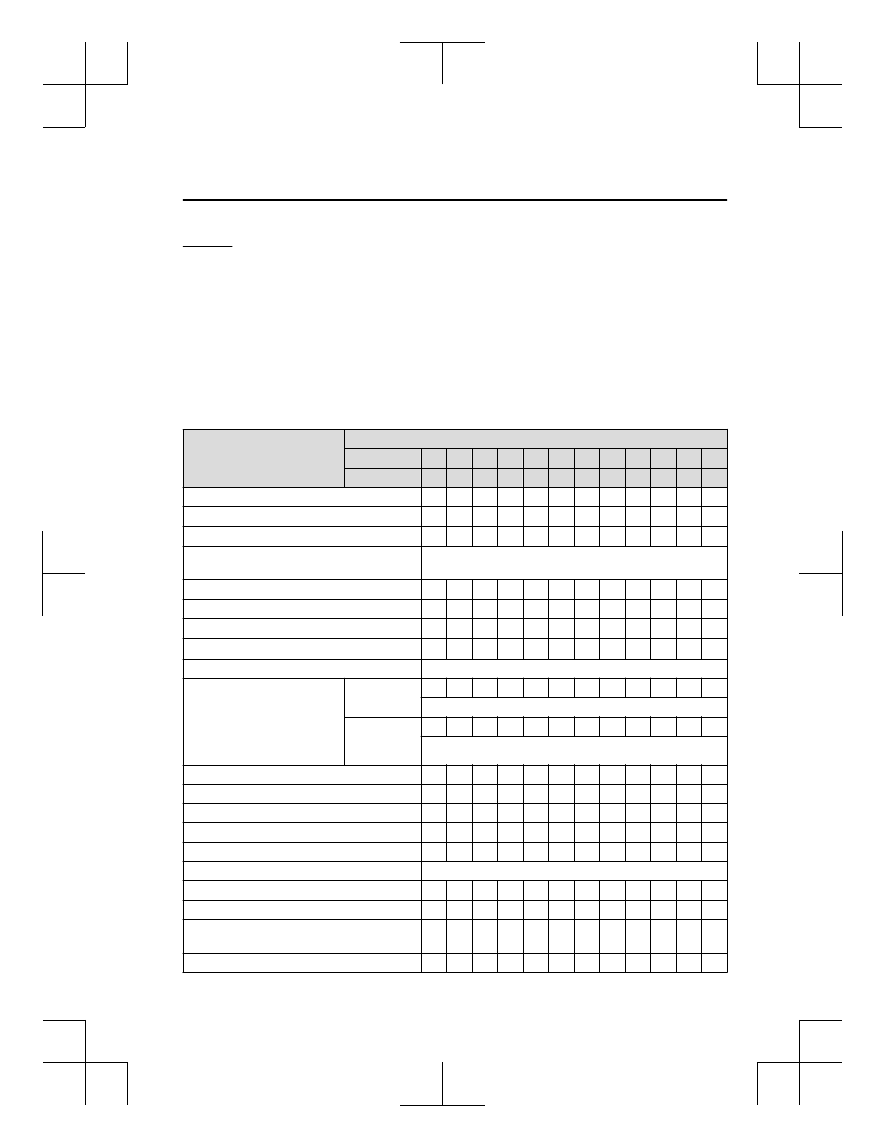
Maintenance Interval

Number of months or kilometers, whichever comes first

Months

39

42

45

48

51

54

57

60

63

66

69

72

×1000 km

65

70

75

80

85

90

95 100 105 110 115 120

Drive belts

I

I

Engine oil & filter

*1

R

R

R

R

R

R

R

R

R

R

R

R

Cooling system

I

I

Engine coolant

*2

Replace at first 200,000 km or 10 years; after that, every

100,000 km or 5 years

Engine coolant level

I

I

I

I

I

I

I

I

I

I

I

I

Air filter

C

R

C

R

C

R

Fuel lines and hoses

I

*3

I

Hoses and tubes for emission

I

*3

I

Fuel filter

Replace every 60,000 km

Spark plugs

SKYACTIV-G
2.5T

I

I

I

I

I

I

Replace every 64,000 km

Except SKY‐
ACTIV-G
2.5T

I

I

I

I

I

I

Replace every 120,000 km

Function of all lights

I

I

I

I

I

I

I

I

I

I

I

I

Brake lines, hoses and connections

I

I

I

Brake and clutch fluid level

I

I

I

I

Brake fluid

R

R

Disc brakes

I

I

I

I

I

I

Tire (Rotation)

Rotate every 10,000 km

Tire inflation pressure and tire wear

I

I

I

I

I

I

Steering operation and linkages

I

I

I

I

I

I

Front and rear suspension, ball joints and wheel
bearing axial play

I

I

I

Driveshaft dust boots

I

I

I

Maintenance and Care

Scheduled Maintenance

6-13

CX-5_8MC3-EA-23G_Edition1_old

2023-5-8 11:05:50

Maintenance Interval

Number of months or kilometers, whichever comes first

Months

39

42

45

48

51

54

57

60

63

66

69

72

×1000 km

65

70

75

80

85

90

95 100 105 110 115 120

Bolts and nuts on chassis and body

T

T

T

Exhaust system and heat shields

I

I

I

All locks and hinges

L

L

L

L

L

L

Washer fluid level

I

I

I

I

I

I

Emergency flat tire repair kit (if equipped)

*4

Inspect annually.

Cabin air filter

R

R

R

Chart symbols:

I:

 Inspect: Inspect and clean, repair, adjust, fill up, or replace if necessary.

R:

 Replace

L:

 Lubricate

C:

 Clean

T:

 Tighten

D:

 Drain

Remarks:

*

1 Reset the engine oil data whenever replacing the engine oil regardless of the message/wrench indicator light

display.

*

2 Use of FL-22 is recommended when replacing engine coolant. Using engine coolant other than FL-22 may

cause serious damage to the engine and cooling system.

*

3 According to state/provincial and federal regulations, failure to perform maintenance on these items will not

void your emissions warranties. However, Mazda recommends that all maintenance services be performed at
the recommended time or kilometer period to ensure long-term reliability.

*

4 Check the tire repair fluid expiration date every year when performing the periodic maintenance. Replace the

tire repair fluid bottle with new one before the expiration date.

Maintenance and Care

Scheduled Maintenance

6-14

CX-5_8MC3-EA-23G_Edition1_old

2023-5-8 11:05:50

Owner Maintenance Precautions

The owner or a qualified service technician should make these vehicle inspections at the
indicated intervals to ensure safe and dependable operation.
 
Bring any problem to the attention of an Authorized Mazda Dealer or qualified service
technician as soon as possible.

When Refueling

Brake fluid level (page 6-24)

Engine coolant level (page 6-22)

Engine oil level (page 6-21)

Washer fluid level (page 6-24)

At Least Monthly

Tire inflation pressures (page 6-35)

At Least Twice a Year (For Example, Every Spring and Fall)

You can do the following scheduled maintenance items if you have some mechanical ability
and a few basic tools and if you closely follow the directions in this manual.

Engine coolant (page 6-22)

Engine oil (page 6-20)

 
Improper or incomplete service may result in problems. This section gives instructions only
for items that are easy to perform.
 
As explained in the Introduction (page 6-2), several procedures can be done only by a
qualified service technician with special tools.
 
Improper owner maintenance during the warranty period may affect warranty coverage.
Refer to Introduction (page 6-2) for owner's responsibility in protecting your investment.
For details, read the separate Mazda Warranty statement provided with the vehicle. If you
are unsure about any servicing or maintenance procedure, have it done by an Authorized
Mazda Dealer.
 
There are strict environmental laws regarding the disposal of waste oil and fluids. Please
dispose of your waste properly and with due regard to the environment.
 
We recommend that you entrust the oil and fluid changes of your vehicle to an Authorized
Mazda Dealer.

Maintenance and Care

Owner Maintenance

6-15

CX-5_8MC3-EA-23G_Edition1_old

2023-5-8 11:05:50

WARNING

Do not perform maintenance work if you lack sufficient knowledge and experience or the
proper tools and equipment to do the work. Have maintenance work done by a qualified
technician:

Performing maintenance work on a vehicle is dangerous if not done properly. You can be
seriously injured while performing some maintenance procedures.

If you must run the engine while working under the hood, make certain that you remove all
jewelry (especially rings, bracelets, watches, and necklaces) and all neckties, scarves, and
similar loose clothing before getting near the engine or cooling fan which may turn on
unexpectedly:

Working under the hood with the engine running is dangerous. It becomes even more
dangerous when you wear jewelry, loose clothing or have long hair or a long beard.
Either can become entangled in moving parts and result in injury.

Pull over to a safe location, then switch the ignition off and make sure the fan is not

running before attempting to work near the cooling fan:

Working near the cooling fan when it is running is dangerous. The fan could continue running
indefinitely even if the engine has stopped and the engine compartment temperature is high.
You could be hit by the fan and seriously injured.

Do not leave items in the engine compartment:

After you have finished checking or doing servicing in the engine compartment, do not forget
and leave items such as tools or rags in the engine compartment.
Tools or other items left in the engine compartment could cause engine damage or a fire
leading to an unexpected accident.

Maintenance and Care

Owner Maintenance

6-16

CX-5_8MC3-EA-23G_Edition1_old

2023-5-8 11:05:50

Hood

WARNING

Always check that the hood is closed and
securely locked:

A hood that is not closed and securely
locked is dangerous as it could fly open
while the vehicle is moving and block the
driver's vision which could result in a
serious accident.

Opening the Hood

1. With the vehicle parked, pull the

release handle to unlock the hood.
 

Release handle

2. Insert your hand into the hood

opening, slide the latch lever to the
right, and lift up the hood.
 

Lever

3. Grasp the support rod in the padded

area and secure it in the support rod
hole indicated by the arrow to hold the
hood open.
 

Pad

Support rod

Maintenance and Care

Owner Maintenance

6-17

CX-5_8MC3-EA-23G_Edition1_old

2023-5-8 11:05:50

Closing the Hood

1. Check under the hood area to make

certain all filler caps are in place and
all loose items (e.g. tools, oil
containers, etc.) have been removed.

2. Lift the hood, grasp the padded area on

the support rod, and secure the support
rod in the clip. Verify that the support
rod is secured in the clip before closing
the hood.
 

Clip

Clip

Clip

3. Lower the hood slowly to a height of

about 20 cm (7.9 in) above its closed
position and then let it drop.

CAUTION

When closing the hood, do not push it
excessively such as by applying your
weight. Otherwise, the hood could be
deformed.

Maintenance and Care

Owner Maintenance

6-18

CX-5_8MC3-EA-23G_Edition1_old

2023-5-8 11:05:50

Engine Compartment Overview

Windshield washer fluid reservoir

Engine oil-filler cap

Brake fluid reservoir

Engine oil-dipstick

Battery

Fuse block

Cooling system cap

Engine coolant reservoir

SKYACTIV-G 2.5

Windshield washer fluid reservoir

Engine oil-filler cap

Engine oil dipstick

Battery

Fuse block

Cooling system cap

Engine coolant reservoir

SKYACTIV-G 2.5T

Brake fluid reservoir

Maintenance and Care

Owner Maintenance

6-19

CX-5_8MC3-EA-23G_Edition1_old

2023-5-8 11:05:50

Engine Oil

NOTE

Changing the engine oil should be
performed by an Authorized Mazda
Dealer.
Refer to Introduction (page 6-2) 
for
owner's responsibility in protecting your
investment.

Recommended Oil

U.S.A., Canada

SKYACTIV-G 2.5

Use SAE 0W-20 engine oil.

Mazda Genuine Oil is used in your Mazda
vehicle. Mazda Genuine 0W-20 Oil is
required to achieve optimum fuel
economy.
 
For maintenance service, Mazda
recommends Genuine Mazda Parts and
Genuine Mazda Premium Oil.
 

(ILSAC)

Only use SAE 0W-20 oil “Certified For
Gasoline Engines” by the American
Petroleum Institute (API).
Oil with this trademark symbol conforms
to the current engine and emission system
protection standards and fuel economy

requirements of the International
Lubricant Standardization and Approval
Committee (ILSAC), comprised of U.S.
and Japanese automobile manufacturers.
 

80

60

40

20

0

–40 –20

30

100

40

20

10

0

–10

–20

–30

–40

SKYACTIV-G 2.5T

Use SAE 5W-30 engine oil.

Mazda Genuine Oil is used in your Mazda
vehicle. Mazda Genuine 5W-30 Oil is
required to achieve optimum fuel
economy.
 
For maintenance service, Mazda
recommends Genuine Mazda Parts and
Genuine Mazda Premium Oil.
 

(ILSAC)

Only use SAE 5W-30 oil “Certified For
Gasoline Engines” by the American
Petroleum Institute (API).
Oil with this trademark symbol conforms
to the current engine and emission system
protection standards and fuel economy

Maintenance and Care

Owner Maintenance

6-20

CX-5_8MC3-EA-23G_Edition1_old

2023-5-8 11:05:50

requirements of the International
Lubricant Standardization and Approval
Committee (ILSAC), comprised of U.S.
and Japanese automobile manufacturers.
 

80

60

40

20

0

–40 –20

30

100

40

20

10

0

–10

–20

–30

–40

Except U.S.A., Canada

SKYACTIV-G 2.5

Use SAE 5W-30 engine oil.

Oil container labels provide important
information.
A chief contribution this type of oil makes
to fuel economy is reducing the amount of
fuel necessary to overcome engine
friction.
 
For maintenance service, Mazda
recommends Mazda Genuine Parts.
 

(ILSAC)

(Mexico)

80

60

40

20

0

–40 –20

30

100

40

20

10

0

–10

–20

–30

–40

SKYACTIV-G 2.5

Use API SM or higher, SAE 5W-30
engine oil. If SAE 5W-30 engine oil is not
available, use SAE 5W-20, SAE 0W-30 or
SAE 10W-30 engine oil.
 
The quality designation SM, SN or SP
must be on the label.
 

SKYACTIV-G 2.5T

Use API SM or higher, SAE 5W-30
engine oil. If SAE 5W-30 engine oil is not
available, use SAE 0W-30 or SAE
10W-30 engine oil.
 
The quality designation SM, SN or SP
must be on the label.
 

Inspecting Engine Oil Level

1. Be sure the vehicle is on a level

surface.

2. Warm up the engine to normal

operating temperature.

3. Turn it off and wait at least 5 minutes

for the oil to return to the oil pan.

Maintenance and Care

Owner Maintenance

6-21

CX-5_8MC3-EA-23G_Edition1_old

2023-5-8 11:05:50

4. Pull out the dipstick, wipe it clean, and

reinsert it fully.
 

MAX

OK

MIN

5. Pull it out again and examine the level.

The level is normal if it is between the
MIN and MAX marks.
If it is near or below MIN, add enough
oil to bring the level to MAX.

CAUTION

Do not overfill the engine oil. This may
cause engine damage.

6. Make sure the O-ring on the dipstick is

positioned properly before reinserting
the dipstick.

7. Reinsert the dipstick fully.
 

Engine Coolant

Inspecting Coolant Level

WARNING

Do not use a match or live flame in the
engine compartment. DO NOT ADD
COOLANT WHEN THE ENGINE IS HOT:

A hot engine is dangerous. If the engine has
been running, parts of the engine
compartment can become very hot. You
could be burned. Carefully inspect the
engine coolant in the coolant reservoir, but
do not open it.

Do not touch rotating parts such as the

fan belt when inspecting inside the engine
compartment:

Working near the cooling fan when it is
running is dangerous. The fan could
continue running indefinitely even if the
engine has stopped and the engine
compartment temperature is high. You
could be hit by the fan and seriously
injured.

 Do not remove either cooling

system cap when the engine and radiator
are hot:

When the engine and radiator are hot,
scalding coolant and steam may shoot out
under pressure and cause serious injury.

NOTE

Changing the coolant should be done by
an Authorized Mazda Dealer.

Maintenance and Care

Owner Maintenance

6-22

CX-5_8MC3-EA-23G_Edition1_old

2023-5-8 11:05:50

Inspect the antifreeze protection and
coolant level in the coolant reservoir at
least once a year―at the beginning of the
winter season―and before traveling where
temperatures may drop below freezing.
 
Inspect the condition and connections of
all cooling system and heater hoses.
Replace any that are swollen or
deteriorated.
 
The coolant should be at full in the
radiator and between the F and L marks on
the coolant reservoir when the engine is
cool.

SKYACTIV-G 2.5


SKYACTIV-G 2.5T


If it is at or near L, add enough coolant to
the coolant reservoir to provide freezing
and corrosion protection and to bring the
level to F.
Securely tighten the coolant reservoir tank
cap after adding coolant.

CAUTION

Radiator coolant will damage paint.
Rinse it off quickly if spilled.

If the “FL22” mark is shown on or near
the cooling system cap, use of FL-22 is
recommended when replacing engine
coolant. Using engine coolant other than
FL-22 may cause serious damage to the
engine and cooling system.


If the coolant reservoir is empty or new
coolant is required frequently, consult an
Authorized Mazda Dealer.

Maintenance and Care

Owner Maintenance

6-23

CX-5_8MC3-EA-23G_Edition1_old

2023-5-8 11:05:50

Brake Fluid

Inspecting Brake Fluid Level

WARNING

If the brake fluid level is low, have the
brakes inspected:

A low brake fluid level is dangerous.
A low level could indicate brake lining wear
or a brake system leak which could cause
the brakes to fail and lead to an accident.

Inspect the fluid level in the reservoir
regularly. It should be kept between the
MAX and MIN lines.
The level normally drops with
accumulated distance, a condition
associated with wear of brake linings. If it
is excessively low, have the brake system
inspected by an Authorized Mazda Dealer.

Washer Fluid

Inspecting Washer Fluid Level

WARNING

Use only windshield washer fluid or plain
water in the reservoir:

Using radiator antifreeze as washer fluid is
dangerous. If sprayed on the windshield, it
will dirty the windshield, affect your
visibility, and could result in an accident.

Using Washer Fluid Without Anti-freeze
Protection in Cold Weather:

Operating your vehicle in temperatures
below 4 °C (40 °F) using washer fluid
without anti-freeze protection is dangerous
as it could cause impaired windshield
vision and result in an accident. In cold
weather, always use washer fluid with
anti-freeze protection.

NOTE

State or local regulations may restrict the
use of volatile organic compounds
(VOCs), which are commonly used as
anti-freeze agents in washer fluid. A
washer fluid with limited VOC content
should be used only if it provides adequate
freeze resistance for all regions and
climates in which the vehicle will be
operated.

Add washer fluid under any of the
following conditions.

The top of the fluid level is low.

The Low Washer Fluid Level Warning
Indication/Warning Light (if equipped)
turns on.

Maintenance and Care

Owner Maintenance

6-24

CX-5_8MC3-EA-23G_Edition1_old

2023-5-8 11:05:50

The top of the fluid level is lower than L
(if equipped).

L

F

 
Use plain water if washer fluid is
unavailable.
But use only washer fluid in cold weather
to prevent it from freezing.

NOTE

Front and rear washer fluid is supplied
from the same reservoir.

Body Lubrication

All moving points of the body, such as
door and hood hinges and locks, should be
lubricated each time the engine oil is
changed. Use a nonfreezing lubricant on
locks during cold weather.
 
Make sure the hood's secondary latch
keeps the hood from opening when the
primary latch is released.

Maintenance and Care

Owner Maintenance

6-25

CX-5_8MC3-EA-23G_Edition1_old

2023-5-8 11:05:50

Wiper Blades

CAUTION

Hot waxes applied by automatic car
washers have been known to affect the
wiper's ability to clean windows.

To prevent damage to the wiper blades,
do not use gasoline, kerosene, paint
thinner, or other solvents on or near
them.

When the wiper lever is in the AUTO
position and the ignition is switched ON,
the wipers may move automatically in
the following cases:

If the windshield above the rain sensor
is touched.

If the windshield above the rain sensor
is wiped with a cloth.

If the windshield is struck with a hand
or other object.

If the rain sensor is struck with a hand
or other object from inside the vehicle.

Be careful not to pinch hands or fingers
as it may cause injury, or damage the
wipers. When washing or servicing the
vehicle, make sure the wiper lever is in
the OFF position.

Contamination of either the windshield or
the blades with foreign matter can reduce
wiper effectiveness. Common sources are
insects, tree sap, and hot wax treatments
used by some commercial car washes.
 
If the blades are not wiping properly, clean
the window and blades with a good
cleaner or mild detergent; then rinse
thoroughly with clean water. Repeat if
necessary.

Replacing Windshield Wiper Blades

When the wipers no longer clean well, the
blades are probably worn or cracked.
Replace them.

CAUTION

To prevent damage to the wiper arms
and other components, do not try to
sweep the wiper arm by hand.

Do not bend the blade rubber
unnecessarily when replacing it.
Otherwise, the metal stiffener in the
blade may deform and the windshield
wiper operation may be adversely
affected.

NOTE

When raising both windshield wiper arms,
raise the driver's side wiper arm first.
When lowering the wiper arms, slowly
lower the wiper arm from the passenger's
side first while supporting it with your
hand. Forcefully lowering the wiper arms
could damage the wiper arm and blade,
and may scratch or crack the windshield.

Replace the wiper blades using the
following procedure.
1. Raise the wiper arm.

CAUTION

To prevent damage to the windshield
let the wiper arm down easily, do not
let it slap down on the windshield.

Maintenance and Care

Owner Maintenance

6-26

CX-5_8MC3-EA-23G_Edition1_old

2023-5-8 11:05:50

2. Slide the blade component in the

direction of the arrow while pressing
the wiper arm tab to remove the blade
component from the wiper arm.
 

3. Pull the blade rubber in the direction of

the arrow and slide it to a position
where the blade holder groove can be
checked.
 

Groove

4. Pull the end of the blade rubber from

the blade holder groove in the direction
of the arrow and remove the blade
rubber from the blade holder.
 

Groove

Maintenance and Care

Owner Maintenance

6-27

CX-5_8MC3-EA-23G_Edition1_old

2023-5-8 11:05:50

5. Insert the end of the new blade rubber

into the groove of the blade holder
until it contacts the end of the blade
holder.
 

Groove

6. After pulling the blade rubber in the

direction of the arrow and sliding the
blade rubber to a position to check the
blade holder groove, slide the blade
rubber end in the opposite direction.
 

Groove

7. Make sure that the blade rubber is

correctly installed to the blade holder.

8. Align the wiper arm tabs with the

blade component grooves.
 

Tabs

Grooves

Maintenance and Care

Owner Maintenance

6-28

CX-5_8MC3-EA-23G_Edition1_old

2023-5-8 11:05:50

9. Align the blade component projection

with the wiper arm notch.
 

Notch

Projection

10. Slide the blade component and install

it to the wiper arm.
 

11. Slowly lower the wiper arm onto the

windshield.

Replacing Rear Window Wiper
Blade

When the wiper no longer cleans well, the
blade is probably worn or cracked.
Replace it.

CAUTION

To prevent damage to the wiper arm and
other components, do not move the wiper
by hand.

1. Remove the cover and raise the wiper

arm.

2. Firmly rotate the wiper blade to the

right until it unlocks, then remove the
blade.

Maintenance and Care

Owner Maintenance

6-29

CX-5_8MC3-EA-23G_Edition1_old

2023-5-8 11:05:50

CAUTION

To prevent damage to the rear window,
do not let the wiper arm fall on it.

3. Pull down the blade rubber and slide it

out of the blade holder.

4. Remove the metal stiffeners from the

blade rubber and install them in the
new blade.

CAUTION

Do not bend or discard the stiffeners.
You need to use them again.

5. Carefully insert the new blade rubber.

Then install the blade assembly in the
reverse order of removal.

Maintenance and Care

Owner Maintenance

6-30

CX-5_8MC3-EA-23G_Edition1_old

2023-5-8 11:05:50

Battery

WARNING

Wash hands after handling the battery and related accessories:

Battery posts, terminals and related accessories contain lead and lead compounds, chemicals
known to the State of California to cause cancer and reproductive harm.

Read the following precautions carefully before using the battery or inspecting to

ensure safe and correct handling:

Always wear eye protection when working near the battery:

Working without eye protection is dangerous. Battery fluid contains SULFURIC ACID which
could cause blindness if splashed into your eyes. Also, hydrogen gas produced during normal
battery operation, could ignite and cause the battery to explode.

Wear eye protection and protective gloves to prevent contact with battery fluid:

Spilled battery fluid is dangerous.
Battery fluid contains SULFURIC ACID which could cause serious injuries if it gets in eyes, or on
the skin or clothing. If this happens, immediately flush your eyes with water for 15 minutes or
wash your skin thoroughly and get medical attention.

Always keep batteries out of the reach of children:

Allowing children to play near batteries is dangerous. Battery fluid could cause serious injuries
if it gets in the eyes or on the skin.

Keep flames and sparks away from battery cells and do not allow metal tools to contact

the positive (+) or negative (-) terminal of the battery when working near a battery. Do not
allow the positive (+) terminal to contact the vehicle body:

Flames and sparks near battery cells are dangerous. Hydrogen gas, produced during normal battery
operation, could ignite and cause the battery to explode. An exploding battery can cause serious burns
and injuries. Keep all flames including cigarettes and sparks away from battery cells.

Maintenance and Care

Owner Maintenance

6-31

CX-5_8MC3-EA-23G_Edition1_old

2023-5-8 11:05:50

Keep all flames and sparks away from battery cells because hydrogen gas is produced

from battery cells while charging the battery or adding battery fluid:

Flames and sparks near battery cells are dangerous. Hydrogen gas, produced during normal
battery operation, could ignite and cause the battery to explode. An exploding battery can
cause serious burns and injuries. Keep all flames including cigarettes and sparks away from
battery cells.

NOTE

Before performing battery maintenance, remove the battery cover.
 

Battery Maintenance

To get the best service from a battery:

Keep it securely mounted.

Keep the top clean and dry.

Keep terminals and connections clean,
tight, and coated with petroleum jelly or
terminal grease.

Rinse off spilled electrolyte immediately
with a solution of water and baking
soda.

If the vehicle will not be used for an
extended time, disconnect the battery
cables and charge the battery every 6
weeks.

Battery Replacement

Contact an Authorized Mazda Dealer for
battery replacement.

Maintenance and Care

Owner Maintenance

6-32

CX-5_8MC3-EA-23G_Edition1_old

2023-5-8 11:05:50

Key Battery Replacement

If the buttons on the transmitter are
inoperable and the operation indicator
light does not flash, the battery may be
dead.
Replace with a new battery before the
transmitter becomes unusable.

CAUTION

Make sure the battery is installed
correctly. Battery leakage could occur if it
is not installed correctly.

When replacing the battery, be careful
not to touch any of the internal circuitry
and electrical terminals, bend the
electrical terminals, or get dirt in the
transmitter as the transmitter could be
damaged.

There is the danger of explosion if the
battery is not correctly replaced.

Dispose of used batteries according to
the following instructions.

Insulate the plus and minus terminals
of the battery using cellophane or
equivalent tape.

Never disassemble.

Never throw the battery into fire or
water.

Never deform or crush.

Replace only with the same type battery
(CR2032 or equivalent).

The following conditions indicate that the
battery power is low:

The KEY indicator light (green) flashes
in the instrument cluster for about 30
seconds after the engine is switched
OFF (for vehicles with a type A/type B
instrument cluster (page 4-18, 4-36),

messages are displayed in the instrument
cluster).

The system does not operate and the
operation indicator light on the
transmitter does not flash when the
buttons are pressed.

The system's operational range is
reduced.

Replacing the battery at an Authorized
Mazda Dealer, is recommended to prevent
damage to the key. If replacing the battery
by yourself, follow the instruction.

Replacing the key battery

1. Remove the lower cover while sliding

the knob in the direction of the arrow.

2. Press in the tab to unlock the upper

cover.

Maintenance and Care

Owner Maintenance

6-33

CX-5_8MC3-EA-23G_Edition1_old

2023-5-8 11:05:50

3. Insert a tape-wrapped flathead

screwdriver into the gap and slide it in
the direction of the arrow.

4. Twist the flathead screwdriver in the

direction of the arrow and remove the
upper cover.

5. Remove the cap using the

tape-wrapped flathead screwdriver.

6. Remove the battery using

tape-wrapped flathead screwdriver.

7. Insert a new battery into the transmitter

so that the positive pole is facing up.

8. Install the cap.

9. Install the upper cover.

10. Insert the tabs of the lower cover into

the slots of the transmitter and install
the lower cover.

Maintenance and Care

Owner Maintenance

6-34

CX-5_8MC3-EA-23G_Edition1_old

2023-5-8 11:05:50

Tires

For reasons of proper performance, safety,
and better fuel economy, always maintain
recommended tire inflation pressures and
stay within the recommended load limits
and weight distribution.

WARNING

Never use different tire types:

Driving your vehicle with different types of
tires is dangerous. It could cause poor
handling and poor braking; leading to loss
of control.
Except for the limited use of the temporary
spare tire, use only the same type tires
(radial, bias-belted, bias-type) on all four
wheels.

Never use wrong-sized tires:

Using any other tire size than what is
specified for the vehicle (page 9-12) is
dangerous. It could seriously affect ride,
handling, ground clearance, tire clearance,
and speedometer calibration. This could
cause you to have an accident. Use only
tires that are the correct size specified for
the vehicle.

Tire Inflation Pressure

WARNING

Always inflate the tires to the correct
pressure:

Overinflation or underinflation of tires is
dangerous. Adverse handling or
unexpected tire failure could result in a
serious accident.
Refer to Tires on page 9-12.

Use only a Mazda-genuine tire valve cap:

Use of a non-genuine part is dangerous as
the correct tire air pressure cannot be
maintained if the tire valve becomes
damaged. If the vehicle is driven under this
condition, the tire air pressure will decrease
which could result in a serious accident. Do
not use any part for the tire valve cap that
is not a Mazda-genuine part.

Inspect all tire pressures monthly
(including the spare) when the tires are
cold. Maintain recommended pressures for
the best ride, handling, and minimum tire
wear.
Refer to the specification charts (page
9-12).

NOTE

Cold inflation pressure

The cold inflation pressure is the
pressure measured under ambient
temperatures before the vehicle is
driven.

Maximum inflation pressure

The maximum inflation pressure is the
upper limit of the cold inflation pressure
designated by the tire manufacturer.

Recommended inflation pressure

The recommended inflation pressure is
the cold inflation pressure necessary for
maintaining the performance of your
Mazda.

Always check tire pressure when tires
are cold.

Warm tires normally exceed
recommended pressures. Do not release
air from warm tires to adjust the
pressure.

Maintenance and Care

Owner Maintenance

6-35

CX-5_8MC3-EA-23G_Edition1_old

2023-5-8 11:05:50

Underinflation can cause reduced fuel
economy, uneven and accelerated tire
wear, and poor sealing of the tire bead,
which will deform the wheel and cause
separation of tire from rim.

Overinflation can produce a harsh ride,
uneven and accelerated tire wear, and a
greater possibility of damage from road
hazards.
Keep your tire pressure at the correct
levels. If one frequently needs inflating,
have it inspected.

Tire Rotation

WARNING

Rotate tires periodically:

Irregular tire wear is dangerous. To
equalize tread wear for maintaining good
performance in handling and braking,
rotate the tires every 12,000 km (7,500
miles). However Mazda recommends to
rotate every 8,000 km (5,000 miles) to help
increase tire life and distribute wear more
evenly.

Refer to Scheduled Maintenance on page
6-4.
 

During rotation, inspect them for correct
balance.
 

Do not include (TEMPORARY USE 
ONLY) spare tire in rotation.

Forward

Also, inspect them for uneven wear and
damage. Abnormal wear is usually caused
by one or a combination of the following:
 

Incorrect tire pressure

Improper wheel alignment

Out-of-balance wheel

Severe braking

 
After rotation, inflate all tire pressures to
specification (page 9-12) and inspect the
lug nuts for tightness.

CAUTION

Rotate unidirectional tires and radial tires
that have an asymmetrical tread pattern or
studs only from front to rear, not from side
to side. Tire performance will be reduced if
rotated from side to side.

Maintenance and Care

Owner Maintenance

6-36

CX-5_8MC3-EA-23G_Edition1_old

2023-5-8 11:05:50

Replacing a Tire

WARNING

Always use tires that are in good condition:

Driving with worn tires is dangerous.
Reduced braking, steering, and traction
could result in an accident.

Replace all four tires at the same time:

Replacing just one tire is dangerous. It
could cause poor handling and poor
braking resulting in loss of vehicle control.
Mazda strongly recommends that you
replace all four tires at the same time.

If a tire wears evenly, a wear indicator will
appear as a solid band across the tread.
Replace the tire when this happens.

New tread

Tread wear 
indicator

Worn tread

You should replace the tire before the band
crosses the entire tread.

NOTE

Tires degrade over time, even when they
are not being used on the road. It is
recommended that tires generally be
replaced when they are 6 years or older.
Heat caused by hot climates or frequent
high loading conditions can accelerate the
aging process. You should replace the
spare tire when you replace the other road
tires due to the aging of the spare tire. The
period in which the tire was manufactured
(both week and year) is indicated by a
4-digit number.
Refer to Tire Labeling on page 8-25.

Temporary Spare Tire

Inspect the temporary spare tire at least
monthly to make sure it is properly
inflated and stored.

NOTE

The temporary spare tire condition
gradually deteriorates even if it has not
been used.

The temporary spare tire is easier to
handle because of its construction which is
lighter and smaller than a conventional
tire. This tire should be used only for an
emergency and only for a short distance.
 
Use the temporary spare tire only until the
conventional tire is repaired, which should
be as soon as possible.
Refer to Tires on page 9-12.
 

CAUTION

Do not use your temporary spare tire rim
with a snow tire or a conventional tire.
Neither will properly fit and could
damage both tire and rim.

Maintenance and Care

Owner Maintenance

6-37

CX-5_8MC3-EA-23G_Edition1_old

2023-5-8 11:05:50

The temporary spare tire has a tread life
of less than 5,000 km (3,000 miles). The
tread life may be shorter depending on
driving conditions.

The temporary spare tire is for limited
use, however, if the tread wear
solid-band indicator appears, replace the
tire with the same type of temporary
spare (page 6-37).

NOTE

Tires degrade over time, even when they
are not being used on the road. It is
recommended that tires generally be
replaced when they are 6 years or older.
Heat caused by hot climates or frequent
high loading conditions can accelerate the
aging process. You should replace the
spare tire when you replace the other road
tires due to the aging of the spare tire. The
period in which the tire was manufactured
(both week and year) is indicated by a
4-digit number.
Refer to Tire Labeling on page 8-25.

Replacing a Wheel

WARNING

Always use wheels of the correct size on
your vehicle:

Using a wrong-sized wheel is dangerous.
Braking and handling could be affected,
leading to loss of control and an accident.

CAUTION

A wrong-sized wheel may adversely affect:

Tire fit

Wheel and bearing life

Ground clearance

Snow-chain clearance

Speedometer calibration

Headlight aim

Bumper height

Tire Pressure Monitoring System

NOTE

When replacing a wheel, make sure the
new one is the same as the original
factory wheel in diameter, rim width,
and offset (inset/outset).

For details, contact an Authorized
Mazda Dealer.

 
Proper tire balancing provides the best
riding comfort and helps reduce tread
wear. Out-of-balance tires can cause
vibration and uneven wear, such as
cupping and flat spots.

Maintenance and Care

Owner Maintenance

6-38

CX-5_8MC3-EA-23G_Edition1_old

2023-5-8 11:05:50

Light Bulbs

Headlights (High/Low beam) 
/Daytime running lights

Parking lights

Front turn signal lights
/Parking lights

Daytime running lights
/Parking lights

Front side-marker lights

Side turn signal lights

Overhead lights
/Front map lights

Ambient lights

Vanity mirror lights

High-mount brake light

Rear map lights

Luggage compartment 
light

License plate lights

Rear turn signal lights

Rear side-marker lights

Brake lights/Taillights

Taillights

Reverse lights

Some models.

CAUTION

When removing the lens or lamp unit using a flathead screwdriver, make sure that the
flathead screwdriver does not contact the interior terminal. If the flathead screwdriver
contacts the terminal, a short circuit may occur.

NOTE

To replace the bulb, contact an Authorized Mazda Dealer.

Maintenance and Care

Owner Maintenance

6-39

CX-5_8MC3-EA-23G_Edition1_old

2023-5-8 11:05:50

Use the protective cover and carton for the replacement bulb to dispose of the old bulb
promptly and out of the reach of children.

Replacing Exterior Light Bulbs

All the exterior light bulbs are LED type.
The LED bulb cannot be replaced as a
single unit because it is an integrated unit.
The LED bulb has to be replaced with the
unit. If a replacement is necessary, consult
an Authorized Mazda Dealer.

Replacing Interior Light Bulbs

The interior lights have either LEDs or
normal bulbs.

LED type

Overhead lights/Front map lights

Rear map lights

Vanity mirror lights

*

Luggage compartment light

Ambient lights

*

The LED bulb cannot be replaced as a
single unit because it is an integrated unit.
The LED bulb has to be replaced with the
unit. If a replacement is necessary, consult
an Authorized Mazda Dealer.

Bulb type

Overhead light/Front map lights, Rear
map lights, Vanity mirror lights

*

1. Wrap a flathead screwdriver with a

soft cloth to prevent damage to the
lens, and then remove the lens by
carefully prying on the edge of the lens
with a flathead screwdriver.

2. Disconnect the bulb by pulling it out.

Overhead light/Front map lights

Maintenance and Care

Owner Maintenance

6-40

*Some models.

CX-5_8MC3-EA-23G_Edition1_old

2023-5-8 11:05:50

Rear map lights

Vanity mirror lights

*

Driver’s seat

Passenger’s seat

3. Install the new bulb in the reverse

order of the removal procedure.

Luggage compartment light

1. Wrap a small flathead screwdriver with

a soft cloth to prevent damage to the
lens and remove the lens unit by
carefully prying on the edge of the lens
unit with the flathead screwdriver.

Maintenance and Care

Owner Maintenance

*Some models.

6-41

CX-5_8MC3-EA-23G_Edition1_old

2023-5-8 11:05:50

2. Disconnect the electrical connector

from the bulb by pressing the tab on
the connector with your finger and
pulling the connector.

CAUTION

When replacing the bulb always
disconnect the connector first.
Otherwise, electric and electronic
devices could be shorted.

3. Insert the flathead screwdriver into the

gap between the lens and the lens unit,
and then slide the screwdriver to
detach the lens.

4. Disconnect the bulb by pulling it out.

5. Install the new bulb in the reverse

order of the removal procedure.

Maintenance and Care

Owner Maintenance

6-42

CX-5_8MC3-EA-23G_Edition1_old

2023-5-8 11:05:50

Fuses

Your vehicle's electrical system is
protected by fuses.
 
If any lights, accessories, or controls do
not work, inspect the appropriate circuit
protector. If a fuse has blown, the inside
element will be melted.
 
If the same fuse blows again, avoid using
that system and consult an Authorized
Mazda Dealer as soon as possible.

Fuse Replacement

Replacing the fuses on the vehicle's left
side

If the electrical system does not work, first
inspect the fuses on the vehicle's left side.
 
1. Make sure the ignition is switched off,

and other switches are off.

2. Open the fuse panel cover.

3. Pull the fuse straight out with the fuse

puller provided on the fuse block
located in the engine compartment.

4. Inspect the fuse and replace it if it is

blown.

Normal

Blown

5. Insert a new fuse of the same

amperage rating, and make sure it fits
tightly. If it does not fit tightly, have an
expert install it. Consult an Authorized
Mazda Dealer.
If you have no spare fuses, borrow one
of the same rating from a circuit not
essential to vehicle operation, such as
the AUDIO or OUTLET circuit.

Maintenance and Care

Owner Maintenance

6-43

CX-5_8MC3-EA-23G_Edition1_old

2023-5-8 11:05:50

CAUTION

Always replace a fuse with a genuine
Mazda fuse or equivalent of the same
rating. Otherwise you may damage the
electric system.

6. Reinstall the cover and make sure that

it is securely installed.

Replacing the fuses under the hood

If the headlights or other electrical
components do not work and the fuses in
the cabin are normal, inspect the fuse
block under the hood.
If a fuse is blown, it must be replaced.
Follow these steps:
 
1. Make sure the ignition is switched off,

and other switches are off.

2. Remove the fuse block cover.

3. If any fuse but the MAIN fuse is

blown, replace it with a new one 

of the

same amperage rating

.

Normal

Blown

WARNING

Do not replace the main fuse by
yourself. Have an Authorized Mazda
Dealer perform the replacement:

Replacing the fuse by yourself is
dangerous because the MAIN fuse is a
high current fuse. Incorrect
replacement could cause an electrical
shock or a short circuit resulting in a
fire.

4. Reinstall the cover and make sure that

it is securely installed.

Maintenance and Care

Owner Maintenance

6-44

CX-5_8MC3-EA-23G_Edition1_old

2023-5-8 11:05:50


Content      ..     14      15      16      17     ..