Hyundai Tucson Plug-in Hybrid (2024 year). Manual in english - page 17
 

  Index      Manuals     Hyundai Tucson Plug-in Hybrid (2024 year). Manual in english


Search            copyright infringement  


Content      ..     15      16      17      18     ..


Hyundai Tucson Plug-in Hybrid (2024 year). Manual in english - page 17


Driver Assistance System

7-82

ONX4OB073097N

ONX4OB073141N

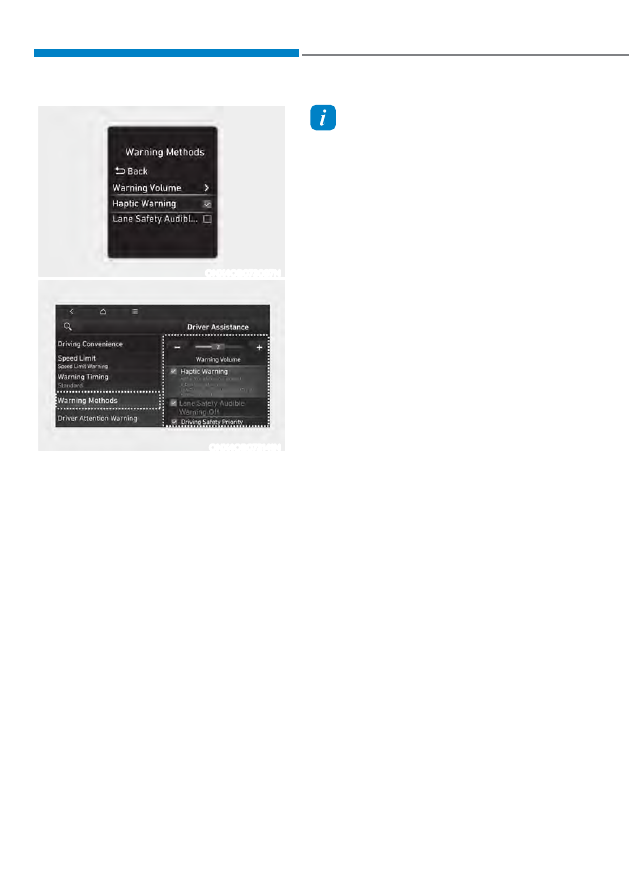
Warning Methods

The Warning Methods can be set with 

WKHYHKLFOHRQ6HOHFWœ8VHU6HWWLQJVƟ
'ULYHU$VVLVWDQFHƟ:DUQLQJ0HWKRGVŔ

from the settings menu in the instrument 

FOXVWHURUœ6HWXSƟ9HKLFOHƟ'ULYHU
$VVLVWDQFHƟ:DUQLQJ0HWKRGVŔIURP

the settings menu in the infotainment 

system to change the following settings.

ś

Warning Volume

: Adjusts the volume 

of the warning sound. 
Even if you set the warning volume 

WRœ2IIŔRUœŔWKHZDUQLQJVRXQGZLOO
VRXQGDWWKHYROXPHVHWWRœ/RZŔRUœŔ

(if equipped)

ś

Haptic Warning

: Activate the steering 

wheel vibration warning. (if equipped)

ś

Driving Safety Priority

: Lowers all 

other audio volumes when the Driving 

Safety system sounds a warning. (for 

infotainment system type) 

 Information

ś

If you change the Warning Methods, it 
can be applied to each function of the 
driver assistance system. Please check 
and change it in each function.

ś

If the vehicle is restarted, Warning 
Methods will maintain the last setting.

ś

The setting menu may not exist based 
on vehicle specification.

ś

If you turn off the haptic warning when 
the warning volume is ‘Off’ or ‘0’, the 
warning volume  will turn on and will 
be set to ‘Medium’ or ‘2’.

ś

If you set the warning volume to ‘Off’ 
or ‘0’ when the haptic warning is off, 
the haptic warning will turn on.

07

7-83

Smart Cruise Control Operation

Operating conditions

Smart Cruise Control will operate when 

the following conditions are satisfied.

Basic function

ś

The gear is in D (Drive)

ś 7KHGULYHUŔVGRRULVFORVHG
ś

EPB (Electronic Parking Brake) is not 

applied

ś

Your vehicle speed is within the 

operating speed range


- 5~110 mph (10~180 km/h): when 

there is no vehicle in front 


- 0~110 mph (0~180 km/h): when 

there is a vehicle in front

ś

ESC (Electronic Stability Control) or 

ABS (Anti-Lock Braking System) is on

ś

ESC (Electronic Stability Control) or 

ABS (Anti-Lock Braking System) is not 

controlling the vehicle

ś

Engine RPM is not in the red zone

ś

Forward Collision-Avoidance Assist 

brake control is not operating

ś

Remote Smart Parking Assist brake 

control is not operating (if equipped)

 Information

When stopped behind another vehicle, the 
driver can turn on Smart Cruise Control 
while the brake pedal is depressed.


Overtake Assist Control 

Overtake Assist Control will operate 

when the turn signal indicator is turned 

on to the left (left-hand drive) or turned 

on to the right (right-hand drive) while 

Smart Cruise Control is operating, and 

the following conditions are satisfied:

ś

Your vehicle speed is above 40 mph 

(60 km/h)

ś

The hazard warning flasher is off

ś

A vehicle is detected in front of your 

vehicle

ś

Deceleration is not needed to 

maintain distance with the vehicle in 

front

 WARNING

ś

When the turn signal indicator is 

turned on to the left while there is 

a vehicle ahead, the vehicle may 

accelerate temporarily. Pay attention 

to the road conditions at all times.

ś

Regardless of your country’s driving 

direction, Overtake Assist Control 

will operate when the conditions are 

satisfied. When using the function 

in countries with different driving 

direction, always check the road 

conditions at all times.

Driver Assistance System

7-84

Display and Control

Basic function

You can see the status of the Smart 

Cruise Control operation in the Driving 

Assist mode on the cluster. Refer to “LCD 

Display Modes” section in chapter 4.
Smart Cruise Control will be displayed 

as below depending on the status of the 

function.

OTMH070022N

ś

When operating

(1)  Whether there is a vehicle ahead 

and the selected distance level are 

displayed.

(2)  Set speed is displayed.
(3)  Whether there is a vehicle ahead 

and the target vehicle distance are 

displayed.

OTM070155E

ś

When temporarily canceled

(1) 

 indicator is displayed.

(2)  The previous set speed is shaded.

 Information

ś

The distance of the front vehicle on the 
cluster is displayed according to the 
actual distance between your vehicle 
and the vehicle ahead.

ś

The target distance may vary according 
to the vehicle speed and the set 
distance level. If vehicle speed is low, 
even though the vehicle distance have 
changed, the change of the target 
vehicle distance may be small.

 Information

The images and colors in the instrument 
cluster may differ depending on the 
cluster type or theme selected from the 
instrument cluster.

07

7-85

To temporarily accelerate

OTMA070004

If you want to speed up temporarily 

without altering the set speed while 

Smart Cruise Control is operating, 

depress the accelerator pedal. While the 

accelerator pedal is depressed, the set 

speed, distance level and target distance 

will blink on the cluster. 
However, if the accelerator pedal is 

depressed insufficiently, the vehicle may 

decelerate.

 WARNING

Be careful when accelerating 

temporarily, because the speed and 

distance is not controlled automatically 

even if there is a vehicle in front of you.

Smart Cruise Control temporarily 

canceled

OTM070113N

Smart Cruise Control will be temporarily 

canceled automatically when:

ś

The vehicle speed is above 120 mph 

(190 km/h)

ś

The accelerator pedal is continuously 

depressed for a certain period of time

ś

The conditions for Smart Cruise 

Control to operate is not satisfied

If Smart Cruise Control is temporarily 

canceled automatically, the ‘Smart 

&UXLVH&RQWUROFDQFHOHGŔZDUQLQJ

message will appear on the cluster, and 

an audible warning will sound to warn 

the driver. 

If Smart Cruise Control is temporarily 

canceled while the vehicle is at a 

standstill with Smart Cruise Control, 

EPB (Electronic Parking Brake) maybe 

applied.

Driver Assistance System

7-86

 WARNING

When Smart Cruise Control is 

temporarily canceled, distance with the 

front vehicle will not be maintained. 

Always have your eyes on the road 

while driving, and if necessary, depress 

the brake pedal to reduce your driving 

speed in order to maintain a safe 

distance.

Smart Cruise Control conditions not 

satisfied

OTM070112N

If the Driving Assist button, + switch, 

- switch or 

 switch is pushed 

when Smart Cruise Control operating 

conditions are not satisfied, the ‘Smart 

&UXLVH&RQWUROFRQGLWLRQVQRWPHWŔZLOO

appear on the cluster, and an audible 

warning will sound. 

In traffic situation

OTM070114L

In traffic, your vehicle will stop if the 

vehicle ahead of you stops. Also, if the 

vehicle ahead of you starts moving, your 

vehicle will start as well. In addition, after 

the vehicle has stopped and a certain 

time have passed, the ‘Use switch or 

SHGDOWRDFFHOHUDWHŔPHVVDJHZLOODSSHDU

on the cluster. Depress the accelerator 

pedal or operate the + switch, - switch or 

 switch to start driving.

 WARNING

While the message is displayed on the 

cluster, if there is no vehicle in front or 

the vehicle is far away from you, and the 

+ switch, – switch or (Pause/Resume 

) switch is operated, Smart Cruise 

Control will automatically cancel and 

EPB will be applied. However, if the 

accelerator pedal is depressed, EPB 

(Electronic Parking Brake) will not be 

applied even though the function is 

canceled. Always pay attention to the 

road condition ahead.

07

7-87

Warning road conditions ahead

ONX4E070035

In the following situation, the ‘Watch for 

VXUURXQGLQJYHKLFOHVŔZDUQLQJPHVVDJH

will appear on the cluster, and an audible 

warning will sound to warn the driver of 

road conditions ahead. 


- The vehicle in front disappears when 

Smart Cruise Control is maintaining 

the distance with the vehicle ahead 

while driving below a certain speed.


- While the ‘Use switch or pedal to 

DFFHOHUDWHŔPHVVDJHLVGLVSOD\HGRQ

the cluster, if there is no vehicle in 

front or the vehicle is far away from 

you, and the + switch, – switch or 


switch is pushed.

 WARNING

Always pay attention to vehicles or 

objects that may suddenly appear in 

front of you, and if necessary, depress 

the brake pedal to reduce your driving 

speed in order to maintain a safe 

distance. 

Collision Warning

ONX4072103N

While Smart Cruise Control is operating, 

when the collision risk with the vehicle 

DKHDGLVKLJKWKHœ&ROOLVLRQ:DUQLQJŔ

warning message will appear on the 

cluster, and an audible warning will 

sound to warn the driver. Always have 

your eyes on the road while driving, and 

if necessary, depress the brake pedal to 

reduce your driving speed in order to 

maintain a safe distance.

 WARNING

In the following situations, Smart Cruise 

Control may not warn the driver of a 

collision. 


-

The distance from the front vehicle 

is near, or the vehicle speed of the 

front vehicle is faster or similar to 

your vehicle 


-

The speed of the front vehicle is very 

slow or is at a standstill 


-

The accelerator pedal is depressed 

right after Smart Cruise Control is 

turned on

Driver Assistance System

7-88

 WARNING

Take the following precautions when 

using Smart Cruise Control:

ś

Smart Cruise Control does not 

substitute for proper and safe 

driving. It is the responsibility of the 

driver to always check the speed and 

distance to the vehicle ahead.

ś

Smart Cruise Control may not 

recognize unexpected and sudden 

situations or complex driving 

situations, so always pay attention to 

driving conditions and control your 

vehicle speed. 

ś

Keep Smart Cruise Control off when 

the function is not in use to avoid 

inadvertently setting a speed. 

ś

Do not open the door or leave the 

vehicle when Smart Cruise Control 

is operating, even if the vehicle is 

stopped.

ś

Always be aware of the selected 

speed and vehicle distance.

ś

Keep a safe distance according to 

road conditions and vehicle speed. 

If the vehicle distance is too close 

during high-speed driving, a serious 

collision may result.

ś

When maintaining distance with 

the vehicle ahead, if the front 

vehicle disappears, Smart Cruise 

Control may suddenly accelerate to 

the set speed. Always be aware of 

unexpected and sudden situations 

from occurring. 

ś

Vehicle speed may decrease on an 

upward slope and increase on a 

downward slope.

ś

Always be aware of situations such 

as when a vehicle cuts in suddenly.

ś

When you are towing a trailer or 

another vehicle, have Smart Cruise 

Control turned off due to safety 

reasons. 

ś

Turn off Smart Cruise Control when 

your vehicle is being towed.

ś

Smart Cruise Control may not 

operate normally if interfered by 

strong electromagnetic waves. 

ś

Smart Cruise Control may not 

detect an obstacle in front and lead 

to a collision. Always look ahead 

cautiously to prevent unexpected 

and sudden situations from 

occurring.

ś

Vehicles moving in front of you with 

a frequent lane change may cause 

a delay in Smart Cruise Control 

reaction or may cause Smart Cruise 

Control to react to a vehicle actually 

in an adjacent lane. Always drive 

cautiously to prevent unexpected 

and sudden situations from 

occurring.

ś

Always be aware of the surroundings 

and drive safely, even though a 

warning message does not appear or 

an audible warning does not sound. 

ś

If any other system’s warning 

message is displayed or warning 

sound is generated, Smart Cruise 

Control warning message may not 

be displayed and warning sound may 

not be generated.

ś

You may not hear the warning sound 

of Forward Collision-Avoidance 

Assist if the surroundings are noisy.

ś

The vehicle manufacturer is not 

responsible for any traffic violation 

or accidents caused by the driver. 

ś

Always set the vehicle speed to the 

speed limit in your area. 

07

7-89

 Information

ś

Smart Cruise Control may not operate 
for 15 seconds after the vehicle is 
started or the front view camera or 
front radar is initialized.

ś

You may hear a sound when the brake 
is controlled by Smart Cruise Control.

Smart Cruise Control 

Malfunction and Limitations

Smart Cruise Control malfunction

OTM070116N

When Smart Cruise Control is not working 

properly, the ‘Check Smart Cruise Control 

V\VWHPŔZDUQLQJPHVVDJHZLOODSSHDUDQG

the   warning light will illuminate on the 

cluster. Have the vehicle inspected by an 

authorized HYUNDAI dealer. 

Smart Cruise Control disabled

OTM070115N

When the front radar cover or sensor 

is covered with snow, rain, or foreign 

material, it can reduce the detecting 

performance and temporarily limit or 

disable Smart Cruise Control. 
If this occurs, the ‘Smart Cruise Control 

GLVDEOHG5DGDUEORFNHGŔZDUQLQJ

message will appear for a certain period 

of time on the cluster. 
Smart Cruise Control will operate 

normally when snow, rain or foreign 

material is removed. 

 WARNING

Even though the warning message does 

not appear on the cluster, Smart Cruise 

Control may not properly operate.

 CAUTION

Smart Cruise Control may not properly 

operate in an area (for example, open 

terrain), where there is nothing to 

detect after turning ON the engine.

Driver Assistance System

7-90

Limitations of Smart Cruise Control 

Smart Cruise Control may not operate 

normally, or it may operate unexpectedly 

under the following circumstances:

ś

The detecting sensor or the 

surroundings are contaminated or 

damaged

ś

Washer fluid is continuously sprayed, 

or the wiper is on

ś

The camera lens is contaminated due 

to tinted, filmed or coated windshield, 

damaged glass, or sticky foreign 

material (sticker, bug, etc.) on the 

glass

ś

Moisture is not removed or frozen on 

the windshield

ś

The field of view of the front view 

camera is obstructed by sun glare 

ś

Street light or light from an oncoming 

vehicle is reflected on the wet road 

surface, such as a puddle on the road

ś

The temperature around the front 

view camera is high or low 

ś

An object is placed on the dashboard

ś

The surrounding is very bright

ś

The surrounding is very dark, such as 

in a tunnel, etc.

ś

The brightness changes suddenly, for 

example when entering or exiting a 

tunnel

ś

The brightness outside is low, and the 

headlights are not on or are not bright 

ś

Driving in heavy rain or snow, or thick 

fog 

ś

Driving through steam, smoke or 

shadow

ś

Only part of the vehicle is detected

ś

The vehicle in front has no tail lights, 

tail lights are located unusually, etc.

ś

The brightness outside is low, and the 

tail lamps are not on or are not bright 

ś

The rear of the front vehicle is small 

or does not look normal (for example, 

tilted, overturned, etc.)

ś 7KHIURQWYHKLFOHŔVJURXQGFOHDUDQFHLV

low or high

ś

A vehicle suddenly cuts in front

ś

Your vehicle is being towed

ś

Driving through a tunnel or iron bridge

ś

Driving near areas containing metal 

substances, such as a construction 

zone, railroad, etc.

ś

A material is near that reflects very 

well on the front radar, such as a 

guardrail, nearby vehicle, etc.

ś

The bumper around the front radar is 

impacted, damaged or the front radar 

is out of position

ś

The temperature around the front 

radar is high or low

ś

Driving in large areas where there 

are few vehicles or structures (for 

example, desert, meadow, suburb, 

etc.)

ś

The vehicle in front is made of 

material that does not reflect on the 

front radar

ś

Driving near a highway (or motorway) 

interchange or tollgate

ś

Driving on a slippery surface due to 

snow, water puddle, ice, etc.

ś

Driving on a curved road

ś

The vehicle in front is detected late

ś

The vehicle in front is suddenly 

blocked by an obstacle

ś

The vehicle in front suddenly changes 

lane or suddenly reduces speed 

07

7-91

ś

The vehicle in front is bent out of 

shape 

ś 7KHIURQWYHKLFOHŔVVSHHGLVIDVWRU

slow 

ś

With a vehicle in front, your vehicle 

changes lane at low speed

ś

The vehicle in front is covered with 

snow 

ś

Unstable driving

ś

You are on a roundabout and the 

vehicle in front is not detected 

ś

You are continuously driving in a circle 

ś

Driving in a parking lot

ś

Driving through a construction area, 

unpaved road, partial paved road, 

uneven road, speed bumps, etc.

ś

Driving on an incline road, curved 

road, etc.

ś

Driving through a roadside with trees 

or streetlights

ś

The adverse road conditions cause 

excessive vehicle vibrations while 

driving 

ś

Your vehicle height is low or high 

due to heavy loads, abnormal tire 

pressure, etc. 

ś

Driving through a narrow road where 

trees or grass are overgrown 

ś

There is interference by 

electromagnetic waves, such as 

driving in an area with strong radio 

waves or electrical noise 

ś

Driving on a curved road

OADAS014 

On curves, Smart Cruise Control may 

not detect a vehicle in the same lane, 

and may accelerate to the set speed. 

Also, vehicle speed may rapidly 

decrease when the vehicle ahead is 

detected suddenly. 
Select the appropriate set speed on 

curves and apply the brake pedal or 

accelerator pedal according to the 

road and driving conditions ahead.

OADAS015 

Your vehicle speed can be reduced 

due to a vehicle in the adjacent lane. 
Apply the accelerator pedal and select 

the appropriate set speed. Check 

to be sure that the road conditions 

permit safe operation of the Smart 

Cruise Control. 

Driver Assistance System

7-92

ś

Driving on an inclined road

OADAS012

During uphill or downhill driving, the 

Smart Cruise Control may not detect 

a moving vehicle in your lane, and 

cause your vehicle to accelerate to 

the set speed. Also, vehicle speed will 

rapidly decrease when the vehicle 

ahead is detected suddenly.
Select the appropriate set speed on 

inclines and apply the brake pedal or 

accelerator pedal according to the 

road and driving conditions ahead.

ś

Changing lanes

OADAS030 

[A] : Your vehicle, [B] : Lane changing vehicle

When a vehicle moves into your lane 

from an adjacent lane, it cannot be 

detected by the sensor until it is in the 

sensor's detection range. Smart Cruise 

Control may not immediately detect 

the vehicle when the vehicle changes 

lanes abruptly. In this case, you must 

maintain a safe braking distance, and 

if necessary, depress the brake pedal 

to reduce your driving speed in order 

to maintain a safe distance.

07

7-93

ś

Situations when detecting are limited

OJX1079181

ONX4070008

In the following cases, some vehicles 

in your lane cannot be detected by the 

sensor: 


- Vehicles offset to one side 


- Slow-moving vehicles or sudden-

decelerating vehicles 


- Vehicles with higher ground 

clearance or vehicles carrying loads 

that stick out of the back of the 

vehicle


- Vehicles that has the front lifted due 

to heavy loads


- Vehicles within approximately 6 feet 

(2 m) from your vehicle


- Oncoming vehicles


- Stopped vehicles 


- Vehicles with small rear profile, such 

as trailers 


- Narrow vehicles, such as 

motorcycles or bicycles 


- Special vehicles


- Animals and pedestrians

Adjust your vehicle speed by 

depressing the brake pedal according 

to the road and driving conditions 

ahead.
In the following cases, the vehicle 

in front cannot be detected by the 

sensor:


- You are steering your vehicle


- Driving on narrow or sharply curved 

roads

Adjust your vehicle speed by 

depressing the brake pedal according 

to the road and driving conditions 

ahead.

OTM058129

ś

When a vehicle ahead disappears 

at an intersection, your vehicle may 

accelerate. 
Always pay attention to road and 

driving conditions while driving. 

Driver Assistance System

7-94

OTM058119

ś

When a vehicle in front of you merges 

out of the lane, Smart Cruise Control 

may not immediately detect the new 

vehicle that is now in front of you.
Always pay attention to road and 

driving conditions while driving. 

OTM058124

ś

Always look out for pedestrians when 

your vehicle is maintaining a distance 

with the vehicle ahead. 

 Information

This device complies with Part 15 of the 
FCC rules.

Operation is subject to the following three 
conditions:

1. 

This device may not cause harmful 
interference, and

2. 

This device must accept any 
interference received, including 
interference that may cause undesired 
operation.

3. 

Changes or modifications not expressly 
approved by the party responsible 
for compliance could void the user's 
authority to operate the device.

 Information

Radio frequency radiation exposure 
information:

This equipment complies with FCC 
radiation exposure limits set forth for an 
uncontrolled environment.

This equipment should be installed and 
operated with minimum distance of 8 in. 
(20 cm) between the radiator (antenna) 
and your body.

This transmitter must not be co-located or 
operating in conjunction with any other 
antenna or transmitter.

07

7-95

Navigation-based Smart Cruise Control 

helps maintain safe speed depending on 

the road conditions by using information 

from the navigation system when driving 

on highways while Smart Cruise Control 

is operating.

 Information

ś

Navigation-based Smart Cruise Control 
is available only on controlled access 
road of certain highways.


Ã

Controlled access road indicates 
roads with limited entrances and 
exits that allow uninterrupted high 
speed traffic flow. Only passenger 
cars and motorcycles are allowed on 
controlled access roads.

Available highway (Controlled access road)

USA

Select Interstate Highway 

and U.S. (Federal) and State 

Highways

Canada

Select Provincial and Territorial 

Highways

ś

Additional highways may be expanded 
by future navigation updates.

 Information

Navigation-based Smart Cruise Control 
operates on main roads of highways (or 
motorways), and does not operate on 
interchanges or junctions.

Highway Curve Zone Auto Slowdown

If vehicle speed is high, Highway Curve 

Zone Auto Slowdown function will 

temporarily decelerate your vehicle 

or limit acceleration to help you drive 

safely on a curve based on the curve 

information from the navigation.

Highway Set Speed Auto Change

Highway Set Speed Auto Change function 

automatically changes Smart Cruise 

Control set speed based on the speed 

limit information from the navigation.

Navigation-based Smart Cruise 

Control Settings

Setting features 

ONX4072105N

With the engine on, select ‘Driver 

$VVLVWDQFHƟ'ULYLQJ&RQYHQLHQFHƟ
+LJKZD\$XWR6SHHG&KDQJHŔIURPWKH

Settings menu to turn on Navigation-

based Smart Cruise Control and deselect 

to turn off the function.

 Information

When there is a problem with Navigation-
based Smart Cruise Control, the function 
cannot be set from the Settings menu.

1$9,*$7,21ǘ%$6('60$57&58,6(&21752/ǣ16&&Ǥǣ,)
(48,33('Ǥ

Driver Assistance System

7-96

Navigation-based Smart Cruise 

Control Operation

Operating conditions

Navigation-based Smart Cruise Control 

is ready to operate if all of the following 

conditions are satisfied:

ś

Smart Cruise Control is operating

ś

Driving on main roads of highways 

 Information

For more details on how to operate Smart 
Cruise Control, refer to “Smart Cruise 
Control (SCC)” section in this chapter.

Display and control

When Navigation-based Smart Cruise 

Control operates, it will be displayed on 

the cluster as follows:

ś

Standby state

OTMA070006

If the operating conditions are satisfied, 

the white 

 indicator will illuminate.

ś

Operating state

OTMA070005

ONX4PH072019N

If temporary deceleration is required in 

the standby state and Navigation-based 

Smart Cruise Control is operating, the 

green 

 symbol will illuminate on the 

cluster.
If the Highway Set Speed Auto Change 

function operates, the 

 symbol and 

set speed will illuminate in green on 

the cluster, and an audible warning will 

sound.

 WARNING

ONX4E070003

‘Drive carefully’ warning message will 

appear in the following circumstances:


-

Navigation-based Smart Cruise 

Control is not able to slow down your 

vehicle to a safe speed

07

7-97

 Information

Highway Curve Zone Auto Slowdown and 
Highway Set Speed Auto Change function 
uses the same 


symbol.

Highway Curve Zone Auto Slowdown

ś

Depending on the curve ahead on the 

highway, the vehicle will decelerate, 

and after passing the curve, the 

vehicle will accelerate to Smart Cruise 

Control set speed. 

ś

Vehicle deceleration time may differ 

depending on the vehicle speed 

and the degree of the curve on the 

road. The higher the driving speed, 

deceleration will start faster.

Highway Set Speed Auto Change

ś

Highway Set Speed Auto Change 

function will operate when Smart 

Cruise Control set speed and the 

highway speed limit is matched.

ś

While Highway Set Speed Auto 

Change function is operating, when 

the highway speed limit changes, 

Smart Cruise Control set speed 

automatically changes to the changed 

speed limit.

ś

If Smart Cruise Control set speed is 

adjusted different from the speed 

limit, Highway Set Speed Auto Change 

function will be in the standby state.

ś

If Highway Set Speed Auto Change 

function has changed to the standby 

state by driving on a road other than 

the highway main road, Highway Set 

Speed Auto Change function will 

operate again when you drive on the 

main road again without setting the 

set speed.

ś

If Highway Set Speed Auto Change 

function has changed to the standby 

state by depressing the brake pedal 

or pressing the 

 switch on the 

steering wheel, press the 

 switch 

to restart the function.

ś

Highway Set Speed Auto Change 

function does not operate on highway 

interchanges or junctions. 

 Information

ś

Highway Set Speed Auto Change 
function only operates based on the 
speed limits of the highway, it does not 
work with speed cameras.

ś

When Highway Set Speed Auto Change 
function is operating, the vehicle 
automatically accelerates or decelerates 
when the highway speed limit changes.

ś

The maximum set speed for Highway 
Set Speed Auto Change function is 86 
mph (140 km/h).

ś

If the speed limit of a new road is not 
updated in the navigation, Highway Set 
Speed Auto Change function may not 
operate properly.

ś

If the speed unit is set to a unit other 
than the speed unit used in your 
country, Highway Set Speed Auto 
Change function may not operate 
properly.

Driver Assistance System

7-98

Limitations of Navigation-based 

Smart Cruise Control 

Navigation-based Smart Cruise Control 

may not operate normally under the 

following circumstances:

ś

The navigation is not working properly

ś

Speed limit and road information in 

the navigation is not updated 

ś

Map information is not transmitted 

due to infotainment system's 

abnormal operation

ś

The map information and the actual 

road is different because of real-time 

GPS data or map information error 

ś

The navigation searches for a route 

while driving

ś

GPS signals are blocked in areas such 

as a tunnel

ś

A road that divides into two or more 

roads and joins again

ś

The driver goes off course the route 

set in the navigation

ś

The route to the destination is 

changed or canceled by resetting the 

navigation

ś

The vehicle enters a service station or 

rest area

ś

Android Auto or Car Play is operating

ś

The navigation cannot detect the 

current vehicle position (for example, 

elevated roads including overpass 

adjacent to general roads or nearby 

roads exist in a parallel way)

ś

The navigation is being updated while 

driving

ś

The navigation is being restarted while 

driving

ś

The speed limit of some sections 

changes according to the road 

situations

ś

Driving on a road under construction

ś

Driving on a road that is controlled 

ś

There is bad weather, such as heavy 

rain, heavy snow, etc.

ś

Driving on a road that is sharply 

curved

07

7-99

OJX1070280L

[1] : Set route, [2] : Branch line, [3] : Driving route, 
[4] : Main road, [5] : Curved road section

ś

When there is a difference between 

the navigation set route (branch line) 

and the driving route (main road), 

Highway Curve Zone Auto Slowdown 

function may not operate until the 

driving route is recognized as the 

main road.

ś

When the vehicle's driving route 

is recognized as the main road by 

maintaining the main road instead 

of the navigation set route, Highway 

Curve Zone Auto Slowdown function 

will operate. Depending on the 

distance to the curve and the current 

vehicle speed, vehicle deceleration 

may not be sufficient or may 

decelerate rapidly.

OJX1070281L

[1] : Set route, [2] : Branch line, [3] : Driving route, 
[4] : Main road, [5] : Curved road section

ś

When there is a difference between 

the navigation route (main road) 

and the driving route (branch line), 

Highway Curve Zone Auto Slowdown 

function will operate based on the 

curve information on the main road.

ś

When it is judged that you are driving 

out of the route by entering the 

highway interchange or junction, 

Highway Curve Zone Auto Slowdown 

function will not operate.

Driver Assistance System

7-100

OJX1070282L

[1] : Driving route, [2] : Branch line, 
[3] : Curved road section, [4] : Main road

ś

If there is no destination set on the 

navigation, Highway Curve Zone Auto 

Slowdown function will operate based 

on the curve information on the main 

road. 

ś

Even if you depart from the main road, 

Highway Curve Zone Auto Slowdown 

function may temporarily operate 

due to navigation information of the 

highway curve section.

 WARNING

ś

Navigation-based Smart Cruise 

Control is not a substitute for safe 

driving practices, but a convenience 

function. Always have your eyes on 

the road, and it is the responsibility 

of the driver to avoid violating traffic 

laws. 

ś

The navigation’s speed limit 

information may differ from the 

actual speed limit information on the 

road. It is the driver's responsibility 

to check the speed limit on the 

actual driving road or lane.

ś

Navigation-based Smart Cruise 

Control will automatically be 

cancelled when you leave the 

highway (or motorway) main road. 

Always pay attention to road and 

driving conditions while driving.

ś

Navigation-based Smart Cruise 

Control may not operate due to the 

existence of leading vehicles and 

the driving conditions of the vehicle. 

Always pay attention to road and 

driving conditions while driving.

ś

When you are towing a trailer 

or another vehicle, have that 

Navigation-based Smart Cruise 

Control turned off due to safety 

reasons.

07

7-101

ś

After you pass through a tollgate on a 

highway (or motorway), Navigation-

based Smart Cruise Control will 

operate based on the first lane. If 

you enter one of the other lanes, 

Navigation-based Smart Cruise 

Control may not operate properly.

ś

The vehicle will accelerate if the 

driver depresses the accelerator 

pedal while Navigation-based Smart 

Cruise Control is operating, and 

the function will not decelerate the 

vehicle. However, if the accelerator 

pedal is depressed insufficiently, the 

vehicle may decelerate.

ś

If the driver accelerates and 

releases the accelerator pedal while 

Navigation-based Smart Cruise 

Control is operating, the vehicle may 

not decelerate sufficiently or may 

rapidly decelerate to a safe speed.

ś

If the curve is too large or too small, 

Navigation-based Smart Cruise 

Control may not operate.

 Information

ś

The time gap could occur between 
the navigation’s guidance and when 
Navigation-based Smart Cruise Control 
operation starts and ends.

ś

The speed information on the cluster 
and navigation may differ.

ś

Even if you are driving at a speed lower 
than Smart Cruise Control set speed, 
acceleration may be limited by the 
curve sections ahead.

ś

If Navigation-based Smart Cruise 
Control is operating while leaving the 
main road to enter an interchange, 
junction, rest area, etc., the function 
may operate for a certain period of 
time.

ś

Deceleration by Navigation-based 
Smart Cruise Control may feel it is not 
sufficient due to road conditions such 
as uneven road surfaces, narrow lanes, 
etc.

 Information

This device complies with Part 15 of the 
FCC rules.

Operation is subject to the following three 
conditions:

1. 

This device may not cause harmful 
interference, and

2. 

This device must accept any 
interference received, including 
interference that may cause undesired 
operation.

3. 

Changes or modifications not expressly 
approved by the party responsible 
for compliance could void the user's 
authority to operate the device.

 Information

Radio frequency radiation exposure 
information:

This equipment complies with FCC 
radiation exposure limits set forth for an 
uncontrolled environment.

This equipment should be installed and 
operated with minimum distance of 8 in. 
(20 cm) between the radiator (antenna) 
and your body.

This transmitter must not be co-located or 
operating in conjunction with any other 
antenna or transmitter.

Driver Assistance System

7-102

/$1()2//2:,1*$66,67ǣ/)$Ǥ

Lane Following Assist detects lane 

markings and/or a vehicle ahead on the 

road, and center your vehicle in the lane.

Detecting sensor

ONX4PH071001N

[1] : Front view camera

The front view camera is used as a 

detecting sensor to detect lane markings 

and vehicles in front.
Refer to the picture above for the 

detailed location of the detecting sensor.

 CAUTION

For more details on the precautions 

of the front view camera, refer to 

“Forward Collision-Avoidance Assist 

(FCA)” section in this chapter.

Lane Following Assist Settings

Setting features

OCN7060087

Turning Lane Following Assist ON/OFF

With the engine on, shortly press the 

Lane Driving Assist button located on the 

steering wheel to turn on Lane Following 

Assist. The white or green   indicator 

light will illuminate on the cluster.
Press the button again to turn off Lane 

Following Assist.


07

7-103

ONX4OB073097N

ONX4OB073142N

Warning Methods

The Warning Methods can be set with 

WKHYHKLFOHRQ6HOHFWœ8VHU6HWWLQJVƟ
'ULYHU$VVLVWDQFHƟ:DUQLQJ0HWKRGVŔ

from the settings menu in the instrument 

FOXVWHURUœ6HWXSƟ9HKLFOHƟ'ULYHU
$VVLVWDQFHƟ:DUQLQJ0HWKRGVŔIURP

the settings menu in the infotainment 

system to change the following settings.

ś

Warning Volume

: Adjusts the volume 

of the warning sound.
Even if you set the warning volume 

WRœ2IIŔRUœŔWKH+DQGVRIIZDUQLQJ

sound will sound at the volume set to 

œ/RZŔRUœŔLIHTXLSSHG

ś

Driving Safety Priority

: Lowers all 

other audio volumes when the Driving 

Safety system sounds a warning. (for 

infotainment system type)

 Information

ś

If you change the Warning Methods, 
the Warning Methods of other Driver 
Assistance systems may change.

ś

If the vehicle is restarted, Warning 
Methods will maintain the last setting.

ś

The setting menu may not exist based 
on vehicle specification.

Lane Following Assist Operation

Warning and control

ONX4PH071006N

Lane Following Assist

If the vehicle ahead and/or both lane 

markings are detected and your vehicle 

speed is below 110 mph (180 km/h), the 

green   indicator light will illuminate on 

the cluster, and Lane Following Assist will 

help the vehicle stay in lane by assisting 

the steering wheel. 

 CAUTION

When the steering wheel is not assisted, 

the green   indicator light will blink 

and change to white.

Driver Assistance System

7-104

ONX4E070091

Hands-off warning

If the driver takes their hands off the 

steering wheel for several seconds, the 

œ3ODFHKDQGVRQWKHVWHHULQJZKHHOŔ

warning message will appear and an 

audible warning will sound in stages.
First stage : Warning message
Second stage : Warning message (red 

steering wheel) and 

audible warning

OTM070117N

If the driver still does not have their 

hands on the steering wheel after the 

hands-off warning, the ‘Lane Following 

$VVLVW/)$FDQFHOHGŔZDUQLQJPHVVDJH

will appear and Lane Following Assist will 

be automatically canceled.

 WARNING

ś

The steering wheel may not be 

assisted if the steering wheel is held 

very tight or the steering wheel is 

steered over a certain degree. 

ś

Lane Following Assist does not 

operate at all times. It is the 

responsibility of the driver to safely 

steer the vehicle and to maintain the 

vehicle in its lane. 

ś

The hands–off warning message 

may appear late depending on road 

conditions. Always have your hands 

on the steering wheel while driving.

ś

If the steering wheel is held very 

lightly the hands–off warning 

message may appear because Lane 

Following Assist may not recognize 

that the driver has their hands on the 

steering wheel.

ś

If you attach objects to the steering 

wheel, the hands-off warning may 

not work properly.

07

7-105

 Information

ś

When both lane markings are detected, 
the lane lines on the cluster will change 
from grey to white.

„

Lane undetected

„

Lane detected

ONX4PH071013N

ONX4070012

ś

If lane markings are not detected, 

steering wheel control by Lane 

Following Assist can be limited 

depending on whether a vehicle is in 

front or the driving conditions of the 

vehicle.

ś

Even though the steering is assisted 

by Lane Following Assist, the driver 

may control the steering wheel. 

ś

The steering wheel may feel heavier 

or lighter when the steering wheel is 

assisted by Lane Following Assist than 

when it is not. 

 Information

The images and colors in the cluster may 
differ depending on the cluster type or 
theme selected from the cluster.

Lane Following Assist 

Malfunction and Limitations

Lane Following Assist malfunction

OTM070118N

When Lane Following Assist is not 

working properly, the ‘Check Lane 

)ROORZLQJ$VVLVW/)$V\VWHPŔZDUQLQJ

message will appear on the cluster. If this 

occurs, have the vehicle inspected by an 

authorized HYUNDAI dealer.

Limitations of Lane Following Assist 

For more details on Lane Following Assist 

limitations, refer to “Lane Keeping Assist 

(LKA)” section in this chapter.

 WARNING

For more details on Lane Following 

Assist precautions, refer to “Lane 

Keeping Assist (LKA)” section in this 

chapter.

Driver Assistance System

7-106

Basic function

Highway Driving Assist detect lanes and 

vehicles ahead, and help maintain the 

distance from the vehicle ahead and the 

set speed, and center your vehicle in the 

lane while driving on the highway.

OADAS035

 Information

ś

Highway Driving Assist is available 
only on controlled access road of 
certain highways. 


Ã

Controlled access road indicates 
roads with limited entrances and 
exits that allow uninterrupted high 
speed traffic flow. Only passenger 
cars and motorcycles are allowed on 
controlled access roads. 

Available highway (Controlled access road)

USA

Select Interstate Highway 

and U.S. (Federal) and State 

Highways

Canada

Select Provincial and Territorial 

Highways

ś

Additional highways may be expanded 
by future navigation updates. 

Detecting sensor

ONX4PH071001N

ONX4PH072028N

[1] : Front view camera, 
[2] : Front radar

Refer to the picture above for the 

detailed location of the detecting 

sensors.

 CAUTION

For more details on the precautions of 

the detecting sensors, refer to “Forward 

Collision-Avoidance Assist (FCA)” 

section in this chapter.

+,*+:$<'5,9,1*$66,67ǣ+'$Ǥǣ,)(48,33('Ǥ

07

7-107

Highway Driving Assist Settings

Setting features

ONX4072104N

With the engine on, select or deselect 

œ'ULYHU$VVLVWDQFHƟ'ULYLQJ&RQYHQLHQFHŔ

from the Settings menu to set whether or 

not to use each function. 


-

,Iœ+LJKZD\'ULYLQJ$VVLVWŔLVVHOHFWHG

it helps maintain distance from the 

vehicle ahead, maintain the set speed, 

and helps center the vehicle in the 

lane.

 Information

ś

If there is a problem with the functions, 
the settings cannot be changed. Have 
Highway Driving Assist inspected by an 
authorized HYUNDAI dealer.

ś

If the engine is restarted, the functions 
will maintain the last setting.

 WARNING

For your safety, only change the 

Settings after parking the vehicle at a 

safe location.

ONX4OB073097N

ONX4OB073142N

Warning Methods

The Warning Methods can be set with 

WKHYHKLFOHRQ6HOHFWœ8VHU6HWWLQJVƟ
'ULYHU$VVLVWDQFHƟ:DUQLQJ0HWKRGVŔ

from the settings menu in the instrument 

FOXVWHURUœ6HWXSƟ9HKLFOHƟ'ULYHU
$VVLVWDQFHƟ:DUQLQJ0HWKRGVŔIURP

the settings menu in the infotainment 

system to change the following settings.

ś

Warning Volume

: Adjusts the volume 

of the warning sound.
Even if you set the warning volume 

WRœ2IIŔRUœŔWKH+DQGVRIIZDUQLQJ

sound will sound at the volume set to 

œ/RZŔRUœŔLIHTXLSSHG

ś

Driving Safety Priority

: Lowers all 

other audio volumes when the Driving 

Safety system sounds a warning. (for 

infotainment system type) 

Driver Assistance System

7-108

 Information

ś

If you change the Warning Methods, 
the Warning Methods of other Driver 
Assistance systems may change.

ś

If the vehicle is restarted, Warning 
Methods will maintain the last setting.

ś

The setting menu may not exist based 
on vehicle specification.

Highway Driving Assist 

Operation

Displaying operating status

You can see the status of the Highway 

Driving Assist operation in the Driving 

Assist mode on the cluster. Refer to “LCD 

Display Modes” section in chapter 4. 
Highway Driving Assist will be displayed 

as below depending on the status of the 

function.

„

Operating state

„

Standby state

ONX4H070006N

ONX4PH071016N

(1)  Highway Driving Assist indicator, 

whether there is a vehicle ahead 

and the selected distance level are 

displayed. 


Ã

Highway Driving Assist indicator


- Green 

 : Operating state


- White 

 : Standby state

(2) Set speed. 
(3)  Lane Following Assist indicator.
(4)  Whether there is a vehicle ahead and 

the selected. 

(5)  Whether the lane is detected or not.

07

7-109

Operating conditions

Highway Driving Assist operates when:

ś

Driving on the main road of highways, 

and turning on Highway Driving Assist 

by pressing the Driving Assist button.

ś

Entering the main road of highways 

while Lane Following assist and Smart 

Cruise Control are enabled.

 Information

The images and colors in the cluster may 
differ depending on the cluster type or 
theme selected from the cluster.

ś

Restarting after stopping

OTM070114L 

When Highway Driving Assist is 

operating, your vehicle will stop if the 

vehicle ahead of you stops. Also, if the 

vehicle ahead of you starts moving 

within 30 seconds after the stop, your 

vehicle will start as well. In addition, 

after the vehicle has stopped and 30 

seconds have passed, the ‘Use switch 

RUSHGDOWRDFFHOHUDWHŔPHVVDJHZLOO

appear on the cluster. Depress the 

accelerator pedal or operate the + 

switch, - switch or 

 switch to start 

driving. 

ś

Hands-off warning

ONX4E070091

If the driver takes their hands off the 

steering wheel for several seconds, 

the ‘Place hands on the steering 

ZKHHOŔZDUQLQJPHVVDJHZLOODSSHDU

and an audible warning will sound in 

stages. 

First stage : Warning message

Second stage : Warning message (red 

steering wheel) and 

audible warning

Driver Assistance System

7-110

OTM070195N

If the driver still does not have their 

hands on the steering wheel after 

the hands-off warning, the ‘Highway 

'ULYLQJ$VVLVW+'$FDQFHOHGŔ

warning message will appear and 

Highway Driving Assist will be 

automatically canceled.

Highway Driving Assist standby

When Smart Cruise Control is 

temporarily canceled while Highway 

Driving Assist is operating, Highway 

Driving Assist will be in the standby state. 

At this time, Lane Following Assist will 

operate normally.

Highway Driving Assist 

Malfunction and Limitations

Highway Driving Assist malfunction

OTM070120N

When Highway Driving Assist is not 

working properly, the 'Check HDA 

(Motorway Driving Assist) system' 

warning message will appear, and the 

 warning light will illuminate on the 

cluster. Have the vehicle inspected by an 

authorized HYUNDAI dealer.

07

7-111

 WARNING

ś

The driver is responsible for braking 

and safe driving.

ś

Always have your hands on the 

steering wheel while driving.

ś

Highway Driving Assist is a 

supplemental function that assists 

the driver in driving the vehicle 

and is not a complete autonomous 

driving system. Always check road 

conditions, and if necessary, take 

appropriate actions to drive safely.

ś

Always have your eyes on the road, 

and it is the responsibility of the 

driver to avoid violating traffic laws. 

The vehicle manufacturer is not 

responsible for any traffic violation 

or accidents caused by the driver. 

ś

Highway Driving Assist may not 

detect possible collisions due to 

limitations of the function. Always 

be aware of the limitations of the 

function. Obstacles such as vehicles, 

motorcycles, bicycles, pedestrians, 

or unspecified objects or structures 

such as guardrails, tollgate, etc., that 

may collide with a vehicle may not be 

detected. 

ś

Highway Driving Assist will turn off 

automatically under the following 

situations:


-

Driving on roads that Highway 

Driving Assist does not operate, 

such as a rest area, intersection, 

junction, etc.


-

The navigation does not operate 

properly such as when the 

navigation is being updated or 

restarted 

ś

Highway Driving Assist may 

inadvertently operate or turn off 

depending on road conditions 

(navigation information) and 

surroundings.

ś

Lane Following Assist function may 

be temporarily disabled when the 

front view camera cannot detect 

lanes properly or the hands-off 

warning is on.

ś

You may not hear the warning sound 

of Highway Driving Assist if the 

surroundings are noisy.

ś

If the vehicle is driven at high speed 

above a certain speed at a curve, 

your vehicle may drive to one side or 

may depart from the driving lane.

ś

When you are towing a trailer or 

another vehicle, turn off Highway 

Driving Assist.

ś

The hands–off warning message 

may appear early or late depending 

on how the steering wheel is held or 

road conditions. Always have your 

hands on the steering wheel while 

driving.

ś

For your safety, please read the 

owner's manual before using the 

Highway Driving Assist.

ś

Highway Driving Assist will not 

operate when the engine is started, 

or when the detecting sensors or 

navigation is being initialized.

Driver Assistance System

7-112

Limitations of Highway Driving 

Assist 

Highway Driving Assist may not operate 

normally, or may not operate under the 

following circumstances:

ś

The map information and the 

actual road is different because the 

navigation is not updated

ś

The map information and the actual 

road is different because of real-time 

GPS data or map information error 

ś

The infotainment system is overloaded 

by simultaneously performing 

functions such as route search, video 

playback, voice recognition, etc.

ś

GPS signals are blocked in areas such 

as a tunnel

ś

The driver goes off course or the 

route to the destination is changed or 

canceled by resetting the navigation

ś

The vehicle enters a service station or 

rest area

ś

Android Auto or Car Play is operating

ś

The navigation cannot detect the 

current vehicle position (for example, 

elevated roads including overpass 

adjacent to general roads or nearby 

roads exist in a parallel way)

 Information

For more details on the limitations of 
the front view camera, front radar, front 
corner radar and rear corner radar, refer 
to “Forward Collision-Avoidance Assist 
(FCA)” section in this chapter.

 Information

This device complies with Part 15 of the 
FCC rules.

Operation is subject to the following three 
conditions:

1. 

This device may not cause harmful 
interference, and

2. 

This device must accept any 
interference received, including 
interference that may cause undesired 
operation.

3. 

Changes or modifications not expressly 
approved by the party responsible 
for compliance could void the user's 
authority to operate the device.

 Information

Radio frequency radiation exposure 
information:

This equipment complies with FCC 
radiation exposure limits set forth for an 
uncontrolled environment.

This equipment should be installed and 
operated with minimum distance of 8 in. 
(20 cm) between the radiator (antenna) 
and your body.

This transmitter must not be co-located or 
operating in conjunction with any other 
antenna or transmitter.

07

7-113

Rear View Monitor displays the area 

behind your vehicle to help with safe 

parking or driving.

ONX4PH072021N

Detecting sensor

ONX4PH071008N

[1] : Wide-rear view camera

Refer to the picture above for the 

detailed location of the detecting sensor.

Rear View Monitor Settings

Warning Methods

ONX4E072197L

The Warning Methods can be set 

with the vehicle on. Select ‘Setup 

Ɵ9HKLFOHƟ'ULYHU$VVLVWDQFHƟ:DUQLQJ
0HWKRGVƟ3DUNLQJ6DIHW\3ULRULW\ŔLQWKH

infotainment system. 

ś

Parking Safety Priority

: Lowers all 

other audio volumes when Rear View 

Monitor is operating. 

 Information

ś

If you change the Warning Methods, 
the Warning Methods of other Driver 
Assistance systems may change.

ś

If the vehicle is restarted, Warning 
Methods will maintain the last setting.

ś

The setting menu may not exist based 
on vehicle specification.

5($59,(:021,725ǣ590Ǥǣ,)(48,33('Ǥ


Content      ..     15      16      17      18     ..