Honda Accord (2024 year). Manual in english - page 10
 

  Index      Manuals     Honda Accord (2024 year). Manual in english (Хонда Аккорд - руководство на английском, 2024 год)


Search            copyright infringement  


Content      ..     8      9      10      11     ..


Honda Accord (2024 year). Manual in english - page 10


323

uu

When Driving

u

Blind Spot Information System

*

Continued

Driving

Blind Spot Information System

*

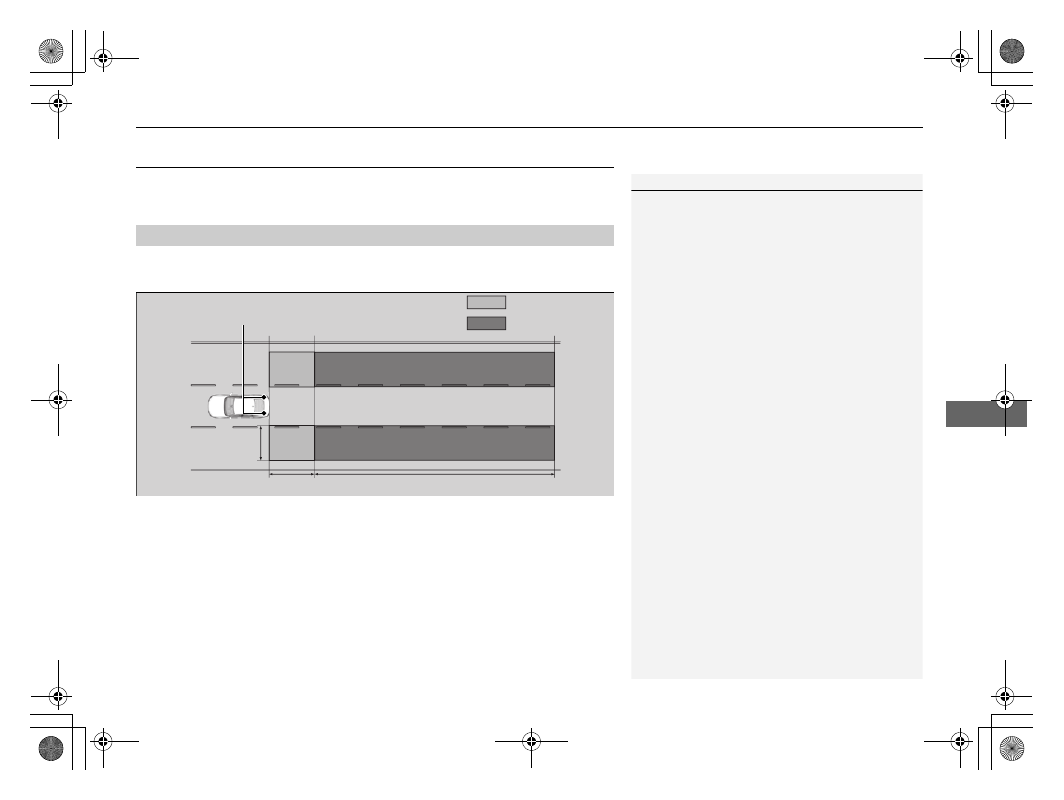
When the system detects vehicles approaching from behind in adjacent lanes, the 
appropriate indicator comes on, providing assistance when you change lanes.

The system activates when your vehicle is moving forward at about 20 mph (32 km/h) 
or above.

Alert zone range
A: Approx. 1.6 ~ 10 feet (0.5 ~ 3 meters) from vehicle side.
B: Approx. 10 feet (3 meters) from rear bumper.
C: Approx. 10 ~ 82 feet (3 ~ 25 meters) behind from rear bumper. (The faster the 
approaching vehicle, the further away it will be detected.)

The initially set alert zone is alert zone 1. Over time, after the vehicle has been driven 
on straight roads with traffic and roadside objects, the system will adapt and expand 
the alert zone (alert zone 1 and 2).

How the System Works

1

Blind Spot Information System

*

Important Safety Reminder

Like all assistance systems, the blind spot information 
system has limitations. Always look in your mirrors, to 
either side of your vehicle, and behind you for other 
vehicles before changing lanes. Overreliance on the 
blind spot information system may result in a 
collision.

Have your vehicle checked by a dealer in the 
following situations:

The rear bumper or area around the radar sensors 
is strongly impacted.

The indicator does not come on even if a vehicle in 
the alert zone should have been detected.

The rear bumper or any system components need 
to be repaired.

If the rear bumper or any system components are 
repaired, the system will revert to alert zone 1 only 
until it is able to adapt and expand to alert zone 1 
and 2.

For proper blind spot information system operation:

Always keep the rear bumper and area around the 
radar sensors clean.

Do not cover the rear bumper corner area with 
labels or stickers of any kind.

Radar Sensors: underneath the 

rear bumper corners

: Alert Zone 1

A

B

C

: Alert Zone 2

* Not available on all models

uu

When Driving

u

Blind Spot Information System

*

324

Driving

When the system detects a vehicle

Blind spot information system alert indicator: 
Located on the outside door mirror on both 
sides.

Comes on when:

A vehicle approaches you from behind to 
overtake you at a speed difference of no 
more than about 31 mph (50 km/h).

You pass a vehicle at a speed difference of 
no more than about 12 mph (20 km/h).

Blinks and a beeper sounds when:

You use the turn signal lever to signal a turn in 
the direction of the detected vehicle while the 
blind spot information system alert indicator is 
on.

u

The beeper sounds three times.

1

Blind Spot Information System

*

The system is for your convenience only. Even if an 
object is within the alert zone, the following 
situations may occur:

The blind spot information system alert indicator 
does not come on and the 

Blind spot 

information system not available

 message 

appears on the driver information interface.

The blind spot information system alert indicator 
may come on even with the message displayed.

The Vehicle Stability Assist

TM

 (VSA

®

) system, Adaptive 

Cruise Control (ACC) with Low Speed Follow, low tire 
pressure/TPMS

*

, safety support, and parking brake 

and brake system (amber) indicators may come on in 
amber along with a message in the driver information 
interface when you set the power mode to ON after 
reconnecting the battery.
Drive a short distance at more than 12 mph (20 
km/h). Each indicator should go off. If any do not, 
have your vehicle checked by a dealer.

Comes On

Blinks

* Not available on all models

Continued

325

uu

When Driving

u

Blind Spot Information System

*

Driving

You can turn the system on and off using the driver information interface.

2

Switching the Display

 P. 112

2

Safety Support

 P. 121

The blind spot information system will stay on the previously selected on or off 
setting each time you start the engine.

Blind Spot Information System On and Off

1

Blind Spot Information System

*

You can change the settings for the blind spot 
information system.

2

Vehicle Settings

 P. 126

* Not available on all models

326

uu

When Driving

u

Blind Spot Information System

*

Driving

The blind spot information system alert indicator may not come on under the 
following conditions:

There is a large speed difference between your vehicle and the vehicle in the 
adjacent lane.

A vehicle is parked in a side lane.

An object not detected by the radar sensors approaches or passes your vehicle.

The vehicle driving in the adjacent lane is a motorcycle or other small vehicle.

The blind spot information system may not operate correctly under the following 
conditions:

Making a turn at an intersection.

Objects (guard rails, poles, trees, etc.) are detected.

An object that does not reflect radio waves well or a motorcycle is in the alert 
zone.

Driving on a curved road.

A vehicle is moving from a far lane to the adjacent lane.

The system picks up signal interference such as other radar sensors from another 
vehicle or strong radio wave transmitted from a facility nearby.

The rear bumper or the area around the radar sensors is covered by dirt, mud, 
snow, ice, etc.

The rear bumper or the area around the radar sensors has been damaged or 
deformed.

In bad weather (heavy rain, snow, and fog).

Making a short turn or driving on a bumpy road that slightly tilts the vehicle.

An object such as a bicycle rack is attached to the rear of the vehicle.

Blind Spot Information System Conditions and Limitations

327

Continued

Driving

Honda Sensing

®

Assists with functions such as acceleration, braking, and steering in order to reduce 
the burden on the driver, as well as avoid or reduce the severity of collisions.

Honda Sensing

®

 has the following functions.

The functions which do not require switch operations to activate

Collision Mitigation Braking System

TM

 (CMBS

TM

2

 P. 330

Road Departure Mitigation System 

2

 P. 342

Traffic Sign Recognition System 

2

 P. 390

Auto High-Beam 

2

 P. 171

Blind Spot Information System

*


2

 P. 323

Cross Traffic Monitor

*


2

 P. 411

Driver Attention Monitor 

2

 P. 117

The functions which require switch operations to activate

Adaptive Cruise Control (ACC) with Low Speed Follow 

2

 P. 350

Lane Keeping Assist System (LKAS) 

2

 P. 370

Traffic Jam Assist 

2

 P. 381

* Not available on all models

328

uu

Honda Sensing

®

u

Driving

 Button

Press to activate standby mode for ACC with 
Low Speed Follow.
Or press to cancel the system.

LKAS Button

Press to activate standby mode for LKAS and 
Traffic Jam Assist.
Or press to cancel these systems.

CANCEL Button

Press to cancel ACC with Low Speed Follow.

Interval Button

Press to change the ACC with Low Speed 
Follow following-interval.

RES/+/SET/− Switch

Press the 

RES/+

/

SET/−

 switch up to set or 

resume the ACC with Low Speed Follow or 
increase the vehicle speed. Press the 

RES/+

/

SET/−

 switch down to set the ACC with Low 

Speed Follow or decrease the vehicle speed.

Operation Switches for the Adaptive Cruise Control (ACC) 

with Low Speed Follow/Lane Keeping Assist System (LKAS)/
Traffic Jam Assist

Interval Button

 Button

LKAS Button

CANCEL

 Button

RES/+

/

SET/−

 Switch

329

uu

Honda Sensing

®

u

Driving

You can see the current state of Adaptive Cruise Control (ACC) with Low Speed 
Follow, Lane Keeping Assist System (LKAS), and Traffic Jam Assist.

a

Indicates that ACC with Low Speed Follow 
is ready to be activated.

Green, White/Green: The system is on.

u

White/Green indicates that a vehicle is 
not detected ahead.

White: The system is standby.

Amber: There is a problem with the system.

b

Indicates that LKAS or Traffic Jam Assist is 
ready to be activated.

Green: The system is on.

White: The system is standby.

Amber: There is a problem with the system.

c

Indicates that LKAS or Traffic Jam Assist is 
activated and whether or not traffic lane 
lines are detected.

Green lines: The system is on.

White lines: Traffic lane lines are detected.

Amber line: Lane departure is detected.

d

Indicates whether or not a vehicle is 
detected ahead.

Control target vehicle: White and outlined 
in green

Outside of control target vehicle: Gray

e

Indicates that ACC with Low Speed Follow 
shows the set vehicle speed.

f

Indicates that ACC with Low Speed Follow 
shows the set vehicle interval.

Gauge Content

330

uu

Honda Sensing

®

u

Collision Mitigation Braking System

TM

 (CMBS

TM

)

Driving

Collision Mitigation Braking System

TM

 (CMBS

TM

)

The system can assist you when it determines there is a possibility of your vehicle 
colliding with a vehicle (including motorcycles) ahead from behind, an oncoming 
vehicle in front, a pedestrian, or someone riding a bicycle (moving bicycle). 
The CMBS

TM

 is designed to alert you when the potential for a collision is determined, 

as well as assist in reducing speed, avoiding collisions, and reducing collision 
severity.

1

Collision Mitigation Braking System

TM

 (CMBS

TM

)

Important Safety Reminder

The CMBS

TM

 is designed to reduce the severity of an 

unavoidable collision. It does not prevent collisions 
nor stop the vehicle automatically. It is still your 
responsibility to operate the brake pedal and steering 
wheel appropriately according to the driving 
conditions.

The CMBS

TM

 may not activate or may not detect a 

vehicle in front of your vehicle under certain 
conditions:

2

CMBS

TM

 Conditions and Limitations

 P. 335

For directions on the proper handling of the radar 
sensor, refer to the following page.

2

Radar Sensor

 P. 398

You can read about handling information for the 
camera equipped with this system.

2

Front Sensor Camera

 P. 396

Continued

331

uu

Honda Sensing

®

u

Collision Mitigation Braking System

TM

 (CMBS

TM

)

Driving

How the system works

The CMBS

TM

 will be canceled when your vehicle stops or the system determines 

there no longer is the potential for a collision.
The CMBS

TM

 may also be canceled when a driver operates the steering wheel and 

the brake or accelerator pedal to avoid a collision.

1

How the system works

The camera in the CMBS

TM

 is also designed to detect 

pedestrians.
However, this pedestrian detection feature may not 
activate or may not detect a pedestrian in front of 
your vehicle under certain conditions.
Refer to the ones indicating the pedestrian detection 
limitations from the list.

2

CMBS

TM

 Conditions and Limitations

 P. 335

A front sensor 

camera is located 

behind the 

rearview mirror.

The system starts monitoring the roadway ahead when your vehicle speed is about 

3 mph (5 km/h) or above and will search for a vehicle, pedestrian, or moving bicycle 

in front of you.

The CMBS

TM

 activates when:

The speed difference between your vehicle and a vehicle, pedestrian, or moving 

bicycle detected in front of you becomes about 3 mph (5 km/h) and over with a 

chance of a collision.

Your vehicle drives at about 18 mph (30 km/h) or less and there is a chance of a 

frontal collision with a detected oncoming vehicle when you turn left at an 

intersection.

Your vehicle speed is about 62 mph (100 km/h) or less and the system determines 

there is a chance of a collision with:

- An oncoming or stationary vehicle detected in front of you.

- A pedestrian or moving bicycle detected in front of you.

When to use

The radar sensor is 

behind the Honda 

emblem on the 

front grille.

332

uu

Honda Sensing

®

u

Collision Mitigation Braking System

TM

 (CMBS

TM

)

Driving

When the system activates

You can change the distance (

Long

/

Normal

/

Short

) between vehicles at which the 

system’s earliest collision alert will come on.

2

Vehicle Settings

 P. 126

The system provides visual and audible alerts of a possible collision, and stops if the 

collision is avoided.

u

Take appropriate action to prevent a collision (apply the brakes, change 

lanes, etc.)

Visual Alerts

Beep

Audible Alert

333

uu

Honda Sensing

®

u

Collision Mitigation Braking System

TM

 (CMBS

TM

)

Continued

Driving

The system has three alert stages for a possible collision. However, depending on circumstances, the CMBS

TM

 may not go through all of 

the stages before initiating the last stage.

Collision Alert Stages

Distance between vehicles

CMBS

TM

The radar sensor detects a vehicle

Audible & Visual WARNINGS

Braking

Stage 

one

There is a risk of a collision with the 
vehicle ahead of you.

When in 

Long

, visual and audible 

alerts come on at a longer distance 
from a vehicle ahead than in 

Normal


setting, and in 

Short

, at a shorter 

distance than in 

Normal

.

Stage 

two

The risk of a collision has increased, 
time to respond is reduced.

Visual and audible alerts.

Lightly applied

Stage 

three 

The CMBS

TM

 determines that a collision 

is unavoidable.

Forcefully applied

Your Vehicle

Vehicle 
Ahead

Normal

Short

Long

Your 
Vehicle

Vehicle 
Ahead

Your 
Vehicle

Vehicle 
Ahead

uu

Honda Sensing

®

u

Collision Mitigation Braking System

TM

 (CMBS

TM

)

334

Driving

You can turn the system on and off using the driver information interface.

2

Switching the Display

 P. 112

2

Safety Support

 P. 121

The CMBS

TM

 is turned on every time you start the engine, even if you turned it off 

the last time you drove the vehicle.

CMBS

TM

 On and Off

1

Collision Mitigation Braking System

TM

 (CMBS

TM

)

You cannot turn the CMBS

TM

 off while driving.

The CMBS

TM

 may automatically shut off, and the 

safety support indicator (amber) will come and stay 
on under certain conditions:

2

CMBS

TM

 Conditions and Limitations

 P. 335

When the CMBS

TM

 is activated, it will continue to 

operate even if the accelerator pedal is partially 
depressed. However, it will be canceled if the 
accelerator pedal is fully depressed.

The Vehicle Stability Assist

TM

 (VSA

®

) system, Adaptive 

Cruise Control (ACC) with Low Speed Follow, low tire 
pressure/TPMS

*

, safety support, and parking brake 

and brake system (amber) indicators may come on in 
amber along with a message in the driver information 
interface when you set the power mode to ON after 
reconnecting the battery.
Drive a short distance at more than 12 mph (20 km/h).
Each indicator should go off. If any do not, have your 
vehicle checked by a dealer.

Have your vehicle checked by a dealer if you find any 
unusual behavior of the system (e.g., the warning 
message appears too frequently).

* Not available on all models

335

uu

Honda Sensing

®

u

Collision Mitigation Braking System

TM

 (CMBS

TM

)

Continued

Driving

In the following situations, the radar sensor or camera may be unable to correctly 
detect vehicles, pedestrians, moving bicycles, or road conditions, potentially causing 
the CMBS

TM

 to operate improperly.

2

Front Sensor Camera

 P. 396

2

Radar Sensor

 P. 398

Environmental conditions

Driving in bad weather (rain, fog, snow, etc.).

Sudden changes between light and dark, such as the entrance or exit of a tunnel.

There is little contrast between objects and the background.

Driving into low sunlight (e.g., at dawn or dusk).

Strong light is reflected onto the pedestrians, moving bicycles or roadway.

Driving in the shadows of trees, buildings, etc.

Roadway objects or structures are misinterpreted as vehicles and pedestrians.

Reflections on the interior of the windshield.

Driving at night or in a dark place such as a tunnel (due to low-light conditions, 
pedestrians, moving bicycles or other vehicles may not be detected).

Roadway conditions

Driving on a snowy or wet roadway (obscured lane marking, vehicle tracks, 
reflected lights, road spray, high contrast).

Driving on curvy, winding, or undulating roads.

The road is hilly or the vehicle is approaching the crest of a hill.

Driving through an area where there are objects that strongly reflect radio waves 
onto vehicles, pedestrians, or moving bicycles.

Your vehicle is strongly shaken on uneven road surfaces.

CMBS

TM

 Conditions and Limitations

336

uu

Honda Sensing

®

u

Collision Mitigation Braking System

TM

 (CMBS

TM

)

Driving

Vehicle conditions

Headlight lenses are dirty or the headlights are not properly adjusted.

The outside of the windshield is blocked by dirt, mud, leaves, wet snow, etc.

The inside of the windshield is fogged.

An abnormal tire or wheel condition (incorrect sizes, varied sizes or construction, 
improperly inflated, compact spare tire, etc.).

When tire chains are installed.

The vehicle is tilted due to a heavy load or suspension modifications.

The camera temperature gets too high.

Driving with the parking brake applied.

When the radar sensor behind the Honda emblem on the front grille gets dirty.

Driving at night or in a dark place (e.g., a tunnel) with the headlights off.

There is residue on the windshield from the windshield wipers.

Continued

337

uu

Honda Sensing

®

u

Collision Mitigation Braking System

TM

 (CMBS

TM

)

Driving

Examples of limitations on the correct detection of the camera due to the 
condition of the vehicle ahead of you, oncoming vehicles, pedestrians, or 
moving bicycles

The distance between your vehicle and the vehicle ahead of you, oncoming 
vehicle, pedestrian, or moving bicycle ahead of you is too short.

The vehicle ahead of you, oncoming vehicle, pedestrian, or moving bicycle 
suddenly cuts in front of or jumps out in front of you.

The bicycle is stopped.

The oncoming vehicle or vehicle ahead of you is sideways or facing diagonally.

When the vehicle ahead of you, oncoming vehicle, pedestrian, or moving bicycle 
blends in with the background, preventing the system from recognizing it.

When several pedestrians are moving ahead of you in a group.

When several bicycles are moving ahead of you in a group.

When a pedestrian or moving bicycle crosses the road too quickly.

A pedestrian or moving bicycle approaches from the opposite direction.

The headlights of the vehicle ahead of you or oncoming vehicle are lit on one side 
or not lit on either side in a dark place.

When part of a pedestrian (heads, limbs, etc.) is hidden by a load.

When a pedestrian is bent over or squatting, when their hands are raised, or they 
are running.

When the pedestrian is shorter than about 3.3 feet (1 meter) or taller than about 
6.6 feet (2 meters) in height.

When the pedestrian is pushing a stroller or bicycle.

1

Collision Mitigation Braking System

TM

 (CMBS

TM

)

Make sure that all the tires are of the same specified 
size, type and brand, and that they are evenly worn.
If you use tires of different sizes, types, brands, or 
degree of wear, the system may not work properly.

Do not modify the suspension. Altering the height of 
the vehicle may prevent the system from working 
properly.

338

uu

Honda Sensing

®

u

Collision Mitigation Braking System

TM

 (CMBS

TM

)

Driving

Examples of other limitations on detection or system operation

When the vehicle ahead of you is a small motorcycle, motorcycle with a sidecar, 
wheelchair, or other specially shaped vehicle.

When a vehicle is lower in the rear than the front such as trucks that are not 
carrying a load, or a narrow vehicle.

When the vehicle ahead of you, oncoming vehicle, pedestrian or moving bicycle 
is not in front of the vehicle.

The speed difference between your vehicle and the vehicle ahead of you, 
oncoming vehicle, pedestrian or moving bicycle is significantly large.

When the vehicle or moving bicycle in front of you slows suddenly.

When the driver operates the brake pedal and steering wheel to avoid a collision.

When you approach the vehicle ahead of you, oncoming vehicle, pedestrians or 
moving bicycles while accelerating rapidly or operating the steering wheel (except 
when turning left at an intersection etc.)

*1

When the moving bicycle is a child-sized bicycle, folding bicycle, three-wheeler or 
other bicycle with small tires, or a long bicycle like a tandem bicycle.

When the radar and camera cannot correctly identify the shape of the vehicle 
ahead of you, oncoming vehicle, pedestrian, or moving bicycle.

When the minimum ground clearance of a vehicle ahead of you is extremely high.

When turning left or right and your turn signal is not activated in the same 
direction you are turning.

*1: When there is a possibility of a frontal collision with the oncoming vehicle while turning 
left, the CMBS

TM

 is activated. However, it may not be activated if you suddenly turn the 

steering wheel.

339

uu

Honda Sensing

®

u

Collision Mitigation Braking System

TM

 (CMBS

TM

)

Continued

Driving

Automatic shutoff

The CMBS

TM

 may automatically shut itself off and the safety support indicator 

(amber) comes and stays on when:

You drive off-road or on a mountain road, or curved and winding road for an 
extended period.

Driving in bad weather (rain, fog, snow, etc.).

Driving with the parking brake applied.

The camera temperature gets too high.

The radar sensor temperature gets too high.

The front of the camera or radar sensor behind the Honda emblem is covered by 
dirt, fog, rain, mud, wet snow, seals, accessories, stickers, or film on the 
windshield.

An abnormal tire condition is detected (incorrect tire size, flat tire, etc.).

You are driving near an object or place that generates strong radio waves or 
noise, such as a TV tower, broadcast station, power plant, or a vehicle equipped 
with radar.

Once the conditions that caused the CMBS

TM

 to shut off improve or are addressed 

(e.g., cleaning), the system comes back on.

340

uu

Honda Sensing

®

u

Collision Mitigation Braking System

TM

 (CMBS

TM

)

Driving

Even if there is little chance of a collision, the CMBS

TM

 may activate under the 

following conditions.
Also, the system may activate if it detects a possibility of collision with pedestrians, 
moving bicycles, or vehicles.

Your vehicle approaches or passes another vehicle that is making a left or right 
turn.

Your vehicle approaches another vehicle ahead of you and you change lanes to 
pass.

With Little Chance of a Collision

341

uu

Honda Sensing

®

u

Collision Mitigation Braking System

TM

 (CMBS

TM

)

Driving

When your vehicle approaches vehicles, pedestrians, or moving bicycles.

When vehicles, pedestrians, or moving bicycles are passing in front of you.

When you drive under a low structure or through a narrow gate at high speed.

When there are traffic signs or structures such as guard rails beside the road along 
a curve.

When driving through curves, your vehicle comes to a point where the oncoming 
vehicle is right in front of you.

When approaching stationary vehicles or walls, such as when parking.

342

uu

Honda Sensing

®

u

Road Departure Mitigation System

Driving

Road Departure Mitigation System

Alerts and helps assist you when the system detects a possibility of your vehicle 
crossing over detected lane markings, or approaching the outer edge of the 
pavement (into grass or gravel border) or a detected oncoming vehicle.

The front sensor camera behind the rearview 
mirror monitors left and right lane markings in 
white or yellow, the outer edge of the 
pavement (bordered by grass or gravel) or a 
detected oncoming vehicles.
If your vehicle approaches any detected lane 
markings, the outer edge of the pavement 
(bordered by grass or gravel) or a detected 
oncoming vehicles when the turn signals have 
not been engaged, the system activates.

u

If the system cannot detect lane markings 
(in white or yellow), no assistance will be 
provided to avoid approaching oncoming 
vehicles. In addition to a visual alert, the 
system assists with steering and alerts you 
with rapid steering wheel vibrations to 
help you remain within the detected lane.

2

Vehicle Settings

 P. 126

As a visual alert, the 

Lane departure


message appears on the driver information 
interface.

How the System Works

1

Road Departure Mitigation System

Important Safety Reminder

Like all assistance systems, the Road Departure 
Mitigation system has limitations.
Overreliance on the Road Departure Mitigation 
system may result in a collision. It is always your 
responsibility to keep the vehicle within your driving 
lane.

The Road Departure Mitigation system alerts you 
when the system detects that you are approaching 
the outer edge of the pavement (into grass or gravel 
border), an oncoming vehicle, or drifting into another 
lane without using a turn signal.
The Road Departure Mitigation system may not detect 
all lane markings or every instance of lane drift.
The Road Departure Mitigation system may not 
detect that you are approaching the outer edge of 
the pavement (bordered by grass or gravel) or an 
oncoming vehicle.
The Road Departure Mitigation system may not be 
able to assist you depending on weather, speed or 
road conditions.

You can read about handling information for the 
camera equipped with this system.

2

Front Sensor Camera

 P. 396

The Road Departure Mitigation system may not work 
properly or may work improperly under the certain 
conditions:

2

Road Departure Mitigation system 
Conditions and Limitations

 P. 346

Amber Line

Continued

343

uu

Honda Sensing

®

u

Road Departure Mitigation System

Driving

The system cancels assisting operations when you turn the steering wheel to avoid 
crossing over detected lane markings or approaching the outer edge of the 
pavement (into grass or gravel border) or an oncoming vehicle.

If the system operates several times without detecting driver response, the system 
beeps to alert you.

1

Road Departure Mitigation System

There are times when you may not notice the Road 
Departure Mitigation system functions due to your 
operation of the vehicle, or road surface conditions.

You can change the settings for the Road Departure 
Mitigation system.
If LKAS is off, the message below may appear if the 
system has determined that there is a possibility of 
your vehicle crossing over detected lane markings, 
the outer edge of the pavement (into a grass or 
gravel border) or oncoming vehicle.

2

Vehicle Settings

 P. 126

uu

Honda Sensing

®

u

Road Departure Mitigation System

344

Driving

The system activates when all of the following conditions are met:

The vehicle is traveling between about 45 and 90 mph (72 and 145 km/h).

The vehicle is on a straight or slightly curved road.

The turn signals are off.

The system makes a determination that the driver is not actively accelerating, 
braking, or steering.

How the System Activates

1

How the System Activates

The Road Departure Mitigation system may 
automatically shut off and the safety support 
indicator (amber) comes and stays on.

2

Indicators

 P. 84

The Road Departure Mitigation system function can 
be impacted when the vehicle is:

Driven on the inside edge of a curve, or outside of 
a lane.

Driven in a narrow lane.

Continued

345

uu

Honda Sensing

®

u

Road Departure Mitigation System

Driving

You can turn the system on and off using the driver information interface.

2

Switching the Display

 P. 112

2

Safety Support

 P. 121

The Road Departure Mitigation system is in the previously selected on or off setting 
each time you start the engine.

Road Departure Mitigation system On and Off

1

Road Departure Mitigation system On and Off

When you have selected 

Warning only

, the system 

does not operate the steering wheel.

2

Vehicle Settings

 P. 126

The Vehicle Stability Assist

TM

 (VSA

®

) system, Adaptive 

Cruise Control (ACC) with Low Speed Follow, low tire 
pressure/TPMS

*

, safety support, and parking brake 

and brake system (amber) indicators may come on in 
amber along with a message in the driver information 
interface when you set the power mode to ON after 
reconnecting the battery.
Drive a short distance at more than 12 mph (20 km/h).
Each indicator should go off. If any do not, have your 
vehicle checked by a dealer.

* Not available on all models

346

uu

Honda Sensing

®

u

Road Departure Mitigation System

Driving

The system may not properly detect lane markings (in white or yellow), the outer 
edge of the pavement (into grass or gravel border) or an oncoming vehicle under 
certain conditions. Some examples of these conditions are listed below.

Environmental conditions

There is little contrast between lane lines and the roadway surface.

Driving in bad weather (rain, fog, snow, etc.).

Driving on a snowy or wet roadway.

Driving into low sunlight (e.g., at dawn or dusk).

Shadows of adjacent objects (trees, buildings, guard rails, vehicles, etc.) are 
parallel to white (or yellow) lines.

Sudden changes between light and dark, such as the entrance or exit of a tunnel 
or the shadows of trees, buildings, etc.

Strong light is reflected onto the roadway.

Driving at night or in a dark place such as a tunnel (due to low-light conditions, 
lane lines, the road surface, or oncoming vehicles may not be illuminated).

The distance between your vehicle and the vehicle ahead of you is too short, and 
lane lines and the road surface are not visible.

The outer edge of the road is bordered by objects, materials, etc. other than grass 
or gravel.

Road Departure Mitigation system Conditions and Limitations

347

uu

Honda Sensing

®

u

Road Departure Mitigation System

Continued

Driving

Roadway conditions

Driving on a road with temporary lane markings.

Faint, multiple, or varied lane markings are visible on the roadway due to road 
repairs or old lane markings.

The roadway has merging, split, or crossing lines, such as at an intersection or 
crosswalk.

The lane markings are extremely narrow, wide, or changing.

Part of the lane markings are hidden by an object, such as a vehicle.

The road is hilly or the vehicle is approaching the crest of a hill.

Your vehicle is strongly shaken on uneven road surfaces.

When objects on the road (curb, guard rail, pylons, etc.) are recognized as white 
(or yellow) lines.

Driving on rough or unpaved roads, or over bumpy surfaces.

Driving on roads with double lane lines.

Driving on snowy or slippery roads.

Passing through an exit or an intersection.

The pavement is only partially visible due to snow or puddles on the road.

Driving on unpaved or rutted roads.

White (or yellow) lines are not recognized correctly due to road conditions such as 
curves, twists, or hills.

348

uu

Honda Sensing

®

u

Road Departure Mitigation System

Driving

Vehicle conditions

When lighting is weak due to dirt covering the headlight lenses, or there is poor 
visibility in a dark place due to the headlights being improperly adjusted.

The front of the camera is covered by dirt, fog, rain, mud, wet snow, seals, 
accessories, stickers, or film on the windshield.

Driving at night or in a dark place (e.g., a tunnel) with the headlights off.

When the driver operates the brake pedal and steering wheel.

There is residue on the windshield from the windshield wipers.

An abnormal tire or wheel condition (incorrect sizes, varied sizes or construction, 
improperly inflated, compact spare tire, etc.).

The vehicle is tilted due to heavy load in the trunk or rear seats.

Tire chains are installed.

The suspension has been modified.

Examples of limitations on detection due to the condition of oncoming 
vehicles

The oncoming vehicle or vehicle ahead of you is sideways.

The oncoming vehicle jumps out in front of you.

When the oncoming vehicle blends in with the background, preventing the 
system from recognizing it.

The headlights of an oncoming vehicle are lit on one side or not lit on either side 
in a dark place.

The distance between your vehicle and the oncoming vehicle is too short.

Part of the oncoming vehicle is not visible due to the vehicle ahead of you.

There are multiple oncoming lanes or turning lanes.

The vehicle in the adjacent lane is parked or moving at an extremely slow speed.

349

uu

Honda Sensing

®

u

Road Departure Mitigation System

Driving

Examples of other limitations on detection or system operation

When the oncoming vehicle is specially-shaped.

When the camera cannot correctly identify the shape of the oncoming vehicle.

With Little Chance of a Collision

The Road Departure Mitigation system may activate in the below conditions.

When driving through curves, your vehicle comes to a point where an oncoming 
vehicle is right in front of you.

350

uu

Honda Sensing

®

u

Adaptive Cruise Control (ACC) with Low Speed Follow

Driving

Adaptive Cruise Control (ACC) with Low Speed 
Follow

Helps maintain a constant vehicle speed and a set following-interval behind a vehicle 
detected ahead of yours and, if the detected vehicle comes to a stop, can decelerate 
and stop your vehicle, without you having to keep your foot on the brake or the 
accelerator.
When ACC with Low Speed Follow slows your vehicle by applying the brakes, your 
vehicle’s brake lights will illuminate.

1

Adaptive Cruise Control (ACC) with Low Speed Follow

3

WARNING

Improper use of ACC with Low Speed 

Follow can lead to a crash.

Use ACC with Low Speed Follow only when 

driving on expressways or freeways and in 

good road and weather conditions.

3

WARNING

ACC with Low Speed Follow has limited 

braking capability and may not stop your 

vehicle in time to avoid a collision with a 

vehicle that quickly stops in front of you.

Always be prepared to apply the brake 

pedal if the conditions require.

When to use

Vehicle speed for ACC with Low Speed Follow: 

A vehicle is detected ahead 

within ACC with Low Speed Follow range

 – ACC with Low Speed Follow 

operates at speeds up to 90 mph (145 km/h).

No vehicle is detected within ACC with Low Speed Follow range

 – ACC with 

Low Speed Follow operates at the speed of 25 mph (40 km/h) or above.

Shift position for ACC with Low Speed Follow: In 

(

D

 or 

(

S

.

A front sensor 

camera is located 

behind the 

rearview mirror.

The radar sensor is 

behind the Honda 

emblem on the 

front grille.

Continued

351

uu

Honda Sensing

®

u

Adaptive Cruise Control (ACC) with Low Speed Follow

Driving

How to activate the system

1

Adaptive Cruise Control (ACC) with Low Speed Follow

Important Reminder

As with any system, there are limits to ACC with Low 
Speed Follow. Use the brake pedal whenever 
necessary, and always keep a safe interval between 
your vehicle and other vehicles.
While in ECON mode, it may take relatively more time 
to accelerate to maintain the set speed.

For directions on the proper handling of the radar 
sensor, refer to the following page.

2

Radar Sensor

 P. 398

You can read about handling information for the 
camera equipped with this system.

2

Front Sensor Camera

 P. 396

3

WARNING

Exiting a vehicle that has been stopped 

while the ACC with Low Speed Follow 

system is operating can result in the vehicle 

moving without operator control.

A vehicle that moves without operator 

control can cause a crash, resulting in 

serious injury or death.

Never exit a vehicle when the vehicle is 

stopped by ACC with Low Speed Follow.

How to use

Press the 

 button on the 

steering wheel.

 (white) is on in the gauge

ACC with Low Speed Follow is ready to use.

uu

Honda Sensing

®

u

Adaptive Cruise Control (ACC) with Low Speed Follow

352

Driving

When driving at about 25 mph (40 km/h) or above: 

Take your foot off the 

pedal and press the 

RES/+

/

SET/−

 switch up or down when you reach the desired 

speed. The moment you release the 

RES/+

/

SET/−

 switch, the set speed is fixed, and 

ACC with Low Speed Follow begins.

When you use ACC with Low Speed Follow, Straight Driving Assist (a feature of the 
Electric Power Steering system) is activated.
By enabling the steering system to automatically compensate for natural steering 
pull, Straight Driving Assist makes it easier for you to keep your vehicle in a straight 
line.

When driving slower than about 25 mph (40 km/h): 

If the vehicle is moving 

and the brake pedal is not depressed, pressing the switch fixes the set speed to 
about 25 mph (40 km/h) regardless of current vehicle speed. If your vehicle is 
stationary, you can set the vehicle speed even with the brake pedal depressed.

To Set the Vehicle Speed

1

Adaptive Cruise Control (ACC) with Low Speed Follow

The radar sensor for ACC with Low Speed Follow is 
shared with the collision mitigation braking system

TM


(CMBS

TM

).

2

Collision Mitigation Braking System

TM


(CMBS

TM

)

 P. 330

ACC with Low Speed Follow may not work properly 
under certain conditions.

2

ACC with Low Speed Follow Conditions 
and Limitations

 P. 358

When not using ACC with Low Speed Follow: Turn 
off adaptive cruise by pressing the 

 button.

Do not use ACC with Low Speed Follow under the 
following conditions:

On roads with frequent lane change or continuous 
stop and go traffic, ACC with Low Speed Follow 
cannot keep an appropriate distance between your 
vehicle and the vehicle ahead of you.

On roads with sharp turns.

On roads with toll collection facilities or other 
objects between lanes of traffic, or in parking 
areas, or facilities with drive through access.

On roads with bad weather (rain, fog, snow, etc.), 
ACC with Low Speed Follow may not detect the 
distance between your vehicle and the vehicle 
ahead of you properly.

On when ACC with Low Speed Follow begins

Up or down

RES/+

/

SET/−

 Switch

Continued

353

uu

Honda Sensing

®

u

Adaptive Cruise Control (ACC) with Low Speed Follow

Driving

When ACC with Low Speed Follow starts 
operating, the vehicle icon, interval bars, and 
set speed appear on the gauge.

1

Adaptive Cruise Control (ACC) with Low Speed Follow

On roads with slippery or icy surfaces. The wheels 
may spin out and your vehicle may lose the control 
on the condition.

On roads with steep uphill or steep downhill slopes.

On roads with undulating slopes.

1

To Set the Vehicle Speed

The Vehicle Stability Assist

TM

 (VSA

®

) system, Adaptive 

Cruise Control (ACC) with Low Speed Follow, low tire 
pressure/TPMS

*

, safety support, and parking brake 

and brake system (amber) indicators may come on in 
amber along with a message in the driver information 
interface when you set the power mode to ON after 
reconnecting the battery.
Drive a short distance at more than 12 mph (20 km/h).
Each indicator should go off. If any do not, have your 
vehicle checked by a dealer.

You can switch the displayed set speed 
measurements on the driver information interface 
between mph and km/h.

2

Vehicle Settings

 P. 126

2

Speed/distance units

 P. 123

Set Vehicle Speed

Set Vehicle Interval

* Not available on all models

uu

Honda Sensing

®

u

Adaptive Cruise Control (ACC) with Low Speed Follow

354

Driving

There is a vehicle ahead

ACC with Low Speed Follow monitors if a vehicle ahead of you enters the ACC with 
Low Speed Follow range. If a vehicle is detected doing so, the ACC with Low Speed 
Follow system maintains or decelerates your vehicle’s set speed in order to keep the 
vehicle’s set following-interval from the vehicle ahead.

2

To Set or Change Following-interval

 P. 363

When in Operation

1

When in Operation

If the vehicle ahead of you slows down abruptly, or if 
another vehicle cuts in front of you, a beeper sounds 
and a message appears on the driver information 
interface.

Depress the brake pedal, and keep an appropriate 
interval from the vehicle ahead.

Beep

ACC with Low Speed Follow Range: 394 ft. (120 m)


Content      ..     8      9      10      11     ..