Ford Galaxy / Ford S-MAX. Manual - part 952
 

  Index      Ford     Ford Galaxy / Ford S-MAX - service repair manual 2006 year


Search            


Content   ..  950  951  952  953   ..


Ford Galaxy / Ford S-MAX. Manual - part 952


In order to prevent excessive water consumption, the headlamp washer system is only 
activated every fourth time the windshield wash/wipe switch is operated, provided the time 
elapsed since the first operation of the washer system does not exceed 10 minutes. If the 
windshield wash/wipe switch is activated again after 10 minutes the the headlamp washer 
system is activated and the time encoder is restarted. 

If the wash water level warning lamp on the instrument cluster comes on because the wash 
water level in the washer reservoir is too low then the headlamp washer pump is no longer 
activated until the washer reservoir is topped up. 

Rain sensor 

CAUTIONS: 

The automatic windshield wipers must be switched off before the vehicle is driven 

into a car wash. 

If the windshield is iced up, the wipers may only be activated by the rain sensor after 

the windshield has been completely defrosted. 
NOTE: The rain sensor is an optical measuring instrument. Contamination such as oil, 
grease or dust impair its correct operation. Before switching on the automatic windshield 
wipers, the windshield must be clean in the area of the rain sensor. 

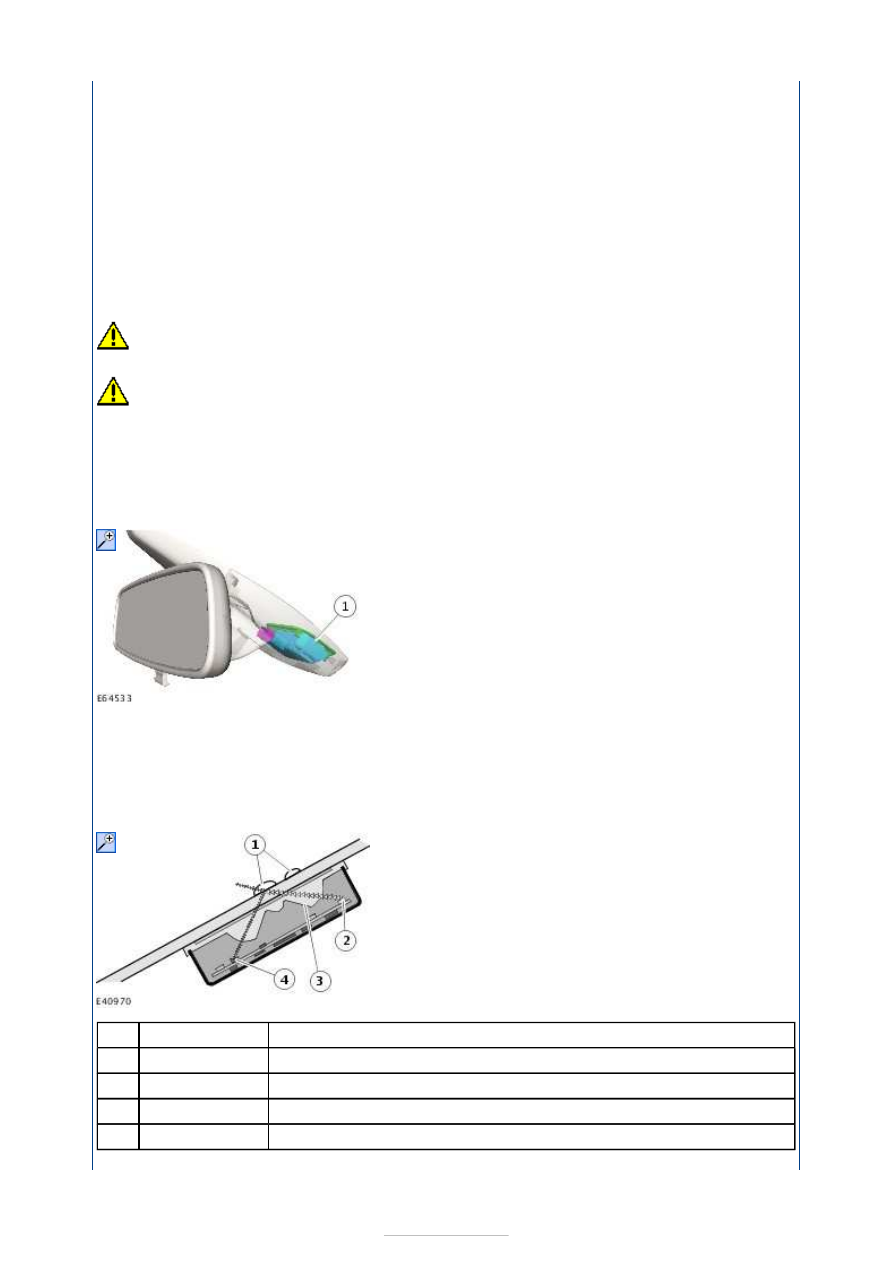
The rain sensor (1) is integrated together with the light sensor in a housing which is 
mounted behind the rear view mirror on the windshield. 

The rain sensor comprises an opto-electronic measuring and evaluation circuit. The sensor 
can calculate the amount of precipitation falling on the windshield and request that the 
windshield wipers are switched on. 

The wipers are then set to the required wipe speed by the GEM on the basis of the 
information supplied by the rain sensor. 


Description 

Raindrop 

LED 

Lens 

Photodiode 

Item

1

2

3

4


Part Number

-

-

-

-

The rain sensor consists of three components: 

an LED  
a photodiode  
a lens 

The LED emits a light beam of known intensity. The emitted beam emerges through the 
lens and is then reflected by the windshield. 

The reflected light beam enters back through the lens and then reaches the photodiode. 
The corresponding value taken without moisture on the windshield is used as the reference 
value for the automatic calibration process. 

Subsequent deviations from this value cause the windshield wipers to be switched on. 

If rain lands on the windshield then the light reflected by the windshield has a lower 
intensity. This loss of intensity is registered by the photodiode and, proportionally to the 
loss of intensity, the module switches on the windshield wipers with the required wipe 
speed (in intermittent or continuous mode). 

On vehicles built up to 07/2006 the wipers are only activated after switching on the 
automatic wipe function (wiper lever to intermittent position) when the water has been 
detected on the windshield by the rain sensor. 

On vehicles built from 07/2006 a single confirmation wipe is performed after the automatic 
wipe function has been switched on. 

It is not necessary to calibrate the rain sensor, as this has already been done at the factory. 

The sensitivity of the rain sensor can be changed by adjusting the control resistor for 
the intermittent mode of the windshield wipers. 

Adjusting ring position - wide symbol: High sensitivity 

The wipers wipe even if only a small amount of water has been measured on the 

windshield. 
Adjusting ring position - narrow symbol: Low sensitivity 

The wipers only wipe if a large amount of water has been measured on the windshield. 

-

-

Wipers and Washers - Wipers and 
Washers

S-MAX/Galaxy 2006.5 (02/2006-)


Print


Diagnosis and Testing 

General Equipment 

Inspection and Testing 

1. 1. Verify the customer concern. 

2. 2. Visually inspect for obvious signs of mechanical or electrical damage. 

Visual Inspection Chart 

3. 3. If an obvious cause for an observed or reported concern is found, correct the cause 

(if possible) before proceeding to the next step. 

4. 4. If the cause is not visually evident, refer to the 

Ford approved diagnostic tool

Ford approved diagnostic tool

Mechanical

Electrical systems

Wiper blade(s)  
Wiper arm pivot shaft  
Washer fluid reservoir  
Hose(s)  
Washer nozzles  
Check the wiper blades for residue-free wiping in the 
vicinity of the rain sensor.  
Check the adhesive pad between the rain sensor and the 
windshield for trapped air.  
Clean wax residues from the windshield in the vicinity of 
the rain sensor.  
Check the windshield for damage/cracks in the vicinity of 
the rain sensor.  
Check that the rain sensor retaining frame is correctly 
attached to the windshield. 

Fuse(s)  
Connector  
Wiring harness(es)  
Washer pump motor  
Headlamp washer pump  
Front/rear window wiper 
motor(s)  
Wash/wipe switch  
Central junction box 
(CJB)  
Rear junction box (RJB)  
Engine junction box 
(EJB) 

Wipers and Washers - Wiper Blade Angle 
Adjustment

S-MAX/Galaxy 2006.5 (02/2006-)


Print


General Procedures 

Special Tool(s) 

501-027 
Aligner, Wiper Arm 

501-027-01 
Adapter for 501-027 

1.

CAUTION: Make sure that the wiper 

motor is in the park position. 

2.

NOTE: Make sure that the 3 marked points of 
the special tool are in contact with the glass. 
NOTE: The angle of the wiper on the scale 
must point from the zero center line to the 
center of the windshield/rear window. Ignore 
the sign (+/-) on the alignment tool. 

Using the special tool, read off the angle between 
the wiper arm and the glass. 

Special Tool(s): 

501-027

501-027-01


3.

CAUTION: Make sure that the special 

tool is lifted off the glass during the 
adjustment. 

Adjust the wiper arm. 

Refer to: 

Specifications

 (501-16 Wipers and 

Washers, Specifications). 

4.  


Content   ..  950  951  952  953   ..