Ford Galaxy / Ford S-MAX. Manual - part 452
 

  Index      Ford     Ford Galaxy / Ford S-MAX - service repair manual 2006 year


Search            


Content   ..  450  451  452  453   ..


Ford Galaxy / Ford S-MAX. Manual - part 452


Electronic Engine Controls - 2.0L Duratec-
HE (107kW/145PS) - MI4/2.0L Duratec-
HE Flex Fuel (107kW/145PS) - MI4 - 
Electronic Engine Controls—Vehicles With: 
Ethanol Capability - System Operation and 
Component Description

S-MAX/Galaxy 2006.5 (02/2006-)


Print


Description and Operation 

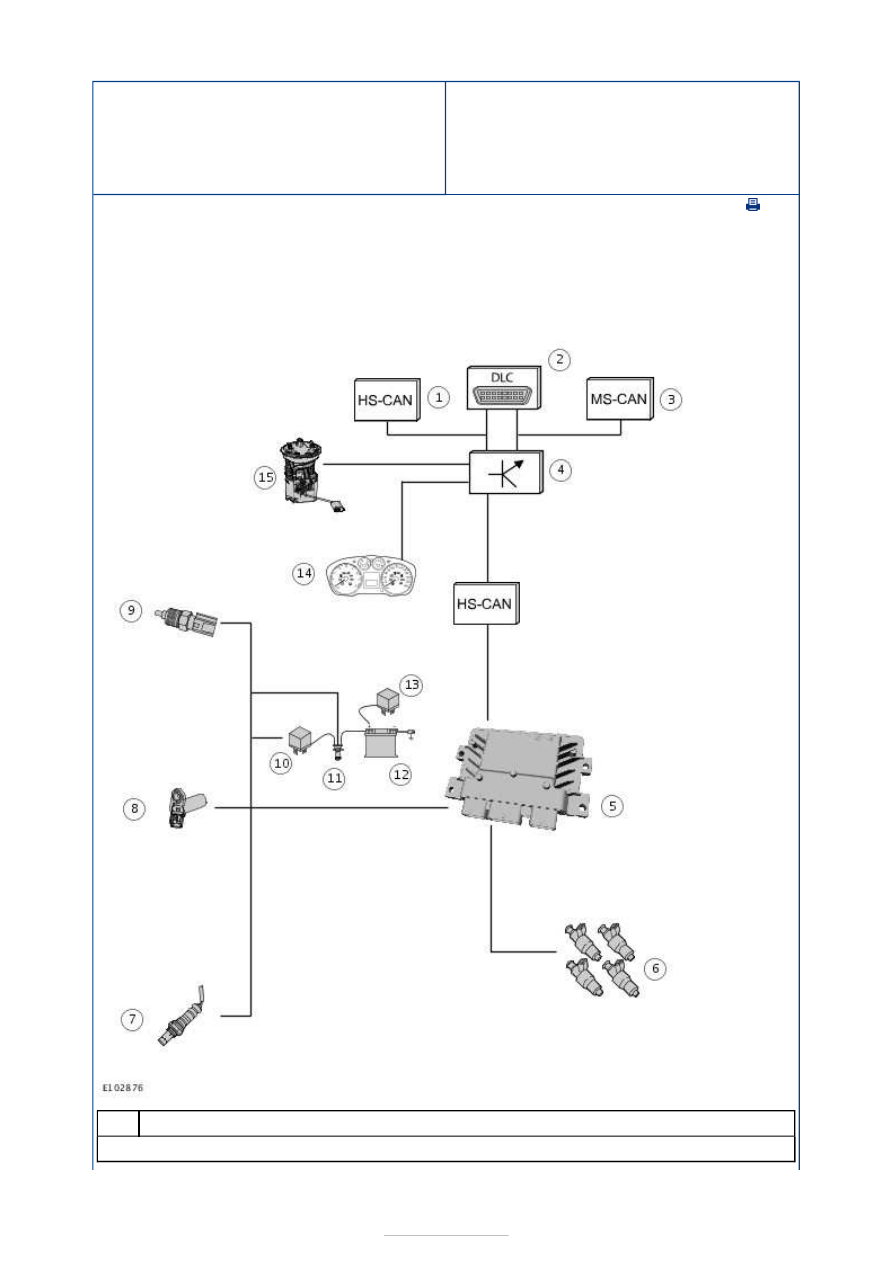
Control Diagram 

NOTE: This description only deals with components relevant to ethanol operation or 
modified components. 


Description 

High speed 

CAN (controller area network)


Item

1


DLC (data link connector)


Medium speed 

CAN


GEM (generic electronic module)


PCM (powertrain control module)


injectors 

HO2S (heated oxygen sensor)


CKP (crankshaft position)


ECT (engine coolant temperature)


Starter Relay 

Ignition lock 

PCM

 relay 

Battery 

Instrument cluster 

Fuel pump driver module 
Comments: 

Of which the following are relevant here: Float arm, resistor board 
Refer to: 

Fuel Tank and Lines - 2.0L Duratec-HE Flex Fuel (107kW/145PS) - MI4, Vehicles 

With: Ethanol Capability

 (310-01A Fuel Tank and Lines - 2.0L EcoBoost SCTi (149kW/203PS) - 

MI4/2.0L Duratec-HE (107kW/145PS) - MI4/2.0L Duratec-HE Flex Fuel (107kW/145PS) - 
MI4/2.3L Duratec-HE (118kW/160PS) - MI4/2.5L Duratec (162kW/220PS) - VI5, Description 
and Operation). 

Instrument cluster 

System Operation 

Fuel type determination and adaptation 

The crucial factor for optimal adaptation of the fuel-air mixture is knowledge of the fuel 
composition in the fuel tank. To determine the ethanol share in the fuel, the 

HO2S

 signal 

and the fuel level sensor are used. A corresponding algorithm in the 

PCM

 calculates the fuel 

composition from these. 

The following prerequisites must be fulfilled for fuel type determination: 

The fuel level must be increased by at least 10 liters if the fuel level sensor has reported 
that the fuel tank is empty.  
The fuel level must be increased by at least 5 liters if the fuel tank is partially full.  
Approximately 0.1 liters of fuel must have been consumed since refueling  
Engine management is working in a closed loop (Lambda control is active). This requires 
an engine temperature of approximately 30 to 40°C  
The engine load is in the range between idling and full load (provided no fuel enrichment 
is carried out to protect the catalyst)  
No error codes are saved in the 

PCM


The following events can trigger a fuel type determination: 

a sufficient increase in the fuel level in the fuel tank  
an empty fuel tank or very low fuel level after prolonged standstill of the vehicle or 
starting of the engine  
programming of the 

PCM


As the fuel level rises, the float arm of the fuel level sensor rises and changes the sensing 
position on the resistance track of the resistor board. The resistor board transfers the 
resulting drop in voltage to the 

GEM

 via direct wiring. The 

GEM

 sends this value to the 

CAN


via 

PCM

. When the above conditions for fuel type determination have been met, the 

PCM


2

3

4

5

6

7

8

9

10

11

12

13

14

15

16

begins the fuel type determination. 

Fuel type determination is carried out on the basis of the fuel type and the fuel level saved 
before refueling. The 

PCM

 compares the previous fuel level with the new fuel level and 

calculates the quantity of fuel topped up. With this information, the 

PCM

 calculates in 

advance which new fuel types could result if either petrol or ethanol E85 were added to the 
tank. With this advance calculation, the 

PCM

 can adapt the fuel injection and ignition angle 

more quickly. 

After being started, the engine is managed based on the fuel type saved before topping up, 
until around 0.1 liters of fuel have been consumed. This ensures that the fuel determination 
only begins when new fuel is already being used. The starting point for the fuel type 
determination is the average of the two pre-calculated new fuel types. If the same fuel has 
been added, the 

HO2S

 will send a Lambda value fluctuating around 1. If a different fuel 

type has been added, the 

HO2S

 sends a Lambda value greater or less than 1. If the 

Lambda value is greater than 1, this means that ethanol E85 was added. Otherwise, petrol 
has been added. As soon as the 

PCM

 detects the direction of the Lambda value, it switches 

the engine management to the relevant settings for the two pre-calculated fuel types. 
When approximately 0.4 liters of fuel have been consumed, the fuel type can be confirmed 
and saved. However, the fuel type is only saved if the Lambda value fluctuates within a 
predefined range around 1 for a predefined period and air quantity. 

Once the pre-calculated fuel type has been confirmed and saved, more accurate fuel type 
determination and adaptation are carried out. 

If the fuel type determination is interrupted before a new fuel type has been saved, certain 
tests are carried out. The purpose of these tests is to check whether sufficient information 
about the fuel type is available to pre-calculate the possible fuel types. If not, engine 
starting is begun with the pre-calculated fuel type for petrol refueling and continuously 
adjusted towards the pre-calculated fuel type for ethanol refueling, until the engine can be 
started. 

The requirements for petrol and ethanol operation are very different, which is why a special 
characteristics map has been saved in the 

PCM

 for both fuel types. For all fuel mixtures 

between petrol and ethanol E85, the 

PCM

 calculates a corresponding intermediate 

characteristics map. 

Special features in ethanol operation 

Because ethanol vaporizes more slowly and approximately 30% more fuel has to be 
vaporized, the greater the ethanol share in the fuel, the earlier and longer the injectors 
must be opened.  
Ethanol has a higher boiling point than petrol. A greater ethanol share reduces cold 
starting ability. With a 75% ethanol share and no engine preheating, the engine cannot 
be started at temperatures as low as -10°C. By preheating with the engine preheater 
over a period of 2 hours the engine can be started at temperatures as low as -30°C.  
The knock resistance of ethanol E85 is around 104 

RON (research octane number)

. As 

the ethanol share increases, the "advanced" ignition return is reduced. With an ethanol 
share of 50% or more, knocking combustion is eliminated and the ignition timing can be 
set to the optimum value. The 

KS (knock sensor)

signal is still present, but is no longer 

needed for engine management  
In the partial load range, the fuel consumption is about 30% higher than in petrol 
operation. At full load the fuel consumption is about 10% higher than in petrol operation, 
as the engine runs with a Lambda value equal to 1 (provided no fuel enrichment is 
carried out to protect the catalyst). In petrol operation the Lambda value is about 0.8 at 
full load.  
During fuel type determination and adaptation, the 

HO2S

 remains active even if the 

throttle valve is fully open. If the catalytic converter threatens to overheat, 

HO2S

 control 

is interrupted and the catalytic converter is cooled through fuel enrichment.  
The error memory is disabled during fuel type determination and adaptation. 

Electronic Engine Controls - 2.0L Duratec-
HE (107kW/145PS) - MI4/2.0L Duratec-
HE Flex Fuel (107kW/145PS) - MI4 - 
Camshaft Position (CMP) Sensor

S-MAX/Galaxy 2006.5 (02/2006-)


Print


Removal and Installation 

Materials 

Removal 

NOTE: Removal steps in this procedure may contain installation details. 

Installation 

Name

Specification

Engine Oil - 5W-30 WSS-M2C913-C

1.  

2.

CAUTION: Only use the specified 

material to lubricate the seals. 

Material: 

Engine Oil - 5W-30 (WSS-M2C913-C)


Torque: 

8 Nm 

1. To install, reverse the removal procedure. 


Content   ..  450  451  452  453   ..