Ford Galaxy / Ford S-MAX. Manual - part 451
 

  Index      Ford     Ford Galaxy / Ford S-MAX - service repair manual 2006 year


Search            


Content   ..  449  450  451  452   ..


Ford Galaxy / Ford S-MAX. Manual - part 451


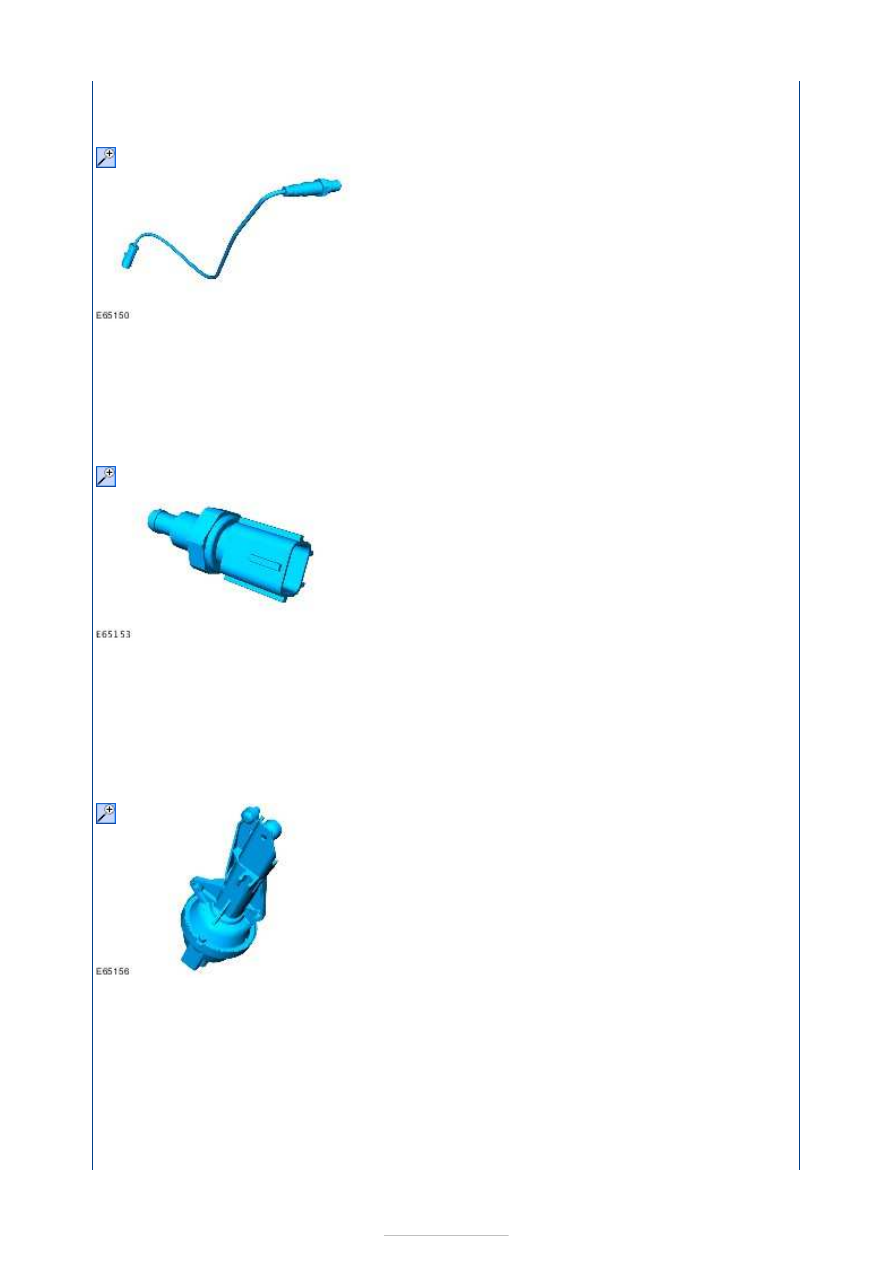
The catalyst monitor sensor is a non-linear characteristic type sensor fitted to the catalytic 
converter. The PCM uses this as it's secondary sensor to measure the oxygen content of the 
exhaust system gasses within the exhaust after they have passed through the catalytic 
converter. As well as providing additional closed-loop fuelling control, the PCM uses this 
information to determine the efficiency of the catalytic converter.  

ECT sensor 

The ECT sensor is screwed directly into the coolant outlet connector and measures the 
temperature of the engine coolant rather than the cylinder head temperature. This is a 
more accurate measurement of the engine temperature and the information is used by the 
instrument cluster for the temperature gauge indication. It is also used by the PCM to 
calculate fuel injection timing and period of injection which will vary dependant on the 
engine temperature. 

IMT valve 

The IMT valve controls the position of the swirl plates located in the intake manifold.  

The IMT valve is controlled by a vacuum operated solenoid which is located on top of the 
intake manifold. The IMT valve is adjusted by the solenoid to the desired settings 
determined by the PCM. 

PCM 


The PCM is attached to the windshield washer reservoir. 

The PCM can be diagnosed through the data link connector (DLC) using the Worldwide 
Diagnostic System (WDS). 

CMP sensor 

The CMP sensor uses the Hall effect principle and is supplied with a reference voltage of 5 
volts. 

If the signal from the CMP sensor fails while the engine is running, the engine continues to 
run using the signals from the CKP sensor. 

If the CMP signal is missing at the next starting operation, it will not be possible to start the 
engine. 

Brake pedal position (BPP) switch and brake light switch 

The BPP switch is connected to the instrument cluster through the CAN bus. 

The BPP switch is closed when de-energized and sends a ground signal to the PCM. 

The brake light switch is connected with the PCM through a conventional electrical 
connector. 

The brake light switch is open when de-energized. When the brake light switch is closed, it 
sends 12 volts to the PCM. 

The signals of the BPP switch and the brake light switch are used if the accelerator pedal 
position (APP) sensor should fail. 

In this instance, the PCM compares the signals of the BPP switch and brake light switch. 

Accelerator pedal position (APP) sensor 


The APP sensor is a double contact-less inductive sensor. 

For safety reasons, the APP sensor consists of two sensors. 

If the APP sensor malfunctions when the vehicle is in operation, a diagnostic trouble code 
(DTC) will be stored in the PCM. 

If one of the sensors in the APP sensor should fail, the engine will operate at reduced 
power. 

If the vehicle is fitted with a driver information system, the fault message "REDUCED 
ACCELERATION" will be displayed. 

If both sensors of the APP switch fail, after a single operation of the BPP switch and the 
brake light switch and then after a plausibility check, the engine is controlled up to a speed 
of 1200 RPM. The vehicle can be accelerated to a maximum speed of 56 km/h (35 mph). 

When the BPP switch and the brake light switch are actuated again, engine speed will drop 
to idle speed. Once the BPP switch and the brake light switch are de-energized again, 
engine speed is increased again. 

If the vehicle is fitted with an information and message system, the fault message 
"REDUCED TOP SPEED" will be displayed. 

If the vehicle is not fitted with an information and message system, the malfunction 
indicator lamp (MIL) will be illuminated to indicate a system fault. 


Electronic Engine Controls - 2.0L Duratec-
HE (107kW/145PS) - MI4/2.0L Duratec-
HE Flex Fuel (107kW/145PS) - MI4 - 
Electronic Engine Controls—Vehicles With: 
Ethanol Capability - Overview

S-MAX/Galaxy 2006.5 (02/2006-)


Print


Description and Operation 

As a general rule, engine management works according to the same principles as for petrol 
operation. The 

PCM (powertrain control module)

, the sensors and the actuators are the 

same for petrol and for ethanol operation E85. For vehicles operated with ethanol, however, 
a fuel type determination and adaptation function is activated. This determines the fuel 
composition and adapts the control mode accordingly. 

Fuel type determination 

The mixture of fuel in the tank can vary from an ethanol share of 0% to 85%. This ethanol 
share is important for the engine management, as it has a strong influence on the engine 
running characteristics and the exhaust gas emissions. To determine the ethanol share in 
the fuel, the 

HO2S (heated oxygen sensor)

 and the fuel level sensor are used. 

Adaptation for ethanol operation 

The optimal fuel-air mixture for ethanol fuel E85 is 9.7 kg air per 1 kg E85. For petrol, the 
optimal fuel-air mixture is 14.5 kg air per 1 kg petrol. Ethanol operation therefore requires 
a richer mixture. To achieve this, injectors with a higher flow rate are used. In addition, the 
ignition time is "advanced", as the speed of transmission of the flame front of ethanol fuel 
E85 is lower. 

The requirements for petrol and ethanol operation are very different, which is why special 
characteristics maps have been saved in the 

PCM

 for both fuel types. 

Errors during fuel type determination and adaptation can have a significant influence on 
fuel consumption and the engine running characteristics. If a leak upstream of the 

HO2S


causes the engine management to change the control mode to ethanol operation, the spark 
plugs may fail due to an excessive fuel supply and the engine will not run satisfactorily in 
the cold state. If the engine management switches to petrol during ethanol operation, the 
engine will run irregularly or will not start. 


Content   ..  449  450  451  452   ..