Ford Galaxy / Ford S-MAX. Manual - part 1088


  Index      Ford     Ford Galaxy / Ford S-MAX - service repair manual 2006 year


Search            


Content   ..  1086  1087  1088  1089   ..


Ford Galaxy / Ford S-MAX. Manual - part 1088
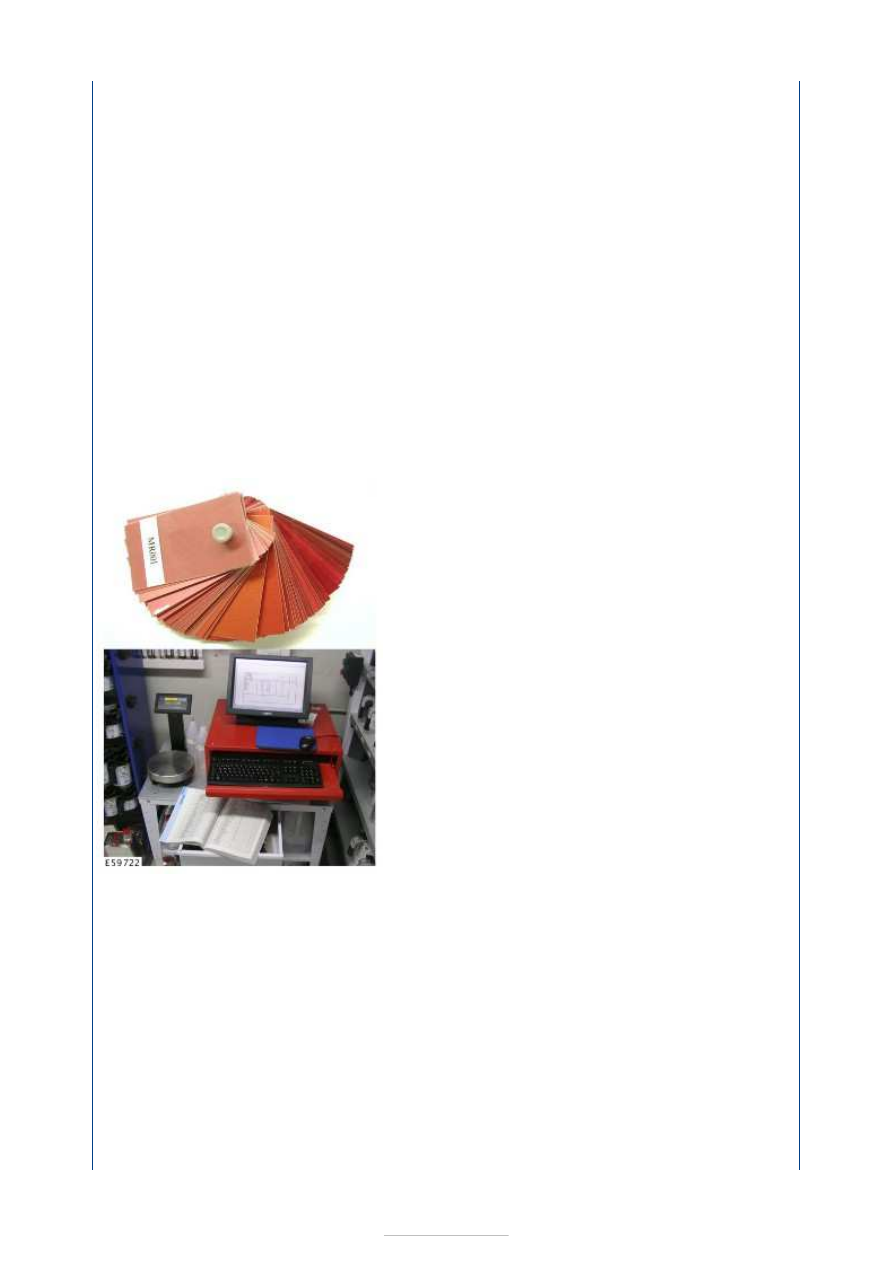


Color shade catalog or color shade system of the repair paint manufacturer. 

The repair paint manufacturers offer a variety of possible systems for the determining the 
production color shade of motor vehicles. There are electronic systems, color card systems 
and manuals for the determination of color shades. 

Most repair paint manufacturers use the following systems:  

A tabular system based on the following parameters: 

Color code 
Make 
Model 
Build year 
Color or color name 
Ancillary codes 

A system with color cards based on the following parameters: 

Make 
Color shade 
Build year 

Because of the many parameters used, in a tabular system the color shade can also be 
determined by the lack of a parameter.  

When using the color cards, emphasis is placed on matching of the original color shade with 
the color shade samples. For this reason this method is very helpful when the other 
parameters are not available. 

Comparison of the results of both methods increases the certainty of using the correct 
original color shade and its formulation. 

Additional certainty can be achieved during color shade determination by making a color 
sample plate. Here it is however important to apply the complete paint structure with base 
paint and clear lacquer onto a sample plate (1) in order to carry out a color shade and color 
coverage test. 

-
-
-
-
-
-

-
-
-


The color shade comparison is done by comparing the vehicle paintwork with the sample 
plate (1). The color coverage test is possible by using the black test stripe (2): If the test 
stripe (2) is still visible after test painting of the sample plate (1), the coverage is not good 
enough. 

By using this determination of the original color shade, the formulation and information on 
any very slight fine adjustments which may be necessary can be established. 

Bare bodyshell plate 

The bare bodyshell plate is located: 

On the hood lock panel.  
Near the type plate. 

The color name is stamped on in the last row. 

Matching tinted filler to the color code  

NOTE: Color samples must always be made from the same materials as the subsequent 
repair painting. Perform color shade matching in the fully hardened state, in natural light 
or under suitable artificial light. 

Various tinted fillers are used during factory painting. In order to achieve the exact color 
shade of the factory applied paint, attention should be paid that the correctly matched 
fillers are used. 

The repair paint manufacturers offer suitable precolored primers. The use of filler color 
cards allows the matching color shade to be determined. 


Paint - General Information - Tips and 
Tricks

S-MAX/Galaxy 2006.5 (02/2006-)


Print


Description and Operation 

Comparing paint structures 

It may happen that an area remains visible, especially when the area of the repair is small. 
The reason for this is the structural variation in the paint surface at the repair location 
compared with the original paint finish. The original paint finish has a slight orange peel 
effect while the repair areas is extremely smooth.  

This effect can be reduced by fine sanding using P3000 of the area around the repair 
location and then polishing.  

Etching substrate 

If the substrate can be etched during the solvent test, suitable preparation must be done. 

Job steps: 

NOTE: Follow the manufacturer specific instructions. 

Sand the damaged area extensively using an eccentric sander and P80 or P120 abrasive 
sheets. Finish off sanding with P150 or P180.  
Remove the sanding dust and clean the area of the damage using silicone remover.  
Apply polyester stopper to the bare panel and to the damaged area.  
Sand the dried polyester stopper to an even surface using P80 - P150. Finish sanding 
using P180 - P240. If required apply more stopper, again only on the bare panel.  
Wet sand the residual old paint finish using P600 - P800. Transitions with P400 - P600. 
Clean with silicone remover.  
Prime bare metal areas with acid primer.  
After the acid primer has been left exposed to the air for the correct evaporation time, 
apply 2-component primer filler in thin layers over the complete repair area, leaving 
enough air exposure time in between coats.  
After the filler has dried, sand wet with P800 or sand dry with P400. Sanded through 
areas must be covered again with 2-component Nonstop filler primer. 

Another possible method of preventing etching of the substrate is to use waterbased primer 
and filler materials. 

Masking the vehicle 

Masking and covering work are among the most important preparations required to achieve 
a high quality paint finish. Paint application onto neighboring components, paint mist and 
sharp paint transitions are quality faults. For this reason it is extremely important to take 
special care and to use suitable masking materials. 

NOTE: When water based paints are used, all materials must be stable towards water. 

Plan the masking work: 

Determine the sequence of masking work. Sometimes after masking film has been 
applied, it is difficult or impossible to reach certain areas.  
Prepare the masking material.  
Start with small difficult areas. 

Pay special attention to the areas of profiled seals, edges, openings and paint transitions.  

Masking tape 

Masking tape is available in various widths for special application areas. In practice 
however, a wide tape has proved best for almost all areas, also taking into account the time 
required for masking work. 

NOTE: Use of differing masking materials is often much more time-consuming. 

Advantages 

Good coverage. Narrower tapes must often be applied in several layers.  
More resistant to tearing.  
Wide tapes can be applied deep into joints and therefore protect from paint mist and 
contamination.  
Removal is often easier. 

Masking film 

Transparent plastic film has become accepted as a practical method to mask large areas of 
a whole vehicle. It can quickly and easily be applied to the vehicle from the roll. 

NOTE: Only mask the vehicle when it is dry. Moisture under the film can lead to matt 
paint in the drying process. 

Using masking film 

Clean the vehicle before masking it.  
Pull the film over the vehicle. Because of the static charge, the film lies on the vehicle 
like a second skin.  
Cut out the repair area using the film knife and then mask it.  

Other ways of masking a vehicle are: 

Masking using masking paper.  
Painting cloth (mostly used during filling work).  

Profiled seals 

If it is not possible to remove a profiled seal, then it must be masked in such a way that no 
edges can form due to paint accumulation. 

To do this, the seal is lifted slightly and masked. The following techniques are possible: 


Description 

Masking tape with plastic strips 

Sealing lip 

Sandpaper with masking tape 

Laying a string or cord under the seal. Suitable for soft and elastic seal lips.  
Special masking tape with plastic strips for hard seal lips.  
Instead of using plastic strips, fine sandpaper cut into strips can be inserted and secured 
using normal masking tape.  
If the seal can be easily displaced, normal masking tape can also be used. 

Item

1

2

3


Part Number

-

-

-


Content   ..  1086  1087  1088  1089   ..