Ford Galaxy / Ford S-MAX. Manual - part 1087


  Index      Ford     Ford Galaxy / Ford S-MAX - service repair manual 2006 year


Search            


Content   ..  1085  1086  1087  1088   ..


Ford Galaxy / Ford S-MAX. Manual - part 1087


(and frequencies). The healthy human eye can recognize wavelengths between 0.36 µm 
(violet) and 0.78 µm (red). 

If all the perceptible wavelengths of the spectrum impinge on the human eye at the same 
time, the impression of white light is produced.  

Additive and subtractive color mixing 

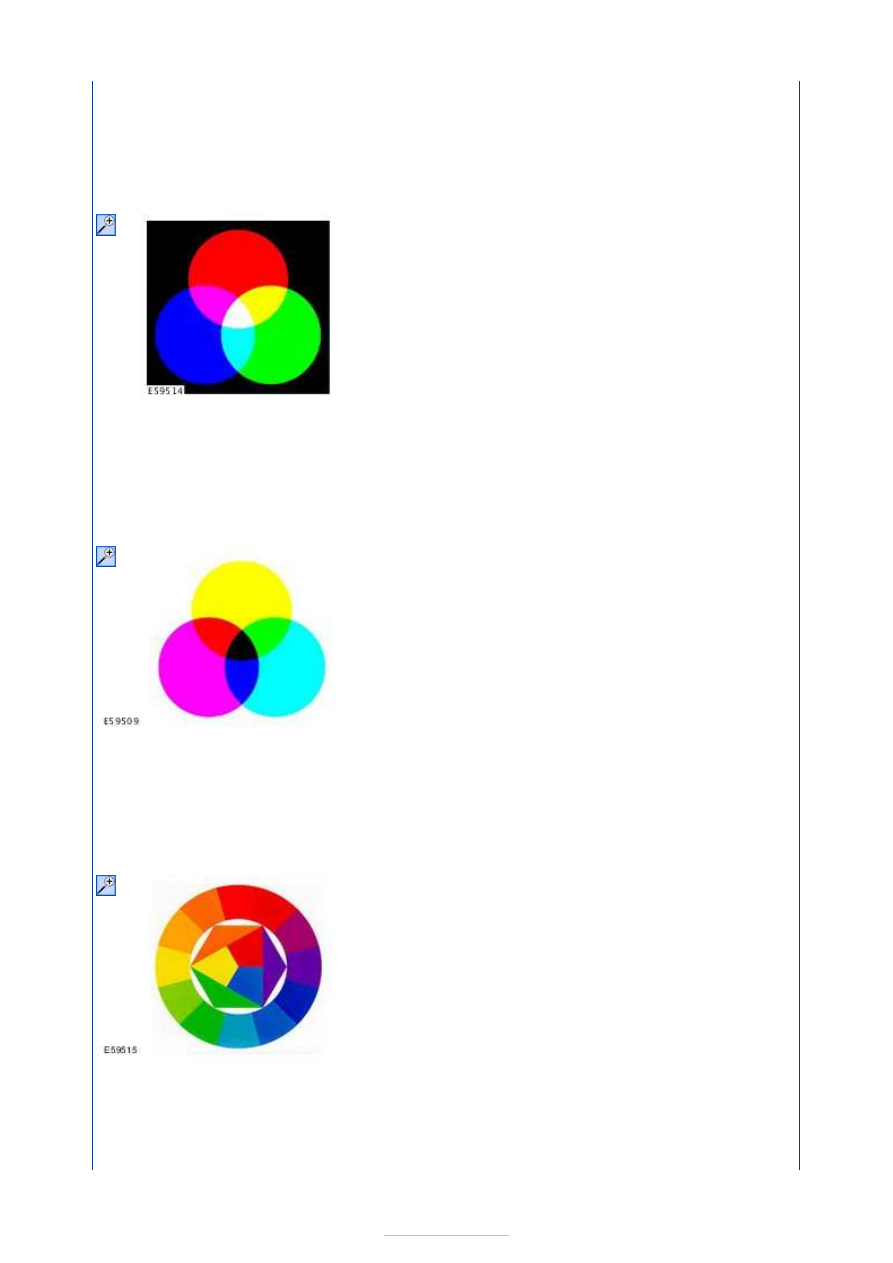
Additive color mixing is the combination of light from different sources to give white. 
Different intensities of the additive primary colors red, green and blue allow millions of 
different colors to be represented (RGB colors). 

Additive color mixing is always therefore used when light should enter the eye directly 
(without reflection off an object). Such as in the case of computer monitors or overhead 
beamers. 

Subtractive color mixing means mixing the primary colors cyan, magenta and yellow to 
form a desired color (CMY colors).  

Subtractive color mixing is used when light should enter the eye of an observer after 
reflection from an object. Such as happens with painting or in printing. 

Oswald color circle 

The Oswald color circle is based on subtractive color mixing, and enables the behavior of 
paints when they are mixed together to be represented. 

Colors lying opposite each other are complementary colors and should not be mixed 
together as this will produce a dull (i.e. grey) shade. If green is added to red, the red 


becomes greyer, not greener. 

Color shades which are side by side are partner colors and produce a mixed color shade. 
For instance, mixing red and blue produces a pure violet. 

In addition, black and/or white may be necessary to produce a particular color shade. 

White makes the color shade lighter.  
Black makes the color shade darker.  
With black and white the color shade becomes more dreary or greyer. 

Metamerism 

Metamerism is the name of the effect which occurs when two colors appear identical in a 
particular light (e.g. artificial light), but the colors appear different under another light 
source (e.g. daylight). 

The cause is the fact that the human brain, aided by the eyes, does not evaluate the 
wavelength, instead it evaluates the spectral intensity of the reflected light. 

It is for this reason that color matching in practice must only ever be performed in daylight, 
or under special artificial light which is based on daylight.  

Metallic and pearl pigments 

Colored paints achieve their color effect by the addition of pigments. Pigments are colored, 
solid, very fine organic and inorganic particles which are insoluble in the binding material. 

Metallic pigments 

Aluminum platelets are added as pigment to form metallic paint.  

Depending on the size and shape of the aluminum platelets, different metallic effects 
can be achieved: 

Cornflake aluminum (1) causes very strong dispersion because of rough edges, low 
brilliance, very low flop and produces grey-silver shades.  
Dollar aluminum (2) causes hardly any dispersion because of the smooth surface, high 
brilliance, produces very light, almost white silver shades. 


With metallic paints however, only a light-dark light reflection effect occurs.  

Colored metallic paints are produced by the extra addition of color pigments to the metallic 
paint. 

Pearl pigments 

The basis of pearl pigments is formed by mica, which is metallized with a silver or gold 
layer. 

Depending on the angles of light and observation, the mica platelets reflect different 
proportions of light. Because of this, the color of the paint appears to the observer to 
change. 

Pearl pigments produce a colored and light-dark reflected light effect. 

Color codes and their determination on Ford vehicles  

It is necessary to determine the correct color shade of the original paintwork in order to 
perform a professional and perfect paint repair.  

The original paint color shade can be found by: 

Inspection of the vehicle type plate with the color code stamped on it. 

Later design 
Earlier design 

Color shade catalog or color shade system of the manufacturer.  
The bare bodyshell plate with color designation. 

Type plate 

Type plate - location on Ford vehicles: 

Right-hand B-pillar - door rebate  
Left-hand B-pillar - door rebate  
Hood lock panel  
Left-hand vertical edge of inner front wing  
Right-hand vertical edge of inner front wing  
Right-hand engine compartment side member  
Left-hand bulkhead  
Right-hand bulkhead  
Luggage compartment interior  
Inner rear panel - luggage compartment 

-
-


The type plate gives the color code in the last row. 

On the newer type plates, the color code is given in the left-hand column, at the 
penultimate position. 


Content   ..  1085  1086  1087  1088   ..