Ford Galaxy / Ford S-MAX. Manual - part 1086


  Index      Ford     Ford Galaxy / Ford S-MAX - service repair manual 2006 year


Search            


Content   ..  1084  1085  1086  1087   ..


Ford Galaxy / Ford S-MAX. Manual - part 1086
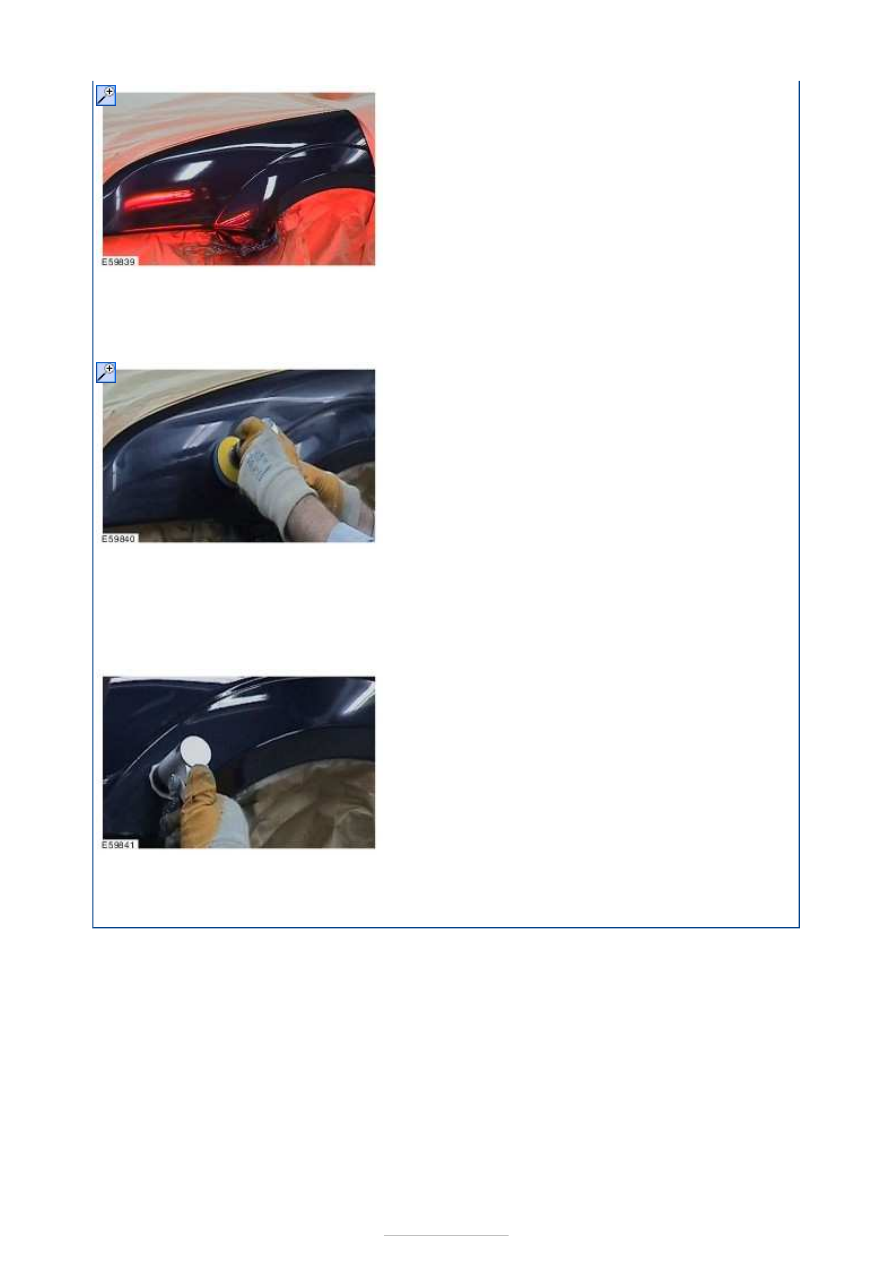


Now dry the clear lacquer according to the manufacturer's instructions using an infrared 
gun.  

Polish 

Polish the component using a polisher and polish and check the polished area for any swirl 
marks which may be present. Polish away any swirl marks which are present. 

Dirt inclusions 

Sand out 

Minor damage can be removed with a small sanding machine or preferably with an 
eccentric sander with P1500 - P2000. Very fine spray mist can be removed using P2000 - 
P4000 paper and a larger eccentric sander. 


Paint - General Information - Corrosion 
Prevention

S-MAX/Galaxy 2006.5 (02/2006-)


Print


Description and Operation 

General 

Although corrosion protection measures and painting processes in production have reached 
a very high technical standard and will be continuously developed further, in the long term 
corrosion on a vehicle cannot be totally avoided. Further demands are therefore made of 
the paint specialist besides his knowledge of normal repainting of vehicles which have been 
repaired after an accident, in addition specialist knowledge is required for assessing and 
rectifying damage due to corrosion.  

During repair painting, take care over the maintenance and re-creation of the corrosion 
protection applied in production, in view of the long-term warranty on Ford vehicles. Only 
those repair materials which are approved by Ford may be used for body repair work and 
repair painting. 

For detailed information on corrosion protection measures during body repairs, please refer 
to chapter 501-25. 

Furthermore, information on corrosion protection measures is repeated in individual 
chapters of the paint manual. 

In particular, pay attention that the layer thicknesses specified in production are 
maintained. The complete system of solid one-layer on galvanized steel panels must equal 
at least 90 µm and the total system of two-layer on galvanized steel panels must equal at 
least 105 µm.  

It is important that sealing operations, as far as they are necessary, should be undertaken 
after the application of the paint to specification, in order to ensure the best corrosion 
protection. All components which form hollow cavities such as pillars, rails, side 
components etc. must be provided with a coating of cavity protection wax. 

Causes of corrosion 

Corrosion of steel is an electrochemical process during which the steel combines with 
oxygen. The following factors lead to corrosion: 

Acidic compounds contained in the air, such as carbonic acid and sulphur dioxide, 
combined with oxygen from the air and/or water. Salts such as sodium chloride used as 
road salt accelerate the corrosion process.  
Mechanical damage such as stone chips and scratches which penetrate through to the 
steel panel.  
Lack of care by the vehicle owner of the painted and corrosion proofed surfaces or areas 
on the vehicle.  
Unfavorable weather or environmental conditions, as may occur in areas with high 
humidity, high salt content in the air or serious air pollution due to aggressive gases and 
dusts.  

In the case of mechanical damage, formation of rust can often be seen, beginning to spread 
into the painted surface from a point (stone chip) or from a line (scratch). If these faults 
are not professionally rectified in good time, the result is rusting through from the outside 
to the inside. Rusting penetration from the inside to the outside occurs when for instance 
the cavity protection was inadequate. 

Operations after painting 

NOTE: The manufacturer's instructions must be followed when working with the various 
corrosion protection materials. 

After painting, treat all cavities in the repair area with cavity protection wax. In doing so, 
pay particular attention to the weld seams. In dead-end applications with a panel insert, 
the cavity protection wax must be applied so that it also reaches the area of the panel 
insert.  
Seals which were applied in production and not over painted must be reapplied. Seals 
protect vulnerable parts of the bodywork, keep moisture away, reduce wind and road 
noise and dampen vibrations.  
Apply transparent wax. 

Definition of the degree of rust 

In workshop practice, in order to be able to carry out a consistent and objective evaluation 
of the scope of the damage, a degree of rust on the scale of 1 to 5 is determined by the 
DIN 53 210 standard. The main criterion here is the extent to which rust exists under the 
paint structure. It is determined in millimeters (mm). 

Underlying rust grade: R1 < 1 mm 

Corrosion starting with up to 1 mm of rust underlying (in the form of a spot or a line).  

The damage can be rectified by cleaning the defective location and mechanically removing 
the underlying rust. For a small extent, apply a primer using a brush and allow it to dry. 
Touch-up the location with a paint pen or provide a new paint coating.  

Underlying rust grade R2 < 1 - 2 mm 

Advanced corrosion with up to 2 mm underlying rust. 

Rectifying the damage: 

Clean the defective location.  
Remove the underlying rust mechanically down to the paintwork carrier.  
Apply 1-component filler and then 2-component "Vario" filler.  
Provide the damage location with new paint coat on visible outer surfaces. Only locally 
touch-up areas which are not optically conspicuous.  

Underlying rust grade R3 < 2 - 4 mm 

More advanced corrosion with up to 4 mm underlying rust. The damage must be rectified in 
the same way as for R2. A permanent cure of this type of damage pattern is still just 
possible 

Underlying rust grade R4 < 4 - 5 mm 

Notably advanced corrosion with up to 5 mm underlying rust. The damage must be rectified 
in the same way as for R2. If it is found that for whole areas this is only possible with a 
great deal of work, or is not possible at all, then a new component must be used.  

Underlying rust grade R5 > 5 mm 

Extreme corrosion, with more than 5mm underlying rust (panels, flanges or load-bearing 
components partially rusted or rusted through).  

Such damage can no longer be repaired because in many cases the constructional strength 
of the component can no longer be produced. The risk in making a repair is too great. 
Install a new component and paint it. 

Paint - General Information - Color 
Identification and Chromatics

S-MAX/Galaxy 2006.5 (02/2006-)


Print


Description and Operation 

Basic color theory 

In order to achieve optically perfect painting results it is vital to understand the physical 
principles of the origin of color impression. 

Color 

Color itself is a sensory perception. 

This perception arises through the combined effect of the following components: 

Light (sunlight or artificial light irradiates the object).  
Surface of the object (reflection from the object of certain constituent parts of the light).  
Eye (perception of the reflections from the object). 

Because the sensory impression of color is produced by all three of these 
components, it is dependent on the type, quality and function of the individual 
components. Practical examples make this clear: 

If a particular article is subjected to artificial light, then it gives a different impression of 
color to that which it gives in sunlight.  
An object with uniform color but different surface textures appears to have different 
colors (grained or ungrained dashboard).  
A person with perception disorder (colorblindness) cannot recognize certain colors or 
distinguish between them e.g. red-green weakness).  

In turn the type of color is determined by the light absorption ability of an object. Light 
shines with all color components (spectral colors) onto an object, certain components of the 
light are absorbed (taken in) and other components are reflected (sent on). The 
components which are reflected produce the specific color impression.  

The colors as we see them are the result of a combination of reflected colors from the 
spectrum. Physically speaking, these are electromagnetic waves with different wavelengths 


Content   ..  1084  1085  1086  1087   ..