Ford Galaxy / Ford S-MAX. Manual - part 1089


  Index      Ford     Ford Galaxy / Ford S-MAX - service repair manual 2006 year


Search            


Content   ..  1087  1088  1089  1090   ..


Ford Galaxy / Ford S-MAX. Manual - part 1089
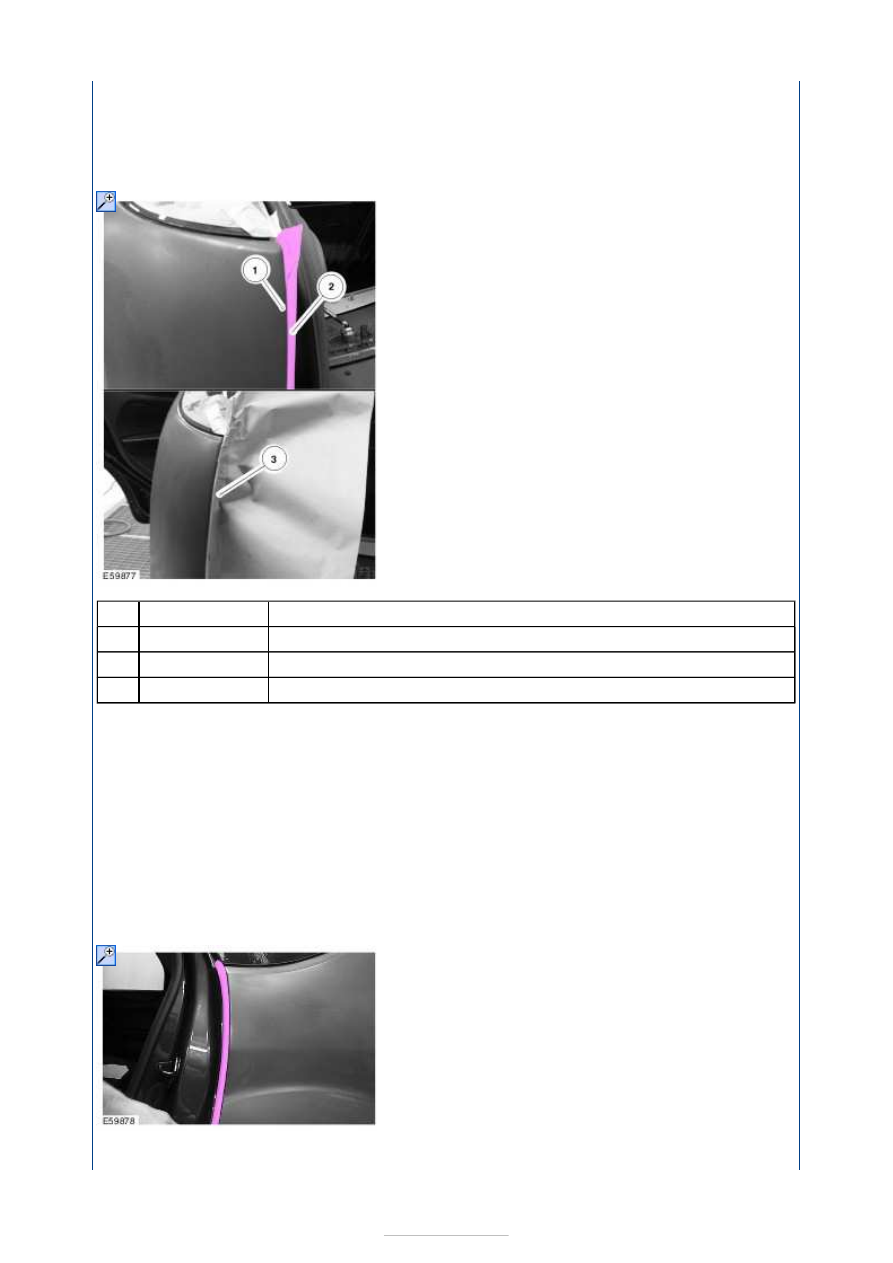


Edges/openings 

Smooth paint transitions can be produced by positioning adhesive tapes.  

NOTE: Pull the adhesive tapes away immediately after the paint has been applied and 
check the paint transitions. 


Description 

Vehicle edge 

Adhesive surface 

Masking paper 

Possible variations 

At edges apply one strip of masking tape half on the area not to be painted and mask 
using a second strip.  
On surfaces, two masking strips can be attached, each affixed by half their adhesive 
surface. The adhesive strip which arises is then applied with one half on the edge of the 
area to be painted. The other half is aligned and fixed in addition in the curves.  
Affix masking paper on one side over the area to be painted. Double back the masking 
paper and secure it.  
Affix round profiled foam at the edge of the area to be painted using masking tape.  

Foam strips are suitable for affixing to openings such as door gaps. 

NOTE: Choose a suitable profile diameter. A profile which is too thick will protrude from 

Item

1

2

3


Part Number

-

-

-


the opening, one which is too thin will leave a gap.  

Clean the door opening well and affix the matching shape. 

Color shade problems 

If a vehicle color shade is taken from a vehicle on a hot summer day and the mixed color 
applied, this may cause color shade problems. Some colors change so much at higher 
temperatures that it can lead to an incorrect result. Red color shades are particularly prone 
to this shade behavior. 

This means that color determination should always be done on the bodywork when it is at 
about the same temperature as the later working temperature will be. The best 
temperature of the item is between 15° and 25° C. 

Isopropanol and water 

Painted surfaces are very easily cleaned using a mixture of 70% water and 30% 
isopropanol (can be obtained through a laboratory supplies specialist or a pharmacist). 

Temperature reduction spray 

If finishing work must be performed on touched-up surfaces and newly painted plastic 
parts, problems may arise. The paint and the transitions are not yet fully hardened. 

NOTE: When working with the polishing machine, make certain that each operating run 
lasts no longer than about 5 - 10 seconds, in order to prevent the paint becoming warm. 

Even so, in order to be able to polish over transitions, temperature reduction spray must be 
applied to the surface. The transition area is then alternately sprayed and polished until a 
perfect transition surface is achieved. 

Paint faults on soft plastic components where elasticizer additive has been used in painting 
must be wet sanded using grade P2000 - P2500 paper. 

In doing this the sanding location and the surroundings are sprayed with temperature 
reduction spray and the paint faults sanded out by hand. Afterwards the location is polished 
as described above. 

Paint plane 

Dirt inclusions and paint runs can be removed with the sanding cylinder ("Finiball") and 
hand sanding or eccentric sander in a wet sanding process.  

Another practical tool for removal of paint faults which lie proud of the surface is the paint 
plane. 

NOTE: Guide the tool carefully with the minimum of force. It must not tilt, otherwise 
more serious damage may easily be caused. 

This tool allows paint faults to be carefully removed in shavings. Afterwards the surface 
must be polished using suitable materials. 

Shading 

Even when all the rules, steps and corresponding instructions have been followed 


concerning possible shades, it may happen that the mixed color shade does not exactly 
match the vehicle color. 

In these cases, shading must be done. Because there is no fixed formula for this, 
experience and a trained eye are important. Some rules must be followed for shading. 

NOTE: Self-made color sample plates of the current colors are very helpful for 
determining the color shade. Refer to the chapter Color Determination and Color Theory.  

When shading, if possible only use the paint mixture that is also allotted in the color 
shade formula.  
Observe the rules concerning contrary colors (complementary colors) and partner colors 
according to the Oswald color circle.  
Complementary colors are not recommended during shading because they mutually 
inhibit and lead to muddy mixtures.  

Sanding marks 

In certain circumstances, the recommended sanding methods up to now are no longer 
suitable for light metallic color shades. Wet sanding with grade P1200 paper or a grey 
sanding pad can cause sanding scratches which can become very visible under certain 
lights.  

In order to achieve an excellent paint result on difficult color shades, follow these working 
rules:  

Sand filler as before, rub down area to be painted with 3M ultra fine matting sponge and 
3M matting gel.  
Sand filler as before, rub down area to be painted with soaked 3M wet sand paper P1500 
- P2000.  
Sand filler as before, rub down area to be painted with 3M 260 L P1000 eccentric 
(Interface Pad).  

Improving touch-up work 

During application of special effect base paints, the effect particles align themselves exactly 
parallel to the surface in the paint layer while it is still liquid. This means a particular 
thickness of the paint layer is required. 

Because during painting the layer thickness in the transition zones reduces from normal to 
zero, the effect particles can no longer align themselves. This leads to lighter, darker or 
cloudy zones. 

If 1-component clear lacquer is sprayed before the base coat, this effect is prevented. An 
optically perfect transition will result. 

Uni-Body, Subframe and Mounting System - 
Front Subframe

S-MAX/Galaxy 2006.5 (02/2006

Removal and Installation 

Special Tool(s) 

General Equipment 

Removal 

NOTE: Removal steps in this procedure may contain installation details. 

204-607 
Remover, Ball joint 

205-316A 
Alignment Pins, Subframe 

Transmission jack

1. Refer to: 

Lifting

 (100-02 Jacking and Lifting, Description 

and Operation). 

2. If equipped. 

3. If equipped. 

4.  


Content   ..  1087  1088  1089  1090   ..