Ford Galaxy / Ford S-MAX. Manual - part 1078


  Index      Ford     Ford Galaxy / Ford S-MAX - service repair manual 2006 year


Search            


Content   ..  1076  1077  1078  1079   ..


Ford Galaxy / Ford S-MAX. Manual - part 1078


of micro-droplets of paint. 

Types of spray gun 


Description 

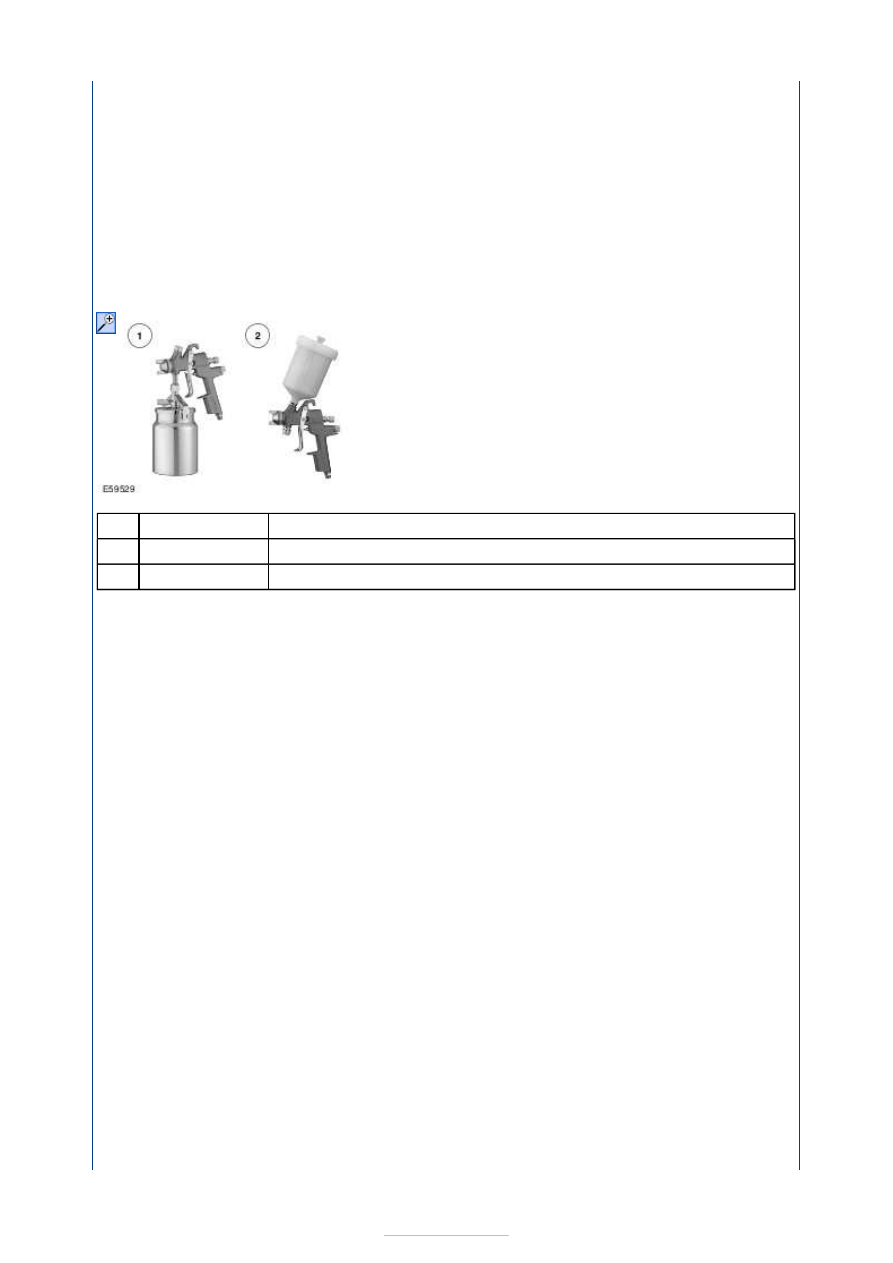
Suction-beaker spray gun 

Flow-beaker spray gun 

In the flow-beaker spray gun, the paint container is mounted above the spray gun. On the 
suction-beaker spray gun, it is below. 

Furthermore, spray guns are categorized by their air pressure requirement into high and 
low pressure guns. 

High pressure guns have the disadvantage that they exhibit high consumption of energy 
and materials. The spray pressure they require is between 1 - 6 bar. 

Because of the high air pressure and the large amount of air needed, the result is a 
powerful paint mist formation (paint transfer rate approx. 35%).  

Current practice is mainly to work with reduced mist spray systems (RP and HVLP 
systems).  

Reduced pressure (RP) guns are optimized high pressure guns which have an input 
pressure at the gun of approx. 2.5 bar and an atomization pressure at the air cap of 1 - 2 
bar. In practice this spray technology is preferred for spraying clear lacquer because of the 
finer atomization. 

Low pressure guns have the advantage that they exhibit minimal paint mist formation and 
because of this the paint transfer rate rises to approx. 65%. The spray pressure required in 
this case is between 1 - 5 bar. Nozzle sizes from 1 - 2.2 mm can be used. 

HVLP spray guns 

Item

1

2


Part Number

-

-


Description 

Quantity control 

Working pressure control 

Spray pattern control 

The high volume low pressure (HVLP) spray gun is a high performance spray gun which 
forms a soft, fine and homogenous spray pattern. The atomization pressure at the air cap is 
0.7 bar when the input pressure at the gun is 2.0 bar. 

The low atomization pressure of 0.7 bar together with greatly reduced spray mist provide 
high material ejection. The low nozzle internal pressure minimizes rebound of the paint 
droplets from the object and thus the proportion of overspray.  

This spray technology has a very high application efficiency. By matching the size of the 
nozzle, the HVLP spray gun can be used for all repair painting materials.  

HVLP spray guns are often used in practice for the application of water based paints. 

Mini spray guns are often used for small, localized touching-up work. Use of HVLP spray 
technology and nozzle sizes of 0.3 - 1.2 mm permits very fine work, so that the area of the 
repair can be kept as small as possible. 

In order to ensure that a spray gun operates efficiently for a long time, careful cleaning is 
absolutely vital after use.  

NOTE: During cleaning you must distinguish between water based and solvent based 
materials.  

Cleaning by hand: 

Empty the paint beaker immediately after use.  
Flush the gun with cleaner.  
Clean it inside and outside with a brush.  
Dismantle the gun to clean it thoroughly.  
Clean the air cap using a suitable brush.  
Use nozzle cleaning needles to clean bores and nozzles. 

A spray gun washing machine is recommended if the painting work is highly intensive. 

Item

1

2

3


Part Number

-

-

-

New types of paint processing systems are replacing the conventional mixing beaker, filter 
and spray gun flow beaker. This reduces the amount of solvent required for cleaning and 
the amount of routine waste which remains. 

Paint preparation system (PPS) 


Description 

Beaker 

Color bag 

With this system, which is suitable for both suction and flow beaker spray guns, only one 
beaker is required for mixing and painting.  

A bag is inserted in the beaker, in which paint can be mixed, processed and stored after 
use or completely disposed of. 

The small quantity of paint remaining in the gun is removed using a minimum quantity of 
solvent from the pipette bottle.  

The amount of cleaner used is reduced because only the spray gun needs to be cleaned.  

Hand and machine sanding tools 

Sanding is used to prepare a surface for application of a paint layer, enabling it to adhere 
well. Sanding materials have a great influence on the quality of a repair paint finish. The 
correct sanding medium must therefore be chosen for every material.  

During sanding, material is mechanically removed from a surface. 

In the paint shop, carborundum or silicon carbide abrasive on a substrate of paper or cloth 
are the most common sanding materials used.  

Carborundum is a very hard mineral consisting mostly of aluminum oxide. During use 
carborundum becomes blunt and wears away. 

Silicon carbide has a very high degree of hardness, but is more brittle than carborundum. 
When silicon carbide is used, the mineral grains break. New long and pointed profiles are 
formed. 

Use of the correct sanding paper depends on the application, the substrates and the tools 
used. The following table can be used as a guideline, but the recommendations of the 

Item

1

2


Part Number

-

-

supplier of the auxiliary materials and additive materials must be followed.  

Soft Pads are recommended for manual refinishing of contours, curves and difficult to reach 
areas. On a Soft Pad the abrasive is found on a coarse structured fleece. Because of this, it 
is very flexible, does not kink and does not slip in the hand. This enables a fine and even 
finish to be achieved. 


Description 

Extraction bores 

Connection for extraction equipment 

Notes on working with sanding tools: 

Tools with a rigid backing pad do not adjust to fit the surface. They are used for flat 
surfaces.  
Tools with a flexible backing pad are used for fine sanding of a surface because they 
adjust to the shape of the surface.  
Build up an even working pressure over the sanding surface.  
Keep the sanding paper tight on the tool (use self-gripping systems).  
Align the extraction holes in the sanding paper with the holes in the tool.  
Guide the tool flat over the surface to be worked. Do not tilt it. 

Hand sanding can be carried out dry but also wet. Wet and dry paper with particle size P 80 
to P 1200 is used for this in the paint field. 

Application

Working area

Grade

Sanding system

Body work, corrosion 
damage

Equalizing paint system 
transition

to P150

Orbital sander, 
dry
Hand sanding, dry

Stopper

Rough sand

P80 - P150

Orbital sander, 
dry

Fine sand

P240 - P320 Orbital sander, 

dry
Hand sanding, dry

Spray stopper

Rough sand

P120 - P180 Orbital sander, 

dry

Fine sand

P240 - P320 Orbital sander, 

dry
Hand sanding, dry

Filler sanding work

Filler fine sand

P400 - P500 Orbital sander, 

dry

P800 - P1200 Hand sand, wet

Top coat

Old paint

P400 - P500 Orbital sand, dry

P800 - P1200 Hand sand, wet

Touch-up paint surfaces

P1000 - 

P2000

Hand sand, wet

Paint damage

Sanding out faults

P2000 - 

P3000

Hand sand, wet

Item

1

2


Part Number

-

-


Content   ..  1076  1077  1078  1079   ..