Ford Galaxy / Ford S-MAX. Manual - part 1079


  Index      Ford     Ford Galaxy / Ford S-MAX - service repair manual 2006 year


Search            


Content   ..  1077  1078  1079  1080   ..


Ford Galaxy / Ford S-MAX. Manual - part 1079
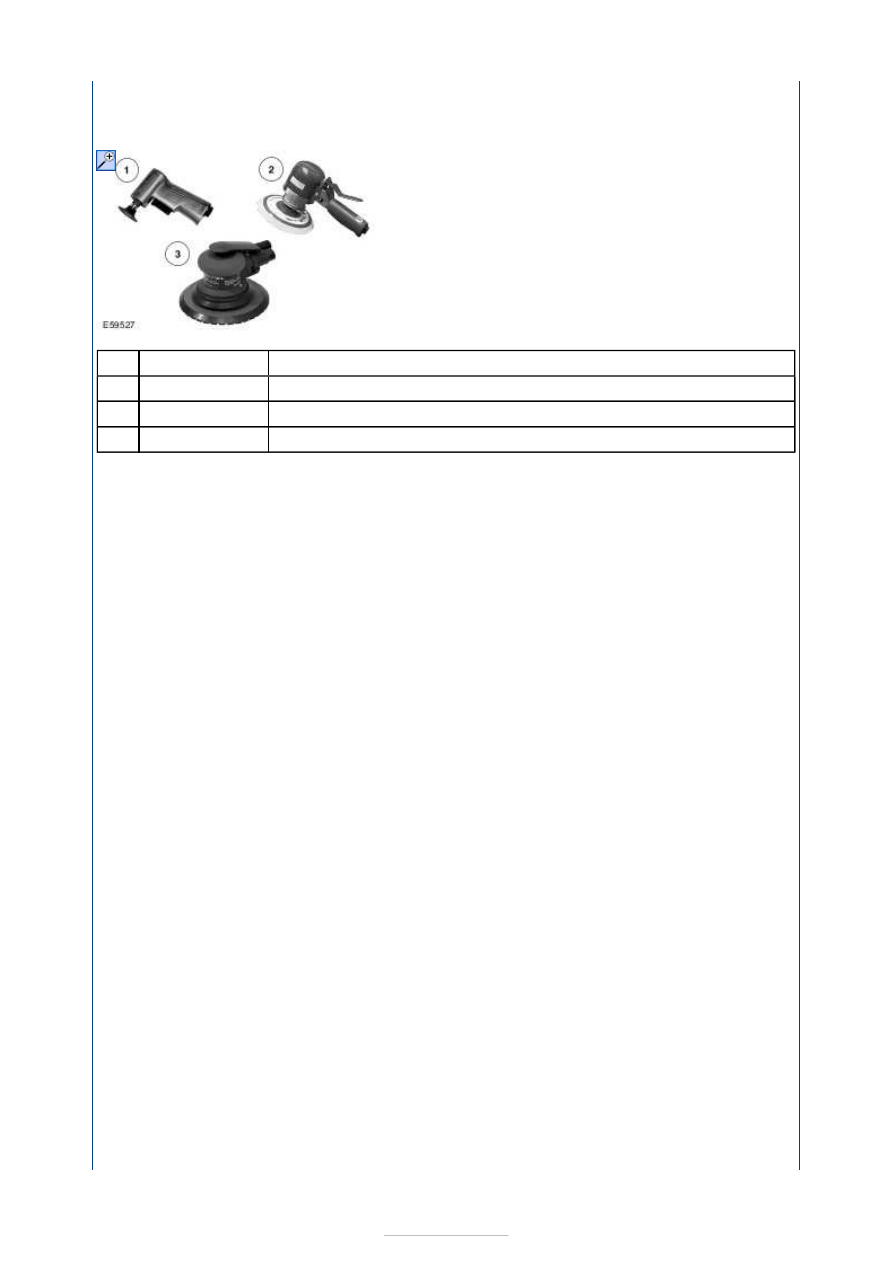


Ways of sanding 

Sanding tools are driven either by electricity or compressed air. 


Description 

Sanding machine 

Polishing machine 

Orbital sander 

The disadvantage of electrically driven machines is that their own weight is high compared 
with pneumatic systems. They also become warm during work. They do not however need 
any special operating equipment for their energy supply. 

Sanding machines are categorized by their type of sanding movement.  

Rotational sanders 

On these machines the sanding paper turns. 

Advantage: 

Ideal for heavy sanding work. 
Fast and aggressive sanding possible.  

Disadvantage: 

Large amount of heat developed. 
Difficulty sanding flat surfaces.  

Application: 

Removal of old paint layers. 
Preparation of panel for stopper.  
Removal of rust. 

Oscillating sander 

On these machines the sanding paper oscillates. The backing pad is rectangular. 

Advantage: 

Large sanding surface. 
Ideal for large and flat surfaces. 

Disadvantage: 

Hardly useable on rounded surfaces. 
Flexible backing pad not possible. 
Vibrations because of the poor support of the backing pad. 

Application: 

Sanding of polyester stopper. 
Sanding processes on flat surfaces. 

Orbital sander 

On these machines the sanding paper turns and oscillates. 

Advantage: 

Item

1

2

3

-
-

-
-

-
-
-

-
-

-
-
-

-
-


Part Number

-

-

-

Easy to handle and good sanding power. 
Minimal heat development. 

Disadvantage: 

Not suitable for sanding stopper on flat surfaces. 
Smooth guidance important, otherwise sanding marks will occur. 

Application: 

Sanding of paint layers. 
Well suited for final preparation of a primer. 

NOTE: Comply with the manufacturer's recommendations when setting the orbital sander. 

On the orbital sander, stroke settings of approx. 3 mm for fine sanding work and approx. 5 
- 7 mm for coarse sanding work have been established. 

Polishing and finishing tools 

The term polishing in the context of paint repairs means the elimination of paint flaws and 
high shine polishing of neighboring parts. 

During polishing the fine sanded surface is returned to a high shine using a special abrasive 
polish. 

Before the actual polishing, all flaws in the paint surface must be removed and the following 
working procedures must be adhered to: 

Thoroughly clean the vehicle.  
Remove spray mist from all surfaces.  
Sand out and polish particle inclusions.  
Sand down paint runs and polish them out.  
Examine the exactness of the color match in daylight.  
Remove masking edges.  
Remove sanding water, sanding dust and polish residues. 

After the polishing process the results must be tested using a special test spray. 

Infrared drying technology 

The drying process in a painting/drying cabin occurs through heat conductance 
(convection). When an infrared dryer is used, the drying process is through heat radiation.  

The infrared rays penetrate the air and the paint layer without warming them. Because the 
infrared rays are reflected from the steel panel, the paint coat is warmed from the inside 
outwards.  

Advantages of infrared drying: 

The drying process occurs from the inside to the outside.  
The drying time is shorter than for warm air systems.  
Because the infrared dryer consists of several cassettes which can be switched on 
independently, the drying area can be optimally controlled.  

Independent of the manufacturer's instructions, pay attention to the following: 

-
-

-
-

-
-


Flash-off time of the paint before switching on the infrared dryer.  
Distance between the infrared dryer and the surface.  
Duration of the irradiation. 

The most common use of the infrared dryer is to dry stopper and primers. The wait time 
between the job steps is shortened without having to use the painting/drying cabin.  

The painting/drying cabin can then be used exclusively for application and drying of 
topcoat. 

There are two types of infrared dryer: 

Infrared dryer with short wavelength radiation.  
Infrared dryer with medium wavelength radiation. 

As an indication, the following drying times are listed for some materials (at 80 cm 
distance): 

NOTE: Observe the material manufacturer's and supplier's specifications. 

Polyester stopper 2 minutes.  
Spray stopper 2 to 7 minutes.  
Water based primer-filler 7 to 9 minutes.  
Primer 3 to 8 minutes.  
Top coat 7 to 10 minutes. 

Air dryers 

The air dryer is suitable in places where drying needs to be done, but without great outlay 
(painting/drying cabin or infrared dryer).  

NOTE: Air from the compressor is often too cold for effective drying.  

Air dryers use the venturi effect to blow the warm ambient air over the paint surface in a 
gentle air flow.  

Paint mixing system 

Because of the many different color variants, it is now seldom possible to store all color 
shades as ready-made mixtures.  

For this reason, vehicle manufacturers make the mixture proportions of their paints 
available as color codes. The required color shade can be obtained from the paint mixing 
system using this color code.  

All the color components are combined according to their proportions by weight using a 
precise computer scales to produce a finished color shade. 

Painting cabin 

The air requirement in a painting cabin is large. The outside air which is drawn in must be 
passed through filtering and warming equipment. This particularly applies during colder 
times of the year and especially for combined types of building where the painting cabin is 


also used as a drying cabin. 

It is primarily used to keep the air free of dust. At the same time, explosive solvent-air 
mixture concentrations are prevented  

NOTE: Vacuum will lead to contamination of the newly applied paint. The outside air flows 
through door gaps, wall joints and other openings and as it does so, brings dust deposits 
with it.  

The air supply quantity depends on the size of the painting space and the quantity of 
extracted air. Enough air must be supplied to cause positive pressure in the painting space. 
An air extraction : air supply ratio of about 1 : 1.05 is sufficient. 

The filters should have a dust-removal grade of not less than 99.8% and must always be 
kept clean. 

It is especially important that the air supply does not cause strong air currents in the 
painting cabin. If not, the following problems could occur: 

Paint contamination cause by paint mist, which persists in air eddies and gradually falls 
on the fresh paintwork.  
Flow problems in the paint because of the high speed of the air, causing the paint to 
thicken very quickly on the surface.  
Loss of gloss and wrinkle formation because the surface dries too fast.  
Painter disturbance while working. 

In modern paint cabins the air supply is provided from the complete surface of the ceiling. 
The air speed should be 0.3 m/sec (measured in the unrestricted cross-section of the spray 
cabin). At the same time, the air in the cabin should change about 350 times per hour. 

Air extraction is best achieved through extraction channels in the floor of the painting cabin. 

NOTE: Refer to the manufacturer's specifications for the operating instructions, safety 
instructions and notes on the maintenance of a paint cabin.  

Smooth walls in the paint cabin should prevent dust deposits. Regular cleaning is necessary 
however. 

Special easily washed adhesive-bonding paint can be applied to the walls to protect the 
cabin from paint mist. 


Content   ..  1077  1078  1079  1080   ..