Ford Galaxy / Ford S-MAX. Manual - part 1077


  Index      Ford     Ford Galaxy / Ford S-MAX - service repair manual 2006 year


Search            


Content   ..  1075  1076  1077  1078   ..


Ford Galaxy / Ford S-MAX. Manual - part 1077
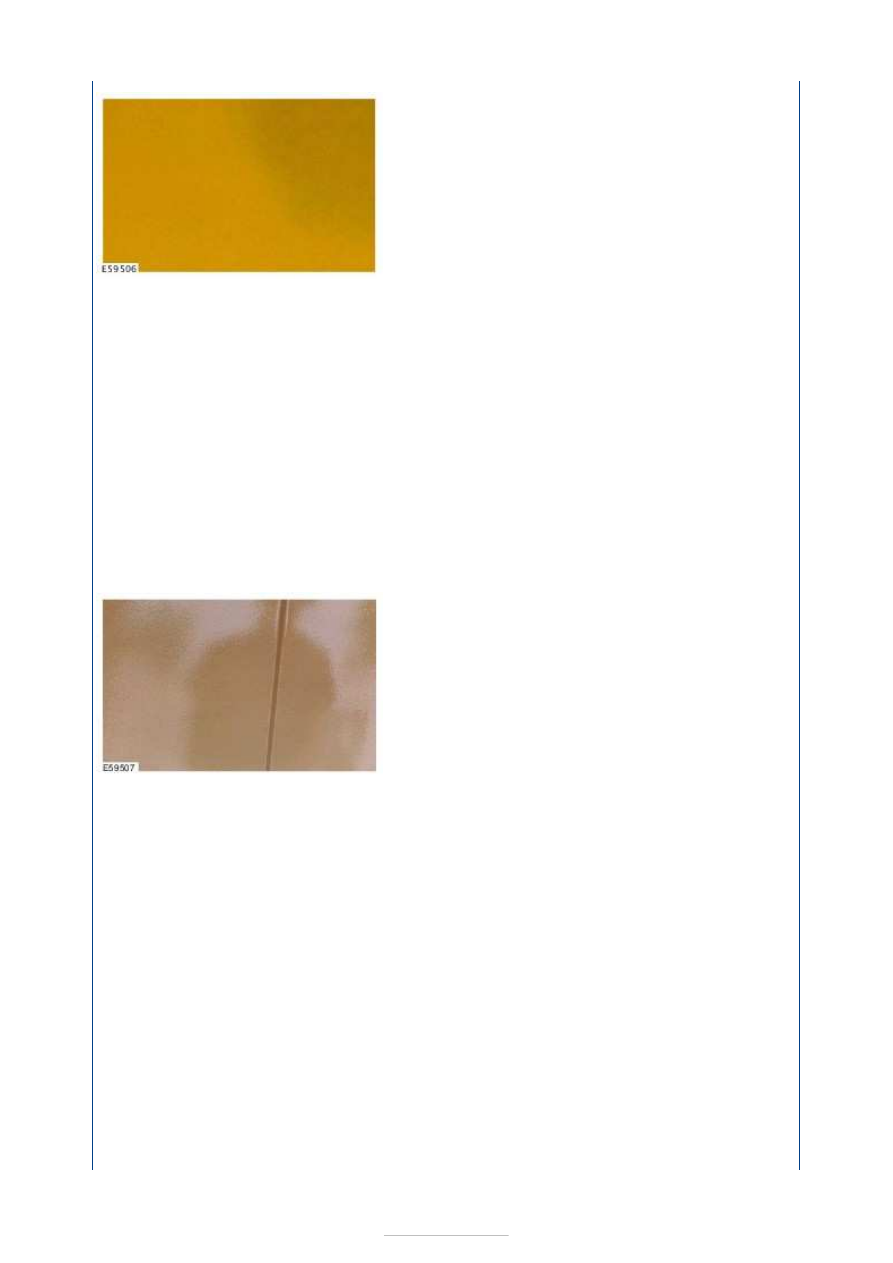


Repair of damage: 

Sand surface and recreate the paint finish. 

Flow problems/orange peel  

Surface structure bumpy, grained. The surface is similar to the peel of an orange. 

Cause/damage pattern:  

Paint viscosity too high.  
Use of fast evaporating, highly volatile thinners.  
Booth temperature too high.  
Spray gun distance too great, too little material applied.  
Nozzle too large.  
Incorrect spray pressure. 

Repair of damage: 

Small surfaces: fine sand and polish.  
Sand out the surface and recreate the paint finish. 

Dirt embedded in metallic base paint. 

Inclusions of contamination in metallic base paint, of different sizes and shapes (grains or 
lint).  

Cause/damage pattern:  

Dust was not properly removed from the surface to be painted.  
Paint material not sieved.  
Function of the painting facilities not optimum.  
Filter contaminated.  
Wearing unsuitable clothing. 

Repair of damage: 

Sand and repaint. 


Dirt embedded in top coat 

Inclusions of contamination in top coat or under paint layers, of different sizes and shapes 
(grains or lint). Optical adverse effect. 

Cause/damage pattern:  

Dust was not properly removed from the surface to be painted.  
Paint material not sieved.  
Function of the painting facilities not optimum.  
Filter contaminated.  
Wearing unsuitable clothing. 

Repair of damage: 

Single inclusions: after thorough hardening, sand out using 1200 - 1500 grade paper and 
repolish using a suitable silicone-free sanding or painting paste.  
Large area contamination: sand and repaint. 

Water marks 

Ring shaped marks appearing on the paint surface. 

Cause/damage pattern:  

Evaporation of water droplets on freshly painted and not yet fully hardened paint finishes 
(mostly only found on horizontal surfaces).  
Layer too thick.  
Drying time too short.  
Hardening faults or hardener no longer useable.  
Use of unsuitable thinners. 

Repair of damage: 

Rub down only slight marks with sanding paper grade P1000 - P1200 and then polish.  
For heavy marking, sand the surface matt, clean with silicone remover and repaint.  

Paint runs 


Wave-like paint run tracks in top coat or in an intermediate layer on vertical surfaces. 
Mostly in the area of swage lines, seams or openings (there they are paint runs, otherwise 
curtains).  

Cause/damage pattern:  

Uneven paint application.  
The specified viscosity was not complied with.  
Use of unsuitable thinner materials.  
Air, material or room temperature too low.  
Layers too thick.  
Spray gun (nozzle) not perfect. 

Repair of damage: 

After thorough drying, sand unevenness flat, if necessary leave to dry afterwards.  
Small areas of damage can be equalised using the paint plane, then sand, polish or 
repaint.  

Swirl marks 

Three dimensional appearance in the paint surface in the form of smears or blotches. This 
effect is intensified in direct sunlight. 

Cause/damage pattern:  

Polishing using polishing machine on paint which has not yet hardened throughout.  
Polishing intervals too long or none at all.  
Pressure too high while polishing.  
Incorrect polishing material or polishing tool.  

Repair of damage: 

Allow the paint to harden completely and then polish.  
If the damage is irreversible, rub down and apply new clear lacquer.  


Paint - General Information - Tools and 
Equipment for Paint Repairs

S-MAX/Galaxy 2006.5 (02/2006-)


Print


Description and Operation 

General work equipment 

In the repair paint shop there is a range of painting tools which make the work of the 
painter easier and improve the quality of the repair paintwork.  

Among these are small tools which are used for the following work:  

Measuring beakers to measure and mix various paint materials.  
Measuring rods with which the required combination amounts of paint and primer filler 
are gauged and mixed.  
Viscosity measuring beaker with a calibrated opening of 4mm, used to set the correct 
paint viscosity.  
Paint filter/paint sieve for filtering foreign bodies out of mixed paint or primer. Care 
must be taken that the correct filter is used for each paint.  
Color sample plates onto which the mixed paint is applied, and the shade is then 
compared to that of the vehicle. Other aids which should help the painter to find the 
correct shade are color sample cards and color panels, which are offered by many 
paint manufacturers.  
Dust bonding cloths which are impregnated with a tacky resin and which pick up dust 
particles particularly well. A surface to be painted must be cleaned with a dust binding 
cloth immediately before paint is applied.  
Compressed air guns are used to remove sanding residues and to dry sanded surfaces. 

Filler and spray guns 

NOTE: Regular maintenance, cleaning after use and careful handling of all individual parts 
of the spray gun are essential for a high-quality paint finish.  

The spray gun is the most important implement in the paint shop. Application of paint using 
the spray gun can produce a layer with absolutely constant thickness and a smooth paint 
surface. 

Principle of operation 


Description 

Air supply 

Paint supply 

Nozzle needle 

Because of the construction design and with the aid of compressed air, a spray-ready paint 
mixture is dragged out of the container to the nozzle by the venturi effect, and is applied to 
the surface being worked.  

When the trigger of the spray gun is pressed to the first pressure point, only the 
compressed air passage opens. If the trigger is pressed further, the nozzle needle displaces 
and the air stream drags paint with it at high speed. This produces a spray mist consisting 

Item

1

2

3


Part Number

-

-

-


Content   ..  1075  1076  1077  1078   ..