Ford Galaxy / Ford S-MAX. Manual - part 1076


  Index      Ford     Ford Galaxy / Ford S-MAX - service repair manual 2006 year


Search            


Content   ..  1074  1075  1076  1077   ..


Ford Galaxy / Ford S-MAX. Manual - part 1076
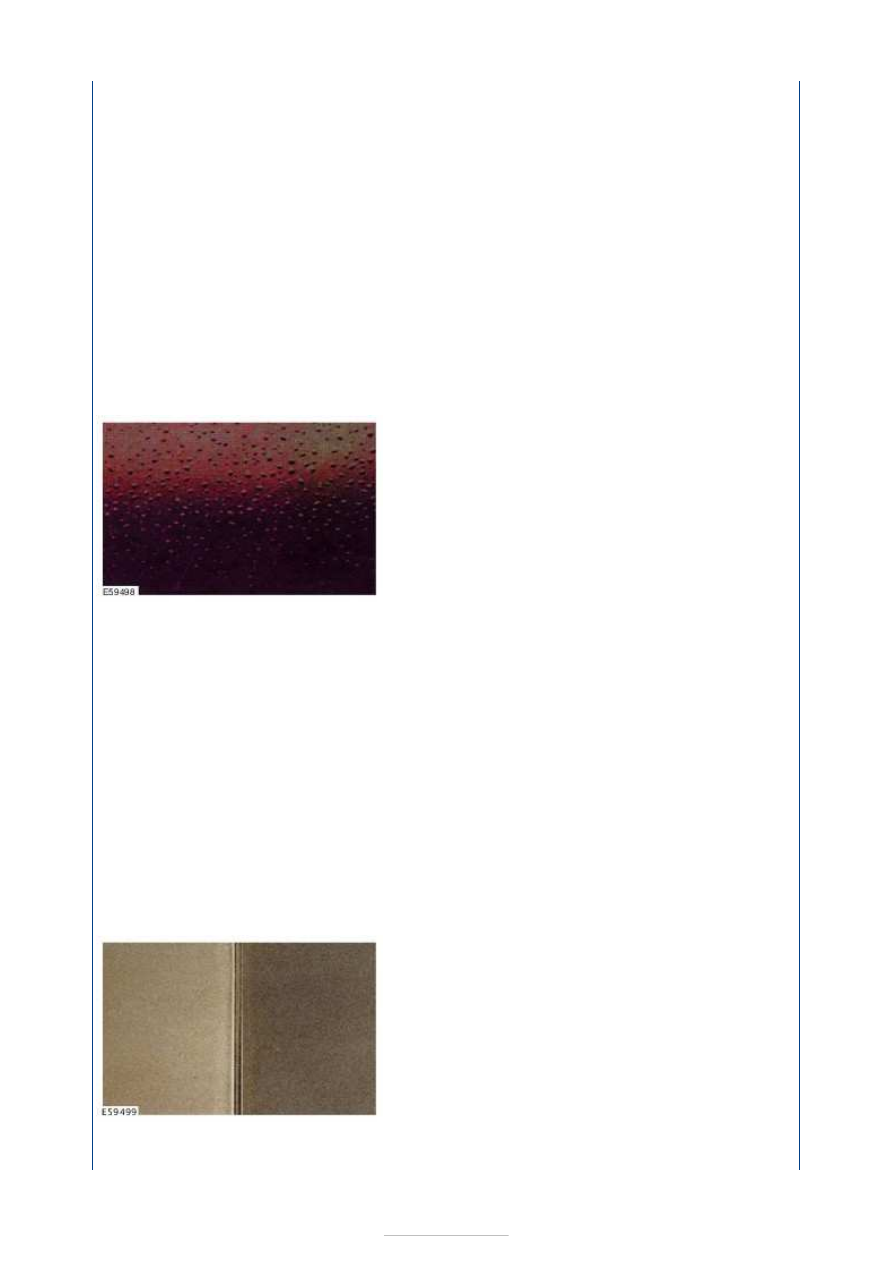


Blistering 

Small, spot-like, air-filled or water-filled blister shaped high-spots in the paint construction. 
Their dimensions can range from pin-head to pin-point size in a closed paint film. 
Arrangement and accumulation very variable. In the advanced stages, circular flaking of 
the paint from the substrate. These are neither boils nor corrosion. 

Cause/damage pattern:  

Moisture absorption by substrate.  
Insufficient drying of the substrate after wet sanding (especially on polyester material).  
Humidity too high before painting; condensation formation because of temperature 
fluctuations.  
Pores/sink holes in substrate not sanded out.  
Polyester material not covered.  
Sweat from hands.  
Salts and minerals in sanding water.  
Spray air contaminated. 

Repair of damage: 

Sand away damage, matt sand remainder of surface, clean with silicone remover, fill and 
re-paint. 

Etching 

The base paint is etched by the clear lacquer. This causes the aluminum pigments to 
change their alignments. The color of the etched base paint seems more grey than that of 
normal base paint. Result is that the surface structure of the clear lacquer becomes 
increasingly more matt. 

Cause/damage pattern:  

Base painted too wet.  
No intermediate flash-off time.  
Layers too thick. 

Repair of damage: 


Sand and re-paint. 

Paint wrinkles/puckering 

Lifting/puckering of the paint surface. 

Cause/damage pattern:  

First paint not hardened through or can be etched.  
Areas of clear lacquer which were sanded through to base paint have not been not 
isolated with filler, or with unsuitable filler.  
Unsuitable substrate (e.g. spray can painting with TPA or nitro).  
Use of unsuitable primer, paint and thinner materials.  
Paint systems not matched to each other.  
In wet-in-wet process, specified flash-off times not adhered to.  
Synthetic resin top coat (alkyd resin) worked over too soon.  

Repair of damage: 

After thorough drying, completely remove the top coat together with the attacked 
substrate at the affected areas and re-create a new paint finish.  
Before applying top coat, rub down the complete surface.  

Cloud formation 

Differing, blotchy color/effect formations in dark/light areas of a metallic paint finish. 

Cause/damage pattern:  

Spray gun, spray nozzle, spray pressure not perfect.  
Varying spray viscosity, spraying method, flash-off times, spray booth temperature.  
Thinners not suitable. 

Repair of damage: 

Droplet method before clear lacquer application.  
After clear lacquer has thoroughly dried, sand surface and re-paint. 


Spots 

Points rising up from the paint film.  

Cause/damage pattern:  

Metallic base paint sprayed too dry, so that the metal particles could not incorporate into 
the paint. The clear lacquer could not cover these vertical standing particles because the 
spray air was too hot or the booth temperature was too high. 

Repair of damage: 

After the paint surface has dried, lightly sand it with grade P800 sanding paper, clean 
with silicone remover and re-apply clear lacquer. 

Metamerism/color deviations  

Noticeable when identical color shades undergo a change of hue as the light source changes 
(daylight/artificial light). Different pigment composition between original and repair paint. 

Cause/damage pattern:  

Use of paints with pigmentation which was not compatible with the standard, e.g. a 
green can be formulated from yellow and blue, or directly from green.  
Use of an unsuitable mixed or ready made paint to re-tone.  

Repair of damage: 

Repaint using the correct paint. 

Washing out 

On paint which has been newly applied but not yet dried, the interaction of surface tension 
and very different specific gravities of the different pigments can lead to swirl-like 
turbulence which results in separation of the pigments.  

Cause/damage pattern:  


Layer too thick, paint not stirred enough. 

Repair of damage: 

Sand and re-paint. 

Loss of gloss 

Milky, dreary tarnishing of the paint with more or less even loss of gloss.  

Cause/damage pattern:  

Cold with low air humidity.  
Heat with high air humidity.  
Substrate can be etched.  
Hardener fault or wrong hardener used.  
Paint thinned too much.  
Proportion of pigment too high because of poor stirring.  
Not optimum drying.  

Repair of damage: 

After drying, remove the matt effect by polishing. If unsuccessful, rub down complete 
area and paint again. 

Covering ability/areas of thin paint 

Different color shades in the surface. The minimum layer thickness is not achieved here. 
The effects range from local minor shade variations through mottled spray zones to 
completely missing top coat.  

Cause/damage pattern:  

No correct, uniform substrate (effect paint).  
On three-layer systems, wrong filler.  
Insufficient top coat application. 


Content   ..  1074  1075  1076  1077   ..