Ford Galaxy / Ford S-MAX. Manual - part 1074


  Index      Ford     Ford Galaxy / Ford S-MAX - service repair manual 2006 year


Search            


Content   ..  1072  1073  1074  1075   ..


Ford Galaxy / Ford S-MAX. Manual - part 1074
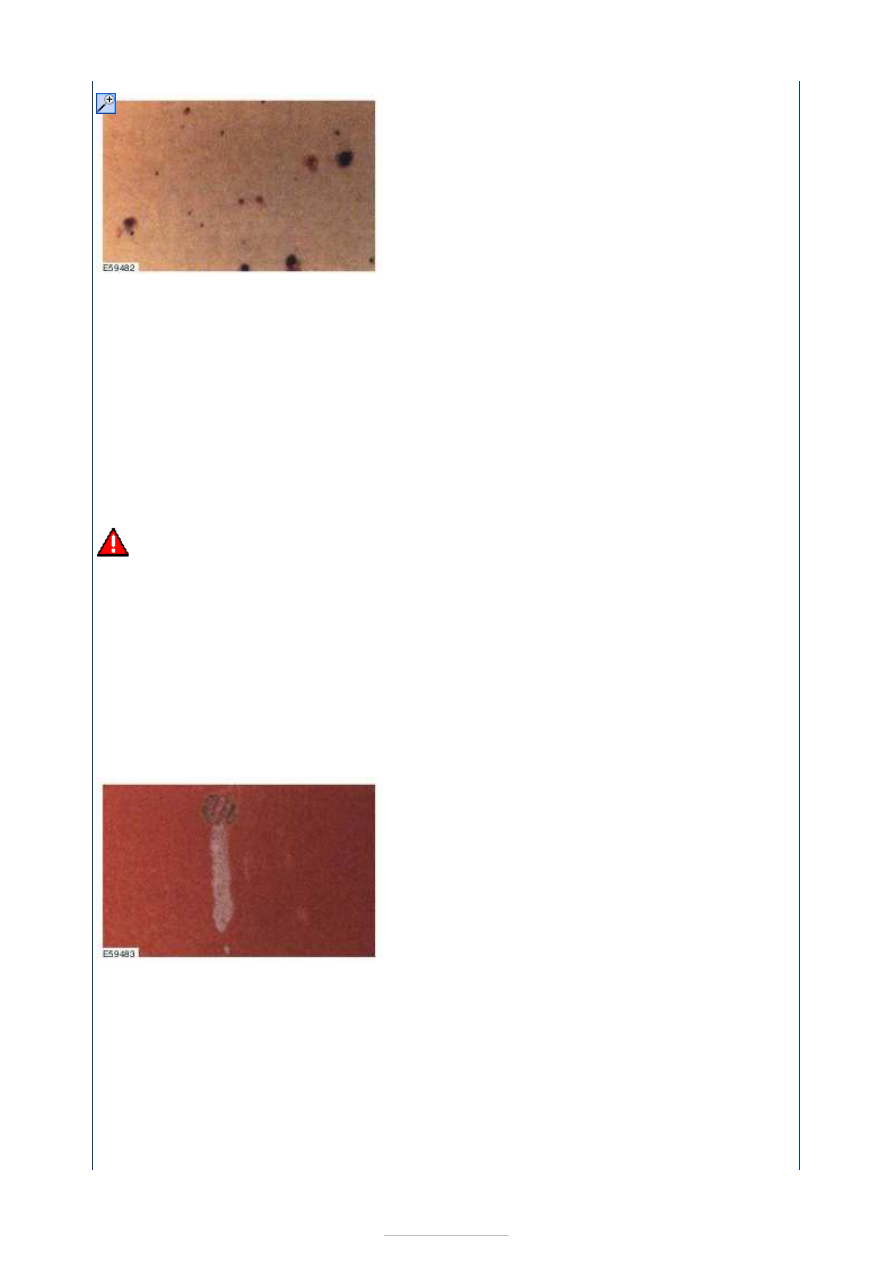


Repair of damage: 

Remove the dust using an industrial fallout remover and thoroughly wash.  
Polish the paint surface. 

NOTE: Never try to remove the particles of industrial fallout by polishing or rubbing!  

Use cleaning dough.  

Damage caused by battery acid. 

Splashes of battery acid caused by carelessly topping up the battery. 

WARNING: Batteries contain sulphuric acid. When working near the battery, or where 

there is battery acid on the vehicle body, protect the skin and eyes from contact with the 
acid. If battery acid contacts the skin or enters the eyes, flush the affected area 
immediately with water (flush for at least 15 minutes) and call a doctor without delay. If 
acid is swallowed, call a doctor immediately. Failure to follow these instructions may 
result in personal injury. 
NOTE: High temperatures accelerate the attack on the top coat. At 50°C the top coat 
layer breaks down after about 15 minutes! 

Cause/damage pattern:  

Etching of the paint layer to decomposition of the paint finish. 

Repair of damage: 

Flush the acid splashes with plenty of water and neutralize with car washing liquid.  
If the contact time of the acid was short, perform a polishing repair.  

Paint damage caused by brake fluid. 

Careless handling of brake fluid. The glycols contained in the fluid cause swellings. 

Cause/damage pattern:  


The temperature and contact time are critical. Splashes lead to loss of shine and 
lightening of color. 

Repair of damage: 

Flush immediately with plenty of water.  
The swellings can often be made to recede completely by treatment with the radiant 
heater or in the paint drying oven at max. 60°C for about 1 hour.  

Mechanical damage 

Stone impact damage or mechanical damage 

Mechanical damage caused by impact of stones or other hard objects and extending down 
to the metal panel lead very quickly to corrosion and rusting under the paint on the 
adjoining surface. 

Cause/damage pattern:  

Paint damage caused from the outside, down to filler, primer or metal panel. 

Repair of damage: 

Sand or blast out.  
Use anti-corrosion primer.  
Apply top coat. 

Damage due to corrosion 

Blistering/rusting below 

Air or water filled blister-shaped raised areas in the paint film. 

Cause/damage pattern:  

Overpainting corroded steel panel.  
Condensation in the spray air.  
Sanding water not dried out or salt crystal residues.  
Road chippings and road winter grit containing salt.  


Repair of damage: 

Sand the affected area of damage or the body component and re-create the paint finish.  
More severe and larger areas of rusting below must be repaired using the corresponding 
repair painting, Repair Level III or IV. 

Damage caused by faults in treatment 

Craters  
Paint boils  
Adhesion defects  
Adhesion defects - clear lacquer  
Sanding scores  
Formation of stripes  
Peeling/blistering on plastic parts  
Blistering on polyester material  
Peroxide marks in metallic paints  
Crack formation  
Shrinking back/zone edge marks  
Blistering  
Etching  
Paint wrinkles/puckering  
Cloud formation  
Spots/metallics  
Metamerism/color deviations  
Washing out  
Loss of gloss  
Covering ability/areas of thin paint  
Flow problems/orange peel  
Dirt embedded in metallic base paint  
Dirt embedded in top coat  
Water marks  
Paint runs  
Swirl marks 

Craters 

Crater-like single or extensively occurring depressions with raised edges, in top coat or the 
intermediate layers.  

Cause/damage pattern:  

Substrate not adequately cleaned with silicone remover.  
Spray air contaminated by oil residues and water accumulations.  
Filter ceiling not adequate for requirements.  
Use of polishes, cleaning agents or sprays (e.g. interior sprays) containing silicone.  
Oil, wax, grease, silicone containing residues.  
Working clothes contaminated by materials containing silicone. 


Repair of damage: 

Sand paint surface, clean with silicone remover and apply one thin spray pass. Let it 
begin to dry well, then apply several thin and dry sprayed passes. 

Paint boils 

Small, hard, closed or burst blisters in the paint top coat. They appear locally in groups or 
spread individually across the whole surface. Sanding opens up a larger cavity, under which 
the primer can often be seen. 

Cause/damage pattern:  

Paint applied in layers which were too thick.  
Specified flash-off and drying times between coats were not adhered to.  
Specified working viscosity and spray pressure were not adhered to.  
Use of unsuitable hardener and thinner materials. (Solvent combinations in paint system 
not optimally matched).  
Poor booth conditions.  

Repair of damage: 

Single boil blisters can be removed using polishing.  
After thorough drying, sand the top coat at the affected areas, clean with silicone 
remover and re-paint. Fill any fine pores still present with 2-component acrylic filler.  
On larger areas of damaged topcoat, sand completely away and apply new paint finish.  

Adhesion defects 

Whole coating detached from substrate or individual layers one from another. Sometimes 
adhesion defects can only be noticed after an external influence such as stone impact. 

Cause/damage pattern:  

Substrate not adequately prepared (rust, grease, moisture, sanding, cleaning).  
Unsuitable material used.  
Drying times, flash-off times too short.  
Base paint not sprayed wet-in-wet, instead the intermediate drying times were too long.  


Content   ..  1072  1073  1074  1075   ..