Ford Galaxy / Ford S-MAX. Manual - part 1024


  Index      Ford     Ford Galaxy / Ford S-MAX - service repair manual 2006 year


Search            


Content   ..  1022  1023  1024  1025   ..


Ford Galaxy / Ford S-MAX. Manual - part 1024


incorrectly adjusted or the seal on the sun roof may be damaged. 

Noises from the door area could come from a window which does not fully close. Side 
guides (seals) can also be the cause of wind noises. 

The covers of window frames can be incorrectly mounted or aligned. The quarter-lights in 
doors must also be checked for correct installation.  

Corrective measures 

Check the gaps and adjust them according to the specifications. If there are problems at 
the sun roof, correct the adjustment and if necessary replace the seals.  

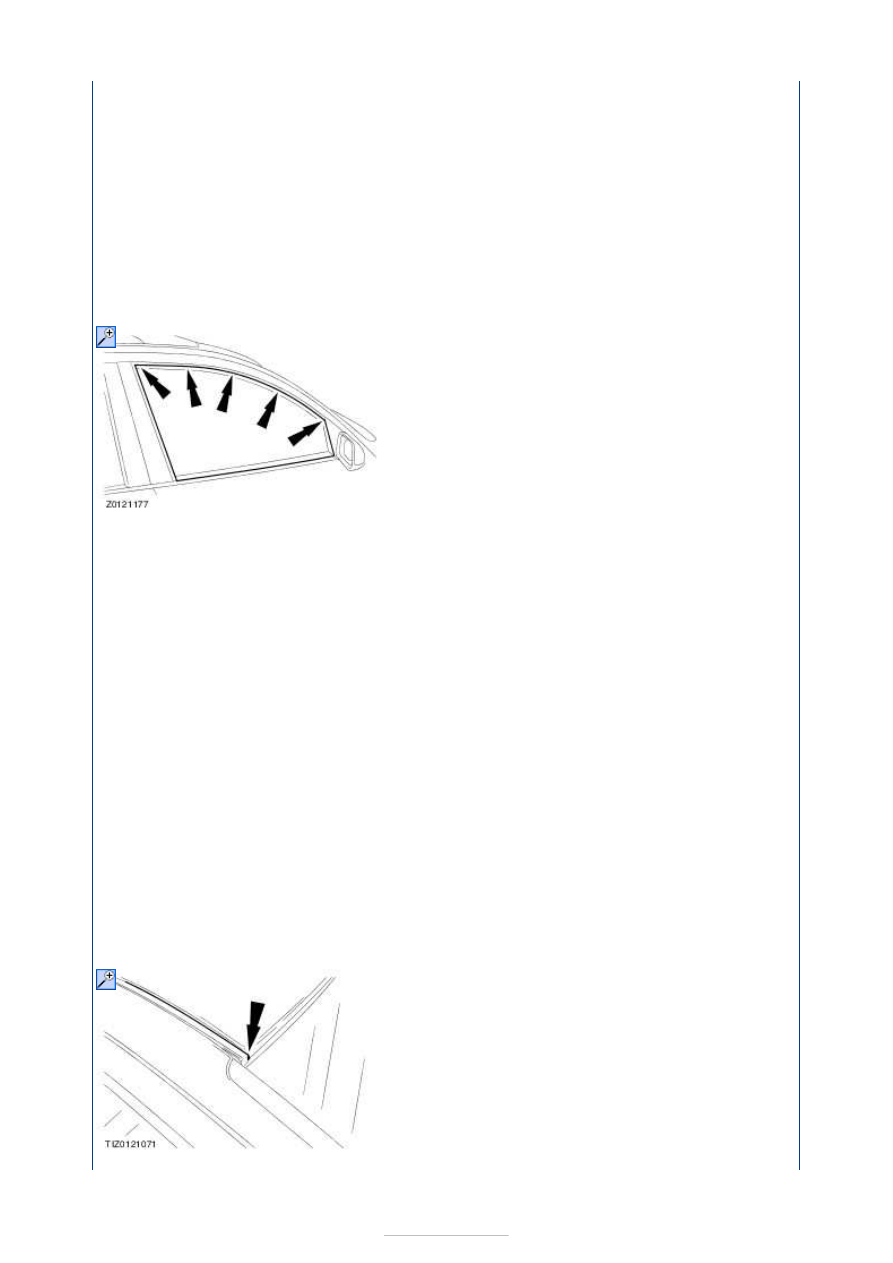
Problem area at side windows 

Side windows which do not fully shut -arrows- must be adjusted. If the vehicle is equipped 
with electric window regulators, the remedy may be to perform the window regulator 
learning process again. In all cases, make certain that the glass enters far enough into the 
seal. 

Ancillary Components 

Components installed on the bodywork may cause noises when they are not correctly 
mounted. 

When troubleshooting it may be helpful to remove the suspected component or, when this 
is not possible, to mask it off with suitable covering tape.  

Roof moldings, roof rail, roof antennas 

Moldings and roof moldings must touch the bodywork along their whole length without any 
gap. Check the end sections in particular. These must neither have any splits nor stand 
away from the bodywork. 

Noises may come from the roof rail if the seal between it and the roof is not correctly 
installed or is cracked. Gaps at the mounting grooves of the carrier can also create wind 
noises. 

The roof antenna and antenna foot seal must be correctly secured. The seal must lie 
completely on the roof and must not be damaged. 

Roof moldings mounting 


If the original mounting points of the roof moldings are in good condition, the fixing can be 
improved using silicone sealant -arrow- if necessary. Align or renew the seals of the roof 
rail. Reduce the clearances of the mounting grooves.  

Corrective measures 

If the original mounting points of the roof moldings are in good condition, the fixing can be 
improved if necessary using silicone sealant -arrow-

Exterior mirrors 

Exterior mirrors or covers of exterior mirrors which are not correctly mounted cause noises. 
The cover must lie evenly on the component and must not lift during driving. There are 
ducts present on the doors for the electrical or mechanical adjusters for the exterior 
mirrors. If there are leaks, wind noises will be caused. Holes can also be present at the 
transition to other components. 

Exterior mirror seals 

There are ducts present on the doors for the electrical or mechanical adjusters for the 
exterior mirrors. If there are leaks, wind noises will be caused. Holes can also be present at 
the transition to other components. 

Remedial Action 

If there is inadequate sealing of the foam seals -2- they must be replaced or supplemented 
with suitable material. Transitions to other components can be sealed with butyl sealing 
compound -1-

Moldings, covers, door handles, windshield wiper arms  

Moldings and covers especially tend to cause wind noises because of their location. These 
components interrupt smooth bodywork surfaces and air turbulence therefore arises at the 
edges. If there are noise concerns in the area of the doors, check especially for gaps and 
projections. Moldings must not stand away from the bodywork or the door. There must not 
be any gaps or discontinuities at the location of joints. 

Incorrectly adjusted windshield wiper arms can cause wind noises. Especially if they are too 
far over the glass surface when in the rest position. 

Wind noises in the transition area between the air cowl cover and the wing or the 
windshield can be caused by an incorrectly installed air cowl cover. At high air speeds the 
air cowl cover may lift and noises will then occur. 

Because of their necessary mechanical features, door handles have a range of openings and 
edges which allow noise to be generated. The door handle can be masked off for testing 
purposes. If a reduction in wind noises is noticed, inadequate sealing may be the reason for 
the noises.  

Remedial Action 

Openings which are used to secure trim panels must be checked for leaks. Any leaks found 
can be rectified using butyl strips.  


Loose or damaged outer trim on the pillars -arrow- must be secured or replaced. 

A butyl sealing strip -1- can be laid underneath the cover in the transition area between the 
air cowl cover and the wing or windshield. 

The sealing of the door handles must be renewed when required. In addition, noise 
absorbing material can be applied to the back of the door handles. 


Body Repairs - General Information - 
Noise, Vibration and Harshness

S-MAX/Galaxy 2006.5 (02/2006-)


Print


Description and Operation 

Noise, coming from the vehicle and which can be heard inside and outside the vehicle. 

Vibrations, oscillations that are felt and noticeable inside the vehicle. 

Harshness, noises which come from the vehicle and which can be heard, felt and noticed 
inside and outside the vehicle. 

These terms are grouped together under the title Noise, Vibration, Harshness, or NVH for 
short. 

The task of vehicle development and production is to ensure that noises caused by the 
vehicle do not disturb the driver and passengers. Moreover, the the external noises emitted 
by the vehicle must not exceed the thresholds set by law. 

NOTE: Basic and advanced training courses are offered for the following contents. For an 
overview of all courses offered, please refer to the Ford Service Organisation's training 
course brochure. 

Noise types and causes 

Noises in and around the vehicle are assigned specific descriptions: 

Humming and droning are perceived as low tones.  
Buzzing and whirring are middle tones.  
Howling, whistling, squeaking are assigned to the high tones. 

Low to middle tones are considered to be unpleasant. They are palpable and noticeable as 
oscillations and vibrations throughout the body. Loud howling and whistling is painful to the 
ears. 

A noise usually consists of a superimposition of different tones which spread as oscillations. 

Each of these oscillations has a specific oscillating time and can be measured in 
frequencies. The frequency describes the number of oscillations per second. The frequency 
unit is specified in Hertz (Hz). 

The human ear can perceive frequencies between 20 and 20000 Hz. 

Where the different notes come from in a vehicle: 

Low notes are mostly produced by the engine.  
Low tones can also be produced by the roadbed, particularly on rough surfaces. This is a 
form of droning which can be felt by the vehicle occupants as vibration or roughness.  
High tones however, which are experienced as howling or whistling noises, are often air 
currents (wind noises) or come from ancillary components such as the generator, power 
steering pump or drivebelt.  
There are also clattering noises which can occur when driving over an uneven road. 
These jerking noises are produced by, for example, the shock absorbers, chassis 
components or loose articles inside the vehicle. 

Noises can already be contained where they occur or, if this is not possible, can be confined 
with suitable measures. 

The basic procedures here are the damping of oscillating parts, the insulation of 
components or the absorption of the noises through appropriate materials. 

Damping 

If a damper is installed next to an oscillating mass, the characteristic of the damper will 


Content   ..  1022  1023  1024  1025   ..