Abarth 500 (2019 year). Manual in english - page 5
 

  Index      Manuals     Abarth 500 (2019 year). Manual in english


Search            copyright infringement  


Content      ..     3      4      5      6     ..


Abarth 500 (2019 year). Manual in english - page 5


INSTALLING AN ISOFIX
CHILD CARSEAT

87) 88) 89) 90)

The car is equipped with ISOFIX
anchorages, a new standard which
makes fitting a child restraint system
quick, simple and safe.
The ISOFIX system lets you install the
ISOFIX child restraining system without
using the car seat belts but connecting
them directly to the carseat with three
anchors in the car. Traditional child
restraint systems can be fitted
alongside ISOFIX child restraint systems
on different seats in the same vehicle.
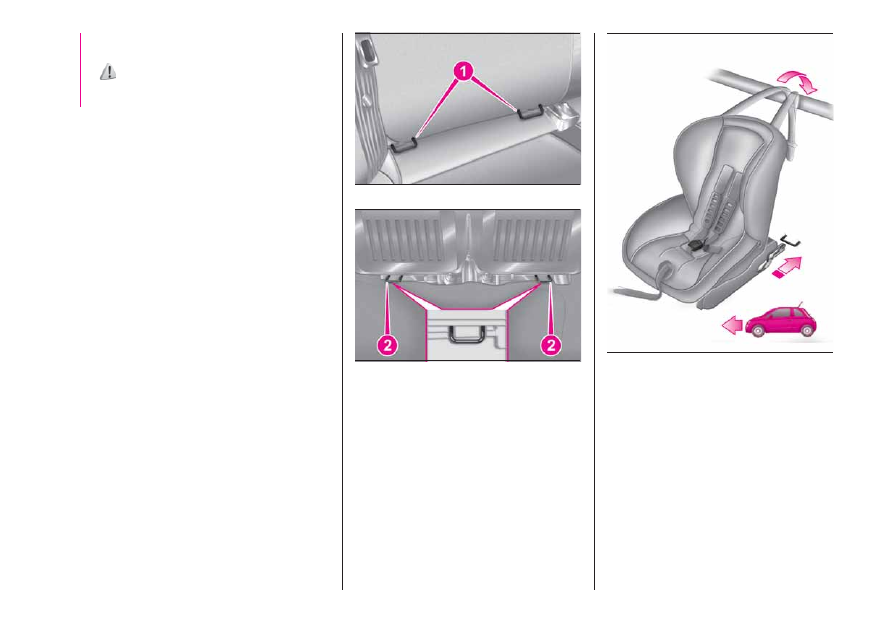
To install an ISOFIX child restraint
system, attach it to the two metal
anchor points 1 fig. 63 located where
the rear seat cushion meets the
backrest, then remove the parcel shelf
and fix the upper strap (available
together with the restraint system) to
the anchor point 2 fig. 64 located at the
bottom behind the backrest.

IMPORTANT The central rear seat is
not approved for any type of ISOFIX
child restraint system.
As an example, fig. 65 shows an
example of a Universal ISOFIX child
restraint system for weight group 1.

IMPORTANT The figure is indicative and
for assembly purposes only. Fit the
child restraint system according to the
instructions, which must be included.
NOTE When a Universal ISOFIX child
restraint system is used, only ECE R44
"ISOFIX Universal" (R44/03) type-
approved child restraint systems can be
used

63

AB0A0068C

64

AB0A0069C

65

AB0A0067C

74

SAFETY

-------------------------------------------------------------------------------------------------------------------------------------------------------------

SUITABILITY OF PASSENGER SEATS FOR ISOFIX CHILD RESTRAINT SYSTEM USE

The table below shows the various possibilities for installing ISOFIX child restraint systems on seats fitted with specific
attachments in accordance with European standard ECE 16.

Weight group

Child restraint system

position

Isofix size class

Rear side seats

Group 0 up to 10 kg

Rear facing

E

X

Group 0+ 0 to 13 kg

Rear facing

E

X

Rear facing

D

X

Rear facing

C

X

Group 1 from 9 to 18 kg

Rear facing

D

X

Rear facing

C

X

Forward facing

B

IUF

Forward facing

B1

IUF

Forward facing

A

IUF (*)

X: ISOFIX position not suitable for ISOFIX child restraint systems in this group of weight and/or size class.
IUF: suitable for forward facing ISOFIX child restraint systems in the universal category and type-approved for use in the weight group.
(*) For 595C/695C versions, this ISOFIX position is not suitable for ISOFIX child restraint systems in this weight group and/or size class.
NOTE The other weight groups are covered by specific ISOFIX child restraint systems, which can be used only if specifically
tested for this vehicle (see list of vehicles provided with the child restraint system). The Universal ISOFIX "Duo Plus" child
restraint system and the special "G 0/1" (or further upgrades) system are available from Lineaccessori Abarth. Refer to the
instruction manual provided with the child restraint system for any further details on installation/use.

75

-------------------------------------------------------------------------------------------------------------------------------------------------------------

Main recommendations to carry
children safely

Install the child restraint systems on

the rear seat, which is the most
protected position in the event of an
impact.

Keep children in rearward facing

child restraint systems for as long as
possible, ideally until they are 2 years
old.

Should a rearward facing child

restraint system be installed on the rear
seats, it is advisable to position it as
far forward as the position of the front
seat allows.

If the passenger's front airbag is

deactivated always check the
permanent switching on of the

warning light to make sure that it

has actually been deactivated.

Carefully follow the instructions

supplied with the child restraint system.
Keep the instructions in the vehicle
along with the other documents and
this handbook. Do not use second-
hand child seats without instructions.

Only one child is to be strapped into

each restraint system; never carry two
children simultaneously.

Always check that the seat belts do

not rest on the child’s neck.

Always check that the seat belt is

well fastened by pulling on it.

While travelling, do not let the child

sit incorrectly or unfasten the belts.

Never allow a child to put the belt's

diagonal section under an arm or
behind their back.

Never carry children on your lap,

even newborns. No-one can hold
a child in the case of a crash.

In the event of an accident, replace

the child restraint system with a new
one. In addition, and depending on the
type of child restraint system installed,
replace the ISOFIX anchors or the
seat belt with which the child restraint
system was connected.

The rear headrest (where provided)

can be removed if needed to install
a child restraint system. The headrest
must always be fitted in the car if the
seat is used by an adult passenger or a
child sitting in a restraint system without
a backrest.

WARNING

79)

SERIOUS DANGER. When an active

passenger airbag is fitted, DO NOT install
rear facing child restraint systems on
the front seat. Deployment of the airbag in
an accident could cause fatal injuries to
the child regardless of the severity of
the impact. It is advisable to always carry
children in a child restraint system on
the rear seat, which is the most protected
position in the event of a collision.

80)

On the sun visor there is a label with

suitable symbols reminding the user that it
is compulsory to deactivate the airbag if
a rearward facing child restraint system is
fitted. Always comply with the instructions
on the passenger side sun visor (see the
"Front airbags" paragraph).

81)

Should it be necessary to carry a child

on the passenger side front seat in a rear
facing child restraint system, the passenger
side front and side airbags must be
deactivated through the display main
menu, verifying deactivation by checking
that the warning light

located in the

central part of the dashboard has switched
on. Move the passenger's seat as far
back as possible to avoid contact between
the child seat and the dashboard.

82)

Do not move the front or rear seat if a

child is seated on it or on the dedicated
child restraint system.

76

SAFETY

-------------------------------------------------------------------------------------------------------------------------------------------------------------

83)

Child restraint systems with ISOFIX

attachments are available for safely
anchoring to the seat without using the car
seat belts. See paragraph "Installing an
ISOFIX child restraint system" for the
installation instructions.

84)

Incorrect fitting of the child restraint

system may result in an inefficient
protection system. In the event of an
accident the child restraint system may
become loose and the child may be
injured, even fatally. When fitting a restraint
system for newborns or children, strictly
comply with the instructions provided
by the Manufacturer.

85)

When the child restraint system is not

used, secure it with the seat belt or with
the ISOFIX anchorages, or remove it from
the vehicle. Do not leave it unsecured
inside the passenger compartment. This
way, in the case of sudden braking or
an accident, it will not cause injuries to the
occupants.

86)

After installing a child restraint system,

do not move the seat: always remove
the child restraint system before making
any adjustment.

87)

If a Universal ISOFIX child seat system

is not fixed to all three anchorages, it will
not be able to protect the child correctly. In
a crash, the child could be seriously or
fatally injured.

88)

Fit the child restraint system when the

car is stationary. The child restraint system
is correctly fixed to the brackets when
you hear the click. Follow the instructions
for assembly, disassembly and positioning
that the Manufacturer must supply with
the child restraint system.

89)

Always make sure that the chest

section of the seat belt does not pass
under the arms or behind the back of the
child. In the event of an accident the seat
belt will not be able to secure the child,
with the risk of injury, including fatal injury.
Therefore the child must always wear
the seat belt correctly.

90)

Do not use the same lower anchoring

to install more than one child restraint
system.

SUPPLEMENTARY
RESTRAINT SYSTEM
(SRS) – AIRBAG

The car may be equipped with:

front driver airbag;

front passenger airbag;

driver's side knee bag;

driver and passenger front side bags

for pelvis, chest and shoulder
protection (Side bags);

side bags for head protection of

front seat passengers and rear side
seat passengers (window bag).

FRONT AIRBAGS

91) 108)

The front driver/passenger airbags and
the driver knee bag (where provided)
protect the front seat occupants in the
event of frontal impacts of medium/high
severity, by placing the bag between
the occupant and the steering wheel or
dashboard.
Therefore non-activation of airbags in
other types of collisions (side impacts,
rear shunts, roll-overs, etc.) does not
indicate a system malfunction.
An electronic control unit will make the
bag inflate in the event of a frontal
impact.

77

-------------------------------------------------------------------------------------------------------------------------------------------------------------

The bag will inflate instantaneously
placing itself between the front
occupants body and the structures
which could cause injury. It will deflate
immediately afterwards.
Front airbags are not a replacement of
but complementary to the seat belts,
which you are recommended to always
wear, as specified by law in Europe
and most non-European countries.
In the event of an impact, someone not
wearing a seat belt could move forward
and come into contact with a bag
which is still opening. The protection
offered by the bag is compromised
in these circumstances.
Front airbags may not activate in the
following situations:

frontal impacts against highly

deformable objects not involving the
front surface of the car (e.g. wing
collision against guard rail);

vehicle wedging under other vehicles

or protective barriers (e.g. trucks or
guard rails).
Failure to deploy in the conditions
described above is due to the fact that
the airbags may not provide any
additional protection compared with
seat belts, so their activation would be
inappropriate. In these cases,
non-deployment does not indicate a
system malfunction.

The front airbags (driver, passenger,
driver's knee bags) are designed and
calibrated to protect front seat
passengers wearing seat belts.
Their volume at the moment of
maximum inflation fills most of the
space between the steering wheel and
the driver, between the lower post
guard and the knees on passenger side
and between the dashboard and the
passenger.
The airbags are not deployed in the
event of minor frontal impacts (for
which the restraining action of the seat
belts is sufficient). Seat belts must
always be worn. In the event of a frontal
collision, they ensure the correct
positioning of the occupant.

Front airbag driver's side

92)

This consists of an instantly inflating
bag contained in a special
compartment in the centre of the
steering wheel fig. 66.

Passenger front airbag

This consists of an instantly inflating
bag contained in a special recess in the
dashboard fig. 67 which has a larger
volume than that of the driver.

Passenger's front airbag and child
restraint systems

93)

Rearward facing child restraint systems
must NEVER be fitted on the front
seat with an active passenger side
airbag since, in the event of a crash, the
airbag activation could cause fatal
injuries to the transported child.

ALWAYS

comply with the instructions

on the label on the passenger side
sun visor (fig. 68 and fig. 69).

66

AB0A0289C

67

AB0A0071C

78

SAFETY

-------------------------------------------------------------------------------------------------------------------------------------------------------------

PASSENGER AIRBAG
DEACTIVATION: FRONT AIRBAG
AND FRONT SIDE AIRBAG (SIDE
BAG)

94) 95)

If a child must be carried on the front
seat in a rearward facing child restraint
system, deactivate the passenger
side front airbag and front side bag.

Warning light 1 fig. 70 will stay on
constantly until the passenger side front
airbag and the front side bag are
reactivated.

IMPORTANT To manually deactivate the
passenger side front airbag and the
front side bag, see paragraph "Menu
items" in the "Knowing the instrument
panel" chapter.

Driver side knee bag (where
provided)

It consists of an instantly inflating
cushion contained in a special
compartment 3 under the lower
steering column guard fig. 71 at the
driver's knee level. It provides further
protection to the driver in the event of a
frontal impact.

68

AB0A0307C

69

AB0A0308C

70

AB0A0228C

71

AB0A0073C

79

-------------------------------------------------------------------------------------------------------------------------------------------------------------

SIDE AIRBAGS (Side bag
- Window bag)

(where provided)
To increase protection of occupants in
the event of side collision, the car is
equipped with side bags for pelvis,
chest and shoulder protection for the
driver and the passenger and airbags
protecting the head.
Non-activation of side bags in other
types of collisions (front collisions, rear
shunts, roll-overs, etc.) is not a system
malfunction.

Front side airbags (Side bags)

These comprise two types of bags
located in the front seat backrests fig.
73 which protect the pelvis, chest
and shoulder area of the occupants in
the event of a side collision of
medium-high severity.

Window bags

These comprise two window bags
located behind the side lining of the
roof and covered by special trim fig. 74.
They are designed to protect the head
of front and rear side occupants in
the event of side collisions, thanks to
their wide inflation surface.

Important notes

In the event of a side impact, the
system provides best protection if the
passenger sits on the seat in a correct
position, thus allowing correct window
bag deployment.
The front airbags and/or side bags may
be deployed if the car is subject to
heavy knocks or accidents involving the
underbody area, such as for example
violent shocks against steps,
pavements or low obstacles, the car
falling in big holes or dips in the road.

A small amount of dust will be released
when the airbags are deployed. The
dust is not harmful and does not
indicate the beginning of a fire.
Furthermore, the surface of the
deployed bag and the interior of the car
may be covered by a dusty residue:
this may irritate skin and eyes. Wash
with neutral soap and water in the
event of exposure.
Every control, repair and replacement
operation concerning the airbags must
only be carried out at an Abarth
Dealership. If the car is scrapped, have
the system deactivated at an Abarth
Dealership.
Pretensioners, front airbags and side
bags are deployed according to
different logics on the basis of the type
of crash. Failure to activate one or
more of the devices does not indicate a
system malfunction.
Should an accident occur in which any
of the safety devices are activated,
take the car to an Abarth Dealership to
have the activated devices replaced
and to have the whole system checked.

96) 97) 98) 99) 100) 101) 102) 103) 104) 105) 106)

107)

73

AB0A0074C

74

AB0A0075C

81

-------------------------------------------------------------------------------------------------------------------------------------------------------------

WARNING

91)

Do not apply stickers or other objects

on the steering wheel, on the dashboard in
the passenger side airbag area, on the
side upholstery on the roof and on the
seats. Never put objects (e.g. mobile
phones) on the passenger's side
dashboard since they could interfere with
correct inflation of the airbag and also
cause serious injury to the passengers.

92)

Always drive with your hands on the

rim of the steering wheel so that the airbag
can inflate freely if required. Do not drive
bent over the steering wheel, but rather sit
upright with your back firmly resting against
the seat back.

93)

When there is an active passenger

airbag, DO NOT install rearward facing
child restraint systems on the front seat.
Deployment of the airbag in a crash could
cause fatal injuries to the child regardless
of the severity of the collision. Therefore,
always deactivate the passenger side
airbag when a rearward facing child
restraint system is installed on the front
passenger seat. The front passenger seat
must also be positioned back as far as
possible in order to prevent the child
restraint system from coming into contact
with the dashboard. Immediately reactivate
the passenger airbag as soon as the child
restraint system has been removed.

94)

A failure of the

warning light is

indicated by the

symbol on the display.

In this case, the

warning light may

not indicate a possible problem with the
airbag restraint system. Before driving off,
contact an Abarth Dealership to have
the system checked immediately.

95)

The

warning light indicates the

passenger side airbag protection status. If
the warning light is off, passenger side
protection is active: to deactivate it, use the
Setup Menu (in this case the LED lights
up). When the vehicle is started (ignition
key turned to MAR position), the warning
light turns on for about 8 seconds,
provided that at least 5 seconds have
elapsed from when it was switched off. If
not, contact an Abarth Dealership. If the
engine is switched off/on again in less than
5 seconds the warning light may remain
off. In this case, to check correct warning
light operation, switch the engine off,
wait for at least 5 seconds and switch the
engine on again. The warning light may
light up with various intensity levels
depending on the vehicle conditions. The
intensity may also vary during the same key
cycle.

96)

If, when turning the key to MAR, the
warning light does not switch on or if it

stays on when travelling, there could be
a fault in the restraint systems; in this event
airbags or pretensioners may not be
deployed in the event of impact or, in a
lower number of cases, they may deploy
accidentally. Before driving off, contact
an Abarth Dealership to have the system
checked immediately.

97)

In some versions, in case of a LED

failure (located on the plate of the

instrument panel), the

warning light on

the instrument panel turns on and the
passenger side airbags are deactivated.

98)

Do not cover the front seat backrests

with extra covers if they are equipped
with side bags.

99)

If the car has been subject to theft,

attempted theft, vandalism, or flooding,
have the airbag system inspected at an
Abarth Dealership.

100)

The airbags may also be deployed

when the car is not moving, if the key is in
the ignition and turned to MAR-ON or
when the engine is off, if the car is hit by
another moving vehicle. Therefore, even if
the vehicle is stationary, when an active
front passenger airbag is fitted, DO NOT
install rearward facing child restraint
systems on the front passenger seat.
Deployment of the airbag following an
impact could cause fatal injuries to the
child. Therefore, always deactivate the
passenger side airbag when a rearward
facing child restraint system is installed on
the front passenger seat. The front
passenger seat must also be positioned
back as far as possible in order to prevent
the child restraint system from coming
into contact with the dashboard.
Immediately reactivate the passenger
airbag as soon as the child restraint system
has been removed. Also remember that, if
the key is turned to STOP, none of the
safety devices (airbags or pretensioners)
will be deployed in the event of collision.
Non-deployment in such cases does
not indicate a system malfunction.

82

SAFETY

-------------------------------------------------------------------------------------------------------------------------------------------------------------

101)

When the ignition key is turned to

MAR, the

warning light switches for few

seconds, then if the passenger airbag
protection is active it should switch off.

102)

Do not wash the seats with water or

pressurised steam (wash by hand or at
automatic seat washing stations).

103)

The airbag deployment threshold is

higher than that of the pretensioners.
For collisions in the range between the two
thresholds, it is normal for only the
pretensioners to be activated.

104)

Do not affix rigid objects to the

garment hooks or support handles.

105)

The airbag does not replace seat

belts but increases their efficiency.
Furthermore, since front airbags are not
deployed in low-speed frontal impacts,
side impacts, rear shunts or roll-overs, the
passengers are protected only by the
seat belts which must therefore be
fastened at all times.

106)

Do not rest your head, arms or

elbows on the door, on the windows or in
the window bag area to prevent injury
during deployment.

107)

Never lean your head, arms or elbows

out of the window.

108)

Do not travel carrying objects in your

lap, in front of your chest or between
your lips (pipe, pencils, etc.): they could
cause severe injury if the airbag is
deployed.

83

-------------------------------------------------------------------------------------------------------------------------------------------------------------

STARTING AND DRIVING

Let’s get to the core of the vehicle:
seeing how you can exploit all of its
potential to the full.

We’ll look at how to drive it safely in any
situation, so that it can be a welcome
companion, with our comfort and
our wallets in mind.

STARTING THE ENGINE ................ 85

PARKING THE VEHICLE ................. 86

USING THE MANUAL GEARBOX.... 87

USING THE ROBOTISED
SEQUENTIAL TRANSMISSION ....... 87

SPORT FUNCTION ......................... 90

PARKING SENSORS....................... 91

REFUELLING THE VEHICLE ........... 92

84

ST

AR

TING

AND

DRIVING

-------------------------------------------------------------------------------------------------------------------------------------------------------------

STARTING THE
ENGINE

The car is fitted with an electronic
engine lock device: if the engine fails to
start, see the paragraph "Fiat CODE
system" in the "Knowing your car"
chapter.

PROCEDURE

Proceed as follows:

engage the handbrake and place

the gearbox lever in neutral;

fully depress the clutch pedal

without touching the accelerator;

turn the ignition key to AVV and

release it as soon as the engine starts.
If the engine does not start at the
first attempt, return the ignition key to
STOP before repeating the starting
procedure.
If, with key at MAR, the

symbol on

the display stays on together with
the

warning light on the instrument

panel, it is advisable to turn the key to
STOP and then back to MAR. If the
warning light remains on, try with the
other keys provided with the car.
Contact an Abarth Dealership if you still
cannot start the engine.

17) 18)

109) 110)

WARMING UP THE
ENGINE JUST AFTER IT
HAS STARTED

Proceed as follows:

drive off slowly, letting the engine

turn at medium revs. Do not accelerate
abruptly;

do not demand full performance at

first. It is advisable to wait until the
engine coolant temperature indicator
starts moving.

19)

SWITCHING OFF THE
ENGINE

Turn the ignition key to STOP while the
engine is idling.

IMPORTANT After a taxing drive, you
should allow the engine to "catch
its breath" before turning it off by letting
it idle to allow the temperature in the
engine compartment to fall.

20)

WARNING

17)

It is advisable not to demand maximum

performance from your car (e.g. excessive
acceleration, long distances at maximum
rpm, excessively intense braking, etc.)
when it is first used.

18)

When the engine is switched off never

leave the key turned to MAR-ON to prevent
useless current absorption from draining
the battery.

19)

Never, under any circumstances, jump

start the engine by pushing, towing or
coasting downhill. This could cause fuel to
flow into the catalytic converter and
damage it beyond repair.

20)

A quick burst on the accelerator before

stopping the engine serves no practical
purpose; it wastes fuel and is especially
damaging to turbocharged engines.

WARNING

109)

It is dangerous to run the engine in

enclosed areas. The engine takes in
oxygen and releases carbon dioxide,
carbon monoxide and other toxic gases.

110)

Remember that the brake servo

and power steering are not operational until
the engine has been started, therefore
much effort than usual is required on the
brake pedal and steering wheel.

85

-------------------------------------------------------------------------------------------------------------------------------------------------------------

PARKING THE
VEHICLE

When parking and leaving the car,
proceed as follows:

engage a gear (1st gear if facing

uphill or reverse if facing downhill) and
leave the wheels turned;

stop the engine and engage the

handbrake;

always remove the ignition key.

Block the wheels with a wedge or a
stone if the car is parked on a steep
slope.
On versions equipped with sequential
robotised transmission, wait for letter P
to be displayed before releasing the
brake pedal.
IMPORTANT NEVER leave the car with
the gearbox in neutral (or, on versions
equipped with sequential robotised
transmission, before placing the gear
lever at P).

111)

HANDBRAKE

The handbrake lever 1 fig. 75 is located
between the front seats.
To use the handbrake pull the lever
upwards until the car cannot be moved.

112)

When the handbrake is on and the
ignition key is at MAR position, the
warning light

will appear on the

instrument panel.
Proceed as follows to release the
handbrake:

slightly lift the lever and press the

release button on the lever 1 fig. 75;

keep the button pressed and lower

the lever. The

warning light in the

instrument panel will go out.
Press the brake pedal when carrying
out this operation to prevent the car
from moving accidentally.

WARNING

111)

Never leave children in the

unattended car. Always remove the ignition
key when leaving the car and take it out
with you.

112)

The car should be braked after a few

clicks of the lever. If it is not, contact an
Abarth Dealership to have it adjusted.

75

AB0A0076C

86

ST

AR

TING

AND

DRIVING

-------------------------------------------------------------------------------------------------------------------------------------------------------------

USING THE MANUAL
GEARBOX

To engage the gears, fully depress the
clutch pedal and put the gear lever
into the required position (the diagram
is shown on the knob fig. 76).

113)

21)

To engage reverse R from neutral,
move the lever to the right and then
backwards.

IMPORTANT Reverse can only be
engaged when the vehicle is completely
stationary. With the engine running,
wait for at least 2 seconds with the
clutch pedal fully pressed before
engaging reverse to prevent damage to
the gears and grating.

WARNING

113)

Press the clutch pedal fully to change

gears correctly. It is therefore essential
that there is nothing under the pedals:
make sure the mats are lying flat and do
not get in the way of the pedals.

WARNING

21)

Do not drive with your hand resting on

the gear lever as the force exerted, even
if slight, could lead over time to premature
wear of the gearbox internal components.

USING THE
ROBOTISED
SEQUENTIAL
TRANSMISSION

(where provided)
The car can be equipped with an
electronically controlled manual
transmission that allows two operating
modes: “MANUAL” and “AUTO”.

With the car stationary and the key at
MAR (ignition-operated electrical
services on), the screen displays the
engaged gear and the active operating
mode (automatic = AUTO or manual
= no display).

76

AB0A0301C

77

AB0A0334C

87

-------------------------------------------------------------------------------------------------------------------------------------------------------------

STARTING THE CAR

NOTES

On starting, the system sets itself to

AUTO mode.

Using the 1, N, R buttons with the

brake pedal pressed, 1

st

gear, neutral

(N) or reverse (R) can be engaged.

Using the 1, N, R buttons without

pressing the brake pedal, the system
does not change gear.

The levers on the steering wheel will

not engage any gear, even with the
brake pedal pressed.

If the car is switched off with SPORT

or NORMAL modes active, the mode
previously set is kept when the engine
is restarted.

OPERATING MODE

The transmission can function in two
operating modes:

the first is manual (MANUAL). In this

mode the driver decides directly when
to shift, using the "+” fig. 78 lever on
the steering wheel to shift up, or the "–"
to shift down. If the request is accepted
by the system, when the gear change
is completed, the display shows the
new gear engaged.

the second, completely automatic

(AUTO), in which the system decides
when to change gear. A gear change
can be requested using the control
lever without having to deactivate this
mode: this function, known as “gear
suggestion”, suspends the automatic
mode for the time necessary to select
the gear requested by the driver.

22)

To turn automatic operation (AUTO) on,
press the A/M button on the gearbox
panel fig. 77; when it is on, the word
AUTO and the engaged gear are shown
on the display. When AUTO mode is
deactivated, the transmission passes to
MANUAL mode.

“Kick Down” function

The "Kick Down" function is also
available: if necessary (for example
when overtaking), pressing the
accelerator pedal fully over the
hardening point, the system downshifts
one or more gears (if the rpm allows
it) in order to provide suitable power
and torque for the acceleration
requested by the driver.

STARTING THE ENGINE

To start the engine press the brake
pedal: the system engages neutral (N)
automatically. When the starting
procedure is complete, you can hold
the brake pedal down and press the 1
or R buttons on the transmission panel
to engage 1

st

or reverse (R) gear

respectively.

MOVING THE CAR

You may set off in the car in both 1

st

gear and 2

nd

gear (advisable on road

surfaces with poor grip) and also in
reverse gear (R). The gears can only be
engaged by pressing the brake pedal.
Proceed as follows:

press the brake pedal;

press the 1 button on the gearbox

panel;

operate the “+” shift paddle while

holding down the brake pedal (only for
setting off in 2

nd

gear);

78

AB0A0335C

88

ST

AR

TING

AND

DRIVING

-------------------------------------------------------------------------------------------------------------------------------------------------------------

release the brake pedal and press

the accelerator pedal (quickly pressing
the pedal fully down and turning off
the ASR, if provided, results in a “lively”
departure).

Engaging reverse gear (R)

To engage reverse gear, press the R
button on the gearbox panel instead of
the 1 button.

Engaging neutral (N)

Press the (N) button to engage neutral.
Neutral (N) can only be engaged with
accelerator pedal released, regardless
of the brake pedal’s status (pressed
or not). In any case, pressing the brake
pedal is recommended.

ACOUSTIC SIGNAL

For safety reasons, there is a buzzer
warning when parking the car with the
gearbox in neutral (N) (the warning is
heard when the ignition key is turned to
the STOP position).
With the car stationary, the engine
running and (1

st

), (2

nd

) or (R) engaged,

the system activates the buzzer and
automatically puts the transmission in
neutral (N) when:

the accelerator and/or brake pedal

are not operated for at least 3 minutes;

the brake pedal is pressed for longer

than 10 minutes;

the driver's door is opened and the

accelerator pedal or the brake pedal
are not operated for at least 1.5
seconds;

a fault has been detected in the

transmission.

PARKING THE CAR

To park safely, you must engage 1

st

or

reverse (R) gear, with your foot on
the brake pedal and, if there is a
gradient, operate the handbrake. Wait
until the indication of the gear engaged
disappears on the display before
releasing the brake pedal.
IMPORTANT NEVER leave the car with
the transmission in neutral (N).

IMPORTANT NOTES

With car stationary and gear

engaged, always keep the brake pedal
pressed until you decide to set off,
then release the brake and accelerate
gradually.

During prolonged stops with the

engine running, it is advisable to keep
the transmission in neutral (N).

In order to safeguard the efficiency

of the clutch, do not use the
accelerator to keep the car stationary
(e.g. when stopped on an incline); if the
clutch overheats it could be damaged.
Use the brake pedal or the handbrake
instead and use the accelerator pedal
only when you decide to set off.

Only use 2

nd

gear when you need

greater control for setting off on
surfaces with poor grip.

If you have to engage 1

st

gear with

reverse gear (R) engaged, or vice versa,
only do so when the car is completely
stationary and with the brake pedal
pressed.

Although it is strongly inadvisable, if

you are driving downhill and, for
unexpected reasons, you let the car
move forward with the transmission in
neutral (N), when there is a request
to engage a gear, depending on the
actual speed of the car, the system will
automatically engage the best gear
for the correct transmission of drive
torque to the wheels.

89

-------------------------------------------------------------------------------------------------------------------------------------------------------------

When necessary, you can engage

1

st

gear, reverse (R) or neutral (N) with

the engine off, the key at AVV and
the brake pressed. In this case, it is
advisable to change allowing at least 5
seconds to elapse between one gear
change and the next to safeguard
the operation of the hydraulic system
and the pump in particular.

Fully and quickly depressing the

accelerator pedal activates a function
that allows a "lively" departure.

For starting uphill, accelerating

gradually but fully immediately after
having released the handbrake or the
brake pedal allows the engine to greatly
increase the rpm and tackle the
steepest gradients with more torque to
the wheels.

WARNING

22)

Using the levers incorrectly (levers

pushed towards the dashboard) could
break them.

SPORT FUNCTION

When the SPORT button 1 fig. 79 is
pressed, the sports driving setting
is turned on giving greater
responsiveness during acceleration, an
increase in drive torque and more
precise steering with greater effort
required on the steering wheel.

When this function is on, the word
SPORT 1 fig. 80 is lit up in the display
and the instrument panel shows a
dedicated screen.
Press the button again to turn the
function off and restore the normal
driving setting.

IMPORTANT When the SPORT button
is pressed, the function is activated
about 5 seconds later.

IMPORTANT During acceleration, when
the SPORT function is used, the
steering may shudder, which is typical
of a sports setting.

NOTE For vehicles equipped with an
Akrapovic exhaust system, a
considerable increase in engine sound
can be heard when the SPORT mode is
activated. This is caused by opening
the valve located in the Akrapovic
exhaust, which improves performance.

79

AB0A0351C

80

AB0A0360C

90

ST

AR

TING

AND

DRIVING

-------------------------------------------------------------------------------------------------------------------------------------------------------------


Content      ..     3      4      5      6     ..