Abarth 500 (2019 year). Manual in english - page 4
 

  Index      Manuals     Abarth 500 (2019 year). Manual in english


Search            copyright infringement  


Content      ..     2      3      4      5     ..


Abarth 500 (2019 year). Manual in english - page 4


Symbol

What it means

amber

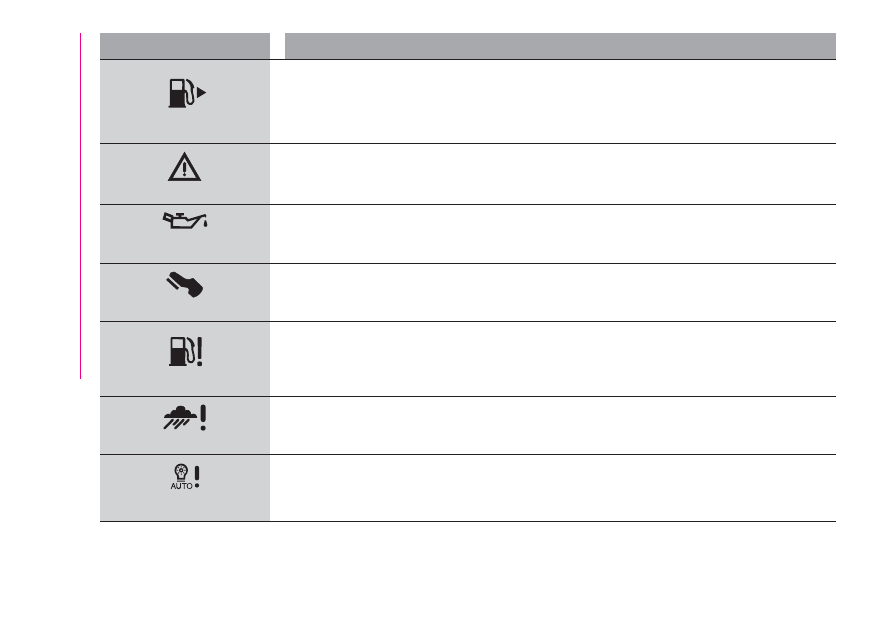
FUEL RESERVE - LIMITED RANGE

When the key is turned to MAR, the icon appears but should disappear after a few seconds.

The symbol switches on in the display when about 5 litres of fuel are left in the tank. The triangle to the side

of the symbol indicates the side of the car with the fuel filler.

amber

ENGINE OIL PRESSURE SENSOR FAILURE INDICATOR

The icon appears when a fault is detected in the engine oil pressure sensor.

Contact an Abarth Dealership as soon as possible to have the fault fixed.

amber

OIL CHANGE

The icon indicates that it is necessary to change the engine oil. Contact an Abarth Dealership.

amber

PRESS THE CLUTCH PEDAL TO START

This symbol turns on to indicate that the clutch pedal must be pressed to enable starting.

amber

FUEL LEVEL SENSOR FAILURE

The symbol switches on in the event of fuel level sensor failure. Contact an Abarth Dealership.

amber

RAIN SENSOR FAILURE

The symbol switches on in the case of failure of the rain sensor. Contact an Abarth Dealership as soon as

possible

amber

DUSK SENSOR FAILURE

The symbol switches on along with a message on the display in the event of dusk sensor failure. Contact

an Abarth Dealership as soon as possible.

58

KNOWING

THE

INSTRUMENT

P

ANEL

-------------------------------------------------------------------------------------------------------------------------------------------------------------

Symbol

What it means

white

HEADLIGHT ALIGNMENT CORRECTOR

The icon, together with a number, indicates the depth of the dipped beam.

WARNING

34)

If, when turning the key to MAR, the

warning light does not switch on or if it stays on when travelling, there could be a fault in the

restraint systems; in this event airbags or pretensioners may not be deployed in the event of impact or, in a lower number of cases, they may
deploy accidentally. Before driving off, contact an Abarth Dealership to have the system checked immediately.

35)

A failure of the

warning light is indicated by the

symbol on the display. In this case, the

warning light may not indicate a

possible problem with the airbag restraint system. Before driving off, contact an Abarth Dealership to have the system checked immediately.

36)

If the

warning light turns on when travelling (on certain versions together with the message on the display) stop the vehicle

immediately and contact an Abarth Dealership.

37)

If the

warning light switches on when driving (on certain versions together with a dedicated message on the display) stop the engine

immediately and contact an Abarth Dealership.

38)

If the warning light flashes or the symbol is constantly on, depending on the versions, there is a fault in the system. If this is the case, go

to an Abarth Dealership to have the system checked.

39)

If, when the ignition key is turned to MAR, the

warning light does not switch on, switches on constantly or flashes while driving (on

certain versions together with the message on the display), contact an Abarth Dealership as soon as possible. The operation of the

warning light may be checked by the traffic police using specific devices. Comply with the laws and regulations of the country where you

are driving.

WARNING

15)

If there is a fault in the gearbox, contact an Abarth Dealership as soon as possible to check the system.

59

-------------------------------------------------------------------------------------------------------------------------------------------------------------

SAFETY

The chapter that you are about to read
is very important: it describes the
safety systems with which the vehicle is
equipped and provides instructions on
how to use them correctly.

ACTIVE SAFETY SYSTEMS ............ 61

ITPMS (INDIRECT TYRE
PRESSURE MONITORING
SYSTEM) ........................................ 64

OCCUPANT PROTECTION
SYSTEMS ....................................... 66

SEAT BELTS ................................... 67

SBR SYSTEM (SEAT BELT
REMINDER) .................................... 68

PRE-TENSIONERS ......................... 68

CHILD PROTECTION SYSTEMS..... 70

SUPPLEMENTARY RESTRAINT
SYSTEM (SRS) – AIRBAG ............... 77

60

SAFETY

-------------------------------------------------------------------------------------------------------------------------------------------------------------

ACTIVE SAFETY
SYSTEMS

The car has the following active safety
systems:

ABS (Anti-lock Braking System);

EBD (Electronic Brake force

Distribution);

DTC (Drag Torque Control);

ESC (Electronic Stability Control);

HH (Hill Holder);

ASR (Antislip Regulation);

PBA (Panic Brake Assist);

TTC (Torque Transfer Control)

For the operation of the systems, see
the following description.

ABS (Anti-lock Braking
System)

This system, which is an integral part of
the braking system, prevents one or
more wheels from locking and slipping
on all road surface conditions,
irrespective of the intensity of the
braking action, ensuring that the car
can be controlled even during
emergency braking thus optimising
stopping distances.
The system intervenes during braking
when the wheels are about to lock,
typically in emergency braking or
low-grip conditions, when locking may
be more frequent.

The system also improves control and
stability of the car when braking on a
surface where the grip of the left and
right wheels varies, or on corners.
The Electronic Braking Force
Distribution (EBD) system completes
the system allowing the brake force to
be distributed between the front and
rear wheels.

System intervention

A slight pulsing of the brake pedal and
noise indicates the intervention of the
ABS: this is completely normal when
the system intervenes.

40) 41) 42) 43) 44) 45) 46) 47) 48)

DTC (Drag Torque
Control) SYSTEM

The system prevents the drive wheels
from possibly locking, which could
happen, for example, if the accelerator
pedal is released suddenly or in the
case of a sudden downshifting in
conditions of poor grip. In these
conditions, the engine braking effect
could cause the drive wheels to slip,
resulting in a loss of car stability. In
these situations, the DTC system
intervenes, restoring torque to the
engine in order to conserve vehicle
stability and increase vehicle safety.

ESC (Electronic Stability
Control) SYSTEM

The ESC system improves the
directional control and stability of the
car in various driving conditions. The
ESC system corrects the car’s
understeer and oversteer, distributing
the brake force on the wheels
appropriately. The torque supplied by
the engine can also be reduced in order
to maintain control of the car. The
ESC system uses sensors installed on
the vehicle to determine the trajectory
that the driver intends to follow and
compares it with the vehicle’s effective
trajectory. When the real trajectory
deviates from the desired trajectory, the
ESC system intervenes to counter the
understeer or oversteer of the car.

Oversteer

: occurs when the car is

turning more than it should according
to the angle of the steering wheel.

Understeer

: occurs when the car is

turning less than it should according to
the angle of the steering wheel.

System intervention

The intervention of the system is
indicated by the flashing of the

warning light on the instrument

panel, to inform the driver that the car is
in critical stability and grip conditions.

49) 50) 51) 52) 53) 54)

61

-------------------------------------------------------------------------------------------------------------------------------------------------------------

HH (Hill Holder) SYSTEM

This is an integral part of the ESC
system and facilitates starting on
slopes, activating automatically in the
following cases:

uphill: car stationary on a road with a

gradient higher than 5%, engine
running, brake pressed and gearbox in
neutral or gear (other than reverse)
engaged;

downhill: car stationary on a road

with a gradient higher than 5%, engine
running, brake pressed and reverse
gear engaged.
When setting off, the ESC system
control unit maintains the braking
pressure on the wheels until the engine
torque required for starting is reached,
or in any case for a maximum of 2
seconds, allowing you to move your
right foot easily from the brake pedal to
the accelerator.
When the 2 seconds have elapsed,
without starting, the system is
automatically deactivated, gradually
releasing the braking pressure.
During this release stage, the typical
mechanical brake release noise can be
heard, indicating that the car is about
to move.

55) 56)

ASR (AntiSlip
Regulation) SYSTEM

This is an integral part of the ESC
system and automatically operates in
the event of one or both drive wheels
slipping, loss of grip on wet roads
(aquaplaning) and acceleration
on slippery, snowy or icy roads, etc.
Depending on the slipping conditions,
two different control systems are
activated:

if the slipping involves both drive

wheels, the ASR system intervenes,
reducing the power transmitted by the
engine;

if the slipping only involves one of

the drive wheels, it also intervenes
automatically, braking the wheel that is
slipping.

System intervention

This is indicated by the

icon

appearing on the instrument panel, to
inform the driver that the car is in critical
stability and grip conditions.

Manual engagement/
disengagement

The ASR comes on automatically
whenever the engine is started. Whilst
driving, the ASR can be switched off
and subsequently switched on again by
pressing button 1fig. 51 (TTC). When
the system is not active, the LED on the
same button turns on and, on some
versions, a message appears on the
display. If the ASR is disengaged during
driving, this is automatically reactivated
at the following car starting.
When travelling on snowy roads with
snow chains, it may be helpful to turn
the ASR off: in fact, in these conditions,
the driving wheels skidding when
moving off gives you better traction.

57) 58) 59) 60) 61) 62)

PBA (Panic Brake
Assist) SYSTEM

The PBA system is designed to
improve the vehicle’s braking capacity
during emergency braking.
The system detects an emergency
braking by monitoring the speed and
strength with which the brake pedal
is pressed, thereby applying the optimal
brake pressure. This can reduce the
braking distance: the PBA system
therefore completes the ABS.

62

SAFETY

-------------------------------------------------------------------------------------------------------------------------------------------------------------

Maximum assistance of the PBA
system is obtained pressing the brake
pedal very quickly; in addition, the
brake pedal should be pressed
continuously during braking, avoiding
intermittent presses, to obtain benefits
from the system.
Do not reduce pressure on the brake
pedal until braking is no longer
necessary.
The PBA system is deactivated when
the brake pedal is released.

63) 64) 65) 66)

TTC (Torque Transfer
Control) SYSTEM

It is an integral part of the ESC system.
This system improves the transfer of
drive torque to the wheels,
guaranteeing safer and more sporty
driving, especially when cornering, far
more able to prevent understeer.

Switching the system on

The system is activated by pressing the
button in the dashboard 1 fig. 51.
Activation is signalled by the LED in the
TTC button lighting up.

WARNING

40)

When the ABS intervenes and you feel

the brake pedal pulsating, do not reduce
the pressure, but hold it down firmly and
confidently; in doing so you will brake
in the shortest distance possible,
depending on the current road conditions.

41)

To obtain the maximum efficiency of

the braking system, a bedding-in period of
about 500 km is needed: during this period
it is better to avoid sharp, repeated and
prolonged braking.

42)

If the ABS system intervenes, this

indicates that the traction of the tyres on
the road is about to reach its limit. You
must slow down to a speed.

43)

The ABS cannot overrule the natural

laws of physics, and cannot increase
the grip available according to the
condition of the road.

44)

The ABS cannot prevent accidents,

including those due to excessive speed on
corners, driving on low-grip surfaces or
aquaplaning.

45)

The capability of the ABS must never

be tested irresponsibly and dangerously, in
such a way as to compromise personal
safety and the safety of others.

46)

For the correct operation of the ABS,

the tyres must of necessity be the same
make and type on all wheels, in perfect
condition and, above all, of the prescribed
type and dimensions.

47)

If the space-saver wheel (where

provided) is used, the ABS system keeps
operating. Always remember that the
space-saver wheel, being smaller than the
original wheel, provides less grip.

48)

The ABS gets the most from the

available grip, but it cannot improve it; you
should therefore take every care when
driving on slippery surfaces and not take
unnecessary risks.

49)

For the correct operation of the ESC

system, the tyres must necessarily be
of the same make and type on all wheels,
in perfect condition and, above all, of
the prescribed type and size.

50)

The ESC functions even when the

space-saver wheel is being used. Always
remember that the space-saver wheel,
being smaller than the original wheel,
provides less grip.

51)

ESC performance features must not

induce the driver to take unnecessary
or unfounded risks. Your driving style must
always be suited to the road conditions,
visibility and traffic. The driver is, in any
case, responsible for safe driving.

51

AB0A0226C

63

-------------------------------------------------------------------------------------------------------------------------------------------------------------

52)

The ESC system cannot alter the

natural laws of physics, and cannot
increase grip, which depends on the
condition of the road.

53)

The ESC system cannot prevent

accidents, including those due to excessive
speed on corners, driving on low-grip
surfaces or aquaplaning.

54)

The capability of the ESC system must

never be tested irresponsibly and
dangerously, in such a way as to
compromise personal safety and the safety
of others.

55)

The HH system is not a parking brake,

therefore do not leave the vehicle without
activating the handbrake, switching off
the engine, and engaging first gear, with
the vehicle parked in safe conditions.

56)

There may be situations on small

gradients (less than 8%), with car laden or
a trailer attached to it (where provided),
in which the HH system may not activate,
causing a slight reversing motion and
increasing the risk of collision with another
vehicle or object. The driver is, in any
case, responsible for safe driving.

57)

For the correct operation of the ASR

system, it is essential that the tyres are
of the same make and type on all wheels,
in perfect condition and, above all, of
the specified type and dimensions.

58)

If the space-saver wheel (where

provided) is used, the ASR system keeps
operating. Always remember that the
space-saver wheel, being smaller than the
original wheel, provides less grip.

59)

The ASR cannot overrule the natural

laws of physics, and cannot increase
the grip available according to the
condition of the road.

60)

The ASR system cannot prevent

accidents, including those due to excessive
speed on corners, driving on low-grip
surfaces or aquaplaning.

61)

The capability of the ASR must never

be tested irresponsibly and dangerously, in
such a way as to compromise personal
safety and the safety of others.

62)

Do not take unnecessary risks, even if

your vehicle is fitted with an ASR system.
Your driving style must always be suited to
the road conditions, visibility and traffic.
The driver is, in any case, responsible for
safe driving.

63)

The PBA system cannot increase tyre

grip on the road over the limits imposed by
laws of physics: always drive carefully
according to the conditions of the road
surface.

64)

The PBA system cannot prevent

accidents, including those due to excessive
speed on bends, travelling on low-grip
surfaces or aquaplaning.

65)

The PBA system is an aid for the driver,

who must always pay full attention while
driving. The responsibility always rests with
the driver.

66)

The capability of the PBA system must

never be tested irresponsibly and
dangerously, in such a way as to
compromise the safety of the driver, the
other occupants of the vehicle or any other
road user.

iTPMS (indirect Tyre
Pressure
Monitoring System)

(where provided)

DESCRIPTION

The car can be equipped with the
iTPMS (indirect Tyre Pressure
Monitoring System) which monitors the
tyre inflation status thanks to wheel
speed sensors.

To access the iTPMS screens ( fig. 52 -
fig. 53), press the TRIP button.
The fig. 53 screen will be displayed only
if one or more tyres are flat.

Correct tyre pressure

If the pressure of all the tyres
corresponds to the correct value, the
display shows the fig. 52 screen.

52

AB0A0123C

64

SAFETY

-------------------------------------------------------------------------------------------------------------------------------------------------------------

Low tyre pressure

The system warns the driver if one or
more tyres are flat by switching on
the

warning light on the instrument

panel.
The display will show “KO” beside the
tyres fig. 53 along with a warning
message.

If the system does not recognise the
pressure value of one or more tyres, the
display will show dashes "– –"
This warning is displayed also when
turning the engine off and on again until
the RESET procedure is carried out.

RESET PROCEDURE

The iTPMS needs an initial "self-
learning" phase (with length depending
on the driving style and road conditions:
optimal conditions being driving on a
straight road at 80 km/h for at least 20
minutes) which starts when the Reset
procedure is carried out.
The Reset procedure must be carried
out:

each time tyre pressure is modified;

when even only one tyre is changed;

when tyres are rotated/inverted;

when the space-saver wheel is

fitted.
Before carrying out the RESET
procedure, inflate the tyres to the rated
pressure values specified in the inflation
pressure table (see "Wheels" paragraph
in the "Technical specifications"
chapter).
If the RESET procedure is not carried
out, in all above cases, the

warning

light may give false indications on
one or more tyres.
To carry out the RESET procedure, with
the car stopped and the ignition key
at MAR, use the setup menu (see the
description of the "Menu items"
paragraph).

At the end of the Reset procedure the
display will show the “Reset saved”
message, indicating that the self-
learning has been started.

OPERATING CONDITIONS

67)

,

68)

,

69)

,

70)

,

71)

,

72)

The system is active for speeds above
15 km/h.
In a few situations such as sporty
driving, particular conditions of the road
surface (e.g. icy, snowy, unsurfaced
roads...) the warning may be delayed or
partial in detecting the deflation of one
or more tyres.
Under special conditions (e.g. car
loaded asymmetrically on one side,
damaged or worn tyre, fitting the
space-saver spare wheel, fitting snow
chains, fitting different tyres on the
axles) the system may give false
warnings or be temporarily deactivated.
If the system is temporarily deactivated
the

warning light flashes for about

75 seconds and then is continuously
on; at the same time, the display shows
a warning message.
This warning is displayed also after the
engine has been switched off and
then on again if the correct operating
conditions are not restored.

53

AB0A0217C

65

-------------------------------------------------------------------------------------------------------------------------------------------------------------

In the case of abnormal signals, it is
recommended to perform the RESET
procedure. If the warnings reappear
once the RESET procedure has started,
check that the same type of tyre is
used on all four wheels and that the
tyres are not damaged; if the
space-saver spare wheel is being used,
refit a wheel with a tyre of normal
dimensions in place of the space-saver
wheel as soon as possible; if possible
remove the snow chains; make sure
that the load is distributed correctly and
repeat the RESET procedure, driving
on a clean and surfaced road. If the
warning persist, contact an Abarth
Dealership.

WARNING

67)

If the system signals a pressure drop

on one or more tyres, it is recommended
to always check the pressure on all tyres.

68)

The iTPMS does not relieve the driver

from the obligation to check the tyre
pressure every month; it is not to
be considered a system to replace
maintenance or a safety system.

69)

Tyre pressure must be checked with

tyres cold. Should it become necessary for
whatever reason to check pressure with
warm tyres, do not reduce pressure even
though it is higher than the prescribed
value, but repeat the check when tyres are
cold.

70)

The iTPMS cannot indicate sudden

tyre pressure drops (for example when
a tyre bursts). In this case, stop the vehicle,
braking with caution and avoiding abrupt
steering.

71)

The system only warns that the tyre

pressure is low: it is not able to inflate
them.

72)

Insufficient tyre inflation increases fuel

consumption, reduces the tread duration
and may affect the capacity to drive safely.

OCCUPANT
PROTECTION
SYSTEMS

Some of the most important safety
equipment of the car comprise the
following protection systems:

seat belts;

SBR (Seat Belt Reminder) system;

head restraints;

child restraint systems;

Front airbags and side bags (where

present).
Read the information given the
following pages with the utmost care. It
is of fundamental importance that the
protection systems are used in the
correct way to guarantee the maximum
possible safety level for the driver and
the passengers.
For the description of the head restraint
adjustment see the "Head restraints"
paragraph in the "Knowing your car"
chapter.

66

SAFETY

-------------------------------------------------------------------------------------------------------------------------------------------------------------

SEAT BELTS

USING THE SEAT BELTS

All vehicle seats are equipped with seat
belts with three anchor points and a
retractor.
The driver is responsible for respecting,
and ensuring that all the other
occupants of the vehicle also respect,
the local laws in force in relation to
the use of the seat belts.
The belt should be worn keeping the
torso straight and rested against the
backrest.
To fasten the seat belts, hold the tab 1
fig. 54 and insert it into the buckle 2
fig. 54, until it clicks into place.
On removal, if the belt jams, let it rewind
for a short stretch, then pull it out
again without jerking.
Press button 3 fig. 54 to release the
belt.
Guide the belt while it is rewinding to
prevent it from twisting.
The reel mechanism operates locking
the belt in the event of sharp braking or
strong deceleration due to an impact.
This allows the belt strap to slide freely
and to adapt to the body of the
occupant. In the event of an accident,
the belt will lock reducing the risk of
impact inside the passenger
compartment and of being projected
outside the car.

The retractor may lock when the car is
parked on a steep slope: this is
perfectly normal. Furthermore, the reel
mechanism locks the belt if it is pulled
sharply or in the event of sudden
braking, collisions and high-speed
bends.

73) 74)

The rear seat is fitted with inertia seat
belts with three anchoring points and a
retractor.
Wear the rear seat belts as shown in
fig. 55.
IMPORTANT When putting the rear
seat back to their normal position after
folding them, make sure the seat belts
are positioned so they are ready to use.

WARNING

73)

Never press button 3 when travelling.

74)

Remember that in the event of an

accident, the rear seat passengers not
wearing seat belts are exposed to a very
serious risk and also represent a serious
danger for the front seat occupants.

54

AB0A0059C

55

AB0A0354C

67

-------------------------------------------------------------------------------------------------------------------------------------------------------------

SBR SYSTEM (Seat
Belt Reminder)

The SBR system warns the front seat
occupants if their seat belt is not
fastened.
The system signals unfastened seat
belts with visual warnings (warning
lights on in the instrument panel and
icons on the display) and an acoustic
signal (see the following paragraphs).
NOTE Contact an Abarth Dealership to
deactivate this acoustic warning
permanently. The acoustic warning can
be reactivated at any time through the
display Setup Menu.

Seat belts warning light operation

The system warns the driver and the
front passenger if their seat belt is
not fastened, as follows:

flashing

warning light and

intermittent acoustic warning for about
100 seconds;

once the cycle has finished, the

warning light remains on constantly until
the seat belts are fastened.

PRE-TENSIONERS

The car is equipped with front seat
belts pretensioners, that reduce slack in
the belts in the event of a severe frontal
collision. This guarantees the perfect
adherence of the seat belts to the
occupants' bodies before the
restraining action begins.
It is evident that the pretensioners have
operated when the belt withdraws
towards the retractor.
This car is also equipped with a second
pretensioner (fitted in the kick plate
area). Its activation is signalled by the
shortening of the metal cable.
A slight discharge of smoke may be
produced during the activation of the
pretensioner which is not harmful and
does not involve any fire hazard.

IMPORTANT To obtain the highest
degree of protection from the action of
the pretensioner, wear the seat belt
tight to the chest and pelvis.
The pretensioner does not require any
maintenance or lubrication: any
changes to its original conditions will
invalidate its efficiency. If, due to
unusual natural events (floods, sea
storms, etc.), the device has been
affected by water or mud, have it
replaced.

75)

16)

LOAD LIMITERS

To increase passenger safety, the front
seat belt reels contain a device which
allows the force acting on the chest and
shoulders to be modulated during the
belt restraining action in the event of
a frontal collision.

GENERAL
INSTRUCTIONS FOR
USING THE SEAT BELTS

76) 77) 78)

Seat belts are also to be worn by
pregnant women: the risk of injury in
the case of a crash is greatly reduced
for them and the unborn child if they
are wearing a seat belt.
Pregnant women must position the
lower part of the belt very low down so
that it passes over the pelvis and under
the abdomen (see fig. 56). While
pregnancy progresses, the driver must
adjust both the seat and the steering
wheel to ensure full control of the
vehicle (pedals and steering wheel must
be easily accessible). The maximum
clearance should be kept between the
abdomen and the steering wheel.

68

SAFETY

-------------------------------------------------------------------------------------------------------------------------------------------------------------

The belt strap must not be twisted. The
upper part must pass over the shoulder
and cross the chest diagonally. The
lower part must adhere to the pelvis fig.
57, not to the abdomen of the
occupant. Never use devices (clips,
clamps, etc.) that hold the seat belt
away from your body.

IMPORTANT Each seat belt must be
used by only one person. Never travel
with a child sitting on the passenger's
lap and a single belt to protect them
both fig. 58. In general, do not place
any objects between the person and
the belt.

SEAT BELTS
MAINTENANCE

For keeping the seat belts in efficient
conditions, carefully observe the
following warnings:

always use the seat belt well

stretched and never twisted; make sure
that it is free to run without
obstructions;

check seat belt operation as follows:

attach the seat belt and pull it hard;

replace the belt after an accident of

a certain severity even if it does not
appear to be damaged. Always replace
the belt if the pretensioners were
deployed;

prevent the retractors from getting

wet: their correct operation is only
guaranteed if water does not get inside;

replace the seat belt when there is

wear or cuts.

WARNING

75)

The pretensioner may be used only

once. Contact an Abarth Dealership to
have it replaced after it has been deployed.

76)

For maximum safety, keep the back of

your seat upright, lean back into it and
make sure the seat belt fits closely across
your chest and pelvis. Always fasten the
seat belts on both the front and the rear
seats! Travelling without wearing seat belts
will increase the risk of serious injury or
even death in the event of an accident.

77)

Removing or tampering with seat belt

and pretensioner components is strictly
prohibited. Any intervention on these
components must be performed by
qualified and authorised technicians.
Always contact an Abarth Dealership.

56

AB0A0347C

57

AB0A0348C

58

AB0A0062C

69

-------------------------------------------------------------------------------------------------------------------------------------------------------------

78)

If the seat belt has been subjected to a

high level of stress, for example after an
accident, it must be completely replaced
together with the anchorages, anchorage
fixing screws and pretensioner. In fact,
even if the seat belt has no visible defects,
it could have lost its resilience.

WARNING

16)

Operations which lead to impacts,

vibrations or localised heating (over 100°C
for a maximum of six hours) in the area
around the pretensioner may damage or
deploy it. Contact an Abarth Dealership
should intervention be necessary on these
components.

CHILD PROTECTION
SYSTEMS

CARRYING CHILDREN
SAFELY

79) 80) 81) 82)

For optimal protection in the event of an
impact, all occupants must be seated
and wearing adequate restraint
systems, including newborn and
children!
This prescription is compulsory in all EC
countries according to EC Directive
2003/20/EC.
Children below the height of 1.50
metres and up to 12 years must be
protected with suitable restraint
systems and be seated on the rear
seats.
Statistics on accidents indicate that the
rear seats offer greater safety for
children.
Compared with an adult, a child's head
is larger and heavier in proportion to
their body and the child's muscular and
bone structures are not fully developed.
Therefore, correct restraint systems
other than adult seat belts are
necessary to reduce as much as
possible the risk of injuries in the event
of an accident, braking or a sudden
manoeuvre.

Children must be seated safely and
comfortably. As far as the
characteristics of the child seats used
allow, you are advised to keep children
in rear facing child seats for as long
as possible (at least until 3–4 years old),
since this is the most protected
position in the event of an impact.
The choice of the most suitable child
restraint system depends on the weight
and size of the child. There are various
types of child restraint systems, which
can be secured to the car by means
of the seat belts or with the ISOFIX
anchorages.
It is recommended to always choose
the restraint system most suitable
for the child; for this reason always refer
to the Owner Handbook provided with
the child restraint system, to be sure
that it is of the right type for the children
it is intended for.
For correct installation on the car, some
universal child restraint systems require
an accessory (base) sold separately
by the restraint system's producer.
Therefore, FCA advises customers to
check that their chosen child restraint
system can be installed on their vehicle
by performing a trial installation, on
the vendor's premises, before
purchase.

70

SAFETY

-------------------------------------------------------------------------------------------------------------------------------------------------------------

In Europe the characteristics of child
restraint systems are ruled by the
regulation ECE-R44, dividing them into
five weight groups:

Group

Weight range

Group 0

up to 10 kg in

weight

Group 0+

up to 13 kg in

weight

Group 1

9-18 kg

Group 2

15 - 25 kg

Group 3

22 - 36 kg

All restraint devices must bear the
type-approval data, together with the
control mark, on a label solidly fixed to
the child restraint system which must
never be removed.
Lineaccessori Abarth offers child
restraint systems for each weight
group. These devices are
recommended having been specifically
designed for Abarth cars.

FITTING A CHILD
RESTRAINT SYSTEM
WITH SEAT BELTS

83) 84) 85) 86)

The Universal child restraint systems
installed with the seat belts only are
type-approved on the basis of the ECE
R44 standard and are divided into
various weight groups.

WARNING The figures are indicative
and provided for assembly purposes
only. Fit the child restraint system
according to the instructions, which
must be included.

GROUP 0 and 0+

Babies up to 13 kg must be carried
with a rear facing child restraint system
of a type as shown in fig. 59 which,
supporting the head, does not induce
stress on the neck in the event of
sudden decelerations.
The child restraint system is secured by
the vehicle seat belts, as shown in fig.
59 and it must restrain the child in
turn with its own belts.

GROUP 1

Children weighing from 9 to 18 kg may
be transported in forward facing child
restraint systems fig. 60.

GROUP 2

Children from 15 to 25 kg may be
restrained directly by the car seat belts
fig. 61.

In this case, the child restraint system is
used to position the child correctly
with respect to the seat belts so that
the diagonal belt section crosses the
child’s chest and not the neck, and the
lower part is snug on the pelvis not
the abdomen.

59

AB0A0063C

60

AB0A0064C

61

AB0A0065C

71

-------------------------------------------------------------------------------------------------------------------------------------------------------------

GROUP 3

For children between 22 and 36 kg,
there are dedicated restraint systems
that allow the seat belt to be worn
correctly.
The fig. 62 shows the correct child
positioning on the rear seat.

Children over 1.50 m in height can wear
seat belts like adults.

62

AB0A0066C

72

SAFETY

-------------------------------------------------------------------------------------------------------------------------------------------------------------

PASSENGER SEAT COMPLIANCE WITH REGULATIONS ON UNIVERSAL CHILD
RESTRAINT SYSTEM USE

The car complies with European Directive 2000/3/EC which governs the arrangement possibilities for child restraint systems on
the various seats of the car as shown in the following table:

Group

Weight range

Front passenger seat

(*)

Rear seats

Airbag enabled

Airbag disabled

Group 0

up to 10 kg

X

U

U

Group 0+

up to 13 kg

X

U

U

Group 1

9 - 18 kg

X

U

U

Group 2

15 - 25 kg

U

U

U

Group 3

22–36 kg

U

U

U

(*) IMPORTANT: NEVER fit a rearward-facing child seat in the front passenger seat if the airbag is active. If you wish to fit a rearward-facing child seat in the front

passenger seat, first deactivate the relative airbag (see instructions in the paragraph (Supplementary protection system (SRS) – Airbag”)

X= Seat not suitable for children in this weight category
U= Suitable for child restraint systems in the "Universal" category, according to European Regulation EEC-R44 for the specified "Groups".

73

-------------------------------------------------------------------------------------------------------------------------------------------------------------


Content      ..     2      3      4      5     ..