Citroën C-Elysée (2022 year). Manual in english - page 5
 

  Index      Manuals     Citroën C-Elysée (2022 year). Manual in english


Search            copyright infringement  


Content      ..     3      4      5      6     ..


Citroën C-Elysée (2022 year). Manual in english - page 5


66

Driving

Cruise control can also be paused 

temporarily:

–  by pressing the brake pedal.

–  automatically, if the electronic stability 

control (ESC) system is triggered.

Changing the cruise speed 

setting

The cruise control must be active.

To change the cruise speed setting, based on 

the vehicle’s current speed:

►  For steps of +/- 1 mph (1 km/h), briefly 

press 

2-SET-

 or 

3-SET+

 repeatedly.

►  For steps of +/- 5 mph (5 km/h), press and 

hold 

2-SET-

 or 

3-SET+

.

Pressing and holding 

2-SET-

 or 

3-SET+


results in a rapid change in the speed of 

the vehicle.

As a precaution, we recommend setting 

a cruise speed fairly close to the current 

speed of your vehicle, to avoid any sudden 

acceleration or deceleration of the vehicle.

Switching off

►  Turn the thumbwheel 

1

 to the "

OFF

" position: 

the cruise control information disappears from 

the screen.

Malfunction

In the event of a malfunction, dashes are 

displayed flashing and then fixed instead of the 

speed setting.

Have it checked by a CITROËN dealer or a 

qualified workshop.

Rear parking sensors

For more information, refer to the 

General recommendations on the use 

of driving and manoeuvring aids

.


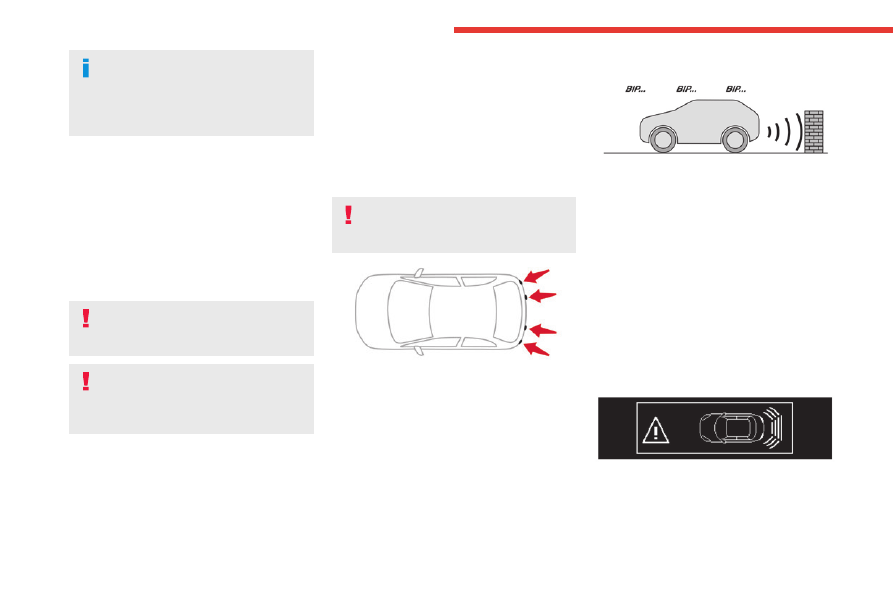
This system detects and signals the proximity of 

obstacles (e.g. pedestrian, vehicle, tree, gate) 

entering the field of detection of sensors located 

in the bumper.

Due to blind spots, obstacles of certain types 

(posts, roadworks cones, etc.) which were 

detected initially won't be any longer by the end 

of the operation.

Audible assistance


The system signals the presence of obstacles 

within the sensors’ detection zone.

The proximity information is given by an 

intermittent audible signal, the frequency of 

which increases as the vehicle approaches the 

obstacle.

When the distance between the vehicle and 

the obstacle becomes less than about thirty 

centimetres, the audible signal becomes 

continuous.

The sound emitted by the speaker (right or 

left) indicates the side on which the obstacle is 

located.

Visual assistance


-------------------------------------------------------------------------------------------------------------------------------------------------------------

67

Driving

6


This supplements the audible signal by 

displaying bars on the screen whose location 

represents the distance between the obstacle 

and the vehicle (white: more distant, orange: 

close, red: very close).

When the obstacle is very close, the "Danger" 

symbol is displayed on the screen.

Deactivation/Activation

The function is deactivated or activated via the 

vehicle configuration menu.

With audio system

The parking sensors can be configured in 

the "

Personalisation - Configuration

menu.

With touch screen

The parking sensors can be 

configured in the 

Driving

/

Vehicle


menu.

The function will be deactivated 

automatically if a trailer is being towed or 

a bicycle carrier is fitted (vehicle fitted with a 

tow bar or bicycle carrier recommended by 

CITROËN).

Malfunction

In the event of a malfunction when 

changing into reverse gear, this warning 

lamp lights up on the instrument panel and/or a 

message appears in the screen, accompanied 

by an audible signal (short beep).

Have it checked by a CITROËN dealer or a 

qualified workshop.

Reversing Camera

For more information, refer to the 

General recommendations on the use 

of driving and manoeuvring aids

.


The reversing camera is automatically activated 

when reverse gear is engaged.

The image is displayed on the touch screen.

The reversing camera function may be 

supplemented with parking sensors.


The representation with overlaid lines helps with 

the manoeuvre.

They are represented as lines marked 

"on the ground" and do not indicate the 

position of the vehicle in relation to tall 

obstacles (e.g. other vehicles).

Some distortion of the image is normal.

It is normal to have a part of the number plate 

showing at the bottom of the screen.

The blue lines 

1

 represent the general direction 

of the vehicle (the gap represents the width of 

your vehicle without the mirrors).

The red line 

2

 represents a distance of about 

30 cm beyond the edge of your vehicle's rear 

bumper.

The green lines 

3

 represent distances of about 1 

and 2 metres beyond the edge of your vehicle's 

rear bumper.

The turquoise blue curves 

4

 represent the 

maximum turning circle.

Opening the tailgate causes the display 

to disappear.

-------------------------------------------------------------------------------------------------------------------------------------------------------------


FILL UP WITH  

CONFIDENCE


WITH QUARTZ LUBRICANTS

* 1L & 5L produced in Europe

Partners  for  more  than  50  years,  Citroën  & 

TotalEnergies share common values: technology, 

creativity, innovation. TotalEnergies equips Citroën 
vehicles with 

Quartz lubricants from their first filling 

in the factory to approved maintenance networks to 

guarantee them optimal performance on a daily basis. 

Especially designed for Citroën vehicles, Quartz 

lubricants make them even more powerful, more fuel 

efficient and more environmentally friendly. For your 

car maintenance, fill up with confidence with Quartz 
lubricants !

Keep your engine younger for longer !

Quartz  Ineo  Xtra  First  0W-20  is  a  very  high 

performance lubricant resulting from the joint work of 

the Citroën and TotalEnergies R&D teams. Its innovative 

technology extends your engine’s life while reaching 

significant fuel savings and thus limiting CO

2

 emissions. 

The product is now available in new packaging* made 

of 50% recycled material and 100% recyclable.


-------------------------------------------------------------------------------------------------------------------------------------------------------------


69

Practical information

7


FILL UP WITH  

CONFIDENCE


WITH QUARTZ LUBRICANTS

* 1L & 5L produced in Europe

Partners  for  more  than  50  years,  Citroën  & 

TotalEnergies share common values: technology, 

creativity, innovation. TotalEnergies equips Citroën 
vehicles with 

Quartz lubricants from their first filling 

in the factory to approved maintenance networks to 

guarantee them optimal performance on a daily basis. 

Especially designed for Citroën vehicles, Quartz 

lubricants make them even more powerful, more fuel 

efficient and more environmentally friendly. For your 

car maintenance, fill up with confidence with Quartz 
lubricants !

Keep your engine younger for longer !

Quartz  Ineo  Xtra  First  0W-20  is  a  very  high 

performance lubricant resulting from the joint work of 

the Citroën and TotalEnergies R&D teams. Its innovative 

technology extends your engine’s life while reaching 

significant fuel savings and thus limiting CO

2

 emissions. 

The product is now available in new packaging* made 

of 50% recycled material and 100% recyclable.


Compatibility of fuels


Petrol fuels conforming to the EN228 standard 

containing up to 5% and 10% ethanol 

respectively.


Diesel fuels conforming to the EN590, EN16734 

and EN16709 standards and containing up to 

7%, 10%, 20% and 30% fatty acid methyl ester 

respectively. The use of B20 or B30 fuels, even 

occasionally, imposes special maintenance 

conditions referred to as "Arduous conditions".


Paraffinic Diesel fuel conforming to the EN15940 

standard.

The use of any other type of (bio) fuel 

(e.g. pure or diluted vegetable or animal 

oils, domestic fuel) is strictly prohibited - risk 

of damaging the engine and fuel system!

The only fuel additives authorised for use 

are those that meet the B715001 (Petrol) 

or B715000 (Diesel) standards.

Diesel at low temperature

At temperatures below 0 °C (+32 °F), the 

formation of paraffins in summer-type Diesel 

fuels could prevent the engine from operating 

correctly. In these temperature conditions, use 

winter-type Diesel fuel and keep the fuel tank 

more than 50 % full.

At temperatures below -15 °C (+5 °F) to avoid 

problems starting, it is best to park the vehicle 

under shelter (heated garage).

Travelling abroad

Certain fuels could damage your vehicle’s 

engine.

In certain countries, the use of a particular 

fuel may be required (specific octane rating, 

specific trade name, etc.) to ensure correct 

operation of the engine.

For all additional information, consult a dealer.

Refuelling

Fuel tank capacity: approximately 50 litres.

Reserve level: approximately 5 litres.

Low fuel level

When the low fuel level is reached, this 

warning lamp lights up on the instrument 

panel. When it first comes on, 

about 5 litres

 of 

fuel remain.

You must refuel as soon as possible to avoid 

running out of fuel.

For more information on 

Running out of fuel 

(Diesel)

, refer to the corresponding section.

A small arrow by the warning lamp 

indicates which side of the vehicle the 

fuel filler flap is located on.

Stop & Start

Never refuel with the engine in STOP 

mode; you must switch off the ignition.

Refuelling

Additions of fuel must be of at least 5 litres, in 

order to be registered by the fuel gauge.

Opening the filler flap may create a noise caused 

by an inrush of air. This vacuum is entirely 

normal, resulting from the sealing of the fuel 

system.

To refuel in complete safety:

► 

You must switch off the engine.


►  Raise the lever.


-------------------------------------------------------------------------------------------------------------------------------------------------------------

70

Practical information


►  Take care to select the pump that delivers the 

correct fuel type for the vehicle's engine (see a 

reminder label on the inside of the filler flap).

►  Open the filler cap by turning it a 1/4 turn to 

the left.


►  Remove the filler cap and hang it on its 

carrier (on the filler flap).

►  Introduce the filler nozzle and push it in as 

far as possible before starting to refuel (risk of 

blowback).

►  Fill the tank.

Do not continue past the 3

rd

 cut-off of the 

nozzle; as this may cause malfunctions.

►  Push the filler flap to close it.

The vehicle is fitted with a catalytic converter, a 

device which helps to reduce the level of harmful 

emissions in the exhaust gases.

For petrol engines, you must use unleaded 

fuel.

The filler neck is narrower, allowing only 

unleaded petrol nozzles to be introduced.

If you have put in the wrong fuel for 

the vehicle, you must have the fuel 

tank drained and filled with the correct fuel 

before starting the engine.

Misfuel prevention (Diesel)

(Depending on country of sale.)

This mechanical device prevents filling the tank 

of a Diesel vehicle with petrol.

Located in the filler neck, the misfuel prevention 

device is visible when the filler cap is removed.

Operation


When a petrol filler nozzle is introduced into the 

fuel filler neck of a Diesel vehicle, it comes into 

contact with the flap. The system remains closed 

and prevents filling.

Do not persist but introduce a Diesel type 

filler nozzle.

The misfuel prevention device does not 

prevent filling with a jerrycan, regardless 

of the fuel type.

Travelling abroad

As Diesel fuel pump nozzles may be 

different in other countries, the presence 

of the misfuel prevention device may make 

refuelling impossible.

Before travelling abroad, it is advisable to 

check with a CITROËN dealer if the vehicle is 

suitable for the distribution equipment of the 

countries visited.

AdBlue

®

 (BlueHDi)

To respect the environment and ensure 

compliance with the Euro 6 standard, without 

adversely affecting the performance or fuel 

consumption of its Diesel engines, CITROËN 

has taken the decision to equip its vehicles with 

a system that combines SCR (Selective Catalytic 

Reduction) with a Diesel Particle Filter (DPF) for 

the treatment of exhaust gases.

-------------------------------------------------------------------------------------------------------------------------------------------------------------

71

Practical information

7

SCR system

Using a liquid called AdBlue

®

 that contains 

urea, a catalytic converter turns up to 85% of 

the nitrogen oxides (NOx) into nitrogen and 

water, which are harmless to health and the 

environment.

The AdBlue

®

 is contained in 

a special 

tank

 holding about 17 litres. 

Its capacity allows a driving range of 

approximately 5,500 miles (9,000 km), 

which 

may vary considerably

 depending on your 

driving style.

An alert system is triggered once the reserve 

level is reached: it is then possible to drive for a 

further 1,500 miles (2,400 km) before the tank is 

empty and the vehicle is immobilised.

During each scheduled service of your vehicle by 

a CITROËN dealer or a qualified workshop, the 

AdBlue

®

 tank is refilled in order to allow normal 

operation of the SCR system.

If the estimated distance travelled by the 

vehicle between two services is greater than 

12,500 miles (20,000 km), it will be necessary to 

top up the AdBlue.

For more information on the 

Warning 

and indicator lamps

 and the associated 

alerts, or the 

Indicators

, please refer to the 

corresponding sections.

Once the AdBlue

®

 tank is empty, a device 

required by law prevents the engine from 

being restarted.

If the SCR system is faulty, the level of 

emissions from the vehicle will no longer meet 

the Euro 6 standard and the vehicle starts 

polluting the environment.

In the event of a confirmed SCR system 

malfunction, it is essential to visit a CITROËN 

dealer or a qualified workshop as soon as 

possible. After 685 miles (1,100 km), a device 

is automatically activated to prevent the 

engine from starting.

In both cases, a range indicator indicates 

the distance that can be travelled before the 

vehicle is immobilised.

Freezing of the AdBlue

®

AdBlue

®

 freezes at temperatures below 

around -11°C.

The SCR system includes a heater for the 

AdBlue

®

 tank, allowing you to continue driving 

in very cold conditions.

Supply of AdBlue

®

It is recommended that the AdBlue

®

 be topped 

up as soon as the first alert is issued indicating 

that the reserve level has been reached.

For the correct operation of the SCR 

system:

–  Use only AdBlue

®

 fluid that meets the ISO 

22241 standard.

–  Never transfer AdBlue

®

 to another container 

as it would lose its purity.

–  Never dilute AdBlue

®

 with water.

You can obtain AdBlue

®

 from a CITROËN dealer 

or a qualified workshop.

You can also visit a service station 

equipped with AdBlue

®

 pumps specially 

designed for passenger vehicles.

Never top up from an AdBlue

®

 dispenser 

reserved for heavy goods vehicles.

Recommendations on storage

AdBlue

®

 freezes at about -11°C and deteriorates 

above +25°C. Containers should be stored in a 

cool area and protected from direct sunlight.

Under these conditions, the fluid can be kept for 

at least a year.

If the fluid has frozen, it can be used once it has 

completely thawed out at room temperature.

Never store AdBlue

®

 containers in your 

vehicle.

-------------------------------------------------------------------------------------------------------------------------------------------------------------

72

Practical information

Precautions for use

AdBlue

®

 is a urea-based solution. This fluid is 

non-flammable, colourless and odourless (when 

kept in a cool place).

In the event of contact with the skin, wash the 

affected area with soap and running water. In the 

event of contact with the eyes, immediately rinse 

the eyes with large amounts of water or with an 

eye wash solution for at least 15 minutes. Seek 

medical attention if you feel a persistent burning 

sensation or irritation.

If swallowed, immediately wash out the mouth 

with clean water and then drink plenty of water.

In certain conditions (high temperature, for 

example), the risk of release of ammonia cannot 

be excluded: do not inhale the fluid. Ammonia 

vapours have an irritant effect on mucous 

membranes (eyes, nose and throat).

Store AdBlue

®

 out of the reach of 

children, in its original container.

Procedure

Before starting the top-up procedure, ensure that 

the vehicle is parked on a flat and level surface.

In wintry conditions, ensure that the temperature 

of the vehicle is above -11°C. Otherwise the 

AdBlue

®

 may be frozen and so cannot be poured 

into the tank. Park the vehicle in a warmer area 

for a few hours to allow the top-up to be carried 

out.

Never pour the AdBlue

®

 into the Diesel 

fuel tank.

For specific information about how to 

access the AdBlue tank, refer to the 

detailed descriptions below.

If any AdBlue

®

 is splashed, or if there are 

any spillages on the bodywork, rinse 

immediately with cold water or wipe with a 

damp cloth.

If the fluid has crystallised, clean it off using a 

sponge and hot water.

Important: 

in the event of a top-up after 

an AdBlue

 breakdown, you must wait 

about 5 minutes before switching on the 

ignition, 

without opening the driver's door, 

unlocking the vehicle or bringing the 

electronic key into the passenger 

compartment.

Switch on the ignition, then wait for 10 

seconds before starting the engine.

►  Switch off the ignition and remove the key 

from the switch to switch off the engine.


►  Turn the blue cap of the AdBlue

®

 tank anti-

clockwise and remove it.

Filling up

►  With a bottle or container of AdBlue

®

: after 

checking the expiry date, read the instructions 

on the label carefully before pouring the contents 

into the vehicle's AdBlue

®

 tank.

►  With an AdBlue

®

 pump: insert the nozzle and 

fill the tank until the nozzle automatically cuts 

out.

In order not to overfill the AdBlue

®

 tank:

–  Add between 10 and 13 litres using 

AdBlue

®

 containers.

–  Stop after the nozzle’s first automatic cut-

out, if you are refilling at a service station.

The system only registers AdBlue

®


intermediate top-ups of 5 litres or more.

If the AdBlue

®

 tank is completely empty 

– which is confirmed by the message 

-------------------------------------------------------------------------------------------------------------------------------------------------------------

73

Practical information

7

Top up AdBlue: Starting impossible

” – it is 

essential to add at least 10 litres.

Top-up detection may not be instantaneous 

after addition. It may take a few minutes of 

driving before the top-up detection is effective.

Do not dispose of AdBlue

®

 bottles or 

containers in the household waste.

Place them in a container reserved for this 

purpose or take them back to where you 

purchased them.

Snow chains

In wintry conditions, snow chains improve 

traction as well as the behaviour of the vehicle 

when braking.

Snow chains must be fitted only to the 

front wheels. They must never be fitted to 

"space-saver" type spare wheels.

Observe the legislation in force in your 

country relating to the use of snow 

chains and maximum authorised speeds.

Use only the chains designed to be fitted to the 

type of wheel fitted to your vehicle :

Original tyre size

Maximum link size

185/65 R15

9 mm

195/55 R16

For more information on snow chains, contact a 

CITROËN dealer or a qualified workshop.

Installation tips 

►  To fit the snow chains during a journey, stop 

the vehicle on a flat surface at the side of the 

road.

►  Apply the parking brake and position any 

wheel chocks under the wheels to prevent 

movement of the vehicle.

►  Fit the snow chains following the instructions 

provided by the manufacturer.

►  Move off gently and drive for a few moments, 

without exceeding 31 mph (50 km/h).

►  Stop the vehicle and check that the snow 

chains are correctly tightened.

It is strongly recommended that you 

practise fitting the snow chains on a level 

and dry surface before setting off.

Avoid driving with snow chains on roads 

that have been cleared of snow to avoid 

damaging the vehicle's tyres and the road 

surface. If the vehicle is fitted with alloy 

wheels, check that no part of the chain or its 

fixings is in contact with the wheel rim.

Energy economy mode

This system manages the duration of use of 

certain functions, in order to conserve a sufficient 

level of charge in the battery with the ignition off.

After switching off the engine and for a maximum 

cumulative period of around 30 minutes, you can 

continue to use functions such as the audio and 

telematics system, dipped beam headlamps or 

courtesy lamps.

Selecting the mode

A confirmation message is displayed when 

energy economy mode is entered, and the active 

functions are placed on standby.

If a telephone call is in progress at the 

time, it will be maintained for around 10 

minutes via the audio system’s hands-free 

system.

Exiting the mode

These functions are automatically reactivated the 

next time the vehicle is used.

To restore the use of these functions 

immediately, start the engine and let it run:

–  For less than 10 minutes, to use the 

equipment for approximately 5 minutes.

–  For more than 10 minutes, to use the 

equipment for approximately 30 minutes.

Let the engine run for the specified duration to 

ensure that the battery charge is sufficient.

-------------------------------------------------------------------------------------------------------------------------------------------------------------

74

Practical information

To recharge the battery, avoid repeatedly or 

continuously restarting the engine.

A flat battery prevents the engine from 

starting.

For more information on the 

12 V battery

refer to the corresponding section.

Load reduction mode

This system manages the use of certain 

functions according to the level of charge 

remaining in the battery.

When the vehicle is being driven, the load 

reduction function temporarily deactivates certain 

functions, such as the air conditioning and the 

heated rear screen.

The deactivated functions are reactivated 

automatically as soon as conditions permit.

Towing device

Load distribution

►  Distribute the load in the trailer so that the 

heaviest items are as close as possible to the 

axle, and the nose weight approaches the 

maximum permitted without exceeding it.

Air density decreases with altitude, thus reducing 

engine performance. The maximum towable load 

must be reduced by 10% per 1,000 metres of 

altitude.

Use genuine towing devices and wiring 

harnesses approved by CITROËN. We 

recommend having them fitted by a CITROËN 

dealer or a qualified workshop.

If not fitted by a CITROËN dealer, they must 

still be fitted in accordance with the vehicle 

manufacturer's instructions.

Certain driving or manoeuvring aid functions 

are automatically deactivated while an 

approved towing system is in use.

For more information about driving with a 

towing device fitted to a trailer and associated 

with the 

Trailer stability assist

, refer to the 

corresponding section.

Comply with the maximum authorised 

towable weight, as indicated on your 

vehicle's registration certificate, on the 

manufacturer's label and in the 

Technical 

data

 section of this guide.

If using accessories attached to the 

towing device (e.g. bicycle carriers, tow 

boxes):

–  Comply with the maximum authorised nose 

weight.

–  Do not transport more than 4 conventional 

bicycles or 2 electric bicycles.

When loading bicycles onto a bicycle carrier 

on a towball, be sure to place the heaviest 

bicycles as close as possible to the vehicle.

Observe the legislation in force in the 

country where you are driving.

Very cold climate screen

(Depending on country of sale)

This removable device prevents the 

accumulation of snow around the radiator 

cooling fan.

In case of difficulty with installation/

removal

Contact a CITROËN dealer or a qualified 

workshop.

Before any operation, ensure that the 

engine is off and the cooling fan has 

stopped.

It is essential to remove them when:

–  the outside temperature exceeds 

10°C.

–  recovery is in progress.

–  the speed is above 75 mph (120 km/h).

-------------------------------------------------------------------------------------------------------------------------------------------------------------

75

Practical information

7

Fitting/Removing


►  Place the screen in front of the front bumper.

►  Insert the two lower fixing brackets 

1

 into the 

bumper.

►  Tilt the screen upwards, press on the two 

upper fixing brackets 

2

 and insert them into the 

bumper.

►  Check that the unit is firmly held by pressing 

its edge.

To remove it, carry out these operations in 

reverse order.

Roof bars

As a safety measure and to avoid 

damaging the roof, it is essential to use 

transverse roof bars approved for your 

vehicle.

Observe the instructions on fitting and use 

contained in the guide supplied with the roof 

bars.

Maximum load distributed over the 

transverse roof bars, for a loading height 

not exceeding 40 cm (except bicycle carrier): 

75 kg

.

As this value may change, please verify the 

maximum load quoted in the guide supplied 

with the roof bars.

If the height exceeds 40 cm, adapt the speed 

of the vehicle to the profile of the road to 

avoid damaging the roof bars and the fixings 

on the vehicle.

Be sure to refer to national legislation in order 

to comply with the regulations for transporting 

objects that are longer than the vehicle.

Recommendations

Distribute the load uniformly, taking care 

to avoid overloading one of the sides.

Arrange the heaviest part of the load as close 

as possible to the roof.

Secure the load firmly.

Drive gently: the vehicle will be more 

susceptible to the effects of side winds and its 

stability may be affected.

Regularly check the security and tight 

fastening of the roof bars, at least before each 

trip.

Remove the roof bars once they are no longer 

needed.

Direct fitting on roof


The transverse bars must only be fixed at the 

four anchorage points located on the roof frame. 

These points are concealed by the vehicle doors 

when the doors are closed.

The roof bar fixings have a stud which must be 

inserted into the opening of each anchorage 

point.

Bonnet

Stop & Start

Before doing anything under the bonnet, 

you must switch off the ignition to avoid any 

risk of the engine restarting automatically.

Take care with objects or clothing that could 

be caught in the blades of the cooling fan 

-------------------------------------------------------------------------------------------------------------------------------------------------------------

76

Practical information

or in certain moving components - risk of 

strangulation and serious injury!

The location of the interior bonnet 

release lever prevents the bonnet being 

opened when the left-hand front door is 

closed.

When the engine is hot, handle the 

exterior safety catch and the bonnet stay 

with care (risk of burns), using the protected 

area.

When the bonnet is open, take care not to 

damage the safety catch.

Do not open the bonnet under very windy 

conditions.

Cooling of the engine when stopped

The engine cooling fan may start after 

the engine has been switched off.

Take care with objects or clothing that 

could be caught in the blades of the fan!

Opening

►  Open the left-hand front door.


►  Pull the interior release lever, located at the 

bottom of the dashboard, towards you.

►  Tilt the exterior safety catch to the left and 

raise the bonnet.


►  Unclip the stay from its housing and place it 

in the support slot to hold the bonnet open.

Closing

►  Hold the bonnet and pull out the stay from the 

support slot.

►  Clip the stay in its housing.

►  Lower the bonnet and release it near the end 

of its travel.

►  Pull on the bonnet to check that it is locked 

correctly.

Because of the presence of electrical 

equipment under the bonnet, it is strongly 

recommended that exposure to water (rain, 

washing, etc.) be limited. 

Engine compartment

The engine shown here is an example for 

illustrative purposes only.

The locations of the following components may 

vary:

–  Engine oil dipstick.

–  Engine oil filler cap.

–  Priming pump.

Petrol engine


-------------------------------------------------------------------------------------------------------------------------------------------------------------

77

Practical information

7

Diesel engine


1.

Screenwash fluid reservoir

2.

Engine coolant reservoir

3.

Brake fluid reservoir

4.

Battery

5.

Remote earth point (-)

6.

Fusebox

7.

Air filter

8.

Engine oil filler cap

9.

Engine oil dipstick

10.

Priming pump*

Diesel fuel system

This system is under very high pressure.

All work must be carried out only by a 

CITROËN dealer or a qualified workshop

Checking levels

Check all of the following levels regularly in 

accordance with the manufacturer's service 

* Depending on engine.

schedule. Top them up if required, unless 

otherwise indicated.

If a level drops significantly, have the 

corresponding system checked by a CITROËN 

dealer or a qualified workshop.

The fluids must comply with the 

manufacturer's requirements and with 

the vehicle's engine.

Take care when working under the 

bonnet, as certain areas of the engine 

may be extremely hot (risk of burns) and the 

cooling fan could start at any time (even with 

the ignition off).

Used products

Avoid prolonged contact of used oil or 

fluids with the skin.

Most of these fluids are harmful to health and 

very corrosive.

Do not discard used oil or fluids into 

sewers or onto the ground.

Empty used oil into the containers reserved 

for this purpose at a CITROËN dealer or a 

qualified workshop.

Engine oil

The level is checked, with the engine 

having been switched off for at least 30 

minutes and on level ground, using the dipstick.

It is normal to top up the oil level between two 

services (or oil changes). It is recommended 

that you check the level, and top up if necessary, 

every 3,000 miles (5,000 km).

In order to maintain the reliability of the 

engine and emissions control system, 

never use additives in the engine oil.

Checking using the dipstick

For the location of the dipstick, please refer 

to the illustration of the corresponding engine 

compartment.

►  Grasp the dipstick by its coloured grip and 

pull it out completely.

►  Wipe the end of the dipstick using a clean, 

lint-free cloth.


►  Reinsert the dipstick and push fully down, 

then pull it out again to visually check the oil 

-------------------------------------------------------------------------------------------------------------------------------------------------------------

78

Practical information

level: the correct level is between marks 

A (max)


and 

B (min).

Do not start the engine if the level is:

–  above mark 

A

: contact a CITROËN dealer or a 

qualified workshop.

–  below mark 

B

: top up the engine oil 

immediately.

Oil grade

Before topping up or changing the 

engine oil, check that the oil is suitable 

for your engine and complies with the 

recommendations in the service schedule 

supplied with the vehicle (or available from 

your CITROËN dealer or qualified workshop).

Use of non-recommended oil may invalidate 

your warranty in the event of engine failure.

Topping up the engine oil level

For the location of the engine oil filler cap, please 

refer to the corresponding engine compartment 

illustration.

►  Add oil in small quantities, avoiding any spills 

on engine components (risk of fire).

►  Wait a few minutes before checking the level 

again using the dipstick.

►  Top up the level if necessary.

►  After checking the level, carefully screw the 

oil filler cap back on and replace the dipstick in 

its tube.

Brake 

fluid

The level of this fluid should be close to 

the "

MAX

" mark. If not, check the brake 

pads for wear.

To know how often the brake fluid should be 

replaced, refer to the manufacturer's servicing 

schedule.

Clean the cap before removing it to refill. 

Use only DOT4 brake fluid from a sealed 

container.

Engine coolant

It is normal to top up this fluid between 

two services.

The check and top-up must only be done with 

the engine cold.

A level of coolant that is too low risks causing 

major damage to the engine; the coolant level 

must be close to the "

MAX

" mark without ever 

going above it.

If the level is close to or below the "

MIN

" mark, it 

is essential to top it up.

When the engine is hot, the temperature of the 

coolant is regulated by the fan.

As the cooling system is pressurised, wait at 

least one hour after switching off the engine 

before carrying out any work.

In order to avoid the risk of scalding if you need 

to top up in an emergency, wrap a cloth around 

the cap and unscrew the cap by two turns to 

allow the pressure to drop.

Once the pressure has dropped, remove the cap 

and top up to the required level.

Screenwash fluid

Top up to the required level when 

necessary.

Fluid specification

The fluid must be topped up with a pre-mixed 

product.

In winter (temperatures below zero), a fluid 

containing an anti-freeze agent which is 

appropriate for the temperature conditions 

must be used in order to protect the system's 

components (pump, tank, ducts, jets).

Filling with pure water is prohibited in all 

circumstances (risk of freezing, 

limescale, etc.).

Diesel fuel additive (Diesel 

with particle filter)

On reaching the minimum level in the 

particle filter additive tank, this warning 

lamp comes on fixed, accompanied by an 

audible signal and a warning message.

Topping up

The topping up of this additive must be carried 

out quickly.

Visit a CITROËN dealer or a qualified workshop.

-------------------------------------------------------------------------------------------------------------------------------------------------------------

79

Practical information

7

AdBlue

®

 (BlueHDi)

An alert is triggered when the reserve level is 

reached.

For more information on the 

Indicators

 and in 

particular the AdBlue range indicators, refer to 

the corresponding section.

To avoid the vehicle being immobilised in 

accordance with regulations, you must top up the 

AdBlue tank.

For more information on 

AdBlue

®

 (BlueHDi)

and in particular the supply of AdBlue, refer to 

the corresponding section.

Checks

Unless otherwise indicated, check these 

components in accordance with the 

manufacturer's service schedule and according 

to your engine.

Otherwise, have them checked by a CITROËN 

dealer or a qualified workshop.

Only use products recommended by 

CITROËN or products of equivalent 

quality and specification.

In order to optimise the operation of 

components as important as those in the 

braking system, CITROËN selects and offers 

very specific products.

12 V battery

The battery does not require any 

maintenance.

Check regularly that the terminals are correctly 

tightened (versions without quick-release 

terminals) and that the connections are clean.

For more information on the precautions 

to take before any work on the 

12 V 

battery

, refer to the corresponding section.

Versions equipped with Stop & Start are 

fitted with a 12 V lead-acid battery with 

special technology and specifications.

Its replacement should be carried out only by 

a CITROËN dealer or a qualified workshop.

Air 

filter

Depending on the environment and the 

use of the vehicle (e.g. dusty atmosphere, 

city driving), 

change it twice as often, if 

necessary

.

Passenger compartment 

filter

Depending on the environment and the 

use of the vehicle (e.g. dusty atmosphere, 

city driving), 

change it twice as often, if 

necessary

.

A clogged passenger compartment filter 

can adversely affect air conditioning 

system performance and generate 

undesirable odours.

Oil 

filter

Change the oil filter each time the engine 

oil is changed.

Particle 

filter (Diesel)

The start of clogging of the particle filter is 

indicated by the temporary lighting of this 

warning lamp, accompanied by an alert 

message.

As soon as traffic conditions allow, regenerate 

the filter by driving at a speed of at least 37 mph 

(60 km/h), with an engine speed above 2,500 

rpm, for about 15 minutes (until the warning lamp 

goes out).

If it is not possible to reach 37 mph (60 km/h), 

leave the engine running at idle for about 15 

minutes, then drive with an engine speed above 

2,500 rpm for 15 minutes.

Do not switch off the engine until the filter 

is fully regenerated; repeated intervals 

can degrade the engine oil prematurely.

Regenerating the filter while the vehicle is 

stationary is not recommended.

Following prolonged operation of the 

vehicle at very low speed or at idle, you 

may, in exceptional circumstances, notice 

water vapour coming from the exhaust while 

-------------------------------------------------------------------------------------------------------------------------------------------------------------

80

Practical information

accelerating. These emissions have no 

impact on the vehicle’s behaviour and the 

environment.

New vehicle

During the first few particle filter 

regeneration operations, you may notice a 

"burning" smell. This is perfectly normal.

Manual gearbox

The gearbox does not require any 

maintenance (no oil change).

Automatic gearbox

The gearbox does not require any 

maintenance (no oil change).

Brake pads

Brake wear depends on the style of 

driving, particularly in the case of vehicles 

used in town, over short distances. It may be 

necessary to have the condition of the brakes 

checked, even between vehicle services.

Unless there is a leak in the circuit, a drop in the 

brake fluid level indicates that the brake pads 

are worn.

After washing the vehicle, moisture, or in 

wintry conditions, ice can form on the 

brake discs and pads: braking efficiency may 

be reduced. Gently dab the brakes to dry and 

defrost them.

Brake disc wear

For information on checking brake disc 

wear, contact a CITROËN dealer or a 

qualified workshop.

Manual parking brake

If you notice excessive brake lever travel 

or decreased effectiveness, the parking 

brake must be adjusted, even between two 

services.

This system must be checked by a CITROËN 

dealer or a qualified workshop.

Wheels and tyres

The inflation pressure of all tyres, 

including the spare wheel, must be 

checked on "cold” tyres.

The pressures indicated on the tyre pressure 

label are valid for "cold" tyres. If you have driven 

for more than 10 minutes or more than 6 miles 

(10 kilometres) at over 31 mph (50 km/h), add 

0.3 bar (30 kPa) to the values indicated on the 

label.

Under-inflation increases energy 

consumption. Non-compliant tyre 

pressures cause tyres to wear prematurely 

and have an adverse effect on the vehicle's 

road holding - risk of accident!

Driving with worn or damaged tyres reduces the 

braking and road holding performance of the 

vehicle. Regularly check the condition of the 

tyres (tread and sidewalls) and rims as well as 

the presence of the valve caps.

When the wear indicators no longer appear set 

back from the tread, the depth of the grooves is 

less than 1.6 mm; replace the tyres as soon as 

possible.

Using different size wheels and tyres from those 

specified can affect the lifetime of tyres, wheel 

rotation, ground clearance, the speedometer 

reading and have an adverse effect on road 

holding.

Fitting different tyres on the front and rear axles 

can cause the ESC to mistime.

Always mark the direction of rotation on the tyres 

that will be stored when fitting winter or summer 

tyres. Store them in a cool, dry place and away 

from direct exposure to the sun's rays.

Winter or 4-seasons tyres can be 

identified by this symbol on their 

sidewalls.

Free-wheeling

In certain situations, it is necessary to put the 

vehicle into free-wheeling mode (e.g. towing, on 

a rolling road, automatic car wash (Wash mode), 

rail or sea transport).

Never leave the vehicle unattended with 

the vehicle into free-wheeling mode.

-------------------------------------------------------------------------------------------------------------------------------------------------------------

81

Practical information

7

With manual or automatic 

gearbox and manual parking 

brake


/


To release them

►  With the vehicle stationary and engine 

running, depress the brake pedal.

►  With a manual gearbox, place the gear lever 

into neutral.

►  With an automatic gearbox, place the gear 

selector to mode 

N

.

►  Release the parking brake.

►  Release the brake pedal, then switch off the 

engine.

Reverting to normal operation

►  Apply the parking brake.

►  With an automatic gearbox, place the gear 

selector to mode 

P

.

Advice on care and 

maintenance

General recommendations

Observe the following recommendations to avoid 

damaging the vehicle.

Exterior

Never use a high-pressure jet wash in 

the engine compartment - risk of 

damaging the electrical components!

Do not wash the vehicle in bright sunshine or 

extremely cold conditions.

When washing the vehicle in an 

automatic roller-brush car wash, be sure 

to lock the doors and, depending on version, 

move the electronic key away.

When using a pressure washer, keep the jet 

nozzle at a minimum distance of 30 cm from 

the vehicle (particularly when cleaning areas 

containing chipped paint, sensors or seals).

Promptly clean up any stains containing 

chemicals liable to damage the vehicle's 

paintwork (including tree resin, bird 

droppings, insect secretions, pollen and tar).

Depending on the environment, clean the 

vehicle frequently to remove salty deposits 

(in coastal areas), soot (in industrial areas) 

and mud/salts (in wet or cold areas). These 

substances can be highly corrosive.

Contact a CITROËN dealer or a qualified 

workshop for advice on removing stubborn 

stains requiring special products (such as tar 

or insect removers).

Preferably, have paint touch-ups performed 

by a CITROËN dealer or a qualified 

workshop.

Interior

When washing the vehicle, never use a 

water hose or high-pressure jet to clean 

the interior.

Liquids carried in cups or other open 

containers can spill, presenting a risk of 

damage to the instruments and controls and 

the controls located on the centre console. Be 

vigilant!

To clean instrument panels, touch screens 

or other displays, wipe gently with a soft, 

dry cloth. Do not use products (e.g. alcohol, 

disinfectant) or soapy water directly on these 

surfaces - risk of damage!

Bodywork

High-gloss paint

Do not use abrasive products, solvents, 

petrol or oil to clean the bodywork.

Never use an abrasive sponge to clean 

stubborn stains - risk of scratching the 

paintwork!

Do not apply polish in strong sunshine, or to 

plastic or rubber parts.

Use a soft cloth and soapy water or a pH 

neutral product.

Gently wipe the bodywork with a clean 

microfibre cloth.

Apply polish with the vehicle clean and dry.

-------------------------------------------------------------------------------------------------------------------------------------------------------------


Content      ..     3      4      5      6     ..