Citroën C5 Aircross (2022 year). Manual in english - page 8
 

  Index      Manuals     Citroën C5 Aircross (2022 year). Manual in english


Search            copyright infringement  


Content      ..     6      7      8      9     ..


Citroën C5 Aircross (2022 year). Manual in english - page 8


114

Driving

Information displayed on 

the instrument panel


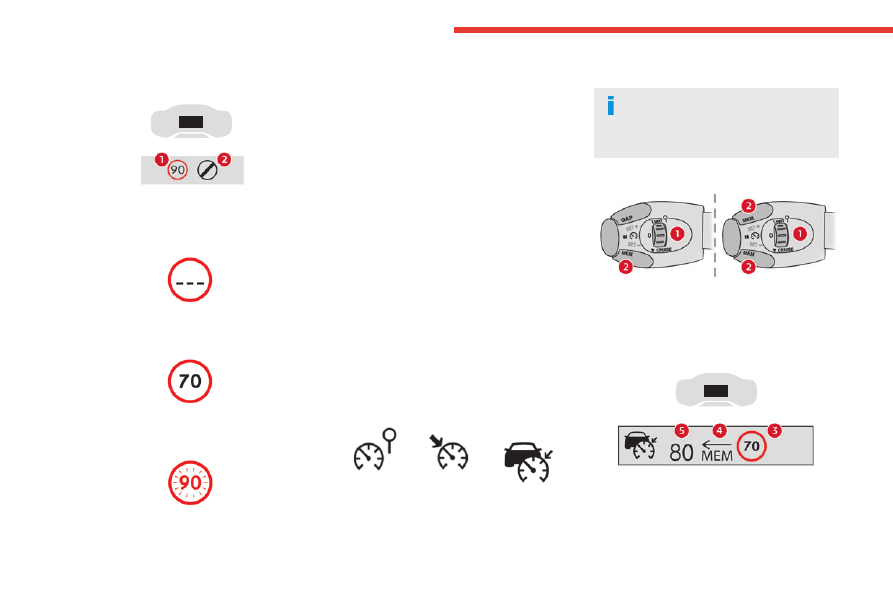
1.

Detected speed limit indication

or

2.

End of speed limit indication


The system is active but is not detecting speed 

limit information.


On detecting speed limit information, the system 

displays the value.


For a suggested maximum speed, the first time 

that the vehicle exceeds it 

by more than 3 mph 

(5 km/h)

 (e.g. 59 mph (95 km/h)), the speed is 

displayed and flashes for 10 seconds (depending 

on version).

Operating limits

The system does not take account of reduced 

speed limits, especially those imposed in the 

following cases:

–  Poor weather (rain, snow).

–  Atmospheric pollution.

– Towing.

–  Driving with a space-saver type spare wheel 

or snow chains fitted.

–  Tyre repaired using the temporary puncture 

repair kit.

–  Young drivers.

The system may not display the speed limit if it 

does not detect a speed limit sign within a preset 

period and in the following situations:

–  Road signs that are obstructed, non-standard, 

damaged or bent.

–  Obsolete or incorrect maps.

Recommendation


In addition to 

Road signs recognition

, the 

driver can select the speed displayed as a speed 

setting for the speed limiter or cruise control 

using the speed limiter or cruise control 'store' 

button.

For more information on the 

Speed 

limiter

Cruise control

 or 

Adaptive 

cruise control

, refer to the corresponding 

sections.

Steering-mounted controls

1.

Speed limiter/cruise control mode selection

2.

Memorise the speed setting

Information displayed on the 

instrument panel


3.

Speed limit indication

4.

Speed memorisation prompt

5.

Current speed setting

-------------------------------------------------------------------------------------------------------------------------------------------------------------

115

Driving

6

Storing the speed setting


►  Switch on the speed limiter/cruise control.

The speed limiter/cruise control information is 

displayed. 

Upon detecting a sign suggesting a new speed 

setting, the system displays the value and 

"

MEM

" flashes for a few seconds, prompting you 

to save it as a new speed setting.

If there is a difference of less than 6 mph 

(9 km/h) between the speed setting and 

the speed displayed by the Road signs 

recognition, the "

MEM

" symbol is not 

displayed.

Depending on the road conditions, several 

speeds may be displayed.

►  Press button 

2 once

 to save the suggested 

speed value.

A message is displayed, confirming the request.

►  Press button 

2 again

 to confirm and save the 

new speed setting.

The display then reverts to its previous state.

Extended Traffic Sign 

Recognition

For more information, refer to the 

General recommendations on the use 

of driving and manoeuvring aids

.


This additional system recognises these road 

signs and displays them on the instrument panel.

As you approach it, the symbol of the 

corresponding sign is displayed on the 

instrument panel.

The actual road signs always take priority 

over those displayed by the system.

The signs must comply with the Vienna 

Convention on road signs.

Activation/Deactivation

The settings are changed via 

the 

Driving

/

Vehicle

 touch screen menu.

Programmable speed 

limiter

For more information, refer to the 

General recommendations on the use 

of driving and manoeuvring aids

.

This system prevents the vehicle from 

exceeding the speed programmed by the 

driver (speed setting).

The speed limiter is switched on manually.

The minimum speed setting is 19 mph (30 km/h).

The speed setting remains in the system 

memory when the ignition is switched off.

Steering-mounted control


1.

ON (

LIMIT

 position)/OFF (position 

0

)

2.

Reduce the speed setting

3.

Increase the speed setting

4.

Pause/resume speed limiter with the speed 

setting previously stored

-------------------------------------------------------------------------------------------------------------------------------------------------------------

116

Driving

5.

Depending on version:

Display the speed thresholds saved using the 

Memorising speeds function

or

Use the speed suggested by the Road signs 

recognition function (

MEM

 display)

For more information on 

Memorising speeds


or the 

Road signs recognition

, refer to the 

corresponding sections.

Information displayed on 

the instrument panel


6.

Speed limiter status: on (amber)/pause 

(grey).

7.

Speed limiter mode selection indication

8.

Speed setting value

9.

Speed suggested by the Road signs 

recognition function (depending on version)

Switching on/Pausing

►  Turn thumbwheel 

1

 to the "

LIMIT

" position 

to select speed limiter mode; the function is 

paused.

►  If the speed limit setting is suitable (most 

recent speed setting programmed in the system), 

press button 

4-II

 to switch the speed limiter on.

►  Pressing 

4-II

 again temporarily pauses the 

function (pause).

When the speed setting remains below 

the vehicle's speed for a prolonged 

period of time, an audible warning is emitted.

Adjusting the limit speed 

setting

You do not have to switch the speed limiter on in 

order to set the speed.

To modify the limit speed setting based on the 

vehicle’s current speed:

►  For steps of +/- 1 mph (1 km/h), briefly 

press 

2-SET-

 or 

3-SET+

 repeatedly.

►  For steps of +/- 5 mph (5 km/h), press and 

hold 

2-SET-

 or 

3-SET+

.

To change the limit speed setting using 

memorised speeds, via the touch screen:

►  Press 

5-MEM

 to display the memorised 

speed settings.

►  Press the touch screen button for the desired 

speed setting.

The selection screen closes after a few 

moments.

This setting becomes the new limit speed.

To modify the speed limit setting based on the 

speed suggested by the Road signs recognition 

function displayed on the instrument panel:

►  Press 

5-MEM

 once; a message is displayed, 

confirming the memorisation request.

►  Press 

5-MEM

 again to save the suggested 

speed.

The new speed setting value is displayed on the 

instrument panel.

Temporarily exceeding the 

speed setting

►  Fully depress the accelerator pedal.

The speed limiter is temporarily deactivated and 

the displayed speed setting flashes.

►  Release the accelerator pedal to return to 

below the speed setting.

When exceeding the speed is not due to the 

driver's action (e.g. in case of a steep slope), an 

audible signal is triggered immediately.

On a steep descent or in the event of 

sharp acceleration, the speed limiter will 

not be able to prevent the vehicle from 

exceeding the speed setting.

If necessary, apply the brakes to control your 

vehicle’s speed.

When the vehicle speed returns to the speed 

setting level, the speed limiter operates again: 

the speed setting display becomes fixed again.

Switching off

►  Turn the thumbwheel 

1

 to the "

OFF

" position: 

speed limiter information is no longer displayed.

-------------------------------------------------------------------------------------------------------------------------------------------------------------

117

Driving

6

Malfunction


In the event of a malfunction, dashes are 

displayed flashing and then fixed instead of the 

speed setting.

Have it checked by a CITROËN dealer or a 

qualified workshop.

Cruise control - 

Specific 

recommendations

The cruise control function does not 

guarantee compliance with the maximum 

authorised speed and the safety distance 

between vehicles, the driver remains 

responsible for their driving.

In the interest of public safety, only use cruise 

control if the traffic conditions enable vehicles 

to drive at a steady speed and maintain an 

adequate safety distance.

Remain vigilant while cruise control is 

activated.

 If you press and hold one of the 

speed setting modification buttons, your 

vehicle may change speed very abruptly.

When 

descending a steep hill

, the cruise 

control system cannot prevent the vehicle 

from exceeding the set speed. Brake if 

necessary to control the vehicle speed.

On 

steep climbs

 or when towing, the set 

speed may not be reached or maintained.

Exceeding the programmed speed 

setting

You can 

temporarily

 exceed the speed 

setting by pressing the accelerator pedal (the 

programmed speed flashes).

To return to the speed setting, release the 

accelerator pedal (when the set speed is 

reached again, the displayed speed stops 

flashing).

Operating limits

Never use the system in the following 

situations:

–  In an urban area with the risk of 

pedestrians crossing the road.

–  In heavy traffic (except versions with the 

Stop & Go function).

–  On winding or steep roads.

–  On slippery or flooded roads.

–  In poor weather conditions.

–  In the event of restricted visibility for the 

driver.

–  Driving on a speed circuit.

–  Driving on a rolling road.

–  When using a ‘space-saver’ type spare 

wheel.

–  When using snow chains, non-slip covers 

or studded tyres.

Programmable cruise 

control

For more information, refer to the 

General recommendations on the use 

of driving and manoeuvring aids

 and the 

Cruise control - Specific 

recommendations

.

This system automatically maintains the 

vehicle’s speed at the value programmed 

by the driver (speed setting), without the use of 

the accelerator pedal.

Cruise control is switched on manually.

It requires a minimum vehicle speed of 25 mph 

(40 km/h).

With a manual gearbox, third gear or higher must 

be engaged.

With an automatic gearbox, mode 

D

 or second 

gear or higher in mode 

M

 must be engaged.

Cruise control remains active after 

changing gear, regardless of the gearbox 

type, on engines fitted with the Stop & Start 

function.

Switching off the ignition cancels any 

speed setting.

-------------------------------------------------------------------------------------------------------------------------------------------------------------

118

Driving

Steering-mounted control


1.

ON (

CRUISE

 position)/OFF (position 

0

)

2.

Activate cruise control at the current speed/

decrease speed setting

3.

Activate cruise control at the current speed/

increase speed setting

4.

Pause/resume cruise control with the speed 

setting previously saved

5.

Depending on version:

Display the speed thresholds saved using the 

Memorising speeds function

or

Use the speed suggested by the Road signs 

recognition function (

MEM

 display)

For more information on 

Memorising speeds


or the 

Road signs recognition

, refer to the 

corresponding sections.

Information displayed on 

the instrument panel


6.

Speed limiter status: on (amber)/pause 

(grey).

7.

Cruise control mode selection

8.

Speed setting value

9.

Speed suggested by the Speed Limit 

recognition and recommendation system 

(depending on version)

Switching on/pausing

►  Turn thumbwheel 

1

 to the "

CRUISE

" position 

to select cruise control mode; the function is 

paused.

►  Press button 

2-SET-

 or 

3-SET+

 to activate 

cruise control and save a speed setting when 

the vehicle has reached the desired speed; the 

vehicle’s current speed is saved as the speed 

setting.

►  Release the accelerator pedal.

►  Pressing button 

4-II

 temporarily pauses the 

function (pause).

►  Pressing button 

4-II

 again resumes operation 

of the cruise control (ON).

Cruise control can also be paused 

temporarily:

–  by pressing the brake pedal.

–  automatically, if the electronic stability 

control (ESC) system is triggered.

Changing the cruise speed 

setting

The cruise control must be active.

To change the cruise speed setting, based on 

the vehicle’s current speed:

►  For steps of +/- 1 mph (1 km/h), briefly 

press 

2-SET-

 or 

3-SET+

 repeatedly.

►  For steps of +/- 5 mph (5 km/h), press and 

hold 

2-SET-

 or 

3-SET+

.

Pressing and holding 

2-SET-

 or 

3-SET+


results in a rapid change in the speed of 

the vehicle.

As a precaution, we recommend setting 

a cruise speed fairly close to the current 

speed of your vehicle, to avoid any sudden 

acceleration or deceleration of the vehicle.

To change the cruise speed setting using 

memorised speed settings and from the touch 

screen:

►  Press 

5-MEM

 to display the memorised 

speed settings.

-------------------------------------------------------------------------------------------------------------------------------------------------------------

119

Driving

6

►  Press the touch screen button for the desired 

speed setting.

The selection screen closes after a few 

moments.

This setting becomes the new cruise speed.

To change the cruise speed setting using the 

speed suggested by the Road signs recognition 

function displayed on the instrument panel:

►  Press 

5-MEM

 once; a message is displayed, 

confirming the memorisation request.

►  Press 

5-MEM

 again to save the suggested 

speed.

The new speed setting value is displayed on the 

instrument panel.

Switching off

►  Turn the thumbwheel 

1

 to the "

0

” position: the 

cruise control information disappears from the 

screen.

Malfunction


In the event of a malfunction, dashes are 

displayed flashing and then fixed instead of the 

speed setting.

Have it checked by a CITROËN dealer or a 

qualified workshop.

Memorising speeds

This function, used only for the speed limiter 

and programmable cruise control, lets you 

save speed settings that will subsequently be 

proposed for the purpose of configuring these 

two systems.

You can memorise multiple speed settings for 

each of the two systems.

By default, some speed settings are already 

memorised.

As a safety measure, the driver must only 

change speed settings when stationary.

Changing a speed setting

Speed settings can be activated, 

deactivated, selected and changed in the 

Driving / Vehicle

 touch screen menu.

"MEM" button


With this button, you can select a memorised 

speed setting to use with the speed limiter or the 

programmable cruise control.

For more information on the 

Speed limiter


or 

Cruise control

, refer to the corresponding 

section.

Highway Driver Assist

Only available on versions with automatic 

gearbox.

This system automatically adjusts the speed 

and corrects the trajectory of the vehicle, using 

Adaptive cruise control with Stop&Go function in 

conjunction with Lane Positioning Assist.

These two functions must be activated and in 

operation.

For more information on 

Adaptive cruise 

control

 and 

Lane Positioning Assist

, refer to 

the corresponding sections.

The system assists the driver by acting 

on the steering, acceleration and braking 

within the physical limits and capacities of the 

vehicle. Certain road infrastructure elements 

or vehicles in the surroundings may not be 

properly seen or may be poorly interpreted by 

the camera and radar, resulting in an 

unexpected change in direction, a lack of 

steering correction and/or inappropriate 

management of acceleration or braking.

Primarily designed for driving on main 

roads and motorways, this system only 

works with moving vehicles driving in the 

same direction as your vehicle.

-------------------------------------------------------------------------------------------------------------------------------------------------------------

120

Driving

Adaptive cruise control

For more information, refer to the 

General recommendations on the use 

of driving and manoeuvring aids

 and the 

Cruise control - Specific 

recommendations

.

This system automatically maintains the vehicle 

speed at a value set by the driver (speed 

setting), while respecting a safety distance from 

the vehicle in front (target vehicle) previously set 

by the driver. The system automatically manages 

the acceleration and deceleration of the vehicle.

With a manual gearbox, the system slows the 

vehicle down as far as a speed of 19 mph (30 

km/h).

With the 

Stop function

, the system manages 

braking until the vehicle comes to a complete 

stop.

With the 

Stop & Go function

, the system 

manages braking until the vehicle comes to a 

complete stop and restarts the vehicle.

The brake lamps come on if the vehicle 

is slowed down by the system.

It can be dangerous to drive if the brake 

lamps are not in perfect working order.


To do this, the system uses a camera fitted at 

the top of the windscreen and, depending on 

version, a radar fitted in the front bumper.

Primarily designed for driving on main 

roads and motorways, this system only 

works with moving vehicles driving in the 

same direction as your vehicle.

If the driver activates the direction 

indicator to overtake a slower vehicle, 

cruise control may temporarily reduce the 

distance to the target vehicle to facilitate 

overtaking, without exceeding the speed 

setting.

Steering-mounted controls

1.

ON (

CRUISE

 position)/OFF (position 

0

)

2.

Activation of cruise control at the current 

speed/decrease speed setting

3.

Activation of cruise control at the current 

speed/increase speed setting

4.

Pause/resume cruise control with the speed 

setting previously saved

Confirmation of vehicle restart after an 

automatic stop (for versions with Stop & Go 

function)

5.

Use the speed suggested by the Road signs 

recognition function (

MEM

 display)

6.

Display and adjustment of the distance 

setting to the vehicle in front

Use

Activating the system (pause)

►  With the engine running, turn thumbwheel 

1

 downwards to the 

CRUISE

 position. Cruise 

control is ready to operate (grey display).

Switching on cruise control and setting 

the speed

With a manual gearbox, your speed must be 

between 19 and 112 mph (30 and 180 km/h).

With an automatic EAT6 gearbox, your speed 

must be between 1 and 112 mph (2 and 

180 km/h).

With an automatic EAT8 gearbox, your speed 

must be between 0 and 112 mph (0 and 

180 km/h).

►  Press 

2-SET-

 or 

 3-SET+

: the current speed 

becomes the speed setting (minimum 19 mph 

(30 km/h)) and cruise control is immediately 

activated (green display).

-------------------------------------------------------------------------------------------------------------------------------------------------------------

121

Driving

6

►  Press 

3-SET+

 to increase or 

2-SET-

 to 

decrease the speed setting (steps of 5 mph 

(km/h) if held pressed).

Pressing and holding either 

2-SET-

 or 

3-SET+

 results in a rapid change in the 

speed of the vehicle.

Pausing/resumption of cruise control

►  Press 

4-II

 or depress the 

brake pedal

 (grey 

display).

Cruise control may also have been paused:

–  automatically, if the electronic stability control 

(ESC) system is triggered.

–  by engaging neutral.

–  when the speed of the vehicle goes below 19 

mph (30 km/h) with a manual gearbox.

–  when the speed of the engine goes below 

1,100 rpm with a manual gearbox.

–  by depressing the clutch pedal for more than 

10 seconds.

–  by using the electric parking brake.

►  Press 

4-II

 to resume cruise control (green 

display). 

With an EAT6 gearbox, following braking that 

has brought the vehicle to a complete stop, 

the system holds the vehicle stationary; cruise 

control is paused. The driver should depress 

the accelerator pedal to move off, then, when 

above 1 mph (2 km/h), reactivate the system by 

pressing 

2-SET-

3-SET+

 or 

4-II

.

With an EAT8 gearbox, following braking that 

has brought the vehicle to a complete stop, if the 

traffic conditions do not allow the vehicle to begin 

moving again within 3 seconds of stopping, 

press 

4-II

 or depress the accelerator pedal to 

move off.

If the driver takes no action after the vehicle 

has been stopped, the electric parking brake is 

applied automatically after about 5 minutes.

Cruise control remains active after 

changing gear, regardless of the gearbox 

type.

When the driver attempts to reactivate 

cruise control after the function has been 

paused, the message "

Activation not 

possible, unsuitable conditions

" is 

displayed briefly if reactivation is not possible 

(safety conditions not met).

Changing the programmed speed setting 

with the Road signs recognition function

►  Press 

5-MEM

 to accept the speed suggested 

by the system on the instrument panel, then 

press again to confirm.

To prevent sudden acceleration or 

deceleration of the vehicle, select a 

speed setting relatively close to the vehicle's 

current speed.

Changing the inter-vehicle distance

►  Press 

6

 to display the distance setting 

thresholds ("Distant", "Normal", "Close"), then 

press again to select a threshold.

After a few seconds, the option is accepted and 

will be memorised when the ignition is switched 

off.

Temporarily exceeding the speed setting

►  Press the accelerator pedal fully. Distance 

monitoring and cruise control are deactivated 

while acceleration is maintained. "Cruise control 

on hold" is displayed.

Deactivating the system

►  Turn thumbwheel 

1

 upwards to the 

OFF


position.

Information displayed on 

the instrument panel

The following information can be seen on the 

instrument panel in "

Driving

" display mode.


7.

Vehicle detected by the system (full symbol)

8.

Cruise control active (colour not grey)

-------------------------------------------------------------------------------------------------------------------------------------------------------------

122

Driving

9.

Speed setting value

10.

Speed suggested by the Road signs 

recognition function

11.

Vehicle held stationary (versions with 

automatic gearbox)


12.

Inter-vehicle distance setting

13.

Position of the vehicle detected by the 

system

Messages and alerts

The digital instrument panel's "

Driving

" display 

mode must have been selected first.

The actual order in which these 

messages or alerts are displayed may 

vary.

"

Cruise paused

" or "

Cruise control on 

hold

" following brief acceleration by the 

driver.

"

Active cruise control

", no vehicle 

detected.

"

Cruise paused

", vehicle detected. 

"

Active cruise control

", vehicle detected. 

(orange)

"

Take back control

".

►  Brake or accelerate, depending on the 

context.

(red)

"

Take back control

".

► 

Take back control of the vehicle 

immediately

: the system cannot manage the 

current driving situation.

"

Activation refused, conditions 

unsuitable

".

The system refuses to activate cruise control, as 

the necessary conditions are not fulfilled.

Stop function

"

Cruise paused

" (for a few 

seconds).

The system has brought the vehicle to a 

complete stop and is keeping it immobilised: 

cruise control is paused.

The driver must accelerate to move off again, 

then reactivate cruise control.

Stop & Go function

"

To pick up again: accelerate or 

press the II button

".

The system has brought the vehicle to a 

complete stop.

Within 3 seconds, the vehicle gradually and 

automatically begins moving again.

Beyond 3 seconds, the driver must accelerate or 

press 

4-II

 to move off again.

While the vehicle is immobilised, the 

following recommendations apply:

–  The driver should not leave the vehicle.

–  Do not open the boot.

–  Do not drop off or pick up passengers.

–  Do not engage reverse gear.

When moving off again, watch out for 

cyclists, pedestrians and animals, as 

they may not be detected properly.

Operating limits

Cruise control operates by day and night, in dry 

weather or moderate rainfall.

Certain situations cannot be managed by the 

system and require driver intervention.

Cases not taken into account by the system:

–  Pedestrians, cyclists, animals.

–  Stationary vehicles (e.g. traffic jams, 

breakdown).


–  Vehicles crossing your lane.

–  Vehicles driving in the opposite direction.

Situations where the driver must suspend the 

system:


-------------------------------------------------------------------------------------------------------------------------------------------------------------

123

Driving

6


–  Vehicles in a tight bend.

–  When approaching a roundabout.


–  When following a narrow vehicle.

Reactivate the system when conditions allow.

Situations in which the driver is prompted to 

immediately resume control:

–  Excessively sharp deceleration by the vehicle 

in front of you.


–  When a vehicle cuts in sharply between your 

vehicle and the one in front.

Some vehicles on the road may be 

poorly perceived or interpreted by the 

camera and/or the radar (e.g. truck), which 

can lead to an incorrect evaluation of 

distances and result in inappropriate 

acceleration or braking of the vehicle.

Pay particular attention:

–  When motorcycles are present and 

when there are vehicles staggered across the 

traffic lane.

–  When entering a tunnel or crossing a 

bridge.

If any of the following malfunctions 

occurs, do not use the system:

–  Following an impact on the windscreen 

close to the camera or on the front bumper 

(versions with radar).

–  Brake lamps not working.

If the vehicle has undergone any of the 

following modifications, do not use the 

system:

–  Carrying long objects on roof bars.

– Towing.

–  Use of the "space-saver" type spare wheel 

(depending on version).

–  Front end of the vehicle modified (for 

example by adding long-range headlamps or 

painting the front bumper).

–  Obstructed radar.

Malfunction

In the event of a malfunction, 

dashes are displayed instead of 

the speed setting.

This warning lamp comes on, 

accompanied by a message and an 

audible signal, to confirm the malfunction.

Have it checked by a CITROËN dealer or a 

qualified workshop.

Lane positioning assist

For more information, refer to the 

General recommendations on the use 

of driving and manoeuvring aids

.


The system identifies the edges of the traffic lane 

and steers the vehicle to keep it inside this lane 

and maintain the lateral position chosen by the 

driver.

To do this, the system uses a camera placed on 

the upper part of the windscreen.

This system is particularly suited to driving on 

motorways and main roads.

-------------------------------------------------------------------------------------------------------------------------------------------------------------

124

Driving

Operating conditions

–  Adaptive cruise control active.

–  Vehicle speed above 19 mph (30 km/h).

–  Traffic lane marked out by lines on both sides.

–  ESC system operational.

–  ASR/CDS systems activated.

–  No trailer detected.

–  No 'space-saver' spare wheel in use.

–  Vehicle not subject to strong lateral 

acceleration.

–  Direction indicators off upon activation of the 

system.

Activation/Deactivation


►  With Adaptive cruise control with Stop&Go 

function activated, press this button.

The action is confirmed by:

–  The indicator lamp in the button lighting up 

green.

–  The following symbol being displayed on the 

instrument panel.

The colour of the symbol on the instrument panel 

depends on the operating status of the system:

(grey colour)

One or more operating conditions is not met; the 

system is paused.

(green colour)

All operating conditions are met; the 

system is active.

(orange colour)

System malfunction.

If the driver no longer wishes to use the system 

for a while, they can deactivate it by pressing the 

button again.

The indicator lamp in the button goes off and the 

symbol disappears from the instrument panel.

The system status is saved when the 

ignition is switched off.

Cruise control

The driver must hold the steering wheel properly.

When cruise control is activated, the symbol is 

displayed in green: by small steering actions, 

the system directs the vehicle and keeps it in the 

position chosen by the driver, in the traffic lane. 

This position is not necessarily the centre of the 

lane.

The driver can feel movements in the steering 

wheel.

The driver can change the position of the vehicle 

at any time, by turning the steering wheel, which 

suspends the function. The driver positions the 

vehicle where they wish to in the lane. When 

the driver feels that the vehicle’s position is 

appropriate, they maintain it until the function 

is reactivated. The system regains control by 

regulating on the new defined position. 

Pausing/Suspending the 

system

The driver must act promptly if they 

believe that the traffic conditions or the 

state of the road surface require their 

intervention, by moving the steering wheel to 

temporarily suspend system operation. Any 

intervention on the brake pedal that causes 

the Adaptive cruise control to pause will also 

cause the system to pause.

If the system detects that the driver is not 

holding the wheel firmly enough, it 

triggers a series of gradual alerts and then 

deactivates itself if there is no response from 

the driver.

If the function is suspended due to the 

prolonged release of the force holding 

the steering wheel, the function must be 

reactivated by pressing the button again.

Automatic pause

–  Triggering of the ESC.

–  Prolonged failure to detect one of the lane limit 

markings. In this case, the Active lane departure 

warning system function can take over, and the 

-------------------------------------------------------------------------------------------------------------------------------------------------------------

125

Driving

6

system will reactivate itself once the operating 

conditions are met again.

In response to action by the driver: 

suspension

–  Activation of the direction indicators.

–  Travelling outside the lane limits.

–  Too tight a grip on the steering wheel or 

dynamic action on the steering wheel.

–  Action on the brake pedal (resulting in a pause 

until cruise control is reactivated) or accelerator 

pedal (suspension for as long as the pedal is 

depressed).

–  Pausing of Adaptive cruise control.

–  Deactivation of the DSC/ASR systems.

Driving situations and related alerts

The tables below describe the displays associated with the main driving situations.

The actual order of display of these alerts may be different.

Button indicator lamp

Cruise control 

thumbwheel

Symbols

Display

Comments

Off

CRUISE


(grey)


(grey)

Cruise paused.

Lane positioning assist not activated.

Off

CRUISE


(green)


(grey)

Active cruise control.

Lane positioning assist not activated.

Green

CRUISE


(green)


(green)

Highway Driver Assist activated.

The system is operating normally 

(correction is made at the steering wheel).

Green

CRUISE


70


(grey)


(grey)

Highway Driver Assist paused.

-------------------------------------------------------------------------------------------------------------------------------------------------------------

126

Driving

Button indicator lamp

Cruise control 

thumbwheel

Symbols

Display

Comments

Green

CRUISE


(green)/(grey)


(grey)

Highway Driver Assist activated.

All the operating conditions for lane 

positioning assist have not been met.

Green

OFF

 or 

LIMIT


(grey)


(grey)

Cruise control deactivated.

All the operating conditions for lane 

positioning assist have not been met.

Green

CRUISE


(green)/(grey)


(grey)

Highway Driver Assist suspended.

Cruise control and lane positioning assist 

are suspended.

Messages

Driving situations

"

Activate cruise control to use lane positioning assist

"

Activation of lane positioning assist while cruise control is not active.

"

Conditions unsuitable - Awaiting activation

"

Activation of lane positioning assist while not all conditions are met.

"

Keep your hands on the steering wheel

"

Prolonged driving without holding the steering wheel, holding it improperly or 

without applying any force.

"

Hold the steering wheel

"

Actual or imminent loss of lane positioning assist.

"

Take back control

"

Simultaneous loss of cruise control and lane positioning assist.

Operating limits

The system may issue an alert when the 

vehicle is travelling on a long, straight 

road with smooth road surface even if the 

driver thinks they are holding the steering 

wheel correctly.

The system may not operate or may produce 

unsuitable corrections to the steering in the 

following situations:

–  Poor visibility (insufficient road lighting, 

snowfall, rain, fog).

–  Dazzle (headlamps of an oncoming vehicle, 

low sun, reflections on a wet road surface, 

leaving a tunnel, alternating light and shade).

-------------------------------------------------------------------------------------------------------------------------------------------------------------

127

Driving

6

–  Windscreen area in front of the camera 

dirty, misted up, frost-covered, snow-covered, 

damaged or covered by a sticker.

–  Lane markings eroded, partially hidden (snow, 

mud) or multiple (roadworks, surface joints).

–  Travelling in a tight bend.

–  Winding roads.

–  Presence of a tarmac joint on the road.

Risk of undesirable operation

The system should be deactivated in the 

following situations:

–  Driving with a "space-saver" type spare 

wheel.

–  When towing or with a bicycle carrier 

attached to a towing device, particularly when 

a trailer is not connected or the trailer is not 

an approved type.

–  Adverse weather conditions.

–  Driving on slippery road surfaces (risk of 

aquaplaning, snow, ice).

–  In roadworks or toll booth areas.

–  Driving on racing circuits.

–  Driving on a rolling road.

Malfunction

In the event of a malfunction, the 

Service warning lamp comes on 

and this (orange) symbol appears on the 

instrument panel, accompanied by the display of 

a message and an audible signal.

Have it checked by a CITROËN dealer or a 

qualified workshop.

Active Safety Brake with 

Collision Risk Alert and 

Intelligent emergency 

braking assistance

For more information, refer to the 

General recommendations on the use 

of driving and manoeuvring aids

.


This system:

–  warns the driver that their vehicle is at risk of 

collision with the preceding vehicle, a pedestrian 

or a cyclist.

–  reduces the vehicle's speed to avoid a 

collision or to limit its severity.

The speed will be reduced by a 

maximum of 16 mph (25 km/h) (versions 

with camera only) or by a maximum of 31 

mph (50 km/h) (versions with camera and 

radar).

The system also takes motorcyclists into 

account.

It may also react on animals. Animals 

(especially animals smaller than 0.5 m) 

and objects on the road are not necessarily 

detected.

This system includes three functions:

–  Collision Risk Alert.

–  Intelligent emergency braking assistance 

(iEBA).

–  Active Safety Brake (automatic emergency 

braking).


The vehicle has a multifunction camera located 

at the top of the windscreen and, depending on 

version, a radar located in the front bumper.

This system does not replace the need 

for driver vigilance.

This system is designed to assist the driver 

and improve road safety.

-------------------------------------------------------------------------------------------------------------------------------------------------------------

128

Driving

It is the driver's responsibility to continuously 

monitor traffic conditions in accordance with 

applicable driving regulations.

As soon as the system detects a 

potential collision, it prepares the braking 

circuit. This may cause a slight noise and a 

slight sensation of deceleration.

Deactivation/Activation

By default, the system is automatically activated 

at every engine start.

The settings are changed via the 

Driving

/

Vehicle

 touch screen menu.

Deactivation of the system is signalled by 

the illumination of this warning lamp, 

accompanied by the display of a message.

Operating conditions and 

limits

Vehicle moving forward without trailer.

Vehicle speed below 87 mph (140 km/h).

Brake system operational.

DSC/ASR systems activated.

Seat belts fastened for all passengers.

Stabilised speed on roads with no or low 

curvature.

This warning lamp lights up on the 

instrument panel without any additional 

message, to indicate that the automatic braking 

system is not available.

This is a normal behavior indicating that a 

condition is not fulfilled and which does not 

request the support of a workshop.

In any situations with ignition on where automatic 

braking presents a risk, deactivating the 

system via the vehicle's configuration menu is 

recommended, for instance:

–  Towing a trailer (particularly a trailer without its 

own braking system).

–  Carrying long objects on roof bars.

–  Driving with snow chains.

–  Using an automatic car wash.

–  Performing any maintenance (e.g. changing a 

wheel, working inside the engine compartment).

–  Placing the vehicle on a rolling bench in a 

workshop.

–  Towing the vehicle.

–  Following a front bumper deformation (version 

with radar).

–  Following a damage of the windscreen close 

to the detection camera.

The system is automatically deactivated 

when the use of certain types of 

"space-saver" spare wheel (smaller diameter) 

is detected, or if a fault with the brake pedal 

switch or at least two brake lamps is detected.

Following a severe crash (e.g. with airbag 

deployment), the system is automatically 

deactivated.

Have it checked by a CITROËN dealer or a 

qualified workshop.

In case the detection is degraded or 

temporarily unavailable by environment 

conditions, then a driver indication is not 

displayed (because a driver action is not 

requested).

It can be dangerous to drive if the brake 

lamps are not in perfect working order.

The driver must not overload the vehicle 

(keep within the GVW limit and load 

height limits for roof bars).

Collision Risk Alert

This function warns the driver that their vehicle 

is at risk of a collision with the vehicle in front, or 

with a pedestrian or cyclist present in their traffic 

lane.

Modifying the alert trigger threshold

This trigger threshold determines the sensitivity 

with which the function warns of the risk of 

collision.

The threshold is set via the 

Driving

/

Vehicle

 touch screen menu.

►  Select one of the three pre-defined 

thresholds: "

Far

", "

Normal

" or "

Close

".

The last threshold selected is memorised when 

the ignition is switched off.

-------------------------------------------------------------------------------------------------------------------------------------------------------------

129

Driving

6

Operation

Depending on the collision risk detected by the 

system and the alert trigger threshold chosen 

by the driver, different levels of alert may be 

triggered and displayed on the instrument panel.

The system takes into account the vehicle 

dynamics, the difference speed of the own 

vehicle and the object identified for the 

collision risk, and the operation of the vehicle 

(e.g. actions on the pedals, steering wheel) to 

trigger the alert at the most relevant moment.

(orange)

Level 1

: visual alert only, warning that the 

preceding vehicle is very close.

The message "

Vehicle close

" is displayed.

(red)

Level 2

: visual and audible alert, warning 

that a collision is imminent.

The message "

Brake!

" is displayed.

While approaching a vehicle too quickly, 

the level 2 alert may be displayed 

directly.

Important:

 the level 1 alert depends on the 

trigger threshold selected. It reacts only on 

moving vehicles. It is disabled automatically 

at lower speed.

It is possible that collision warnings are 

not given, are given too late or seem 

unjustified.

The driver must always stay in control of the 

vehicle and be prepared to react at any time 

to avoid an accident.

Intelligent emergency 

braking assistance (iEBA)

This function increases vehicle deceleration 

if the driver does not brake enough to avoid a 

collision.

This assistance is only provided if the driver 

presses the brake pedal.

Active Safety Brake


This function, also called "automatic emergency 

braking", intervenes after the acoustic alert if the 

driver does not operate the brake pedal quickly 

enough.

The system aims at reducing the speed of 

impact or avoiding a collision if the driver fails to 

react.

The speed will be reduced by a 

maximum of 16 mph (25 km/h) (versions 

with camera only) or by a maximum of 31 

mph (50 km/h) (versions with camera and 

radar).

-------------------------------------------------------------------------------------------------------------------------------------------------------------


Content      ..     6      7      8      9     ..