FANUC Series 0i-MODEL F Plus. CONNECTION MANUAL (FUNCTION) - page 341
 

  Index      Manuals     FANUC Series 0i-MODEL F Plus. CONNECTION MANUAL (FUNCTION) B-64693EN-1/01


Search            copyright infringement  


Content      ..     339      340      341      342     ..


FANUC Series 0i-MODEL F Plus. CONNECTION MANUAL (FUNCTION) - page 341


17. EMBEDDED ETHERNET FUNCTION


B-64693EN-1/01


- 2682 - 

FOCAS2 screen 

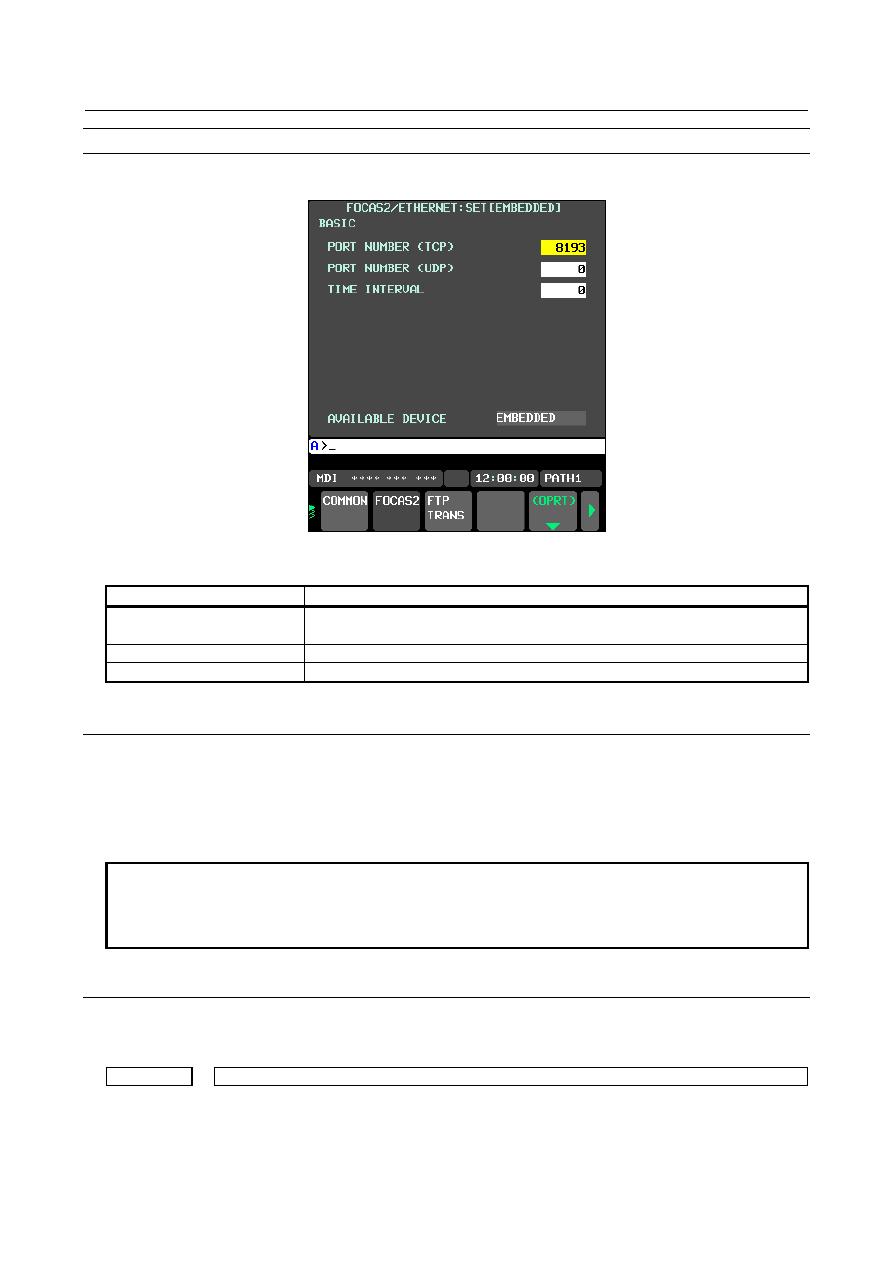
Press soft key [FOCAS2] to display the FOCAS2 screen. 


Fig. 17.2.4.1 (b) FOCAS2 screen 


Setting items 

Item 

Description 

PORT NUMBER (TCP) 

Specifies the port No. to be used by the CNC screen Display function 
(FOCAS2/Ethernet function), within a range of 5001 to 65535. 

PORT NUMBER (UDP) 

Set this item to 0. 

TIME INTERVAL 

Set this item to 0. 


17.2.5 

Setting of the Machine Remote Diagnosis package 

Machine Remote Diagnosis package  is a tool designed for the machine tool builder to provide remote 
support of machines easily.  Machine Remote Diagnosis function works on Embedded Ethernet or Fast 
Ethernet board in order to communicate with Machine Remote Diagnosis package. 
Refer to "Machine Remote Diagnosis Package OPERATOR’S MANUAL (B-63734EN)" for the method 
of use. 
 

NOTE 


Refer to the notes of “Setting of the CNC Screen Display function” when using 
CNC Screen Display function for MRDP (Machine Remote Diagnosis 
Package).The notes are applied to this function, too. 


17.2.5.1 

Related NC parameters 

When using Machine Remote Diagnosis package on Embedded Ethernet, the following parameters must 
be set. 
 

0024 


Setting of communication with the PMC ladder development tool 


[Input type]  Setting input 


[Data type]  Word 

[Valid data range]  10:  The high-speed interface (Ethernet) is used for PMC online editing. 

B-64693EN-1/01


17. EMBEDDED ETHERNET FUNCTION


- 2683 - 


#7 

#6 

#5 

#4 

#3 

#2 

#1 

#0 

8706 


MRD 


[Input type]  Parameter input 


[Data type]  Bit 


#6  MRD 

Machine Remote Diagnosis function is used: 
0: 

On Embedded Ethernet. 

1: 

On Fast Ethernet board. 


NOTE 


When this parameter is set, the power must be turned off before 
operation is continued. 


#7 

#6 

#5 

#4 

#3 

#2 

#1 

#0 

14880 


PCH 


[Input type]  Parameter input 


[Data type]  Bit 


#1  PCH  At the start of communication of the Data Server, FTP file transfer function, or machine 

remote diagnosis functions, checking for the presence of the server using PING is: 
0: 

Performed. 

1: 

Not performed. 


NOTE 


When connecting with the host computer (machine remote 
diagnosis accepting server) on Intranet, set 0. 


When the presence of the server using PING is not checked by 
setting 1, it may take several tens of seconds until an error is 
recognized due to no server on the network. 


When connecting with the host computer (machine remote 
diagnosis accepting server) via Internet, set 1. 


#7 

#6 

#5 

#4 

#3 

#2 

#1 

#0 

14882 


ERD 


[Input type]  Parameter input 


[Data type]  Bit 


NOTE 


Re-setting this parameter requires turning the power off and on 
again or restarting the embedded Ethernet interface. 


#0  ERD 

On Embedded Ethernet, Machine Remote Diagnosis is: 
0: 

Not used. 

1: 

Used. 


17. EMBEDDED ETHERNET FUNCTION


B-64693EN-1/01


- 2684 - 

17.2.5.2 

Operation on the Setting screen 

Procedure 

Press the function key 

Soft key [EMBED PORT] appears. (When there is not this soft keys, press the continue key.) 

Press soft key [EMBED PORT] to display the Ethernet Setting screen. 

Press soft keys [COMMON], [FOCAS2], and [REMOTE DIAG] and then enter parameters for the 
items that appear. 


NOTE 

1  The parameters for the embedded Ethernet port and the parameters for the 

PCMCIA Ethernet card are independent of each other. 

2  If the [PCMCIA LAN] soft key is pressed, the PCMCIA Ethernet card can be set 

up.  However, the card setup is carried out for maintenance and is not 
necessary usually. 


COMMON screen (BASIC) 

Press soft key [COMMON] to display the COMMON screen (BASIC). 


Fig. 17.2.5.2 (a) COMMON screen (BASIC) 


Setting items 

Item 

Description 

IP ADDRESS 

Specify the IP address of the embedded Ethernet. 
(Example of specification format: "192.168.0.100") 

SUBNET MASK 

Specify a mask address for the IP addresses of the network. 
(Example of specification format: "255.255.255.0") 

ROUTER IP ADDRESS 

Specify the IP address of the router. 
Specify this item when the network contains a router. 
(Example of specification format: "192.168.0.253") 

DHCP CLIENT 

The value of parameter No.14880#6(DHC) related to the DHCP client function is 
displayed, and the setting is also possible. For details, see Subsection, "Setting Up 
the DNS/DHCP Function". 


B-64693EN-1/01


17. EMBEDDED ETHERNET FUNCTION


- 2685 - 

Display items 

Item 

Description 

MAC ADDRESS 

Embedded Ethernet MAC address 

AVAILABLE DEVICE 

Enabled device of the embedded Ethernet. 
Either the embedded Ethernet port or the PCMCIA Ethernet card is displayed. 


FOCAS2 screen 

Press soft key [FOCAS2] to display the FOCAS2 screen. 


Fig. 17.2.5.2 (b) FOCAS2 screen 


Setting items 

Item 

Description 

PORT NUMBER (TCP) 

Specifies the port No. to be used by the machine remote diagnosis functions 
(FOCAS2/Ethernet functions), within a range of 5001 to 65535. 

PORT NUMBER (UDP) 

Set this item to 0. 

TIME INTERVAL 

Set this item to 0. 


17. EMBEDDED ETHERNET FUNCTION


B-64693EN-1/01


- 2686 - 

MACHINE REMOTE DIAG screen (COMMON) 

Press soft key [REMOTE DIAG] to display the MACHINE REMOTE DIAG screen (COMMON). 


Fig. 17.2.5.2 (c) Machine remote diagnosis screen (COMMON) 


Setting items 

Item 

Description 

MTB ID 

This information is required by the machine remote diagnosis package to confirm that 
the diagnosis request is issued from a machine manufactured by the machine tool 
builder. The MTB identification information on the diagnosis accepting server of the 
machine remote diagnosis package can be set to accept diagnosis requests only from 
the machines manufactured by the machine tool builder. 
(Example of specification format: "FANUC") 

MACHINE ID 

Information required by the machine remote diagnosis package to identify the machine 
under diagnosis 
(Example of specification format: "217xxx-1011xxxxx") 


B-64693EN-1/01


17. EMBEDDED ETHERNET FUNCTION


- 2687 - 

MACHINE REMOTE DIAG screen (INQUIRY1, INQUIRY2, INQUIRY3) 

Press soft key [RMTDIAG] to display the MACHINE REMOTE DIAG screen. 

By using page keys 


, the three host computers at inquiry destinations 1, 2, and 3 can be set. 


(When the DNS function is disabled)                  (When the DNS function is enabled) 

Fig. 17.2.5.2 (d) Machine Remote Diagnosis screens (INQUIRY1) 


Setting item 

Item 

Description 

HOST NAME 

Specify the IP address of the host computer (machine remote diagnosis accepting 
server) when the DNS function is disabled. 
(Example of specification format: "200.201.202.203") 
Specify the host name of the host computer (machine remote diagnosis accepting 
server) when the DNS function is enabled. (You can specify up to 63 characters.) 
(Example of specification format: "RMTDIAG.FANUC.CO.JP") 

PORT NUMBER 

Specify a port number. Usually, specify "8194" because the machine remote diagnosis 
functions are used. 

INQUIRY NAME 

Specify information for identifying the host computer (machine remote diagnosis 
accepting server). (You can specify up to 63 characters.) 
(Example of specification format: "FANUC") 


17. EMBEDDED ETHERNET FUNCTION


B-64693EN-1/01


- 2688 - 

17.2.5.3 

Controlling Machine Remote Diagnosis function from PMC 

You can use signals from the PMC to control the start and forced termination of the machine remote 
diagnosis functions and post the status of the machine remote diagnosis functions and error numbers to 
the PMC ladder. 
 

Signals 

No. 


#7 

#6 

#5 

#4 

#3 

#2 

#1 

#0 

G0141 


DIAREQ 

DIASTP 


INQU2 

INQU1 

INQU0 


DIAREQ

  <G0141.5> 


[Name]  Signal to request machine remote diagnosis 

  [Classification]  Input signal 
 

[Function]  Requests the start of machine remote diagnosis. 


[Operation]  When this signal is set to "1", it requests the start of machine remote diagnosis to the 

inquiry destination according to the signals indicating the number of the inquiry 
destination (INQU0<G0141.0> to INQU2<G0141.2>). When the acceptance completion 
signal (RMTEND<F0083.6>) or acceptance reject signal (RMTCAN<F0083.7>) is set to 
"1", this signal is set to "0". 


DIASTP

  <G0141.4> 


[Name]  Signal to request machine remote diagnosis cancellation 

  [Classification]  Input signal 
 

[Function]  Requests the forced termination of machine remote diagnosis. 


[Operation]  When this signal is set to "1", it requests forced termination to the machine remote 

diagnosis accepting server. When the completion signal for machine remote signal cancel 
acceptance (RMTCLS<F0082.3>) is set to "1", this signal is set to "0". 


INQU2

  <G0141.2> 


INQU1

  <G0141.1> 


INQU0

  <G0141.0> 


[Name]  Inquiry number select signals 

  [Classification]  Input signal 
 

[Function]  Inquiry destination for which to start machine remote diagnosis 


[Operation]  Select an item from the table below as an inquiry destination for which to start machine 

remote diagnosis. 


INQU2 

INQU1 

INQU0 

Status 

No selection 

Inquiry destination 1 

Inquiry destination 2 

Inquiry destination 3 


No. 


#7 

#6 

#5 

#4 

#3 

#2 

#1 

#0 

F0082 


RMTCLS 


RMTCLS

  <F0082.3> 


[Name]  Completion signal for machine remote diagnosis cancel acceptance 

  [Classification]  Output signal 
 

[Function]  Notifies that a request to cancel machine remote diagnosis has been accepted. 

[Output condition] When machine remote diagnosis is canceled after the signal to request machine remote 

diagnosis cancellation (DIASTP<G0141.4>) is set to "1", this signal is set to "1". When 
the signal to request machine remote diagnosis cancellation (DIASTP<G0141.4>) is set 
to "0", this signal is set to "0". 

B-64693EN-1/01


17. EMBEDDED ETHERNET FUNCTION


- 2689 - 

No. 


#7 

#6 

#5 

#4 

#3 

#2 

#1 

#0 

F0083 


RMTCAN 

RMTEND 

DIAST5 

DIAST4 

DIAST3 

DIAST2 

DIAST1 

DIAST0 


RMTCAN

  <F0083.7> 


[Name]  Reject signal for machine remote diagnosis acceptance 

  [Classification]  Output signal 
 

[Function]  Notifies that a machine remote diagnosis request has been rejected. 

[Output condition] When the signal to request machine remote diagnosis (DIAREQ<G0141.5>) is set to "1", 

a request to start machine remote diagnosis is issued to the machine remote diagnosis 
accepting server. When the server rejects the request, this signal is set to "1". When the 
signal to request machine remote diagnosis (DIAREQ<G0141.5>) is set to "0", this signal 
is set to "0". 


RMTEND

  <F0083.6> 


[Name]  Completion signal for machine remote diagnosis acceptance 

  [Classification]  Output signal 
 

[Function]  Notifies that a machine remote diagnosis request has been accepted by the machine 

remote diagnosis accepting server. 

[Output condition] When the signal to request machine remote diagnosis (DIAREQ<G0141.5>) is set to "1", 

a request to start machine remote diagnosis is issued to the machine remote diagnosis 
accepting server. When the server accepts the request, this signal is set to "1". When the 
signal to request machine remote diagnosis (DIAREQ<G0141.5>) is set to "0", this signal 
is set to "0". 


DIAST5

  <F0083.5> 


DIAST4

  <F0083.4> 


DIAST3

  <F0083.3> 


DIAST2

  <F0083.2> 


DIAST1

  <F0083.1> 


DIAST0

  <F0083.0> 


[Name]  Notification signals for the machine remote diagnosis status 

  [Classification]  Output signal 
 

[Function]  Report the status of machine remote diagnosis. 

[Output condition] The status of machine remote diagnosis is reported as listed in the following table. 


DIAST5 

DIAST4 

DIAST3 

DIAST2 

DIAST1 

DIAST0 

Description 

No status 

OPEN 

OPENING 

ACCEPTED 

REFUSED 

DIAGNOSING 

DIAGNOSING 

CLOSE 

FORCE CLOSING 

ERROR 


Content      ..     339      340      341      342     ..