Lancia NUOVA YPSILON. Service Manual - part 6
 

  Index      Manuals     Lancia NUOVA YPSILON. Service Manual


Search            copyright infringement  


Content      ..     4      5      6      7     ..


Lancia NUOVA YPSILON. Service Manual - part 6


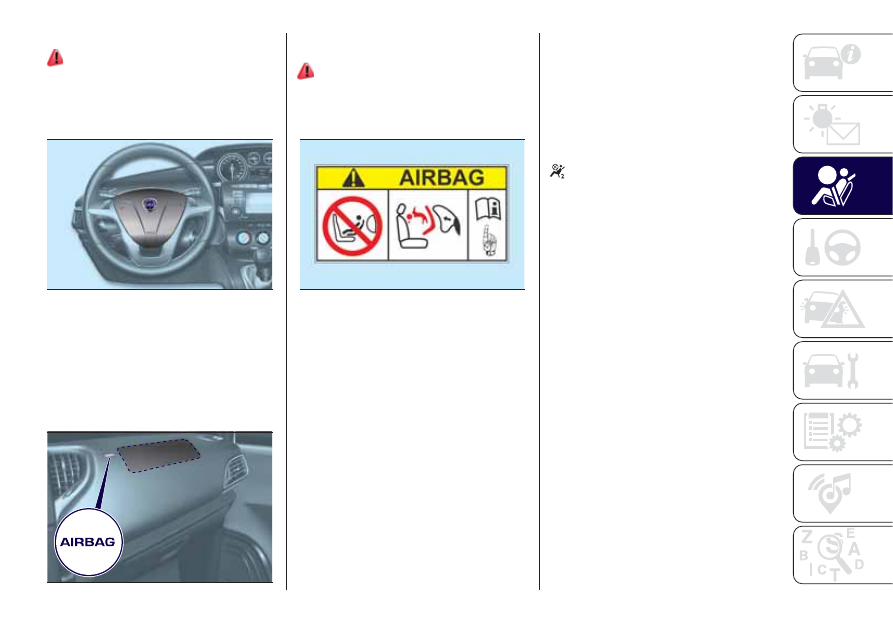
Passenger side front airbag

This consists of an instantly inflating
bag contained in a special recess in the
dashboard: this bag has a larger
volume than that on the driver side

Passenger side front airbag and
child restraint systems

93)

ALWAYS comply with the instructions
on the label stuck on both sides of
the sun visor (fig. 65).

Deactivating the passenger side
airbags: front airbag and side bag

If a child must be carried on the front
seat in a backwards facing child seat,
deactivate the passenger side front
airbag and front side bag (for
versions/markets, where provided).
With the airbags deactivated, the

warning light switches on in the

instrument panel.

IMPORTANT To manually deactivate the
passenger's front airbag and the front
side bag (for versions/markets, where
provided), operate on the Setup Menu
of the display.

63

L0F0402C

64

L0F0073C

65

F0Y0708C

87

Driver's side front airbag

92)

This consists of an instantly inflating
cushion contained in a special
compartment in the centre of the
steering wheel fig. 63.

fig.64

-------------------------------------------------------------------------------------------------------------------------------------------------------------

Passenger side front airbag and child restraint systems IMPORTANT

66

F0S1025

88

SAFETY

-------------------------------------------------------------------------------------------------------------------------------------------------------------

SIDE AIRBAGS (Side bag
- Window bag)

To help increase occupants protection
in the event of a side impact, the
vehicle is equipped with front side bags
(for versions/markets, where provided)
and window bag (for versions/markets,
where provided).
Side bags protect occupants from
side-on crashes of medium/high
severity by placing the bag between the
occupant and the internal parts of the
side structure of the vehicle.
Non-activation of side bags in other
types of collisions (front collisions, rear
shunts, roll-overs, etc.) is not a system
malfunction.

Side bags

These are comprised of two types of
bag located in the front backrests, fig.
67which protect the chest and shoulder
area of passengers in the event of a
side impact of medium-high severity.

Window bag

This comprises two "curtain" bags
housed behind the roof side linings and
fig. 68 covered by special trims. It is
designed to protect the head of front
and rear occupants in the event of
a side collision, thanks to the
wide cushion inflation surface.

The deployment of side bags in the
event of side impacts of low severity is
not required.
In the event of a side impact, the
system provides best protection if the
passenger sits on the seat in a correct
position, thus allowing correct window
bag deployment.

Important information

Do not wash the seats with water or
pressurised steam (wash by hand or at
automatic seat washing stations).
The front and/or side airbags
may activate in the event of sharp
impacts to the underbody of the vehicle
(e.g. impact with steps, pavements,
potholes or road bumps etc.).
When the airbag deploys it emits a
small amount of dust: the dust is
harmless and does not indicate the
beginning of a fire. The dust may irritate
the skin and eyes however: in this
case, wash with neutral soap
and water.
Airbag checking, repair and
replacement must be carried out at a
Lancia Dealership.
If the car is scrapped, have the airbag
system deactivated at a Lancia
Dealership.

67

L0F0203C

68

L0F0226C

89

-------------------------------------------------------------------------------------------------------------------------------------------------------------

Pretensioners and airbags are deployed
in different ways on the basis of the
type of collision. Failure to activate one
or more of the devices does not
indicate a system malfunction.

94) 95) 96) 97) 98) 99) 100) 101) 102) 103) 104) 105)

106)

WARNING

91) Do not apply stickers or other objects
on the steering wheel, on the dashboard in
the passenger side airbag area, on side
upholstery on the roof or on the seats.
Never put objects (e.g. mobile phones) on
the passenger side of the dashboard
since they could interfere with correct
inflation of the passenger airbag and also
cause serious injury to the passengers.
92) Always drive with your hands on the
rim of the steering wheel so that the airbag
can inflate freely if required. Do not drive
with your body bent forward. Keep your
back straight against the backrest.

93) When there is an active passenger
airbag, DO NOT install rearward facing
child restraint systems on the front seat.
Deployment of the airbag in an accident
could cause fatal injuries to the child
regardless of the severity of the impact.
Therefore, always deactivate the passenger
side airbag when a rearward facing child
restraint system is installed on the front
passenger seat. The front passenger seat
must also be positioned back as far as
possible in order to prevent the child
restraint system from coming into contact
with the dashboard. Immediately reactivate
the passenger airbag as soon as the child
restraint system has been removed.
94) Do not affix rigid objects to the garment
hooks or support handles.
95) Do not rest your head, arms or elbows
on the door, windows or the area in which
the window bag is located to avoid
possible injury during airbag inflation.
96) Never lean your head, arms or elbows
out of the window.
97) If, when the key is turned to MAR, the

warning light does not switch on or

stays on whilst driving, a fault may have
occurred in the restraint systems. In this
case the airbags or pretensioners may not
be deployed in an impact or, in a lower
number of cases, they may be deployed
accidentally. Before continuing, contact
a Lancia Dealership immediately to have
the system checked.
98) For versions/markets where provided,
in the event of

warning light failure,

the

warning light switches on and the

explosive charges of the passenger airbag
are deactivated.

99) On cars with side bags, do not cover
the front seat backrests with extra covers.
100) Do not travel carrying objects in
your lap, in front of your chest or between
your lips (pipe, pencils, etc.): they could
cause severe injury if the airbag is
deployed.
101) If your car has been subject to theft,
attempted theft, vandalism, or flooding,
contact a Lancia Dealership to have the
airbag system checked.
102) The airbags may also be deployed
when the car is not moving, if the key is in
the ignition and turned to MAR-ON or
when the engine is off, if the car is hit by
another moving vehicle. Therefore, even if
the vehicle is stationary, when an active
front passenger airbag is fitted, DO NOT
install rearward facing child restraint
systems on the front passenger seat.
Deployment of the airbag following an
impact could cause fatal injuries to the
child. Therefore, always deactivate the
passenger side airbag when a rearward
facing child restraint system is installed on
the front passenger seat. The front
passenger seat must also be positioned
back as far as possible in order to prevent
the child restraint system from coming
into contact with the dashboard.
Immediately reactivate the passenger
airbag as soon as the child restraint system
has been removed. Also remember that, if
the key is turned to STOP, none of the
safety devices (airbags or pretensioners)
will be deployed in the event of collision.
Non-deployment in such cases does
not indicate a system malfunction.

90

SAFETY

-------------------------------------------------------------------------------------------------------------------------------------------------------------

103) When the ignition key is turned to
MAR, the

warning light switches for few

seconds, then if the airbag is active it
should switch off.
104) The flashing

warning light on

indicates possible

warning light faults.

In this case, the

warning light may

not indicate a possible problem with the
airbag restraint system. Before continuing,
contact a Lancia Dealership immediately
to have the system checked.
105) The airbag deployment threshold is
higher than that of the pretensioners.
For collisions in the range between the two
thresholds, it is normal for only the
pretensioners to be activated.
106) The airbag does not replace seat
belts but increases their efficiency.
Because front airbags are not deployed for
low-speed crashes, side collisions,
rear-end shunts or rollovers, occupants are
protected, in addition to any side bags,
only by their seat belts, which must
therefore always be fastened.

91

-------------------------------------------------------------------------------------------------------------------------------------------------------------

STARTING AND DRIVING

Let’s get to the core of the vehicle:
seeing how you can exploit all of its
potential to the full.

We’ll look at how to drive it safely in any
situation, so that it can be a welcome
companion, with our comfort and
our wallets in mind.

STARTING THE ENGINE ................. 93

HANDBRAKE .................................. 94

MANUAL GEARBOX ....................... 95

WITH DUAL FUNCTION SYSTEM
GEARBOX....................................... 96

STOP/START SYSTEM ................... 97

CRUISE CONTROL ......................... 98

PARKING SENSORS....................... 99

TOWING TRAILERS ........................101

REFUELLING THE VEHICLE ..........102

92

ST

AR

TING

AND

DRIVING

-------------------------------------------------------------------------------------------------------------------------------------------------------------

STARTING THE
ENGINE

107) 108)

33) 34) 35) 36)

Before starting the engine, adjust the
seat, the interior rear view mirrors,
the door mirrors and fasten the seat
belt correctly.
Never press the accelerator pedal for
starting the engine.

PETROL VERSIONS

Proceed as follows:
❒ engage the handbrake and place the
gear lever in neutral. On 0.9 TwinAir
versions engage the handbrake and
place the gear lever in neutral or fully
press the clutch pedal if a gear other
than neutral is engaged;
❒ for all versions (except 0.9
TwinAir) fully depress the clutch pedal
without touching the accelerator;
❒ turn the ignition key to AVV and
release it as soon as the engine starts.

DIESEL VERSIONS

Proceed as follows:
❒ engage the handbrake and place the
gearbox lever in neutral;
❒ turn the ignition key to MAR: the
warning lights

and

on the

instrument panel will turn on;

❒ wait for the warning lights

and

to switch off;

❒ fully depress the clutch pedal without
touching the accelerator;
❒ turn the ignition key to AVV as soon
as warning light

switches off.

Waiting too long will waste the heating
work carried out by the plugs. Release
the key as soon as the engine starts.

IMPORTANT With cold engine, the
accelerator must be entirely released
when turning the ignition key to position
AVV. If the engine does not start at the
first attempt, return the ignition key
to STOP before repeating the starting
procedure. If, when the ignition key is at
MAR, the instrument panel warning
light

remains lit, turn the key to

STOP and then back to MAR. If the
warning light remains on, try with the
other keys provided with the car.
Contact a Lancia Dealership if you still
cannot start the engine.

VERSIONS WITH DUAL
FUNCTION SYSTEM
GEARBOX

109)

The system allows the engine to be
started both with a gear engaged and
with the gearbox in neutral (N).
However, the brake pedal must always
be pressed first if neutral is not
engaged. It is therefore advisable to
position the gear lever at N before
starting the engine.

LPG AND NATURAL
POWER VERSIONS

37)

The engine always starts up on petrol
independently of the mode previously
selected.

SWITCHING OFF THE
ENGINE

38)

Turn the ignition key to STOP while the
engine is idling.

IMPORTANT After a demanding drive,
before turning the engine off you should
allow it to idle to allow the temperature
in the engine compartment to
decrease.

93

-------------------------------------------------------------------------------------------------------------------------------------------------------------

WARNING

107) It is dangerous to run the engine in
enclosed areas. The engine takes in
oxygen and releases carbon dioxide,
carbon monoxide and other toxic gases.
108) Remember that the brake servo
and power steering are not operational until
the engine has been started, therefore
much effort than usual is required on the
brake pedal and steering wheel.
109) If the engine fails to start with a gear
engaged, the potentially dangerous
situation due to the fact that the gearbox is
automatically placed in neutral will be
signalled by a buzzer.

WARNING

33) Warning light

flashing for 60

seconds after starting or during prolonged
cranking of the engine indicates a fault
with the glow plug heating system. You
can use the car as usual if the engine
starts but you should contact a Lancia
Dealership as soon as possible.
34) It is advisable not to demand maximum
performance from your car (e.g. excessive
acceleration, long distances at maximum
rpm, excessively intense braking, etc.)
when it is first used.
35) When the engine is switched off never
leave the key turned to MAR-ON to prevent
useless current absorption from draining
the battery.

36) Never, under any circumstances, jump
start the engine by pushing, towing or
coasting downhill. This could cause fuel to
flow into the catalytic converter and
damage it beyond repair.
37) There must therefore always be
enough petrol in the tank to protect the
petrol pump and to guarantee temporary
switching from methane to petrol
operation, if high performance is required.
38) A quick burst on the accelerator before
stopping the engine serves no practical
purpose; it wastes fuel and is especially
damaging to turbocharged engines.

HANDBRAKE

110) 111) 112)

The handbrake lever is located between
the two front seats.
Handbrake engagement: pull lever A
fig. 69 upwards until the vehicle is
braked.
Handbrake disengagement: slightly
raise lever A and press the release
button B fig. 69 checking that the
warning light

switches off in the

instrument panel.

94

ST

AR

TING

AND

DRIVING

69

L0F0074C

-------------------------------------------------------------------------------------------------------------------------------------------------------------

WARNING

110) Never leave children unattended in
the car. Always remove the key from the
ignition when leaving the car and take
it with you.
111) The car should be braked after a few
clicks of the lever, if it is not, contact a
Lancia Dealership to have it adjusted.
112) In the case of parking manoeuvres on
roads on a gradient, the front wheels
must be steered towards the pavement
(when parking downhill), or in the opposite
direction if the vehicle is parked uphill.
Block the wheels with a wedge or a stone if
the car is parked on a steep slope.

MANUAL GEARBOX

113)

39)

To engage the gears, press the clutch
pedal fully and put the gear lever into
the required position (the diagram
for gear engagement is shown on the
knob fig. 70).

For 0.9 TwinAir 85 HP and 1.2 8V 69
HP versions, to engage reverse R from
neutral, lift the ring A fig. 70 located
under the knob and at the same time
shift the lever to the right and back.
For 1.3 16V MultiJet version: to engage
reverse R from neutral position, move
the lever to the right and then back.

IMPORTANT Reverse can only be
engaged when the vehicle is completely
stationary. With the engine running,
wait for at least 2 seconds with the
clutch pedal fully pressed before
engaging reverse to prevent damage to
the gears and grating.

IMPORTANT The clutch pedal should
be used only for gear changes. Do
not drive with your foot resting on the
clutch pedal, however lightly. For
versions/markets where provided, the
electronic clutch control could cut
in, interpreting the incorrect driving style
as a fault.

WARNING

113) Depress the clutch pedal fully to
change gear correctly. It is therefore
essential that there is nothing under the
pedals: make sure the mats are lying
flat and do not get in the way of the
pedals.

WARNING

39) Do not drive with your hand resting on
the gear lever as the force exerted, even
if slight, could lead over time to premature
wear of the gearbox internal components.

70

L0F0426C

95

-------------------------------------------------------------------------------------------------------------------------------------------------------------

WITH DUAL
FUNCTION SYSTEM
GEARBOX

(for versions/markets, where provided)

The car may be equipped with an
electronically controlled manual
gearbox known as "Dual Function
System" which allows two operating
logics: MANUAL and AUTO.

GEAR LEVER

40)

The lever fig. 71 is "multistable" floating
type, in other words it has three stable
and three unstable positions.

The three stable positions correspond
to neutral (N), reverse (R) and the
central position located between the
unstable positions (+) and (-).

The unstable positions, in other words
those that are abandoned as soon
as the lever is released, are the position
which requests a higher gear (+), the
position which requests a lower gear (–)
and the automatic/manual operating
mode request position (A/M).

IMPORTANT With the engine started,
any error between the lever position
and the gear actually engaged is
signalled by a buzzer until consistency
is restored.

MANUAL MODE

❒ Press the brake pedal and start the
engine;
❒ if AUTO appears on the display,
move the gear lever fig. 71 to A/M to
select MANUAL mode;
❒ push the gear lever towards (+) to
engage first gear (if starting from N or
R, simply place the lever in the middle
position) or R to engage reverse;
❒ release the brake pedal and press
the accelerator pedal;
❒ in driving conditions, push the gear
lever towards (+) to engage the next
gear up or towards (–) to engage the
next gear down.

AUTOMATIC MODE

❒ Press the brake pedal and start the
engine;
❒ if AUTO does not appear on the
display, move the gear lever fig. 71 to
A/M to select AUTOMATIC mode;
❒ push the gear lever towards (+) to
engage 1

st

gear (if starting from N or R,

simply place the lever in the middle
position) or R to engage reverse;
❒ release the brake pedal and press
the accelerator pedal: the gear most
suited to the car speed will be
engaged.

OPERATION (AUTO-ECO)

The ECO function, which optimises the
gearbox, can be activated only with
automatic mode on. The ECO function
is activated by pressing the ECO button
on the instrument panel.

“Kick Down” FUNCTION

If necessary (e.g. when overtaking), the
system downshifts one or more gears
when the accelerator pedal is
depressed beyond the point where it
becomes stiff (and if the rpm allow it) in
order to provide suitable power and
torque for the acceleration requested
by the driver.

71

L0F0117C

96

ST

AR

TING

AND

DRIVING

-------------------------------------------------------------------------------------------------------------------------------------------------------------

IMPORTANT The use of the “Kick
Down” function is recommended only
when overtaking or accelerating quickly,
in order not to increase fuel
consumption.

CONTROLS ON STEERING WHEEL

(for versions/markets, where provided)

41)

On some versions, the gearbox can be
managed sequentially using the
steering wheel controls fig. 72.

To use the controls on the steering
wheel, the gear lever must be in the
central position between + and –:
❒ operating the + lever: engage
a higher gear;
❒ operating the – lever: engage a lower
gear.
The engagement of a lower (or higher)
gear is only permitted if the engine
rpm allow it.

WARNING

40) Avoid keeping your hand placed on this
lever in between gear changes or
Auto/Manual mode.
41) Using the paddles incorrectly (paddles
pushed towards the dashboard) could
break them.

STOP/START
SYSTEM

(for versions/markets, where provided)

114) 115)

42)

The Stop/Start system automatically
stops the engine each time the vehicle
is stationary and starts it again when
the driver wants to move off. In this
way, the vehicle efficiency is increased,
by reducing consumption, dangerous
gas emissions and sound pollution.

OPERATING MODES

Stopping the engine

With manual gearbox: with the car
stationary, the engine stops with the
gearbox in neutral and the clutch pedal
released.
With Dual FuNction System gearbox:
the engine stops if the vehicle is at
a standstill and the brake pedal is
pressed. This condition can be
maintained even if the brake pedal is
not depressed, if the gear lever is
in position N (Neutral).

Note The engine can only be stopped
automatically after exceeding a speed
of about 10 km/h, to prevent the engine
from being repeatedly stopped when
driving at walking pace.

72

L0F0431C

97

-------------------------------------------------------------------------------------------------------------------------------------------------------------

The

symbol appears on the display

when the engine stops.

Restarting the engine

With manual gearbox: press the clutch
pedal.
With Dual FuNction System gearbox: if
the gear lever is in position N (Neutral),
place it in any other gear, otherwise
release the brake pedal or move the
gear lever to +, – or R (Reverse).

MANUAL SYSTEM
ACTIVATION/
DEACTIVATION

To activate/deactivate the system
manually, press the A fig. 73 button on
the dashboard control panel.

LED off: system deactivated.
LED on: system deactivated.

WARNING

114) When replacing the battery, always
contact a Lancia Dealership. Replace
the battery with one of the same
type (HEAVY DUTY) and with the same
specifications.
115) We recommend that you remove the
key from the ignition if other people remain
in the vehicle. Exit from the vehicle only
after having removed the ignition key
or having rotated it to the STOP position.
During refuelling, make sure that the engine
is off and that the ignition key is in the
STOP position.

WARNING

42) If climate comfort is to be favoured, the
Stop/Start system can be disabled, for a
continuous operation of the climate control
system.

CRUISE CONTROL

(for versions/markets, where provided)

116) 117)

This is an electronically controlled
driving assistance device that allows
the desired vehicle speed to be
maintained, without having to press the
accelerator pedal.

This device can be used at a speed
above 30 km/h on long stretches of dry,
straight roads with few variations (e.g.
motorways).
It is therefore not recommended to use
this device on extra-urban roads with
traffic. Do not use it in town.

ACTIVATING THE DEVICE

Turn ring nut A fig. 74 to ON. Activation
is indicated by the

warning light

switching on and, on some versions, by
a message on the display.

73

L0F0421C

74

L0F0202C

98

ST

AR

TING

AND

DRIVING

-------------------------------------------------------------------------------------------------------------------------------------------------------------

Storing the vehicle speed

Proceed as follows:
❒ turn ring nut A fig. 74 to ON and
press the accelerator pedal so that the
car reaches the desired speed;
❒ move the stalk upwards (+) for at
least one second, then release it: the
speed is memorised and you can
therefore release the accelerator pedal.
If necessary (when overtaking for
instance), you can accelerate simply by
pressing the accelerator pedal: when
you release the pedal, the car goes
back to the speed memorised
previously.

Increasing the stored speed

In can take place in two ways: pressing
the accelerator and memorising the
new speed or moving the stalk
upwards (+), until reaching the new
speed, which will be memorised
automatically.

Reducing the memorised speed

In can take place in two ways:
deactivating the devices and
memorising the new speed or moving
the stalk fig. 74 downwards (-) until
reaching the new speed, which will be
memorised automatically.

DEACTIVATING THE DEVICE

The device can be switched off by the
driver in the following ways:
❒ by turning ring nut A fig. 74 to the
OFF position;
❒ by switching off the engine;
❒ by pressing the brake pedal, the
clutch or the accelerator; in this last
case the system is not completely
deactivated but gives priority to the
acceleration request. The device still
remains active, without the need to
press the RES button to return to the
previous condition once acceleration is
concluded.

Automatic deactivation

The device deactivates automatically in
the following cases: activation of the
ABS or ESC system, vehicle speed
below the predefined limit, system
failure.

WARNING

116) When travelling with the device active,
never move the gear lever to neutral.
117) In the event of device faults or failures,
turn knob A to OFF and contact a Lancia
Dealership.

PARKING SENSORS

(for versions/markets, where provided)

43)

SENSORS

The sensors are located in the rear
bumper fig. 75 and their function is to
detect the presence of any obstacles
near the rear part of the vehicle and
inform the driver, through an
intermittent acoustic signal.

ACTIVATION

The sensors are automatically activated
when reverse gear is engaged. As the
obstacle behind the vehicle gets closer,
the acoustic signal becomes more
frequent.

75

L0F0027C

99

-------------------------------------------------------------------------------------------------------------------------------------------------------------

OPERATION WITH A
TRAILER

Sensor operation is automatically
deactivated when the trailer's electric
cable plug is fitted in the vehicle's
tow hook socket.
The sensors are automatically
reactivated when the trailer's cable plug
is removed.

IMPORTANT
INFORMATION

118)

44)

When parking, take the utmost care
over obstacles that may be above
or under the sensor.
Objects close to the vehicle are not
detected under certain circumstances
and could therefore cause damage
to the vehicle or be damaged.
The following conditions may influence
the performance of the parking
assistance system:
❒ the presence of ice, snow, mud or
multiple layers of paint on the surface of
the sensor may reduce its sensitivity
and the system performance;
❒ mechanical interference (e.g. washing
the vehicle, rain, strong wind, hail) may
cause the sensor to detect a
non-existent obstacle ("echo
interference");

❒ the presence of ultrasonic systems
(e.g. pneumatic brake systems of
trucks or pneumatic drills) near the
vehicle could alter the signals sent to
the sensor;
❒ the variation in sensor position,
caused by variation in ride (due
to suspension or shock absorber wear),
changing tyres, overloaded vehicle, or
tuning that lowers the vehicle, for
example, may affect parking sensor
system performance;
❒ the presence of a tow hook without
trailer interferes with the correct
operation of the parking sensors. If a
fixed tow hook is installed, the sensors
cannot be used. If the customer installs
a removable tow hook, this must
always be disconnected from
the crossmember whenever the trailer
is not attached to prevent the activation
of the sensors.

WARNING

118) Parking manoeuvres, however, are
always the driver’s responsibility. While
carrying out these manoeuvres, always
make sure that no people (especially
children) or animals are in the area
concerned. The parking sensors are used
to assist the driver, who must never allow
his attention to lapse during potentially
dangerous manoeuvres, even those
executed at low speeds.

WARNING

43) For correct operation of the system,
sensors must always be clean from mud,
dirt, snow or ice. Be careful not to scratch
or damage the sensors while cleaning
them. Avoid using dry, rough or hard
cloths. The sensors must be washed using
clean water, with the addition of vehicle
shampoo if necessary. When using special
washing equipment such as high pressure
jets or steam cleaning, clean the sensors
very quickly keeping the jet more than
10 cm away. Also, do not apply stickers to
the sensors.
44) Have interventions on the bumper in
the area of the sensors carried out only by
a Lancia Dealership. Interventions on the
bumper that are not carried out properly
may compromise the operation of the
parking sensors.

100

ST

AR

TING

AND

DRIVING

-------------------------------------------------------------------------------------------------------------------------------------------------------------

TOWING TRAILERS

119) 120)

IMPORTANT NOTES

For towing caravans or trailers the
vehicle must be fitted with an approved
tow hook and an adequate electrical
system. Installation must be carried out
by a specialist.
Install any specific and/or additional
door mirrors as specified by the
Highway Code.
Remember that when towing a trailer,
steep hills are harder to climb, braking
distances increase and overtaking
takes longer depending on the overall
weight of the trailer.
Engage a low gear when driving
downhill, rather than constantly using
the brake.
The weight the trailer exerts on the
vehicle tow hook reduces the vehicle's
loading capacity by the same amount.
To make sure that the maximum
towable weight is not exceeded (given
in the vehicle registration document)
account should be taken of the fully
laden trailer, including accessories and
luggage.

Do not exceed the speed limits specific
to each country you are driving in, in
the case of vehicles towing trailers.
In any case, the top speed must not
exceed 100 km/h.
Any electric brake must be powered
directly by the battery through a cable
with a cross-section of no less than 2.5
mm

2

.

In addition to the electrical branches,
the vehicle electrical system can only
be connected to the supply cable for an
electric brake and to the cable for an
internal light for the trailer, not
exceeding 15 W. For connections, use
the preset control unit with a battery
cable with section not less than 2.5
mm

2

.

IMPORTANT The use of auxiliary loads
other than external lights (electric brake,
etc.) must take place with engine
running.

IMPORTANT To install a tow hook
contact a Lancia Dealership.

WARNING

119) The ABS with which the car is
equipped will not control the braking
system of the trailer. Particular caution is
required on slippery roads.
120) Never modify the braking system of
the vehicle to control the trailer brake.
The trailer braking system must be fully
independent of the car’s hydraulic system.

101

-------------------------------------------------------------------------------------------------------------------------------------------------------------

REFUELLING THE
VEHICLE

45) 46) 47)

Always stop the engine before
refuelling.

PETROL ENGINES

Only use unleaded petrol, with an
octane number (R.O.N.) not lower than
95.
In order to prevent damage to the
catalytic converter never introduce even
the smallest amount of leaded petrol,
even in the event of an emergency.

DIESEL ENGINES

48)

Only use Diesel for motor vehicles (EN
590 specification).
When using or parking the vehicle for a
long time in the mountains or cold
areas, it is advisable to refuel using
locally available diesel. In this case, it is
also advisable to keep the tank over
50% full.

REFUELLING
PROCEDURE

Petrol and Diesel versions equipped
with fuel tank cap

(for versions/markets, where provided)

To refuel proceed as follows:
❒ open flap A fig. 76, pulling it
outwards;
❒ keep the cap B still, insert the ignition
key in the lock and turn it anticlockwise;
❒ turn the plug anticlockwise and
remove it.

The cap has a device C fig. 76 that
attaches it to the flap so it cannot be
lost. When refilling, attach the cap
to the flap, as shown in the figure.
After refuelling, fit the plug B fig. 76
(complete with key) and turn it
clockwise until it clicks once or more.
Turn the ignition key clockwise and
remove it. Close the flap A.

Petrol and Diesel versions equipped
with "Smart Fuel" system

The refuelling procedure described
below is illustrated on the label B fig. 77
located inside the fuel flap. The label
also indicates the fuel type (UNLEADED
FUEL=petrol, DIESEL=diesel fuel).

To refuel proceed as follows:
❒ open flap A fig. 77, pulling it
outwards;

76

L0F0240C

77

L0F0085C

102

ST

AR

TING

AND

DRIVING

-------------------------------------------------------------------------------------------------------------------------------------------------------------


Content      ..     4      5      6      7     ..