Tractors X60 Series. Manual - part 41
 

  Index      Tractors     Tractors X60 Series - service repair manual 2012 year


Search            


Content   ..  39  40  41  42   ..


Tractors X60 Series. Manual - part 41


163

Tyres, Wheels, Ballasting

6

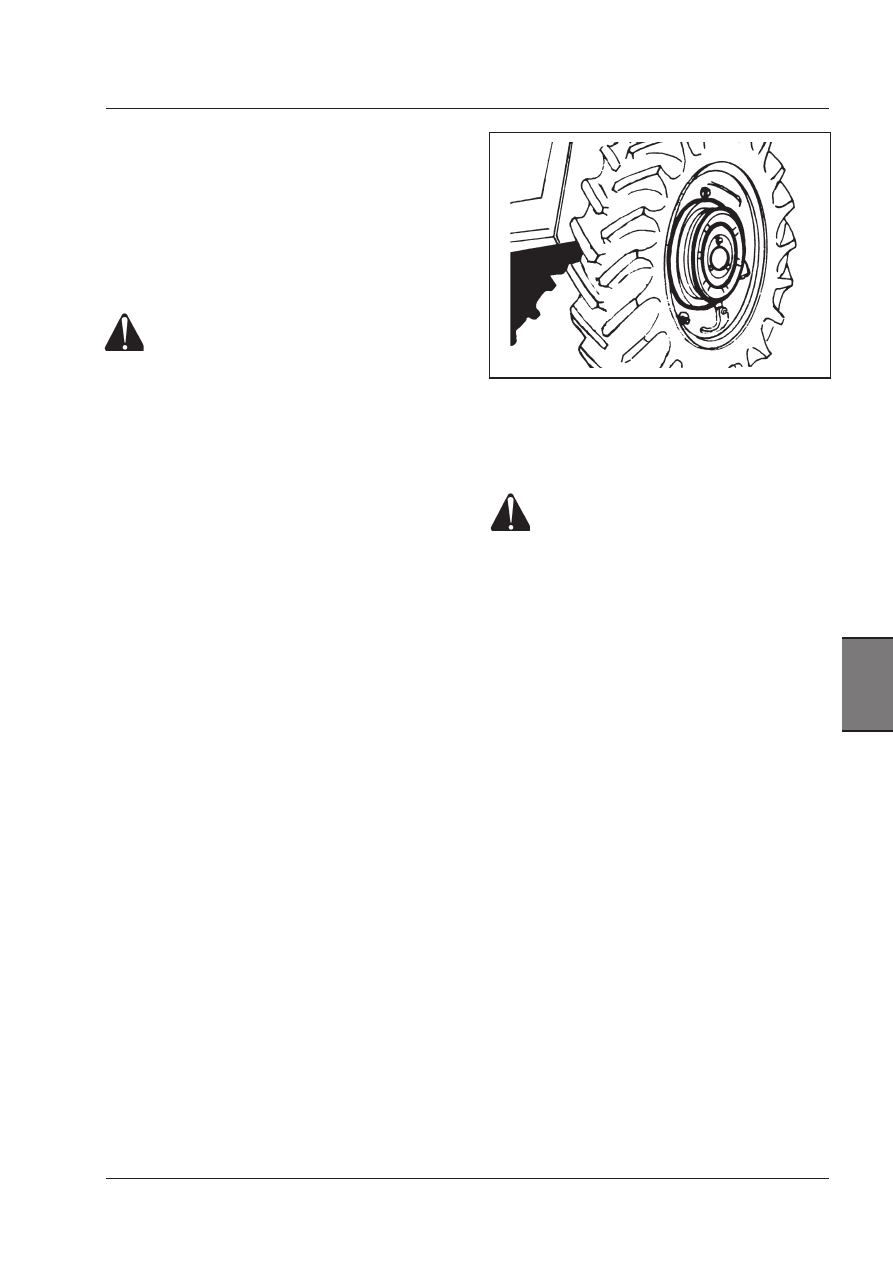
Ballasting the rear wheels. Max. 2 rings on each wheel.

Ballasting the rear wheels

 [4.2.h]

Two rings can be applied on each rear wheel (see figure).
The first one is directly fixed to the wheel, the second one
on the first ring.

The total weight that can be applied is therefore:
4 rings (2+2) each weighing 60 kg: total 240 kg.

WARNING: Due to the great weight of each bal-

last, manual lifting of front and rear ballast 

weights could be dangerous for your safety.

Use exclusively a hook or suitable equipment 
to lift front and rear ballast weights.

IMPORTANT:

-  Do not ballast the tractor over its rated carrying weight.
-  When  using  the  tractor  for  light  work,  transport  and 

on-road  towing,  remove  the  ballast  weights  to  avoid 
unnecessary strain on the mechanical components.

-  With  semi-mounted  and  fully  mounted  implements 

(which  inevitably  increase  the  load  on  the  rear  axle 
of the tractor), ballast must only be used when strictly 
necessary. There is no point in increasing grip beyond 
the level required for efficient work, as this will reduce 
tyre life.

-  Carefully check the tyre inflation pressure since this will 

make the tyre last longer and ensure a more regular 
wear.

-  The softer the soil, the lower tyre inflation must be, while 

the tyre should be inflated to a greater extent as the soil 
becomes more compact.

IMPORTANT: The total tractor weight with full equipment 
and ballast weight must never be more than the maximum 
allowed operating weight. See Maximum Allowed Operat-
ing Weights in this manual. Comply with tyre capacities 
and any possible legal limitations.

WARNING: Always use suitable personal sa-
fety devices (safety gloves and shoes) when 
applying or removing ballast.

164

Tyres, Wheels, Ballasting

Ballasting with water

The tractor can also be ballasted by filling the tyres with
water.

To lower the freezing point a few degrees in winter, add
calcium chloride to the water in compliance with the pro-
portions given in the following table. The ballast should
evidently  be  removed  when  the  job  does  not  require
excessive draft, otherwise the soil could become exces-
sively compressed.

The following table gives approximate values for the liters
of water and kilos of calcium chloride required to prepare
the antifreeze solution used to three-quarters (75%) fill
each tyre.

In relation to ballasting with cast iron rings on the driving
wheels,  this  type  of  weighting  offers  the  following  ad-
vantages:

-  Low cost.

-  Easy preparation.

-  Improved steering.

-  The weight of the driving wheels can be regulated ac-

cording to the real requirements.

CAUTION: Ballasting with water and calcium chlori-
de antifreeze solution can increase corrosion of the 
components that come into contact with the mixture.

12.4-24

77

24

66

90

13.6-24

120

30

103

133

420/70-24

166

44

149

193

16.9-24

210

57

187

244

480/65-24

213

58

189

247

380/70-24

130

35

116

151

380/70-28

130

35

116

151

13.6-28

140

38

124

162

14.9-24

150

40

134

174

16.9-34

276

86

238

324

13.6-36

180

54

155

209

13.6-38

190

56

164

220

16.9-38

280

76

249

325

18.4-34

360

97

321

418

18.4-38

370

100

329

429

480/70-38

310

84

276

360

520/70-38

380

103

338

441

16.9-30

239

74

206

280

18.4-30

248

77

214

291

Commercial

sodium

Weight of

chloride

solution

70-72%

Kg

Kg

Ballasting with antifreeze solution

TYRE CAPACITIES FOR BALLASTING WITH WATER

Water

litres

Capacity

Tyre

to valve

size

level

(75%)

litres

NOTE:  This table contains only indicative data. The operator should ballast wheels with water on the base of the tables
issued by the tyre manufacturer and according to the use anticipated for the tractor.

WARNING: Always use suitable personal sa-
fety devices (safety gloves and shoes) when 
applying or removing ballast.

165

Tyres, Wheels, Ballasting

6

How to fill the tyres with water

WARNING:  when  you  prepare  a  solution  of 
calcium chloride to ballast the tyres, NEVER 
EVER pour the water on to the calcium chlori-
de since this could lead to a violent reaction. 
This danger can be avoided by adding the 
calcium  chloride  very  slowly  to  the  water 
and stirring until it has completely dissolved.

Jack up the wheel and position it with the valve right at
the top.
Unscrew the movable union of the valve and wait until
the tyre deflates.
Tighten the relative fitting (3) into the valve housing (1)
and apply the tube (2). Air will escape from the little tube
(4) as the tyre is filled with water.

The tyres are filled to the three-quarter mark when water
escapes from the small tube (4) if this is positioned com-
pletely downwards.

To  add  less  water,  i.e.  obtain  a  lower  weight,  turn  the
wheel so that the valve is in a more downward position.

Tighten the union on the valve casing again and inflate
the tyre with air until obtaining the prescribed pressure.

Take the following precautions when preparing the water-
calcium chloride mixture (antifreeze solution for the cold
season):

-  Pour the necessary amount of water in a vessel and then

pour in calcium chloride until the established quantity
has been reached. Never pour water on to the calcium
chloride as this would cause a violent reaction.

-  Only use the solution after it has completely cooled. To

limit the acidity, add 1% of soda in proportion to the
calcium chloride used.

-  After inflating the tyre, thoroughly rinse any metal parts

that may have been wetted with this corrosive solution,
with water.

How to deflate the tyres

–  Jack up the tyre in question (Fig. 4-50) and set it with

its valve pointing downwards.

–  Unscrew the mobile union of the valve and allow the

water to drain from the tyre.

–  Tighten the relative union into the valve housing and

place the tube (4) in contact with the tyre.

–  Blow in pressurized air through the union (2): the

remaining water will drain through the tube (4).

–  Remove the union (3), replace it with the valve retai-

ner and then inflate the tyre.

NOTE - Never use ballasting systems differing from the 
ones indicated above.

CAUTION:  Ballasting  with  water  and  anti-freeze 
solution  containing  calcium  chloride  might  cause 
corrosion of the parts in contact with the solution.

Indicative layout for water ballasting.

1 - Valve housing.
2 - Water tube union.
3 - Special fitting to pour in and drain out the water.
4 - Air bleeding tube.

WARNING: Always use suitable personal sa-
fety devices (safety gloves and shoes) when 
applying or removing ballast.

166

Tyres, Wheels, Ballasting

This page has been left blank intentionally


Content   ..  39  40  41  42   ..