Tractors X60 Series. Manual - part 37
 

  Index      Tractors     Tractors X60 Series - service repair manual 2012 year


Search            


Content   ..  35  36  37  38   ..


Tractors X60 Series. Manual - part 37


Operation 

147

5

Tractor transport

 [4.1.j]

Towing the tractor

If you need to tow or push the tractor for a brief distance,
remember that the power steering system will allow you
to drive and steer it for a short way with the engine off.

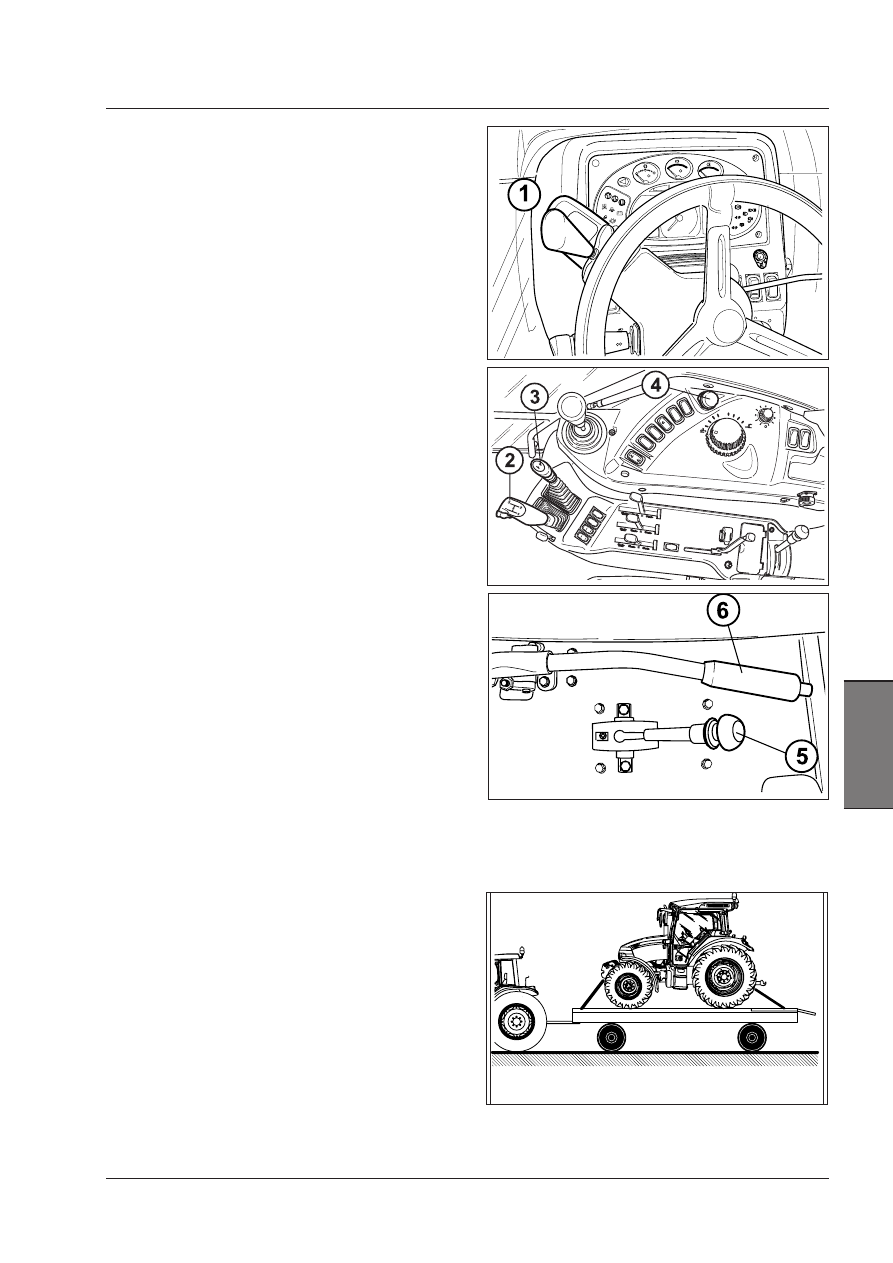
Put the following controls in NEUTRAL:

1-  Reverse shuttle lever (1)
2- Gearshift lever (2)
3-  Range selector lever (3)
4-  (With Xtrashift only) Disengage the Park Lock (if

equipped) (5)

5-  Disengage the parking brake (6)
6-  Make sure that the PTO engagement switch is disen-

gaged (4) OFF.

How to drive the tractor

 To drive the tractor, you will need to excercise

greater effort if the engine is at a standstill.

 Slow and stop the tractor with the brake pedals  

latched together .

 Tow or push the tractor at moderate speed.

How to safely drive the tractor

 Affix the slow moving vehicle card (SMV-Slow

Moving Veicle).

 Use the revolving beacon and the hazard lights.

 Strictly comply with the laws in force in the country

where the tractor is used.

Tractor transport

The tractor must be transported with a suitable vehicle.
Engage the first gear, then apply the parking brake. (6).
Engage the Park Lock (with Xtrashift only) (5).
Firmly  fasten  the  tractor  to  the  transport  vehicle  using
suitable chains or straps.
Use the tow bar or its supports as rear fixing points for
the tractor.

CAUTION: Never hitch or connect chains around the 
tractor components as these could be damaged by 
the chains themselves or by excessive loads.

The trailer must be provided with the warning signs and
lights required by the local laws in force.

WARNING: If the tractor needs to be transported, it 
should not be lifted, but should be driven onto the 
transport means.
If the tractor cannot be driven owing to a fault or 
malfunction, the operation should be entrusted to 
specialised firms having a suitable equipment.

Operation 

148

Towing the tractor

 [4.1.j]

Towing the tractor is not recommended, but if it should be
absolutely necessary, the procedure is different depending
on the fact that the engine is on or off, and that the low
pressure hydraulic circuit is operating or not operating.
Use the following procedures as applicable, at the fol-
lowing conditions:
- Connect safely one the tow hooks of the machine to the
towing vehicle by means of a rigid drawbar, or a chain, or
a metal cable of suitable size.
- In the middle of the linking means a red flag is to be
hanged so that it is visible to other drivers on the road.
- The towing vehicle must keep the rotating beacon light
operating. The towed tractor must keep the flashing hazard
lights operating (turn indicators flashing contemporarily).
- Make sure that the brakes of the machine are operating.
- It is recommended that the machine is escorted by two
cars, one in front of it and one at the rear, at a distance of
75÷150 m from the machine. These cars must carry danger
signals according to the rules and laws of the country.

NOTE: For the tow hooks fixed on the machine, see the 
Towing Attachments chapter in the Technical specifica-
tions section of this book.

CAUTION: Use only the appropriate tow hooks to 
tow the tractor.

Towing the tractor with the engine off or low pres-
sure hydraulic circuit not operating.

WARNING: If the machine is towed with the 
engine off (or with the low pressure hydraulic 
circuit not operating), the brakes and steering 
will not be power assisted if this depends on 
the  low  pressure  hydraulic  circuit.  The  par-
king brake must be disengaged.

- The machine can be towed for max. 10 Km at a max.
speed of 8 Kph.

WARNING: Make sure that the weight of a trai-
led vehicle that is not equipped with brakes 
NEVER EXCEEDS the weight of the tractor that 
is towing the vehicle or any national weight 
limitations  which  may  apply.  Stopping  di-
stance increases with increasing speed as the 
weight of the towed load increases, especially 
on slopes.

Towing  the  tractor  with  the  engine on  or  low  pressure
hydraulic circuit operating.

- Check that all controls are in neutral.

- If possible, level the machine and lower the telescopic
boon completely.

- Check that the parking brake is disengaged.

- Do not exceed a speed of 20 Kph when towing the tractor
and check that the rear differential lock is disengaged.

- Run the engine at 1200 RPM at least, if possible.

149

Tyres, Wheels, Ballasting

6

Section 6

Tyres, Wheels, Ballasting

150

Tyres, Wheels, Ballasting

TYRE INFLATION SPECIFICATIONS

For maximum tractor performance, always adjust the tyre
pressure within the minimum/maximum range, to conform
with the actual load on the tyres. Under normal conditions
use  the  minimum  pressure  rating  for  general  drawbar
work. Use the higher pressure rating, up to the maximum,
for heavy three-point hitch mounted equipment.

INFLATING

AT MAXIMUM

PRESSURE WITH

MINIMUM LOAD

EXAMPLE A

Example  ‘A’  shows  the  cross  section  of  a  tyre  inflated
for maximum load but with a minimum load on the tyre.
The tyre tread is not making full contact with the ground,
which will give poor performance.

INFLATING

PRESSURE

ACCORDING TO

TRACTOR WEIGHT

EXAMPLE B

Example ‘B’ shows the cross section of a tyre with the
inflated  pressure  correctly  adjusted  to  the  load  on  the
tyre. The tyre tread is making full contact with the ground,
which will give maximum performance.

Tyre pressure can also be adjusted as required to satisfy
the following requirements.

A. Severe Service. 

Tyre pressure can be increased 28 kPa (0.27 bar - 4 psi)
more than the maximum pressure shown in the charts,
for tyres used in severe service. Severe service includes
the  furrow  tyre  in  regular  ploughing  operations,  and  in
hillside operations.

B. Tyres With Liquid Ballast. 

Inflate the tyres 14 kPa (0.14 bar - 2 psi) more than the
normal  operating  pressure required  for  your  operation.
This will compensate for aeration that occurs when the
tyres are in motion.

WARNING: A tyre can explode during infla-
tion and cause serious injury or death. Never 
increase  air  pressure  beyond  241  kPa  (2.4 
bar) to seat the bead on the rim.  Replace a 
tyre if it has a defect. Replace a wheel rim 
which has cracks, wear or severe rust. Make 
sure that all the air is removed from a tyre 
before removing the tyre from the rim. Never 
use force on an inflated or partially inflated 
tyre, make sure the tyre is correctly seated 
before inflating.

See Tyre and Wheel Service on the following pages for
further instructions on safe tyre inflation procedure, rec-
ommended tyre maintenance and tyre/rim repair.

IMPORTANT: During transportation, by rail or road, tractor 
tyres are inflated to higher than normal operating pres-
sures. Before using your tractor check the air pressure in 
the tyres to make sure that the air pressures are correct.


Content   ..  35  36  37  38   ..