Tractors X60 Series. Manual - part 6
 

  Index      Tractors     Tractors X60 Series - service repair manual 2012 year


Search            


Content   ..  4  5  6  7   ..


Tractors X60 Series. Manual - part 6


25

2

Safety notes

General operating hazards

 [4.2.e][4.2.b]

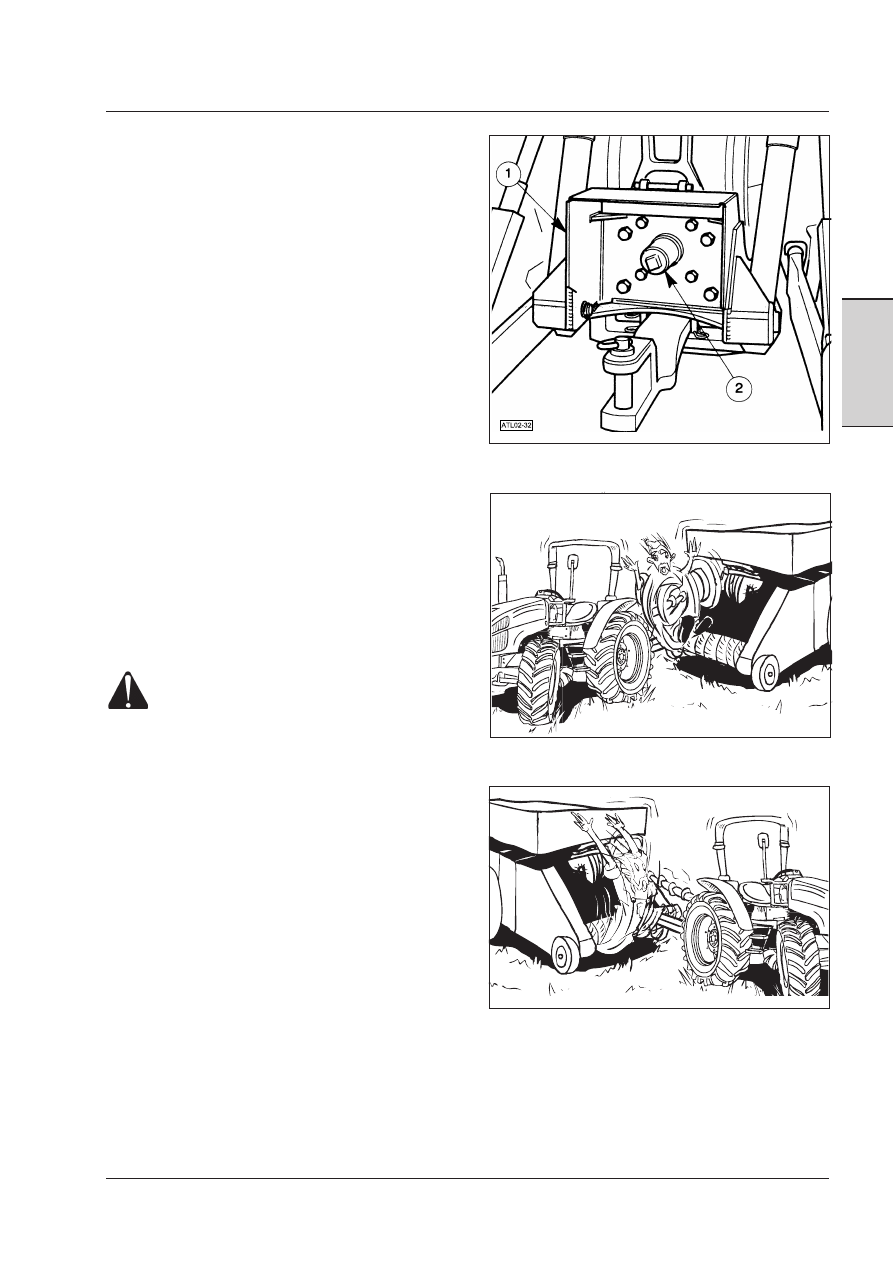
 Ensure that the PTO shield (1) is in place and that the

cap (2) is fitted when the PTO driveline is not in use

(Fig. 2-32).

 Before  connecting,  disconnecting,  cleaning  or

adjusting implements driven by the power take-off,

disengage the PTO, turn the engine off, remove the

ignition key and make sure that the PTO shaft is at

standstill (Fig.2-33).

 Ensure that all the PTO driveline guards are in place

and observe all safety signs (Fig. 2-33).

 Make sure that everyone stands clear of the tractor

before  engaging  the  PTO.  During  stationary  use  of

your tractor, always shift the gear lever, the reverse

shuttle and the ranges to neutral, engage the parking

brake and secure the wheels of tractor and implement

with wooden wedges or chocks.

 When working with implements powered by power

take-off, never leave the driver’s seat unless the PTO
is  disengaged,  the  first  gear  and  the  parking  brake
are  engaged,  the  engine  is  off  and  the  ignition  key
removed. As an alternative, if the tractor is to be used
as a fixed power unit, before leaving the tractor shift
the  gear  to  neutral,  engage  the  parking  brake  and
make sure there are no people within the operating
range of the machine.

 DO NOT use PTO adaptors, reducers or extensions as

they extend the PTO coupler and universal joint out

beyond the protection offered by the PTO shield.

 The top link and lift rods must not be extended beyond

the point where threads begin to show.

DANGER:  NEVER  attempt  to  unplug  the 
hydraulic  connections,  or  adjust  an  imple-
ment  with  the  engine  running  or  the  PTO 
drive in operation. There is a great danger of 
serious or deadly injuries (Fig.2-34).

 When using chemicals, carefully follow any directions

for their use, storage and discharge. Also follow the

directions given by manufacturers of equipment for
applying  chemicals.  Always  use  specific  personal
safety devices for each operation.

 When  operating  under  poor  visibility  conditions,  or

in the dark, use your tractor field lights and reduce

your ground speed. (DO  NOT use your field lights

when travelling on a roadway because rear pointed

white  lights  are  illegal  except  when  reversing  and

may confuse following drivers).

 Operate your tractor with the wheels set at the widest

setting  possible,  consistent  with  the  particular  task

you are performing. To adjust wheel settings refer to

Maintenance and Adjustment section.

 Reduce  your  speed  when  operating  over  rough  or

slippery ground and when foliage restricts your view

of  hazards.

 DO NOT make sharp turns at high speed.

Fig.2-32

Fig.2-33

Fig.2-34

26

Safety notes

Fig.2-35

Fig. 2-36

 Improper use of the drawbar, even if correctly posi-

tioned, can cause a rear overturn.

 DO NOT overload an attachment or towed equipment.

Use proper counterweights to maintain tractor stability.

Hitch heavy loads to the drawbar only.

Implements and attachments

 [4.5.1.1]

WARNING:  Use  exclusively  front  loader  ap-
proved by the tractor’s manufacturer, with CE 
mark and parallelogram type. The installation 
and modification of the tractor must be car-
ried out with the highest technical standards 
by  specialised  workshops  with  qualified 
personnel. Such workshops must be able to 
guarantee and attest the risk analysis provi-
ded for in the Machinery Directive 2006/42/
EC concerning the foreseen and predictable 
use of the tractor with front loader, in order 
to  carry  out  all  required  adaptations  of  the 
tractor.  Use the front loader and all supplied 
equipment as prescribed by the loader’s ope-
rator manual.

IMPORTANT: Keep the loader’s operation manual together 
with the tractor’s manual, always at hand in the storage 
compartment of the tractor. Before driving or operation 
your tractor, it is mandatory to read this manual very ca-
refully, with special attention to the chapter concerning 
safety rules.

WARNING:  Use  of  the  front  loader  and  of 
the  tractor  equipped  with  front  loader,  if 
not  correctly  carried  out,  and  handling  not 
secured loads constitute a serious danger for 
the operator and everyone standing by, due 
to  possible  objects  falling  from  above.  (Fig. 
2-35)

 [4.5.a]

 Three-point hitch and side mounted implements make

a much larger arc when turning than towed equipment.

Make certain to maintain enough clearance for safe

turning.

[4.2.b]

 To use mounted, semi-mounted or towed equipment

and trailers it is required to use exclusively CE marked

implements, after reading their operation handbooks

carefully, giving maximum attention to risks connected

with their association to the tractor.

[4.2.a]

 Implements must be hitched to the tractor by means

of the three-point linkage. It is therefore necessary to

check couplings for compatibility according to their

classes.

The implement has to be fitted with suitable supports

in order to avoid tipping or accidental shifting during

hitching.

Always check three-directional fastening to the tractor

of the mounted or semi-mounted implement, to avoid

dangerous swinging and shaking during transport and

work that could jeopardize the stability of the tractor-

implement assembly.

 The  cardan  shaft  must  be  always  CE-marked  and

suitable  to  tractor-implement  coupling.  Follow  all

directions of the operation manual, concerning both

the fastening according to connection direction and

safety rules to avoid rotation of protections (chains)

and  overlaying  of  the  telescopic  tubes.  Also  keep

articulation angles.

[4.2.e][4.2.k]

 Hitch loads to the drawbar only. Towing or attaching

to other locations may cause the tractor to overturn

(Fig.2-36)

To reduce the risk:
-  Use  only  loaders  equipped  with  load  self-leveling 
system, commonly defined as parallelogram type.
- Use only implements that are specifically dedicated to 
the work to be done. Strictly follow all directions and 
warnings mentioned by the loader handbook.

 [4.1.g]

- Use the tractor and implement carefully. Drive on flat 
ground and avoid holes, ditches and trenches. Do not 
turn, start or stop abruptly.
- If a front loader is mounted, it is advisable to use 
a tractor with cab or with a 4-post frame with FOPS 
safety system.  The loader installer should carefully 
analyze all risks and make all required adjustments.

27

2

Safety notes

Road transport

Before operating your tractor on a public road, a number
of precautions must be taken.

  Family yourself - and comply - with all local bye-laws, 

and national laws appropriate to your tractor.

  Lock both brake pedals together.

  Raise all implements to their transport position and 

lock them in place.

  Place all implements into their narrowest transport 

configuration.

  Disengage the PTO and differential lock.

  Make sure tractor and equipment are equipped with 

slow moving vehicle (SMV) signs or beacon if the 

law requires them (Fig.2-38 and 2-39).

  Make  sure  any  required  clearance  flags  or  hazard 

lights are in place and in working order.

  Make sure you use a proper safety hitch pin with a 

safety clip retainer.

  Clean off all reflectors and road lights, front and rear, 

and be certain they are in working order.

  Three-point hitch and implements jutting out from 

the sides make a much larger arc when turning than 

towed equipment. Make certain to maintain enough 

clearance for safe turning.

Road circulation rules

Before operating your tractor on a public road, a number
of precautions must be taken.

WARNING: DO NOT allow any passengers on 
the tractor or towed equipment.

 Know the route you are going to travel.

 Use the prescribed lights or, if required, the rotating

beacon,  both  in  the  daytime  and  in  the  night-time

(Fig.2-39).

 North  America  -  Use  regulation  lights  and  blinking

hazard lights when travelling on road.

 Use caution when towing a load at transport speeds

especially if the towed equipment is NOT equipped

with brakes.

 Observe all local or national regulations regarding the

road speed of your tractor.

 Use extreme caution when driving on snow-covered

or slippery roads.

Fig.2-38 - Use the symbol in force in your country

Fig.2-39

 Check  for  correct  coupling  between  tow  hook  and

trailer. See the Towing Attachments chapter.

 Use ballast weight as recommended. NEVER add more

ballast  to  compensate  a  higher  load  than  allowed.

Reduce load.

 Only  North  American  markets.  A  safety  chain  will

help control drawn equipment should it be acciden-

tally separated from the drawbar while transporting.

Using the proper adaptor parts, attach the chain to

the tractor drawbar support or other specified anchor

location.  Provide  only  enough  slack  in  the  chain  to

permit  turning.  See  your  Dealer  for  a  chain  with  a

strength  rating  equal  to,  or  greater  than  the  gross

weight of the towed machine (Fig.2-37).

Fig.2-37

28

Safety notes

 Wait  for  traffic  to  clear  before  entering  a  public

road.

 Beware of blind intersections. Slow down until you

have a clear view.

 DO NOT attempt to pass at any intersection.

 Slow down for turns and curves.

 Make wide, gentle turns.

 Signal your intent to slow, stop or turn.

 Shift  to  a  lower  gear  before  going  up  or  downhill.

(Fig.2-40)

 Keep  tractor  in  gear.  Never  coast  with  the  clutch

disengaged or transmission in neutral (Fig.2-40).

 Check for correct coupling between power steering

on  the  tractor  and  corresponding  system  on  the

tractor.

 STAY OUT of the path of oncoming traffic.

 Drive in your correct lane keeping as near to the curb

as possible.

 If traffic builds up behind you, pull off the road and

let it go by.

 Drive defensively. Anticipate what other drivers might

do.

 When towing a heavy load, start braking sooner than

normal and slow down gradually.

 Watch out for overhead obstructions (bridges, trees

etc.).

SAFETY - AFTER USE

 [4.2.c]

Always stop the tractor safely (DO NO park the tractor on
a slope). Engage the parking brake, engage the Park-Lock
(if equipped), disengage the PTO, engage the lowest gear,
lower any implement to the ground, stop the engine and
remove the ignition key BEFORE leaving the driver’s seat
(Fig.2-41).

Fig.2-40

Fig.2-41


Content   ..  4  5  6  7   ..