Tractors X60 Series. Manual - part 5
21
2
Safety notes
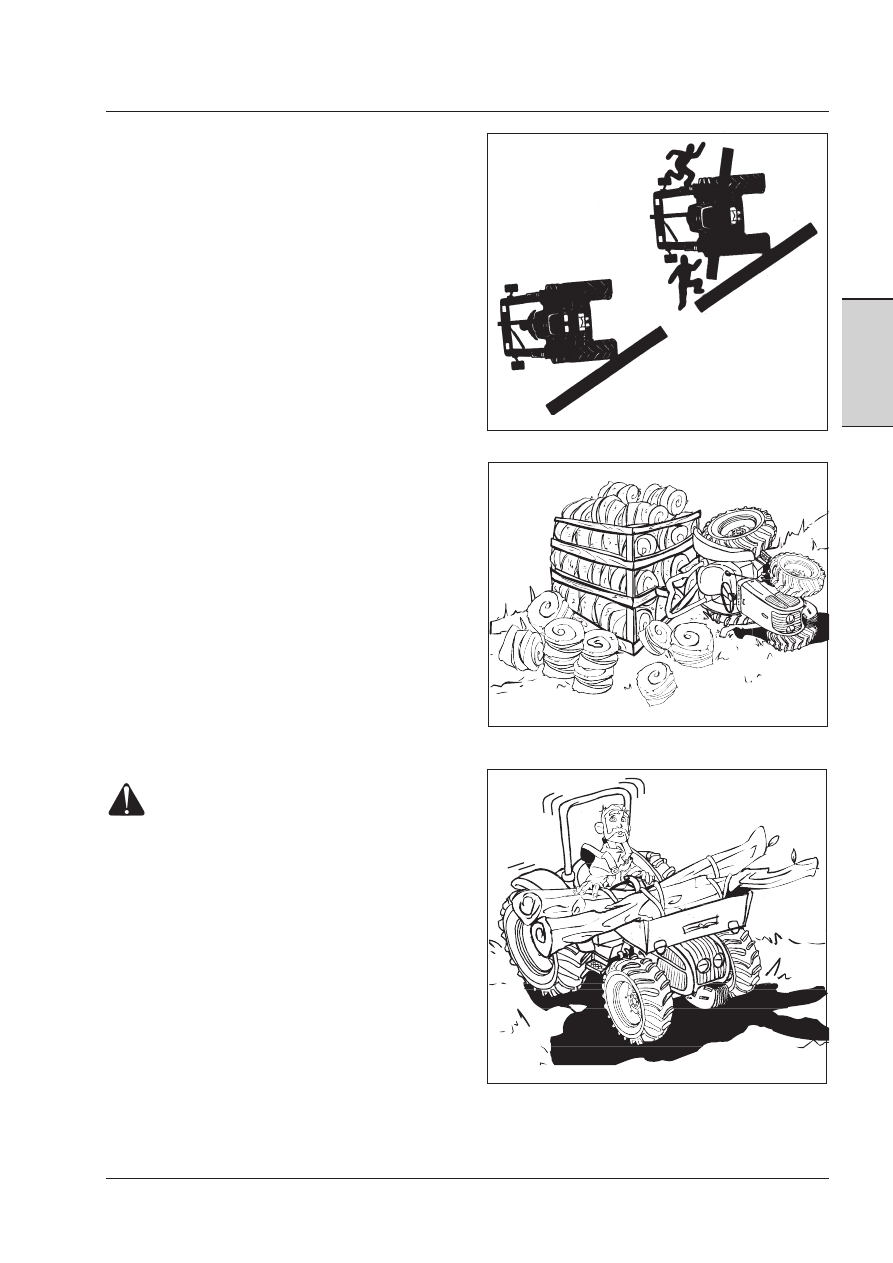
Risk of overturning
For your safety, tractors must be equipped with original
safety belts (Fig.2-18).
In case of overturning, hold firmly the steering wheel e DO
NOT try to get off the seat until the tractor has come to
a stop. If the doors are locked, leave the tractor through
the duly indicated emergency exits (Fig.2-18).
IMPORTANT: The safe working practices listed here-
under concerns only a few cases of overturning risk.
The list is therefore NOT comprehensive of all possible
cases.
[4.1.m]
To avoid side overturns
•
Set the wheel track at the widest setting suitable for
the job being done.
•
Lock the brake pedals together before driving at
transport speeds.
•
Reduce speed to match operating conditions. If the
tractor is equipped with a front-end loader, carry the
bucket and load as low as possible.
•
Make wide slow turns at reduced speed. DON'T let
your tractor bounce. You may loose steering con-
trol.
•
DON'T pull a load too heavy for your tractor. It could
run away on the down slope or the tractor could
jackknife around a towed load.
•
DON'T brake suddenly. Apply brakes smoothly and
gradually.
•
When going down a slope use the throttle to slow
the tractor engine and use the same gear you would
use to up the slope. Shift into gear before you start
downhill.
•
Engage four-wheel drive (if equipped); this will give
greater stability.
WARNING: NEVER disengage the clutch or
attempt to shift gear after you have started
downhill.
•
Always go up and down slopes following a straight
upward or downward line.
•
Do not overload a front implement or a trailer. Use
suitable counterweights to keep the tractor stable
(Fig.2-20).
•
If a load is towed at transport speed, the drawbar
must be locked in central position.
•
NEVER use the tractor to round up animals or cat-
tle.
Fig.2-18
Fig.2-19
Fig.2-20