Tractors X60 Series. Manual - part 3
 

  Index      Tractors     Tractors X60 Series - service repair manual 2012 year


Search            


Content   ..  1  2  3  4  ..


Tractors X60 Series. Manual - part 3


13

2

Safety notes

PRECAUTIONS FOR WORKING IN 
SAFETY

Protect yourself

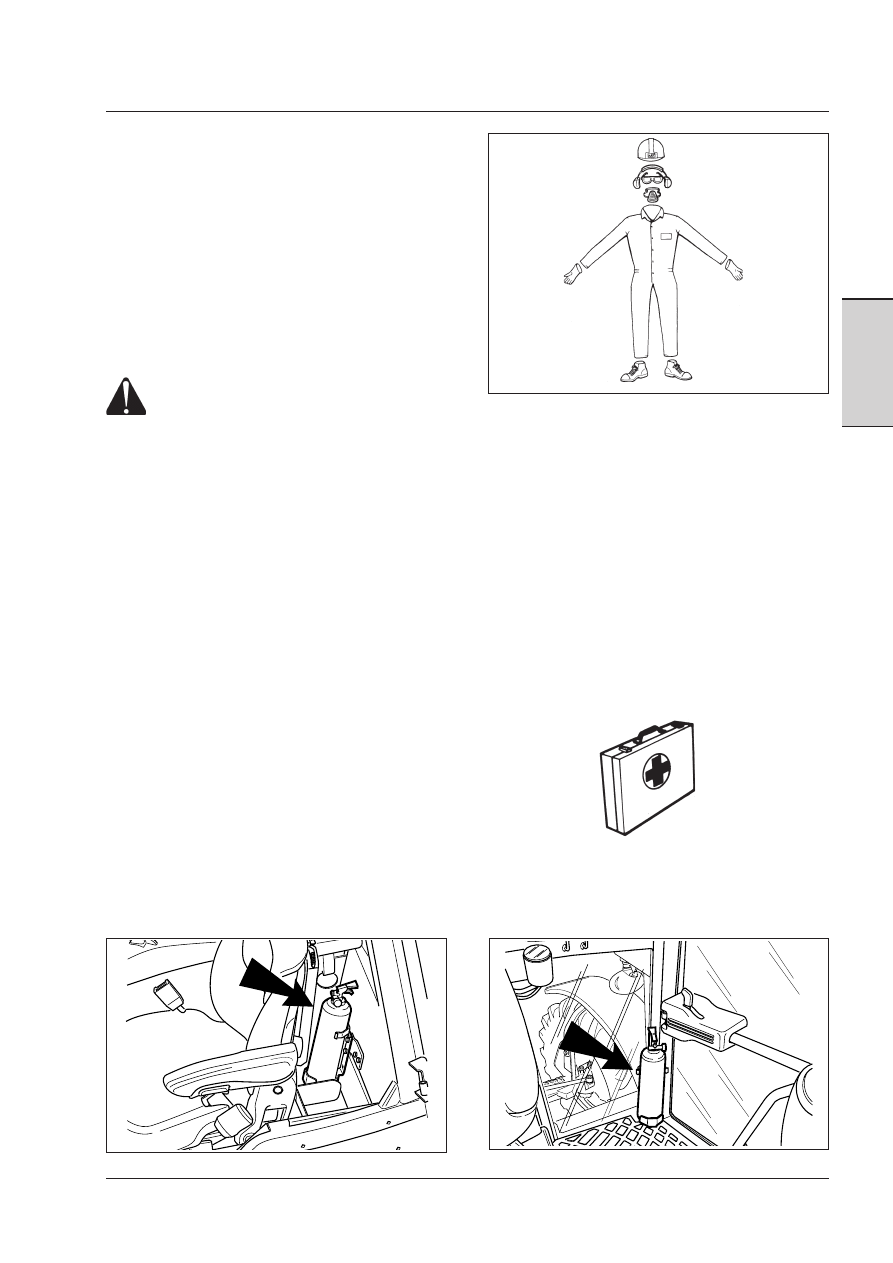
NEVER take any risks. Wear all protective clothing and
any personal protection devices called for by the work
conditions. (Fig. 2-3).

The following personal safety devices are always 
necessary:
- Hearing protection.
- Safety shoes.

WARNING: the tractor is not protected against 
dangerous matters and emissions. If you are 
working in an environment where there is a 
danger  of  inhaling,  ingesting  or  contacting 
dangerous matters, the operator should wear 
specific personal safety devices.

 [4.1.p][4.5.3]

DO  NOT  wear  loose  clothing,  jewellery  or 
other items and tie up long hair that could get 
entangled in controls or moving parts.

A  first  aid  kit  should  be  available  on  any  work  site
(Fig.2-5).

WARNING: The tractor is designed and built to avoid 
any fire risks during normal operation. Therefore, it 
is not provided of a self-extinguishing system or a fire 
extinguisher  on  board  as  a  standard.  The  tractor  is 
anyway designed to install a 1 kg dust fire extinguisher 
complying with UNI EN 3/7 2004 standard. The fire 
extinguisher  must  be  mounted  in  the  reserved  and 
indicated position (Fig.2-4a & Fig.2-4b)
The fire extinguisher with its support can be bought 
as a kit by our Dealers or authorized workshops. The 
kit consists in a fire extinguisher, support, fastening 
means, directions for its mounting and a decal to be 
applied in the indicated area. The decal, when applied, 
declares that  the  tractor  may not  be used  if  the  ire 
extinguisher is not in its place.
It  is  up  to  the  owner  of  the  farm  or  to  the  person 
responsible for safety at the farm to judge the oppor-
tunity of using the tractor in areas at high fire risk. 
They are also responsible for use of the tractor with 
the extinguisher duly mounted.

Fig.2-3

Fig.2-4a

Fig.2-5

Fig.2-4b

The fire extinguisher position changes according to tractor model

First aid box
If  the  tractor’s  owner  or  safety  manager  provides  the
tractor with a first aid box, we recommend storing the
box in a suitable place when the tractor is not used for a
long time, owing to its highly perishable content.

14

Safety notes

Know your equipment

Know your tractor. Know how to operate all equipment
on your machine and the implements and attachments
used with it. Know the purpose of all the controls, gauges
and  dials.  Know  the  rated  load  capacity,  speed  range,
braking and steering characteristics, turning radius, and
operating clearances.

Keep  in  mind  that  rain,  snow,  ice,  loose  gravel,  soft
ground, etc. can change the way your tractor operates..
Under poor conditions, slow down and be extra careful, 
engage four-wheel drive, if fitted.

Study the DANGER, WARNING or CAUTION safety
signs on your tractor and the information signs also.

READ THIS OPERATOR INSTRUCTION BOOK BEFORE
STARTING THE ENGINE.

STUDY IT BEFORE YOU START WORK (Fig. 2-6).

IF THERE IS SOMETHING YOU DO NOT UNDERSTAND,
ASK  SOMEONE  SPECIALISED  (e.g.  your  Dealer)  FOR
EXPLANATION.

IMPORTANT: This manual covers general safe practices 
for agricultural tractors. It must always be kept with the 
tractor. For further copies contact your Dealer.

Use all available protective devices

Keep all protective devices in place and securely fastened.
Make certain all guards, shields and safety signs are pro-
perly installed, as specified, and are in good condition.

Fig.2-6

To help keep yourself and others around you 
safe, your tractor should be equipped and kept 
in perfect service order with:

 Safety belts complying with law requirements of the

various countries.

 Power take-off shields.

 Shields against heat.

 Shields  and  guards  against  shearing,  pinching  and

moving parts.

 Rear view mirrors.

 Anti-deflagration shields on tubes, if required.

 Dust filters in the cab

 Decals and pictograms.

 Means to access the driver’s seat.

 Driver’s seat.

 Controls.

 Operator’s manual.

 Slow  Moving  Vehicle  emblem  (SMV).  Additional

safety guards, lights or decals and a back-up alarm

(Fig.2-38 and 2-39) (North America).

Know which devices are required for safe operation of
your tractor. Use them at all times. Make sure they are in
place and in good condition. NEVER remove or disconnect
any safety device.

15

2

Safety notes

Fig.2-8

Fig.2-7

Check the equipment

Before you begin your working day, take time to check
your tractor and ensure that all systems are in good ope-
rational condition.

WARNING: personal safety devices must be worn for 
each check and maintenance operation.

DO NOT smoke while refuelling the tractor. Keep any

type of open flame away (Fig. 2-7).

[4.1.l]

Check for loose, broken, missing, or damaged parts.

Have  everything  put  into  good  repair.  Make  certain

all safety devices are in place.

 Check  the  seat  belts  for  damage:  Damaged  belts

MUST be replaced.

 Ensure that implements and attachments are properly

installed and that the tractor and implement PTO RPM

ratings match.

 Check  the  tires  for  cuts,  bulges  and  correct  pres-

sure.    Replace  worn  or  damaged  tyres.  Check  foot

and  parking  brakes  for  proper  operation.  Adjust  if

necessary.

 Stop the engine and wait for it to cool before refuel-

ling.

 Check the engine oil level and add oil if required.

 Perform all maintenance procedures outlined in the

maintenance and adjustment section of this manual.

 Check  that  the  PTO  drive  locking  devices  are

latched.

 Check that the tractor PTO shield and driveline guards

are in place and operating properly.

 Check the tractor and implement hydraulic system.

Have any  leaks or damaged  parts repaired or rene-

wed.

WARNING: Diesel fuel or hydraulic fluid un-
der pressure can pierce the skin or eyes and 
cause serious personal injury, blindness or 
death. Fluid leaks under pressure may not 
be visible. Use a piece of cardboard or wood 
to find leaks. Never use your bare hand. 
Wear safety goggles for eye protection. If 
any fluid is injected into the skin, it MUST 
be surgically removed within a few hours 
by a doctor familiar with this type of injury 
(Fig.2-8).

Before applying pressure to the fuel or hydraulic system,
be  sure  all  connections  are  tight  and  that  lines,  pipes,
and hoses are not damaged. Before disconnecting fuel
or hydraulic lines, be sure to relieve all pressure.

Make sure that all hydraulic lines are correctly installed
and not tangled.

WARNING:  Liquid  cooling  systems  build  up 
pressure as the engine gets hot. Before remo-
ving the radiator cap, stop the engine and let 
the system cool.

 Check the engine cooling system and add coolant as

required.

 HYDRODYNAMIC  SYSTEMS:  HOSES  Hoses  are  an

important  component  in  modern  machines.  Hoses
can change their characteristics in the course of time
because of pressure, vibrations, weather etc. Laws
in  force  prescribe  that  hoses  are  replaced  within  6
years  from  their  construction.  WE  RECOMMEND
COMPLIANCE WITH THIS RULE.

[4.1.i]

WARNING: When auxiliary control valves 
are used, their quick couplings can reach 
high temperatures. Therefore, safety glo-
ves suitable for such temperatures must be 
worn every time the connected implements 
are connected to or disconnected from the 
couplings.

16

Safety notes

Clean the tractor

 Keep work surfaces and engine compartments clean.

 Before  cleaning  the  machine,  always  lower  imple-

ments to the ground, engage the first gear, engage
the  parking  brake,  turn  the  engine  off  and  remove
the  key.

 Always use specific personal safety devices for each

service  operation.

 Clean steps, pedals and floor. Remove grease or oil.

Brush away dust or mud. In winter, scrape away snow

and ice. Remember - slippery surfaces are dangerous.

 When plastic parts need to be cleaned (such as con-

sole, instrument panel, monitors, indicators etc), do

not use petrol, paraffin, diluents etc.

They could cause discoloration, cracking or warping

of the cleaned parts..

These  parts  should  ONLY  be  cleaned  with  water,

neutral soap and a soft cloth.

 Remove and store implements, keys, hitches etc. in

their proper places.

Protect the environment

 It  is  illegal  to  pollute  drains,  water  courses  or  soil.

Use  authorized  waste  disposal  facilities,  including

civic  amenity  sites  and  garages  providing  facilities

for disposal of used oil. If in doubt, contact your local

authority for advice.

 To  get  to  know  the  correct  methods  to  dispose  of

oils, filters, tyres etc. contact your Dealer or the local

agency for waste recycling.

 Only for North America:

The safety sheets of each material give information

on chemicals contained in a product, procedures to

use it safely, first-aid and procedure to be followed

in case of leakage or spills. In all North America such

safety sheets are available at the Dealer's.

Before  any  maintenance  on  the  machine,  refer  to

the  above  mentioned  safety  sheets  for  fluids,  oils

etc. used in this machine. The sheets inform about

risks and safe maintenance procedures. We strongly

recommend  to  follow  these  indications  during  any

maintenance operations.

 Disposal  of  the  tractor:  The  tractor  is  made  up  of

parts  subject  to  rules  and  laws  for  their  disposal.

When the tractor  is not  used any  more, it  must  be

disposed  of  through  proper  agencies  according  to

such rules. Do not pollute the environment with the

tractor or its parts.

WARNING: Hot parts of the machine are suita-
bly guarded, wherever possible. This does not 
exclude, however, that great care should be 
used when working on the machine, to avoid 
burns or scalding. 

[4.1.n]

 Before any adjustments or servicing on the electrical

system, disconnect the battery by operating the mas-

ter disconnect switch (if equipped) or disconnecting

the cables of the battery. See the section concerning

battery servicing.

 To prevent fire or explosion, do not go with free flames

near the battery or cold starting device. Carefully fol-

low the directions for the use of coupling cables to

avoid sparks that may cause an explosion.

 Consult your Dealer for any repairs or adjustments;

such  works  should  be  carried  out  by  specialised

workmanship.

 Check regularly that all nuts and bolts are securely

tightened, specially the nuts in wheel hubs, disks or

rims. Tighten to the prescribed driving torques.

 Check  the  oil  level  at  regular  intervals  and  top  up

if  required.

 Check  the  brakes  regularly,  top  up  the  reservoir

and/or adjust where necessary. Make sure that the

brakes  are  evenly  adjusted,  especially  when  using

a  trailer.

WARNING: When it is necessary to carry out 
service,  filling  up,  cleaning  or  adjustment 
operations  in  places  at  an  height  above  1.5 
m  (e.g.  engine  coolant  reservoir  or  cab  air 
filters, work light lamps etc.) a stable and safe 
mean (e.g. a ladder) is required to reach the 
service point. 

WARNING: Work and road lights can be very 
hot  and  dangerous  if  on  since  a  long  time. 
Take care to avoid contacts that could cause 
burns. If work on these lights is needed, turn 
them off and let them cool down.
Always  use  safety  gloves  suitable  for  high 
temperatures.

 Carry out the following operations before any opera-

tion about the tractor: engage the first gear, engage
the  parking  brake,  turn  the  engine  off  and  remove
the ignition key.

Maintenance operations must be carried out when the
engine  is  cold.  If  the  maintenance  operation  must  be
carried out while the engine is hot (e.g. when changing
engine oil), start the engine and let it idle for the required
time, then turn it off before the maintenance operation.

If  you  need  to  open  the  bonnet,  follow  the  procedure
indicated under “How to open the bonnet”. In this case
beware the risk of burning and shearing.

Personal safety devices must be worn for each check and
maintenance operation.

SAFETY - TRACTOR MAINTENANCE


[4.1.h]

CAUTION:  With  exception  of  normal  service,  as  ex-
plained in the Maintenance section, all other servicing 
or reparations must be carried out by properly skilled 
personnel in authorised workshops.

 DO NOT carry out maintenance operations while the

engine is hot or the tractor is moving.


Content   ..  1  2  3  4  ..