Tractors X60 Series. Manual - part 4
 

  Index      Tractors     Tractors X60 Series - service repair manual 2012 year


Search            


Content   ..  1  2  3  4  5  ..


Tractors X60 Series. Manual - part 4


17

2

Safety notes

Fig.2-9b

Fig.2-9c

Fig.2-10a

SAFETY - STARTING UP

Warn bystanders before starting the engine.

Before starting, walk around the whole tractor and any
attached equipment. Make sure that no one is under, on,
or close to the tractor or equipment. Let other workers
and bystanders know you are starting up and don’t start
until  everyone  is  clear  of  the  tractor,  implements  and
towed equipment.

Make sure that everyone, particularly children, is in a
safe position before starting the engine.

Mount and dismount safely.

 [4.1.e]

Always use ‘three point contact’ with the machine, and
face the machine when you mount it. Three point contact
means both hands and one foot or one hand and both
feet are in contact with the machine at all times during
mounting and dismounting.

Clean your shoes and wipe your hands before climbing on.
Use handrails, grab handles, ladders or steps (as provided)
when mounting or dismounting.

NEVER use control levers as a hand hold and NEVER step
on foot controls when mounting or dismounting.

NEVER try to go on or off the moving tractor.

If the tractor must be lifted for servicing, take it to a sui-
tably equipped workshop.
Carry out the following operations before any operation
about the tractor: engage the four-wheel drive, the first
gear and the parking brake and put chocks to the wheels
touching the ground.
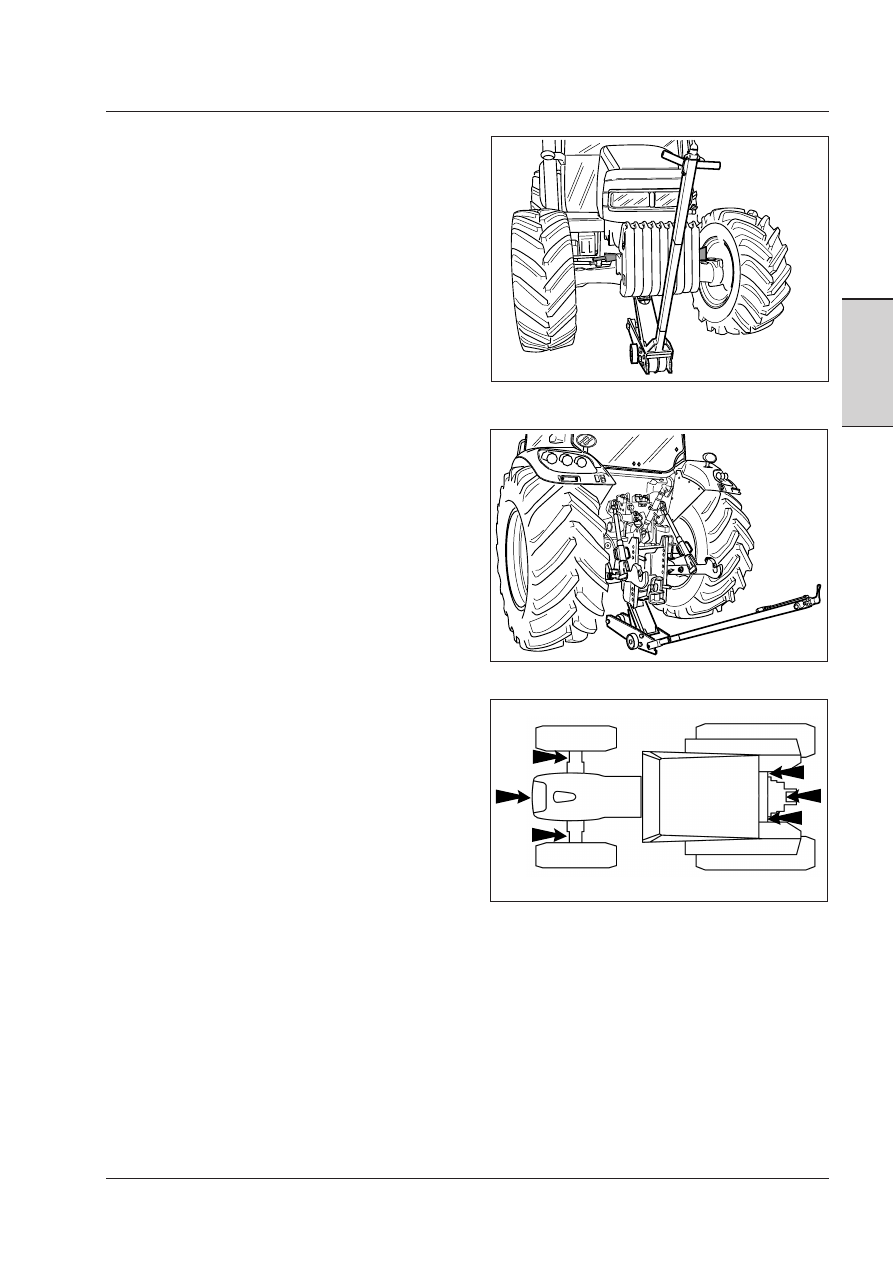
Before lifting the tractor, avoid its swinging by means of
wooden wedges applied to the front axle (Fig.2-9b): the
chocks must avoid any swinging of the tractor.
Use jack lifts of suitable capacity and apply them at the
centre of the front and rear axles (Fig. 2-9b and Fig.2-9c)
paying due attention to weight distribution.

[4.1.k]

No decals for the lifting point are applied on the tractor, as
they would be too difficult to apply in the available spaces
and would be all too easily removed or effaced during
normal operation of the tractor. Apply the jack lift to the
lifting points (Fig. 2-10a ) according to the type of operation
and following the safety procedures given before.

WARNING: DO NOT raise the tractor using the tow 
hook.

18

Safety notes

Fig.2-12

Fig.2-13

Fig.2-11

Fig.2-10b

Safety at starting 

[4.1.c]


WARNING:  Make  sure  that  there  is  enough 
ventilation before starting the engine. Never 
start the engine in an enclosed space. Exhaust 
fumes may cause asphyxiation (Fig.2-10b).

Make sure that the tractor dual brake pedals are locked
together at all times unless you are making turns in the
field which require independent use of the brakes. Make
sure the brakes are properly adjusted so that both brakes
engage at the same time.

Adjust the seat and fasten your seat belt (if applicable,
according the description in this book),

Always start the engine from the operator’s seat, after
depressing  the  clutch  pedal,  with  all  the  transmission
levers and  PTO  and  auxiliary spool  valve control  levers
in neutral.

DANGER: The engine must be started with 
the ignition key only from the driver’s seat. 
DO NOT attempt to start the engine by 
shorting across the terminals of the starter 
motor. If the starter circuit is bypassed to 
neutral, the tractor could start with an en-
gaged gear, with danger of serious injury or 
death to bystanders (Fig.2-11).

Follow recommended starting procedures.

Follow  the  starting  procedures  recommended  in  the
Operation section of this Operator Instruction Book. This
includes  normal  starting,  cold  starting,  and  the  use  of
starting fluids.

Overhaul the controls.

After engine ignition, overhaul all instruments and lights.
Be  sure  that  all  are  operating  correctly.  If  the  machine
does  not  respond  properly  to  controls,  DO  NOT  use  it
until the fault is mended.

Make sure that the starter motor solenoid valve fuse is
always installed.

Starting fluid

CAUTION: Do not inject fluids (ether) to make the 
engine easier to start in cold weather. The tractor is 
equipped with a cold weather starting system (Fig.2-
12).

Before starting the tractor, make sure that there are no
persons or hindrances in its operating range (Fig.2-13).

19

2

Safety notes


Do not start the tractor without ensuring a perfect com-
mand of speed and steering controls (Fig.2-14).

 Before starting, inspect the work area to establish

the best and safest procedure. Plan your work

so that you drive as straight as possible forward.

Beware of trenches, pits, ditches, slopes, trunks

or stumps, ponds etc. Watch for any possibly

dangerous condition. If you are using a front loader

or foldable implements or implements with high

components, watch out for obstacle in the tractor's

way.

WARNING: Accidental contact with high-volta-
ge lines causes death. In case of contact with 
high-voltage  conductors  DO  NOT  leave  the 
tractor, but move the tractor and/or the loader 
in such a way as to eliminate the contact and 
reach a safe distance (Fig.2-15).

Fig.2-14

WORKING IN SAFETY


WARNING: An unbalanced tractor could over-
turn and cause injury or death. If required, put 
ballast weights on their front support and on 
rear wheels as described in this section of the 
Operation chapter. Ballast weights must be used 
according  to  the  manufacturer’s  directions. 
NEVER add extra counterweights to compen-
sate for an overload. It is better to reduce the 
load.

WARNING: Keep all parts of your body inside 
the operator's compartment while operating 
the tractor.

Follow the rules when using your tractor.

Be sure the tractor is ready for the job on hand. Learn the
rated loads by heart and never exceed them. Make sure
that any implement or equipment you are going to use
does NOT exceed the load capacity of your tractor. Check
that the coupling PTO shaft/implement is correct (see the
Technical Specifications section for mass data).

Keep in mind that tractors normally operate on uneven,
unpaved, and often bumpy or sloping surfaces. Operating
conditions can reduce the amount of weight you should
carry or pull.

Follow safe operating practices

 Operate the controls smoothly - don't jerk the steering

wheel or other controls.

 DO NOT get on or off a moving tractor. Keep a firm

grip on the steering wheel at all times, with the thumbs

clear of the spokes when driving the tractor.

 Always use specific personal safety devices for each

operation.

 Make sure you have adequate clearance in all direc-

tions for tractor, cab, asfety frame and implement.

 NEVER play games with a tractor or equipment.

 NEVER attempt to work the controls except from the

operator's seat.

 Before getting off the tractor, always disengage the

PTO,  lower  all  attachments  and  implements  to  the

ground, place the tractor in neutral, engage parking

brake, shut off the engine and remove the key.

 NEVER attempt to work the controls except from the

operator’s seat.

 Carry out the following operations before leaving the

tractor:  engage  the  first  gear,  engage  the  parking
brake,  turn  the  engine  off  and  remove  the  ignition
key.

As an alternative, if the tractor is to be used as a
fixed power unit, before leaving the tractor shift the
gear to neutral, engage the parking brake and make
sure there are no people within the operating range
of the machine.

Fig.2-15

DIRECTIONS TO AVOID IMPROPER USE OF THE TRACTOR

20

Safety notes

Fig.2-16

Fig.2-17

WARNING: NEVER stand, or allow anyone else 
to stand between the tractor and implement 
unless the engine is turned off and the par-
king brake is engaged, a gear is engaged and 
all  attachments  or  implements  are  lowered 
to the ground.

Beware of other people

 Think about what you are going to do.  Never  al-

low persons that are not qualified or suitably skilled

to operate your tractor. They could be a danger for

themselves or for others.

WARNING: Your tractor is designed to be ope-
rated by one person. DO NOT allow others to 
ride on the tractor or the implement (Fig.2-
16). Never allow anyone to ride on the imple-
ments or other equipment including trailers, 
except on certain harvesting equipment, spe-
cifically designed for riders during the actual 
harvest operation only (not during transport). 
Such  equipment  must  have  provision  for  a 
safe riding area. NEVER allow children on a 
tractor.

WARNING: Make sure you can safely control 
speed  and  driving  direction  of  the  tractor 
before  moving  it.  Start  slowly  until  you  are 
sure everything is operating regularly. After 
starting,  turn  the  steering  right  and  left  to 
check for correct operation. Check steering 
and brake system for operation. If differential 
is locked, DO NOT operate at high speed or 
turn the tractor until the differential lock is 
disengaged.

 Keep others away from your operation area. Never

allow anyone to stand or pass under a raised imple-

ment (Fig.2-17).

 DO NOT lift objects that cannot be contained safely

in the bucket, get the appropriate attachment. Never

allow anyone to stand on the safety frames or fend-

ers.

 When using a loader, avoid sudden stops, starts,

turns, or changes of direction. Keep loads as near

as possible to the ground during transport.

 Never stand (or allow anyone else to stand) in front

of, under, or behind loaded or loading equipment.

Never drive a tractor up to someone standing in

front of a fixed object.

WARNING:  NEVER  lift  a  load  over  anyone 
(Fig.2-17).

 Keep others away from articulation joints, hitches,

drawbar, lift arms, PTO drives, cylinders, belts, pul-

leys, and other moving parts. Keep safety guards in

place.

WARNING: NEVER stand, or allow anyone else 
to stand between the tractor and the trailer 
unless the engine is turned off and the parking 
brake is engaged and a gear is engaged. 

[4.2.m]


Content   ..  1  2  3  4  5  ..