Motovario: Motoreducers, Motovariators, Electric Motors. Product catalog - page 17

Condizioni di funzionamento
Altitudine:
ambiente sia compresa tra 40 e 6C°, è necessario a pplicare alla
Non superiore a 1000 metri sul livello del mare (s.l.m.)
potenza del motore un coefficiente correttivo che consente al motore
Temperatura ambiente nel luogo di installazione:
di mantenere la propria riserva termica (temperatura massima rag-
Minima -1C°, massima +4C°.
giunta dagli avvolgimenti in condizione nominali di esercizio).
Condizioni di altitudine e/o temperatura differenti devono essere og-
Se i motori sono destinati a funzionare in località ad una altitudine
compresa tra 1000 e 4000m s.l.m. o nel caso in cui la temperatura
getto di discussione con il Ns. ufficio tecnico.
Operating Conditions
Altitude:
and 6C°, it is necessary to apply a corrective coe fficient to the motor
Standard ratings are based on 1000 metres above sea level (a.s.l.)
power to allow the motor to maintain its thermal reserve (maximum
Ambient temperature at the place of installation:
temperature reached by the windings in normal operating conditions).
Other conditions of altitude and/or temperature must be discussed
Minimum -1C°, maximum +4C°.
If the motors are destined to operate at places at a height of between
with our engineering department.
1000 and 4000m a.s.l., or if the ambient temperature is between 40
Betriebsbedingungen
Höhe:
zu werden, bzw. falls die Raumtemperatur zwischen+ 40 und +6C°
Nicht über 1000 Meter über dem Meeresspiegel.
liegen sollte, ist die Motorleistung entsprechend zu reduzieren.
Umgebungstemperatur am Installationsort:
Bei anderen Höhen- und/oder Temperaturbedingungen ist mit unserer
technischen Abteilung Rücksprache zu nehmen.
Minimum -1C°, höchstens bis +4C°.
Falls die Motoren dazu bestimmt sind, an einem Ort in einer Höhe
zwischen 1000 und 4000 m Höhe über dem Meeresspiegel betrieben
Conditions de fonctionnement
Altitude:
ambiante serait comprise entre 40 et 6
, il faut a ppliquer à la puissance
Non supérieure à 1000 mètres au dessus du niveau de la mer
du moteur un coefficient de correction qui permette au moteur de
Température ambiante dans le lieu d’installation:
maintenir sa propre réserve thermique (température maximum atteinte
par les enroulements en condition de service nominal). Conditions
Mini. -1C°, maxi. +4C°.
Si les moteurs doivent fonctionner dans des localités ayant une altitude
d’altitude et/ou de température différentes doivent être discutées avec
notre S.ce technique.
comprise entre 1000 et 4000 m s.n.m. ou dans le cas où la température
Condiciones de funcionamiento
Altitud:
tura ambiente esté comprendida entre 40 y 6
C, ser á necesario
No superior a 1000 metros sobre el nivel del mar (s.n.m.)
aplicar a la potencia del motor un coeficiente de corrección que permita
Temperatura ambiente en el lugar de instalación:
que el motor mantenga su propia reserva térmica (temperatura máxima
alcanzada por los bobinados en condiciones nominales de ejecución).
Mínima -1C°, máxima +4C°.
Si los motores tienen que funcionar en lugares que tengan una altitud
Condiciones de altitud y/o temperatura diferentes deberán ser
discutidas con nuestro departamento técnico.
comprendida entre 1000 y 4000m s.n.m. o en caso en que la tempera-
K
4
C
1.0
4
C
5
C
0.9
5
C
6
C
0.8
0.7
0.6
0.5
0
1000
2000
3000
4000
[m]
320
Condizioni di funzionamento
Umidità:
Il sistema di impregnazione adottato per l’isolamento degli avvolgimenti
del motore è idoneo per climi temperati in cui l’umidità relativa dell’aria
non supera il 90%. Il trattamento è designato: tropicalizzazione TROP1.
Condizioni climatiche relative al luogo di installazione caratterizzate
da valori di umidità relativa superiori (es. climi tropicali) necessitano
protezioni aggiuntive.
Su richiesta, previo accordo, è possibile applicare all’avvolgimento
uno smalto elettroisolante aggiuntivo di eccellente resistenza agli agenti
chimici: acqua, acido (soluzione 10% acido solforico), alcali (1%
idrossido di sodio), acqua salata; oli minerali (ASTM-D-115-55).
Il trattamento è designato: tropicalizzazione TROP2.
Operating Conditions
Humidity:
The system of impregnation adopted to insulate the motor windings is
suitable for temperate climates where the relative humidity of air does
not exceed 90%. This treatment is designated tropicalization TROP1.
Climatic conditions of the place of installation featuring higher values
of relative humidity (e.g., tropical climes) need additional protection.
On request, subject to agreement, it is possible to treat the winding
with an additional isolating glaze with excellent resistance to chemical
agents: water, acid (10% sulphuric acid solution), alkalis (1% sodium
hydroxide), salt water, mineral oils (ASTM-D-115-55).
This treatment is designated: tropicalization TROP2.
Betriebsbedingungen
Feuchtigkeit:
Die für die Isolierung der Motorwicklungen eingesetzte Imprägnierung
eignet sich für gemäßigte Klima, deren relative Luftfeuchtigkeit nicht
über 90% liegt. Bezeichnung der Behandlung: Tropenschutz TROP1.
Klimaverhältnisse am Installationsort, die von höheren relativen
Feuchtigkeitswerten gekennzeichnet sind (z.B. Tropenklimen) bedürfen
eines zusätzlichen Schutzes.
Auf Wunsch ist es möglich, auf die Wicklung eine zusätzliche
Beschichtung mit ausgezeichneter Beständigkeit gegen chemische
Medien wie Wasser, Säure (Lösung mit 10% Schwefelsäure), Lauge
(1% Natriumhydroxyd), Salzwasser, Mineralöle (ASTM-D-115-55)
aufzutragen. Bezeichnung dieses Schutzes: Tropenschutz TROP2.
Conditions de fonctionnement
Humidité:
Le système d’imprégnation adopté pour l’isolation des enroulements
du moteur est indiqué pour les climats tempérés où l’humidité relative
de l’air ne dépasse pas les 90%. Le traitement est nommé: tropicalisation
TROP1. Des conditions climatiques concernant le lieu d’installation
avec des valeurs d’humidité relative supérieures (par ex. Climats
tropicaux) nécessitent des protections additionnelles.
Sur demande et après accord, on peut appliquer, à l’enroulement, une
peinture électroisolante additionnelle très résistante aux agents
chimiques, soit eau, acide (solution 10% acide sulfurique), alcali (1%
hydroxyde de sodium), eau salée; huiles minérales (ASTM-D-115-55).
Le traitement est nommé : tropicalisation TROP2.
Condiciones de funcionamiento
Humedad:
El sistema de impregnación adoptado para aislar a los bobinados del
motor es idóneo para climas templados en los que la humedad relativa
del aire no supera el 90%. Al tratamiento se le ha llamado: tropicalización
TROP1. Condiciones climáticas relativas al lugar de instalación
caracterizadas por valores superiores de humedad relativa (ej. climas
tropicales) necesitan protecciones adicionales.
Si así se solicita, previo acuerdo, se podrá aplicar en el momento del
bobinado un esmalte electroaislante adicional de excelente resistencia
contra los agentes químicos: agua, ácido (solución 10% ácido sulfúrico),
alcalino (1% hidróxido de sodio), agua salada; aceites minerales (ASTM-
D-115-55).Al tratamiento se le ha llamado: tropicalización TROP2.
321
Condizioni di funzionamento
Scarico condensa
Scaldiglia anticondensa
Nel caso di motori installati all’aperto o in luoghi con alto grado di
Nel caso di motori destinati ad ambienti particolarmente severi, carat-
umidità e/o con elevate escursioni termiche, è possibile prevedere - a
terizzati da temperature estremamente basse, forti umidità, e/o
richiesta - fori di drenaggio per lo scarico della condensa.I fori sono
elevatissime escursioni termiche, è consigliabile l’uso di scaldiglie
normalmente chiusi da tappini in plastica al fine di garantire il grado di
anticondensa.
protezione specificato sulla targa del motore; periodicamente è op-
portuno aprire e chiudere i fori per consentire lo scarico della conden-
sa. Al fine di ottenere il corretto posizionamento dei fori è opportuno
precisare in fase di ordinazione la posizione d’impiego del motore.
Operating Conditions
Condensation drainage
Anti-Condensation Heaters
In case of outdoor applications or in places with a high degree of
In the case of motors designated for particularly harsh environments,
humidity and/or wide temperature range, it is possible to have
with extremely low temperatures, high humidity levels, and/or extremely
drainage holes, on request, to drain off the condensation. The holes
wide temperature ranges, it is advisable to use anti-condensation
are closed by plastic caps in order to ensure the protection degree
heaters.
stated on the motor name plate. Periodically, it is a good idea to open
and close the holes to drain off the condensation. To position the
holes correctly, the motor operating position should be stated at the
time of ordering.
Betriebsbedingungen
Kondenswasserablaßlöcher
Stillstandsheizung gegen Kondenswasserbildung
Im Falle einer Anwendung im Freien oder unter Bedingungen mit hoher
Beim Einsatz der Motoren bei extrem niedrigen Temperaturen, starker
Luftfeuchtigkeit, ebenso bei hohen Temperaturschwankungen, ist auf
Feuchtigkeit und/oder extrem starken Temperaturschwankungen, ist
Anfrage line Modifikation möglich: Ablaufbohrungen. Die Bohrungen
die Verwendung von Stillstandsheizungen gegen Kondenswasserbildung
sind normalerweise mit Kunststoffstopfen abgedichtet, um die auf
ratsam.
dem Leistungsschild angegebene Schutzart zu garantieren. Die
Bohrungen müssen regelmäßig geöffnet und geschlossen werden,
damit das Kondenswasser abfließen kann. Zur korrekten
Positionierung der Bohrungen ist es notwendig, bei der Bestellung die
Bauform des Motors anzugeben.
Conditions de fonctionnement
Vidange condensations
Réchauffeur anticondensations
Les conditions climatiques relatives au lieu d’installation caractérisées
En cas de moteurs destinés aux milieux particulièrement durs,
par les valeurs d’humidité supérieures relatives (ex. climats tropicaux),
caractérisés par des températures extrêmement basses, par fortes
nécessitent des protections additionnelles.
humidités et/ou amplitudes thermiques très élevées, on conseille l’emploi
Les trous sont normalement fermés par de petits bouchons en plastique,
de réchauffeurs anticondensations.
afin de garantir le degré de protection spécifié sur la plaquette du
moteur; périodiquement, il faut ouvrir et refermer les trous pour permettre
la vidange des condensations. Pour un positionnement correct des
trous, il faut préciser la position d’assemblage du moteur lors de la
commande.
Condiciones de funcionamiento
Drenaje condensación
Resistencia anti-condensación
En caso de motores instalados a la intemperie o en lugares con alto
En caso de motores que tengan que ubicarse en ambientes
grado de humedad y/o con alta variación térmica, es posible instalar
especialmente severos, caracterizados por temperaturas
- bajo pedido - agujeros de drenaje contra la condensación. Los
extremadamente bajas, humedad muy alta, y/o elevadas variaciones
orificios normalmente están cerrados con tapones de plástico para
térmicas, se aconseja la utilización de resistencias anti-condensación.
garantizar el grado de protección especificado en la placa del
motor; se aconseja abrir y cerrar los orificios, periódicamente,
para permitir drenar la condensación. Para obtener una correcta
colocación de los orificios se aconseja precisar, en el momento de
realizar el pedido, la posición de utilización del motor.
322
Condizioni di funzionamento
Esecuzione per basse temperature
In tali condizioni, dove è probabile la formazione di condensa, si ese-
Nel caso di applicazioni con temperature ambiente comprese tra -
gue anche l’impregnazione supplementare dell’avvolgimento
5C° e -1C°, il motore elettrico viene realizzato
adottando opportuni
denominata TROP2 ed eventualmente - a richiesta - l’esecuzione
accorgimenti:
con fori scarico condensa e scaldiglia anticondensa.
-
cuscinetti con lubrificazione speciale e gioco maggiorato
idonei alle basse temperature di funzionamento;
-
anelli di tenuta al silicone;
-
ventola e coprimorsettiera in alluminio;
-
pressacavi e tappi in metallo.
Operating Conditions
Execution for low temperatures
Such applications could cause condensation and may require an
In case of applications with ambient temperature included between
additional impregnation of the windings called TROP2 and on request
-5
C and -1
C, the electric motor is equipped wit
h special
the execution with drain holes and anti-condensation heaters.
components:
-
bearings with special lubrication and higher backlash
suitable for low running temperatures;
-
silicone oil seal;
-
aluminium fan and terminal box cover;
metal plugs and cable glands.
Betriebsbedingungen
Anwendungsbereich - Niedrige Temperaturen
Bei Anwendungen, bei denen eine Bildung von Kondenswasser
Bei Anwendungen mit Temperaturbereich zwischen -50°C und -
wahrscheinlich ist, führen wir eine ergänzende Imprägnierung der
1C°, wird der Elektromotor mit speziellen Komponen ten
Wicklung nach TROP2 aus.
ausgestattet:
Auf Anfrage werden die Motoren mit Kondensationsbohrungen und
-
Lager mit besonderer Schmierung und erhöhtem Spiel
Antikondensationsheizlüftern ausgestattet.
geeignet bei niedrigen Temperaturen;
-
spezielle Silikon Simmeringe;
-
Aluminiumlüfter und Aluminium Klemmkasten;
-
Metallverschraubungen und Metallstopfen.
Conditions de fonctionnement
Exécution pour basses températures
Dans de telles conditions, où la formation de condensation est probable,
Dans le cas d’applications avec des températures moyennes comprises
on exécute l’imprégnation supplémentaire du bobinage dénommée
entre -5C° et -1C°, le moteur électrique est réal
isé en adoptant les
TROP2 aussi et éventuellement, à la demande, l’exécution avec des
solutions suivantes:
trous de purge et des résistances anti-condensation.
-
roulements avec graissage spécial et jeu augmentés aptes aux
basses températures de fonctionnement;
-
bagues d’étanchéité en silicone;
-
ventilateur et boîte à bornes en aluminium;
-
presse étoupe et bouchons métalliques.
Condiciones de funcionamiento
Ejecucion para bajas temperaturas
En tales condiciones, donde es probable la condensación, se
En caso de aplicaciones con temperatura ambiente comprendida
ejecuta también la impregnación suplementaria del devanado
entre -5C° y -1C°, el motor eléctrico se realiza
adoptando las
denominada TROP2 y eventualmente - bajo pedido - la ejecución
oportunas correcciones:
con agujeros de drenaje y resistencias de caldeo.
-
rodamientos con lubrificación especial y juego aumentado
idóneo para bajas temperaturas de funcionamiento;
-
retenes con silicona;
-
ventilador y caja de bornes de aluminio;
-
prensaestopas y tapones de metal.
323
Condizioni elettriche
Tensione e frequenza di alimentazione
In accordo alla Pubblicazione IEC38, il funzionamento dei motori trifase
Secondo IEC38 la tensione di alimentazione per motori trifase standard
standard è garantito nei seguenti intervalli di tensione dove, a 60Hz il
è 230/400V con tolleranza ±10%, mentre per motori monofase standard
motore eroga una potenza pari a 1,2 volte la potenza nominale; i valori
è 230V con tolleranza ±5%; la frequenza di alimentazione è 50Hz.
nominali sia a 50 che a 60Hz sono indicati sulla targa del motore.
Le attuali tensioni utilizzate in Europa:
220/380V/50Hz ±5%
240/415V/50Hz ±5%
risultano comprese nell’intervallo 230/400V/50Hz ±10%.
Electrical conditions
Supply voltage and frequency
In agreement with Publication IEC38, operation of the standard three-
According to IEC38 the supply voltage for standard three-phase motors
phase motors is ensured in the following voltage ranges where, at
60Hz, the motor supplies power equal to 1.2 times the nominal power.
is 230/400V with tolerance ±10%, whereas for standard single-phase
motors it is 230V with tolerance ±5%; the supply frequency is 50Hz.
The nominal values at both 50 and 60Hz are given on the motor name
plate.
The standard voltages used in Europe:
220/380V/50Hz ±5%
240/415V/50Hz ±5%
are in the range 230/400V/50Hz ±10%.
Elektrische Bedingungen
Anschlußspannung und-frequenz
Der Betrieb der Standard-Drehstrommotoren ist gemäß IEC38 in
Laut IEC38 entspricht die Anschlußspannung für Standard-
folgenden Spannungsbereichen garantiert, in denen der Motor bei 60
Hz eine Leistung abgibt, die 1,2 mal der Nennleistung entspricht. Die
Drehstrommotoren 230/400V mit einer Toleranz von ±10%, während
sie bei Standard-Einphasenmotoren auf 230V mit einer Toleranz von
Nennwerte bei sowohl 50 als auch 60 Hz sind auf dem Motorschild
angegeben.
± 5% lautet. Die Anschlußfrequenz ist 50Hz.
Die zur Zeit in Europa verwendeten Spannungen
220/380V/50Hz ±5%
240/415V/50Hz ±5%
liegen innerhalb des Bereiches 230/400V/50Hz ±10%.
Conditions électriques
Tension et fréquence d’alimentation
Selon la IEC38, le fonctionnement des moteurs triphasés standard est
garanti dans les intervals de tension où, à 60 Hz, le moteur débite une
Selon la IEC38, la tension d’alimentation pour moteurs triphasés standard
est de 230/400V avec une tolérance ±10%, alors que pour les moteurs
puissance de 1,2 fois la puissance nominale; les valeurs nominales
tant à 50 qu’à 60 Hz sont indiquées sur la plaquette du moteur.
monophasés est de 230V avec tolérance ±5% ; la fréquence
d’alimentation est de 50Hz.
Les tensions actuellement utilisées en Europe, soit
220/380V/50Hz ±5%
240/415V/50Hz ±5%
Sont comprises dans l’interval 230/400V/50Hz ±10%.
Condiciones eléctricas
Tensión y frecuencia de alimentación
De acuerdo con la Publicación IEC38, el funcionamiento de los motores
trifásicos estándar está garantizado en los intervalos de tensión ,en
Según IEC38 la tensión de alimentación para motores trifásicos
estándar es 230/400V con tolerancia ±10%, mientras que para motores
los que, a 60Hz el motor suministra una potencia equivalente a 1,2
veces la potencia nominal; los valores nominales tanto de 50 como de
monofásicos estándar es 230V con tolerancia ±5%; la frecuencia de
alimentación es 50Hz.
60Hz se hallan indicados en la placa del motor.
Las tensiones actualmente utilizadas en Europa:
220/380V/50Hz ±5%
240/415V/50Hz ±5%
están comprendidas en el intervalo 230/400V/50Hz ±10%.
D
Y
50Hz
207
230
253
360
400
440
[Volt]
60Hz
240
266
290
415
460
500
[Volt]
324

Servizio
Si definisce “servizio” la condizione di carico alla quale la macchina è
se la successione nel tempo dei valori delle variabili non è definita,
sottoposta, inclusi (se applicabili) i periodi di avviamento, frenatura
dovrà essere scelta una successione fittizia equivalente non meno
elettrica, funzionamento a vuoto, riposo, nonchè la loro durata e la loro
severa di quella reale, conforme ad uno dei servizi predefiniti; se il
sequenza nel tempo.
servizio non è precisato, si applica il servizio S1.
Il servizio può essere descritto attraverso uno dei tipi di servizio di
I valori precisati nelle tabelle di catalogo si riferiscono a motori elettrici
seguito indicati, conformemente a IEC34-1, o da altro tipo identificato
in esecuzione chiusa, ventilazione superficiale esterna, per i quali
dall’utilizzatore eventualmente mediante l’ausilio di un grafico che rap-
nelle condizioni nominali di esercizio tenuto conto della classe di isola-
presenti la successione nel tempo delle grandezze variabili;
mento, si applica il servizio S1. Il tipo di servizio è indicato sulla targa
del motore.
Service
"Duty" is defined as being the load condition the machine is subject to,
If the succession in time of the values of the variables is not defined,
including (if applicable) the periods of starting, electrical braking,
a fictitious succession will need to be chosen that is equivalent but no
operating with no load, and rest, as well as their duration and sequence
less severe than the actual one, in conformity with one of the predefined
in time.
services. If the service is not stated, service S1 is applied.
The duty can be described by one of the types of service indicated
The values given in the catalogue tables refer to electric motors,
below, in conformity with IEC34-1, or by another type identified by the
totally enclosed, with fan-cooled external surface ventilation, for which
user, possibly with the aid of a graph showing the succession in time
in nominal operating conditions, taking account of the insulation class,
of the variables.
the S1 service is applied. The type of service is given on the motor
name plate.
Betrieb
Mit “Betrieb” ist der Belastungszustand gemeint, welcher der Maschine
falls die zeitliche Folge der Werte der Variablen nicht bestimmt ist, muß
auferlegt wird, einschließlich (wenn anwendbar) der Perioden für
eine vorgetäuschte äquivalente Folge gewählt werden, die nicht
Anlassung, elektrische Bremsung, Leerlauf, Stillstand, sowie deren
weniger streng als die reelle Folge sein darf und einer der
Dauer und zeitliche Folge.
vorbestimmten Betriebsarten entsprechen muß; falls der Betrieb nicht
Der Betrieb kann durch eine der nachstehend angeführten
angegeben ist, ist die Betriebsart S1 anzuwenden.
Betriebsarten nach IEC34-1 beschrieben werden bzw. durch eine
Die in den Katalogtabellen enthaltenen Werte beziehen sich auf
andere, eventuell vom Benutzer identifizierte Betriebsart, und zwar
Elektromotoren in gekapselter Ausführung mit externer
mit Hilfe eines Kurvenbildes, das die zeitliche Folge der veränderlichen
Oberflächenlüftung, für welche bei normalen Betriebsbedingungen
Größen darstellt;
unter Berücksichtigung der Isolationsklasse der Betrieb S1
angewendet wird. Die Betriebsart ist auf dem Motorschild angegeben.
Service
Par “service” on entend la condition de charge à laquelle la machine
si la succession dans le temps des valeurs des variables n’est pas
est soumise, y-inclus (si applicables) les périodes de démarrage,
définie, on devra choisir une succession fictive équivalente, pas moins
freinage électrique, fonctionnement à vide, repos ainsi que leur durée
rigide de celle réelle, conforme à l’un des services prédéfinis; si le
et leur séquence dans le temps.
service n’est pas précisé, on applique le service S1.
Le service peut être décrit par l’un des types de service indiqués par
Les valeurs précisées dans les tables du catalogue se réfèrent aux
la suite, comme d’après la IEC34-1 ou par un autre type identifié par
moteurs électriques en exécution fermée et ventilation extérieure,
l’utilisateur éventuellement à l’aide d’un diagramme qui représente la
pour lesquels on applique, dans les conditions nominales de service,
succession dans le temps des grandeurs variables;
compte tenu de la classe d’isolation, le service S1. Le type de service
est indiqué sur la plaquette du moteur.
Servicio
Se define “servicio” la condición de carga a la que la máquina se halla
si la sucesión temporal de los valores de las variables no esta definida,
sometida, incluidos (si se aplican) los períodos de arranque, frenado
se tendrá que elegir una sucesión ficticia equivalente no menos seve-
eléctrico, funcionamiento en vacío, pausa, su duración y su secuencia
ra que la real, conforme con uno de los servicios predefinidos; si no
temporal.
se ha precisado de que servicio se trata, se aplicará el servicio S1.
El servicio se puede describir mediante uno de los tipos de servicio
Los valores indicados en las tablas de catálogo se refieren a motores
indicados a continuación, conforme con IEC34-1, o con otro tipo
eléctricos de ejecución cerrada, ventilación superficial exterior, a los
identificado por el usuario, si resulta necesario se puede utilizar un
que, en las condiciones nominales de ejecución y teniendo en cuenta
gráfico que represente la sucesión temporal de las magnitudes
la clase de aislamiento, se aplica el servicio S1. El tipo de servicio se
variables;
halla indicado en la placa del motor.
325
Protezione
Ogni equipaggiamento elettrico deve essere protetto contro i danni
- Nei motori monofase è possibile collegare il termoprotettore diretta
derivanti da guasti o funzionamenti anormali; i fenomeni che devono
mente con l’alimentazione del motore ed interrompere istantanea
essere presi in considerazione sono:
mente la corrente. Per evitare il ripristino automatico dell’alimenta
- sovracorrenti derivanti da cortocircuito;
zione, vietato secondo EN60204-1, è possibile utilizzare un partico
- correnti di sovraccarico;
lare termoprotettore (tipo R1) che presenta, in parallelo al contatto
- interruzione o diminuzione della tensione di alimentazione;
bimetallico, una resistenza in grado di mantenere caldo il contatto
- velocità eccessiva degli elementi delle macchine.
anche se nel frattempo il motore si è raffreddato, consentendo per
Ai fini della sicurezza devono inoltre essere predisposte protezioni
ciò il riavviamento del motore solo manualmente intervenendo sul
contro i contatti diretti a parti in tensione e indiretti a parti normalmente
l’interruttore della linea di alimentazione.
non in tensione ma che potrebbero diventarlo in seguito al manifestar-
TERMISTORE - PTC
si di guasti all’isolamento.
Applicazione e funzionamento: i termistori sono sonde di temperatura
Termoprotettore bimetallico
aventi elevata sensibilità alla temperatura. In prossimità della tempera-
Applicazione e funzionamento:
tura di intervento la resistenza aumenta bruscamente. Questo segna-
- Contatto bimetallico NC (normalmente chiuso); NO (normalmente
le può essere utilizzato da un dispositivo di sgancio che protegge
aperto) a richiesta;
l’apparecchiatura.
- Il termoprotettore viene inserito direttamente dentro le testate dei
PT100
motori, che successivamente vengono formate ed impregnate;
Dispositivo che varia la propria resistenza in modo crescente e con
Il protettore garantisce l’apertura rapida del circuito senza che venga
continuità al variare della temperatura. Si presta al monitoraggio della
superata la massima temperatura ammessa per gli avvolgimenti, se-
temperatura (ad esempio degli avvolgimenti del motore), attraverso
condo IEC34-1, in relazione alla classe di isolamento del motore; nor-
apparecchiature elettroniche.
malmente viene utilizzato come sensore e comanda l’intervento di un
teleruttore che interrompe l’alimentazione.
Protection
All electrical equipment must be protected against damage deriving
The protector ensures the circuit opens quickly without the maximum
from trouble or abnormal operation. The following phenomena must be
admitted temperature for the windings being exceeded, in accordance
taken into consideration:
with IEC34-1, depending on the motor insulation class. It is normally
- over-current deriving from short-circuiting;
used as a sensor and controls a remote control switch that cuts off
- overload currents;
supply.
- break or decrease in supply voltage;
- In single-phase motors it is possible to connect the thermo-protector
- excessive speeds of the elements of the machine.
directly to the motor supply and to cut off current instantly. To prevent
In addition, for the purposes of safety, there needs to be protection
the supply automatically being restored, prohibited according to
against direct contact with live parts and indirect contact with parts
EN60204-1, it is possible to use a special thermo-protector (type
normally not live but which could become live in the event of the
R1) that, in parallel with the bimetallic contact, has a resistor capable
insulation failing.
of keeping the contact hot even if meanwhile the motor has cooled,
Bimetallic Thermo-protector
thereby permitting the motor to be restarted only manually with the
Application and operation:
power switch.
- Bimetallic contact N/C (normally closed); N/O (normally open) on
THERMISTOR - PTC
request;
Application and operation: the thermistors are temperature sensors
- The thermo-protector is inserted directly inside the windings of the
with high temperature sensitivity. Close to the trip temperature the
motors, which are then formed and impregnated; in the three-phase
resistance sharply increases. This signal can be used by a release
motors there are two bimetallic thermo-protectors connected in
device that protects the equipment.
series and in close contact with the three phases of the winding;
PT100
A device that varies its resistance increasingly and continuously as
the temperature changes. It lends itself for monitoring the temperature
(for example of the motor windings) with electronic equipment.
Schutz
Jede Elektroausrüstung muß mit Motorschutzeinrichtungen ausgestattet
- Bei Einphasenmotoren ist es möglich, den Thermoschutz direkt mit
sein. Hierbei ist zu berücksichtigen:
der Motoreinspeisung zu verbinden und augenblicklich den Strom
- Überstrom durch Kurzschluß
zu unterbrechen. Zur Vermeidung der laut EN60204-1 verbotenen
- Überlastungsstrom;
automatischen Spannungsrückstellung kann ein besonderer
- Unterbrechung oder Absenkung der Anschlußspannung;
Thermoschutz (Typ R1) verwendet werden, der parallel zum
- zu hohe Drehzahl der Maschinenteile.
bimetallischen Kontakt einen Widerstand besitzt, der den Kontakt
Sicherheitshalber müssen außerdem Schutzeinrichtungen gegen
vorheizen kann, selbst wenn inzwischen der Motor abgekühlt ist,
direkte Berührung mit spannungsführenden Teilen vorhanden sein
wodurch das Wiederanlassen des Motors nur manuell durch
sowie gegen indirekte Berührungen mit normalerweise nicht
Betätigung des Schalters der Versorgungsleitung möglich ist.
spannungsführenden Teilen, die infolge von Defekten an der Isolierung
THERMISTOR ( PTC)
unter Spannung stehen können.
Anwendung und Betrieb: Thermistoren sind Temperatursonden mit
Bimetall Thermoschutz
hoher Temperaturempfindlichkeit. Nahe der Ansprechtemperatur erfolgt
Anwendung und Betriebsweise:
eine sprunghafte Widerstandssteigerung. Dieses Signal kann von einer
- Bimetallischer NC-Kontakt (Öffner); auf Anfrage NO-Kontakt
Ausschaltvorrichtung genutzt werden.
(Schließer);
PT100
- Der Thermoschutz wird direkt in die Motorköpfe montiert, die nach
Diese Vorrichtung verändert den Eigenwiderstand in zunehmender
dem Einbau geformt und imprägniert werden. Bei Drehstrommotoren
und kontinuierlicher Weise, wenn sich die Temperatur ändert. Eignet
sind zwei bimetallische Thermoschutzeinrichtungen vorhanden, die
sich für die Monitorüberwachung der Temperatur
(z.B. der
reihengeschaltet sind und in die Wicklung eingebettet sind;
Motorwicklungen) über elektronische Geräte.
Der Schutz garantiert in bezug auf die Isolationsklasse des Motors ein
rasches Öffnen des Schalters ohne Überschreitung der für die
Wicklungen zulässigen Höchsttemperatur, gemäß ICE34-1.
Normalerweise wird er als Sensor verwendet und bewirkt die
Einschaltung eines Fernschalters, der die Einspeisung unterbricht.
326
Protection
Chaque installation électrique doit être protégée contre les dommages
- Dans les moteurs monophasés, on peut connecter le
dus aux avaries ou fonctionnements incorrects; les phénomènes qui
thermoprotecteur directement à l’alimentation du moteur et interrompre
doivent être considérés sont les suivants:
immédiatement le courant. Pour éviter l’auto-rétablissement de
- courants excessifs dus au cour-circuit;
l’alimentation, interdite par la EN60204-1, on peut utiliser un
- courants de surcharge;
thermoprotecteur particulier (typo R1) qui présente, en parallèle au
- interruption ou diminution de la tension d’alimentation;
contact bimétallique, une résistance en mesure de maintenir chaud
- vitesse excessive des éléments des machines.
le contact même si, pendant ce temps, le moteur s’est refroidi ; il
Pour la sécurité, on doit en outre prévoir des protections contre les
permet ainsi le redémarrage du moteur seulement à la main, en
contacts directs avec les parties sous tension et indirects avec parties
intervenant sur l’interrupteur de la ligne d’alimentation.
normalement hors tension, mais qui pourraient le devenir suite à un
THERMISTANCE - PTC
problème d’isolation.
Application et fonctionnement : les thermistances sont des capteurs
Thermoprotecteur bimétallique
de température particulièrement sensibles à la température. A proximité
Application et fonctionnement:
de la température d’intervention, la résistance augmente brusquement.
- Contact bimétallique NC (normalement fermé); NO (normalement
Ce signal peut être utilisé par un dispositif de déclenchement qui protège
ouvert), sur demande;
l’appareil.
- Le thermoprotecteur est directement intégré aux têtes des moteurs
PT100
qui sont par la suite formées et impregnées; dans les moteurs
Dispositif qui change sa propre résistance d’une façon décroissante
triphasés, il y a deux thermoprotecteurs bimétalliques connectés en
et avec continuité lors de la variation de température. Il se prête à la
série et en contact direct avec les trois phases d’enroulements,
surveillance de la température (par exemple des enroulements du
Le protecteur assure l’ouverture rapide du circuit, sans que la
moteur), au moyen d’appareillages électroniques.
température maxi. Admise pour les enroulements soit dépassée, selon
la IEC 34-1, par rapport à la classe d’isolation du moteur ; Normalement,
il est utilisé comme capteur et il commande l’intervention qui interrompt
l’alimentation.
Protección
Todos los equipos eléctricos tienen que estar protegidos contra los
- En los motores monofásicos se podrá conectar el protector térmico
daños causados por averías o funcionamientos anómalos; los
directamente con la alimentación del motor e interrumpir
fenómenos que se tienen que tomar en consideración son:
instantáneamente la corriente. Para evitar la reactivación automática
- sobrecorrientes causadas por cortocircuito;
de la alimentación, prohibida según EN60204-1, se podrá utilizar un
- corrientes de sobrecarga;
protector térmico especial (tipo R1) que presenta, en paralelo al
- interrupción o disminución de la tensión de alimentación;
contacto bimetálico, una resistencia capaz de mantener caliente el
- velocidad excesiva de los elementos de las máquinas.
contacto incluso si durante ese periodo de tiempo el motor se ha
Para garantizar la seguridad también se tienen que preparar
enfriado, y de esta manera, permite la reactivación del motor sólo
protecciones contra los contactos directos con partes en tensión y
manualmente mediante la utilización del interruptor de la línea de
contactos indirectos con partes normalmente no en tensión, pero que
alimentación.
podrían recibirla si el aislamiento sufriese algún daño.
TERMISTOR - PTC
Protector térmico bimetálico
Aplicación y funcionamiento: los termistores son sondas de tempera-
Aplicación y funcionamiento:
tura muy sensibles. Cuando se acerca la temperatura de intervención,
- Contacto bimetálico NC (normalmente cerrado); NO (normalmente
la resistencia aumenta bruscamente. Esta señal puede ser utilizada
abierto) si así se solicita;
por un dispositivo de desincronización que protege la instalación.
- El protector térmico se introduce directamente dentro de las bobinas
PT100
de los motores, que sucesivamente se forman y se impregnan; en
Dispositivo que varía la propia resistencia de manera creciente y con
los motores trifásicos están previstos dos protectores térmicos
continuidad cuando varía la temperatura. Se puede utilizar para
bimetálicos conectados en serie y en contacto directo con las tres
controlar la temperatura (como por ejemplo de los bobinados del motor),
fases de bobinado,
mediante equipos electrónicos.
El protector garantiza la apertura rápida del circuito sin que se supere
la temperatura máxima admitida para los bobinados, según IEC34-1,
de acuerdo con la clase de aislamiento del motor; normalmente se
utiliza como sensor y controla la intervención de un telerruptor que
interrumpe la alimentación.
327
Applicazioni a velocità variabile
Alimentazione del motore tramite inverter.
Applicazioni a numero di giri molto basso e molto alto, possono richie-
I motori elettrici asincroni trifase di produzione standard sono in grado
dere l’uso della servoventilazione, da un lato per migliorare il raffred-
di essere utilizzati in applicazioni a velocità variabile, alimentati tramite
damento essendo insufficiente, dall’altro per ridurre il rumore causato
inverter PWM, fermo restando le prescrizioni generali per le macchine
dall’autoventilazione e per ridurre il carico determinato dalla portata
elettriche rotanti stabilite dalla IEC34-1.Ciò è consentito grazie al gene-
d’aria della ventola, non più trascurabile alle alte velocità.
roso dimensionamento elettromagnetico e all’accurato sistema isolan-
Naturalmente i limiti di impiego della servoventola sono strettamente
te adottato caratterizzato da un elevato margine tecnico e dielettrico,
legati alle condizioni di carico (entità e durata); per servizio continuo
tali da consentire una buona risposta anche in caso di sovraccarichi
S1, valgono orientativamente le indicazioni riportate sul diagramma di
o applicazioni a frequenze limite.
funzionamento.
Si raccomanda l’utilizzo del motore elettrico in modo tale da non solle-
Applicazioni a velocità superiori ai 3600min-1 devono essere oggetto di
citarlo dal punto di vista dell’isolamento elettrico; se adoperato in ma-
discussione con il Ns. ufficio tecnico.
niera adeguata, conformemente a IEC34-1 il motore non subisce solle-
citazioni tali da danneggiare l’isolamento e tali da ridurne la vita; si
raccomanda soprattutto in applicazioni particolarmente gravose con
motore collegato a notevoli distanze dall’inverter e/o con più motori
collegati in parallelo allo stesso inverter di controllare la forma d’onda
della tensione in ingresso ai motori ed eventualmente di ricorrere a filtri
per attenuare il contenuto armonico; in tali situazioni si raccomanda
l’uso di separatori di fase per gli avvolgimenti (a richiesta per motori
fino alla gr.90, di serie per grandezze motore superiori); interpellare in
ogni caso il ns. ufficio tecnico.
Variable speed applications
Motor supply with inverter.
Applications with an extremely high or low speed may require the use
The standard three-phase asynchronous electric motors can be used
of forced ventilation, on the one hand to improve cooling as it is
in variable speed applications, supplied with a PWM inverter, without
insufficient, on the other hand to decrease the noise caused by self-
prejudice to the general requirements for rotating machines established
ventilation and to decrease the load caused by the flow rate of the air
by IEC34-1. That is possible thanks to the considerable dimensions of
produced by the fan, that becomes quite considerable at high speeds.
the electromagnet and the accurate insulation characterised by high
Of course, the operating limits of the servo-fan are strictly connected
thermal and dielectric margin, such as to allow good performances
with the conditions of load (duration and quantity); for S1 service,
also with overloads and application with limit frequency.
please refer indicatively to the indication given in the operation diagram.
It is recommended to use the electric motor so as not strain it from
Applications at speeds above 3600min-1 must be discussed with our
the point of view of the electrical insulation. If utilized appropriately,
technical service.
in conformity with IEC34-1, the motor will not undergo such as to
damage the insulation and shorten its service life; it is recommended
in heavy duty applications with the motor connected at considerable
distance from the inverter and/or with several motors connected in
parallel to the same inverter, to check the wave shape of the output
voltage and possibly to use filters to attenuate the harmonic
content, these situations implies the utilisation of phases separators
between windings (on request for motors up to size 90, standard
for bigger sizes); in any case please ask to our technical service.
Anwendungen mit veränderlicher Drehzahl
Betrieb durch Frequenzumrichter.
Bei Anwendungen, die eine sehr hohe als auch eine sehr niedrige
Unsere Standard Drehstrom Asynchronmotoren, sind ausgerichtet
Drehzahl voraussetzen, ist der Einsatz einer Fremdbelüftung,
für Anwendungen mit veränderlichen Drehzahlen. Die Einspeisung
anzuraten.
durch Frequenzumrichter beruht auf der generellen Verordnung
Im Hinblick auf die Kühlung und die Spannungseinspeisung und der
nach IEC34-1 für elektrische Maschinen. Dies ist möglich Dank der
somit verbundene Verschlechterung des Wirkungsgrades, sind
großzügigen elektromagnetischen Dimensionierung der
folgende Punkte nach unserer Meinung einzuhalten.
Drehstrommotoren und dem sorgfältigen Aufbau von Isolation,
Natürlich sind die Einsatzbedingungen für einen Fremdlüfter
charakterisiert durch ein hohes Maß an Sicherheit. Diese
unmittelbar verbunden mit Abtriebsmoment, Einschaltdauer und
Ausstattung erlaubt den Frequenzumrichtereinsatz, als auch
Intensität, im S1 Betrieb, dies bitten wir nachfolgend zu beachten.
kurzweilige Überlastungen. Wir empfehlen den Einsatz dass
Anwendungen mit Drehzahlen über 3600min-1 müssen mit unserem
Elektromotors so zu wählen, alle Gesichtspunkte der elektrischen
Konstruktionsbüro.
Isolierung eingehalten werden; sobald der Elektromotor in
angemessener Weise betrieben wird, ist die zu erwartende
Lebensdauer, gemäß IEC34-1; nicht beeinträchtigt.
Es empfiehlt sich, besonders bei stark belastenden Einsatz, darauf
zu achten, dass die Kabellänge - Verbindung Motor / Umrichter, als
auch der Betrieb von mehreren gleichartigen Motoren mit gleicher
Frequenz / Spannung, den exakt vorgegebenen Einsatz finden,
notfalls empfehlen wir mit elekt. Filtern, Maßnahmen zu ergreifen,
die zur Verbesserung und Harmonisierung der Anwendung führen
Hierbei empfehlen wir generell den Einsatz von Phasentrennern, die
wir als Standardausrüstung ab der Baugröße 100 liefern.
Generell bitten wir hierbei das technische Büro zu kontaktieren.
328
Applications à vitesse variable
Alimentation du moteur par variateur de frequence.
Les applications aux vitesses très basses ou très élevées peuvent
Les moteurs électriques triphasés asynchrones de production
demander l’usage d’une servoventilation, d’un côté pour améliorer le
standard sont aptes à être utilisé avec vitesse variable, alimenté par
refroidissement qui est insuffisant, de l’autre pour éliminer le bruit
variateur de fréquence PWM, suivant les prescriptions générales pour
causé de l’auto ventilation et pour réduire la charge engendrée par le
les machines électriques tournantes établies par l’IEC34-1. Ceci est
flux d’air du ventilateur, plus négligeable aux hautes vitesses. Les
possible grâce au dimensionnement électromagnétique généreux, et
limites d’emploi du servoventilateur sont liées naturellement étroitement
au système d’isolation adapté, caractérisé par une marge thermique
aux conditions de charge (entité et durée); pour service continue S1
et diélectrique élevées, de telles façons à donner une bonne tenue
voir les indications reportées sur le diagramme de fonctionnement.
aussi en cas de surcharges ou applications aux fréquences limites.
Applications aux vitesses supérieures à 3600 tr/min doivent faire
On recommande l’utilisation du moteur électrique de manière telle à
l’objet de discussion avec notre bureau technique.
ne pas le solliciter du point de vue de l’isolement électrique; si utilisé
de manière proportionnelle, conformément à l’IEC34-1 le moteur ne
subit pas de sollicitations telles à endommager l’isolement et
diminuer la durée de vie ; on recommande avec des applications
particulièrement difficiles et surtout avec des moteurs reliés aux
variateurs avec une grande distance et/ou avec plusieurs moteurs
reliés en parallèle au même variateur, de contrôler la forme d’onde
de la tension en entrée des moteurs et éventuellement de recourir
aux filtres pour atténuer l’effet d’harmonique; dans de telles
situations on recommande l’usage de séparateurs de phase pour
les enroulements (sur demande pour les moteurs jusqu’à la gr. 90,
de série pour les grandeurs supérieures); demander pour chaque
cas notre bureau technique.
Aplicaciones con velocidad variable
Alimentación del motor con invérter.
Aplicaciones con un numero de revoluciones muy bajo o muy alto,
Los motores eléctricos asíncronos trifásicos de producción
pueden requerir el uso de servoventilación, en un caso para mejorar
estándar pueden usarse en aplicaciones de velocidad variable,
la refrigeración, en el otro para eliminar el ruido causado por la
alimentados a través de invérter PWM, respetando las
autoventilación y para reducir la carga provocada por el caudal de
prescripciones generales para maquinas eléctricas rotativas
aire del ventilador, significativo a alta velocidad. Naturalmente los limites
establecidas en la norma IEC34-1. Esto es posible gracias al
de empleo de la servoventilación están estrechamente ligados a las
generoso dimensionado electromagnético y al cuidadoso sistema
condiciones de carga (entidad y duración); para servicio continuo S1,
aislante adoptado caracterizado por un elevado margen térmico y
sirven orientativamente las indicaciones del diagrama de
dieléctrico, tal que permite una buena respuesta también en caso
funcionamiento.
de sobrecarga o aplicaciones a frecuencia límite.
Aplicaciones a velocidad superior a 3600min-1 deben ser objeto de
Se recomienda la utilización del motor eléctrico en modo tal de no
estudio con nuestra oficina técnica.
forzarlo desde el punto de vista del aislamiento eléctrico; se debe
utilizar de manera adecuada, conforme a la norma IEC34-1 el
motor no debe soportar cargas tales que dañen el aislamiento,
reduciendo su vida; se aconseja sobretodo en aplicaciones
particularmente gravosas con motor conectado a notable distancia
del invérter y/o con más motores conectados en paralelo al mismo
invérter controlar la forma de onda de la tensión de entrada a los
motores y eventualmente recurrir a filtros para atenuar el
contenido armónico; en tal situación es recomendable el uso de
separadores de fase para el bobinado (opcional para motores
hasta tamaño 90, de serie para tamaños superiores); consultar en
cada caso a nuestra oficina técnica.
329
Applicazioni a velocità variabile
Nell’applicazione del motore elettrico mediante inverter, si possono
Nel caso di motore 230/400V/50Hz, se la corrente richiesta dal motore
individuare due zone di funzionamento:
è compatibile con il limite di corrente dell’inverter, è possibile impostare
il rapporto tensione/frequenza uguale a 400/87 e alimentare il motore
-zona a rapporto V/f (tensione/frequenza) costante (400/50
con collegamento a D; in queste condizioni il flusso magnetico nel
per motore 230/400V/50Hz collegato a Y o motore 400/690V/50Hz
motore rimane pressochè costante fino a 87Hz, pertanto è possibile
collegato a D e utilizzo di inverter trifase, 230/50 per motore
estendere la zona a coppia costante fino a tale valore di frequenza,
230/400V/50Hz collegato a D e utilizzo di inverter monofase o
senza determinare fenomeni di saturazione nella macchina e senza
trifase); la zona considerata individua il funzionamento del motore a
sollecitare l’isolamento del motore oltre le sue caratteristiche nominali.
coppia costante fino ad un limite inferiore (indicativamente 25-30Hz
Funzionamenti a V/f costante con valori di coppia superiori alla coppia
per motore autoventilato, 20-25Hz per motore servoventilato in ser-
nominale sono ammessi, compatibilmente con il limite di corrente
vizio continuo S1), al di sotto del quale si ha un declassamento della
dell’inverter e la durata del servizio, non più garantito in S1 (interpella-
coppia; l’andamento della coppia a bassa frequenza è comunque
re il Ns. ufficio tecnico).
dipendente dalle impostazioni dell’inverter (es. funzione boost di ten-
sione); il valore di coppia nominale può essere esteso fino a pochi
-zona a tensione costante pari al valore nominale di targa: in
Hz se si utilizza un inverter di tipo vettoriale (in tale condizione si
raccomanda di configurare l’inverter adattandolo ai parametri del cir-
tale zona si riesce a mantenere la potenza del motore ad un valore
cuito equivalente del motore elettrico in modo da ottimizzarne le pre-
costante, deflussando il motore al crescere della frequenza; il limite
stazioni).
80-90Hz è dettato da limiti fisici che rendono impossibile ridurre il
flusso del motore oltre certi valori mantenendo le prestazioni costanti;
oltre tale limite coppia e potenza decrescono entrambe all’aumentare
della frequenza. Per funzionamento del motore a coppia costante fino
a 87Hz, il tratto a potenza costante si estende fino a valori superiori ai
100Hz.
Variable speed applications
Applications of electric motor with inverter are distinguished by two
In case of electric motor 230/400V/50Hz, if the current required by
operation areas:
the motor is not such as to put much strain in the inverter, it is
possible to set voltage/frequency ratio to 400/87 and supply the
-area with a constant V/f (voltage/frequency) (400/50 for
motor with a D; connection; in these conditions the magnetic flux of
motor 230/400V/50Hz connected in Y or motor 400/690V/50Hz
the motor stays virtually constant up to 87Hz, therefore it is possible
connected in D using the three phase inverter, 230/50 for motor
to extend the constant torque zone up to this frequency without
230/400V/50Hz connected in D using the single phase or three
causing saturation in the machine and without straining the motor
phase inverter); the area considered identifies motor operation with
insulation beyond its nominal specifications.
a constant torque up to a determinate low limit (indicatively
25-30Hz
Operations with constant V/f ratio with torque values higher than
for self-ventilated motor, 20-25Hz for motor with forced ventilation
the nominal torque are possible, according to the limit current of the
in S1), applications with lower frequency are possible, but there is
inverter and service duration, not guaranteed in S1 (ask to our
a de-rating of the nominal torque; torque performance at low
technical service).
frequency depends anyhow on the inverter features (ex. voltage
boost functions); the value of the nominal torque can be extended
Area with constant voltage at rated value: in this area it is
up to few Hz if you use a vector inverter (in this situation it is
possible to keep the motor power at a constant value, de-fluxing the
recommended to adapt the inverter to the parameters of the electric
motor as the frequency increases. The limit of 80-90Hz is dictated
motor in order to get the best performances).
by the physical limit that make it impossible to decrease the motor
flux under certain limits, keeping the performance constant; above
that limit both torque and power decrease when the frequency
increases. For motor operation with constant torque up to 87Hz, the
line of the power remains constant for values above 100Hz.
Anwendungen mit veränderlicher Drehzahl
Bei Anwendungen mit Frequenzumrichter weisen wir generell auf
Sollte der Elektromotor im Falle 230/400V50Hz mit dem eingesetzten
zwei Einsatzgebiete hin:
Umrichter nicht konform gehen, ist es möglich das Verhältnis wie folgt
anzupassen: 400V/87Hz.
- Zonen mit konstantem Verhältnis V/f Spannung Frequenz,
Unter dieser Voraussetzung arbeitet der Motor annähernd bei 87
400V/50Hz für Motor 230/400V/50Hz im Y oder Motor
HZ, bei gleichbleibender Performance und unter Vorgabe der
400/690V/50Hz verbunden zu einem dreiphasigem
nominalen Spezifikation.
Frequenzumrichter, 230/50 für Motor 230/400V/50Hz verbunden zu
Anwendungen mit einem konstantem V/f Verhältnis, jedoch bei
zu einem dreiphasigem Frequenzumrichter, 230/50 für Motor
höherem Moment, gegenüber dem nominalen, sind möglich.
230/400V/50Hz verbunden mit einem Einphasen oder Dreiphasen
Entsprechend den Umrichtervorgaben.
Frequenzumrichter;
Bei S1 Betrieb ist das technische Büro zu kontaktieren.
Einsatzbereich der Motoren beinhaltet eine untere Frequenzzone
von 20-25 Hz für selbstbelüftete Motoren und 20-25 Hz für
- Anwendung bei konstanter Spannung zu bemessenem Wert:
fremdbelüftete Motoren. S1 Betrieb
In diesem Bereich ist es möglich die Motorleistung annähernd gleich zu
Anwendungen mit niedriger Frequenzen sind möglich, jedoch ist mit
behalten; die physikalische Grenze hierbei liegt bei 80 - 90Hz. Diese
Verschlechterung der Antriebsmomente, welches in Abhängigkeit
macht es unmöglich gewisse Werte konstant zu halten.
des eingesetzten Umrichter, zu sehen ist.
Leistungsminderung ist zu erwarten.
Der Einsatzbereich kann bis auf wenige Hz eingeregelt werden,
Oberhalb dieser Grenze nehmen Leistung und Moment ab, sobald
hierbei ist jedoch ein Vector Umrichter einzusetzen. Hierbei sind die
die Frequenz zunimmt.
Parameter des Elektromotors zu beachten und einzuhalten.
Bei Anwendungen bei gleichbleibendem Moment bis 87Hz bleibt die
Leistungslinie konstant über 100Hz.
330
Applications à vitesse variable
Pour l’application de moteur électrique avec variateur de fréquence,
Dans le cas de moteur 230/400V/50Hz, si le courant demandé par le
on peut déterminer deux zones de fonctionnement:
moteur est compatible avec la limite du courant du variateur, il est
possible d’avoir le rapport tension/fréquence égal à 400/87 et alimenter
- zone avec rapport U/f (tension/fréquence) constant (400/50
le moteur en triangle; dans ces conditions le flux magnétique dans le
pour moteur 230/400V/50Hz couplé en étoile ou moteur
moteur reste constant presque jusqu’à 87Hz, il est donc possible
400/690V/50Hz couplé en triangle à un variateur triphasé, 230/50
d’étendre la zone de couple constant jusqu’à cette valeur de fréquence,
pour moteur 230/400V/50Hz couplé à un variateur monophasé ou
sans constater un phénomène de saturation dans la machine et sans
triphasé); la zone considérée détermine le fonctionnement du
solliciter l’isolement du moteur au-delà de ses caractéristiques
moteur au couple constant vers la limite inférieure (référence
nominales.
indicative: 25-30Hz pour moteur auto ventilé, 20-25Hz pour moteur
Les fonctionnements avec U/f constant avec des valeurs de couple
servoventilé en service continu S1) en dessous il y a un
supérieures au couple nominal sont admis, d’une manière compatible
déclassement du couple; la valeur du couple à basse fréquence
avec la limite de courant du variateur et la durée du service, plus
est dépendante de toute façon des réglages du variateur (ex.
garanti en S1 (demander notre bureau technique).
fonction boost de tension); la valeur de couple nominal peut être
étendue jusqu’à quelques Hz si on utilise un variateur de type
- zone de tension égale constante à la valeur nominale de la
vectoriel (en telle condition on recommande de régler le variateur en
plaque: dans cette zone on réussit à maintenir la puissance du
l’adaptant aux caractéristiques du moteur électrique de façon à en
moteur à une valeur constante, en réduisant le flux au moteur lors
optimiser les performances).
de l’augmentation de la fréquence; la limite 80-90Hz est dues aux
limites physiques qui rendent impossibles de réduire le flux du
moteur au-delà de certaines valeurs en maintenant les
performances constantes; au-delà de cette limite, couple et
puissance décroissent en même temps que l’augmentation de la
fréquence. Pour le fonctionnement du moteur à couple constant
jusqu’à 87Hz, le tracé de la puissance constante s’étend jusqu’aux
valeurs supérieures aux 100Hz.
Aplicaciones con velocidad variable
En el uso del motor eléctrico con invérter, se pueden distinguir dos
En los motores 230/400V/50Hz, si la corriente solicitada por el motor
zonas de funcionamiento:
es compatible con el límite de corriente del invérter, es posible programar
la relación tensión/frecuencia igual a 400/87 y alimentar el motor con
-zona con relacción V/f (tensión/frecuencia) constante (400/50
conexión D; en estas condiciones el flujo magnético en el motor
per motores 230/400V/50Hz conectado en Y o motor 400/690V/50Hz
permanece casi constante hasta 87Hz, por lo que es posible extender
conectado en D y uso de invérter trifásico, 230/50 para motores
la zona de par constante hasta tal valor de frecuencia, sin provocar
230/400V/50Hz conectado en D y utilización de invérter monofásico
fenómenos de saturación en la máquina y sin forzar el aislamiento del
o trifásico); la zona considerada determina el funcionamiento del
motor más allá de sus características nominales.
motor a par constante hasta un límite inferior (aproximadamente 25-
El funcionamiento a V/f constante con valores de par superior al
30Hz para motor autoventilado, 20-25Hz per motor servoventilado
par nominal es admisible, respetando el límite de corriente del
en servicio continuo S1), por debajo del cual hay un caída del par;
invérter y la duración del servicio, S1 excluido (consultar a nuestra
el comportamiento del par a baja frecuencia depende del tipo de
oficina técnica).
invérter (ej. función boost dé tensión); el valor de par nominal puede
mantenerse hasta pocos Hz si se utiliza un invérter de tipo vectorial
(en tales condiciones se recomienda configurar el invérter
-zona a tensión constante para los valores nominales de pla-
adaptándolo a los parámetros del circuito equivalente del motor
ca: en tal zona se tiende a mantener la potencia del motor a un valor
eléctrico para optimizar las prestaciones).
constante, deflujando el motor al crecer la frecuencia; el límite 80-
90Hz es dictado por límites físicos que impiden reducir el flujo del
motor más allá de ciertos valores manteniendo las prestaciones
constantes; a partir de tales límites par y potencia decrecen al aumen-
tar la frecuencia. Para el funcionamiento del motor a par constante
hasta 87Hz, el tramo a potencia constante se extiende hasta valores
superiores a 100Hz.
331
Applicazioni a velocità variabile
In fase di ordinazione, nota l’applicazione sotto inverter, per un corret-
Oltre alla servoventilazione, su richiesta è possibile equipaggiare il
to dimensionamento del motore è bene fornire informazioni dettagliate
motore con un encoder incrementale per la rilevazione della posizione
relativamente alle coppie di valori tensione e frequenza di funziona-
e del numero di giri (vedasi paragrafo specifico).
mento e delle prestazioni richieste al motore in termini di coppia o
In caso di motore autofrenante l’impiego sotto inverter è ammesso,
potenza, nonché la durata del servizio per valutare la necessità o
previa alimentazione del freno indipendente
meno della servoventilazione; un’attenta valutazione della curva cop-
pia/nr.giri al variare della frequenza e/o della tensione, note le caratte-
ristiche di funzionamento dell’applicazione, consentiranno al Ns. uffi-
cio tecnico un’accurato e preciso dimensionamento.
Variable speed applications
When ordering, knowing the application with inverter, to size the motor
In addition to forced ventilation, on request, it is possible to equip the
correctly it is wise to provide detailed information on the different
motor with an incremental encoder to measure the position and rpm
points of operation, indicating the pairs of operating values voltage,
(see specific paragraph).
frequency and performances required of the motor in terms of torque
In case of brake motor the use with inverter is possible, only if with
or power, as well as the duration of the service in order to evaluate
independent power supply of the brake
the possibility of forced ventilation; a careful evaluation of the torque/
rpm curve related to the variation of frequency and/or voltage, knowing
the operating the details of the application, will allow an accurate and
correct sizing by our technical service.
Anwendungen mit veränderlicher Drehzahl
Bei Bestellungen sind folgende Angaben bezüglich der Applikation
Zusätzlich können wir zur Option Fremdbelüftung , auf Anfrage, die
zu machen. Angabe über Spannung und Frequenzbereich.
Motoren mit Inkrementaldrehgebern ausstatten. Im Falle einer
Leistungsangaben sowie Momentangaben. Ebenso ist die
Anwendung mit Bremse, können wir den Motor dies nur mit einer
Einschaltdauer anzugeben, wegen der Auslegung und der
getrennten Spannungseinspeisung für die Bremse liefern.
Ausstattung mit Fremdbelüftung. Die Beachtung des Verhältnisses
Moment / U-min. ist in Abhängigkeit zu den Variationen von Frequenz
und Spannung zu sehen. Hinweise zur Anwendung und Betrieb
komplettieren Ihre Angaben, damit das technische Büro eine exakte
Auslegung realisieren kann.
Applications à vitesse variable
Lors de la commande, pour l’application avec variateur, pour un
En plus de la servoventilation, sur demande il est possible d’équiper le
dimensionnement correct du moteur on doit fournir les renseignements
moteur avec un codeur incrémental pour le relevé de la position et du
bien détaillés des couples aux valeurs tension et fréquence de
nombre de tours (voir paragraphe spécifique).
fonctionnement et des performances demandées au moteur en termes
En cas de moteur frein l’emploi d’un variateur est admis, alimentation
de couple ou puissance, ainsi que la durée du service pour évaluer la
du frein indépendante.
nécessité de monter une servoventilation; une évaluation attentive du
couple/nombre de tours, courbe au changement de la fréquence et/ou
de la tension, définissent les caractéristiques de fonctionnement de
l’application, permettrons à notre bureau technique un dimensionnement
soigné et précis.
Aplicaciones con velocidad variable
En fase de pedido, sabiendo que se va a utilizar un invérter, para un
Además de la servoventilación, opcionalmente es posible equipar el
correcto cálculo del motor es mejor suministrar información detallada
motor con un encóder incremental para el control de posición y
relativa al par de valores tensión y frecuencia de funcionamiento y de
velocidad (véase párrafo específico).
las prestaciones solicitadas al motor en términos de par o potencia,
En caso de motor con freno el montaje con invérter es admisible,
así como la duración del servicio para evaluar si es necesaria la
previa alimentación del freno independiente.
servoventilación; una precisa evaluación de la curva par/nº vueltas
en función de la variación de la frecuencia y/o de la tensión, conociendo
las características de funcionamiento de la aplicación, permitirán a
nuestra oficina técnica un cálculo cuidadoso y preciso.
332
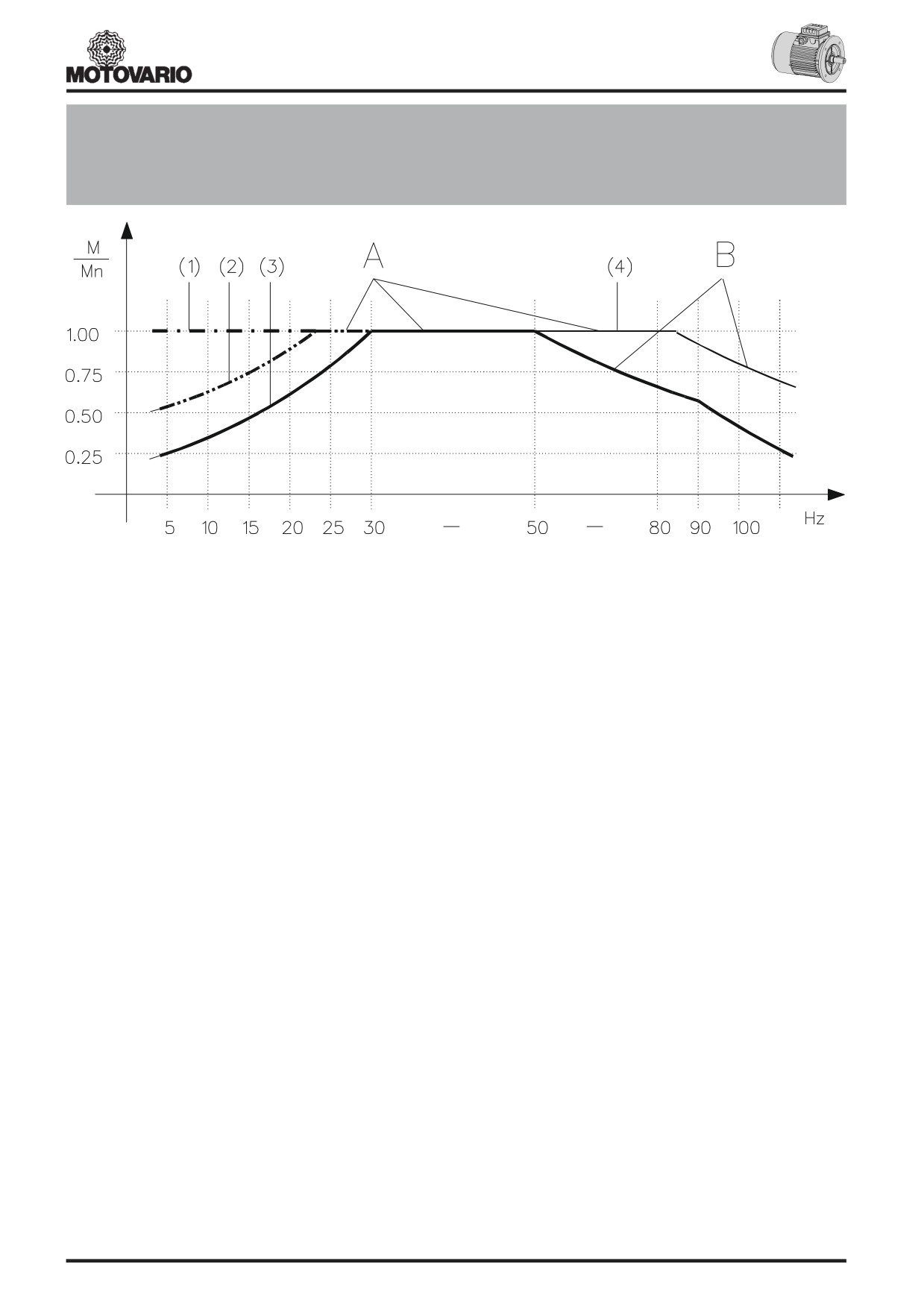
Applicazioni a velocità variabile / Variable speed applications
Anwendungen mit veränderlicher Drehzahl / Applications à vitesse variable /
Aplicaciones con velocidad variable
tratto a M = Mn
line at M = Mn
linie a M = Mn
ligne à M = Mn
tratado a M = Mn
A =
( V/f ) costante
( V/f ) costant
( V/f ) konstant
( V/f ) constant
( V/f ) constante
tratto a P = Pn
line at M = Mn
linie a P = Pn
ligne à P = Pn
tratado a P = Pn
B =
( V ) costante
( V/f ) costant
( V ) konstant
( V ) constant
( V ) constante
(1) estensione tratto a coppia costante per funzionamento con inverter vettoriale e servoventilazione (IC416), servizio S1
(2) estensione curva V/f=costante per funzionamento con inverter PWM e servoventilazione
(IC416), servizio S1
(3) curva caratteristica di funzionamento con inverter PWM, autoventilazione (IC411) e servizio S1
(4) estensione della curva di cui al pt.3 per funzionamento motore 230/400V/50Hz, collegamento D e V/f=400/87
(1) extension of the line with constant torque for operation with vector inverter and forced ventilation (IC416), service S1
(2) extension of the curve V/f= constant for operation with vector PWM inverter and forced ventilation (IC416), service S1
(3) typical curve for operation with vector PWM, self-ventilation (IC411) and service S1
(4) extension of the curve as per point 3 for motor operation 230/400V/50Hz, connection D and V/f=400/87
(1) Vergrößerung der Linie bei konstantem Moment der Applikation, mit Vektor Umrichter und Fremdlüfter (IC416) S1 Betrieb
(2) Vergrößerung der Kurve V/f = konstant für die Anwendung mit Vektor PWM Umrichter und Fremdlüfter (IC416), S1 Betrieb
(3) Typischer Kurvenverlauf für Anwendung mit Vektor PWM , Eigenbelüftung (IC411), S1 Betrieb
(4) Vergrößerung der Kurve, wie unter Punkt 3, für Motor 230/400V/50Hz, Verbindung D und V/f=400/87
(1) extension du tracé avec couple constant pour fonctionnement avec le variateur vectoriel et servoventilation (IC416), service S1
(2) extension de la courbe U/f=constante pour fonctionnement avec un variateur PWM et servoventilation (IC416), service S1
(3) caractéristique courbe de fonctionnement avec le variateur PWM, auto ventilé (IC411) et service S1
(4) extension de la courbe du point.3 pour fonctionnement moteur 230/400V/50Hz, couplage triangle et U/f=400/87
(1) extensión del tramo a par constante para funcionamiento con invérter vectorial y servoventilación (IC416), servicio S1
(2) extensión curva V/f = constante en funcionamiento con invérter PWM y servoventilación (IC416), servicio S1ù
(3) curva característica de funcionamiento con invérter PWM, autoventilación (IC411) y servicio S1
(4) extensión de la curva del pt.3 pera funcionamiento con motor 230/400V/50Hz, conectado en D a V/f = 400/87
333
Raffreddamento
Servoventilazione
La definizione dei limiti di velocità che determinano la necessità della
Nel caso di applicazioni del motore a velocità variabile, può essere
ventilazione forzata dipende dalle condizioni di carico a cui il motore
necessario ricorrere alla ventilazione forzata (metodo di raffredda-
elettrico è sottoposto in funzione della velocità e del tipo di servizio; in
mento IC416), ottenuta mediante una servoventola di tipo assiale la cui
caso di motori a 2 poli la portata d’aria della servoventilazione è inferio-
portata d’aria è indipendente dalla velocità di rotazione dell’albero mo-
re a quella del motore autoventilato, pertanto il corretto utilizzo della
tore. L’alimentazione, separata da quella del motore, viene effettuata
servoventola è subordinato alla durata e all’entità del carico; si racco-
mediante connettore applicato direttamente sul copriventola (versione
manda in ogni caso di interpellare il Ns. ufficio tecnico.
monofase 230V/50-60Hz), oppure tramite scatola morsettiera sepa-
La servoventilazione è stata progettata come kit; pertanto è possibile
rata applicata sul copriventola (versione trifase 230/400V/50Hz). Il
trasformare un motore standard autoventilato (IC411) in motore
grado di protezione della ventola è IP44; su richiesta possono essere
servoventilato (IC416) attraverso semplici operazioni:
analizzate soluzioni differenti con grado di protezione superiore e
-
smontare il copriventola standard, svitando le apposite viti di
tensioni diverse.
fissaggio alla carcassa motore
L’uso della servoventola è consigliato per velocità del motore molto
-
togliere la boccola di fissaggio della ventola in plastica ed
basse rispetto alla velocità nominale, velocità alle quali la portata d’aria
estrarre la ventola stessa mediante l’ausilio di un attrezzo;
della ventola standard sarebbe insufficiente per un corretto raffred-
-
montare il kit servoventilato avvitandolo alla carcassa motore
damento, e per velocità molto alte rispetto alla velocità nominale, velo-
utilizzando le viti di fissaggio del copriventola appena smontato.
cità alle quali le perdite per ventilazione della ventola standard risulte-
A richiesta è possibile fornire motori elettrici servoventilati con
rebbero non più trascurabili rispetto al carico nominale e anche il
alimentazione della servoventola direttamente entro la scatola
rumore emesso dalla ventilazione diventerebbe fastidioso.
morsettiera del motore; in questo caso il gruppo servoventola non
è gestito come kit, ma deve essere ordinato il motore completo.
L’applicazione del kit servoventilato comporta una variazione di
lunghezza del motore (vedasi tabelle dimensionali).
Cooling
Forced ventilation
The definition of the speed limits determining the need for forced
In the case of applications of the variable speed motor, it may be
ventilation depends on the load conditions the electric motor is subject
necessary to resort to forced ventilation (cooling method IC416),
to in relation to the speed and type of service; In case of 2 pole motors,
obtained by means of an axial flow servo-fan whose air flow rate is
the flow rate of the air of forced ventilation is lower than the one of
independent of the speed of rotation of the drive shaft. The supply,
self-ventilated motor, therefore the correct use of servo-fan depends
independent from the electric motor, is given by means of a connector
on the load (duration and quantity); it is recommended in any case to
applied directly on fan cover (single phase version 230V/50-60Hz), or
call our technical service.
by means of a separate terminal box cover applied on fan cover
Forced ventilation has been designed as a kit; therefore it is possible
(three phase version 230/400V/50Hz). Protection degree of the fan is
to modify a standard self-ventilated electric motor (IC411) into a
IP44; on request different solutions with higher protection degree and
motor with forced ventilation (IC416) by following these simple
different voltages are available.
instructions:
Use of the servo-fan is recommended for motor speeds much lower
-
Disassemble the standard fan cover, unscrewing the fastening
than the nominal speed, when the air flow rate of the standard fan
screws from the motor casing
would be insufficient for correct cooling, and for much higher speeds
-
Remove the fastening bush of the plastic fan and remove the
than the nominal speed, when the losses due to ventilation of the
fan with the help of a tool ;
standard fan would no longer be negligible compared to the nominal
Assemble the forced ventilation kit by tightening to the motor casing
load and also the noise of ventilation would be annoying.
with the fastening screws of the fan cover just disassembled .
On request it is possible to supply forced ventilated motors with
forced ventilation supply directly from the terminal box of the motor;
in this case the forced ventilated unit cannot be supplied as a kit,
but it should be ordered together with the complete motor.
The application of the forced ventilation kit determines a length
variation of the motor (see dimensional tables).
Kühlung
Fremdlüftung
Die Bestimmung der Drehzahlgrenzen, die die Fremlüftung notwendig
Bei Motoranwendungen mit veränderlicher Drehzahl kann eine
macht, ist vom Belastungszustand abhängig mit dem der Elektromotor
Fremdlüftung notwendig werden (Kühlungsmethode IC416), die mittels
bzgl. Drehzahl und der Betriebsart eingesetzt ist; im Falle der Version
eines axial angebauten Servolüfters erreicht wird, wobei die
Zweiphasen Motor, ist die Strömungsrate bei Fremdlüfter geringer als
Luftfördermenge von der Drehzahl der Motorwelle unabhängig ist.
die bei der Eigenbelüftungsvariante. Bitte kontaktieren Sie das
Diese Einspeisung erfolgt über einen speziellen Anschluss auf der
technische Büro.
Lüfterhaube. Spannung Einphasenversion 230V 50Hz/60Hz.
Die Fremdlüftung beinhaltet einen Zusammenbaukitt, hierbei ist es
Ebenfalls ist es möglich diesen Anschluss über einen Klemmkasten ,
möglich einen Standardmotor mit Eigenbelüftung (IC411) umzubauen
bei der Version Dreiphasenvariante 230/400V 50Hz/60Hz zu
in einen Motor mit Fremdlüfter ( IC416). Hierbei finden Sie
realisieren. Schutzart IP44; Auf Anfrage können höhere Schutzarten
nachfolgend eine kurze Anleitung:
und verschiedene Spannungen geliefert werden.
-
demontieren Sie den Standardlüfter und lösen Sie die
Der Einsatz des Fremdlüfters wird empfohlen, wenn die Motordrehzahl
Motorschrauben B Seite;
im Vergleich zur Nenndrehzahl sehr gering ist, d.h.bei Drehzahlen, bei
-
demontieren Sie den Ring zu Fixierung des Lüfterrades;
denen die Luftfördermenge des Standard-Lüfters für eine
-
verbinden Sie den Fremdlüfterkitt mit den gerade gelösten
ordnungsgemäße Kühlung unzureichend wäre, sowie bei Drehzahlen,
Stehbolzen und schrauben Sie diese fest.
bei denen die Verluste durch die Lüftung mit dem Standard-Lüfter im
Auf Anfrage können die Motoren mit einem Fremdlüfter ausgestattet
Vergleich zur Nennlast nicht mehr vernachlässigt werden können und
werden. Die Einspeisung erfolgt direkt über die Motorspannung / Klemmbrett.
auch das durch die Lüftung erzeugte Geräusch zu hoch ist.
In diesem Fall können wir keinen Nachrüste - Kit anbieten.
Das Adaptieren der Fremdbelüftung beinhaltet eine Veränderung der
Abmessungen (Beachten Sie hierbei die Tabelle).
334
Refroidissement
Ventilation assistée
La définition des limites de vitesse qui déterminent la nécessité de la
ventilation forcée dépend des conditions de charge auxquelles le
En cas d’applications du moteur à vitesse variable, il peut être
nécessaire d’adopter la ventilation forcée (méthode de refroidissement
moteur électrique est soumis en fonction de la vitesse et du type de
service; dans le cas de moteurs 2 pôles le flux d’air de la
IC416), obtenue à l’aide d’un ventilateur assisté de type axial, dont le
débit d’air est indépendant de la vitesse de rotation de l’arbre moteur.
servoventilation est inférieur à celle du moteur auto ventilé, donc
l’utilisation correcte de la servoventilation est subordonnée à la durée
L’alimentation, séparée de celle du moteur, est effectuée par un
connecteur directement monté sur le capot de ventilation (version
et à l’entité de la charge; il est recommandé dans chaque cas d’appeler
notre bureau technique.
monophasé 230V/50-60Hz), ou par boîte à bornes séparée appliquée
sur le capot de ventilation (version triphasé 230/400V/50Hz). Le degré
La servoventilation a été étudiée en kit; il est possible de transformer
un moteur autoventilé standard suivant (IC411) en moteur servoventilé
de protection du ventilateur est IP44; sur demande on peut évaluer
diffèrentes solutions avec un degré de protection plus élevé et tensions
(IC416) suivant ces opérations simples:
- démonter le capot de ventilation standard en dévissant les vis
différentes.
L’emploi du ventilateur assisté est conseillé pour les vitesses du moteur
spéciales de fixation sur la carcasse moteur,
- enlever la boucle de fixation du ventilateur en plastique et extraire le
très basses par rapport à la vitesse nominale, vitesses dans lesquelles
le débit d’air du ventilateur standard serait insuffisant pour un
ventilateur avec le secours d’un outil;
- monter le kit servoventilation en le fixant à la carcasse moteur en
refroidissement correct, et pour les vitesses très élevées par rapport
à la vitesse nominale, vitesses dans lesquelles les pertes du ventilateur
utilisant les vis de fixation du capot de ventilation.
Sur demande il est possible de fournir un moteur électrique
standard ne seraient plus négligeables par rapport à la charge nomi-
nale et dans lesquelles même le bruit émit lors de la ventilation deviendrait
servoventilé avec une ventilation forcée alimentée directement à
partir du bornier du moteur ; dans ce cas, la ventilation forcée ne
fastidieux.
peut être gérée comme un kit mais elle doit être commandée avec le
moteur complet.
Le montage du kit servoventilation comporte une variation de
longueur du moteur (voir tableaux dimensionnels).
Enfriamiento
Servoventilación
La definición de los límites de velocidad que determinan la necesidad
de ventilación forzada depende de las condiciones de carga a las que
En caso de aplicaciones del motor con velocidad variable, puede
resultar necesario recurrir a la ventilación forzada (método de
el motor eléctrico se halla sometido en función de la velocidad y del
tipo de servicio; en caso de motores de 2 polos el caudal de aire de la
enfriamiento IC416), obtenida mediante un servoventilador de tipo axial
cuya cantidad de aire será independiente de la velocidad de rotación
servoventilación es inferior al del motor autoventilado, por lo que el
correcto uso de la servoventilación depende de la duración y entidad
del eje motor. La alimentación, separada de la del motor, es efectuada
mediante conector aplicado directamente sobre la tapa del ventilador
de la carga; se recomienda en cada caso consultar a nuestra oficina
técnica.
(versión monofásica 230V/50-60Hz), o a través de caja de bornes
separada aplicada sobre la tapa del ventilador (versión trifásica 230/
La servoventilación ha sido proyectada como kit; por tanto es posible
trasformar un motor estándar autoventilado (IC411) en motor
400V/50Hz). El grado de protección del ventilador es IP44; bajo pedido
pueden estudiarse protecciones superiores y tensiones diferentes.
servoventilado (IC416) mediante un sencillo montaje:
- desmontar la tapa del ventilador estándar, destornillando los tornillos
La utilización del servoventilador se aconseja para velocidades del
motor muy bajas con respecto a la velocidad nominal, velocidades en
de fijación a la carcasa del motor
- sacar la brida de fijación de ventilador de plástico y extraerlo
las que la cantidad de aire del ventilador estándar sería insuficiente
para un correcto enfriamiento, y para velocidades muy altas con
ayudándose con algunas herramientas;
- montar el kit de servoventilación atornillándolo a la carcasa del
respecto a la velocidad nominal, velocidades en las que las pérdidas
por ventilación del ventilador estándar ya no serían despreciables
motor utilizando los tornillos de la tapa del ventilador desmontada
anteriormente.
con respecto a la carga nominal e incluso el ruido emitido por la
ventilación sería muy molesto.
Bajo pedido se pueden suministrar motores con ventilación
independiente con la conexión del servoventilador dentro de la caja
de bornes del motor; en ese caso la ventilación no se suministra
como kit y debe ser pedida con el motor completo.
El uso del kit de servoventilación comporta una variación de longitud
del motor (véase la tabla de dimensiones).
335
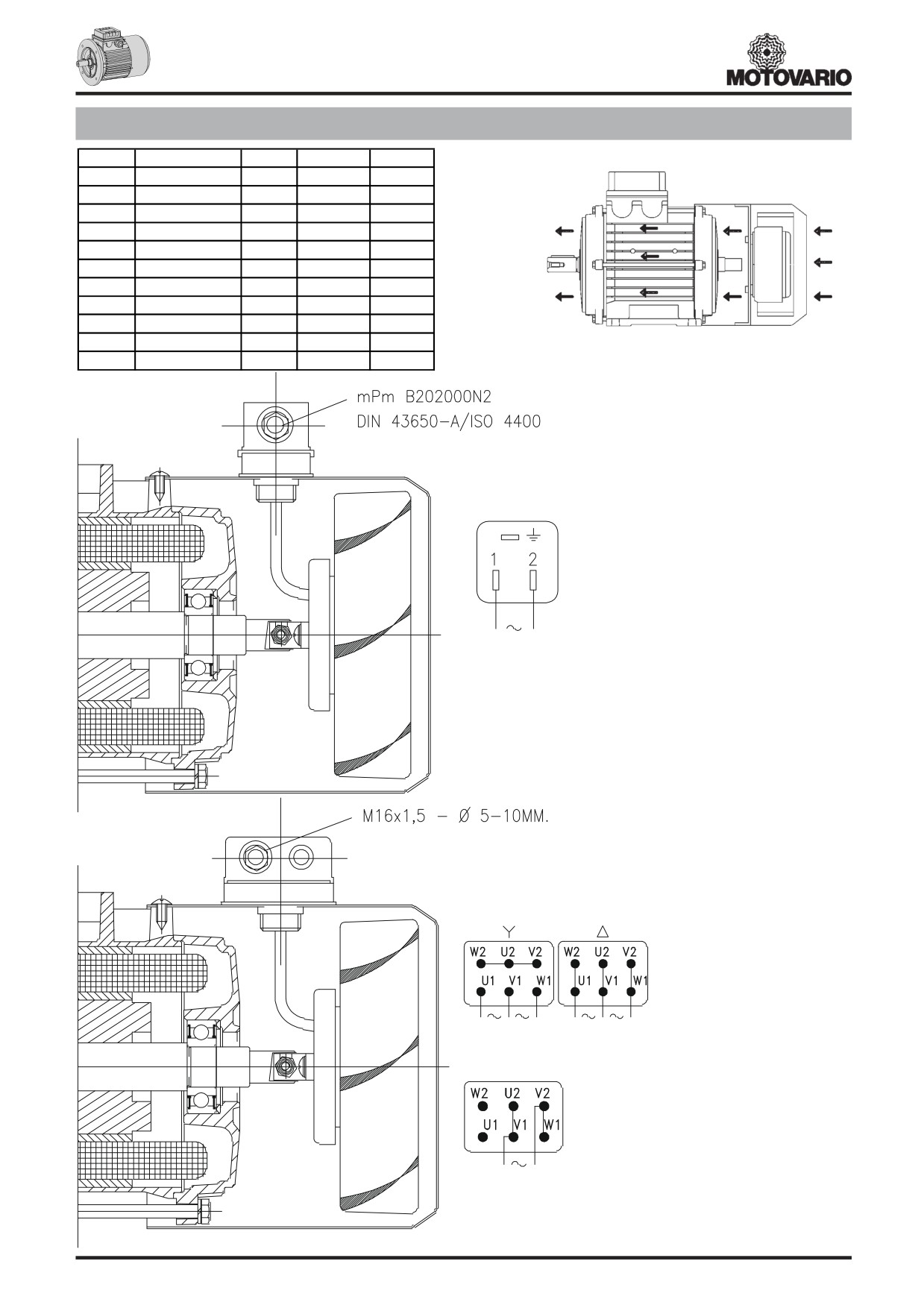
Raffreddamento / Cooling / Kühlung / Refroidissement / Enfriamiento
motore
[V] / [Hz]
[W]
[A]
[m3/h]
63
230V/50-60Hz
15-17
0.12-0.14
160-170
71
230V/50-60Hz
15-17
0.12-0.14
160-170
80
230V/50-60Hz
36-39
0.22-0.25
300-325
90
230V/50-60Hz
36-39
0.22-0.25
300-325
100
230V/50-60Hz
58-68
0.26-0.30
615-745
112
230V/50-60Hz
68-82
0.30-0.36
895-970
132
230V/50-60Hz
68-82
0.30-0.36
895-970
100
230/400V/50Hz
34
0.17/0.10
520
112
230/400V/50Hz
58
0.19/0.11
875
IC 416
132
230/400V/50Hz
58
0.19/0.11
875
~ 1 (63 / 90)
~3 (100/132)
~ 1 (100/132)
336
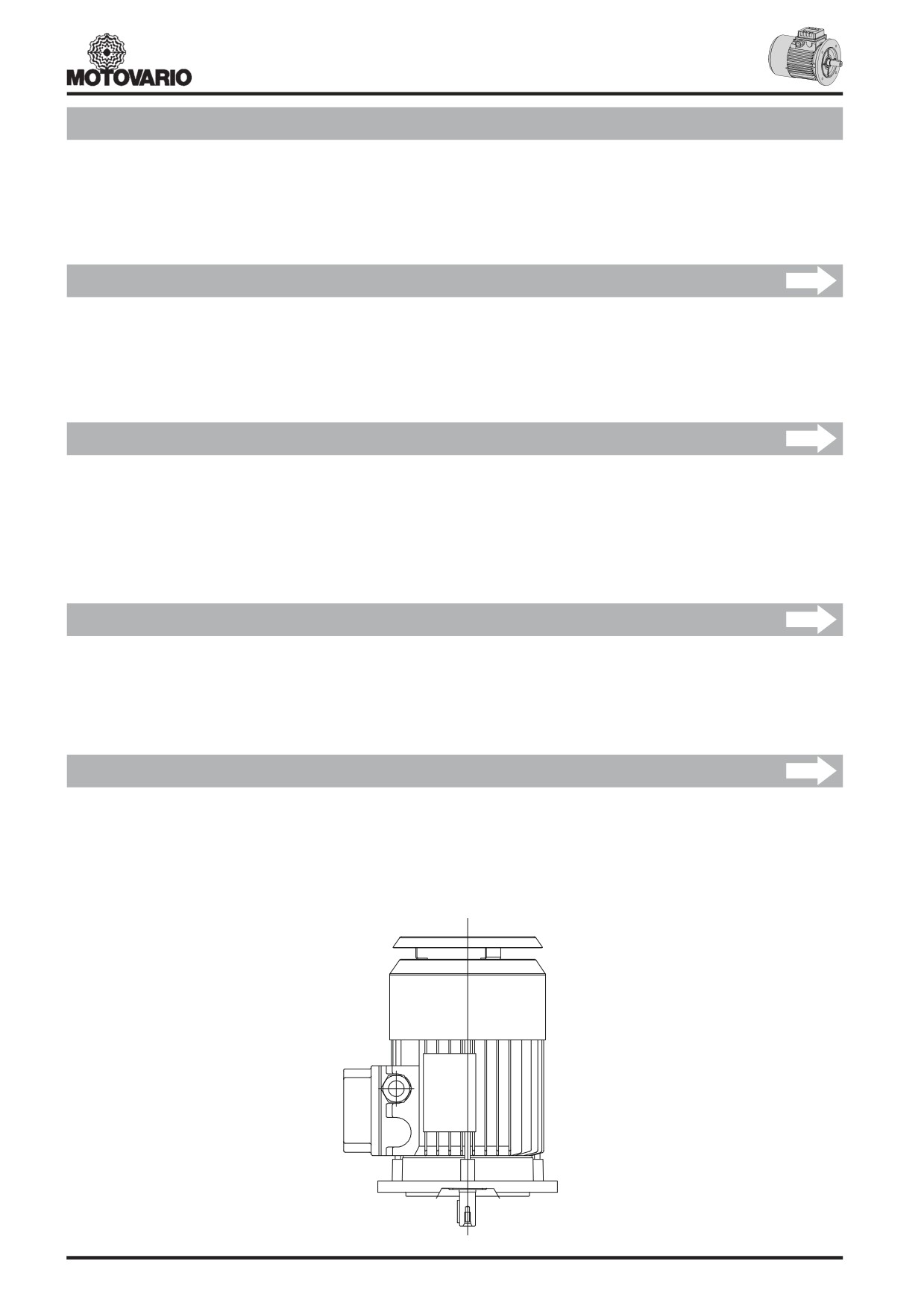
Accessori
Esecuzione con tettuccio
funzionamento del motore, per infiltrazione di acqua, per otturazione
Nel caso di posizionamento del motore in verticale in applicazioni al-
parziale della griglia di adduzione dell’aria, per impedimento alla ventola
l’aperto, con estremità d’albero lato comando rivolta verso il basso, si
e quindi all’albero di ruotare correttamente.
raccomanda l’uso di un copriventola con tettuccio che ha la funzione
La presenza del tettuccio non altera le sovratemperature degli
di parapioggia.
avvolgimenti.
Tale esecuzione si raccomanda in generale in tutti i casi in cui l’ingres-
La presenza del tettuccio determina una variazione di altezza del
so di acqua o di corpi solidi sono tali da compromettere il corretto
motore.
Accessories
Rain cover
the motor, due to infiltration of water, partial blockage of the air grill, or
In the case of positioning the motor vertically in outdoor applications,
an obstruction preventing the fan and the shaft from turning correctly.
with the end of the shaft on the driving side facing downwards, it is
The cover does not alter the effects of the fan to cool the motor.
recommended to use a fan guard with a cover to shelter it from the
The application of the cover determines a height variation of the
rain.
motor.
This version is generally recommended in all cases where entry of
water or solid bodies is such as to jeopardise the correct operation of
Zubehör
Ausführung mit Abdeckhaube
teilweiser Verstopfung des Luftzuführungsgitters bzw.
Wenn der Motor bei Anwendungen im Freien vertikal und mit
Lüfterbehinderungen und folglicher Verhinderung einer
antriebsseitig nach unten gerichtetem Wellenende positioniert wird,
ordnungsgerechten Betriebsweise beeinträchtigt wird.
wird zum Schutze vor Regen der Gebrauch einer Schutzabdeckung
Der Aufbau der Abdeckhaube verändert die Übertemperaturen der
angeraten.
Wicklungen nicht.
Diese Ausführung wird allgemein für alle Fälle empfohlen, bei denen
Das Schutzdach gegen Eintritt von Regen verbindet eine Änderung
das Eintreten von Wasser oder Festkörpern derart ist, daß der
der baulichen Abmessungen.
ordnungsgerechte Motorbetrieb wegen Wassereinsickerungen,
Accessoires
Exécution avec auvent
fonctionnement correct du moteur par infiltration d’eau, obturation
En cas de positionnement vertical du moteur en applications en plein
partielle de la grille d’aération, empêchement au ventilateur et, par
air, on recommande, le bout de l’arbre côté commande orienté vers le
conséquent, à l’arbre de tourner correctement.
bas, l’emploi d’un capot de ventilateur avec auvent ayant la fonction
La présence de l’auvent n’altère pas l’élévation de températures des
de parapluie. Cette exécution est en général recommandée dans tous
enroulements.
les cas où l’entrée d’eau ou de corps solides pourrait compromettre le
La présence du petit toit détermine une variation de hauteur du
moteur.
Accesorios
Ejecución con tejadillo
agua, por obstrucción parcial de la rejilla de suministro del aire, por
En caso de colocación vertical del motor (posición V1 ó similares)en
impedimento de la marcha del ventilador y en consecuencia, por impe-
aplicaciones al aire libre, con extremidad de eje lado accionamiento
dimento de rotación del eje.
colocada hacia abajo, se aconseja la utilización de una tapa-ventilador
La presencia de la tejadillo no altera las sobretemperaturas de los
con tejadillo para que quede protegido de la lluvia.
bobinados.
Dicha ejecución se aconseja en general en todos los casos en que la
La presencia del tejadillo implica una variación de altura del motor.
entrada de agua o de cuerpos sólidos sea de una entidad que pueda
comprometer el correcto funcionamiento del motor: por infiltración de
337
Accessori
Dispositivo antiritorno
Per un corretto assemblaggio del dispositivo antiritorno, in fase di
Nelle applicazioni in cui deve essere impedita la rotazione inversa del
ordinazione è necessario specificare il senso di rotazione del motore;
motore, determinata dall’azione trascinante del carico, è possibile pre-
un’etichetta adesiva posta sul copriventola mette in evidenza il senso
vedere un dispositivo antiritorno applicato direttamente sul motore dal
di rotazione consentito.
lato della ventola.
Il dispositivo antiritorno, dimensionato in modo tale da poter sopportare
Data l’elevata velocità di rotazione, se ne sconsiglia l’utilizzo per motori
la massima coppia trasmessa dal motore e per lavorare alla velocità di
a 2 poli.
rotazione nominale del motore senza eccessiva usura, è lubrificato a
vita mediante l’uso di grasso specifico.
Accessories
Backstop device
For correct assembly of the backstop device, when ordering, it is
In applications where reverse motor rotation must be prevented,
necessary to state the direction of rotation of the motor. An adhesive
label on the fan cover shows the admitted direction of rotation.
caused by the dragging action of the load, it is possible to have a
backstop device applied directly on the motor on the fan side.
The backstop device, sized so as to be able to withstand the maximum
torque transmitted by the motor and to work at the nominal speed of
In consideration of the high speed of rotation, it is not recommended
to use 2 pole motors.
rotation of the motor without excessive wear, is lubricated for life with
specific grease.
Zubehör
Rücklaufsperre
Für einen korrekten Zusammenbau der Rücklaufsperre muß bei der
Bei Anwendungen, bei denen der Rücklauf ausgeschlossen werden
Bestellung die Motordrehrichtung angegeben werden; ein Aufkleber
auf der Lüfterhaube weist auf die zulässige Drehrichtung hin. Die
muß, kann eine Rücklaufsperre eingebaut werden, die Lüfterseitig
direkt am Motor angebracht wird.
Rücklaufsperre ist so bemessen, daß sie das vom Motor übertragene
maximale Drehmoment aufnehmen und übertragen kann und auch
Bei zweipolige Motoren und der damit verbundenen höheren
Geschwindigkeit ist es nicht zulässig diese Motoren mit o. g. Option
ohne übermäßige Abnutzung bei Nenndrehzahl des Motors arbeiten
kann.
auszustatten.
Sie ist mit einem besonderen Schmierfett lebensdauergeschmiert.
Accessoires
Système antidevireur
Pour un assemblage correct du sistème antidevireur, il faut, lors de la
Dans les applications où la rotation inverse du moteur, déterminée par
commande, spécifier le sens de rotation du moteur; une étiquette
l’action entraînante de la charge, doit être empêchée, on peut prévoir
adhésive placée sur le capot de ventilation met en évidence le sens de
un système antidevireur appliqué directement sur le moteur du côté du
rotation admis. Le système antidevireur, dimensionné de telle sorte
ventilateur.
qu’il puisse supporter le couple maxi. transmis par le moteur et travailler
Dans le cas de vitesse élevée, on déconseille l’utilisation de moteurs
à la vitesse de rotation nominale du moteur sans usure excessive, est
2 pôles.
lubrifié à vie avec graisse spécifique.
338
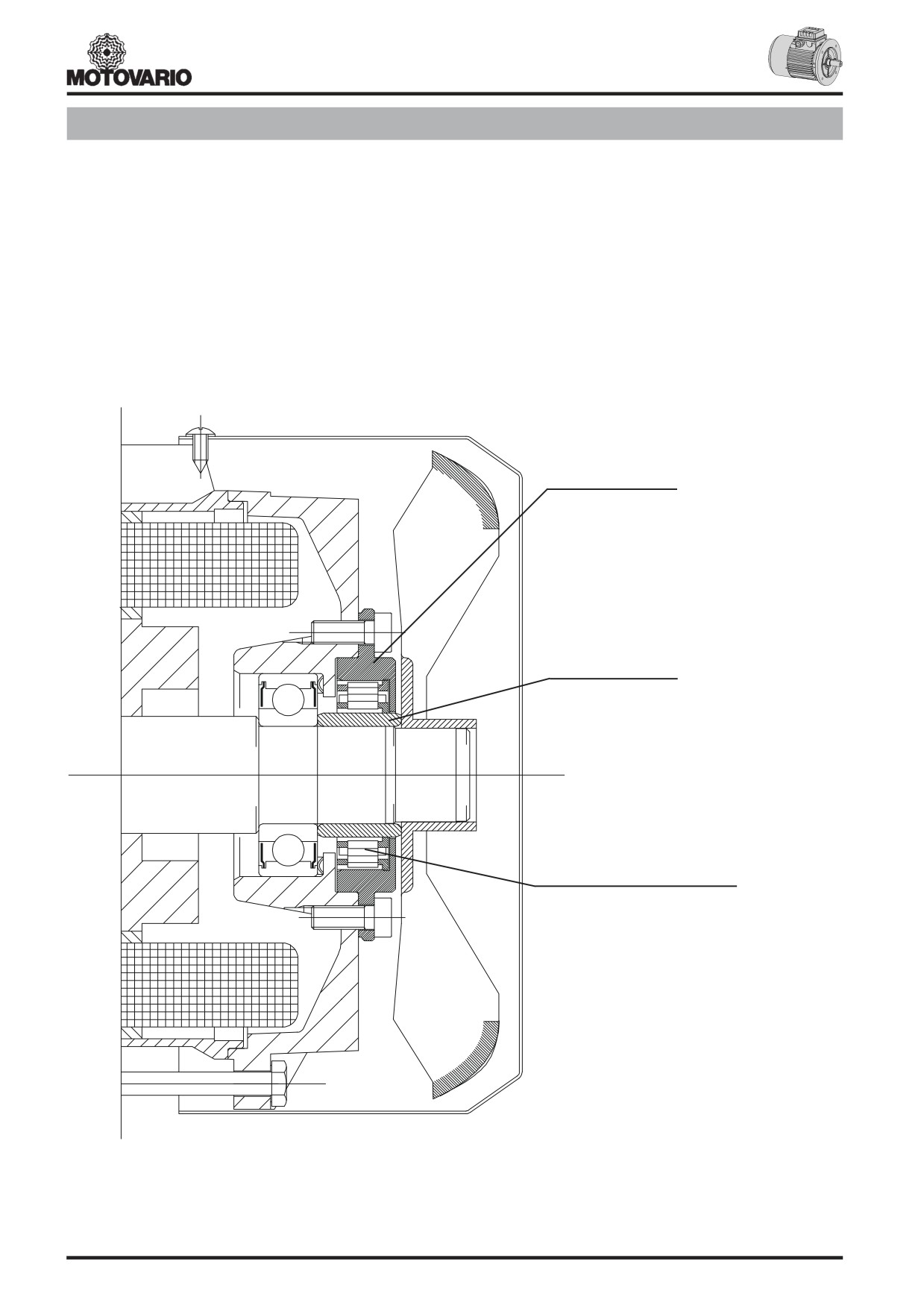
Accesorios
Dispositivo anti-retorno
Para ensamblar correctamente el dispositivo anti-retorno, será
En las aplicaciones en las que se tienen que impedir la rotación inver-
necesario especificar la dirección de rotación del motor en el momen-
to de realizar el pedido; una etiqueta adhesiva colocada sobre la tapa-
sa del motor, determinada por la acción de arrastre de la carga, se
podrá preparar un dispositivo anti-retorno aplicado directamente sobre
ventilador indica la dirección de rotación permitida.
El dispositivo anti-retorno, preparado para poder soportar el par máximo
el motor desde el lado del ventilador.
Dada la elevada velocidad de rotación, se recomienda no usar con
transmitido por el motor y para trabajar a la velocidad de rotación
nominal del motor sin excesivo desgaste, se lubrifica de por vida con
motores a 2 polos.
grasa específica.
Pista esterna
External race
Planetenlaufring
Piste extérieure
Pista externa
Pista interna
Internal race
Planetenträgerring
Piste intérieure
Pista interna
Dispositivo Antiritorno
Backstop Device
Rücklaufsperre
Système antidevireur
Dispositivo anti-retorno
339