National Security Commission on Artificial Intelligence. Final Report - page 8
BLUEPRINT FOR ACTION: CHAPTER 10
Chapter 10:
The Talent Competition
Blueprint for Action
The United States must dramatically invest in its artificial intelligence (AI) talent pipelines in
order to remain at the forefront of AI now and into the future. It is imperative that the United
States strategically invest in science, technology, engineering, and mathematics (STEM)
education at all levels and improve the immigration system to allow for more AI talent to
enter and remain in the United States. Therefore, this Blueprint for Action is organized into
two broad categories of recommendations for strengthening the U.S. talent pipeline: the
U.S. education system and immigration.
Talent Pipeline: U.S. Education System
Investments in STEM education are a necessary part of increasing American national
power and improving national security. This requires the United States to reform its
education system to produce both a higher quality and quantity of graduates.
Recommendation
Recommendation: Pass a New National Defense Education Act
In response to the Soviet launch of Sputnik in 1957, the United States passed the National
Defense Education Act (NDEA) in 1958 to extend U.S. leadership in education and
innovation.1 The NDEA promoted the importance of science, mathematics, and foreign
languages for students, authorizing more than $1 billion toward decreasing student loans,
funding for education at all levels, and funding for graduate fellowships. Many students
were able to attend college because of this bill; 3.6 million students attended college in
1960, and by 1970, it was 7.5 million.2 This act helped America win the Space Race and
accelerated our ability to innovate, and it is widely regarded as one of the most successful
pieces of education legislation in U.S. history.
Now is the time for a new NDEA. The NDEA greatly increased the number of Americans
with a college degree, expanded the number of math and science teachers to meet the
demand of the K-12 system after the postwar baby boom, and was focused on defense-
centric fields, particularly a deficiency in mathematicians. The impacts of federal spending
on higher education today are echoes of the investments made in the late 1950s by the
Eisenhower administration. The United States needs a second NDEA (NDEA II) in order to
address the current digital talent gap and prevent the United States from falling behind in
the race for AI and STEM talent.
p
421
THE TALENT COMPETITION
Actions for Congress:
•
Increase Funding for STEM- and AI-Focused Afer-School Programs
o STEM and AI-focused afer-school learning programs expose students to STEM-
and AI-related programs beyond normal school hours. The length of the school
day limits teachers’ ability to cover a myriad of topics. American elementary school
students are exposed to an average of 20 minutes of science and 60 minutes of
math during the school day.3 Given the short amount of time that teachers are
able to spend on STEM in their classrooms, some school districts have begun
to offer afer-school programs that expose students to STEM in a less structured
environment. More time spent studying STEM topics helps students’ test scores,
and for those who are underrepresented in STEM fields, federal funding for afer-
school programs will increase students’ accessibility to quality educational tools.4
Appropriations for afer-school programs should favor applications that are jointly
submitted by a local educational agency and a community-based organization or
other public or private entity as a way to defray costs and encourage community
engagement.
•
Increase Funding for STEM- and AI-Focused Summer Learning Programs
o STEM- and AI-focused summer learning programs will encourage students to
engage in STEM and AI activities during the months when students are typically
unengaged and experience learning loss. The 21st Century Community Learning
Centers Act is an example of a program that funds “academic enrichment
opportunities during non-school hours for children, particularly students who
attend high-poverty and low-performing schools” and has exhibited proven,
positive results.5 Much like the afer-school initiative, priority should be given to
those applications that are jointly submitted by a local educational agency and a
community-based organization or other public or private entity.
•
Allocate Funds for K-12 STEM Teacher Recruitment, Retention, and Training
o Teachers are an integral part of the learning experience for STEM subjects. One
inequity is the lack of teachers with the requisite proficiency in STEM. Evidence
shows that STEM teacher training for current teachers is sporadic, ineffective, and
not effective in addressing the specific needs of individual students.6 Moreover,
recruiting high-quality K-12 teachers with STEM experience and proficiency is
difficult. This is particularly concerning, as teachers are one of the most influential
aspects of school, having two to three times the impact of other components, such
as leadership and school services.7 As the world continues to integrate technology
into education, teachers must be taught how to use this technology as well as
how to teach students the critical foundations and basic functions that come
with it.8 Support should be given to school districts to create and execute teacher
training in AI concepts, techniques, and curriculum design, with preference given
to professional development courses that count against continuing education
requirements for teacher certification.
•
Direct and Fund the National Science Foundation to Create STEM Scholarships and
Fellowships
o We recommend that the NSF create 25,000 STEM undergraduate scholarships,
5,000 STEM PhD fellowships, and 500 postdoctoral positions over five years to
increase the number and quality of STEM and AI practitioners that will reach the job
market in a few years.9 Growing the nationwide STEM talent pool in high-demand
p
422
BLUEPRINT FOR ACTION: CHAPTER 10
areas requires a pipeline of students who have studied relevant STEM coursework
during their undergraduate careers. Between 2000 and 2017, the share of STEM
bachelor’s degrees earned—as a percentage of total bachelor’s degrees earned
in the U.S.—rose from 32% to 35%.10 The sharpest recent increases were among
computer science and engineering majors.11 For AI specifically, a degree in cognitive
science or computer science with concentrations in AI or machine learning (ML)
can pave the way for future careers in AI research or practice. AI is rarely offered
as a major at the undergraduate level. Instead, universities offer standalone
courses, a sequence of AI courses, or the option to study a technical major with a
concentration in AI. Until a major in AI is more universally offered at U.S. universities,
STEM scholarships will increase the number of individuals with the skills necessary
to work on AI.
o Scholarship and fellowship recipients should receive full tuition and room and
board. Undergraduate recipients should receive a stipend of $40,000 a year, and
graduate recipients should receive a stipend of $70,000 a year.12 Combined with
postdoctoral positions, this will bring the total cost to $7.2 billion over five years.13
Actions for the Department of Education:
• Add Elements of Computational Thinking and Statistics to Student Testing
o Computational thinking and statistics are vital for students to understand how AI
works.14 As interdisciplinary fields, the use of computational thinking and statistics
within AI can be found at all stages of discovery, from developing and planning
studies to assessing the results. Critical thinking along with problem-solving are
vital skills taught in statistics. Unfortunately, the majority of high schools in America
do not require testing for skills related to computational thinking for graduation.15
There is no way to comprehensively measure U.S. students’ overall abilities or
aptitude for skills related to computational thinking and statistics. Students are
taught what is needed to pass exams. Compared to other countries, many of which
have statistics in their curriculum, the United States ranks low in math.16 By including
subjects critical for computational thinking and statistics in standardized testing
at the state level, the United States can gain a better understanding of students’
capabilities and work to implement curriculum and lessons focused more on
computational thinking and statistics in order to ensure students’ success.
Recommendation
Recommendation: Require Statistics in Middle School and Computer Science Principles
in High School
Actions for State Legislatures:
• Require statistics as a required course in middle school and computer science
principles in high school. Many fundamental concepts in AI, ML, and their
subfields are applied statistics in disguise.17 The techniques and algorithms
used are heavily based in statistical methods, such as cluster analysis and model
selection. Statistics and computer science principles are needed to prepare
students for AI courses, concentrations, and internships. Providing training in
statistics starting in middle school will better prepare students for the increasingly
advanced analytic techniques in demand for AI and STEM careers. Similarly,
currently only 47% of U.S. high schools offer computer science coursework.18 This
is much higher than just a decade ago, thanks to nationally organized initiatives,
but this still leaves many high schools without computer science education.
p
423
THE TALENT COMPETITION
Moreover, adoption has been piecemeal and curriculum depth varies widely.
Therefore, state action is needed.
• On their own, neither statistics nor computer science are sufficient to teach
students the concepts needed to understand AI. Having both allows students to
experience the critical bases that must be covered early on in order to prepare
students for a technological career. Simple math such as basic probability and
summarizing numerical data is applying concepts of statistics and computer
science.
Talent Pipeline: Immigration
Immigration reform is imperative for strengthening the U.S. talent pipeline, particularly given
the significant benefits the United States experiences due to highly skilled immigration.
Therefore, the United States must pursue reforms to accelerate highly skilled immigration
and retention of international students within the United States.
The following recommendations are intended to help the United States lead the world’s
development and implementation of AI by gaining a decisive majority of a critical and
limited resource: AI talent. The recommendations will improve the United States’ ability to
attract talent to the United States and, just as important, away from competing countries.
The United States needs to take bold steps to ensure it wins the competition for international
talent for years to come. Such steps should ensure that our immigration system attracts
students, technical experts, and entrepreneurs; grants stability while they continue to
contribute to the American economy and research environment; and retains students,
entrepreneurs, and experts rather than sending them home or to competing countries. The
best way to accomplish these goals and to send a clear message to AI and STEM talent
around the world is to pass a National Security Immigration Act that specifically helps
STEM talent remain in the United States, reduces the overall burden of the citizenship
process, and creates specific paths for entrepreneurs.
Recommendation: Pass a National Security Immigration Act
Recommendation
1) Grant Green Cards to All Students Graduating with STEM PhDs from Accredited
American Universities
This would issue an incredibly clear message to talented young people around the world
that they are welcome in the United States and would ease their transition to American
citizenship. It is a very aggressive maneuver to gain a larger share of the world’s STEM
talent.
Such a proposal is admittedly bold, but the benefits of attracting vetted, top-tier talent
outweigh the risks. Bold measures are needed to preserve America’s advantages in STEM
fields today and to ensure we out-innovate and outperform competitors in the future.19 Few
p
424
BLUEPRINT FOR ACTION: CHAPTER 10
other proposals are significant enough to make a dramatic difference in the competition
for talent, or to force China into a dilemma on their domestic front. It is also noteworthy that
similar proposals have received bipartisan support in the past.20
Actions for Congress:
• Amend 8 U.S.C. 1151(b)(1) to grant lawful permanent residence to any foreign
national who:
o Graduates from an accredited United States institution of higher education
with a doctoral degree in a field related to science, technology, engineering, or
mathematics in a residential or mixed residential and distance program;
o Has a job offer in a field related to science, technology, engineering, or
mathematics; and
o Does not pose a national security risk to the United States.
• Vetting for national security concerns should be enabled by the FBI and
Intelligence Community
• Graduates granted lawful permanent residence through this program should not
count against overall or country-of-origin green card caps
2) Double the Number of Employment-Based Green Cards
Whether one aims for the United States to achieve AI dominance, grow gross domestic
product (GDP), stimulate job growth, reduce government deficits, or bolster the solvency
of the U.S. Social Security program, the most straightforward solution is the same: increase
the number of highly skilled permanent residents. Under the current system, employment-
based green cards are scarce: 140,000 per year, fewer than half of which go to the principal
worker.21 This leaves many highly skilled workers unable to gain permanent residency and
unable to transfer jobs or negotiate with employers as effectively as domestic workers. If
underpaid, these workers cannot leave their jobs or bargain for better wages without risking
revocation of the employer’s green card sponsorship or even firing and forced departure
from the United States. This decreases the appeal of joining the American workforce.
The H-1B system is problematic for most employers, as well, with a consistently
oversubscribed “lottery” of 85,000 visas each year (of which 20,000 are reserved for
advanced degree holders from U.S. universities).22 To reduce the backlog of highly skilled
workers, the United States should double the number of employment-based green cards,
with an emphasis on permanent residency for STEM and AI-related fields. If it were easier
for U.S. employers to sponsor global talent for a green card as opposed to an H-1B visa,
the H-1B program could then serve its originally intended function as a vehicle for truly
temporary high-skilled work needs.
p
425
THE TALENT COMPETITION
Action for Congress:
• Amend 8 U.S.C. 1151(d)(1)(A) by changing “140,000, plus” to “280,000, plus”
3) Create an Entrepreneur Visa
International doctoral students are more likely to want to found a company or become an
employee at a startup than their native peers; but, in practice, they are less likely to pursue
those paths. One reason is the constraints of the H-1B visa system.23 Similarly, immigrant
entrepreneurs without the capital to use the EB-5 route to permanent residency are forced
to use other visas that are designed for academics and workers in existing companies, not
entrepreneurs.24 All of these issues make the United States less attractive for international
talent and, just as important, reduce the ability of startups and other small companies, the
main source of new jobs for Americans, to hire highly skilled immigrants that have been
shown to improve the odds that the business will succeed.
Actions for Congress:
• Create an entrepreneur visa. This visa should serve as an alternative to employee-
sponsored, investor, or student visas and should instead target promising potential
founders. Legislation should:
o Define an entrepreneur as an alien whose organization and operation of a business
would provide significant public benefit to the United States if allowed to stay in the
country for a limited trial period to grow a company.
o Prioritize entrepreneurs active in high-priority fields such as AI or in fields that use AI
for other applications, such as agriculture. The National Science Foundation should
update the list of high-priority fields every three years.
o Use capital capture as a screening criterion for entrepreneurs.
o Emphasize job creation for Americans—potentially emphasizing underserved
regions or areas with high unemployment—as a core factor in the assessment of
significant public benefit.
4) Create an Emerging and Disruptive Technology Visa
A new nonimmigrant visa designed to attract top technology talent in critical fields would
allow universities and businesses that work on AI and other emerging technologies access
to a greater pool of talent necessary to create cutting-edge research. It would also respond
more flexibly to labor market demands as new technologies emerge. The effect would be to
“revitalize our country’s research ecosystem, empower our country’s innovation economy,
and ensure that the United States remains a world superpower in the coming decades.”25
p
426
BLUEPRINT FOR ACTION: CHAPTER 10
Action for Congress:
• Create an emerging and disruptive technology visa that:
o Requires the National Science Foundation to identify critical emerging and
disruptive technologies every three years;
o Allows students, researchers, entrepreneurs, and technologists in applicable fields
to apply; and
o Does not include emerging and disruptive technology visa holders in any other visa
category cap.
Recommendation
Recommendation: Broaden the Scope of “Extraordinary” Talent to Make the O-1 Visa More
Accessible and Emphasize AI Talent
The O-1 temporary worker visa is for people with extraordinary ability or achievement.26
O-1 visas are valid for three years and can be renewed annually an unlimited number of
times. There is also no limit on the number of visas issued per year. Currently, about 15,000
to 18,000 new O-1 visas are issued annually.27 For these reasons, the O-1 visa is generally
a more flexible visa category than the H-1B visa, which is, with some exceptions, capped
in duration and number.28
While O-1 visas provide many advantages, they are a poor fit for many highly skilled workers
due to the uncertainty of their criteria and the administrative burden of the application and
adjudication process. Adjudicators determine an applicant’s eligibility through subjective
assessments of whether applicants received nationally recognized prizes, have been
published in major outlets, have done original work of major significance, and meet other
similar criteria. For the sciences and technology, this aligns largely with academic criteria
such as publications in major outlets and is not well suited for people who excel in industry.
Actions for the U.S. Citizenship and Immigration Service (USCIS):
• Issue new guidance with clear and broad standards for regulatory criteria, such as
what counts as a major outlet, nationally recognized prize, or original work.
o For example, if a publication in a top-five academic journal within a scientist’s field
counts as a major outlet, many PhD graduates would likely qualify.
• Initiate a regulatory process to decrease the threshold for eligibility for an O-1 visa,
for example by reducing the number of criteria an applicant has to fulfill.
o The current standard is three out of eight criteria.29
• Broaden criteria to better accept non-academic AI and STEM accomplishments.
o For instance, some top-tier engineers have not earned an undergraduate degree or
published major papers, instead focusing on developing and monetizing cutting-
edge technology in the private sector. New criteria should make O-1 visas more
accessible to this demographic.
p
427
THE TALENT COMPETITION
Recommendation: Implement and Advertise the International Entrepreneur Rule
Recommendation
The International Entrepreneur Rule (IER) allows USCIS to grant a period of authorized
stay to international entrepreneurs who demonstrate that “their stay in the United States
would provide a significant public benefit through their business venture.”30 The IER would
be relatively easy for the Executive Branch to implement and is more directly tied to job
creation than most other immigration proposals, making it more helpful to most Americans.
Action for the President:
• An immediate executive action could announce the administration’s intention to
use the IER to boost immigrant entrepreneurship, job creation for Americans, and
economic growth.
Actions for the USCIS:
• Announce that USCIS will give priority to entrepreneurs active in high-priority
STEM fields such as AI, or in fields that use AI for other applications, such as
agriculture.
• Use capital capture as a screening criterion for entrepreneurs.
• Emphasize job creation for Americans—potentially emphasizing underserved
regions or areas with high unemployment—as a core factor in its assessment of
significant public benefit.
Recommendation
Recommendation: Expand and Clarify Job Portability for Highly Skilled Workers
The Department of Homeland Security (DHS) published a final rule in November 2016
that made a number of reforms to improve temporary work visa programs, including some
measure of relief for workers tethered to the employer sponsoring their green card petition
during a potentially decades-long waiting period.31 The rule allows workers on H-1B,
O-1, and other temporary work visas to obtain open-market work permits for a one-year
renewable period under compelling circumstances. Compelling circumstances include:
• Serious illness or disability faced by the worker or his/her dependents,
• Employer retaliation against the worker,
• Other substantial harm to the worker, and
• Significant disruption to the employer.32
The criteria for compelling circumstances are too limited and ambiguous. Expanding visa
holders’ ability to obtain a work permit would allow for greater rates of entrepreneurship,
tighter skill-matching with new employers, and for visa holders to negotiate compensation
on a level playing field with domestic workers.
p
428
BLUEPRINT FOR ACTION: CHAPTER 10
Actions for the USCIS:
• Clarify when highly skilled, nonimmigrant workers are permitted to change jobs or
employers;
• Increase job flexibility when an employer either withdraws their petition for an
H-1B or goes out of business, is acquired, or downsizes; and
• Increase flexibility for H-1B workers seeking other H-1B employment.
Recommendation: Recapture Green Cards Lost to Bureaucratic Error
Recommendation
Congress mandates annual caps on the number of green cards that may be issued to
certain family-based immigrants (226,000) and employment-based immigrants (140,000).
33 Because federal agencies do not want to exceed the annual green card caps, they
generally issue fewer green cards than they are allowed to. Due to this trend, as of 2009,
the Federal Government had not issued more than 326,000 green cards.34 The number
today is likely higher, but DHS has not published updated statistics.
Actions for the Departments of Homeland Security and State:
• Publish an annual report on the number of green cards lost due to bureaucratic
error.
• Review whether existing authorities can be used to:
o Issue lost green cards the subsequent year without counting against green card
caps.
o Prioritize highly skilled immigrants who have waited the longest, followed by highly
skilled immigrants with long projected wait times.
• If existing authorities are insufficient, engage with Congress to recapture green
cards lost to bureaucratic error through special legislation.
p
429
BLUEPRINT FOR ACTION: CHAPTER 10
Blueprint for Action: Chapter 10 - Endnotes
1 Pub. L. 85-864.
2 Sputnik Spurs Passage of the National Defense Education Act, U.S. Senate (last accessed Jan. 29,
Defense_Education_Act.htm#:~:text=The%20National%20Defense%20Education%20Act%20of%20
1958%20became%20one%20of,and%20private%20colleges%20and%20universities.
3 Highlights From the 2018 NSSME+, The National Survey of Science and Mathematics Education at
2018-NSSME.pdf. Additionally, almost half of Americans believe that students don’t spend enough
time during school hours on STEM subjects. Cary Funk & Kim Parker, Most Americans Evaluate
STEM Education as Middling Compared with Other Developed Nations, Pew Research Center (Jan. 9,
middling-compared-with-other-developed-nations/.
4 Kristen A. Malzahn, et al., Are All Students Getting Equal Access to High-Quality Mathematics
Education? Data From the 2018 NSSME+, The National Survey of Science and Mathematics Education
at 15 (Feb. 2020), http://horizon-research.com/NSSME/wp-content/uploads/2020/02/Math-Equity-
Report.pdf.
5 21st Century Learning Centers, Department of Education (last accessed Jan. 1, 2021), https://www2.
ed.gov/programs/21stcclc/index.html.
catalog/13158/successful-k-12-stem-education-identifying-effective-approaches-in-science.
7 Isaac M. Opper, Teachers Matter: Understanding Teachers’ Impact on Student Achievement, RAND
matter.html.
8 Amy Johnson, et al., Challenges and Solutions When Using Technologies in the Classroom, Adaptive
Educational Technologies for Literacy Instruction (2016), https://files.eric.ed.gov/fulltext/ED577147.
pdf.
9 James Manyika & William H. McRaven, Innovation and National Security: Keeping our Edge, Council
on Foreign Relations (Sept. 2019), https://www.cfr.org/report/keeping-our-edge/recommendations/.
10 Josh Trapani & Katherine Hale, Trends in Undergraduate and Graduate S&E Degree Awards,
National Science Foundation at Figure 2-6 (Sept. 4, 2019), https://ncses.nsf.gov/pubs/nsb20197/
trends-in-undergraduate-and-graduate-s-e-degree-awards.
11 Id.
12 The $70,000 stipend is intended to incentivize American students to pursue graduate research,
rather than transitioning to the private sector directly after completing their undergraduate degree.
Research has shown that higher stipends increase the number and quality of program applicants,
likely “attract[ing] some potentially outstanding science and engineering students who would
otherwise choose other careers.” See Richard Freeman, et al., Supporting “The Best and Brightest”
in Science and Engineering: NSF Graduate Research Fellowships, The National Bureau of Economic
Research and Harvard University at abstract (Mar. 2006), https://users.nber.org/~sewp/Freeman_
NSFstip_Proceedings.pdf.
13 Based on the Commission staff’s research, the Commission calculates this total allotting an
estimated $175,000 per postdoctoral fellow per year.
14 Computational thinking can be defined as “a way of solving problems, designing systems, and
understanding human behavior that draws on concepts fundamental to computer science.” Center
for Computational Thinking at Carnegie Mellon (last accessed Feb. 8, 2021), http://www.cs.cmu.
edu/~CompThink/. Some current subjects relevant to computational thinking include computer
science, coding, and statistics.
15 See 50 State Comparison: High-School Graduation Requirements, Education Commission of
the States (Feb. 2019), https://internal-search.ecs.org/comparisons/high-school-graduation-
requirements-01. As shown in this 50-state comparison, unlike algebra, statistics is rarely listed as a
graduation requirement. See Id.
p
431
THE TALENT COMPETITION
16 Erin Richards, Math Scores Stink in America. Other Countries Teach It Differently and
news/education/2020/02/28/math-scores-high-school-lessons-freakonomics-pisa-algebra-
geometry/4835742002/.
17 Statistics includes foundations of probability, hypothesis testing, expected utility, decision analysis,
and causality, and introductions to topics in the broader data sciences, such as basics of pattern
recognition and machine learning.
18 2020 State of Computer Science Education: Illuminating Disparities, Code.org Advocacy Coalition,
Computer Science Teachers Association & Expanding Computing Education Pathways Alliance
(2020), https://advocacy.code.org/2020_state_of_cs.pdf.
19 According to the National Science Foundation (NSF), in 2018, 179,500 undergraduate and 233,600
graduate international students were enrolled in science and engineering programs in the United
States. Beethika Kahn, et al., The State of U.S. Science and Engineering 2020, NSF (Jan. 15, 2020),
https://ncses.nsf.gov/pubs/nsb20201/u-s-and-global-education#degree-awards. It should not be
assumed that all of these students would meet the listed criteria.
20 A 2013 Senate-passed bill would have exempted all PhD and master’s STEM degree holders (U.S.
graduates) and all PhD holders in any field (worldwide graduates) from green card caps. Madeleine
Sumption & Claire Bergeron, Remaking the U.S. Green Card System: Legal Immigration Under the
Border Security, Economic Opportunity, and Immigration Modernization Act of 2013, Migration Policy
Institute 2, at 8 (June 2013), https://www.migrationpolicy.org/research/remaking-us-green-card-
system-legal-immigration-economic-opportunity.
21 William Kandel, The Employment-Based Immigrant Backlog, Congressional Research Service at 4-5
(March 26, 2020), https://fas.org/sgp/crs/homesec/R46291.pdf.
22 H-1B Fiscal Year (FY) 2021 Cap Season, U.S. Citizenship & Immigration Services (last accessed
occupations-and-fashion-models/h-1b-fiscal-year-fy-2021-cap-season.
23 Michael Roach, et al., Are Foreign STEM PhDs More Entrepreneurial? Entrepreneurial
Characteristics, Preferences and Employment Outcomes of Native and Foreign Science & Engineering
w26225.
24 William R. Kerr, Global Talent and U.S. Immigration Policy: Working Paper 20-107, Harvard Business
School at 14 (2020), https://www.hbs.edu/faculty/Publication%20Files/20-107_0967f1ab-1d23-4d54-
b5a1-c884234d9b31.pdf.
25 Oren Etzioni, What Trump’s Executive Order on AI Is Missing: America Needs a Special Visa
wired.com/story/what-trumps-executive-order-on-ai-is-missing/.
26 O-1A is the relevant O-1 category for STEM; it also encompasses those in “education, business,
or athletics.” O-1 Visa: Individuals with Extraordinary Ability or Achievement, U.S. Citizenship &
Immigration Services (last accessed Jan. 29, 2021), https://www.uscis.gov/working-in-the-united-
states/temporary-workers/o-1-visa-individuals-with-extraordinary-ability-or-achievement.
27 Nonimmigrant Visas Issued by Classification, U.S. Department of State (last accessed Jan. 29,
FY20AnnualReport-TableXVB.pdf.
28 H1-B Fiscal Year (FY) 2021 Cap Season, U.S. Citizenship & Immigration Services (last accessed
Jan. 29, 2021), https://www.uscis.gov/working-in-the-united-states/temporary-workers/h-1b-specialty-
occupations-and-fashion-models/h-1b-fiscal-year-fy-2021-cap-season.
29 8 C.F.R. 214.2(o)(3)(iii)(b).
p
432
BLUEPRINT FOR ACTION: CHAPTER 10
Blueprint for Action: Chapter 10 - Endnotes
30 International Entrepreneur Parole, U.S. Citizenship & Immigration Services (last accessed Jan.
parole. There is currently no visa category well-suited to entrepreneurship in U.S statutes related to
immigration. The IER, which relies on parole authority, was initiated after legislative avenues were
exhausted. Legislative fixes would be preferable but have so far proven politically infeasible.
31 81 Fed. Reg. 82398, Retention of EB-1, EB-2, and EB-3 Immigrant Workers and Program
Improvements Affecting High-Skilled Nonimmigrant Workers, U.S. Department of Homeland Security
(Nov. 18, 2016), https://www.federalregister.gov/d/2016-27540.
32 Id.
p
433
THE TALENT COMPETITION
33 Julia Gelatt, Explainer: How the U.S. Legal Immigration System Works, Migration Policy Institute
works.
34 A 2009 report to Congress indicates that some 242,000 unused family-based green cards were
ultimately applied to the employment-based backlog. Congress also recaptured some 180,000 out
of roughly 506,000 unused employment preference green cards via special legislation, leaving more
than 326,000 green card numbers wasted out of the nearly 750,000 unused green cards. Annual
Report 2010, Department of Homeland Security Citizenship and Immigration Services Ombudsman at
35 (June 30, 2010), https://www.dhs.gov/xlibrary/assets/cisomb_2010_annual_report_to_congress.
pdf.
p
434
BLUEPRINT FOR ACTION: CHAPTER 11
Chapter 11:
Accelerating AI Innovation
Blueprint for Action
The United States remains the world’s artificial intelligence (AI) leader. However, trends
within the United States indicate underlying weaknesses. The Federal Government holds
the responsibility to provide strategic direction and long-term resources to strengthen
the nation’s foundation for AI innovation. The United States—through government
leadership, and in partnership with industry and academia—must increase the diversity,
competitiveness, and accessibility of its AI innovation environment to ensure continued
leadership.
Recommendation: Scale and Coordinate Federal AI R&D Funding
Recommendation
The United States must reinforce the foundation of technical leadership in AI by enacting
a bold, sustained federal push to invest in AI R&D to foster a nationwide landscape
of AI innovation and drive breakthroughs in the next generation of AI technologies by
establishing a National Technology Foundation, funding AI R&D at compounding levels,
establishing additional National AI Research Institutes, and making big bets on talent and
innovative ideas.
Component 1: Establish a National Technology Foundation
In the wake of Russia’s successful launch of the Sputnik satellite in 1957, Congress
made significant investments in the National Science Foundation (NSF) to shore up U.S.
leadership in science and technology.1 Since then, the NSF has supported research
across the frontiers of science and engineering, funding efforts that contributed to the
development of the Internet, smartphones, and additive manufacturing.2 However, in
today’s heightened geopolitical technology competition, even bolder action is needed to
meet the promise of emerging and disruptive technologies like AI, drive U.S. innovation
toward the national interest, and secure our economic future.
The Commission recommends the creation of a National Technology Foundation (NTF) as
an independent federal agency and sister organization to the NSF to provide the means
to move science more aggressively into engineering and scale innovative ideas into
reality. This will require an organization that is structured to accept higher levels of risk
and empowered to make big bets on innovative ideas and people. It also demands an
emphasis on the transition of technology from the lab to the market.
p
435
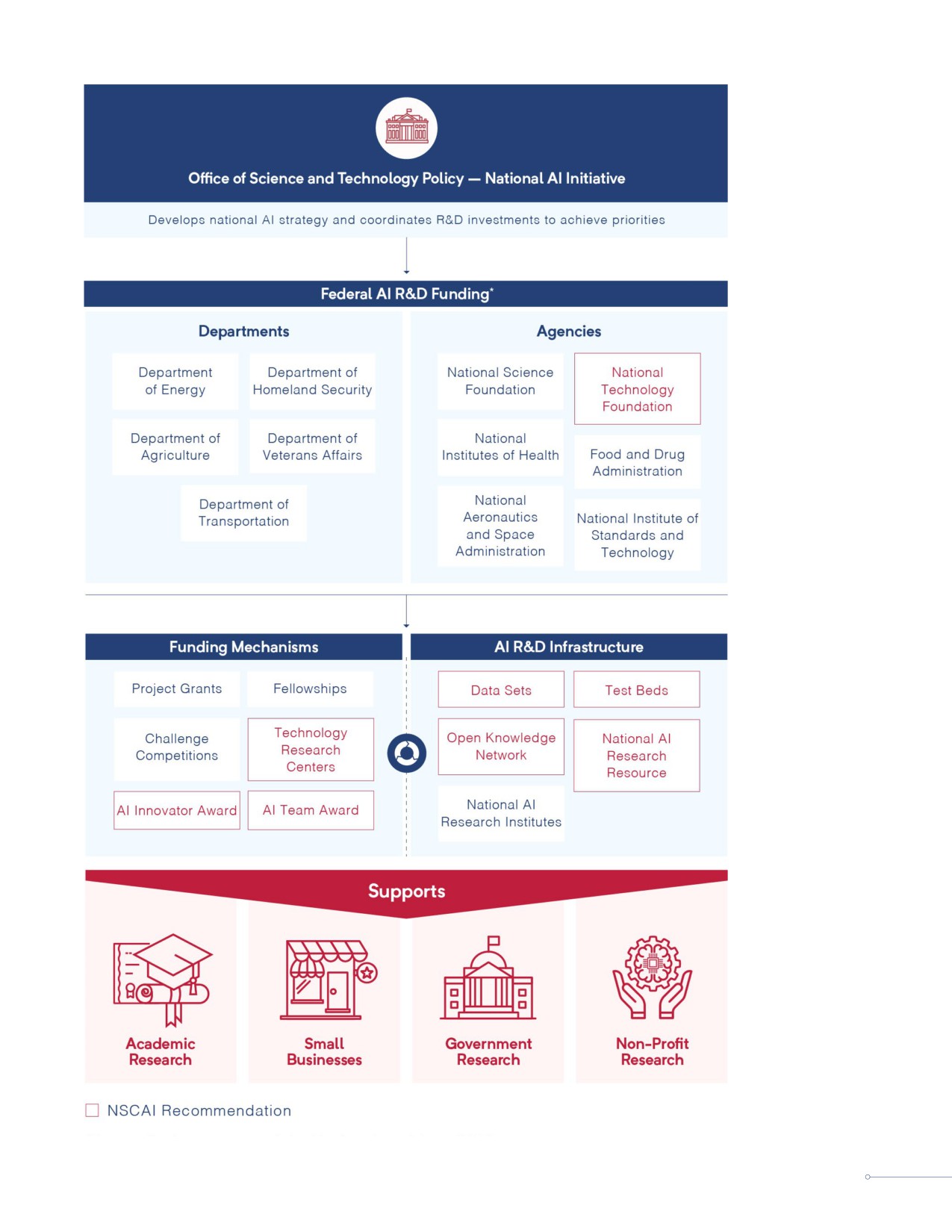
ACCELERATING AI INNOVATION
Federal AI
R&D Ecosystem.
*Representing the current top 10 federal funders of non-defense AI R&D
p
436
BLUEPRINT FOR ACTION: CHAPTER 11
The current federal R&D posture lacks an organization that provides the level of investment
and focus in applied research and technology engineering commensurate with the benefit
that technology breakthroughs could bring to the U.S. economy, society, and national
security. In contrast to fundamental science, technology development embodies a more
costly undertaking,3 requires the support of a diverse base of researchers and developers—
including private-sector partners—and involves regular risk-taking. The Defense Advanced
Research Projects Agency (DARPA) does this effectively, but for specific national security-
focused ends and primarily through a prescribed program-based approach.
The NTF would drive technology progress at a national level by focusing on generating value
at intermediate levels of technical maturity, prioritizing use-inspired concepts,4 establishing
infrastructure for experimentation and testing, and supporting commercialization of
successful outcomes. It would work in close concert with the NSF, DARPA, and other
interagency partners to strengthen investment in domestic science and technology (S&T),
providing the fuel for the development and delivery of AI and other technologies on which
future economic progress and national security advantages rely.
To provide the level of attention to advance technologies of strategic importance, the NTF
should focus efforts around a set of routinely updated priority research areas, such as those
the Commission has identified as technologies critical to U.S. national competitiveness5:
1.
Artificial Intelligence
5. Robotics and Autonomy
2. Biotechnology
6.
5G and Advanced Networking
3. Quantum Computing
7.
Advanced Manufacturing
4.
Semiconductors and
8. Energy Technology
Advanced Hardware
We do not underestimate the challenge of establishing a new institution; however, we see
it as a strategic imperative. The NTF represents a long-term investment in America’s ability
to lead in AI and other disruptive technologies and apply technology toward efforts of
societal importance. It would provide access to the resources and tools that could promote
a national culture of experimentation and invention with new technology.
Given the criticality of holistically strengthening the national R&D landscape, the NTF should
not detract from the level of appropriations for NSF, DARPA, or other existing federal R&D
efforts. Rather, it should be instantiated as part of a broader approach that bolsters NSF as
an institution of enduring, critical importance and amplifies federal support for technology
R&D through existing channels as the organization gets off the ground.
Action for Congress:
• Authorize and appropriate funding to support the establishment of the NTF.
o To match the envisioned enlargement of U.S. technology efforts, federal investment
p
437
ACCELERATING AI INNOVATION
in the NTF should gradually increase from Fiscal Year 2022 to Fiscal Year 2026 for
an ultimate estimated operating budget of $20 billion per year.
■ Additional funds for facilities and equipment necessary for the Foundation’s
creation, estimated at around $30 million, should be made available starting in
Fiscal Year 2022.
o A National Technology Board—with members appointed by the President—should
be created to provide policy direction to the NTF, supervise the Foundation’s
major initiatives, and ensure that its research focus areas are updated to reflect
technology trends. The Board’s directives and actions should be informed by the
National Technology Strategy proposed by the Commission and, when necessary,
coordinated with the Technology Competitiveness Council—both of which are
separately recommended in this report.6
o Jointly, a Director and Deputy Director appointed by the President should
coordinate programming across the Foundation’s directorates and with external
organizations.
o The NTF should be empowered to implement a portfolio of responsibilities:
■ Distribute funding through grants, cooperative agreements, and contracts
awarded through competitive, risk-acceptant processes to academic and
private-sector researchers, nonprofits, and consortia.
■ Manage a component of its funding through an innovation unit modeled on
DARPA in which independent program managers would fund proposals from
both industry and academia to advance solutions to forward-looking research
questions.
■ Promote the transfer of technology advancements to the government as well
as the commercial sector.
■ Run prize competitions to catalyze research around significant technology
challenge problems.
■ Manage national technology resources and infrastructure that democratize an
ability to build, test, and experiment.
■ Contribute to the success of the regional innovation clusters envisioned by the
Commission by participating in the proposed technology program office and
liaising with industry at Technology Research Centers.
■ Contribute to international R&D collaborations and standards-setting
dialogues that strengthen U.S. strategic partnerships.
Component 2: Increase Federal Funding for Non-Defense AI R&D at Compounding Levels
and Prioritize Key Areas of AI R&D
Research is the linchpin of America’s global leadership in AI. However, current federal
funding is not adequate to meet the growth of the field, let alone support its continued
expansion.7 The Trump Administration’s proposed budget for non-defense AI R&D in
Fiscal Year 2021 was $1.5 billion,8 a growth from around $1 billion spent in Fiscal Year
2020.9 Further building on this investment, Congress included the National AI Initiative
p
438
BLUEPRINT FOR ACTION: CHAPTER 11
Act of 2020 in the National Defense Authorization Act for Fiscal Year 2021, which creates
a structure for a more strategic approach to harnessing AI and includes authorization for
additional investments in AI at the NSF, Department of Energy (DoE), National Institute
of Standards and Technology
(NIST), and
the
National Oceanic and Atmospheric
Administration (NOAA).10
The government should build on
National AI Initiative Act of 2020
these first moves and invest in
AI R&D at compounding levels.
• Created an executive branch entity
Federal research funding holds the
within the Office of Science and
power to change the trends that are
Technology Policy to coordinate
federal support for AI research and
degrading the ability of the U.S. to
development, education and training,
continue to lead in AI, namely that
research infrastructure, and international
academic research is weakening as
engagement in order to achieve national
a result of brain drain of professors
priorities as defined in a regularly
updated strategic plan for AI.11
and diversion of graduate students
to industry, the domestic AI talent
• Included provisions that established
pipeline is not keeping up with
a National AI Research Resource
task force, formalized the National AI
government and industry needs,
Research Institute effort, and authorized
and national technical and ethical
funding for AI research at the National
standards for development are
Science Foundation, the National
lagging behind the technology.12
Institute of Science and Technology,
the Department of Energy, and the
Furthermore, federal support can
National Oceanic and Atmospheric
spur the application of AI to other
Administration.
fields of science and engineering,
which holds the potential for
significant returns on investment.
Through sustained investments, federal
support
can serve to holistically strengthen
AI R&D by embracing a range of initiatives—to include support for basic and applied
research, shared research infrastructure, a network of AI R&D institutes, fellowships, and
challenge competitions. Flowing investments through a diversity of agencies will create
a vibrant fabric of funding, both mission-oriented and investigator-driven, that balances
sustainment of evolutionary progress with big bets on revolutionary breakthroughs and
supports innovation in academia and the private sector.
Actions for Congress:
• Double annual non-defense AI R&D funding to reach $32 billion by Fiscal Year
2026.
o Congress should support compounding levels of federal funding for AI R&D,
doubling investments annually from the baseline of $1 billion in Fiscal Year 2020.
o Investments should be made across federal R&D funding agencies, notably the
p
439
ACCELERATING AI INNOVATION
proposed National Technology Foundation, DoE, NSF, the National Institutes of
Health (NIH), NIST, and the National Aeronautics and Space Administration (NASA).
o Significant funds should be appropriated to expand fellowship and scholarship
programs.13 Augmented funding through these vehicles would support additional
undergraduate and graduate students to pursue AI-related fields of study, helping
to strengthen academia, grow the domestic talent pipeline, and provide pathways
into government for technical talent. Similarly, career/faculty fellowship vehicles
supporting researchers in academia would serve to stem the flow of researchers to
industry and invest in top talent to pursue big ideas.
• Commit to spending at least 1% of GDP on federally funded R&D.
o To maintain a strong base of innovation across S&T, Congress should pair AI-
specific investments with an overall federal commitment to annually fund R&D
at a level that reaches at least 1% of gross domestic product (GDP). This could be
accomplished through steady growth over the next five years, at a rate of about $15
billion per year.
Actions for the Office of Science and Technology Policy:
•
Balance Interagency AI R&D Investment Portfolios.
o The National AI Initiative should coordinate federal investments in AI R&D toward
annual doubling benchmarks, through amplified research funding, fellowships, and
establishment of research infrastructure.
o The National AI Initiative should ensure that growth in funding occurs across
multiple agencies and embodies a portfolio approach that leverages a diverse
set of mechanisms, focused on a range of outcomes—advancement of basic
science, solving specific challenge problems, and facilitating commercialization of
breakthroughs.
•
Prioritize Critical AI Research Areas.
o Research investments should prioritize areas critical to advance AI technology that
will underpin future national security and economic growth but may not receive
significant private-sector investment, such as:
■ Novel machine learning (ML) directions. To further non-traditional approaches
to supervised ML in an unsupervised or semi-supervised manner as well as
the transfer of learning from one task or domain to another.14 Other directions
include exploration of hybrid AI techniques that combine data-centric AI with
different forms of model-based representations and inference methodologies
to capitalize on complementary strengths.15
■ Test and evaluation, verification and validation (TEVV) of AI systems. To
develop a better understanding of how to conduct TEVV and build checks
and balances into the entire life cycle of an AI system,16 including improved
methods to explore, predict, and control individual AI system behavior so that
when AI systems are composed into systems-of-systems their interaction does
not lead to unexpected negative outcomes. Understand context-specificity
and degradation of performance in new and unseen environments.
p
440
BLUEPRINT FOR ACTION: CHAPTER 11
■
Robust and resilient ML. To cultivate more robust methods that can overcome
adverse conditions and advance approaches that enable assessment of types
and levels of vulnerability and immunity. Addressing challenges of multiple
classes of adversarial ML attacks. Includes research on fairness.
■
Complex multi-agent scenarios. To advance the understanding of interacting
cohorts of AI systems, including research into adversarial vulnerabilities and
mitigations, along with the application of game theory to varied and complex
scenarios.
■
AI for modeling, simulation, and design. To progress the use of rich simulations
as a source of synthetic data and scenarios for training and testing AI systems,
and to use AI to solve complex analytical problems and serve as a generative
design engine in scientific discovery and engineering.
■
Advanced scene understanding. To evolve perceptual models to incorporate
multi-source and multi-modal information to support enhanced actionable
awareness and insight across a range of complex, dynamic environments and
scenarios.
■
Preservation of personal privacy. To assure personal privacy of individuals is
protected in the acquisition and use of data for AI system development and
operation through advancements in anonymity techniques and privacy-
preserving technologies such as homomorphic encryption, differential privacy
techniques, and multi-party federated learning.
■
AI system risk assessment. Advance capabilities to support risk assessment
including standard methods and metrics for evaluating degrees of auditability,
traceability, interpretability, explainability, and reliability.
■
Enhanced human-AI interaction and teaming. To advance the understanding
of human-AI teaming, including human-AI complementarity, methods for
augmenting human reasoning abilities, and fluid handoffs in mixed-initiative
systems. Also includes bolstering AI technologies to better perceive and
understand human intention and communications, including comprehension
of spoken speech, written text, and gestures. Advances in human-machine
teaming will enable human interactions with AI-enabled systems to move from
the current model of interaction where the human is the “operator” to a future
in which humans have a “teammate” relationship with machines.
■
Autonomous AI systems. To advance a system’s ability to accomplish goals
independently, or with minimal supervision, from human operators in
environments that are complex and unpredictable.
■
Toward more general AI. Research persistent challenging problems and
mysteries of human intellect, including ability to learn efficiently in an
unsupervised manner; amass and apply commonsense knowledge; build
causal models that provide robust explanations; exercise self-awareness,
assessment, and control; and generalize and leverage knowledge learned
about specific tasks to become proficient at another task.
p
441
ACCELERATING AI INNOVATION
Component 3: Triple the Number of National AI Research Institutes
NSF awarded grants for the first National AI Research Institutes in 2020, supporting
seven university-based, multi-institution consortia organized around fundamental and
applied areas of AI research—topics for which were determined through coordination
with interagency and community stakeholders.17 NSF plans to fund a second round of
institutes in 2021, coordinating support not only with interagency partners but also with
private-sector stakeholders to launch eight additional institutes.18 Congress took steps to
support the initiative through the National AI Initiative Act of 2020, which formalizes the
effort, provides all agencies the authority to financially support formation of a National
AI Research Institute, and directs NSF to bring together the institutes as an “Artificial
Intelligence Leadership Network.”19
Expansion of this initiative would create a nationwide network of AI innovation that supports
a breadth of AI research initiatives—advancing basic AI science, solving domain-specific
challenges, and applying AI to other fields of science and engineering. Their establishment
would increase training opportunities for students and research opportunities for academic
faculty, national lab researchers, and non-profit research organizations; help grow the field
outside of leading private universities and regional technology hubs; and strategically steer
research toward areas that could advance the science of AI and applications that serve
broader society and the national interest.
Action for Congress:
• Direct and appropriate funds to expand the network of AI institutes.
o Congress should direct and appropriate funds to NSF to expand the network of AI
institutes three-fold over the course of the next three years—ideally resulting in a
broad diversity of participating institutions, regions, and research concentrations.
o This investment would encompass 30 additional institutes, totaling $600 million to
sustain the additional institutes for the five-year duration of the grant awards. This
would entail appropriations of $200 million in Fiscal Year 2022, Fiscal Year 2023,
and Fiscal Year 2024.
Action for the Office of Science and Technology Policy:
• Integrate the network of institutes with national AI R&D infrastructure investments.
o The National AI Initiative should ensure alignment of the National AI Research
Institutes with strategic research priorities and integration with the national network
of open AI test beds and the National AI Research Resource (see discussion of a
National AI Research Infrastructure below).
p
442
BLUEPRINT FOR ACTION: CHAPTER 11
Component 4: Invest in Talent that Will Transform the Field
Top talent in AI is a scarce commodity, and investing in talent holds the potential to not
only unlock breakthroughs in the science and application of AI but also to attract and
retain top talent in the United States.20 Similarly, investing in research initiatives conducted
by integrated, multidisciplinary teams is a proven mechanism to prompt breakthroughs,
address complex problems, and challenge the status quo.21
The launch of an AI Innovator Award and complementary team-based AI award would
strengthen the ability of federal AI research funding to push the boundaries of the field,
providing a mechanism to complement ongoing investments in incremental progress with
bets on revolutionary breakthroughs.
Actions for Congress:
•
Direct and fund establishment of an AI Innovator Award.
o Congress should direct and fund NSF to establish an AI Innovator Award, loosely
modeled on the NIH Pioneer Award22 and the Howard Hughes Medical Institute
Investigator Program23 to create a mechanism that provides top researchers the
flexibility to pursue big ideas without prescribed outcomes over the course of a five-
year, renewable grant award.
■ Totaling around $5.5 million per awardee for the five-year term, the awards
would cover the full salary and benefits of the researchers at their respective
institutions as well as a research budget that would support equipment and
staff.24
■ At its height, the program would support a maximum of 100 researchers at
a time, reaching an annual funding level of around $125 million for research
support, with additional funds available for major equipment support.
■ Eligible researchers would be those at any career stage based at U.S.
universities or research institutions who commit to spending 75% of their time
on research.25
■ Attention should be paid by the selection committee to the need for diversity
among awardees in terms of gender, race, age, location, and primary focus area
of study, as well as on the communication and leadership skills of applicants.
o Congress should authorize NSF to:
■ Fund an external organization to administer the program.26
■ Annually select 10 to 20 recipients for five-year, renewable terms and conduct
selection through a small, rotating panel of AI experts.27
■ Ensure selection of innovative candidates through an advocacy model process
in which candidates are ranked in accordance with the maximum scores
provided by reviewers, thereby placing priority on their upside potential.28
■ Hold an annual meeting in which all awardees would share their work,
providing a venue for meaningful feedback between review cycles and helping
build a community of innovation among the top U.S.-based minds in AI.
p
443
ACCELERATING AI INNOVATION
o Congress should require NSF to assess the program afer seven years of operation
to determine whether the program should continue to expand or operate at a lower
number of awards and to evaluate the impact of the funding level and award term
on the research conducted by participants.
• Direct and fund establishment of a team-based AI research award.
o Congress should direct and fund NSF to work with the same external organization
as the AI Innovator Award to create a team-based award to support bold,
interdisciplinary research initiatives that apply AI to solve complex challenge
problems or pursue use-inspired basic research efforts.
■ The program should begin with an annual budget of $50 million, growing to a
sustained annual budget of $250 million by its fifh year of operation.
o Congress should authorize the NSF to:
■ Fund an external organization to administer the program.
■ Select five to 10 teams annually for non-renewable, five-year terms, awarding
$4 million to $10 million per year for the five-year term of the award.29
Recommendation: Expand Access to AI Resources through a National AI Research
Recommendation
Infrastructure
If not addressed, the growing divide between “haves” and “have nots” in AI R&D will
degrade the long-term research and training functions performed by U.S. universities,
limit the ability of small businesses to innovate, and exacerbate the lack of diversity in the
field.30 While developments in the past five years have dramatically increased access to
baseline ML tools and cloud-based computation, progress on the cutting edge of many
important AI approaches requires significant amounts of data and computing power,
expensive infrastructure, and substantial hardware and software engineering.
The United States should foster the world’s leading environment for AI innovation through
democratized access to AI R&D that supports more equitable growth of the field and
expansion of AI expertise across the country; enables application of AI to a broad range
of fields of science and engineering, commercial sectors, and public services; and fuels
the next waves of innovation.
Component 1: Launch the National AI Research Resource
Since the explosion of deep learning in 2012 and accompanying growth in use of
specialized hardware for AI computing, there has arisen what some have termed the
“compute divide”—a disparity in access between large technology companies and elite
universities and mid- and lower-tier universities to the resources necessary for cutting-
edge AI research.31 Availability and type of compute resources have been found to levy
“outsized” influence in the direction of research pursued by researchers, as has the
ascendency of the well-equipped firms in shifting the overall direction of AI research
toward applied, “narrow AI” efforts.32
p
444
BLUEPRINT FOR ACTION: CHAPTER 11
To bridge the compute divide, the Federal Government should establish a National AI
Research Resource (NAIRR) to provide verified researchers and students with access to
compute resources, co-located with AI-ready government and non-government data sets,
educational tools, and user support.33 This infrastructure should leverage public-private
partnerships and cutting-edge private-sector technology and build on existing government
efforts34—avoiding high startup costs of a government-run data center. Congress has taken
the first step in the Fiscal Year 2021 National Defense Authorization Act, implementing a
component of the Commission’s prior recommendation to create a task force to develop
a roadmap for a NAIRR.35 The result of this effort will be due to Congress 18 months after
appointment of task force members.
Action for Congress:
• Authorize and appropriate $30 million for implementation of the NAIRR roadmap.
o Congress should authorize and appropriate funds to immediately implement the
roadmap developed by the NAIRR task force.
■ The resource should be sustained at an initial level of $30 million annually,
amplified by contributions from private-sector partners, and scaled as it
matures and gains users.
■ Funding would support staffing of the program and the cloud resources,
augmented through public-private partnerships. Staff would be responsible
for maintaining and improving the architecture solution, curating data sets,
building interfaces and tools, and providing support to researchers.
Component 2: Create a Network of National AI Testbeds to Serve the Academic and
Industry Research Communities
Sponsored through various federal agencies, this network of national AI testbeds would
provide real-world, domain-specific resources open to the academic, business, and
government research communities to drive basic and applied research to address complex
problems and develop robust, usable AI systems ripe for commercialization (for example,
a self-driving vehicle test range, an instrumented humanitarian aid and disaster relief test
site, or an instrumented home environment). Such resources would help establish and
maintain benchmarking standards that enable measurable research progress through
comparable approaches and reproducibility testing.
Testbeds should support experimentation with both novel software and hardware, equipped
with rich simulation capabilities to model the physical world. Supported by simulated, live,
and blended environments, these platforms would support research and experimentation
that tackles open-ended, real-world problems. Furthermore, they should be architected
to collect valuable data that could be made accessible to the community for training and
evaluation, providing additional fuel for progress.
p
445
ACCELERATING AI INNOVATION
Action for the Office of Science and Technology Policy:
• Coordinate agency investments in AI R&D testbed facilities.
o The National AI Initiative should coordinate agency investments in AI testbed
facilities through the annual budget process, aligning investments with
research priorities issued in the initiative’s strategic plan. Attention should focus
on modernizing existing resources to support data-driven and AI-enabled
technologies.36
Action for Federal Agencies:
• Invest in domain-specific AI R&D testbeds through upgraded or purpose-built
facilities.
o Investment in the suite of national AI testbeds should be made across multiple
federal agencies, facilitating creation of domain-specific resources open to the
broader research community. Focus areas of each testbed should be aligned with
priority AI research areas and in support of existing federal AI investments.
o Testbeds should be set up as “user facilities” that maintain a hybrid approach of
awarding grants for use and charging fees to those not selected for grant funding.
User fees would assist in maintaining the testbeds and supplementing the amount
of funding available for grants.
Action for Congress:
• Support agency funding requests for establishment of AI R&D testbeds.
Component 3: Invest in Large-Scale, Open Training Data
Data is critical currency for today’s popular AI approaches. Promising work in the realm
of low-shot learning, semi-supervised learning, and learning from synthetic data provides
glimpses of a future in which performance of an AI system is not directly tied to big data,
and the Federal Government should continue to prioritize funding for research in these
areas. However, balancing these bets on the future with investments in resources to further
U.S. leadership in the current leading AI approaches would strengthen the foundation of
both current and future AI-based technology and applications.
Building AI systems and solutions for new domains and application areas relies on availability
of specialized data that have been cleaned and organized for use. Federal support for
well-designed, publicly-available data sets and provision of AI-ready government data
sets would help drive research progress in AI and its application to other fields of study.
Currently, a sizable amount of government data that is legal to share with trusted non-
government researchers is not being shared due to a lack of confidence in cybersecurity
and privacy-protecting technologies and a lack of willingness to accept risk.
p
446
BLUEPRINT FOR ACTION: CHAPTER 11
Responsibly creating pipelines for the curation, hosting, and maintenance of complex data
sets would set the foundation for future AI capabilities, help strategically steer the research
community toward issues in the public interest, and advance technology around data set
lifecycle maintenance.
These data investments could be further augmented by and created in support of the
domain testbeds recommended above and hosted through the NAIRR. This integration
could foster creation of data sets to support benchmarks within the testbeds as well as
generate rich data from testing that could be provided back out to serve the research
community. Access to resources should be granted to researchers with verified research
efforts and governed by appropriate compliance controls based on the type of data and
metadata contained in the data set.
Actions for the Executive Branch:
•
Issue a common policy and set of best practices.
o Leveraging the work of NIST,37 the U.S. Chief Data Officer should issue a common
policy and set of best practices to support release of AI-ready government data to
the public and work with industry and academia to adopt compatible policies and
best practices for reciprocal sharing and documentation.
•
Provide incentives to industry and academia to make available select data sets.
o The U.S. Chief Data Officer should develop incentives for industry and academia to
make available select data sets on the NAIRR that would be managed and accessed
alongside government-owned data sets.
•
Support NSF-funded cybersecurity and privacy researchers to make government
data accessible for research purposes.
o The National AI Initiative should coordinate NSF-funded cybersecurity and privacy
researchers to undertake rotational assignments at federal agencies38 and work
closely with agency personnel and data stewards to responsibly unlock access to
more of the government’s data holdings for the purpose of stimulating AI research
and innovation.
o Researchers would apply promising methodologies for protecting data and privacy
in a controlled manner, providing a proving ground for new approaches and
objective evidence to justify evolving data-sharing policies and practices. This
could include creating secure environments for verified researchers to access more
sensitive government-held data.
Actions for Congress:
• Unlock public data for AI R&D.
o Congress should fund teams of data engineers and data scientists organized
through the U.S. Digital Service to unlock public data currently held by the
government for use by the AI research community.39
p
447
ACCELERATING AI INNOVATION
o These teams would prioritize, clean, and curate non-sensitive public data sets
to make them AI-ready and structure enduring processes to capture, clean, and
regularly update data that would be hosted on a platform such as NAIRR, accessible
by verified U.S.-based researchers.
• Fund an AI data program at the Department of Energy.
o Congress should appropriate $25 million40 per year for the next five years to DoE
to administer an AI data program that would create exemplar, complex data sets
and maintain them as living, regularly updated resources. These could include
specialized data sets in physical, biological, earth, and engineering sciences, as well
as social sciences.41
o The program should be coordinated through the National AI Initiative to ensure data
sets created steer the research community in desired directions.
o Congress should direct DoE to work closely with NIST to develop standards for the
data—to include standards for documentation, data modeling, data engineering,
and data formats—as well as to advance the methods and tools necessary to
support the data lifecycle.
Component 4: Sponsor an Open Knowledge Network
Open knowledge networks (or repositories) with massive amounts of world knowledge
could fuel the next wave of AI exploration, driving innovations from scientific research to
the commercial sector. Today, only the biggest tech companies have the resources to
develop significant knowledge graphs and networks.
Various federal agencies have invested in specialized, domain-specific knowledge
networks that could provide a starting point for an open knowledge network.42 Beginning
with a push to federate and map together existing specialized knowledge networks and
government data platforms, and then building in real-world knowledge and context, the
government could sponsor an Open Knowledge Network that would serve verified U.S.-
based companies and researchers of all backgrounds to use world knowledge to develop
AI systems that operate effectively and efficiently. This type of resource, particularly if
paired with the complementary research infrastructure above, could unlock frontiers of
technology yet unexplored.
Action for the Office of Science and Technology Policy:
• Hold an innovation sprint to build an open knowledge network roadmap.
o Leveraging prior work undertaken through the Networking and Information
Technology Research and Development (NITRD) program Big Data Interagency
Working Group,43 the Office of Science and Technology Policy should hold an
innovation sprint to build a roadmap to establish an open knowledge network in a
phased manner.
p
448
BLUEPRINT FOR ACTION: CHAPTER 11
Action for Congress:
• Direct and fund implementation and management of the open knowledge network.
o Congress should direct and fund the NSF to implement and manage the open
knowledge network, appropriating $25 million per year for the next five years
and encouraging NSF to leverage partnerships with industry stakeholders where
possible.44
Recommendation: Leverage Both Sides of the Public-Private Partnership
Recommendation
U.S. companies are at the forefront of AI R&D, and their investments benefit consumers
globally through the rapid development and adoption of AI-enabled products. But the
impact of AI-enabled products on U.S. society and national security has largely come as
an afterthought. The speed of technology development by the private sector has vastly
outpaced federal policies and regulations. To address these challenges, the public and
private sector must share responsibility for the safety, security, and well-being of Americans.
The following recommendations would make the government a better partner for industry,
broaden the benefits of strategic emerging technologies like AI through regional innovation
clusters, and expand opportunities to access AI research and education through private-
sector philanthropy.
Component 1: Create Markets for AI and Other Strategic Technologies
The government’s buying power cannot compete with a global consumer market, but
it can influence investment decisions in technologies essential to overall U.S. technical
leadership.45 Many potential public-sector applications of AI, such as education and labor,
fall under agencies with limited R&D budgets. As the government increases investment in
basic research, it must also fully leverage its purchasing power to support AI and other
strategic technologies.46 The scale of government funding can influence the research
priorities and viability of early-stage startups, which often succeed or fail in the first year;
and, if leveraged collectively, it can draw private-sector resources toward areas of strategic
priority. This makes investors and technology companies important partners for AI R&D
that can build future defense and national security capabilities.
Yet the government remains a difficult customer—especially for small and medium-sized
businesses—because of its complex contracting process and unique requirement. Making
the U.S. government a more compelling customer and effective buyer of commercial
technology will help drive technology development in the commercial sector that is in the
national interest. It will also assist the government in almost every aspect of its mission,
from providing basic public services to driving economic policy and protecting national
security.
p
449
ACCELERATING AI INNOVATION
Actions for the General Services Administration (GSA):
• Promote the application of AI across the U.S. Government.
o In fulfilling its mandate to facilitate the adoption of AI technologies in the Federal
Government,47 the AI Center of Excellence (AI CoE) should look first to readily
available commercial off-the-shelf (COTS) technology that can be tailored for
government use.
■ AI CoE should work with Federal technical leadership,48 including the U.S.
Chief Technology Officer, Chief Information Officer Council, and the National
AI Initiative,49 to identify government needs and opportunities and expedite the
adoption of commercial AI applications across federal agencies.
■ The AI CoE should leverage existing digital governance efforts across the
Executive Branch, including GSA’s 18F and the U.S. Digital Service, and
technical talent exchange programs, including GSA’s Presidential Innovation
Fellowship, to bring sufficient technical expertise and commercial proficiency
to this effort.50
• Communicate federal AI capability priorities to the private sector.
o The AI CoE should add federal procurement priorities and agency capability needs
to its publicly available website, which contains information regarding programs,
pilots, and other initiatives.51
Actions for the U.S. Small Business Administration:
• Publish a digital technology “playbook” for small businesses.
o A playbook for small businesses should outline paths for companies interested in
doing business with the U.S. government and explain in a single place52 how to
navigate challenges like obtaining access cards to government facilities. Such a
resource would make the acquisitions process more transparent and reduce the
need for companies to hire outside help.
■ The playbook should be developed and reviewed by personnel with technical
and commercial proficiency, for example Presidential Innovation Fellows or
staff from the U.S. Digital Service, and written in language that technology
startups with no prior government experience can understand.
■ The playbook should be aggressively publicized to increase its visibility.
• Bridge public and private investment through the Small Business Innovation
Research (SBIR) Program.53
o Support the efforts of participating federal agencies to modernize SBIR to more
effectively develop and deploy AI solutions and encourage broader participation of
American technology startup and small-business companies.
■ Expand pilot programs that offer supplemental funding to bridge the gap
between current SBIR/Small Business Technology Transfer (STTR) Phase II
awards and Phase III scaling efforts.54
p
450
BLUEPRINT FOR ACTION: CHAPTER 11
■ Expand pilot programs that offer larger funding amounts55 and private-
sector matching opportunities to support higher technology readiness levels
common in DoD SBIR contracts.56
o Update SBIR Policy Directive to allow programs to require matching private-sector
funds as early as Phase II.57
Actions for Department of Defense and Intelligence Community:
•
Adopt a “hoteling” model to allow small- and medium-sized technology
companies to access classified facilities on a flexible basis.
o The Digital Ecosystem described in Chapter 2 of this report would establish
prototypical platform environments for contributors and users, including cleared
personnel from AI companies. Flexible access to classified spaces would speed
development cycles and help companies more regularly engage with current or
potential customers within the national security enterprise, leading to more tailored
and effective solutions delivered more quickly.
•
Simplify the contracting process to attract non-traditional vendors.
o Amend the Defense Federal Acquisition Regulation to allow commercial
performance to be considered more widely in the contracting process. The U.S.
government can benefit from broader adoption of best-in-class commercial AI
sofware.
o Allow for pilot use of commercially available digital application tools and access
portals for SBIR and other non-traditional contracting vehicles.58
•
Commit to growing the national security innovation base.
o DoD should set a target of increasing its contracts with early-stage technology
firms by four times over the five-year Future Years Defense Program.59 This will also
require growing the budgets of successful but nascent innovation initiatives such as
the Defense Innovation Unit.60
■ To this point, DoD has focused on a large number of small bets without
following up with larger later-stage investments. Larger contracts for later-
stage companies would help scale validated solutions that meet military
requirements.
o The Under Secretary of Defense for Acquisition and Sustainment and the Service
Acquisition Executives should encourage Acquisition Category programs of all sizes
to solicit bids from at least one non-traditional contractor per program.
•
Strengthen return on SBIR investments.
o Review, modernize, and streamline SBIR processes to encourage broader
participation of American technology startup and small-business companies.61
■ Program officers should clearly communicate pathways to transition, including
milestone criteria and dollar amounts, to SBIR awardees so that they can plan
and resource accordingly.
■ Explicitly allow SBIR contracts to leverage any “color of money” as matching
funds up to the amount of SBIR funding.
p
451
ACCELERATING AI INNOVATION
o Enable successful prototypes to scale through sufficient funding, early access
to customers and operators, and better due diligence on the commercialization
prospects of a company.62
■ Military Service and Office of the Secretary of Defense (OSD) SBIR programs
should allocate a portion of SBIR funding for scaling successful SBIR projects
through Phase II enhancements.63
■ Program Offices should provide program dollars alongside matching SBIR
funds to increase the likelihood of transition.
o Continue efforts to align SBIR program with Department technology priorities to
focus investments on subsets of key technologies on which private-sector R&D can
help advance.64
■ The Office of the Under Secretary of Defense for Research and Engineering
should introduce a special solicitation on AI that invites solutions across a
diversity of AI approaches65 and a range of technology readiness levels.66
Component 2: Form a Network of Regional Innovation Clusters Focused on Strategic
Emerging Technologies
Competition is critical to a vibrant national security innovation base.67 If a strategic industry
lacks competition, one wrong bet by an incumbent can place the nation’s technological
leadership in jeopardy.68 The U.S. government should create an environment in which
innovative startups are able to disrupt inefficient or outdated ways of doing business and
grow into industry leaders themselves. The right mix of policies and incentives can help
firms overcome mounting barriers to entry at the cutting edge of emerging technologies like
AI.69 This approach will promote innovation in industries that are essential to U.S. leadership
in AI and the nation’s economic and technological competitiveness more broadly.70
As the Commission noted in its 2019 Interim Report, the clustering of technology firms
in regions like Silicon Valley yields a more dynamic and globally competitive industry by
expediting knowledge sharing and sharpening domestic rivalry.71 However, this trend has
benefited some regions and demographics more than others.72 To spur regional innovation
across a broader swath of the nation, the U.S. government should support the growth of
technology clusters in regions with latent innovation potential. Broader in mission and scope
than existing models within the U.S. government, such an initiative would democratize
access to federal R&D resources so that small firms could compete in industries with high
barriers to entry like AI. By facilitating the exchange of technology and talent between the
public and private sectors, the U.S. government would also be well positioned to establish
new contracts and intellectual property sharing agreements for commercial technologies
that are critical to U.S. national security.
p
452
BLUEPRINT FOR ACTION: CHAPTER 11
Actions for Congress:
•
Establish an interagency program office responsible for coordinating a network of
regional innovation clusters focused on R&D and commercialization of strategic
emerging technologies.
o The program office should be hosted by the Department of Commerce at NIST and
staffed by representatives from U.S. departments and agencies with experience
in and missions related to strategic emerging technologies.73 The program office
should also draw on expertise from the private sector and academia through talent-
exchange programs and external advisory arrangements.
o Congress should authorize $5 million for the creation of the program office and task
it with designating regional innovation clusters in qualified locations throughout
the United States via a competitive process, as described below in detail. As a first
step, the program office should solicit bids for financial assistance from applicants
focused on the R&D and commercialization of strategic emerging technologies. In
assessing bids, the program office should consider the following criteria:
■ Location. Clusters should be equitably distributed throughout the United
States in regions with latent innovation potential, taking into account factors
such as proximity to federal R&D facilities, the level of support from state and
local governments, the presence of and value proposition for leading firms and
research institutions, and the size and education level of the local workforce.74
■ Subject area. Clusters should be organized around the research, development,
and commercialization of strategic emerging technologies that are critical
to U.S. national competitiveness. Of particular interest are technologies that
enable advances in adjacent sectors and whose domestic production would
directly benefit U.S. national security, such as microelectronics.75
■ Economic feasibility. To maximize the impact of federal resources and ensure
self-sustainability of the clusters, financial assistance should only be awarded
to applicants that demonstrate the existence of a nascent cluster in their
region.76
o The program office should establish Technology Research Centers (TRCs)
for each cluster to facilitate collaboration between participants. By forming
sustained partnerships with anchor institutions, each TRC should strive to
advance the research, development, and commercialization of strategic emerging
technologies.77
■ Leverage talent. TRCs should host researchers on temporary assignments from
U.S. departments and agencies, establish talent exchanges with local firms
and research institutions, and fund multi-year, postdoctoral fellowships for the
commercialization of research.78
■ Encourage technology transfer. TRCs should host program managers from U.S.
departments and agencies responsible for transitioning basic research into
commercially viable technologies, identifying national security use cases and
end users within the U.S. government, and initiating new government contracts
for those products.
■ Generate intellectual property. TRCs should establish intellectual property-
sharing agreements with cluster participants to encourage government
adoption of commercial technologies. When appropriate, research should be
p
453
ACCELERATING AI INNOVATION
published in the open-source domain to encourage advances in the broader
science and technology community.
■ Bring government resources to bear. TRCs should facilitate participants’
access to federal computing resources, curated government data sets, testing
infrastructure and ranges, and other R&D facilities at low cost.79
o The program office should play a high-level coordination role that includes
supervising the operation of TRCs, facilitating R&D collaboration between clusters,
and promoting the commercialization of technologies with national security use
cases.
•
Enact a package of provisions that incentivizes industry and academia to
participate in clusters.
o Provisions should include tax incentives to locate near the cluster, competitive
research grants, loan guarantees, and seed funding. A complementary approach
should be taken by state and local governments. These policies could be modeled
on Opportunity Zones, which have stimulated investment in regional economies.80
■ Investment tax credits. To compete with incentives offered by foreign countries,
Congress should establish investment tax credits for firms participating
in regional innovation clusters. While the details of these tax credits will
vary by sector, one example is the investment tax credit for semiconductor
manufacturing facilities and equipment proposed in Chapter 13 of this report.
•
Provide funding to each cluster for at least five years, with matching investments
from public- and private-sector partners.
o Within one year, the program office should request from Congress the necessary
funding for the designation of up to 10 clusters. This funding should be matched
at least 1:1 by investment from private companies, state and local governments,
and federal agencies, with a target of each cluster initially receiving a total of $50
million annually. This annual amount should increase as demand and capacity at
each cluster expands over time.81 These funds would be used to operate the TRCs,
maintain R&D facilities, issue research grants, and seed startups.
Component 3: Establish a Private Sector-Led Competitiveness Consortium
The private sector shares responsibility with the government to strengthen the foundations
of the R&D ecosystem that underpins breakthroughs they will commercialize and the
training pipeline needed to meet their increasing demand for technical talent.
Companies are already struggling to find these qualified applicants for technical roles, with
one estimate showing more than 400,000 open computing jobs nationwide.82 Furthermore,
as described above, researchers in academia who will undertake the high-risk, high-gain
research that will push the frontiers of the field are finding themselves locked out from the
computing and data resources needed to fuel this work. How well the nation addresses
this looming challenge has widespread implications for the economy, society, and U.S.
global competitiveness.
p
454
BLUEPRINT FOR ACTION: CHAPTER 11
Chapter 10 of this report describes in detail recommendations to revamp the U.S.
educational system to equip Americans for the jobs of the future, and this chapter details
the extensive investments the Federal Government should make in AI R&D. However,
corporations should also consider their responsibility to prepare citizens for the future they
are inventing and maintain the strong foundation of national innovation from which they
benefit. Toward that end, many firms are already having a positive impact beyond their
bottom lines through corporate social responsibility efforts. STEM education programs
and job training feature prominently in the charitable-giving arms of leading tech firms.83
Yet the scale of the challenge is too broad for individual firms to address in insolation,
despite their generosity.
Actions for the Private Sector:
•
Donate $1 billion over five years.
o Providing every American an opportunity to increase their technical proficiency
requires bold action from government, academia, and industry to coordinate,
prioritize, and scale programs that broaden AI research opportunities and
instill digital proficiency.84 For the private sector to meet this call to action, the
Commission calls upon industry to donate $1 billion over the next five years to
support AI education and upskilling and provide data and compute resources to
democratize and fuel best-in-class AI research efforts.
o These funds would lay the foundation for broader digital transformation and
economic empowerment. Government officials should publicly highlight the impact
of this effort and the role of the firms contributing to it.
o Similar to the Partnership on AI’s work coordinating development of best
practices across AI firms,85 this effort should be managed by an independent
non-profit organization that can link and scale firms’ efforts to build digital skills
and democratize AI research. The U.S. Digital Service Academy proposed by the
Commission could also contribute expertise, volunteers, curriculum development,
and other in-kind support.86
•
Expand research exchanges between industry and academia.
o Leading technology firms should invest in or expand exchange programs designed
to combine top academic talent with world-class private-sector computing
resources. Rotational exchanges of this type would both democratize computing
access for researchers and simultaneously shed light on new pathways for next-
generation AI products that could be commercialized by industry.
Action for the U.S. Bureau of Labor Statistics:
• Standardize and report data on digital skills in the job market.
o The U.S. Bureau of Labor Statistics should lead an effort in coordination with other
agencies such as the Department of Education to collect and regularly update
statistics on the digital proficiency of demographic groups and regions, with entries
describing specific digital skills needed by firms with job openings. This will enable
p
455
ACCELERATING AI INNOVATION
academic institutions, firms, and other organizations to prioritize their efforts for
educating, reskilling, upskilling, and digital transformation.
Recommendation
Recommendation: Tackle Some of Humanity’s Biggest Challenges
If the investments detailed above are implemented, they will set the conditions to harness
AI to tackle some of the biggest challenges in science, society, and national security.
Examples of promising initiatives that could improve societal well-being and advance
scientific frontiers include, but are not limited to:
• Enable long-term quality of life. AI technology that can help the elderly live
independently longer, assisting in managing health and daily tasks and improving the
quality of life. This can include application of AI to biomedicine to address acute and
chronic illnesses and enhance healthy aging.
• Revolutionize education and lifelong learning. AI tools that personalize education,
training, and retraining at appropriate challenge levels and intuitively evaluate
development to optimize standard curricula to promote individual learning success.
• Transform energy management. Smart infrastructure for cities that can effectively
respond to surges in energy demand and emergencies (both man-made and natural
disasters).
• Effectively predict, model, prepare for, and respond to disasters. Accurate, near-real
time weather, earthquake, and fire line detection and prediction of escalation to aid
in emergency response and planning for optimized deployment of limited resources.
Autonomous robots for search, rescue, and cleanup in the wake of natural or man-made
disaster, providing force-multiplying support to first responders and hazardous materials
professionals.
Action for the Office of Science and Technology Policy:
• Direct the National AI Initiative to align federal investments in AI R&D to tackle
significant scientific, technological, and societal challenges.
o The National AI Initiative should identify and oversee realization of opportunities to
harness federal R&D investments to take on audacious scientific and technological
challenges that could lead to breakthroughs that benefit society and national
security.87
o Prioritization of these efforts should be coordinated with the national security
research community and informed by the Technology Competitiveness Council
proposed by the Commission88 to define areas of research where the application of
AI could contribute to progress that provides strategic advantages.
p
456
BLUEPRINT FOR ACTION: CHAPTER 11
Blueprint for Action: Chapter 11 - Endnotes
1 The National Science Foundation: A Brief History, National Science Foundation (July 15, 1994),
Sputnik, the Foundation’s appropriation had leveled at $40 million. In fiscal 1959, it more than tripled
at $134 million, and by 1968 the Foundation budget stood at nearly $500 million.”).
2 12 Irreplaceable Innovations Made Possible by NSF, National Science Foundation (last accessed
Feb. 11, 2021), https://www.nsf.gov/news/special_reports/btyb/innovation.jsp. A recent report
produced by Computer Science and Telecommunications Board of the National Academies of
Sciences, Engineering, and Medicine traces the interplay between fundamental research in
information technology (IT) in academia and industry and its effects on capabilities of IT and non-
IT sectors. For an illustration of the how the research funded by NSF and others has influenced
the technologies that have transformed our everyday lives, see Information Technology Innovation:
Resurgence, Confluence, and Continuing Impact, National Academies of Sciences, Engineering, and
Medicine at 14 (2020), https://doi.org/10.17226/25961.
3 We recommend an estimated operating budget of $20 billion per year. For comparison, NSF has an
annual budget of $8.5 billion (FY 2021), while five U.S. technology firms—Alphabet, IBM, Facebook,
Microsoft, and Amazon—spent an estimated $80.5 billion on AI R&D alone in 2018. See About the
www.nsf.gov/about/; Martijn Rasser, et al., The American AI Century: A Blueprint for Action, CNAS
action.
4 As argued by Donald Stokes in 1997, research should be conceived not as a dichotomy
between basic and applied research, but on a quadrant along the axes of “quest for fundamental
understanding” and “considerations of use.” Research in the upper-right quadrant is defined as
use-inspired basic research—research that advances fundamental knowledge but is driven by a
clear purpose. Stokes calls this “Pasteur’s quadrant” after the work of Louis Pasteur, whose research
pushed scientific boundaries and had practical applications. See Cherie Winner, Pasteur’s Quadrant,
Washington State Magazine (2009), https://magazine.wsu.edu/web-extra/pasteurs-quadrant/.
5 See Chapter 16 of this report for additional details on each of these technologies and why the
Commission believes they are critical to future U.S. national competitiveness.
6 For additional details on the Commission’s proposed National Technology Strategy and the
Technology Competitiveness Council, see Chapter 9 of this report.
7 For example, NSF, which provides 85% of federal funding for computer science, funded $188 million
in core AI research in 2019 but did not have room in the budget to fund another $178 million worth
of highly rated proposals. This was an improvement from 2018, when it funded $165 million but left
$185 million of highly rated work unfunded. Furthermore, NSF (in partnership with the Department of
Agriculture) funded seven National AI Research Institutes in 2020 but was unable to fund the more
than 30 that were judged worthy of supporting. NSF presentation to NSCAI (January 2020).
8 The Networking & Information Technology Research & Development Program Supplement To The
nitrd.gov/pubs/FY2021-NITRD-Supplement.pdf.
9 The Networking & Information Technology Research & Development Program Supplement To The
nitrd.gov/pubs/FY2020-NITRD-Supplement.pdf.
10 Pub. L. 116-283, William M. (Mac) Thornberry National Defense Authorization Act for Fiscal Year
2021, 134 Stat. 3388 (2021).
11 The legislation tasks an interagency committee overseen by the National AI Initiative Office
to develop every three years a strategic plan for AI that determines and prioritizes areas of AI
R&D requiring Federal Government leadership and investment; supports long-term funding for
interdisciplinary AI research; provides or facilitates the availability of curated, standardized, secure,
representative, aggregate, and privacy-protected data sets for AI R&D; provides or facilitates the
necessary computing, networking, and data facilities for AI R&D; supports and coordinates Federal
education and workforce training activities; and supports and coordinates the network of AI Research
Institutes.
p
457
ACCELERATING AI INNOVATION
Willis, Analysis of Current and Future Computer Science Needs via Advertised Faculty Searches for
needs-via-advertised-faculty-searches-for-2019/.
13 Expanded funding could go through programs across federal agencies, notably the following.
For NSF: CAREER fellowship; Graduate Research Fellowship Program; CyberCorps: Scholarship
for Service; Historically Black Colleges and Universities Undergraduate Program; and Research
Traineeship. For DoE: Early Career Research Program; Computational Science Graduate Fellowship.
For NASA: Space Technology Research Fellowship program. For DoD: DARPA Young Faculty
Award; Vannevar Bush Faculty Fellowship; Science, Mathematics, and Research for Transformation
Scholarship for Service Program; National Defense Science and Engineering Graduate Fellowship
Program; and Historically Black Colleges/Universities and Minority-Serving Institutions Research
and Education Program. See Chapter 10’s recommendation for the passage of a National Defense
Education Act.
14 Learning techniques such as unsupervised, semi-supervised, self-supervised, one- or zero-shot,
and reinforcement learning enable training AI models with less reliance on large data sets of labeled
data, albeit often with lower accuracy than with using supervised learning. See Dr. Bruce Draper,
learning-with-less-labeling. Reducing reliance on large amounts of labeled data is important when
supporting applications where data is scarce or labeling data is cost prohibitive. See NSCAI Interim
uploads/2021/01/NSCAI-Interim-Report-for-Congress_201911.pdf.
15 Hybrid AI approaches include integrating statistical machine learning with other techniques such as
symbolic AI, knowledge representations, game theory, search, and planning. Hybrid AI approaches
are often used in applications of robotics, battle management systems, and resilient systems. NSCAI
Staff Correspondence with DARPA (Feb. 22, 2021).
16 This is a particular challenge for long-lived, autonomous AI systems operating over long durations
of time. These systems will likely continuously evolve their mission sets and capabilities, utilizing
dynamic learning, along with in-field, in situ updating. All this requires advancing the discipline
of TEVV to continuously monitor and ensure such a system’s operation remains compliant to
performance requirements over its missional lifetime.
17 The topics were Trustworthy AI, Foundations of Machine Learning, AI-Driven Innovation in
Agriculture and the Food System, AI-Augmented Learning, AI for Accelerating Molecular Synthesis
and Manufacturing, and AI for Discovery in Physics. The Department of Agriculture teamed with
NSF to provide funding toward two of the institutes to support AI research on developing the next
generation of and resilience in agriculture. Artificial Intelligence at NSF, NSF (Aug. 26, 2020), https://
www.nsf.gov/cise/ai.jsp.
18 Around the topics of Human-AI Interaction and Collaboration, Advances in Optimization, AI and
Advanced Cyberinfrastructure, Advances in AI and Computer and Network Systems, Dynamic
Systems, AI-Augmented Learning, AI to Advance Biology, and AI-Driven Innovation in Agriculture and
the Food System. The institutes are funded at a rate of $4 million per year for five years, totaling $20
million. See Id.
19 Pub. L. 116-283, sec. 5201(b), William M. (Mac) Thornberry National Defense Authorization Act for
Fiscal Year 2021, 134 Stat. 3388 (2021).
20 A 2019 evaluation of the grants made as a component of the National Institutes of Health (NIH)
high-risk, high-reward program—which include large, longer-term investments in talent through the
NIH Director’s Pioneer Award, NIH Director’s New Innovator Award, and the NIH Director’s Early
Independence Award—found that these awards funded highly productive research compared to
the work funded under traditional NIH research grants and that they result in a higher technological
impact. The high-risk, high-reward program was created to accelerate the pace of biomedical,
behavioral, and social science discoveries by supporting creative scientists with highly innovative
research. See Report of the ACD Working Group on High-Risk, High-Reward Research, National
Institutes of Health Advisory Committee to the Director (June 2019), https://www.acd.od.nih.gov/
documents/presentations/06132019HRHR_B.pdf.
p
458
BLUEPRINT FOR ACTION: CHAPTER 11
Blueprint for Action: Chapter 11 - Endnotes
21 Studies have found that research that effectively combines diversity of knowledge is more likely to
prompt breakthroughs and that interdisciplinary research lends itself to complex problem-solving,
developing new research thrusts, and challenging the status quo. See Lee Fleming, Recombinant
Uncertainty in Technological Search, Management Science (Jan. 2001), https://funginstitute.berkeley.
edu/wp-content/uploads/2012/10/Recombinant-Uncertainty-in-Technological-Search.pdf; Andrew
ac.uk/~ir28/IDR/Barry2008.pdf.
22 The NIH Director’s Pioneer Award supports researchers at any career stage who propose bold
research projects with unusually broad scientific impact. The program supports awardees with
$3.5 million over five years and requires 51% of time spent on research in the first three years. See
commonfund.nih.gov/pioneer. Competition for participation in the program is high; reportedly the
success rate for applicants is just 1%. See Roberta B. Ness, The Creativity Crisis, Oxford University
Press at 87 (2015).
23 Established in 1978, the Howard Hughes Medical Institute (HHMI) supports more than 250
investigators across the United States. Thirty current or former HHMI investigators have been awarded
the Nobel Prize. The HHMI Investigator Program is organized around the core belief in the power of
individuals to make breakthroughs over time. Through the program, which selects 20 investigators per
year, HHMI aims to expand a community of basic researchers and physician scientists who catalyze
discovery research in basic and biomedical sciences, plant biology, evolutionary biology, biophysics,
chemical biology, biomedical engineering, and computational biology. See Investigator Program,
HHMI (last accessed Feb. 3, 2021), https://www.hhmi.org/programs/biomedical-research/investigator-
sites/default/files/programs/investigator/investigator2021-program-announcement-200714.pdf.
24 This mirrors the HHMI structure and cost model, with HHMI awarding $8 million over a seven-year
term. HHMI updated the length of their award in 2018, extending the term from five to seven years.
bets-big-on-19-new-investigators.
25 Should researchers move institutions over the course of the program, the award would move with
them.
26 This could be conducted through a cooperative agreement, mirroring the relationship NSF formed
with the Computing Research Association to launch the Computing Innovation Fellows program in
2009 to support postdoctoral PhDs imperiled in finding academic appointments by the downturn of
cra.org/ccc/leadership-development/cifellows/. Furthermore, this entity would be able to accept
supplemental funding from individuals, corporations, or other non-profits to further strengthen and
expand the program.
27 They would provide meaningful feedback to selectees throughout their participation in the program.
The quality of feedback provided by reviewers was identified by researchers as a key factor in the
success of HHMI investigators. Pierre Azoulay, et al., Incentives and Creativity: Evidence from the
Academic Life Sciences, NBER (Dec. 2011), https://www.nber.org/papers/w15466.
mitsloan.mit.edu/shared/ods/documents/?PublicationDocumentID=6296. See also the “gold award”
model used by the Gates Foundation. How Grand Challenges Explorations Grants Are Selected, Bill
& Melinda Gates Foundation Global Grand Challenges (last accessed Feb. 3, 2021), https://gcgh.
grandchallenges.org/how-grand-challenges-explorations-grants-are-selected.
29 The amount of the award would be adjusted in accordance with the specificities of the project.
Eligible teams would be composed of researchers based in U.S. academic or research institutions
proposing innovative work related to AI.
30 The annual Taulbee Survey that tracks the field of computer science (CS) found that women
make up 21.0% of CS bachelor graduates and 20.3% of CS doctoral graduates, and domestic
underrepresented minorities account for 14.7% of CS bachelor graduates and only 3.1% of doctoral
graduates. Stuart Zweben & Betsy Bizot, 2019 Taulbee Survey, Computing Research Association at
4-5, 22, (May 2020), https://cra.org/wp-content/uploads/2020/05/2019-Taulbee-Survey.pdf.
p
459
ACCELERATING AI INNOVATION
31 Nur Ahmed & Muntasir Wahed, The De-democratization of AI: Deep Learning and the Compute
Divide in Artificial Intelligence Research, ArXiv (Oct. 22, 2020), https://arxiv.org/abs/2010.15581.
pdf/2009.10385.pdf.
33 This program may be realized as a single cloud resource or a federation of resources, the pros and
cons of which should be considered by the task force with determinations made within their resulting
roadmap.
34 Such as the NSF’s CloudBank, which brokers cloud access to specific NSF-funded researchers,
and the COVID-19 High Performance Computing Consortium, a public-private partnership that grants
access to a range of computing resources to serve COVID-19-related research. See CloudBank (last
accessed Jan. 2, 2021), https://www.cloudbank.org/; the COVID-19 High Performance Computing
Consortium (last accessed Jan. 2, 2021), https://covid19-hpc-consortium.org/.
35 Pub. L. 116-283, sec. 5106, William M. (Mac) Thornberry National Defense Authorization Act for
Fiscal Year 2021, 134 Stat. 3388 (2021).
36 For example, AI testbeds could be hosted by DoE’s existing national laboratory facilities and high-
performance computing resources, by DoD’s existing testing and evaluation infrastructure, or by
facilities managed by the Department of Transportation, NIH, NIST, or the Department of Agriculture.
37 The National AI Initiative Act of 2020 tasks NIST to develop standards for AI data sharing and
documentation. See Pub. L. 116-283, William M. (Mac) Thornberry National Defense Authorization Act
for Fiscal Year 2021, 134 Stat. 3388 (2021).
38 Through such mechanisms as the Intergovernmental Personnel Act mobility program.
Intergovernmental Personnel Act, U.S. Office of Personnel Management (last accessed Feb. 1, 2021),
https://www.opm.gov/policy-data-oversight/hiring-information/intergovernment-personnel-act/.
39 Executive Order 13859 on AI called on federal agencies to “enhance access to high-quality federal
data, models, and computing resources to increase their value for AI R&D.” See Donald J. Trump,
Executive Order on Maintaining American Leadership in Artificial Intelligence, The White House (Feb.
american-leadership-artificial-intelligence/.
40 This would provide for creation of five initial data sets, as well as maintenance over their lifetime
and creation of additional data sets as the program matures.
41 The DoE is well placed to manage such a program, leveraging the cross-disciplinary expertise
resident throughout the laboratory network, the unique computing and user facilities housed at the
17 laboratories, and the ability to create and maintain secure data environments. User Facilities at a
osti.gov/User-Facilities/User-Facilities-at-a-Glance#0. The program could build on the pathfinder
Open Data Initiative launched by Lawrence Livermore National Laboratory in partnership with the
University of California San Diego, which hosts complex, labelled data sets for testing solutions
for scalable ML platforms. See New Partnerships Results in Increased Access to Compelling “Real
results-in-increased-access-to-compelling-real-world-data/; Open Data Initiative, Lawrence Livermore
National Laboratory (last accessed Jan. 2, 2021), https://data-science.llnl.gov/open-data-initiative.
42 For example, NSF, NASA, NIH, and DARPA have all sponsored or created data resources relevant
to an open knowledge network. In addition, government and community-led efforts to pool data to
build solutions to the COVID-19 pandemic could be leveraged.
43 Open Knowledge Network: Summary of the Big Data IWG Workshop, National Science & Technology
Council (Nov. 2018), https://www.nitrd.gov/pubs/Open-Knowledge-Network-Workshop-Report-2018.
pdf.
44 This would build on ongoing efforts through NSF’s Convergence Accelerator track on Open
Knowledge Networks. NSF Convergence Accelerator Awards Bring Together Scientists, Businesses,
announcements/091019.jsp.
p
460
BLUEPRINT FOR ACTION: CHAPTER 11
Blueprint for Action: Chapter 11 - Endnotes
45 For additional details and recommendations on technologies associated with AI that are important
to U.S. technology leadership, see Chapter 16 of this report. A strategic industry is considered by the
government to be very important to a country’s economy or safety. In the national security context,
it is considered critical to the country’s competitive advantage over an adversary. While the United
States’ 16 critical infrastructure sectors refer to large segments of the economy “whose assets,
systems, and networks, whether physical or virtual, are considered so vital to the United States,” a
strategic industry refers to a much more specific group of companies or businesses. See Critical
Infrastructure Sectors, Cybersecurity and Infrastructure Agency (last accessed Jan. 4, 2020), https://
www.cisa.gov/critical-infrastructure-sectors; see also Strategic Industry, Cambridge Dictionary (last
accessed Jan. 4, 2020), https://dictionary.cambridge.org/dictionary/english/strategic-industry.
46 U.S. federal agencies collectively have an annual information technology (IT) budget of $90
billion—one-tenth the annual revenue of the top five U.S. tech firms—yet the majority of government
systems are “outdated and poorly protected.” An American Budget, U.S. Office of Management and
Budget at 9 (Feb. 2018), https://trumpwhitehouse.archives.gov/wp-content/uploads/2018/02/budget-
fy2019.pdf.
47 Congress, in the Consolidated Appropriations Act, 2021, called on the General Services
Administration (GSA) to create a five-year program to be known as the “AI Center of Excellence”
to “(1) facilitate the adoption of artificial intelligence technologies in the Federal Government; (2)
improve cohesion and competency in the adoption and use of artificial intelligence within the Federal
Government; and (3) carry out paragraphs (1) and (2) for the purposes of benefiting the public and
enhancing the productivity and efficiency of Federal Government operations.” Rules Committee Print
116- 68, Text of the House Amendment to Senate Amendment to H.R. 133, U.S. House Committee on
Rules at 378 (Dec. 21, 2020), https://rules.house.gov/sites/democrats.rules.house.gov/files/BILLS-
116HR133SA-RCP-116 - 68.pdf (referring specifically to section 103 of the Consolidated Appropriations
Act, 2021).
48 The Consolidated Appropriations Act, 2021, outlines AI CoE’s duties to include “advising the
Director of the Office of Science and Technology Policy on developing policy related to research
and national investment in artificial intelligence.” Rules Committee Print 116-68, Text of the House
Amendment to Senate Amendment to H.R. 133, U.S. House Committee on Rules at 380 (Dec. 21,
pdf.
49 The National AI Initiative Act of 2020 directs the Director of OSTP to establish a “National Artificial
Intelligence Initiative Office” within OSTP to “(1) provide technical and administrative support
to the Interagency Committee and the Advisory Committee; (2) serve as the point of contact on
Federal artificial intelligence activities carried out under the Initiative for Federal departments and
agencies, industry, academia, nonprofit organizations, professional societies, State governments,
and such other persons as the Initiative Office considers appropriate to exchange technical and
programmatic information; (3) conduct regular public outreach to diverse stakeholders, including
through the convening of conferences and educational events, the publication of information about
significant Initiative activities on a publicly available website, and the dissemination of findings and
recommendations of the Advisory Committee, as appropriate; and (4) promote access to and early
adoption of the technologies, innovations, lessons learned, and expertise derived from Initiative
activities to agency missions and systems across the Federal Government, and to industry, including
startup companies.” Pub. L. 116-283, sec. 5102, William M. (Mac) Thornberry National Defense
Authorization Act for Fiscal Year 2021, 134 Stat. 3388 (2021).
50 The Consolidated Appropriations Act, 2021, outlines AI CoE’s duties to include “advising the
Administrator, the Director, and agencies on the acquisition and use of artificial intelligence through
technical insight and expertise, as needed.” Rules Committee Print 116-68, Text of the House
Amendment to Senate Amendment to H.R. 133, U.S. House Committee on Rules at 379 (Dec. 11,
pdf.
p
461
ACCELERATING AI INNOVATION
51 The Consolidated Appropriations Act, 2021, outlines AI CoE’s duties to include “(1) regularly
convening individuals from agencies, industry, Federal laboratories, nonprofit organizations,
institutions of higher education, and other entities to discuss recent developments in artificial
intelligence, including the dissemination of information regarding programs, pilots, and other
initiatives at agencies, as well as recent trends and relevant information on the understanding,
adoption, and use of artificial intelligence; (2) collecting, aggregating, and publishing on a publicly
available website information regarding programs, pilots, and other initiatives led by other agencies
and any other information determined appropriate by the Administrator.” Rules Committee Print
116- 68, Text of the House Amendment to Senate Amendment to H.R. 133, U.S. House Committee on
Rules at 378-79 (Dec. 21, 2020), https://rules.house.gov/sites/democrats.rules.house.gov/files/BILLS-
116HR133SA-RCP-116 - 68.pdf.
52 The digital playbook should consider recent upgrades made to Acquisition.gov. An important
element of the development of an effective playbook is ensuring its interface and content accounts
for different user profiles. Critical among those user profiles is that of a small-business or non-
traditional government contractor that may be unfamiliar with the process to even begin eligibility
for a government contract. Access the Federal Acquisition Regulation, U.S. General Services
Administration (last accessed Feb. 18, 2021), https://www.acquisition.gov/.
53 The SBIR program is one of the largest and longest-standing programs for federally funded R&D in
small businesses. It was established in 1982 as part of the Small Business Innovation Development
Act, and Federal agencies with extramural research and development budgets that exceed $100
million set aside 3.2% of their budgets to fund the SBIR program. The program is structured in three
phases: Phase I awards of approximately $50,000 to $250,000 for six months to vet “technical merit,
feasibility, and commercial potential”; Phase II awards of $750,000 to $1,700,000 for two years to
support successful efforts initiated in Phase I; and Phase III, which is not funded by SBIR dollars, to
pursue commercialization. The program issues a higher number of Phase I awards but allocates more
funding toward Phase II, with the goal of placing many small bets on novel technologies and only
scaling those that show real promise. NSCAI Engagement (Sept. 25, 2020); see also About, Small
Business Innovation Research (last accessed Feb. 3, 2021), https://www.sbir.gov/about.
54 For example, AFWERX’s Supplemental Funding Pilot Program (TACFI and STRATFI) and
USD(R&E)’s Accelerated Transition funding program.
55 “As of November 2020, agencies may issue a Phase I award (including modifications) up to
$259,613 and a Phase II award (including modifications) up to $1,730,751 without seeking SBA
approval. Any award above those levels will require a waiver.” About, Small Business Innovation
Research (last accessed Feb. 3, 2021), https://www.sbir.gov/about. See also Small Business
Innovation Research (SBIR) and Small Business Technology Transfer (STTR) Program Policy Directive,
U.S. Small Business Association (May 2, 2019), https://www.sbir.gov/sites/default/files/SBIR-STTR_
Policy_Directive_2019.pdf.
56 The Air Force, in partnership with Air Force Research Lab (AFRL) and the National Security
Innovation Network (NSIN), developed Open SBIR Topics, which includes a “few big bets” (strategic
financing): rewards of up to $15 million, with 1:1:2 Program-SBIR-Private Matching options. SBIR Open
Topics, U.S. Air Force AF WERX (last accessed Feb. 3, 2021), https://www.afwerx.af.mil/sbir.html.
57 Specifically, on page 74 of the SBA SBIR/STTR Policy Directive, the line “For example, some
agencies administer Phase IIB awards that differ from the base Phase II in that they require third party
matching of the SBIR/STTR funds.” could be changed to “For example, some agencies administer
Phase II or IIB awards that require third party matching of the SBIR/STTR funds.” Small Business
Innovation Research (SBIR) and Small Business Technology Transfer (STTR) Program Policy Directive,
U.S. Small Business Administration at 74 (May 2, 2019), https://www.sbir.gov/sites/default/files/SBIR-
STTR_Policy_Directive_2019.pdf.
58 The current application portals for beta.sam.gov and the “Defense SBIR/STTR Innovation
Portal” are significant barriers to entry for non-traditionals trying to work with the DoD. NSCAI staff
engagement (Feb. 9, 2021).
59 Future of Defense Task Force Report 2020, U.S. House Committee on Armed Services at 68 (Sept.
0/424EB2008281A3C79BA8C7EA71890AE9.future-of-defense-task-force-report.pdf.
60 For more examples of innovation initiatives and recommendations to scale their impact, see Chapter
2 of this report and its associated Blueprint for Action.
p
462
BLUEPRINT FOR ACTION: CHAPTER 11
Blueprint for Action: Chapter 11 - Endnotes
61 Contracts must be easier to understand and fill out, review periods shortened and clearly
communicated, and oversight streamlined to keep pace with the current rate of technology innovation.
62 Phase II and supplemental awards should be based on a broader diligence process that includes
the long-term health and viability of the company. This assessment should consider as a starting point
the firm’s technical capabilities, financial structure, management structure, and the larger commercial
market opportunities.
63 Phase II enhancements, sometimes called Phase IIB/II.5 contacts, have become a common
method to extend SBIR dollars to promising projects that fail to secure Phase III funding. The Navy
Commercialization Readiness Program oversees the distribution of Phase II.5 contracts “to further
develop SBIR technologies and to accelerate transition for existing Phase II projects.” Navy Phase
II.5 Structure and CRP, U.S. Navy (last accessed Feb. 3, 2021), https://www.navysbir.com/cpp.htm.
The Air Force’s AFWERX, Army, and DARPA, as well as several Federal agencies outside the DoD,
also use Phase IIB awards. The Office of the Secretary of Defense (OSD) Transitions SBIR Technology
Pilot Program provides SBIR awardees the opportunity to apply for Phase II Enhancement (e) and
Accelerated Transition funding for the funding sponsor. However, current funding limits set by SBA
reduce their efficacy by including Phase II enhancements under the Phase II cap of SBIR dollars.
NSCAI staff engagement (Sept. 23, 2020). For further detail, see Interim Report and Third Quarter
Recommendations, NSCAI at 52-57 (Oct. 2020), https://www.nscai.gov/previous-reports/.
64 This effort would be informed by the Technology Annex to the National Defense Strategy
recommended in Chapter 2 of this report.
65 The future will likely be defined by a fusion of many different AI approaches including expert
systems, model-based AI, symbolic-based AI, statistical ML, and new and evolving AI approaches
such as neurosymbolic AI. See Neuro-Symbolic AI, MIT-IBM Watson AI Lab (last accessed Feb. 3,
2020), https://mitibmwatsonailab.mit.edu/category/neuro-symbolic-ai/.
66 DARPA’s SBIR program, for example, is unique in its long time horizon. Most of its investments are
pre-commercial and will take another eight to 10 years to develop before results can be scaled for
military or commercial use.
67 David E. Cooper, Defense Industry Consolidation: Competition Effects of Mergers and Acquisitions,
Statement before the U.S. Senate Committee on Armed Services Subcommittee on Acquisition and
Technology (March 4, 1998), https://www.gao.gov/assets/110/107240.pdf.
68 For example, Intel’s recent chip missteps have jeopardized U.S. leadership in the design and
manufacturing of advanced semiconductors. See Michael Kan, Intel: Sorry, But Our 7nm Chips Will Be
will-be-delayed-to-2022-2023.
69 For example, small firms have difficulty affording the cost of compute resources and data for
training sophisticated ML models. Nur Ahmed & Muntasir Wahed, The De-democratization of AI: Deep
Learning and the Compute Divide in Artificial Intelligence Research, arXiv (Oct. 22, 2020), https://
arxiv.org/abs/2010.15581.
70 Michael Porter, The Competitive Advantage of Nations, Harvard Business Review (1990), https://hbr.
org/1990/03/the-competitive-advantage-of-nations.
71 Interim Report, NSCAI at 26 (Nov. 2019), https://www.nscai.gov/previous-reports/; see also Michael
org/1998/11/clusters-and-the-new-economics-of-competition.
72 William R. Kerr & Frederic Robert-Nicoud, Tech Clusters, Journal of Economic Perspectives at 63
(2020), https://pubs.aeaweb.org/doi/pdfplus/10.1257/jep.34.3.50.
73 The program office could be modeled on the Advanced Manufacturing National Program Office that
coordinates Manufacturing USA, a network of manufacturing innovation institutes. See Manufacturing
USA (last accessed Feb. 3, 2021), https://www.manufacturingusa.com/.
p
463
ACCELERATING AI INNOVATION
74 For example, proximity to research facilities operated by the departments of Defense and Energy or
access to technically oriented military installations should be prioritized.
75 See the Chapter 13 Blueprint for Action for more details on the importance of U.S. access to trusted
and assured microelectronics for national security use cases. The Commission also proposes a
preliminary list of strategic emerging technologies that are critical to U.S. national competitiveness in
Chapter 16 of this report.
76 The existence of a nascent cluster suggests industry has already passed the market test. Mark
Muro & Bruce Katz, The New “Cluster Moment”: How Regional Innovation Clusters Can Foster the
new-cluster-moment-how-regional-innovation-clusters-can-foster-the-next-economy/. Resources like
the U.S. Cluster Mapping Project will also be essential to identify which locations are economically
viable. See U.S. Cluster Mapping (last accessed Feb. 3, 2021), http://clustermapping.us/.
77 Anchor institutions are firms, not-for-profit institutions, and research universities that locate near the
cluster and pursue joint R&D with federal agencies or other cluster participants.
78 Overview: The New Federal Role in Innovation Clusters, Clustering for 21st Century Prosperity:
chapter/3#31.
79 For example, the clusters may be co-located with DoE’s national laboratories or military test ranges.
80 According to the Council of Economic Advisors, Opportunity Zones (OZs) incentivize private
investment in low-income communities by lowering capital gains taxes on businesses investing in
the region, which could be a revenue-neutral way of lifting people out of poverty due to the expected
reduction in transfer payments. Investors receive tax benefits for investing in Qualified Opportunity
Funds, which can be used to make equity investments in partnerships or corporations that operate
in an OZ. The funds can also be used to purchase tangible property for use in the fund’s trade or
business. See The Impact of Opportunity Zones, The Council of Economic Advisors (Aug. 2020),
Zones-An-Initial-Assessment.pdf.
81 Private-sector contributions may comprise cost sharing in joint R&D projects, donations, or
membership dues, if such a model is adopted.
82 CODE Advocacy Coalition (last accessed Jan. 2, 2021), https://advocacy.code.org/.
83 See, e.g., Microsoft Philanthropies: TechSpark, https://query.prod.cms.rt.microsoft.com/cms/api/am/
binary/RE4s6AL; Carolina Milanesi, STEM Education as a Diversity Driver in Tech, Amazon (Sept. 14,
2020), https://www.aboutamazon.com/news/community/stem-education-as-a-diversity-driver-in-tech;
Applied Digital Skills: Teach and Learn Practical Digital Skills, Google (last accessed Jan. 2, 2021),
https://applieddigitalskills.withgoogle.com/s/en/home.
84 Michael Wade, Corporate Responsibility in the Digital Era, MIT Sloan Management Review (April 28,
2020), https://sloanreview.mit.edu/article/corporate-responsibility-in-the-digital-era/.
85 Partnership on AI has a mission to shape best practices, research, and public dialogue about
AI’s benefits for people and society, with partners from more than 100 companies and research
organizations. Partnership on AI (last accessed Feb. 3, 2021), https://www.partnershiponai.org.
86 See Chapter 6 of this report for further discussion of the Commission’s proposed U.S. Digital
Service Academy.
87 One way this could be enacted is by assigning “national mission managers” to oversee each
opportunity identified.
88 As recommended in Chapter 9 of this report.
p
464
BLUEPRINT FOR ACTION: CHAPTER 12
Chapter 12:
Intellectual Property
Blueprint for Action
America’s intellectual property (IP) laws and institutions must be considered as critical
components for safeguarding U.S. national security interests, including advancing
economic prosperity and technology competitiveness. Prioritization of IP policy is especially
important given China is both leveraging and exploiting IP policies as a tool within its
national strategies for emerging technologies. The United States must, at a minimum,
articulate and develop national IP reforms and policies with the goal of incentivizing,
expanding, and protecting artificial intelligence (AI) and emerging technologies,1 at home
and abroad. Such policies should be developed and proposed via the Executive Branch
with a process that integrates the disparate departments and agencies that serve important
roles in promoting U.S. innovation.
Recommendation: Develop and implement national IP policies and regimes to incentivize,
Recommendation
expand, and protect AI and emerging technologies as part of national security strategies.
Action for the President:
• Issue an Executive Order to prioritize IP policies for AI and critical emerging
technologies.
o The President should issue an Executive Order to recognize IP policy as a national
priority and establish a comprehensive process to reform and establish new IP
policies and regimes for AI and critical emerging technologies that further national
security, economic, and technology competitiveness strategies.
o The Executive Order should:
■ Direct the Vice President, as Chair of the Technology Competitiveness Council
(TCC)2 or otherwise as chair of an interagency task force,3 to oversee the
comprehensive process;
■ Direct the Secretary of Commerce to:
• Lead, on an ongoing basis, the development of proposals (Executive and/
or Legislative Branch actions) to reform and establish new IP policies and
regimes to incentivize, expand, and protect AI and emerging technologies;
• In executing these responsibilities, coordinate with the Under Secretary
of Commerce for Intellectual Property, the Director of the U.S. Patent and
Trademark Office (USPTO), and other relevant Executive Branch agencies;
p
465
INTELLECTUAL PROPERTY
consult with the Director of the U.S. Copyright Office; and convene public
deliberations, to include at a minimum academia and industry;
■
Direct the USPTO Director, in his capacity as advisor to the President,4 to:
• Submit, within 90 days, a report to the Vice President, in their capacity
as the head of the TCC or interagency task force, that (1) identifies and
analyzes metrics, trends, and data necessary to inform IP policymaking,
particularly as prioritized in the Executive Order; and (2) identifies the
associated U.S. Executive Branch departments and agencies that will be
required to provide any requisite data;
• Submit, within 12 months from issuance of the first report, a second
report, or portions on a rolling basis, to the Vice President that (1)
comprehensively assesses the weaknesses in the current U.S. IP policies
and regimes, relative to IP regimes of other nations, for incentivizing,
expanding, and protecting innovation in AI and emerging technologies
and supporting national strategies; (2) examines the non-exhaustive list
of “IP considerations” (see second recommendation); and (3) proposes
corresponding executive and legislative actions for reforming and
establishing new IP policies and regimes;
• Provide all necessary information and advice to the Vice President to
enable a fulsome analysis of the IP proposals;
■
Direct the Vice President to:
• Lead an ongoing assessment of IP policies, regimes, and reform
proposals from the Secretary of Commerce that should be implemented
and integrated into national security, economic, and technology
competitiveness strategies;
• Empower the Secretary of Commerce to facilitate implementation of IP
policies and regimes assessed as critical to national security, economic,
and technology competitiveness strategies; and
■
Direct Executive Branch departments and agencies to resource and support
the Secretary of Commerce in executing these Executive Order efforts,
including providing the identified metrics and trends.
Actions for the Secretary of Commerce and USPTO Director:
• Establish, as necessary, in consultation with the Director of the USPTO, a
committee of multidisciplinary experts, from within and outside the U.S.
government, to provide technical and IP-related expertise and advice in
implementing this Executive Order.
• Convene public deliberations, to include at a minimum academia and industry,
in executing these Executive Order responsibilities. The outcome of these
deliberations should inform proposed IP policies and regimes.
• Assess metrics and data necessary to inform IP policy.
o In assessing the proper metrics and data necessary to inform IP policy deliberation
as required by the Executive Order, the Secretary of Commerce and USPTO
p
466
BLUEPRINT FOR ACTION: CHAPTER 12
Director should take a whole-of-government approach. Due to the breadth of the IP
considerations, including those delineated in this report, as well as the far-reaching
impact of IP upon many segments of the U.S. economy and innovation ecosystem,
there are many U.S. government entities that may already track relevant metrics or
have the capability to expand their analyses to address the necessary prioritization
of IP for AI and emerging technologies.
■ For example, innovation and investment trends based on patent filings, and,
where possible, licensing data—in various technology sectors, including by
foreign countries, particularly China—should be analyzed (e.g., to assess
quality and research trends5), with care not to rely solely on patent counting.
■ Other potential metrics include but are not limited to tracking of patents self-
declared as standard essential in comparison to patents actually licensed;
licensing to unrelated parties; the impact of prior art on the U.S. patent and
trademark examination systems; international filings for IP protections on U.S.-
funded research, particularly without U.S. funders’ or inventors’ awareness; the
ratio of U.S. companies filing for IP protections, as well as pursuing IP-related
litigation, in the U.S. versus abroad; and patent assignment data.
Action for the Department of Justice:
• Advise courts on ensuring consistency on patentability decisions.
o The Department of Justice, through the Solicitor General and the Civil Appellate
Section, should advise federal courts on eliminating confusing, inconsistent, or
overly restrictive patentability decisions to ensure consistency with national security
policies.
Action for Congress:
• Prioritize proposed IP-related legislation to bolster U.S. national strategies,
including for national security, economic interests, and technology
competitiveness.
o Congress should prioritize legislative recommendations for IP policies and regimes
elevated by the Vice President, as Chair of the TCC or an interagency task force.
This is particularly important given Congress is responsible for passing patent and
IP legislation that the USPTO and other relevant stakeholders execute and follow.
Additionally, the U.S. Copyright Office is housed as a federal department within the
Library of Congress as the principal advisor to Congress on copyright matters and
administers copyright registrations.6
p
467
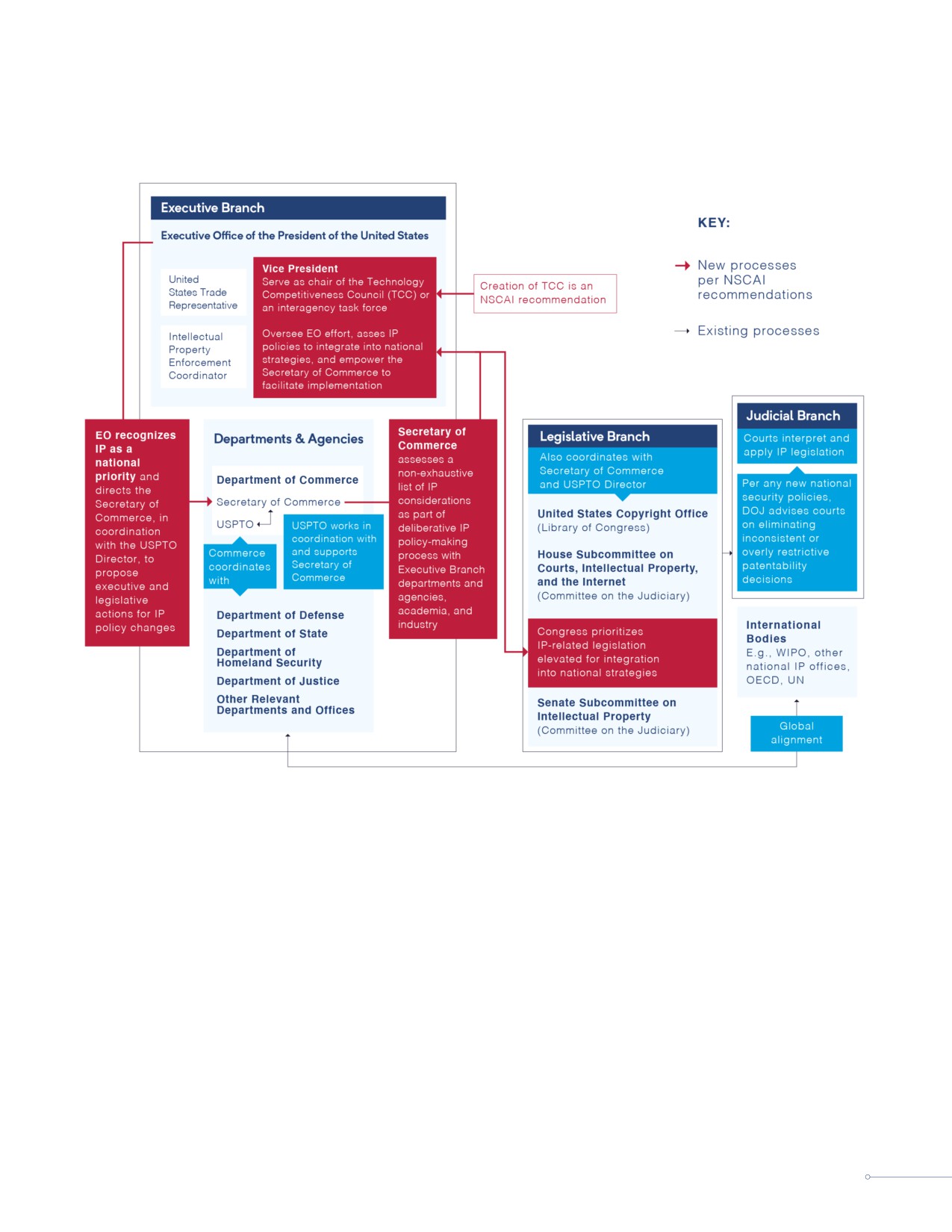
INTELLECTUAL PROPERTY
Executive Order to Prioritize IP Policies for AI
and Emerging Technologies*
*This illustration is not comprehensive of all relevant U.S. government entities with intellectual property
responsibilities
p
468
BLUEPRINT FOR ACTION: CHAPTER 12
Recommendation: The Secretary of Commerce should assess and examine the following
Recommendation
non-exhaustive list of “IP considerations,” in coordination with the Under Secretary of
Commerce for IP and the Director of the USPTO, as part of developing and proposing
reforms and new IP policies and regimes to the Vice President.
Action for the Secretary of Commerce:
• Assess and examine the following non-exhaustive list of 10 considerations for
intellectual property as part of the reports submitted to the Vice President as
mandated by the Executive Order.
1. Patent Eligibility: The Secretary of Commerce should assess and articulate the impact
of current patent eligibility laws on innovation in AI and emerging technologies from an
economic, trade, and national security policy perspective to better inform the legislative
and agency efforts on patent eligibility reform. America’s IP regime has spurred American
ingenuity since the late 18th century. By protecting “any new and useful process, machine,
manufacture, or composition of matter” through stable legal institutions governed by the rule
of law, inventors and investors have relied on America’s IP system to provide the certainty
necessary to justify large and risky R&D investments,7 which are critical for technologies.8
A strong and robust patent system is equally critical to incentivizing American innovation
in AI and emerging technologies that affect national security.9 Unfortunately, recent
patent eligibility court rulings have narrowed the scope of inventions that are eligible for
patent protection. This has resulted in a broad swath of innovation that is now ineligible
for patent protection in both digital technologies and biopharma, among others.10 The
legal uncertainty for U.S. innovators and companies as to whether their inventions will be
eligible for patent protection or susceptible to invalidation once granted is pervasive.11 This
uncertainty in turn has impacted investments in AI and technologies critical to national
security. Empirical studies have proven that patents are causally linked to venture capital
investments in startups, and, as a result, are causally linked to the success of startups.12
Recent reports, however, reveal that investments in patent-intensive U.S. startups that
develop critical technologies (e.g., computer hardware, semiconductors, medical devices
and supplies, and pharmaceuticals and biotechnology) have declined relative to non-
patent-intensive companies.13 This is consistent with investors consistently reporting that
patent eligibility is a key factor in their decisions whether to invest in a particular company’s
technologies or bring a new product to market.14
Legislation appears to be the only practical means to reform patent eligibility doctrine.
The Judiciary, specifically the Supreme Court, has indicated an unwillingness to revisit
its decisions in the past decade that have created this fundamental problem in patent
eligibility doctrine.15 The USPTO has adopted a framework for assessing patent eligibility
during the examination process of patent applications, which has had positive results in
providing greater certainty to patent applicants,16 but the Federal Circuit does not seem
inclined to follow USPTO guidance.17
p
469
INTELLECTUAL PROPERTY
Efforts to reform the patent eligibility doctrine by amending the relevant provision in the
patent statutes failed in 2019.18 Efforts continue to restart the legislative reform process. A
national security point of view has not been expressed on the impact of patent eligibility
law on technologies critical to national security, such as AI, microelectronics,
5G
telecommunications, quantum computing, and biotechnology. A national security point
of view on the impact of current patent eligibility laws on AI and emerging technologies
should inform a national IP strategy.
2. Counter China’s narrative on winning the innovation competition: The Secretary of
Commerce, in coordination with relevant departments and agencies (e.g., Department of
State, USTR), should address how the United States might best counter China’s efforts to
shape the narrative that it is winning the innovation competition based in part on its patent
application filings and other interventions in its technology markets.19 China has become
the domestic forum with the highest number of patent application filings, and China’s
companies and inventors are the most prolific AI patent application filers globally.20 This
benchmark helps to shape the narrative that China has become the leader in innovation
because intensive patenting has been shown to generally correlate to economic growth.21
China also is garnering this reputation when it comes to emerging technologies such
as AI.22 Sources claim that China is outpacing the United States in filing worldwide AI-
related patent applications.23 However, high levels of patenting output is not necessarily
indicative of high levels of inventive output.24 Specifically, non-market factors driven by
state-sponsored interferences can distort filings.25 Moreover, China often files patents as a
“numbers game,” which can lead to mischaracterizing its technological prowess. Similarly,
China’s 5G companies declare the most patents as “standard essential,” appearing to
marry China’s concerted, top-down strategy to advance its AI and emerging technology
agenda by influencing international standards setting with its goals to dominate numeric
benchmarks.26 The Secretary of Commerce should examine what measures need to be
undertaken to counterbalance the narrative of China’s technological dominance based on
selective patenting data.
3. Impact of China’s patent application filings on USPTO and U.S. inventors: The Secretary
of Commerce, in coordination with the USPTO Director, should assess whether the USPTO
requires additional resources, both human and technical, to ensure high-quality patent
examination and recommend policies to address any concerns. In doing so, the Secretary
of Commerce should assess the impacts of increased filings from China and AI-generated
prior art (the term in patent law for the worldwide scientific and technical knowledge by
which an invention is evaluated to determine if it is new). The large body of often low-
quality prior art created by China’s high-volume patenting has the potential to adversely
impact global patent examination systems, including those of the USPTO.27 At the same
time, U.S. inventors may face hurdles in patenting around massive amounts of low-quality
Chinese prior art.28 The USPTO has also noted that stakeholders have raised the issues of
whether AI may generate a proliferation of prior art, making it difficult to find relevant prior
art for examination.29
p
470
BLUEPRINT FOR ACTION: CHAPTER 12
4. Impediments to AI public-private partnerships and international collaboration: The
Secretary of Commerce should assess any impediments to the IP contractual ecosystem to
strengthen AI partnerships among national security departments and agencies, industry,
and international collaboration. This should include assessing and addressing ambiguities
in the Federal Acquisition Regulation and the Defense Federal Acquisition Regulation
Supplement relevant to AI and data. AI development presents unique IP contractual issues.
For example, industry AI developers will likely need access to relevant U.S. Government
training data to develop AI-enabled government solutions or applications. If the solution
or application is dual-use, the private entity may want to provide a license for the U.S.
Government agency to access the AI application, but retain the IP in the AI model to
license to others. But there are unanswered questions as to whether the U.S. Government
agency has any IP rights or ownership in the model that was trained on its data.30 The U.S.
Government agency may also want to retain IP rights in order to avoid “vendor lock.”31
These outstanding questions about IP rights and ownership issues could also arise
in international AI system R&D collaboration, where impediments can be amplified by
conflicting national laws on IP and/or data protections.
5. IP protection for data: The Secretary of Commerce should assess whether there is a
need for sui generis protection or additional IP-type of protections for data and propose
policies and/or legislation if protection is deemed necessary. Data is critical to AI and
machine learning (ML), but gaps may exist in current protection regimes afforded by
patent or copyright. Inadequate protections for data may disincentivize the necessary
investments in developing these critical data sets as well as public disclosure and sharing
agreements.32 While protections for data might be a future need, the U.S. should be
proactive in assessing and addressing the necessity of such protections. The Secretary of
Commerce also should explore ways to protect and incentivize creation of data sets while
allowing the data to be shared at some point, particularly with smaller entities that might
not otherwise be able to enter the market.33 An analysis of the strengths and weaknesses
of the European sui generis database protections should inform this assessment.34
6. Combat IP theft: The Secretary of Commerce, in coordination with relevant departments
and agencies (e.g., USTR, Intellectual Property Enforcement Coordinator, the National
Science Foundation, the Office of Science and Technology Policy,35 as well as the
Departments of Homeland Security,36 Justice,37 and State) should assess and identify
additional efforts that the Executive Branch should undertake to counter IP theft threats,
including actions in collaboration with allies and partners.38 In particular, the Secretary of
Commerce should clearly articulate that the U.S. counter-IP theft strategy will contain both
criminal and civil economic dimensions. The Department of Commerce should utilize all
available tools for establishing a deterrence regime to punish firms guilty of stealing U.S.
IP and deter future IP theft to level the playing field for U.S. and allied firms. These tools
should include placing offending companies on the Bureau of Industry & Security entity
list,39 blocking visas of key employees, or levying tariffs against products derived from
stolen IP. Solutions that should be explored include training for allies and partners to stop
p
471
INTELLECTUAL PROPERTY
counterfeits at borders and efforts to increase individuals’ respect for IP and recognition
of and ways to avoid counterfeits. In addition, the Secretary should assess methods
and means for strengthening and updating existing mechanisms available to American
victims of trade-secret theft, including reintroducing legislation to strengthen the Economic
Espionage Act by, for example, increasing damages available to trade-theft victims and
extending the statute of limitations.40
7. Inventorship by AI: The Secretary of Commerce should assess the need for policy
changes for issues raised by AI-generated inventions and creations, particularly as
technologies evolve. The USPTO has determined that under current legal doctrine, an
inventor must be a natural person and denied a patent application naming a machine as
the inventor.41 The U.S. is not alone in this position.42 The USPTO also issued extensive
requests for public comments on a variety of AI IP policy issues, including AI’s impact
on inventorship and ownership, as well as impacts on non-patent IP protections, such as
copyright. As a result, the USPTO issued a comprehensive report of public views on AI
and IP policy. The majority of commenters agreed that, given that current AI capabilities
are limited to “narrow AI” (AI systems that are trained and perform individual tasks in well-
defined domains) and artificial general intelligence is not yet a reality, current AI could
neither invent nor author without human intervention.43 The Secretary of Commerce should
consult with allies and partners to ensure continued harmonization around the various
IP issues raised by AI-generated inventions and creations and gain an understanding of
China’s strategies for addressing these issues, particularly as AI technologies move past
narrow AI.
8. Global IP alignment: The Secretary of Commerce, in coordination with relevant
departments and agencies (e.g., USPTO, IPEC, USTR, Department of Defense, Department
of State), should work with partners and allies to develop global disincentives for IP theft and
alleviate any inconsistencies in patent regimes that make it overly difficult for companies
to protect their patents in multinational markets. In doing so, the Secretaries should
leverage the Commission’s recommendation that the United States and allies—through
the Emerging Technology Coalition—explore coordinated approaches to IP (as part of
the NSCAI-proposed critical area No. 4: Promoting and Protecting Innovation44), including
a mutual agenda within the WIPO’s Conversation on AI and IP and forums with broader
mandates. The Secretaries also should assess whether current forums for dialogues on
global IP alignment are sufficient or whether new forums or venues are necessitated,
particularly given any changes to domestic IP policies or regimes identified during the
review of the other IP considerations. For example, if the U.S. determines new protections
or policies are needed for data, it may need to work with key allies and partners—bilaterally
and multilaterally—to ensure global harmonization.
9. Democratize innovation and IP ecosystems: The Secretary of Commerce should assess
whether additional Executive Branch efforts are necessary to expand the innovation base
and democratize access to and create more jobs in the innovation and IP ecosystem.45
p
472
BLUEPRINT FOR ACTION: CHAPTER 12
The USPTO, in collaboration with the Secretary of Commerce, has undertaken initiatives to
expand the U.S. innovation base by creating the National Council for Expanding American
Innovation (NCEAI) to develop a comprehensive national strategy to increase equity and
fuel the U.S. innovation ecosystem by encouraging, empowering, and supporting all future
innovators.46 The Secretary of Commerce should ensure that the USPTO has the full support
of the Executive Branch in these initiatives. As part of the NCEAI initiative, the Secretary
of Commerce also should focus on assessing and identifying potential actions and tools
that can fast-track processes and streamline guidance for startups seeking IP protections
and ensuring resources for assisting small and medium-sized entities. Such a focus is
particularly important when comparing the impact of litigation costs and potentially overly
burdensome processes in the U.S., relative to other countries, on U.S. inventors’ decisions
to pursue IP protections in the United States.47
10. “Standard essential” patents process48: The Secretary of Commerce, in coordination
with relevant departments and agencies (e.g., USPTO, NIST, and the Department of State),
should assess policies by which the U.S. can serve a leadership role in and ensure U.S.
firms are able to fully participate in the processes by which “standard essential” patents are
claimed and asserted.49 This would help ensure the continuing legitimacy of the standard-
setting process, a privately developed method for efficiently coordinating development
p
473
INTELLECTUAL PROPERTY
and deployment of new technologies in the marketplace, and deflect Beijing’s attempt
to dominate or manipulate these processes through its own coordination of firms from
China. Chinese Communist Party leadership has articulated a linkage between patent
leadership in emerging technologies like AI and the standards-setting processes for these
same technologies.50 Current trends confirm China’s intention to use both patents and
standards to lead in technological innovation.51 Additional mechanisms may be necessary
to protect the integrity of international standards-setting as well as to protect and promote
U.S. innovation, such as identifying efforts by foreign governments to influence, directly
or indirectly, standard-setting organizations. This would also include identifying foreign
governments subsidizing or otherwise incentivizing the over-declaration of patents as
“standard essential”52 or creating barriers to U.S. participation in foreign standard-setting
bodies. The Secretary of Commerce also should explore how the U.S. government might
support smaller U.S. companies and inventors fully participating in the standard-setting
process and encourage the observation of licensing or legal disputes in foreign jurisdictions
by U.S. government officials from U.S. Embassies and Missions. Relatedly, the Secretary
of Commerce, in coordination with the Director of the USPTO, should assess foreign court
rulings on licensing that may impact U.S. national sovereignty to determine a coherent U.S.
position or response.53
p
474
BLUEPRINT FOR ACTION: CHAPTER 12
Blueprint for Action: Chapter 12 - Endnotes
1 For a discussion of the U.S. government’s efforts to define and prioritize critical emerging
technologies, as well as the Commission’s recommended eight emerging technologies key to U.S.
national competitiveness, see Chapter 16 of this report and its associated Blueprint for Action.
2 NSCAI recommended the creation of a Technology Competitiveness Council in its 2020
Interim Report and Third Quarter Recommendations. See Interim Report and Third Quarter
Competitiveness Council, led by the Vice President and with a Commissioned Assistant to
the President as the day-to-day coordinator, to fill this role.”) If the TCC is not established as
recommended by the Commission, the Commission recommends that the Vice President should lead
these efforts.
3 If the TCC is not established, the President, through an Executive Order, should establish a task
force to address the mandate recommended here.
4 The USPTO Director “shall advise the President, through the Secretary of Commerce, on national
and certain international intellectual property policy issues.” 35 U.S.C. § 2.
5 As an example, an examination of China’s patents can provide insight into its biotechnology and
genomics research and plans. See Kristy Needham, Exclusive: China Gene Firm Providing Worldwide
us-china-genomics-military-exclusive/exclusive-china-gene-firm-providing-worldwide-covid-tests-
worked-with-chinese-military-idUSKBN29Z0HA.
6 Overview of the Copyright Office, U.S. Copyright Office (last accessed Feb. 2, 2021), https://www.
copyright.gov/about/.
7 NSCAI staff engagement with Professor Adam Mossoff, Antonin Scalia Law School, George Mason
University (Oct. 7, 2020); David J. Kappos, National Security Consequences of U.S. Patent (In)
consequences-of-u-s-patent-ineligibility/.
8 For example, the Supreme Court’s controversial 1980 decision in Diamond v. Chakrabarty, which
classifies a genetically modified bacterium as a patentable innovation (under Section 101), “was a
key factor in spurring the explosive growth in the biotech industry in the ensuing decade in the U.S.
The Chakrabarty Court’s recognition that the products of biotech research are patentable, especially
when such products are living organisms or represent the building blocks of life, paved the way for
dramatic advances in the life sciences and in medical treatment, such as in cancer research.” While
the U.S. was the first country to patent genetic modification of living organisms (critical for cancer
research), other countries refused to patent such innovations for more than a decade. This led to the
U.S. becoming the birthplace of the biotech revolution. Similarly, the Supreme Court’s 1981 decision
in Diamond v. Diehr that an invented process using “a computer program was not automatically an
‘abstract idea’ or ‘algorithm’ that precluded patent protection” was key for providing reliable patent
rights that enabled the high-tech revolution of the late 20th century. Kevin Madigan & Adam Mossoff,
Turning Gold to Lead: How Patent Eligibility Doctrine Is Undermining U.S. Leadership in Innovation,
George Mason Law Review, Vol. 24 at 942-946 (2017), https://papers.ssrn.com/sol3/papers.
cfm?abstract_id=2943431.
9 Technologies critical to national security interests include AI, microelectronics, 5G
telecommunications, quantum computing, and biotechnology. For more information on various U.S.
government efforts to define and prioritize critical emerging technologies and the Commission’s
recommended list of critical emerging technologies, see Chapter 16 of this report and its associated
Blueprint for Action. See also Interim Report and Third Quarter Recommendations, NSCAI at 138 (Oct.
2020), https://www.nscai.gov/previous-reports/. There also is a convergence of technologies with the
infusion of AI across all technologies. See Joint Written Testimony of Dr. Eric Schmidt et al. before
the House Committee on Armed Services, Subcommittee on Intelligence and Emerging Threats and
Capabilities, Interim Review of the National Security Commission on Artificial Intelligence Effort and
HHRG-116-AS26-Wstate-SchmidtE-20200917.pdf.
p
475
INTELLECTUAL PROPERTY
10 See Alice Corp. v. CLS Bank Int’l, 134 S. Ct. 2347, 2360 (2014) (holding that a computer program for
facilitating complex international financial transactions is an abstract idea and cannot be patented);
see also Association for Molecular Pathology v. Myriad Genetics, Inc., 133 S. Ct. 2107, 2117 (2013)
(holding that isolated DNA for laboratory and medical uses is an unpatentable natural phenomenon);
Mayo Collaborative Services v. Prometheus Laboratories, Inc., 566 U.S. 66, 72-73 (2012) (holding
that a diagnostic medical treatment for an autoimmune disorder is an unpatentable discovery of a law
of nature); Bilski v. Kappos, 561 U.S. 593, 609 (2010) (holding that a business method for hedging
investment risk is an abstract idea and not a patentable invention); Kevin Madigan & Adam Mossoff,
Turning Gold to Lead: How Patent Eligibility Doctrine Is Undermining U.S. Leadership in Innovation,
George Mason Law Review, Vol. 24 at 946-952 (2017), https://papers.ssrn.com/sol3/papers.
cfm?abstract_id=2943431.
11 A former Chief Judge of the Federal Circuit lamented this uncertainty while testifying before the
U.S. Senate Judiciary Committee’s Intellectual Property Subcommittee: “It is important for me, as a
retired [Federal Circuit] judge, to acknowledge that the courts alone created this problem. … If I, as
a judge with 22 years of experience deciding patent cases on the Federal Circuit’s bench, cannot
predict outcomes based on case law, how can we expect patent examiners, trial judges, inventors
and investors to do so?” See Testimony of Judge Paul R. Michel (Ret.), U.S. Court of Appeals for the
Federal Circuit, before the U.S. Senate Committee on the Judiciary, Subcommittee on Intellectual
Property, The State of Patent Eligibility in America: Part I (June 4, 2019), https://www.judiciary.senate.
gov/imo/media/doc/Michel%20Testimony.pdf. The U.S. Chamber of Commerce recently observed
that uncertainty surrounding patent-eligible subject matter and the viability of biopharmaceutical
companies’ business models is posing “an existential threat to the United States’ position as the
undisputed global leader in biopharmaceutical innovation.” Art of the Possible: U.S. Chamber
International IP Index, U.S. Chamber of Commerce, Global Innovation Policy Center at 10 (2020),
FullReport_A_04b.pdf. The former Director of the USPTO similarly emphasized the importance of
certainty to innovation in the U.S.: “[t]o ensure that our nation remains at the forefront of AI and other
technologies, we must, among other things, provide a reliable and predictable legal framework
to incentivize and protect innovation here at home.” See USPTO Responses to Questions for the
Record by Senator Tillis, Hon. Andrei Iancu, Under Secretary of Commerce for Intellectual Property
and Director of the U.S. Patent and Trademark Office, as Witness, U.S. Senate Committee on the
Judiciary, Subcommittee on Intellectual Property, Oversight of the U.S. Patent and Trademark Office at
11 (hearing held March 13, 2019, responses submitted Aug. 15, 2019), https://www.judiciary.senate.
gov/imo/media/doc/Iancu%20Responses%20to%20QFRs2.pdf.
12 See Joan Farre-Mensa, et al., What Is a Patent Worth? Evidence from the U.S. Patent “Lottery,”
almost double increase in chance of a startup receiving venture capital investments if it has a patent,
and further finding this causally linked to a higher rate of success in startups); Stuart J.H. Graham,
et al., High Technology Entrepreneurs and the Patent System: Results of the 2008 Berkeley Patent
Survey, Berkeley Technology Law Journal, Vol. 24, No. 4 at 255-327 (July 4, 2009), https://papers.
ssrn.com/sol3/papers.cfm?abstract_id=142904.
13 Surveys and industry reports demonstrate that “investment has shifted away from patent-intensive
industries.” Mark F. Schultz, The Importance of an Effective and Reliable Patent System to Investment
in Critical Technologies, Alliance for U.S. Startups and Investors for Jobs at 24-37 (July 2020),
2a4/1596467617939/USIJ+Full+Report_Final_2020.pdf. For example, a look at a subset of patent-
reliant technologies (core internet networking, wireless communications, internet software, operating
system software, semiconductors, pharmaceuticals, drug discovery, surgical devices, and medical
supplies) shows a significant decrease in funding, from 21% of total venture capital funding in 2004 to
only 3.2% in 2017. U.S. Startup Company Formation and Venture Capital Funding Trends 2004 to 2017,
Alliance for U.S. Startups and Investors for Jobs at 9 (June 2019), https://static1.squarespace.com/
static/5746149f86db43995675b6bb/t/5d14b7bb46692200012463e0/1561638845187/USIJ+--+U.S.+S
tartup+Formation+Trends+--+2014-2017.pdf.
cardozolawreview.com/patent-eligibility-and-investment/.
p
476
BLUEPRINT FOR ACTION: CHAPTER 12
Blueprint for Action: Chapter 12 - Endnotes
15 See, e.g., Hikma Pharmaceuticals USA Inc. v. Vanda Pharmaceuticals Inc., No. 18-817 (Jan. 13,
2020) (cert. denied); Athena Diagnostics, Inc. v. Mayo Collaborative Services, LLC, No. 19-430 (Jan.
13, 2020) (cert. denied); HP Inc. v. Berkheimer, No. 18-415 (Jan. 13, 2020) (cert denied). In Athena,
all 12 active judges of the Federal Circuit, the appellate court from which the decision was appealed
to the Supreme Court, agreed that the diagnostic methods at issue should be patent eligible, but
the majority indicated that they had to find the inventions ineligible for patent protection pursuant to
Supreme Court precedent. Athena Diagnostics, Inc. v. Mayo Collaborative Services, LLC, No. 19-430
(Jan. 13, 2020) (cert. denied). On Jan. 29, 2021, however, the Supreme Court asked for a response to
a petition for certiorari appealing a decision from the Federal Circuit that a drive shaft is not eligible
for patent protection because the alleged invention is based on a natural law. American Axle &
Manufacturing Inc. v. Neapco Holdings LLC, No. 20-891 (Jan. 29, 2021). See also Rebecca Lindhorst,
Two-Stepping Through Alice’s Wasteland of Patent-Eligible Subject Matter: Why the Supreme Court
scholarlycommons.law.case.edu/cgi/viewcontent.cgi?article=4813&context=caselrev.
16 In January 2019, the USPTO published the initial framework in a Revised Guidance and requested
public comment on the Guidance. See 84 Fed. Reg. 50, United States Patent and Trademark Office:
2019 Revised Patent Subject Matter Eligibility Guidance, U.S. Patent and Trademark Office (Jan.
7, 2019), https://www.federalregister.gov/documents/2019/01/07/2018-28282/2019 -revised-patent-
subject-matter-eligibility-guidance. Once the USPTO received comments, it issued an Update to the
Guidance: October 2019 Update: Subject Matter Eligibility, U.S. Patent and Trademark Office (Oct.
2019), https://www.uspto.gov/sites/default/files/documents/peg_oct_2019_update.pdf. The Revised
Guidance and the Update were later incorporated into the newest edition of the USPTO’s Manual
of Patent Examining Procedure when it was revised in June 2020. See Manual of Patent Examining
www.uspto.gov/web/offices/pac/mpep/index.html. Since the USPTO issued the patent eligibility
guidance, uncertainty in the examination process has significantly decreased for technologies
affected by the Alice decision. Office of the Chief Economist, Adjusting to Alice: USPTO Patent
Examination Outcomes After Alice Corp. v. CLS Bank International, United States Patent and
Trademark Office at 6 -7 (April 2020), https://www.uspto.gov/sites/default/files/documents/OCE-
DH_AdjustingtoAlice.pdf (demonstrating with statistical significance that the Guidance decreased
uncertainty as to patent eligibility determinations in the first-action stage of examination by 44% for
Alice-affected technologies).
17 Though the USPTO Guidance on patent eligibility applies at the USPTO, the Federal Circuit has
held that it is not bound by the Guidance and, if any conflicts arise between it and case precedent
from the Federal Circuit and the Supreme Court, precedent will override the Guidance. See Cleveland
Clinic Foundation v. True Health Diagnostics LLC, 760 F. App’x 1013, 1020 (Fed. Cir. 2019) (non-
precedential) (“While we greatly respect the PTO’s expertise on all matters relating to patentability,
including patent eligibility, we are not bound by its guidance.”); see also In re Rudy, 956 F.3d 1379,
1383 (Fed. Cir. 2020) (precedential) (citing Cleveland Clinic Foundation, 760 F. App’x at 1021 (“To the
extent the Office Guidance contradicts or does not fully accord with our caselaw, it is our caselaw,
and the Supreme Court precedent it is based upon, that must control.”).
18 Michael Borella, The Zombie Apocalypse of Patent Eligibility Reform and a Possible Escape
of-patent-eligibility-reform-and-a-possible-escape-route.html?utm_source=feedburner&utm_
medium=feed&utm_campaign=Feed%3A+PatentDocs+%28Patent+Docs%29 (citing an interview
wherein Senator Thom Tillis, Chairman of the Senate Judiciary Committee’s Subcommittee on
Intellectual Property, recognized that his 2019 patent eligibility reform proposal did not have a “path
forward” to become a bill in that Congress).
19 Solely relying on patent counting is not reflective of innovation. See Jonathan Putnam, et al.,
Innovative Output in China, at 32 (Aug. 2020) (pending revision), https://papers.ssrn.com/sol3/papers.
cfm?abstract_id=3760816.
20 Patrick Thomas & Dewey Murdick, Patents and Artificial Intelligence: A Primer, Center for Security
and Emerging Technology at 10 (Sept. 2020), https://cset.georgetown.edu/wp-content/uploads/CSET-
Patents-and-Artificial-Intelligence.pdf.
21 Jonathan M. Barnett, Patent Tigers and Global Innovation, CATO at 14 (Winter 2019/2020), https://
www.cato.org/sites/cato.org/files/2019-12/v42n4-2.pdf.
p
477
INTELLECTUAL PROPERTY
22 WIPO’s Patent Cooperation Treaty (PCT) procedure allows inventors to indicate an intent to
file patent applications in multiple countries. However, while in the subsequent national phase
applications, a third country examines the patent and makes its own determination to grant. Therefore,
experts assert that national phase applications are a better indicator for monitoring high-quality
patent filings than filings under the PCT system. For information on PCT and national phase process,
see PCT FAQs, WIPO (April 2020), https://www.wipo.int/pct/en/faqs/faqs.html; WIPO Technology
pub_1055.pdf; George Leopold, China Dominates AI Patent Filings, EnterpriseAI (Aug. 31, 2020),
a fierce defender of intellectual property linked to what planners consider a strategic technology”).
Although China has a high level of PCT filings, the associated national phase applications are
significantly lower. See Patent Cooperation Treaty Yearly Review 2020: The International Patent
System, WIPO at 50 and 55 (2020), https://www.wipo.int/edocs/pubdocs/en/wipo_pub_901_2020.pdf.
asia.nikkei.com/Business/Business-trends/China-overtakes-US-in-AI-patent-rankings (“Chinese
companies have surged ahead of their U.S. counterparts on a Nikkei ranking of the top 50 patent
filers for artificial intelligence over the past three years, expanding their presence in the world’s most
prominent high-tech battleground.”); Andrew Snowdon, UK Ranked Fourth in the World for Number
of Blockchain Patents Filed But Is Falling Behind for AI Patents, UHY Hacker Young (Jan. 21, 2019),
behind-ai-patents (“New Artificial Intelligence technology developments dominated by Chinese
companies”).
hudson.org/Hudson_5G%20Technological%20Leadership.pdf (“There are important limitations with
using patent counting as a measure of innovative output, as economists and statisticians have long
recognized. … This is why economists consider information about the number of patents to be a
‘noisy’ indicator of innovative output. … What matters is the quality, not the quantity of patents.”);
Jonathan Putnam, et al., Innovative Output in China, at 32 (Aug. 2020) (pending revision), https://
papers.ssrn.com/sol3/papers.cfm?abstract_id=3760816; Jonathan M. Barnett, Patent Tigers and
Global Innovation, CATO (Winter 2019/2020), https://www.cato.org/sites/cato.org/files/2019-12/v42n4-
2.pdf.
25 Michael Mangelson, et al., Trademarks and Patents in China: The Impact of Non-Market Factors on
gov/sites/default/files/documents/USPTO-TrademarkPatentsInChina.pdf (discussing China’s subsidies
for trademark and patent application filings); Testimony of Mark Cohen, Senior Counsel on China in
the Office of Policy and International Affairs in the United States Patent and Trademark Office, Before
House Committee on the Judiciary, International Antitrust Enforcement: China and Beyond (June
judiciary (discussing numerous strategies used by China to increase patent filings).
26 See Meeting the China Challenge: A New American Strategy for Technology Competition,
Working Group on Science and Technology in U.S.-China Relations at 29 (Nov. 16, 2020),
pdf [hereinafter Meeting the China Challenge]; Matthew Noble, et al., Determining Which
media/pdfs/news/articles/2019/determining-which-companies-are-leading-the-5g-race.
pdf?la=en&hash=8ABA5A7173EEE8FFA612E070C0EA4B4F53CC50DE. For example, as of
February 2020, Huawei and ZTE filed the most number of “standard essential” patents (SEP)s for 5G
technologies, but assessments of these filings are critical of the quality of these patents. Jed John
Ikoba, Huawei Has Filed the Most 5G Patents Globally as of February 2020-A Report, Gizmochina
essential-patents-globally/.
p
478
BLUEPRINT FOR ACTION: CHAPTER 12
Blueprint for Action: Chapter 12 - Endnotes
27 The potential impact of Chinese patent prior art that must be examined at the USPTO can be
likened to what is happening to the USPTO trademark application process. An influx of fraudulent
trademark applications from China, supported by monetary incentives from the Chinese government,
is likely damaging the integrity of the U.S. trademark registration process, including by imposing
unpredictability in examination process schedules. Hearing on Fraudulent Trademarks: How They
Undermine the Trademark System and Harm American Consumers and Businesses, U.S. Senate
Committee on the Judiciary, Subcommittee on Intellectual Property (Dec. 3, 2019), https://www.
judiciary.senate.gov/meetings/fraudulent-trademarks-how-they-undermine-the-trademark-system-
and-harm-american-consumers-and-businesses; Barton Beebe & Jeanne C. Fromer, Are We Running
Out of Trademarks? An Empirical Study of Trademark Depletion and Congestion, Harvard Law Review
(Feb. 9, 2018), https://harvardlawreview.org/2018/02/are-we-running-out-of-trademarks/; Josh
Gerben, Massive Wave of Fraudulent US Trademark Filings Likely Caused by the Chinese Government
subsidies-linked-to-fraudulent-trademark-filings/.
28 Jeanne Suchodolski, et al., Innovation Warfare, North Carolina Journal of Law & Tech at 201 (Dec.
2020), https://ncjolt.org/articles/volume-22/volume-22-issue-2/innovation-warfare/.
29 Public Views on Artificial Intelligence and Intellectual Property Policy, U.S. Patent and Trademark
Office at iii (Oct. 2020), https://www.uspto.gov/sites/default/files/documents/USPTO_AI-
Report_2020-10-07.pdf [hereinafter USPTO AI IP policy report].
30 Richard Vray & Jane Mutimear, Artificial Intelligence: Navigating the IP Challenges, Mobile
World Live (Feb. 16, 2019), https://www.mobileworldlive.com/intellectual-property-news/artificial-
intelligence-navigating-the-ip-challenges.
31 David Deptula, The Growing Importance of Data Rights in Defense Acquisition, Forbes (Oct. 16,
in-defense-acquisition/?sh=165063242a04.
32 In the USPTO report surveying stakeholders for perspectives on IP policy for AI, “commenters
were nearly equally divided between the view that new intellectual property rights were necessary
to address AI inventions and the belief that the current U.S. IP framework was adequate to address
AI inventions. Generally, however, commenters who did not see the need for new forms of IP rights
suggested that developments in AI technology should be monitored to ensure needs were keeping
pace with AI technology developments. The majority of opinions requesting new IP rights focused
on the need to protect the data associated with AI, particularly ML.” USPTO AI IP policy report at 15;
Id. at 38 (“[a] smaller number of commenters did suggest a reconsideration of whether additional
protections of datasets and databases could be useful to spur investment in high-quality data of
vetted/assured provenance.”).
33 See USPTO AI IP policy report at 15.
34 Protection of Databases, European Commission (June 1, 2018), https://ec.europa.eu/digital-single-
market/en/protection-databases; USPTO AI IP policy report at 38.
35 This includes the Joint Committee on the Research Environment (JCORE).
36 This includes U.S. Customs and Border Protection.
37 This includes the Computer Crime and Intellectual Property Section (CCIPS).
38 Meeting the China Challenge at 16 (“In concert with allies and like-minded countries, the U.S.
should investigate, punish, and condemn such acts and identify ways to induce changes in China’s
maneuvers through counter-espionage, law enforcement, diplomatic pressure, and professional
training in scientific integrity.”).
39 Press Release, The U.S. Department of Commerce, Statement from Secretary Ross on The
Department’s 77 Additions to the Entity List for Human Rights Abuses, Militarization of the South
releases/2020/12/statement-secretary-ross-departments-77-additions-entity-list-human.
p
479
INTELLECTUAL PROPERTY
40 Charles Barquist & Maren Laurence, How a Biden Administration Would Shape IP Policy, Law 360
ip-policy; Sean Lyngaas, As China Tensions Mount, U.S. Officials Outline Efforts to Combat Economic
officials-outline-efforts-combat-economic-espionage/; see also 18 U.S.C. § 1831 (regarding economic
espionage); 18 U.S.C. §1832 (regarding theft of trade secrets).
41 Robert Bahr, Decision on Petition: Application No. 16/524,350, U.S. Patent and Trademark Office
(2020), https://www.uspto.gov/sites/default/files/documents/16524350_22apr2020.pdf.
42 Consistent with U.S. policy that an inventor must be a human “natural person,” in January 2020
the European Patent Office (EPO) and the UK Intellectual Property Office (UKIPO) rejected two
patent applications that identified the AI machine as the inventor. The EPO and UKIPO found that the
applications met the requirements for patentability, but they rejected the applications because the
inventor was not a “human being.” See Emma Woollacott, European Patent Office Rejects World’s
european-patent-office-rejects-worlds-first-ai-inventor/?sh=2915e17d5cd0; Angela Chen, Can an
com/2020/01/08/102298/ai-inventor-patent-dabus-intellectual-property-uk-european-patent-office-
law/; EPO Provides Reasoning for Rejecting Patent Applications Citing AI as Inventor, IPWatchdog
applications-citing-ai-inventor/id=118280/.
43 USPTO AI IP policy report at ii-iii.
44 See the Chapter 15 Blueprint for Action and its associated Annex for more details on the proposed
critical areas for international alignment for the Emerging Technology Coalition. Critical Area No. 4,
as detailed in the Blueprint for Action and Annex, is “Promoting and protecting innovation, including
through intellectual property alignment.” Recognizing the importance of IP to promote and protect
innovation, the critical area proposes coordination on assistance to nations in developing strong and
aligned IP regimes, coordinated efforts to stop IP theft and counter-cyberespionage, and aligning on
a mutual agenda within IP-related multilateral forums.
45 “To maintain our technological leadership, the United States must seek to broaden our intellectual
property ecosystem demographically, geographically, and economically.” Expanding Innovation,
USPTO Director Andrei Iancu).
46 Remarks by Commerce Secretary Wilbur L. Ross at the First Meeting of the National Council for
commerce.gov/news/speeches/2020/09/remarks-commerce-secretary-wilbur-l-ross-first-meeting-
national-council; Support the National Council for Expanding American Innovation, USPTO (last
accessed Jan. 3, 2021), https://www.uspto.gov/initiatives/expanding-innovation/national-council-
expanding-innovation/support-national-council.
47 “A significant proportion of lawyers are advising clients with products in the global market to patent
in China, Germany, and even the U.K. instead of the U.S. The U.S. is losing the fight to be the major
center of patents, investment, and tech because it is easier and less expensive for companies to file
and ensure their patents are enforced in other countries than in the U.S.” NSCAI staff engagement
with Robert Taylor, owner of RPT Legal Strategies, PC (Oct. 8, 2020).
48 Through the standards-setting process, standards-setting bodies (e.g., ISO, IEC, IEEE, ITU, and
others) often require that patent owners self-identify patents that may be deemed essential in a
future standard. This requirement aims to ensure transparency and often requires commitments by
these patent owners to license their patents fairly, reasonably, and non-discriminatorily. However,
these standards-setting bodies do not assess whether a patent is essential or not, leaving these
determinations to private companies negotiating licenses or, if there is a dispute, to courts. See IEEE
SA Standards Board Bylaws, IEEE, https://standards.ieee.org/about/policies/bylaws/sect6-7.html#loa.
p
480
BLUEPRINT FOR ACTION: CHAPTER 12
Blueprint for Action: Chapter 12 - Endnotes
49 See Chapter 15 of this report and its associated Blueprint for Action for the coordinated U.S.
national plan to support international technology efforts and its first component on shaping
international technical standards. Also see the Chapter 15 Annex for more details on proposed
international technical standards-setting recommendations for NIST, the Department of State, and
other critical Departments and Agencies. NSCAI recommends that the U.S. government provide
greater attention to and resourcing for international technical standardization efforts; increase
interagency coordination on AI-related standards-setting; strengthen partnerships and collaboration
with the private sector, particularly through a federal advisory committee and a grant program to
enable small and medium-sized U.S. AI companies to participate in international standardization
efforts; and increase international alignment with key partners and allies. See also Meeting the China
Challenge at 27.
50 Dai Hong, the director of China’s National Standardization Committee’s Industrial Standards
Department, stated in January 2018, as the research for China Standards 2035 was launched: “In
today’s world, industry, technology, and innovation are developing rapidly. The new generation of
information technology industry represented by artificial intelligence, big data, cloud computing, etc.
is emergent. International technology research and development and patent distribution have not
yet been completed. Global technical standards are still being formed. This offers the opportunity to
realize the transcendence of China’s industry and standards.” See translated quote from January 20,
2018, on the China News Network in Emily de la Bruyère & Nathan Picarsic, China Standards 2035:
Beijing’s Platform Geopolitics and ‘Standardization Work in 2020,’ Horizon Advisory at 6 (April 2020),
https://www.horizonadvisory.org/china-standards-2035-first-report. Additionally, the Guangdong
High People’s Court published an October 2013 opinion piece that argued “for Chinese enterprises
to make a revival, there is only one road to take: strengthen our capacity for innovation, and only
by gaining control over SEPs can Chinese companies avoid being ‘led by the nose.’” It cited Chief
Judge Qiu Yongqing, who ruled against the U.S. firm InterDigital in its lawsuit against Huawei and
argued that “Chinese enterprises should bravely employ anti-monopoly lawsuits to break technology
barriers and win space for development.” See David Cohen & Douglas Clark, China’s Anti-Monopoly
uploads/2018/11/IAM92_China-anti-monopoly_section_0.pdf.
p
481