National Security Commission on Artificial Intelligence. Final Report - page 9
INTELLECTUAL PROPERTY
51 Jeanne Suchodolski, et al., Innovation Warfare, North Carolina Journal of Law & Tech at 201 n. 130
firms recognize the strategic importance of standards-setting activities and that participation in
those forums provides the legal means to both access and influence developing technologies). “In
recent years the PRC government decided that promoting Chinese standards in global standards
bodies via the work of Huawei and other Chinese companies is key to realizing techno-nationalist
goals for technological ascension. Viewed in this context, Huawei is in the vanguard of the Chinese
effort to establish dominance in both the number and significance of Chinese patents that are
deemed “standard essential” to 5G standards … it is in the U.S. interest to deflect Beijing’s attempt
to dominate the standard-setting process.” See Meeting the China Challenge at 29. See also Matthew
Noble, et al., Determining Which Companies Are Leading the 5G Race, IAM (July/August 2019),
leading-the-5g-race.pdf.
52 Over-declaration is already present in 5G. See Matthew Noble, et al., Determining Which
pdfs/news/articles/2019/determining-which-companies-are-leading-the-5g-race.pdf.
53 Countries are increasingly seeking to attract inventors by setting favorable global royalty rates (see
the U.K.’s decision in Unwired Planet v. Huawei) or by controlling the jurisdiction in which companies
may file for injunctive relief or pursue litigation. For example, licensing disputes have recently led to
additional satellite litigation involving broader issues of international law and comity between China
and other legal jurisdictions. Experts predict disputes to increase and warn of cycle of anti-suit, “anti-
antisuit,” and “anti-anti-antisuit” injunctions. See Mark Cohen, Wuhan and Anti-Suit Injunction, China
IPR Blog (Dec. 28, 2020), https://chinaipr.com/2020/12/28/wuhan-and-anti-suit-injunctions/; Dani
Kass, FRAND Rate ‘Nightmare’ Raises Call For International Tribunal, Law360 (Jan. 14, 2021), https://
www.law360.com/articles/1343824/frand-rate-nightmare-raises-call-for-international-tribunal/; Michael
Renaud, et al., Key Considerations for Global SEP Litigation-Part 1, National Law Review (Oct. 30,
2019), https://www.natlawreview.com/article/key-considerations-global-sep-litigation-part-1; Michael
Renaud, et al., Key Considerations for Global SEP Litigation-Part 2, National Law Review (Nov. 5,
2019), https://www.natlawreview.com/article/key-considerations-global-sep-litigation-part-2; Zhao
files.wordpress.com/2020/07/statistics-of-chinese-sep-cases-in-2011-2019-lexfield9892.pdf.
p
482
BLUEPRINT FOR ACTION: CHAPTER 13
Chapter 13:
Microelectronics
Blueprint for Action
Regaining microelectronics leadership requires meeting an explicit objective: Stay at least
two generations ahead of China in state-of-the-art microelectronics and maintain multiple
sources of cutting-edge microelectronics fabrication in the United States. To do this,
the Executive Branch must prepare and implement a National Microelectronics Strategy
while Congress simultaneously institutes new tax credits, subsidizes the construction of
semiconductor manufacturing facilities, and grows federal microelectronics R&D and
infrastructure funding. Achieving this goal will require roughly $30 billion in additional
federal funding, but these funds should attract more than five times as much private-
sector investment. Additional federal funding on this scale will likely boost economic
activity domestically and could add more than $100 billion to U.S. gross domestic product
(GDP).1 Inside the U.S. government, agencies must also expand access to trustworthy,
high-performance microelectronic components by shifting from serial to concurrent
development of hardware and software to catch up to the commercial sector and make
use of new microelectronics produced in the United States.
Five-Year Microelectronics Funding
Category
Amount
Federal Grants for Microelectronics
$3 billion per project ($15 billion total)
Manufacturing*
Microelectronics R&D
$12 billion
Microelectronics Infrastructure
$7 billion
DoD Trusted & Assured Microelectronics
$0.5 billion
Total
$35 billion
p
483
MICROELECTRONICS
Recommendation: Issue an Executive Order on Microelectronics Strategy and Leadership
Recommendation
The United States needs a National Microelectronics Strategy to coordinate semiconductor
policy, funding, and incentives within the Executive Branch and externally with industry
and academia.
Actions for the President:
• Issue an Executive Order on Microelectronics National Strategy and Leadership.
o The first step in rebuilding microelectronics leadership is clearly stating that
it is a Presidential priority to stay at least two generations ahead and maintain
multiple sources of cutting-edge microelectronics fabrication in the United States.
The Administration should also highlight the importance of the legislatively
required National Microelectronics Strategy and create a durable structure for its
development, implementation, and revision by issuing an Executive Order requiring
the National Defense Authorization Act (NDAA)-mandated Subcommittee on
Microelectronics Leadership to lead a process to develop a clear federal strategy for
microelectronics leadership. Draf text to inform the development of an Executive
Order for this purpose is included as an Annex to this Blueprint for Action.
Recommendation: Revitalize Domestic Microelectronics Fabrication
Recommendation
Existing U.S. incentives offset the cost of semiconductor foundry construction attributable
to capital expenses, operating expenses, and taxes by 10% to 15%.2 Yet additional tax
credits and subsidies are needed to make the United States a globally competitive market
for semiconductor manufacturing, especially leading-edge logic facilities. Other leading
semiconductor manufacturing nations such as South Korea, Taiwan, and Singapore offer
25% to 30% cost reduction, roughly double what the United States currently offers.3 This
gap in incentives is one driving factor behind the lack of an advanced logic merchant
foundry in the United States. Closing the gap will encourage U.S. firms to construct
facilities domestically while also attracting foreign firms. In fact, a program of the size
described here is projected to attract roughly 14 new fabs in the United States over 10
years.4 Additionally, increasing demand in the United States for high-end semiconductor
manufacturing equipment
(SME) will create new business opportunities for SME
manufacturers from allied countries, particularly Japan and the Netherlands, which could
increase their governments’ willingness to align their export control policies with U.S.
policies prohibiting the export of such equipment to China.5 A refundable investment tax
credit should be instituted in combination with funding for federal grants for the expansion,
construction, and modernization of SME authorized in the NDAA.6
Action for Congress:
• Create a 40% refundable investment tax credit for domestic semiconductor
manufacturing.
p
484
BLUEPRINT FOR ACTION: CHAPTER 13
o Congress should pass legislation establishing a 40% refundable federal investment
tax credit for semiconductor manufacturing facilities and equipment required to
produce state-of-the-art logic chips. This incentive would reduce a semiconductor
firm’s tax bill by 40% on SME and facilities through 2024, followed by reduced tax
credit rates of 30% and 20%, respectively, through 2025 and 2026. Although
introduced as part of the Creating Helpful Incentives to Produce Semiconductors
for America Act (CHIPS for America Act), Congress has not yet passed legislation
establishing this credit.7
•
Appropriate funding authorized in the FY 2021 NDAA for domestic semiconductor
manufacturing incentives, including matching funds for semiconductor fabrication
facilities.
o The FY 2021 NDAA authorizes the Secretary of Commerce to establish a Federal
financial assistance program to incentivize investment in facilities and equipment
in the United States for semiconductor fabrication, assembly, testing, advanced
packaging, or R&D. Under the program, the Secretary may authorize up to $3 billion
per project to finance the construction, expansion, or modernization of facilities and
equipment for semiconductor manufacturing. Larger subsidies are also permitted
if the project significantly increases the proportion of semiconductors relevant for
national security and economic competitiveness that can be met through reliable
domestic production. However, this judgment requires the concurrence of the
Secretary of Defense and Director of National Intelligence.
o Although authorized in the FY 2021 NDAA, funds have not yet been appropriated
toward this program. Congress should appropriate at least $15 billion to subsidize
several facilities in the United States to meet the end goal of multiple state-of-the-
art sources for domestic fabrication.
Recommendation
Recommendation: Double Down on Funding for Research and Infrastructure to Lead the
Next Generation of Microelectronics
Four research arms of the U.S. government focused on medium- and long-term
microelectronics breakthroughs through engagement with academia and industry are
the Department of Energy (DOE), the Defense Advanced Research Projects Agency
(DARPA), the National Science Foundation (NSF), and the Department of Commerce.
Their suite of existing programs, such as DARPA’s Electronics Resurgence Initiative (ERI),
are targeting the right research areas but must be expanded by an order of magnitude to
achieve the necessary breakthroughs to maintain U.S. competitiveness. Additional funding
should support not only research projects, but also the capital-intensive infrastructure
for microelectronics development, including the National Semiconductor Technology
Center and advanced packaging prototyping programs authorized in the FY 2021 NDAA.
In line with the existing focus areas of these programs and the Commission’s prior
recommendations, funding should pursue breakthroughs in promising technologies such
as 3D chip stacking, photonics, carbon nanotubes, gallium nitride transistors, domain-
specific hardware architectures, electronic design automation, and cryogenic computing.
In particular, funding should prioritize the development of manufacturing equipment and
tools to reach 3nm and beyond at production scale. However, this funding should not
solely be directed to classical computing technologies. The U.S. government should
also support efforts to research and develop hybrid quantum-classical techniques that
p
485
MICROELECTRONICS
leverage noisy intermediate-scale quantum computers. The Commission offers detailed
recommendations on this subject in Chapter 16 of this report.
Action for Congress:
•
Appropriate $1.1 billion for semiconductor R&D in FY 2022 and continue increasing
funding over the next five years for a total of $12 billion
o Congress should appropriate an additional $1.1 billion in FY 2022. Consistent with
the amounts in the CHIPS for America Act, this funding should include $400
million for DARPA ERI, $300 million for NSF semiconductor research, and $400
million for DOE semiconductor research. These funding levels should be grown
over the following five years to roughly $7 billion per year and $12 billion total.
Recognizing it will take time to build capacity among agencies to administer
programs at the necessary scale, these amounts should start at funding levels that
can be absorbed by agencies and ramped up over time.
•
Appropriate $1 billion in FY 2022 and $5 billion total over five years for the
Advanced Packaging National Manufacturing Program.
o Novel packaging techniques such as heterogeneous integration and 3D stacking—
combined with domain-specific architectures—will be critical to the development
of artificial intelligence (AI) as traditional architectures of silicon-based chipsets
encounter diminishing marginal performance improvements. Congress should
also appropriate $1 billion in initial FY 2022 funding to establish the Advanced
Packaging National Manufacturing Program led by the National Institute of
Standards and Technology (NIST), as authorized by the FY 2021 NDAA.8 This
funding should be continued through FY 2027 for a total of $5 billion.
•
Appropriate $100 million in FY 2022 and $2 billion over five years to establish the
National Semiconductor Technology Center.
o A National Semiconductor Technology Center would serve as a microelectronics
research hub while also conducting prototyping of advanced semiconductors in
partnership with the private sector. Early-stage semiconductor startups currently
face difficulties scaling due to the high costs of microelectronics design and
fabrication. The incubator component of the center could provide resources to
promising, early-stage microelectronics startups while also giving them access
to fabrication facilities, design tools, and shared intellectual property (IP) to
assist with early-stage development costs. It could also partner with the U.S.
International Development Finance Corporation (DFC) to provide loan guarantees
to microelectronics firms if DFC’s authorities are expanded and extended to rebuild
domestic supply chains for a broader range of strategic emerging technologies.9
This laboratory could grow into a center of expertise in high-performing, trusted
microelectronics, ensuring continued U.S. leadership in this field over the ensuing
years.
Recommendation: Continue DoD’s Trusted Microelectronics Program and Adopt Agile
Recommendation
Hardware Development
Semiconductor manufacturing has moved offshore, expanding threat vectors to hardware
security and leaving the U.S. government unable to trust sensitive electronic components
it needs for defense systems. And while the U.S. government is now recognizing that it
p
486
BLUEPRINT FOR ACTION: CHAPTER 13
must take steps to adopt modern software practices, there has been less attention on
incorporating hardware into the agile development process. Both issues require attention
from the Department of Defense (DoD) and other government agencies. The U.S.
government needs to inject security and agility into its microelectronics acquisition and
development process to leverage the best technology possible for defense systems.
Actions for the Department of Defense:
•
Continue growing the Trusted & Assured Microelectronics Program to include AI-
enabling hardware.
o DoD’s Trusted and Assured Microelectronics research, development, test, and
evaluation (RDT&E) funding has grown to more than $500 million annually for
advanced component development and prototyping and system development
and demonstration.10 These programs improve access to advanced packaging and
testing; support the development of quantifiable assurance and secure design;
develop foundry access standards; expand access to non-complementary metal
oxide semiconductor state-of-the-art microelectronics; support disruptive R&D;
and promote education and workforce development. These are foundational
microelectronics capabilities that will also enable the development and application
of AI and machine learning (ML) capabilities across national security mission
areas. In FY 2021 and beyond, USD(R&E) should expand the program to focus
on developing AI-enabling capabilities and apply $50 million of funding toward
developing AI multi-chip packages.
•
Shif to a more agile approach to hardware development and procurement.
o Just as agile development has transformed sofware, there is an opportunity to
bring agile hardware design practices to speed development cycles, lower costs,
and increase performance. Rather than designing through a serial process, the
commercial sector has developed best practices to integrate hardware and sofware
development processes concurrently. While DoD has made strides in agile sofware
development, it remains behind the commercial sector in applying these lessons
to hardware. Broader adoption of hardware emulation and moving to a common
and secure design environment for the chip, package, and board would also
accelerate system development and improve security. This requires the combined
efforts of USD(R&E) and USD(A&S) to continue improving sofware acquisition and
development practices to incorporate hardware.
p
487
MICROELECTRONICS
Blueprint for Action: Chapter 13 - Endnotes
1 Sparking Innovation: How Federal Investment in Semiconductor R&D Spurs U.S. Economic Growth
org/wp-content/uploads/2020/06/SIA_Sparking-Innovation2020.pdf; Semiconductor Incentives,
Semiconductor Industry Association at 2 (Oct. 9, 2020), https://www.semiconductors.org/wp-content/
uploads/2020/10/Incentives-Infographic-2020.pdf.
2 Antonio Varas, et al., Government Incentives and US Competitiveness in Semiconductor
Manufacturing, Boston Consulting Group and Semiconductor Industry Association at 19 (Sept. 2020),
us-competitiveness-in-semiconductor-manufacturing-sep-2020.pdf.
3 Id.
4 Id.
5 See Chapter 14 of this report for additional details regarding export controls on SME.
6 Total matching funding will vary based on the number of projects approved but should have a ceiling
of at least $10 billion to $15 billion.
7 S. 3933, 116th Cong. (2020); H.R. 7178, 116th Cong. (2020).
8 Pub. L. 116-283, sec. 9906, William M. (Mac) Thornberry National Defense Authorization Act for
Fiscal Year 2021, 134 Stat. 3388 (2021).
9 See the Chapter 16 Blueprint for Action for further details on extending and expanding DFC’s loan
guarantee program through executive action.
10 Pub. L. 116-260, Division C, Department of Defense Appropriations Act (2021), https://docs.house.
gov/billsthisweek/20201221/BILLS-116RCP68-JES-DIVISION-C.pdf.
p
488
BLUEPRINT FOR ACTION: CHAPTER 13
Chapter 13 Annex: Executive Order on Microelectronics Strategy
By the authority vested in me as President by the Constitution and the laws of the
United States of America, including section 9906 of the National Defense Authorization Act
(NDAA) for Fiscal Year 2021 (Public Law 116-283), it is hereby ordered as follows:
Section 1. Findings. The United States relies heavily on imports of certain
microelectronics that are vital to the Nation’s security and economic prosperity. This
dependency on semiconductor imports creates strategic economic and military
vulnerabilities to supply chain disruptions for electronics, including adverse foreign
government actions and natural disasters. Despite tremendous expertise in microelectronics
research, development, and innovation across the country, the United States is limited by
a lack of domestically located semiconductor fabrication facilities, especially for state-
of-the-art semiconductors. This limitation compounds the risk that the United States
may be outpaced in microelectronics design and fabrication. Focusing the efforts of the
United States Government, industry, and academia to develop domestic microelectronics
fabrication facilities will reduce the Nation’s dependence on imports, preserve U.S.
leadership in technological innovation, support job creation, strengthen national security
and balance of trade, and enhance the technological superiority and readiness of the
Armed Forces, which are important consumers of advanced microelectronics.
Section 2. Policy. To maintain the Nation’s security and economic prosperity, it
shall be the policy of the United States to stay at least two generations ahead of potential
adversaries in state-of-the-art microelectronics and maintain multiple sources of cutting-
edge microelectronics fabrication in the United States.
Section 3. Establishment of Subcommittee on Microelectronics Leadership.
(a) There is hereby established in the National Science and Technology Council
a subcommittee on matters relating to leadership and competitiveness of the United
States in microelectronics technology and innovation to be named the Subcommittee on
Microelectronics Leadership (Subcommittee).
(b) The Subcommittee shall be composed of the following members:
(i) The Secretary of Commerce, who shall be Chair of the Subcommittee;
(ii) The Secretary of State;
(iii) The Secretary of Defense;
(iv) The Secretary of Energy;
(v) The Secretary of Homeland Security;
p
489
MICROELECTRONICS
(vi) The Director of the Office of Management and Budget;
(vii) The United States Trade Representative;
(viii) The Director of National Intelligence;
(ix) The Director of the National Science Foundation;
(x) The Assistant to the President for Science and Technology;
(xi) The Assistant to the President for Technology Competitiveness;
(xii) The Assistant to the President for National Security Affairs;
(xiii) The Assistant to the President for Economic Policy;
(xiv) The Assistant to the President for Domestic Policy; and
(xv) The heads of other executive departments and agencies and other
senior officials within the Executive Office of the President, as determined by the
Chair.
(c) Sunset. The Subcommittee shall terminate on January 1, 2031.
Section
4. Functions of the Subcommittee on Microelectronics Leadership.
Consistent with applicable law, the Subcommittee shall:
(a) advise the President on matters involving policy affecting microelectronics;
(b) develop, within 270 days of the date of this order, and no less than once every
five years thereafter, a National Strategy on Microelectronics Research, Development,
Manufacturing, and Supply Chain Security (Strategy), which shall address the following
elements:
(i) methods to accelerate the domestic development and production of
microelectronics and strengthen the domestic microelectronics workforce;
(ii) methods to ensure that the United States is a global leader in the field
of microelectronics research and development;
(iii) activities that may be carried out to strengthen engagement and
outreach between Federal agencies and industry, academia, and international
partners of the United States on issues relating to microelectronics;
p
490
BLUEPRINT FOR ACTION: CHAPTER 13
(iv) priorities for research and development to accelerate the advancement
and adoption of innovative microelectronics and new uses of microelectronics and
components;
(v) the role of diplomacy and trade in maintaining the position of the United
States as a global leader in the field of microelectronics;
(vi) the potential role of a Federal laboratory, center, or incubator exclusively
focused on the research and development of microelectronics, as described in
section 231(b)(15) of the NDAA for Fiscal Year 2017 (as added by section 276 of
the NDAA for Fiscal Year 2021) in carrying out the Strategy; and
(vii) such other activities as the Subcommittee determines may be
appropriate to overcome future challenges to the innovation, competitiveness, and
supply chain integrity of the United States in the field of microelectronics; and
(c) coordinate the policymaking process with respect to microelectronics-related
research, development, manufacturing, and supply chain security activities and budgets
of Federal agencies and ensure such activities are consistent with the Strategy required by
this section.
Section 5. General Provisions. (a) If any provision of this order or the application of such
provision is held to be invalid, the remainder of this order and other dissimilar applications
of such provision shall not be affected.
(b) This order is not intended to, and does not, create any right or benefit,
substantive or procedural, enforceable at law or in equity by any party against the United
States, its departments, agencies, or entities, its officers, employees, or agents, or any
other person.
(c) Nothing in this order shall be construed to impair or otherwise affect:
(i) the authority granted by law to an executive department or agency, or
the head thereof; or
(ii) the functions of the Director of the Office of Management and Budget
relating to budgetary, administrative, or legislative proposals.
(d) This order shall be implemented consistent with applicable law and subject to the
availability of appropriations.
p
491
BLUEPRINT FOR ACTION: CHAPTER 14
Chapter 14:
Technology Protection
Blueprint for Action
This Blueprint for Action provides detail for how the United States must craft technology
protection policies to ensure it retains existing advantages in technology areas with national
security applicability but avoids stifling innovation. U.S. research, entrepreneurship,
and talent development remain the key ingredients of success. However, as dual-
use technologies become more important to U.S. national security, the margin of U.S.
technological advantage narrows, and foreign efforts to acquire American know-how
and technology increase, the United States must also reexamine how it can protect its
commercial and academic ecosystem from foreign exploitation. The United States faces
substantial challenges in adapting its technology protection regime to address threats
related to emerging, dual-use technologies such as artificial intelligence (AI) without
hindering the free flow of commerce or its open research environment, both of which are
systemic U.S. strengths. This Blueprint for Action proposes reforms for (1) modernizing
export controls and investment screening and (2) protecting the U.S. research environment
in ways which are consistent with U.S. national security, commercial interests, and values.
Modernizing Export Controls and Investment Screening
How the U.S. Government regulates competitors’ access to sophisticated U.S. technologies
with national security applications will be one of the principal challenges of current and
future geoeconomic competition. The United States must modernize its export control
and investment screening regimes to better address the challenges posed by dual-use
emerging technologies, to include AI. These reforms are necessary to allow the government
to implement technology protection policies in ways which maximize their impact on the
military capabilities of U.S. strategic competitors and minimize any resulting harms to U.S.
industry.
Recommendation
Recommendation: Clearly State the Overarching Principles to Guide Future U.S. Dual-Use
Technology Protection Policies
The U.S. Government must clearly state the principles that will guide future U.S. decisions
regarding policies to protect critical technologies. This will enable more consistent and
cohesive technology protection policies and provide clarity to industry regarding how the
government intends to utilize these regulatory tools in the current competitive environment,
thereby reducing uncertainty for U.S. businesses. No such framework currently exists.
p
493
TECHNOLOGY PROTECTION
Action for the President:
• Issue an Executive Order outlining the principles which will guide U.S. policies for
protecting dual-use technologies.1
o The President should issue an Executive Order to clarify guiding principles which
will guide U.S. policies to protect critical dual-use technologies, including AI. The
Executive Order should include the following guiding principles:
■ U.S. technology controls will not supplant investment and innovation.
■ U.S. strategies to promote and protect U.S. technology leadership will be
integrated and mutually reinforcing.
■ The United States will be judicious in applying export controls to AI-related
technologies, targeting discrete chokepoints and coordinating policies with
allies.
■ The United States will broaden investment screening to protect AI-related
technologies.
Recommendation: Enhance U.S. Capacity to Carry Out Effective Technology Protection
Recommendation
Policies
Departments and agencies responsible for protecting U.S. technologies lack the
organizational and technical capacity to design and implement effective policies to prevent
the transfer of the national security-sensitive components of emerging technologies such
as AI. They suffer from a dearth of technical talent needed to identify effective new policies
and lack the analytical capacity to enforce their policies efficiently, especially on dual-
use goods. Filling these gaps in key elements of the Executive Branch--particularly in
the Departments of Commerce, the Treasury, and State--will enhance the government’s
ability to craft targeted export controls that have the greatest strategic impact and pose the
least harm to U.S. competitiveness.
Actions for the Department of Commerce:
• Designate a network of FFRDCs and UARCs to serve as a shared technical resource
on export controls.2
o To deepen its internal technical expertise, the Department of Commerce should
establish a network within existing federally funded research and development
centers (FFRDCs) and university-affiliated research centers (UARCs) to provide
technical expertise to all departments and agencies for issues relating to export
controls on emerging technologies. This network should be coordinated by the
Department of Commerce and encompass a regional distribution of FFRDCs and
UARCs that are either located in U.S. technology hubs or have significant expertise
in emerging technologies.
o As an initial step, the Department of Commerce should identify the FFRDCs and
UARCs with existing expertise in emerging technologies under consideration for
export controls. This should be followed by a request for funding in the Fiscal Year
(FY) 2022 President’s Budget to support and expand work of FFRDCs and UARCs
focusing on export controls.
p
494
BLUEPRINT FOR ACTION: CHAPTER 14
• Require all new technology protection rules on emerging technologies to be
coordinated with existing technical advisory groups that include outside experts.3
o The Secretary of Commerce should require that the Bureau of Industry and
Security (BIS) solicit and receive feedback on any proposed controls on emerging
or foundational technologies, to include proposed rules and regulations, from
the Emerging Technology Technical Advisory Committee (ETTAC) and any other
relevant technical advisory groups.4 More frequent and effective use of such existing
advisory committees would provide flexible technical expertise to key departments,
help prevent publishing counterproductive controls, and ensure that policymakers
hear the perspective of industry and academia before controls go into effect.
Actions for the Departments of Commerce, the Treasury, and State:
•
Expedite and automate export licensing and CFIUS filing processes.5
o The Departments of Commerce and the Treasury should partner with FFRDCs,
UARCs, and other contracted entities to build an integrated, smart system for
analyzing export license applications and filings with the Committee on Foreign
Investment in the United States (CFIUS). This system should utilize AI to conduct
a preliminary analysis of filings and attempt to score levels of risk before human
review. In the near term, this would help identify which transactions are very low risk
and which are very high risk to aid subsequent human review. In the longer term, it
could prove more accurate than human review and make decisions without human
involvement, allowing for precise, rapid, and less labor-intensive reviews.
•
Encourage allies to implement legal reforms authorizing them to implement
unilateral export controls and enhance investment screening procedures.
o The Departments of State and Commerce must urge all allies which have not
already done so to pass domestic legislation to overhaul their export control
regimes, increasing their bureaucratic capacity and providing them the authorities
to implement unilateral export controls. Currently, many allies lack such domestic
legal authorities and instead defer all decisions about regulations to multilateral
organizations such as the Wassenaar Arrangement and the European Union.6
These reforms are needed to allow allies to implement targeted, rapid, and effective
export controls on emerging dual-use technologies, which are evolving quickly.
Technology protection regimes on globally available products are only as strong
as their weakest link, necessitating U.S. cooperation with allies and strong allied
regulatory capacity. This builds on existing work, which has been productive and
should continue with an immediate focus on countries that have a strong domestic
emerging technology base and weak regulatory regimes.7
o The Departments of State and the Treasury should expedite efforts to enhance
the investment screening capabilities of close allies and partners. Existing efforts
have shown some success but now require increased urgency, given the threats
allies face from adversarial capital and the U.S. desire to exempt some firms in
allied nations from certain CFIUS requirements.8 State and the Treasury should also
regularly share data about patterns in investment flows in the United States and
allied countries to assist allied efforts to block predatory investments and illustrate
the nature of the threat.
•
Ensure that the offices responsible for export controls and investment screening
policies have sufficient resources and technical capacity.
p
495
TECHNOLOGY PROTECTION
o The Departments of Commerce, the Treasury, and State must ensure that the
offices responsible for designing and implementing export controls and investment
screening provisions on emerging technologies are sufficiently resourced and
have sufficient technical capacity. Agencies should rely on external sources
such as FFRDCs, UARCs, and advisory boards for deep technical expertise on
particular technologies. However, they also must ensure that the offices principally
responsible for managing the policy processes regarding controls on these
technologies have adequate staffing, resources, and baseline technical capacity to
keep pace with the rapidly evolving security challenges associated with dual-use
technologies.
Recommendation: Identify “Emerging” and “Foundational” Technologies Which Must Be
Recommendation
Controlled, as Required by the Export Control Reform Act of 2018
The Export Control Reform Act of 2018 (ECRA) and the Foreign Investment Risk Review
Modernization Act of 2018 (FIRRMA) are intended to overhaul the U.S. export control and
investment screening regimes to better accommodate emerging technologies. ECRA
requires the Department of Commerce to develop a regular, formal interagency process
to identify “emerging and foundational technologies that … are essential to the national
security of the United States,” and are not otherwise controlled.9 Any such technologies
identified by Commerce become subject to U.S. export controls, and any foreign
investment in a U.S. company which “produces, designs, tests, manufactures, fabricates,
or develops” one or more such technologies must be reviewed by CFIUS.10 This list must
be distinct from efforts within the Commission-proposed National Technology Strategy
(NTS) to define emerging technologies key to U.S. national competitiveness and national
security. The ECRA list must be more narrowly defined and focused only on specific
technologies for which export controls are necessary, whereas the TCC and NTS’ focus
should be on identifying broader technologies and particular platforms in which continued
U.S. leadership is essential.
However, as of March 2021, the Department of Commerce has yet to identify a single
emerging or foundational technology as mandated by ECRA. While there is reason to be
judicious in developing this list, given its implications on U.S. industry, and Commerce
faces legitimate capacity and resourcing limitations, the magnitude of the delay is
unacceptable. The delay has garnered bipartisan criticism, created uncertainty for firms
working in fields that could be labeled as emerging or foundational technologies, and
delayed the government’s ability to either control the export of, or more importantly gain
insight into transactions involving, critical technologies that are not otherwise controlled.11
Identifying this list of technologies is critical to enabling the United States to fully implement
both ECRA and FIRRMA. As ECRA and FIRRMA are structured, until the Department
of Commerce defines a technology which is not otherwise controlled as “emerging
and foundational” as part of this review process, with rare exceptions CFIUS cannot
require foreign companies to disclose non-controlling investments in U.S. technology
p
496
BLUEPRINT FOR ACTION: CHAPTER 14
firms. Although the Commission also recommends breaking CFIUS’ reliance on this
ECRA list for mandatory disclosures (see recommendations on reforming CFIUS for
emerging technology competition, below), currently Commerce’s delay in identifying such
technologies is hindering the full implementation of both ECRA and FIRRMA.
Action for the Department of Commerce:
• Direct the Bureau of Industry and Security to develop proposed rules containing
initial lists of both “emerging” and “foundational” technologies by December 31,
2021.12
o The Secretary of Commerce should direct the BIS to work with the U.S. interagency
to develop initial versions of the lists of “emerging” and “foundational” technologies
by December 31, 2021. Beyond 2021, these lists should be regularly revised in an
iterative manner to meet ECRA’s mandate to Commerce to continually refine the
lists. As part of this iterative review process, Commerce must also regularly engage
with industry as technologies develop and mature. Finalizing initial versions of these
lists, if properly scoped and defined, would control critical technologies, clarify
to industry how Commerce intends to implement ECRA, and ensure that such
technologies are included within CFIUS.
Recommendation: Reform CFIUS for Emerging Technology Competition
Recommendation
CFIUS is not currently postured to address the range of threats that the United States
faces from adversarial capital from strategic competitors such as China and Russia.
The Department of the Treasury has little insight into Russian and Chinese investments
in U.S. emerging technology firms, as CFIUS filings are still largely voluntary for non-
controlling investments in industries such as AI, semiconductors, quantum computing, and
telecommunications equipment. While FIRRMA took positive steps in broadening CFIUS’
authorities, it also left critical gaps in the investment screening regime. Additional steps
are necessary to enable CFIUS to protect sensitive U.S. industries from adversarial capital,
while ensuring the continued free flow of capital from trusted investors from allied nations.
Action for Congress:
• Amend CFIUS’ authorizing legislation to require competitors to disclose
investments in “sensitive technologies” to CFIUS.
o Congress should amend CFIUS’ authorizing legislation to mandate CFIUS filings
for all non-controlling investments from “countries of special concern” in “sensitive
technologies.” The Commission recommends that the legislation:
■ Define “countries of special concern” as states subject to export restrictions
pursuant to section 744.21 of title 15 within the Code of Federal Regulations
(China, Russia, and Venezuela) or any state that the Secretary of State
designates as a state sponsor of terrorism (Iran, North Korea, and Syria).13
■ Require the Treasury Department to define a separate list of “sensitive
technologies” for the purposes of CFIUS. Only investors from “countries of
p
497
TECHNOLOGY PROTECTION
special concern” would be required to submit CFIUS filings for investments in
“sensitive technologies.” Treasury currently lacks authorities to broaden CFIUS’
mandatory filing requirements, which are linked to lists of technologies that are
export controlled.14
o Mandating CFIUS filings from select competitors in a broader set of sensitive
industries—such as national security-relevant applications of AI, semiconductors,
quantum computing, and advanced telecommunications equipment—will provide
the Treasury with better visibility into Russian and Chinese investments in U.S. firms
in key sectors. This allows CFIUS to operate with more precision and insight and
focus attention on the riskiest investments.
o Additionally, de-linking CFIUS disclosure requirements from export controls
recognizes that there are instances in which it may be appropriate to screen
investments prior to enacting export controls.15 Without this change, the only way to
increase such disclosure requirements would be to place export controls on entire
industries, which would significantly hamper commerce.
Action for the Department of the Treasury:
• Expedite CFIUS exemption standards for allies and partners and create fast tracks
for exempting trusted investors.
o The Department of the Treasury should issue clear guidance regarding what
investment screening policies allied nations must implement to achieve CFIUS-
exempted status.16 Clearly defining the standards for investment screening
mechanisms in foreign nations necessary for investors to be exempted from CFIUS
will create a powerful incentive for allied nations to adopt stronger screening
mechanisms against adversarial capital. The sooner the Treasury takes this action,
the more impact it will have on allied regulations. The Treasury should prioritize
engagement with Five Eyes intelligence-sharing partners, Japan, South Korea,
India, Israel, Singapore, Taiwan, and the European Union to enable investment from
allied nations in U.S. high-tech firms.
o Treasury should also issue new regulations creating a waiver for “trusted investors”
from foreign countries that have a strong track record of CFIUS approval to exempt
them from or lessen their CFIUS requirements. Currently there is no certification
for investors with a trusted track record, and CFIUS treats foreign investors that are
submitting for the first time the same as ones which have already submitted and
been approved 100 times. Creating such a waiver would allow CFIUS to fast-track
investments from low-risk, trusted investors with a strong history of CFIUS approval,
facilitating legitimate foreign investment and focusing CFIUS’ resources on higher-
risk investments.
Recommendation: Utilize Targeted Export Controls on Key Semiconductor Manufacturing
Recommendation
Equipment
Although the Commission believes that export controls on AI algorithms would likely be
ineffective given their widespread availability and commercial use, export controls on
specific hardware components are capable of constraining competitors’ AI capabilities
with national security applications and slowing their advancement. Policymakers must
p
498
BLUEPRINT FOR ACTION: CHAPTER 14
be judicious in their application of such controls, as sweeping controls on general-use
semiconductors are likely to cause substantial damage to the U.S. semiconductor industry
and could have a net negative effect on overall U.S. competitiveness in microelectronics.
However, targeted controls on key components that only the United States—or the United
States and a small group of close allies—produce which are essential for cutting-edge
defense applications could have a significant strategic impact at a relatively minimal cost.
The primary target for such controls should be select, high-end semiconductor
manufacturing equipment (SME) needed to produce high-end chipsets, particularly
photolithography equipment.17 China is the world’s largest importer of SME, accounting for
29% of global imports from 2014 to.2018, and none of the largest or most sophisticated SME
manufacturing firms are located in China.18 Simultaneous to implementing such controls,
as discussed in Chapter 13 of this report, the United States should also fund efforts to
prioritize the domestic development and manufacturing of SME tools and components
needed to produce chips at scale at the 3nm node and beyond.19
Action for the Departments of Commerce and State:
•
Align the export control policies of the United States, the Netherlands, and Japan
to restrict the export of high-end SME to China, including EUV and ArF immersion
lithography equipment.20
o The Departments of State and Commerce should work to align the export control
policies of the United States, the Netherlands, and Japan regarding high-end
SME, particularly extreme ultraviolet lithography (EUV) equipment and argon
fluoride (ArF) immersion lithography equipment, which is capable of producing
chips at the 16nm node and below.21 All three states should establish a policy of
presumptive denial of export licenses for exports of such equipment to China.22
This should include EUV scanner tools as well as specialized components for those
tools, such as resist processing tools and EUV light sources, mirrors, and laser
amplifiers. If such controls are effective, it will be difficult for China’s government
to cultivate indigenous, cutting-edge semiconductor fabrication capabilities and
will degrade its advanced trailing-edge fabrication capabilities by complicating
equipment repairs. Coupled with the refundable investment tax credit to promote
U.S. semiconductor leadership recommended in Chapter 13 of this report, this will
further the Commission’s proposed U.S. policy goal of remaining two generations
ahead of China in cutting-edge microelectronics design and fabrication.23
•
Assess the effectiveness of existing U.S. export controls on SME on China’s
semiconductor industry and assess whether targeted controls on additional
equipment are viable and necessary.
o The Departments of Commerce and State should assess the effectiveness
of existing U.S. export controls on SME on China’s indigenous advanced
semiconductor industry. Pending the results of that review and whether the
Netherlands and Japan agree to align controls related to EUV and ArF immersion
equipment, the United States could subsequently consider controls on additional
SME chokepoints. If existing controls have failed to slow China’s development of
advanced fabrication capabilities, the United States could consider implementing
controls on other targeted equipment chokepoints controlled by firms in allied
p
499
TECHNOLOGY PROTECTION
countries, such as atomic layer etching tools in conjunction with Japan and the
United Kingdom.24
Recommendation: Utilize End-Use Export Controls to Prevent Malicious Use of AI
Recommendation
Export controls that restrict transfer of dual-use items for specific end uses will not be
effective at preventing technology transfer to determined adversaries, but they can still
play a role in preventing the involvement of U.S. firms and technology in human rights
abuses. For specific, high-end, dual-use equipment prone to facilitating uses of AI which
enable human rights abuses, such as mass surveillance, U.S. firms should be required to
certify that the equipment will not be used for specific nefarious ends and keep logs of
their transactions. End-use controls and reporting requirements would not substantially
delay sales and present a lower barrier to commerce compared to list-based controls.
Requiring companies to self-certify and self-report could deter U.S. firms from knowingly
enabling bad behavior abroad.
Action for the Department of Commerce:
• Implement end-use controls and reporting requirements to prevent the use of
high-end U.S. AI chips in human rights violations.
o The Department of Commerce should implement end-use controls on high-end
U.S.-designed or -manufactured AI chips for use in mass surveillance applications
and institute reporting requirements on sales of such chips to China. The controls
should be targeted only at very high-end or specialized chips, such as specific
high-performing GPUs, ASICs, or FPGAs that exceed a certain high-performance
threshold.25 Commerce would, by necessity, update this threshold as chips
continue to improve.
o Any firm that sells such chips to China should have to certify that the chips will not
be used for any designated human rights abuses. Firms that sell such chips should
also be required to provide quarterly reports to BIS listing all chip sales, in what
quantity, and to which company. This will facilitate U.S. government tracking of
chips that are most likely to facilitate abusive uses of AI and deter companies from
selling chips to businesses that they know are engaging in such behavior.26
Protecting the U.S. Research Environment
The United States needs comprehensive and resourced interagency measures to counter
adversarial threats to its research environment, especially from China. Efforts must be
supported by technically versed intelligence collection, analysis, and dissemination on
threats in the Science & Technology (S&T) space. Promising steps have been initiated
through the National Counterintelligence Task Force and the Office of Science and
Technology Policy.27 However, it is imperative to holistically improve the way the government
postures itself and equips the research community—in academia and the private sector—
to counter threats and uphold the integrity of open research.
p
500
BLUEPRINT FOR ACTION: CHAPTER 14
Recommendation
Recommendation: Build Capacity to Protect the Integrity of the U.S. Research Environment
Actions for Congress:
•
Pass a modified version of the Academic Research Protection Act.28
o Congress should pass the Academic Research Protection Act (ARPA) with a
modification that would mandate and execute standardization of grant processes
across federal research-funding agencies.29
■ The ARPA would establish a National Commission on Research Protection;
establish an open-source intelligence clearinghouse relating to foreign
threats to academia overseen by the Director of National Intelligence; improve
guidance from the Departments of State and Commerce on export control
responsibilities; and develop a Federal Bureau of Investigation (FBI) outreach
strategy to promote information sharing on threats to the academic community.
■ The proposed modification would mandate development and implementation
of a uniform application process and database across all Executive agencies
that award R&D grants. This would enable effective oversight by grant-
awarding agencies, allow for automated auditing, and support investigative
efforts by federal law enforcement.
•
Establish a government-sponsored independent entity focused on research
integrity.
o Congress should authorize the sponsorship of a university-affiliated research
center (UARC) to act as a center of excellence on research integrity and provide
information and advice on research security.
o The entity should bridge the gap between the government and academic and
private-sector research institutions and lower the barriers for research organizations
to independently conduct compliance and informed risk assessments.
o The UARC mandate should be to:
■ Maintain open-source materials to serve university vetting of international
engagement and risk management, including databases and risk-assessment
tools;
■ Provide tailored guidance to research organizations for decision support;
■ Conduct comprehensive studies and regular reports on the state of foreign
influence on U.S. research;
■ Undertake independent investigations on research integrity;
■ Develop education materials and tools for U.S. research institutions to build
annual training and compliance initiatives; and
■ Manage dialogue with stakeholder communities and provide a venue for
information sharing.
p
501
TECHNOLOGY PROTECTION
Action for the Director of National Intelligence:
• Strengthen channels for information sharing with the research community.
o In concert with the open-source intelligence clearinghouse relating to foreign
threats to academia directed by the ARPA legislation, the Director of National
Intelligence should support increased information and intelligence sharing with
designated personnel at research organizations to share actionable information on
specific threats. This would provide organizations the ability to swifly take steps to
mitigate risks.
Recommendation: Coordinate Research Protection Efforts Internationally with Allies and
Recommendation
Partners
The United States should build a coalition of like-minded nations committed to the principle
of open fundamental research and the associated values of research integrity—sidelining
nations and organizations that do not abide by the values that provide the foundation for
international innovation and science cooperation.30
Action for the Office of Science and Technology Policy:
• Foster international dialogue around research protection and integrity.
o The Office of Science and Technology Policy, through the National Science and
Technology Council, should work in coordination with Department of State’s
Office of Science and Technology Cooperation and Office of the Science and
Technology Adviser to foster discussions with like-minded allies and partners
focused on mitigating detrimental academic collaboration with China’s People’s
Liberation Army (PLA)-affiliated and other high-risk entities. This should involve the
establishment of an annual meeting of relevant education, science, and industry
ministers to deepen research collaboration and coordinate on issues related to
intellectual property and research security.
Action for the Department of Justice:
• Strengthen information-sharing venues.
o The Department of Justice (DOJ) and FBI, in coordination with Intelligence
Community partners, should strengthen channels for information sharing on threats
and best practices on research protection and coordinate multilateral responses to
enforce research security.
Action for the Department of State:
• Reinforce global norms around a commitment to open fundamental research.
o Through international dialogues on research security and associated diplomacy, the
Department of State should reinforce global norms around commitment to open
p
502
BLUEPRINT FOR ACTION: CHAPTER 14
fundamental research,31 as described in the United States in the National Security
Decision Directive (NSDD)-189, the National Policy on the Transfer of Scientific,
Technical and Engineering Information.32
Recommendation
Recommendation: Bolster Cybersecurity Support to Research Institutions
Protection of research data and intellectual property from cyber-enabled theft is perhaps
the most important and actionable layer of security for the U.S. R&D environment. This is
particularly true for AI, when theft of training data or trained models essentially provides
malicious actors access to a final product. Federal investments in priority emerging
technology research areas such as AI should be accompanied by a requirement and
support for institutions—whether academic or private sector—to implement cybersecurity
measures that adequately guard research data from cyber-enabled theft.
Actions for U.S. grant-making agencies:
•
Incentivize cybersecurity standards and best practices for grant-receiving research
institutions.
o U.S. grant-making agencies should provide incentives to research institutions
to ensure that necessary practices, based on the existing NIST cybersecurity
framework,33 as well as governance processes are in place to protect sensitive
research data.
■ Reporting structures and information flows of research institutions should be
structured to raise cybersecurity as a critical issue for senior management and
facilitate internal checks and audits. This includes senior leadership awareness
of cyber threats, risk assessments, and active preventive measures.
■ U.S. grant-making agencies should make available incentives for research
institutions that demonstrate adherence to cybersecurity standards and best
practices.
■ Universities, research institutions, and other recipients of federal research
funding should be required to periodically demonstrate that they are adhering
to cybersecurity best practices. For government-owned and -sponsored
laboratories, adherence to best practices, such as requiring critical data to be
encrypted at rest and in transit, should be mandated and audited on a routine
basis.
•
Support increased information sharing.
o Research institutions receiving federal research dollars that do not already
participate should be encouraged to join the Research and Education Networks
Information and Sharing Analysis Center (REN-ISAC)34 or an alternate ISAC, through
which they can share information on threats and mitigation, benefit from automated
threat-sharing tools, and have access to peer-assessment services to strengthen
security postures.
o Similarly, research institutions should be made aware and encouraged to take
advantage of the cybersecurity services offered by the Department of Homeland
Security’s Cybersecurity and Infrastructure Security Agency (CISA), to include
automated indicator sharing35 and enhanced cybersecurity services.36
p
503
TECHNOLOGY PROTECTION
Action for the Federal Bureau of Investigation:
• Share real-time, actionable threat information with research institutions.
o The FBI Cybersecurity Division should work closely with and share timely,
anonymized threat information with REN-ISAC and research institutions to help
them take active measures to counter cyber attacks and mitigate vulnerabilities.
Action for the Department of Homeland Security:
• Support research cybersecurity information sharing similar to that of critical
infrastructure.
o The Department of Homeland Security, CISA, and National Cybersecurity and
Communications Integration Center37 should support the level of information
sharing with research institutions as they do with critical infrastructure and the
Financial Services ISAC.38
Action for the Office of Science and Technology Policy:
• Support secure data storage.
o OSTP should broker commercial cloud credits39 for universities to establish
an ability to support secure data storage for research groups and laboratories
conducting work known to be of high interest to foreign adversaries. This would
provide an ability for universities to protect their sensitive research in a manner that
does not require a significant capital investment.
Recommendation: Counter Foreign Talent-Recruitment Programs
Recommendation
China uses foreign talent-recruitment programs to achieve a “high ground” of AI experts.40
Rather than pursue legitimate competition for scientific talent through attractive job offers,
China’s talent-recruitment plans are designed in a manner that contradicts U.S. norms of
research integrity, violates rules around disclosure, and creates vectors for technology
transfer.41 The FBI and Intelligence Community assess that
“participants are often
incentivized to transfer to China the research they conduct in the United States, as well
as other proprietary information to which they can gain access.”42 There is an urgent need
to reinforce standards around disclosure of conflicts of interest and commitment and to
create mechanisms that enable a heightened level of transparency and accountability.43
This applies to researchers’ individual transparency and institutional accountability, as
well as to the government in identifying problematic affiliations and enforcing standards.
Currently, U.S. grant-making agencies lack common processes, coordination, and
compliance mechanisms to enable this level of transparency and effective oversight.44
p
504
BLUEPRINT FOR ACTION: CHAPTER 14
Action for the Office of Science and Technology Policy:
• Standardize grant application and recording processes.
o The Office of Science and Technology Policy (OSTP), in coordination with the
Office of Management and Budget, should provide advice and coordination to the
Executive Branch to make uniform the grant application and recording processes
across Federal agencies that fund external research.
o OSTP should advise and coordinate with agencies to ensure agencies embrace a
government-wide standard for grant proposal documentation, requiring machine-
readable formats that facilitate automation to identify fraud.45 This would enable
effective oversight by grant-awarding agencies, allow for automated auditing, and
support investigative efforts by federal law enforcement.
Actions for Congress:
• Mandate and resource compliance operations.
o Congress should require and resource U.S. grant-making agencies to maintain
compliance operations that can enforce standardized disclosure and accountability
measures. Through periodic vetting and monitoring, grant-making agencies can
provide a layer of accountability to enforce disclosure and protection policies.46
• Amend the Foreign Agent Registration Act.
o Congress should amend the Foreign Agent Registration Act (FARA)47 to require
any individual or entity involved in the recruitment of U.S. nationals for a foreign
talent program48 to register as a foreign agent. This requires Congress to add a new
category of activity to the legislation.
Actions for Department of Justice:
• Update filing regulations to support an amended FARA.
o Should Congress amend FARA legislation as proposed above, DOJ, in its
implementing regulations, should identify specific information required from
individuals involved in recruitment for foreign talent programs to ensure that the
U.S. government has adequate visibility into foreign countries’ talent recruitment
activities in the United States.
o DOJ regulations should include methods for individuals and organizations to appeal
a determination that they are subject to registration under this FARA expansion.
• Publicly identify U.S.-based entities and foreign government proxies that serve as
recruitment networks, platforms, or brokers.
o To help raise awareness among researchers and research institutions, and reinforce
transparency, Federal law enforcement and other relevant agencies should identify
entities involved in recruitment activities for foreign talent programs and require
their registration through the FARA (if amended).
o This effort must be accompanied by an associated appeal process for organizations
to contest the need to register from identification.
p
505
TECHNOLOGY PROTECTION
Recommendation: Limit Collaboration with PLA-Affiliated Persons and Entities
Recommendation
PLA-affiliated universities and research labs send personnel abroad, with the overarching
aim to obtain knowledge that can directly feed defense research and development
priorities. Visiting scholars or students from PLA institutions often downplay their ties to the
military or deliberately obscure affiliation by using alternate, external names for their home
institutions that do not mention military or defense mandates.49
The government should take actions through designation of institutions of concern and
heightened visa vetting to assist universities in making risk assessments around research
collaborations—becoming an effective partner in protecting research integrity.
Action for the Director of National Intelligence:
• Create an open-source database of organizations that have a history of improper
technology transfer, intellectual property thef, or cyber espionage.50
o The Director of National Intelligence, in coordination with law enforcement
partners, should create a queryable database of academic institutions and other
organizations that have a history of improper technology transfer, intellectual
property thef, or cyber espionage. This resource should serve the research
community and inform risk assessments of research organizations when entering
collaborative arrangements. It would represent an expansive, open-source view of
research institutions of concern, countering efforts to obscure military affiliations
through adoption of innocuous institutional aliases.
o This must be accompanied by an associated appeal process for organizations to
contest their inclusion in the database.
Action for the President:
• Limit entrance of researchers with military and intelligence affiliations from
countries of concern.
o The President should issue an order to the Secretary of State and Secretary of
Homeland Security to implement a requirement for special review of visas for
advanced-degree students and researchers with ties to research institutions
affiliated with foreign military and intelligence organizations of designated countries
of concern.51
■ This should be paired with penalties that ban entry to any visa applicants found
to have intentionally obscured institutional affiliations.
Action for the Department of State:
• Resource special review measures.
o Consular officers should be provided with adequate training, reference resources,
analytical support, and time to conduct the special review.
p
506
BLUEPRINT FOR ACTION: CHAPTER 14
Blueprint for Action: Chapter 14 - Endnotes
1 A draft text of such an Executive Order is included in an Annex to this Blueprint for Action.
This Executive Order also includes directives pertaining to most other export control-related
recommendations in this Blueprint for Action.
2 Additional details for this recommendation are also contained within the draft Executive Order
included as an Annex to this Blueprint for Action.
3 Additional details for this recommendation are also contained within the draft Executive Order
included as an Annex to this Blueprint for Action.
4 The ETTAC contains roughly 20 leading technical experts from prominent U.S. technology and
defense firms, universities, and think tanks. However, it has been underutilized by Commerce; ETTAC
did not hold a single meeting between June 2018 and May 2020. Emerging Technology Advisory
index.php/ettac-home.
5 Additional details for this recommendation are also contained within the draft Executive Order
included as an Annex to this Blueprint for Action.
6 The Wassenaar Arrangement, a multilateral body with 42 participating states, is the primary
international forum responsible for aligning policies on dual-use export controls. However, because it
operates by consensus and includes Russia, is slow to react to new technologies and developments,
and is non-binding, the Wassenaar Agreement must not be the exclusive forum in which the United
States and allies negotiate export control provisions on dual-use technologies. About Us, The
Wassenaar Arrangement (last accessed Jan. 2, 2021), https://www.wassenaar.org/about-us/; Second
Quarter Recommendations, NSCAI at 68-69 (2020), https://www.nscai.gov/previous-reports/.
7 The Chapter 15 Blueprint for Action and associated Annex reinforce this recommendation and
illustrate how these efforts should fit into a broader technology diplomacy strategy.
8 See Chris Darby, et al., Mitigating Economic Impacts of the COVID-19 Pandemic and Preserving U.S.
Strategic Competitiveness in Artificial Intelligence, NSCAI at 14-15 (May 19, 2020), https://www.nscai.
gov/white-papers/covid-19-white-papers/; Second Quarter Recommendations, NSCAI at 69, 75-77
(July 2020), https://www.nscai.gov/previous-reports/.
9 50 U.S.C. § 4817(a)(1)(A).
10 50 U.S.C. § 4565(a)(4)(B)(iii)(II); 85 Fed. Reg. 3112, Provisions Pertaining to Certain Investments
in the United States by Foreign Persons, U.S. Department of Treasury: Office of Investment Security
pertaining-to-certain-investments-in-the-united-states-by-foreign-persons.
11 New Controls on Emerging Technologies Released, While U.S. Commerce Department Comes
emerging-technologies-released-while-us-commerce-department-comes-under-fire-for-delay/; Letter
from U.S. Senators Tom Cotton and Charles E. Schumer to Secretary Wilbur Ross, Department of
Commerce (Nov. 18, 2019), https://www.cotton.senate.gov/imo/media/doc/191118_Cotton_Schumer_
ECRA%20Letter%20to%20Sec.%20Ross%20copy.pdf.
12 Additional implementation details for this recommendation are also contained within the draft
Executive Order included as an Annex to this chapter.
state.gov/state-sponsors-of-terrorism/.
14 As discussed in the following recommendation, due to the Department of Commerce’s delay in
identifying export controls on “emerging and foundational technologies,” as required under the Export
Control Reform Act of 2018 (ECRA), CFIUS’ mandatory filing requirements have largely not expanded
to emerging technology industries.
p
507
TECHNOLOGY PROTECTION
15 For instance, for early-stage technology venture investments, particularly those that do not
yet produce specific products, export controls have historically been ineffective, but investment
screening would still have value. See Michael Brown & Pavneet Singh, China’s Technology Transfer
diux_chinatechnologytransferstudy_jan_2018_(1).pdf.
16 CFIUS regulations released in January 2020 created an exception for non-controlling technology,
infrastructure, and data (TID) investments for investors tied to “excepted foreign states,” with
Australia, Canada, and the United Kingdom forming the initial list. The regulations require that
excepted foreign states implement their own process to analyze foreign investments for national
security risks and to facilitate coordination with the United States on investment screening by
February 2022. However, Treasury has yet to publish the criteria CFIUS will use when determining
whether additional countries can qualify as “excepted foreign states” in the future. See 31 C.F.R.
800.218 (2020), https://home.treasury.gov/system/files/206/Part-800-Final-Rule-Jan-17-2020.pdf.
17 The detailed reasons why high-end SME and photolithography equipment in particular represents
the best target for such controls are described in Chapter 14 of this report.
18 John Verwey, The Health and Competitiveness of the U.S. Semiconductor Manufacturing Equipment
Industry, SSRN at 5, 8 (July 1, 2019), https://papers.ssrn.com/sol3/papers.cfm?abstract_id=3413951.
19 See Chapter 13 of this report and its associated Blueprint for Action for additional details on
recommendations to support the U.S. microelectronics industry, to include U.S. development of SME.
20 Additional details for this recommendation are also contained within the draft Executive Order
included as an Appendix to this chapter.
21 EUV lithography equipment is the only type of lithography equipment capable of mass
manufacturing chips at the 5nm node or potentially below. ArF immersion lithography equipment is
the only other type of tool capable of mass producing chips at the 28nm node or below, with more
sophisticated ArF immersion equipment capable of nodes under 16nm. See Saif Khan, Securing
Semiconductor Supply Chains, Georgetown Center for Security and Emerging Technologies at 20
(Jan. 2021), https://cset.georgetown.edu/research/securing-semiconductor-supply-chains/.
22 In 2019, the United States put significant pressure on the Netherlands to block a sale of EUV
lithography equipment from Dutch firm ASML to Chinese firm SMIC. The contract expired before
the equipment was delivered, although the Netherlands has not stated whether or not it will approve
future sales. See Alexandra Alper, et al., Trump Administration Pressed Dutch Hard to Cancel China
holding-usa-china-insight/trump-administration-pressed-dutch-hard-to-cancel-china-chip-equipment-
sale-sources-idUSKBN1Z50HN.
23 Increasing the competitiveness of the cutting-edge U.S. microelectronics fabrication industry would
create new market opportunities for SME firms, which could offset any potential losses resulting
from decreased access to the Chinese market due to export controls. This is particularly important
for allied governments that may be hesitant to impose export controls on equipment which will hurt
key domestic companies without simultaneously providing them access to new markets or growing
existing markets.
24 Saif Khan, Securing Semiconductor Supply Chains, Georgetown Center for Security and Emerging
Technologies at 20 (Jan. 2021), https://cset.georgetown.edu/research/securing-semiconductor-
supply-chains/.
25 GPUs are graphics processing units, ASICs are application-specific integrated circuits, and FPGAs
are field-programmable gate arrays.
26 The Chapter 15 Blueprint for Action reinforces this recommendation and illustrates how these efforts
should fit into a broader technology diplomacy strategy.
27 Specifically, the Joint Committee on Research Environments within the National Science and
whitehouse.gov/ostp/nstc/.
bill/116th-congress/house-bill/8346.
p
508
BLUEPRINT FOR ACTION: CHAPTER 14
Blueprint for Action: Chapter 14 - Endnotes
29 This could mirror a provision for development of a uniform grant application process across
research-funding agencies proposed in S. 3997, Safeguarding American Innovation Act, 116th Cong.
(2020), https://www.congress.gov/bill/116th-congress/senate-bill/3997/text.
30 Notably, two-thirds of overseas professional associations that transfer technology to China are
located outside the United States. See Ryan Fedasiuk & Emily Weinstein, Overseas Professionals
and Technology Transfer to China, Center for Security and Emerging Technology at 2 (July 21, 2020),
https://cset.georgetown.edu/research/overseas-professionals-and-technology-transfer-to-china/.
One-third of Thousand Talents awardees are located outside the United States, mainly in the U.K.,
Germany, and Singapore. See Ryan Fedasiuk & Jacob Feldgoise, The Youth Thousand Talents
cset.georgetown.edu/research/the-youth-thousand-talents-plan-and-chinas-military/. Two-thirds
of awardees for some of China’s largest scholarship programs are outside the United States. See
Andrew Imbrie & Ryan Fedasiuk, Untangling the Web: Why the US Needs Allies to Defend Against
research/untangling-the-web-why-the-us-needs-allies-to-defend-against-chinese-technology-
transfer/. Leaders in Canada, the Netherlands, U.K., Japan, and India have in recent years publicly
raised concerns around security risks related to research collaborations with China. Remco Zwetsloot,
China’s Approach to Tech Talent Competition: Policies, Results, and the Developing Global Response,
Center for Security and Emerging Technology at 8 (April 2020), https://cset.georgetown.edu/research/
chinas-approach-to-tech-talent-competition-policies-results-and-the-developing-global-response/.
31 This could build on a concept currently under consideration by the National Science Foundation
to establish and formalize an international code of conduct around shared principles in research
integrity and then fund collaborative research in accordance with said principles.
32 The directive defines fundamental research as: “‘Fundamental research’ means basic and
applied research in science and engineering, the results of which ordinarily are published and
shared broadly within the scientific community, as distinguished from proprietary research and from
industrial development, design, production, and product utilization, the results of which ordinarily
are restricted for proprietary or national security reasons.” The key provision of NSDD-189 remains
today: “It is the policy of this Administration that, to the maximum extent possible, the products of
fundamental research remain unrestricted. It is also the policy of this Administration that, where the
national security requires control, the mechanism for control of information generated during federally
funded fundamental research in science, technology and engineering at colleges, universities and
laboratories is classification.” National Policy on the Transfer of Scientific, Technical and Engineering
Information, NSDD-189 (Sept. 21, 1985), https://fas.org/irp/offdocs/nsdd/nsdd-189.htm.
33 Cybersecurity Framework, NIST (last accessed Feb. 1, 2021), https://www.nist.gov/cyberframework.
34 REN-ISAC (last accessed Jan. 2, 2021), https://www.ren-isac.net/.
35 Automated Indicator Sharing, Cybersecurity and Infrastructure Security Agency (CISA) (last
accessed Feb. 10, 2021), https://www.cisa.gov/automated-indicator-sharing-ais.
36 Enhanced Cybersecurity Services (ECS), Cybersecurity and Infrastructure Security Agency (last
accessed Feb. 10, 2021), https://www.cisa.gov/enhanced-cybersecurity-services-ecs.
37 Cyber Incident Response, CISA (Oct. 27, 2020), https://www.cisa.gov/cyber-incident-response.
38 Information Sharing and Awareness, CISA (Dec. 8, 2020), https://www.cisa.gov/information-sharing-
and-awareness.
39 The National Science Foundation’s CloudBank program could be leveraged as a model. See
CloudBank, https://www.cloudbank.org/.
40 William C. Hannes & Huey-meei Chang, China’s Access to Foreign AI Technology, Center for
Security and Emerging Technology (CSET) at 9-10 (Sept. 2019), https://cset.georgetown.edu/wp-
content/uploads/CSET_China_Access_To_Foreign_AI_Technology.pdf.
p
509
TECHNOLOGY PROTECTION
41 The Office of Science and Technology Policy defines foreign government talent-recruitment
programs as “an effort directly or indirectly organized, managed, or funded by a foreign government
to recruit science and technology professionals or students (regardless of citizenship or national
origin).” Enhancing the Security and Integrity of America’s Research Enterprise, Office of Science
and Technology Policy at 18 (June 2020), https://trumpwhitehouse.archives.gov/wp-content/
uploads/2020/07/Enhancing-the-Security-and-Integrity-of-Americas-Research-Enterprise.pdf.
42 Testimony of John Brown, Assistant Director, Counterintelligence Division, Federal Bureau of
Investigation, delivered before the U.S Senate Committee on Homeland Security and Governmental
Affairs, Permanent Subcommittee on Investigations, Hearing on Securing the U.S. Research
Enterprise from China’s Talent Recruitment Plans at 2 (Nov. 19, 2019), https://www.hsgac.senate.gov/
imo/media/doc/Brown%20Testimony.pdf. In some cases, the Chinese government appears to have
rewarded scientists caught stealing technology through talent-recruitment programs, Alex Joske,
Hunting the Phoenix, Australian Strategic Policy Institute at 8 (2020), https://www.jstor.org/stable/
resrep26119.1.
43 A National Science Foundation-commissioned JASON study on fundamental research security
found that “disclosure of activities presents our main defense against foreign influence, especially that
involving rewards, deception, and coercion.” Fundamental Research Security, JASON at 31 (Dec. 6,
ity_12062019FINAL.pdf.
44 Threats to the U.S. Research Enterprise: China’s Talent Recruitment Plan, U.S. Senate Permanent
Subcommittee on Investigations (Nov. 2019), https://www.hsgac.senate.gov/imo/media/doc/2019-11-
18%20PSI%20Staff%20Report%20-%20China’s%20Talent%20Recruitment%20Plans.pdf.
45 This mirrors a recommendation from the U.S. Senate Permanent Subcommittee on Investigations.
See Threats to the U.S. Research Enterprise: China’s Talent Recruitment Plan, U.S. Senate Permanent
Subcommittee on Investigations at 11 (Nov. 2019), https://www.hsgac.senate.gov/imo/media/
doc/2019-11-18%20PSI%20Staff%20Report%20-%20China’s%20Talent%20Recruitment%20Plans.pdf.
46 The National Institutes of Health’s recent investments in this capability could serve as a model for
others, scaled in terms of an agency’s level of funding.
47 22 U.S.C. § 611 et seq.
48 This will require a clear definition of a foreign talent program, distinct from standard internationally
funded research opportunities. The Office of Science and Technology Policy defines foreign
government talent recruitment programs as “an effort directly or indirectly organized, managed,
or funded by a foreign government to recruit science and technology professionals or students
(regardless of citizenship or national origin).” Enhancing the Security and Integrity of America’s
trumpwhitehouse.archives.gov/wp-content/uploads/2020/07/Enhancing-the-Security-and-Integrity-of-
Americas-Research-Enterprise.pdf.
49 Glenn Tiffert, Global Engagement: Rethinking Risk in the Research Enterprise, The Hoover
Institution at 12 (2020), https://www.hoover.org/sites/default/files/research/docs/tiffert_
globalengagement_full_0818.pdf.
50 If Congress passes the Academic Research Protection Act, this initiative could be a component of
the open-source intelligence clearinghouse on threats to academia created through the legislation.
51 This is recommended as an update to Presidential Proclamation 10043 that automatically suspends
F or J visas to study or conduct research for Chinese nationals affiliated with the Chinese government
military-civil fusion strategy. See Donald J. Trump, Proclamation on the Suspension of Entry as
Nonimmigrants of Certain Students and Researchers from the People’s Republic of China, The White
House (May 29, 2020), https://trumpwhitehouse.archives.gov/presidential-actions/proclamation-
suspension-entry-nonimmigrants-certain-students-researchers-peoples-republic-china/. This order
would provide for a case-by-case, risk-based review of potentially concerning applications from a
broader group of designated countries.
p
510
BLUEPRINT FOR ACTION: CHAPTER 14
Chapter 14 Annex: Technology Protection
Draft Executive Order on Export Control on Principles Guiding U.S. Policies for Protecting
Dual-Use Technologies
By the authority vested in me as President by the Constitution and the laws of
the United States of America, and in order to promote U.S. innovation and leadership in
emerging and foundational technologies while protecting U.S. national security, it is hereby
ordered as follows:
Section 1. Policy. It is the policy of the United States that export controls and
investment screening mechanisms must be used in targeted, clearly defined, and strategic
ways to protect U.S. national security, in pursuit of the broader policy of promoting U.S.
innovation and leadership in emerging and foundational technologies, to include dual-use
technologies such as artificial intelligence (AI).
The United States must be tailored and discrete in implementing export controls on dual-
use emerging technologies such as AI. To ensure maximum effectiveness and minimize the
adverse impact on U.S. industry, the U.S. Government should be guided by the following
principles:
(1) Principle One: Export Controls Cannot Supplant Investment and
Innovation. Technology protection policies are intended to slow U.S. competitors’ pursuit
and development of key strategic technologies for national security purposes, not stop
them in their tracks. The United States must cultivate investment in these technologies
through direct federal funding or changes to the regulatory environment in order to preserve
existing U.S. advantages.
(2) Principle Two: U.S. Strategies to Promote and Protect U.S. Technology
Leadership Must Be Integrated. The U.S. strategy to protect emerging technologies,
including but not limited to AI, must be integrated with targeted efforts to promote U.S.
leadership in such technologies. When choosing to implement controls, the United States
should simultaneously consider policies to spur domestic research and development
(R&D) in key industries to partially offset the resulting costs to U.S. firms, create alternative
global markets, or encourage new investment to strengthen the U.S. industrial position.
(3) Principle Three: Export Controls Must Be Targeted, Strategic, and
Coordinated with Allies. In devising new export controls on widespread and dual-
use technologies such as AI, the United States must be careful and selective in the
implementation of export controls. To ensure maximum effectiveness and minimize the
adverse impact on U.S. industry, the U.S. Government should be guided by the following
three-part test:
a.
Export controls must be targeted, clearly defined, and focused
on choke points where they will have a strategic impact on the national security
capabilities of competitors but smaller repercussions on U.S. industry.
p
511
TECHNOLOGY PROTECTION
b.
Export controls must have a clear strategic objective, seeking
to deter competitors from pursuing paths that endanger U.S. national security
interests, and account for the projected cost and timeframe for competitors to
create a domestic alternative.
c.
Export controls must be coordinated with key U.S. allies which
are also capable of producing the given technology, in order to effectively restrict
the supply to adversaries and also prevent circumstances in which unilateral
controls cut off U.S. market access but competitors are able to purchase the same
technology from other countries.
(4) Principle Four: The United States will be judicious in its use of export
controls but broaden investment screening on critical and emerging technologies.
While broad and sweeping export controls on AI and other dual-use emerging technologies
could result in significant blowback on U.S. industry, which would harm overall U.S.
strategic competitiveness, investment screening presents opportunities to take a more
proactive regulatory approach while minimizing risk to U.S. industry. Provided the United
States can continue approving benign transactions expeditiously, enhancing investment
screening presents significant potential to blunt concerning transfers of technology.
Section 2. Objective. In 2018, the Congress enacted the Export Control Reform
Act of 2018 (ECRA) and the Foreign Investment Risk Reduction Modernization Act of 2018
(FIRRMA) to provide the U.S. Government with additional mechanisms to control exports
and screen investments. The U.S. Government must take steps to provide the private sector
and foreign governments with clarity about the application of these laws to emerging and
foundational technologies and enhance U.S. national security in the process.
Section 3. Establishment of Interagency Task Force on Emerging and
Foundational Technologies. (a) Pursuant to Section 1758 of ECRA, there is hereby
established an Interagency Task Force on Emerging and Foundational Technologies (Task
Force) to identify emerging and foundational technologies that are essential to the national
security of the United States and are not critical technologies described in clauses (i)
through (v) of 50 U.S.C. 4565(a)(6)(A).
(b) The Task Force shall be chaired by the Secretary of Commerce (Chair) and
consist of senior-level officials from the following Executive departments and agencies
(agencies) designated by the heads of those agencies:
(i) Department of State;
(ii) Department of the Treasury;
(iii) Department of Defense;
p
512
BLUEPRINT FOR ACTION: CHAPTER 14
(iv) Department of Energy; and
(vi) such other agencies as the President, or the Chair, may designate.
(c) The Chair shall designate a senior-level official of the Department of Commerce
as the Executive Director of the Task Force, who shall be responsible for regularly
convening and presiding over the meetings of the Task Force, determining its agenda,
and guiding its work in fulfilling its functions under this Order, in coordination with the BIS
at the Department of Commerce.
Section 4. Functions of the Task Force.
(a) The Task Force shall meet regularly to identify emerging and foundational
technologies that are essential to the national security of the United States for purposes
of establishing export controls and investment screening mechanisms, as appropriate,
related to those technologies.
(b) Within 120 days, the Task Force shall finalize lists of emerging and foundational
technologies pursuant to section 1758 of ECRA. The Secretary of Commerce shall
thereafter issue proposed rules on emerging and foundational technologies and proceed
expeditiously to issue final rules at the conclusion of the notice and comment period.
(c) The Task Force shall review the lists of emerging and foundational technologies
and issue amendments as needed on no less than an annual basis.
Section 5. Process for Identifying Emerging and Foundational Technologies.
(a) In identifying emerging and foundational technologies pursuant to this Order, the Task
Force shall consider information from multiple sources, including:
(i) publicly available information;
(ii) classified information, including relevant information provided by the
Director of National Intelligence;
(iii) information relating to reviews and investigations of transactions by the
Committee on Foreign Investment in the United States under 50 U.S.C. 4565; and
(iv) information provided by the advisory committees established by the
Secretary to advise the Under Secretary of Commerce for Industry and Security
on controls under the Export Administration Regulations, including the Emerging
Technology Technical Advisory Committee (ETTAC).
(b) In identifying emerging and foundational technologies pursuant to this Order,
p
513
TECHNOLOGY PROTECTION
the Task Force shall take into account:
(i) the development of emerging and foundational technologies in foreign
countries;
(ii) the effect that export controls imposed pursuant to this section may
have on the development of such technologies in the United States;
(iii) the effectiveness of export controls imposed pursuant to this section
on limiting the proliferation of emerging and foundational technologies to foreign
countries; and
(iv) the policy and principles reflected in section 1 of this Order.
Section 6. Improving Coordination with Expert Advisory Groups. (a) The
Secretary of Commerce shall review existing technical advisory committees (TACs) at the
Department of Commerce, including the ETTAC, to ensure that each TAC is composed of
members from industry and academia with deep subject-matter expertise to assess the
need for export controls for emerging and foundational technologies.
(b) The Secretary of Commerce, as Chair of the Task Force, shall ensure that the
Task Force has solicited and received feedback from the ETTAC and other relevant TACs
at the Department of Commerce on the text of any proposed or final rule on emerging or
foundational technologies, prior to issuance of such rule.
(c) The Secretary of Commerce shall ensure that senior officials at the Departments
of State and the Treasury are granted non-voting observer access at all ETTAC meetings.
Section 7. Improving International Coordination on Export Controls on
Semiconductor Manufacturing Equipment. Within 180 days, the Secretary of State,
in consultation with the Secretary of Commerce and the Secretary of Defense, shall host
a multilateral engagement with senior-level representatives of Japan, the Netherlands,
and, if deemed appropriate, other U.S. allies and partners that produce semiconductor
manufacturing equipment (SME), including EUV lithography equipment and ArF immersion
lithography equipment, listed by the Wassenaar Arrangement or identified by the Task
Force. The purpose of this meeting will be to align export licensing policies toward a
presumptive denial of export licenses for exports of semiconductor manufacturing
equipment to China. The Secretary of State shall provide a report to the President within
60 days of the meeting assessing:
(i) whether U.S. allies and partners are currently exporting such equipment
to China;
p
514
BLUEPRINT FOR ACTION: CHAPTER 14
(ii) what steps each country that manufactures such equipment must take
to ensure its regulatory regime is aligned with that of the United States, and its
willingness to take those steps; and
(iii) whether additional opportunities exist to strengthen international
cooperation on export controls on SME which are consistent with the policy and
principles reflected in Section 1 of this Order.
Section 8. Engaging Technical Experts for Export Control Review. (a) The
Secretary of Commerce, in consultation with the Secretaries of the Treasury and Defense,
shall establish a network within existing Federally Funded Research and Development
Centers
(FFRDCs) and University Affiliated Research Centers
(UARCs) to provide
technical expertise to all departments and agencies for issues relating to export controls
and investment screening related to emerging and foundational technologies. The network
shall encompass a regional distribution of FFRDCs and UARCs located in areas of the
United States with a concentration of technology expertise in emerging and foundational
technologies.
(b) Individuals selected to participate in the network shall provide real-time
technical input to all policy discussions on export controls and review of export control
license applications, including those of the Task Force, those conducted pursuant to EO
12981 or a successor order, and any other interagency policy discussions pertaining
to export controls, as well as the investment screening processes of the Committee on
Foreign Investment in the United States (CFIUS).
Section 9. Automating Export Control and Investment Screening Reviews.
The Secretaries of Commerce and the Treasury shall task the aforementioned network
with exploring using AI-based systems to assist in the evaluation of applications for export
control licenses and CFIUS filings and shall provide a report to the President on the use
of AI-based systems for such purposes within 180 days. This report shall include an
evaluation of:
(i) how AI-based systems could assist existing review processes;
(ii) whether incorporating such systems could enhance the accuracy and
speed of the review processes;
(iii) whether relevant Departments and Agencies have sufficient quantity
and quality of data to train AI-based review systems, and how existing data can
be improved;
(iv) what information technology infrastructure inside relevant Departments
and Agencies needs to be improved to fully utilize such systems; and
p
515
TECHNOLOGY PROTECTION
(iv) an approximate timeline and cost for deploying a system or systems,
and the projected savings per year in labor-hours once deployed.
Section 10. General Provisions. (a) Nothing in this Order shall be construed to
impair or otherwise affect:
(i) the authority granted by law, regulation, Executive Order, or Presidential
Directive to an executive department, agency, or the head thereof; or
(ii) the functions of the Director of the Office of Management and Budget
relating to budgetary, administrative, or legislative proposals.
(b) This order shall be implemented consistent with applicable law and subject to
the availability of appropriations.
(c) This order is not intended to, and does not, create any right or benefit,
substantive or procedural, enforceable at law or in equity by any party against the United
States, its departments, agencies, or entities, its officers, employees, or agents, or any
other person.
p
516
BLUEPRINT FOR ACTION: CHAPTER 15
Chapter 15:
A Favorable International
Technology Order
Blueprint for Action
This Blueprint for Action provides detail for a comprehensive strategy to further U.S.
interests with allies and partners to shape a favorable international technology order, win
the technology competition against authoritarian states, and advance artificial intelligence
(AI) innovation and adoption across the world to promote the values of free and open
societies. This Blueprint for Action also proposes reforms to reorient U.S. foreign policy
and the Department of State for great power competition in the digital age.
Recommendation
Recommendation: Develop an International Science & Technology Strategy
The International Science & Technology Strategy
(ISTS) will help coordinate
emerging technology policies across the government and with our closest allies and
partners; apply the tools of foreign assistance, technical expertise and guidance,
and development finance and investment; and foster collaborative R&D. The ISTS
should serve as the international component of the National Technology Strategy
(NTS) and provide an organizing framework to drive U.S. foreign policy with
regard to emerging technologies.1 The ISTS should center on four big initiatives:
• Building an Emerging Technology Coalition (ETC);
• Launching an International Digital Democracy Initiative (IDDI);
• Implementing a coordinated U.S. national plan to support international efforts; and
• Enhancing the United States’ position as an international digital research hub.
Action for the President:
• Direct development of an International Science & Technology Strategy (ISTS) by a
White House-led interagency task force.
o The President should direct development of the ISTS by a dedicated task force.
o The ISTS Task Force should be convened by the Technology Competitiveness
Council or otherwise co-chaired by the Assistant to the President for National
p
517
A FAVORABLE INTERNATIONAL TECHNOLOGY ORDER
Security Affairs and the Directors of the Office of Science and Technology Policy
and the National Economic Council.
o The ISTS Task Force should include leadership from the following agencies:
o the Department of State;
o the Department of the Treasury;
o the Department of Commerce, including the Bureau of Industry and Security (BIS)
and the National Institute of Standards and Technology (NIST);
o the Department of Energy (DOE);
o the Department of Homeland Security’s Cybersecurity & Infrastructure Security
Agency (CISA);
o the National Science Foundation (NSF);
o the United States Agency for International Development (USAID);
o the U.S. International Development Finance Corporation (DFC);
o the Export-Import Bank of the United States (EXIM);
o the U.S. Trade and Development Agency (USTDA);
o the Millennium Challenge Corporation (MCC); and
o as appropriate, other agencies with expertise on individual topics.
o The ISTS Task Force should develop and submit to the President a formal strategy,
linked closely to the President’s National Security Strategy (NSS) and the Secretary
of State’s and USAID Administrator’s Joint Strategic Plan (JSP), building on those
documents’ technology-related goals and priorities. The ISTS should serve as the
international component of the National Technology Strategy.2
o The ISTS should be centered around four big initiatives addressed in this Plan:
■ building an Emerging Technology Coalition;
■ launching an International Digital Democracy Initiative;
■ implementing a comprehensive U.S. national plan to support international
digital efforts around technical standards, foreign assistance, development
finance, and export controls; and
■ enhancing the United States’ position as an international digital research hub.
o Once approved by the President, the ISTS Task Force would be responsible for
overseeing and supporting the implementation, to include identifying resource and
organizational changes needed to implement the strategy. The ISTS Task Force
should hold regular meetings to facilitate execution of the strategy.
p
518
BLUEPRINT FOR ACTION: CHAPTER 15
Recommendation: Build an Emerging Technology Coalition
Recommendation
As part of the ISTS, the United States, led by the White House and the Department
of State, should lead in forming an Emerging Technology Coalition
(ETC) of
countries respectful of democratic values. The ETC would be a body of like-
minded allies and partners to work with each other and with help from international
and non-governmental organizations, civil society actors, and the private sector
to develop and implement a coordinated strategy and associated policies to:
1. promote the design, development, and use of emerging technologies according to
democratic norms and values;
2.coordinate policies and investments to counter the malign use of these technologies by
authoritarian regimes; and
3.provide concrete, competitive alternatives to counter the adoption of digital
infrastructure made in China.
Action for the White House and the Department of State:
•
Convene key allies and partners to join and establish the ETC.
o The United States should lead an ETC of like-minded nations either as part of a
larger democracy summit or as a stand-alone endeavor.
o Membership should include a core group of technologically advanced democratic
nations, reflecting a broad geographic distribution, that have demonstrated
shared interests in advancing responsible AI, countering malign uses of emerging
technologies, and ensuring high standards for openness, trust, and privacy in digital
infrastructure.
■ The ETC should build on two important dialogues previously recommended
by the Commission: the U.S.-India Strategic Tech Alliance and the U.S.-EU
Strategic Dialogue for Emerging Technologies.3
■ The ETC should build on—and be additive to—promising efforts and projects
underway at the Organization for Economic Co-Operation and Development
(OECD) and the Global Partnership on AI (GPAI).4 See Table 1. Key Multilateral
Technology Initiatives (located at the end of this Plan).
o The Commission further recommends that the ETC invite representatives from
international organizations, non-governmental organizations, civil society,
academia, and the private sector.
■ These organizations are critical to implement policies across borders,
convene state and non-state actors, and promote alignment of responsible
AI and digital infrastructure development and use in accordance with shared
democratic values.5
■ They should be included in the ETC, among participants in the inaugural
session, and should have observer status.
p
519
A FAVORABLE INTERNATIONAL TECHNOLOGY ORDER
Actions for the United States and Allies and Partners:
•
Organize efforts to synchronize policies and initiatives across seven critical areas.
o The ETC should be organized around a concrete agenda with actionable objectives
focused on the outcomes rather than processes, designed to develop and realize
a shared vision of a positive technological future and contrast it against a future
dominated by authoritarian practices.
o Building on an existing framework of guiding principles, such as the OECD AI
Principles,6 members should use the inaugural meeting to endorse a concrete
agenda designed to operationalize policies and initiatives across seven critical areas:
■ Developing and operationalizing standards and norms in support of democratic
values and the development of secure, reliable, and trusted technologies;
■ Promoting and facilitating coordinated and joint R&D on AI and digital
infrastructure that advances shared interests and benefits humanity;
■ Promoting democracy, human rights, and the rule of law through joint efforts
to counter censorship, malign information operations, human trafficking, and
illiberal uses of surveillance technologies;
■ Exploring ways to facilitate data sharing among allies and partners through
enabling agreements, common data archival procedures, cooperative
investments in privacy-enhancing technologies, and addressing legal and
regulatory barriers;
■ Promoting and protecting innovation, particularly through export controls,
investment screening, supply chain assurance, emerging technology
investment, trade policy, research and cyber protections, and intellectual
property alignment;
■ Developing AI-related talent by analyzing labor market challenges,
harmonizing skills and certification requirements, and increasing talent
exchanges, joint training, and workforce development initiatives; and
■ Launching the International Digital Democracy Initiative to coordinate
international foreign assistance, development aid and financing, technical
guidance, and policy guidance.
o To execute an agenda across the seven critical areas, the ETC members should
consider creating implementation groups for each area.
o Proposed agendas and guidance for each critical area are included in the Emerging
Technology Coalition Annex to this Blueprint for Action.
Recommendation
Recommendation: Launch an International Digital Democracy Initiative
The Commission recommends that the United States and ETC partner states launch an
International Digital Democracy Initiative (IDDI), a coordinated effort to align partner states’
foreign assistance policies and programs to develop, promote, and fund the adoption of
AI and associated technologies that comport with democratic values and ethical norms
around openness, privacy, security, and reliability.7 The IDDI will:
p
520
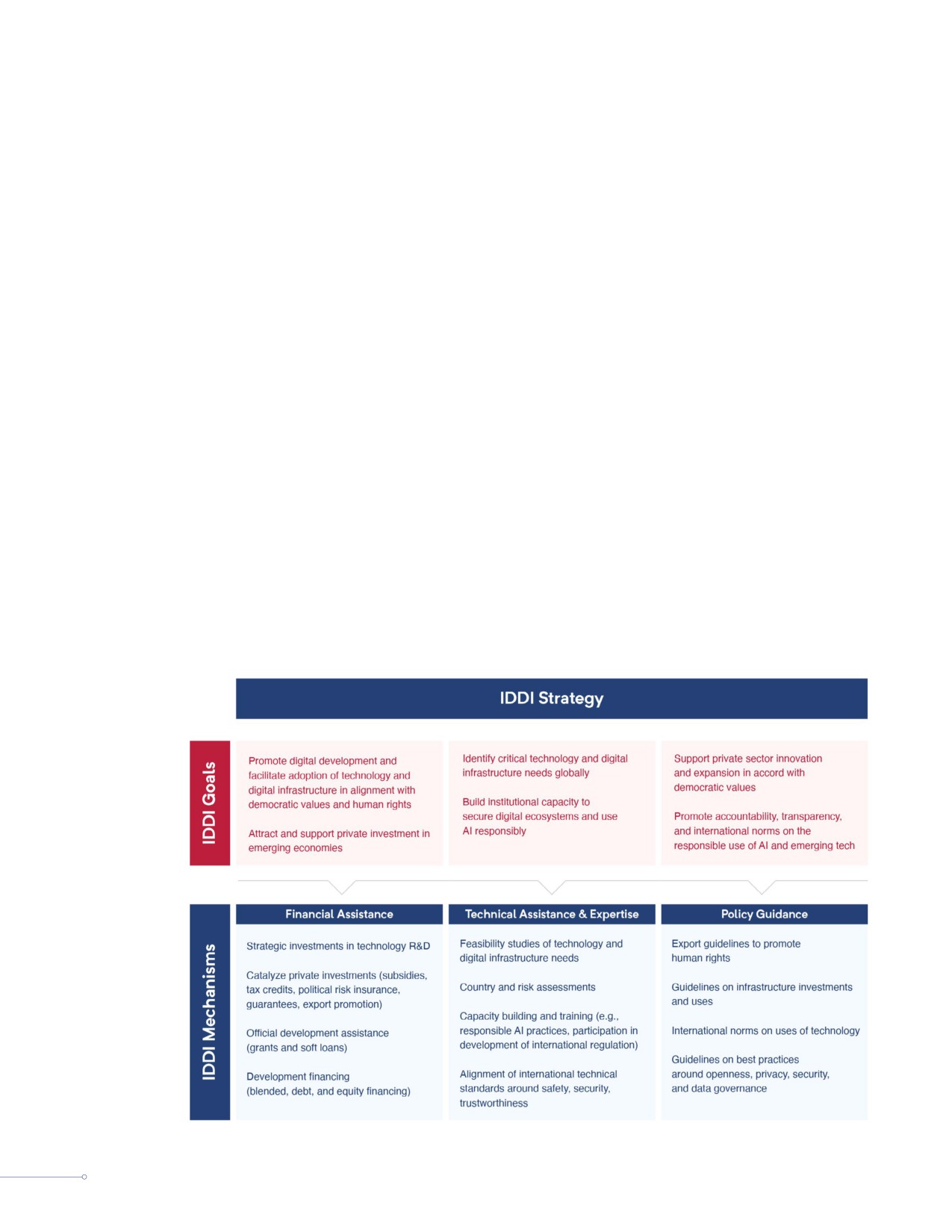
BLUEPRINT FOR ACTION: CHAPTER 15
• Coordinate partner-state approaches to adopting and governing digital technologies;
• Mobilize coalition efforts to provide alternatives (through funding assistance, technology
development, and private-sector investment) to digital infrastructure and AI/machine
language (ML)-enabled technologies that are used for illiberal ends and to promote
technologies that enhance democratic participation, human rights, and the rule of law;
and
• Facilitate adoption of secure, reliable, and trusted digital infrastructure, AI/ML-enabled
technologies, and information and communications technology (ICT).8
Actions for the United States and Allies and Partners:
• Coordinate national strategies that articulate involvement in IDDI.
o The United States and IDDI partners should take steps to coordinate the
development of national strategies for IDDI involvement. By focusing on developing
and investing in democratically aligned digital technologies and supporting digital
development, infrastructure, and capacity-building projects, national strategies for
IDDI should further the overarching goals of the ETC. The figure below provides an
overview of the IDDI.
o The Commission recommends that IDDI partners seek to align national strategies
around common guidelines for investment strategies, critical technologies, policy
guidance, and export promotion. A public diplomacy plan and associated resources
should also be prominent within each national strategy given the importance of
promoting a positive, unified message on the benefits and importance of IDDI.
Overview of
IDDI Strategy.
p
521
A FAVORABLE INTERNATIONAL TECHNOLOGY ORDER
•
Conduct an assessment of the global digital development landscape.
o IDDI partner states should convene with representatives from development
agencies and international financial institutions (IFIs) to conduct an assessment of
digital connectivity and the global digital development environment to guide IDDI
activities.9
o The Commission proposes that this assessment include:
■
A global risk evaluation of state-sponsored policies, financing and investment
tools, surveillance technologies, and other mechanisms that erode privacy and
civil and human rights. This evaluation would inform IDDI priorities.
■
Identification of technologies or technological features to promote through
IDDI activities, incorporating some or all of the following:
• privacy protections, such as privacy-preserving ML, eyes-off ML, advanced
encryption, and secure multi-party computational models10;
• protections against unwanted bias in data and inferences;
• restrictions on the use of certain applications to prevent the potential
infringement on civil and human rights;
• data storage and access restrictions, to prevent access from third parties,
multiple government agencies, and foreign governments;
• secure, reliable AI tools and digital infrastructure;
• tools and infrastructure to support “green” initiatives, including smart grids;
and
• tools for local populations to counter authoritarian, social-control uses of
AI.
■
Identification of best practices within IDDI members and existing initiatives that
provide solid foundations to build upon and develop at scale. The IDDI should
capitalize on the unique capabilities and resources of individual IDDI partner
states.
• See Table 2. International Digital Development Programs (located at the
end of this Plan) and the figure below.
p
522
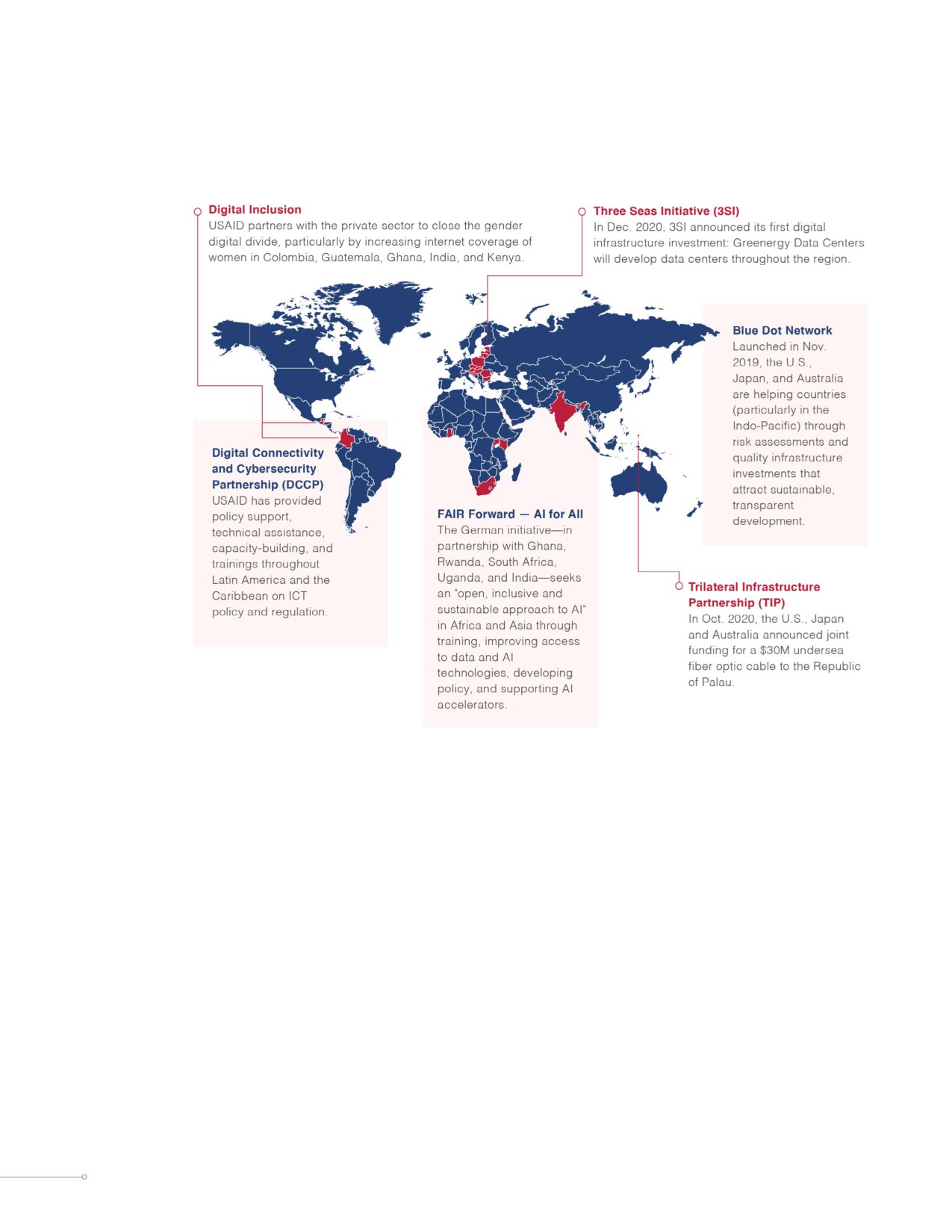
BLUEPRINT FOR ACTION: CHAPTER 15
Models for International Digital Democracy Initiative
The following examples of efforts to develop, promote, and fund the adoption of
secure, trusted, and open digital ecosystems can serve as models for IDDI projects.
Models for
International
Digital Democracy
Initiative (IDDI).
Women’s Global Development and Prosperity (W-GDP) Fund Announces $122 Million in Progress
and Partnerships, USAID
(Sept.
3,
womens-global-development-and-prosperity-fund-announces-122m-progress-partnerships;
Digital
digital-development/digital-connectivity-cybersecurity-partnership; Press Release, U.S. Embassy
Chile, U.S. Support for Digital Transformation in Latin America and the Caribbean (Nov. 10, 2020),
https://cl.usembassy.gov/u-s-support-for-digital-transformation-in-latin-america-and-the-caribbean/;
The Three Seas Fund Makes Its First Digital Investment, Three Seas Initiative Investment Fund (Dec.
2,
2020), https://3siif.eu/news/the-three-seas-fund-makes-its-first-digital-investment; FAIR Forward
-
Artificial Intelligence for All, Deutsche Gesellschaft für Internationale Zusammenarbeit (GIZ) GmbH
(June
2020),
E050620-1.pdf; The Launch of Multi-Stakeholder Blue Dot Network, U.S. International Development
Finance Corporation
(Nov.
4,
stakeholder-blue-dot-network; Blue Dot Network, U.S. Department of State (last accessed Feb. 16,
2021), https://www.state.gov/blue-dot-network/; Fact Sheet, U.S. Department of State, The United
States Partners with Australia and Japan to Expand Reliable and Secure Digital Connectivity in Palau
(Oct.
29,
to-expand-reliable-and-secure-digital-connectivity-in-palau//index.html; Press Release, Australian
Infrastructure Financing Facility for the Pacific, Australia Partnering with Japan and the United States
to Finance Palau Undersea Cable (Oct. 28, 2020), https://www.aiffp.gov.au/news/australia-partnering-
japan-and-united-states-finance-palau-undersea-cable#:~:text=This%20project%2C%20valued%20
at%20approximately,Japan%20and%20the%20United%20States.
p
523
A FAVORABLE INTERNATIONAL TECHNOLOGY ORDER
•
Determine investment guidelines for technology development and digital
development projects and support alignment through OECD.
o Investment decisions into the development of specific technologies and funding
of various digital development projects should be guided by the outcome of the
assessment and agreed-upon digital development and AI use principles. These
include:
■ G20 Principles for Quality Infrastructure Investment 11;
■ Principles for Digital Development, used by USAID to guide digital foreign
assistance efforts12;
■ Criteria for Security and Trust in Telecommunications Networks and
Services, developed by the Department of State, the Center for Strategic and
International Studies, and outside experts, and used by the Blue Dot Network13;
■ OECD’s Recommendation on Digital Security of Critical Activities14;
■ the forthcoming OECD Principles on Trusted Government Access to Data;
■ OECD Guidelines for Multinational Enterprises15; and
16
■ UN Guiding Principles on Business and Human Rights.
o IDDI members should also work with the OECD to standardize AI and digital
development assistance through the creation of a dedicated “Digital Development”
purpose code.
■ A dedicated purpose code, monitored by the OECD’s Development Assistance
Committee (DAC),17 will demonstrate international resolve, facilitate
coordination, enable the OECD and other entities to monitor funding in digital
development activities, and consolidate data to inform IDDI strategic decision-
making.
•
Develop guidelines for the use of technologies within the IDDI.
o The risk assessment should lead to the development of guidelines for the use of AI/
ML-enabled applications and surveillance technologies.
■ This effort should build on several foundational documents, including the
OECD AI Principles18 along with NSCAI’s Key Considerations for Responsible
Development & Fielding of Artificial Intelligence,19 which provide operational
guidance for the responsible and ethical development and use of AI in
engineering practices, system performance, human-AI interaction, and
accountability and governance.
•
Develop export promotion and control principles and coordinate adoption by each
partner state.
o IDDI nations should establish priorities for export promotion and R&D activities to
promote technologies that comport with shared democratic values and support free
and open societies. These priorities may expand upon OECD guidelines and new
U.S. Department of State guidelines on surveillance due diligence (see below on
Promoting Democracy through Export Controls), to incentivize companies against
transactions that could result in misuse of technology by government end users.20
p
524
BLUEPRINT FOR ACTION: CHAPTER 15
• Expand public- and private-sector investments by exploring the creation of a joint
investment fund and incentives for private investment.
o IDDI members should consider creating a joint investment fund—with a dedicated
investment manager—ŧo support IDDI projects. Such a fund could be modeled on
the Three Seas Initiative Investment Fund (3SIIF). See Table 2. International Digital
Development Programs (located at the end of this Plan).
o As public-sector investment is unlikely to achieve the scale necessary to realize
IDDI goals and safeguard IDDI partner states’ collective security,21 IDDI partners
should seek to catalyze at least $20 billion in private-sector investment.
o IDDI members could explore incentives for private-sector investment in critical
emerging technologies, particularly in the Indo-Pacific, Latin America, and other
regions with strong growth potential. Policies to explore include tax incentives
and subsidies, communication of IDDI priorities to the private sector, highlighting
private-sector investments and practices that advance IDDI goals, and increased
taxes on profits made from strategic competitors’ publicly traded companies.22
• Execute a coordinated strategic messaging and awareness campaign.
o The success of the IDDI will depend not only on coordinated investment and
assistance activities, but also on the ability of IDDI members to effectively
and strategically communicate the objectives to world leaders, international
organizations, and the public.
Recommendation
Recommendation: Develop and Implement a Comprehensive U.S. National Plan to Support
International Technology Efforts
The ISTS should include an integrated government-wide plan for coordinating the tools
of U.S. foreign policy to advance the ETC, the IDDI, and stand-alone projects. This plan
should leverage technical expertise, foreign assistance, development financing and
investment, policy guidance, and export controls in support of three core goals:
1. Shaping international technical standards on AI and related technologies;
2. Implementing a coordinated U.S. policy for the IDDI; and
3. Promoting transparency and accountability through export controls.
Component 1: Shape International Technical Standards
The United States and its allies should lead the way on international technical standardization
for AI. U.S. government-led dialogue with U.S. industry, as well as democratic allies, can
help overcome information asymmetries and clarify objectives for technical standards on
AI that foster economic growth, protect consumers, and safeguard democratic values.
Partnership and information-sharing between the U.S. government, industry, and academia
is critical to ensure protection of national security concerns involving standards and the
neutrality of international standards-setting bodies.23
p
525
A FAVORABLE INTERNATIONAL TECHNOLOGY ORDER
Action for the President:
•
Issue an Executive Order to support international technical standardization.
o As detailed in NSCAI’s Interim Report and Third Quarter Recommendations, the
President should issue an executive order24 that would:
■
establish an interagency coordination task force for sharing threat information
and identifying U.S. national security interests related to AI technical
standards, and related standards such as international data science standards,
to be led by NIST with membership from the Departments of State, Defense,
Energy, Commerce, and Homeland Security, the Office of the Director of
National Intelligence, and USAID;
■
direct the interagency task force to improve partnership and collaboration with
industry and academia;
■
direct the interagency task force to consult with relevant congressional
committees and develop a work plan with congressional appropriators on
the necessary resources and full-time equivalents necessary to support U.S.
leadership in international technical standardization;
■
direct federal agencies to resource and support focused research, test, and
evaluation and regular and active participation by the U.S. Government in
international standards-setting activities;
■
require the Director of NIST and the Standards Coordinator to encourage the
private sector to create a Standardization Center to improve sharing of best
practices and other information relevant to standards development, as well as
support focused research coordination; and
■
establish a federal advisory committee with experts from the private sector and
academia to provide strategic guidance to the interagency coordination task
force on international technical standards.
Action for the Department of Commerce:
• Coordinate technical standards-development activities government-wide through
NIST leadership of the interagency task force.
o The development of international standards for AI and emerging technology
should be incorporated into the overarching ISTS. Within the U.S. government, this
process must continue to be led by NIST with active participation of agencies in the
coordination task force described above.
o The Commission has proposed a comprehensive plan for NIST and other U.S.
departments and agencies to ensure that the development of international
technical standards receives greater attention and resourcing to ensure that U.S.
national security interests, including the promotion of technologies that comport
with democratic values, are advanced in standards-development organizations.25
o NIST and other agencies should consider the Commission’s Key Considerations for
Responsible Development and Fielding of AI in assessing positions on technical
standards.26
p
526
BLUEPRINT FOR ACTION: CHAPTER 15
• Convene a federal advisory committee to inform strategy on international
standards.
o As noted above, the proposed Executive Order would create a federal advisory
committee to provide the interagency task force with expert guidance to inform U.S.
government strategy on international technical standards.
o Members of the advisory committee should be drawn from the private sector and
academia and should be selected by the interagency task force for their expertise in
emerging technologies, geopolitical analysis, global economic trends, and similar
fields.
o The Commission envisions that this advisory committee, by focusing on strategic
geopolitical issues around international technical standards, would serve a function
not currently fulfilled by other advisory groups and the industry organizations that
coordinate U.S. positions before international standards bodies.27
o The advisory committee should have a forward-looking mandate to contribute
to U.S. government strategy on a range of emerging technologies—including
technologies involved in genomics, digital currency, biopharma production, and
others.
o NIST and the Department of State should ensure that members receive appropriate
clearances to facilitate exchanges of classified information necessary to the
development of U.S. strategy.
Action for the Departments of Commerce and State:
• NIST, with assistance from the Department of State, should coordinate technical
standards-development activities internationally.
o In addition, NIST, working closely with the Department of State—ideally, in the
context of the ETC and the IDDI—must prioritize engagement with democratic
nations to align positions on standards critical to mutual security and defense
and ensure those positions are reflected in deliberations of technical standards-
development organizations.
o The Department of State’s Regional Technology Officers can serve as conduits for
this alignment (see below on “Reorient U.S. Foreign Policy and the Department of
State”).
Actions for Congress:
• Provide appropriate funding to NIST and other U.S. departments and agencies to
support international technical standardization efforts.
o As the Commission has recommended,28 Congress should provide funds sufficient
to support at least six full-time equivalent personnel at NIST and at least one full-
time equivalent each at the Departments of State, Defense, Homeland Security,
and Energy; the Office of the Director of National Intelligence; USAID; and other
agencies as may be appropriate. These personnel will support NIST’s AI Standards
Coordinator, support focused research, and undertake other responsibilities
p
527
A FAVORABLE INTERNATIONAL TECHNOLOGY ORDER
necessary for technical standardization, such as participating in standards-
development organizations.
•
Provide appropriate funding, and grant-issuing authority, for the Department of
State to ensure international leadership in developing technical standards.
o As the Commission has recommended,29 the Department of State must be properly
resourced to fully engage in international forums, unions, and organizations focused
on developing standards for AI, associated technologies, and data. Congress
should provide a minimum of $5 million to support these endeavors, particularly the
recruitment and funding of U.S. academic scholars and researchers to participate
in these international forums. This action may require the creation of a new foreign
assistance fund and grant-issuing authority to a Department office.
•
Establish a grant program to enable small- and medium-sized U.S. AI companies to
participate in international standardization efforts.
o As the Commission has recommended,30 Congress should authorize a grant
program for small- and medium-sized U.S. AI companies to cover the high costs
of engaging in international standardization efforts, including conducting relevant
research, developing requisite skills and expertise, preparing standards proposals,
and attending technical standards-setting meetings. Their input enables greater
technological innovation, helps prevent potential high “switching costs” that may
impede their growth, and facilitates solution development for standards that impede
exporting by these small businesses.
o The Commission proposes that Congress appropriate an initial amount of $1 million
annually to fund grants issued by the Small Business Administration, in coordination
with NIST.
Component 2: Implement a Coordinated U.S. National Policy for the IDDI
A national policy for U.S. digital development efforts and involvement in IDDI will provide
high-level strategic vision and coordination necessary to:
• Advance the interests of the United States and its allies and partners in the development
and global adoption of AI/ML-enabled technologies and secure, trusted, and open
digital ecosystems that promote values critical to free and open societies;
• Elevate—across U.S. departments and agencies—ŧhe prioritization of digital
development necessary to advance U.S. interests and IDDI goals and reorient U.S.
development efforts for a digital age; and
• Strengthen U.S. foreign policy through significant appropriations for digital
development, increased resourcing and staffing, and expanded authorities for federal
departments and agencies, particularly the Department of State, USAID, and DFC.
p
528
BLUEPRINT FOR ACTION: CHAPTER 15
Actions for the ISTS Task Force:
• Develop, as part of the ISTS, a U.S. national strategy for promoting digital
technologies and supporting digital development, infrastructure, and capacity-
building.
o The ISTS should include a comprehensive and integrated approach to the foreign
assistance and development financing tools of the U.S. government. This will
enable coordinated U.S. participation in the broader IDDI effort and provide
a roadmap to more effectively using U.S. government resources to support
digital infrastructure development and democratic adoption of AI and emerging
technology.
o The strategy should also detail a strategic messaging and public awareness
campaign to expose violations of international standards and democratic norms by
authoritarian states.
o The figure below identifies critical U.S. stakeholders and their proposed role in the
government-wide effort. The Commission recommends development of agency-
specific plans to implement the strategy.
p
529
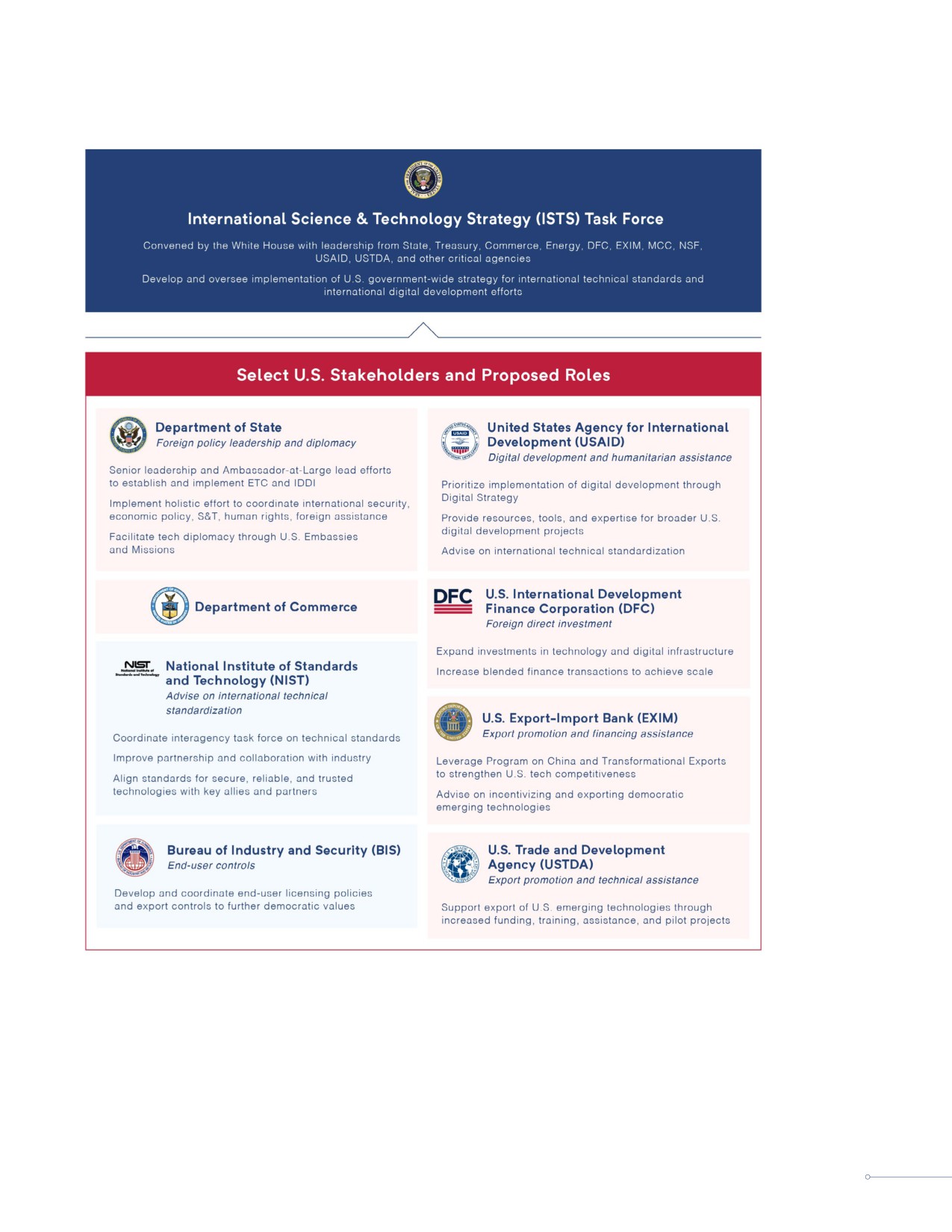
A FAVORABLE INTERNATIONAL TECHNOLOGY ORDER
U.S. National Plan to Support International Technology Efforts
U.S. National
Plan to Support
International
Technology Efforts.
NIST is non-regulatory agency of the Department of Commerce and BIS is a Bureau in the Department
of Commerce.
p
530
BLUEPRINT FOR ACTION: CHAPTER 15
• Conduct an assessment of existing programs across the U.S. government and
associated funding, staffing, and authorities of ISTS Task Force entities.
o The ISTS Task Force should conduct an early assessment to guide development of
this portion of the ISTS. The assessment should include:
■ An evaluation of current and recent interagency programs to identify best
practices and priority countries as well as data governance frameworks and
multilateral engagements on which more comprehensive efforts can be built.31
See Table 3. U.S. Digital Development Programs (located at the end of this
Plan).
■ An evaluation of authorities, appropriations, and personnel necessary to
achieve the objectives of the national strategy.32
o The ISTS Task Force should also consider addressing immediate needs for experts
in emerging technology issues through innovative public-private fellowship rotation
programs and intra-government details.
■ Personnel from CISA and the Defense Advanced Research Projects Agency
(DARPA), for example, can help on immediate needs at the Department of
State and USAID.
Action for USAID:
•
Prioritize implementation of the Digital Strategy and support urgent resourcing
and organizational needs.
o The USAID Digital Strategy33 is an ambitious and necessary five-year plan for
development and humanitarian assistance focused on promoting secure, trusted,
and open digital ecosystems and the responsible use of AI technologies.
■ Implementation has lagged due to insufficient funding, inadequate staffing,
and bureaucratic challenges. Currently, the Digital Strategy is administered by
the Technology Division within the Innovation, Technology and Research Hub
in the Bureau for Democracy, Development and Innovation (DDI).
o The Commission recommends that the USAID Administrator continue efforts to
transform the development paradigm by infusing a digital foundation across USAID
portfolios.34 To this end, the Administrator should prioritize the Digital Strategy by (1)
advocating for congressional appropriations to fund Digital Strategy programs (see
infra), (2) augmenting development staff with experts in AI, 5G and connectivity,
and cybersecurity, both at headquarters and in forward-deployed missions,
(3) converting the Technology Division into a formal Center within DDI, and (4)
prioritizing the inclusion of technology and digital across all development efforts.
o Immediate staff augmentation can be accomplished by enhancing existing
implementing partnerships with the private and non-profit sectors, through direct
hires, fellowship programs for researchers, and details from other federal agencies.
o Longer-term staffing needs would benefit from creating a foreign service backstop
from the recommended Center focused on digital expertise to strengthen USAID’s
ability to identify needs, assess risks, and execute on programmatic activities around
digital development.
p
531
A FAVORABLE INTERNATIONAL TECHNOLOGY ORDER
Action for DFC:
•
Expand formal relationships with international partners and private foundations to
expand the scope of DFC investments and connectivity projects through blended
financing arrangements.
o DFC’s Roadmap for Impact is a five-year effort to catalyze $75 billion—$25 billion
by DFC, $50 billion from the private sector—and provide technical expertise and
support to optimize development impact.35 The Roadmap for Impact proposes to
“elevate innovation and technology across at least 50% of the DFC portfolio” and
devote $5 billion for digital infrastructure projects and increasing internet access.36
o Current authorities limit DFC’s ability to invest in higher-risk transactions, which
presents challenges for scaling digital infrastructure projects, particularly in
developing countries.
■ DFC investments are scored under the Federal Credit Reform Act, and DFC
has limited budget authority for subsidy for equity financing ($150 million) and
debt financing and technical assistance ($30 million).37
■ DFC cannot provide concessionary lending, unlike China38 and peer
agencies, such as the Japan Bank for International Cooperation and European
Investment Bank, as well as the World Bank.39
o DFC should deepen its relationships with existing and new international partners to
expand the scope of its financing and equity investments in the digital development
space.40
o Similarly, DFC should expand partnerships with a broader range of non-
governmental entities to leverage its own appropriations through blended financing
arrangements that enable higher-risk investments.41
o This may include creating a digital technology fund42 that invests in developing
secure, trusted digital infrastructure, AI/ML-enabled technologies, and ICT with
technical features that comport with democratic values and ethical norms around
openness, privacy, security, and reliability.
Actions for Congress:
• Create an allocated Emerging Technology Fund for foreign operations and related
programs of USAID and the Department of State.
o The underfunding of U.S. digital foreign assistance and financing programs is
exacerbated by competition with other funding priorities and lack of a flexible
allocated budget.
o Congress should authorize an allocated budget account, the Emerging Technology
Fund, to facilitate holistic planning of digital foreign assistance, digital development
projects, emerging technology programs, and other ISTS activities.
o The Commission proposes that the allocated account include the requests for
additional, targeted appropriations for USAID and the Department of State.
o Existing digital-related programs could also be consolidated into the Emerging
Technology Fund.
p
532
BLUEPRINT FOR ACTION: CHAPTER 15
•
Appropriate $200 million annually to implement the USAID Digital Strategy.
o The Commission recommends Congress appropriate a minimum of $200
million annually to support implementation of the USAID Digital Strategy by the
Technology Division within DDI, with required funding likely multiples higher. The
funds should support programmatic activities as well as critical hiring needs.
o This amount builds on USAID’s FY 2021 request for $82 million,43 which includes
support for the Digital Ecosystem Fund,44 staff augmentation, and programmatic
activities.
•
Appropriate $300 million annually for the Department of State’s emerging-
technology programs.
o The Commission recommends Congress appropriate a minimum of $300 million
annually to support the Department of State’s emerging technology programs and
administrative needs and to build what is currently a small cross-Department group
of officials with expertise in emerging technology issues.
■ These funds should include the immediate request for supplemental
appropriations, described later in this Blueprint for Action, for $70 million
to address urgent diplomatic efforts, programs, and foreign operations in AI,
emerging technologies, and data.
■ Additional funding would support foreign assistance activities around
emerging tech and digital infrastructure, to include planning, assessments,
and provision of assistance. Funds would support targeted, digital programs in
several areas, including Department of State programs involving the rule of law
(INL), democracy and human rights (DRL), security cooperation (AVC, PM, ISN),
and technical assistance (EB, STAS, others).
•
Provide DFC with sufficient appropriations to strengthen development finance as a
tool for achieving national objectives.
o To improve the ability of the U.S. government to leverage the tools of development
finance and equity investments to further the ISTS mission, Congress should
provide DFC with $1 billion in flexible, programmatic funding to support digital
development projects.45
•
Increase DFC’s capacity for blended development financing through interagency
partnerships.
o Congress has restricted the appropriations available for USAID, MCC, and the
Department of State to partner with DFC in blended transactions.46 USAID and the
Department of State are limited to transferring $50 million overall—spread across
all projects, not limited to digital.47
o As DFC’s role in digital development investments increases, the need for funds
from the Department of State, USAID, and MCC will also increase, requiring an
equivalent increase in funding to support USAID, State, and MCC digital and AI-
related efforts that may be tabled to enable a transfer of funds to DFC.48
o The Commission proposes that Congress appropriate a total of $200 million to the
Department of State, USAID, and MCC to be used for DFC investment programs.
•
Appropriate funds to support critical personnel needs at DFC.
p
533
A FAVORABLE INTERNATIONAL TECHNOLOGY ORDER
o Congress should appropriate funds sufficient for DFC to increase its forward-
deployed personnel, located in regions in which DFC invests.
■ Currently, 98% of DFC staff is based in Washington, D.C. This puts DFC at
a disadvantage vis-à-vis foreign development finance institutions (DFIs). By
comparison, DFC estimates that peer DFIs have roughly four times the number
of staff and base them predominantly in low- and lower-middle-income
countries.49
Component 3: Promote Transparency and Accountability Through Export Controls
ISTS objectives will be furthered by the U.S. government’s ability to harness the power of
the U.S. private sector. A critical tool for achieving this involves incentivizing the export of
technologies that align with democratic values.
Action for the Departments of Commerce and State:
•
Develop end-user licensing policies and export controls as part of the ISTS.
o The Department of Commerce, through the BIS, should use targeted end-use
controls and human rights due-diligence reporting requirements to prevent
and deter U.S. firms from enabling problematic government end uses of AI and
associated technologies.50
■ BIS should build on its 2020 request for public comments on ways to
strengthen controls and monitoring of advanced surveillance systems—this
area could be explored to prevent the use of compute-intensive technologies
for human rights abuses while furthering the promotion of democratic-aligned
technology. Regulations issued in October 2020 provide BIS with discretion to
deny export licenses for products that could be used to violate or abuse human
rights.51
■ Coordinated with the ISTS Task Force, these stronger export control rules can
promote the ethical and responsible use of AI among U.S. firms, set standards
for global industry, and counter abuses of human and civil rights.
o The Department of State, through the Bureaus of Democracy, Human Rights and
Labor (DRL), International Security and Nonproliferation (ISN), and Political-Military
Affairs (PM), should expand upon its recently issued framework to guide businesses
in assessing risks of human rights abuses when exporting surveillance equipment,52
while bolstering the promotion of democratic values.
o In coordination with the Department of Commerce, the Department of State
should expand data collection and analysis of human rights abuses associated with
emerging technologies and authoritarian digital practices.53
p
534
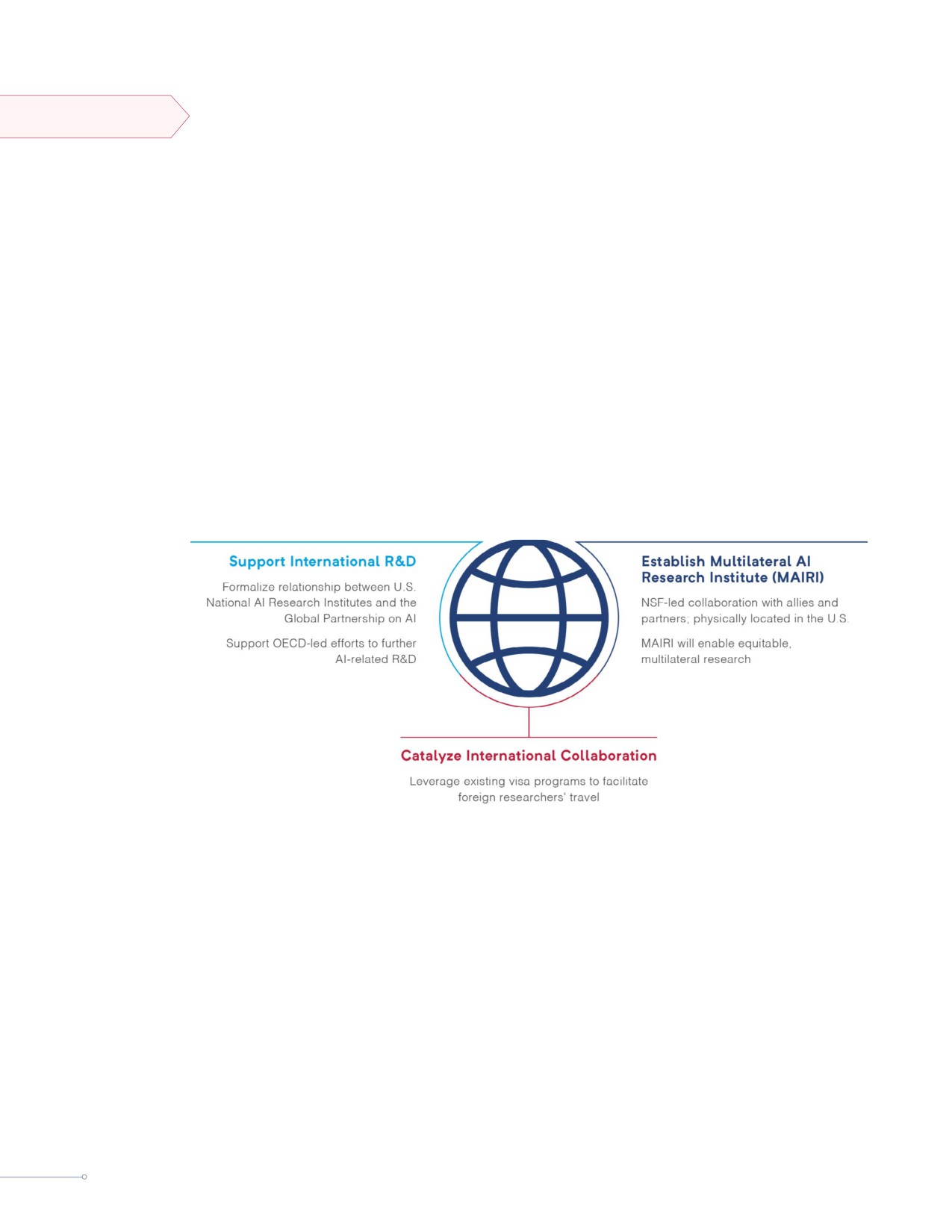
BLUEPRINT FOR ACTION: CHAPTER 15
Recommendation
Recommendation: Enhance the United States’ Position as an International Emerging
Technology Research Hub
The third component of the ISTS is to enhance the role of the United States as an
international emerging technology research hub. The goals are to:
• Facilitate U.S. government contributions to collaborative initiatives and technical
standards, such as Global Partnership on AI (GPAI)54 and digital projects of the OECD;
• Strengthen the talent of the United States, allies, and partners by investing in people
through workforce development, mentorship, and exchange programs facilitated
through the recommended Multilateral AI Research Institute (MAIRI);
• Foster collaborative research relationships and pool research resources for the
development of technologies (particularly in civilian applications) that comport with
democratic values and address gaps in commercial R&D, including joint research in
privacy-enhancing technologies; and
• Enable the U.S. and allies to overcome current regulatory challenges currently
inhibiting collaboration, particularly in Europe, such as data-sharing restrictions and
liability agreements.
Components of
International Digital
Research HUB.
Component #1: Support International Digital and AI R&D
International efforts, like the GPAI and the OECD’s AI and digital initiatives, are critical
forums for facilitating alignment among like-minded countries on advancing the responsible
and human-centric development and use of AI. Research undertaken by the National AI
Research Institutes—run by the NSF and other U.S. agencies—and by other programs
across Federal departments and agencies, is an incredible resource that should support
these key international efforts and advance AI and digital goals of the U.S. and like-minded
partners.
p
535
A FAVORABLE INTERNATIONAL TECHNOLOGY ORDER
Actions for the Department of State, OSTP, and NSF:
•
Formalize a “center of expertise” relationship with the Global Partnership on
Artificial Intelligence (GPAI).
o NSF should evaluate candidates to serve as a U.S. center of expertise for GPAI. NSF
should submit a recommendation to the Director of OSTP to guide negotiations with
GPAI.
■ NSF should consider candidates from among its AI-related awardees,
including the National AI Research Institutes or by establishing a coordination
hub of all Institutes. NSF should also propose methods for leveraging other
U.S. science and research agencies, such as the Department of Energy and
NIST, to support the center of expertise.
o In coordination with the Department of State and OSTP, NSF should negotiate a
memorandum of understanding between NSF and GPAI to formalize the center’s
support of GPAI working groups.55
•
Increase support to the OECD’s AI and digital efforts.
o The U.S. government should expand its collaboration with the OECD’s AI initiatives,
including those of the Directorate for Science, Technology and Innovation and the
AI Policy Observatory.56 The Commission proposes an expanded relationship in
three ways:
o First, NSF should explore methods to support OECD’s “Going Digital” program57 to
promote data sharing among partner nations.
■ Input should include pilots on cross-border data flow measurement,
taxonomies to compare countries’ data initiatives, or data governance policies.
o Second, the Department of State, OSTP, and NSF should look for opportunities to
align with allies and partners through the OECD on data guidelines, in particular
by promoting value-based best practices for collecting (e.g., with consent and
contributor controls), documenting (e.g., to support responsible use and quality),
using data in R&D (e.g., with transparency), and then making data used in published
research available to the broader research community (e.g., for reproducibility).
o Third, OSTP should work with the OECD to formalize a “network of research
nodes” to coordinate AI and digital-related efforts and R&D centers worldwide.
Policymakers and researchers would greatly benefit from a global information
platform that enables easier understanding of the various AI and related initiatives
and ongoing research efforts.
Action for Congress:
• Provide administrative funding to support U.S. research contributions to GPAI.
o The centers of expertise that support GPAI also provide administrative and
secretariat-like assistance (e.g., planning of GPAI plenaries). Congress should
therefore provide additional resourcing to NSF to support the center’s development,
administrative staff, and resourcing to leverage research from NSF’s AI portfolio,
including the National AI Research Institutes, and from other U.S. departments and
agencies as needed.
p
536
BLUEPRINT FOR ACTION: CHAPTER 15
o The Commission recommends a minimum of $3 million over a three-year period.
Component #2: Establish the Multilateral AI Research Institute (MAIRI)
The Multilateral AI Research Institute (MAIRI) will provide a model for equitable, multilateral
research, facilitate AI R&D that builds on like-minded countries’ strengths, and develop the
next-generation global AI workforce. With a physical center located in the United States
with a virtual presence, MAIRI will enable collaborative research among key allies and
partners and contribute to a broader effort—reflected in the Emerging Technology Coalition
and IDDI—ŧo preserve free and open societies, win the global technology competition,
and foster AI innovation in a manner that comports with democratic values. Ultimately, to
further these objectives, MAIRI should seek to facilitate a federated network of research
institutes across the globe and with national labs and university hubs.
Actions for the NSF:
•
Establish MAIRI in the U.S. and support involvement of U.S. researchers in MAIRI.
o NSF should establish MAIRI, modeled on the Banff International Research Station.58
MAIRI should have a physical center in the United States, as well as a virtual
presence. NSF should provide MAIRI with all staff necessary to ensure its success.
■ Although NSF does not require further authorities to establish MAIRI,
legislation could facilitate this process (see actions for Congress).
o MAIRI should be designed with sufficient flexibility to enable involvement by
researchers from industry, academia, and research institutions and philanthropies
on a project-by-project basis; other U.S. departments and agencies, like the
Department of Energy, may be critical for leveraging the entire U.S. R&D ecosystem.
o NSF programs through the Office of International Science and Engineering (OISE)
can support MAIRI by facilitating involvement of U.S. researchers.
■ AccelNet59 can fund the travel, virtual networking and other activities
necessary to support research projects between research networks.
■ MULTIPLIER60 may support subject-matter experts’ travel to identify
collaboration opportunities with founding members or with countries that are
considering joining MAIRI.
•
Identify key allies and partners to be MAIRI founding members.
o NSF, in close coordination with the Department of State, should identify and
negotiate involvement of founding members.
o The Commission recommends that founding members include Australia, Canada,
France, Germany, Italy, Japan, New Zealand, South Korea, and the United Kingdom.
■ These countries have existing agreements and collaborative relationships with
the United States that could be more readily leveraged to develop the center.
They also have extensive research capabilities and share values and interests
with the United States.
p
537
A FAVORABLE INTERNATIONAL TECHNOLOGY ORDER
o Expansion to include additional allies and partners should be prioritized; for
example:
■ European Union involvement should be a priority; however, the EU’s inclusion
in MAIRI will depend on the ability to overcome disagreements between the
EU and United States over governing law, liability, funding, data sharing, and
intellectual property.
■ Involvement by India should also be prioritized as MAIRI develops, building on
the Commission’s recommended U.S.-India Strategic Tech Alliance.
•
Develop research integrity principles with MAIRI’s founding members.
o Founding members would agree to a jointly determined Principles for Multilateral
AI Research, which would be founded on the importance of research integrity.
Principles may include the need for transparency, particularly in disclosing funding
and international connections; the necessity for open data and data sharing; the
development of risk-benefit frameworks; and the use of merit-based competition
reviews of research proposals.
o Members would also receive training on security risks and agree to use trusted
infrastructure as part of founding principles (see recommended appropriations in
actions for Congress).
o The agreement will also detail the terms for handling intellectual property, sharing
data, governing law and liability, and funding.
•
Develop a concrete research agenda with MAIRI’s founding members.
o Once founding members have agreed to the Principles, they will determine focus
areas and initiatives. Countries will fund the involvement of their researchers in
joint projects. Joint research projects will occur through virtual spaces as well as at
partner entities like research institutions and universities that receive funding from
MAIRI. The facilities of other participating departments and agencies may also be
used.61
o Research Priorities: Projects should be chosen to leverage members’ comparative
advantages, enabling participants to learn from partner researchers. Examples of
R&D priorities are provided in the Emerging Technology Coalition Annex to this
Blueprint for Action. Priorities should include:
■ Building shared, secure compute resources (including high-performance
computing [HPC], cloud, and quantum computing),62 including joint
benchmarking projects and data-sharing, pooling, and storing initiatives
founded on commonly agreed upon principles that ensure trust, privacy, and
security.
■ Privacy-preserving AI/ML technologies, including technologies like federated
learning and on-device prediction that enable remote execution, encrypted
computation through multi-party computation and homomorphic encryption,
and differential privacy.
■ Developing smart-city technologies, aligned with democratic values,
that promote sustainability as well as norms that should guide standards
development at bodies like the ITU and technical standards bodies.
p
538
BLUEPRINT FOR ACTION: CHAPTER 15
• Coordinate with MAIRI founding members on funding, international agreements,
and governance structures.
o Although the United States should fund the initial startup costs, including
acquisition of MAIRI’s physical center, staff, and virtual research/networking
infrastructure (see recommendations to Congress below), each member should
thereafer provide proportionate financial contributions to MAIRI’s R&D and to the
participation of their researchers in MAIRI-sponsored workshops and conferences63
modeled on the approach used by the Banff International Research Station.64
o For ongoing operations, MAIRI should explore the potential to develop an
endowment, modelled on the three US-Israeli binational funds. This approach
would facilitate the use of philanthropic donations to support MAIRI.
o Umbrella international AI/S&T agreements—negotiated with NSF, MAIRI members,
and U.S. agencies—will facilitate cooperation among allies and partners beyond
MAIRI.
o Once established, MAIRI may support GPAI and other international efforts. MAIRI
should also pursue research agreements with other centers of excellence and
research centers focused on AI R&D to create a federated network of research
institutes throughout the globe.
o MAIRI members should also determine how they will determine expanding MAIRI’s
membership, particularly to the European Union and India.
Action for Other U.S. Departments and Agencies:
• Support the establishment of MAIRI and its R&D.
o NSF will be the U.S. anchor partner for MAIRI. Its success requires leveraging the
entire U.S. R&D ecosystem and government research entities.65 The Departments of
Energy and State as well as NIST, in particular, should be critical partners.
o The Department of Energy should leverage its national labs, history of working
with industry, immense technical capabilities, experience on applied research, and
expertise in HPC and quantum computing.
o The Department of State should provide foreign policy expertise and diplomacy,
including by assigning a dedicated Foreign Service Officer to support the creation of
MAIRI as well as identification of beneficial projects.
o Other federal entities, including the National Institutes of Health, the National
Oceanic and Atmospheric Administration (NOAA), and the Department of Health
and Human Services, will be critical for technical expertise and collaboration on
targeted research projects.
Actions for Congress:
• Pass legislation to formally authorize MAIRI.
o Although it’s not required for MAIRI’s establishment, Congress should pass
legislation that formally authorizes the creation of MAIRI and clarifies the authorities
p
539
A FAVORABLE INTERNATIONAL TECHNOLOGY ORDER
of other executive agencies to award funding to MAIRI. This will serve as a signal of
the importance of international AI collaboration and ensure that NSF and partner
agencies have sufficiently robust authorities to achieve its objectives.
o Legislation should also specifically authorize and direct NSF, in coordination with
the Department of State, to create a trusted learning cloud and associated compute
capacity to facilitate international collaborative research.
■ The trusted learning cloud would enable access to needed resources,
compute, and data for shared innovation and development of data-sharing
standards that could be a model for a larger international data-sharing
framework.
•
Support the establishment of MAIRI through appropriate funding to NSF and other
critical agencies.
o The Commission recommends Congress appropriate a minimum of $60,750,000
for a five-year period, which will be supplemented by contributions from
international partners.
o The proposed appropriations are as follows:
■
$10 million per year for five years to NSF and other critical agencies (such as
the Departments of Energy and State) for research initiatives.
■
$2 million per year for five years to NSF for establishing and maintaining the
physical center located in the United States, its associated infrastructure, and
administrative operations.
■
$150,000 per year for five years to NSF to support U.S. researchers’ travel and
associated expenses to partake in MAIRI’s workshops, conferences, and other
events at the physical center.
o The Commission recommends Congress appropriate $11.25 million per year for
research initiatives dedicated to creating a trusted learning cloud and associated
compute capacity to facilitate international collaborative research.
•
Create an endowment for MAIRI to support ongoing funding.
o MAIRI may wish to develop an endowment fund similar to the U.S.-Israeli binational
foundations. If pursued, Congress should authorize this endowment fund and
support an initial U.S. investment. Additional appropriations would be required to
support a MAIRI endowment fund secretariat.
Component #3: Expand Talent Exchanges
The United States must attract talent to collaborative research endeavors at both the
National AI Research Institutes and MAIRI. Sustained, strong collaboration between
MAIRI partners is critical to ensure that responsible, secure, human-centric AI prevails
over authoritarian AI. Shoulder-to-shoulder research and talent exchanges are invaluable,
enabling researchers to build relationships, learn from each other, exchange ideas, and
spark future collaborations.
p
540
BLUEPRINT FOR ACTION: CHAPTER 15
Action for the Department of State:
• Leverage O and J visa programs to attract skilled researchers to support MAIRI and
international talent exchange programs.
o The Department of State, in coordination with the Department of Homeland
Security, should leverage the O and J visa programs to facilitate foreign researchers
to travel to the United States to work collaboratively with researchers from the
United States and other nations.66 There are no statutory caps on the number of
visas issued under these programs.67
Recommendation
Recommendation: Reorient U.S. Foreign Policy and the Department of State for Great
Power Competition in the Digital Age
In the near term, it is imperative to establish a Department of State focal point for emerging
technology policy and expertise and resourcing through steps the Commission proposes
below. In the longer term, the United States must fundamentally reorganize the structure,
focus, and culture of the Department of State to advance American interests at the
intersection of democracy, technology, security, commerce, and human rights.68 Without
high-level support in the Department, technology competition is unlikely to become a core
aspect of U.S. foreign policy.
Action for the President:
• Disseminate a Presidential letter of instruction to Chiefs of Mission that articulates
emerging technology as inseparable from U.S. core geopolitical interests.
o The instruction should direct each Chief of Mission to develop an emerging
technology plan as part of its mission strategy submitted to the Secretary of State.
Actions for the Department of State:
• The Secretary of State should direct the Deputy Secretary of State for Management
and Resources (D/MR) to lead on reorienting and reorganizing the Department for
technology diplomacy.
o The D/MR position has in the past exercised leadership to oversee significant
organizational and resourcing priorities across the Department of State.
■ Past officials in the D/MR position have spearheaded U.S. diplomatic priorities
around regional policy (such as the U.S.-Pakistan Strategic Dialogue), foreign
assistance, civilian response, and international economic issues.
o D/MR should provide direction around immediate and long-term planning to
coordinate disparate offices and bureaus within the Department of State, develop
technological expertise at all levels of the Foreign and Civil Service, and ensure
that policy direction is aligned with management, personnel, and resource actions
needed to achieve reorientation with urgency and sustainability.
o D/MR should also provide leadership for executing the ISTS.
p
541
A FAVORABLE INTERNATIONAL TECHNOLOGY ORDER
•
Generate a comprehensive proposal for immediate funding needs with a request to
Congress for supplemental appropriations.
o The Department of State should prepare and submit to Congress within 60 days
a request for immediate funding needs to address personnel shortages and
programmatic efforts to further U.S. diplomacy around emerging technology. The
Department should seek funding through supplemental appropriations to avoid lags
in the budget cycle.
•
Expedite building out a dedicated bureau for emerging technology diplomacy.
o The Department of State should expedite and prioritize efforts to staff, resource, and
build out a bureau for emerging technology diplomacy.
o The Bureau of Cyberspace Security and Emerging Technologies (CSET Bureau),
formally approved in January 2021,69 is intended to focus on security challenges
associated with cyberspace and emerging technologies.70 The Commission
proposes that the CSET Bureau be established with a broad aperture to address
diplomatic efforts across the security, economic, human rights, and regional
dimensions of foreign policy. It should serve as a clearinghouse to assess strategic,
budgetary, and personnel priorities on emerging technology policy across the
Department. The Bureau should have responsibilities for managing high-level
dialogues with allies and partners to further progress and cooperation, coordinating
policy, standards, and digital development assistance with U.S. agencies, and
promoting AI and emerging technology advocacy within the Department.
o The Department should assess where the CSET Bureau should be placed to best
achieve those objectives, but must ensure that its creation is not further delayed.
o The Bureau should be led by a high-profile Assistant Secretary or Ambassador-at-
Large. If the Department appoints an Assistant Secretary to head the Bureau and
lead coordination across the Department, it should consider creating a separate
Ambassador-at-Large position to lead diplomacy with foreign counterparts on
cybersecurity and emerging technology.
•
Develop a comprehensive plan to reorganize technology diplomacy under a new
Under Secretary.
o The Department of State should develop a comprehensive proposal to establish
an Under Secretary for Science, Research and Technology (Q). State/Q would
bring together the elements for a robust, coordinated approach to science and
technology diplomacy in the context of great power competition—with a focus on
emerging technology.71
■ State/Q would also work with the Director for Foreign Assistance to manage a
new allocated account for digital democracy and emerging technologies and
lead implementation of the ISTS across the U.S. government.
o The plan should also consider establishing Deputy Assistant Secretaries for Science
and Technology in each regional bureau. These positions would provide a critical
link between technology officers and senior leadership.
■ Currently the Department lacks a core of senior, career officials with deep and
broad technology policy expertise. The positions would provide a career path
to the senior level for officers focused on technology policy and would enable
senior-level advocacy for reforms needed to effectively manage technology
policy.
p
542