National Security Commission on Artificial Intelligence. Final Report - page 7
BLUEPRINT FOR ACTION: CHAPTER 6
Recruitment. Each node would be responsible for recruiting and screening its digital
experts. Notably, OMB would not be responsible for establishing qualification standards
for members of the NRDC. While volunteers would need to be able to pass a background
check and would not be employees of a foreign government (though they might be foreign
nationals), node leaders would be empowered to screen and select volunteers, and to
recruit experts from within NRDC for specific tasks. OMB would provide administrative
support, much like a human resources team in a private sector company.6
Project Selection. Projects would be selected in three ways:
• Selection by a node afer contact with a government client
• OMB would direct a node to take on a project
• Node leadership would approve individual projects driven by a perceived need that is
not tied to a request from a government client
Government clients would directly contact node leaders or OMB. Nodes would be
responsible for establishing relationships with government agencies and selecting projects,
but OMB would be responsible for ensuring that agencies’ requests are received and that
nodes contribute to NRDC’s mission and vision. Individual projects that are not driven by a
government client’s request would be pursued at the node leadership’s discretion.
Relationship with Government Agencies. Members of the NRDC would work with agencies
on a project-to-project basis, such as consulting for a specific project or teaching a specific
course. They would not have a commitment to work with the same agency consistently.
Government agencies would be responsible for paying for their projects, including the cost
for reservist time.
Relationship with Civilian Employers. Members of the NRDC and their civilian employers
would be bound by the same rules as the military reserve under the Uniformed Services
Employment and Reemployment Rights Act (USERRA).7 Members would be responsible for
identifying conflicts of interest and removing themselves as appropriate. Employers would
not be able to discriminate against members of NRDC, fire them, or delay promotions as a
consequence of spending time serving in NRDC.8 Implementation could take the form of
a legislative recommendation to modify USERRA or a proposal modeled after USERRA.
Incentivizing Reservist Participation. Civilian reservists in this program would benefit in
several ways. They would gain an opportunity to contribute to their country, do exciting,
meaningful work, and attain awareness of work and advances in a community that differs
from their own. They may also benefit from the following incentives:
• The government should create an NRDC scholarship program modeled afer
the Reserve Officer Training Corps. Universities would select students through a
competitive process to receive full tuition and study specific disciplines related to
digital technology. In return for accepting the scholarship, graduates would spend part
of their summers during school in government internships. Between their freshman
p
361
TECHNICAL TALENT IN GOVERNMENT
and sophomore years, students would spend six weeks becoming familiar with a range
of U.S. Government departments and agencies. Between their sophomore and junior
years, students would spend six weeks as an intern at a specific government agency or
office. Between their junior and senior years, students would spend another six weeks
interning at a specific agency or office. Upon graduation, scholarship recipients would
spend five years serving in the NRDC, beginning as a GS-7 and advancing to a GS-11
over the course of five years. Students would also begin the security clearance process
at least two years before graduating.9
• The NRDC should include a training and continuing education fund for all members.
The NRDC would pay up to $50,000 to each reservist to attend training and
educational opportunities related to AI or to pay for student loans. Educational
opportunities would include conferences, seminars, degree and certificate granting
programs, and other opportunities. An incentive explicitly tied to continuing education
would increase the perceived and actual competency of AI reservists. It would
also attract those with an active interest in continuing education, especially new
practitioners seeking to establish themselves.
How NRDC Would Work: An Example. The following is a hypothetical example of how the
NRDC would function. In this example, OMB would begin creating a node by selecting
a leader that would be trusted to establish and manage a team of reservists. OMB
selects “Jennifer,” a full-time government employee working within the NRDC division
of OMB, to lead a new NRDC node. Jennifer decides to organize her node functionally
rather than regionally. Using existing government tools and her professional contacts,
she recruits people from across the country, most of whom have backgrounds in health
care data management or recent graduates with degrees related to the field. She also
recruits from within the NRDC by posting open positions on online job boards. During the
recruitment process, OMB provides financial support for recruitment efforts, travel money,
and processes new reservist administrative paperwork, including security clearance
applications.
After the node is established and the team is in place, a government agency--in this
example, the Centers for Disease Control and Prevention (CDC)--realizes it has two digital
needs it cannot meet internally: improving a database and training their workforce in new
data management practices at the National Center for Chronic Disease Prevention and
Health Promotion. After reaching out to OMB, they determine that Jennifer’s node is the
best fit, and request assistance. After examining the request and her team’s workload,
Jennifer determines that she would support the CDC’s database improvement request
with a four-person team and support workforce training with a two-person team. The four-
person team spends 14 days examining the existing database and making updates to
the database. The two-person team spends 10 days on site at the National Center for
Chronic Disease Prevention and Health Promotion speaking with leaders and employees
about their data management needs and the current state of the workforce’s skill level,
developing curriculum, and teaching data management best practices.
p
362
BLUEPRINT FOR ACTION: CHAPTER 6
The teams Jennifer selects to support the CDC include Michael. Michael received a
four-year scholarship from NRDC to study computer science as an undergraduate. After
graduating three years ago, he began working full-time as a data analyst at a health care
company and working part-time on NRDC projects he coordinates with his node leader.
He also used his education stipend to pay for an online course from MIT last year. This
hypothetical shows that an NRDC can effectively increase the U.S. digital talent, connect
private-sector workers with a government agency, and create a pathway for that connection
to solve an actual problem.
Actions for Congress:
•
Pass legislation establishing the NRDC within OMB
o Grant OMB direct-hire authorities to hire node leaders and reservists.
o The NRDC should offer full tuition scholarships to students studying specific
disciplines related to national security digital technology for up to four years in
exchange for five years of service as a member of the NRDC. This could be done
by including service in the NRDC as an option for people with degrees in digital
fields to pay off service obligations incurred as a result of education received in the
Defense Civilian Training Corps.10
o Legislation should authorize up to $50,000 in educational benefits for courses,
seminars, conferences, and other educational opportunities that are approved
by OMB. It should also ensure that members of the NRDC receive the same
employment protections as military reservists under USERRA. This can be done
by amending USERRA to cover “service in the uniformed services or the National
Reserve Digital Corps.”
o Congress should make a two-year appropriation of $16 million to pay for initial
administrative, scholarship, and education benefits.
•
Evaluate NRDC Success
o Use three metrics to evaluate NRDC’s success: 1) The number of technologists
who participate annually; 2) Evaluations of results from government clients; and 3)
Evaluations of results from reservists. OMB should establish the central, organizing
function for the NRDC within six months of the passage of legislation, and establish
five nodes and a mechanism for distributing educational benefits within nine
months of the passage of legislation.
Actions for OMB:
• Immediately upon receiving authority from Congress, establish a National Reserve
Digital Corps with systems and processes designed to:
o Select and hire node leaders
o Encourage potential government clients to contact NRDC nodes, or OMB, with
potential problems to resolve
o Ensure government client needs are met by NRDC nodes
o Provide funding for education supplements and scholarship programs
p
363
TECHNICAL TALENT IN GOVERNMENT
o Provide administrative support (including for security clearances)
o Establish node access to development environments and tools
o Facilitate technical exchange meetings
o Match recipients of NRDC scholarships with node leaders
• At the outset, establish five NRDC nodes. Each node leader should be responsible
for:
o Recruiting and hiring reservists
o Ensuring the quality of their work
o Partnering with government agencies
Recommendation: Create Digital Talent Recruiting Offices Aligned with Digital Corps
Recommendation
Executive branch agencies should create agency-level digital talent offices of up to 20
personnel responsible for recruiting both early career and experienced professionals.
Recruiting offices would monitor their agencies’ need for specific types of digital talent. The
offices would be empowered to recruit technologists virtually, by attending conferences,
career fairs, recruiting on college campuses, and offering scholarships, recruiting bonuses,
referral bonuses, non-traditional recruiting techniques such as prize competitions, and
other recruiting mechanisms. A recruiting office would assume responsibility for their
agency’s digital talent recruitment efforts, e.g., Science, Mathematics and Research
for Transformation (SMART) Scholarship-for-Service, and partner with agency human
resources offices to use direct-hire authorities and the Intergovernmental Personnel Act
(IPA) to accelerate hiring. This would help scale digital talent recruitment by creating a
central, empowered organization that focuses on a specific mission; concentrates expertise
and funds; would help experts move in and out of government positions throughout their
career; and can develop relationships with universities and private-sector companies.
Actions for Congress:
• Amend Section 230 of the FY2020 NDAA. (Armed Services Committees)
o The DoD should be required to appoint a civilian official responsible for digital
engineering talent recruitment policies and their implementation.
o The civilian official should be supported by a digital talent recruiting office with the
Office of the Under Secretary for Personnel and Readiness, as described above.
• Require the Office of the Director of National Intelligence (ODNI) to create a digital
talent recruiting office. (Intelligence Committees)
o The office should work with the IC to identify their agencies’ needs for specific types
of digital talent.
o Recruit technologists by attending conferences, career fairs, and actively recruiting
on college campuses.
p
364
BLUEPRINT FOR ACTION: CHAPTER 6
o Integrate federal scholarship for service programs into agency recruiting; offer
recruitment and referral bonuses.
o Partner with their agencies’ human resource teams to use direct-hire authorities to
accelerate hiring.
•
Require the Department of Homeland Security (DHS) to create a digital talent
recruiting office. (Senate Homeland Security and Governmental Affairs Committee
and the House Committee on Homeland Security)
o The office should work with DHS to identify their agencies’ needs for specific types
of digital talent.
o Recruit technologists by attending conferences, career fairs, and actively recruiting
on college campuses.
o Integrate federal scholarship for service programs into agency recruiting; offer
recruitment and referral bonuses.
o Partner with their agencies’ human resource teams to use direct-hire authorities to
accelerate hiring.
•
Require the Department of Energy (DoE) to create a digital talent recruiting office.
(Senate Committee on Energy and Natural Resources and the House Committee on
Energy and Commerce)
o The office should work with DoE to identify their agencies’ needs for specific types
of digital talent.
o Recruit technologists by attending conferences, career fairs, and actively recruiting
on college campuses.
o Integrate federal scholarship for service programs into agency recruiting; offer
recruitment and referral bonuses.
o Partner with their agencies’ human resource teams to use direct-hire authorities to
accelerate hiring.
Actions for DoD, including U.S. military services, DOE, DHS, and the ODNI:
• Create digital talent recruiting offices.
o Offices should work with their agencies to identify their need for specific types of
digital talent.
o Recruit technologists by attending conferences, career fairs, and actively recruiting
on college campuses.
o Integrate federal scholarship for service programs into agency recruiting; offer
recruitment and referral bonuses.
o Partner with their agencies’ human resource teams to use direct-hire authorities to
accelerate hiring.
p
365
TECHNICAL TALENT IN GOVERNMENT
Recommendation: Grant exemption from OPM General Schedule Qualification Policies for
Recommendation
Specific Billets and Position Descriptions
AI practitioners applying for positions within the federal government and their hiring
agencies are constrained by OPM minimum qualification standards. While these standards
are important, and have increased fairness in hiring, they also prevent expert technologists
that do not have master’s degrees—and in some cases, bachelor’s degrees or comparable
work experience—from joining the government at a reasonable level of compensation. For
example, a 19-year-old software developer or AI practitioner might have a proven track
record on cybersecurity or in AI competitions, but can only enter the government as a
GS-7. To reduce this hiring challenge, the government should allow agencies to exempt
certain billets from OPM general schedule qualification policies, and instead allow local
hiring managers to make an independent decision about both hiring and pay grade based
on evaluations, prior work, alternative certification programs, or practical experience.
Actions for Congress:
• Direct the Office of Personnel Management to amend 5 C.F.R. § 338.301, on service
appointments.
o Allow service secretaries and cabinet officials to create exceptions from the
Qualification Standards for General Schedule Positions by individual billet or
position description.
Actions for OPM and Military Services:
• OPM should create and execute a process by which federal departments and
agencies can apply for billets or position descriptions to be exempt from general
schedule qualification policies.
• Two-star-and-above commands and their civilian equivalents should declare
individual billets and position descriptions exempt from OPM qualification
standards without approval from OPM or any more senior authority.
Recommendation: Expand the CyberCorps: Scholarship for Service
Recommendation
The CyberCorps: Scholarship for Service (SFS) is a recruiting program designed to
attract students studying IT, cybersecurity, and related fields into the USG. Expanding it
could bring in more people with AI-related skills. It is managed by the National Science
Foundation in partnership with the Office of Personnel Management and the Department
of Homeland Security. Students enrolled in the program receive a scholarship in exchange
for an obligation to work in an approved government agency for a period of time equal
to the time covered by the scholarship. Seventy undergraduate and graduate institutions
participate in SFS by selecting students for the program, and since 2001, 3,600 students
have received scholarships, 94% of whom went on to serve in government.11 Hiring typically
takes place during annual online and in-person career fairs.12
p
366
BLUEPRINT FOR ACTION: CHAPTER 6
It should be noted that cyber and AI are different fields. Expanding CyberCorps: SFS to
CyberCorps and AI: SFS would avoid increasing administrative burdens. This should not
be taken as an indication that AI and cyber are synonymous, as the education and skills
for each field differ.
Actions for Congress:
• Amend the CyberCorps: SFS, as defined by Section 230 of the National Defense
Authorization Act for Fiscal Year 2020.
o Include digital engineers.
o Pay for up to four years of scholarships.
o Include the opportunity to begin the security clearance process.
• Amend 15 U.S.C. § 7442 subsection (a).
o ... recruit and train the next generation of information technology professionals,
digital engineers, artificial intelligence practitioners, data engineers, data analysts,
data scientists, industrial control system security professionals, security managers,
and cybersecurity course instructors to meet the needs of the cybersecurity mission
for Federal, State, local, tribal, and territorial governments.
• Amend 15 U.S.C. § 7442 subsection (b).
o Provide an opportunity for scholarship recipients to initiate their security clearance
process at least one year before their planned graduation date.
• Amend 15 U.S.C. § 7442 subsection (c).
o Allow the scholarship to last for 4 years.
Actions for the National Science Foundation and Office of Personnel Management:
• Broaden the CyberCorps: SFS.
o Pay for up to four years.
o Include fields falling under digital engineering, as those fields are defined by
the National Defense Authorization Act for Fiscal Year 2020 (Pub. L. 116-92,
section 230): the discipline and set of skills involved in the creation, processing,
transmission, integration, and storage of digital data, including data science,
machine learning, sofware engineering, sofware product management, and
artificial intelligence product management.
Recommendation
Recommendation: Establish a STEM Corps
A bipartisan group of members of the House Armed Services Committee have proposed
H.R. 6526, STEM Corps Act of 2020. The proposal would authorize the appropriation of $5
million per fiscal year, with $500,000 for administrative costs and an advisory board. The
program provides a maximum scholarship of $40,000 per student per year. Scholarship
recipients would serve in different capacities within the DoD for a minimum of three years,
p
367
TECHNICAL TALENT IN GOVERNMENT
with an option to either remain in the DoD or transfer to a private-sector company that has
contributed to STEM Corps funding. The proposal requires participants to be paid at a
rate not less than GS-6 for the first three years of their obligation and at not less than as a
GS-10 during their fourth year. This proposal has the potential to significantly increase the
number of personnel with STEM backgrounds in the DoD civilian workforce for a relatively
low cost if a sufficient number of private-sector companies contribute. The potential for
recipients to transfer to the private sector after three years of government service may
create retention issues, but it may also serve as a mechanism to create bridges between
the DoD and private sector companies.
Actions for Congress:
• Establish a STEM Corps in the FY2022 NDAA.
• Set aside $5 million for a STEM Corps for FY2022 and each fiscal year thereafer.
Actions for the DoD:
• With congressional authorization and appropriation, establish an office to manage
and establish a STEM Corps as described above.
• Include a scholarship program, advisory board, private-sector partnership
program, and STEM Corps member management program.
Build
The government will not be able to come out of its workforce deficit through recruiting
alone. AI and digital talent is simply too scarce in the United States. In 2020, there were
more than 430,000 open computer science jobs in the United States, while only 71,000
new computer scientists graduate from American universities each year.13 To overcome the
challenges presented by AI and digital talent scarcity, the government should deliberately
focus on building its AI and digital workforce.
Recommendation: Create a United States Digital Service Academy
Recommendation
The United States needs a new academy to train future public servants in digital skills.
Civil servants play a critical and often underappreciated role in government. They hold
much of the government’s niche, long-term expertise. This is especially true for the
digital expertise that is badly needed for the government to modernize. Methods like the
competitive service and scholarship for service programs have helped recruit talent, but
as the government’s needs changed, those approaches will no longer address the full
scope of the government’s needs. Bolder measures are necessary to produce the broad,
diverse, and technically educated workforce the government needs.
Our proposed United States Digital Service Academy (USDSA) would be an accredited,
degree-granting university that receives government funding,14 be an independent entity
p
368
BLUEPRINT FOR ACTION: CHAPTER 6
within the federal government, and have the mission to help meet the government’s needs
for digital expertise. It would be advised by an interagency board that would be assisted
by a federal advisory committee composed of commercial and academic leaders in
emerging technology.
Existing Models: The Military Service Academies. The USDSA should be modeled off of
the five U.S. military service academies but should produce trained government civilians
not only to the military departments, but also to civilian departments and agencies beyond
DoD.15
The five military service academies each produce commissioned officers for the armed
forces.16 The academies select cadets and midshipmen through a congressional and
presidential nomination process, followed by a competitive admissions process. The cadets
and midshipmen, who are government employees, exchange a commitment to serve after
graduation for a tuition-free education. Many choose this path for the opportunity to serve;
the free tuition and education often are considered a bonus. Those who depart prior to
meeting the minimum requirements for graduation still incur either a service commitment
or financial requirement to pay back education received upon their departure from the
schools.
The academies contribute between 15% and 20% of the new junior officers to their respective
services each year--the largest single commissioning source. Academy graduates also
play an outsized role in the military services’ senior leadership.17 As a result, the academies
help shape the identity and culture of their services, including their standards and ethical
norms. USDSA would be comparable to the other service academies in many ways.
It would be a degree-granting institution focused on producing leaders for the United
States Government. USDSA students, like military service academy students, would not
pay for tuition, or room and board, and would have a post-graduation service obligation.
Americans should expect USDSA graduates to seek to serve, to lead the nation’s digital
workforce, and to ensure the United States sets an example of intelligent, responsible, and
ethical high-tech leadership.
Key Differences Between USDSA and the Military Service Academies. The USDSA would
differ in significant ways. First and foremost, USDSA students would enter the institution to
become civil servants. They would know that their education would be repaid in the form
of a five-year obligation to serve in government, which would begin upon graduation when
they become a civil servant at a GS-7 level. Exclusively producing civil servants would
eliminate the need for students to complete commissioning requirements, simplifying
the school’s curriculum and administrative burdens, and reduce the need for expansive
campus real estate for training and parade grounds. It would also make USDSA less
redundant, as the military service academies already produce hundreds of computer
scientists, electrical engineers, and mathematicians every year.
p
369
TECHNICAL TALENT IN GOVERNMENT
USDSA students would also have a more STEM-focused education. While the core
curriculum would ensure broad exposure to different fields, students would have a
highly technical education. A wide variety of technical majors could include AI, software
engineering, electrical science and engineering, computer science, molecular biology,
computational biology, biological engineering, cybersecurity, data science, mathematics,
physics, human-computer interaction, robotics, and design. Students could also blend
those majors with humanities and social science disciplines such as political science,
economics, ethics and philosophy, or history.
A third difference would be that USDSA graduates would serve across the Federal
government. To avoid both perceived and real parochial bias from the organizations
that administer service academies, USDSA would be administered as an independent
Federal entity. The minimum and maximum number of graduates who would serve in each
department or agency would be determined annually by an interagency board.18
Mission Statement of the USDSA. We propose the following: “The United States Digital
Service Academy’s mission is to develop, educate, train, and inspire digital technology
leaders and innovators and imbue them with the highest ideals of duty, honor, and service
to the United States of America in order to prepare them to lead in service to our nation.”
The Student Experience. During their first year, students would begin the Academy’s core
curriculum, explore some electives to help determine their major, and take a summer
internship or fellowship. The core curriculum is envisioned to include, among other things,
American history, government, and law, as well as composition, mathematics, computer
science, and the physical and biological sciences. Once summer arrives, students would
participate in summer internships with private sector companies.
Students would select their major early in their second year, begin concentrating on their
technical field, and continue their core curriculum. They would also initiate their security
clearance application process. The goal would be for all students to graduate with at least
a secret clearance. After completing the classroom portion of their second year, students
would complete internships in two government agencies, which would help them focus
their goals for government service.
During their third year, USDSA students would increase the focus on their major, complete
the majority of their core curriculum, and begin committing to a government agency. Similar
to the military service academies, attendance of the first day of class at the start of their
third year serves as a commitment to five years of government service upon graduation.
After completing the classroom portion of the third year, students would participate in
another private sector internship.
Students would commit to a particular government agency and career field during
the first weeks of their fourth year and begin the job placement process. To select a
p
370
BLUEPRINT FOR ACTION: CHAPTER 6
department and career field, students would create a rank ordered list of career fields
within departments, agencies, and services. The USDSA would then match student
preferences to the government’s needs as identified by an annual interagency process.
After successfully completing all academic requirements, students would graduate as GS-
7s, with the potential to progress rapidly to GS-11. After completing their service obligation,
USDSA graduates would have the opportunity to transition to the NRDC.
Accreditation. In order to receive federal funding, the USDSA would take the required
steps to complete the accreditation process through a regional accreditation organization.
The accreditation organization would be determined based on the physical location of
the institution and recognized by the Department of Education and Council for Higher
Education Accreditation.19 Membership in such an organization ensures academic quality
throughout the institution’s life span, as accreditation requires ongoing assessment for
improvement. Future employers are able to affirm the credentials of USDSA graduates, the
academy is able to accept charitable donations, and post-graduate programs recognize
the validity of undergraduate degrees through accreditation. Based on the location of
USDSA, the institution would also work with the hosting state to determine compliance
with all core standards and processes.20
Proposed Blueprint for Action for the USDSA:
Phase One (Years 1-2 )
•
Identify and secure an appropriate site for initial USDSA buildout with room for future
expansion.
•
Identify gaps in the government’s current and envisioned digital workforce by an
interagency task force under Office of Personnel Management leadership.
•
Establish the USDSA administration as a new Executive branch agency with an
individual appropriation that will be responsible for the phased Blueprint for Action plan
and the management of the institution.
•
Recruit tenure-track faculty.
•
Recruit adjunct faculty, primarily from private-sector technology companies.21
•
Grant the USDSA the authority to accept outside funds and gifs from individuals and
corporations for startup, maintenance, and infrastructure costs.
•
Appropriate $40 million to pay for administrative costs.
•
Satisfy the necessary requirements set by the Department of Education as well as the
state USDSA is in for degree-granting approval.
•
Apply for degree-program-specific accreditation through Computing Accreditation
Commission on Colleges of Accreditation Board for Engineering and Technology.22
•
Apply for accreditation with a Regional Accrediting Organization approved by the
Department of Education and Council for Higher Education Accreditation in order to be
granted “Candidate” status.
p
371
TECHNICAL TALENT IN GOVERNMENT
• Construct initial physical infrastructure.
• Appropriate additional costs for the selection and purchase of the physical location and
construction of infrastructure.
Phase Two (Years 3-5)
• Begin classes with an initial class of 500 students at the beginning of year three.23
• Demonstrate compliance with all requirements and standards of the regional
accrediting organization in order to be granted Membership status.
Phase Three (Years 6-7)
• Graduate the first class.
• Ongoing improvement through accreditation assessments.
• Assess, and as appropriate, expand class sizes.
Actions for Congress:
• Authorize the establishment of the USDSA.
o An independent entity with a mandate to establish the institution described above.
o Appropriate $40 million over two years to pay for the USDSA’s initial administrative
costs.
Actions for the Office of Personnel Management:
• Begin an interagency process to identify skill and personnel gaps in the federal
government’s digital workforce.
Employ
Digitally talented people should be able to reasonably expect to spend a career
performing meaningful work focused on their field of expertise in government. Without
such an expectation, they are unlikely to join the government workforce, and without their
experience matching expectations, they are unlikely to stay for long.
Recommendation: Establish Career Fields for Government Civilians in Software
Recommendation
Development, Software Engineering, Data Science, Knowledge Management, and Artificial
Intelligence
Government civilians play a critical role in the national security enterprise. A significant
portion of the government’s AI talent is likely to exist in the civilian workforce. Government
civilians currently do not have career paths outside of research and development that
p
372
BLUEPRINT FOR ACTION: CHAPTER 6
allow them to focus on software development, data science, or AI for the majority of their
career. This results in a highly limited ability to recruit talent from outside of government,
an inability for an individual to focus on a skill set for an extended time, a lack of continuing
education opportunities for these government civilians, and retention issues. It also
causes the government to struggle to identify and manage the software development,
data science, and AI talent within its workforce.24 Digitally focused occupational series will
better allow the government to track and manage its digital workforce, to attract new talent
that wants to focus on a technical skill set, and to create new positions.
The government should create software development, software engineering, data science,
knowledge management, and AI occupational series. This combination of occupational
series would significantly improve the government’s ability to recruit and manage experts
that will supervise the collection and curation of data, build human-machine interfaces,
and help end users generate and act on data-informed insights. Many successful private-
sector organizations use a version of this combination of skills.25 The government should
follow their example.
Actions for Congress:
• Require OPM to draf sofware development, sofware engineering, data
science, knowledge management, and artificial intelligence occupational series
classification policies no later than 270 days afer the passage of the legislation.
Actions for OPM:
• Create sofware development, sofware engineering, data science, knowledge
management, and artificial intelligence occupational series.
• Accelerate the creation of new digital occupational series.
o Rather than waiting for agencies to provide a formal request for a new occupational
series, ask agencies to provide supporting documents and subject matter experts to
study and draf a classification policy for each occupational series.
Recommendation: Establish Digital Career Fields for Military Personnel
Recommendation
Digital subject matter experts’ inability to spend a career working on digital topics while
serving in the military is arguably the single most important issue impeding military
modernization.26 Much like their civilian counterparts, U.S. military personnel do not have
career paths that allow them to focus on software development, data science, or AI for the
majority of their career.27 The military has established career fields for doctors and lawyers
that allow them to focus on a technical field, develop their skill over time, and advance within
their service. The military is choosing not to do the same for many types of digital talent.
While some of the services train some operational research and systems analysis (ORSA)
personnel to perform machine learning and AI tasks, these personnel may be shifted to
work on other ORSA tasks rather than AI. Phrased differently, AI practitioners have some
background in ORSA, but not all ORSA personnel are trained to work in machine learning
or AI.28
p
373
TECHNICAL TALENT IN GOVERNMENT
This results in a reduced ability to recruit talent outside of the government, an inability to
focus on a skill set for an extended time, a lack of continuing education opportunities, and
retention issues. It also causes the government to struggle to identify and manage the
software development, data science, and AI talent within its workforce.29 These problems
are particularly acute for military personnel, who are required to regularly change positions
and move into manager roles or face eventual discharge from the military. The lack of
digital career fields also causes the military services to struggle to identify and manage
the software development, data science, and AI talent within their workforces.30 As long
as this state continues, the military should not expect to achieve better results for its digital
modernization than its legal and medical fields would have without career fields for lawyers
and doctors.
The military services should have primary career fields that allow military personnel to
focus on software development, data science, or artificial intelligence for their entire career,
either as managers or technical specialists.
Actions for Congress:
• Require the military service chiefs to create career fields focused on sofware
development, data science, and artificial intelligence.
o Congress should amend section 230 of the FY2020 NDAA to require the military
service chiefs to create career fields focused on sofware development, career fields
focused on data science, and career fields focused on artificial intelligence for both
commissioned officers and enlisted personnel, and, as appropriate, warrant officers.
o Military personnel should be able to join these career fields either upon entry into
the military, or by transferring into the field afer serving a period in another career
field. These career fields should have options that allow personnel to either follow
a path to senior leadership positions, or specialize and focus on technical skill sets.
Those that specialize and focus on technical skill sets should not have to leave their
focus area and move into management positions to continue to promote. Legislation
should not restrict the military services to only two career fields, but rather require
each service to create at least two career fields, and more at their discretion. The
military services should be required to create the career fields within one year of
passage of legislation.
Actions for the Military Services:
• Create career fields that allow military personnel to focus on sofware
development, career fields that allow military personnel to focus on data science,
and career fields that allow military personnel to focus on artificial intelligence.
o While remaining consistent with service personnel policies and procedures, these
career fields should be open to both enlisted personnel and commissioned officers,
and, as appropriate, warrant officers.
o Military personnel should be able to join these career fields either upon entry into
the military, or by transferring into the field afer serving a period in another career
field.
p
374
BLUEPRINT FOR ACTION: CHAPTER 6
o These career fields should have options that allow personnel to either follow a path
to senior leadership positions, or specialize and focus on technical skill sets. Those
that specialize and focus on technical skill sets should not have to leave their focus
area and move into management positions to continue to promote.
Recommendation
Recommendation: Provide Government Technologists with World-Class Tools, Data Sets,
and Infrastructure.
Highly skilled technologists working in government are regularly denied access to
software engineering tools. They have to jump bureaucratic hurdles to accomplish basic
job functions such as sharing source code or downloading data sets, leading to frustration
and periods of idling. To perform meaningful work in government, employees within the
digital workforce need access to enterprise-level software capabilities at par with those
found in the private sector. Capabilities include software engineering tools, access to
software libraries, open-source support, and infrastructure for large-scale collaboration.
Employees within the AI career field in particular will need access to further specialized
resources such as curated data sets and compute power.
In order to be effective, developers need to be able to find and view source code written by
other developers before them. Being unaware of existing code repositories often leads to
writing redundant software that meets a different set of quality standards and robustness
than existing software. To prevent this, each member of the AI career field needs access to
a shared, enterprise-level repository of AI software and tools, similar to that recommended
in Chapter 2 of this report for the Department of Defense. This repository should house
source code available to all AI developers within a government agency.
Each government agency should create enterprise-scale solutions for source code
management across multiple software projects. This does not mean that every developer
in an agency will be able to modify every single project in a repository—with protocols
for delegated access, a system administrator can set project-specific read and write
permissions for each AI developer. New software projects should be set up to allow
ubiquitous unit testing as code is written, and automatic integration into a code review
process to ensure robust and bug-free output. Following these guidelines will promote a
culture of software engineering excellence, emphasizing to technologists that it is possible
to work in government while remaining at the forefront of a digital field.
For new developers who join an agency, onboarding procedures must include separate
instructions for pushing their new code to this repository as well as instructions on how to
navigate the software catalog and search for existing source code.
All career fields also need unobstructed access to the latest open-source libraries and tools.
Over time, technologists develop individual preferences for their software development
environment, opting for custom software development kits (SDKs), debugging tools, cloud
tools, version control software, and data visualization platforms on local machines. To
p
375
TECHNICAL TALENT IN GOVERNMENT
ensure productivity and developer satisfaction, agencies must give each developer the
authority to install vetted, authorized tools on their local machines.
AI developers use open-source software libraries for training machine learning models
and making them production-ready for real-world use. To harness the full power of these
essential libraries, AI developers should have access to vetted libraries, but also to
compute power while training their machine learning models. Models train very slowly on
a local machine because of the complexity of underlying mathematical calculations in the
training process. As a result, AI developers prefer to train them rapidly through automatic
deployment pipelines on commercially available platforms, or another external service.
Smoothing the transition from local software development to cloud services is critical for
any organization using AI and ML.31
Actions for Departments and Agencies (including, but not limited to, the Department of
Energy, Department of Homeland Security, Department of State, Department of Commerce,
and Department of Justice):32
• Ensure sofware developers and engineers, data scientists, and AI practitioners:
o Have access to systems with capabilities comparable to Repo One and Platform
One.
o Are authorized to install custom sofware licenses, debugging tools, cloud
deployment tools, version control sofware, and data visualization platforms on their
computers.
o Have agency-specific resources for cloud-based compute power that AI developers
can harness to train machine learning models with greater speed.
p
376
BLUEPRINT FOR ACTION: CHAPTER 6
Blueprint for Action: Chapter 6 - Endnotes
1 Jim Perkins, et al., Don’t Just Copy and Paste: A Better Model for Managing Military Technologists,
War on the Rocks (Aug. 24, 2020), https://warontherocks.com/2020/08/dont-just-copy-and-paste-a-
better-model-for-managing-military-technologists/.
2 These fields were selected from a combination of NSCAI’s Third Quarter recommendations and
Partnership for Public Service’s Tech Talent for 21st Century Government. See Interim Report and
Third Quarter Recommendations, NSCAI (October 2020), https://www.nscai.gov/previous-reports/;
Tech Talent for 21st Century Government, Partnership for Public Service: Tech Talent Project (April
Government.pdf.
3 A special government employee is “an officer or employee of the executive or legislative branch of
the United States Government . . . who is retained, designated, appointed, or employed to perform,
with or without compensation, for not to exceed one hundred and thirty days during any period of
three hundred and sixty-five consecutive days.” 18 U.S.C. § 202.
4 Members of the military reserves typically serve two to three days a month, and one 14-day
obligation a year, averaging around 38 days a year.
5 Organizations that employ full-time technical experts in temporary positions, such as the United
States Digital Service or Defense Digital Service, already exist, and have proven successful. The
NRDC is an alternative for experts that cannot or do not want to pursue a full-time route.
6 Some administrative functions, such as background checks, security clearance processing,
processing tax paperwork, and others, would place an unnecessary burden on local nodes and
should be addressed by a central body such as OMB.
7 Uniformed Services Employment and Reemployment Rights Act of 1994, U.S. Department of Justice
(Aug. 6, 2015), https://www.justice.gov/crt-military/userra-statute.
8 Frank Whitney, Employment Rights of the National Guard & Reserve, U.S. Department of Justice
(last accessed Jan. 1, 2021), https://www.justice.gov/sites/default/files/usao-ednc/legacy/2011/04/29/
EmploymentRights.pdf.
9 All reservists would apply for security clearances, but this should not imply that reservists would
work primarily on classified materials. A large part of the work needed to modernize the government is
unclassified.
10 The Defense Civil Training Corps was created by the National Defense Authorization Act for Fiscal
Year 2020. See Pub. Law 116 -92, sec. 860, National Defense Authorization Act for Fiscal Year 2020,
116th Congress (2019).
11 Engagement with government officials on Aug. 22, 2019, Feb. 7, 2020, and March 9, 2020.
12 CyberCorps: Scholarship for Service, U.S. Office of Personnel Management (last accessed Jan. 1,
2021), https://www.sfs.opm.gov/.
13 Code.org (last accessed Jan. 11, 2021), https://code.org/promote. See also Oren Etzioni, What
Trump’s Executive Order on AI Is Missing: America Needs a Special Visa Program Aimed at Attracting
executive-order-on-ai-is-missing/.
14 The USDSA should also have the authority to accept gifts, particularly to help fund its
establishment.
15 The Council on Foreign Relations report, Innovation and National Security: Keeping Our Edge,
recommends creating a digital military service academy. James Manyika & William McRaven,
Innovation and National Security: Keeping Our Edge, Council on Foreign Relations (September 2019),
https://www.cfr.org/report/keeping-our-edge/. Our recommendation is for a civilian digital service
academy that would not produce any uniformed military personnel.
16 The five academies include the United States Military Academy, the United States Naval Academy,
the United States Coast Guard Academy, the United States Merchant Marine Academy, and the
United States Air Force Academy.
p
377
TECHNICAL TALENT IN GOVERNMENT
17 Joseph Moreno & Robert Scales, The Military Academies Strike Back, The Chronicle of Higher
Education (Nov. 12, 2012), https://www.chronicle.com/article/the-military-academies-strike-back/. As
an example, 5 Secretaries of the Navy, 29 Chiefs of Naval Operations, and nine Commandants of the
Marine Corps graduated from the United States Naval Academy.
18 Each military service academy has a maximum and minimum number of positions available for
every available career field, causing some graduates to receive career fields other than their first
choice. Similarly, USDSA graduating classes would have a minimum and maximum number of civilian
graduates that join each military department or government agency.
19 The military service academies are accredited by different regional accreditation organizations
recognized by the U.S. Secretary of Education and Council for Higher Education. Their engineering
programs are generally accredited by the Accreditation Board for Engineering and Technology, Inc.
20 State approval and accreditation are not the same, but both are required.
21 Recruitment will rely on private-sector champions to recruit high-profile adjunct faculty that can
serve as beacons that will attract additional faculty and high-quality students.
22 The Computing Accreditation Commission on Colleges of Accreditation Board for Engineering
and Technology is a nonprofit, ISO 9001 certified organization that accredits college and university
programs in applied and natural science, computing, engineering, and engineering technology.
23 For comparison, since 2001, C:SFS has had 3,600 graduates, or about 189 graduates per year,
according to program officials NSCAI spoke with on March 9, 2020.
24 This analysis is based on the NSCAI staff conducting more than 100 interviews with government
officials between May 2019 and May 2020. This feedback has emerged as a common theme in nearly
all of NSCAI’s workforce discussions. See e.g., NSCAI interviews with government officials (June 7,
2019); NSCAI interviews with government officials (May 17, 2019).
25 NSCAI staff interview with a private-sector company (Sept. 9, 2019); NSCAI staff interview with a
private-sector company (Sept. 19, 2019); NSCAI staff interview with a private-sector company (April
24, 2020).
26 NSCAI staff interviews with government and private-sector senior leaders (May 6, 2020).
27 Workforce Now: Responding to the Digital Readiness Crisis in Today’s Military, Defense Innovation
Board at 1-7 (2019), https://media.defense.gov/2019/Oct/31/2002204196/-1/-1/0/WORKFORCE_NOW.
PDF.
28 NSCAI staff has interviewed several ORSA personnel performing AI-related tasks. All agreed
when asked that a separate career field for artificial intelligence or data science is needed. Existing
initiatives make some progress, but do not adequately address the lack of career fields for digital
talent.
29 The NSCAI staff conducted more than 100 interviews with government officials between May 2019
and May 2020. This feedback has emerged as a common theme in nearly all of NSCAI’s workforce
discussions. See e.g., NSCAI interviews with government officials (June 7, 2019); NSCAI interviews
with government officials (May 17, 2019).
30 NSCAI’s First Quarter Recommendations included an addition to the Armed Services Vocational
Aptitude Battery to test for computational thinking that would help identify aptitude and a test for
coding language proficiency that would help identify skill. First Quarter Recommendations, NSCAI at
33-35 (March 2020), https://www.nscai.gov/previous-reports/. Both tests will be helpful, but will not
meet their full utility without digital career fields. In conversations with NSCAI, numerous government
officials continuously identified a lack of digital career fields as a key impediment to talent
management. See e.g., NSCAI interviews with government officials (June 7, 2019); NSCAI interviews
with government officials (May 17, 2019).
www.nscai.gov/previous-reports/.
32 See Chapter 2 of this report for a detailed description of how DoD would implement this plan.
p
378
BLUEPRINT FOR ACTION: CHAPTER 7
Chapter 7:
Establishing Justified
Confidence in AI Systems
Blueprint for Action
A Holistic Framework for Ensuring Justified Confidence in AI Systems.
The U.S. Government should align on a common understanding of critical steps
needed to ensure justified confidence in AI systems, including confidence in their
responsible development and use. The Commission has outlined such a strategy in the
Key Considerations. The Key Considerations provide a framework for the responsible
development and fielding of AI that should be adopted by all agencies critical to national
security. The framework includes near-term recommendations and topics that agencies
should give priority consideration, practices that should be implemented immediately, and
policies that should be defined or updated to reflect new AI considerations.
Based on robust feedback from agencies including Department of Defense (DoD),
Intelligence Community (IC), Department of Homeland Security (DHS), Federal Bureau
of Investigation
(FBI), Department of Energy (DoE), Department of State (DoS), and
Department of Health and Human Services (HHS), as well as the GSA AI Community of
Practice, the Key Considerations also outlines areas needing future work and targeted
investment to overcome current challenges. Agencies that have already adopted AI
principles noted broad alignment between the Key Considerations framework and their AI
principles. For instance, the framework’s recommended practices help operationalize the
AI Principles of the DoD and IC1 and the Principles for Use of AI in Government.2
The implementation of the Key Considerations’ recommendations for future action will
be important not only for agencies, but also for cooperation across the world on the
responsible development and fielding of AI.3 Further, while the Commission’s mandate led
to a focus on recommendations specific to national security entities in our report, many
recommendations we elevate in the Key Considerations are relevant to the whole country,
including other sectors and industry.
Heads of departments and agencies critical to national security should implement the
Key Considerations as a framework for the responsible development and fielding of AI
systems. Agencies, at a minimum, include the DoD, IC, FBI, DHS, DoE, DoS, and HHS.
p
379
ESTABLISHING JUSTIFIED CONFIDENCE IN AI SYSTEMS
Implementing the Key Considerations includes developing policies and processes to
adopt the framework’s recommended practices, monitoring their implementation, and
continually refining them as best practices evolve. While this framework covers dozens of
practices that contribute toward an ideal state of responsible development and fielding,
some practices will be more critical than others depending on the stakes and context, and
complying with them will require different costs and resources. This Blueprint for Action
provides details on the key actions from this framework that all departments and agencies
critical to national security can and should take now as a priority, and investments and
resources that the government should make available to further responsible AI across
all agencies. These span recommendations for Robust and Reliable AI; Human-AI
Interaction and Teaming; Testing and Evaluation, Verification and Validation; Leadership;
and Accountability and Governance.
Recommendations for Robust and Reliable AI
Recommendation
Action for the Office of Science and Technology Policy (National AI Initiative Office):
• Focus federal research and development (R&D) investments on advancing AI
security and robustness, to help agencies better identify and mitigate evolving
AI system vulnerabilities. Confidence in the robustness and reliability of AI systems
requires insight into the development process and the operational performance of the
system. Insight into the development process is supported by capturing decisions and
development artifacts for review; insight into operational performance is supported
by runtime instrumentation and monitoring to capture details of execution. In both
development and operation, there is a need to invest in R&D for better tools to facilitate
the capture of needed processes and data. R&D should also advance interpretability
capabilities to better understand if AI systems are operating as intended. And R&D
should support better characterization of performance envelopes to enable the gradual
rollout and adoption of AI systems. “Robust AI” is included among the priority research
areas found in Chapter 11 of this report.
Action for all Departments and Agencies
• Create an AI Assurance Framework. All government agencies will need to develop
and apply an adversarial machine learning threat framework to address how key AI
systems could be attacked and should be defended. An analytical framework can help
to categorize threats to government AI systems, and assist analysts with detecting,
responding to, and remediating threats and vulnerabilities.4 This framework must
address supply chain threats to data and models as well as adversarial AI attacks.5 The
framework will support assurance of data authenticity and data and model integrity.
“Create an AI Assurance framework” is included among recommendations found in
Chapter 1 of this report.
p
380
BLUEPRINT FOR ACTION: CHAPTER 7
Action for DoD and the Office of the Director of National Intelligence (ODNI):
• Create dedicated red teams for adversarial testing. Such red teams should assume
an offensive posture, dedicated to trying to break systems and make them violate rules
for appropriate behavior.6 Because of the scarcity of required expertise and experience
for AI red teams, the DoD and ODNI should consider establishing enterprise-wide
communities of AI red teaming and vulnerability testing capabilities that could
be applied to multiple AI developments. The Commission supports the aligned
recommendation by WestExec Advisors that the DoD and ODNI should consider
“standing up a national AI and ML red team as a central hub to test against adversarial
attacks, pulling together DoD operators and analysts, AI researchers, T&E, CIA, DIA,
NSA, and other IC components, as appropriate. This would be an independent red-
teaming organization that would have both the technical and intelligence expertise to
mimic realistic adversary attacks in a simulated operational environment.”7
Actions for Agencies Critical to National Security:8
•
To Meet Baseline Criteria for Robust and Reliable AI -
o Upgrade development, procurement, and acquisition strategies to ensure that those
accountable for the development, procurement, or acquisition of an AI system (e.g.,
program managers) adopt the following practices:
■
Consult an interdisciplinary group of experts to conduct hazard analysis
and risk assessments. These should cover, as relevant to the context:
potential disparate impact related to unwanted bias; privacy and civil liberties;
international humanitarian law; human rights;9 system security against
targeted attacks;10 risks of technology being leaked, stolen, or weaponized
by adversaries against the U.S.;11 and steps taken to mitigate identified risks.
Agencies should specify in their respective strategies who will consult such
a group and who will ultimately make final decisions based on the group’s
advice.
■
Improve documentation practices. Produce documentation describing the
data used for training and testing; model(s); other relevant systems (including
connections and dependencies within systems); required maintenance
(for datasets and models) technical refresh, and when the system is used
in a different operational environment. For data, documentation should
include how data were sampled, and their provenance. For synthetic data,
documentation should also include details on how the data were generated.12
■
Build overall system architectures to limit the consequences of system
failure. Agencies should build an overall system architecture that monitors
component performance and handles errors when anomalies are detected;
build AI components to be self-protecting (validating input data) and self-
checking (validating data passed to the rest of the system); and include
aggressive stress testing. As with all high-consequence sofware systems,
where technically feasible, it is important that high-consequence AI systems
have overall system architectures that support robust recovery and repair or
fail-fast and fail-over to a reliable degraded mode safe system. There should
be clear mechanisms for disengaging and deactivating the system when things
go wrong.13
p
381
ESTABLISHING JUSTIFIED CONFIDENCE IN AI SYSTEMS
Recommendations for Human-AI Interaction and Teaming
Recommendation
Action for Department of Defense:
•
Invest in a sustained, multi-disciplinary initiative to enhance human-AI teaming
through the Service Laboratories and DARPA.
o This initiative should focus on maximizing the benefits of human-AI interaction;
better measuring human performance and capabilities when working with AI
systems; and helping AI systems better understand contextual nuances of a
situation. Advances in human-machine teaming will enable human interactions
with AI-enabled systems to move from the current model of interaction where the
human is the “operator” of the machine, to a future in which humans are able to have
a “teammate” relationship with machines. Specific funding should be dedicated
to research on how to improve human-machine teaming and interaction when it
involves human life-safety or lethal deployment of a system. Additional research
is urgently needed which should address the following issues, among others:
delegation of authority, observability, predictability, directability, communication,
and trust.
o R&D investment should also focus on the following:
■ Developing improved human performance assessment, an essential element
for AI to understand when and how an appropriate AI intervention should be
made.
■ Developing new approaches to humans and AI establishing and maintaining
common ground in support of collaboration, particularly cognitive
collaboration. This encompasses how a newly established human-AI team
scaffolds its mutual understanding and then how it extends it to creatively and
collaboratively tackle new challenges.
■ Developing new approaches to trust calibration in human-AI teams. This
includes helping people understand when AI is approaching or outside
the bounds of its competency envelope, and likewise helping machines
understand when people are approaching their limits. The two together
will help the human-AI team calibrate trust appropriately and shape their
interaction for improved team performance.14 “Enhanced human-AI interaction
and teaming” is included among the priority research areas found in Chapter 11
of this report. This recommendation also maps to the overall DoD R&D funding
recommendation in Chapter 3 of this report.
Actions for Agencies Critical to National Security:
• Meet Baseline Criteria for Effective Human-AI Interaction and Teaming -
o National security departments and agencies should clarify policies on human roles
and functions, develop designs that optimize human-machine interaction, and
provide ongoing and organization-wide AI training.
■ Develop design methodologies that improve our understanding of human-
AI interaction and provide specific guidance and requirements that can be
assessed.15 These methodologies should clearly delineate requirements of
potential human-AI teaming alternatives and identify whether a proposed
solution is likely to meet those requirements or not.
p
382
BLUEPRINT FOR ACTION: CHAPTER 7
• Designs should mitigate automation bias (that places unjustified
confidence in the results of computation) and unjustified reliance on
humans as a failsafe mechanism. They should provide accurate cues to the
human operator about the level of confidence the system has in its results/
behaviors.
■
Ensure policies provide ethical bounds regarding when and where AI is
appropriate within a human-AI team in a given context.
• Policies should identify what functions humans should perform across the
AI life cycle; bound assignments and functions, including autonomous
functionality; define when tasks should be handed off between a human
and machine based on bounds; and require feedback loops to inform
oversight and ensure systems operate as expected.
■
Provide ongoing training to help the workforce better interact, collaborate
with, and be supported by AI systems—including understanding AI tools.16
As relevant, employees across departments and agencies, and the DoD in
particular, should, at a minimum:
• Gain familiarity with AI tools (e.g., through everyday interaction), including
use of AI systems in realistic situations and provide continual feedback to
integrate improvements.17
• Receive education that includes fundamentals of AI and data science,
including coverage of key descriptors of performance and probabilities.18
• Receive training on interpreting performance standards and metrics
correctly and making informed decisions based on them.19
• Gain an understanding of both the fundamental concepts and the high-
level concepts in terms of how the system components interact with each
other.20
• Have training to recognize human cognitive biases so that human
operators interacting with machines can recognize where they might be
succumbing to such bias.21
• Receive ongoing refresher trainings suited to system operators. Refresher
trainings are appropriate when systems are deployed in new settings
and unfamiliar scenarios, and when predictive models are revised with
additional training data as system performance may shif, introducing
behaviors that are unfamiliar to operators.22
Recommendation
Recommendations for Testing and Evaluation, Verification and Validation
Action for the Department of Defense:
• DoD should tailor and develop TEVV policies and capabilities to meet the changes
needed for AI as AI-enabled systems grow in number, scope, and complexity in the
Department.23
This should address the following elements:
p
383
ESTABLISHING JUSTIFIED CONFIDENCE IN AI SYSTEMS
•
Establish a testing and evaluation, verification and validation (TEVV) framework
and culture that integrates testing as a continuous part of requirements
specification, development, deployment, training, and maintenance and includes
run-time monitoring of operational behavior.24 An AI testing framework should:
o Establish a process for writing testable and verifiable AI requirement specifications
that characterize realistic operational performance.25
o Provide testing methodologies and metrics that enable evaluation of these
requirements—including principles of ethical and responsible AI, trustworthiness,
robustness, and adversarial resilience.26
o Define requirements for performance reevaluation related to new usage scenarios
and environments, and distribution over time.
o Encourage incorporation of operational usage workflow and requirements from the
defined use case into the testing.
o Issue data quality standards to appropriately select the composition of training and
testing sets.
o Support the use of common modular cognitive architectures within suitable
application domains that expose standard interface points for test harnessing—
supporting scalability through increased automation along with federated
development and testing.
o Support a cyclical DevSecOps-based approach, starting on the inside and working
outward, with AI components, system integration, human-machine interfaces, and
operations (including human-AI and multi-AI interactions).
o Remain flexible enough to support diverse missions with changing requirements
over time.
•
Extend existing and develop new TEVV methods and tools for dealing with
complex, stochastic, and non-stationary systems, including the design of
experiments, real-time monitoring of states and behaviors, and the analysis
of results. These methods/tools need to account for human-system interactions
(HSI) and their impact on system behavior, system-system interactions and their
effect on emergent behavior across a group of systems, and adversarial attacks,
via both conventional cyberattacks, and nascent perceptual adversarial AI attacks.
Risk assurance concepts should be extended beyond simple “stop-light” charts of
consequence and likelihood for a risk being realized and leverage tools that support
developing assurance cases that present verifiable claims about system behavior and
provide reviewable arguments and evidence to support the claims.27
•
Make TEVV tools and capabilities readily available across the DoD, including
downloadable and configurable AI TEVV sofware stacks.28 In addition, the DoD should
ensure tools that support TEVV and reliability and robustness goals are available
department-wide including tools for bias detection, explainability, and documentation
across the product life cycle (e.g., of data inputs and system outputs).
•
Update existing and create new live, virtual, and constructive test ranges for
AI-enabled systems (blending modeling and simulation, augmented reality, and
cyber physical system environments). Upgraded test ranges should include live-
virtual-constructive environments, the ability to capture data from testing, and the
ability to evaluate data from operations. They should support: 1) The full exploration
of potential system states and behaviors over a range of runtimes and fidelity levels;
p
384
BLUEPRINT FOR ACTION: CHAPTER 7
2) the co-development of AI-system functionality and concepts of operations
(CONOPS) associated with human-system and system-system teaming; and 3) a fuller
understanding of the impact of adversarial activities undertaken to counter these
systems. Build these capabilities upon extensive modeling and simulation (M&S)
facilities, human and constructive adversarial “red teams,” virtual and augmented reality
enablers, full instrumentation, and post-run big data analytics capability.
• Support the T&E community by restructuring the processes that underlie
requirements specification, system design, T&E itself, and CONOPS development.
This includes continuing DoD investments and policies supporting architecting
sofware-intensive systems using common frameworks and composable subsystems,29
the inclusion of runtime instrumentation (adding the capture of internal states of the
system, analogous to a flight data recorder on aircraf) in system design and monitoring
during operation,30 the proper curation and protection of data used in training these
systems, and a heavy investment in successively sophisticated M&S, starting at the
requirements stage and proceeding through development, TEVV, and operator training.
Action for the National Institutes of Standards and Technology (NIST):
• NIST should provide and regularly refresh a set of standards, performance metrics,
and tools for qualified confidence in AI models, data, and training environments,
and predicted outcomes.31 Over time, as the science of how to test systems across
responsible AI attributes evolves, NIST should provide guidance on:
o Metrics to assess system performance per responsible AI attributes (e.g., fairness,
interpretability, reliability, robustness) and according to application/context profiles.
This should include:
■ Definitions, taxonomy, and metrics needed to enable agencies to better assess
AI performance and vulnerabilities.
32
■ Metrics and benchmarks to assess reliability of model explanations.
o For each of the metrics and technical measures created, NIST should also provide
measurable outcomes against which success can be determined.33
• In the near term, NIST should also provide guidance on:
o Standards for testing intentional and unintentional failure modes
o Exemplar data sets for benchmarking and evaluation, including robustness testing
and red teaming
o Defining characteristics of AI data quality and training environment fidelity (to
support adequate performance and governance)
In conducting the above, NIST should publish quarterly updates to inform departments
and agencies about the trustworthy frameworks, standards, and metrics work it is
planning.34
p
385
ESTABLISHING JUSTIFIED CONFIDENCE IN AI SYSTEMS
Action for the Office of Science and Technology Policy - National AI Initiative Office:
• The federal government should increase R&D investment to improve our
understanding of how to conduct TEVV. This is needed to better understand how
to efficiently and effectively test AI systems to provide objective assurance to support
a justified level of confidence, build checks and balances in systems, and how to
monitor and mitigate unexpected behavior in a composed system-of-systems or when
systems interact. Such R&D should advance our understanding of how to test system
performance across responsible AI attributes (e.g., fairness, interpretability, reliability,
and robustness). This recommendation is echoed by the priority research areas found
in Chapter 11 of this report, including “TEVV of AI Systems” and “standard methods and
metrics for evaluating degrees of auditability, traceability, interpretability, explainability,
and reliability.” For more information, see also Chapter 3 of this report.
Actions for Agencies Critical to National Security:
• To ensure optimal performance of AI systems, national security departments and
agencies should:
o Plan for and execute aggressive stress testing of AI components to evaluate error
handling and robustness against unintentional and intentional threats under
conditions of intended use.
o Include testing for blind spots and fairness throughout development and
deployment. Testing and validation should be done iteratively at strategic
intervention points, especially for new deployments.
o Clearly document system performance requirements (including identified system
hazards), metrics used for TEVV, deliberations on the appropriate fairness metrics
to use, and the representativeness of the test data for the anticipated operational
environment.
o Conduct red teaming to rigorously challenge AI systems, exploring their risks,
limitations, and vulnerabilities including intentional and unintentional failure
modes.
Recommendation
Recommendations for Leadership
Actions for DoD, IC, FBI, DHS, DoE, DoS, and HHS:
• Every department and agency critical to national security and each branch of the
armed services, at a minimum, should have a dedicated, full-time Responsible AI
Lead who is part of the senior leadership team. Responsible AI Leads must have
dedicated staff, resources, and authority to succeed in their roles. Every lead
should have at least two full-time staff to effectively fulfill the following:
o The Responsible AI Lead in each department should oversee the implementation
of the Key Considerations recommended practices alongside the department/
agency’s respective AI principles.35 This includes driving policy development and
training programs for the department and internally coordinating Responsible AI
leads in the department’s supporting branches or agencies (as applicable) to ensure
synergistic implementation of such policies and programs. The department lead
should determine the Responsible AI governance structure to ensure centralized
and consistent policies36 are applied across the department.
p
386
BLUEPRINT FOR ACTION: CHAPTER 7
o The department Responsible AI Lead and those supporting Responsible AI leads
should collectively:
■ provide Responsible AI training to relevant personnel;
■ serve as subject matter experts regarding existing and proposed Responsible
AI policy and best practices;
■ shape procurement policy and guidance for product managers to ensure
alignment with recommended practices and adopted AI principles;
■ build a central repository of Responsible AI work going on in the department,
and lessons learned from practical implementation across the department, to
help streamline department efforts;
■ ensure interagency knowledge sharing for responsible AI, including iterative
sharing of best practices, resources and tools, evolving risks and vulnerabilities,
and other lessons learned from practical implementation;
■ annually produce a report for Congress on department resources received,
any additional resources needed, and an update on required policy work and
implementation of recommended practices.
o Where possible, centralized assessments and shared learnings should be
communicated across a department’s elements or branches, to avoid units spending
unnecessary and duplicative resources and to accelerate practices that reduce
friction in workflows. Responsible AI Leads in each department should consider
the Learning, Knowledge, and Information Exchange (LKIE) framework as a way to
accelerate organizational knowledge within their department given the need to
leverage collective insights that are gleaned from on-the-ground experience where
the Key Considerations will be put into practice rather than letting the insights sit
in silos.37 Furthermore, having Responsible AI “champions”38 who “socialize” this
knowledge can help to transfer the knowledge within and across different U.S.
Government agencies and components.39
o Borrowing from the world of cybersecurity, the Lead also should consider
coordinating the adoption of an empirically driven prioritization matrix for risk
management.40
Action for the National AI Initiative Office:
• In addition to the National AI Initiative responsibilities defined in the National
Defense Authorization Act for Fiscal Year 2021 (FY2021 NDAA),41 the Office should
create a standing body of multi-disciplinary experts who can be voluntarily called
upon by agencies as a resource to provide advice on Responsible AI issues. The
group should include people with expertise at the intersection of AI and other fields
such as ethics, law, policy, economics, cognitive science, and technology including
adversarial AI techniques. As the government upskills and diversifies its workforce with
AI expertise, this standing body of experts should help fill gaps in multi-disciplinary
expertise that can be called upon by agencies as needed for processes including multi-
disciplinary risk assessment, human-AI teaming assessments, and red-teaming.
• Leveraging this in-house expertise, and serving as the central resource for best practice
sharing across agencies, it should also:
p
387
ESTABLISHING JUSTIFIED CONFIDENCE IN AI SYSTEMS
o Maintain a Learning, Knowledge, and Information Exchange (LKIE) repository to
benefit all agencies:
■ A repository compiling insights across agencies (e.g., per the LKIE framework
mentioned above) would accelerate organizational knowledge and support
the goal of interagency sharing of insights gleaned from on-the-ground
practice—rather than letting such insights sit in silos.42 These collective
insights would be generalized from bright spots of successful AI adoption and
from lessons learned from AI adoptions that faced problems in development
or use.43 Centralized insights will also provide a resource to help agencies
address critical questions that will arise as AI capabilities evolve. Examples
of potential critical questions include how to support redress with updated
policies and procedures; how to efficiently monitor behavior in operation; and
how to effectively measure and address changes introduced by technical
refresh. With technical refresh, it is necessary to analyze results carefully. Even
if overall performance may be steady or improve afer a refresh, the aggregate
performance can mask certain parts of the performance envelope where
results are significantly skewed and problematic.
Action for Congress:
• To enable departments and agencies critical to national security to execute
Responsible AI work department-wide, and to encourage necessary appointments
of Responsible AI personnel, Congress should appropriate an estimated $21.5
million each fiscal year to fund billets.
o Organizations that have high mission complexity and diverse components may
need more support staff and/or Responsible AI Leads to be allocated across the
organization. The Commission recommends that, at a minimum, the following is
needed:
■ For the DoD, a department-wide Responsible AI (RAI) Lead and supporting RAI
Leads for each branch of the armed services, with each lead supported by two
staff members;
■ For the Intelligence Community, an ODNI RAI Lead and supporting RAI Leads
for each IC agency, with each lead supported by two staff members;
■ For the DOE, a RAI Lead and a supporting RAI Lead for the National
Laboratories, with each lead supported by two staff members; and
■ For the FBI, DHS, and HHS, a RAI Lead in each respective organization who is
supported by two staff members.44
Recommendations for Accountability and Governance
Recommendation
Actions for Agencies Critical to National Security:
• Adapt and extend existing policies to ensure accountability is established and
documented across the AI life cycle for any given AI system and its components.45
• Establish clear requirements about information that should be captured about
the development process46 (via traceability) and about system performance and
p
388
BLUEPRINT FOR ACTION: CHAPTER 7
behavior in operation (via runtime monitoring) to support reliability and robustness as
well as auditing for oversight. Instrumentation to support monitoring can contribute to
insights about system performance, but must be provided thoughtfully to prevent new
openings for external espionage or tampering with AI systems.47
o Guidance should include technical audit trail requirements per mission needs for
high-stakes systems.
•
Institute comprehensive oversight and enforcement practices.
o Agencies should identify or establish new policies, due to the novelty and
advancement of AI technologies, that:
■ allow individuals to raise concerns about irresponsible AI development (e.g.,
through an ombudsman); and
■ provide layers of human oversight or redundancy so that high-stakes decisions
do not rely entirely on determinations made by the AI system.48
o Adapt and extend oversight practices to include reporting requirements49 for
AI systems; a mechanism to allow for thorough review of the most sensitive and
high-risk AI systems (to ensure auditability and compliance with deployment
requirements); an appealable process for those found at fault of developing or using
AI irresponsibly; and grievance processes for those affected by the actions of AI
systems.50
o Establish selection criteria that indicate if and when specific recommended
practices (as found in the Key Considerations) need to be used according to system
and mission risks.
o Define triggers that would require escalated review of an AI system.
p
389
ESTABLISHING JUSTIFIED CONFIDENCE IN AI SYSTEMS
p
390
BLUEPRINT FOR ACTION: CHAPTER 7
Blueprint for Action: Chapter 7 - Endnotes
1 See Key Considerations for Responsible Development & Fielding of Artificial Intelligence Supporting
Supporting-Visuals.pdf.
2 See Donald J. Trump, Executive Order on Promoting the Use of Trustworthy Artificial Intelligence
gov/presidential-actions/executive-order-promoting-use-trustworthy-artificial-intelligence-federal-
government/. The Principles for Use of AI in Government do not apply to national security agencies;
however, they do apply to agencies the Commission considers critical for national security (e.g.,
Department of State and Department of Health and Human Services).
3 See the Appendix of this report containing the abridged version of NSCAI’s Key Considerations for
Responsible Development & Fielding of AI. For additional details on international cooperation, see
the Commission’s recommendation for future action in the sections on “Aligning Systems and Uses
with American Values and the Rule of Law” and “System Performance” in Key Considerations for
Responsible Development & Fielding of Artificial Intelligence: Extended Version, NSCAI (2021) (on file
with the Commission).
4 There are various public and private efforts ongoing. See for instance the MITRE-Microsoft
adversarial ML framework, Ram Shankar Siva Kumar & Ann Johnson, Cyberattacks Against Machine
microsoft.com/security/blog/2020/10/22/cyberattacks-against-machine-learning-systems-are-more-
common-than-you-think/; Adversarial AI Threat Matrix: Case Studies, MITRE (last accessed Jan. 10,
2021), https://github.com/mitre/advmlthreatmatrix/blob/master/pages/case-studies-page.md.
5 NISTIR 8269 (Draft): A Taxonomy and Terminology of Adversarial Machine Learning, National
Institute of Standards of Technology (October 2019), https://csrc.nist.gov/publications/detail/
nistir/8269/draft.
6 See the Appendix of this report containing the abridged version of NSCAI’s Key Considerations
for Responsible Development & Fielding of AI. For additional details on the Commission’s
recommendation for red teaming, see the section on “Engineering Practices” in Key Considerations
for Responsible Development & Fielding of Artificial Intelligence: Extended Version, NSCAI (2021) (on
file with the Commission).
7 See Michele Flournoy, et al., Building Trust Through Testing (October 2020), https://cset.georgetown.
edu/wp-content/uploads/Building-Trust-Through-Testing.pdf.
8 As noted above, the Commission considers these, at a minimum, to include the DoD, IC, DHS, FBI,
DoE, Department of State, and HHS.
9 For more on the importance of human rights impact assessments of AI systems, see Report of
the Special Rapporteur to the General Assembly on AI and its impact on freedom of opinion and
Issues/FreedomOpinion/Pages/ReportGA73.aspx. For an example of a human rights risk assessment
for AI in categories such as nondiscrimination and equality, political participation, privacy, and
freedom of expression, see Mark Latonero, Governing Artificial Intelligence: Upholding Human
DataSociety_Governing_Artificial_Intelligence_Upholding_Human_Rights.pdf.
10 These can include reidentification attacks. Departments and agencies should use privacy
protections such as robust anonymization that can withstand sophisticated reidentification attacks,
and when possible, privacy-preserving technology such as differential privacy, federated learning,
and ML with encryption of data and models.
11 For exemplary risk assessment questions that IARPA has used, see Richard Danzig, Technology
Roulette: Managing Loss of Control as Many Militaries Pursue Technological Superiority, Center for a
New American Security at 22 (June 28, 2018), https://s3.amazonaws.com/files.cnas.org/documents/
CNASReport-Technology-Roulette-DoSproof2v2.pdf?mtime=20180628072101.
12 Such documentation should support assurances of the authenticity, integrity, and provenance of
data.
p
391
ESTABLISHING JUSTIFIED CONFIDENCE IN AI SYSTEMS
13 See Making Responsible AI the Norm Rather than the Exception, Montreal AI Ethics Institute at
“building fail safes and backup modes that don’t have to rely on continuous access to the ‘intelligent’
elements and have graceful failures that minimize harm.”).
14 See Brian Wilder, et al., Learning to Complement Humans, Proceedings of the Twenty-
Ninth International Joint Conference on Artificial Intelligence (2020), https://www.ijcai.org/
Proceedings/2020/0212.pdf.
15 For an example of applicable guidelines, see Saleema Amershi, et al., Guidelines for Human-AI
Interaction, CHI ’19: Proceedings of the CHI Conference on Human Factors in Computing Systems
(May 2019), https://dl.acm.org/doi/10.1145/3290605.3300233.
16 For more on training, see the Appendix of this report containing the abridged version of NSCAI’s
Key Considerations for Responsible Development & Fielding of AI. For additional details on the
Commission’s recommendation for training, see the section on “Human-AI Interaction and Teaming”
in Key Considerations for Responsible Development & Fielding of Artificial Intelligence: Extended
Version, NSCAI (2021) (on file with the Commission).
17 Such everyday interaction and continual feedback loops will further enhance TEVV.
18 See the Appendix of this report containing the abridged version of NSCAI’s Key Considerations
for Responsible Development & Fielding of AI. For additional details on the Commission’s
recommendation for training, see the section on “Human-AI Interaction and Teaming” in Key
Considerations for Responsible Development & Fielding of Artificial Intelligence: Extended Version,
NSCAI (2021) (on file with the Commission). See also MAIEI Report at 7.
19 MAIEI Report at 7.
20 Id.
21 Id.
22 See the Appendix of this report containing the abridged version of NSCAI’s Key Considerations
for Responsible Development & Fielding of AI. For additional details on the Commission’s
recommendation for training, see the section on “Human-AI Interaction and Teaming” in Key
Considerations for Responsible Development & Fielding of Artificial Intelligence: Extended Version,
NSCAI (2021) (on file with the Commission).
23 To the greatest extent possible, DoD should develop TEVV policies and capabilities in coordination
with the Office of the Director of National Security.
24 To achieve this, heavy investment is needed that supports requirements generation/traceability,
the integration of heterogeneous test data at all stages of testing, and the use of extensive M&S, test
automation, and data analytics wherever feasible.
25 This should be framed broadly, providing left/right limits that provide guidance but do not limit
innovation.
26 These testing methodologies and metrics should support robust red teaming, meeting the DoD’s
particular needs for solutions hardened to adversarial actions.
27 Miles Brundage, et al., Toward Trustworthy AI Development: Mechanisms for Supporting Verifiable
Claims, arXiv (April 20, 2020), https://arxiv.org/abs/2004.07213.
28 TEVV tools and software stacks should be shared across the Department using the AI Digital
Ecosystem described in Chapter 2 of this report.
29 Such frameworks for composing testable AI systems should be established and accessed through
the AI Digital Ecosystem described in Chapter 2 of this report.
p
392
BLUEPRINT FOR ACTION: CHAPTER 7
Blueprint for Action: Chapter 7 - Endnotes
30 See e.g., Software Acquisition Pathway Interim Policy and Procedures, Memorandum from the
Under Secretary of Defense, to Joint Chiefs of Staff and Department of Defense Staff (Jan. 3, 2020),
pdf (stating that program managers are required to “achieve ... continuous runtime monitoring of
operational software”).
31 This recommendation is in line with Congress’ expansion of NIST’s mission regarding AI standards
in the FY2021 NDAA, section 5301 to include: “advance collaborative frameworks, standards,
guidelines” for AI, “support the development of a risk-mitigation framework” for AI systems, and
“support the development of technical standards and guidelines” to promote trustworthy AI systems.”
Pub. L. 116-283, William M. (Mac) Thornberry National Defense Authorization Act for Fiscal Year 2021,
134 Stat. 3388 (2021).
32 “Documentation of the assumptions and limitations of the benchmarks so created will also be
essential in helping those utilizing them to make sure they will get the intended intelligence from it
rather than becoming falsely confident about the system.” MAIEI Report at 9.
33 MAIEI Report at 9.
34 Doing so will enable departments and agencies to plan and prioritize any internal standards work
accordingly (e.g., avoiding redundant or obsolete efforts).
35 For each of the metrics and technical measures mentioned in the Key Considerations, it will be
important to have measurable outcomes against which success can be determined. See MAIEI Report
at 9.
36 This includes, for example, “Accountability and Governance” policy work identified below in this
Blueprint for Action.
37 MAIEI Report at 11-16.
38 “AI champions” are a cross-functional group of ambassadors, who can, for example, consider
ways to operationalize AI ethical principles and serve as internal advocates and evangelists for
responsible AI. See Department of Defense Joint Artificial Intelligence Center Responsible AI
ai_champions_pilot.pdf; Tim O’Brien, et al., How Global Tech Companies can Champion Ethical AI,
World Economic Forum (Jan. 14, 2020), https://www.weforum.org/agenda/2020/01/tech-companies-
ethics-responsible-ai-microsoft/.
39 MAIEI Report at 12.
40 MAIEI Report at 20-23.
41 Pub. L. 116-283, Div. E., Title LI, sec. 5102, William M. (Mac) Thornberry National Defense
Authorization Act for Fiscal Year 2021, 134 Stat. 3388 (2021).
42 MAIEI Report at 11-16.
43 For instance, this could include communication of failure modes (e.g., when a system produces a
formally correct, but unsafe outcome), and instances to establish a shared understanding of how and
where the systems go wrong. Leveraging this, agencies should tap into USG network-wide expertise
to address those failures. See Ram Shankar Siva Kumar, et al., Failure Modes in Machine Learning,
Microsoft (Nov. 11, 2019), https://docs.microsoft.com/en-us/security/engineering/failure-modes-in-
machine-learning; MAIEI Report at 7.
p
393
ESTABLISHING JUSTIFIED CONFIDENCE IN AI SYSTEMS
44 Collectively, considering both Responsible AI Leads and supporting staff, this recommendation
proposes 21 full-time employees (FTEs) for the DoD; 54 for the IC; 3 for the FBI; 3 for DHS; 6 for DoE;
3 for HHS; and 3 for DoS.
45 As noted in the Key Considerations, agencies should determine and document who is accountable
for a specific AI system or any given part of an AI system and the processes involved with it. This
should identify who is responsible for the development or procurement; operation (including the
system’s inferences, recommendations, and actions during usage) and maintenance of an AI system;
as well as the authorization of a system and enforcement of policies for use. See the Appendix of this
report containing the abridged version of NSCAI’s Key Considerations for Responsible Development
& Fielding of AI. For additional details on the Commission’s recommendation for accountability, see
the section on “Accountability and Governance” in Key Considerations for Responsible Development
& Fielding of Artificial Intelligence: Extended Version, NSCAI (2021) (on file with the Commission).
46 For a list of recommended information that documentation should note about system development,
see the Appendix of this report containing the abridged version of NSCAI’s Key Considerations
for Responsible Development & Fielding of AI. For additional details on the Commission’s
recommendations for traceability, see the Key Considerations for Responsible Development & Fielding
of Artificial Intelligence: Extended Version, NSCAI (2021) (on file with the Commission).
47 For example, “APIs are ‘doors’ to access digital infrastructures thus, the security and resilience of
digital environments will also depend on the robustness of the API infrastructure.” V. Lorenzino, et
al., Application Programming Interfaces in Governments: Why, What and How, European Union Joint
Research Centre (2020). https://ec.europa.eu/jrc/en/publication/eur-scientific-and-technical-research-
reports/application-programming-interfaces-governments-why-what-and-how.
48 See Frances Duffy, Ethical Considerations for Use of Commercial AI, John Hopkins Applied Physics
Laboratory at 31 (Dec. 2020). For example, DoD Directive 3000.09 requires human oversight in
the targeting and execution process for lethal autonomous weapons. See DoD Directive 3000.09:
portals/54/documents/dd/issuances/dodd/300009p.pdf.
49 For example, reporting risk and impact assessment, steps taken to mitigate such risks, and system
performance during testing and fielding.
50 As with all consequential software systems, developers and adopters of consequential AI systems
must adapt and extend existing support for oversight, audit, reporting, and appealable accountability
for developing or using systems irresponsibly, and a redress process where appropriate for those
affected by system actions. Existing frameworks must be tailored to reflect issues of concern
with AI-based systems (particularly based on machine learning). These issues of concern are
discussed in more detail in the Appendix of this report containing the abridged version of NSCAI’s
Key Considerations for Responsible Development & Fielding of AI. For additional details on the
Commission’s recommendations for accountability and governance, see the Key Considerations for
Responsible Development & Fielding of Artificial Intelligence: Extended Version, NSCAI (2021) (on file
with the Commission)
p
394
BLUEPRINT FOR ACTION: CHAPTER 8
Chapter 8:
Upholding Democratic Values:
Privacy, Civil Liberties, and
Civil Rights in Uses of AI for
National Security
Blueprint for Action
The U.S. needs an approach for adopting AI domestically for national security that upholds
and bolsters respect for democratic values, including privacy, civil liberties, and civil
rights. Such an approach must strengthen, provide, and show leadership with regard to:
1) transparency; 2) approaches for AI system development and testing; 3) the ability to
contest AI decisions; 4) oversight over AI development and use; and 5) legislative and
regulatory controls on how AI is used. Our recommendations include immediate actions
that the President, the Congress, and agencies should take; a comprehensive assessment
by a Task Force that leads to reforms for AI governance and oversight; and areas for
continued work. The recommendations are aimed at assuring that AI systems used by
national security agencies uphold democratic values. Secondarily, the adoption of these
recommendations can earn and inspire public confidence, both domestically and abroad,
in uses of AI by national security agencies.
Recommendation
Recommendation Set 1: Increase Public Transparency about AI Use through Improved
Reporting
Actions for Congress:
• For AI systems that involve U.S. persons, require AI Risk Assessment Reports
and AI Impact Assessments to assess the privacy, civil liberties and civil rights
implications for each new qualifying AI system or significant system refresh.
o The Commission proposes Congress require elements of the Intelligence
Community (coordinated by the Office of the Director of National Intelligence
(ODNI)) as well as the Department of Homeland Security (DHS) and the Federal
Bureau of Investigation (FBI), to prepare and publish an AI Risk Assessment
Report and conduct AI Impact Assessments to assess the privacy, civil liberties,
and civil rights implications of each new qualifying AI system or significant system
refresh. The Commission recognizes the current requirements for privacy impact
p
395
UPHOLDING DEMOCRATIC VALUES: PRIVACY, CIVIL LIBERTIES, AND CIVIL RIGHTS IN USES OF AI FOR NATIONAL SECURITY
assessments and civil liberties impact assessments done at agencies as required
by current statute. AI-related technologies may be reviewed by these, but are
not fully/adequately captured by the current assessments. The Commission’s
recommendation intends to augment these requirements.
o The AI Risk Assessment Report and AI Impact Assessment would be required for
“new qualifying AI systems” and for “significant system refreshes.” The Commission
proposes that the Task Force described later in this Blueprint be charged with
determining the decision procedures for identifying which AI systems and
significant system refreshes would require AI Risk and Impact Assessment Reports.
o The intent of the AI Risk Assessment Report and AI Impact Assessment is to ensure
potential impacts are considered and mitigated while avoiding an unnecessary
increase in compliance burdens.
■ Legislated frameworks for ensuring effective and pragmatic risk mitigation
(with the ability to categorize systems per risk and determine the appropriate
mitigations if any) exist in other models that can be used as a template (e.g.
FISMA).
o The AI Risk Assessment Report should include a detailed analysis of system
implications for, and steps to mitigate and track risks (e.g., through metrics) to:
■ Freedom of expression (e.g., is the AI-enabled surveillance targeting people
because of their First Amendment protected activity or is the AI-enabled
government surveillance causing or may potentially cause a chilling effect?);
■ Equal protection (e.g., is the AI-enabled surveillance biased toward a protected
class? What are the likely effects the new technology or program will have on
key demographics such as race, gender, or disability?);
■ Privacy (e.g., is a warrant required for the government action? Are minimization
and query processes sufficient/satisfactory?);
■ Redress and due process (e.g., what mechanisms exist, or limitations have been
accepted, for providing redress for adverse government actions taken based on
information generated by the AI system?); and
■ The assessment should account for the environment in which the AI system
will be deployed, including its interactions with other AI tools and programs
that collect personally identifiable information (PII).
o AI Impact Assessment should be made available periodically, but no less than
annually, to the agency’s Privacy and Civil Liberties ( PCL ) Office to determine the
degree to which a qualifying AI system remains compliant with the constraints
and metrics established in the Risk Assessment. AI Impact Assessments should
be based on outcomes, impacts, and metrics collected during system use, and
determine if the existing validation processes should be improved.
o Resources and staffing. PCL Offices should assess the resources, including
staff, needed to adequately complete the above. Agency heads should support
additional resourcing for PCL Offices as part of the annual budget process.
o Disclosure notices. Congress should require ODNI, DHS, and the FBI to review
non-public and/or classified AI programs once the program is shut down for
declassification and/or disclosure.
p
396
BLUEPRINT FOR ACTION: CHAPTER 8
Action for the President:
• Should Congress not require new privacy, civil liberties, and civil rights reporting
(as identified above), conduct AI Risk Assessment and AI Impact Assessment
Reports as described above.
Actions for DHS and the FBI:
•
DHS and the FBI should impose new obligations for System of Record Notices
(SORNs) and Privacy Impact Assessments (PIAs) specific to AI systems to ensure
that they provide richer information.
o SORNs and PIAs should provide a holistic picture about the collection, use,
and storage of personal information by any AI system, including its connections
to existing systems and accounting for the layering of different surveillance
technologies where applicable. Agency practices do not sufficiently support the
production of SORNs and PIAs that adequately depict how AI systems collect, use,
and store personal information.1
o DHS and the FBI should require that all PIAs include description of the algorithm(s)
used and purpose of the algorithm(s); the potential for inferring additional
information about individuals from the aggregation of multiple data sources; and
importantly, the measures that will be used to address these risks.
o DHS and the FBI should require that SORNs provide more specificity in describing
types of data collected, data sources and the connections between data sources,
and who will use such data and why.
•
DHS and the FBI should take steps to increase public transparency about the AI
systems they employ.
o DHS has recently started an effort to improve transparency, and those efforts should
be prioritized and assessed as they are implemented.2
o The FBI should implement similar reforms to improve transparency.
•
DHS and the FBI should make their websites easier for the public to navigate and
ensure the websites are regularly updated. Privacy, Civil Liberties, and Civil Rights
Risk and Impact Assessment Reports, related semiannual reports, PIAs, and SORNs
should be located in a central place; have clearly marked dates next to the title, and
chronologically ordered, and published in a timely manner. DHS and the FBI should
seek public comments annually about the navigability of their websites and potential
improvements.
Recommendation
Recommendation Set 2: Develop & Test Systems per Goals of Privacy Preservation and
Fairness
Actions for the President:
• Through Executive Order, the President should require the Director of National
Intelligence, the Secretary of Homeland Security, and the Director of the FBI to
take the following actions:
p
397
UPHOLDING DEMOCRATIC VALUES: PRIVACY, CIVIL LIBERTIES, AND CIVIL RIGHTS IN USES OF AI FOR NATIONAL SECURITY
•
Implement steps to mitigate privacy, civil liberties, and civil rights risks associated
with any AI system on an iterative basis and require documentation of all accepted
risks.
o In implementing steps to achieve this objective, the Commission recommends that
ODNI, DHS and the FBI adopt practices from the Key Considerations. In particular:
■ Use privacy protections such as robust anonymization that can withstand
sophisticated reidentification attacks, and when possible, privacy-preserving
technology such as differential privacy, federated learning, and machine
learning (ML) with encryption of data and models.3
■ Mitigate bias in development and testing. For development, conduct
stakeholder engagement to establish consensus on the definition of fairness
metrics to be used for the specific development and identify necessary
constraints on system behavior to protect civil rights and avoid inequitable
outcomes.4 In testing, confirm that identified constraints are enforced.5 Testing
to expose unintended bias should include testing for and documentation of
different types of error rates (e.g., differences in false positive or false negative
rates) or disparate outcomes across demographics.6
■ Use AI-tools to support assessing fairness (e.g., industry tools cited in the Key
Considerations).7
■ Ensure the MLOps toolchains include routine calibration of agreed-upon
fairness metrics throughout continuous development and integration.8
■ Assess model performance and system impact during fielding on an ongoing
basis, including emergent behavior, to ensure compliance with privacy, civil
rights, and civil liberties objectives.9
•
Designate an office, committee, or team in each agency to conduct a pre-
deployment review of AI technologies that will impact privacy, civil liberties, and
civil rights, including relevant documentation.
o This should include review in advance of their deployment and for compliance
over the life span of the system.10 An office in each Intelligence Community
agency, DHS, and the FBI should be equipped to assess data, model, and system
documentation, and testing results of technologies per their intended use.
o In undertaking this review, the Commission recommends the designated office use
the Key Considerations.
Actions for Congress:
• Establish third-party testing center(s) to allow independent, third-party testing of
national-security-related AI systems that could impact U.S. persons.
o Congress should fund NIST to create a Third-Party AI Testing Lab program under
the NIST National Voluntary Laboratory Accreditation Program.11
p
398
BLUEPRINT FOR ACTION: CHAPTER 8
o The third-party test mechanism’s mandate should be to:
■ Tailor metric assessment per agency mission and authorities;
■ Develop an approach for testing both sofware products that can be installed in
a test facility and cloud-based services;
■ Establish binding data dissemination agreements with stakeholders of the
system to be tested (e.g., the agency requesting testing and relevant vendors
and data owners);
■ Collaborate with the agency seeking testing to reach consensus on how to
handle the test data provided and the test results and analyses.12
o Third-party test center(s) should allow government vendors to share proprietary
data without fear of it being exposed to competitors; and offer the benefits of an
aggregated view of performance across a sector or collection of corporations and
aggregated best practices.
o Third-party test center(s) should be used by agencies prior to procuring or fielding
high-consequence systems that impact U.S. persons, and use should be considered
to overcome in-house testing limitations.
•
Require the Department of Justice (DOJ), in consultation with the Privacy and
Civil Liberties Oversight Board (PCLOB), to develop binding guidance for the
use of third-party testing (e.g., thresholds for high-consequence systems or
unprecedented factors) of AI systems.13
o This should include criteria for when an AI system may pose high enough risk for
privacy, civil liberties, and civil rights that it would trigger a testing requirement by a
third party. In forming such guidance, PCLOB and the DOJ should consult with PCL
Officers in federal agencies.
Acknowledgment of continued work for the technical community and legal experts.
There are significant unresolved tensions between various technical approaches to
preserving civil rights and civil liberties and current and anticipated legal frameworks.
For example, scholars have expressed concern “that technical and legal approaches to
mitigating bias will diverge so much that laws prohibiting algorithmic bias will fail in practice
to weed out biased algorithms and technical methods designed to address algorithmic bias
will be deemed illegally discriminatory.”14 Continued work in the technical, legal, and policy
domains is required to find a consensus balance that addresses technical approaches to
preserving privacy, civil liberties, and civil rights and evolving policy.
Recommendation
Recommendation Set 3: Strengthen the ability of those aggrieved by AI to seek redress
and have due process.
Actions for FBI and DHS:
• The FBI and DHS should each conduct a review of its respective policies and
practices related to AI technology to ensure that parties aggrieved by government
p
399
UPHOLDING DEMOCRATIC VALUES: PRIVACY, CIVIL LIBERTIES, AND CIVIL RIGHTS IN USES OF AI FOR NATIONAL SECURITY
action involving the use of AI, including through system actions or misuse, can
seek redress and clearly know how to do so. At least annually, the FBI and DHS
shall assess if updates or changes are required to their respective reviews.
o This review should determine whether notice of AI use in decision-making is
adequately provided to aggrieved parties to enable redress, as well as the degree of
auditability and interpretability needed to contest.
o The FBI and/or DHS review team—which must include the Offices of Privacy and
Civil Liberties—should submit recommendations to their respective agency heads
for any regulatory and/or policy changes necessary to amend existing redress
mechanisms to reflect issues raised by the use of an AI-enabled system.
o The Attorney General, working with the Director of the FBI, and the Secretary of
Homeland Security, respectively, should direct appropriate actions to ensure that
each agency:
■ provides adequate redress, based on the recommendations of the review; and
■ provides the public with clear, updated guidance on how to seek redress in
situations covered by the review, including by posting relevant information on
their websites.
Actions for the Attorney General:
• Issue federal guidance on AI and due process. This guidance should describe how
relevant agencies should safeguard the due process rights of U.S. persons when AI
use may lead to a deprivation of life or liberty. This should include what obligations
agencies have to disclose on its use of AI15 to a criminal defendant in a timely manner
prior to trial or hearing (i.e., notice obligations), including the role that AI played leading
to an arrest, charge, or criminal prosecution. Such guidance should be incorporated into
agency operational guidelines.
Acknowledgment of continued work by the judicial and/or legislative branches:
The above actions should ensure that agencies receive clear guidance on AI-related
redress and due process16 in the interim as Congress and/or the courts weigh in on federal
requirements. Continued work will be needed to provide baseline guidance with the
evolution of AI capabilities and their application,17 and to address open questions on the
federal rules of evidence and criminal procedure as they relate to AI.18
Recommendation Set 4: Strengthen Oversight and Governance Mechanisms to Address
Recommendation
Current and Evolving Concerns
Actions for Congress:
• Strengthen the Privacy and Civil Liberties Oversight Board’s (PCLOB) ability to
provide meaningful oversight and advice to the federal government’s use of AI-
enabled technologies for counterterrorism purposes. To achieve this, Congress
p
400
BLUEPRINT FOR ACTION: CHAPTER 8
should provide for a targeted expansion of PCLOB’s authorities and appropriations as
follows:
o Awareness of AI programs. As part of PCLOB’s authority to access all relevant
material from agencies, agencies should be required to provide PCLOB notice prior
to the fielding or repurposing of an AI system, as well as any associated privacy, civil
liberties, and civil rights impact assessments.
o Visibility into technology. Agencies should be required to provide to PCLOB, upon
PCLOB’s request, specific information about technology used in any AI system,
including: the data used for AI systems (e.g., documentation regarding the data
collection processes for AI-enabled tools and programs, including disclosure and
consent processes); models used (and supporting model documentation regarding
training and testing); and model repurposing (beyond that context for which it was
trained/approved).
o Resources and other organizational requirements. PCLOB requires an increase
to its resources, both in terms of talent and funding, to achieve its mission and
manage its portfolio as AI adoption increases. PCLOB should provide Congress
with a self-assessment of its resources and organizational structure given the
expected increase of AI-related programs that fall under its current mandate and
responsibilities.
•
Empower DHS Offices of Privacy and Civil Rights and Civil Liberties. Congress
should bolster the roles of DHS’ Office of Privacy and Office of Civil Rights and Civil
Liberties by requiring the Chief Civil Rights and Civil Liberties Officer, in coordination
with the Privacy Officer, to play an integral role in the legal and approval processes for
the procurement and use of AI-enabled systems, including associated data of machine
learning systems in DHS. As part of this legislation, the Privacy and Civil Rights and
Civil Liberties offices should report back to Congress concerning additional staffing or
funding resources that are required to satisfy this mandate.
Action for the Secretary of Homeland Security:
• Ensure the Privacy Officer and the CRCL Officer receive permanent seats in
the new DHS enterprise-wide AI Coordination and Advisory Council. Such
appointments are needed in order to meaningfully satisfy the DHS AI Strategy objective
titled, “Formalize AI Governance Processes at DHS.”19
Actions for the President:
• Through Executive Order, require stronger coordination and alignment among
oversight and audit organizations through creation of an interagency working
group focused on oversight and audit. Voluntary compliance by agencies with AI
documentation and testing requirements should be supported by rigorous, technically
informed oversight. To achieve this and overcome current auditing impediments, a
standing body (e.g., an interagency working group) should align and coordinate to
enhance AI oversight and audit with respect to privacy, civil liberties, and civil rights.
This includes system auditability such that the government can monitor and trace the
steps that produced a system’s output,20 and auditing to ensure systems are not being
misused.
p
401
UPHOLDING DEMOCRATIC VALUES: PRIVACY, CIVIL LIBERTIES, AND CIVIL RIGHTS IN USES OF AI FOR NATIONAL SECURITY
o Composition: Organizations should include the Department of Justice Intelligence
Oversight Section; Office of the Inspector General of the Intelligence Community;
the Government Accountability Office; the Privacy & Civil Liberties Oversight
Board; Civil Liberties and Privacy Offices of national security agencies; the National
Security Council, and the Office of Science & Technology Policy.
o Function: The interagency working group should provide a forum for members
to substantively and regularly address and share information. The working group
should:
■
Develop an inventory of the types of AI-relevant oversight and audit currently
performed by and anticipated by the participant organizations.
■
Develop an inventory of specific capabilities developed in each organization to
address AI oversight and audit.
■
Assess available AI-enabled tools that can be adapted to support more
effective and efficient oversight and audit.
• Tools that support financial audit21 and model risk management22 are
examples of advances in applying AI to improve the efficiency and
scalability of audits that should be reviewed for adoption.
■
Identify priority investment requirements for each organization to address
current needs.
■
Identify priority research topics for open S&T gaps in supporting AI oversight
and audit, including research gaps in applications of AI in support of privacy
and civil liberties (e.g., ML techniques for classification, recommendation,
anomaly detection, and other applications)23 and extending tools such as those
that support financial audits and model risk management;
■
Recommend policy or legislative changes for specific authorities granted to
the individual organizations.
■
Address mission and focus overlap among representative organizations.
■
Issue reports, at a minimum annually, on key oversight and audit activities as
well as S&T gaps.
Action for the President or Congress:
• Establish a task force to assess the privacy and civil rights and civil liberties
implications of AI and emerging technologies.
The goal of the task force would be to identify gaps and make recommendations to ensure
that uses of AI and associated data in U.S. government operations comport with U.S. law
and values, and to study organizational reforms that would support this goal. Specifically,
it should assess existing policy and legal gaps for current AI applications and emerging
technologies, and make recommendations for:
• legislative and regulatory reforms on the development and fielding of AI and emerging
technologies;24 and
p
402
BLUEPRINT FOR ACTION: CHAPTER 8
• institutional changes to ensure sustained assessment and recurring guidance on privacy
and civil liberties implications of AI applications and emerging technologies.
As mentioned in Chapter 8 of this report, the advancement of AI requires a forward-
looking approach to oversight that anticipates the continued evolution and adoption of
new technologies, and better positions the government to manage their employment
responsibly well into the future. The Commission assesses that, to achieve this goal, a new
task force is needed.
The Commission recommends that the President or Congress create a task force with the
proposed membership, structure, function, and priorities identified below.
For expediency, the President should:
•
Issue an Executive Order that creates a task force charged with recommending
reforms for AI governance and oversight.
o Membership and structure. The President should create a task force in the
Executive Office of the President to develop recommendations on ensuring
adequate AI governance and oversight. The President should designate a senior
official to lead the task force. Members should include the heads of OMB, NIST,
PCLOB, and the GAO; and Chief Civil Liberties and Privacy Officers and Inspectors
General of all national security agencies. In addition, the task force should include
representatives from civil society (including organizational leaders with expertise
in privacy, civil liberties, and civil rights), industry, and academia. The National AI
Advisory Committee Subcommittee on AI and Law Enforcement should also be
represented.25
o Function. The task force should be charged with the following responsibilities:
■ Conducting a macro assessment of the privacy and civil rights and civil
liberties implications of the capabilities of AI and emerging technologies;
■ Making recommendations for legislative and regulatory reforms on the
development and fielding of AI and emerging technologies, including
associated data, in the following key areas:
• Privacy, Civil Liberties, and Civil Rights (P/CLCR) reporting. Binding
guidance on when the IC, DHS, and FBI should prepare and publish
an AI Risk Assessment Report and AI Impact Assessments, specifically
what constitutes a qualifying AI system or significant system refresh (as
discussed in the first recommendation of Chapter 8 of this report).
• Biometric technologies. This should include baseline standards for federal
government use of biometric identification technologies, including but not
limited to, facial recognition.
o To address the urgent need for baseline standards and safeguards
regarding facial recognition, this should include assessing gaps in
federal legislation, gathering input from agency stakeholders (and
their legal counsel) currently using facial recognition for national
security missions; privacy, civil liberties, and civil rights experts inside
and outside of government, including PCLOB; and from the public at
large in order to make facial recognition legislation recommendations.
p
403
UPHOLDING DEMOCRATIC VALUES: PRIVACY, CIVIL LIBERTIES, AND CIVIL RIGHTS IN USES OF AI FOR NATIONAL SECURITY
o Beyond facial recognition, guidance will be needed regarding other
biometric identification tools including voiceprints.
• Government procurement of commercial AI products. This should
include contractual best practices for ensuring industry AI products
(including associated data) procured by the government uphold privacy,
civil liberties, and civil rights expectations (including privacy, information
security, fairness/non-discrimination, auditability, and accountability). This
should include third-party requirements that should be incorporated into
procurement terms that speak to responsible AI objectives, including for
testing validation.26 Consideration should be given to both government-
off-the-shelf and commercial-off-the-shelf (COTS) procurement.27
• Data privacy and retention. Updates to and reforms of government data
privacy and retention requirements to address AI implications.
■
Making recommendations for institutional changes to ensure sustained
assessment and recurring guidance on privacy and civil liberties implications
of AI applications and emerging technologies.
•
Evolving AI capabilities are poised to challenge existing expectations
for privacy, civil liberties, and civil rights.28 In light of this, the task force
should assess the utility of a new entity within the federal government to
regulate and provide government-wide oversight of AI use by the federal
government.
•
In evaluating options for a new entity, the task force should consider the
following:
o Authorities and resources necessary for the new entity to provide
ongoing guidance and baseline standards for:
■ The federal government’s development, acquisition, and fielding
of AI technologies to ensure they comport with privacy, civil
liberties, and civil rights law and values, and to include guardrails
for their use and disallowed outcomes29 to be incorporated in
policy and embedded in system development; and
■ Transparency to oversight entities and the public regarding the
Federal Government’s use of AI systems and the performance of
those systems.
o Existing interagency and intra-agency efforts to address AI oversight;
and
o The unique needs of national security, law enforcement, and other
government missions with respect to AI systems and potential
implications for privacy, civil liberties, and civil rights, and civil liberties.
•
Afer considering the potential utility of a new organization, make
recommendations on organizational placement and structure,
composition, authorities, and resources needed.
■
Assessing ongoing efforts to adapt regulation of the private sector’s AI
adoption,30 and as appropriate, consider and recommend institutional or
organizational changes to facilitate adequate regulation of commercial
development and fielding of AI and associated data.
p
404
BLUEPRINT FOR ACTION: CHAPTER 8
o Reporting. The task force should issue a report to the President with its
legislative and regulatory recommendations on a rolling basis, but no later than
within 180 days of its creation. It should issue a report to the President with its
recommendations for organizational changes within one year of its creation. The
Commission recommends that the report be provided to Congress to ensure
transparency and assist Congress in examining these critical issues.
• In the alternative, Congress should mandate the existence of this task force as
outlined above.
Acknowledgment of continued work to update and clarify legal frameworks on key issues
in data protection and data privacy:
A comprehensive approach to upholding privacy and civil liberties in the AI era requires
tackling several large, unresolved policy and legal questions regarding data protection
and data privacy. Detailed recommendations on these issues would extend beyond the
scope of this Commission’s mandate, but we identify them here in order to urge further
study and congressional action.
•
Legal concerns over federal use of third-party data. Congress and/or the Judiciary
should assess the adequacy of current legal constraints over the federal government’s
obtainment and use of third-party data, including data acquired from data brokers.
Either through evolving case law or legislation, agencies would benefit from clarity
surrounding the Fourth Amendment’s application on third-party data.31 In the
meantime, agencies should provide transparency on their respective policies and legal
basis for accessing and using commercial data.32
•
National data protection standards. Data privacy policies and standards that apply to
government agencies alone will be inadequate, and in some cases may harm national
security interests.33 This is particularly important considering how adversaries (both
state and non-state actors) can access and use data collected about U.S. persons.
As Congress considers proposals for national data security and privacy protection, it
should ensure any future legislation addresses the issue of microtargeting. As noted in
Chapter 1 of this report, AI systems will create new capabilities for state actors to target
individuals with precision as well as numerous aspects of our society like cities, supply
chains, universities, corporations, infrastructure, and financial transactions. Strong data
privacy protections will be necessary for a multitude of reasons, including to shield the
United States from this new phenomenon.
•
National framework for use of biometric technologies. In the absence of federal
legislation regulating the use of facial recognition, the existing patchwork of state and
local laws and regulations creates a number of difficulties for government officials,
industry, and the public. This has led to actions including: companies prohibiting the
sale of facial recognition to law enforcement,34 and local government bans on the use of
facial recognition have emerged from coast to coast.35 The lack of a consistent federal
approach is also a liability for national security agencies when best practices are not
used locally.36 In developing regulation, it will be critical that policy and legislation
account not only for facial recognition, but other types of biometric identification that,
when combined with other AI technology, can introduce additional concerns.37
p
405
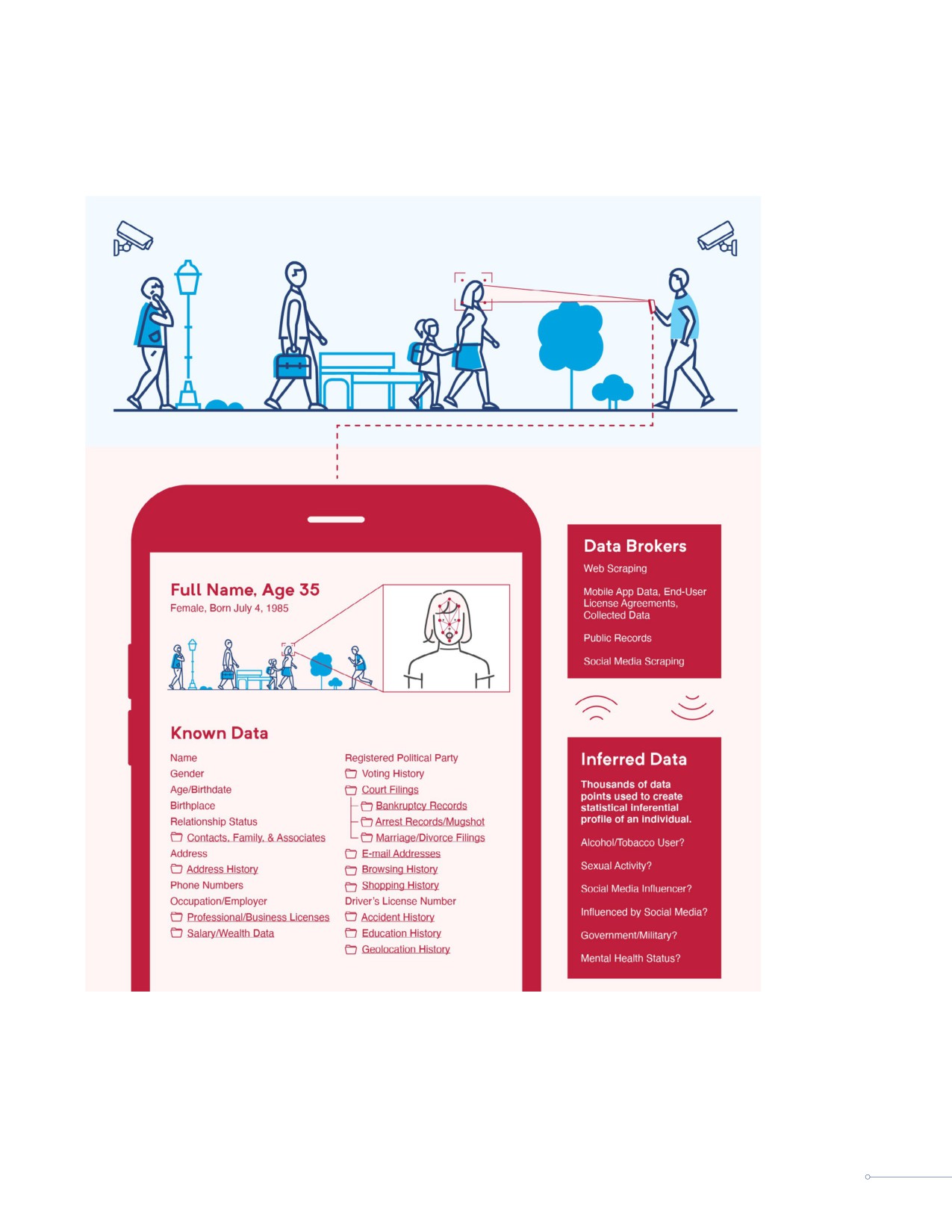
UPHOLDING DEMOCRATIC VALUES: PRIVACY, CIVIL LIBERTIES, AND CIVIL RIGHTS IN USES OF AI FOR NATIONAL SECURITY
Unregulated and Legal Data Collection & Brokering for
AI-enabled Predictions and Identification
p
406
BLUEPRINT FOR ACTION: CHAPTER 8
Blueprint for Action: Chapter 8 - Endnotes
1 For instance, a recent DHS IG report criticizes the DHS Privacy Office for not establishing controls
to ensure that privacy compliance documentation is complete and submitted as required, and
specifically noted DHS had not performed required periodic reviews for new and evolving privacy
risks. DHS IG, DHS Privacy Office Needs to Improve Oversight of Department-wide Activities,
Programs, and Initiatives, OIG-21-06, (Nov. 4, 2020). Civil society members have noted that PIAs
and SORNs are often too opaque to be helpful, and that agencies sometimes try to shoehorn new
data collections under older SORNs and PIAs. See Comments of the Electronic Frontier Foundation
Regarding System of Records Notices 09-90-2001,09-90-2002, Electronic Frontier Foundation (Aug.
17, 2020), https://www.eff.org/files/2020/08/17/2020 - 08-17_-_eff_comments_re_hhs_regs_re_covid_
data.pdf
(criticizing two SORNs issued by the Department of Health and Human Services during the
pandemic, as “overly vague in describing the categories of data collected, the data sources, and the
proposed routine uses of the data”).
2 The Commission acknowledges DHS’ steps to improve public records as noted in the DHS AI
Strategy: “Future AI systems implemented by DHS will require a public release of system information
with appropriate exceptions for certain sensitive military and intelligence systems, and some
exceptions for law enforcement activities. DHS will produce a framework for releasing AI system
information and a process for public comment.” See U.S. Department of Homeland Security Artificial
gov/publication/us-department-homeland-security-artificial-intelligence-strategy.
3 To support agencies in this goal, federal R&D investment should continue to advance the state of
the art for preserving personal privacy. For information regarding the critical AI research areas the
Commission recommends OSTP prioritize, see the Chapter 11 Blueprint for Action. Agencies should
also assign responsibility for assessing the state of the practice and encouraging federated learning
and anonymization pilots for government databases used in machine learning developments (e.g., to
Chief Data Officers at each agency).
4 Development practices should also include documenting trade-offs made, including optimizations
that cause a trade-off in performance across fairness metrics.
5 For instance, constraints about proxies for national origin or protected classes used for rules-based
system predictions.
6 These include: 1) Documenting operating thresholds including those that yield different true positive
and false positive rates or different precision and recall across demographics; (2) Assessing the
representativeness of data and model for the specific context at hand; (3) Using tools to probe for
unwanted bias in data, inferences, and recommendations; (4) Testing for fairness and articulating the
approach, performance, and metrics used. For an extensive list of practices, see the Appendix of this
report containing the abridged version of NSCAI’s Key Considerations for Responsible Development
& Fielding of AI. For additional details on the Commission’s recommendations to mitigate bias in
development and testing, see the Key Considerations for Responsible Development & Fielding of
Artificial Intelligence: Extended Version, NSCAI (2021) (on file with the Commission).
7 Examples of tools available to assist in assessing and mitigating bias in systems relying on machine
learning include Aequitas by the University of Chicago, Fairlearn by Microsoft, AI Fairness 360
by IBM, and PAIR and ML-fairness-gym by Google. Microsoft’s AI Fairness checklist provides an
example of an industry tool to support fairness assessments. See Michael A. Madaio et al., Co-
Designing Checklists to Understand Organizational Challenges and Opportunities around Fairness in
AI, CHI 2020 (April 25-30, 2020), http://www.jennwv.com/papers/checklists.pdf.
8 A widely used Industry example of a fairness metric is Equality of Opportunity (EEO), defined in
com/machine-learning/glossary/fairness. Note that EEO is suited for some contexts and a poor fit for
others—this is why careful deliberation of the operational metrics for fairness must be established
early in the development process.
p
407
UPHOLDING DEMOCRATIC VALUES: PRIVACY, CIVIL LIBERTIES, AND CIVIL RIGHTS IN USES OF AI FOR NATIONAL SECURITY
9 Select practices include: 1) Assessing statistical results for performance over time to detect
emergent bias; 2) recurrent testing and validation at strategic milestones, especially for new
deployments and classes of tasks; and 3) Continuously monitoring AI system performance,
including the use of high-fidelity traces to determine if a system is going outside of acceptable
parameters (e.g., for fairness and privacy leakage) pre-deployment and in operation. For an
extensive list of practices, see the Appendix of this report containing the abridged version of
NSCAI’s Key Considerations for Responsible Development & Fielding of AI. For additional details on
the Commission’s recommendation for maintenance and deployment, see the section on “System
Performance” in Key Considerations for Responsible Development & Fielding of Artificial Intelligence:
Extended Version, NSCAI (2021) (on file with the Commission).
10 ML systems in particular require ongoing assessments of privacy and fairness assurances,
including the specific definition of fairness being assumed.
11 This requires the creation of an AI TEV V handbook, a culmination of applied research, to create
the testing protocols that should be carried out by third-party testing lab(s) and the accreditation
procedures by which labs can become certified.
12 In some cases, exposure of test results could reveal weaknesses in a national security system that
could be exploited by an adversary.
13 As noted in Ethical Considerations for Commercial Use of AI, “rigorous testing is particularly
important for high-risk applications, and standards should be established to determine the nature
of those applications.” See Frances Duffy, Ethical Considerations for Use of Commercial AI, Johns
Hopkins Applied Physics Laboratory (Dec. 2020).
14 Alice Xiang, Reconciling Legal and Technical Approaches to Algorithmic Bias, Tennessee Law
Review at 7 (July 13, 2020), https://papers.ssrn.com/sol3/papers.cfm?abstract_id=3650635. See
also Zachary Lipton, et al., Does Mitigating ML’s Impact Disparity Require Treatment Disparity?,
arXiv (Jan. 11, 2019), https://arxiv.org/abs/1711.07076. (Some approaches to mitigate disparate
outcomes explicitly make use of membership in protected classes such as race or gender, and are
demonstrably more equitable than comparable algorithms that are “blind” to protected classes.)
15 Disclosure requirements should be specific to each application of AI. See Frances Duffy,
Ethical Considerations for Use of Commercial AI, Johns Hopkins Applied Physics Laboratory at 31
(December 2020). (“Appropriate disclosure requirements should be created for the purposes of
traceability in a court case or for the government’s own internal use.”)
16 As noted in the Key Considerations, existing policies for contestability should be assessed
and updated as needed to ensure accountability and to mitigate errors though feedback loops.
See the Appendix of this report containing the abridged version of NSCAI’s Key Considerations
for Responsible Development & Fielding of AI. For additional details on the Commission’s
recommendation to adopt policies to strengthen accountability and governance, see the section on
“Accountability and Governance” in Key Considerations for Responsible Development & Fielding of
Artificial Intelligence: Extended Version, NSCAI (2021) (on file with the Commission).
17 Due process rights require that individuals have the ability to meaningfully challenge a decision
made against them. In federal criminal trials, this includes having the government’s explanation of
how an unfavorable decision was reached, so it can be contested. In cases where AI-assisted or
AI-enabled decisions are made, certain AI techniques will be less conducive to due process. See
openscholarship.wustl.edu/cgi/viewcontent.cgi?article=1166&context=law_lawreview; see also Ryan
Calo & Danielle Keats Citron, The Automated Administrative State: A Crisis of Legitimacy, Emory Law
Journal (April 3, 2020), https://papers.ssrn.com/sol3/papers.cfm?abstract_id=3553590.
18 For instance, evidentiary standards for admitting AI evidence in court have yet to be developed and
are not encompassed in current Daubert standards guidance.
19 DHS’s Artificial Intelligence Strategy, dated December 2020, includes the establishment of a DHS
enterprise-wide AI Coordination and Advisory Council composed of internal subject matter experts
to monitor and support the adoption of AI technology by DHS Components. See U.S. Department of
Homeland Security Artificial Intelligence Strategy, U.S. Department of Homeland Security at 10 (Dec.
strategy.
p
408
BLUEPRINT FOR ACTION: CHAPTER 8
Blueprint for Action: Chapter 8 - Endnotes
20 For issues relevant to AI system audits, see Global Perspectives and Insights: The IIA’s Artificial
periodicals/Public%20Documents/GPI-Artificial-Intelligence-Part-II.pdf.
21 See e.g., Audit Map (last accessed Jan. 3, 2021), https://auditmap.ai/; The Next Generation of
Internal Auditing-Are You Ready?, Protiviti (2018), https://www.protiviti.com/sites/default/files/united_
states/insights/next-generation-internal-audit.pdf.
22 See e.g., Bernhard Babel, et al., Derisking Machine Learning and Artificial Intelligence, McKinsey &
Company (Feb. 19, 2019), https://www.mckinsey.com/business-functions/risk/our-insights/derisking-
machine-learning-and-artificial-intelligence; Saqib Aziz & Michael Dowling, Machine Learning and
chapter/10.1007/978-3-030-02330-0_3.
23 Xuning (Mike) Tang & Yihua Astle, The Impact of Deep Learning on Anomaly Detection, Law.com
anomaly-detection/.
24 Examples include baseline AI standards and policy guidance for biometric identification
technologies; for government procurement of commercial AI products; and for federal data privacy
standards.
25 In the FY2021 NDAA, Congress directed the Secretary of Commerce, in consultation with other
senior Executive branch officials, to establish the National AI Advisory Committee, including a
Subcommittee on AI and Law Enforcement. The Subcommittee is tasked to “provide advice to the
President on matters relating to the development of artificial intelligence relating to law enforcement.”
Pub. L. 116-283, sec. 5104 William M. (Mac) Thornberry National Defense Authorization Act for Fiscal
Year 2021, 134 Stat. 3388 (2021).
26 These should seek to encourage contracts with companies that have transparent policies and
practices in support of traceability and auditability and those that share information about how their
technology works and how it performs in independent testing.
27 “Federal government acquisition regulations require that agencies procure software commercially
off-the-shelf whenever possible, due to their cost effectiveness. Only when no comparable systems
exist are agencies permitted to develop government off-the-shelf solutions.” See Frances Duffy,
Ethical Considerations for Use of Commercial AI, Johns Hopkins Applied Physics Laboratory at S-1
(December 2020). As standards and requirements for system development and testing evolve, it may
be helpful for the government to “establish and maintain a list of COTS AI technologies that have
been vetted and approved for micro-purchasing, based on their consistency with government security
and testing standards, as well as their transparency.” This could facilitate both rapid procurement
and proper assessment of a vendor’s consistency with Responsible AI practices. See Frances Duffy,
Supplement to Ethical Considerations for Commercial Use of AI: Implications of Acquisition Scale,
Johns Hopkins Applied Physics Laboratory (forthcoming).
28 For example, policymakers and legislators will need to direct future attention to policies to preserve
PCL as technological capabilities for ubiquitous sensing grow, e.g., in smart cities. In the future,
ubiquitous sensing may make it impossible to distinguish U.S. persons’ data versus non-U.S. persons’
data for AI analytics. Another example for continued consideration includes the role of AI in filtering to
remove U.S. persons’ information from bulk data and conversely using AI to reveal such information,
as minimization and de-minimization guidance may evolve based on AI efficacy relative to the status
quo.
29 Disallowed outcomes and guidance will need to be updated over time as community norms and
technical capabilities change.
30 See, for example, Remarks of Commissioner Rebecca Kelly Slaughter: Algorithms and Economic
remarks_of_commissioner_rebecca_kelly_slaughter_on_algorithmic_and_economic_
justice_01-24-2020.pdf; Artificial Intelligence and Machine Learning in Software as a Medical Device,
U.S. Food and Drug Administration (January 2021), https://www.fda.gov/medical-devices/software-
medical-device-samd/artificial-intelligence-and-machine-learning-software-medical-device.
p
409
UPHOLDING DEMOCRATIC VALUES: PRIVACY, CIVIL LIBERTIES, AND CIVIL RIGHTS IN USES OF AI FOR NATIONAL SECURITY
31 See Byron Tau, Homeland Security Watchdog to Probe Department’s Use of Phone Location Data,
Wall Street Journal (Dec. 2, 2020), https://www.wsj.com/articles/homeland-security-watchdog-to-
probe-departments-use-of-phone-location-data-11606910402 (reporting that “DHS’s general counsel
began examining [the agency’s use of location tracking data] after concerns were raised by several
offices within the department that use of the technology wasn’t compatible with [Carpenter],” and that
the DHS IG planned to investigate the matter).
32 In ODNI Director Avril D. Haines’ confirmation hearing, she was asked about the IC’s use of
commercially available location data. She testified that she would “try to publicize, essentially, a
framework that helps people understand the circumstances under which we do that and the legal
basis that we do that under. . . I think that’s part of what’s critical to promoting transparency generally
so that people have an understanding of the guidelines under which the intelligence community
operates.” Charlie Savage, Intelligence Analysts Use U.S. Smartphone Location Data Without
politics/dia-surveillance-data.html.
33 Investigative reporting and opinion pieces have underscored the national security threats involved
with smartphone location data. Charlie Warzel & Stuart A. Thompson, They Stormed the Capitol.
opinion/capitol-attack-cellphone-data.html?referringSource=articleShare; Stuart A. Thompson
interactive/2019/12/20/opinion/location-data-national-security.html; Stuart A. Thompson & Charlie
www.nytimes.com/interactive/2019/12/19/opinion/location-tracking-cell-phone.html.
34 See Larry Magid, IBM, Microsoft And Amazon Not Letting Police Use Their Facial Recognition
amazon-not-letting-police-use-their-facial-recognition-technology/?sh=34b473dc1887; Asa Fitch,
Microsoft Pledges Not to Sell Facial-Recognition Tools to Police Absent National Rules, Wall Street
Journal (June 11, 2020), https://www.wsj.com/articles/microsoft-pledges-not-tosell-facial-recognition-
technology-to-police-absent-national-rules-11591895282.
banfacialrecognition.com/map/.
36 The Department of Defense, the Drug Enforcement Administration, Immigrations and Customs
Enforcement, the Internal Revenue Service, the Social Security Administration, the U.S. Air Force
Office of Special Investigations, and the U.S. Marshals Service have all had access to one or more
state or local face recognition systems. See Clare Garvie, et al., The Perpetual Line-up: Unregulated
Police Face Recognition in America, Georgetown Law Center on Privacy & Technology (Oct. 18,
2016), https://www.perpetuallineup.org/.
37 Such types of identification aided by AI include voice recognition and gait detection. An example
of additional risks includes when biometric identification is coupled with other advancing capabilities;
for instance, for identity recognition or for emotion recognition. See Emotional Entanglement: China’s
Emotion Recognition Market and its Implications for Human Rights, Article 19 (January 2021), https://
www.article19.org/wp-content/uploads/2021/01/ER-Tech-China-Report.pdf. See also Drew Harwell &
Eva Dou, Huawei Tested AI Software that Could Recognize Uighur Minorities and Alert Police, Report
huawei-tested-ai-software-that-could-recognize-uighur-minorities-alert-police-report-says/; Parmy
Olson, The Quiet Growth of Race Detection Software Sparks Concerns Over Bias, Wall Street Journal
concerns-over-bias-11597378154.
p
410
PART TWO
Blueprints for Action
PART TWO
p
411
THE NATIONAL SECURITY COMMISSION ON ARTIFICIAL INTELLIGENCE
Chapter 9: A Strategy for Competition and Cooperation
413
Chapter 9 Annex: A Strategy for Competition and Cooperation
415
Chapter 10: The Talent Competition
421
Chapter 11: Accelerating AI Innovation
435
Chapter 12: Intellectual Property
465
Chapter 13: Microelectronics
483
Chapter 13 Annex: Executive Order on Microelectronic Strategy
489
Chapter 14: Technology Protection
493
Chapter 14 Annex: Technology Protection
511
Chapter 15: A Favorable International Technology
517
OrderChapter 15 Annex: A Favorable International Technology
559
Order Chapter 16: Associated Technologies
581
The following Blueprints for Action cover Part II of NSCAI’s Final Report. Part II,
“Winning the
Technology Competition” (Chapters 9-16), outlines AI’s role in a broader technology competition and
recommends actions the government must take to promote AI innovation to improve all facets of national
competitiveness and protect critical U.S. advantages. These Blueprints for Action complement the
Commission’s Final Report and mirror its organizational structure.
Building upon the top-line recommendations in the Commission’s Final Report, the Blueprints for
Action serve as more detailed roadmaps for Executive and Legislative branch actions to retain
America’s AI leadership position. The Blueprints for Action identify who should take a particular
action--Congress, the White House, or an Executive Branch department or agency. The
Commission provides estimated increases in funding or appropriations as part of its
recommendations. All recommendations that include funding figures should be considered estimates
for consideration by Congress and/or the Executive Branch.
p
412
BLUEPRINT FOR ACTION: CHAPTER 9
Chapter 9: A Strategy for
Competition and Cooperation
Blueprint for Action
The United States should advance a comprehensive policy on China that promotes and
protects a rules-based international order. By investing in U.S. competitiveness and
resilience at home, safeguarding critical technologies, and deepening coordination with
allies and partners, the United States can pursue cooperation with China—where it is in the
national interest and from a position of strength. Properly sequenced and resourced, such
a strategy would generate solutions to global challenges and leverage formal diplomatic
dialogue to address critical issues around emerging technology.
Recommendation
Recommendation: Establish a High-Level U.S.-China Comprehensive Science and
Technology Dialogue (CSTD)
The United States should establish a regular, high-level technology dialogue with China
that benefits the American people, remains faithful to our allies, and presses China to abide
by international rules and norms. The dialogue should focus on challenges presented by
emerging technologies—to include AI, biotechnology, and other technologies as agreed
by both sides. The CSTD should have two overarching objectives:
• Identify targeted areas of cooperation on emerging technologies to solve global
challenges such as climate change, public health, and natural disasters; and
• Provide a forum to air a discrete set of concerns or friction points around specific uses of
emerging technologies while building relationships and establishing process between
the two nations.
The United States should be clear-eyed that the dialogue will not solve all our differences
with China. The CSTD should be results-oriented, and it should achieve concrete outcomes
for the American people.
Actions for the White House and the Department of State:
• Establish the CSTD.
o Emerging technologies play an instrumental role in the economic, social, and
security dynamics between the United States and China. Therefore, the CSTD
should be established as part of a comprehensive strategy toward China that
mobilizes democratic allies and partners in support of a rules-based international
order.
p
413
A STRATEGY FOR COMPETITION AND COOPERATION
o The Department of State—in close coordination with the Office of Science and
Technology Policy—should lead the CSTD.
o The Department of State should build a process that is results oriented and aims
to address challenges and opportunities in the current relationship between the
United States and China related to the emerging technologies. For example:
1. The CSTD should explore collaborative technological solutions to global
challenges (e.g., climate change, healthcare and biodata, food safety and
security, and natural disasters).
2.The CSTD should identify areas of current challenges related to emerging
technologies (e.g., data sharing and privacy, supply chain risk management,
international standards and norms, and intellectual property) and develop a
clear roadmap with milestones to address these issues.
o The CSTD should initiate personnel exchanges and data-sharing frameworks to
support and foster identified research projects with reciprocal access to information
that can lead to concrete results.
o The United States should identify leads for each of these topics (e.g., the
Department of Energy, the U.S. Special Presidential Envoy for Climate, and the
National Oceanic and Atmospheric Administration for climate change; the National
Institutes of Health for healthcare; the U.S. Food and Drug Administration for
food safety; and the Department of Defense and U.S. Agency for International
Development for natural disasters).
•
Relation to strategic dialogue. On a separate track from this CSTD, the Commission
has recommended that the United States and Chinese governments convene a
Strategic Security Dialogue (SSD) focused on eliminating misunderstandings and
misperceptions on key strategic issues and threats and reducing the likelihood of
inadvertent escalation. China has resisted U.S. attempts to create such a dialogue for
nearly a decade, but its creation has never been more critical. The Commission’s vision
regarding the role of the SSD is explored in greater detail in Chapter 4 of this report.
o This dialogue should be the primary forum for discussions regarding practices
surrounding AI-enabled and autonomous weapon systems and should include
discussions on testing, doctrine, and use, and potentially the exploration of practical
concrete confidence-building measures to mitigate risks.
o It is important to separate the SSD from the CSTD to ensure discussions related
to conflict escalation and crisis stability are insulated from political forces which
influence the broader U.S.-China bilateral relationship.
p
414
BLUEPRINT FOR ACTION: CHAPTER 9
Chapter 9 Annex: A Strategy for Competition and Cooperation
Draft Executive Order Establishing the Technology Competitiveness Council
By the authority vested in me as President by the Constitution and laws of the
United States of America, and in order to provide a coordinated process for developing
technology policy and a national technology strategy and for monitoring its implementation,
it is hereby ordered as follows:
Section 1. Policy. The national security, economic competitiveness, and domestic
prosperity of the United States require a comprehensive and coordinated approach by the
Federal Government to ensure long-term U.S. leadership across the entire suite of critical
and emerging technologies. To achieve this objective, this order establishes a Technology
Competitiveness Council to develop a National Technology Strategy and to coordinate
policies regarding critical and emerging technologies across the Federal Government.
Section. 2. The Technology Competitiveness Council.
(a) Establishment. There is established a Technology Competitiveness Council
(Council).
(b) Membership. The Council shall be composed of the following members:
(i) the Vice President, who shall be Chair of the Council;
(ii) the Secretary of State;
(iii) the Secretary of the Treasury;
(iv) the Secretary of Defense;
(v) the Attorney General;
(vi) the Secretary of Commerce;
(vii) the Secretary of Energy;
(viii) the Secretary of Homeland Security;
(ix) the Director of the Office of Management and Budget;
(x) the Assistant to the President for Technology Competitiveness;
(xi) the Assistant to the President for National Security Affairs;
p
415
A STRATEGY FOR COMPETITION AND COOPERATION
(xii) the Assistant to the President for Science and Technology;
(xiii) the Assistant to the President for Economic Policy;
(xiv) the Assistant to the President for Domestic Policy;
(xv) the United States Trade Representative;
(xvi) the Chairman of the Joint Chiefs of Staff; and
(xvii) the heads of other executive departments and agencies and other
senior officials within the Executive Office of the President, as determined by the
Chair.
A member of the Council may designate, to perform the Council functions of the
member, a senior-level official who is part of the member’s department, agency, or office
and who is a full-time officer or employee of the Federal Government.
(c) Responsibilities of the Chair.
(i) The Chair or, upon his or her direction, the Assistant to the President
for Technology Competitiveness, shall convene and preside over meetings of the
Council and shall determine the agenda for the Council.
(ii) The Chair shall authorize the establishment of such committees of
the Council, including an executive committee, and of such working groups,
composed of senior designees of the Council members and of other officials
invited to participate in Council meetings, as he or she deems necessary or
appropriate for the efficient conduct of Council functions.
(iii) The Chair shall report to the President on the activities and
recommendations of the Council. The Chair shall advise the Council as appropriate
regarding the President’s directions with respect to the Council’s activities and
national technology policy generally.
(d) Administration.
(i) The Council shall have a staff, headed by the Assistant to the President
for Technology Competitiveness.
(ii) The Office of Administration in the Executive Office of the President
shall provide the Council with such personnel, funding, and administrative support,
to the extent permitted by law and subject to the availability of appropriations, as
p
416
BLUEPRINT FOR ACTION: CHAPTER 9
directed by the Chair or, upon the Chair’s direction, the Assistant to the President
for Technology Competitiveness, to carry out the provisions of this order.
(iii) To the extent practicable and permitted by law, including the Economy
Act, and within existing appropriations, agencies serving on the Council shall make
resources, including but not limited to personnel and office support, available to
the Council as reasonably requested by the Chair or, upon the Chair’s direction,
the Assistant to the President for Technology Competitiveness.
(iv) The heads of agencies shall provide, as appropriate and to the extent
permitted by law, such assistance and information to the Council as the Chair may
request to implement this order.
(v) Members of the Council shall ensure that their departments and
agencies cooperate with the Council and provide such assistance, information,
and advice to the Council as the Council may request, to the extent permitted by
law.
(vi) The creation and operation of the Council shall not interfere with
existing lines of authority and responsibilities in the departments and agencies.
(vii) On technology policy and strategy matters relating primarily to national
security, the Council shall coordinate with the National Security Council (NSC)
through the Deputy National Security Advisor for Cyber and Emerging Technology
to create policies and procedures for the Council that respect the responsibilities
and authorities of the NSC under existing law.
Section. 3. Functions of the Council. The Council shall:
(a) develop recommendations for the President on U.S. technology competitiveness
and technology-related issues, advise and assist the President in development and
implementation of national technology policy and strategy, and perform such other duties
as the President may prescribe;
(b) develop and oversee the implementation of a National Technology Strategy as
required by section 4 of this order;
(c) serve as a forum for balancing national security, economic, and technology
considerations of U.S. departments and agencies as they pertain to technology research,
development, commercial interests, and national security applications;
(d) coordinate policies across U.S. departments and agencies related to U.S.
p
417
A STRATEGY FOR COMPETITION AND COOPERATION
competitiveness in critical and emerging technologies and ensure that policies designed
to promote U.S. leadership and protect existing competitive advantages are integrated
and mutually reinforcing; and
(e) synchronize budgets and strategies, in consultation with the Director of the
Office of Management and Budget, in accordance with the National Technology Strategy.
Section. 4. National Technology Strategy. It is the policy of the United States to retain
leadership in critical and emerging technologies essential to U.S. national security and
economic prosperity. Within one year of the date of this order, and annually thereafter,
the Council shall submit to the President a National Technology Strategy containing the
following elements:
(a) an assessment of the U.S. Government’s efforts to preserve U.S. leadership
in key emerging technologies and prevent U.S. strategic competitors from leveraging
advanced technologies to gain strategic military or economic advantages over the United
States;
(b) a review of existing U.S. Government technology policy, including long-range
goals;
(c) an analysis of technology trends and assessment of the relative competitiveness
of U.S. technology sectors in relation to strategic competitors;
(d) identification of sectors critical for the long-term resilience of U.S. innovation
leadership across design, manufacturing, supply chains, and markets;
(e) recommendations for domestic policy incentives to sustain an innovation
economy and develop specific, high-cost sectors necessary for long-term national security
ends;
(f) recommendations for policies to protect U.S. and allied leadership in critical
areas through targeted export controls, investment screening, and counterintelligence
activities;
(g) identification of priority domestic R&D areas critical to national security and
necessary to sustain U.S. leadership, and directing funding to fill gaps in basic and applied
research where the private sector does not focus;
(h) recommendations for talent programs to grow U.S. talent in key critical and
emerging technologies and enhance the ability of the Federal Government to recruit and
retain individuals with critical skills into Federal service; and
p
418
BLUEPRINT FOR ACTION: CHAPTER 9
(i) methods to foster the development of international partnerships to reinforce
domestic policy actions, build new markets, engage in collaborative research, and create
an international environment that reflects U.S. values and protects U.S. interests.
Section. 5. Advisory Committee on Technology Competitiveness.
(a) There is established an Advisory Committee on Technology Competitiveness
(Committee) to provide advice and recommendations to the Council and matters within the
scope of the Council’s responsibilities.
(b) The Committee shall include the Assistant to the President for Technology
Competitiveness and not more than 16 additional members appointed by the President.
The additional members shall include distinguished individuals from sectors outside of
the Federal Government. They shall have diverse backgrounds and expertise in national
security, economic competitiveness, and critical and emerging technologies relevant
to the National Technology Strategy. The Assistant to the President for Technology
Competitiveness, along with one non-Federal member of the Committee, shall serve as
Co-Chairs. Members of the Committee shall serve without any compensation for their
work on the Committee, but they may receive travel expenses, including per diem in lieu
of subsistence, as authorized by law for persons serving intermittently in the government
service (5 U.S.C. 5701-5707).
(c) The Committee shall meet as directed by the Co-Chairs of the Council and
shall provide advice or work product solely for use by the Council in the performance of its
duties under this order.
(d) The Office of Administration in the Executive Office of the President shall
provide such funding and administrative and technical support as the Committee may
require.
(e) The Committee shall terminate two years from the date of this order unless
extended by the President.
Section. 6. General Provisions.
(a) If any provision of this order or the application of such provision is held to be
invalid, the remainder of this order and other dissimilar applications of such provision shall
not be affected.
(b) This order is not intended to, and does not, create any right or benefit,
substantive or procedural, enforceable at law or in equity by any party against the United
States, its departments, agencies, or entities, its officers, employees, or agents, or any
other person.
p
419
A STRATEGY FOR COMPETITION AND COOPERATION
(c) Nothing in this order shall be construed to impair or otherwise affect:
(i) the authority granted by law to an executive department or agency, or
the head thereof; or
(ii) the functions of the Director of the Office of Management and Budget
relating to budgetary, administrative, or legislative proposals.
(d) This order shall be implemented consistent with applicable law and subject to
the availability of appropriations.
p
420