National Security Commission on Artificial Intelligence. Final Report - page 6
BLUEPRINT FOR ACTION: CHAPTER 2
directorates; positions within Force Development directorates; and leadership
positions at the operational and tactical levels within the military services.
• Create a process for officers to become emerging and disruptive technology
certified.
o The process to become emerging tech certified would resemble the joint
qualification system.
o Officers should become emerging technology qualified by serving in emerging
technology focused fellowships,53 emerging technology focused talent exchanges,
emerging technology focused positions within government, and completing
educational courses focused on emerging technologies.
Organizing DoD for
AI Adoption.
p
301
FOUNDATIONS OF FUTURE DEFENSE
Recommendation: Accelerate Adoption of Existing Digital Technologies
Recommendation
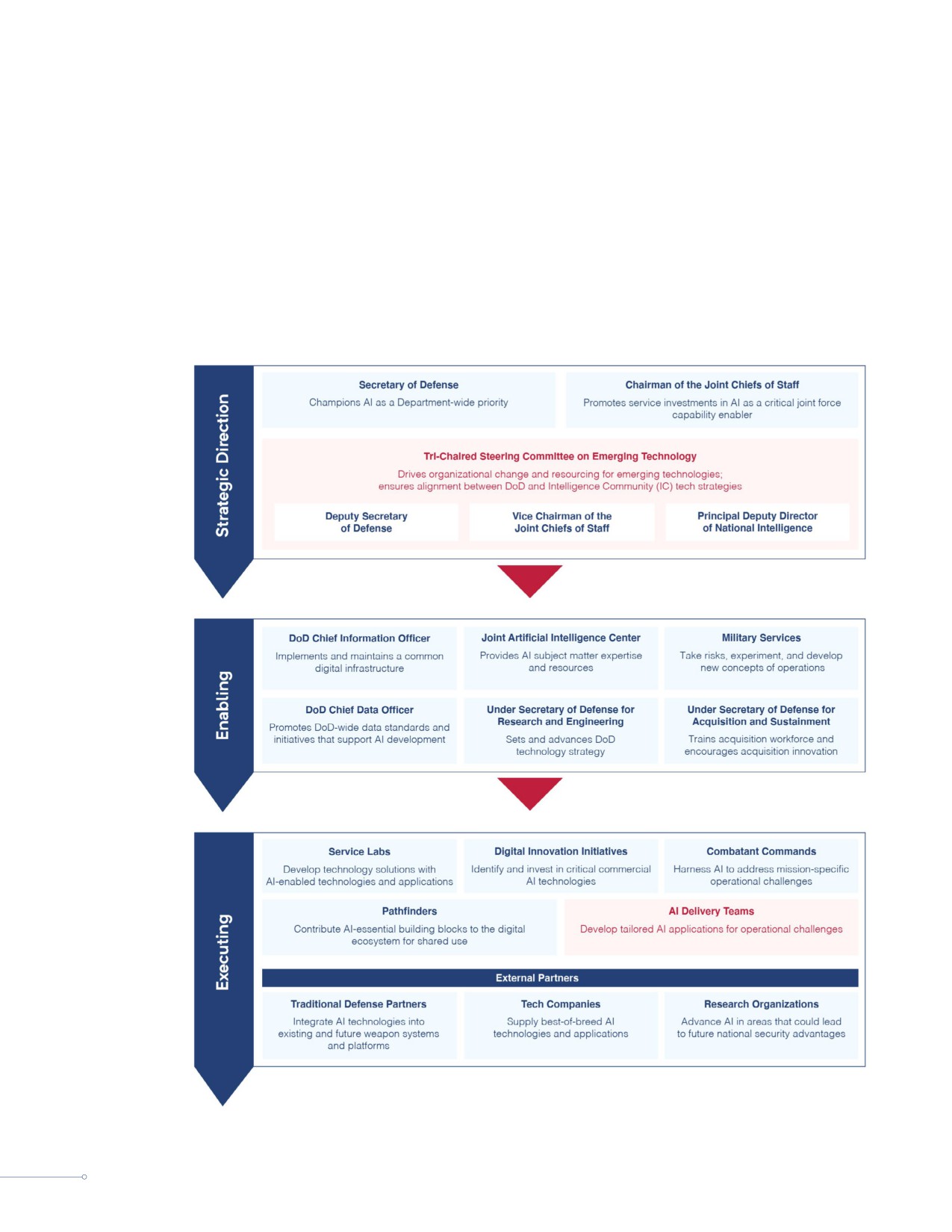
The Department must have an integrated approach to AI and other emerging technologies
that ensures the U.S. military can continuously identify, source, field, and update
capabilities faster than our competitors. This requires more targeted investment in dual-
use technologies, ensuring system adaptability through a more agile budget and oversight
process, and streamlining the acquisition process to shed those rules and regulations
whose benefits are outweighed by the burdens imposed on the system. Critically, the
Defense Acquisition System must shift away from a one-size-fits-all approach to measuring
value from the acquisition process. Adherence to cost, schedule, and performance
baselines is rarely a proxy for value delivered, but is particularly unsuited for measuring
and incentivizing the iterative approaches inherent in AI and other software-based digital
technologies. Unless the requirements, budgeting, and acquisition processes are aligned
to permit faster and more targeted execution, the U.S. will fail to stay ahead of potential
adversaries.
Component 1: Adopt Proven Commercial AI Applications for Core Business Processes.
Commercial AI applications for business processes can generate labor and cost savings,
speed administrative actions, and inform decision-making with superior insights. To realize
these benefits, DoD should initiate the digital transformation of its core administrative
functions.
Efforts to apply business AI depend on the availability of clean, organized data. Significant
resources are required to access, clean, and label enterprise data from the range of legacy
business platforms.
DoD should create opportunities for bottom-up identification of AI use cases by
incentivizing DoD organizations to deploy proven commercial applications tailored to their
specific mission needs. Promising categories of commercial AI include: 1) Knowledge
management applications such as intelligent search tools that index, retrieve, and display
an agency’s digital information, as well as collective intelligence and coaching tools that
accumulate and exchange tacit knowledge across an agency’s workforce; 2) AI-enabled
tools that analyze business information to identify patterns, develop insights, and inform
decision-making; and 3) Robotic Process Automation (RPA) tools including desktop
assistants, bots, and other personal productivity applications that automate individual
office functions.
Actions for the Department of Defense:
• Prioritize construction of enterprise data sets across core DoD business
administration areas.54
o The Deputy Secretary of Defense should:
p
302
BLUEPRINT FOR ACTION: CHAPTER 2
■ Assign the DoD CDO responsibility for working with institutional stakeholders
to develop enterprise data sets for human resources, budget & finance,
acquisition, logistics, retail, real estate, and health care.
■ Place special priority on the CDO building an enterprise data set that supports
portfolio management of investments in emerging technologies, spanning
budget requests, acquisition, contracting, and invoicing.55
■ Assign the JAIC to support the DoD CDO in developing new methods for
generating higher quality data for each core business administration area
at the point of origin. This would include applying data tags that allow AI-
enabled cross domain analyses.56 As part of this effort, the JAIC should
also look to develop or procure AI tools that continuously extract tagged
information for analysis from enterprise data sets.
■ Ensure sufficient funding is included as part of the FY2023 budget request to
provide data engineering services.
o The Secretary of Defense should issue a department-wide directive mandating the
review and streamlining of policies and regulations wherever possible to increase
and accelerate data sharing across agencies, with proper protections, building on
the JAIC’s Gamechanger AI prototype57 to analyze and modernize the framework
within which data access rules are enforced.
•
Launch a department-wide initiative to incentivize rapid deployment of
commercial AI solutions for business functions.
o The Deputy Secretary of Defense should assign the JAIC, in its role as the
Department’s AI accelerator,58 to administer allocation of matching funds, monitor
and assess results, and disseminate best practices and lessons learned for the
deployment of AI solutions for knowledge management, business analytics,
and RPA across the Department, defense agencies, Services, and Combatant
Commands.59
o The Secretary of Defense should issue a DoD directive mandating added flexibility
and/or streamlining of policies and regulations wherever possible to increase and
accelerate acquisition and deployment of commercial AI sofware, building on the
JAIC’s Gamechanger AI prototype to analyze and modernize the existing rules
framework.60
o The Deputy Secretary of Defense should establish a $100 million fund under the
management of the JAIC to accelerate procurement and integration of commercial
AI solutions for business applications. This would be used to provide matching
incentive funds for agencies contracting with commercial AI vendors with approved
solutions. The Deputy Secretary should also:
■ Consider leveraging the defense-wide review process detailed below to
identify and reprogram sufficient funds to stand-up this fund by the beginning
of FY2022.
■ Ensure sufficient funding is included as part of the FY2023 budget request to
sustain the fund.
p
303
FOUNDATIONS OF FUTURE DEFENSE
Action for Congress:
• Congress should provide $125 million as part of the FY2023 defense
appropriations act for developing enterprise-wide data sets, and $100 million for
the fund to accelerate procurement and integration of commercial AI solutions for
DoD business functions.
Component 2: Network Digital Innovation Initiatives to Scale Impact.
Too often the Department’s enthusiasm for innovation comes at the expense of impact
and scale. Dozens of innovation offices across the Department and Services develop,
transfer, and apply cutting-edge technology for national security uses.61 However, many of
the initiatives that are focused on bridging the gap with the technology sector, to include
AFWERX, NavalX, Army Applications Laboratory (AAL), and the Defense Innovation Unit
(DIU), operate in silos and are limited in their ability to scale solutions. These pockets of
successful bottom-up innovation have achieved some promising results, but disparate
activities cannot translate to strategic change without top-down leadership to synchronize
efforts and overcome organizational barriers.62 The Department should
“network”
programs that work to source cutting-edge technology solutions under the banner of
“digital innovation initiatives” to execute a “go-to-market strategy” for digital technology
that is supported at the highest levels of the Department.
Actions for the Department of Defense:
•
Designate an Executive Agent to coordinate the Department’s digital innovation
initiatives.
o The Secretary of Defense should designate USD (R&E) as Executive Agent for the
Department’s digital innovation initiatives63 and direct that USD (R&E) to coordinate
closely with USD (A&S), DoD CIO, and DoD CDO to carry out the responsibilities
associated with this role.64
o As Executive Agent, USD (R&E) should facilitate access to resources,65 provide
strategic guidance, and offer other forms of institutional support to enable
innovation organizations to execute their current mandates more effectively, without
infringing on autonomy or inhibiting bottom-up experimentation.66 USD (R&E)
should work with the DoD CIO, the DoD CDO, and USD (A&S) as well as other
institutional stakeholders as appropriate, to:
■ Develop a common digital platform for digital innovation initiatives to share
data and procurement and development best practices,67 track ongoing
projects, connect with DoD program offices, and identify other means of
collaboration.
■ Harness business AI tools to eliminate stovepipes and gain shared
understanding of the digital innovation community, including investments and
customers.68
■ Identify and implement other metrics for the digital innovation initiatives to
report as necessary, so long as they are lightweight and automated to the
maximum extent possible.
p
304
BLUEPRINT FOR ACTION: CHAPTER 2
•
Develop a “go-to-market” strategy for digital technology.
o USD (R&E) and USD (A&S) should issue a joint memo outlining a “go-to-market”
strategy for digital technology to guide innovation organizations to pursue common
objectives, based on the Technology Annex described below. This approach would
coordinate efforts for effect and reduce duplication of effort, while preserving room
for trial and experimentation with unexpected technologies or applications that
could inform new operational concepts.69
o The Department should back this strategy with significant resources and top-down
support. As described further in Chapter 11 of this report, DoD should set a target
of increasing its contracts with early-stage technology firms by four times over
the five-year Future Years Defense Program. To meet this goal, the Department
should increase the procurement budgets of innovation organizations and other
DoD entities to which innovation organizations hand off successful prototypes for
production, as appropriate.
o USD (R&E) should conduct annual investment portfolio reviews of digital innovation
initiatives to assess alignment with strategy70 and report findings to the Steering
Committee on Emerging Technology.
•
Optimize operations to enable transition and scaling of AI solutions.
o USD (R&E), in partnership with USD (A&S), should assist innovation organizations
in providing contracted vendors access and resources to build, deploy, and assure
AI solutions ofen and at scale.71 In developing vendor contracts and planning
customer journeys, digital innovation initiatives should consider the methods and
means to:
■ Ensure that data access and data security requirements are included in
contracts for AI systems that depend on data for training or operations.
■ Provide consistent access to end users as part of AI development processes
and throughout the life cycle of the AI algorithm; and capture in contract
terms.
■ Include AI testing and evaluation consideration as part of every development
agreement.
■ Dedicate people and processes to onboard non-traditional vendors, migrate
them onto the right networks and sandbox environments, and assist them in
securing ATO.72
■ Connect prototype contract recipients with DoD customers early in the
technology development process and match program dollars with additional
funding (SBIR, dedicated scaling funds, etc.) wherever possible.73
■ Identify new opportunities for defense primes to team with non-traditional
firms to adopt AI capabilities more quickly across existing platforms.74
o USD (R&E) should work with USD (A&S) to develop common reporting requirements
to measure the impact of digital innovation initiatives, building off of ongoing
efforts at DIU.75 Collection of this data should be automated to the maximum extent
possible and communicated routinely to Congressional defense committees.
Reporting should consider:
p
305
FOUNDATIONS OF FUTURE DEFENSE
■ Expansion of NSIB: Number of awards made to companies with no previous
DoD experience and percentage of these that receive follow-on contacts; or
number of companies that receive recurring government revenue for first time
and funding stability over consecutive quarters.
■ Rate of Transition: Number of companies that receive follow-on production
contracts.
■ Rate of Scaling: Number of prototype contract recipients that reach $10
million, $50 million, $100 million, $500 million, and $1 billion in total DoD
contracts annually.
■ Reach of Products: Number of users76 that are benefiting from the product in
one year, three years, 10 years, etc.
■ User Experience: User feedback on the product (scale 1-10).
■ Company Acquisition Process Experience: Company feedback on the new
acquisition process (scale 1-10).
■ Operational/Enterprise Impact: Actual or projected operational or fiscal return
on investment (e.g., initiative addressed an operational gap; innovative RPA
reduced production time or man-hours).
Component
3: Expand Use of Specialized Acquisition Pathways and Contracting
Approaches.
AI technologies are incompatible with the lengthy, linear processes typical of traditional
DoD capabilities acquisition.77 Recent policy reforms such as the rollout of the Adaptive
Acquisition Framework78
(AAF) and associated resources—such as the Contracting
Cone79—are positive steps to move the Department away from a “one-size-fits-all”
approach to acquisition. However, use of the specialized pathways and authorities80
within the Framework is inconsistent and disincentivized.81 The traditional acquisition
process remains the default for most acquisition professionals—many of whom are neither
incentivized nor properly equipped to make use of the full resources at their disposal
through the Framework.
To accelerate delivery of AI-enabled technologies to the warfighter and increase their
operational relevance, DoD must build the capacity to use the full breadth of acquisition
pathways and contracting approaches.82 Acquisition professionals must have a sufficient
understanding of digital and emerging technologies in order to thoughtfully apply these
tools. Given the speed of advancements in AI and other software-based technologies, this
requires a shift to a continuous learning mindset and a different approach to training for
acquisition professionals in which the target metric for success is not course completion,
but rather the ability to apply what is learned and impact mission outcomes. DoD should
coordinate acquisition workforce training initiatives relative to digital and emerging
technologies ongoing across the Department and continuously assess acquisition
workforce capability needs. Importantly, the DoD must also ensure acquisition personnel
have common access to available digital technology courses and best practices as well
p
306
BLUEPRINT FOR ACTION: CHAPTER 2
as a community of experts that illustrate how specialized authorities can be used to deliver
best of breed technologies.
Actions for the Department of Defense:
•
Accelerate training of acquisition professionals and senior leaders on the AAF,
Contracting Cone, and Digital Technologies.
o The Secretary of Defense should develop a set of best practices in the use of
new acquisition pathways83 and direct USD (A&S) and Component Acquisition
Executives to train the right acquisition professionals and DoD senior leaders and
executives on the AAF, the Contracting Cone, and best practices for the use of
these flexibilities, within one year.
o USD (A&S) should also work closely with USD (R&E), the JAIC, the Service
Acquisition Executives, and the Component Acquisition Executives to implement
a coordinated approach to training acquisition professionals and senior leaders
on cross-functional specialties relative to emerging technologies. The approach
should amplify and harmonize ongoing workforce training efforts84 related to AI,
data analytics, sofware, and digital engineering and look to leverage training or
courses that can be procured off-the-shelf or as a service.
•
Leverage public-private talent exchanges to infuse technical expertise into the
acquisition corps.85
o The Secretary of Defense should direct that acquisition professionals are considered
among the highest priority to participate in public-private talent exchanges.86
•
Establish enterprise learning platforms, course catalogs, and knowledge
management tools for acquisition personnel and make them available Department-
wide.87
o USD (A&S) should invest in and scale appropriate learning platforms, course
catalogs, and knowledge management tools and create incentives for their use by
FY2022. These resources should catalog available training88 and best practices89
and make relevant experts and specialists discoverable for acquisition professionals
Department-wide.
•
Continuously assess existing acquisition workforce capabilities and evolve training
for acquisition professionals.
o The Secretary of Defense should direct that USD (A&S) work with the Service
Acquisition Executives, Component Acquisition Executives, USD (R&E), and the
JAIC to ensure curricula and approach to training90 for acquisition professionals is
consistently and appropriately updated to support the Technology Annex to the
National Defense Strategy, as described below.
Action for Congress:
• Authorize the use of a rapid contracting mechanism for the sofware acquisition
pathway.
o The Armed Services Committees should direct the Secretary of Defense to develop
a rapid contracting mechanism to support the AAF’s sofware acquisition pathway.91
The mechanism should include:
p
307
FOUNDATIONS OF FUTURE DEFENSE
■ A value-based price evaluation model.
■ An independent, non-advocate cost estimate developed in parallel with
engineering and leveraging agile cost estimation best practices.
■ Performance metrics intended to measure value that can be automatically
generated by users and shared as requested by DoD officials and
congressional defense committees.
Component 4: Modernize the Budget and Oversight Processes for Digital Technologies.
The DoD’s budget process requires that funds be requested two years in advance of
their execution and focuses planning within the five-year Future Years Defense Plan
(FYDP). Resources are allocated to program elements (PEs) that are defined at the system
level92 and based upon cost buildups for pre-determined and highly specified system
requirements.93 In addition, the life-cycle-phased appropriation categories94 that govern
the DoD budget structure run counter to the iterative process inherent to AI and other
software-based technologies.95
This construct creates a paradigm unfriendly to the speed, adaptation, risk-taking, and
joint force cohesion necessary to compete in an AI-enabled threat environment. Senior
leaders champion the need to experiment96 and “fail fast,” but the budget process prevents
the allocation of funds without a justification clearly tied to program objectives. At the
same time, the DoD requirements process—responsible for formulating the basis of those
program objectives—assumes a linear and sequential relationship between requirements
and technology.97
To adapt faster than our adversaries, DoD must have a requirements and budget process
that: 1) Prioritizes joint force capabilities and aligns resources accordingly; 2) Enables
experimentation, iteration, and continuous development—especially for AI and digital
technologies where persistent user feedback is critical; and 3) Balances speed, scale,
and risk depending on the technology or capability being delivered.
Implementation of the large-scale institutional changes required to achieve this vision will
take time and equal commitment from both DoD and Congress. In the near term, DoD
and Congressional leaders should focus on generating mutual trust by establishing pilot
programs to demonstrate the impact of reforms to the budget and requirements process
relative to AI. The inclusion of support for the Department’s Budget Activity 8 pilot program
in the FY2021 defense authorization and appropriations acts represents positive progress
to this effect.98
Below are recommended steps that DoD and Congress should take immediately and over
the longer term to create a modern budget and requirements process that supports the
application of AI at speed and scale.
p
308
BLUEPRINT FOR ACTION: CHAPTER 2
Immediate Actions for the Department of Defense:
•
Reorient the Joint Requirements Oversight Council (JROC) process to focus on
Joint and Cross-Domain Capability.
o The Chairman of the Joint Chiefs of Staff should appoint the USD (R&E) Co-Chair
and Chief Science Advisor of the JROC.99
o The Chairman of the Joint Chiefs of Staff should direct that the JROC charter
be updated to reflect USD (R&E) as Co-Chair and Chief Science Advisor with
responsibility for:
■ Delivering technology assessments and trend reports that inform JROC
deliberations on future military requirements; and
■ Validating the technical feasibility of requirements developed by the services
and ensuring they comply with the reference design for the digital ecosystem
recommended above.
•
Make supplemental funding available to drive operational prototyping, scale, and
transition of AI technologies.
o The Secretary of Defense should establish a dedicated AI fund as a pilot under
the management of USD (R&E) to mature, operationally prototype, and transition
exceptionally promising AI-enabled technologies that align with applications
identified in the Technology Annex as described below. In doing so, the Secretary of
Defense should direct:
■ Inclusion of approximately $200 million for the fund in the FY2022 budget
request.
o USD (R&E), in collaboration with the JAIC and the military services, should establish
clear metrics for success and a time horizon upon which to stand-up additional
similar funds for specific technologies or capabilities.
•
Accelerate efforts100 to implement a portfolio management approach for
requirements and budget.
o The Deputy Secretary of Defense should produce a proposal for consideration in
the FY2022 defense authorization and appropriation bills to establish a pilot to test
a portfolio management approach for requirements and budgeting for at least one
joint capability area, such as Command and Control, in FY2023.101 The proposal
should:
■ Establish a reasonable ceiling value for the portfolio.
■ Consider consolidation of program elements and the creation of a Program
Executive Office or other organizational entity empowered to resource and
oversee programs designed to meet the joint capability need.
■ Request reprogramming authority to drive a “fail fast” mentality, promote
experimentation and early prototyping, and quickly integrate new capabilities.
■ Provide recommendations on adjusted reporting guidance and justification
documents, including metrics and mechanisms,102 that will allow Congress to
conduct appropriate approval and oversight.
p
309
FOUNDATIONS OF FUTURE DEFENSE
o The Deputy Secretary of Defense should also produce a separate proposal to
establish a pilot to test mission-focused budgeting and appropriations (e.g., a
Mission Element). The proposal should be developed in coordination with a
Combatant Command and organized around a high-priority operational challenge
as identified by the Joint Staff. It should:
■ Consider more flexible funding mechanisms, including reprogramming
authorities, applied across existing, relevant service programs to promote
digital modernization and integration of AI technologies, interoperability, and
new development or prototyping efforts for the specific operational challenge.
■ Provide recommendations on adjusted reporting guidance, and justification
documents, including metrics and mechanisms, that will allow Congress to
conduct appropriate approval and oversight.
Immediate Actions for Congress:
• Update Title 10. Section 181 to designate USD (R&E) Co-Chair and Chief Science
Advisor to the JROC.
• Direct the Secretary of Defense to establish the dedicated AI fund.
o Congress should include a provision in the FY 2022 National Defense Authorization
Act directing the establishment of an AI fund under USD (R&E) and appropriate at
least $200 million to support it as a pilot.103
• Support the continuation of the Budget Activity 8 pilot program in FY2022 and
direct the Department to add an S&T project to the pilot programs.
o Congress should continue to support the DoD sofware and digital technologies
pilot program designed to allow for flexibility in funding the full life cycle of
development, procurement, deployment, assurance, modifications, and continuous
improvement for digital technologies.104
o Congress should support DoD expanding the pilot in FY2022 to include a program
that explicitly supports an S&T development effort in order to effectively test
the impact of the single funding mechanism for the entirety of the AI life cycle,
including early-stage research and development.
Longer-term Actions for the Department of Defense and Congress:
• Establish a single appropriation and budget structure for sofware and digital
technologies by FY2023.
o Congress should build on the BA 8 pilot and establish a single appropriation for
sofware and digital technologies that is exempt from the traditional programming or
planning process and can be used as a single source of funding for the full life cycle
of capability delivery and continuous engineering.
o The Department and Congress should collaborate to develop and implement a
budget structure and transparent oversight process for the new sofware and digital
technology appropriation that enables agile development of AI technologies and
capability portfolio management.105
• Identify and implement successful portfolio- and mission-based budgeting
constructs at scale across DoD.
p
310
BLUEPRINT FOR ACTION: CHAPTER 2
o The Department and Congress should look to BA 8 as an example of how to apply a
similar approach to monitoring and scaling portfolio- and mission-based budgeting.
Based on metrics and oversight of the pilots over an appropriate timeline, DoD and
Congress should determine what approaches to implement more broadly.
Recommendation
Recommendation: Democratize AI Development
An AI-enabled threat environment requires our forces to be able to develop and deploy
solutions nearly as quickly as threats arise. However, our forces frequently lack the
infrastructure, tools, talent, and support to solve their challenges locally and with modern
technology.106 The JAIC cannot develop and proliferate AI applications for every user group
or mission area within the DoD. To accelerate adoption of AI, the Department must create
the technical infrastructure and organizational structures that pair top-down strategy with
bottom-up development.
p
311
FOUNDATIONS OF FUTURE DEFENSE
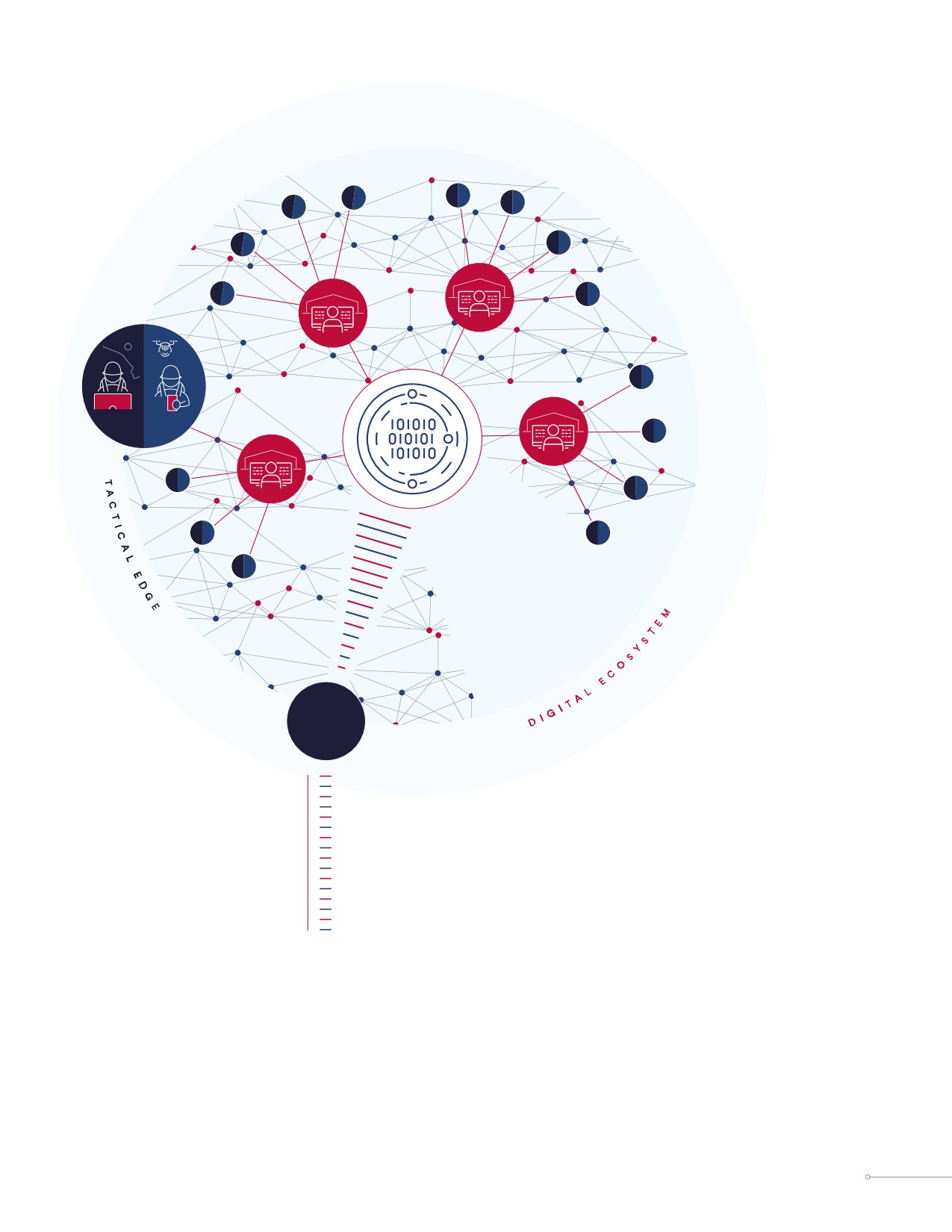
Democratize
Development.
AI delivery teams at
Combatant Commands
Development teams
embedded with
operational units
JAIC
JOINT AI
CENTER
A I A C C E L E R A T O R
Subject matter expertise
Standards and governance
Development tools
Applications
Contracting vehicles
Component 1: Leverage the JAIC as the Department’s AI Accelerator.
The JAIC should serve as the Department’s “AI accelerator” and central node for AI-
related information. In this role, the JAIC would maintain critical situational awareness of
p
AI stacks across the Department (i.e., options, including applications, available within the
digital ecosystem that mission owners can leverage to enable local development efforts)
p
312
BLUEPRINT FOR ACTION: CHAPTER 2
and provide the expertise and resources necessary to enable distributed development
efforts.
Actions for the Department of Defense:
•
Designate the JAIC as the Department’s AI Accelerator.
o The Deputy Secretary of Defense should issue a memorandum107 designating the
role of JAIC as the DoD enterprise’s AI accelerator with responsibility for:
■
Developing tailorable AI applications to address high-level, cross-domain
challenges and shared problems, and making them available through the
digital ecosystem as enablers for development teams across the enterprise.
■
Administering a matching fund to incentivize integration of commercial AI
solutions for business functions across the Department.
■
Collecting best practices (including best-of-breed AI applications) from
industry, academia, and across the enterprise and making them accessible for
the broader DoD developer community.108
■
Providing AI subject matter expertise and assistance to DoD Components to
inform strategy, policy, and technical approaches. This would include:
• Participating as a member of the Steering Committee on Emerging
Technology.
• Contributing to the development of a reference design for the DoD AI
digital ecosystem and associated governance policies.109
• Advising on integrating the appropriate governance frameworks for
responsible use of AI into policies and procedures.110
• Advising on TEVV policies and capabilities for AI.
• In coordination with the Under Secretary of Defense for Policy, serving as
the Department’s lead for AI-related international engagement.
■
Developing a common AI TEVV framework,111 in coordination with DOT&E and
any other appropriate stakeholders, that integrates testing as a continuous
part of requirements specification, development, deployment, training, and
maintenance and includes run-time monitoring of operational behavior.112
■
Identifying, procuring, and orchestrating AI development tools and making
them available through the digital ecosystem sofware exchange113 described
above to enable distributed development efforts.114
■
Making available enterprise-wide contracting vehicles (e.g., Blanket Ordering
or Purchase Agreements) for talent115 and AI technical services116 and
continuously onboarding new companies.117
■
Coordinating with USD (R&E) on AI-related elements of the go-to-market
strategy discussed above.
■
Integrating with nation-wide initiatives within other agencies and departments,
as directed by the President.
p
313
FOUNDATIONS OF FUTURE DEFENSE
• Build technical support capability.
o The JAIC should grow and train a staff of resident experts118 that can provide
support to users across the enterprise akin to an “AI help desk,” to include providing
technical and policy consultation and advice; implementing solutions for small
problems; and facilitating connections of support (for larger problems).119
Component 2: Embed AI development capabilities in support of operations.
The Department must ensure operators are paired with technologists at every echelon.
Doing so will institutionalize user-centered; agile development, improve the speed and
operational relevance of solutions delivered; and build trust and confidence in AI-enabled
systems. Implementation of the actions below will create a networked support structure to
enable bottom-up AI development extending from the tactical edge to the JAIC.120
Actions for the Department of Defense:
•
Establish integrated AI delivery teams at every Combatant Command (CCMD).
o The Secretary of Defense should direct each Combatant Commander to stand-
up an AI delivery team dedicated to developing and deploying AI applications to
support operational units.121
o Teams should be staffed with the appropriate talent to manage the full life cycle
of AI solutions, including in disciplines such as data science, AI testing and model
training, sofware engineering, product management, and full stack development.122
AI Delivery teams should be responsible for:123
■ Finding, tailoring, and fielding applications from the digital ecosystem (e.g.,
those developed by other CCMDs, Service sofware factories, or the JAIC).
■ Developing additional sustainable mission applications as needed.
■ Contributing new and tailored applications to the digital ecosystem for use
across the CCMD(s) to meet common challenges.
•
Integrate forward-deployed development teams with operational units.
o Each Combatant Commander should develop and implement a plan for the
integration of forward-deployed development teams to act as the local customer
interface for the AI delivery team with each operational unit.124 Forward-deployed
development teams should:
■ Work side-by-side with warfighters to identify problems and opportunities that
could be met with AI applications.
■ Leverage the digital ecosystem to provision development environments
and tools to produce “quick wins” to improve capabilities and generate
efficiencies.125
p
314
BLUEPRINT FOR ACTION: CHAPTER 2
Recommendation
Recommendation: Invest in Next Generation Capabilities
The DoD must have an enduring process that clearly identifies, prioritizes, resources, and
tracks126 critical technologies over multiple time horizons. This will drive an investment
strategy that pursues technology applications that close key capability gaps and optimize
current operational concepts, and simultaneously makes bets on disruptive technologies
to enable transformative capabilities and operational concepts over the long term.
Component 1: Increase investments in Science & Technology (S&T) and AI R&D.
To compete and win in AI-enabled warfare, the propagation of technology from core AI
research to broad AI applications must expand drastically.127 Across the board, increases
in all lines of AI research128 are called for, with particularly large increases in research
funding required to advance key areas, such as developing methods for human-machine
teaming and deploying trusted AI applications through rigorous methods for TEVV.
Action for the Department of Defense:
• Commit to building budgets that invest at least 3.4%129 of the annual DoD budget
in S&T and allocate at least $8 billion for research and development of core AI.
o Particular focus should go toward strengthening the AI research budgets at
organizations where AI expertise is centered, such as DARPA, the Office of Naval
Research, the Air Force Office of Scientific Research, the Army Research Office, and
the Service Laboratories.
Action for Congress:
• Support DoD budget requests for amplified funding of AI R&D and AI-related
initiatives.
p
315
FOUNDATIONS OF FUTURE DEFENSE
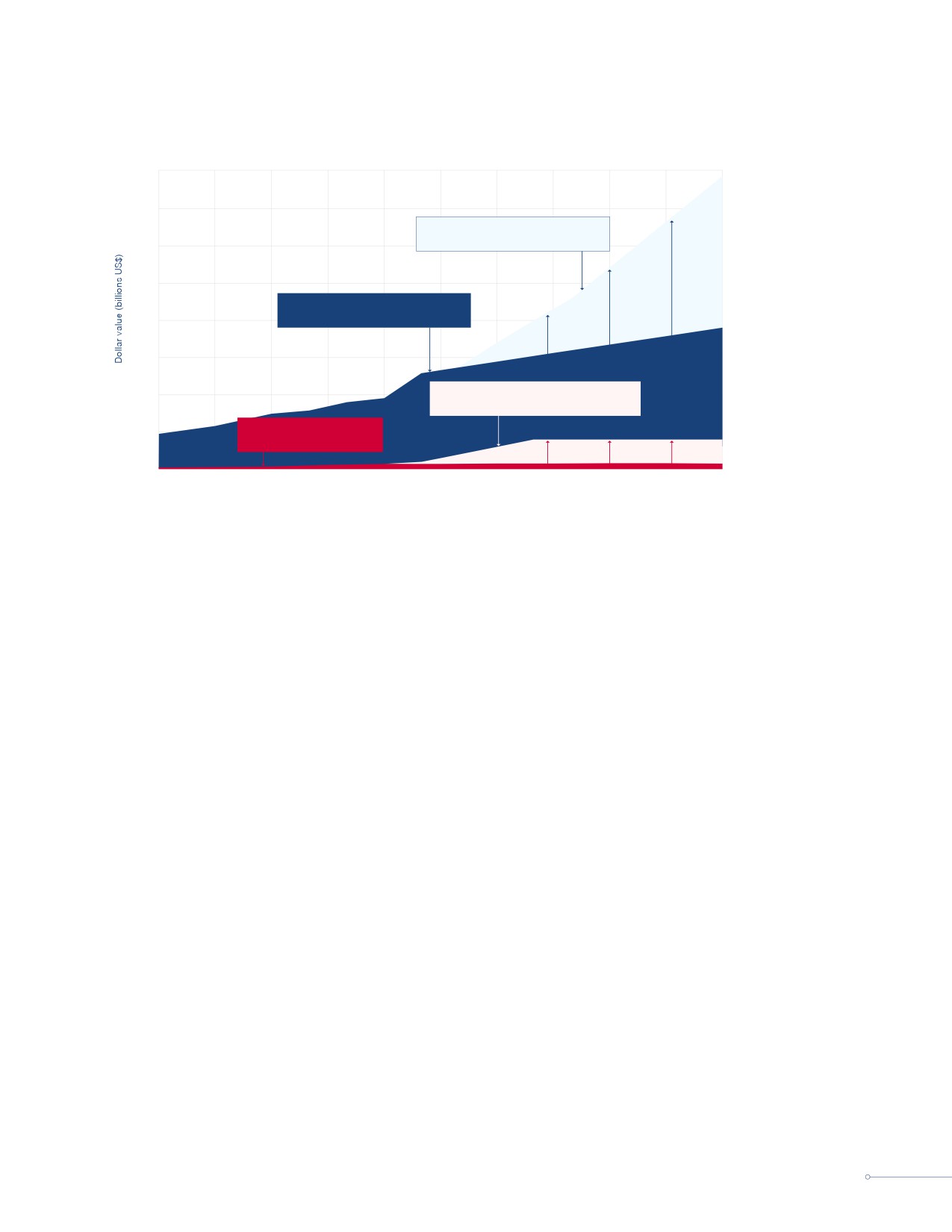
Enhanced AI R&D Investment, FY 2015-2030
Source: Govini and NSCAI
$80
Enhanced AI R&D
$70
Investment, FY
2015-2030.
Projection of spending on AI adoption with
recommended core AI spending of $8B/yr.
$60
$50
Projection of spending on AI adoption with
current core AI spending of $1.5B/yr.
$40
$30
$20
NSCAI recommendation: increase Core AI
spending from $1.5B to $8B per year by 2025.
$10
Projection of Core AI spending
under the status quo.
$0
2015
2018
2021
2024
2027
2030
Core AI spending is comprised of RDT&E programs to develop AI applications such as machine learning/
deep learning, collaborative behavior, computer vision; human-machine teaming, automated reasoning,
robotic autonomy, automated data fusion, and self-healing networks. Together with commercially
sourced AI applications, core AI spending enables AI adoption. We define AI adoption as the sum of
AI-enabled and AI-enabling investments (defined below).
AI-enabled programs develop (in the case of RDT&E programs) and field (in the case of procurement
programs) the gamut of DoD warfighting and business systems, incorporating Core AI applications
for analyzing, automating, communicating, maneuvering, monitoring, sensing, and many other tasks.
While AI spending is usually a small percentage of these programs, their system’s performance may be
critically dependent upon the incorporation of core AI.
AI-enabling programs include technologies such as cloud computing and advanced microelectronics
required to support the deployment of effective AI capabilities at scale.
Component 2: Retire Legacy Systems Ill-Equipped to Compete in AI-Enabled Warfare.
In the face of new budget realities, the Department must undergo an aggressive portfolio
rebalance to ensure sustained room in its budget for emerging technologies like AI.130 This
will require DoD to make hard decisions on where to divest, and identify opportunities
and timelines to upgrade or phase out legacy systems, as it continues to invest in new
systems. However, the Department must also approach new systems differently. Rather
than continuing to build large, monolithic platforms while competitors invest heavily in
attritable systems, the DoD should focus on speed. DoD should drive investments into
rapid prototyping and modular system design to develop and field new capabilities at a
rate that allows U.S. forces to continuously out-adapt the adversary.
p
316
BLUEPRINT FOR ACTION: CHAPTER 2
Actions for the Department of Defense:
•
Institutionalize an enduring defense-wide review and decision-making process,131
prioritized to the threat, to divest of legacy systems.
o The Secretary of Defense should direct the Service Secretaries, USD (A&S), the
Defense Agencies, and DoD Field Activities to evaluate the relevance and resiliency
of all platforms and systems against emergent threats, and ruthlessly divest from
systems and platforms deemed too costly or ineffective to equip with AI or make
compatible with AI-enabled systems and architectures.132
o The Service Secretaries and USD (A&S), in comparing the risk/reward tradeoffs
between new versus old technologies and operating concepts, should leverage AI
technologies as decision support tools.
o The Director of CAPE should enforce decisions to divest or reduce funding through
the program review process.
o The Service Secretaries and USD (A&S) should explore options for updating legacy
systems with leading-edge technologies to buy time for required long-term
modernization projects.
•
Evaluate AI alternatives prior to funding new major defense acquisition programs.
o The Secretary of Defense should issue a memorandum directing that all new major
defense acquisition programs must conduct a thorough evaluation of AI alternatives
as part of their analysis of alternatives prior to funding for major defense acquisition
programs.133
o USD (R&E) and the JAIC should provide support to program offices conducting such
analysis by providing subject matter expertise informed by technology scouting and
an awareness of the capabilities in the R&D pipelines across the S&T enterprise.
Action for Congress:
• The Congressional defense committees should support the Department’s hard
decisions when presented with evidence that divestment or defunding can enable
a more competitive force posture.
Component 3: Create an integrated technical intelligence program134 and a supporting
community of practice.
To effectively leverage scientific and technological breakthroughs for competitive
advantage, DoD must have a sophisticated technical intelligence program that monitors
developments as they progress from basic research to prototype to fielded capabilities,
understanding the R&D roadmaps of the private sector wherever possible. This intelligence
must be global in scale, monitoring emerging technologies in near real time, especially in
the rapidly evolving field of AI. The intelligence must be actionable, informing prioritization
of resourcing and providing decision-makers the ability to continuously update technology
roadmaps for our national security agencies.
p
317
FOUNDATIONS OF FUTURE DEFENSE
Such a technical intelligence program should provide inputs to the proposed Technology
Annex to the National Defense Strategy135 in three main areas: 1) An understanding of the
current and future threat capabilities in the R&D, production, and sustainment pipelines of
our adversaries; 2) An understanding of the current and future friendly capabilities in the
R&D, production, and sustainment pipelines of the U.S. government and allied partners;
and 3) An understanding of emerging military and dual use technologies worldwide
available for integration into national security capabilities.136
Actions for the Department of Defense:
•
Transform the Strategic Intelligence Analysis Cell.
o USD (R&E) should reconceive the Strategic Intelligence Analysis Cell (SIAC)137
as a robust analytic hub that marshals DoD, IC, and other technology scouting
capabilities for strategic effect.138 The SIAC Director should report directly to the
USD (R&E).
o SIAC should convene an interagency technology scouting community of practice
from the service laboratories, OSD (including DARPA and DIU), innovation initiatives
within the military services (such as AFWERX and AAL), the Departments of Energy
and Homeland Security, university-affiliated research centers, federally funded
research and development centers, CCMDs, and international security partners.
This community of practice should:
■ Establish a federated approach to provide USD (R&E) with inputs to produce
and continuously update the Technology Annex.
■ Conduct analytic exchanges and wargames to assess future technology
scenarios and include AI to the maximum extent possible.139
■ Develop rigorous technology forecasting capabilities, leveraging best practices
from academia and the private sector.
■ Engage with industry and update requirements for technology scouting tools
and data.
o In order to leverage private industry more effectively, SIAC should maintain
knowledge of private market investments relevant to the technologies and
capabilities outlined in the Technology Annex.
o In order to locate existing DoD capability gaps and potential solutions, SIAC must
receive technical details at all levels of classification on current programs of
record from OSD (A&S) and the armed service’s acquisition executives, as well as
technical details on RDT&E programs from OSD (R&E) and the technology scouting
community of practice described above.
o SIAC should establish a technology fellows program, inviting organizations in the
technology scouting community to nominate personnel for short-term (three- to
12-month) assignments with SIAC where they would work side-by-side with SIAC
analysts. This program should:
■ Build interdisciplinary teams of technologists and warfighters to conduct in-
depth investigations of emerging technologies, initiating direct contacts with
academia and industry in addition to passive data collection.
p
318
BLUEPRINT FOR ACTION: CHAPTER 2
■ Circulate personnel through the tech fellows’ program into key roles in
experimentation and concept development activities across OSD and the
military services.
■ Develop personnel with greater understanding of emerging technologies
across the national security community.
■ Leverage hiring authorities from the Public-Private Talent Exchange Program
and the Intergovernmental Personnel Act to include fellows from industry,
academia, and other government agencies to enhance access to non-DoD
research and perspectives.140
o SIAC should acquire or develop research tools for use by the technology scouting
community of practice, including AI-enabled analysis of large commercial
databases, classified threat intelligence, and the technology investment portfolios
of the United States Government and its allies.
Actions for Congress:
• Congress should appropriate an additional $10 million to USD (R&E)’s budget for
the technology fellows program and AI-enabled technology scouting tools and
data.
Component 4: Develop a Technology Annex to the National Defense Strategy.
To identify where and how to direct scarce resources, the DoD should formulate its
investment strategy as a classified Technology Annex to the National Defense Strategy
(NDS) produced by the Department’s Chief Technology Officer, USD (R&E). The Appendix
should: 1) Identify emerging technologies and applications required to solve the operational
challenges outlined in the NDS; and 2) Outline a clear plan for pursuing these technologies
and applications. This plan should account for existing technologies, including dual-use
commercial technologies, and drive rapid integration of these technologies to close near-
term capability gaps.141 The plan should also help inform the agenda for DARPA and the
DoD labs, by identifying disruptive technology elements and applications that warrant
longer-term, exploratory investments. Finally, the plan must take into account industry’s
comparative advantage in available R&D capital and include a consistent and transparent
approach to messaging defense technology priorities to build and broaden the industrial
base.142
Actions for the Department of Defense:
• Develop a Technology Annex to the National Defense Strategy.
o The Secretary of Defense, with support from the Director of National Intelligence,
should issue a memo directing the Steering Committee on Emerging Technology
to oversee the development of a comprehensive classified Technology Annex
as a component of the next NDS and assign USD (R&E) as the Executive Agent
responsible for producing the Technology Annex.
■ The Technology Annex should identify emerging technologies and
applications that are critical to enabling specific capabilities for solving the
operational challenges outlined in the NDS.
p
319
FOUNDATIONS OF FUTURE DEFENSE
o The Steering Committee on Emerging Technology described above should
ensure that the Technology Annex sets clear guidance that drives prioritization
and resourcing, while allowing enough flexibility for subordinate organizations to
implement that guidance as best suits their mission. At a minimum, the Technology
Annex should include:
■
Identified intelligence support requirements, including how the IC analyzes
the global environment and monitors technological advancements, adversarial
capability development, and emerging threats.
■
Identified functional requirements and technical capabilities necessary to
enable concepts that address each challenge.
■
A prioritized, time-phased plan for developing or acquiring such technical
capabilities that takes into account R&D timelines, a strategy for public private
partnerships, and a strategy for connecting researchers to end users for early
prototyping, experimentation, and iteration.
• This should include roadmaps for designing, developing, fielding, and
sustaining the technologies and applications to address the operational
challenges outlined in the NDS.
• These roadmaps should account for and leverage existing commercial-
off-the-shelf/dual-use technologies and identify areas where defense-
specific solutions are needed.
• The roadmaps should use quantitative technological forecasting methods
developed in academia and industry to identify disruptive technologies.
■
Identified additional or revised acquisition policies and workforce training
requirements to enable DoD personnel to identify, procure, integrate, and
operate the technologies necessary to address the operational challenges.
■
A prioritized, time-phased plan for integrating technology into existing DoD
exercises that support the NDS.
■
Identified infrastructure requirements for developing and deploying technical
capabilities, including data, compute, storage, and network needs; a resourced
and prioritized plan for establishing such infrastructure; and an analysis
of TEVV requirements to support prototyping and experimentation and a
resourced plan to implement them.
■
Identified joint capability and interoperability requirements and a resourced
and prioritized plan for implementation.
■
Consideration of human factor elements associated with priority technical
capabilities, including user interface, human-machine teaming, and workflow
integration.
■
Consideration of interoperability with allies and partners, including areas for
sharing of data, tools, and operational concepts.
■
Flexibility to adapt and iterate appendix implementation at the speed of
technological advancement.
•
Steward Implementation of the Technology Annex in Coordination with the
Intelligence Community.
p
320
BLUEPRINT FOR ACTION: CHAPTER 2
o The Secretary of Defense should direct the Steering Committee on Emerging
Technology to steward implementation of the Technology Annex, to include
coordination with the IC; and establish a reporting structure and metrics to monitor
the implementation of each technology roadmap to ensure each effort is resourced
properly and progressing sufficiently.
o The Steering Committee on Emerging Technology should ensure common
technical requirements are developed to align with the digital ecosystem’s open
architecture and are adhered to for the acquisition of emerging technologies
identified in the Technology Annex. The standards should be coordinated across
DoD and the IC.143
o The Steering Committee should conduct (at least) an annual review of the
Appendix and ensure that guidance, policy, and implementation evolve at the pace
of technological change.
Component 5: Clearly communicate defense technology priorities to industry.
DoD must leverage industry’s comparative advantage in available R&D capital as part of
its investment strategy. To do so effectively, the Department must adopt a consistent and
transparent approach to messaging defense technology priorities that enables Defense
primes and non-traditionals to plan and invest more to help meet DoD R&D needs, and
further supports the Department’s efforts to attract venture-backed companies.
Action for the Department of Defense:
• Publish unclassified emerging technology R&D objectives to support the
Technology Annex to the National Defense Strategy.
o The Secretary of Defense should direct USD (R&E) to produce unclassified
emerging technology R&D objectives and publish these objectives publicly. The
objectives should represent an unclassified component of the Technology Annex,
and be regularly updated as living documents.
■ The R&D objectives should be tied to subsets or components of priority
technologies and applications on which the government envisions the private
sector playing a major role in building future capabilities.144 They should be
communicated with an appropriate level of detail to provide current defense
companies guidance to steer their internal R&D investments, communicate to
startups interested in working with the government where future opportunities
lie, and signal to venture capitalists where future DoD funding might flow.
■ USD (R&E) should incorporate these objectives into the go-to-market strategy,
coordinating digital innovation initiatives to act as surrogates to amplify this
communication, and where appropriate, execute these priorities.
p
321
FOUNDATIONS OF FUTURE DEFENSE
o The Secretary of Defense should direct the Steering Committee on Emerging
Technology to develop an appropriate approach to monitor industry-independent
R&D investments to gauge the effectiveness of these efforts. This should be
coordinated with the DoD Office of General Counsel and relevant industry
associations.
o OUSD (R&E) should leverage public-private exchange programs,145 as well
as internal technical expertise from entities like DARPA and the interagency
technology scouting community, to bring both technical expertise and commercial
proficiency to the effort.146
p
322
BLUEPRINT FOR ACTION: CHAPTER 2
Blueprint for Action: Chapter 2 - Endnotes
1 See Chapter 9 of this report and its associated Blueprint for Action for a recommendation to
establish a Technology Competitiveness Council that could serve as a body for this kind of strategic-
level coordination.
2 This action is mirrored in the Chapter 3 and Chapter 5 Blueprints for Action. The Commission
acknowledges section 236 of the FY2021 National Defense Authorization Act, which permits the
Secretary of Defense to establish a steering committee on emerging technology and national security
threats composed of the Deputy Secretary of Defense; the Vice Chairman of the Joint Chiefs of
Staff; the Under Secretary of Defense for Intelligence and Security; the Under Secretary of Defense
for Research and Engineering; the Under Secretary of Defense for Personnel and Readiness; the
Under Secretary of Defense for Acquisition and Sustainment; the Chief Information Officer; and such
other officials of the Department of Defense as the Secretary determines appropriate. However, the
structure described in section 236 does not include leadership from the Intelligence Community, and
will thus not drive the intended action. See Pub. L. 116-283, William M. (Mac) Thornberry National
Defense Authorization Act for Fiscal Year 2021, 134 Stat. 3388 (2021), https://docs.house.gov/
billsthisweek/20201207/CRPT-116hrpt617.pdf.
3 The Commission’s recommendation for the development of a Technology Annex to the National
Defense Strategy is discussed later in this blueprint.
4 For example, the DoD’s Joint AI Center (JAIC) is building a Joint Common Foundation (JCF) that
aims to provide policies and tools that support an enterprise cloud-enabled AI environment. See
About the JAIC, JAIC (last accessed Feb. 2, 2021), https://www.ai.mil/about.html. Other digital
ecosystem pathfinders include, but are not limited to, Platform One, Kessel Run, Space CAMP, Black
Pearl, CReATE, ADVANA, and the Army Futures Command Software Factory.
5 See DoD Digital Modernization Strategy, U.S. Department of Defense at 30, 42-43 (July 12, 2019),
STRATEGY-2019.PDF (describing how the DoD plans to deploy an end-to-end identity, credential,
and access management infrastructure). This is an essential function that must be implemented in
an interoperable way across the national security-wide digital AI R&D ecosystem. DoD plans include
a goal to “Improve and Enable Authentication to DoD Networks and Resources through Common
Standards, Shared Services, and Federation.” Id. at 30.
6 Implemented as applications as a service (AaaS).
7 Implemented as platforms as a service (PaaS).
8 The digital ecosystem should incorporate DevSecOps processes and tools laid out in the DoD
Enterprise DevSecOps Reference Design. See DoD Enterprise DevSecOps Reference Design,
U.S. Department of Defense (Aug. 12, 2019), https://dodcio.defense.gov/Portals/0/Documents/
DoD%20Enterprise%20DevSecOps%20Reference%20Design%20v1.0_Public%20Release.pdf.
For more information, see Understanding the Differences Between Agile & DevSecOps - from a
differences_agile_devsecops/ (“DevSecOps improves the lead time and frequency of delivery
outcomes through enhanced engineering practices; promoting a more cohesive collaboration
between Development, Security, and Operations teams as they work towards continuous integration
and delivery.”).
9 For a short primer on MLOps, see 2021 Technology Spotlight - The Emergence of MLOps, Booz
Allen Hamilton (2021), https://www.boozallen.com/content/dam/boozallen_site/dig/pdf/white_paper/
the-emergence-of-mlops.pdf.
10 Notably, the Office of the Under Secretary of Defense for Research & Engineering (OUSD (R&E))
in 2020 outlined a similar vision for an enterprise-wide, shared digital ecosystem to implement
the Department’s Digital Engineering Strategy and accelerate broad adoption of model-based
system engineering. See Andrew Monje, Future Direction of Model-Based Engineering Across the
uploads/2020/05/RAMS-Monje-27Jan2020-Future.pdf.
11 A common software delivery platform used by industry and academia based on the features of Git
p
323
FOUNDATIONS OF FUTURE DEFENSE
12 Implemented as software as a service (SaaS).
13 See Chapter 7 of this report. See also Tab 1 - Recommendation 6: “Expedite the development of
tools to create tailored AI test beds supported by both virtual and blended environments” in Second
Quarter Recommendations, NSCAI at 14 (July 2020), https://www.nscai.gov/previous-reports/.
14 See Tab 1 - Recommendation 1: “Create an AI software repository to support AI R&D” in Second
Quarter Recommendations, NSCAI at 3 (July 2020), https://www.nscai.gov/previous-reports/;
see also Tab 1 - Recommendation 2: “Promote ATO reciprocity as the default practice within and
among programs, Services, and other DoD agencies to enable sharing of software platforms,
components, infrastructure, and data for rapid deployment of new capabilities” in Second Quarter
Recommendations, NSCAI at 5 (July 2020), https://www.nscai.gov/previous-reports/.
15 Implemented as data as a service (DaaS). See Tab 1 - Recommendation 3: “Create a DoD-wide AI
data catalog to enable data discovery for AI R&D” in Second Quarter Recommendations, NSCAI at 7
(July 2020), https://www.nscai.gov/previous-reports/.
16 The data services and resources provided by the digital ecosystem should support the DoD Data
Strategy. See Executive Summary: DoD Data Strategy, U.S. Department of Defense (Sept. 30, 2020),
https://media.defense.gov/2020/Oct/08/2002514180/-1/-1/0/DOD-DATA-STRATEGY.PDF.
17 For more information on AI documentation, see Chapter 7 of this report and the Appendix
containing the abridged version of NSCAI’s Key Considerations for Responsible Development &
Fielding of AI. See also the Commission’s recommendation to produce documentation of the AI life
cycle in the section on “Engineering Practices” in Key Considerations for Responsible Development &
Fielding of Artificial Intelligence: Extended Version, NSCAI (2021) (on file with the Commission).
18 As part of the funding plan, the Department should consider proposing expansion of the pilot for
consumption-based solutions outlined in Section 834 of the FY2021 NDAA to extend across the stack
of managed services that compose the digital ecosystem. See Pub. L. 116-283, William M. (Mac)
Thornberry National Defense Authorization Act for Fiscal Year 2021, 134 Stat. 3388 (2021).
19 The DoD CIO should determine the appropriate structure for such a working group, and may decide
to leverage or federate existing cross-functional working groups such as those for the DoD Enterprise
DevSecOps Initiative or Enterprise Infrastructure. Similarly, DoD CIO should work with pathfinder
organizations to determine whether they should be incorporated as part of the governance working
group or broken out as a separate community from which to draw best practices.
20 For example, contributions to the digital ecosystem would come from AI delivery teams at the
combatant command headquarters level, and from forward-deployed teams, as they leverage the
ecosystem for agile development of AI-driven capabilities.
21 The list included is intended as a general outline of key stakeholders; it is not exhaustive.
22 In recent years, the Department has made promising initial steps to establish managed services
constructs for platforms, cloud infrastructure, and software development; for example, the Air Force’s
CloudOne and Platform One as well as multiple in-house software factories such as Kessel Run and
Space CAMP (https://software.af.mil/software-factories and https://software.af.mil/dsop/services/ );
the Navy’s Black Pearl (https://blackpearl.us/ ); and the Army’s Coding Repository and Transformation
Environment (CReATE); and the new Software Factory at Army Futures Command. Further, the
Office of the Secretary of Defense has built a data management platform, ADVANA, with the goal
to establish it as the single authoritative source for audit and business data analytics. See Written
Statement for the Record of David L. Norquist, Deputy Secretary of Defense before the U.S. Senate
Armed Services Committee Subcommittee on Readiness at 6 (Nov. 20, 2019), https://www.armed-
services.senate.gov/imo/media/doc/Norquist_11-20-19.pdf.
23 The digital ecosystem’s open architecture should be developed with consideration of existing
warfighting architectures; for example, the Joint Warfighting Network Architecture recommended in
Chapter 3 of this report.
24 The open architecture should: 1) Define a common set of well-documented common interfaces for
the ecosystem’s key components and building blocks; 2) Support and integrate the work of existing
pathfinders up and down the ecosystem technology stack; and 3) Incorporate the process elements
of the DoD DevSecOps Reference Design Version 1.0 Aug. 12, 2019, data authorizations, and
continuous software ATO reciprocity.
p
324
BLUEPRINT FOR ACTION: CHAPTER 2
Blueprint for Action: Chapter 2 - Endnotes
25 The CIO should include guidance along with the open architecture describing what categories of
systems are to be adherent and which may be exempt.
26 Later in this blueprint, NSCAI recommends that USD (R&E) be appointed co-chair and chief
science advisor to the Joint Requirements Oversight Council (JROC) for joint and cross-domain
capabilities. This recommendation is also emphasized in Chapter 3 of this report.
27 The Executive Summary that accompanies the DoD Data Strategy states that each Component
will develop “measurable Data Strategy Implementation Plans, overseen by the CDO and DoD Data
Council.” See Executive Summary: DoD Data Strategy, U.S. Department of Defense (Sept. 30, 2020),
https://media.defense.gov/2020/Oct/08/2002514180/-1/-1/0/DOD-DATA-STRATEGY.PDF.
28 For example, ensuring contract Data Item Descriptions include the use of application programming
interfaces as the data transfer medium. For additional details on AI documentation, see Chapter 7
of this report and the Appendix containing the abridged version of NSCAI’s Key Considerations for
Responsible Development & Fielding of AI. See also the Commission’s recommendation to produce
documentation of the AI life cycle in the section on “Engineering Practices” in Key Considerations for
Responsible Development & Fielding of Artificial Intelligence: Extended Version, NSCAI (2021) (on file
with the Commission).
29 Memorandum from Deputy Secretary of Defense, Actions to Enhance and Accelerate Enterprise
Data Management, U.S. Department of Defense at 1 (Dec. 10, 2020).
30 As an example, the Steering Committee on Emerging Technology could consider designating the
Defense Logistics Agency (DLA) as an enterprise service provider for logistics applications and
associated services. These applications would be made available within the ecosystem for reuse and
integration. Similarly, upon publication of the reference design, the Committee could explore working
with the Intelligence Community to designate and integrate Intelligence Community application
service providers (e.g., the National Geospatial Agency for GEOINT application services).
31 The repository would support implementation of the DoD Data Strategy; the Strategy’s guiding
principles include “data is a strategic asset” and “enterprise-wide data access and availability.”
gov/2020/Oct/08/2002514180/-1/-1/0/DOD-DATA-STRATEGY.PDF.
32 See “Advana” Defense Analytics Platform - Department of Defense, ACT-IAC (June 16, 2020),
https://www.youtube.com/watch?v=BIQ31B9Hv44.
33 The digital ecosystem rides on the capacity of DoD’s underlying network and communication
backbone to provide rapid, on-demand access to the essential AI building blocks. The DoD Digital
Modernization Strategy calls out the need to modernize the Department’s primary networks,
the warfighter’s communication connectivity, and coalition networks—highlighting the need to
upgrade the optical network transport, routers, switches, and satellite gateways. See DoD Digital
defense.gov/2019/Jul/12/2002156622/-1/-1/1/DOD-DIGITAL-MODERNIZATION-STRATEGY-2019.PDF.
34 Components of which are already underway as a result of the JAIC’s Joint Common Foundation
initiative.
35 A common software delivery platform used by industry and academia based on the features of Git
36 See Tab 1 - Recommendation 1: “Create an AI software repository to support AI R&D” in Second
Quarter Recommendations, NSCAI at 3 (July 2020), https://www.nscai.gov/previous-reports/.
37 See Chapter 7 of this report. See also Tab 1 - Recommendation 6: “Expedite the development of
tools to create tailored AI test beds supported by both virtual and blended environments” in Second
Quarter Recommendations, NSCAI at 14 (July 2020), https://www.nscai.gov/previous-reports/.
38 A federated repository system uses a federated directory that ties distributed repositories together
as a virtual whole. See Tab 1 - Recommendation 3: “Create a DoD-wide AI data catalog to enable
data discoverability for AI R&D” in Second Quarter Recommendations, NSCAI at 7 (July 2020), https://
www.nscai.gov/previous-reports/.
p
325
FOUNDATIONS OF FUTURE DEFENSE
39 This would be supported by the prototype centralized data repository recommended above,
and hinges on implementation of the new DoD Data Strategy, which details the goals to make
DoD data visible, accessible, understandable, linked, trustworthy, interoperable, and secure. DoD
Oct/08/2002514180/-1/-1/0/DOD-DATA-STRATEGY.PDF.
40 Trained AI models are a special class of data, and the same federated repository system solution
used for DataEx can also be used to support ModelEx.
41 Another type of anticipated trained AI model is digital twins, as modeling and simulation platforms,
such as the Army’s One World Terrain advance to support training digital twins through reinforcement
learning. For more on One Word Terrain, see One World Terrain: A Pillar of the Army’s Synthetic
Training Environment, USCICT (Aug. 2, 2019), https://www.youtube.com/watch?v=K50eL1wU4ic.
42 DoD users could choose services off a multi-cloud provider schedule paying as they go for
computing resources and uploading/storing the government’s data. To facilitate seamless migration
of data and software from one platform to another, the DoD should negotiate contracts with providers
that appropriately limit expenses related to data egress and migration.
43 Internally developed software solutions and data sets could be contributed for use across the DoD
with built-in incentives for contributors through awarded cloud credits when products are contributed
and used. Limited public-facing elements could be brokered on the National AI Research Resource
recommended in Chapter 11 of this report.
44 See Chapter 7 of this report.
45 These platform environments should have ATO reciprocity for the building blocks they provision,
including incorporating DevSecOps development stacks.
46 Digital ecosystem contributors and users include embedded development teams working at
the tactical edge (see below Recommendation: Embed AI development capabilities in support of
operations); private sector partners contributing trained models; academic researchers working
on open challenge problems; researchers working within a DoD lab; or international partners co-
developing interoperable AI capabilities.
47 Becky Frankiewicz & Tomas Chamorro-Premuzic, Digital Transformation Is About Talent, Not
is-about-talent-not-technology.
48 As recommended in Chapter 7 of this report, national security departments and agencies should
provide ongoing training to help the workforce better interact, collaborate with, and be supported by
AI systems—including understanding AI tools.
49 Steve Blank & Pete Newell, What Your Innovation Process Should Look Like, Harvard Business
Review (Sept. 11, 2017), https://hbr.org/2017/09/what-your-innovation-process-should-look-like.
50 Andrew Moore, et al., The AI Stack: A Blueprint for Developing and Deploying Artificial Intelligence,
Proc. SPIE 10635 (May 4, 2018), https://doi.org/10.1117/12.2309483. For a graphical depiction of the
AI stack, see About, Carnegie Mellon University Artificial Intelligence (last accessed Jan. 1, 2021),
https://ai.cs.cmu.edu/about.
51 Pub. L. 109 -364, John Warner National Defense Authorization Act for Fiscal Year 2007, 109th
Congress (2006).
52 DoD Instruction 1300.19: DOD Joint Officer Management Program, U.S. Department of Defense
at 14 (April 3, 2018), https://www.esd.whs.mil/Portals/54/Documents/DD/issuances/dodi/130019p.
pdf?ver=2018-04-03-114842-923.
53 See Chapter 2 of this report and this associated Blueprint for Action section below about leveraging
public-private talent exchanges to infuse technical expertise into the acquisition corps for NSCAI’s
recommendation to create a technology fellows program to support development of a Technology
Annex to the National Defense Strategy; there are numerous extant fellowships across the DoD
involving emerging technologies.
p
326
BLUEPRINT FOR ACTION: CHAPTER 2
Blueprint for Action: Chapter 2 - Endnotes
54 This action aligns with the recommendation to establish a strategic data node within the
digital ecosystem discussed earlier in this Blueprint and with the DoD Data Strategy, which lists
Senior Leader Decision Support and Business Analytics as initial areas of focus. See DoD Data
Oct/08/2002514180/-1/-1/0/DOD-DATA-STRATEGY.PDF.
55 Notably, this recommendation is aligned with Section 836 of the FY 2021 National Defense
Authorization Act, which directs the Secretary of Defense to develop and integrate advanced digital
data management and analytics capabilities that integrate all aspects of the defense acquisition
system; facilitate the management and analysis of all relevant data; enable the use of such data to
inform further development, acquisition, management, and oversight of such systems, including
portfolio management; and include software capabilities to collect, transport, organize, manage,
make available, and analyze relevant data throughout the life cycle of defense acquisition programs.
The section further requires capability demonstrations and revised policies to promote the use of
digital management and analytics capabilities by March 15, 2022. Pub. L. 116-283, William M. (Mac)
Thornberry National Defense Authorization Act for Fiscal Year 2021, 134 Stat. 3388 (2021).
56 For example, critical human resource variables such as performance and retention are likely related
to budget variables (pay), health care variables (accessibility and quality of care) and even real estate
variables (housing). These relationships will become transparent and quantifiable when data tagging
supports cross domain analyses.
57 Gamechanger is an AI-enabled tool designed to analyze documentation of U.S. government
legislation, policies, and regulations for semantic content, to trace authorities and responsibilities
across documents, and to map authorities and responsibilities to agencies and officials designated
therein.
58 See discussion below for details on the responsibilities envisioned for JAIC as the Department’s AI
Accelerator.
59 For example, DIU is currently pursuing a number of AI projects to optimize business processes
in the DoD--ranging from using AI-driven Robotic Process Automation to reduce labor costs for
the Army Comptroller, to improving Air Force readiness with AI-driven predictive maintenance, to
leveraging AI-constructed knowledge graphs to rapidly identify supply chain risks. See JAIC Partners
ai.mil/blog_10_01_20-jaic_partners_with_diu_on_aiml_models_to_resolve_complex_finanical_errors.
html; U.S. Defense Department Awards C3.ai $95M Contract Vehicle to Improve Aircraft Readiness
en/US-Defense-Department-Awards-C3.ai-95M-Contract-Vehicle-to-Improve-Aircraft-Readiness-
Using-AI; Accrete.AI Accelerates Growth and Product Adoption with Defense Innovation Unit Contract,
Accrete.ai (April 23, 2020), https://blog.accrete.ai/newsroom/accrete.ai-wins-million-dollar-contract-
with-the-defense-innovation-unit.
60 This should include an evaluation of existing policies and regulations on contract data rights,
data format, data definitions, and data environments to accelerate application of commercial AI for
acquisition, management, and oversight and maximize insights derived.
61 For a glimpse into the DoD’s innovation ecosystem, see Tap the Innovation Ecosystem, MITRE:
Acquisition in the Digital Age, (last accessed Jan. 25, 2020), https://aida.mitre.org/demystifying-dod/
innovation-ecosystem/; Understanding the DoD Innovation Ecosystem, MITRE: Bridging Innovation
(last accessed Jan. 25, 2020), https://bridge.mitre.org/visualization/.
62 See Interim Report, NSCAI at 31 (November 2019), https://www.nscai.gov/previous-reports/.
63 The term “digital innovation initiatives” is used here to describe the various entities across the
Office of the Secretary of Defense and the military services, such as the Defense Innovation Unit
(DIU), AFWERX, NavalX, and Army Applications Laboratory (AAL), that are focused on bridging the
gap with the commercial technology section-especially startups and non-traditional vendors-and
accelerating the delivery of best-of-breed technology solutions.
64 As the Department’s Chief Technology Officer, USD (R&E) has both the authority and mandate to
coordinate discrete efforts across OSD and the military services to accelerate the adoption of digital
technology and expand the national security innovation base (NSIB). However, USD (R&E) must
ensure close coordination with USD (A&S) and, in the case of IT and information systems, DoD CIO,
to improve the transition of solutions emerging from these organizations into operational systems.
p
327
FOUNDATIONS OF FUTURE DEFENSE
65 For example, through current SBIR “bridging” funds described in Chapter 11 of this report or
technology-specific supplemental funding recommended later in this Blueprint for Action under,
“Make supplemental funding available to drive operational prototyping, scale, and transition of AI
technologies.”
66 As the Chief Technology Officer of the DoD, USD (R&E) has a “mission to advance technology
and innovation.” Additionally. USD (R&E) is responsible for advis[ing] the Secretary of Defense on
all matters related to research; engineering; manufacturing; developmental test & evaluation; and
technology development, innovation, and protection activities and programs in the DoD and occurring
internationally [as well as] establishing priorities across those matters to ensure conformance with
Secretary of Defense policy and guidance. For a full list of USD (R&E)’s responsibilities and functions,
see DoDD Directive 5137.02: Under Secretary Of Defense For Research And Engineering (USD
DD/issuances/dodd/513702p.pdf?ver=2020-07-15-124712-047. [hereinafter DoDD 5137.02]
67 For example, DIU leverages Other Transaction Authority (OTA) and the Commercial Solutions
Opening process to “test, field, and scale commercial technology in less than 24 months.” The
Air Force’s AFWERX, in partnership with Air Force Research Lab (AFRL) and DIU’s National
Security Innovation Network (NSIN), has pioneered new approaches to Small Business Innovation
Research (SBIR) and Small Business Technology Transfer (STTR) funding to “increase the
efficiency, effectiveness, and transition rate” of the program. See Annual Report 2019, Defense
Innovation Unit at 4 (2019), https://assets.ctfassets.net/3nanhbfkr0pc/ZF9fhsMe6jtX15APMLalI/
cd088a59b91857c5146676e879a615bd/DIU_2019_Annual_Report.pdf; SBIR Open Topics, U.S. Air
Force AFWERX (last accessed Jan. 1, 2021), https://www.afwerx.af.mil/sbir.html.
68 Also informed by the JAIC, and made accessible through the digital ecosystem.
69 As described in Chapter 3 of this report, there should be a push-pull relationship between
innovative technologies and concepts such that the Technology Annex informs, but does not limit, the
scope of activity. Digital Innovation Initiatives will likely continue to have responsibilities outside of this
go-to-market strategy; for example, the acceleration of commercial AI applications for core business
processes.
70 The impact and potential use cases of investments may not be apparent for several years. This
review aims to provide insight into current activities so as to influence, but not dictate, modifications to
the next “go-to-market strategy.” This process should be automated to the maximum extent possible
to minimize overhead.
71 Many of the processes and technical roadblocks faced by traditional and non-traditional
vendors that slow critical efforts to build and integrate AI systems will be greatly diminished by the
implementation of a digital ecosystem, as described above. However, until then, top-down support at
the highest levels of leadership will be essential to empower digital innovation initiatives. Per DoDD
5137.02, part of USD (R&E)’s functions include working in conjunction with the USD (A&S) to identify,
evaluate, and promote opportunities to reduce barriers to entry for commercial technologies and non-
traditional defense partners; and leading initiatives to engage non-traditional suppliers of technology.
See DoDD 5137.02.
72 Where appropriate, efforts should leverage expertise from FFRDCs and UARCs.
73 Prototyping contracts provide non-recurring engineering dollars to companies for early-stage
technologies and projects “to evaluate and inform [their] feasibility or usefulness.” Often, these
dollars come from dedicated funds, such as the SBIR and STTR programs and DIU’s internal
prototyping budget; and are distributed by organizations like DIU outside of the acquisition life cycle
domains, including DoD programs of record (PoR). Companies executing promising projects through
these mechanisms often exhaust prototype funding and are unable to secure sustainable follow-
on contracts (i.e., with a clear path toward integration into a PoR) because they cannot identify a
customer, or the customer’s funding is already committed. AFWERX improved transition in its SBIR
program by achieving buy-in from potential customers through matching program funds. See Tab
1 - Recommendation 7: “Strengthen Return on SBIR Investments” in Interim Report and Third Quarter
Recommendations, NSCAI at 52 (October 2020), https://www.nscai.gov/previous-reports/; Prototyping
Guidebook, U.S. Department of Defense at 36 (November 2019), https://www.dau.edu/tools/Lists/
DAUTools/Attachments/329/DoD%20Prototyping%20Guidebook,%20v2.0.pdf.
p
328
BLUEPRINT FOR ACTION: CHAPTER 2
Blueprint for Action: Chapter 2 - Endnotes
74 For example, at least one F-22 and F-35 aircraft designated as AI test beds could incentivize
existing contractors and non-traditional firms to work together and better align their incentives to field
new mission capabilities. Such an initiative would build on initial efforts to integrate agile software
development into F-22 modernization programs. See Craig Ulsh, Software Acquisition and Practices
gov/2019/Mar/07/2002097482/-1/-1/0/SWAP_STUDY_VIGNETTES.PDF.
75 The 2019 National Defense Authorization Act identified metrics for DIU to report, such as: the
number and types of transitions by the Unit to the military departments or fielded to the warfighter;
and the impact of the Unit’s initiatives, outreach, and investments on Department of Defense access
to technology leaders and technology not otherwise accessible to the Department, including the
number of non-traditional defense contractors with Department of Defense contracts or other
transactions resulting directly from the Unit’s initiatives, investments, or outreach; the number of
traditional defense contractors with contracts or other transactions resulting directly from the Unit’s
initiatives; and the number of innovations delivered into the hands of the warfighter. See Pub. L.
115-232, sec. 244, John S. McCain National Defense Authorization Act for Fiscal Year 2019, 115th
Congress (2018); Pub. L. 116-283, William M. (Mac) Thornberry National Defense Authorization Act for
Fiscal Year 2021, 134 Stat. 3388 (2021).
76 This metric should be appropriately scoped such that consideration is given to products or
solutions that lend themselves to enterprise licensing agreements and prioritize measures that
indicate the level of cross-service, cross-unit proliferation of a solution.
77 A 2019 study conducted by the Defense Innovation Board Defense reached similar conclusions with
regard to software acquisitions generally, stating that the current approach to software development
is broken and is a leading source of risk to DoD; it takes too long, is too expensive, and exposes
warfighters to unacceptable risk by delaying their access to tools they need to ensure mission
success. Software is Never Done: Refactoring the Acquisition Code for Competitive Advantage, DoD
Defense Innovation Board at i (May 2019), https://media.defense.gov/2019/May/01/2002126689/-1/-
1/0/SWAP%20COMPLETE%20REPORT.PDF.
78 The Adaptive Acquisition Framework promotes use of tailored acquisition approaches based on the
needed capability. It includes six guiding pathways for acquiring capabilities that Milestone Decision
Authorities (MDAs), other Decision Authorities (DAs), and Program Managers (PMs) can “tailor,
combine, and transition between”: Urgent Capability Acquisition, Middle Tier of Acquisition, Major
Capability Acquisition, Software Acquisition, Defense Business Systems, and Acquisition of Services.
See Adaptive Acquisition Framework Pathways, Defense Acquisition University, (last accessed Dec.
26, 2020), https://aaf.dau.edu/aaf/aaf-pathways/. The Software Acquisition Pathway was developed
based on a recommendation from the Defense Innovation Board in the 2019 Software Study. See
Software is Never Done: Refactoring the Acquisition Code for Competitive Advantage, DoD Defense
Innovation Board at 37, S2 (May 2019), https://media.defense.gov/2019/May/01/2002126689/-1/-1/0/
SWAP%20COMPLETE%20REPORT.PDF.
79 The Contracting Cone outlines all Federal Acquisition Regulation (FAR) and Non-FAR contract
strategies. Contracting Cone, Defense Acquisition University (last accessed Dec. 20, 2020), https://
aaf.dau.edu/aaf/contracting-cone/.
80 Specialized pathways include approaches captured within the Department’s Adaptive Acquisition
Framework such as the Middle Tier of Acquisition and Software Acquisition that are exempted from
certain requirements within the Defense Acquisition System.
81 In January 2020, former Under Secretary of Defense for Policy Michele Flournoy cited concern
over inadequate training and incentives for acquisition professionals to make full use of authorities
provided by Congress. She noted “pockets of [acquisition] excellence” in Special Operations
Command and the Air Force, but argued the larger acquisition corps “is not using the authorities
effectively, consistently, and at scale.” See Testimony of The Honorable Michele A. Flournoy,
former Under Secretary of Defense for Policy before the U.S. House of Representatives Armed
armedservices.house.gov/_cache/files/4/4/44fbef3d-138c-4a0a-b3a9-2f05c898578f/0E4943A5BFAE
DA465D485A166FABCF5F.20200115-hasc-michele-flournoy-statement-vfinal.pdf.
82 Including Federal Acquisition Regulation (FAR)-based approaches and non-FAR-based approaches
as outlined in the Defense Acquisition University’s Contracting Cone. See Contracting Cone, Defense
Acquisition University (last accessed Dec. 20, 2020), https://aaf.dau.edu/aaf/contracting-cone/.
p
329
FOUNDATIONS OF FUTURE DEFENSE
83 Such as the middle tier of acquisition and the software acquisition pathway.
84 For example, efforts associated with section 230 of the Fiscal Year 2020 NDAA on talent
management of digital expertise and software professionals; section 256 on an education strategy for
Artificial Intelligence; and section 862 of the FY2020 NDAA on software development and software
acquisition training and management programs. In support of the implementation of Section 862,
USD (A&S) is developing a pilot software acquisition training program that aims to better enable the
“creation and execution of acquisition strategies and contracts that support the speed of technology
and change” by providing students with the foundations of digital technologies through evolutionary
content in context of the Defense Acquisition System. Digital DNA: Software Acquisition Training Pilot,
U.S. Department of Defense at 1 (on file with the Commission); see also Report to Congress on FY20
NDAA Section 862(b)(1)(B) Software Development and Software Acquisition Training and Management
Policy/FY20_NDAASec862ReportToCongress_DoDSoftwDevSoftwAcqTngMgt_Jan2021.pdf.
85 This should be coordinated appropriately with the relevant legal and ethics officials to avoid any
potential conflicts of interest.
86 Section 1102 of the FY2021 National Defense Authorization Act directs the Secretary of Defense
to provide briefings to the defense authorization committees on implementation of public-private
exchange programs and recommendations for statutory changes to improve their use and
effectiveness. Section 1102 also directs the Secretary to take steps to ensure the exchange program
is applied to the defense modernization priorities-including AI. While USD (R&E)’s modernization
directors are responsible for “unifying and advancing the Department’s investments and capabilities
[in their areas], and ensur[ing] the transition of technologies into operational use,” the Department’s
acquisition professionals will be the personnel ultimately responsible for operationalizing the
modernization priorities. See Pub. L. 116-283, William M. (Mac) Thornberry National Defense
Authorization Act for Fiscal Year 2021, 134 Stat. 3388 (2021); see also Modernization Priorities,
U.S. Department of Defense, USD (R&E), (last accessed Dec. 28, 2020), https://www.cto.mil/
modernization-priorities/.
87 The DoD has already begun to make progress in these areas. For example, the Advanced
Distributed Learning (ADL) Initiative under the Office of the Under Secretary of Defense for Personnel
and Readiness (USD (P&R)), which originated in the 1990s, is a DoD-wide program for modernizing
DoD training/education, including the use of learning technologies and platforms, and support for
content sharing, collaboration, and interoperability. ADL is currently pursuing an Enterprise Course
Catalog to federate disparate or decentralized catalogs across the organization, aggregating
the content into a single, Defense-wide portal. See Enterprise Course Catalog (ECC), Advanced
Distributed Learning Initiative (last accessed Feb. 12, 2021), https://adlnet.gov/projects/ecc/.
88 Including DoD-specific training as well as relevant commercial and open-source training.
89 Examples could include draft acquisition strategy documents for programs planning to use the
middle tier or software acquisition pathways; model contracting language for AI technologies, etc.
90 Including on new or innovative acquisition approaches and best practices as well as new or
emerging digital technologies and technical approaches (e.g., digital engineering, MLOps, etc.).
91 This recommendation echoes a recommendation made by the Defense Innovation Board (DIB) in a
2019 study on software acquisition and practices within the Department of Defense. The DIB called
for a new acquisition pathway for software that would prioritize continuous integration and delivery
of working software in a secure manner, with continuous oversight from automated analytics. The
DIB provided draft legislative language in the body of the report for consideration by the DoD and
Armed Services Committees in implementing this recommendation. The draft legislative text indicated
the need for a rapid contracting mechanism to be established as part of the software pathway.
Although the creation of a software acquisition pathway was directed by section 800 of the FY2020
NDAA and the Department has since issued a formal policy on the pathway, the rapid contracting
mechanism remains unimplemented. See Software is Never Done: Refactoring the Acquisition Code
gov/2019/May/01/2002126689/-1/-1/0/SWAP%20COMPLETE%20REPORT.PDF; Pub. L. 116-92,
National Defense Authorization Act for Fiscal Year 2020; DoD Instruction 5000.87: Operation of the
Portals/54/Documents/DD/issuances/dodi/500087p.PDF?ver=virAfQj4v_LgN1JxpB_dpA%3D%3D.
p
330
BLUEPRINT FOR ACTION: CHAPTER 2
Blueprint for Action: Chapter 2 - Endnotes
92 Using system-level program elements incentivizes programs to build “full stack” with each
subcomponent and enabling technology being built and procured individually as part of the broader
program makeup. This reduces risk. In recent years, enabling services such as Platform One have
re-emerged, but it is difficult to justify base operating budgets for these organizations because
they are not tied to discrete outputs. See Eric Lofgren, The DoD Budget Process: the Next Frontier
of Acquisition Reform, George Mason University Center for Government Contracting (July 9, 2020),
https://business.gmu.edu/images/GovCon/White_Papers/The_DoD_Budget_Process.pdf.
93 Joint Capabilities Integration and Development System (JCIDS) and the Planning, Programming,
Budget and Execution (PPBE) process are tightly linked. Military needs drive the development of
new programs to deliver capability. Traditionally derived from concepts of operations, these needs
are the basis against which the Department evaluates, costs, and ultimately pursues a solution. If
the Department determines that a material solution is necessary, the need will be decomposed into
requirements that prescribe the design, specification, and function of the system intended to deliver
the capability. Once validated, these requirements drive the DoD’s budget. Id. at 5.
94 Commonly known as “colors of money,” DoD funds are appropriated into the following categories,
each with its own allowable uses per law: Research, Development, Test & Evaluation (RDT&E) dollars,
Procurement dollars, Operations & Maintenance (O&M), and Sustainment dollars.
95 The distinction between research and development funds and operating funds disincentivizes
the cycle of continuous development and integration necessary to derive value from AI and
software-based applications. Within the RDT&E appropriation alone, separate funding for research,
development, prototyping, and fielding assumes a slow linear progression from lab to field pre-
defined system requirements that allow for little to no user feedback. Once fielded, appropriations law
governing the use of O&M funds challenges upgrades to digital systems.
96 Congressional testimony from former Under Secretary of Defense for Policy Michele Flournoy
highlights the centrality of experimentation to developing new concepts and capabilities at the
speed required to outpace our competitors. See Testimony of The Honorable Michele A. Flournoy,
former Under Secretary of Defense for Policy before the U.S. House of Representatives Armed
armedservices.house.gov/_cache/files/4/4/44fbef3d-138c-4a0a-b3a9-2f05c898578f/0E4943A5BFAE
DA465D485A166FABCF5F.20200115-hasc-michele-flournoy-statement-vfinal.pdf.
97 Requirements are developed that drive technological development, and prototyping and
experimentation occur as a means to refine requirements and manage risk. This incentivizes
integration of incremental technologies into programs of record rather than disruptive or rapidly
changing user-centered technologies, such as AI; and limits the ability of program managers to
respond to any fast-paced change in technology later in the life of the program. See Pete Modigliani
et al., Modernizing DoD Requirements: Enabling Speed, Agility, and Innovation, The MITRE Center for
Technology and National Security (March 2020), https://www.mitre.org/sites/default/files/publications/
pr-19-03715-2-modernizing-dod-requirements-enabling-speed-agility-and-innovation.pdf.
98 The budget activity 8 (BA 8) pilot seeks to overcome the barrier that DoD spending categories
pose to the development and sustainment of digital technologies. The Office of the Under Secretary
of Defense for Acquisition and Sustainment and the Office of the Under Secretary of Defense for
Comptroller selected nine programs to begin to pilot the BA 8 for FY2021. Defense appropriators
approved eight of the nine programs, and BA 8 is being established for each Service and Defense-
wide under the Research, Development, Test & Evaluation appropriation and enable two-year funding.
See H.R. 133, Consolidated Appropriations Act, 2021, 116th Congress (2020), https://docs.house.
gov/billsthisweek/20201221/BILLS-116RCP68-JES-DIVISION-C.pdf?source=email (joint explanatory
statement at 118).
99 Appointing USD (R&E) Co-Chair and Chief Science Advisor to the JROC would help push
forward efforts to reform requirements generation and validation. Serving as the system architect
for joint and cross-domain solutions, USD (R&E) would advocate for more flexible system design
and specifications such as modular open systems architecture and standards, well-documented
application programming interfaces (APIs). See Chapter 3 of this report. See also Tab 2 -
Recommendation 2: “USD (R&E) should be appointed the Co-Chair and Chief Science Advisor to
the Joint Requirements Oversight Council (JROC) for Joint and cross-domain capabilities” in Interim
previous-reports/.
p
331
FOUNDATIONS OF FUTURE DEFENSE
100 Section 809 of the FY2021 NDAA directs the Secretary of Defense and the Director for Extramural
Innovation and Research Activities to “conduct an assessment of the processes for developing
and approving capability requirements for the acquisition programs of the Department of Defense
and each military department” and submit reports to the defense authorization committees. Pub.
L. 116-283, William M. (Mac) Thornberry National Defense Authorization Act for Fiscal Year 2021,
134 Stat. 3388 (2021). Section 809 further stipulates that, as part of the assessment, both officials
must evaluate the “extent to which portfolio management techniques are used in the process for
development capability requirements to coordinate decisions and avoid duplication of capabilities
across acquisition programs.” Id. The Joint Explanatory Statement accompanying the provision
indicates that the Department shall consider the recommendations made in the MITRE Corporation’s
Modernizing the Requirements Process: Enabling Speed, Agility, and Innovation as part of the
directed assessment. Recommendations include the establishment of enterprise-level requirements
or “Warfighter Essential Requirements’’ for capabilities to ensure acquisition programs are closely
aligned to warfighter needs, drive systems of systems approaches and reduce redundancies
between and among services and domains; and enable budget and requirements trade-offs through
a portfolio management approach. The authors also recommend different management approaches
for requirements based on the attributes of the system being developed. See Pete Modigliani, et al.,
Modernizing the Requirements Process: Enabling Speed, Agility, and Innovation, MITRE (March 2020),
enabling-speed-agility-and-innovation.pdf.
101 A formal legislative proposal may not be required. DoD retains discretion in the structure
and objectives of annual budget proposals. However, approval from Congress and the Office of
Management and Budget is required.
102 Such as dashboards and digital engineering artifacts.
103 USD (R&E) should work closely with the JAIC, the Joint Staff, and the military services to identify
specific programs and mission areas ripe for potential application of AI technologies, with particular
attention to near-term warfighter needs from the Combatant Commands, and use the fund to
accelerate efforts in those areas. Establishment of this fund would need to be accompanied with
transfer authority such that USD (R&E) could transfer resources to the relevant entities to conduct
these activities.
104 This is being led by the DoD Office of the Under Secretary of Defense for Comptroller and
Office of the Under Secretary of Defense for Acquisition and Sustainment, based on the findings
and recommendations of the Defense Innovation Board’s Software Acquisition and Practices
Study. Software is Never Done: Refactoring the Acquisition Code for Competitive Advantage, DoD
Defense Innovation Board (May 2019), https://media.defense.gov/2019/Apr/30/2002124828/-1/-1/0/
SOFTWAREISNEVERDONE_REFACTORINGTHEACQUISITIONCODEFORCOMPETITIVEADVANTAGE_
FINAL.SWAP.REPORT.PDF. Jeff Boleng, Special Assistant for Software Acquisition to the Under
Secretary of Defense for Acquisition and Sustainment, publicly stated the goal of the pilot as
“simplifying the budget process, increasing the visibility, accountability of the funding.” Billy
Mitchell, DOD has OMB Support for Special Software-only Appropriations Pilots, FedScoop
pilots/. In public remarks made March 3, 2020, Under Secretary of Defense for Acquisition and
Sustainment Ellen Lord underscored the significance of the pilot, asserting, “we will begin to
see results almost instantaneously, because the administrative burden of making sure you are
charging the right development number, the right production number, the right sustainment
number, slows things down.” Jared Serbu, Pentagon Teeing Up Nine Programs to Test New
federalnewsnetwork.com/acquisition/2020/03/pentagon-teeing-up-nine-programs-to-test-
new-color-of-money-for-software-development/; West 2020: 3 March 2020 Morning Keynote
watch?v=VGlqjyMhtok&list=PLFZb4znlHwx0TcsirmyYD6k5BAYxDRwU0&index=6&t=0s.
105 For example: budget activities within the appropriation could be aligned to a DoD Component;
program elements or budget lines under the budget activities would align to joint capabilities
(e.g., Joint Command and Control) and then further decomposed into projects (i.e., key systems,
investments, and supporting activities).
106 Often, technology that has been in use in the commercial sector for years.
p
332
BLUEPRINT FOR ACTION: CHAPTER 2
Blueprint for Action: Chapter 2 - Endnotes
107 Section 232 of the National Defense Authorization Act for FY2021 designates the JAIC as a direct
report to the Deputy Secretary of Defense, adds to the JAIC’s responsibilities the “acquisition and
development of mature artificial intelligence technologies in support of defense missions,” and directs
the Secretary of Defense to clarify the roles and responsibilities of various DoD Components relative
to the “research, development, prototyping, testing, procurement of, requirements for, and operational
use of artificial intelligence technologies.” See Pub. L. 116-283, William M. (Mac) Thornberry National
Defense Authorization Act for Fiscal Year 2021, 134 Stat. 3388 (2021).
108 Best practices could include user-centered approaches such as problem discovery, which could
be captured and shared via a modern, queryable knowledge management system; or algorithms or
models added to the JAIC’s repository within the digital ecosystem.
109 For example, identity-based user authentication and access controls; definition of common
standard interfaces and documentation requirements; and accreditation and ATO reciprocity. See full
list above.
110 For example, working with the Office of the Under Secretary of Defense, the Defense Contract
Management Agency, Service Acquisition Executives, and other relevant parties responsible for
acquisition and procurement activities to develop model contract language that incorporates the
standards and practices outlined in NSCAI’s Key Considerations for Responsible Development
& Fielding of AI. These would apply both to systems developed by DoD, as well as those that
are acquired (including Commercial off-the-shelf systems or those developed by contractors).
See the Appendix of this report containing the abridged version of NSCAI’s Key Considerations
for Responsible Development & Fielding of AI. For additional details on the Commission’s
recommendation for governance, see the sections on “Aligning Systems and Uses with American
Values and the Rule of Law” and “Accountability and Governance” in Key Considerations for
Responsible Development & Fielding of Artificial Intelligence: Extended Version, NSCAI (2021) (on file
with the Commission).
111 More details for a TEV V framework can be found in Chapter 7 of this report.
112 AI applications are extremely diverse and thereby necessitate a wide range of testing methods.
Establishing common approaches to tailoring appropriate processes and tools to the type of AI
application at hand will support the ability of DoD components to embrace and scale AI solutions
by shortening the testing cycle and making test results interpretable and comparable across the
Department. Given the diversity of use cases, the framework would not embody a one-size-fits-all
approach, but rather provide core capabilities and guidance adaptable across application areas. For
a full discussion on this framework, and required resourcing, see Chapter 7 of this report.
113 Depending on the current state of the implementation of the digital ecosystem, this shared access
could be accomplished through the federated system of distributed software repositories—whether
the JAIC’s software repository or one managed by a DoD component that originally developed or
licensed the software tool.
114 Including tools for TEV V. This effort should also determine what AI development tools are
already available across the Department (e.g., where commercial software licenses already exist)
and, leveraging the acquisition authority granted in the FY2021 NDAA, procuring leading-edge AI
development tools with licensing terms to support enterprise-wide usage. Reasonable consideration
should be given for the maturity of the product/tool and likelihood of enterprise use. Section 808 of
the FY 2021 National Defense Authorization Act grants the Director of the Joint Artificial Intelligence
Center acquisition authority up to $75 million out of the funds made available in FiY 2021-2015 to
enter into new contracts. Pub. L. 116-283, William M. (Mac) Thornberry National Defense Authorization
Act for Fiscal Year 2021, 134 Stat. 3388 (2021).
115 Such as data scientists, AI and software engineers, infrastructure engineers, product managers,
and other key positions.
116 Including full stack development, engineering, testing, integration, etc., for AI applications and
systems.
117 To reduce barriers to entry, the Department could also consider pairing the Blanket Ordering
Agreement or Blanket Purchasing Agreement with a Broad Agency Announcement or Commercial
Solutions Open solicitation procedure.
p
333
FOUNDATIONS OF FUTURE DEFENSE
118 This should include a diverse cross-section of expertise that at a minimum includes engineering
(i.e., data science and AI solutions), AI digital ecosystem architecture, AI software experts, product
managers; and acquisition, legal, policy experts as well as domain experts.
119 This could also involve JAIC representatives embedded at Combatant Command headquarters
where appropriate and feasible.
120 Of note, the NSCAI Interim Report Appendix 3: Workforce Model’s recommendations are designed
to support this model, with AI experts and developers serving at hubs, developers serving in spokes,
and deployment specialist training helping domain experts maintain data sets and software and better
nscai.gov/previous-reports/.
121 CCMDs have specific operational needs that routinely outpace centralized development
approaches. Modern battlefield dynamics require that each commander have the ability to tailor the
character of his or her war to out-adapt the adversary.
122 To stand-up these teams quickly, the CCMDs could leverage the enterprise contracting vehicles
through the JAIC to access a pre-vetted pool of talent with AI engineering, data science, and product
management competencies. If local contracting vehicles are used, contract provisions should require
that all development efforts are interoperable with and leverage the digital ecosystem.
123 In this way, the AI delivery teams will contribute to a growing resource of shared data and software
within the digital ecosystem by consuming ecosystem services, developing and fielding tailored AI
capabilities, and integrating them into sustainable projects available for use across the department.
124 As an example, both Army Futures Command (AFC) and Army Special Operations Command
(USASOC) use a model known as “tactical data teams.” This model brings AI/ML expertise forward
to the field in the form of three- to six-person teams to build AI solutions for real-time operational
problems. Executed by a small business, Striveworks, under contract with AFC and USASOC, they are
currently supporting efforts in Central Command and Indo-Pacific Command Areas of Responsibility.
125 These are similar interactions with the digital ecosystem as those taken by the delivery teams at
Combatant Command HQ, only the forward-deployed development team will be consuming digital
ecosystem services locally on their provisioned mobile platform. Collocation of the developers with
operators will drive real-time experimentation and shorten application feedback loops.
126 DoD lacks reliable budget data to track its investments in AI and other critical technologies;
a weakness that should be addressed at the source with AI applications that assist humans in
generating program descriptions and other budget artifacts.
127 For a full discussion of how AI will change warfare, see Chapter 3 of this report.
128 For a list of priority AI R&D research areas, see Chapter 3 of this report.
129 The Defense Science Board has recommended the level of 3.4% to mirror best practices in the
private sector multiple times. Department of Defense Research, Development, Test, and Evaluation
(RDT&E): Appropriations Structure, Congressional Research Service at 12 (Oct. 7, 2020), https://fas.
org/sgp/crs/natsec/R44711.pdf.
130 While defense budgets are projected to flatten or decline in the coming years, the threat
environment will only increase in complexity. To meet these new realities, we must create more room
in the budget while simultaneously increasing the lethality of our forces. By retiring legacy systems
and investing more in emerging technologies and, over the longer term, portfolios of attritable
systems, DoD can pursue these needs in tandem, boosting the composability and adaptability of our
military forces.
p
334
BLUEPRINT FOR ACTION: CHAPTER 2
Blueprint for Action: Chapter 2 - Endnotes
131 Former Secretary of Defense Mark Esper pioneered his “night-court” budgeting process as
Army Secretary (2017-2019) and later applied it Department-wide. He “took a hard look at legacy
department programs and cut a number of them, refocusing funds on efforts to challenge China
and Russia.” As Army Secretary, he “helped guide those restructurings through Congress, and the
process, which found around $25 billion in savings, has garnered largely positive reviews.” Aaron
www.defensenews.com/pentagon/2019/08/28/night-court-comes-to-the-pentagon/. According to
the Pentagon’s press release detailing the highlights of the FY2021 budget proposal, the process
applied defense-wide generated $5.7 billion in FY2021 savings, $0.2 billion in Working Capital Fund
efficiencies, and another $2.1 billion in activities and functions realigned to the Services. Press
Release, The Office of the Under Secretary of Defense for Comptroller, DoD Releases FY 2021
Press_Release.pdf.
132 This echoes a recommendation made by the Future of Defense Task Force. The Task Force
recommended that Congress commission the RAND Corporation (or similar entity) and the
Government Accountability Office to study legacy platforms within the Department of Defense and
determine their relevance and resiliency to emerging threats over the next 50 years. The Task Force
further recommended that upon completion of the studies, “a panel should be convened, comprising
Congress, DoD, and representatives from the industrial base to make recommendations on which
platforms should be retired, replaced, or recapitalized.” Future of Defense Task Force Report 2020,
House Armed Services Committee at 8 (Sept. 23, 2020), https://armedservices.house.gov/_cache/
files/2/6/26129500-d208-47ba-a9f7-25a8f82828b0/424EB2008281A3C79BA8C7EA71890AE9.future-
of-defense-task-force-report.pdf.
133 As noted in the discussion above on building a technical backbone, new programs should also
adhere to the digital ecosystem reference design.
www.nscai.gov/previous-reports/.
135 The purpose and proposed contents of such a Technology Annex are discussed below.
136 See recommendations for the IC to increase S&T expertise and intelligence collection in Chapter 5
of this report.
137 In its response to the 2017 NDAA provision creating USD (R&E), the DoD specified that the new
organization would organize around three major themes. The first was an SIAC that would focus
on understanding the enemy’s capabilities and vulnerabilities, conducting analysis on our own
U.S. capabilities, tracking technology trends across the globe and assessing potential/emerging
threats and/or future opportunities that warrant action, that merit investment. However, since the
establishment of USD (R&E), the SIAC has been downgraded from a direct report to the Under
Secretary and largely focused on examining threat technologies for OSD customers. See Report
to Congress, Restructuring the Department of Defense Acquisition, Technology and Logistics
Organization and Chief Management Officer Organization, U.S. Department of Defense at 8 (August
[hereinafter 2017 AT&L Reorganization Plan]
p
335
FOUNDATIONS OF FUTURE DEFENSE
138 USD (R&E) has the mandate and authority to perform this function. See DoDD 5137.02 at 5-6.
139 This is consistent with a recommendation made in Chapter 3 of this report that the DoD should
integrate AI-enabled applications into all major Joint and Service exercises and, as appropriate, into
other existing exercises, wargames, experiments, and table-top exercises. See also Second Quarter
Recommendations, NSCAI at 27 (July 2020), https://www.nscai.gov/previous-reports/.
140 This would also directly support objectives of Section 1102 of the FY2021 NDAA with respect to
utilization of public-private talent exchanges. Pub. L. 116-283, William M. (Mac) Thornberry National
Defense Authorization Act for Fiscal Year 2021, 134 Stat. 3388 (2021).
141 For example, via the go-to-market strategy outlined above.
142 An unclassified version of the strategy must be communicated externally, to where the bulk of the
AI talent resides. Shifting to a more integrated and transparent communication of priorities would
enable Defense primes and non-traditionals to plan and invest more to help meet DoD R&D needs.
See Tab 1 - Issue 3: “Expanding Industry’s Role in DoD’s AI R&D to Develop Next-Generation
Capabilities” in Interim Report and Third Quarter Recommendations, NSCAI at 48 (October 2020),
https://www.nscai.gov/previous-reports/.
143 This could be done via the reference design for the digital ecosystem outlined above. As stated
above, adherence to the reference design should be driven top-down via a memorandum from the
Secretary of Defense and enforced through the Joint Requirements Oversight Council (JROC).
144 For example, under microelectronics, this might include advancing AI multi-chip packages,
development of quantifiable assurance, 3D chip stacking, photonics, carbon nanotubes, gallium
nitride transistors, domain-specific hardware architecture, electronic design automation, and
cryogenic computing. As recommended by NSCAI in our First Quarter Recommendations. See First
Quarter Recommendations, NSCAI at 51 (March 2020), https://www.nscai.gov/previous-reports/.
145 This should be coordinated appropriately with the relevant legal and ethics officials to avoid any
potential conflicts of interest.
146 OUSD (R&E) could leverage existing Intergovernmental Personnel Act authorities as well as the
pilot Public-Private Talent Exchange Program. See Department Of Defense Public-Private Talent
Exchange (PPTE) Program: Questions/Answers, DoD Defense Civilian Personnel Advisory Service
pdf; Pub. L. 116-283, William M. (Mac) Thornberry National Defense Authorization Act for Fiscal
Year 2021, 134 Stat. 3388 (2021) (directing that the Department of Defense establish public-private
exchange programs to support the defense modernization priorities).
p
336
BLUEPRINT FOR ACTION: CHAPTER 3
Chapter 3: AI and Warfare
Blueprint for Action
If U.S. forces are not organized, trained, and equipped for a new warfighting paradigm that
is emerging because of artificial intelligence (AI) and other emerging technologies, they
will be outmatched and paralyzed by the complexity of the future battlefield.
This Blueprint for Action includes five top-line recommendations to achieve military AI
readiness and prepare our forces for the future: 1) Drive organizational reforms through
top-down leadership;
2) Develop innovative warfighting concepts;
3) Establish AI-
readiness performance goals; 4) Develop and fund advanced technologies and R&D; and
5) Promote AI interoperability and the adoption of critical emerging technologies among
U.S. allies and partners.
Recommendation: Drive organizational reforms through top-down leadership.
Recommendation
Continuously out-innovating the competition requires strong commitment from the top
civilian and military leaders directing the rapid development and adoption of innovative and
disruptive approaches to warfare through top-down governance and oversight processes.
Action for the Department of Defense and the Office of the Director of National Intelligence:
• Establish a Steering Committee on Emerging Technology, tri-chaired by the
Deputy Secretary of Defense, the Vice Chairman of the Joint Chiefs of Staff, and
the Principal Deputy Director of National Intelligence.1
o The Secretary of Defense and Director of National Intelligence should issue a
directive immediately establishing the senior oversight committee described above.
o The Steering Committee on Emerging Technology provides a forum to drive
change, focus, and action on emerging technology that otherwise would not be
prioritized. It will enhance intelligence analysis related to emerging technology;
connect strategic vision to organizational change; focus concept and capability
development on emerging threats; guide defense investments that ensure
America’s strategic advantage against near-peer competitors; and provide the
authority to drive technology adoption and application by the Department.
• Assign the tri-chair Steering Committee on Emerging Technology responsibility for
overseeing the development of a Technology Annex to the next National Defense
Strategy2
p
337
AI AND WARFARE
Actions for the Department of Defense:
• Ensure all future JAIC Directors are a three-star general or flag officer with
significant operational experience who reports directly to the Deputy Secretary of
Defense.3
o Three-star leadership allows the JAIC to engage with the services at a senior rank
and within their command structure. Operational experience enables the Director
to understand how AI can serve operational requirements and better communicate
with the services as to how AI meets capability needs.
• Appoint Under Secretary of Defense for Research and Engineering (USD (R&E))
as the co-chair and chief science advisor to the Joint Requirements Oversight
Council.4
o To accelerate AI and other emerging technologies for competitive advantage,
USD (R&E) must play a central role in connecting technological advancements in
research and development to joint operational requirements.
Action for Congress:
• In the Defense Authorization Act (NDAA) for Fiscal Year 2022, establish a Steering
Committee on Emerging Technology and National Security Threats and designate
that it be tri-chaired by the Deputy Secretary of Defense, the Vice Chairman of the
Joint Chiefs of Staff, and the Principal Deputy Director of National Intelligence.5
Recommendation
Recommendation: Develop Innovative AI-enabled Warfighting Concepts, Informed by
Experimentation, Wargames and Real-world Exercises.
Battlefield advantage will shift to those who harness superior data, connectivity, compute
power, algorithms, and overall system security to new warfighting concepts. Developing
new operational concepts requires Services to incentivize experimentation, and foster a
culture of “thinking Red”--in other words, considering the strategies of potential adversaries
when developing operational concepts.
Actions for the Department of Defense:
• Develop innovative operational concepts that integrate new warfighting
capabilities with emerging technologies.
o The Deputy Secretary of Defense and the Vice Chairman of the Joint Chiefs should
issue a memorandum directing Components and Services to develop a complete
deterrence concept for systems warfare that leverages human-machine teaming,
AI, and associated technology to prevail against intelligent adversary systems of
systems.
o Under the guidance from the tri-chair Steering Committee on Emerging
Technology, USD (R&E) should receive $5 million for a team (approximately 20
people) in FY2022 funding to research and develop new AI-enabled capabilities for
development and testing of advanced operational concepts. This project must be
done in conjunction with DARPA and other capability offices to share the costs of
filling technological gaps discovered during the analytic process.
p
338
BLUEPRINT FOR ACTION: CHAPTER 3
o These operational concepts should be institutionalized in classified DoD documents
that drive comprehensive force development and investment prioritization.
Confidential demonstrations should be executed to realize the deterrence concept.
•
Integrate AI-enabled applications into all major Joint and Service exercises and, as
appropriate, into other existing exercises, wargames, and table-top exercises.
o The Deputy Secretary of Defense and the Vice Chairman of the Joint Chiefs should
issue a memorandum calling for inclusion of AI and other emerging technologies
into existing exercises, wargames, and table-top exercises. This includes large-scale
exercises and smaller, more frequent events at all echelons.
o The purpose of this would be to realize connectivity between systems and sensors,
rapid data analysis, faster and more informed decision-making, and more distributed
operations.
o Concept writers should participate in all major technology demonstrations.
o Develop performance objectives and associated metrics to assess integration of AI-
enabled applications into exercises, wargames, experiments, and TTXs.
•
Incentivize experimentation with AI-enabled applications through the Warfighting
Lab Incentive Fund (WLIF).
o DoD should incentivize experimentation with AI applications across the Department
at every level possible by establishing either a special category or prioritized
evaluation criteria within the WLIF for proposals that incorporate AI applications.
■ Experimentation with AI-enabled applications are particularly well-suited for
the space, cyber, and information domains because of the high volumes of
24/7 data generated in these domains.
o The Steering Committee on Emerging Technology should provide annual guidance
for selection of WLIF proposals for funding based on priorities developed in the
Technology Annex to the NDS.
o DoD should increase WLIF funding by $10 million annually specifically for AI-
enabled applications.6
•
Encourage a culture of “thinking Red.”
o DoD working closely with the Intelligence Community should develop a granular
understanding of our main competitors’ approach to systems confrontation. This will
help the Department to better understand our competitors’ operational concepts
and to eventually avoid battlefield surprise.
o Joint Warfare Analysis Center (JWAC) should be the lead to develop competitors’
operational concepts. Estimate $2.5 million allocation for a 10-week, 10-game
series devoted to mastering red thinking.
■ Red-thinking games must: 1) Integrate deterrence-credibility stretch problems
from key classified DoD documents; 2) clear denial concepts for our most
stressing scenarios; 3) Be conducted with realistic basing and naval posture;
4) the highest standards of incorporating the best available intelligence; 5)
the highest standards of AI-enabled modeling and simulation that ingest
and mimic red operations; 6) rigorous two-player adjudication with physics-
level detail on red capabilities; and 7) rapid turnaround on force development
considerations for the Secretary of Defense.
p
339
AI AND WARFARE
o The Office of the Secretary of Defense and the Joint Staff should issue a
memorandum directing all military educational institutions to foster in their
curriculum the culture of “thinking Red.”
Actions for Congress:
• Congress should appropriate an additional $17.5 million to DoD’s budget to support
innovative concept development.
Recommendation: Establish AI and digital readiness performance goals.
Recommendation
To drive outcomes and accountability and provide a means for oversight of Department
efforts regulated to AI, DoD should establish key performance objectives and accompanying
metrics for AI and digital readiness.7
Actions for the Department of Defense:
•
By the end of 2021, establish AI and digital readiness performance goals. To
achieve more substantial integration of AI across DoD, the Deputy Secretary of
Defense should:
o Direct DoD components to assess military AI and digital readiness through existing
readiness management forums and processes. The Steering Committee on
Emerging Technology should work closely with the Under Secretary of Defense
for Personnel and Readiness,8 the Joint Staff, and the JAIC to ensure the identified
AI and digital readiness performance objectives are incorporated into the military
services’ readiness reporting recovery frameworks, and resourcing strategies.
o Direct the military services to accelerate review of specific skill gaps in AI, to inform
recruitment and talent management strategies and provide a report within 12
months.
■ Assess the number of civilian personnel needed in sofware developer,
sofware engineer, knowledge management, data scientist, and AI career fields
for both management and specialist tracks.
■ Assess the number of military personnel needed in sofware development,
data science, and AI career fields, in both management and specialist tracks,
and for commissioned and enlisted personnel.
■ Assess the specialties and personnel required for a DoD and military service
digital corps.
■ Establish annual retraining and recruiting goals to create and maintain the
personnel described above.
•
Direct the military services, in coordination with the Under Secretary of Defense
(Acquisition and Sustainment), the Joint Staff, and the Defense Logistics Agency,
and enabled by enterprise services and expertise at the JAIC, to prioritize
integration of AI into logistics and sustainment systems wherever possible.
o The Deputy Secretary of Defense should issue a memorandum directing the
military services to accelerate use of AI and apply commercial best practices in
p
340
BLUEPRINT FOR ACTION: CHAPTER 3
predictive analytics for maintenance and supply chain to optimize all classes of
supply, equipment, and parts.9 The Deputy Secretary of Defense should establish a
$100 million fund, administered by the Under Secretary of Defense (Acquisition and
Sustainment) to provide matching contributions to service and agency efforts based
on estimated financial or operational return on investment.
o By the end of 2021, the Under Secretary of Defense (Acquisition and Sustainment),
supported by Senior Acquisition Executives and in coordination with the DoD CDO
and the JAIC, will establish performance objectives and identify best approaches
to achieve data-ready systems in logistics and sustainment systems to support
application of AI. Disparate conditions of data-readiness in existing and future
systems will require differential approaches to achieve AI-readiness. Broadly, these
categories of data-readiness are:
■ Systems with proprietary vendor data (ex. F-35 Joint Strike Fighter, M1 Abrams
Tank)
■ Systems with government-owned data (ex. Maintenance and Availability Data
Warehouse)
■ Systems that are data-ready (government-owned data that has been
documented/tagged for storage/discovery and has published schema for
data access (ex. Next Generation Air Dominance, T-7 Redtail, Ground Based
Strategic Deterrent).
Actions for Congress:
• Require the Secretary of Defense to establish performance objectives and
accompanying metrics for AI and digital readiness, and provide an update to
Congress no later than 120 days afer approving these goals.
Recommendation: Develop and Fund Advanced Technologies and R&D.
Recommendation
Development and fielding of advanced AI-enabled technologies will remain a critical
component of DoD’s ability to achieve decision advantage on the battlefield.
Actions for the Department of Defense:
• Define a joint warfighting network architecture by the end of 2021. OSD CIO and
the Joint Staff, in coordination with the Services, should issue a memorandum directing
the architecture for a secure, warfighting command and control network. A Service-
agnostic warfighting network will enable better integration of AI-enabled technologies
with current and future weapon systems. The OSD CIO should provide $5 million to the
right entity to accomplish this design.
• Invest in priority AI R&D with the support areas that could support future military
capabilities. To accelerate adoption of AI in warfighting missions, the Under Secretary
of Defense (R&E) should increase investments10 in the following priority R&D areas to
support future AI-enabled warfighting capability. If advanced, this could build near-
and long-term AI-driven capabilities for competitive advantage in a future method of
conflict defined by AI. These should be viewed as investments in deterrence in the
interim—pursuing critical incremental advancements—and in the long term—building
new capabilities yet to be determined that will sustain overmatch. Investments should
include:
p
341
AI AND WARFARE
o USD (R&E),,with the support from DARPA, should prioritize AI R&D for the following
topics:
■ The future of teaming—to advance human-AI and AI-AI teaming
■ Advanced scene understanding
■ Intelligent edge devices, computing, and networking
■ Robust and resilient AI
■ Testing and Evaluation, Verification and Validation (TEVV)
■ Integrated AI, modeling, and simulation for decision support
■ Autonomous AI systems
■ Toward more general Artificial Intelligence
Recommendation: Promote AI interoperability and the adoption of critical emerging
Recommendation
technologies among allies and partners.
America’s enduring relationships with allies and partners represent asymmetric advantages
over competitors and adversaries. Differential adoption of AI across military alliances
and intelligence partnerships creates interoperability risk that threatens allies’ political
and military cohesion, the resiliency of alliance structures, and the efficacy of coalition
operations. The recommendations that follow reflect a holistic approach to furthering
cooperation around AI and emerging technologies in the context of defense, intelligence,
and security arrangements. They focus on interoperability and improving capacity and
capability development to foster competitive military and intelligence advantages.
Component 1: Enhance Five Eyes efforts to achieve interoperable AI systems.
Actions for the Department of Defense and the Office of the Director of National Intelligence:
• Coordinate with Five Eyes officials to conduct assessments of the comparative
strengths and gaps in AI-related technologies and applications among the Five
Eyes allies.
o Assessments would evaluate Doctrine, Organization, Training, Materiel, Leadership
and Education, Personnel, Facilities and Policy (DOTMLEPF-P) across the alliance
for adopting AI, and future plans for AI-enabled warfighting architectures.
• Coordinate with Five Eyes officials to develop a five-year plan for improving AI
interoperability across the Five Eyes alliance.
o Proposed plans should include, among other things, combined research priorities,
development objectives, experimentation, methods to facilitate data sharing, use
cases, and common standards for TEVV of AI-enabled systems and interoperability
standards. It should also include stress tests for supply chains in critical industries
and corresponding risk-mitigation measures.
p
342
BLUEPRINT FOR ACTION: CHAPTER 3
o In developing plans, Five Eyes leaders should enhance ongoing efforts of the
Technical Cooperation Program,11 through the AI Strategic Challenge (AISC), to
further align interoperable AI systems.
o Five Eyes leaders should continue to advance the joint development of intelligence
products by expanding efforts to “increase collection access and reliability, improve
the quality and quantity of partner data and analysis, align strategic capabilities and
emerging technologies, and promote compatibility across digital architectures and
analytic tradecraf.”12
Actions for the Department of Defense:
• Direct a series of AI demonstration pilot projects and host an AI wargame and
experimentation series.
o Based on the recommended assessments and planning above, the Secretary of
Defense should: 1) Direct a series of AI demonstration pilot projects in areas such
as predictive maintenance, autonomous logistics, and sensor fusion with Five Eyes
partners across the Future Years Defense Program; and 1) host an AI wargame and
experimentation series, beginning with Five Eyes allies.
Component 2: Accelerate NATO AI adoption.
NATO and its member states recognize that AI-related technology has transformative
potential for collective security. Coordinated, accelerated, responsible adoption of AI must
be an urgent priority across the Alliance in order to address the challenge presented by
algorithmic warfare.13 NATO allies need to dedicate personnel and resources to support
the development and operational applications of AI-related, and other Emerging and
Disruptive Technologies (EDTs).
Actions for the Departments of Defense and State:
• Provide clear policy guidance, technical expertise, and resource support to assist
and accelerate NATO’s AI-related initiatives to:
o Ensure AI technologies are incorporated into the NATO Defense Planning Process,
NATO Warfighting Capstone Concept, and plans for Deterrence and Defense of the
Euro-Atlantic Area.
o Evaluate DOTMLPF-P for AI adoption and future plans for AI-enabled warfighting
architecture and interoperability in allied or coalition environments.
o Support and coordinate development and adoption of foundational definitions,
operational and data-sharing practices, technical standards, and architectures
focused on interoperability, privacy, and responsible, legal deployment of AI.
o Ensure the NATO Science and Technology Strategy anticipates technological
developments to guide NATO and national research and development priorities.
o Develop NATO international staff and allied nation technical expertise.
o Conduct simulations, wargaming, experimentation, and pilot projects with use cases
for data fusion, data exploitation, and interoperability.
p
343
AI AND WARFARE
o Assist in the collaboration with partners beyond the NATO Alliance, including
industry and academia
• Develop, with NATO allies, a proposal for an Alliance-wide AI Implementation
Strategy deliverable for NATO Heads of State.
o The proposal should build upon key recommendations of the NATO Reflection
Group report submitted to the Secretary General,14 and should provide guidance on
the areas identified above.15
Component 3: Foster the JAIC AI Partnership for Defense (AI PfD) as a critical vehicle to
further AI defense and security cooperation.
Launched in 2020, the AI PfD is a DoD-led effort to convene partner nations to “provide
values-based global leadership” on adoption of AI in the defense and security context.16
Current members include Australia, Canada, Denmark, Estonia, Finland, France, Israel,
Japan, Norway, South Korea, Sweden, and the United Kingdom.
Action for the Department of Defense:
• Prioritize and foster the AI PfD as a critical space for democratic allies and partners
to work through defense issues on AI.
o The AI PfD can enhance U.S. efforts to accelerate AI adoption across NATO by
supporting key foundational efforts related to data governance and management,
infrastructure and technical, legal, and ethics expertise. DoD and Congress should
provide continued support to enable the AI PfD to further AI cooperation on defense
and security with key allies and partners.
Component 4: Incorporate AI into Indo-Pacific defense cooperation efforts.
Increased opportunities exist for collaboration with Quadrilateral Security Dialogue (Quad)
partners India, Japan, and Australia, and other nations committed to advancing a free and
open Indo-Pacific region.
Actions for the Departments of Defense and State:
• Build on the Quad framework and negotiate formal AI-related defense and
intelligence cooperation agreements in the Indo-Pacific region with Australia,
India, and Japan, as well as with New Zealand, South Korea, and Vietnam.
o This could be done in connection with broader conventional defense and
intelligence relationships, and existing security cooperation agreements, or in a
stand-alone manner, bilaterally or multilaterally. The U.S. Government should also
prioritize AI interoperability at ministerial and working level meetings.17
Component 5: Create an Atlantic-Pacific Security Technology Partnership to improve
defense and intelligence interoperability across Europe and the Indo-Pacific.
p
344
BLUEPRINT FOR ACTION: CHAPTER 3
An Atlantic-Pacific technology partnership would seek to improve capability and
interoperability by bringing together technology innovation with allied and partner militaries
and intelligence communities, whether in a NATO, coalition, or other multinational context.
Action for the Departments of Defense and State:
• Advance a deliberate NATO partnership with Indo-Pacific allies and partners for
AI-enabled defense cooperation.
o A NATO-Indo-Pacific partnership focused on AI is needed to facilitate early
collaboration and lay the groundwork for interoperability among different allied and
partner warfighting architectures.
o Plans for such a partnership should include guidance from the tri-chair Steering
Committee on Emerging Technology for data sharing, common standards, wargame
and experimentation, and improving interoperability of AI systems and warfighting
architectures.
Component 6: Modify authorities and processes in order to improve DoD’s ability to
conduct international capability development.
DoD requires more flexibility in its ability to develop, test, and field AI-enabled systems
with existing and new foreign partners, both public and private.
Action for Congress:
• Expand the flexibility and the agility of the Secretary of Defense’s authority to
engage in cooperative R&D agreements.
o Legislation should permit DoD to pursue cooperative projects with private
companies, academic research centers, and defense and non-defense
governmental entities within NATO, major non-NATO allies, and friendly foreign
countries, without a direct showing to the improvement of conventional defense
capabilities.
p
345
AI AND WARFARE
o Legislation should also account for partners’ non-monetary contributions, including
the value of R&D capabilities and the strategic partnerships, when assessing
potential projects.
Actions for the Department of Defense:
• Review and revise policies related to International Armaments Cooperation to
provide flexibility for AI and sofware driven partnerships.
o The review should include policies related to technology transfer, national
disclosure, information and equipment use, equitability requirements, funding
requirements, and contracting.
o DoD should update policies to provide greater delegation of authorities to Military
Departments and Defense Agencies to conclude international agreements.
• Revise DoD Instruction (DoDI) 5530.03, “International Agreements,”18 to provide
appropriate guidance on AI and sofware-driven partnerships.
o DoDI 5530.03 should be revised to: 1) enable continuous collaboration on
evolutionary hardware and sofware products that need continuous update across
research, development, testing, evaluation, and operational deployment with
international partners; 2) provide sufficiently flexible entry and exit criteria for all
types of international partners (governmental, industry, and academic) to facilitate
capabilities, products, knowledge, and services at the point of need; and 3) provide
guidance for acceptable thresholds and limits to balance the protection and
promotion aspects of AI-related capability development with international partners.
p
346
BLUEPRINT FOR ACTION: CHAPTER 3
Blueprint for Action: Chapter 3 - Endnotes
1 The Commission acknowledges section 236 of the FY 2021 National Defense Authorization Act,
which permits the Secretary of Defense to establish a steering committee on emerging technology
and national security threats composed of the Deputy Secretary of Defense; the Vice Chairman
of the Joint Chiefs of Staff; the Under Secretary of Defense for Intelligence and Security; the
Under Secretary of Defense for Research and Engineering; the Under Secretary of Defense for
Personnel and Readiness; the Under Secretary of Defense for Acquisition and Sustainment; the
Chief Information Officer; and such other officials of the Department of Defense as the Secretary
determines appropriate. However, the structure described in section 236 does not include leadership
from the Intelligence Community and will thus not drive the intended action. See Pub. L. 116-283,
William M. (Mac) Thornberry National Defense Authorization Act for Fiscal Year 2021, 134 Stat. 3388
(2021), https://docs.house.gov/billsthisweek/20201207/CRPT-116hrpt617.pdf.
2 This action is described in greater detail in the Chapter 2 Blueprint for Action, which designates
a member of the Steering Committee on Emerging Technology the Executive Agent responsible for
developing the Technology Annex and outlines the recommended contents and use for the Appendix.
3 Notably, section 236 of the FY2021 NDAA designates the Director of the Joint Artificial Intelligence
Center as a direct report to the Deputy Secretary of Defense. See Pub. L. 116-283, William M. (Mac)
Thornberry National Defense Authorization Act for Fiscal Year 2021, 134 Stat. 3388 (2021).
4 This echoes an action in the Chapter 2 Blueprint for Action, which emphasizes that to reduce
redundancies, increase interoperability, and drive a system-of-systems approach to requirements
development and management, USD (R&E) must have a stronger role in the Joint Requirements
Oversight Council.
5 As indicated above, DoD and ODNI have the authority to establish such a forum without legislative
action. However, codifying it into law will ensure that it is sustained through leadership transitions.
The defense committees could consider using the FY2022 NDAA to amend section 236 of the
FY2021 NDAA. As written, section 236 only “permits” the establishment of such a committee;
additionally, the provision does not clearly denote chairs of the committee and does not include
any Intelligence Community representation. This recommendation is also discussed in Chapter 5 of
this report. Additionally, Chapters 2 and 5 of this report recommend establishing funds to mature,
operationally prototype, and transition exceptionally promising AI-enabled technologies. For DoD,
USD (R&E) would control those funds and, for the IC, the ODNI CTO would control those funds. Those
investments should be informed by the Steering Committee on Emerging Technology.
6 FY2021 O&M funding was $42.4 million. J7 received 110 proposals for FY2021 WLIF funding and
selected 20 experimentation efforts. NSCAI staff discussions with JS/J7.
7 General Charles Q. Brown, Jr. & General David H. Berger, To Compete with China and Russia, the
U.S. Military Must Redefine ‘Readiness,’ Washington Post (Feb. 1, 2021), https://www.washingtonpost.
com/opinions/2021/02/01/brown-berger-military-readiness/.
8 “P&R must enable, guide, and assess a strategically ready Department of Defense for employment
by the Joint warfighter when and where it is needed, adaptive to the strategic geopolitical and
threat environments, and evolving military-technological advances.” Preserving Our Competitive
Advantage, Personnel And Readiness Strategy For 2030, U.S. Department of Defense at 13
pdf?ver=KY6Vacn3kT1Gd9fNxnR34w%3D%3D.
p
347
AI AND WARFARE
9 In the FY2021 NDAA, Title II, section 234, Congress directed “the Secretary of Defense to identify a
set of no fewer than five use cases of the application of existing artificial intelligence enabled systems
to support improved management of enterprise acquisition, personnel, audit, or financial management
functions, or other appropriate management functions, that are consistent with reform efforts that
support the National Defense Strategy.” Pub. L. 116-283, William M. (Mac) Thornberry National
Defense Authorization Act for Fiscal Year 2021, 134 Stat. 3388 (2021).
10 With additional funding for DoD investments in AI R&D recommended in the Chapter 2 Blueprint for
Action.
11 DoD Instruction 3100.08: The Technical Cooperation Program (TTCP), U.S. Department of Defense
pdf?ver=2017-11-30-114948-343.
12 The AIM Initiative: A Strategy for Augmenting Intelligence Using Machines, Office of the Director of
National Intelligence at 10 (Jan. 16, 2019), https://www.dni.gov/files/ODNI/documents/AIM-Strategy.
pdf.
13 Memorandum from Robert O. Work, Deputy Secretary of Defense, Establishment of an Algorithmic
Warfare Cross-Functional Team (Project Maven), U.S. Department of Defense (April 26, 2017), https://
www.govexec.com/media/gbc/docs/pdfs_edit/establishment_of_the_awcft_project_maven.pdf.
14 NATO 2030: United for a New Era. Analysis and Recommendations of the Reflection Group
en/natohq/news_179730.htm.
15 For further detail, see Interim Report and Third Quarter Recommendations, NSCAI at 187-195
(October 2020), https://www.nscai.gov/previous-reports/.
16 The AI PfD seeks to align “like-minded nations to promote the responsible use of AI, advance
shared interests and best practices on AI ethics implementation, establish frameworks to facilitate
cooperation, and coordinate strategic messaging on AI policy.” Joint Statement, AI Partnership for
Defense (Sept. 15-16, 2020), https://www.ai.mil/docs/AI_PfD_Joint_Statement_09_16_20.pdf. The
AI PfD held its second formal dialogue in January 2021. DoD Joint AI Center Facilitates Second
joint_ai_center_facilitates_second_international_ai_dialogue_for_defense.html.
17 See Tab 5 - Recommendation 2: “The Departments of State and Defense should negotiate formal AI
cooperation agreements in the Indo-Pacific region with Australia, India, Japan, New Zealand, South
Korea, and Vietnam” in Interim Report and Third Quarter Recommendations, NSCAI at 196 (October
2020), https://www.nscai.gov/previous-reports/.
18 DoD Instruction 5530.03: International Agreements, U.S. Department of Defense (Dec. 4, 2019),
https://www.esd.whs.mil/Portals/54/Documents/DD/issuances/dodi/553003p.PDF.
p
348
BLUEPRINT FOR ACTION: CHAPTER 5
Chapter 5: AI and the Future
of National Intelligence
Blueprint for Action
Intelligence will benefit from rapid adoption of artificial intelligence
(AI)-enabled
technologies more than any other national security mission. However, critical barriers keep
the Intelligence Community (IC) from turning this potential into real capabilities that are
scaled across agencies.
An Ambitious Agenda: AI-Ready by 2025.
To build on the progress that individual agencies have made, the IC should set the
ambitious goal of adopting and integrating AI-enabled capabilities across every possible
aspect of the intelligence enterprise as part of a larger vision for the future of intelligence.
Recommendation: Empower the IC’s science and technology leadership.
Recommendation
Actions for Office of the Director of National Intelligence (ODNI):
• The DNI should designate the Director of Science and Technology (S&T) as the IC
Chief Technology Officer (CTO)1 and direct the IC CTO to:
o Develop and monitor IC-wide metrics for AI investments, AI implementation, AI
outcomes, and AI readiness.
o Ensure maximum sharing and reuse of AI models, code, and tools across the IC to
prevent unnecessary duplication where possible.
o Establish policies on, and supervise, IC research and engineering, technology
development, technology transition, appropriate prototyping activities,
experimentation, and developmental testing activities.
o Afer congressional approval and appropriation, manage a fund that would allow the
ODNI to identify and invest in AI applications with outsized potential that may not
have an identified source of agency or program funding as they near the end of their
S&T life cycle.
• The IC CTO, in coordination with the IC Chief Information Officer (CIO), Chief
Data Officer (CDO), and Chief Information Security Officer, should oversee the
establishment of common technical standards and policies for the IC. These
standards and policies should be coordinated with the DoD to promote maximum
interoperability, reciprocity, and data-sharing2 in the following areas:
p
349
AI AND THE FUTURE OF NATIONAL INTELLIGENCE
o An Application Programming Interface (API)-driven open architecture and
associated policies that support the infrastructure to enable AI.3
o Multi-level security standards for technical solutions allowing the movement of data
across security clearance levels and the policies to enable it.
o Data tagging and labeling.
o Data sharing and access, including incentives for data stewards that reward their
ability to share their data; shif the culture such that data stewards make it a default
practice of externalizing their data via APIs, with appropriate levels of access
restriction and control.
o Common standards for machine readable processing, exploitation, and
dissemination (PED) products.
o Automated and reciprocal Authority to Operate (ATO) processes that include rapid
code certification and accreditation processes.
o Documentation strategies for data, models, and systems, and of the AI life cycle
infrastructure to support traceability, training and testing procedures, and human-
AI design guidelines.4
o Technical standards for algorithms in support of interpretability and explanation,
and policies to strengthen accountability.
o Technologies and operational policies that align with privacy preservation, fairness,
inclusion, human rights, and documentation of value considerations and trade-offs.5
o Alternative hiring authorities for term-limited appointments appropriate for
technical positions, such as Special Government Employees (SGE), highly qualified
experts (HQE), and Intergovernmental Personnel Act (IPA) detailees.
o Expanding the use of prize challenges as alternatives to traditional procurement.
o Program and contracting guidance for well-documented and hardened APIs,
data access and sharing across the IC, and provisions for the sharing and reuse of
sofware products across the IC.
•
The IC CTO, in coordination with DoD, should develop a Technology Annex to the
National Intelligence Strategy (NIS).6
o The appendix should establish technology roadmaps to adopt AI-enabled
applications to solve operational intelligence requirements. The appendix should
address current issues within the IC, to include:
■ Aligning technical standards and policies with DoD to ensure seamless
interoperability as well as make the Executive branch a better customer and
more attractive market for industry.
■ Identify and promote acquisition reforms and methods that ensure the IC can
rapidly procure and field systems to its intelligence professionals.
o The Technology Annex to the NIS should, at a minimum, include:
■ Intelligence support requirements, including how the IC analyzes the global
environment and monitors technological advancements, adversarial capability
development, scientific and technical cooperation among U.S. competitors,
and emerging threats.
p
350
BLUEPRINT FOR ACTION: CHAPTER 5
■
Functional requirements and technical capabilities necessary to enable
concepts that address each challenge.
■
A prioritized, time-phased plan for developing or acquiring such technical
capabilities, that takes into account research and development timelines,
a strategy for public private partnerships, and a strategy for connecting
researchers to end users for early prototyping, experimentation, and iteration.
■
Additional or revised acquisition policies and workforce training requirements
to enable IC personnel to identify, procure, integrate, and operate the
technologies necessary to address the intelligence requirements.
■
Infrastructure requirements for developing and deploying technical
capabilities, including data, compute, storage, and network needs; a resourced
and prioritized plan for establishing such infrastructure; and an analysis of the
testing, evaluation, verification, and validation (TEVV) requirements to support
prototyping and experimentation and a resourced plan to implement them,
including standards, test beds, and red-teams for testing AI systems against
digital “denial & deception” attacks.
■
Consideration of human-factor elements associated with priority technical
capabilities, including innovative human-centric approaches to user interface,
human-machine teaming, and workflow integration.
■
Consideration of interoperability with allies and partners, including areas for
sharing of data, tools, and intelligence products.
■
Flexibility to adapt and iterate appendix implementation at the speed of
technological advancement.
•
ODNI should advance and continue to build out a purpose-built IC Information
Technology Environment (ITE) that can fuse intelligence from different domains
and sources.
o The IC ITE should be built in concert with the DoD digital ecosystem outlined
in Chapter 2 of this report; they should focus on a federated system that is
interoperable, integrated, and designed with building block services using the same
interfaces as the DoD ecosystem.
o The IC should accelerate ad hoc work and continuous experimentation to learn
better how to integrate their systems.
■ Intelligence fusion promised by AI can only occur when all relevant data is
made available across all systems. Building on the promise of IC ITE, the IC
CIO and CTO should work with their counterparts across the IC and mission
partners to ensure that IC integration and interoperability are given priority
when evaluating technology investments.
■ The IC CTO should establish a multi-agency accredited learning environment
and test bed where ad hoc work and continuous experimentation can occur
using all relevant intelligence data.
Actions for Congress:
• Designate the Director of S&T within ODNI as the IC CTO, and grant that position
additional authorities for establishing policies on, and supervising, IC research
p
351
AI AND THE FUTURE OF NATIONAL INTELLIGENCE
and engineering, technology development, technology transition, appropriate
prototyping activities, experimentation, and developmental testing activities.
• Establish a fund that would allow the DNI to identify and invest in AI applications
with outsized potential that may not have an identified source of agency or
program funding as they near the end of their S&T life cycle.
• Grant the Director of National Intelligence sufficient budgetary authorities
to enforce technical standards across the IC, including the ability to fence or
otherwise withhold funding for programs that are not compliant with established
common standards and policies.
• Establish a 10-year, $1 billion, Program of Record to provide long-term, predictable
funding for technologies identified in the Technology Annex to the National
Intelligence Strategy.
o This funding should target programs or departments with a proven track record of
transitioning new or critical technologies to meet mission needs.
Recommendation: Change risk management practices to accelerate new technology
Recommendation
adoption.
Actions for ODNI:
•
Establish an IT modernization Senior Risk Management Council (IT SRMC).
o The IT SRMC should be tri-chaired by the IC CTO, CIO, and CDO to promote the
effective governance of significant risk across the IC.
■ The IT SRMC should report to the Principal Deputy Director of National
Security (PDDNI).
■ The IT SRMC should become a regular briefing entity in the Deputies
Executive Committee (DEXCOM).
o The IT SRMC should include a senior member from the following IC entities:
■ ODNI Office of General Counsel
■ ODNI Office of Civil Liberties, Privacy, and Transparency
■ ODNI Mission Integration Directorate
■ Each intelligence agency and service branch
o The IT SRMC responsibilities should include:
■ Reviewing existing policies or creating new policies to ensure the IC uses
informed risk acceptance and management practices when considering the
adoption and use of AI technologies.
■ Advising the DNI on enterprise risk associated with not adopting AI
technologies.
•
Address shortcomings in the current implementation of the National Institute of
Standards & Technology (NIST) Federal Information Security Modernization Act
(FISMA) Risk Management Framework (RMF).7
p
352
BLUEPRINT FOR ACTION: CHAPTER 5
o Recommendations from the IT SMRC should inform the operational risk of not
adopting a new technology as a balance to the technical risks considered in the
RMF, allowing agencies to make better informed decisions on what systems they
choose to bring on line or delay.
o The IC should automate the implementation and simultaneous assessment of RMF
considerations to the greatest extent possible.
o Agencies within the IC ofen implement the RMF with different, but associated,
policies that can prevent reciprocal accreditation and make it difficult to share tools
among agencies.
o The IC should make accreditation reciprocity within the RMF the standard and apply
a high level of scrutiny to any agency that seeks to not recognize the accreditation
of others.
Actions for Congress:
• Assess the IC’s approach to risk and work with the IC to ensure the proper balance
between risk acceptance, risk management, and risk avoidance.
Recommendation
Recommendation: Improve coordination between the IC and DoD.
Actions for ODNI:
• In coordination with the Secretary of Defense, the DNI should immediately issue a
directive designating the PDDNI as a standing member and/or co-chair to the tri-
chair Steering Committee on Emerging Technology.8
o Absent of Congressional action, the Director of National Intelligence should
work with the Secretary of Defense and members of the Steering Committee on
Emerging Technology, including the Deputy Secretary of Defense and Under
Secretary of Defense for Intelligence and Security, to identify the method and
means to drive sustained coordination on emerging technology intelligence, policy,
and resourcing.
• Assist DoD, as requested, in developing the Technology Annex to the National
Defense Strategy.9
• Work with DoD to establish an AI integration team focused on maximizing
knowledge, data, and model sharing across and between the IC and DoD.
Actions for Congress:
• Revise the National Defense Authorization Act for Fiscal Year 2021 (FY2021
NDAA) provision authorizing a Steering Committee on Emerging Technology
by designating it to be tri-chaired by the Deputy Secretary of Defense, the Vice
Chairman of the Joint Chiefs of Staff, and the Principal Deputy Director of National
Intelligence.10
Recommendation
Recommendation: Capitalize on AI-enabled analysis of open source and publicly available
information.
p
353
AI AND THE FUTURE OF NATIONAL INTELLIGENCE
Actions for ODNI:
•
Develop a coordinated and federated approach to integrate open source
intelligence into all current intelligence processes and products. ODNI should
promote coordination by taking the following actions:
o Develop common standards and policies that enable the individual agencies to be
more effective, such as contracting publicly available data sources for common use
across the IC and clarifying or updating policy guidance on the appropriate use of
publicly available and open source information, including with respect to privacy
and civil liberties for U.S. persons or entities.
o Support the IC by identifying reliable industry partners across the spectrum of
information sources and creating contract vehicles to rapidly integrate them into
intelligence work across the IC. This should include establishing a pilot project to
test “data-for-tools” exchanges in public-private partnerships.
o Aid the IC in communicating emerging risks and threats to industry and academia
by coordinating the right expertise from across the IC; -for example, by
connecting non-government entities to the Federal Bureau of Investigation for
counterintelligence guidance, or to the U.S. Cyber Command/National Security
Agency for cybersecurity.
o Develop a robust capability for bringing in individuals without security clearances or
awaiting security clearance adjudication and allowing them to work on unclassified
projects that directly support the IC.
•
Each individual agency should develop open source capabilities focused on the
specialized applications of open source and publicly available information within
their unique intelligence domains.
Recommendation: Aggressively pursue security clearance reform for clearances at the
Recommendation
Top Secret level and above, and enforce security clearance reciprocity among members
of the IC.
Actions for ODNI:
• Develop a Blueprint for Action for security clearance reform for clearances at
the Top-Secret-and-above level including detailed timelines and metrics. The
Blueprint for Action should include:
o A collaborative effort with the private sector and academia to develop data-
informed behavioral approaches to understanding risk factors and security
clearance adjudication.11
o Reforming identity management to ensure there is seamless security clearance
reciprocity across the IC.
o A mechanism to enforce security clearance reciprocity among members of the IC
and DoD.
p
354
BLUEPRINT FOR ACTION: CHAPTER 5
Actions for Congress:
• Congress should require the DNI to develop a Blueprint for Action for security
clearance reform for clearances at the Top-Secret-and-above level including
detailed timelines and metrics.
• Where necessary, Congress should reinforce the DNI’s authority as head of the IC
to enforce uniform security clearance policies and practices across the IC.
• Congress should require the DNI and the directors of the major intelligence
services to regularly report on progress to the oversight committees.
p
355
AI AND THE FUTURE OF NATIONAL INTELLIGENCE
Blueprint for Action: Chapter 5 - Endnotes
1 We envision the IC CTO as having roles, responsibilities, and authorities similar to the Under
Secretary of Defense for Research and Engineering (USD (R&E)) within the DoD and to help the IC
implement guidance and priorities established by the Steering Committee on Emerging Technology
and the Technology Competitiveness Council.
2 In Chapter 3 of this report, the Commission recommends the creation of a Steering Committee on
Emerging Technology that is tri-chaired by the Deputy Secretary of Defense, the Vice Chairman of
the Joint Chiefs of Staff, and the Principal Deputy Director for National Intelligence. This Committee
should act as a forum through which to drive coordination between the IC and DoD, including the
Chief Technology Officers.
3 Consistent with the DoD digital ecosystem described in the Chapter 2 Blueprint for Action, the API
driven open architecture should: 1) Define a common set of well-documented common interfaces for
the ecosystem’s key components and building blocks; 2) Support and integrate the work of existing
pathfinders up and down the ecosystem technology stack; and 3) Incorporate the process elements
for data authorizations and continuous software ATO reciprocity.
4 Chapter 7 of this report provides more details on improving documentation practices for achieving
baseline robust and reliable AI.
5 Chapter 8 of this report provides details on developing and testing systems per goals of privacy
preservation and fairness.
6 A Technology Annex to the NIS should complement the Technology Annex to the National Defense
Strategy (NDS) recommended in Chapter 2 of this report. The recommended Executive Agent for
the Technology Annex to the NDS (see the Chapter 2 Blueprint for Action), the Under Secretary of
Defense for Research and Engineering (USD (R&E)) should act as the primary interlocutor with the IC
CTO for the creation of a Technology Annex to the NIS.
7 For more information, see FISMA Implementation Project, NIST (Dec. 3, 2020), https://csrc.nist.gov/
projects/risk-management/rmf-overview.
8 The Chapter 3 Blueprint for Action calls for the Secretary of Defense, with support from the Director
of National Intelligence, to issue a directive immediately establishing a tri-chair Steering Committee
on Emerging Technology to oversee development of concepts and capabilities that include emerging
and disruptive technologies to meet the current and future operational challenges facing the nation.
9 For a full discussion of the Technology Annex to the National Defense Strategy, see Chapter 2 of this
report.
10 This action mirrors the Chapter 3 Blueprint for Action. While DoD and ODNI have the authority to
establish such a forum without legislative action, codifying it into law will ensure that it is sustained
through leadership transitions. If, at the drafting of the FY2022 NDAA, the DoD and ODNI have
established the tri-chaired Steering Committee recommended herein, Congress should use the
FY2022 NDAA to codify the body into law. If DoD and ODNI have not established the Committee
as described in this report, Congress should include in the FY2022 NDAA a provision revising
the FY2021 NDAA, section 236, which permits the creation of a Steering Committee on Emerging
Technology, but is not structured effectively to improve coordination between the DoD and the IC.
For a full discussion of section 236, see the Chapter 3 Blueprint for Action. The Commission also
recommends that the legislative language be sufficiently broad so as to enable flexibility in the
Steering Committee’s roles and responsibilities should they need to adapt as emerging technologies
and Department efforts evolve. See the Draft Legislative Language Appendix to this report.
11 For more information on the need for an academic and scientific review of behavioral approaches
to security clearance adjudication, see David Luckey, et al., Assessing Continuous Evaluation
Approaches for Insider Threats: How Can the Security Posture of the U.S. Departments and Agencies
RR2684.html.
p
356
BLUEPRINT FOR ACTION: CHAPTER 6
Chapter 6: Technical
Talent in Government
Blueprint for Action
The United States Government needs digital experts now or it will remain unprepared
to buy, build, and use AI and its associated technologies. Expanding digital expertise is
the most important step the government can take to modernize. While this challenge is
recognized, few parts of government have adequately invested in building their digital
workforce.
To expand its digital and AI digital workforce, the government needs to:
• Organize technologists within government through a talent management system
designed to house highly skilled specialists.
• Recruit people that already have the skills the government needs, such as industry
experts, academics, and recent college graduates.
• Build its own workforce by training and educating current and future government
employees.
• Employ its digital workforce more effectively to ensure digital talent can perform
meaningful work once they are in government.
Organize
Recommendation
Recommendation: Create Digital Corps for Cabinet-Level Departments and Select
Agencies to Organize the Government’s Technical Workforce
How a digital workforce is organized is as important as the workforce’s level of expertise.
We propose creating Digital Corps for Cabinet-level departments and select agencies that
would recruit, train, and educate personnel; place personnel in and remove personnel from
digital workforce billets; manage digital careers; and set standards for digital workforce
qualifications. Agencies would create billets for members of the Digital Corps, and provide
guidance to members of the Digital Corps about the work they perform.
Existing Models: The Army’s Medical Corps. Full scaling of specialized talent will only happen
if hired personnel have freedom to solve technical challenges. Many existing strategies
for personnel management are inadequate due to a shortage of people in government
agencies who can properly manage such specialized talent. A notable counterexample to
this, which serves as an inspiration to our Digital Corps model, is the U.S. Army’s Medical
p
357
TECHNICAL TALENT IN GOVERNMENT
Corps. The Medical Corps organizes experts with specialized health care skills that do not
fit into the Army’s traditional talent management framework.1 Nurses and doctors receive
education and training as civilians, but their skill sets are crucial to the Army’s health care
system. So, the Medical Corps talent management framework was created to house these
medical professionals in a way that maximizes their ability to practice medicine within
the Army. Like the Medical Corps, the Digital Corps should have specialized personnel
policies, guidelines for promotion, training resources, and certifications for personnel to
demonstrate proficiency in new digital areas.
Notably, a Digital Corps would not be comparable to either the Marine Corps or a Space
Service, as it would not have a service secretary or a distinct theater or domain, and its
members would work for existing services or agencies.
Roles Within the Digital Corps. Career fields are distinct from core competencies—
skills that every Digital Corps member should possess prior to hiring—such as modern
stack software development, deployment, and data-informed decision-making. Training
resources for each career field should be made available to Digital Corps members across
every agency. Departments and agencies must also be cognizant that digital talent is
rarely interchangeable across different skill sets; for example, database architecture,
machine learning, and user experience design all fall into different career fields with near-
zero overlap. Digital Corps members should be allowed to focus on any one of the following
additional career fields:
• Sofware development
• Product management
• Data science
• Security
• Artificial intelligence
• Data governance and use
• DevOps and site reliability engineering
• Emerging technologies2
• Human-centered product design
Digital Corps technologists should be able to continue to promote without leaving their
focus area and move upward into management. Many private tech companies distinguish
between their engineering and engineering management tracks, so that skilled engineers
are not incentivized to become managers solely for the sake of career advancement. The
Army’s Medical Corps follows a similar model. Once promoted, officers highly competent
in their medical specialty can either continue as clinicians or become administrators and
managers within the Medical Service Corps.
Staffing and Digital Corps Billets. Cabinet-level departments and select agencies should
develop their own Digital Corps rather than relying on a single, government-wide Digital
Corps. For Corps members, this approach creates well-defined tracks for career progression
and stronger incentives to stay. This approach also makes it easier for departments and
agencies to identify and invest in in-house talent for future technology projects.
p
358
BLUEPRINT FOR ACTION: CHAPTER 6
Each Cabinet-level department and select agency should create designated billets to be
filled by qualified members of its Digital Corps based on skills and experience. In addition,
each should maintain a central talent repository with Corps members’ portfolios of prior
digital projects completed with the agency. Departments and agencies can then search
this repository to find the most suitable Corps member to fill each billet. Taking inspiration
from software development companies, one method of reliably measuring skill proficiency
is to conduct digital interviews consisting of case questions and whiteboarding exercises.
We recommend that billets be filled based on candidates’ performance in these interviews,
chosen career field, and prior project experience (possibly while filling other billets within
the same agency at an earlier date).
Actions for Departments and Select Agencies:
• Allocate resources toward the creation of Digital Corps modeled afer the Army’s
Medical Corps.
• Develop Digital Corps training resources in the forms of licensed instructional
videos, tutorials, and coursework for each of the nine career fields listed.
• Create agency-specific talent repositories where Corps members can list project
portfolios, source code (where permitted), and career field training badges.
• Create billets and fill them through interviews, evaluation of Corps members’
career field training, and other relevant experiences.
• Develop parallel management-oriented and technical-oriented tracks for each
Corps member’s career progression, with set standards for promotion per agency.
Recruit
The government needs to improve its ability to attract scarce AI talent from the private
sector, academia, and recent college graduates. Doing so requires making paths to
service as easy as possible for as many technologists as possible.
Many AI and other digital practitioners are interested in working with the government
and can and would do so as either full-time employees or part-time employees. Of those
desiring full-time employment, some seek an entire career as a government civilian or
in the military. Others, while willing to work with the U.S. Government full-time, are less
willing to make long-term commitments or to dedicate as much of their time, and instead
desire to become short-term employees, fellows, talent exchange participants, or military
reservists. A third group is willing to work with or for the government part-time, but are
unwilling to become full-time civilian employees and have no desire to serve as part of the
military. To improve recruiting, the government needs to improve the hiring process and
build mechanisms for part-time civilian service.
p
359
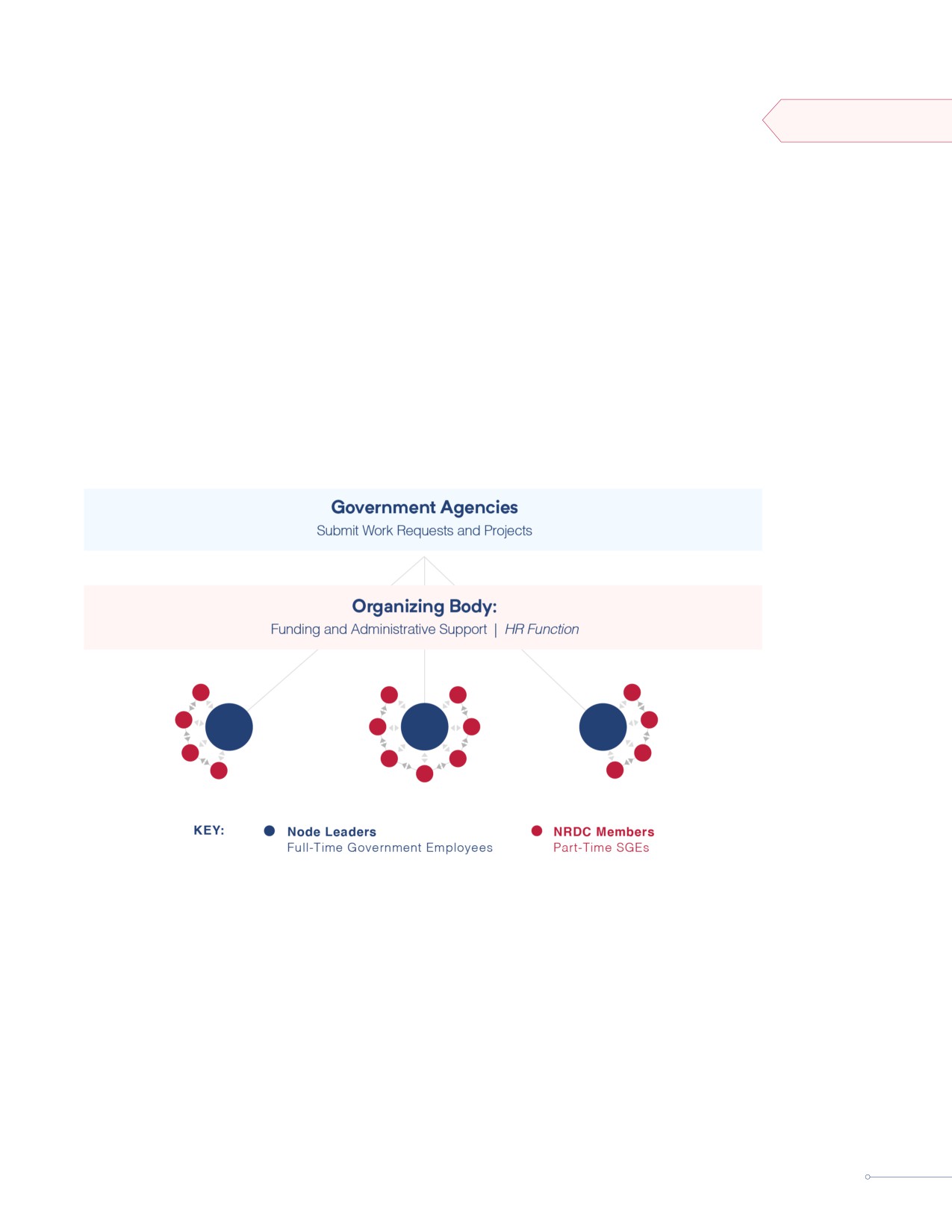
TECHNICAL TALENT IN GOVERNMENT
Recommendation: Create a National Reserve Digital Corps
Recommendation
The government would benefit from access to a larger portion of the country’s total digital
workforce. Many government digital projects suffer from lack of access to digital expertise.
The U.S. Government should establish a civilian National Reserve Digital Corps (NRDC)
modeled after the military reserves’ service commitments and incentive structure. Members
of the NRDC would become civilian special government employees (SGEs),3 and work
at least 38 days each year as short-term advisors, instructors, or developers across the
government.4 Longer-term positions would be established on an individual basis. While
short-term volunteers are not a substitute for full-time employees, they can help improve
AI education for both technologists and non-technical leaders, perform data triage and
acquisition, help guide projects and frame technical solutions, build bridges between the
public and private sector, and other important tasks.5 Several AI practitioners within the
United States Government have said during interviews with the NSCAI that their projects
would benefit from the kind of reserve corps we propose here.
National Reserve
Digital Corps.
General Structure. We recommend establishing and managing the NRDC as a set of
nodes that fall under the supervision of the Office of Management and Budget (OMB).
Each node would be aligned with a full-time government employee leader selected by
OMB rather than geography, digital applications, or government agency. In effect, OMB
would select node leaders, who would then be responsible for recruiting and organizing
their team. In addition to selecting node leaders, OMB would establish standards, ensure
nodes meet government client requirements, provide funding and administrative support,
maintain security clearances, establish access to an agile development environment and
tools, and facilitate technical exchange meetings, when appropriate, to ensure stovepipes
are not created.
p
360