National Security Commission on Artificial Intelligence. Final Report - page 5
CHAPTER 15
Chapter 15:
A Favorable
International
Technology Order
p
241

A FAVORABLE INTERNATIONAL TECHNOLOGY ORDER
Coordination and Alignment
with Allies and Partners
Develop an
Reorient the
International
Department of
S&T Strategy
State and U.S.
Foreign Policy
Build an Emerging
Technology
Coalition
Launch an
International
Digital Democracy
Initiative
Implement a
Cultivate an
Comprehensive
International
U.S. National Plan
Emerging
Technology
Research Hub
p
242
CHAPTER 15
The United States cannot compete with and counter the global
technology ambitions of authoritarian rivals if it acts alone. Like-
minded countries must work together to advance an international
rules-based order, protect free and open societies, and unleash
economic innovation. The authoritarian challenge to the global
technology order encompasses five distinct but related elements:
• A rising challenge to U.S. and Western technology firms for global market share,
impacting the prosperity and global economic position of the United States and its allies
and partners;
• China’s increasing influence and strategic leverage over countries that utilize
technologies and infrastructure built and developed in China;
• The prospect of authoritarian consolidation in states that gain easy access to digital
tools that can strengthen repressive rule;
• The prospect of democratic backsliding in states with governments that may be tempted
to utilize digital tools in ways that undermine liberal values; and
• A threat to the cohesion of democratic allies as an influential bloc of states with the
capacity to shape global technology norms and standards.1
“The United States must
pursue a comprehensive
strategy in close coordination
with our allies and partners for
AI innovation and adoption that
promotes values critical to free
and open societies.”
p
243
A FAVORABLE INTERNATIONAL TECHNOLOGY ORDER
The United States must pursue a comprehensive strategy in close coordination with our
allies and partners for artificial intelligence (AI) innovation and adoption that promotes
values critical to free and open societies. Furthermore, the United States must collaborate
with its closest allies and partners to develop principles for employing AI tools ethically
and responsibly, defend the integrity of international technical standards, promote digital
markets, leverage comparative expertise to develop privacy-preserving technologies,
and share practices and resources to defend against authoritarian attacks on digital
infrastructure and democratic values.
To achieve these goals, the Commission proposes that the White House request the
Department of State to lead an effort with and other key agencies to:
Develop and implement an International Science and Technology Strategy (ISTS) to help
Recommendation
coordinate AI and emerging-technology policies government-wide and with our closest
allies and partners; apply the tools of foreign assistance, technical expertise and guidance,
and development finance; and foster collaborative R&D. The ISTS should serve as the
international component of the National Technology Strategy (see Chapter 9 of this report).
The ISTS should be centered around four big initiatives:
• Build an Emerging Technology Coalition of allies and partners to promote the design,
development, and use of emerging technologies according to democratic norms
and values; coordinate policies and investments to counter the malign use of these
technologies by authoritarian regimes; and provide concrete, competitive alternatives to
counter the adoption of digital infrastructure made in China.
• As part of the Emerging Technology Coalition, launch an International Digital
Democracy Initiative with allies and partners to align international assistance efforts
to develop, promote, and fund the adoption of AI and associated technologies that
comports with democratic values and ethical norms around openness, privacy, security,
and reliability.
• Implement a comprehensive U.S. national plan to support international technology
efforts around technical standards, foreign assistance, development finance, and export
controls.
• Enhance the United States’ position as an international emerging technology
research hub for collaborative R&D efforts by formalizing a partnership between
the U.S. National AI Research Institutes and multilateral initiatives like the Global
Partnership on AI (GPAI), creating a Multilateral AI Research Institute (MAIRI) in the
United States with key allies and partners, and catalyzing international collaboration and
talent exchanges.
Build an Emerging Technology Coalition. The United States should lead an Emerging
Recommendation
Technology Coalition (ETC) of like-minded nations either as part of a larger democracy
summit or as a stand-alone endeavor. The immediate step for the ETC should be to
organize its efforts to synchronize policies around the following seven critical areas:
p
244
CHAPTER 15
• Developing and operationalizing standards and norms, in support of democratic
values and the development of secure, reliable, and trusted technologies;
• Promoting and facilitating coordinated and joint R&D on AI and digital
infrastructure that advances shared interests and benefits humanity;
• Promoting democracy, human rights, and the rule of law through joint efforts to
counter censorship, malign information operations, human trafficking, and illiberal uses
of surveillance technologies;
• Exploring ways to facilitate data-sharing among allies and partners through enabling
agreements, common data archival procedures, cooperative investments in privacy-
enhancing technologies, and addressing legal and regulatory barriers;
• Promoting and protecting innovation, particularly through export controls, investment
screening, supply chain assurance, emerging technology investment, trade policy,
research and cyber protections, and intellectual property alignment;
• Developing AI-related talent, by analyzing labor market challenges, harmonizing
skills and certification requirements, and increasing talent exchanges, joint training, and
workforce development initiatives;
• Launching the International Digital Democracy Initiative.2
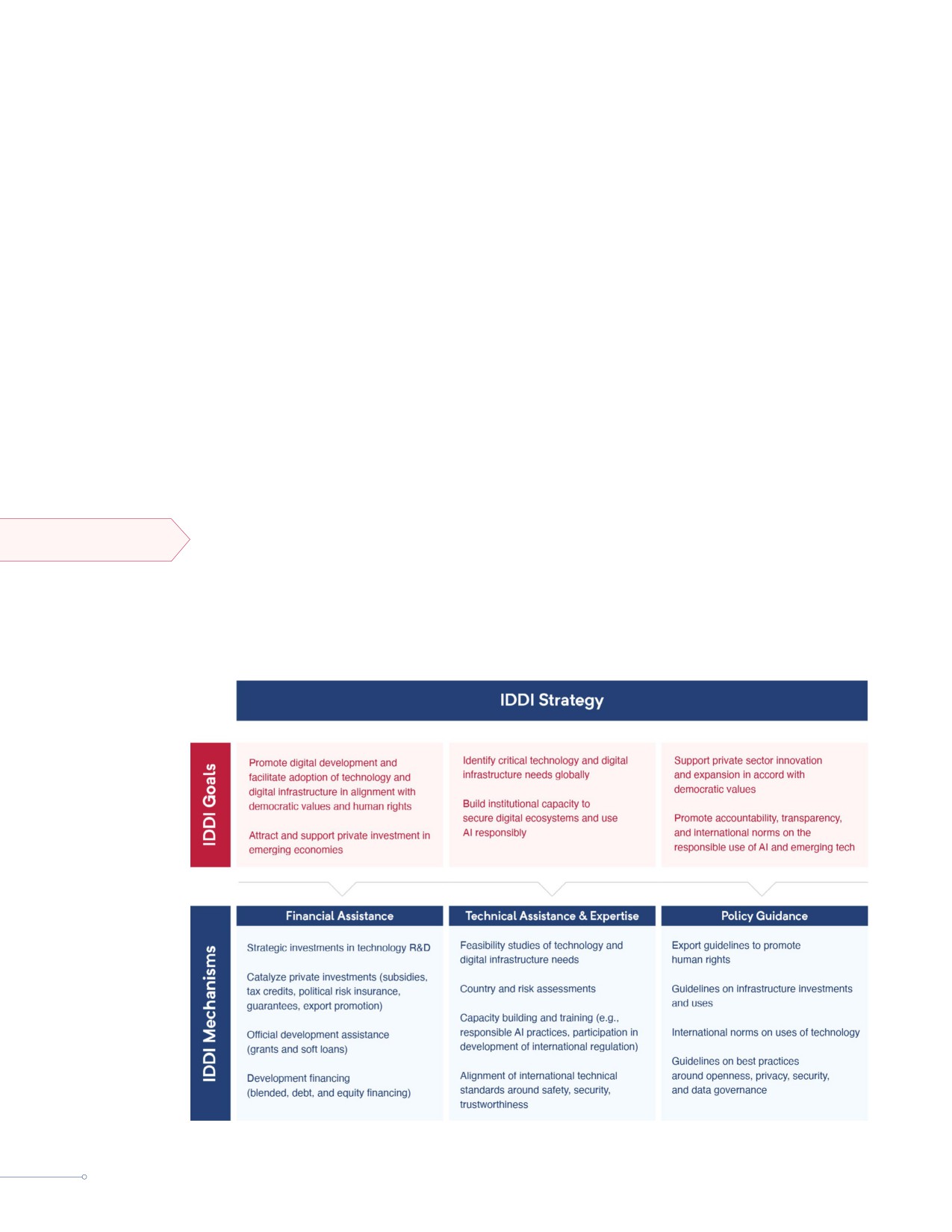
Launch an International Digital Democracy Initiative (IDDI). As part of the ETC, the United
Recommendation
States, with its allies and partners, should launch an IDDI to align international assistance
efforts to develop, promote, and fund the adoption of AI and associated technologies that
comport with democratic values and ethical norms around openness, privacy, security,
and reliability.
IDDI Strategy.
p
245
A FAVORABLE INTERNATIONAL TECHNOLOGY ORDER
The IDDI will be critical for enabling nations around the world to adopt secure, trusted, and
open digital ecosystems,3 empowering communities to use AI and digital technologies in
ways that strengthen democracies, promote sustainable development, and advance shared
values like privacy, human rights, and the rule of law. IDDI further provides an opportunity
for the United States and like-minded allies and partners to counter authoritarian uses
of AI, particularly by providing alternatives to digital infrastructure projects that are used
for illiberal ends, endanger the social cohesion among and between democracies, and
threaten collective security.4 As international digital and telecommunications infrastructure
investment needs continue to grow5 and China continues to use digital development to
export authoritarianism and expand influence, the United States and its allies and partners
must join forces to coordinate a strategy that maximizes the impact of government assistance
efforts and also catalyzes private-sector investment to address shared challenges.
“... the United States and its
allies and partners must join
forces to coordinate a strategy
that maximizes the impact of
government assistance efforts
and also catalyzes private sector
investment to address shared
challenges.”
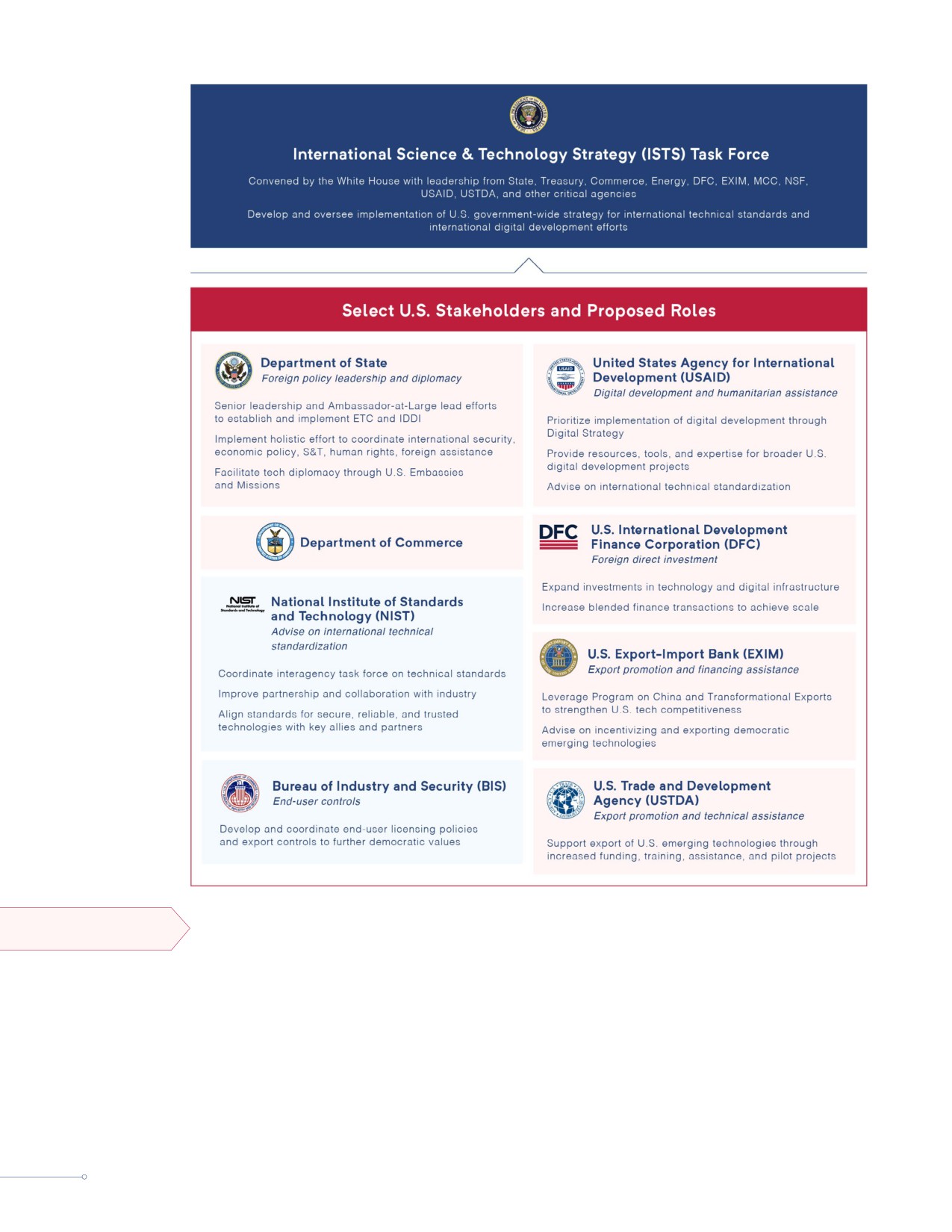
Implement a comprehensive U.S. national plan to support international technology efforts.
Recommendation
The ISTS should include an integrated government-wide plan for using and bolstering
the tools of U.S. foreign policy—including technical and foreign assistance, development
financing, and export controls—to advance the ETC, the IDDI, and stand-alone projects.
As demonstrated below, the plan should include methods to shape international technical
standards; coordinate and expand programs of the Department of State, the United
States Agency for International Development, the U.S. International Development Finance
Corporation, and other federal agencies; and use targeted export controls to preserve key
U.S. and allied technical advantages and also further transparency and accountability. It
will require significant, dedicated appropriations to achieve meaningful results.6
p
246
CHAPTER 15
U.S. National
Plan to Support
International
Technology Efforts.
Enhance the United States’ position as an international emerging technology research hub.
Recommendation
The United States must maintain its leadership in international R&D by further establishing
itself as a hub of international research into and involving emerging technologies to foster
AI collaboration and coordination with key allies and partners. These efforts will facilitate
critical support to the ETC and IDDI by developing digital technologies and best practices
that comport with democratic values; enhance U.S. contributions to existing and future
international efforts like GPAI; and provide avenues for the United States and allies—
particularly European allies—to pool resources to address commercial gaps in R&D and
p
247
A FAVORABLE INTERNATIONAL TECHNOLOGY ORDER
“The United States must maintain
its leadership in international
R&D by further establishing
itself as a hub of international
research into and involving
emerging technologies to foster
AI collaboration and coordination
with key allies and partners.”
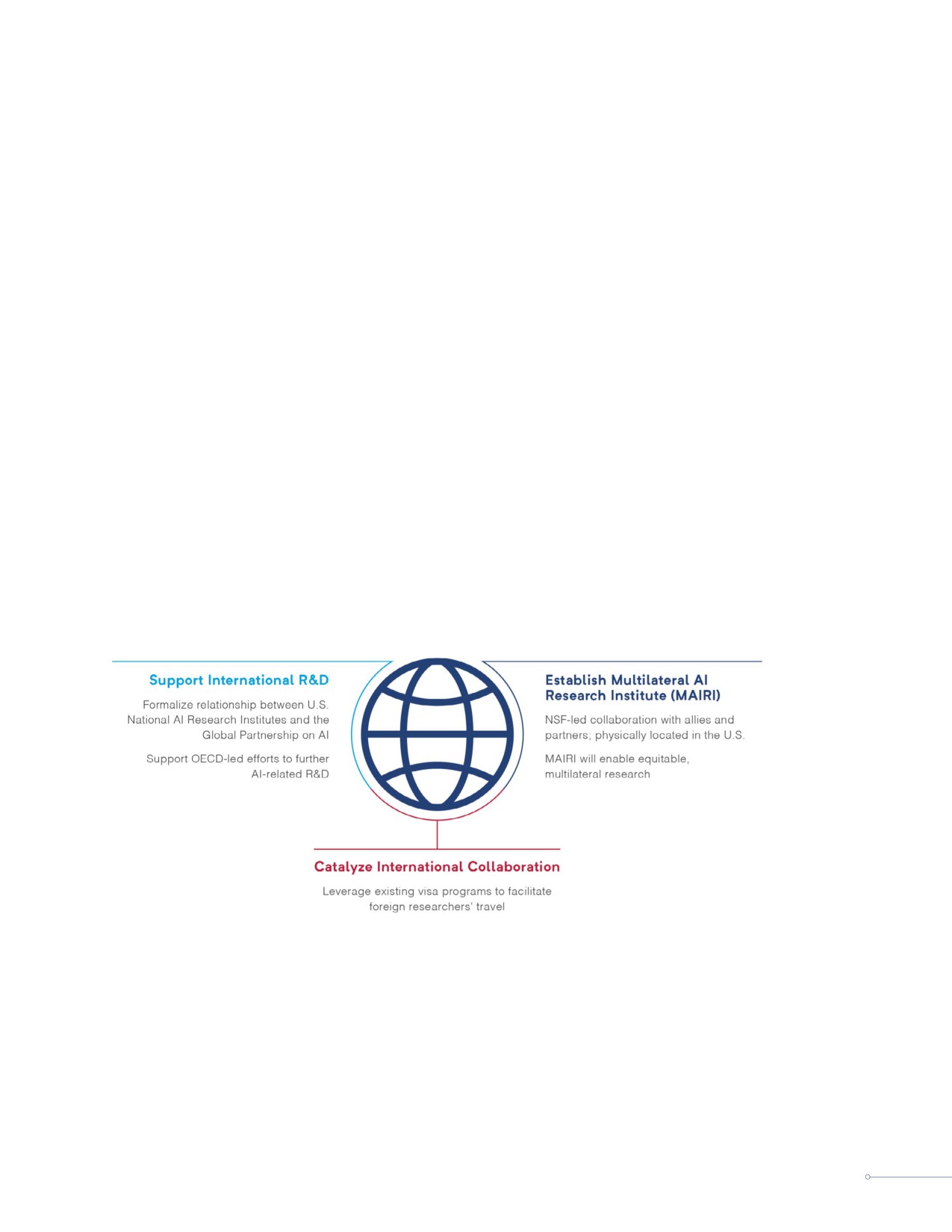
overcome challenges to collaboration around cross-border data-sharing. Making the
United States an international emerging technology research hub has three components:
Components of
International Digital
Research Hub.
• First, the United States should provide formal research support to key international
efforts such as GPAI and the Organisation for Economic Co-operation and
Development,7 particularly through the National Science Foundation (NSF)’s National
AI Research Institutes.8 The important research undertaken by the National AI
Research Institutes—run by the NSF and other U.S. agencies—and by other United
States departments and agencies is an incredible resource that should support these
international efforts and advance AI and digital goals of the U.S. and like-minded
partners.
p
248
CHAPTER 15
• Second, the United States should work with key allies and partners to establish the
Multilateral AI Research Institute (MAIRI). MAIRI will facilitate joint efforts to develop
technologies that advance responsible, human-centric, and privacy-preserving AI/
machine learning (ML) that better societies and allow allies to pool their talents and
resources. It will provide a model for equitable, multilateral research, facilitate AI R&D
that builds on like-minded countries’ strengths, and foster a global AI workforce for the
next generation. MAIRI will be key to a U.S.-led effort to promote values of free and open
societies, win the global technology competition, unleash AI innovation and economic
prosperity, and develop AI applications that benefit humanity. MAIRI members will
champion agreed-upon research integrity principles, leverage trusted infrastructure
and research resources, and seek to be a part of a federated network of global research
institutes. NSF should be the anchor partner, but MAIRI should be structured to enable
participation of other federal agencies, like the Departments of State and Energy.9 The
United States should fund the initial startup costs, including acquisition of MAIRI’s
physical center located in the United States.
• Third, the United States should leverage existing O and J visa programs to facilitate
foreign researchers’ involvement in joint projects. Sustained, strong collaboration
between the United States and allies and partners is critical to winning this techno-
competition and unleashing innovation and entrepreneurship across like-minded
countries. There is no substitute for shoulder-to-shoulder research for building
relationships, exchanging ideas and expertise, and sparking future collaboration.10
Recommendation
Reorient U.S. foreign policy and the Department of State for great power competition in
the digital age. New outward-facing digital foreign policy initiatives are only part of the
equation for ensuring the long-term success of global technology policy. The United States
must make inward-focused reforms to the Department of State as well. There is currently
no clear lead for emerging technology policy or diplomacy within the State Department,
which hinders the Department’s ability to make strategic technology policy decisions. It
also creates confusion for allies and partners, who regularly express uncertainty regarding
which senior official should be their primary point of contact for issues related to key topics
such as AI, 5G, quantum computing, biotechnology, or new emerging technologies.
Competitive diplomacy in AI and emerging technology arenas is a strategic imperative
in an era of great power competition and necessitates an intensified reorientation of the
Department of State. The United States must redesign the internal structure, focus, and
culture of the State Department to adapt U.S. diplomacy for the digital age and empower
diplomats to advance American interests at the intersection of technology, security,
commerce, and human rights. Supporting these efforts and succeeding in U.S. diplomacy
will require targeted appropriations from Congress.
The Commission recommends the following immediate actions to reorient U.S. diplomacy:
• First, the Deputy Secretary of State for Management and Resources (D/MR)
should have responsibility to prioritize reorienting and reorganizing the Department
for technology diplomacy. Past administrations have used the D/MR position to lead
on strategic priorities and ensure execution. The D/MR should provide direction for
immediate and long-term planning around technology diplomacy, including policy
development, coordination, and resourcing. The D/MR should also have a lead role in
oversight and implementation of the ISTS.
p
249
A FAVORABLE INTERNATIONAL TECHNOLOGY ORDER
“The United States must redesign
the internal structure, focus, and
culture of the State Department
to adapt U.S. diplomacy for the
digital age ...”
•
Second, the State Department should expedite and prioritize efforts to staff,
resource, and build out the newly created Bureau of Cyberspace Security and
Emerging Technologies (CSET Bureau). The CSET Bureau, approved in early January
2021, would be led by an official with the title of Ambassador-at-Large and Coordinator.
The bureau would have a critical role as the focal point for U.S. diplomatic efforts
around security challenges associated with emerging technologies and would provide
an accountable home for AI advocacy within the Department.11 The Department,
with congressional support, must ensure the CSET Bureau is adequately staffed and
resourced. Quickly standing up CSET is critical to building the Department’s technology
diplomacy capacity, improving technology policy coordination across the Department,
and regularly elevating technology issues to the attention of senior leaders. The
Department should assess where CSET should be placed to best achieve those
objectives but must ensure its creation is not further delayed.
•
Third, the State Department should enhance its presence in foreign and U.S.
technology hubs with a cadre of dedicated technology officers at U.S. missions to
strengthen diplomatic advocacy, improve technology scouting, and inform policy and
foreign assistance.
•
Fourth, AI-related technology modules should be incorporated into Foreign
Service Institute training courses at multiple levels to ensure U.S. diplomats are
equipped to lead in an environment being transformed by emerging technology.
•
Fifh, Congress must appropriate funds necessary for urgent State Department
needs both to augment the U.S. diplomatic corps and to support critical State
Department programs focused on AI and emerging technologies to advance U.S.
interests.
These steps are essential, but not sufficient, to further U.S. interests in tech diplomacy.
Eventually, the D/MR role should transition into a permanent Under Secretary for Science,
Research and Technology (State/Q). State/Q would lead a reorganization of the Department,
combining offices and bureaus to further a robust, coordinated approach to science and
technology diplomacy and foreign assistance in the context of great power competition.12
p
250
CHAPTER 15
Chapter 15 - Endnotes
1 The threat to allied cohesion also extends to the military realm, insofar as building divergent or
incompatible digital systems poses challenges for interoperability or creates risks for U.S. forces
operating in allied countries. See Daniel Kliman, Why the United States Needs a Digital Development
commentary/why-the-united-states-needs-a-digital-development-fund (“Over the long term, China’s
digital investments could render some developing countries off-limits to U.S. forces, constricting the
geography of American military access.”).
2 Detail on these critical areas can be found in the Chapter 15 Blueprint for Action andits associated
Annex.
3 USAID’s Digital Strategy defines the “digital ecosystem” as the “stakeholders, systems, and
enabling environments that together empower people and communities to use digital technology to
gain access to services, engage with each other, or pursue economic opportunities.” This includes
“a sound enabling environment and policy commitment; robust and resilient digital infrastructure;
capable digital service providers and workforce; and, ultimately, empowered end-users of digitally
digital-strategy.
4 The Chinese government’s global infrastructure projects and its widespread state influence within
its private sector have enabled Chinese firms to provide surveillance and smart-city technologies to
hundreds of cities globally, particularly in developing countries, bolstering autocratic regimes and
enabling Chinese geopolitical coercion and government data collection. See, e.g., Hugh Harsono,
China’s Surveillance Technology is Keeping Tabs on Populations Around the World, The Diplomat
on-populations-around-the-world/; Testimony of Steven Feldstein before the U.S.-China Economic and
uscc.gov/sites/default/files/Feldstein_Testimony.pdf.
5 To support the G20, the Global Infrastructure Hub has forecasted global telecommunications
infrastructure investment needs at $8.9 trillion over the next approximately 20 years, with current
trends falling short of these needs by $1 trillion. Forecasting Infrastructure Investment Needs and
Gaps, Global Infrastructure Hub (last accessed Jan. 13, 2021), https://outlook.gihub.org/.
p
251
A FAVORABLE INTERNATIONAL TECHNOLOGY ORDER
6 Detailed recommendations for U.S. agencies and Congress can be found in the Chapter 15 Blueprint
for Action.
7 GPAI was launched in 2020 to “foster responsible development of AI grounded in these principles
of human rights, inclusion, diversity, innovation and economic growth.” Current members include
Australia, Brazil, Canada, the European Union, France, Germany, India, Italy, Japan, Mexico, the
Netherlands, New Zealand, Poland, Singapore, Slovenia, South Korea, Spain, the United Kingdom,
and the United States, with the OECD and UNESCO as Permanent Observers. GPAI bridges “the
gap between theory and practice,” particularly through research and technical expertise shared via
ai/about/; UNESCO Joins Global Partnership on Artificial Intelligence as Observer, UNESCO (Dec. 10,
2020), https://en.unesco.org/news/unesco-joins-global-partnership-artificial-intelligence-observer.
8 Artificial Intelligence at NSF, NSF (Aug. 26, 2020), https://www.nsf.gov/cise/ai.jsp.
9 For example, the Department of Energy may provide critical expertise on undertaking applied
research with industry or through its national laboratories, particularly on high-performance and
quantum computing, while the Department of State can provide foreign policy expertise and support
initiatives on data-sharing and AI research clouds with allies and partners.
10 Detailed recommendations for each of these components can be found in the Chapter 15 Blueprint
for Action.
11 Secretary Pompeo Approves New Cyberspace Security and Emerging Technologies Bureau, U.S.
Department of State (Jan. 7, 2021), https://2017-2021.state.gov/secretary-pompeo-approves-new-
cyberspace-security-and-emerging-technologies-bureau//index.html.
12 These components of the State Department should include key functions of the CSET Bureau; the
Bureau of Oceans, Environment and Science; the Office of the Science and Technology Adviser; the
Coordinator for Cyber Issues; and the Center for Analytics.
p
252
CHAPTER 16
Chapter 16: Associated
Technologies
p
253

ASSOCIATED TECHNOLOGIES
AI and Beyond: Identifying and Prioritizing
Critical Emerging Technologies
Artificial
Intelligence
Semiconductors
Biotechnology
Quantum
Computing
Robotics
and Autonomy
5G and Advanced
Networking
Advanced
Manufacturing
Energy
Systems
p
254
CHAPTER 16
The Commission’s work ends where it began, with the conclusion
that artificial intelligence (AI) will transform virtually every aspect of
our existence. However, leadership in AI is not an end unto itself; it
is a necessary, but not sufficient, condition for the overarching goal
of preserving U.S. leadership in technology. That reality presents a
challenge for U.S. strategy: how to prioritize investments in AI and
other key emerging technologies and support specific projects
that will build on and amplify cross-technology strengths. The
United States must view its efforts to lead in AI through the broader
lens of competition across a range of emerging technologies, and,
therefore, also support a comprehensive strategy to sustain U.S.
leadership in key associated technologies.
“The United States must view
its efforts to lead in AI through
the broader lens of competition
across a range of emerging
technologies ...”
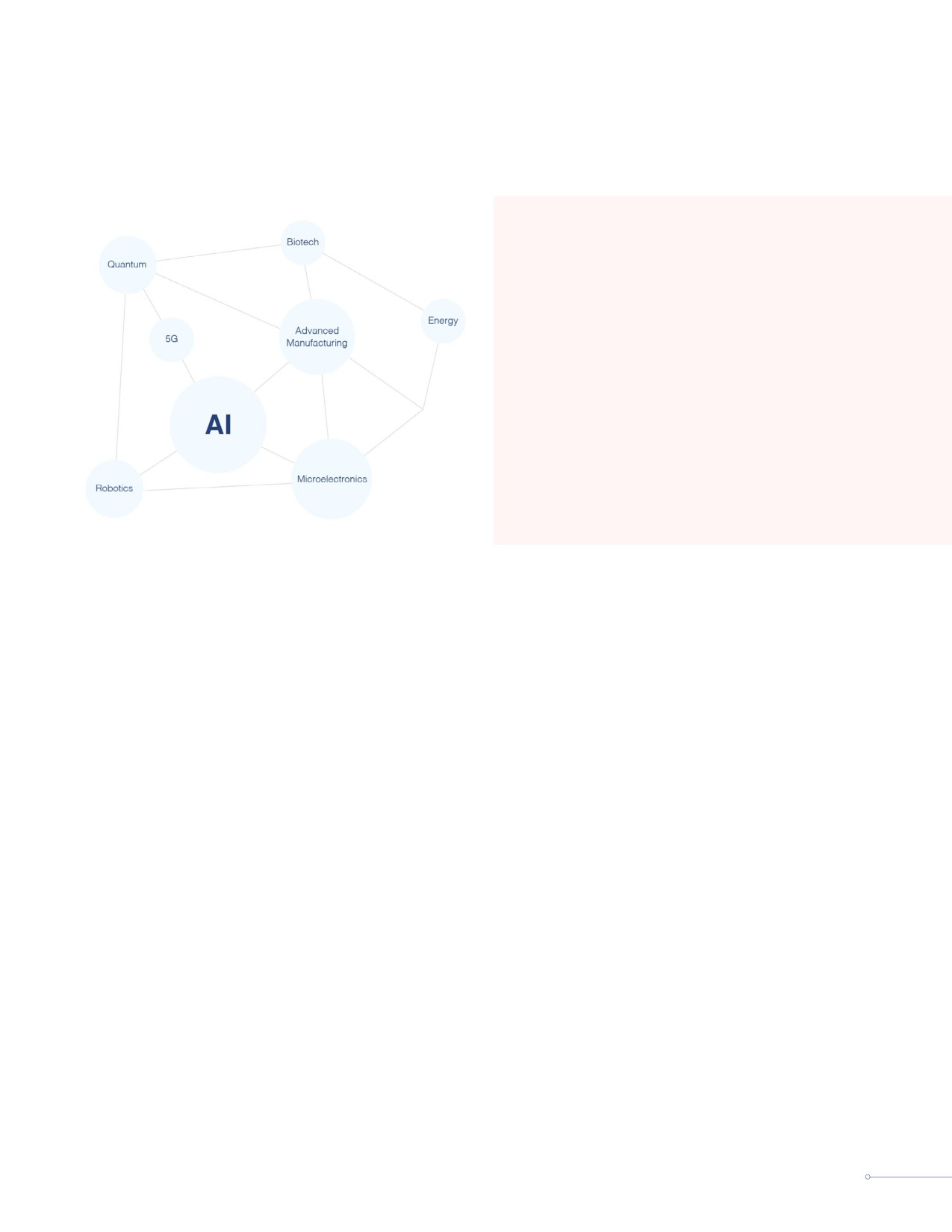
Leadership in AI relies on and drives leadership across a suite of emerging technologies.
AI sits at the center of the constellation of emerging technologies, enabling some and being
enabled by others.1 For instance, 5G and quantum computing are poised to enable new
growth in AI capabilities, while AI stands to transform the biological sciences, producing
significant technological breakthroughs and turning the biotechnology sector into one of
the primary drivers of overall economic competitiveness.2
p
255
ASSOCIATED TECHNOLOGIES
AI is at the center of a constellation of emerging technologies, enabling some and
enabled by others. The United States Government must view its efforts to lead in AI
as part of a broader strategy to compete in each of these technologies:
The United States
Government must:
Define and prioritize the key emerging
Associated
technologies needed to ensure U.S.
Technologies.
national competitiveness, including U.S.
leadership in the following technologies
and platforms:
• Advanced biofabrication capabilities
• Quantum chip fabrication
•
5G spectrum sharing
• Robotics software
• Additive manufacturing
• Energy storage technologies
China is pursuing a comprehensive technology leadership strategy. China’s strategic
investments in key sectors through its Made in China
2025 initiative threaten U.S.
technological prowess, economic prosperity, and national security.3 In addition to
investments in AI, China is seeking to become a world leader in quantum, 5G, and
biotech, among other areas, and sees its strategies to lead in AI and each of these other
technologies as mutually reinforcing. It has made clear which technologies it views as key
national priorities and is investing heavily in a wide range of sectors that it assesses are
essential to overall technical leadership.
The United States has neither identified, nor prioritized leadership in, the technologies that
are central to national competitiveness. The United States must develop a unified list of
the technologies that will underpin national competitiveness in the 21st century because
the first-mover advantage of developing and deploying technologies like microelectronics,
biotechnology, and quantum computing will make it difficult for the United States to catch
up to China. The lack of such a list results in disparate funding and policy approaches to
technology protection and promotion across the U.S. government. The absence of clear
priorities also makes it more difficult to effectively marshal private-sector investment in
key technologies. In critical sectors with strong network effects like telecommunications,
a winner-take-all dynamic raises the stakes even further for rapidly developing a leading
technology platform.4
p
256
CHAPTER 16
Ensuring U.S. leadership in the manufacturing of key emerging technology platforms
will be an essential component of national competitiveness. Identifying and supporting
research in priority technologies is a necessary but insufficient step to maintain national
competitiveness in emerging technologies. The United States will also have to invest in the
production of strategic physical elements of these technologies to create game-changing
platforms, maximize U.S. competitiveness, and reduce dependencies that create national
security vulnerabilities. Such investments are often expensive, but a strategic approach
does not require manufacturing every advanced component domestically and will pay
tremendous long-term dividends. The need to support advanced manufacturing applies
to nearly every key emerging technology sector, including semiconductors, quantum
computing, biotechnology, telecommunications equipment, and others, and is reflected in
the following recommendations.
Technology leadership will require major new investments in underlying digital infrastructure.
It is impossible to ignore the state of America’s underlying digital infrastructure when
considering a strategy to preserve overall U.S. leadership in technology. The sophistication
and reach of the core U.S. digital infrastructure that underpins connectivity, namely
high-speed internet and telecommunications networks, significantly lag behind those of
many other developed nations.5 Additionally, U.S. physical infrastructure remains largely
disconnected; no U.S. cities are ranked among the top 10 in smart-city connectedness,
and only one is in the top 30.6 Maximizing citizens’ access to the digital economy, ensuring
they have the requisite digital skills, and more closely connecting the physical and digital
worlds will be necessary to fuel future growth. Boosting the digital connectivity of physical
U.S. assets will not only enhance their effectiveness and reliability, but also generate new
sources of data that enable novel, potentially revolutionary uses of AI in areas ranging
from energy grid management and urban planning to transportation. As the United
States considers options to modernize U.S. physical infrastructure, prioritizing its digital
connectivity will provide substantial long-term benefits and buttress U.S. technology
competitiveness and national security.
Identifying and Prioritizing Technologies Central to National Competitiveness.
While the United States should by no means adopt China’s centrally planned and state-
directed economic model, it must start by developing better strategic planning, forecasting,
and prioritization of emerging technologies to ensure long-term competitiveness. The
government should:
Define and prioritize the key emerging technologies that are needed to ensure U.S. national
Recommendation
competitiveness. As part of its National Technology Strategy (see Chapter 9 of this report),
the White House should publish a list of critical and emerging technologies in which U.S.
leadership is essential. It should develop detailed implementation plans for each sector to
determine how the government should best work with industry to promote U.S. leadership,
assess which specific subsectors are crucial to national security, and determine what
p
257
ASSOCIATED TECHNOLOGIES
“As part of its National
Technology Strategy (see
Chapter 9), the White House
should publish a list of critical
and emerging technologies
in which U.S. leadership
is essential.”
regulatory steps or incentives are necessary to create the required investment environment.
These plans should promote investment in specific platforms that will have a force multiplier
effect on U.S. technology leadership, identify key choke points where competitors could
potentially be blocked with minimal impact on U.S. industry, and promote supply chain
resiliency. The creation and maintenance of such a list and the associated implementation
plans will help produce a national consensus across government, industry, and academia
about which sectors are most important in the emerging techno-economic competition.
The result will be an important message to Congress regarding where the country must
prioritize and expend resources, as well as a powerful demand signal to industry.
Many similar lists exist throughout the government, but there has been no effort to unify
them into a single, authoritative document accompanied by a strategic vision and detailed
follow-through actions designed to ensure long-term U.S. leadership.7 However, the
significant overlap between these lists demonstrates an emerging national consensus on
which technologies are most critical to U.S. national competitiveness. Table 5 illustrates
the initial slate of technologies that the Commission recommends including as part of a
broader technology leadership strategy, as well as whether or not those technologies have
been included on select, existing U.S. government lists of critical technologies. As an initial
step, the Commission recommends that the White House designate these technologies as
critical through an Executive Order and direct Departments and Agencies to prioritize and
coordinate them accordingly.
p
258

CHAPTER 16
U.S. Government Lists of Critical Technologies
NSCAI-
2018
DoD List
Commerce
PCAST List
S.3832 -
WH Nat
Proposed
National
of Critical
ANPRM on
of Industries
Endless
Strategy
Critical
Defense
Emerging
Emerging
of the Future
Frontier
for
Technology List
Strategy
Technologies
Technologies
Act
C&ET
Artificial
Intelligence
Biotechnology
Quantum
Computing
Semiconductors
and Advanced
Hardware
Autonomy and
Robotics
5G and
Advanced
Networking
Advanced
Manufacturing
Energy
Systems
Actions to Promote Technologies and Platforms Essential
to U.S. Leadership and National Security.
After reaching consensus on the set of emerging technologies essential to overall U.S.
technology leadership, the Executive Branch should assess each sector and identify
specific platforms that meet the following criteria:
• Have potential applications of strategic and national security importance;
• Could have a significant impact on overall U.S. technical leadership and
competitiveness, either alone or when combined with existing U.S. technical strengths;
and
• Require government action to spur or protect its development.
Such platforms could require government support for several reasons. In some instances,
a market failure may lead to underinvestment by the private sector in an area of strategic
importance to national security. In other instances, seizing a market opportunity may only
be possible if the federal government focuses the private sector, academia, and research
organizations on a specific goal. The government must tailor its approach to the context
p
259
ASSOCIATED TECHNOLOGIES
by increasing funding, implementing regulatory changes, or taking other steps aimed at
promoting innovation and protecting advantages that fit the circumstances.
The Commission has already presented recommendations to support U.S. leadership
in key technology platforms within several of the aforementioned strategic technologies.
For example, Chapter 11 of this report recommends establishing a National AI Research
Resource, which would create an essential platform to sustain and extend U.S. leadership
in AI. Additionally, in Chapter 13 of this report, the Commission provided a series of
recommendations for promoting U.S. leadership in microelectronics, including specific
actions to incentivize the construction of a leading-edge merchant fabrication facility
domestically.
The recommendations below build on the Commission’s previous work and provide
further actions the U.S. government could take to promote U.S. leadership in the key
associated technologies and platforms that the Commission assesses to be of greatest
strategic importance—specifically, biotechnology, quantum computing, 5G and advanced
networking, autonomy and robotics, advanced and additive manufacturing, and energy
systems.8
Biotechnology.
Biology is now programmable, and AI’s ability to identify ways to optimize this programming
will enable transformational biotechnology breakthroughs. AI was crucial in the rapid
development of COVID-19 vaccines, allowing researchers to finalize the genetic sequence
of a vaccine candidate only two days after the virus’ full genetic sequence was first posted
online.9 Computer vision techniques applied to medical imagery have also enabled more
accurate and efficient diagnoses.10 And recently, an AI network made substantial progress
over the last year toward solving one of biology’s most daunting challenges: determining
a protein’s 3D shape from its amino-acid sequence.11 Tools such as these will become
“Biology is now programmable,
and AI’s ability to identify ways
to optimize this programming
will enable transformational
biotechnology breakthroughs.”
p
260
CHAPTER 16
even more powerful in combination with synthetic biology and gene editing. Together they
will enhance human health by allowing deeper studies of the building blocks of life and
enabling the quicker discovery and fabrication of more advanced drugs and materials. As
AI fuels rapid new developments in the biological sciences and biotechnology becomes
a greater driver of the overall world economy, the strategic consequences of ceding
leadership in biotechnology will increase significantly—a fact that the COVID-19 pandemic
illustrates in clear and stark terms. The government should:
Recommendation
Prioritize the development of an advanced domestic biotechnology R&D ecosystem. As
part of a national bioeconomy strategy, the United States should support the development
of biotechnology platforms that maximize researchers’ ability to utilize AI to drive new
biological breakthroughs and help transition advanced research into physical products
at scale. This will necessitate support for both world-class biodata resources to fully
harness the power of AI and biomanufacturing platforms to rapidly realize the benefits
from analytical breakthroughs:
•
Biodata: The United States should fund and prioritize efforts to build a world-class
biobank containing a wide range of high-quality biological and genetic data sets
securely accessible by researchers. GenBank, the leading U.S. genetic database, which
is run by the National Institutes of Health, is currently underfunded, underutilized, and
poorly curated. The goal should be to create a genetic database that is well-curated and
easy for researchers to access and use; contains a significant number and broad range
of whole human, animal, and plant genomes; and aggregates open and proprietary
data sets across government and the private sector. It should also contain de-identified
metadata about corresponding phenotypes whenever possible and include strong
privacy protections for human genetic data. This will require significant levels of
funding; China National GeneBank, the equivalent facility in China that is operated
by the BGI Group (formerly the Beijing Genomics Institute), required approximately
$117 million in initial funding.12 Establishing such an entity in the United States would
enhance and democratize biotechnology innovations by pooling existing data resources
and facilitating new levels of AI-enabled analysis of genetic data while also reducing
U.S. researchers’ reliance on BGI or other Chinese entities for access to large-scale
genomic databases for research.
•
Biomanufacturing: The United States should support efforts to diversify and expand
the biotechnology industry beyond its current vertically integrated models and
encourage the development of multiple standardized, merchant biofabrication
facilities. Doing so is necessary to ensure U.S. biomanufacturing capabilities keep pace
with AI’s transformative impact on the bioeconomy. Expanding access to advanced
biofabrication tools among startups and laboratories would allow firms to rapidly design
new molecules and materials via the cloud and place immediate orders for fabrication.
Such efforts should include R&D funding and incentives to support advanced biotech
manufacturing initiatives through entities such as the Biomedical Advanced Research
and Development Authority (BARDA),13 with appropriate stewardship, and the expansion
of existing relevant programs such as BioMADE.14 Congress should prioritize such
initiatives in future health-related spending bills. Given that up to 60% of the physical
inputs to the global economy could be produced via synthetic biology, there is a clear
and pressing need for the United States to retain leadership in biomanufacturing moving
forward.15
p
261
ASSOCIATED TECHNOLOGIES
“... quantum computers have
the potential to outperform
their classical counterparts on
certain classes of problems
related to machine learning and
optimization, the simulation
of physical systems, and the
collection and transfer of
sensitive information.”
Quantum Computing.
As the pace of innovation predicted by Moore’s Law becomes increasingly difficult for
semiconductor manufacturers to maintain due to the physical limits of microchip design,
leadership in next-generation computer hardware will be essential to preserving long-term
U.S. advantages in strategic technologies like AI.16 Although classical computers will likely
remain the most economical way of performing day-to-day computational tasks in the near
future, quantum computers have the potential to outperform their classical counterparts
on certain classes of problems related to machine learning (ML) and optimization, the
simulation of physical systems, and the collection and transfer of sensitive information.
For example, quantum computers may be able to efficiently optimize military logistics or
discover new materials for weapon systems.17 Each of these applications creates novel
national security threats and opportunities at the intersection of AI and quantum computing.
The government should:
Transition from basic research to national security applications of quantum computing and
Recommendation
incentivize domestic fabrication. The United States is a global leader in research of quantum
computers, but it risks losing its edge in applications to national security. Recognizing
that advances in quantum computing may drive advances in AI, the United States must
establish trusted sources of materials and components for quantum computers, invest in
the development of hybrid quantum-classical algorithms, and focus on fielding of national
security applications. Offering access to both classical and quantum computers through
p
262
CHAPTER 16
the National AI Research Resource will facilitate the development of hybrid quantum-
classical algorithms that leverage noisy intermediate-scale quantum computers. Publicly
announcing specific government use cases of quantum computers will signal that a market
exists for national security applications and encourage further investment by the private
sector.
5G and Advanced Networking.
5G networks will form the connective tissue between AI platforms, which means maintaining
access to trusted and robust 5G networks is a critical component of overall leadership in
AI. Huawei is pursuing global dominance in 5G, and there is no single supplier that can
compete with it in terms of both price and quality. Due to the urgency of the issue, the
United States should pursue several complementary approaches concurrently to ramp up
deployment of 5G domestically and provide a credible alternative to Huawei. As a starting
point, any comprehensive effort should include support for dynamic spectrum sharing.18
The government should:
“Expanding spectrum sharing
efforts is critical to ensuring
that DoD maintains access
to spectrum essential for
operational effectiveness while
broadening commercial access to
spectrum for 5G networks.”
Bolster and accelerate U.S.
5G network deployment through mid-band spectrum
Recommendation
sharing. Expanding spectrum-sharing efforts is critical to ensuring that the Department
of Defense (DoD) maintains access to spectrum essential for operational effectiveness
while broadening commercial access to spectrum for 5G networks. A multi-agency effort
is needed to expand sharing arrangements and licenses and permit additional portions
of the mid-band to be simultaneously utilized by DoD and commercial carriers. Through
this portfolio approach, the United States stands the best chance of accelerating its 5G
deployment at a pace that can support the widespread adoption of AI.
p
263
ASSOCIATED TECHNOLOGIES
Autonomy and Robotics.
Autonomous systems are already unlocking value across global markets. In the private
sector, they enable products ranging from expert advisory systems and self-driving
vehicles to manufacturing. In the realm of national security, autonomous systems generate
opportunities to reduce the number of warfighters in harm’s way, increase the pace and
quality of decisions, and create entirely new military capabilities.19 The ability to design
and produce the hardware and software for advanced robotics is an essential part of
autonomous systems. The government should:
Incentivize the development of world-class software platforms for robotic and autonomous
Recommendation
systems. The future of autonomy and robotics will manifest in almost unlimited shapes and
sizes as firms develop and tailor robots for different use cases and environments. The
U.S. trails nations such as China, Japan, and South Korea in the deployment of robots
and robotic hardware and must work to improve its capabilities in such areas as materials
design and energy storage for robots.20 However, U.S. expertise in software development
lends itself to creating a world-class digital platform for many classes of robotic hardware.
The software powering robotic systems will be built upon several core capabilities rooted
in AI: It will need to be able to sense its environment, reason, and operate in the world
around it.21 In creating cutting-edge software for these types of capabilities, there is an
opportunity for U.S. firms to win the market for the software platforms that power the next
wave of industrialization.22 To promote U.S. leadership in the development of software
for autonomous systems, the U.S. government should fuel industry’s ongoing efforts
by supplementing the basic R&D, standard-setting, and data-sharing programs led by
National Institute of Standards and Technology (NIST)’s Intelligent Systems Division.23 It
should also incentivize early adoption of automation and create markets for autonomous
systems in areas already ripe for them, such as mail sorting, that will yield data and
experience relevant for achieving scale and addressing adjacent markets.24 Combined,
a multi-pronged approach along these lines would position industry to compete more
effectively in the market for autonomous system software, a strategically important area
aligned with existing U.S. technical strengths.
Advanced and Additive Manufacturing.
The capacity to produce high-tech goods domestically is critical to national security, both
to maintain access to finished goods and as a driver of innovation. In terms of access,
the United States must strive for self-reliance in industries that are critical to national
security or that would take too long to regenerate in the event of protracted conflict.25
Innovation also benefits from a tight feedback loop between technological design and
production, which allows for more rapid iteration.26 This link is particularly important in
the defense sector, where feedback from the manufacturing process back into the R&D
cycle helps bring technology from lab to military operations. Longer-term disruptions to
the manufacturing industry through new techniques such as additive manufacturing also
p
264
CHAPTER 16
“The capacity to produce
high-tech goods domestically
is critical to national security,
both to maintain access to
finished goods and as a driver
of innovation.”
pose threats and opportunities for national security. For example, additive manufacturing
may enable a step-change in domestic manufacturing capabilities, but it also creates
new threats by potentially democratizing the production of firearms and other goods with
military applications.27 The government should:
Accelerate additive manufacturing production of legacy parts across the DoD. Additive
Recommendation
manufacturing and 3D printing have the potential to transform manufacturing. They are
capable of rapid, high-quality, and complex production, and they are flexible enough that
3D printers may be able to be located near the point of need for just-in-time production.28
Although current additive manufacturing techniques struggle to replicate the quality of
advanced traditional manufacturing techniques, AI has already shown the ability to enable
significant improvements in their accuracy.29 The Federal Government should proactively
support initiatives that advance the development of additive manufacturing techniques
and also provide practical benefits by easing the production of legacy items.30 The DoD
should announce a goal of identifying all legacy parts in active weapon systems that are
capable of being produced via additive manufacturing and 3D printing and doing so by
2025.
Energy Systems.
Cheap and reliable access to energy is critical to U.S. national security, whether it be to
ensure military readiness, facilitate the response to a domestic crisis, or keep the economy
functioning smoothly. As an input to nearly every sector, the price of energy directly impacts
economic output and is a key determinant of U.S. national competitiveness. Furthermore,
dependence on foreign countries for energy resources and technologies would put the
United States in a position of vulnerability, especially if those resources or technologies
are controlled by strategic competitors. Although the United States is at the forefront of the
exploration, extraction, and processing of oil and gas and possesses significant domestic
p
265
ASSOCIATED TECHNOLOGIES
reserves, China is far and away the leading producer of renewable energy and is investing
heavily in advanced energy storage technologies, such as batteries and their constituent
materials.31 To remain competitive, in these critical sectors U.S. industry will need to achieve
aggressive cost targets in terms of kilowatts/hour and energy density. This is especially
true in markets with the most substantial growth potential, such as long-duration stationary
storage devices and battery packs for electric vehicles.32 The government should:
Develop and domestically manufacture energy storage technologies to meet U.S. market
Recommendation
demand by 2030. Developing new technologies to more effectively store electrical
energy so it is readily available whenever and wherever needed would drive advances in
electricity transmission and distribution. It would also offer advantages to the United States
both economically and strategically. To accelerate breakthroughs in energy storage,33
the Department of Energy has set the ambitious goal of developing and domestically
manufacturing storage technologies capable of meeting the entirety of U.S. market
demand by 2030.34 Congress should fully fund the federal R&D and establish incentives
for commercialization needed to achieve the Department of Energy’s Energy Storage
Grand Challenge roadmap by 2030.35
“Cheap and reliable access
to energy is critical to U.S.
national security, whether it be
to ensure military readiness,
facilitate the response to a
domestic crisis, or keep the
economy functioning smoothly.”
p
266
CHAPTER 16
Chapter 16 - Endnotes
1 Recognizing this connection, Congress included AI and “associated technologies” as they relate to
national security within the scope of the Commission’s mandate.
2 The Commission’s first Interim Report identified biotechnology, quantum computing, and 5G as key
nscai.gov/previous-reports/.
3 Made in China 2025 includes the following sectors: new-generation information technology,
high-grade machine tooling and robotics, aviation and aerospace equipment, marine engineering
equipment and high-tech ships, advanced rail transportation equipment, new energy automobiles,
electric power equipment, agriculture equipment, new materials, and biomedicine and high-tech
medical devices. See Alice Tse & Julianna Wu, Why ‘Made in China 2025’ Triggered the Wrath of
china/article/made-in-China-2025/index.html.
4 According to McKinsey, “Platforms are the back-end technology capabilities, whether provided by
individual systems or by assemblies of multiple systems, that power products.” Ross Frazier, et al.,
Products and Platforms: Is Your Technology Operating Model Ready?, McKinsey Digital (Feb. 28,
platforms-is-your-technology-operating-model-ready.
5 The United States ranks 18th among 37 Organisation for Economic Co-operation and Development
(OECD) countries in fixed and mobile broadband subscriptions per 100 inhabitants and eighth
broadband/broadband-statistics/ (see “Penetration and data usage” table “1.2 Fixed and mobile
broadband subscriptions per 100 inhabitants” [Dec. 2019] and “Speeds” table “5.2 Akamai average
speed” [Q1 2017]).
city-index-2019/#:~:text=The%20Top%2010%20smartest%20cities,and%20Dusseldorf%20(10th).
7 For example, the White House published its National Strategy for Critical and Emerging Technologies
in October 2020, which included a list of critical and emerging technologies as identified by
Departments and Agencies. The document does not provide detail on how each technology is
essential to national competitiveness and lacks a specific plan for promoting and protecting U.S.
advantages in each. See National Strategy for Critical and Emerging Technologies, The White House
at A-1 (Oct. 2020), https://www.whitehouse.gov/wp-content/uploads/2020/10/National-Strategy-for-
CET.pdf?utm_source=morning_brew. In their 2018 report, Michael Brown and Pavneet Singh argue
that the lack of a unified list of critical technologies harms the ability of the United States to protect
against technology transfer. See Michael Brown & Pavneet Singh, China’s Technology Transfer
diux_chinatechnologytransferstudy_jan_2018_(1).pdf.
8 This includes all technologies other than AI on NSCAI’s proposed critical technologies list with the
exception of semiconductors, which are addressed separately in Chapter 13 of this report. Elements
of AI-enabled biotechnology are also separately addressed in Chapter 1 of this report. Additional
recommendations to promote U.S. leadership in biotechnology, quantum computing, and 5G can be
found in the Chapter 16 Blueprint for Action.
9 Hannah Mayer, et al., AI Puts Moderna Within Striking Distance of Beating COVID-19, Harvard
Business School (Nov. 24, 2020), https://digital.hbs.edu/artificial-intelligence-machine-learning/ai-
puts-moderna-within-striking-distance-of-beating-covid-19/; Noah Weiland, et al., Modern Vaccine Is
nytimes.com/2020/12/15/health/covid-moderna-vaccine.html.
10 Junfeng Gao, et al., Computer Vision in Healthcare Applications, Journal of Healthcare Engineering
(March 4, 2018), https://www.ncbi.nlm.nih.gov/pmc/articles/PMC5857319/.
11 Ewen Callaway, ‘It will Change Everything’: DeepMind’s AI Makes Gigantic Leap in Solving Protein
Structures, Nature (Nov. 30, 2020), https://www.nature.com/articles/d41586-020-03348-4.
12 Zhuang Pinghui, China Opens First National Gene Bank, Aiming to House Hundreds of Millions
article/2021623/chinas-noahs-ark-first-national-gene-bank-opens-shenzhen.
p
267
ASSOCIATED TECHNOLOGIES
13 Biomedical Advanced Research and Development Authority (BARDA), U.S. Department of Health
and Human Services (Dec. 4, 2019), https://www.hhs.gov/about/agencies/orgchart/aspr/barda/index.
html.
14 BioMADE is a public-private partnership with DoD, operated under Manufacturing USA, that
is focused on building a sustainable bioindustrial manufacturing ecosystem and enhancing U.S.
bioindustrial competitiveness. See BioMADE (Bioindustrial Manufacturing and Design Ecosystem),
Manufacturing USA (last accessed Jan. 9, 2021), https://www.manufacturingusa.com/institutes/
biomade.
15 Michael Chui, et al., The Bio Revolution, McKinsey Global Institute at 43 (May 13, 2020), https://
innovations-transforming-economies-societies-and-our-lives.
16 Steve Blank, What the GlobalFoundries’ Retreat Really Means, IEEE Spectrum (Sept. 10, 2018),
means.
17 Pontus Vikstål, et al., Applying the Quantum Approximate Optimization Algorithm to the Tail-
Assignment Problem, Physical Review Applied, vol. 14, iss. 3 (Sept. 3, 2020), https://doi.org/10.1103/
PhysRevApplied.14.034009; He Ma, et al., Quantum Simulations of Materials on Near-term Quantum
Computers, npj Computational Materials (July 2, 2020), https://doi.org/10.1038/s41524-020-00353-z.
18 The 5G Ecosystem: Risks & Opportunities for DoD, DoD Defense Innovation Board (April 2019),
https://media.defense.gov/2019/Apr/03/2002109302/-1/-1/0/DIB_5G_study_04.03.19.pdf.
reports/2010s/DSBSS15.pdf.
20 Maximiliano Dvorkin & Asha Bharadwaj, Which Countries and Industries Use the Most Robots,
Federal Reserve Bank of St. Louis (Nov. 7, 2019), https://www.stlouisfed.org/on-the-economy/2019/
november/robots-affecting-local-labor-markets.
21 Advanced materials (such as biological components), brain-computer interfaces, and small and
efficient power supplies are additional areas of potential innovation that connect robotics to AI and
other associated technologies described in this chapter.
22 For example, core capabilities might include gripping physical objects, which robotics maker ABB
and several firms in the U.S. and Europe are currently pursuing. See Jonathan Vanian, Industrial
com/2020/02/25/industrial-robotics-ai-covariant/.
23 Intelligent Systems Division, NIST (last accessed Jan. 6, 2021), https://www.nist.gov/el/intelligent-
systems-division-73500.
24 One specific area to expand demand for autonomous systems could be drastically scaling the
U.S. Postal Service’s Autonomous Mobile Robot pilot program from 25 sorting facilities to all sorting
facilities by 2025. Autonomous Mobile Robots and the Postal Service, USPS Office of Inspector
General (April 9, 2018), https://www.uspsoig.gov/sites/default/files/document-library-files/2019/RARC-
WP-18-006.pdf.
read/11658/chapter/1; see also Assessing and Strengthening the Manufacturing and Defense
Industrial Base and Supply Chain Resiliency of the United States, Interagency Taskforce in Fulfillment
of Executive Order 13806 at 46 (Sept. 2018), https://media.defense.gov/2018/oct/05/2002048904/-
1/-1/1/assessing-and-strengthening-the-manufacturing-and%20defense-industrial-base-and-supply-
chain-resiliency.pdf (identifying 10 risk archetypes threatening America’s manufacturing and defense
industrial base).
26 Strategy for American Leadership in Advanced Manufacturing, National Science & Technology
Council (Oct. 2018), https://trumpwhitehouse.archives.gov/wp-content/uploads/2018/10/Advanced-
Manufacturing-Strategic-Plan-2018.pdf; Gregory Tassey, Rationales and Mechanisms for Revitalizing
documents/2017/05/09/manufacturing_strategy_paper_0.pdf.
p
268
CHAPTER 16
Chapter 16 - Endnotes
27 3D Opportunity for Adversaries, Deloitte (Aug. 22, 2017), https://www2.deloitte.com/us/en/insights/
focus/3d-opportunity/national-security-implications-of-additive-manufacturing.html.
28 Audit of DoD’s Use of Additive Manufacturing for Sustainment Parts, DoD Inspector General (Oct.
29 Mark Anderson, 3D Print Jobs Are More Accurate with Machine Learning, IEEE Spectrum (Feb. 19,
2020), https://spectrum.ieee.org/tech-talk/artificial-intelligence/machine-learning/3d-print-jobs-news-
accurate-machine-learning.
30 For instance, in August 2020, the DoD printed the first metal part for a B-52 jet engine. Kyle
Mizokami, The Old School Engine That Powers the B-52 Gets a 3D-Printed Upgrade, Popular
Mechanics (Aug. 10, 2020), https://www.popularmechanics.com/military/aviation/a33535790/air-
force-3d-print-metal-part-turbofan-engine/.
p
269
ASSOCIATED TECHNOLOGIES
31 Robert Rapier, Ten Countries That Dominate World Fossil Fuel Production, Forbes (July 14, 2019),
https://www.forbes.com/sites/rrapier/2019/07/14/ten-countries-that-dominate-fossil-fuel-production;
irena.org/Statistics/View-Data-by-Topic/Capacity-and-Generation/Country-Rankings.
oe/energy-storage.
33 The field of energy storage includes a broad technology base such as batteries (both conventional
and advanced), electrochemical capacitors, flywheels, power electronics, control systems, and
software tools for storage optimization and sizing.
oe/energy-storage.
energy.gov/sites/prod/files/2020/12/f81/Energy%20Storage%20Grand%20Challenge%20Roadmap.
pdf.
p
270
BLUEPRINTS FOR ACTION: PART ONE
Blueprints for Action
PART ONE
p
271
THE NATIONAL SECURITY COMMISSION ON ARTIFICIAL INTELLIGENCE
Chapter 1: Emerging Threats in the AI Era
273
Combating Malign Information Operations Enabled by AI
273
reparing for AI-Enabled Cyber Conflict
278
Chapter 2: Foundations of Future Defense
291
Chapter 3: AI and Warfare
337
Chapter 5: AI and the Future of National Intelligence
349
Chapter 6: Technical Talent in Government
357
Chapter 7: Establishing Justified Confidence in AI Systems
379
Chapter 8: Upholding Democratic Values: Privacy, Civil
395
Liberties, and Civil Rights in Uses of AI for National Security
The following Blueprints for Action cover Part I of NSCAI’s Final Report. Part I, “Defending America in the
AI Era,” (Chapters 1-8) outlines what the United States must do to defend against the spectrum of AI-
related threats from state and non-state actors, and recommends how the U.S. government can
responsibly use AI technologies to protect the American people and our interests. These Blueprints for
Action complement the Commission’s Final Report and mirror its organizational structure.
The Blueprints for Action serve as more detailed roadmaps for Executive and Legislative branch actions
to retain America’s AI leadership position. They identify who should take a particular action--Congress,
the White House, or an executive branch department or agency. The Commission provides estimated
increases in funding or appropriations as part of its recommendations. All recommendations that
include funding figures should be considered estimates for consideration by Congress and/or the
Executive branch.
This report does not contain a separate Blueprint for Action for Chapter 4. This is because given the importance of the
topic, the Commission chose to detail its arguments, recommendations, and the specific actions required to implement
them directly in this chapter. Additionally, further detail on how the United States should adapt its TEVV policies to maintain
confidence in AI systems can be found in Chapter 7 and its associated Blueprint for Action, and recommendations on
relevant changes to DoD organizational structure can be found in Chapter 3.
p
272
BLUEPRINT FOR ACTION: CHAPTER 1
Chapter 1: Emerging
Threats in the AI Era
Blueprint for Action: Number One
Combating Malign Information Operations Enabled by AI.
The use of AI to produce, manipulate, and promote malign information marks a disruptive
evolution in the use of information as a tool of statecraft, a weapon of war, and a threat to
democracy.1 The following recommendations represent a strategic, organizational, and
operational framework that the U.S. government should adopt to adequately defend and
counter malign information operations in the AI era, including by employing AI-enabled
technologies.
Recommendation: A National Strategy for the Global Information Domain
Recommendation
Expanding upon the principles of information statecraft outlined in the 2017 National
Security Strategy,2 the President should issue a new national strategy for the global
information domain that more fulsomely addresses how AI and associated technologies
are defining new fronts in this area. The strategy should:
• Acknowledge that the network-connected world is dissolving barriers between
societies.
• Prioritize the global information domain as an arena for competition.
• Detail how adversarial state and non-state actors are attempting to define and control
the global information domain in order to shape global opinion and achieve strategic
advantage.
• Account for the critical role of AI-enabled malign information in achieving these goals.
• Designate malign information operations as a national security threat with its own set of
priority actions to defend, counter, and compete against them.
• As necessary, update critical infrastructure designations and require relevant
departments and agencies to update sector-specific plans to reflect emerging
technologies.
• Establish organizational structures for U.S. national security agencies to defend, counter,
and compete against the threat.
Action for the President:
• Issue a supplemental National Strategy for the Global Information Domain.
p
273
EMERGING THREATS IN THE AI ERA
Action for Congress:
• Congress should direct the Executive Branch to transmit a National Strategy for the
Global Information Domain that categorizes the global information domain as an arena
of competition vital to the national security of the United States.
Organizational Framework
The proliferation of malign information has exposed an Achilles heel in the U.S. national
security apparatus. Previous major reorganizations could not foresee contemporary digital
technology and society’s profound dependence upon it. They could not anticipate the use
of ICT platforms and tools, bots, and AI-enabled technologies to spread false information.
They do not account for the role that the commercial sector and civil society play in
defending against malign information, and enabling its spread. Individual agencies such
as the Department of Homeland Security (DHS), the Federal Bureau of Investigation (FBI),
and the Office of the Director of National Intelligence (ODNI) have stretched their mandates
to confront the threat. They rely on narrow sets of outdated tools, and are hampered by
cultures shaped by the Cold War and counter-terrorism paradigms.
Recommendation: Create a Joint Interagency Task Force (JIATF) and Operations Center.
Recommendation
Action for the President:
• Direct creation of a JIATF and operations center to lead and integrate government
efforts to counter foreign-sourced malign information in real time.
o The Presidential action should direct the Secretaries of State, Defense, Justice, and
Homeland Security, the Attorney General and the Director of National Intelligence,
to create a JIATF and stand-up an operations center to counter foreign-sourced
malign information.
o The JIATF should integrate efforts of key offices, bureaus, and divisions within each
of these agencies, as well as the broader intelligence community (IC) and law
enforcement establishment.
o The JIATF should have the responsibility to survey the landscape of relevant public
and private actors, coordinate among them, and act in real time to counter foreign
information campaigns.
o The JIATF should draw on existing authorities to create an operations center with
modern, AI-enabled digital tools and expert staff to expose, attribute, and respond
effectively.
o The Presidential action should also direct these officials, as part of the JIATF, to
create a mechanism to share and exchange critical information with key companies
in the private sector that run internet and social media platforms where malign
information proliferates.
p
274
BLUEPRINT FOR ACTION: CHAPTER 1
Action for the Secretaries of State, Defense, Justice, Homeland Security, and the Director
of National Intelligence:
•
Establish the JIATF and Operations Center.
o These agency heads should direct immediate development of a plan to create
the JIATF and operations center with a focus on identifying those offices, bureaus,
and divisions within their agencies and the broader IC and law enforcement
establishment that are essential to the mission of countering foreign-sourced
malign information.
■ As part of this effort, the JIATF should leverage the authority provided by
Congress in the FY2020 NDAA to stand-up a Foreign Malign Influence
Response Center within ODNI.3
■ Components that will be critical to the JIATF include, among others, the
Central Intelligence Agency’s Open Source Enterprise and the National
Counterintelligence and Security Center.4 Leadership will need to ensure
involvement of relevant components from the FBI, the National Security
Agency, across the Department of Defense, and the Global Engagement
Center (GEC) at the Department of State.
•
The JIATF would lead and integrate existing and new national strategic efforts against
foreign malign information operations by providing analysis, sharing information with
government and commercial partners, and driving whole-of-government action,
subject to Presidential direction, to advance U.S. information objectives.
•
The Commission proposes that the operations center component of the JIATF be
modeled on the National Counterterrorism Center (NCTC), as a proven model for
providing real-time situational awareness of and response to evolving national security
threats.
•
To exchange information and coordinate with internet and social media platforms on
malign information threats, the Commission proposes creation of an associated industry
consortium that includes an information sharing and analysis center (ISAC). The
consortium, supplemented by the ISAC, would allow the JIATF to exchange information
with industry, monitor malign information across ICT platforms, and improve U.S.
government response to malign information threats. In developing the ICT consortium
and ISAC, JIATF should look to the Global Internet Forum to Counter Terrorism as a
model.5
Action for the Director of National Intelligence:
• Appoint a Malign Information Threat Executive (MITE) to lead the JIATF.
o In July 2019, ODNI created the Election Threat Executive position responsible
for coordinating across the IC on issues related to election security.6 The threat
of foreign malign information operations demands that this position be elevated,
renamed, and expanded beyond the subject of elections.
o The MITE role should also serve as a liaison function between the White House/
National Security Council and the JIATF to ensure alignment and responsiveness to
the national security strategy.
p
275
EMERGING THREATS IN THE AI ERA
Action for Congress:
• Appropriate $30 million per year to support the operations of the JIATF.
Operational Framework
Efforts by the U.S. Government and private sector to counter terrorist propaganda offer a
potential roadmap for how the United States can go on the offensive to counter and compete
against malign information. The creation of the Global Coalition to Defeat the Islamic State
of Iraq and Syria (ISIS) has shown how a burden-sharing model can be deployed to
successfully counter and defeat a shared threat.7 The United States and its allies will only
succeed if they can develop and deploy personnel as well as an advanced set of tools to
assist in their effort to counter and compete against malign information operations. Efforts
need to be made to encourage innovation as well as harness commercially available
technologies to go on the offensive.
Recommendation: The Department of State should lead a global effort to counter
Recommendation
disinformation.
Action for the President:
• Designate the Under Secretary of Public Diplomacy and Public Affairs at the
Department of State to lead the international fight against malign information
operations.
Action for the Department of State:
• Build an International Task Force to Counter and Compete Against Disinformation.
Modeled afer the Global Coalition to Defeat ISIS, the Department of State should
build a similar task force to counter malign information. The International Task Force
to Counter and Compete Against Disinformation should be led by the Department
of State’s Under Secretary for Public Diplomacy and Public Affairs, with the GEC
coordinating its daily activities.8 The task force will be in charge of directing, leading,
synchronizing, integrating, and coordinating efforts by allies to recognize, understand,
expose, and counter foreign state and non-state propaganda and malign information
efforts. The GEC should leverage the work of the Technology Engagement Team (TET)
to share and test technologies to detect and disrupt the creation, manipulation, and
dissemination of malign information from state and non-state actors. See the Chapter
15 Blueprint for Action for more detail on creating a task force as part of the Emerging
Technology Coalition proposed by the Commission.
Recommendation
Recommendation: The Defense Advanced Research Projects Agency (DARPA) should
coordinate multiple research programs to detect, attribute, and disrupt AI-enabled malign
information campaigns and to authenticate the provenance of digital media.
The government should sponsor research to develop technologies to detect, attribute,
and disrupt malign influence operations, including influence campaigns, psychological
operations on social media platforms, and manipulated and synthetic media. In parallel,
p
276
BLUEPRINT FOR ACTION: CHAPTER 1
the government should develop alternative technologies to authenticate the provenance
of digital media and head off the risk that other approaches will not be successful. These
efforts should be led by DARPA.
Action for Congress:
• Appropriate $60 million to $80 million in additional funding for DARPA to sponsor
multiple research projects to develop technologies to detect, attribute, and
disrupt malign influence operations that rely on AI-generated content, and to
develop alternative technologies to authenticate the provenance of digital media.9
DARPA has existing authority to fund such research with the scope outlined in this
recommendation, but will require dedicated appropriations to carry out the effort and a
security review of the best innovation vehicles to sponsor the research.
Action for DARPA:
• Sponsor further research as described above using innovation vehicles, such as
challenge competitions, or any other deemed necessary by DARPA to develop
and transition these technologies to accountable agencies and departments for
maximum employment.
Recommendation: Create a task force to study the use of AI and complementary
Recommendation
technologies, including the development and deployment of standards and technologies,
for certifying content authenticity and provenance.
In response to the challenges of misinformation, efforts are underway to develop standards
and pipelines aimed at certifying the authenticity and provenance of audiovisual content.10
These efforts make use of technologies, including encryption and fragile watermarking, to
secure and track the expected transformations of content via production and transmission
pipelines. These efforts offer the opportunity to mitigate malign information campaigns that
seek to corrupt or spoof highly trusted sources of information across our digital ecosystem.
This technology area is ripe for public-private partnership, as several private organizations
are already forming to fight disinformation.11
Actions for the Office of Science and Technology Policy (OSTP):
• Establish a task force to study the use of AI and complementary technologies for
certifying content authenticity and provenance.
o OSTP should establish an interagency task force to assess the use of AI and
complementary technologies to certify content authenticity and provenance, to
include an evaluation of technical standards and production and transmission
pipelines.
o The task force should make recommendations on methods to improve content
certification, which may include public-private initiatives, legislation, and changes
to federal policy. In addition, the task force should assess options for federal
regulation of content certification by non-governmental organizations.
p
277
EMERGING THREATS IN THE AI ERA
Recommendation: Executive Branch departments and agencies should utilize Other
Recommendation
Transaction Authorities (OTAs), creative investing, and the Small Business Innovation
Research (SBIR) program to deploy capital to companies that offer technical solutions that
will assist the United States Government in identifying, countering, and defending against
malign information operations.
The U.S. Government has an array of mechanisms that are not currently leveraged to
deploy capital to companies that create strategic technology to unleash AI, machine
learning (ML), and associated technologies in this counter-information operations fight.12
Action for all U.S. departments and agencies:
• Explore the use of the SBIR program and OTAs to acquire technology solutions that
will assist the United States Government in identifying, countering, and defending
against malign information operations.
The United States must prepare for both the present and future threat of increasingly
automated and AI-enabled cyber conflict. The expanding threats of mutating malware and
AI-powered tools are combining with traditional cyber threats to automate, optimize, and
ultimately transform the precision, speed, stealth, scale, and effectiveness of cyber-attack
and espionage campaigns.13 To defend the U.S. from current and future cyber threats,
we must move to develop AI-enabled cyber defenses and to mitigate proliferating cyber
vulnerabilities.
Chapter 1: Emerging
Threats in the AI Era
Blueprint for Action: Number Two
Preparing for AI-Enabled Cyber Conflict.
Section 1: Developing AI-enabled defenses against cyber attacks.
Recommendation: Develop and deploy machine-speed threat detection and mitigation.
Recommendation
Detecting and reacting to unknown threats on a network is difficult, but not impossible,
for self-learning AI systems that have been trained to differentiate between normal and
anomalous network behavior.14 To address deficiencies highlighted by the SolarWinds
attack, autonomous defenses are needed to defend the U.S. Government’s systems.
p
278
BLUEPRINT FOR ACTION: CHAPTER 1
Actions for the Department of Homeland Security and Department of Defense:
•
Expand machine speed threat information sharing, behavior-based anomaly
detection, and cyber threat mitigation to all government networks containing
sensitive information and critical functions.
o DHS must improve the National Cybersecurity Protection System (NCPS), while
DoD must also accelerate its efforts to harness AI-enabled cyber defenses and
sensors. At a minimum, the objective of these new defenses should be to flag or
potentially block never-before-seen connections and communications missed
by currently deployed intrusion detection and prevention technologies such as
EINSTEIN.15 To fully take advantage of new capabilities, these defenses should also
aim to accelerate recovery from cyber attack by automatically generating courses
of action for federal agencies to assure secure continuity of operations. These
defenses should assist recognition of insider threats as well as externally launched
attacks, and use machine speed information sharing to prepare other public and
private networks to defend themselves against detected threats.
o DoD and DHS must also assess and mitigate security risks posed by introducing
and enhancing threat detection systems. These systems will require precautions
against their elevated system access being used to deliver malware or abused by
other cyber threats. AI-enabled system components designed to mitigate new and
unknown threats likewise will need defenses against adversarial techniques.
o To minimize cost overruns in altering a multibillion-dollar project, DHS should
reprogram $10 million to investigate the best means to accelerate and set up AI-
enabled threat detection systems. This study would be tasked to look for synergies
with existing intrusion detection sofware and infrastructure, seek to address any
remaining key deficiencies found by GAO in the National Cybersecurity Protection
System, and to develop a final budget proposal for Congress.16 This study likewise
should aim to address how previous intrusion detection systems failed to detect the
SolarWinds cyber attack.
Recommendation
Recommendation: Execute large, instrumented, and realistic tests to gather data and train
AI-enabled cyber defenses.
AI-enabled cyber defenses require training to recognize potential threats, and sensors
to detect them. By experimenting with larger networks in realistic conditions, the United
States can train more robust AI-enabled cyber defense capabilities.
Action for Congress:
• Fund the Defense Advanced Research Projects Agency (DARPA) to sponsor
additional secure, instrumented, and realistic research on AI-enabled cyber
defenses.
o DARPA funding should be increased by $20 million, to be divided between a
security review, and other programmatic costs for the additional research. DARPA
should be lef free to determine the structure of further research, with an innovation
vehicle such as a challenge competition or any other that DARPA deems necessary.
• Expand the National Institute of Standards and Technology AI testbed program.
p
279
EMERGING THREATS IN THE AI ERA
o For FY2021, NIST requested a $25 million increase, for measurement tools and
testbeds to accelerate the development and adoption of interoperable, secure, and
reliable AI technologies.17 Since then, NIST has been authorized for $64 million in
additional AI R&D responsibilities including AI testbeds. To ensure NIST can meet
its new responsibilities in addition to its prior ones, Congress should meet NISTs
authorized funding increase for AI R&D.
Actions for DARPA:
•
Structure and standardize an innovation vehicle, such as a challenge competition,
or any other DARPA deems necessary, to increase insight about options for new AI-
enabled cyber defenses.
o DARPA should aim to encourage the prototyping of new means of AI-enabled cyber
defense and test the efficacy of these defenses against intelligent opponents and
AI-enabled cyber threats. DARPA should structure new research to broaden insight
on the importance of real-life factors such as cyber-attack externalities, differences
in risk tolerance between threat actors, and differences in network infrastructure
between defenders.18
•
Bring broader fields of expertise to bear for cyber defense research.
o Cyber expertise is not the only expertise relevant to cybersecurity and the efficacy
of cyber operations.19 The new research should involve experts from other fields
such as economics, game theory, and behavioral psychology to improve scoring
metrics, improve the human components of cyber strategy, and propagate insight
further within government. With these improved metrics and insights, future
investments can be more directly aligned with mission assurance.
•
Conduct a security review to determine the rules and bounds of new cyber
research initiatives.
o DARPA must conduct a thorough security review about the second-order effects
of sponsoring research with public-facing results and without strong information
security measures, to mitigate against potential adversaries acquiring information
that can be weaponized against us. International competition in this area is getting
so intense that the organization must consider using a vetted closed-challenge
competition or initiative as opposed to an open-challenge competition format.
Actions for NIST:
• Expand the NIST AI testbed program to generate data for AI-enabled cyber
defenses in differing IT infrastructure environments.
o Larger-scale testing is necessary to generate the data required for AI-enabled cyber
defenses. By scaling testbeds within NIST, there will be the opportunity to generate
this data, and to evaluate the performance of varying network architectures at
strengthening network security.
o Training data ofen reflects a broad sampling of common scenarios and does not
itself necessarily convey the costs of different types of compromises without further
labeling.20 NIST should create optimized data sets for training cyber defenses to
minimize expected costs of network disruption, compromise, and damage rather
than merely trying to identify cyber threats and vulnerabilities with high accuracy.
To develop these data sets, NIST will need to hire or contract multidisciplinary talent
to develop better metrics.
p
280
BLUEPRINT FOR ACTION: CHAPTER 1
Recommendation
Recommendation: Ensure the robustness of AI-cyber defenses.
To make AI-based cyber defenses stronger, their supporting supply chains and data must
be defended, while the algorithms themselves must be protected from malware, trained
against adversarial techniques, and red teamed to the point of failure. This approach can
be found in the Chapter 7 Blueprint for Action.
Section 2: Ensuring resilience against AI-enabled cyber attacks.
Many of the defenses required to protect against AI-enabled cyber threats are also
required to defend against less advanced cyber threats. To provide this protection, the
Commission endorses specific Cyberspace Solarium Commission recommendations,
which are instrumental in enhancing U.S. defenses against AI-enabled cyber threats.21
Recommendation: Improve incentives for information and cyber security.
Recommendation
AI cannot defend inherently indefensible digital infrastructure against escalating offensive
AI-enabled cyber capabilities. Even if vulnerabilities are known and easily patchable,
that is no guarantee that they will be closed without a further impetus to action. Similarly,
while new instrumented digital infrastructure is required to accelerate AI-enabled cyber
defenses, those that build it must be careful to ensure new vulnerabilities don’t outweigh
the benefits of these defenses. In both cases, incentives must be realigned in the public
and private sector to assure gaps are closed and new infrastructure is secure.
Action for Congress:
• Establish liability for final goods assemblers for damage stemming from incidents
that exploit known and unpatched vulnerabilities, incentivize reporting, and
amend the Sarbanes-Oxley Act to include cybersecurity reporting requirements.22
o The Cyberspace Solarium Commission made recommendations to incentivize
timely vulnerability patching. In addition to these recommendations, companies
should be incentivized to improve their cybersecurity, and participate in new
vulnerability disclosure programs via selectively reducing legal liability and product
recalls for companies that can mitigate and patch controlled vulnerabilities within a
limited, but rule-defined, time period. The overall structure of liability reform should
aim to minimize perverse incentives to avoid liability by concealing failure. Grid,
critical infrastructure, and medical device companies should be the primary targets
for improvement.
o To harmonize and clarify cybersecurity oversight and reporting requirements for
publicly traded companies, Congress should amend the Sarbanes-Oxley Act to
explicitly account for cybersecurity.23
p
281
EMERGING THREATS IN THE AI ERA
Action for the Executive Branch
• Incentivize information technology security through Federal Acquisition
Regulations and Federal Information Security Management Act authorities.24
o Zero-trust networking and robust code should become key priorities for government
contracts related to information technology, and especially for contracts related to
AI. Contractors should not be paid more for additional lines of code when adding
them generates new vulnerabilities without additional functionality. Code should be
subjected to AI-enabled vulnerability review.
• Task CISA to develop an IT infrastructure “Cash for Clunkers” incentive plan, to
submit to Congress for FY2022.
o This program would support the replacement of vulnerable outdated equipment
with modern alternatives through targeted federal subsidies. CISA should
coordinate the effort by setting the program’s strategy, prioritizing devices and
critical digital infrastructure for replacement, and determining subsidy levels for
the systems to be replaced. CISA must develop the plan so as to minimize perverse
incentive to acquire vulnerable infrastructure before the plan is funded, and once
the plan is developed, Congress must implement it as quickly as possible to reduce
perverse incentives for companies to hold out on replacing vulnerable devices and
infrastructure in the meantime.
Section 3: Disrupting adversary AI-enabled cyber-attacks and capabilities.
Recommendation: Develop additional, impactful non-kinetic options to respond to
Recommendation
adversarial cyber and information operations.
Modern information operations have enormous overlap with cyber operations. As AI-
enabled cyber capabilities spread in the presence of wide-open societal vulnerabilities,
the United States needs to have additional tools to counter proliferating threat actors, and
to establish deterrence in the cyber and information domains.
Action for Congress:
• Expedite the establishment of the Bureau of Cyberspace Security and Emerging
Technologies (CSET) within the U.S. Department of State.
o The CSET Bureau will be essential for strengthening norms in cyberspace,
engaging other countries on information technology standards, assisting
allied cyber defense, and improving international cyber law enforcement.
Recommendations to expedite the Bureau’s buildout and ensure that it has a clear
mandate to coordinate strategy on the full range of emerging technology issues, in
addition to critical cybersecurity needs, can be found in the Chapter 15 Blueprint for
Action.
• Strengthen the U.S. Government’s ability to take down botnets by enacting Section
4 of the International Cybercrime Prevention Act.25
p
282
BLUEPRINT FOR ACTION: CHAPTER 1
o Botnets are already a present threat, and may become more powerful with advances
in AI, not just directly spreading malware, but harvesting both computational power
and data to put toward further offensive training in ways that were not previously
possible. To enable the U.S. Government to better work with private industry and
international partners, Congress, in consultation with the Department of Justice,
should enact Section 4 of the International Cybercrime Prevention Act.26 This
legislation would provide broader authority to disrupt all types of illegal botnets, not
just those used in fraud.27
Actions for Cyber Command, the Department of Homeland Security, the Federal Bureau
of Investigation, and the National Security Agency:
• Expand current cyber threat inoculation initiatives.
o Machine speed information sharing is a key piece of enabling AI-cyber defenses.
To contribute to the readiness of U.S. defense and critical infrastructure, efforts
should be made to accelerate sharing of the most recent malicious code captured
in the wild through appropriate interagency channels, including through a Joint
Collaborative Environment. U.S. Cyber Command should ensure and accelerate
coordination with DHS, the FBI, NSA, and stakeholders in the private sector in the
release of threat information, particularly with owners and operators of systemically
important critical infrastructure.28
Section 4: Coordinating and Strategizing a Response.
Recommendation
Recommendation: Reform the U.S. Government’s strategy, structure, organization, and
authorities for handling AI-enabled cyber threats.
The U.S. must organize and align authorities to fully implement the cyber security mission
and fully capitalize on machine speed information sharing defenses. Technology alone
isn’t enough: Cyber threat intelligence, joint planning, and response must be integrated
into the same organization to keep pace with AI cyber threats.
Actions for the Executive Branch:
• Issue an updated National Cyber Strategy with the following components.
o First, the strategy should build on the layered deterrence framework put forward by
the Cyberspace Solarium Commission with a focus on making the framework more
robust against the ways AI will transform cyber conflict.29
■ To support the strategy, the Department of Defense, in partnership with the
Department of State and the IC, should also develop a multitiered signaling
strategy and promulgate a declaratory policy that addresses the use of AI in
cyber operations.30
o Second, to inform the strategy, the Department of Homeland Security should run a
study to develop regulatory recommendations for the most cost-effective means of
defending digital devices and infrastructure. This study should investigate, but not
be limited to:
p
283
EMERGING THREATS IN THE AI ERA
■ Standards requiring critical private and public sector networks to keep their
data encrypted at rest and in transit
■ Multifactor authentication requirements for critical private and public sector
networks
■ Air gapping requirements for select sensitive, but still unclassified, networks
■ Analog defenses for cyber physical infrastructure to prevent the most lethal
failures regardless of how much network access cyber attackers gain, or how
advanced their methods of attack become
■ Federated machine learning techniques that lower espionage and privacy risk
via enabling data to be partitioned or remain decentralized
■ Specialized, narrow purpose computation hardware that can’t be repurposed
by malware for attacks
■ Ways to harness AI to lock down and constrain hardware toward its intended
purpose on vulnerable networks that can’t yet be patched or replaced
■ Ways to use cloud computing and virtual machines to reduce vulnerability of
AI and cyber systems to advanced persistent threats
•
Accelerate the establishment of a Joint Cyber Planning and Operations Center,
modeled afer the National Counterterrorism Center.31
o This planning office under the Cybersecurity and Infrastructure Security Agency is
necessary to coordinate cybersecurity planning and readiness across the federal
government and between public and private sectors. To properly stand-up such a
collaborative environment, the Executive branch must submit to Congress a list of
authorities and data sharing issues that will require additional authorities or funding.
•
Develop and implement an information and communications technology industrial
base strategy.32
o This strategy must increase support to supply chain risk management efforts, and
provide better defense to the hardware supply chains, data, and algorithms that
compose the “AI stack.”
Action for Congress:
• Establish a Bureau of Cyber Statistics to inform both cyber defense policy and AI-
enabled cyber defenses.33
o Large accurate data sets with relevant data are especially useful for training AI-
enabled cyber defenses that minimize the costs of cyber attacks and false alarms,
rather than just the number of attacks and false alarms. To that end, Congress
should establish a Bureau of Cyber Statistics, within the Department of Commerce,
or another department or agency, that would act as the government statistical
agency that collects, processes, analyzes, and disseminates essential statistical data
on cybersecurity, cyber incidents, and the cyber ecosystem to the American public,
Congress, other federal agencies, state and local governments, and the private
sector.34
p
284
BLUEPRINT FOR ACTION: CHAPTER 1
Recommendation
Recommendation: Coordinate with the Private Sector to Increase Resilience Against AI-
Enabled Cyber Attacks.
Action for Congress:
• Create or Designate Critical Technology Security Centers.35
o Congress should direct and appropriate funding for the Department of Homeland
Security, in partnership with the Department of Commerce, Department of Energy,
Office of the Director of National Intelligence, and Department of Defense, to
competitively select, designate, and fund up to three Critical Technology Security
Centers.
o These Centers would be designed to centralize efforts directed toward evaluating
and testing the security of devices and technologies that underpin our networks and
critical infrastructure.
p
285
EMERGING THREATS IN THE AI ERA
• Authorize, establish, and fund a joint collaborative environment for sharing and
fusing threat information.36
o Sharing and fusing threat information is an instrumental step in improving the speed
and capability of potential AI-enabled cyber defenses.37 Congress must ensure that
Executive branch agencies have necessary authorities to bring their data together
in support of these efforts. Likewise, Congress must create incentives—including
liability protection—to attract the private sector to participate in threat information
sharing programs.
o To achieve these goals, the Commission endorses the Cyberspace Solarium
Commission recommendation for Congress to establish a ‘Joint Collaborative
Environment,’ a common, cloud-based environment in which the federal
government’s unclassified and classified cyber threat information, malware
forensics, and network data from monitoring programs are made commonly
available for query and analysis—to the greatest extent possible.38
p
286
BLUEPRINT FOR ACTION: CHAPTER 1
Blueprint for Action: Chapter 1 - Endnotes
1 For the purposes of this section, “malign information” includes both disinformation—false information
or intentionally misleading facts communicated with the intent to deceive—and misinformation—
false information not necessarily meant to deceive. See Daniel Fried & Alina Polyakova, Democratic
Defense Against Disinformation, Atlantic Council at n.1 (Feb. 2018); https://www.atlanticcouncil.org/
wp-content/uploads/2018/03/Democratic_Defense_Against_Disinformation_FINAL.pdf. For a broader
discussion, see Laura Rosenberger, Making Cyberspace Safe for Democracy, Foreign Affairs (May/
democracy. For a study of how AI might be used to counter disinformation, see William Marcellino, et
rand.org/content/dam/rand/pubs/research_reports/RRA500/RRA519-1/RAND_RRA519-1.pdf.
trumpwhitehouse.archives.gov/wp-content/uploads/2017/12/NSS-Final-12-18-2017-0905-2.pdf.
3 Pub. L. 116-92, The National Defense Authorization Act for FY2020, 133 Stat. 1198, 2129-30 (2019).
4 National Counterintelligence and Security Center, Office of the Director of National Intelligence (last
accessed Feb. 8, 2020), https://www.dni.gov/index.php/ncsc-home.
5 About, Global Internet Forum to Counter Terrorism (last accessed Oct. 2, 2020), https://www.gifct.
org/about/.
6 Press Release, Office of the Director of National Intelligence, Director of National Intelligence Daniel
R. Coats Establishes Intelligence Community Election Threats Executive,
(July 19, 2019), http://www.
dni.gov/index.php/newsroom/press-releases/item/2023-director-of-national-intelligence-daniel-r-
coats-establishes-intelligence-community-election-threats-executive.
7 Brett McGurk, America Should Build an International Coalition Now, The Atlantic (March 29, 2020),
now/608983/.
8 Though this overall Blueprint for Action uses the term “malign information” to broaden beyond
disinformation to include misinformation, it will likely be easier to organize a task force around
countering disinformation.
9 Funding level should depend upon the number of programs DARPA has the capacity to execute in
this area.
10 See, e.g., Paul England, et al., AMP: Authentication of Media via Provenance, arXiv (June 20, 2020),
https://arxiv.org/abs/2001.07886.
11 See Creating the Standard for Digital Content Attribution, Content Authenticity Initiative (last
accessed Feb. 19, 2020), https://contentauthenticity.org/; Overview, Project Origin (last accessed
Feb. 19, 2021), http://www.originproject.info/about.
12 These could be SBIRs, OTAs, or other modern vehicles with minimal red tape. Recently published
reports on countering malign influence have issued wide-ranging recommendations including:
deploying special operations forces to areas “vulnerable to political warfare,” building “rapid-
reaction information cells to track and counter” malign influence operations, and promoting civil
society to “combine the values of accurate media with engagement skills and an understanding of
how propagandists prey on polarization, inflaming divides.” These recommendations are already
being put into action by Special Operations Command in Africa, using commercially available
services to combat and attribute malign information operations about COVID-19 and other issues
on the continent. The General Services Administration has awarded IST Research a Phase III SBIR
contract to “support operations in the information environment for the special operations and Federal
Government community.” Additionally, the U.S. Air Force and U.S. Special Operations Command
have contracted with Primer to “automatically identify and assess suspected disinformation” using ML
technology. See David Ronfeldt & John Arquilla, Whose Story Wins: Rise of the Noosphere, Noopolitik,
pubs/perspectives/PEA200/PEA237-1/RAND_PEA237-1.pdf (citing or quoting other experts or
reports); Dave Nyczepir, SOCOM Looks to Combat Disinformation in Africa on New Governmentwide
Contract, FedScoop (July 27, 2020), https://www.fedscoop.com/socafrica-disinformation-ist-research/;
p
287
EMERGING THREATS IN THE AI ERA
globenewswire.com/news-release/2020/07/23/2066650/0/en/IST-Research-Awarded-Five-year-66-
Million-GSA-Contract.html; SOCOM and US Air Force Enlist Primer to Combat Disinformation, Cision
PR Newswire (Oct. 1, 2020), https://www.prnewswire.com/news-releases/socom-and-us-air-force-
enlist-primer-to-combat-disinformation-301143716.html.
com/9315/2354/6488/2018-Webroot-Threat-Report_US-ONLINE.pdf; Gary J. Saavedra, et al.,
pdf/1906.11133.pdf; Isao Takaesu, Machine Learning Security: Deep Exploit, GitHub (Aug. 29, 2019),
https://github.com/13o-bbr-bbq/machine_learning_security/tree/master/DeepExploit; Catherine
Stupp, Fraudsters Used AI to Mimic CEO’s Voice in Unusual Cybercrime Case, Wall Street Journal
cybercrime-case-11567157402; Implications of Artificial Intelligence for Cybersecurity: Proceedings
org/10.17226/25488; Ben Buchanan, et al., Automating Cyber Attacks: Hype and Reality, Center for
Security and Emerging Technology (Nov. 2020), https://cset.georgetown.edu/research/automating-
cyber-attacks/; Nektaria Kaloudi & Jingyue Li, The AI-Based Cyber Threat Landscape, ACM
Computing Surveys at 1-34 (Feb. 2020), https://dl.acm.org/doi/abs/10.1145/3372823; Dakota Cary &
Daniel Cebul, Destructive Cyber Operations and Machine Learning, Center for Security and Emerging
Technology at 5-23 (Nov. 2020), https://cset.georgetown.edu/research/destructive-cyber-operations-
and-machine-learning/.
14 Max Heinemeyer, Dissecting the SolarWinds Hack without the Use of Signatures, Darktrace (Jan.
signatures/.
15 See EINSTEIN, U.S. Cybersecurity & Infrastructure Security Agency (last accessed Feb. 8, 2021),
https://www.cisa.gov/einstein.
16 Gregory C. Wilshusen, DHS Needs to Enhance Efforts to Improve and Promote the Security of
Federal and Private-Sector Networks. Government Accountability Office, (April 24, 2018), http://www.
gao.gov/assets/700/691439.pdf. See also Information Security: DHS Needs to Enhance Capabilities,
Improve Planning, and Support Greater Adoption of Its National Cybersecurity Protection System,
Government Accountability Office (Jan. 28, 2016), https://www.gao.gov/assets/680/674829.pdf.
17 President’s FY 2021 Budget Request to Congress for the National Institute of Standards and
Technology, National Institute of Standards and Technology (2020), http://www.nist.gov/system/files/
documents/2020/02/11/FY2021-NIST-Budget-Book.pdf.
18 Implications of Artificial Intelligence for Cybersecurity: Proceedings of a Workshop, National
Academies of Sciences, Engineering, and Medicine at 17-19 (2019), https://doi.org/10.17226/25488.
19 Implications of Artificial Intelligence for Cybersecurity: Proceedings of a Workshop, National
Academies of Sciences, Engineering, and Medicine at 12-19 (2019), https://doi.org/10.17226/25488.
20 Implications of Artificial Intelligence for Cybersecurity: Proceedings of a Workshop, National
Academies of Sciences, Engineering, and Medicine at 15 (2019), https://doi.org/10.17226/25488.
21 Report, U.S. Cyberspace Solarium Commission (March 2020), https://www.solarium.gov/report.
[hereinafter CSC Report]
22 This recommendation modifies an existing Cyberspace Solarium Commission recommendation in
order to reduce the risk of creating perverse incentives to avoid enforcement. See recommendation
4.2 and 4.4.4, CSC Report at 76, 83.
23 See recommendation 4.4.4, CSC Report at 83.
24 See recommendation 4.4.3, CSC Report at 82.
25 See recommendation 4.5.3, CSC Report at 87.
congress.gov/bill/115th-congress/senate-bill/3288/text.
p
288
BLUEPRINT FOR ACTION: CHAPTER 1
Blueprint for Action: Chapter 1 - Endnotes
27 Report of the Attorney General’s Cyber Digital Task Force, U.S. Department of Justice at 124 (July
2, 2018), https://www.justice.gov/archives/ag/page/file/1076696/download.
28 See recommendation 6.1.2, CSC Report at 114.
29 See recommendation 1.1, CSC Report at 32.
30 See recommendations 1.1.1 and 1.1.2, CSC Report at 32.
31 See recommendation 5.4, CSC Report at 87.
32 See recommendation 4.6, CSC Report at 88.
p
289
EMERGING THREATS IN THE AI ERA
33 See recommendation 4.3, CSC Report at 78.
34 CSC Report, 78.
35 See recommendation 4.1.1, CSC Report at 75.
36 See recommendation 5.2, CSC Report at 101.
37 The President’s National Infrastructure Advisory Council detailed a similar recommendation to
make cyber intelligence more actionable. Transforming the U.S. Cyber Threat Partnership, President’s
National Infrastructure Advisory Council at 8 (Dec. 12, 2019), https://www.cisa.gov/sites/default/files/
publications/NIAC-Working-Group-Report-DRAFT-508.pdf.
38 CSC Report at 102
p
290
BLUEPRINT FOR ACTION: CHAPTER 2
Chapter 2: Foundations
of Future Defense
Blueprint for Action
The Department of Defense (DoD) lags far behind the commercial sector in integrating new
and disruptive technologies such as Artificial Intelligence (AI) into its operations. Technical,
bureaucratic, and cultural challenges must be overcome to adopt AI to maintain the U.S.
military advantage. By 2025, the DoD must put in place the foundations for widespread AI
adoption, by: 1) Building the technical backbone; 2) Training and educating warfighters;
3) Accelerating adoption of existing digital technologies; 4) Democratizing development of
AI; and 4) Investing in next-generation capabilities. To the maximum extent possible, these
efforts should be coordinated with the Intelligence Community (IC) and other partners
across the national security community.1
Recommendation
Recommendation: Drive Change through Top-Down Leadership.
Maintaining the defense advantage in an AI-enabled future will require top-down leadership
to overcome organizational barriers and create strategic change. Critically, civilian and
military leaders across the DoD and the IC must coordinate more closely, aligning priorities,
resources, and policies to speed technology adoption and research breakthroughs.
Actions for the Department of Defense and the Office of the Director of National Intelligence:
• Establish a Steering Committee on Emerging Technology, tri-chaired by the
Deputy Secretary of Defense, the Vice Chairman of the Joint Chiefs of Staff, and
the Principal Deputy Director of National Intelligence.2
o The Secretary of Defense and Director of National Intelligence should issue a
directive immediately establishing the senior oversight committee listed above.
o The Steering Committee on Emerging Technology provides a forum to drive
change, focus, and action on emerging technology that otherwise would not be
prioritized. It will enhance intelligence analysis related to emerging technology;
connect strategic vision to organizational change; focus concept and capability
development on emerging threats; guide defense investments that ensure
America’s strategic advantage against near-peer competitors; and provide the
authority to drive technology adoption and application by the Department.
• Assign the tri-chaired Steering Committee on Emerging Technology responsibility
for overseeing the development of a Technology Annex to the next National
Defense Strategy.3
p
291
FOUNDATIONS OF FUTURE DEFENSE
Action for Congress:
• In the National Defense Authorization Act (NDAA) for FY2022, establish a Steering
Committee on Emerging Technology and National Security Threats and designate
that it be tri-chaired by the Deputy Secretary of Defense, the Vice Chairman of the
Joint Chiefs of Staff, and the Principal Deputy Director of National Intelligence.
Recommendation: Build the Technical Backbone
Recommendation
Integration of AI into DoD operations requires urgent investment in a modern digital
ecosystem that will enable ubiquitous development and fielding at all levels—from the
headquarters to the tactical edge. It is essential to establish a technical foundation that:
1) Provides access to leading cloud technologies and services for scalable computing;
2) Enables the sharing of data, software, and capabilities through well-documented and
hardened application programming interfaces (API) with proper access controls; and 3)
Gives all DoD developers and scientists access to the tools and resources they need to
drive new AI capabilities. To this end, the figure below depicts the ecosystem managed
as a multilayer stack of services, accessed through common interfaces and providing
shared access to essential AI building blocks of data, algorithms, tools, trained AI models,
and compute. This should be realized through a federated approach, building on existing
resources and pathfinder efforts.4
The key elements that comprise the envisioned AI digital ecosystem are:
•
Contributors and Users. A diverse, distributed network that includes development
teams working at the tactical edge and at headquarters levels; private sector partners
contributing trained models and applications; academic researchers working on open
challenge problems; researchers working within a DoD lab; or international allies or
partners co-developing interoperable AI capabilities.
•
Common Interfaces. A service-oriented architecture where resources at each level
of the stack are accessed and maintained through common APIs based on industry-
standard protocols.
•
Authentication. Enhancing both the sharing and the safeguarding of resources through
a uniform policy and practice for managing authoritative, shared user attributes across
classification levels to control who will build, use, or share AI building blocks.5
•
Applications. Discoverable and accessible AI solutions ready for fielding through
provisioned platform environments.6
•
Platforms. Environments that support development, testing, fielding, and continuous
updating of applications to diverse sets of contributors and users.7 These platforms
include workflows and processes supporting the DevSecOps8 life cycle, MLOps9 for
machine learning pipelines, and digital engineering.10
•
Sofware. Federated sofware architecture11 linking distributed repositories hosted across
the Department by mission components, their sofware factories, and service labs,
making sofware discoverable through a catalog.12 Includes AI algorithms, data analysis
tools, and tools supporting test and evaluation, verification and validation (TEVV)13
as well as processes and tools to support continuous Authorization to Operate (ATO)
frameworks and reciprocity.14
p
292
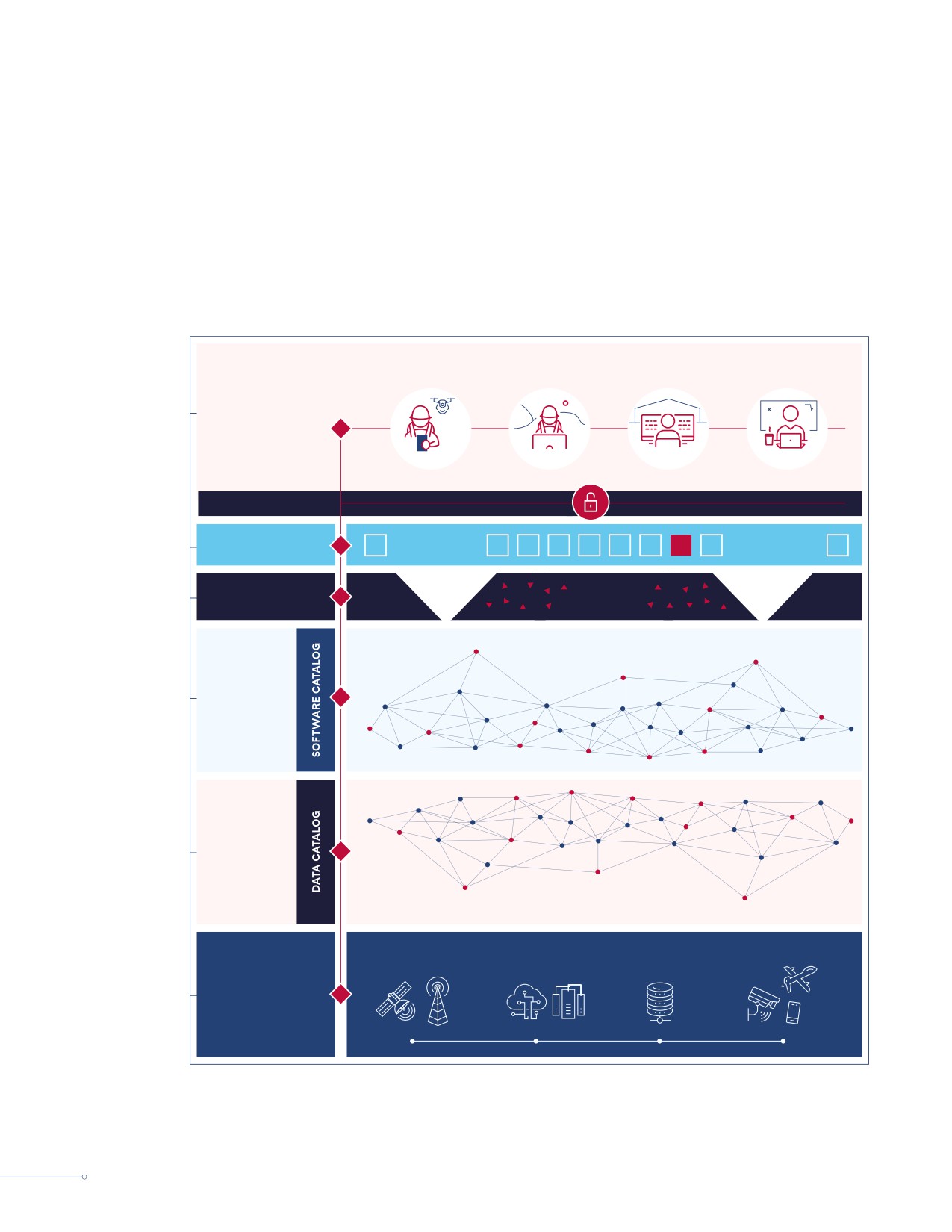
BLUEPRINT FOR ACTION: CHAPTER 2
• Data. Federated and secured data architecture linking distributed repositories across
the department hosted by mission components, service labs, and enterprise programs,
making data discoverable through a catalog.15 With appropriate access controls, this will
facilitate finding, accessing, and moving desired data across the Department16 including
data sets, associated data models, and trained AI models along with supporting
documentation.17
• Hardware Infrastructure. Networking and communications backbone to transport
ecosystem resources, particularly data, and provide seamless access and interchange
between cloud computing and storage services.
AI Digital
Ecosystem.
OPERATOR
DEVELOPER
DEVELOPER
RESEARCHER
IN THE FIELD
AT AN OFFICE
ACCESS TO
ALL LEVELS
BY COMMON
INTERFACES
AUTHENTICATION
APPLICATIONS
Workflows
PLATFORM
DevSecOps
SOFTWARE REPOSITORIES
Algorithms
Tools
Datasets
Trained
AI Models
DATA REPOSITORIES
HARDWARE INFRASTRUCTURE
Network
Computing
Storage
Devices
p
293
FOUNDATIONS OF FUTURE DEFENSE
To accelerate the process of building on existing resources and pathfinder efforts, and to
increase interoperability in the short term, DoD should determine a governance structure
and develop necessary policies and guidance, draft a reference design, and make the
technical investments in the network and in platform environments. Implemented correctly,
the digital ecosystem will ensure force-multiplying common access and interoperability.
The Blueprint for Action framework outlined below marries top-down coordination and
direction with bottom-up mission implementation to realize an enterprise-wide ecosystem
in a manner that does not slow or stymy innovation, but rather incorporates new capabilities
at the speed of innovation and mission requirements.
Actions for the Department of Defense:
•
Establish Digital Ecosystem Leadership and Governance.
o The Secretary of Defense should direct the establishment of an enterprise-wide
digital ecosystem to support capability development to maintain the technological
superiority of the United States military.
■ To ensure senior leader oversight and sustained resourcing, the Secretary
should assign the Steering Committee on Emerging Technology the
responsibility to oversee the implementation and sustainment of the
ecosystem.
■ The Secretary should assign the DoD Chief Information Officer (CIO) as the
Executive Agent responsible for the ecosystem design, development, and
operation.
o The Steering Committee on Emerging Technology, coordinating with the DoD
CIO, DoD Comptroller, Director of Cost Assessment and Program Evaluation, and
appropriate acquisition and programming representatives from the military services,
should produce a funding plan18 for the ecosystem within 90 days of the Secretary’s
direction.
o The DoD CIO should form and chair an enduring digital ecosystem implementation
working group19 to establish and maintain an open architecture, an evolving
reference design, governance structure, and processes to include management
and authorization for ecosystem functions and growth. The Steering Committee
on Emerging Technology will ensure strategic direction and coordination,
and pathfinder organizations will provide bottom-up and mission-oriented
implementation.20
■ The working group should report to the Steering Committee on Emerging
Technology, add members when appropriate, and include representatives
from:21
• The Office of the DoD Chief Data Officer (CDO)
• Component CIOs and CDOs
• The Joint Artificial Intelligence Center (JAIC)
• The Office of the Under Secretary of Defense for Research & Engineering
(OUSD (R&E))
p
294
BLUEPRINT FOR ACTION: CHAPTER 2
• The Office of the Under Secretary of Defense for Acquisition &
Sustainment (OUSD (A&S))
• The Office of the Under Secretary of Defense for Intelligence & Security
(OUSD (I&S))
• Service Acquisition Executives
• The Office of the Director of Operational Test and Evaluation (DOT&E)
• The Director of the Defense Advanced Research Projects Agency
(DARPA)
• Digital ecosystem pathfinders, including but not limited to, the Air Force’s
PlatformOne, Kessel Run, Space CAMP, the Navy’s Black Pearl, the Army’s
CReATE, ADVANA, and the Army Futures Command Sofware Factory22
•
Develop and Mandate Participation in a Digital Ecosystem Governed by an Open
Architecture and Reference Design.
o Within 12 months of the Secretary’s direction to establish the ecosystem, the DoD
CIO should work with the implementation working group to develop and publish an
open, interoperable architecture23 built on common interfaces based on industry-
standard protocols along with an evolving reference design.24
■ The open architecture and reference design should be owned by the DoD CIO
and reviewed quarterly and updated through the working group.
■ An unclassified version of the open architecture and reference design should
be published publicly for commercial capability providers.
o The Secretary of Defense should issue a memorandum that requires all new joint
and service programs to participate in the digital ecosystem and adhere to the open
architecture.25 This should include a requirement that all existing programs develop
a plan to participate and become interoperable with the digital ecosystem wherever
possible by 2025.
■ Through the Joint Requirements Oversight Council (JROC), the Vice Chairman
of the Joint Chiefs of Staff (VCJCS) and USD (R&E)26 should ensure that all
joint and service programs designed to meet joint capability needs adhere to
the digital ecosystem open architecture.27
o The DoD CDO, acting in coordination with the DoD Data Council, should ensure
that the Data Strategy Blueprints for Action Annex developed by each Component
under the DoD Data Strategy adhere to the digital ecosystem open architecture.
o The USD (A&S) should update the guidance governing the formatting requirements
for deliverable data in contracts to be well-documented,28 “non-proprietary formats
designed for interoperability.”29
o The Steering Committee on Emerging Technology should lead an effort with the
IC to assess additional ways to accelerate implementation and leverage the digital
ecosystem, including designating service providers to proliferate applications
across the enterprise and make them available for integration into complex mission
solutions.30 Wherever possible, the digital ecosystem’s open architecture should
leverage and interoperate with proven solutions from the IC such as the Information
Technology Environment recommended in Chapter 5 of this report.
p
295
FOUNDATIONS OF FUTURE DEFENSE
•
Establish a Strategic Data Node.
o The DoD CDO should make it a priority to create a linked, large-scale, cloud-based
data repository (i.e., a node within the digital ecosystem) adherent to the data
service interfaces specified in the ecosystem’s open architecture. This would be a
critical step to enable distributed development efforts by providing AI development
teams secure access to authoritative data from diverse mission sets and functional
areas, and serve as a prototype for the digital ecosystem reference design.31
■ The CDO should create this strategic data node by integrating digital
ecosystem interoperability into the DoD ADVANA system32 and prioritize
construction of enterprise data sets as recommended below.
•
Expand the Network and Communications Backbone to the Digital Ecosystem.
o The Department should fully fund its network and communications modernization
effort as outlined in the DoD Digital Modernization Strategy,33 require the DoD CIO
to factor this into their list of highest priorities, and hold the DoD CIO accountable
for expediting critical upgrades.
•
Create a Marketplace to Promote Democratization of AI Building Blocks.
o The DoD CIO, in accordance with the digital ecosystem governance and reference
design addressed above, should create an AI marketplace for strategic exchanges of
the essential AI building blocks.34 The marketplace should include:
■ SofEx - GitLab-like35 sofware repository system36 hosting AI algorithms,
TEVV tools,37 hardened AI sofware stacks, etc.
■ DataEx - a federated data repository system38 of AI-ready data sets,
documentation, and associated data models.39
■ ModelEx - a federated repository system of trained models40 generated from
various types of AI approaches and techniques, including statistical machine
learning.41
■ CloudEx - a cloud-agnostic, networked marketplace for pre-negotiated
computing and storage services from a pool of vetted cloud providers.42
o Trusted partners (inside and outside government) should be able to develop
solutions and products within secured environments of the ecosystem, offering
monetized access to users.43
•
Develop Prototypical Platform Environments within the Digital Ecosystem.
o The DoD CIO should work closely with the digital ecosystem pathfinder community
to build a set of tailorable development environments for training AI systems
using: data-driven statistical machine learning; the latest simulation and modeling
capabilities to support reinforcement learning (e.g., digital twinning within an
accurate world model); and complementary TEVV services.44
o The DoD CIO should work closely with the digital ecosystem pathfinder community
to implement a set of prototypical platform environments45 that support
development, testing, fielding, and continuous update of AI-powered applications
for diverse categories of contributors and users.46
p
296
BLUEPRINT FOR ACTION: CHAPTER 2
Action for Congress:
• Prioritize funding for the Department’s digital ecosystem and associated activities.
o The Armed Services Committees should use the FY2022 NDAA to direct the
Department to develop a resourcing plan for the digital ecosystem that establishes,
sustains, and incentivizes use of its various components as enterprise-wide,
enduring resources.
o The Committees should also authorize the obligation of funds to begin work on the
ecosystem.
Recommendation
Recommendation: Train and Educate Warfighters
Warfighters need the following capabilities to effectively build and use AI-enabled systems:
• Data-informed decision-making: Data-informed decision-making uses data to generate
insights and act on them. Data-driven organizations ofen make decisions more quickly,
at lower levels in the organization, and with a stronger empirical foundation than
organizations that rely primarily on intuitive or experience-based decision-making.47
• Computational thinking: Service members need to better understand how to use
information processing agents to perform beneficial calculations that could not be done
quickly or efficiently by a human, rather than just representing human thinking in a
digital format.
• Maker culture: Service members of all ranks and occupations need regular contact with
AI-enabled machines, and should be able and encouraged to experiment with and
participate in the development of new tools.
• Human-machine teaming: Military leaders need to understand how to effectively
provide input to machines, interpret machine outputs, and critically, when to trust or not
trust machine outputs.48
• Organizational transformation: Leaders need to understand when and how to integrate
AI-related tasks into their organization’s priorities, allocate resources needed to build
and maintain the AI stack, oversee the deployment and scaling of new systems, and how
to effectively interact with and support the careers of their technical experts.
Component 1: Integrate Digital Skill Sets and Computational Thinking into Military Junior
Leader Education.
Military junior leaders need to understand enough about AI to manage and operate AI-
enabled organizations responsibly and effectively. Commanding and leading AI-driven
systems and humans are very different fields. Leadership is even more complex in
organizations that combine human and AI elements. The below skill sets will equip junior
leaders with the fundamental skills needed.
Problem Definition and Curation. Military leaders need to understand problem curation,
or the process of discovering the causal mechanisms that lead to problems, associated
issues, stakeholders, and potential minimum viable products.49 Poor problem definition
p
297
FOUNDATIONS OF FUTURE DEFENSE
and curation can lead to projects that attempt to solve the incorrect problem, wasting
significant amounts of time and money. This is particularly true for AI. Not all problems
can be solved using the type of probabilistic reasoning performed by many algorithms, or
with limited data sets. Also, many problems with potential AI solutions can be solved with
much easier, less-resource-intensive techniques. Military leaders that understand problem
curation will be better able to identify problems with potential AI solutions, and, just as
importantly, problems that AI will not help solve. This would not only help with the use of AI
but would also make junior leaders generally more productive.
A Conceptual Understanding of the AI Stack. The AI stack is a model that “provides a
streamlined approach to visualize, plan, and prioritize strategic investments in commercial
technologies and transformational research to leverage and continuously advance AI across
operational domains, and achieve asymmetric capability through human augmentation
and autonomous systems.”50 A conceptual understanding of the AI stack would reinforce
the importance of building structural solutions to data collection, management, curation,
installation of sensors, and other underappreciated topics, and reduce attempts to add AI
at the end of a project. It will also help military leaders better understand what part of their
adversaries’ AI to target to degrade its effectiveness.
Data Collection and Management. Junior leaders need to understand how to collect
and manage data and to use systems that do the same in a manner that prepares it for
exploitation, and to operate in an environment where adversaries are doing the same. They
also need to understand the causes, effects, and ethical implications of data bias. Training
junior leaders to collect and manage data with the same degree of responsibility and
expertise that they use for medical care and equipment maintenance would accelerate the
government’s ability to create AI solutions, and to employ data-informed decision-making.
Understanding Probabilistic Reasoning and Data Visualization. Junior leaders need to
know enough about probabilistic reasoning and data visualization to understand the
outputs of their AI systems and their implications for a particular situation or environment.
This is critically linked to understanding when to trust and not trust a system’s outputs,
and other aspects of commanding and leading AI-driven systems. Notably, this does not
require leaders to perform computational statistics, just to understand their output, a much
less demanding task.
Data-informed Decision-making. To make data-informed decisions, leaders need to
understand system thinking and critical thinking. System thinking combines all of the
above to create an empirical but incomplete understanding of factors influencing a
decision, and how both their system affects their AI and how their decision will affect
their system. Critical thinking will help leaders understand the limits of AI, and the limits of
data-informed decision-making processes that are based on imperfect information. This
report references data-informed rather than data-driven decision-making because military
leaders should never be bound by the imperfect information in front of them. Their critical
p
298
BLUEPRINT FOR ACTION: CHAPTER 2
thinking, judgment, and intuitive understanding of both their system and their environment
will always have a critical role to play, even as it is informed by decision-making aids.
Action for Congress:
• Require the military services to integrate digital skills and computational thinking
into pre-commissioning and entry-level training.
o The Armed Services Committees should use the FY2022 NDAA to require the
military services to integrate understanding problem curation, the AI life cycle, data
collection and management, probabilistic reasoning and data visualization, and
data-informed decision-making into existing, pre-commissioning or entry-level
training for junior officers and training for non-commissioned officers within one
year of the passage of the legislation.
Action for the Military Services:
• Integrate digital skills and computational thinking into pre-commissioning and
entry-level training.
o The military services need to integrate understanding problem curation, the AI
life cycle, data collection and management, probabilistic reasoning and data
visualization, and data-informed decision-making into pre-commissioning or
entry-level training for junior officers and training for both junior and senior non-
commissioned officers. The military services can accomplish this by creating
new modules or courses, or by integrating this training into existing training and
education for commissioned and non-commissioned officers. Whenever possible,
this training should include the use of existing AI-enabled systems and tools.
Component
2: Integrate Emerging and Disruptive Technologies into Service-level
Professional Military Education.
While it is critical that military junior leaders better understand digital technology, military
leaders must also understand how technology will affect warfare, their roles in their
organizations, and how they should integrate new technology, both as they increase in
rank and responsibility and as technology changes.
Action for Congress:
• Require the military services to integrate emerging and disruptive technologies
into service-level Professional Military Education.
o The Armed Services Committees should use the FY2022 NDAA to direct the DoD
to require emerging and disruptive technologies courses for officers within one year.
The Armed Services Committees should also require the DoD to develop a training
plan that incrementally builds the necessary skills in its officer corps.
Action for the Military Services:
• Integrate emerging and disruptive technologies into service-level Professional
Military Education.
p
299
FOUNDATIONS OF FUTURE DEFENSE
o Course materials should address AI and other militarily significant emerging
technologies, as identified by the military services and the USD (R&E), in
coordination with the national laboratories, Federally Funded Research and
Development Centers (FFRDCs), and University Affiliated Research Centers
(UARCs).
o Course materials should include an introduction to the latest technology, the
benefits and challenges of adapting new technologies, how organizations
successfully and unsuccessfully adopt these technologies, and ethical issues
surrounding the uses of emerging technologies, including the impact of biases in
these technologies.
o As officers progress in rank, such courses should increasingly build the knowledge
base, vocabulary, and skills necessary to better understand new threats/challenges,
develop operational and organizational concepts, and incorporate technology into
operations and operational support.
o Military services should establish a mechanism that audits these courses annually
to ensure that emerging technologies have been properly identified, and that the
nomenclature, lexicon, definitions, and course content match changes in emerging
technologies.
Component 3: Create Emerging and Disruptive Technology Coded Billets in the Department
of Defense.
It is crucial that the DoD incentivize and increase the skill needed to introduce and field
emerging and disruptive technologies within the military officer corps. The joint qualification
process can serve as a model. The DoD already designates that certain critical billets must
be filled by Joint Qualified Officers51 and different levels of joint qualification.52 To do this,
the DoD should create emerging and disruptive technology designated billets for officers
that require an emerging and disruptive technology qualification prior to assignment and
a process for military leaders to become emerging and disruptive technology qualified.
Emerging and disruptive technology qualified officers would add value in a number of
areas for the services, including: 1) Assisting with acquisition of emerging technology; 2)
Helping integrate technology into field units; 3) Developing organizational and operational
concepts; and 4) Developing training and education plans.
Action for Congress:
• Require the Department of Defense to create emerging and disruptive technology
critical billets that must be filled by emerging technology certified leaders.
Actions for the Department of Defense:
• Create billets that require officers to become emerging and disruptive technology
certified before serving in the positions.
o The Office of the USD (R&E) should define emerging and disruptive technologies.
o Billets include, but are not limited to, positions that develop military doctrine and/
or operating concepts; positions within Force Structure, Resources, and Assessment
p
300