National Security Commission on Artificial Intelligence. Final Report - page 3
CHAPTER 6
The artificial intelligence (AI) competition will not be won by the side
with the best technology. It will be won by the side with the best,
most diverse and tech-savvy talent. The Department of Defense
(DoD) and the Intelligence Community (IC) both face an alarming
talent deficit. This problem is the greatest impediment to the U.S.
being AI-ready by 2025. National security agencies need more
digital experts now or they will remain unprepared to buy, build, and
use AI and its associated technologies. Digital expertise is the most
important requirement for government modernization, but few parts of
government have adequately invested in building a digital workforce.1
“DoD and the IC both face an
alarming talent deficit.”
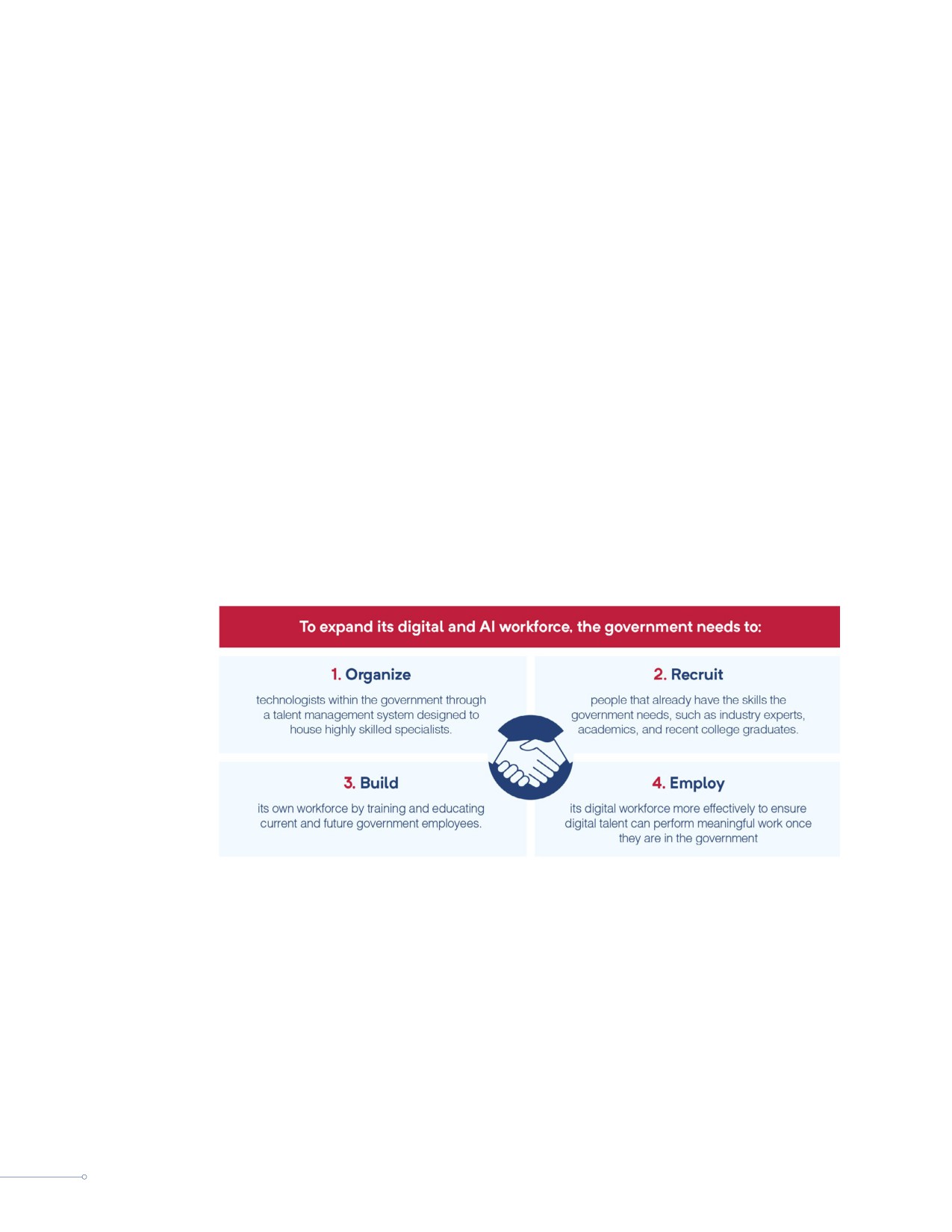
To expand its digital and AI workforce, the government needs to:
• Organize technologists within government through a talent management system
designed to house highly skilled specialists;
• Recruit people who already have the skills the government needs, such as industry
experts, academics, and recent college graduates;
• Build its own workforce by training and educating current and future government
employees; and
• Employ its digital workforce more effectively to ensure digital talent can perform
meaningful work once they are in government.
p
121
TECHNICAL TALENT IN GOVERNMENT
“Digital expertise is the most
important requirement for
government modernization ...”
The Current Model.
Government organizations responsible for creating AI solutions are struggling to build
their digital workforce. Real obstacles impede recruiting and retaining AI practitioners and
broader digital talent. The government does not compete with private-sector salaries and
suffers from a cumbersome hiring process, and all reforms are hindered by a slow security
clearance process.
We should not accept an undesirable status quo as the inevitable future. The government
can compete with the private sector for talent. The government may not match private-
sector salaries, but it does offer the opportunity to tackle national security challenges
and to make a substantial contribution to society. The biggest obstacle hindering the
recruitment of digital talent is not compensation. It is the perception, and too often the
reality, that it is difficult for digital talent in government to perform meaningful work, with
modern computing tools, at the forefront of a rapidly changing field.2
“We should not accept an
undesirable status quo as
the inevitable future. The
government can compete with
the private sector for talent.”
p
122
CHAPTER 6
The Commission is not persuaded by the argument that the government should focus
on project management and data collection and management, and outsource all
development. We have heard this argument from leaders who do not believe it is feasible
for the government to hire or train its own AI experts. Interestingly, we have not heard this
argument from industry.
“Government strategies
that do not develop a
government technical
workforce are short-sighted.”
Government strategies that do not develop a government technical workforce are short-
sighted. Government agencies that rely solely on contractors for digital expertise will
become incapable of understanding the underlying technology well enough to make
successful acquisition decisions independent of contractors.3 This situation creates
national security risks. While contractors should continue to play a critical role, they
are incentivized, and in some sense required, to fulfill the terms of their contract, not to
pursue overall system improvements or to disagree with poorly thought-out requirements
or ineffective strategies. As a result, agencies that rely on contractors force their digital
experts to have a secondary voice in key decisions, even those related to their field of
expertise. The government will always have contractors. But the government can and
should grow its own digital workforce.
Organize.
How a digital workforce is organized is as important as the workforce’s level of expertise.
To generate and manage a proficient digital workforce at the scale required by the national
security enterprise, the government needs to establish a talent management framework
tailored to the task.
Recommendation
Departments and select agencies should create Digital Corps. We propose that departments
and select agencies should create Digital Corps that would recruit, train, and educate
personnel; place people in and remove them from digital workforce billets; manage digital
careers; and set standards for digital workforce qualifications. Departments and select
agencies would create billets for members of these Digital Corps and provide guidance to
members about the work they perform for the agencies.
p
123
TECHNICAL TALENT IN GOVERNMENT
The Digital Corps model is inspired by the Army’s Medical Corps, which organizes
experts with specialized healthcare skills that do not fit into the Army’s traditional talent
management framework. Like the Medical Corps, agency-specific Digital Corps should
have specialized personnel policies, guidelines for promotion, training resources, and
certifications to demonstrate proficiency in new digital areas.
Recruit.
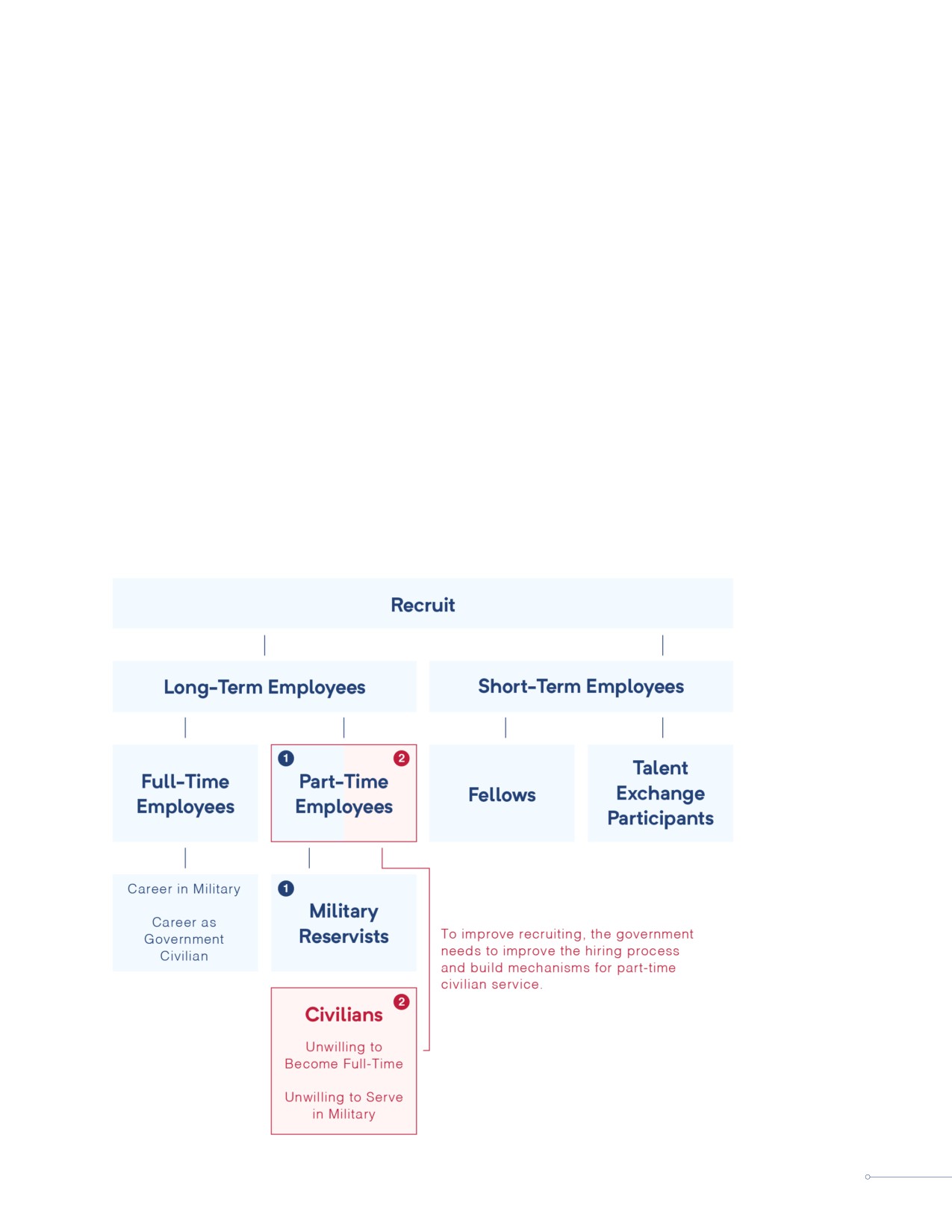
To fill these Digital Corps and to improve its broader digital workforce, the government needs
to improve recruiting and the hiring process, accelerate security clearances, use temporary
hiring vehicles such as the Intergovernmental Personnel Act, and build mechanisms for
part-time civilian service.4 Many AI and other digital practitioners are interested in working
with the government as either full-time employees or part-time employees. Of those
desiring full-time employment, some seek an entire career as a government civilian or in
the military. Others are less willing to make long-term commitments and instead desire to
become temporary, full-time employees, fellows, talent exchange participants, or military
reservists. A third group is willing to work with or for the government part-time, but they
are unwilling to become full-time civilian employees and have no desire to serve as part
of the military.
Gaps in the
Recruitment Model.
p
124
CHAPTER 6
Establish a civilian National Reserve Digital Corps. The government should tap into the
Recommendation
pool of technologists willing to contribute part of their time to public service by creating
a mechanism to hire them. While part-time employees are not a substitute for full-time
employees, they can help improve AI education, perform data triage and acquisition, help
guide projects and frame digital solutions, build bridges between the public and private
sectors, and take on other important tasks.
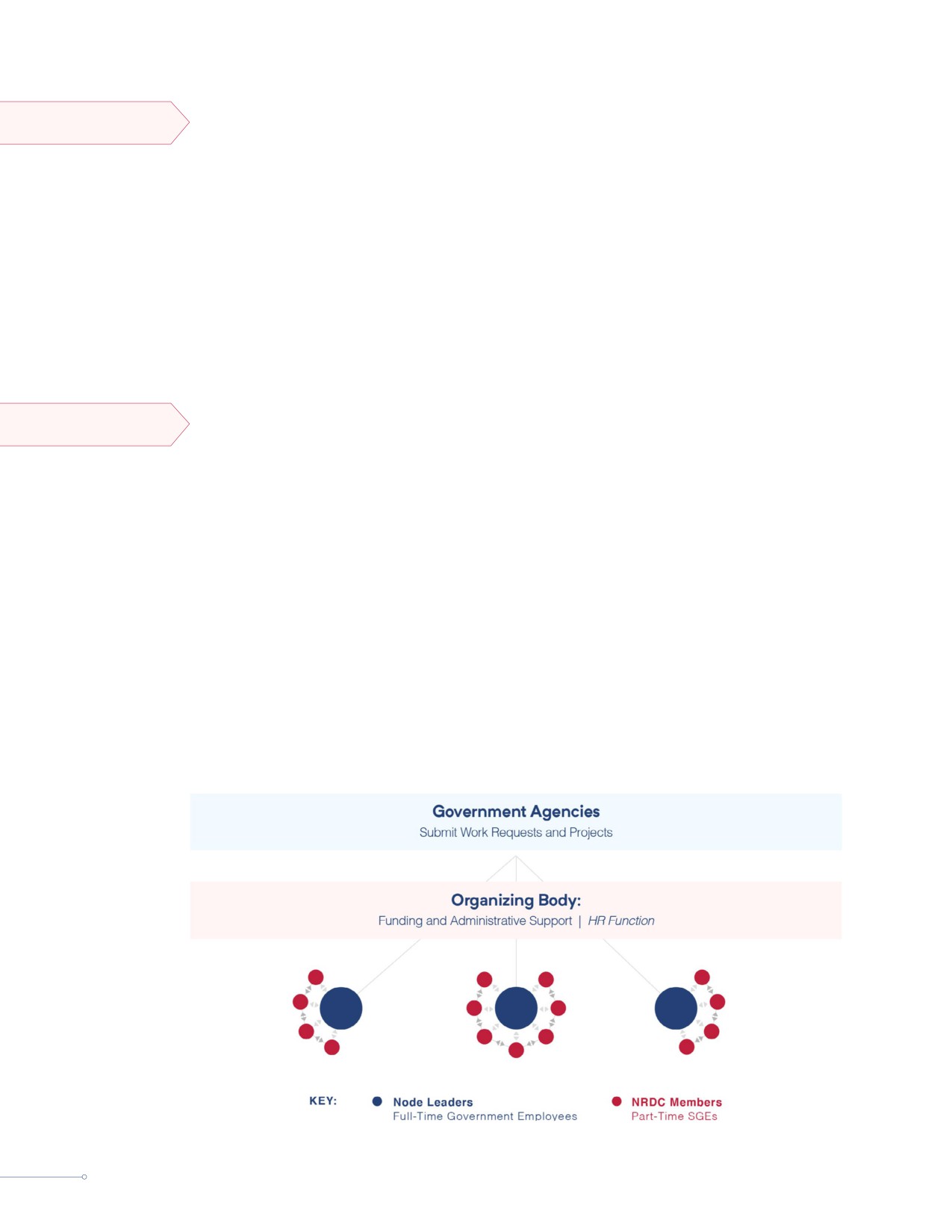
To eliminate this recruitment gap, the government should establish a civilian National
Reserve Digital Corps (NRDC) modeled after the military reserve’s commitments and
incentive structure. Members of the NRDC would become civilian special government
employees in one of the agency Digital Corps and work at least 38 days each year as
advisors, instructors, or developers across the government.
Streamline the hiring process and expand digital talent pipelines. The government hiring
Recommendation
system’s problems are well known: It moves too slowly, struggles to attract experts in a
competitive market, and makes it difficult for experts who are young or do not have a degree
to be hired, especially at a pay grade matching their level of expertise. These challenges
are not caused by a lack of hiring authorities or an inherently slow hiring process. The
Commission has been unable to identify a gap in hiring authorities for the digital workforce.
To clear this recruiting bottleneck, the government needs to expand science, technology,
engineering, and mathematics
(STEM) and AI talent pipelines from universities to
government service, streamline the hiring process, and create agency- and military
service-specific digital talent recruiting offices either for Digital Corps or agencies. The
recruiting offices would monitor their corps, agency, or service’s need for specific types of
digital talent and be empowered to recruit technologists virtually, by attending conferences
and career fairs, recruiting on college campuses, hosting prize competitions, and offering
scholarships, recruiting bonuses, and referral bonuses.
National Reserve
Digital Corps.
p
125
TECHNICAL TALENT IN GOVERNMENT
The Commission has been
unable to identify a gap in
hiring authorities for the
digital workforce.
Standing Digital Corps will oversee government-wide progress and make recommendations
to expand and improve digital talent hiring and pipelines. They should also be able to
experiment with new authorities.
Build.
The government will not be able to recruit its way out of its technology workforce deficit.
AI and digital talent are simply too scarce in the United States. In 2020, there were more
than 430,000 open computer science jobs in the United States, while only 71,000 new
computer scientists graduate from American universities each year.5 The government
should also make a new commitment to building its workforce from the ground up with a
major initiative.
“The United States needs to
establish a new service academy
to train future civil servants in the
digital skills that are needed to
modernize the government.”
p
126
CHAPTER 6
Establish a United States Digital Service Academy. The United States needs to establish
Recommendation
a new service academy to train future civil servants in the digital skills that are needed
to modernize the government. The United States Digital Service Academy (USDSA)
would be an accredited, degree-granting university that receives both government and
private funding, is managed by a purpose-built independent agency within the federal
government, and meets the government’s needs for digital expertise--as determined by
an interagency board, assisted by a Federal Advisory Committee composed of private-
sector and academic technology leaders. The USDSA should be modeled off of the five
U.S. military service academies but produce trained and educated government civilians
for all federal government departments and agencies.
Proposed
Phase One
Implementation
(Years 1-2)
Plan for USDSA.
• Identify and secure an appropriate site for initial
• Appropriate $40 million to pay for administrative costs.
USDSA build-out with room for future expansion.
• Satisfy the necessary requirements set by the
• Identify gaps in the government’s current and
Department of Education, as well as the state the
envisioned digital workforce by an interagency task
USDSA is in, for degree-granting approval.
force under Office of Personnel Management
• Apply for degree program-specific accreditation through
leadership.
the Computing Accreditation Commission on Colleges
• Establish the USDSA administration as a new
of Accreditation Board for Engineering and Technology.
Executive Branch agency with an individual
• Apply for accreditation with a regional accrediting
appropriation that will be responsible for the phased
organization approved by the Department of Education
implementation plan and the management of the
and Council for Higher Education Accreditation in order
institution.
to be granted “Candidate” status.
• Recruit tenure-track faculty.
• Construct the initial physical infrastructure.
• Recruit adjunct faculty, primarily from private-sector
• Appropriate additional costs for the selection and
technology companies.
purchase of the physical location and construction of
• Grant the USDSA the authority to accept outside funds
the infrastructure.
and gifts from individuals and corporations for startup,
maintenance, and infrastructure costs.
Phase Two
Phase Three
(Years 3-5)
(Years 6-7)
• Begin classes with an initial class of 500 students at
• Graduate the first class.
the beginning of year three.
• Ongoing improvement through accreditation
• Demonstrate compliance with all requirements and
assessments.
standards of the regional accrediting organization in
• Assess, and as appropriate, expand
order to be granted Membership status.
class sizes.
p
127
TECHNICAL TALENT IN GOVERNMENT
“Digitally talented people should
be able to reasonably expect
to spend a career performing
meaningful work focused on their
field of expertise in government.”
Employ.
Digitally talented people should be able to reasonably expect to spend a career
performing meaningful work focused on their field of expertise in government. Without
such an expectation, they are unlikely to join the government workforce, and without their
experience matching expectations, they are unlikely to stay for long. Aligning expectations
and experience for the digital workforce requires three changes:
• Opportunity for technologists to spend an entire career focused on the field they are
passionate about;
• Well-informed leaders, some of whom are digitally proficient themselves; and
• Access to tools, data sets, and infrastructure.
These changes are more tactical than those described above, but no less impactful.
Strategic initiatives succeed or fail at the tactical level, and many digital initiatives that
might otherwise have strategic impact are struggling or failing tactically in part because
the government does not employ its technologists effectively.
Establish new digital career fields. New career fields challenge an organization’s definition of
Recommendation
its necessary competencies and, potentially, the nature of its identity. If the military services
create career fields for software developers and data scientists, this will almost inevitably
change what it means to be a soldier, sailor, airman, or marine, much as the introduction
of aviation did generations ago. The government should create civilian occupational series
for software development, software engineering, knowledge management, data science,
and AI. The military services should create career fields in software development, data
science, and AI, with both management and specialist tracks. Digital corps will need
additional career fields as they develop, but these steps will establish a strong foundation.
p
128
CHAPTER 6
Expand access to tools, data sets, and infrastructure. Highly skilled technologists working
Recommendation
in government are regularly denied access to software engineering tools. The digital
workforce needs access to enterprise-level software capabilities on par with those found
in the private sector. Capabilities include software engineering tools, access to software
libraries, vetted open-source support, curated data sets, and infrastructure for large-scale
collaboration.
All career fields need improved access to the latest open-source libraries and tools.6 Most
advanced AI and machine learning (ML) libraries need vast amounts of data available to
train models on. Providing AI practitioners rich data sets across the physical and biological
sciences, economics, and behavioral studies will let them focus on their areas of expertise
rather than scraping obscure sources for data.
p
129
TECHNICAL TALENT IN GOVERNMENT
Chapter 6 - Endnotes
1 There are pockets of excellence in several parts of the government, such as in the United States
Digital Service, Kessel Run, the Army Artificial Intelligence Task Force, the USAF-MIT AI Accelerator,
components of the Intelligence Community, and the national labs--but there are too few, and they
have not spread widely enough across the government. Agencies’ requirements for the size and type
of AI workforce vary, but every agency NSCAI has engaged has expressed a need to expand its AI
workforce, and the recommendations here are broadly applicable.
2 NSCAI staff discussions with the Defense Innovation Board and Defense Digital Service (May 2019).
3 William A. LaPlante, Owning the Technical Baseline, Defense AT&L at 18-20 (July-Aug. 2015), https://
apps.dtic.mil/dtic/tr/fulltext/u2/1016084.pdf.
4 For more information on the Intergovernmental Personnel Act, see Intergovernmental Personnel Act,
OPM (last accessed Feb. 1, 2021), https://www.opm.gov/policy-data-oversight/hiring-information/
intergovernment-personnel-act/.
5 Code.org (last accessed Jan. 11, 2021), https://code.org/promote. See also Oren Etzioni, What
Trump’s Executive Order on AI Is Missing: America Needs a Special Visa Program Aimed at Attracting
executive-order-on-ai-is-missing/.
6 For the AI career field in particular, TensorFlow is one of the world’s most popular libraries for
training neural networks and other machine learning (ML) algorithms. PyTorch is another open-source
library that aids in transforming research prototypes to production-ready machine learning models.
p
130
CHAPTER 7
Chapter 7:
Establishing Justified
Confidence in AI Systems
p
131

ESTABLISHING JUSTIFIED CONFIDENCE IN AI SYSTEMS
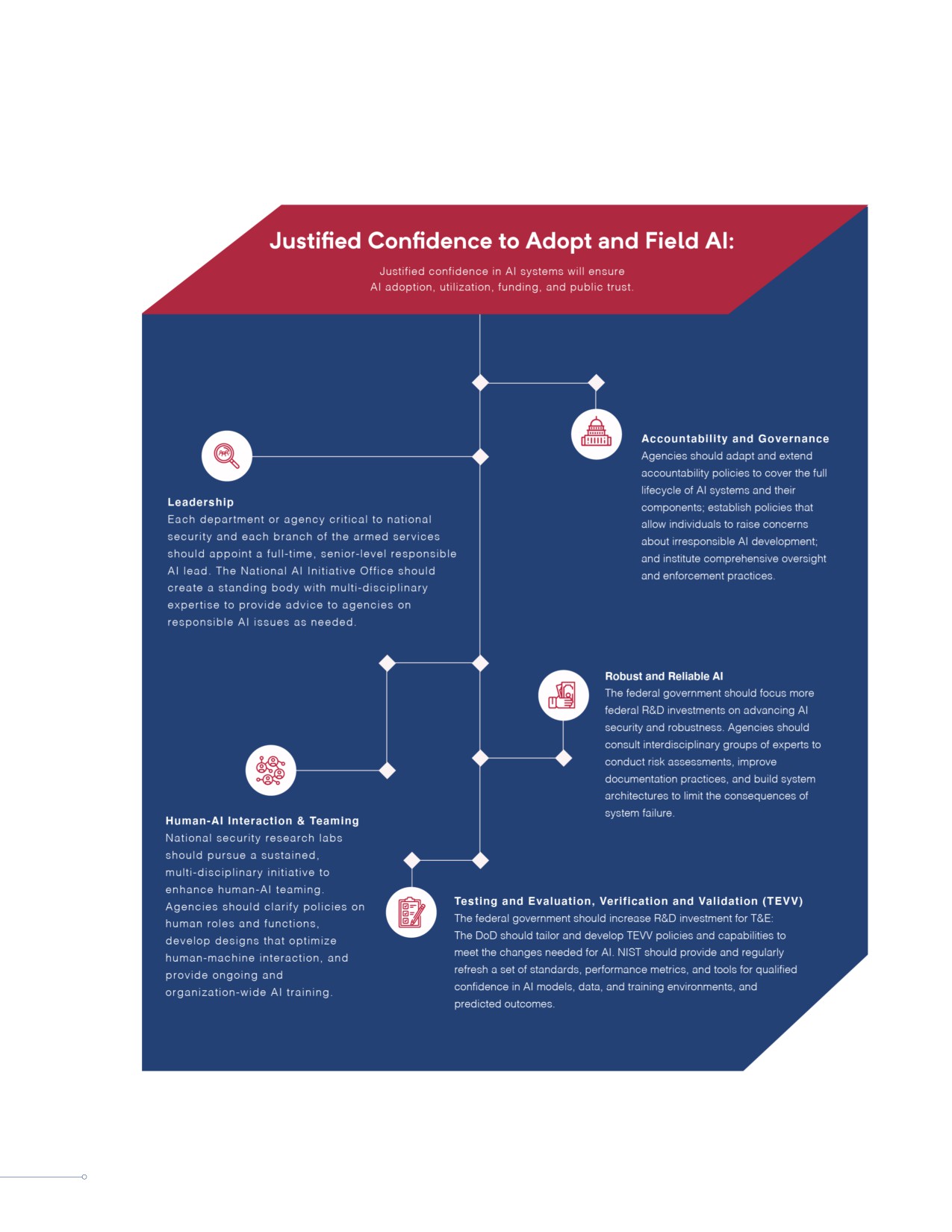
Justified Confidence to
Adopt and Field AI.
Accountability
and Governance
Leadership
Robust and
Reliable AI
Human-AI
Interaction
and Teaming
Testing and
Evaluation,
Verification and
Validation (TEVV)
p
132
CHAPTER 7
Artificial intelligence (AI) systems must be developed and fielded
with justified confidence.1 If AI systems do not work as designed,
or are unpredictable in ways that can have significant negative
consequences, then leaders will not adopt them, operators will not
use them, Congress will not fund them, and the American people will
not support them.
“If AI systems ... are
unpredictable in ways that
can have significant negative
consequences, then leaders will
not adopt them, operators will
not use them, Congress will not
fund them, and the American
people will not support them.”
Achieving acceptable AI performance often is linked to the decision to accept some level
of risk. No technology works perfectly under all conditions. Risk calculus changes with
circumstances. The variables and considerations that inform judgments to rely on AI will
vary significantly across military, intelligence, homeland security, and law enforcement
missions. In a high-threat environment like combat, in some cases it may be reasonable
to employ a system offering some immediate military advantage, while recognizing that
it might fail; in other cases, however, a reasonable commander might want the highest
assurances of AI reliability before fielding when lives are at risk.
p
133
ESTABLISHING JUSTIFIED CONFIDENCE IN AI SYSTEMS
“As departments and agencies
rely more heavily on machines,
a central guiding principle
across national security scenarios
is the continued centrality of
human judgment.”
As departments and agencies rely more heavily on machines, a central guiding principle
across national security scenarios is the continued centrality of human judgment. Those
charged with utilizing AI need an informed understanding of risks, opportunities, and
tradeoffs. They need awareness of the possibilities and limitations in a system’s expected
performance. Ultimately, they need to formulate an educated answer to this question: In the
given circumstance, how much confidence in the machine is enough confidence? These
issues bear on the full lifecycle of an AI system--from acquisition or system development
and the thresholds for justified confidence to deploy a specific AI-intensive system to the
performance of the system in the field.
While there is no absolute assurance of perfection, there are policies and best practices
that support making these decisions responsibly. Agencies are broadly aware of the
principal challenges in employing AI systems and the necessity of incorporating best
practices in the engineering and management of AI systems.
The Commission has produced a detailed framework to guide the responsible
development and fielding of AI across the national security community (see the Appendix
on Key Considerations for Responsible Development and Fielding of AI). It contains key
considerations for policymakers and technical practitioners covering the full breadth
of the AI lifecycle. The framework includes recommended practices that should be
integrated and updated as the technology advances. The Commission is heartened that
some departments have already taken actions to integrate recommendations from our
framework.2
To assist agencies in meeting baseline criteria for Responsible AI, we highlight the main
challenges and key recommendations in our framework across five issue areas.
p
134
CHAPTER 7
1. Robust and Reliable AI.
Current AI systems, such as those used for perception and classification, have different
kinds of failure--characterized as rates of false positives and false negatives. They are
often brittle when operating at the edges of their performance competence, and it is
difficult to anticipate their competence boundaries.3 They are also vulnerable to attack,
and they can exhibit unwanted bias in operation. For national security missions, these can
be serious problems. U.S. government agencies should:
Focus more federal R&D investments on advancing AI security and robustness. These
Recommendation
investments should also advance the interpretability and explainability of AI systems, so
users can better understand whether the systems are operating as intended.
Consult interdisciplinary groups of experts to conduct risk assessments, improve documentation
Recommendation
practices, and build overall system architectures to limit the consequences of system failure.4
Such architectures should securely monitor component performance and handle errors
when anomalies are detected5; contain AI components that are self-protecting (validating
input data) and self-checking (validating data passed to the rest of the system); and include
aggressive stress testing.
“The government needs
AI systems that augment
and complement human
understanding and
decision-making so that the
complementary strengths of
humans and AI can be leveraged
as an optimal team. Achieving
this remains a challenge.”
p
135
ESTABLISHING JUSTIFIED CONFIDENCE IN AI SYSTEMS
2. Human-AI Interaction and Teaming.
The government needs AI systems that augment and complement human understanding
and decision-making so that the complementary strengths of humans and AI can be
leveraged as an optimal team. Achieving this remains a challenge. For instance, humans
are prone both to over-trusting and to under-trusting machines depending on context.
Challenges also exist for measuring the performance of human-AI teams, conveying
enough information while avoiding cognitive overload, enabling humans and machines
to understand the circumstances in which they should pass control between each other,
and maintaining appropriate human engagement to preserve situational awareness and
meaningfully take action when needed. Agencies will also need to determine machine
performance standards and expectations as compared with humans. The government
should:
Pursue a sustained, multidisciplinary initiative through national security research labs to enhance
Recommendation
human-AI teaming. This initiative should focus on maximizing the benefits of human-AI
interaction; better measuring human performance and capabilities when working with
AI systems, including testing through continuous contact and experimentation with end
users; and helping AI systems better understand contextual nuances of a situation.
Clarify policies on human roles and functions, develop designs that optimize human-machine
Recommendation
interaction, and provide ongoing and organization-wide AI training.
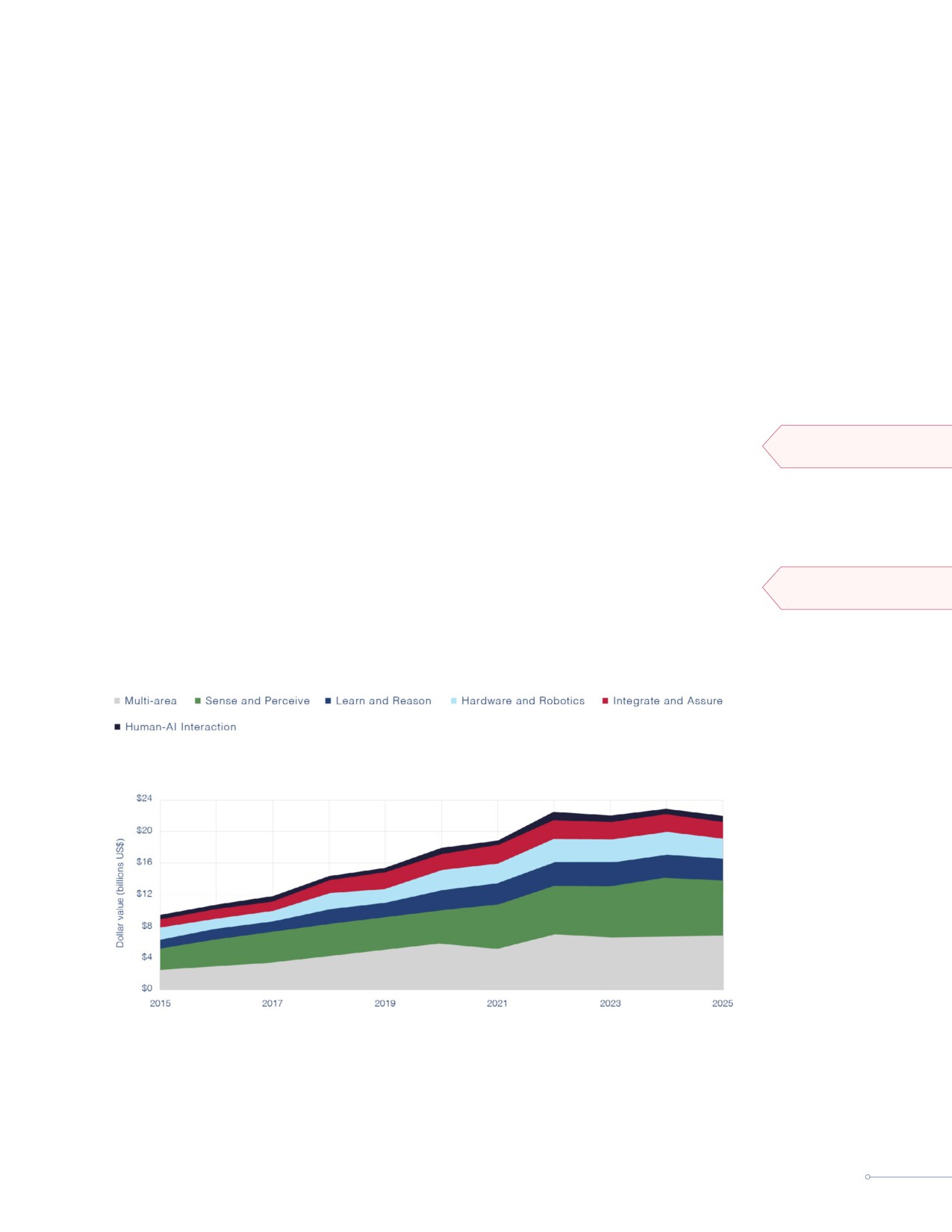
DoD AI Total RDT&E Investments by Research Area, FY 2015-2025
Source: Govini
DoD AI
total RDT&E
Investments.
This figure displays estimated DoD spending levels across five major research categories devised by NSCAI
commissioners, indicating that investments in human-AI interaction lags behind other research categories.
Note the spending levels presented in figure represent estimates based on an analysis of DoD RDT&E budget
documents for FY2021-FY2025. See Analysis of DoD RDT&E Investments in AI, NSCAI (on final with the
Commission). Due to inherent quality issues in the source data, estimates presented contain significant, difficult
to estimate margins of error.
p
136
CHAPTER 7
3. Testing and Evaluation, Verification and Validation (TEVV).
Having justified confidence in AI systems requires assurances that they will perform
as intended, including when interacting with humans and other systems. The TEVV of
traditional legacy systems is not sufficient at providing these assurances. As a result,
agencies lack common metrics to assess trustworthiness that AI systems will perform as
intended. To minimize performance problems and unanticipated outcomes, an entirely
new type of TEVV will be needed. This is a priority task, and a challenging one. The federal
government will need to increase R&D investments to improve our understanding of how to
conduct AI and software-related TEVV. Toward this end:
Recommendation
DoD should tailor and develop TEVV policies and capabilities to meet the changes needed
for AI as AI-enabled systems grow in number, scope, and complexity in the Department. This
should include establishing a TEVV framework and culture that integrates continuous
testing; making TEVV tools and capabilities more readily available across DoD; updating or
creating live, virtual, and constructive test ranges for AI-enabled systems; and restructuring
the processes that underlie requirements for system design, development, and testing.6
National Institute of Standards and Technology (NIST) should provide and regularly refresh a
Recommendation
set of standards, performance metrics, and tools for qualified confidence in AI models, data,
and training environments, and predicted outcomes. NIST should lead the AI community
in establishing these resources, closely engaging with experts and users from industry,
academia, and government to ensure their efficacy.
4. Leadership.
Responsible development and fielding of AI requires end users and senior leaders to be
aware of system capabilities and limitations so that they are not misused. It also requires
subject-matter experts to support training, acquisition, risk assessment, and adoption of
best practices as they evolve. Today, only the DoD has a dedicated lead for Responsible
AI; employees in national security agencies taking on these roles typically do so on a
voluntary, part-time basis. Without full-time dedicated staff, agencies will not succeed in
fully adopting and implementing these recommended practices. The government should:
Appoint a full-time, senior-level Responsible AI lead in each department or agency critical
Recommendation
to national security and each branch of the armed services. Such an official should drive
Responsible AI training, provide expertise on Responsible AI policies and practices, lead
interagency coordination, and shape procurement policies.
Create a standing body of multidisciplinary experts in the National AI Initiative Office. The
Recommendation
standing body would provide advice to agencies as needed on responsible AI issues. The
group should include people with expertise at the intersection of AI and other fields such
as ethics, law, policy, economics, cognitive science, and technology, including adversarial
AI techniques.
p
137
ESTABLISHING JUSTIFIED CONFIDENCE IN AI SYSTEMS
5. Accountability and Governance.
Congress and the public need to see that the government is equipped to catch and
fix critical flaws in systems in time to prevent inadvertent disasters and hold humans
accountable, including for misuse. Agencies need the ability to monitor AI performance
as systems run (to assess if they are performing as intended) and to build systems with
the necessary instrumentation to do so.7 Departments and agencies critical to national
security and oversight entities have all expressed challenges with having visibility into their
systems, while vendors are calling for clarity on instrumentation/auditability requirements.
Government agencies should:
Adapt and extend existing accountability policies to cover the full lifecycle of AI systems and
Recommendation
their components.
Establish policies that allow individuals to raise concerns about irresponsible AI development
Recommendation
and institute comprehensive oversight and enforcement practices. These should include
auditing and reporting requirements, a review mechanism for the most sensitive or high-
risk AI systems, and appeals and grievance processes for those affected by the actions
of AI systems.
p
138
CHAPTER 7
p
139
ESTABLISHING JUSTIFIED CONFIDENCE IN AI SYSTEMS
Chapter 7 - Endnotes
1 The term “justified confidence,” taken from a widely used international standard, uses a specific
definition of assurance as being “grounds for justified confidence.” It notes that “stakeholders need
grounds for justifiable confidence prior to depending on a system” and that “the greater the degree
of dependence, the greater the need for strong grounds for confidence.” ISO/IEC/IEEE International
Standard - Systems and Software Engineering - Systems and Software Assurance, IEEE/ISO/IEC
15026-1 (2019), https://standards.ieee.org/standard/15026-1_Revision-2019.html.
2 The Department of Defense’s Joint Artificial Intelligence Center (JAIC) Subcommittees on
Responsible AI and Test & Evaluation have both conducted substantial mapping exercises to
determine which existing practices correspond to recommendations found in the Key Considerations.
Recommendations from the Key Considerations are also reinforced by inclusions in the Department of
Homeland Security (DHS)’s AI Strategy. See Department of Homeland Security Artificial Intelligence
artificial-intelligence-strategy?topic=intelligence-and-analysis.
3 Like other intelligent systems, including software and humans, AI systems have competency
limitations. However, we have less science to understand the performance limitations of AI systems
including why, when, and how they fail.
4 Such interdisciplinary teams should explore the possibility of documentation/labels specifying the
narrow task/mission for which a system was designed and tested. As noted in the Appendix on Key
Considerations for Responsible Development & Fielding of AI, documentation of the AI lifecycle
should include information about the data used to train and test a model and the methods used to test
a model, both based on the context in which it will be used. It also should include requirements for re-
testing, retraining, and tuning when a system is used in a different scenario or setting.
5 Monitoring can add a layer of robustness, but must itself also be guarded to prevent new openings
for external espionage or tampering with AI systems.
6 Upgrades to digital infrastructure, as outlined in Chapter 2 of this report, will be required to augment
physical test ranges to create digital testing environments that can leverage digital twins.
7 Cases in which new sensors and instrumentation are added can also introduce new vulnerabilities.
It is especially important to ensure that the overall architecture of such systems is secure against
external espionage and tampering.
p
140
CHAPTER 8
Chapter 8:
Upholding Democratic Values:
Privacy, Civil Liberties, and
Civil Rights in Uses of AI for
National Security
p
141

UPHOLDING DEMOCRATIC VALUES: PRIVACY, CIVIL LIBERTIES, AND CIVIL RIGHTS IN USES OF AI FOR NATIONAL SECURITY
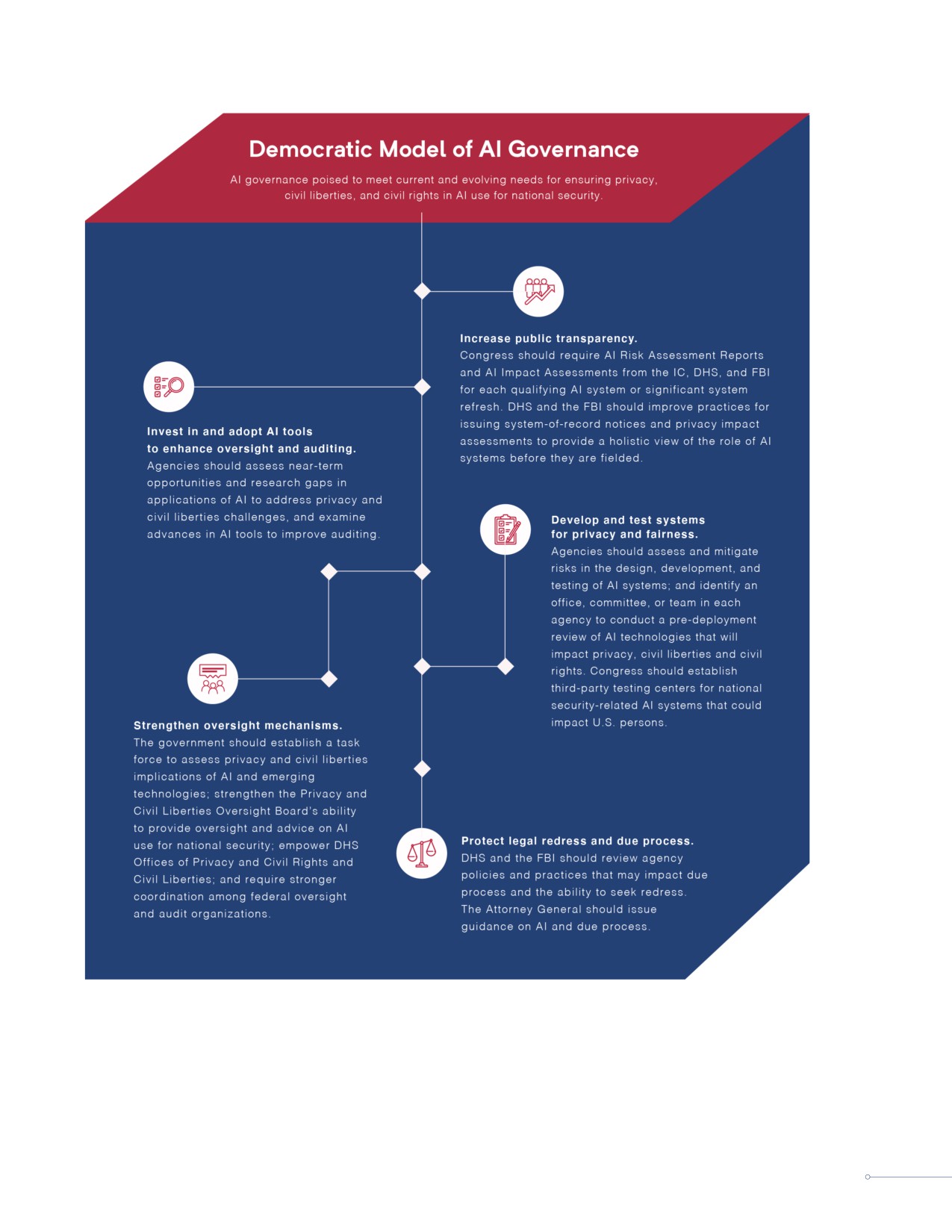
Democratic Model of AI Governance
Increase Public
Transparency
Invest In and
Adopt AI Tools
to Enhance
Oversight and
Auditing
Develop and
Test Systems
for Privacy
and Fairness
Strengthen
Oversight
Mechanisms
Protect Legal
Redress and Due
Process
p
142
CHAPTER 8
The basic purpose of the American government is to protect the
security and liberty of the American people. Americans have a
long tradition of debating how best to achieve these twin goals
when tensions arise between them. The two decades following
9/11 saw intensive efforts to calibrate the government’s powers to
stop another terrorist attack with its obligations to respect individual
rights and liberties. Artificial intelligence (AI) is ushering in the next
era of this debate because new technologies offer government
agencies more powerful ways to collect and process information,
track individuals’ behavior and movements, and act on the basis
of computer-generated analyses.
In addition to supporting military and intelligence missions abroad, these tools are promising
for national security purposes closer to home—whether to examine foreign intelligence to
find signs of danger to the United States, to screen for threats at the borders, to protect
against cyber attacks and information operations, or to identify domestic terrorism plots.
Americans have concerns that AI applications used for these security and public safety
purposes—especially those involving biometric technologies or the analysis of aggregated
personal data—will invade their privacy, restrict their freedoms of speech and assembly,
and reinforce bias and discrimination. At the same time, if applied effectively, AI can help
improve protections for privacy and civil liberties. Machine analysis could be more precise,
and AI systems potentially could enhance oversight through real-time monitoring.
For the United States, as for other democratic countries, use of AI by officials must comport
with principles of limited government and individual liberty. These principles do not uphold
themselves. In a democratic society, any empowerment of the state must be accompanied
by wise restraints to make that power legitimate in the eyes of its citizens.
As this report argues, the promise of emerging AI technologies to enhance national
security is real and significant. The ability of U.S. intelligence, homeland security, and
law enforcement agencies to develop and use them for national security purposes must
be preserved. To do so, however, the government must ensure that their use is effective,
legitimate, and lawful. Public trust will hinge on justified assurance about compliance with
privacy, civil liberties, and civil rights.
Democratic AI Governance and Novel Challenges for Privacy,
Civil Liberties, and Civil Rights.
With new models of techno-authoritarian governance gaining traction abroad, the United
States must continue to serve as a beacon of democratic values. The democratic model
p
143
UPHOLDING DEMOCRATIC VALUES: PRIVACY, CIVIL LIBERTIES, AND CIVIL RIGHTS IN USES OF AI FOR NATIONAL SECURITY
must prove its resilience in the face of emerging technological changes that could
challenge it. Fundamentally, we are confident that the American system—and the rules,
norms, and institutions that uphold it—can adapt to uphold the dual imperatives of security
and liberty in the AI era.
For the Intelligence Community (IC), core features of that system include laws, rules, and
procedures to minimize the collection, retention, and dissemination of U.S. persons’ data,
as well as oversight from all three branches of government.1 Homeland security and law
enforcement agencies likewise operate within frameworks of policy, oversight, and judicial
review that guide border protection and criminal investigations. Ultimately, the actions of
all federal agencies are subject to the Constitution’s guarantees.
Within this context, the advent of modern AI—and the novel capabilities it can bring
to intelligence, homeland security, and law enforcement missions—raises a number of
concerns and difficult questions and challenges with respect to the privacy, civil liberties,
and civil rights of U.S. persons. For example:
•
AI-powered analytics can help officials process and make sense of huge amounts of
information, which can be aggregated to form a revealing “mosaic” picture of a person’s
activities, whereabouts, and patterns of behavior.2 Combining disparate data streams
involving geolocation, web browsing, financial transactions, and other data sources
creates the possibility of new insights for analysts or investigators. This could be highly
useful to identify threats, but it has also raised questions about the proper scope and
authorization for border or law enforcement searches.3
•
Much of this personal information is held by private companies. This fact of modern
digital life has raised constitutional questions about whether and when individuals
should have a “reasonable expectation of privacy” in the information they provide to
third parties like technology firms—and questions about the circumstances in which
that information may be accessed and utilized by intelligence, homeland security, or law
enforcement agencies for a legitimate national security purpose.4
•
AI can help automate aspects of data collection and analysis. Such methods can
augment the ability of analysts or investigators to sif through and triage masses of
information to establish patterns or pinpoint threats. But they also raise questions about
the proper roles of machine and human analysis in these processes, including for
making predictive judgments. To the extent that an AI system’s functions are opaque,
it may be difficult to trace and justify the computational process that led the system to
make a recommendation. Determining when and how to rely on algorithms is especially
pertinent to minimization and querying procedures in the IC and to building cases for
law enforcement action.5
•
AI models can evolve based on changing data and interaction with other models,
leading to unexpected outcomes. As a result, AI systems require more continuous
testing and evaluation than prior generations of technology.
•
Unintended bias can be introduced during many stages of the machine learning (ML)
process, which can lead to disparate impacts in American society, a problem that has
been documented in law enforcement contexts.6
p
144
CHAPTER 8
Tenets for Managing AI Challenges.
This Commission will not endeavor to draw all of the lines for what may be permissible
or wise in particular circumstances. However, important principles to follow in different
national security contexts include the following:
Foreign Intelligence Collection and Analysis: The Office of the Director of National
Intelligence (ODNI) AI Ethics Guidance to the Intelligence Community is an encouraging
step, as it places strong emphasis on utilizing AI for foreign intelligence missions in
ways that uphold the privacy and civil liberties of Americans.7 As these guidelines are
implemented, it will be important to pay close attention to ensuring that data minimization,
retention, and querying procedures are adequate and rigorously enforced.
Border Security: AI surveillance and analysis capabilities can make the government’s
operations more efficient and effective at the borders and ports of entry. But to sustain
public support for these uses, the Department of Homeland Security (DHS) must take care
to ensure that automated screening processes lead agents only to the information they
need and are authorized to access, and do not impermissibly single out individuals based
on characteristics such as race or religion.
Domestic Security and Public Safety: Rapid advances in AI-enabled technologies for
law enforcement purposes, including biometric surveillance techniques such as facial
recognition, may be outpacing rules for their proper use. The government must exercise
special caution in managing risks to bedrock constitutional principles including equal
protection, due process, freedom from unreasonable searches and seizures, and freedoms
of speech and assembly.8
In carrying out these missions, it will be important to maintain clear distinctions between
appropriate authorities in these different national security contexts. It is also important to
gain greater public confidence by enhancing transparency, improving the performance
and reliability of AI technologies, ensuring due process, and strengthening oversight. With
these tenets in mind, the government should take the following steps.
p
145
UPHOLDING DEMOCRATIC VALUES: PRIVACY, CIVIL LIBERTIES, AND CIVIL RIGHTS IN USES OF AI FOR NATIONAL SECURITY
“Agencies should assess near-
term opportunities and research
gaps in applications of AI to
address privacy and civil liberties
challenges ...”
Recommendations.
Invest in and adopt AI tools to enhance oversight and auditing in support of privacy and
Recommendation
civil liberties. Agencies should assess near-term opportunities and research gaps in
applications of AI to address privacy and civil liberties challenges, such as ML techniques
for classification, recommendation, anomaly detection, and other applications.9 Examples
of advances in AI to improve auditing include tools that support financial audits and
model risk management. Agencies should examine the utility of these and other current or
emerging practices.10
Improve public transparency about how the government uses AI. There is a lack of
Recommendation
transparency into agency policies and procedures and into the accuracy of AI systems
that may impact civil liberties.11 The “black box” nature of some ML systems only adds to
this opacity.12 More transparency could help to ease public concerns. Of course, in certain
operational contexts, especially for intelligence and law enforcement agencies, secrecy
is essential to the mission. However, existing transparency mechanisms could be utilized
more effectively, and, in some cases, revised. New agency reporting requirements would
also be beneficial.
• For AI systems that impact U.S. persons, Congress should require AI Risk Assessment
Reports and AI Impact Assessments from the Intelligence Community, the Department
of Homeland Security, and the Federal Bureau of Investigation. These should assess
the privacy, civil liberties and civil rights implications for each qualifying AI system or
significant system refresh.13
• DHS and the FBI should also improve practices for issuing system of records notices
and privacy impact assessments to provide a more holistic view of the role of AI systems
before they are fielded.
p
146
CHAPTER 8
Develop and test systems with the goal of advancing privacy preservation and fairness. ML
Recommendation
systems in particular require ongoing assessments of privacy and fairness assurances,
including the specific definition of fairness being assumed. Although an ML system may
meet requirements at a static point in time, ongoing compliance is not a given once
the system is operational. This is in large part due to changing data, the introduction of
unintended bias, and potential re-identification of anonymized data.14 This is a complex
technical area, and continued work in the technical, legal, and policy domains is required
to find greater consensus on technical approaches to preserving privacy, civil liberties,
and civil rights.15 Meanwhile, agencies should take several steps:
• Assess and mitigate risks in the design, development, and testing of AI systems.
In addition to conducting risk assessments for the privacy, civil liberties and civil rights
of U.S. persons, IC elements, DHS, and the FBI should take measures to mitigate those
risks, and document remaining risks that are accepted. In doing so, they should adopt
practices from the Key Considerations, including using privacy protections such as
robust anonymization, and when possible, privacy-preserving technology; taking steps
to mitigate bias in development and testing; and assessing model performance on an
ongoing basis.16
• Identify an office, committee, or team in each agency that will conduct a pre-
deployment review of AI technologies that will impact privacy, civil liberties,
and civil rights. This should include review in advance of their deployment and for
compliance over the lifespan of the system. An office in each IC element, DHS, and
the FBI should be equipped to assess data, model, and system documentation, and to
assess the testing results of systems with respect to their intended use.
• Establish third-party testing centers for national security-related AI systems that
could impact U.S. persons. Such independent, third-party testing could be done by
a national laboratory, a University Affiliated Research Center, or a Federally Funded
Research and Development Center. Such testing should be mandatory for high-stakes
systems but otherwise voluntary.17 It would provide agencies with additional expertise to
help overcome in-house limitations.
Recommendation
Strengthen the ability of those impacted by government actions involving AI to seek redress and
have due process. AI systems will make errors.18 Agencies have to accept non-zero false
positive and false negative rates in order to deploy any AI system. It is important to ensure
opportunities for redress, consistent with the constitutional principle of due process—
for example, when a system error leads to a benefit being denied (e.g., visa approval);
restrictions on movement (e.g., being placed on a no-fly list); or an arrest.19 There are also
due process concerns in cases in which AI contributes to building a case to press criminal
charges.20 We recommend two steps to start addressing these issues:
• Review DHS and FBI policies and practices that may impact due process and the
ability to seek redress. DHS and the FBI should review agency policies and practices to
ensure that parties aggrieved by government action involving AI technology, including
through system actions or misuse, can seek redress and clearly know how to do so. This
review should include whether adequate notice of AI use in decision-making is provided
to impacted parties, as well as the degree to which AI systems can be audited to trace
the process by which a system arrived at a recommendation, if it is contested.
p
147
UPHOLDING DEMOCRATIC VALUES: PRIVACY, CIVIL LIBERTIES, AND CIVIL RIGHTS IN USES OF AI FOR NATIONAL SECURITY
• Issue Attorney General guidance on AI and due process. The guidance should
describe how relevant agencies should safeguard the due process rights of U.S. persons
when AI use may lead to a deprivation of life or liberty.
Strengthen oversight mechanisms to address current and evolving concerns. The advancement
Recommendation
of AI requires a forward-looking approach to oversight that anticipates the continued
evolution and adoption of new technologies and better positions the government to
responsibly manage their employment well into the future.
“The advancement of AI requires
a forward-looking approach
to oversight that anticipates
the continued evolution and
adoption of new technologies,
and better positions the
government to responsibly
manage their employment well
into the future.”
The government should:
• Establish a task force to assess the privacy and civil liberties implications of AI and
emerging technologies. The goal of the task force would be to identify gaps and make
recommendations to ensure that uses of AI and associated data in U.S. government
operations comport with U.S. law and values, and to study organizational reforms that
would support this goal. Specifically, it should assess existing policy and legal gaps for
current AI applications and emerging technologies, and make recommendations for:
o legislative and regulatory reforms on the development and use of AI and
emerging technologies and associated data21; and
o institutional changes to ensure sustained assessment and recurring guidance
on privacy and civil liberties implications of AI applications and emerging
technologies.
p
148
CHAPTER 8
• Strengthen the ability of the Privacy and Civil Liberties Oversight Board (PCLOB)
to provide meaningful oversight and advice on AI use for national security. Since
its creation in 2007, following a recommendation of the 9/11 Commission, PCLOB has
had an especially important role in overseeing, and advising the government on, U.S.
counterterrorism missions. In recent years, it has started turning attention to the use of
new technologies in foreign intelligence collection and analysis.22 The board should
be given visibility into AI systems before they are fielded, including at a more granular
technical level, and should be resourced and staffed to fulfill the more technically
sophisticated mission that the AI era now requires.23
• Empower DHS Offices of Privacy and Civil Rights and Civil Liberties (CRCL). The
Chief CRCL Officer, in coordination with the Privacy Officer, must play an integral role in
the legal and approval processes for the procurement and use of AI-enabled systems,
including for associated data used in DHS ML systems.
• Require stronger coordination and alignment among federal oversight and
audit organizations. Compliance by agencies with AI documentation and testing
requirements should be supported by rigorous, technically informed oversight. To
achieve this and overcome current audit and oversight impediments, a standing body
should align and coordinate to enhance AI oversight and audit with respect to privacy,
civil liberties, and civil rights.24
p
149
UPHOLDING DEMOCRATIC VALUES: PRIVACY, CIVIL LIBERTIES, AND CIVIL RIGHTS IN USES OF AI FOR NATIONAL SECURITY
p
150
CHAPTER 8
Chapter 8 - Endnotes
1 For a compilation of Attorney General guidelines from the IC components, see Status of Attorney
dni.gov/files/documents/Table_of_EO12333_AG_Guidelines%20for%20PCLOB_%20Updated%20
July_2016.pdf. Elements of the IC oversight system include counsels and privacy officials within
intelligence agencies, the Department of Justice, independent bodies such as the Privacy and Civil
Liberties Oversight Board, Federal courts including the Foreign Intelligence Surveillance Court, and
the House and Senate intelligence committees.
2 On the mosaic concept, see, e.g., Steven M. Bellovin, et al., When Enough Is Enough: Location
Tracking, Mosaic Theory, and Machine Learning, NYU Journal of Law & Liberty, Vol. 8 (Sept. 3, 2013),
https://papers.ssrn.com/sol3/papers.cfm?abstract_id=2320019.
3 For an informative discussion of evolving debates over Fourth Amendment regulation of government
searches in the context of AI, see James E. Baker, The Centaur’s Dilemma: National Security Law for
the Coming AI Revolution, Ch. 6 (Brookings, 2020).
4 Congress and the Judiciary will need to assess the adequacy of current legal constraints over
the federal government’s obtainment and use of third-party data, including data acquired from
data brokers. Either through evolving case law or legislation, agencies would benefit from clarity
surrounding the Fourth Amendment’s application with respect to third-party data. On third-party
doctrine, see Richard M. Thompson II, The Fourth Amendment Third-Party Doctrine, Congressional
Research Service (June 5, 2014), https://fas.org/sgp/crs/misc/R43586.pdf.
5 For a discussion and different views on the implications of human and machine analysis in the
intelligence context, see Robert Litt, The Fourth Amendment in the Information Age, Yale Law Journal
(April 27, 2016), https://www.yalelawjournal.org/forum/fourth-amendment-information-age; Cindy
Cohn, Protecting the Fourth Amendment in the Information Age: A Response to Robert Litt, Yale Law
Journal (July 27, 2016), https://www.yalelawjournal.org/forum/protecting-the-fourth-amendment-in-the-
information-age.
6 Concerns about algorithmic error rates and disparate performance across age, skin tones,
and genders are especially pronounced for facial recognition. See Patrick Grother, et al., Face
nistpubs/ir/2019/NIST.IR.8280.pdf. The Gender Shades Project found that various facial recognition
systems were very accurate for white men, but they were significantly less accurate for women and
people of color (and worst for women of color). See Gender Shades (last accessed Jan. 11, 2021),
http://gendershades.org/.
7 See Principles of Artificial Intelligence Ethics for the Intelligence Community, ODNI (last accessed
ethics-for-the-intelligence-community.
8 Some observers have found a “chilling effect” that impacts the degree to which individuals exercise
freedoms of expression, association, and assembly. See, e.g., Rachel Levinson-Waldman, Hiding in
Plain Sight: A Fourth Amendment Framework for Analyzing Government Surveillance in Public, Emory
Law Journal Vol. 66 (2017), https://scholarlycommons.law.emory.edu/elj/vol66/iss3/4/.
9 Xuning (Mike) Tang & Yihua Astle, The Impact of Deep Learning on Anomaly Detection, Law.com
anomaly-detection/.
10 See, e.g., Bernhard Babel, et al., Derisking Machine Learning and Artificial Intelligence, McKinsey &
Company (Feb. 19, 2019), https://www.mckinsey.com/business-functions/risk/our-insights/derisking-
machine-learning-and-artificial-intelligence; Saqib Aziz & Michael Dowling, Machine Learning and
chapter/10.1007/978-3-030-02330-0_3.
p
151
UPHOLDING DEMOCRATIC VALUES: PRIVACY, CIVIL LIBERTIES, AND CIVIL RIGHTS IN USES OF AI FOR NATIONAL SECURITY
11 For instance, disclosure by U.S. Customs and Border Protection (CBP) when using facial recognition
at airports has been inconsistent, and claims exist that the FBI failed to provide information about its
Next Generation Identification database and use of facial recognition as required by law. In 2020, the
U.S. Government Accountability Office (GAO) found that “CPB’s privacy notices—which inform the
public about its use of this technology—were not always current or available [at airports] where this
technology is being used or on CBP’s website.” Facial Recognition: CBP and TSA Are Taking Steps to
Implement Programs, but CBP Should Address Privacy and System Performance Issues, GAO (Sept.
2, 2020), https://www.gao.gov/products/GAO-20-568; see also The Perpetual Line-Up: Unregulated
Police Face Recognition in America, Georgetown Law Center on Privacy & Technology (Oct. 18,
2016), https://www.perpetuallineup.org/.
12 In a 2018 report, GAO has raised concerns about lack of transparency from tech companies
that build algorithms and “limited testing on the systems for accuracy.” Artificial Intelligence:
assets/700/690910.pdf.
13 The Commission proposes that the task force described in this chapter, and in the accompanying
Blueprint for Action, should provide binding guidance on two issues: first, when the IC, DHS, and FBI
should prepare and publish AI Risk Assessment Reports and AI Impact Statements; and second, what
should constitute a “qualifying AI system or significant system refresh.”
14 For example, pseudonymized data can be linked with other data to uncover a cell phone
owner’s identity. See Byron Tau & Michelle Hackman, Federal Agencies Use Cellphone
wsj.com/articles/federal-agencies-use-cellphone-location-data-for-immigration-enforcement-
11581078600?mod=breakingnews.
15 See the Appendix of this report containing the abridged version of NSCAI’s Key Considerations for
Responsible Development & Fielding of AI. For further discussion of recommendations to: (1) employ
technologies and operational policies that align with privacy preservation and mitigate unwanted
bias and (2) to continuously monitor and evaluate AI system performance, see sections “Aligning
Systems and Uses with American Values and the Rule of Law” and “System Performance” in Key
Considerations for Responsible Development & Fielding of Artificial Intelligence: Extended Version,
NSCAI (2021) (on file with the Commission).
16 Key Considerations for Responsible Development & Fielding of Artificial Intelligence, NSCAI (July
2020), https://www.nscai.gov/previous-reports/.
17 To provide agencies guidance on when such a test mechanism should be leveraged, an
organization should establish guidance on thresholds by which agencies would be required to
conduct third-party testing. This should include criteria for when an AI system may pose high enough
risk for privacy, civil liberties, and civil rights that it would trigger a testing requirement by a third-
party auditor.
18 See, e.g., Kashmir Hill, Wrongfully Accused by an Algorithm, New York Times (June 24, 2020),
https://www.nytimes.com/2020/06/24/technology/facial-recognition-arrest.html.
19 An individual’s right to due process, including notice, is grounded in the Constitution and the case
law expounding on that right. Our recommendation’s aim is to help ensure that the government does
its part to uphold these long-standing rights notwithstanding its use of AI.
p
152
CHAPTER 8
Chapter 8 - Endnotes
20 Due process rights require that individuals have the ability to meaningfully challenge a decision
made against them. In federal criminal trials, this includes the government explaining how an
unfavorable decision was reached, so it can be contested. In cases where AI-assisted or AI-
enabled decisions are made, certain AI techniques will be less conducive to due process. See
openscholarship.wustl.edu/cgi/viewcontent.cgi?article=1166&context=law_lawreview; Ryan Calo &
Danielle Keats Citron, The Automated Administrative State: A Crisis of Legitimacy, Emory Law Journal
(March 9, 2020), https://papers.ssrn.com/sol3/papers.cfm?abstract_id=3553590. Early cases in
which an AI system’s predictions, classifications, or recommendations have been challenged in
court illustrate that defendants encounter substantial impediments in seeking to exercise their rights.
See Litigating Algorithms: Challenging Government Use of Algorithmic Decision Systems, AI Now
Institute (Sept. 2018), https://ainowinstitute.org/litigatingalgorithms.pdf. There are also open questions
including federal rules of evidence and criminal procedure as they relate to AI. For instance,
evidentiary standards for admitting AI evidence in court have yet to be developed.
21 Examples include baseline AI standards and policy guidance for biometric identification
technologies, for government procurement of commercial AI products, and for federal data privacy
standards.
p
153
UPHOLDING DEMOCRATIC VALUES: PRIVACY, CIVIL LIBERTIES, AND CIVIL RIGHTS IN USES OF AI FOR NATIONAL SECURITY
22 See Projects, PCLOB (last accessed Jan. 9, 2021), https://www.pclob.gov/Projects.
23 PCLOB works alongside multiple oversight organizations to conduct oversight. It will also
be important for PCLOB and such organizations to better align and coordinate to conduct
complementary AI oversight and auditing with respect to privacy, civil liberties, and civil rights.
24 For examples of impediments, see Taka Ariga & Stephen Sanford, A is for Accountability: Oversight
eu/Lists/ECADocuments/JOURNAL20_01/JOURNAL20_01.pdf; see also Press Release, Office
of the Inspector General of the Intelligence Community, The Inspector General of the Intelligence
ICIG/Documents/News/ICIG%20News/2019/May%2030%20-%20AI/Press%20Release%20-%20AI.
pdf; Michael K. Atkinson, Semiannual Report: October 2018-March 2019, Office of the Inspector
General of the Intelligence Community (2019), https://www.oversight.gov/sites/default/files/oig-sa-
reports/20190430_ICIG-SAR_Oct18-Mar19.pdf.
p
154
PART TWO
PART TWO
p
155
THE NATIONAL SECURITY COMMISSION ON ARTIFICIAL INTELLIGENCE
PART II: WINNING THE TECHNOLOGY COMPETITION
155
Chapter 9: A Strategy for Competition and Cooperation
157
Chapter 10: The Talent Competition
171
Chapter 11: Accelerating AI Innovation
183
Chapter 12: Intellectual Property
199
Chapter 13: Microelectronics
11
Chapter 14: Technology Protection
23
Chapter 15: A Favorable International Technology
241
Order Chapter 16: Associated Technologies
253
p
156
CHAPTER 9
Chapter 9: A Strategy for
Competition and Cooperation
p
157

A STRATEGY FOR COMPETITION AND COOPERATION
Organizing the U.S. Government to Tackle
Emerging Technology Challenges
Create the
Technology
Competitiveness
Council
Develop a National
Technology Strategy
Establish High-
Level U.S.-China
S&T Dialogue
p
158
CHAPTER 9
The impact of artificial intelligence (AI) on the world will extend far
beyond narrow national security applications. The development of
AI constitutes a new pillar of strategic competition, and it heightens
the competition in existing pillars. The nation with the most resilient
and productive economic base will be best positioned to seize
the mantle of world leadership. That base increasingly depends
on the strength of the innovation economy, which in turn will
depend on AI. AI technologies will drive waves of advancement
in critical infrastructure, commerce, transportation, health,
education, financial markets, food production, and environmental
sustainability.
The race to research, develop, and deploy AI and associated technologies is already
intensifying strategic competition. The U.S. government must embrace the AI competition
and organize to win it. The American approach to innovation, which has served the country
well for decades, must be recalibrated to account for the centrality of the competition
involving AI and associated technologies to the emerging U.S.-China rivalry. To retain
its innovation leadership and position in the world, the United States needs a stronger
government-led technology strategy that integrates promotion and protection policies and
links investments in AI to a larger constellation of related emerging technologies.1
“The race to research,
develop and deploy AI and
associated technologies is
already intensifying strategic
competition. The U.S.
government must embrace the
AI competition and organize to
win it.”
p
159
A STRATEGY FOR COMPETITION AND COOPERATION
This chapter articulates the nature of the AI competition and the two prerequisites for
winning it: organizing for technology competition under White House leadership and
establishing the principles for continued cooperation with competitors. The following
chapters (10-16) enumerate the core elements of an integrated strategy and prescribe
actions to ensure the United States wins the AI competition and sets the foundation to win
the broader technology competition. It is foremost an affirmative agenda for growing and
recruiting talent, promoting a diverse AI innovation ecosystem, and investing in the R&D
to harness AI and associated technologies to build a healthier, more prosperous, and
secure society. Protection of research, intellectual property (IP), and investments will be
necessary to complement the effort to invigorate AI competitiveness at home and build a
coalition of like-minded partners in the world.
The United States Government must understand and define the
technology competition, organize for it, and set the terms to engage
with China.
Organizing for the
Understanding the
Competition
Competition.
Establish a White House
National Technology
Competitiveness Council:
Empower a single entity
in the White House to set
strategic direction and
oversee a coordinated
approach to technology
competition.
Made in China 2025
and AI World Leader
2030:
Managing the Competition
China has already
Begin a U.S.-China
developed a strategy
Comprehensive S&T
for technology
Dialogue: Establish a high-
leadership, picked key
level dialogue with China
technology sectors,
to discuss challenges and
started high-tech
manage tensions related to
projects within key
emerging technologies (e.g.
sectors, and delegated
AI, quantum, biotech).
authority across
individual government
agencies.
Winning the Competition
Develop a National
Technology Strategy: The
Technology Competitiveness
Council should develop a
national strategy to guide
U.S. policy across the
constellation of emerging
technologies starting with AI.
p
160
CHAPTER 9
The U.S.-China AI Competition Is Serious and Complex.
The leading indexes that measure progress in AI development generally place the United
States ahead of China.2 However, the gap is closing quickly. China stands a reasonable chance
of overtaking the United States as the leading center of AI innovation in the coming decade.3
In recent years, technology firms in China have produced pathfinding advances in natural
language processing,4 facial recognition technology,5 and other AI-enabled domains. China’s
businesses, investors, technologists, and academics are integral to global AI development.
China’s social media and e-commerce companies compete for users around the world. Its
telecoms build global 5G infrastructure. Its venture capitalists and large technology firms
invest huge sums in new startups.6 Its leading AI companies have research labs in the United
States7 and elsewhere.8 Its researchers produce a trove of respected AI papers that advance
the field.9 None of this would concern us from a national security perspective, except for the
fact that China is led by a single-party authoritarian regime that threatens American interests.
“China stands a reasonable
chance of overtaking the
United States as the leading
center of AI innovation in the
coming decade.”
China has moved more quickly and with more determination than the United States, guided
by a constellation of AI plans for government ministries, universities, and companies.10 These
strategic documents reflect Beijing’s view that advances in AI will fundamentally reshape
military and economic competition in the coming decades.11 China has backed up its
strategic plans with significant state subsidies to technology firms and academic institutions
that engage in cutting-edge AI research.12 China preserves its capital by taking advantage of
basic research done by the West so that it can focus more on applications. It pours significant
sums of money into research and talent in relevant fields,13 and it promotes “national champion”
companies to win markets abroad.14 Through its military-civil fusion programs, China has
sought to integrate advances in AI from the commercial and academic worlds into military
power.15 Using espionage, technology transfer programs, and targeted investment, Beijing
seeks to acquire sensitive IP and data from the United States and other countries.16
p
161
A STRATEGY FOR COMPETITION AND COOPERATION
The U.S.-China competition is complicated by the complex web of supply chains, research
partnerships, and business relationships that link the world’s two AI leaders. Dramatic steps
to sever these ties could be costly for Americans and reverberate across the world. The
relationships between American and Chinese academics, innovators, and markets are
deep, often mutually beneficial, and help advance the field of AI.17 Moreover, it remains in
the U.S. national interest to leverage formal diplomatic dialogue about AI and other emerging
technologies and to explore areas for cooperative AI projects that will benefit humanity.
“The United States can
compete against China
without ending collaborative
AI research and severing all
technology commerce.”
The United States can compete against China without ending collaborative AI research and
severing all technology commerce. Broad-based technological decoupling with China could
deprive U.S. universities and companies of scarce AI and science, technology, engineering,
and mathematics (STEM) talent,18 sever American companies’ efficient supply chains,19 and
cut off access to markets and capital for innovative firms.20 Instead, the United States should
conceive of targeted disentanglement as just one element of its overall approach, which, if
applied judiciously to key sectors, can help build U.S. technological resilience, reduce threats
from illicit technology transfer, and protect national security-critical sectors.
The Policy Challenges.
China’s competitive approach should not define the U.S. approach to innovation, but it does
present an alternative model of AI development, frame the stakes of competition, and expose the
sheer breadth of public policy choices the U.S. government must make to preserve American
advantages.
The United States will need to reexamine its immigration policies to ensure that America
wins the competition for AI talent. It will need to consider AI and broader STEM education
initiatives through the lens of global competitiveness. It will have to consider how to
diversify the AI research agenda and expand access to the data and tools necessary to
p
162

CHAPTER 9
conduct AI research in the face of costs for compute and data that are consolidating AI in
fewer locations and shifting the balance from universities to the private sector. The United
States will have to consider whether the long-standing approaches to IP are best suited to
an era in which IP theft is pervasive and the U.S. IP regime has not yet fully accounted for
AI and other emerging technologies. The United States will need to protect its leadership
in the design of microelectronics, which may include encouraging the domestic reshoring
of critical manufacturing on which our national security depends. And the United States
will have to ensure that its tools and policies designed to prevent illicit technology transfer
are postured to address the national security challenges presented by dual-use emerging
technologies.
These AI-specific challenges,
•
How to draw on the best global
talent without enabling damaging
in turn, expose even more
technology and knowledge transfer to
fundamental questions
competitors.
spanning the technology,
•
How to foster an open collaborative
economic, and national security
research environment while closing
spheres:
licit and illicit loopholes exploited by
foreign competitors.
• How to compete with a rival without
compromising U.S. values—including
•
How to sustain long-term strategies for
free-market principles, individual
R&D that are nevertheless responsive
liberty, and limited government.
to rapidly shifing geopolitical and
technology developments.
• How to ensure the proper balance
between defense and economic
•
How to ensure the free flow of
priorities.
investment/capital without allowing
strategic competitors to buy strategic
• How to preserve hardware advantages
advantage.
without suffocating the domestic
designers and producers that rely on
•
How to engage with our allies
foreign competitors’ markets.
and other partners to reduce their
dependence on China’s digital
• How to capitalize on and shape
technologies, build more resilient
private-sector developments for
supply chains, and develop
national security ends without stifling
technology standards and norms that
private sector-led and free-market
reflect democratic values.
innovation.
The Need for a Stronger Government Role in Technology Strategy.
The Commission is not calling for a state-directed economy, a five-year plan, or China-
style “military-civil fusion.” It is instead urging a government-led process to restore a
more balanced equilibrium between government, industry, and academia that ensures a
p
163
A STRATEGY FOR COMPETITION AND COOPERATION
diverse research environment, competitive economy, and the sustainment of a research
agenda that supports the needs of the nation. The government has a long history of
mobilizing industry and academia and making huge investments when the United States
is challenged.21 Against the backdrop of a declared and committed competitor like China,
and given AI’s transformative potential, the United States is confronting such a moment.
“... the U.S. government
champions AI leadership in
speeches and memorandums,
but deploys few resources
relative to commercial
investment and historic
funding benchmarks ...”
Today, the U.S. government champions AI leadership in speeches and memorandums,
but it deploys few resources relative to commercial investment and historic funding
benchmarks and relies on a decentralized governance structure for achieving it.22 There
is talk of a global talent competition, but in recent years the United States has tightened
restrictions on visas for highly skilled workers,23 and U.S. students at the kindergarten to
12th grade (K-12) level have lagged behind East Asian and European competitors in exams
designed to measure competency in STEM fields.24 Tech leaders and government officials
talk about the importance of “public-private partnership,” but there is little action in either
direction to deepen it in concrete ways. U.S. experts warn of the danger of AI being used
for techno-authoritarian ends,25 but Washington has not led any new enduring coalition
to create democratic alternatives. Current policies amount to a compilation of disparate
AI-related activities underway in the federal government. Nowhere can one find a strategy
coupled with the organization and resources to win an AI competition and preserve the
United States’ AI leadership.
The government will have to orchestrate policies to promote innovation; protect industries
and sectors critical to national security; recruit and train talent; incentivize domestic
research, development, and production across a range of technologies deemed essential
for national security and economic prosperity; and marshal coalitions of allies and
p
164
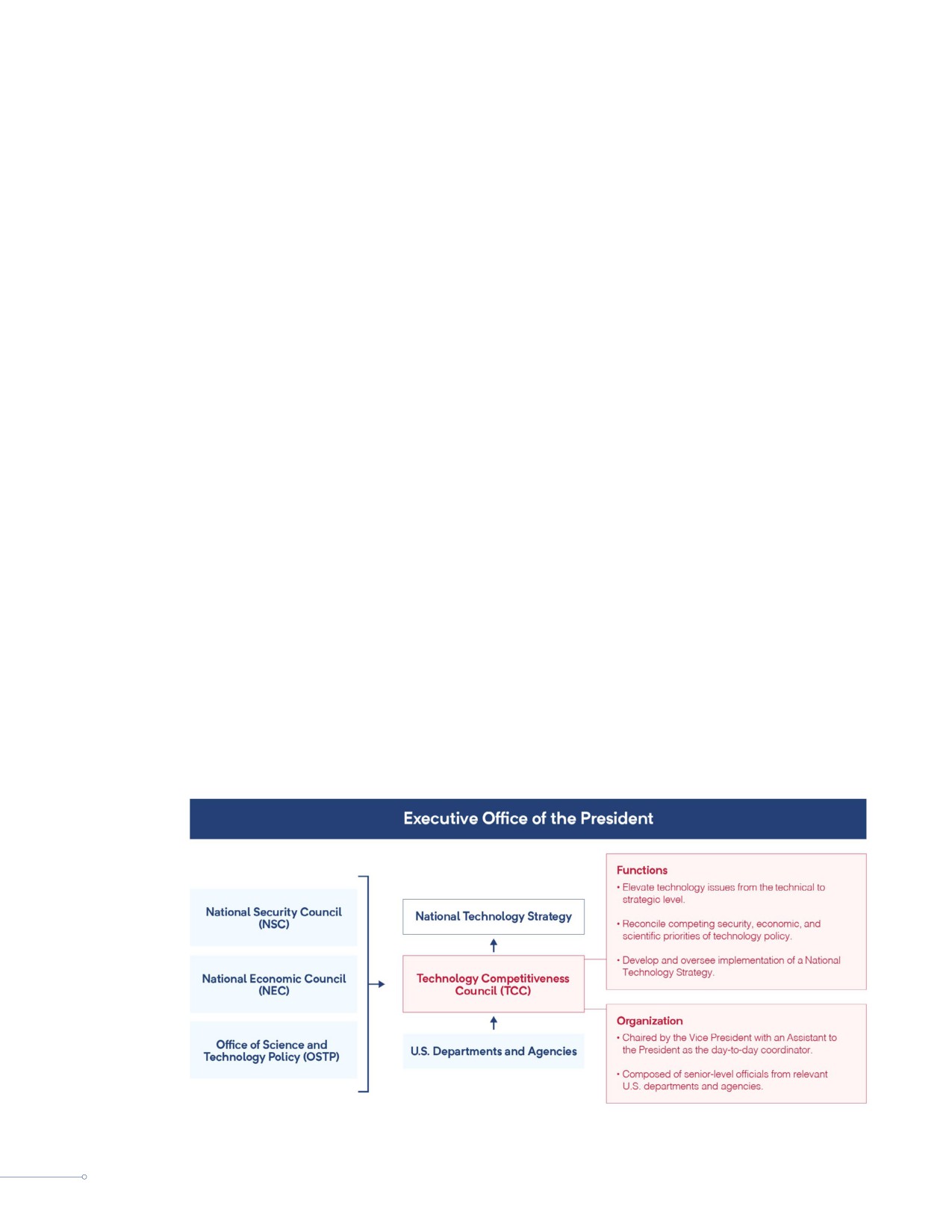
CHAPTER 9
partners to support democratic norms. Some elements of a national strategy will need
to be coordinated and replicated at the state level, through state-specific strategies to
support AI research, commerce, and education. This will require a complex sequencing
of promotion and protection actions to minimize costs and risks of punitive actions; ensure
basic and applied research agendas are mutually reinforcing; coordinate approaches with
international partners; and align executive priorities with legislative powers. It will require
identifying technology trends and assessing the relative strengths of the United States and
its competitors. It will require, above all, strong and consistent White House leadership.
The Case for White House Leadership.
The government will require a center of power that can exert gravitational pull on domestic
economic, national security, and science and technology policies. We have no such
organization today. Several separate Executive Office of the President (EOP) entities
possess some responsibility and capacity to fulfill the basic organizational requirements:
the National Security Council (NSC),26 the Office of Science and Technology Policy (OSTP)
27 and its associated National Science and Technology Council (NSTC),28 and the National
Economic Council (NEC).29 The Domestic Policy Council (DPC) also has critical related
responsibilities and a similar mandate with leadership in the realm of immigration policy,
education policy, and regulatory policy.30 An additional entity—the Office of Management
and Budget (OMB)—oversees related budgets and government reform efforts.
In the absence of an overarching structure, it is left to the President and Vice President
to identify, adjudicate, and reconcile the positions that emerge from parallel interagency
processes, while leaving endless room for gadflies to run the gaps and influence the
President. The President needs a tool to help decide and drive a new technology strategy
down through the necessary but not sufficient existing councils and into the rest of the
government. The White House should:
Technology
Competitive
Council.
p
165
A STRATEGY FOR COMPETITION AND COOPERATION
“The government will require
a center of power that can
exert gravitational pull on
domestic economic, national
security, and science and
technology policies. We have
no such organization today.”
Create a Technology Competitiveness Council. The United States must strengthen executive
Recommendation
leadership in technology policy in the White House by empowering a single entity to
implement a comprehensive technology strategy. The Commission proposes creating a new
Technology Competitiveness Council (TCC), which would include the same amalgamation
of EOP leaders and Cabinet secretaries as other White House forums for convening the
interagency, and be chaired by the Vice President with a newly appointed Assistant to
the President for Technology Competitiveness serving as the day-to-day leader. The TCC
would ensure that the gaps between NEC, OSTP, and NSC responsibilities are filled and
linked to OMB. It would not replace the NSC, NEC, or OSTP-led NSTC structures, but would
provide a forum for reconciling competing security, economic, and scientific priorities and
elevate technology policy and concerns from a technical to a strategic level. To coordinate
the council’s work, it is necessary to create a new principal, the Assistant to the President
for Technology Competitiveness, responsible for ensuring policies pertaining to emerging
technologies receive sufficient Presidential-level attention.
Develop a National Technology Strategy. The TCC should create a National Technology
Recommendation
Strategy, building on the elements we present here, which can guide U.S. policy across all
key emerging technologies starting with AI. The goal of the National Technology Strategy
should be to ensure long-term, overall U.S. leadership in technology, particularly emerging
technologies critical to national security and competitiveness. The strategy should weigh
the difficult tradeoffs between competing policy interests and priorities, identify critical
technologies where competitors have sought to match or overtake U.S. leadership, and
facilitate an integrated policy approach to emerging technologies. As a starting point,
the strategy should build on the following pillars: 1) winning the AI talent competition; 2)
promoting American AI innovation; 3) protecting U.S. AI advantages; and 4) leading a
favorable international AI order.
p
166
CHAPTER 9
Establish a high-level U.S.-China Comprehensive Science & Technology dialogue. The United
Recommendation
States should establish a regular, high-level diplomatic dialogue with China that benefits the
American people, remains faithful to our allies, and presses China to abide by international
norms. The dialogue should focus on challenges presented by emerging technologies—to
include AI, biotechnology, and other technologies as agreed by both sides. The dialogue
should have two overarching objectives:
• Identify targeted areas of cooperation on emerging technologies to solve global
challenges such as climate change and natural disaster relief; and
• Provide a forum to air a discrete set of concerns around specific uses of emerging
technologies while building relationships and establishing processes between the two
nations.
p
167
A STRATEGY FOR COMPETITION AND COOPERATION
Chapter 9 - Endnotes
1 While the U.S. government has released a number of documents emphasizing the importance
of AI research and development—see, for example, President Trump’s executive order on AI—the
U.S. lacks a comprehensive, whole-of-government plan to guide policymakers, researchers, and
businesses toward a more secure U.S. future. Artificial Intelligence for the American People, The
White House (last accessed Jan. 28, 2021), https://trumpwhitehouse.archives.gov/ai/.
2 See, e.g., Alexandra Mousavizadeh, et al., The Global AI Index, Tortoise Media (Dec. 3, 2019),
https://www.tortoisemedia.com/2019/12/03/global-ai-index/; Jean François Gagné, et al., Global AI
Talent Report 2020 (last accessed Dec. 29, 2020), https://jfgagne.ai/global-ai-talent-report-2020/;
digital-projects/the-global-ai-talent-tracker/; Jeffrey Ding, et al., MERICS Web Seminar: China as an
AI Superpower? Quantifying China’s AI Progress Against the US and Europe, MERICS (July 1, 2020),
against-us-and-europe.
3 Audrey Cher, ‘Superpower Marathon’: U.S. May Lead China in Tech Right Now—But Beijing Has the
beijing-has-strength-to-catch-up-with-us-lead.html; Graham Allison & Eric Schmidt, Is China Beating
the U.S. to AI Supremacy?, Belfer Center for Science and International Affairs (Aug. 2020), https://
www.belfercenter.org/publication/china-beating-us-ai-supremacy; Will Knight, China May Overtake
the US with the Best AI Research in Just Two Years, MIT Technology Review (March 13, 2019),
research-in-just-two-years/.
4 Karen Hao, Three Charts Show How China’s AI Industry Is Propped Up by Three Companies, MIT
Technology Review (Jan. 22, 2019), https://www.technologyreview.com/2019/01/22/137760/the-future-
of-chinas-ai-industry-is-in-the-hands-of-just-three-companies/.
5 James Kynge & Nian Liu, From AI to Facial Recognition: How China Is Setting the Rules in New Tech,
Financial Times (Oct. 7, 2020), https://www.ft.com/content/188d86df-6e82-47eb-a134-2e1e45c777b6.
6 Yusho Chao, Chinese Venture Capitalists Take a Shine to Startups Again, Nikkei (Sept. 13, 2020),
https://asia.nikkei.com/Business/Finance/Chinese-venture-capitalists-take-a-shine-to-startups-again.
See also, Visualizing Chinese Tech Giants Billion-dollar Acquisitions, CB Insights (May 28, 2020),
https://www.cbinsights.com/research/bat-billion-dollar-acquisitions-infographic/.
7 See, e.g., A Chinese Tech Giant Is Setting Up an A.I. Research Lab on Amazon’s Home Turf, CNBC
(May 2, 2017), https://www.cnbc.com/2017/05/02/tencent-ai-research-lab-seattle.html.
8 See, e.g., Saheli Roy Choudhury, Alibaba Sets Up Joint A.I. Research Center Outside China to Focus
lab-in-singapore.html.
9 In 2019, China had the largest number of submitted and accepted papers to the Association for
the Advancement of AI (AAAI), one of the longest-running AI conferences. See Artificial Intelligence
Index: 2019 Annual Report, Stanford Institute for Human-Centered AI at 41 (2019), https://hai.stanford.
edu/sites/default/files/ai_index_2019_report.pdf. The Allen Institute for AI also predicts that China is
poised to overtake the U.S. in the share of top-cited, breakthrough papers in AI by 2025. See Field
Cady & Oren Etzioni, China May Overtake US in AI Research, Allen Institute for Artificial Intelligence
(March 13, 2019), https://medium.com/ai2-blog/china-to-overtake-us-in-ai-research-8b6b1fe30595.
10 For a selection of such strategic documents, see AI Policy—China, Future of Life Institute (last
accessed Dec. 30, 2020), https://futureoflife.org/ai-policy-china/; Graham Webster, et al., Full
Translation: China’s ‘New Generation Artificial Intelligence Development Plan,’ New America (Aug. 1,
2017), https://www.newamerica.org/cybersecurity-initiative/digichina/blog/full-translation-chinas-new-
generation-artificial-intelligence-development-plan-2017/ (translating China’s State Council Notice on
the Issuance of the New Generation Artificial Intelligence Development Plan, dated July 20, 2017).
11 Gregory C. Allen, Understanding China’s AI Strategy, Center for a New American Security (Feb. 6,
2019), https://www.cnas.org/publications/reports/understanding-chinas-ai-strategy.
p
168
CHAPTER 9
Chapter 9 - Endnotes
12 Ashwin Acharya & Zachary Arnold, Chinese Public AI R&D Spending: Provisional Findings, Center
for Security and Emerging Technology (Dec. 2019), https://cset.georgetown.edu/wp-content/uploads/
Chinese-Public-AI-RD-Spending-Provisional-Findings-1.pdf; see also Emily Weinstein, Mapping
China’s Sprawling Efforts to Recruit Scientists, Defense One (Nov. 30, 2020), https://www.defenseone.
com/ideas/2020/11/mapping-chinas-sprawling-efforts-recruit-scientists/170373/; David Cyranoski,
China Joins the Battle for AI Talent, Nature (Jan. 17, 2018), https://www.nature.com/articles/d41586-
018-00604-6.
13 Id.
14 U.S.-China Economic and Security Review Commission, Hearing on Technology, Trade, and
Military-Civil Fusion: China’s Pursuit of Artificial Intelligence, New Materials, and New Energy at 46,
115-116 (June 7, 2019), https://www.uscc.gov/sites/default/files/2019 -10/June%207,%202019%20
Hearing%20Transcript.pdf.
15 U.S.-China Economic and Security Review Commission, Hearing on Technology, Trade, and
Military-Civil Fusion: China’s Pursuit of Artificial Intelligence, New Materials, and New Energy (June
7, 2019), https://www.uscc.gov/sites/default/files/2019 -10/June%207,%202019%20Hearing%20
Transcript.pdf.
16 Id.
17 As Eric Schmidt noted in Building a New Technological Relationship and Rivalry. See Hal Brands &
Francis J. Gavin, COVID-19 and World Order: The Future of Conflict, Competition, and Cooperation,
Johns Hopkins University Press at 406-418 (Aug. 31, 2020), https://muse.jhu.edu/chapter/2696578.
18 Ishan Banerjee & Matt Sheehan, America’s Got AI Talent: US’ Big Lead in AI Research Is Built on
big-lead-in-ai-research-is-built-on-importing-researchers/?rp=m.
19 U.S. Dependence on China’s Rare Earth: Trade War Vulnerability, Reuters (June 27, 2019), https://
earth-trade-war-vulnerability-idUSKCN1TS3AQ.
files/member_survey_2019_-_en_0.pdf.
21 For instance, adjusted for inflation, the Manhattan Project cost an estimated $27 billion and the
Apollo program totaled roughly $121 billion. Deborah Stine, The Manhattan Project, the Apollo
Program, and Federal Energy Technology R&D Programs: A Comparative Analysis, Congressional
dollars was calculated using the U.S. Bureau of Labor Statistics’ CPI Inflation Calculator, available at
p
169
A STRATEGY FOR COMPETITION AND COOPERATION
22 In 2018, U.S. federal R&D funding amounted to 0.7% of GDP, down from its peak at above 2% in
the 1970s. See James Manyika & William H. McRaven, Innovation and National Security: Keeping
recommendations/.
23 Zolan Kanno-Youngs & Miriam Jordan, Trump Moves to Tighten Visa Access for High-Skilled Foreign
foreign-workers-trump.html.
24 Moriah Balingit & Andrew Van Dam, U.S. Students Continue to Lag Behind Peers in East Asia
and-europe-in-reading-math-and-science-exams-show/2019/12/02/e9e3b37c-153d-11ea-9110-
3b34ce1d92b1_story.html.
25 Alina Polyakova & Chris Meserole, Exporting Digital Authoritarianism, Brookings (Aug. 2019), https://
www.brookings.edu/research/exporting-digital-authoritarianism/.
26 The National Security Council has a statutory mandate to “advise the President with respect to the
integration of domestic, foreign, and military policies relating to the national security so as to enable
the Armed Forces and the other departments and agencies of the United States Government to
cooperate more effectively in matters involving the national security.” 50 U.S.C. § 3021(b)(1).
27 See Pub. L. 94-282, National Science and Technology Policy, Organization, and Priorities Act of
1976, 90 Stat. 459 (1976), https://obamawhitehouse.archives.gov/sites/default/files/microsites/ostp/
ostp_organic_statute.pdf.
28 The function of the NSTC under the supervision of the Director of OSTP is: “(1) to coordinate
the science and technology policy-making process; (2) to ensure science and technology policy
decisions and programs are consistent with the President’s stated goals; (3) to help integrate the
President’s science and technology policy agenda across the Federal Government; (4) to ensure
science and technology are considered in development and implementation of Federal policies and
programs; and (5) to further international cooperation in science and technology. The Assistant may
take such actions, including drafting a Charter, as may be necessary or appropriate to implement
such functions.” William J. Clinton, Executive Order 12881: Establishment of the National Science and
WCPD-1993-11-29-Pg2450.pdf.
29 William J. Clinton, Executive Order 12835: Establishment of the National Economic Council (Jan. 25,
1993), https://www.govinfo.gov/content/pkg/WCPD-1993-02-01/pdf/WCPD-1993-02-01-Pg95.pdf.
30 William J. Clinton, Executive Order 12859: Establishment of the Domestic Policy Council (Aug. 16,
1993), https://www.archives.gov/files/federal-register/executive-orders/pdf/12859.pdf.
p
170
CHAPTER 10
Chapter 10:
The Talent
Competition
p
171

THE TALENT COMPETITION
Winning the AI Talent Competition
NDEA II With
Attract and
a Focus on
Retain the
Digital Skills
World’s Brightest
p
172
CHAPTER 10
The United States is in a global competition for scarce AI talent.1
The Commission is very concerned with current talent trends. The
number of domestic-born students participating in AI doctorate
programs has not increased since 1990, and competition for
international students has accelerated, endangering the United
States’ ability to retain international students.2 For the first time
in our lifetime, the United States risks losing the competition for
talent on the scientific frontiers. Cultivating more potential talent at
home and recruiting and retaining more existing talent from foreign
countries are the only two options to sustain the U.S. lead.
“For the first time in our lifetime,
the United States risks losing
the competition for talent on the
scientific frontiers.”
Competitors and allies recognize the importance of implementing AI talent strategies.
Between 2000 and 2014, China’s university system increased its number of science,
technology, engineering, and mathematics (STEM) graduates by 360%, producing 1.7
million in 2014 alone.3 The number of STEM graduates in the United States’ university
system rose by 54% during the same time period, and many were international students.4
China’s researchers now represent roughly 29% of top-tier deep learning talent in the
world.5 China and other states have also taken steps to attract international talent with
flexible immigration policies and incentives for tech talent.6
The United States needs to invest in all AI talent pipelines in order to remain at the forefront
of AI now and into the future. A passive strategy will not work in the face of the AI talent
competition.
p
173

THE TALENT COMPETITION
To achieve dominance in AI, the U.S. needs to train four archetypes to propel AI in
America: researchers, implementers, end users, and informed consumers.
Researchers
AI research engineers will focus on R&D of technologies that enable and
advance semi- and fully-autonomous systems. They serve as algorithm experts
with up-to-date knowledge of modern AI research and may be involved in the
inception of ideas and drive the development cycles from research to testing of
prototypes for a major project or component of a major project.
Implementers
They will be responsible for data cleaning, feature extraction and selection,
and analysis; model training and tuning; partnerships with domain knowledge
experts and end users; and the discovery of local opportunities for exploitation.
Developers require less training and education than AI experts, and will have
training, education, and/or experience that is roughly equivalent to an associate
or bachelor’s degree; and that includes relevant ethics and bias mitigation in
data processing and model training.
End Users
They will have their daily business augmented/enabled by AI. Use of AI will
strongly resemble the use of currently available software in that it will require
some system-specific training, but, with the exception of some positions that
manage data, little to no AI specific expertise.
Informed Consumers
This group of people needs the ability to make better consumer choices when
purchasing technology and understand the importance of their actions in the market.
The Promise and Limits of Expanding STEM.
Investments in STEM education are a necessary part of increasing American national
power and improving national security. The United States ranks well overall on international
measures of talent because of our ability to attract international talent, in spite of our
uneven kindergarten to 12th grade (K-12) education system.7 It is critical that the United
States invest significantly in STEM education as an engine to drive the growth of AI talent in
America. Investments in STEM education alone, however, will not be enough for the United
States to win the international competition for AI and STEM talent. China is producing
large numbers of computer scientists, engineers, and other STEM graduates.8 For the
foreseeable future, the United States’ STEM education system does not have the capacity
nor the quality to produce sufficient STEM or AI talent to supply the United States’ markets
or national security enterprise.9 To compete, the United States must reform its education
system to produce both a higher quality and quantity of graduates.
p
174
CHAPTER 10
Pass a National Defense Education Act II. Motivated by fear that America had fallen behind
Recommendation
in education and innovation after the Soviets launched Sputnik in 1957, Congress passed
the National Defense Education Act (NDEA) the following year. The NDEA promoted the
importance of science, mathematics, and foreign languages for students, authorizing more
than $1 billion toward decreasing student loans, funding for education at all levels, and
funding for graduate fellowships. Many students were able to attend college because of
this legislation. In 1960, 3.6 million students attended college; by 1970 it was 7.5 million.10
This act helped America win the Space Race, helped power the microelectronics industry,
accelerated the U.S. capacity to innovate, and, ultimately, played an important role in
America’s victory in the Cold War.
The Commission believes the time is right for a second NDEA, one that mirrors the first
legislation, but with important distinctions. NDEA II would focus on funding students
acquiring digital skills, like mathematics, computer science, information science,
data science, and statistics. NDEA II should include K-12 education and reskilling
programs that address deficiencies across the spectrum of the American educational
system, purposefully targeting under-resourced school districts. The Commission also
recommends investments in university-level STEM programs with 25,000 undergraduate,
5,000 graduate, and 500 PhD-level scholarships. Undergraduate scholarships should
include credit hours at community colleges to ensure more Americans have access to
affordable STEM education. Ultimately, the goal of NDEA II is to widen the digital talent
pool by incentivizing programs for underrepresented Americans.
“The Commission believes the
time is right for a second NDEA ...”
Strengthen AI talent through immigration. Immigration reform is a national security imperative.
Recommendation
Nations that can successfully attract and retain highly skilled individuals gain strategic
and economic advantages over competitors. Human capital advantages are particularly
significant in the field of AI, where demand for talent far exceeds supply.11 Highly skilled
immigrants accelerate American innovation, improve entrepreneurship, and create jobs.12
The United States benefits far more from the immigration of highly skilled foreign workers
than other countries. In 2013, the United States had 15 times as many immigrant inventors
as there were American inventors living abroad.13 By contrast, Canada, Germany, and
the U.K. all maintain a net negative inventor immigration rate.14 Compared with other U.S.
advantages in the AI competition—such as financial resources or hardware capacity—this
immigration advantage is harder for other countries to replicate.
p
175
THE TALENT COMPETITION
“Nations that can successfully
attract and retain highly
skilled individuals gain strategic
and economic advantages
over competitors.”
Unfortunately, international students in the United States are increasingly choosing to
study in other countries or return home.15 One reason is the growing backlog of green card
petitions.16 Indian immigrants face a particularly long wait. Many will spend decades on
constrictive work visas waiting to receive their green cards, hindering both the technology
sector’s ability to recruit talent and Indian immigrants’ quality of life. At the same time, other
countries are increasing their efforts to attract and retain AI talent, including immigrants in
Silicon Valley.17
“Restrictions harm U.S. innovation
and economic growth and only
help our competitors by enabling
their human capital to grow. They
also incentivize U.S. technology
companies to move to where
talent resides, whether right
across our borders or overseas.”
p
176
CHAPTER 10
While immigration benefits the United States, policymakers must also bear in mind the
threat of unwanted technology transfer. However, restricting immigration is far too blunt a
tool to solve this problem.18 Restrictions harm U.S. innovation and economic growth and
only help our competitors by enabling their human capital to grow. They also incentivize
U.S. technology companies to move to where talent resides, whether right across our
borders or overseas.19 Technology transfer will only get worse if significant components
of the U.S. technology sector move their research and development to China or other
countries that are more vulnerable than the United States to technology transfer efforts.20
A more effective strategic approach would pair actions to improve the United States’ ability
to attract top global talent with targeted efforts to combat technology transfer vectors.
NSCAI addresses technology transfer in detail in Chapter 14 of this report. Changes to
immigration policies should be paired with those recommendations.
Immigration policy can also slow China’s progress. China’s government takes the threat of
brain drain seriously, noting that the United States’ ability to attract and retain China’s talent
is an obstacle to the Chinese Communist Party’s (CCP) ambitions.21 Increasing China’s
brain drain will create a dilemma for the CCP—which will be forced to choose between
losing even more human capital, further slowing their economic growth and threatening
their advancement in AI, or denying Chinese nationals opportunities to study and work in
the United States. At the same time, the United States should be cautious about potential
adverse effects on talent pools in partner nations.
“Increasing China’s brain drain will
create a dilemma for the CCP ...”
Recommendation
Broaden the scope of “extraordinary” talent to make the O-1 visa more accessible and
emphasize AI talent. The O-1 temporary worker visa is for people with extraordinary ability
or achievement. Currently adjudicators determine an applicant’s eligibility through a
subjective assessment. For the sciences and technology, this aligns largely with academic
criteria such as publications in major outlets and is not well suited for people who excel in
industry.
Recommendation
Implement and advertise the international entrepreneur rule. The International Entrepreneur
Rule (IER) allows U.S. Citizenship and Immigration Services (USCIS) to grant a period
of authorized stay to international entrepreneurs who demonstrate that “their stay in the
United States would provide a significant public benefit through their business venture.”22
An executive action could announce the administration’s intention to use the IER to boost
immigrant entrepreneurship, job creation for Americans, and economic growth. USCIS
p
177
THE TALENT COMPETITION
could also be directed to announce that it will give priority to entrepreneurs active in
high-priority STEM fields such as AI, or in fields that use AI for other applications, such
as agriculture. Entrepreneurs’ ability to attract investors should be used as a screening
criterion for entrepreneurs.
Expand and clarify job portability for highly skilled workers. The criteria for workers with H-1B,
Recommendation
O-1, and other temporary work visas to obtain open market work permits for a one-year
renewable period are too limited and ambiguous. Changes should clarify when highly
skilled, nonimmigrant workers are permitted to change jobs or employers, increase job
flexibility when an employer either withdraws their petition or goes out of business, and
increase flexibility for H-1B workers seeking other H-1B employment.
Recapture green cards lost to bureaucratic error. Federal agencies generally issue fewer green
Recommendation
cards than they are allowed. As of 2009, the federal government had failed to issue more
than 326,000 green cards based on cumulative bureaucratic error.23 The Departments of
State and Homeland Security (DHS) should publish an up-to-date report on the number of
green cards lost due to bureaucratic error. Using available authorities, both should grant
lost green cards to applicants waiting in line. Congress should support the Departments of
State and Homeland Security by passing legislation to recapture lost green cards.24
Grant green cards to students graduating with STEM PhDs from accredited American universities.
Recommendation
Congress should amend the Immigration and Nationality Act25 to grant lawful permanent
residence to any vetted (not posing a national security risk) foreign national who graduates
from an accredited United States institution of higher education with a doctoral degree in
a STEM-related field in a residential or mixed residential and distance program and has
a job offer in a field related to science, technology, engineering, or mathematics. They
should not be counted toward permanent residency caps.
Double the number of employment-based green cards. Under the current system,
Recommendation
employment-based green cards are unduly scarce: 140,000 per year, fewer than half of
which go to the principal worker.26 This leaves many highly skilled workers unable to gain
permanent residency and unable to transfer jobs or negotiate with employers as effectively
as domestic workers. This decreases the appeal of joining the American workforce. To
reduce the backlog of highly skilled workers, the United States should double the number
of employment-based green cards, with an emphasis on permanent residency for STEM
and AI-related fields.
Create an entrepreneur visa. International doctoral students are more likely than their native
Recommendation
peers to want to found a company or become an employee at a startup, but they are less
likely to pursue those paths.27 One reason is the constraints of the H-1B visa system.28
Similarly, immigrant entrepreneurs without the capital to use the EB-5 route to permanent
residency are forced to use other visas that are designed for academics and workers
in existing companies, not entrepreneurs.29 All of these issues make the United States
p
178
CHAPTER 10
less attractive for international talent, and, perhaps as important, reduce the ability of
startups and other small companies—the main source of new jobs for Americans—to hire
highly skilled immigrants, who have been shown to improve the odds that the business
will succeed. Congress should create an entrepreneur visa for those who would provide
a “significant public benefit” to the United States if allowed to stay in the country for a
limited trial period to grow their companies.30 This visa should serve as an alternative
to employee-sponsored, investor, or student visas and should instead target promising
potential founders.
Create an emerging and disruptive technology visa. The National Science Foundation (NSF)
Recommendation
should identify critical emerging technologies every three years. DHS would then allow
students, researchers, entrepreneurs, and technologists in applicable fields to apply for
emerging and disruptive technology visas. This would provide much-needed talent R&D
and strengthen our economy.31
p
179
THE TALENT COMPETITION
Chapter 10 - Endnotes
1 Estimates on the gap of talent necessary to fill AI slots vary greatly, but it is agreed upon that the
gap in talent currently is and will continue to be significant as nations compete for scarce resources.
See Remco Zwetsloot, et al., Strengthening the U.S. AI Workforce: A Policy and Research Agenda,
Center for Security and Emerging Technology at 2 (Sept. 2019), https://cset.georgetown.edu/wp-
content/uploads/CSET-Strengthening-the-U.S.-AI-Workforce.pdf (“The Research Institute at Tencent,
a major Chinese technology company, asserts there are roughly 300,000 AI researchers and
practitioners worldwide, with market demand for millions of roles. Element AI, a leading Canadian
AI company, estimated in 2018 that there are roughly 22,000 PhD-educated researchers globally
who are able to work on AI research, with only about 25 percent of those ‘well-versed enough in the
technology to work with teams to take it from research to application.’ AI firm Diffbot estimates that
there are over 700,000 people skilled in machine learning worldwide.”).
2 Remco Zwetsloot, et al., Keeping Top AI Talent in the United States, Center for Security and
Emerging Technology at iii-vi (Dec. 2019), https://cset.georgetown.edu/wp-content/uploads/Keeping-
Top-AI-Talent-in-the-United-States.pdf.
gov/nsb/sei/one-pagers/China-2018.pdf (China also passed the United States in the global share of
peer-reviewed S&E articles).
statistics/2018/nsb20181/assets/561/higher-education-in-science-and-engineering.pdf.
5 For these purposes “top tier” talent was defined by accepted papers at the prestigious AI deep
learning conference Neural Information Processing Systems in 2019. This reflected approximately the
top 20% of researchers in the field. The Global AI Talent Tracker, MacroPolo (last accessed Dec. 28,
2020), https://macropolo.org/digital-projects/the-global-ai-talent-tracker/. China has placed a strong
emphasis on deep learning, just one of the important components of AI.
6 For example, China’s Thousand Talents Plan is part of a state-organized blueprint to be a global
leader in science and technology by 2050. Staff Report, Threats to the U.S. Research Enterprise:
China’s Talent Recruitment Plans, U.S. Senate Permanent Subcommittee on Investigations at 14 (Nov.
China’s%20Talent%20Recruitment%20Plans.pdf.
digital-projects/the-global-ai-talent-tracker/. See also Gordon Hanson & Matthew Slaughter, High-
Skilled Immigration and the Rise of STEM Occupations in U.S. Employment, National Bureau of
Economic Research at 1 (Sept. 2016), https://www.nber.org/system/files/working_papers/w22623/
w22623.pdf.
gov/nsb/sei/one-pagers/China-2018.pdf.
9 As noted in Chapter 6 of this report, there were 433,116 open computer science jobs in the United
States in 2019, while only 71,226 new computer scientists graduated from American universities in
2019. Code.org (last accessed Jan. 11, 2021), https://code.org/promote. See also Oren Etzioni, What
Trump’s Executive Order on AI Is Missing: America Needs a Special Visa Program Aimed at Attracting
executive-order-on-ai-is-missing/.
10 Sputnik Spurs Passage of the National Defense Education Act, U.S. Senate (last accessed Dec. 28,
Defense_Education_Act.htm#:~:text=The%20National%20Defense%20Education%20Act%20of%20
1958%20became%20one%20of,and%20private%20colleges%20and%20universities.
11 According to one report, job listings for AI on one popular job website “increased more than five-
fold between 2015 and 2017 and demand for ‘deep learning’ skills increased by a factor of more than
30,” while the number of people looking for jobs in the field grew much more slowly. This mismatch is
slowing the adoption of AI. Most firms report that skills gaps are one of the top obstacles preventing
them from adopting AI. Remco Zwetsloot, et al., Strengthening the U.S. AI Workforce: A Policy and
georgetown.edu/wp-content/uploads/CSET-Strengthening-the-U.S.-AI-Workforce.pdf.
p
180