National Security Commission on Artificial Intelligence. Final Report - page 2
CHAPTER 2
The U.S. military has enjoyed military-technical superiority over all
potential adversaries since the end of the Cold War. Now, its technical
prowess is being challenged, especially by China and Russia. Senior
military leaders have warned that if current trend lines are not altered,
the U.S. military will lose its military-technical superiority in the coming
years.1 Artificial intelligence (AI) is a key aspect of this challenge, as
both of our great power competitors believe they will be able to offset
our military advantage using AI-enabled systems and AI-enabled
autonomy. In the coming decades, the United States will win against
technically sophisticated adversaries only if it accelerates adoption of
AI-enabled sensors and systems for command and control, weapons,
and logistics.
The Department of Defense (DoD) must set an ambitious goal. By 2025, the foundations
for widespread integration of AI across DoD must be in place. Those foundations include a
common digital infrastructure that is accessible to internal AI development teams and critical
industry partners alike, a digitally literate workforce, and modern AI-enabled business practices
that improve efficiency. All are prerequisites to achieving a state of military AI readiness, which
is discussed in Chapter 3 of this report.
“By 2025, the foundations for
widespread integration of AI
across DoD must be in place.”
DoD lags far behind the commercial sector in integrating new and disruptive technologies such
as AI into its operations. Pockets of excellence started to emerge in 2017 when Project Maven
was launched with the aim to simplify work for intelligence analysts by recognizing objects
in video footage captured by drones and other platforms.2 Other promising initiatives are
occurring in defense labs and agencies, and proof-of-concept demonstrations are ongoing in
service-level tests.3 However, visionary technologists and warfighters largely remain stymied
by antiquated technology, cumbersome processes, and incentive structures that are designed
for outdated or competing aims.4 Successes are usually based on workarounds--in spite of
the system.
p
61
FOUNDATIONS OF FUTURE DEFENSE
“... visionary technologists
and warfighters largely
remain stymied by antiquated
technology, cumbersome
processes, and incentive
structures that are designed for
outdated or competing aims.”
The obstacles to integrating AI are many. DoD has long been hardware-oriented toward ships,
planes, and tanks. It is now trying to make the leap to a software-intensive enterprise. Spending
remains concentrated on legacy systems designed for the industrial age and Cold War.5 Many
Departmental processes still rely too much on PowerPoint and manually driven work streams.
The data that is needed to fuel machine learning (ML) is currently stovepiped, messy, or often
discarded. Platforms are disconnected. Acquisition, development, and fielding practices
largely follow rigid, sequential processes, inhibiting early and continuous experimentation and
testing critical for AI. Even promising AI programs have not yet delivered as hoped and often
remain bound to proprietary software and data storage of commercial vendors. Steps such
as building the cloud infrastructure necessary to scale AI applications proceed slowly. Data-
sharing agreements and software updates that take hours or days in industry turn into months-
long delays. Service members at every level lack the technical education and experience to
employ AI.
Meanwhile, bureaucracy hinders partnerships with technology firms and critical efforts to
expand the National Security Innovation Base.6 The prospect of bureaucratic snarls deters
companies from working with DoD; it is economically irrational for many startups to even try.
Traditional defense companies will continue to play a central role in building and integrating large
systems for AI-enabled warfare.7 However, even these contractors, who have the resources and
expertise to navigate the system, face process and technical roadblocks that slow efforts to
build and integrate AI systems.
As a result, change will not be easy. It will require a Secretary of Defense who focuses the
Department on speeding the adoption of new technologies, and a dedicated Steering
Committee on Emerging Technology to drive implementation and align priorities between the
DoD and the Intelligence Community. The Secretary should direct action in five areas:
p
62

CHAPTER 2
Recommendation
1. Build the technical backbone. DoD should make foundational investments to support a
Department-wide technical infrastructure for ubiquitous development and fielding of AI. It took a
promising first step in 2020 with the issuance of a DoD Data Strategy.8 However, the Department
lacks the modern digital ecosystem, collaborative tools and environments, and broad on-
demand access to shared AI resources that it needs to integrate AI across the organization.9
The Department should avoid reinventing core infrastructure for each new AI-driven program
or capability, and it should look to leverage and interoperate with proven solutions from the
Intelligence Community (IC) wherever possible. A broader platform that could be used across
the Department would enable more dynamic development and employment of AI and would
more efficiently utilize scarce technical expertise.10
Common
The Secretary of Defense should direct
Interfaces
the establishment of a DoD-wide digital
AI Digital
Ecosystem.
ecosystem. The Secretary should require
USERS
that all new joint and service programs
adhere to the design of this ecosystem and
APPLICATIONS
that, wherever possible, existing programs
become interoperable with it by 2025.11 Key
PLATFORM ENVIRONMENTS
elements should include:
• Data architecture composed of a secure,
SOFTWARE
federated system of distributed repositories
linked by a data catalog and appropriate
access controls12 that facilitates finding,
DATA
accessing, and moving desired data across
the DoD.13
• Packaged AI environments14 that
HARDWARE
enable agile and iterative AI capabilities
development,15 testing, fielding, and updating
in support of a diverse set of stakeholders.16
•
A marketplace of shared AI resources17 that builds upon federated repositories of data,
sofware, and trained models,18 along with pre-negotiated computing and storage
services from a pool of vetted cloud providers.
•
A bolstered network and communications backbone to provide bandwidth to support
transport and data fusion, secure processing, continuous development and fielding of AI
applications, and sofware system integration at all levels.
•
Common interfaces that allow swif integration of mission-oriented investments.
p
63
FOUNDATIONS OF FUTURE DEFENSE
“Warfighters cannot change
the way they fight without also
changing the way they think.”
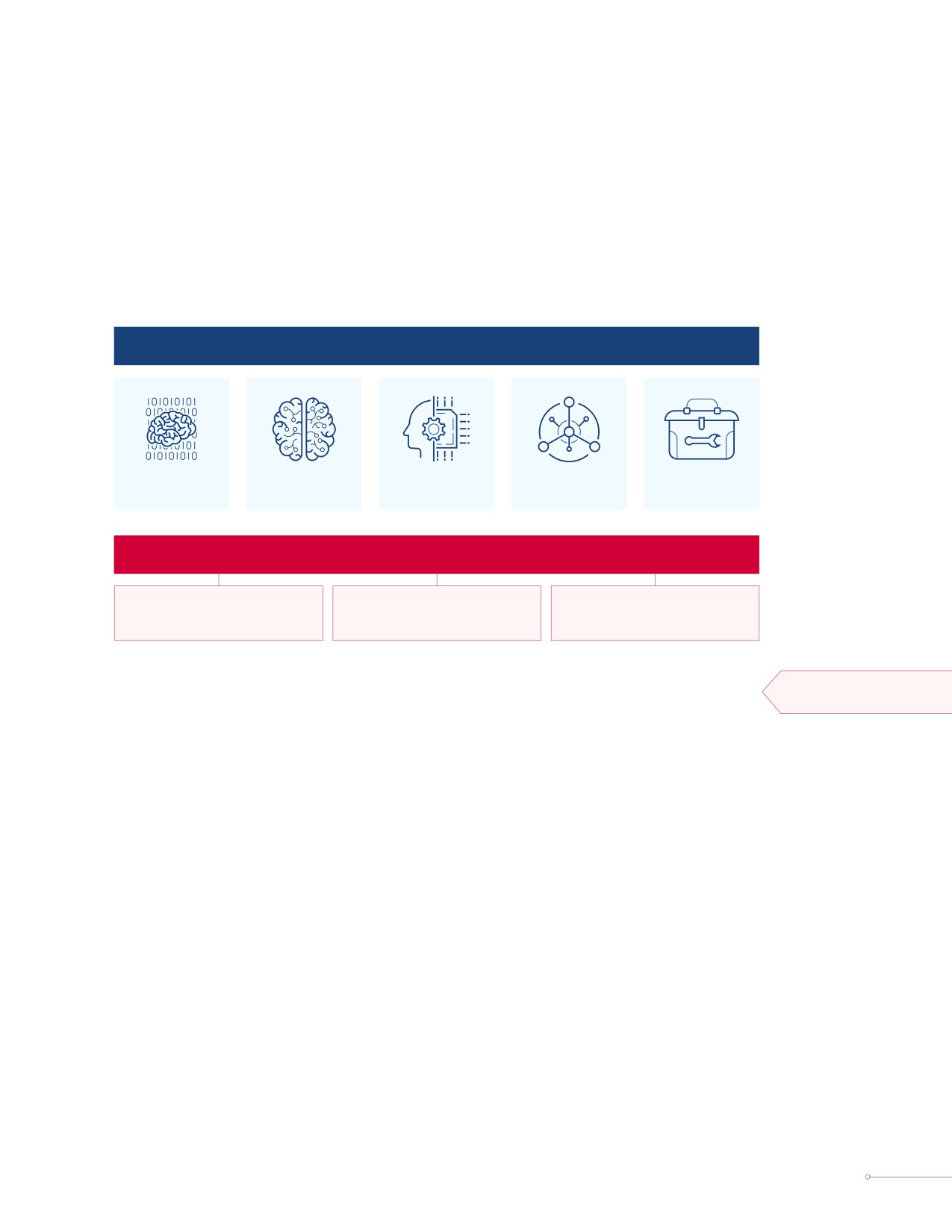
Train and Educate
Pillars
Warfighters.
Data-informed
Computational
Human-machine
Organizational
Maker
decision making
thinking
teaming
transformation
culture
Recommendations
Integrate digital skill sets and
Integrate emerging and disruptive
Create emerging and disruptive technology
computational thinking into junior military
technologies into service-level professional
coded billets in the DoD
leader education
military education
2. Train and educate warfighters. Warfighters cannot change the way they fight without also
Recommendation
changing the way they think. Most service members only use the powerful computers they
have to create PowerPoint presentations, build spreadsheets, or send emails. Our service
members need to develop core competencies in building, using, and responsibly teaming
with machine systems to recognize AI’s potential for building a faster and more effective
force. In particular, they need to know:
• How to use data in decision-making in ways that complement intuition and experience.
• How to use information processing agents and how to get a computer to perform
calculations and analytics that could not be done efficiently by a human.
• How to develop and thrive in a “maker” culture that encourages continuous contact and
regular experimentation with and development of new tools.
• How to move toward a “teammate model” for interacting with autonomous systems and
navigate issues of delegated authority, observability, predictability, directability, and
trust.
• How to bring organizations into the AI era—including when and how to integrate AI-
related tasks into priority missions, allocate resources to build and maintain the AI stack,
oversee new systems, and support the careers of technical experts.
p
64
CHAPTER 2
To improve training and education along these lines, DoD should:
• Identify service members who excel at computational thinking during the accession
process;
• Invest in upskilling its workforce through self-guided education courses and coding
language incentives;
• Teach junior leaders about problem curation, the AI lifecycle, data collection and
management, probabilistic reasoning and data visualization, and data-informed
decision-making as part of their pre-commissioning requirements and initial training;
• Integrate emerging and disruptive technology training into professional military
education courses; and
• Create emerging technology coded billets and an emerging technology certification
program comparable to the joint billet and qualification system.
3. Accelerate the adoption of existing digital technologies. DoD has largely relied on
Recommendation
workarounds to adopt new technologies, while the core acquisition processes remain sclerotic.
There are some bright spots, including the release of the Department’s tailorable acquisition
framework, contracting resources,19 and approaches taken by certain programs within the Air
Force.20 The Department must scale these innovative practices and take further steps to align
acquisition workforce training, program incentives, budget, and organizational structures to
better support the delivery of digitally enabled capabilities.
A number of the Department’s digital innovation initiatives have delivered results,21 but they
are uncoordinated and under-resourced. DoD signaling of technology priorities is ad hoc and
is not supported by a track record of significant DoD investments in digital technology with
non-traditional vendors. As a result, national security AI applications attract less private-market
investment. The Department should focus on four actions:
• Integrate commercial AI to optimize core business processes. DoD should embrace
proven commercial AI applications and incentivize their use to generate labor and
cost savings, speed administrative actions, and inform decision-making.22 As a critical
first step, DoD should prioritize construction of enterprise data sets across core
administration areas.
• Network digital innovation initiatives to scale impact. Pockets of bottom-up
innovation need to be married with top-down leadership. The Department should
harmonize its innovation initiatives to carry out a coordinated go-to-market strategy for
commercial technology solutions. The Under Secretary of Defense for Research and
Engineering, working closely with the Under Secretary of Defense for Acquisition and
Sustainment, the military services and other headquarters counterparts, should provide
strategic direction for this effort.
• Expand use of specialized acquisition pathways and contracting approaches. DoD
should accelerate efforts to train acquisition professionals on the full range of available
options for acquisition and contracting and incentivize their use for AI and digital
technologies.23
p
65
FOUNDATIONS OF FUTURE DEFENSE
• Update the budget and oversight processes. DoD’s resource allocation process is
nearly identical to what was put in place in 1961. It is incompatible with AI and other
digital technologies. DoD and Congress should institute reforms that enable the
advancement of sofware and digital technologies by accounting for speed, uncertainty,
experimentation, and continuous upgrades.
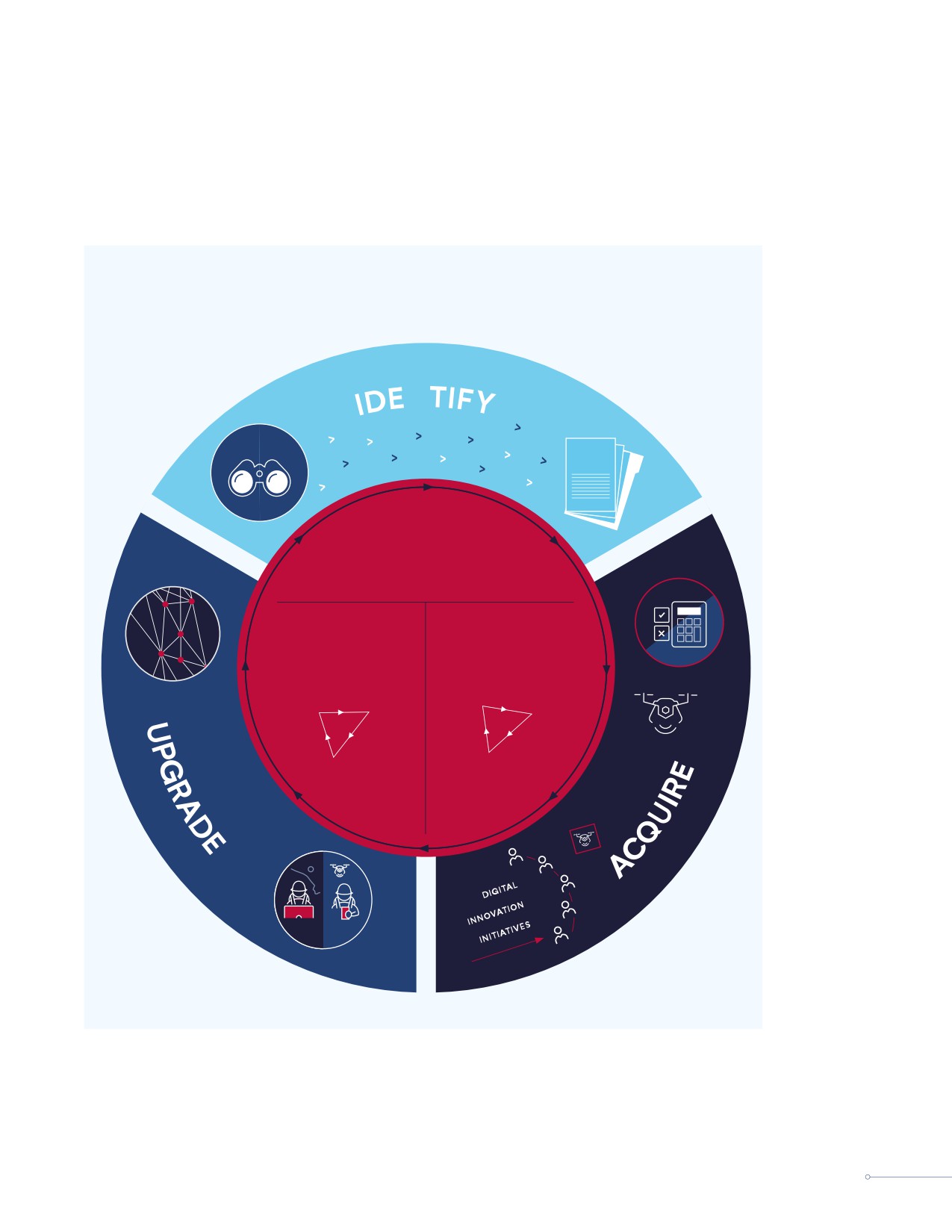
An integrated and strategic approach to technology that aligns the process, incentives, and organizational
Delivering AI at
culture of the DoD and the National Security Innovation Base as a pipeline to resource, prioritize, acquire and
Speed and Scale.
iterate capabilities critical to sustain the competitive advantage
N
SCOUT
TECH
ANNEX
RESOURCE
$
CREATE SUSTAINABLE
BUILD THE SUPPLY
FUNDING
BASE
ANALYZE
DIVEST
SIGNAL
FUND
SCALE
UPDATE
p
66
CHAPTER 2
“At every level, technologists,
operators, and domain
experts should function as
integrated teams.”
4. Democratize AI development. The Department must promote bottom-up AI
Recommendation
development.24 At every level, technologists, operators, and domain experts should
function as integrated teams.25 This would facilitate user feedback and improve trust and
confidence in AI systems. DoD should:
• Designate the Joint Artificial Intelligence Center (JAIC) as the Department’s
AI Accelerator. The JAIC cannot identify every potential use for AI in the
Department, but it can and should serve as a central hub of AI expertise. In this
“accelerator” model, JAIC would coordinate with relevant acquisition, technology,
and governance offices to inform strategy; develop AI applications that address
shared challenges at the Combatant Commands; and provide resources that enable
distributed AI development across the Department and the military services.26
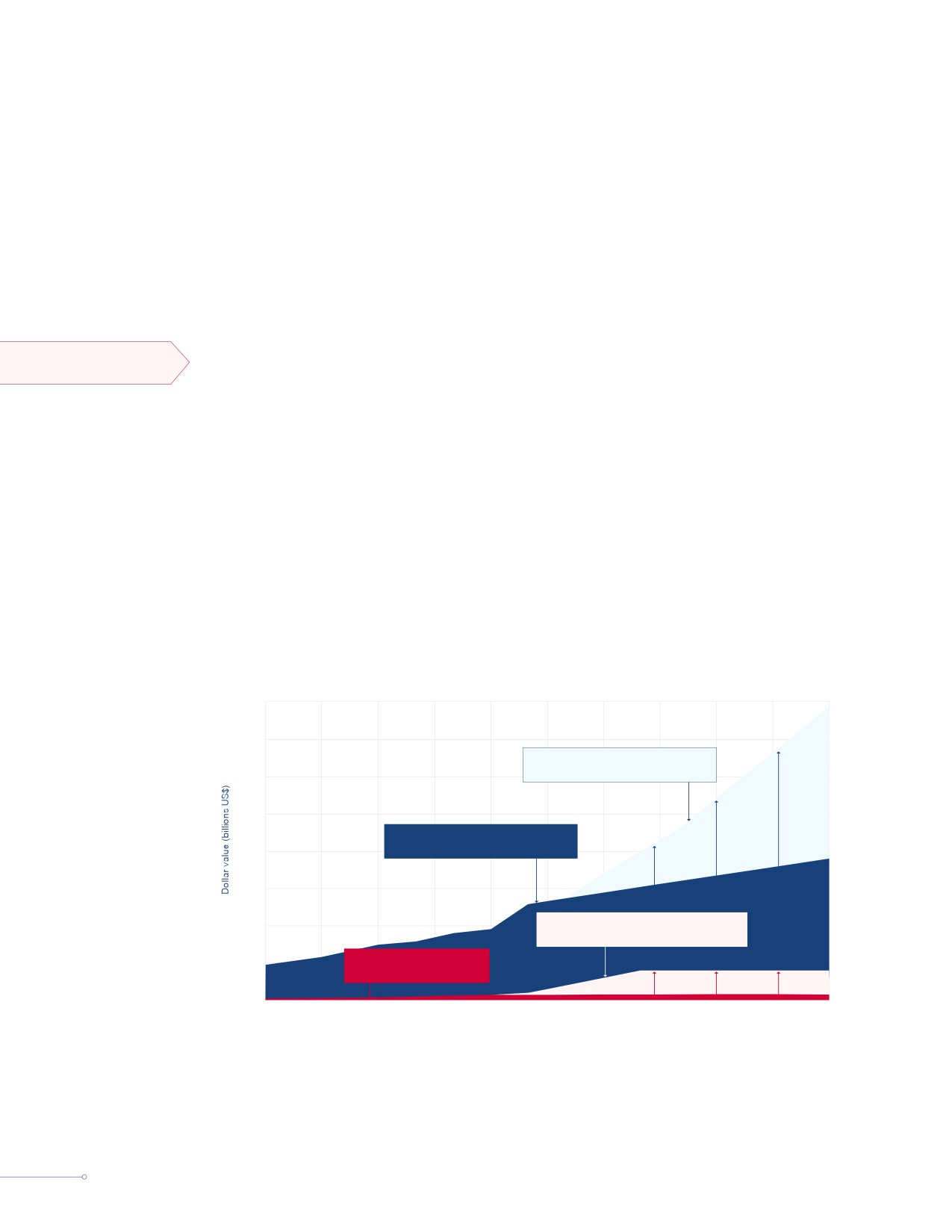
Enhanced AI R&D Investment, FY 2015-2030
Source: Govini and NSCAI
$80
Enhanced AI R&D
$70
Investment, FY
2015-2030.
Projection of spending on AI adoption with
recommended core AI spending of $8B/yr.
$60
$50
Projection of spending on AI adoption with
current core AI spending of $1.5B/yr.
$40
$30
$20
NSCAI recommendation: increase Core AI
spending from $1.5B to $8B per year by 2025.
$10
Projection of Core AI spending
under the status quo.
$0
2015
2018
2021
2024
2027
This figure illustrates the correlation between R&D investment in Core AI technologies and AI adoption
projected to the year 2030. Two scenarios are represented in this figure. In the first, the DoD maintains
its current level of investment in core AI (~1.5B/year). In the second scenario, the DoD increases its
p
67
FOUNDATIONS OF FUTURE DEFENSE
investments in core AI to $8B/year. A significant increase in core AI spending is required to drive the
rate of AI adoption higher.
NSCAI staff teamed with two external partners to analyze historical and planned DoD investments in
AI RDT&E. The source data for the analysis is DoD’s annual RDT&E budget expenditures (for FY2015
- FY 2020) and annual RDT&E budget requests (for FY2021-FY2025). For the methodology employed
and lessons learned from this work, see Analysis of DoD RDT&E Investments in AI, NSCAI (on file with
the Commission). Disclaimer: We believe this analysis yields important insights into general trends in
AI spending and solutions for better future analyses, but caution that quality issues in the source data
detailed in our on file report mean that the spending level estimates presented contain significant,
difficult to estimate margins of error.
AI-enabled programs develop (in the case of RDT&E programs) and field (in the case of procurement
programs) the gamut of DoD warfighting and business systems, incorporating Core AI applications
for analyzing, automating, communicating, maneuvering, monitoring, sensing, and many other tasks.
While AI spending is usually a small percentage of these programs, their system’s performance may be
critically dependent upon the incorporation of core AI.
AI-enabling programs include technologies such as cloud computing and advanced microelectronics
required to support the deployment of effective AI capabilities at scale.
• Establish integrated AI delivery teams at each Combatant Command. These
commands have specific operational needs that routinely outpace centralized
development. AI delivery teams should be embedded at each Combatant Command
and capable of supporting the full lifecycle of AI development and fielding, including
data science, engineering, testing, and production—leveraging common resources
through the digital ecosystem.27 Teams should include forward-deployable
components to act as the local interface with operational units.28
5. Invest in next-generation capabilities. DoD leaders anticipate flat or declining defense
Recommendation
budgets for the coming years.29 Despite potential budgetary pressures, DoD must continue
accelerating its modernization programs by prioritizing emerging and disruptive technologies
such as AI.30
• Fund AI research and development. The Department should commit to spending
at least 3.4% of its budget on science and technology and allocate at least $8 billion
toward AI R&D annually.31 Additional resources should be focused on organizations
with significant AI expertise, such as the Defense Advanced Research Projects Agency
(DARPA), the Office of Naval Research (ONR), the Air Force Office of Scientific Research
(AFOSR), the Army Research Office (ARO), and the service laboratories.
p
68
CHAPTER 2
“To make AI ubiquitous
throughout its business processes
and military systems, DoD must
make tough budget tradeoffs and
prioritize modernization.”
• Retire legacy systems ill-equipped to compete in AI-enabled warfare. To make AI
ubiquitous throughout its business processes and military systems, DoD must make
tough budget tradeoffs and prioritize modernization.32 DoD should pursue a balanced
approach to update existing systems with leading-edge technologies to buy time for
investments in longer-term bets. Further, to guard against bias in favor of defending the
status quo, DoD should require an evaluation of AI alternatives prior to funding Major
Defense Acquisition Programs (MDAP).33
• Produce a technology annex to the National Defense Strategy. To link DoD’s
technology investment strategy to future operational needs, the annex should include
roadmaps for designing, developing, fielding, and sustaining critical technologies that
are needed to address the operational challenges identified in the strategy.
p
69
FOUNDATIONS OF FUTURE DEFENSE
Chapter 2 - Endnotes
1 General Joseph Dunford, then Chairman of the Joint Chiefs of Staff, testified in 2017 that “The U.S.
military’s competitive advantage against potential adversaries is eroding […] I assess that within five
years we will lose our ability to project power; the basis of how we defend the homeland, advance
U.S. interests, and meet our alliance commitments.” Posture Statement of General Joseph Dunford,
Chairman of the Joint Chiefs of Staff before the Senate Armed Services Committee, Senate Armed
doc/Dunford_06-13-17.pdf.
2 Big Data at War: Special Operations Forces, Project Maven, and Twenty-First-Century Warfare,
Modern War Institute (Aug. 25, 2020), https://mwi.usma.edu/big-data-at-war-special-operations-
forces-project-maven-and-twenty-first-century-warfare/; Cheryl Pellerin, Project Maven to Deploy
Explore/News/Article/Article/1254719/project-maven-to-deploy-computer-algorithms-to-war-zone-by-
years-end/. Project Maven now includes detecting, classifying, and tracking objects within full motion
video images (e.g., person, vehicle, and weapon) and other AI algorithms for text-based projects. PE
0305245D8Z: Intelligence Capabilities and Innovation, Office of the Secretary of Defense (Feb. 2019),
https://www.dacis.com/budget/budget_pdf/FY20/RDTE/D/0305245D8Z_187.pdf.
3 For example, the Army’s Project Convergence exercise in September 2020 demonstrated use of
AI at multiple stages of the targeting process. Jen Judson & Nathan Strout, At Project Convergence,
the US Army Experienced Success and Failure—and It’s Happy About Both, Defense News (Oct. 12,
the-us-army-experienced-success-and-failure-and-its-happy-about-both/. The Air Force has held
similar exercises, most notably as part of its efforts associated with the Advanced Battle Management
System—the technical infrastructure which will support the DoD’s Joint All-Domain Command and
Control concept. Theresa Hitchens, ABMS Demo Proves AI Chops For C2, Breaking Defense (Sept. 3,
2020), https://breakingdefense.com/2020/09/abms-demo-proves-ai-chops-for-c2/.
4 This includes the traditional process by which concepts of operation interact with technology
development. Chapter 3 of this report offers recommendations to adapt this approach and ensure that
technological advancements inform concepts as much as concepts drive technology development.
5 As one observer has noted: “While DoD’s investment accounts have grown substantially in
the last three years, this growth has been highly concentrated in buying systems from existing
production lines and doing prototypes of military systems.” Testimony of Andrew Hunter, Director,
Defense-Industrial Initiatives Group, CSIS, before the U.S. House of Representatives Armed
armedservices.house.gov/_cache/files/5/8/5818cc1f-b86f-4dca-8aee-10ca788e6f43/9F4A03ABF1DE
AB747AF2D1302087A426.20200115-hasc-andrew-hunter-statement-vfinal.pdf.
6 The National Defense Strategy highlights the importance of the National Security Innovation Base
in maintaining the Department’s technological advantage. Summary of the 2018 National Defense
pubs/2018-National-Defense-Strategy-Summary.pdf. The Center for Strategic and International
Studies offers a useful definition of the term, noting that the “[National Security Innovation Base] is a
significant expansion in scope […] compared to the traditional concept of the defense industrial base”
and includes tech firms out of innovation hubs such as Silicon Valley, Boston, and Austin. See Andrew
analysis/strategic-approach-defense-investment.
7 “The largest six prime defense suppliers (Lockheed Martin, Boeing, Northrop Grumman,
Raytheon, General Dynamics, and BAE Systems) […] represented 32 percent of all DoD prime
obligations in 2019.” Fiscal Year 2020: Industrial Capabilities, U.S. Department of Defense at 40
pdf?ver=o3D76uGwxcg0n0Yxvd5k-Q%3d%3d.
8 The strategy lays the foundation for the Department to treat data as a strategic asset and details the
goals to make DoD data visible, accessible, understandable, linked, trustworthy, interoperable, and
media.defense.gov/2020/Oct/08/2002514180/-1/-1/0/DOD-DATA-STRATEGY.PDF.
p
70
CHAPTER 2
Chapter 2 - Endnotes
9 In recent years the Department has made promising initial steps to establish managed services
constructs for platforms, cloud infrastructure, and software development. For example, the Air Force’s
CloudOne and PlatformOne offerings (https://software.af.mil/dsop/services/); the Navy’s Black Pearl
(https://blackpearl.us/ ); and the Army’s Coding Repository and Transformation Environment (CReATE).
Further, the Office of the Secretary of Defense has built a data management platform, ADVANA, with
the goal to establish it as the single authoritative source for audit and business data analytics. See
Written Statement for the Record of David L. Norquist, Deputy Secretary of Defense before the U.S.
Senate Armed Services Committee Subcommittee on Readiness at 6 (Nov. 20, 2019), https://www.
armed-services.senate.gov/imo/media/doc/Norquist_11-20-19.pdf.
10 Components of this platform are underway as a result of the Joint Artificial Intelligence Center
(JAIC)’s Joint Common Foundation initiative—particularly the marketplace of shared AI resources
including data, algorithms, and trained AI models.
11 Use of a common technical infrastructure will vastly improve DoD’s ability to ensure interoperability
and increase the effectiveness of the joint force. However, it is important to note that even without
such critical technical infrastructure, the Department is taking important policy steps to drive
interoperability and AI readiness for programs designed to meet joint capability needs. See Aaron
Mehta, Hyten to Issue New Joint Requirements on Handling Data, Defense News (Sept. 23, 2020),
handling-data/. Chapter 3 of this report outlines additional recommendations for achieving a state of
military AI readiness by 2025.
12 Secured access to data sets as well as other shared resources should be managed by user- and
role-based authentication facilitated by an end-to-end identity, credential, and access management
infrastructure.
13 This hinges on implementation of the DoD’s new data strategy. Executive Summary: DoD
Oct/08/2002514180/-1/-1/0/DOD-DATA-STRATEGY.PDF.
14 These are platform environments with ready-made workflows that can be tailored and launched
depending on user type (e.g., researcher, industry partner, operator) and use case (e.g.,
development, TEVV [test, evaluation, validation, and verification], fielding).
15 In other words, the DevSecOps application lifecycle. “DevSecOps improves the lead time and
frequency of delivery outcomes through enhanced engineering practices, promoting a more cohesive
collaboration between Development, Security, and Operations teams as they work towards continuous
integration and delivery.” Understanding the Differences Between Agile & DevSecOps—From a
differences_agile_devsecops/.
16 Stakeholders could include embedded development teams working at the tactical edge; private-
sector partners contributing pre-trained models; academic researchers working on open, relevant
challenge problems; government science and technology (S&T) researchers working within a service
lab; or international partners co-developing interoperable AI capabilities.
17 Shared AI resources should be managed with continuous Authorization to Operate (ATO)
frameworks and with mandated default ATO reciprocity across the Department.
18 Similar to or relying upon the platform delivery and features of Git (https://git-scm.com ), GitHub
19 The Pentagon acquisition office’s Adaptive Acquisition Framework and Contracting Cone mark
important steps by the Department to promote the use of alternate authorities for acquisitions and
contracting. These include, for example, other transaction authorities, middle-tier acquisitions, rapid
prototyping and rapid fielding, and specialized pathways for software acquisition.
20 For example, the Air Force’s Advanced Battle Management System (ABMS), which is managing
systems intended to support the new Joint All-Domain Command and Control concept as a portfolio
and based heavily on experimentation to drive innovation and an iterative approach to requirements.
Notably, the Department of Defense Appropriations Bill for Fiscal Year 2021 expresses concern with
various aspects of the Air Force’s approach, including the “absence of firm requirements, acquisition
p
71
FOUNDATIONS OF FUTURE DEFENSE
strategy, or cost estimate” and system of systems integration. See H. Rept. 116-453, at 294-295 (July
16, 2020), https://www.congress.gov/116/crpt/hrpt453/CRPT-116hrpt453.pdf.
21 The term “digital innovation initiatives” is used here to describe the various entities across the
Office of the Secretary of Defense and the military services--such as the Defense Innovation Unit
(DIU), AFWERX, NavalX, and Army Applications Laboratory (AAL)--that are focused on bridging
the gap with the commercial technology sector, especially startups and non-traditional vendors, and
accelerating the delivery of best-of-breed technology solutions.
22 The Defense Innovation Unit (DIU) is currently pursuing a number of AI projects to optimize
business processes in the DoD, ranging from using AI-driven Robotic Process Automation to reduce
labor costs for the Army Comptroller to improving Air Force readiness with AI-driven predictive
maintenance and leveraging AI-constructed knowledge graphs to rapidly identify supply chain
risks for the Defense Intelligence Agency. See JAIC Partners with DIU on AI/ML Models to Resolve
diu_on_aiml_models_to_resolve_complex_finanical_errors.html; U.S. Defense Department Awards
C3.ai $95M Contract Vehicle to Improve Aircraft Readiness Using AI, Business Wire (Jan. 15, 2020),
ai-95M-Contract-Vehicle-to-Improve-Aircraft-Readiness-Using-AI; Accelerate.AI Accelerates Growth
and Product Adoption with Defense Innovation Unit Contract, Accrete.ai (April 23, 2020), https://blog.
accrete.ai/newsroom/accrete.ai-wins-million-dollar-contract-with-the-defense-innovation-unit.
23 As an example, DIU uses several acquisition pathways and contracting strategies that could help
improve both the adoption and operational relevance of AI solutions and also expand the National
Security Innovation Base. DIU pioneered the Commercial Solutions Opening with Army Contracting
Command-New Jersey, which leverages section 2371b of title 10 U.S.C. Other Transaction authority
to create a “fast, flexible, and collaborative” contract vehicle to prototype capabilities for the
Department. DIU has also used Section 2374a of title 10 U.S.C. Prize Challenge authority to advance
various AI-related priorities for DoD and the broader AI research community.
24 The Department-wide digital infrastructure described above is critical to enabling this approach,
but structural changes are also required to maximize its utility.
25 There are notable examples of warfighter-technologist pairings within DoD, such as the Air Force’s
software factories and the forward-deployed tactical data teams used by Special Operations and
Army Futures Command. They found that partnering technologists (such as data scientists) with
operators or analysts at the tactical edge: 1) significantly reduces the time it typically takes a
contractor to understand the problem set and deploy a solution; 2) incentivizes iterative development
techniques and fast-fielding of minimum viable products that yield higher-impact solutions on an
accelerated timeline; and 3) generates increased buy-in to data and AI technologies as critical
mission enablers. NSCAI Engagements (Nov. 2020). To ensure U.S. forces maintain overmatch in the
long-term, DoD must scale this user-centered development.
26 Important offices for coordination with the JAIC include but are not limited to USD(R&E), USD
Acquisition & Sustainment (USD(A&S)), Director Operational Test & Evaluation (DOT&E), and the
DoD Chief Information Officer (CIO) and Chief Data Officer (CDO). Within USD(R&E), DIU is a key
enabler of the JAIC that pursues a project-based approach by transitioning commercial prototypes for
specific applications. The JAIC currently serves the Combatant Commands through its Component
Mission Initiatives (CMIs), including a Mission Initiative for Joint Warfighting Operations. See Mission
Initiatives, JAIC (last accessed Dec. 28, 2020), https://www.ai.mil/mi_joint_warfighting_operations.
html.
27 Such applications could be developed by other Combatant Commands, Service software factories,
or the JAIC and discoverable via the recommended digital ecosystem. Each Combatant Command
should ensure that the AI delivery teams are staffed with the appropriate talent to manage the full
lifecycle of AI solutions, including in disciplines such as data science, AI testing and model training,
software engineering, product management, and full stack development.
28 As an example, both Army Futures Command (AFC) and Army Special Operations Command
(USASOC) use a model known as “tactical data teams.” This model brings AI/ML expertise forward
to the field in the form of three- to six-person teams to build AI solutions for real-time operational
problems. Executed by a small business, Striveworks, under contract with AFC and USASOC, they are
currently supporting efforts in Central Command and Indo-Pacific Command Areas of Responsibility.
p
72
CHAPTER 2
Chapter 2 - Endnotes
29 Jim Garamone, Chairman Discusses Future Defense Budgets, U.S. Department of Defense (Dec.
defense-budgets/.
dod.defense.gov/Portals/1/Documents/pubs/2018-National-Defense-Strategy-Summary.pdf.
31 The Defense Science Board has proposed the level of 3.4% in the past to mirror typical practices
in the private sector. Department of Defense Research, Development, Test, and Evaluation (RDT&E):
crs/natsec/R44711.pdf.
p
73
FOUNDATIONS OF FUTURE DEFENSE
32 The Future of Defense Task Force report similarly stated that “policy makers, industry, and the
Pentagon must work together to identify trade-offs within the defense apparatus to include legacy
systems and operations, which will allow for investment in technology and operational concepts
to address future challenges.” Future of Defense Task Force Report 2020, House Armed Services
Committee at 18 (Sept. 23, 2020), https://armedservices.house.gov/_cache/files/2/6/26129500-d208-
47ba-a9f7-25a8f82828b0/424EB2008281A3C79BA8C7EA71890AE9.future-of-defense-task-force-
report.pdf.
33 This should utilize wargaming, experimentation, and live-virtual-constructive environments wherever
feasible, and should mandate interoperability with the digital ecosystem. This point echoes the Future
of Defense Task Force, which recommended that every Major Defense Acquisition Program (MDAP)
should be required “to evaluate at least one AI or autonomous alternative prior to funding.” Id. at 7.
p
74
CHAPTER 3
Chapter 3: AI and Warfare
p
75

AI AND WARFARE
AI Ready by 2025
Innovative
Top-Down
Concepts
Leadership
AI-Readiness
Performance
Goals
Advanced
Technologies
and R&D
AI-Enabled Allies
and Partners
p
76
CHAPTER 3
Even with the right artificial intelligence
(AI)-ready technology
foundations in place, the U.S. military will still be at a battlefield
disadvantage if it fails to adopt the right concepts and operations
to integrate AI technologies. Throughout history, the best adopters
and integrators, rather than the best technologists, have reaped the
military rewards of new technology.1 The Department of Defense
(DoD) should not be a witness to the AI revolution in military affairs,
but should deliver it with leadership from the top, new operating
concepts, relentless experimentation, and a system that rewards
agility and risk.
A new warfighting paradigm is emerging because of AI. Our competitors are making
substantial investments to take advantage of it. This idea has been called “algorithmic”
or “mosaic” warfare2; China’s theorists have called it “intelligentized” war.3 All of these
terms capture, in various ways, how a new era of conflict will be dominated by AI and pit
algorithms against algorithms. Advantage will be determined by the amount and quality of
a military’s data, the algorithms it develops, the AI-enabled networks it connects, the AI-
enabled weapons it fields, and the AI-enabled operating concepts it embraces to create
new ways of war.
Today’s DoD is trying to execute an AI pivot, but without urgency. Despite pockets of
imaginative reform and a few farsighted leaders, DoD remains locked in an Industrial
Age mentality in which great-power conflict is seen as a contest of massed forces and
monolithic platforms and systems. The emerging ubiquity of AI in the commercial realm
and the speed of digital transformation punctuate the risk of not pivoting fast enough. The
Department must act now to integrate AI into critical functions, existing systems, exercises,
and wargames to become an AI-ready force by 2025. Simultaneously, DoD must develop
more creative warfighting concepts that are paired with investments in future AI-enabled
technologies to continuously out-innovate potential adversaries. If our forces are not
equipped with AI-enabled systems guided by new concepts that exceed those of their
adversaries, they will be outmatched and paralyzed by the complexity of battle.
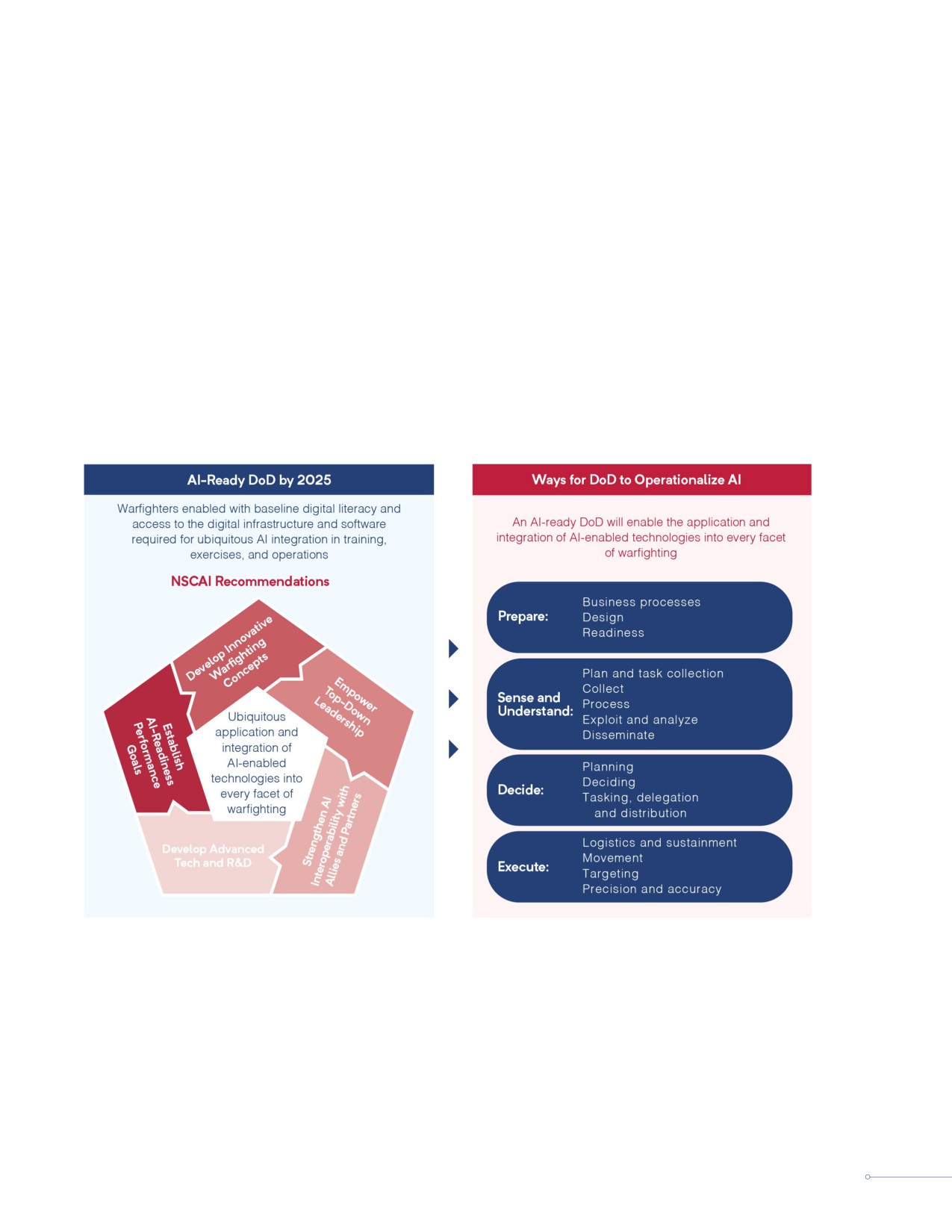
An AI-Ready DoD by 2025:
Warfighters enabled with baseline digital literacy and access
to the digital infrastructure and software required for ubiquitous
AI integration in training, exercises, and operations.
p
77
AI AND WARFARE
“The Department must act
now to integrate AI into critical
functions, existing systems,
exercises and wargames to become
an AI-ready force by 2025.”
AI and Warfare
To compete, deter, and, if necessary, fight and win in future conflicts requires wholesale
adjustments to operational concepts, technologies, organizational structures, and how we
integrate allies and partners into operations. It will also require risk-based assessments of
both the benefits and drawbacks of widespread integration of AI-enabled capabilities, to
include future autonomous weapon systems. Lastly, it will require a willingness to engage
in bilateral and multilateral dialogues with our allies and partners to urge them to make
similar AI pivots to ensure future interoperability.
p
78
CHAPTER 3
How AI Will Change Warfare.
AI-enabled warfare will not hinge on a single new weapon, technology, or operational concept;
rather, it will center on the application and integration of AI-enabled technologies into every
facet of warfighting. AI will transform the way war is conducted in every domain from undersea
to outer space, as well as in cyberspace and along the electromagnetic spectrum. It will
impact strategic decision-making, operational concepts and planning, tactical maneuvers
in the field, and back-office support. In this new kind of warfare, traditional confines of the
battlefield will be expanded through AI-enabled micro-targeting, disinformation, and cyber
operations, as described in Chapter 1 of this report. AI will reshape many attributes of war,
such as its speed, tempo, and scale; the relationships service members have with machines;
the persistence with which the battlefield can be monitored; and the discrimination and
precision with which targets can be attacked. There will be a premium on speed and accuracy
in developing knowledge, acting, and reacting as the conflict unfolds.
“AI-enabled warfare will not
hinge on a single new weapon,
technology, or operational
concept; rather, it will center on the
application and integration of AI-
enabled technologies into every
facet of warfighting.”
p
79
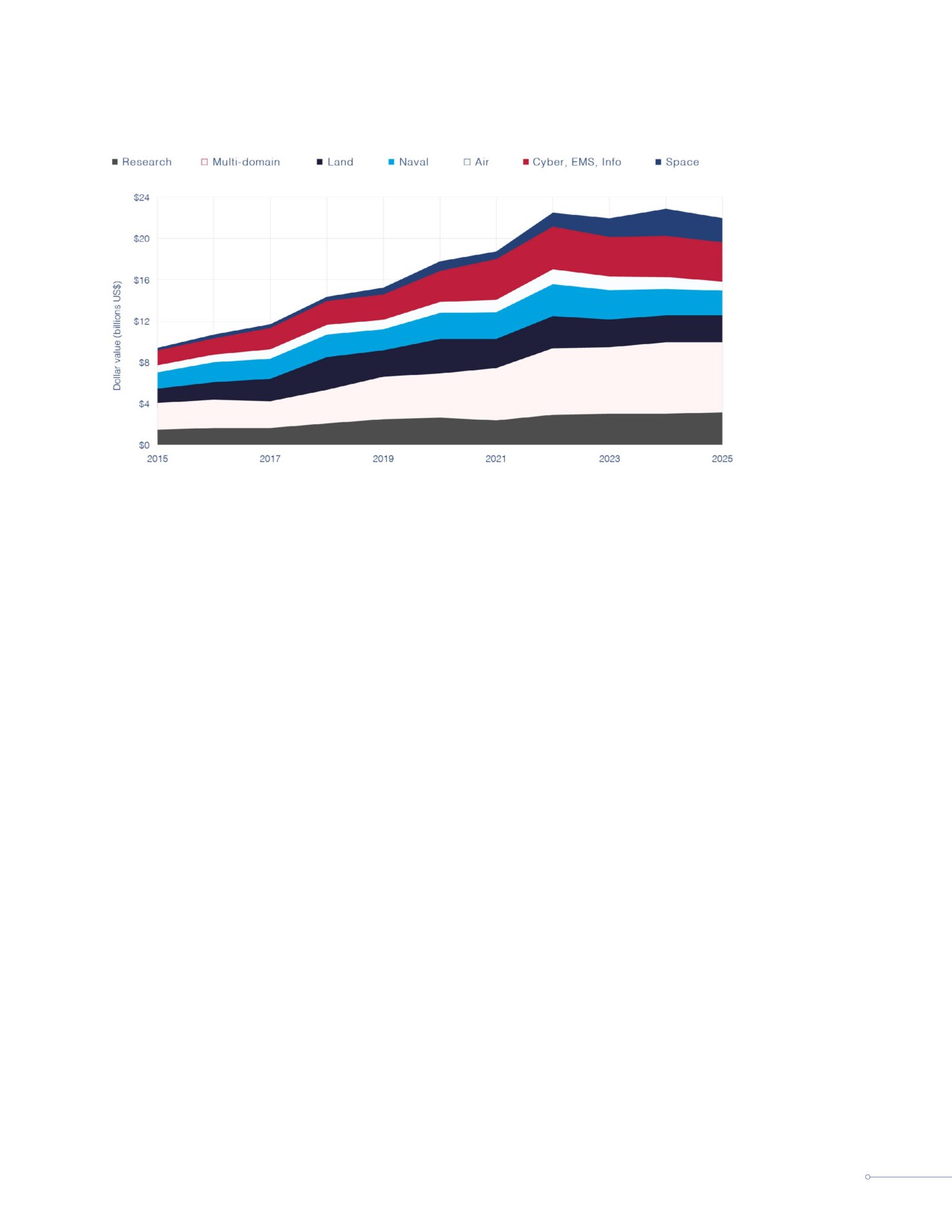
AI AND WARFARE
DoD AI RDT&E Investments by Warfighting Domains, FY 2015-2025
Source: Govini
DoD AI RDT&E
Investments.
DoD’s AI investments are well distributed across the various warfighting domains (land, naval, air,
space, cyber, electromagnetic spectrum, information), with over 25% of investments in multi-domain
applications of AI, signaling AI’s potential for integrating multi-domain operations. Investments in AI
applications for Space operations more than quadrupled from FY2019 to FY2025, from $500M to $2.2B,
increasing from 3% to almost 9% of AI-enabled investment.
Note the spending levels presented in figure represent estimates based on an analysis of DoD RDT&E
budget documents for FY2021-FY2025. See Analysis of DoD RDT&E Investments in AI, NSCAI (on final
with the Commission). Due to inherent quality issues in the source data, estimates presented contain
significant, difficult to estimate margins of error.
AI will make the process of finding and hitting targets of military value faster and more efficient.
It will also increase accuracy of target identification and minimize collateral damage. Currently,
this process generally involves passing data in a serial fashion from a sensor, through a
series of humans, to a platform that can shoot at the target. AI will help automate some of
the intermediate stages of the decision process. AI will also create opportunities for more
advanced processes that would operate more akin to a web, fusing multiple sensors and
platforms to manage complex data flows and transmitting actionable information to human
operators and machines across all domains.4
In war, many of the military uses of AI will complement, rather than supplant, the role of humans.
AI tools will improve the way service members perceive, understand, decide, adapt, and act
in the course of their missions. However, new concepts for military operations will also need to
account for the changing ways in which humans will be able to delegate increasingly complex
tasks to AI-enabled systems. In the near term, this will be managed through the military’s
principle of “mission command,” which stresses decentralized execution and disciplined
initiative by subordinates who follow a commander’s intent. This human-centric approach to
fighting should remain the standard for the foreseeable future. But as AI continues to advance
into the cognitive and neuromorphic domain, and human-machine teaming becomes more
sophisticated, the military will need to develop more imaginative concepts and organizational
constructs that take full advantage of AI technologies without relinquishing the principles that
undergird mission command.
p
80

CHAPTER 3
Ways to
Operationalize AI.
Business processes. Robotic Process Automation and AI-enabled analysis can generate significant
savings, speed administrative actions, and provide decision-makers with superior insights into core
business processes such as finance, budget, contracting, travel, and human resources.
Design. AI will support a holistic system-of-systems approach to developmental force design via digital
engineering, digital twins, and modeling and simulation to enable a more comprehensive understanding of
system vulnerabilities and adjacent capabilities, concepts, and technologies.
Readiness. AI will enhance training by relieving the cognitive burden of doing repetitive tasks that can be
performed better by machines. AI will be prevalent in all exercises and wargames and will enhance the
military’s ability to train in live, virtual, and constructive environments.
Plan and task collection. Through automation, AI-enabled systems will optimize tasking and collection
for platforms, sensors, and assets in near-real time in response to dynamic intelligence requirements or
changes in the environment.
Collect. At the tactical edge, “smart” sensors will be capable of pre-processing raw intelligence and
prioritizing what data to transmit and store, which will be especially helpful in degraded or low-bandwidth
environments.
Process. AI-enabled natural language processing, computer vision, and audiovisual analysis can vastly
reduce manual data processing. AI can also be used to automate data conversion such as translations
and decryptions, accelerating the ability to derive actionable insights.
Exploit and analyze. AI-enabled tools have the potential to augment filtering, flagging, and triage across
multiple data sets. Such tools can identify connections and correlations more efficiently and at a greater
scale than human analysts and can flag those findings and the most important content for human analysis.
AI will improve indications and warnings for military leaders.
• AI can fuse data from multiple sources, types of intelligence, and classification levels to produce
accurate predictive analysis in a way that is not currently possible.
• Advances in speech-to-text transcription and language analytics now enable reading comprehension,
question answering, and automated summarization of large quantities of text.
Disseminate. AI will be able to automatically generate machine-readable versions of intelligence products
and disseminate them at machine speed so that computer systems across the IC and the military can
ingest and use them in real time without manual intervention.
Planning. AI decision-support applications will utilize modeling and simulation algorithms and real-time
data sets to optimize planning options.
Deciding. AI will integrate command-and-control networks and compress the speed of finding and
attacking targets of military value.
Tasking, delegation, and distribution. Edge processing enhanced by delegated authorities will allow
frontline units to operate in a coordinated manner with minimal to no communications. AI techniques like
machine learning, and rule-based models will support network resiliency.
Logistics and sustainment. AI-enabled predictive analytics, optimization, and tracking will improve
efficiency and effectiveness across all facets of logistics. Intelligent systems will aid in the development
of courses of action for routine and contingency logistics and sustainment operations. Robotic process
automation will streamline human-centric maintenance and supply chain workflows.
Movement. AI will enhance the ability of commanders to maneuver, position, and protect units and forces.
AI will help network and coordinate movements of autonomous swarms via human-machine and machine-
machine teaming.
Targeting. AI-enabled systems will expand a single targeting chain into a complex targeting web that
considers numerous variables across units and domains.
Precision and accuracy. Through AI-enabled smart weapons and autonomous platforms, AI will enable
the military to be more precise and discern friendly forces, non-combatants, and adversary targets with
greater accuracy.
p
81
AI AND WARFARE
This list of how AI might transform warfighting principles and capabilities—as well as
others like it—is by no means exhaustive. Innovation will lead to future capabilities that are
unknowable at present and will only become clearer in time.
“Innovation will lead to future
capabilities that are unknowable
at present and will only become
clearer in time.”
Stronger Together.
If the United States wants to fight with AI, it will need allies and partners with AI-enabled
militaries and intelligence agencies. Uneven adoption of AI will threaten interoperability
and the political cohesion and resiliency of U.S. alliances.5 As it deepens and expands
conventional defense arrangements across the globe--especially in Europe and the Indo-
Pacific--the United States should incorporate AI and emerging technology into coordinated
defense and intelligence activities. Given the dual-use nature of many software-based
capabilities, DoD will need more flexibility to work with civilian agencies, companies, and
research institutions in partner nations.
Promote AI interoperability and the adoption of critical emerging technologies among allies
Recommendation
and partners, including the Five Eyes, the North Atlantic Treaty Organization (NATO), and
across the Indo-Pacific. This should include:
• Enhancing existing Five Eyes AI-related defense and intelligence efforts.
• Supporting NATO efforts to accelerate agreements on architectures and standards,
develop allied technical expertise, and pursue coalition AI use cases for exercises and
wargames.
• Fostering the Joint Artificial Intelligence Center (JAIC)’s International AI Partnership for
Defense as a critical vehicle to further AI defense and security cooperation.6
• Creating an Atlantic-Pacific Security Technology Partnership to improve military and
intelligence capabilities and interoperability across European and Indo-Pacific allies
and partners.
p
82
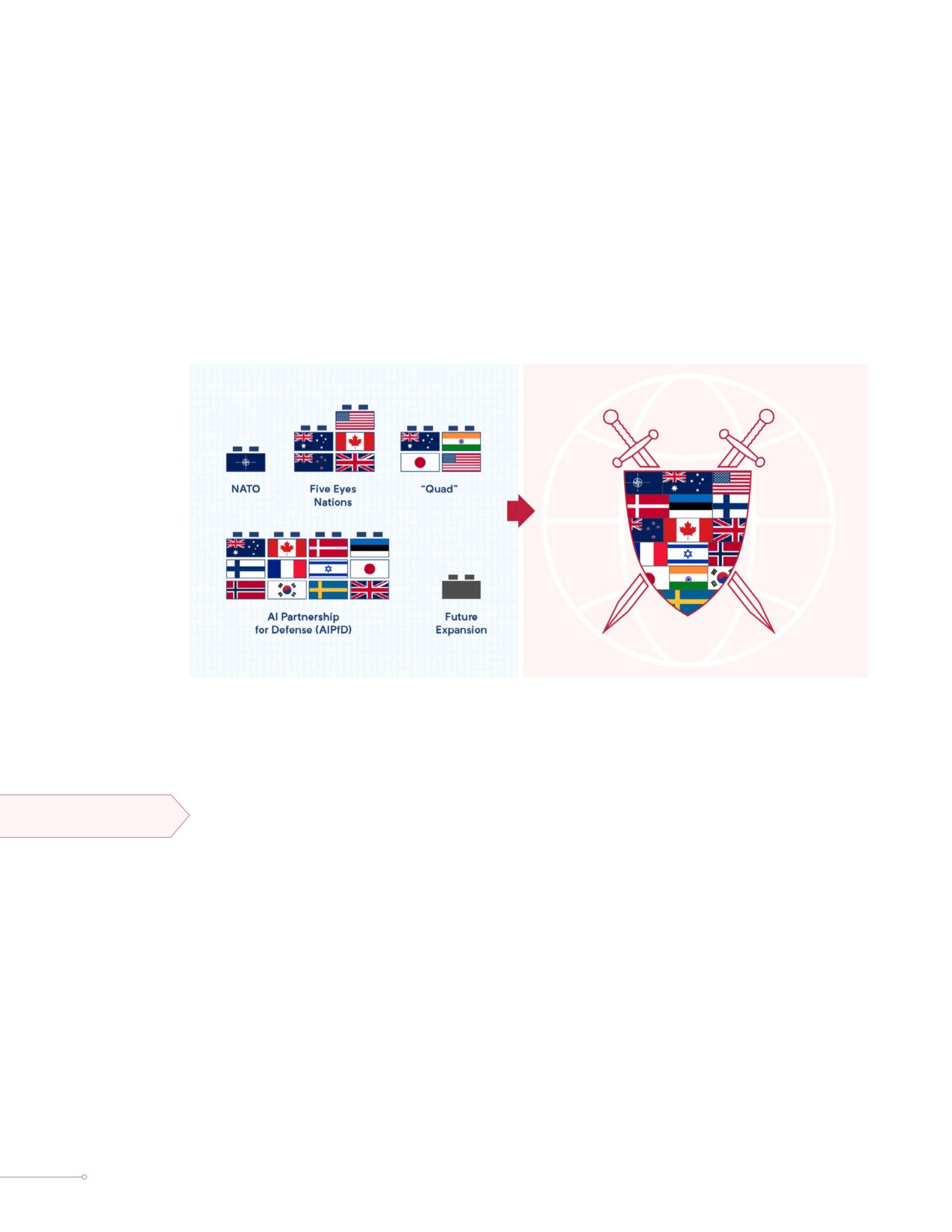
CHAPTER 3
“Uneven adoption of AI will
threaten military interoperability,
and the political cohesion and
resiliency of U.S. alliances.”
AI-enabled
Alliances and
Partnerships.
Achieve a State of Military AI Readiness by 2025.
To reach this goal, the DoD should:
Drive organizational reform through top-down leadership. Senior civilian and military officials
Recommendation
should set clear priorities and direction, empower subordinates, and accept higher
uncertainty and risk in pursuing new technologies. Specifically, DoD should:
• Establish a high-level Steering Committee on Emerging Technology, tri-chaired by the
Deputy Secretary of Defense, the Vice Chairman of the Joint Chiefs of Staff, and the
Principal Deputy Director of National Intelligence7;
• Ensure that the JAIC Director remains a three-star general or flag officer with significant
operational experience who reports directly to the Secretary of Defense or Deputy
Secretary of Defense;
• Appoint the Under Secretary of Defense for Research and Engineering as the co-chair
and chief science advisor to the Joint Requirements Oversight Council; and
p
83
AI AND WARFARE
• Assign an AI Operational Advocate on the staff of every Combatant Command. This
officer would perform a similar role to that played by the Staff Judge Advocate. He or she
would be an expert in AI systems, advise the commander and staff on the capabilities
and limitations of AI systems, and identify when AI-enabled systems are being used
inappropriately.
Develop innovative operational concepts that integrate new warfighting capabilities with
Recommendation
emerging technologies.8 These concepts should strive for seamless interoperability across
the military services and across operational domains. The concept developers should
work closely with technologists to articulate how the military could fight most effectively in
future scenarios, and they should assume that AI-enabled capabilities will be ubiquitous
on future battlefields. These concepts can also drive future investments.
By the end of 2021, establish AI and digital readiness performance goals.9 To achieve more
Recommendation
substantial integration of AI across DoD, the Deputy Secretary of Defense should:
• Direct DoD components to assess military AI and digital readiness through existing
readiness management forums and processes. The Tri-Chaired Steering Committee
on Emerging Technology should work closely with the Under Secretary of Defense for
Personnel and Readiness and the Joint Staff to ensure the identified AI readiness criteria
are incorporated into the military services’ readiness reporting and resourcing strategies.
• Direct the military services to accelerate review of specific skill gaps in AI to inform
recruitment and talent-management strategies.10
• Direct the military services—in coordination with the Under Secretary of Defense for
Acquisition and Sustainment, the Joint Staff, the Defense Logistics Agency, and the
JAIC—to prioritize integration of AI into logistics and sustainment systems wherever
possible.
• Integrate AI into major wargames and exercises to promote field-to-learn approaches
to technology adoption. Operators need persistent interaction with AI-enabled
capabilities early in the development cycle to generate critical feedback on how they
function and how they impact the mission. Widespread experimentation will advance
both concept development and the performance of the technology.11
• Incentivize experimentation with AI-enabled applications through the Warfighting
Lab Incentive Fund, which could be overseen by the proposed Tri-Chaired Steering
Committee.12
Define a joint warfighting network architecture by the end of 2021. The key objective of this
Recommendation
joint warfighting network should be a secure, open-standards systems network that
supports the integration of AI applications at operational levels and across domains.13
It should be accessible by all of the military services and encompass several elements,
including command and control networks; data transport, storage, and secure processing;
and weapon system integration. The technical infrastructure for the network should be
supported by best practices in digital engineering.14 It should also be interoperable with
the digital ecosystem described in Chapter 2 of this report.15
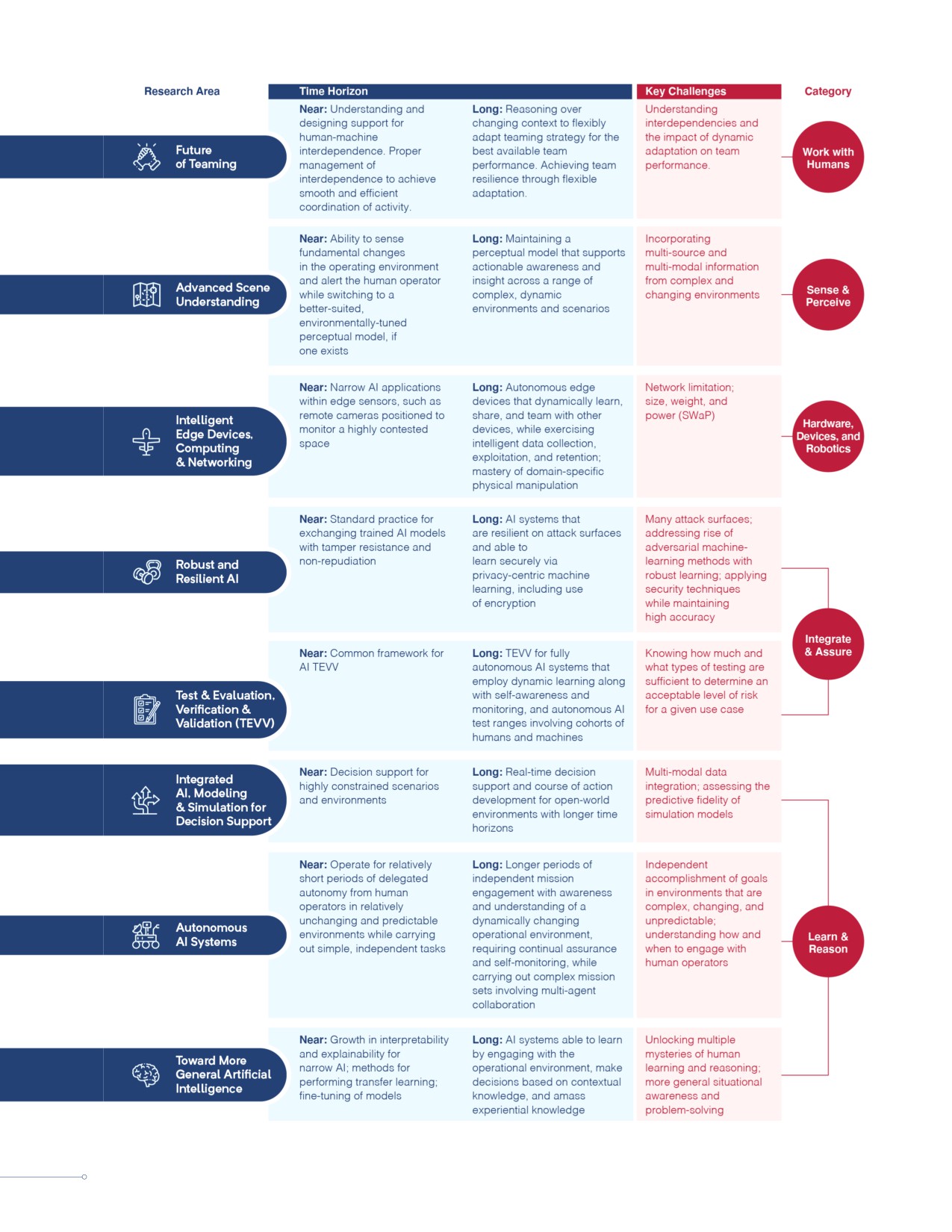
Invest in priority AI R&D areas that could support future military capabilities, including the
Recommendation
following:
p
84
CHAPTER 3
p
85
AI AND WARFARE
Chapter 3 - Endnotes
1 On military adoption, see, e.g., Michael C. Horowitz, The Diffusion of Military Power: Causes and
Consequences for International Politics, Princeton University Press (2010).
2 The Defense Advanced Research Projects Agency (DARPA) Mosaic warfare central concept is
built around the “adaptability for U.S. forces and complexity or uncertainty for the enemy through
the rapid composition and recomposition of a more disaggregated U.S. military force using human
command and machine control.” Bryan Clark, et al., Mosaic Warfare: Exploiting Artificial Intelligence
and Autonomous Systems to Implement Decision-Centric Operations, CSBA at vi (Feb. 11, 2020),
autonomous-systems-to-implement-decision-centric-operations/publication/1.
3 The People’s Liberation Army has developed a warfighting concept for what it calls “intelligentized
operations” with AI at its core. Within this construct, China theorizes that in future conflict, the central
contest will be between adversarial battle networks rather than traditional weapons platforms, and
that information advantage and algorithmic superiority will be a determinant of victory. See Elsa
Kania, Chinese Military Innovation in Artificial Intelligence, CNAS at 1 (June 7, 2019), https://www.
cnas.org/publications/congressional-testimony/chinese-military-innovation-in-artificial-intelligence
(testimony before the U.S.-China Economic and Security Review Commission).
news-events/2020-09-18a. See also AI Fusion: Enabling Distributed Artificial Intelligence to Enhance
Multi-Domain Operations & Real-Time Situational Awareness, Carnegie Mellon University (2020),
http://www.cs.cmu.edu/~ai-fusion/overview.
5 On military interoperability challenges related to AI, see Erik Lin-Greenberg, Allies and Artificial
Intelligence: Obstacles to Operations and Decision-Making, Texas National Security Review (Spring
2020), https://tnsr.org/2020/03/allies-and-artificial-intelligence-obstacles-to-operations-and-decision-
making/.
6 The AI Partnership for Defense, launched in September 2020, includes the United States and 12
partner nations: Australia, Canada, Denmark, Estonia, Finland, France, Israel, Japan, Norway, South
Korea, Sweden, and the United Kingdom. It seeks to “provide values-based global leadership” on
adoption of AI in the defense and security context and align “like-minded nations to promote the
responsible use of AI, advance shared interests and best practices on AI ethics implementation,
establish frameworks to facilitate cooperation, and coordinate strategic messaging on AI policy.” Joint
Statement_09_16_20.pdf. The Partnership held its second formal dialogue in January 2021. DoD Joint
AI Center Facilitates Second International AI Dialogue for Defense, JAIC (Jan. 27, 2021), https://www.
ai.mil/news_01_27_21-dod_joint_ai_center_facilitates_second_international_ai_dialogue_for_defense.
html.
7 The Commission acknowledges Section 236 of the Fiscal Year 2021 National Defense Authorization
Act, which permits the Secretary of Defense to establish a steering committee on emerging
technology and national security threats composed of the Deputy Secretary of Defense, the Vice
Chairman of the Joint Chiefs of Staff, the Under Secretary of Defense for Intelligence and Security,
the Under Secretary of Defense for Research and Engineering, the Under Secretary of Defense for
Personnel and Readiness, the Under Secretary of Defense for Acquisition and Sustainment, the Chief
Information Officer, and such other officials of the Department of Defense as the Secretary determines
appropriate. However, the structure described in Sec. 236 does not include leadership from the
Intelligence Community and will thus not drive the intended action. See Pub. L. 116-283, William M.
(Mac) Thornberry National Defense Authorization Act for Fiscal Year 2021, 134 Stat. 3388 (2021).
8 Notably, the National Defense Strategy emphasizes the need to “evolve innovative operational
concepts” and “foster a culture of experimentation and calculated risk-taking.” Tighter coordination
between concept writers and technologists would create a more dynamic cycle of technology
development and integration. Summary of the 2018 National Defense Strategy, U.S. Department of
Defense at 7 (2018), https://dod.defense.gov/Portals/1/Documents/pubs/2018-National-Defense-
Strategy-Summary.pdf.
p
86
CHAPTER 3
Chapter 3 - Endnotes
9 “Readiness” is a key measure of military effectiveness and remains at the heart of budget,
policy, and oversight debates on defense preparedness. In this context, DoD should establish key
AI and digital readiness performance objectives to measure and drive Department and service
accountability. See G. James Herrera, The Fundamentals of Military Readiness, Congressional
Research Service at 2 (Oct. 2, 2020), https://fas.org/sgp/crs/natsec/R46559.pdf.
10 As noted in Chapter 6 of this report, there is already an identified need for the creation of digital
corps, civilian and military AI and AI-related career fields, an expansion of recruiting pathways, and
the creation of recruiting offices. The military services need to assess the number of personnel in
those fields and structures, not the need to establish them.
11 Although AI will be ubiquitous across all domains, the high-data volumes associated with the space,
cyber, and information operations domains make use cases in those domains particularly well-suited
for prioritized integration of AI-enabled applications in wargames, exercises, and experimentation.
12 The Warfighting Lab Incentive Fund is intended to spur field experiments and demonstrations to
“evaluate, analyze and provide insight into more effective ways of using current capabilities, and
to identify new ways to incorporate technologies into future operations and organizations.” See
Memorandum from the Deputy Secretary of Defense, Warfighting Lab Incentive Fund and Governance
wp-content/uploads/2018/02/DSD_memo.pdf.
p
87
AI AND WARFARE
13 The network envisioned is well-aligned with ongoing DoD efforts to embrace standards-driven
interoperability, system adaptability, and data-sharing. See Memorandum from the Secretary of the
Navy, Secretary of the Army, and Secretary of the Air Force for Service Acquisition Executives and
Program Executive Officers, U.S. Department of Defense (Jan. 7, 2019), https://www.dsp.dla.mil/
Portals/26/Documents/PolicyAndGuidance/Memo-Modular_Open_Systems_Approach.pdf.
14 Such as the goals and focus areas outlined in the DoD Digital Engineering Strategy; terms, any
knowledge, and guidelines shared as part of the Digital Engineering Body of Knowledge; and
incorporating Section 231 of the National Defense Authorization Act for Fiscal Year 2020, which
requires the creation of a digital engineering capability to automate testing and evaluation. See
Department of Defense Digital Engineering Strategy, Office of the Deputy Assistant Secretary of
Defense for Systems Engineering (June 2018); see also Pub. L. 116-92, The National Defense
Authorization Act for Fiscal Year 2020, 133 Stat. 1198 (2019). For a description of the Digital
Engineering Body of Knowledge, see Andrew Monje, Future Direction of Model-Based Engineering
Across the Department of Defense, U.S. Department of Defense (Jan. 27, 2020), https://ac.cto.mil/wp-
content/uploads/2020/05/RAMS-Monje-27Jan2020-Future.pdf.
15 See the Chapter 2 Blueprint for Action for details on how this architecture should interact with the
digital ecosystem.
p
88
CHAPTER 4
Chapter 4:
Autonomous Weapon
Systems and Risks Associated
with AI-Enabled Warfare
p
89

AUTONOMOUS WEAPON SYSTEMS AND RISKS ASSOCIATED WITH AI-ENABLED WARFARE
Mitigate Strategic Risks Associated
with AI-Enabled Weapon Systems
Continue
Develop
Rigorous TEVV
International
Procedures
Standards of
Practice
Discuss
Limit Specific
Risks with
Applications
Competitors
p
90
CHAPTER 4
World military powers both large and small are pursuing artificial
intelligence (AI)-enabled and autonomous weapon systems. Such
systems have the potential to help commanders make faster, better,
and more relevant decisions. They will enable weapon systems to
be capable of levels of performance, speed, and discrimination that
exceed human capabilities. And they will enable hitherto impossible
complex tasks. If properly designed, tested, and used, they could
improve compliance with International Humanitarian Law (IHL)1 by
reducing the risk of accidental engagements, decreasing civilian
casualties, minimizing collateral infrastructure damage, and allowing
for detailed auditing of the decisions and actions of operators and
their command chains. Although U.S. weapons platforms have
utilized autonomous functionalities for more than eight decades,2
AI technologies have the potential to enable novel, sophisticated
offensive and defensive autonomous capabilities.
The increasing use of AI technologies in weapon systems has generated important
questions regarding whether such systems are lawful, safe, and ethical. Those critical of
using AI technologies in weapons argue that states should negotiate limits or restrictions
on such systems and their use. There is also concern that autonomous weapon systems
may make conflict escalation more likely, and debate continues over what steps are
needed to ensure that such systems minimize the risk of unintended military engagements
or inadvertent and uncontrollable conflict escalation. Since 2014, the United Nations
Convention on Certain Conventional Weapons (CCW) has held meetings among states
parties to discuss the technological, military, legal, and ethical dimensions of “emerging
technologies in the area of lethal autonomous weapon systems (LAWS).”3 Specifically, it is
examining whether autonomous technologies will be capable of complying with IHL and
whether additional measures are necessary to ensure that humans maintain an appropriate
degree of control over the use of force.
The Commission has consulted with civil society, academic organizations, and government
agencies in studying the legal, ethical, and strategic questions that surround AI-enabled
and autonomous weapon systems, including their potential military benefits and risks,
possible ethical issues coming to the fore, international efforts to regulate them, and their
compliance with IHL. The Commission offers the following four judgments to reflect its
conclusions on these discussions.
p
91
AUTONOMOUS WEAPON SYSTEMS AND RISKS ASSOCIATED WITH AI-ENABLED WARFARE
Judgment 1: Provided their use is
authorized by a human commander or
NSCAI Judgments Regarding
operator, properly designed and tested
AI-Enabled and Autonomous
AI-enabled and autonomous weapon
Weapon Systems
systems have been and can continue
•
Provided their use is authorized by a
to be used in ways which are consistent
human commander or operator, properly
with IHL.
designed and tested AI-enabled and
autonomous weapon systems have been
This judgment is grounded in several
and can continue to be used in ways
which are consistent with IHL.
elements of IHL:
•
Existing DoD procedures are capable
•
Distinction: The principle of distinction
of ensuring that the United States will
holds that parties to an armed conflict
field safe and reliable AI-enabled and
must distinguish between civilians
autonomous weapon systems and use
and combatants.4 Weapons with
them in a manner that is consistent with
increasingly accurate AI-enabled
IHL.
target recognition systems have the
potential to reduce cases of target
•
There is little evidence that U.S.
misidentification, the leading cause
competitors have equivalent rigorous
of inadvertent engagements during
procedures to ensure their AI-enabled
combat operations, and thus reduce
and autonomous weapon systems will be
civilian casualties and collateral
responsibly designed and lawfully used.
infrastructure damage.5
•
The Commission does not support a
•
Proportionality: The principle of
global prohibition of AI-enabled and
proportionality prohibits attacks
autonomous weapon systems.
which would cause incidental loss of
civilian life excessive to the anticipated
military advantage.6 AI-enabled and
autonomous weapon systems can and
should also be designed to carry out operations in accordance with human judgments
and directions regarding the proportionality of an attack. The moral reasoning involved
in this calculus—weighing anticipated military advantage against potential civilian
harm—remains the responsibility of a human commander.7
•
Accountability: Ensuring accountability and command responsibility is essential
to compliance with IHL. A human can and should be held accountable for the
development, testing, use, and behavior of any autonomous weapon system, AI-
enabled or otherwise. Autonomous weapon systems operate within the same general
parameters as those used for human command and control systems, which are
specifically designed to ensure accountability for actions and compliance with IHL. This
is no different than for any other weapon system.8
The Commission endorses DoD’s body of policy that states that human judgment must
be involved in decisions to take human life in armed conflict. The kind of involvement
necessary for humans to remain accountable for the use of autonomous weapon systems
will vary depending on the time criticality of the situation as well as the operational context,
circumstance, and type of weapon systems involved.9 It is incumbent upon states to
establish processes which ensure that appropriate levels of human judgment are relied
p
92
CHAPTER 4
“... human judgment must be
involved in decisions to take
human life in armed conflict.”
upon in the use of AI-enabled and autonomous weapon systems and that human operators
of such systems remain accountable for the results of their employment.
Human accountability for the results of lethal engagements does not necessarily require
human oversight of every step of an engagement process. Once a human authorizes an
engagement against a target or group of targets, subsequent steps in the attack sequence
can be completed autonomously without relinquishing human accountability. The exact
number of steps in this sequence is dependent on the system’s technical capabilities and
the context and must consider factors such as the uncertainty associated with the system’s
behavior and potential outcomes, the magnitude of the threat, and the time available
for action. For instance, an autonomous weapon system located in a rapidly changing
environment, such as an urban setting, for an extended period, may require more frequent
human authorization to ensure sufficient human accountability over autonomous actions
than an equivalent system, operated for a similar amount of time, in a highly predictable
and less populated environment—such as underwater or in space. This logic can and
should be incorporated into the system’s design, testing, and operational planning. Taking
these factors into consideration, when feasible and deemed necessary operation designs
should include points of required human guidance amid a sequence of automated actions.
At such points, a human must review the system’s status and authorize its next actions
before the system’s mission can continue. A blanket decision to compel every discrete step
in an engagement involving lethal force to be subject to explicit authorization by a human
is neither realistic nor desirable. Indeed, such a policy could instead spur commanders to
use less precise, unguided weapon systems that might result in greater levels of collateral
damage.
Judgment 2: Existing DoD procedures are capable of ensuring that the United States will
field safe and reliable AI-enabled and autonomous weapon systems and use them in a
manner that is consistent with IHL.
DoD’s commitment to rigorous procedures for the development and use of autonomous
weapon systems—as well as its commitment to strong AI ethical principles10—instills
confidence that it will be able to field AI-enabled and autonomous weapon systems that are
used lawfully. DoD has comprehensive processes for ensuring that the use of any weapon
it fields is compliant with IHL and has a demonstrated commitment to operating within
IHL, minimizing civilian casualties, and learning from its mistakes.11 DoD has established
p
93
AUTONOMOUS WEAPON SYSTEMS AND RISKS ASSOCIATED WITH AI-ENABLED WARFARE
a cross-department legal group, the DoD Law of War Working Group, to “develop and
coordinate law of war initiatives and issues, such as analysis regarding the legality of
new means or methods of warfare under consideration by DoD components.”12 This
standing body is well positioned to examine implications for IHL as technology evolves
over time. The International Committee on the Red Cross (ICRC) has lauded the strength
and transparency of this system, listing the United States as one of eight countries that
have “national mechanisms to review the legality of weapons and that have made the
instruments setting up these mechanisms available to the ICRC.”13
In addition to baseline legal review, the Department has taken special precautions for
autonomous weapon systems to ensure these systems undergo sufficient test and evaluation,
verification and validation (TEVV). In 2012, DoD added to an extensive list of guiding directives
and instructions regarding weapons development within the Department by publishing DoD
Directive (DoDD) 3000.09, Autonomy in Weapon systems, which establishes DoD policy
for the development and use of autonomous weapon systems. It requires that all systems
be designed “to allow commanders and operators to exercise appropriate levels of human
judgment over the use of force” and requires senior DoD leaders to approve any autonomous
weapon with lethal capabilities first when development begins, and again before fielding.14
It also mandates any autonomous or semi-autonomous weapon that undergoes a revision
to its operating state to undergo additional testing and evaluation. DoDD 3000.09 provides
important definitions and baseline requirements for such systems and must be reviewed
annually as technology evolves.15 Chapter 7 of this report provides specific recommendations
on how the United States should adapt its TEVV policies and capabilities to ensure it retains
justified confidence in AI-enabled systems.16
“The U.S. commitment to
IHL is longstanding, and AI-
enabled and autonomous
weapon systems will not change
this commitment.”
In addition, DoD’s command and control procedures to authorize target selection and
employment of munitions are rigorous and designed to ensure compliance with IHL.
Operational commanders in the field are directly supported by lawyers embedded at
multiple levels to advise on decisions about the use of force. The U.S. commitment to IHL
p
94
CHAPTER 4
is long-standing, and AI-enabled and autonomous weapon systems will not change this
commitment.17 These same principles will be ingrained into the design of those weapons,
demonstrated in TEVV, and maintained by commanders overseeing their deployment. DoD’s
policy for autonomy in weapon systems and its adoption of ethical principles for AI in 2020
further highlight and reinforce this commitment.18
Judgment 3: There is little evidence that U.S. competitors have equivalent rigorous
procedures to ensure their AI-enabled and autonomous weapon systems will be
responsibly designed and lawfully used.
Battlefield success may become increasingly dependent on AI performance, and AI-
enabled weapons are likely to proliferate given the open-source and dual-use nature of AI.
This could cause pressure to mount on states to rapidly field new and untested systems
and algorithms. Such pressures could also tilt designs toward systems that react more
quickly, limiting the amount of time available for effective human oversight on engagement
decisions. U.S. competitors, particularly Russia and China, likely do not have equivalent
operational and targeting procedures to ensure the use of such systems is compliant
with IHL and to preserve human accountability over the use of lethal force. Russia and
China also have not published anything equivalent to DoDD 3000.09, outlining their
policies and processes governing the acquisition, development, testing, and deployment
of autonomous weapon systems. Unlike in the United States, in Russia and China these
processes are secret, if they exist at all.
U.S. competitors have demonstrated that they are unlikely to adhere to the same ethical
and legal standards in developing and utilizing AI-enabled weapon systems. Russia in
particular has historically demonstrated a willingness to deploy risky and under-tested
weapon systems, and it has deployed poorly performing unmanned ground vehicles
“A global treaty prohibiting
the development, deployment,
or use of AI-enabled and
autonomous weapon systems is
not currently in the interest of
U.S. or international security ...”
p
95
AUTONOMOUS WEAPON SYSTEMS AND RISKS ASSOCIATED WITH AI-ENABLED WARFARE
with limited autonomous functionalities in combat in Syria.19 China is not only actively
pursuing increased autonomous functionality across a range of military systems, but it
is also currently exporting armed drones with autonomous functionalities to other nations.
This includes systems such as the Blowfish A3, which Ziyan, the system’s manufacturer,
advertises as capable of conducting autonomous, lethal, targeted strikes.20
Judgment 4: The Commission does not support a global prohibition of AI-enabled and
autonomous weapon systems.
A global treaty prohibiting the development, deployment, or use of AI-enabled and
autonomous weapon systems is not currently in the interest of U.S. or international
security and would be inadvisable to pursue for several reasons:
•
First is the basic definitional problem. With respect to autonomous weapon systems,
although the UN discussions about LAWS date back to 2014, states have yet to agree
on a definition for them. This makes any treaty negotiation problematic, as it may be
impossible to define the category of systems to be restricted in such a way that provides
adequate clarity while not overly constraining existing U.S. military capabilities.
•
Even if the definitional problem could be overcome, we judge that, at present,
implementation of such an agreement would be impractical because compliance could
not be verified. There is no feasible technical manner in which states could demonstrate
to one another that specific weapon systems are or are not autonomous, or that they
possess or lack certain capabilities. Doing so would require foreign inspectors to have
short-notice access to the underlying code in weapon systems of concern. States
are unlikely to agree to such an intrusive verification regime because revealing that
information would create unacceptable risks to the security of their systems.
•
Additionally, the effects of a prohibition agreement likely would run counter to U.S.
strategic interests. Commitments from states such as Russia or China likely would be
empty ones. Such an agreement would not serve the goal of putting political pressure
on the states that are most likely to deploy autonomous weapon systems in unsafe
and ethically concerning ways. Rather, the primary impact of an agreement would be
to increase pressure on those countries that abide by international law, including the
United States and its democratic allies and partners. Moreover, differing views on a
prohibition among U.S. allies could deepen divisions among them on the employment
of AI-enabled autonomous weapon systems. If U.S. allies joined an agreement
while the United States did not, that divergence would likely hinder allied military
interoperability.21
For these reasons, we believe the practical and strategic problems with a prohibition
treaty outweigh potential benefits for the United States and its allies and partners,
and therefore we support the current U.S. policy in opposition to such an agreement.
However, this does not preclude other agreements or policies to address strategic
risks associated with AI-enabled and autonomous weapon systems, or the
future possibility of regulating specific types of technologies in AI-enabled and
autonomous weapons technologies when such an agreement could be verifiable.
p
96

CHAPTER 4
Recommendations to Mitigate Strategic Risks of AI.
While the Commission believes that properly designed, tested, and utilized AI-enabled and
autonomous weapon systems will bring substantial military and even humanitarian benefit, the
unchecked global use of such systems potentially risks unintended conflict escalation and
crisis instability. The United States cannot assume that AI-enabled and autonomous weapon
systems fielded by other countries will be developed, acquired, and fielded with the appropriate
testing and verification to enable them to act as intended. Unintended escalations may occur for
numerous reasons, including when systems fail to perform as intended, because of challenging
and untested complexities of interaction between AI-enabled and autonomous weapon systems
on the battlefield, and, more generally, as the result of machines or humans misperceiving
signals or actions. AI-enabled systems will likely increase the pace and automation of warfare
across the board, reducing the time and space available for de-escalatory measures. Beyond
testing and robustness, we cannot assume that AI-enabled and autonomous weapons
developed by other nations will be designed to behave in accordance with IHL.
Therefore, countries must take actions which focus on reducing risks associated with AI-
enabled and autonomous weapon systems and encourage safety and compliance with IHL
when discussing their development, deployment, and use. Such efforts should and must
be led by the United States, which is uniquely situated to lead them given its technical
expertise, military prowess, and clear and transparent policies and ethical principles
governing the deployment and use of AI-enabled and autonomous weapon systems. The
Commission presents the following five recommendations regarding actions the United
States should take to mitigate risks associated with AI-enabled and autonomous weapon
systems.
Strategic Risks
Associated with
NSCAI Recommended Actions
Objectives
AI-Enabled Weapons
U.S. Actions
Nation states could
Clearly and publicly affirm existing
allow AI to authorize
U.S. policy that only human beings
Prevent unintended nuclear
employment of key
can authorize employment of
conflict due to AI-enabled
strategic weapon
nuclear weapons, and seek similar
launch authorization.
systems.
commitments from Russia and China.
Enable effective verification
States cannot verify
of potential future
Pursue technical means to verify
compliance with
agreements, which provides
compliance with future arms control
potential international
confidence systems are
agreements pertaining to AI-enabled
agreements pertaining
working as intended
and autonomous weapon systems.
to AI-enabled weapons.
without revealing sensitive
operational details.
p
97

AUTONOMOUS WEAPON SYSTEMS AND RISKS ASSOCIATED WITH AI-ENABLED WARFARE
Strategic Risks
Associated with
NSCAI Recommended Actions
Objectives
AI-Enabled Weapons
Design and incorporate
proliferation-resistant
Global, unregulated
Fund research on technical means
features into sophisticated
proliferation of
to prevent proliferation of AI-enabled
AI-enabled and autonomous
AI-enabled and
and autonomous weapon systems.
weapons, and potentially
autonomous weapons.
share them with Russia and
China.
U.S. Actions with Allies
Set international norms
Poorly designed or
Develop international standards of
guiding responsible
improperly utilized AI-
practice for the development and
development and use of
enabled weapons could
use of AI-enabled and autonomous
AI-enabled and autonomous
behave unpredictably.
weapon systems.
weapon systems.
U.S. Actions with Russia and China
Improve understanding
Discuss AI’s impact on crisis stability
of doctrine and develop
AI-enabled systems
in the existing U.S.-Russia Strategic
confidence-building
could cause inadvertent
Security Dialogue and create an
measures regarding use of
conflict escalation.
equivalent meaningful dialogue with
AI-enabled and autonomous
China.
weapon systems.
Clearly and publicly affirm existing U.S. policy that only human beings can authorize employment
Recommendation
of nuclear weapons, and seek similar commitments from Russia and China. The United States
should make a clear, public statement that decisions to authorize nuclear weapons
employment must only be made by humans, not by an AI-enabled or autonomous system,
and should include such an affirmation in the DoD’s next Nuclear Posture Review.22 This
would cement and highlight existing U.S. policy, which states that “[t]he decision to employ
nuclear weapons requires the explicit authorization of the President of the United States.”23
It would also demonstrate a practical U.S. commitment to employing AI and autonomous
functions in a responsible manner, limiting irresponsible capabilities, and preventing AI
systems from escalating conflicts in dangerous ways. It could also have a stabilizing effect,
as it would reduce competitors’ fears of an AI-enabled, bolt-from-the-blue strike from the
United States and could incentivize other countries to make equivalent pledges.
The United States should also actively press Russia and China, as well as other states
that possess nuclear weapons, to issue similar statements. Although joint political
commitments that only humans will authorize employment of nuclear weapons would not
be verifiable, they could still be stabilizing, responding to a classic prisoner’s dilemma: as
long as countries have confidence that others are not building risky command and control
structures that have the potential to inadvertently trigger massive nuclear escalation, they
would have less incentive to develop such systems themselves.24 While this norm is widely
accepted in the United States, it is unclear if Russia and China share the same strategic
p
98
CHAPTER 4
“... countries must take actions
which focus on reducing risks
associated with AI-enabled and
autonomous weapon systems,
and encourage safety and
compliance with IHL when
discussing their development,
deployment, and use. Such
efforts should and must be led
by the United States ...”
concerns. Public reports indicate that Russia previously installed a “dead hand” system to
automate nuclear launch authorization,25 and China’s representatives in Track II dialogues
with the United States have been hesitant to state that China would make an equivalent
commitment. If neither Russia nor China is willing to agree to such a proposal, the United
States should mount a strong international pressure campaign to condemn this decision
and highlight how Russia and China refuse to commit to responsible military uses of AI.
Discuss AI’s impact on crisis stability in the existing U.S.-Russia Strategic Security Dialogue
Recommendation
(SSD) and create an equivalent meaningful dialogue with China. The Departments of State
and Defense should discuss AI’s impact on crisis stability within the existing U.S.-Russia
SSD and create an equivalent meaningful dialogue with China. The SSD is an interagency
bilateral dialogue focused on reducing misunderstandings and misperceptions on key
strategic issues and threats, as well as reducing the likelihood of inadvertent escalation.
Although the dialogue has traditionally focused on nuclear arms control and doctrine, it
has recently been used to also discuss emerging technologies and space security.26
The United States has no equivalent dialogue with China, as China has resisted U.S.
attempts to establish one for nearly a decade. However, within the last year there has
been increasing evidence that China is interested in formal talks with the United States
concerning AI-enabled military systems.27 This interest should be cultivated and leveraged
into establishing a U.S.-China SSD that includes the relevant military, diplomatic, and
security officials from both sides.
p
99
AUTONOMOUS WEAPON SYSTEMS AND RISKS ASSOCIATED WITH AI-ENABLED WARFARE
Given that the United States, Russia, and China are all aggressively pursuing AI-enabled
capabilities, and that Russia and China are likely to field AI-enabled systems that have
undergone less rigorous TEVV than comparable U.S. systems and may be unsafe or unreliable,
it is crucial to improve mutual understanding of each other’s military doctrines, including with
respect to AI-enabled and autonomous systems. The United States should use this channel to
highlight how deploying unsafe systems could risk inadvertent conflict escalation, emphasize
the need to conduct rigorous TEVV, and discuss where each side sees risks of a conventional
conflict rapidly escalating in order to better anticipate future responses in a crisis.
“... it is crucial to improve mutual
understanding of each other’s
military doctrines, including
with respect to AI-enabled and
autonomous systems.”
These dialogues could also plant the seeds for a future, standing dialogue exclusively
focused on establishing practical and concrete confidence building measures surrounding
AI-enabled and autonomous weapon systems. For instance, the United States, Russia, and
China could work to develop an “international autonomous incidents agreement,” modeled
after the 1972 Incidents at Sea Agreement, which would seek to define the “rules of the
road” for behavior of autonomous military systems to create a more predictable operating
environment and avoid accidents and miscalculations.28 They could also agree to integrate
“automated escalation tripwires” into systems that would prevent the automated escalation
of conflict in specific scenarios without human intervention, to include nuclear weapons
employment as noted above.
Work with allies to develop international standards of practice for the development, testing, and
Recommendation
use of AI-enabled and autonomous weapon systems. The United States must work closely
with its allies to develop standards of practice regarding how states should responsibly
develop, test, and employ AI-enabled and autonomous weapon systems. This could build
off of existing work, to include the 11 Guiding Principles agreed to by the LAWS Group of
Governmental Experts (GGE) in 2019,29 DoDD 3000.09, the DoD Ethical Principles for AI,
and the NSCAI Key Considerations for Responsible Development and Fielding of AI.30 As
part of this effort, the DoD Law of War Working Group should meet regularly to review any
future technical developments that pertain to autonomous weapon systems and IHL, and
the tri-chaired Steering Committee on Emerging Technology (separately recommended
p
100
CHAPTER 4
by the Commission in Chapter 3 of this report) should advise on how such future technical
developments impact policy and national defense.
The outputs of both groups should inform future DoD engagements with both allies and
competitors on AI-enabled and autonomous weapon systems. Obtaining allied consensus
regarding standards for the development, testing, and use of such systems will set
important norms regarding these systems, help to ensure they are developed and used
safely, and further highlight the commitment of the United States and its allies to ethical
and responsible uses of AI. The United States should also use these consultations to
highlight the ways in which AI will become a crucial part of future military operations and
develop common frameworks guiding the appropriate and responsible use of AI-enabled
and autonomous weapon systems on the battlefield. This should seek to incentivize allies
to invest in the digital modernization of their own forces while also highlighting the risks to
military interoperability should any ally agree to join a treaty prohibiting LAWS.
Pursue technical means to verify compliance with future arms control agreements pertaining to
Recommendation
AI-enabled weapon systems. The United States should actively pursue the development of
technologies and strategies that could enable effective and secure verification of future
arms control agreements involving uses of AI technologies. Although arms control of AI-
enabled weapon systems is currently technically unverifiable, effective verification will
likely be necessary to achieve future legally binding restrictions on AI capabilities. DoD
and the Department of Energy (DoE) should spearhead efforts to design and implement
technologies which could provide other countries confidence that an AI-enabled and
autonomous weapon system is working as intended without revealing sensitive operational
details. For instance, it could examine ways for AI-enabled weapons platforms to produce
authenticatable records of operation, which could be spot-checked via international
challenge inspections if noncompliant activity is suspected. Technical creativity will be
necessary to enable any future international restrictions on AI capabilities without revealing
sensitive information.
Fund research on technical means to prevent proliferation of AI-enabled and autonomous
Recommendation
weapon systems. Controlling the proliferation of AI-enabled and autonomous weapon
systems poses significant challenges given the open-source, dual-use, and inherently
transmissible nature of AI algorithms.31 The proliferation of makeshift autonomous weapon
systems which primarily utilize commercial components will be particularly difficult to
control via regulation and will necessitate capable intelligence sharing and domestic law
enforcement efforts to prevent their use by terrorists and other non-state actors. Regarding
more sophisticated autonomous weapon systems, the United States should double down
on efforts to design and incorporate proliferation-resistant features, such as standardized
ways to prevent unauthorized users from utilizing such weapons, or reprogramming a
system’s functionality by changing key system parameters. DoD and DoE should fund
technical research on such methods, and if appropriate, these methods could be shared
with Russia and China, or potentially other countries, to prevent the proliferation or loss of
control of certain AI-enabled autonomous weapon systems.32
p
101
AUTONOMOUS WEAPON SYSTEMS AND RISKS ASSOCIATED WITH AI-ENABLED WARFARE
This report does not contain a separate Blueprint for Action for Chapter 4. This is because given the
importance of the topic, the Commission chose to detail its arguments, recommendations, and the
specific actions required to implement them directly in this chapter. Additionally, further detail on how
the United States should adapt its TEVV policies to maintain confidence in AI systems can be found in
Chapter 7 and its associated Blueprint for Action, and recommendations on relevant changes to DoD
organizational structure can be found in Chapter 3.
p
102
CHAPTER 4
Chapter 4 - Endnotes
1 IHL is also referred to as the law of armed conflict (LOAC) and the law of war.
2 Paul Scharre, Army of None: Autonomous Weapons and the Future of War, W.W. Norton & Co. at 39
(April 24, 2018).
3 Background on Lethal Autonomous Weapon systems in the CCW, United
Nations (last accessed Jan. 11, 2021), https://www.unog.ch/80256EE600585943/
(httpPages)/8FA3C2562A60FF81C1257CE600393DF6?OpenDocument.
casebook.icrc.org/glossary/distinction.
5 There is room for improvement in reducing target misidentification in U.S. military operations. In
the Afghanistan war, for example, a study indicated that about half of all civilian casualty incidents
caused by U.S. forces resulted from target misidentification. The use of AI-enabled systems to make
more accurate targeting decisions is perhaps the principal way in which the proper employment
of AI could make warfare more humane. Larry Lewis, Redefining Human Control: Lessons from the
2017-U-016281-Final.pdf.
casebook.icrc.org/glossary/proportionality.
7 See Paul Scharre, Army of None: Autonomous Weapons and the Future of War, W.W. Norton & Co. at
255-257 (2018).
8 For a properly designed and tested autonomous system which correctly carries out the commander’s
intent, the commander is clearly accountable for the actions of that system. It is incumbent on states
to properly design, test, and use such systems and also put in place rigorous procedures ensuring
that any weapon use complies with IHL, including by ensuring individual accountability.
9 The Commission believes DoD’s existing formulation of “appropriate human judgment,” discussed
in the following Judgment, captures that necessary variation and ensures that any decision to employ
lethal force begins with and is under the control of human judgment, and that a human ultimately will
remain accountable for any decision to employ force.
10 Press Release, U.S. Department of Defense, DoD Adopts Ethical Principles for Artificial Intelligence
ethical-principles-for-artificial-intelligence/.
11 DoDD 5000.01 requires any weapon fielded by DoD to undergo a legal review to ensure compliance
with the Law of Armed Conflict (LOAC), adhering to the requirements set out in Article 36 of the
Protocol Additional to the Geneva Conventions of 12 August 1949. DoDD 3000.09 and the DoD AI
Ethics Principles build on top of this baseline. See Department of Defense Directive 5000.01: The
mil/Portals/54/Documents/DD/issuances/dodd/500001p.pdf?ver=2020-09-09-160307-310; Protocol
Additional to the Geneva Conventions of 12 August 1949, and relating to the Protection of Victims of
International Armed Conflicts (Protocol I), 8 June 1977, International Committee of the Red Cross (last
accessed Jan. 5, 2021), https://ihl-databases.icrc.org/applic/ihl/ihl.nsf/WebART/470-750045.
12 Department of Defense Directive No. 2311.01: DoD Law of War Program, U.S. Department of
Defense at 11 (July 2, 2020), https://www.esd.whs.mil/Portals/54/Documents/DD/issuances/
dodd/231101p.pdf?ver=2020-07-02-143157-007.
13 A Guide to the Legal Review of New Weapons, Means and Methods of Warfare: Measures to
Implement Article 36 of Additional Protocol I of 1977, International Committee of the Red Cross at 5, n.
8 (Jan. 2006), https://www.icrc.org/en/doc/assets/files/other/icrc_002_0902.pdf.
14 Department of Defense Directive 3000.09: Autonomy in Weapon systems, U.S. Department of
Defense at 2 (Nov. 21, 2012, incorp. change 1 May 8, 2017), https://www.esd.whs.mil/portals/54/
documents/dd/issuances/dodd/300009p.pdf. The weapons-review processes established in DoDD
3000.09 are designed specifically to ensure that any U.S. autonomous weapon system complies with
IHL principles such as discrimination and proportionality while also maintaining appropriate levels of
human judgment and ensuring accountability.
p
103
AUTONOMOUS WEAPON SYSTEMS AND RISKS ASSOCIATED WITH AI-ENABLED WARFARE
15 Department of Defense Instruction 5025.01: DoD Issuances Program at 22 (Aug. 1, 2016, incorp.
change 3 May 22, 2019), https://www.esd.whs.mil/Portals/54/Documents/DD/issuances/dodi/502501p.
pdf?ver=2020-05-20-081854-657.
16 See the Appendix of this report containing the abridged version of NSCAI’s Key Considerations
for Responsible Development & Fielding of AI. For additional details on the Commission’s
recommendation for future R&D needed to advance capabilities for Testing, Evaluation, Verification,
and Validation of AI systems, see the section on “System Performance” in Key Considerations for
Responsible Development & Fielding of Artificial Intelligence: Extended Version, NSCAI (2021) (on file
with the Commission).
17 The DoD Law of War manual serves as a detailed resource for all DoD personnel responsible for
implementing the law of war and executing military operations. See Department of Defense Law of
pubs/DoD%20Law%20of%20War%20Manual%20-%20June%202015%20Updated%20Dec%202016.
pdf?ver=2016-12-13-172036-190.
18 Press Release, U.S. Department of Defense, DoD Adopts Ethical Principles for Artificial Intelligence
ethical-principles-for-artificial-intelligence/.
19 David Axe, Don’t Panic, But Russia Is Training its Robot Tanks to Understand Human Speech,
Forbes (June 30, 2020), https://www.forbes.com/sites/davidaxe/2020/06/30/dont-panic-but-russia-is-
training-its-robot-tanks-to-understand-human-speech/?sh=7373377914f2.
20 Patrick Tucker, SecDef: China Is Exporting Killer Robots to the Mideast, Defense One (Nov. 5,
mideast/161100/.
21 The United States has expressed similar concerns with respect to treaties banning cluster munitions
hrw.org/news/2010/11/06/qa-convention-cluster-munitions#; Heather Williams, What the Nuclear
com/2020/11/what-the-nuclear-ban-treaty-means-for-americas-allies/. As of March 2021, no ally with
which the United States has a mutual defense agreement has expressed support for a treaty banning
LAWS.
22 The Commission recognizes that AI should assist in some aspects of the nuclear command and
control apparatus, such as early warning, early launch detection, and multi-sensor fusion to validate
single sensor detections and potentially eliminate false detections.
23 Nuclear Matters Handbook 2020, Office of the Deputy Assistant Secretary of Defense for Nuclear
Matters at 18 (2020), https://fas.org/man/eprint/nmhb2020.pdf.
24 There could be other reasons countries may delegate nuclear weapons launch authority to
autonomous systems, particularly if leadership trusts machines to execute launch orders more than
humans. A political agreement is unlikely to be able to address these concerns, although offering it
would highlight how other nations are engaging in irresponsible and dangerous behavior.
25 Michael Peck, Russia’s ‘Dead Hand’ Nuclear Doomsday Weapon is Back, The National Interest
back-38492.
26 Press Release, U.S. Department of State, Deputy Secretary Sullivan’s Participation in Strategic
Security Dialogue with Russian Deputy Foreign Minister Sergey Ryabkov (July 17, 2019),
dialogue-with-russian-deputy-foreign-minister-sergey-ryabkov/index.html; Press Release, U.S.
Department of State, The United States and Russia Hold Space Security Exchange (July 28, 2020),
https://2017-2021.state.gov/the-united-states-and-russia-hold-space-security-exchange/index.html.
27 Over the last year, Chinese experts have participated actively in several Track II dialogues with U.S.
experts on the safety of military AI systems, potentially signaling a desire for formal government-to-
government communication on these issues.
p
104
CHAPTER 4
Chapter 4 - Endnotes
28 See Michael C. Horowitz and Paul Scharre, AI and International Stability: Risks and Confidence-
com/files.cnas.org/documents/AI-and-International-Stability-Risks-and-Confidence-Building-
Measures.pdf?mtime=20210112103229&focal=none.
29 Final Report of the 2019 Session of the Group of Governmental Experts on Emerging Technologies
in the Area of Lethal Autonomous Weapon systems, Group of Governmental Experts of the
High Contracting Parties to the Convention on Prohibitions or Restrictions on the Use of Certain
Conventional Weapons Which May Be Deemed to Be Excessively Injurious or to Have Indiscriminate
Effect, CCW/MSP/2019/CRP.2/Rev.1, (Nov. 13-15, 2019), https://undocs.org/CCW/MSP/2019/9.
30 See the Appendix of this report containing the abridged version of NSCAI’s Key Considerations
for Responsible Development & Fielding of AI. For additional details on the Commission’s
recommendation for future action on International collaboration and cooperation, see the section on
“System Performance” in Key Considerations for Responsible Development & Fielding of Artificial
Intelligence: Extended Version, NSCAI (2021) (on file with the Commission).
p
105
AUTONOMOUS WEAPON SYSTEMS AND RISKS ASSOCIATED WITH AI-ENABLED WARFARE
31 See Chapter 14 of this report for additional information on the difficulty of using export controls to
prevent the transfer of AI algorithms.
32 Along these lines, the United States shared the technology for Permissive Action Links (PALs),
which prevent the unauthorized arming of a nuclear weapon, with the Soviet Union in the 1970s. It
is not clear if there is an equivalent technology to PALs for AI, one which would reduce the risk of
unauthorized or accidental escalation by an AI system without simultaneously significantly increasing
the military performance of that system. If equivalent technologies are developed, cooperation would
have to be considered on a case-by-case basis.
p
106
CHAPTER 5
Chapter 5: AI and the
Future of National
Intelligence
p
107

AI AND THE FUTURE OF NATIONAL INTELLIGENCE
2025: AI-Enabled Intelligence
and Predictive Analysis
Innovative
Approaches
Empowering
to Human and
Science and
Machine Teaming
Technology
Leadership
Capitalizing on AI
Prioritizing
Analysis of Open-
the Collection
Source Information
of Scientific
and Technical
Intelligence
Building the
IC Information
Technology
Environment
p
108
CHAPTER 5
Intelligence will benefit from rapid adoption of artificial intelligence (AI)-
enabled technologies more than any other national security mission.
As every possible platform—both machine and human—contributes
to the global information grid, and as the number of sensors grows
exponentially, the volume, velocity, and variety of data threaten to
overwhelm intelligence analysis. Ascertaining the veracity and value
of information will be harder. Analysts will be challenged to provide
the context crucial for turning information into actionable intelligence.
AI will help intelligence professionals find needles in haystacks, connect the dots, and disrupt
dangerous plots by discerning trends and discovering previously hidden or masked indications
and warnings. AI-enabled capabilities will improve every stage of the intelligence cycle from
tasking through collection, processing, exploitation, analysis, and dissemination. AI algorithms
can sift through vast amounts of data to find patterns, detect threats, identify correlations, and
make predictions. AI tools can make satellite imagery, communications signals, economic
indicators, social media data, and other large sources of information more intelligible. AI
can find correlations between open-source data and other sources of intelligence, and help
the Intelligence Community (IC) be more precise, efficient, and effective in its targeting and
collections activities. The constellation of current and emerging AI technologies applicable to
intelligence missions includes computer vision for imagery analysis, biometric technologies
(such as face, voice, and gait recognition), natural language processing, and algorithmic search
and query functions for large databases, among others. Most important, AI enables data fusion
from dissimilar data streams to create a composite picture.1
In military scenarios—against technologically advanced adversaries, rogue states, or terrorist
organizations—AI-enabled intelligence, surveillance, and reconnaissance platforms and AI-
enabled indication and warning (I&W) systems will be critical for the kind of advanced warfighting
capabilities discussed in Chapter 3 of this report. Through automation, AI-enabled systems will
optimize tasking and collection for platforms, sensors, and assets in near-real time in response
to dynamic intelligence requirements or changes in the environment. At the tactical edge,
“smart” sensors will be capable of pre-processing raw intelligence and prioritizing the data to
transmit and store, which will be especially helpful in degraded or low-bandwidth environments.
Once collected, intelligent processing systems can triage the information, identify trends and
patterns, summarize key implications, and prepare the highest-priority information for human
review (or flag items of particular interest, based on analyst-defined conditions). This includes
advanced I&W systems that will enable warfighters to anticipate and understand emerging
threats earlier, allowing them to proactively shape the environment, as well as systems close to
the tactical edge identifying adversarial denial and deception efforts. When paired with human
judgment, these capabilities will enhance all-domain awareness, lead to tighter and more
informed decision cycles, offer recommendations for different courses of action, and allow
rapid counter-actions to adversary actions.
p
109
AI AND THE FUTURE OF NATIONAL INTELLIGENCE
The need to adapt is made urgent by the quickening diffusion of these new technologies.
Once exquisite IC capabilities are now in wide use around the world.2 Our adversaries’ ability
to quickly adopt AI tools means that the IC may be more vulnerable to deception, information
operations, sources and methods exposure, cyber operations, and counterintelligence
activities. The IC has been an early mover within the government in establishing some of
the underlying infrastructure to enable the adoption of AI, such as contracting an IC-wide
commercial cloud service in 2013.3 In addition, the IC’s 2019 Augmenting Intelligence
using Machines (AIM) initiative provided direction and a framework for broader adoption,
and some intelligence agencies have made great strides in AI adoption, putting them
ahead of others in government. Still, critical barriers in authorities, policies, budgets, data
sharing, and technical standards keep the IC from fully realizing its potential, and none
of these recommendations will be effective without substantial reforms of the security
clearance process.
An Ambitious Agenda: AI-Ready by 2025.
To build on the progress that individual agencies have made, the IC should set the
ambitious goal of adopting and integrating AI-enabled capabilities across every possible
aspect of the intelligence enterprise as part of a larger vision for the future of intelligence.
An AI-Ready IC by 2025:
Intelligence professionals enabled with baseline digital literacy
and access to the digital infrastructure and software required for
ubiquitous AI integration in each stage of the intelligence cycle.
Starting immediately, the IC should prioritize automating each stage of the intelligence
cycle to the greatest extent possible and processing all available data and information
through AI-enabled analytic systems before human analyst review. Products should also
be disseminated at machine speed-which means they must be in machine-readable
formats-and systems across the IC must be able to ingest and use them without manual
intervention. Optimizing AI-enabled systems in this way will require an entirely different
approach to the creation and review of finished intelligence products. The IC should
require that all intelligence products include both a human-readable version and, just
as important, an automated machine-readable version that can be ingested into other
analytic systems throughout the IC. All future intelligence systems should be optimized for
AI-oriented data collection and processing.
p
110
CHAPTER 5
“The IC should require that all
intelligence products include
both a human-readable
version and, as importantly, an
automated machine-readable
version that can be ingested
into other analytic systems
throughout the IC.”
Once the IC has automated its processes within individual intelligence disciplines, it
should fuse those individual processes into a continuous pipeline of all-source intelligence
analysis processed through a federated architecture of continually learning analytic
engines. This transformational change could lead to insights arising from human-machine
teaming that are beyond the current limits of unaided human cognition. Such a system
would bring greater clarity to ongoing developments and also enable more accurate and
reliable predictive analysis of emerging threats. As analysts gain more trust in AI-enabled
systems, the ratio of human- to machine-led analysis will tip more heavily toward machines.
p
111
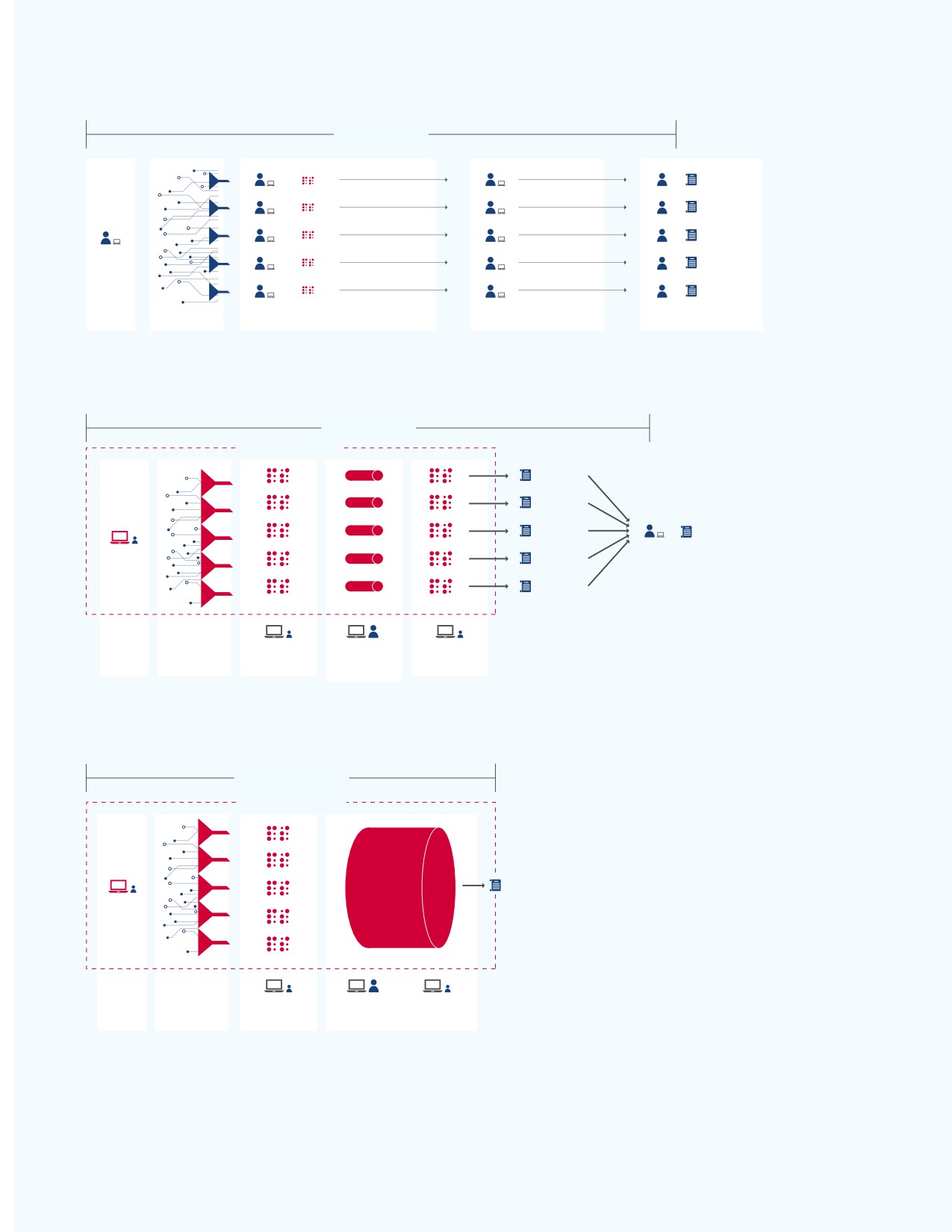
Current
AI-Enabled National
Intelligence.
Days to Weeks
HUMINT
SIGINT
IMINT
MASINT
Planning
OSINT
and
Tasking
Collection
Processing
Exploitation and Analysis
Dissemination
Optimized: AI-Enabled Automation within Current Intelligence Disciplines
Hours to Days
AI-Enabled Tools
HUMINT
SIGINT
Fused All
IMINT
Source
Intelligence
MASINT
OSINT
Planning
and
Collection
Processing
Exploitation
Dissemination
Tasking
and Analysis
Transformed: AI-Enabled All Source Intelligence and Predictive Analysis
Continuous Cycle
AI-Enabled Tools
HUMINT
SIGNIT
Fused All Source Intelligence
IMINT
and Predictive Analysis
MASINT
OSINT
Planning
and
Collection
Processing
Exploitation
Dissemination
Tasking
and Analysis
CHAPTER 5
Preparing for an AI-ready 2025 demands the following actions:
Empower the IC’s science and technology leadership. The Director of National Intelligence
Recommendation
(DNI) should designate the Director of Science and Technology (S&T) within the Office of
the Director of National Intelligence (ODNI) as the IC’s Chief Technology Officer (CTO) and
task and empower this position to drive the IC’s adoption of AI-enabled applications to
solve operational intelligence requirements. To do so, the IC CTO should oversee the AIM
strategy, establish and enforce common technical standards and policies necessary to
rapidly and responsibly scale AI-enabled applications across the IC, and lead acquisition
reform to ensure that the IC can rapidly procure and field systems to its intelligence
professionals. The IC CTO should be granted additional authorities for establishing policies
on and supervising IC research and engineering, technology development, technology
transition, appropriate prototyping activities, experimentation, and developmental testing
activities.
Change risk management practices to accelerate new technology adoption. The IC needs
Recommendation
to balance the technical risks involved in bringing new technologies online and quickly
updating them with the substantial operational risks that result from not keeping pace,
similar to DoD. Regular software upgrades should be automated to the extent possible. To
share software tools more easily among agencies, reciprocal accreditation of information
technology systems should be the standard.4
“The IC needs to balance
the technical risks involved
in bringing new technologies
on line and quickly updating
them with the substantial
operational risks that result
from not keeping pace ...”
p
113
AI AND THE FUTURE OF NATIONAL INTELLIGENCE
To coordinate these changes, the ODNI should establish a Senior Risk Management
Council focused on technology modernization.5 Its task should be to weigh the risks of
adopting new technologies with the opportunity costs of not doing so. Its goal should be
to ensure that analysts have access to the tools they need to do their jobs.
The IC will need support from the intelligence committees in Congress--for example, in the
flexible use of funds within a more agile software development framework. To support the
argument for greater flexibility, the IC should develop data-driven ways of communicating
operational gains, as well as credible assessments of the risk of inaction.
Improve coordination and interoperability between the IC and DoD. The IC must aggressively
Recommendation
pursue automated interoperability with the DoD for intelligence operations conducted at
machine speeds.6 To do this, security managers and network administrators must build
greater confidence in fast and secure data exchanges. ODNI, the Under Secretary of
Defense for Intelligence and Security, and the Joint Artificial Intelligence Center (JAIC)
should coordinate more on intelligence-related AI projects to minimize duplication of
effort while maximizing common approaches to AI capability development, testing and
evaluation, deployment, international engagement, and policies and authorities. They
should work together to create interoperable and sharable resources and tools--such
as those envisioned in the AI R&D ecosystem described in Chapter 2 of this report--and
should establish a culture of sharing all AI-enabled capabilities whenever feasible.7
Capitalize on AI-enabled analysis of open-source and publicly available information.8 The IC
Recommendation
should develop a coordinated and federated approach to applying AI-enabled applications
to open-source intelligence (OSINT) and should strive to integrate open-source analysis
into existing intelligence processes wherever possible in every intelligence domain.9
Prioritize and accelerate collection of scientific and technical intelligence to better understand
Recommendation
adversary capabilities and intentions. Such collection requires the IC to significantly increase
the technical sophistication, capabilities, and capacity of its analytic workforce. That must
involve aggressive efforts to train, recruit, and retain analysts who have the requisite
skills. These analysts must guide collection requirements and provide timely, accurate
assessments. To better coordinate intelligence on these topics, including collecting on
scientific and technical cooperation among our competitors, the DNI should appoint an
Emerging Technology Collection Executive within the National Intelligence Council.10
To recruit more S&T experts into the IC, aggressively pursue security clearance reform for
Recommendation
clearances at the Top Secret level and above, and enforce security clearance reciprocity
among members of the IC. ODNI should develop and implement an AI-enabled data and
science-based approach to security-clearance adjudication that significantly shortens
investigation timelines.11
p
114
CHAPTER 5
Advance and continue to develop a purpose-built IC Information Technology Environment that
Recommendation
can fuse intelligence from different domains and sources. An AI-enabled technical architecture
of this kind could help autonomously integrate intelligence across stove-piped intelligence
domains, which currently often require manual intervention to share raw data or finished
analysis.12 Doing so would help the IC blend insights from different streams of information to
create a composite picture. For example, signals intelligence often depends upon human
intelligence or geospatial intelligence. Likewise, the value of human intelligence can almost
always be enhanced by layering signals intelligence or open-source information on top of it.
Embrace fused, predictive analysis as the new standard. Successfully fusing all-source/all-
Recommendation
domain intelligence will enable accurate predictive analysis in a way that is not currently
possible. The government’s response to the COVID-19 virus has offered glimpses into
the potential for fused data sets to inform such analysis. For example, U.S. Northern
Command (working with the JAIC and the National Guard Bureau) built predictive models
from dozens of different data sets that helped to identify COVID-19 hotspots and reconcile
demands for critical supplies.13
Develop innovative human-centric approaches to human-machine teaming. The kind of data
Recommendation
fusion envisioned here through autonomous machine-to-machine integration will require
new concepts for human-machine teaming that optimize the strengths of each.14 The IC
will need new approaches that amplify and extend human cognition to effectively handle
the scale and complexity of the information generated by all-source intelligence analytic
engines. When developing these systems, the IC must understand and make deliberate
decisions on when and under what conditions the human or machine should act alone and
under what conditions human-machine teaming is desirable.
“The kind of data fusion
envisioned here through
autonomous machine-to-
machine integration will require
new concepts for human-
machine teaming that optimize
the strengths of each.”
p
115
AI AND THE FUTURE OF NATIONAL INTELLIGENCE
Chapter 5 - Endnotes
1 For additional information on AI-enabled use cases throughout the intelligence cycle, see the
discussion on “Applications” in Maintaining the Intelligence Edge: Reimagining and Reinventing
Intelligence Through Innovation, CSIS Technology and Intelligence Task Force at 8-22 (Jan. 13, 2021),
https://csis-website-prod.s3.amazonaws.com/s3fs-public/publication/210113_Intelligence_Edge.pdf.
2 AIM Initiative: A Strategy for Augmenting Intelligence Using Machines, Office of the Director of
National Intelligence (2019), https://www.dni.gov/files/ODNI/documents/AIM-Strategy.pdf (foreword by
the Honorable Sue Gordon, Principal Deputy Director of National Intelligence).
3 Frank Konkel, The Details about the CIA’s Deal with Amazon, The Atlantic (July 14, 2014),
amazon/374632/.
4 In adopting new software systems, the IC follows a risk-management framework developed by the
National Institute of Standards and Technology (NIST). While it is a useful framework overall, it can
also create delays or prevent the IC from keeping up with cutting-edge AI tools that are commercially
available. For more information, see FISMA Implementation Project, NIST (Dec. 3, 2020), https://csrc.
nist.gov/projects/risk-management/rmf-overview.
5 The Senior Risk Management Council would help the IC implement guidance from the proposed
Tri-Chair Committee on Emerging Technology and function similarly to the role this commission
recommended for the Under Secretary of Defense for Research and Engineering as a co-chair on the
Joint Requirements Oversight Council in DoD.
6 For more information, see Kent Linnebur, et al., Intelligence After Next: The Future of the IC
sites/default/files/publications/pr-20-1891-intelligence-after-next-the-future-of-the-ic-workplace.pdf.
7 These efforts should leverage the JAIC’s Joint Common Foundation (JCF).
8 Pub. L. 116-260, The Consolidated Appropriations Act (2021), Division W, Section 326 (“Open
source intelligence strategies and plans for the intelligence community”), Section 623 (“Independent
study on open-source intelligence”), and Section 624 (“Survey on Open Source Enterprise”) provide a
starting point for the IC to reimagine the role of open-source intelligence.
9 It is important to note that open-source intelligence (OSINT) is not limited to traditional media
sources (newspapers, radio broadcasts, etc.) and social media. OSINT also includes publicly
available information such as public government data sources (official reports, budget documents,
hearing testimonies, etc.), professional and academic publications, commercial data sources
(industry reports, financial statements, commercial imagery, etc.), and more.
10 For additional information, see the discussion on “Elevating Technical Intelligence” in Maintaining
the Intelligence Edge: Reimagining and Reinventing Intelligence Through Innovation, CSIS Technology
and Intelligence Task Force at 12 (Jan. 13, 2021), https://csis-website-prod.s3.amazonaws.com/s3fs-
public/publication/210113_Intelligence_Edge.pdf.
11 For more information on the need for an academic and scientific review of behavioral approaches
to security clearance adjudication, see David Luckey, et al., Assessing Continuous Evaluation
Approaches for Insider Threats: How Can the Security Posture of the U.S. Departments and Agencies
RR2684.html.
p
116
CHAPTER 5
Chapter 5 - Endnotes
12 The technical aspects of such an environment are covered in more detail in Chapter 2 of this report.
13 Air Force General Terrence J. O’Shaughnessy, Commander, U.S. Northern Command & Army
Lieutenant General Laura J. Richardson, Commander, U.S. Army North, Transcript: US NORTHCOM
and ARNORTH Commanders Discuss Ongoing COVID-19 Efforts, U.S. Department of Defense (April
and-arnorth-commanders-discuss-ongoing-covid-19-efforts/.
p
117
AI AND THE FUTURE OF NATIONAL INTELLIGENCE
14 See Kenneth M. Ford, et al., Cognitive Orthoses: Toward Human-Centered AI, AI Magazine at 7
(Winter 2015), https://doi.org/10.1609/aimag.v36i4.2629; John Laird, et al., Future Directions in Human
defense.gov/Portals/61/Future%20Directions%20in%20Human%20Machine%20Teaming%20
Workshop%20report%20%20%28for%20public%20release%29.pdf; Gagan Bansal, et al., Is the Most
microsoft.com/en-us/research/publication/is-the-most-accurate-ai-the-best-teammate-optimizing-ai-
for-teamwork/.
p
118
CHAPTER 6
Chapter 6: Technical
Talent in Government
p
119

TECHNICAL TALENT IN GOVERNMENT
Improve Technical Talent in Government
Organize
Recruit
Build
Employ
p
120