National Security Commission on Artificial Intelligence. Final Report - page 4
CHAPTER 10
Chapter 10 - Endnotes
12 William S. Kerr, High-Skilled Immigration, Innovation, and Entrepreneurship: Empirical Approaches
papers/w19377; Gordon Hanson & Matthew Slaughter, Strengthening the U.S. AI Workforce, High-
Skilled Immigration and the Rise of STEM Occupations in U.S. Employment, National Bureau of
Economic Research at 23 (Sept. 2016), https://www.nber.org/system/files/working_papers/w22623/
w22623.pdf; Remco Zwetsloot, et al., Strengthening the U.S. AI Workforce: A Policy and Research
wp-content/uploads/CSET-Strengthening-the-U.S.-AI-Workforce.pdf.
13 Carsten Fink, What Leads Inventors to Migrate?, World Economic Forum (July 17, 2013), https://www.
weforum.org/agenda/2013/07/what-leads-inventors-to-migrate/.
14 Ernest Miguelez & Carsten Fink, Measuring the International Mobility of Inventors: A New Database,
World Intellectual Property Organization at 16 (May 2013), https://www.wipo.int/edocs/pubdocs/en/
wipo_pub_econstat_wp_8.pdf.
15 According to the Center for Security and Emerging Technology, in 2016, 14% of international
students declined offers to study at U.S. universities to study at home, and 19% decided to study in
another country. In 2018, these numbers rose, with 39% staying at home and 59% studying in another
country. Remco Zwetsloot, et al., Keeping Top AI Talent in the United States: Findings and Policy
Options for International Graduate Student Retention, Center for Security and Emerging Technology
at 26 (Dec. 2019), https://cset.georgetown.edu/wp-content/uploads/Keeping-Top-AI-Talent-in-the-
United-States.pdf.
16 Shulamit Kahn & Megan MacGarvie, The Impact of Permanent Residency Delays for STEM PhDs:
abs/pii/S0048733319301982.
17 Tina Huang & Zachary Arnold, Immigration Policy and the Global Competition for AI Talent, Center
for Security and Emerging Technology at 8 (June 2020), https://cset.georgetown.edu/research/
immigration-policy-and-the-global-competition-for-ai-talent/.
18 Zachary Arnold, et al., Immigration Policy and the U.S. AI Sector: A Preliminary Assessment, Center
for Security and Emerging Technology at 22 (Sept. 2019), https://cset.georgetown.edu/research/
immigration-policy-and-the-u-s-ai-sector/.
19 Remco Zwetsloot, et al., Strengthening the U.S. AI Workforce: A Policy and Research Agenda,
Center for Security and Emerging Technology at 5 (Sept. 2019), https://cset.georgetown.edu/wp-
content/uploads/CSET-Strengthening-the-U.S.-AI-Workforce.pdf.
20 China is the world’s largest single source of AI talent. Leading U.S. technology companies such
as Google and Microsoft have established cutting-edge research centers in China, in part to access
that talent. This increases China’s AI R&D capacity and potential for technology transfer, and,
if the companies remain American, it reduces the American Intelligence Community’s (IC) legal
authorization to collect information about Chinese technology development. See The Global AI Talent
ai-talent-tracker/; Roxanne Heston & Remco Zwetsloot, Mapping U.S. Multinationals’ Global AI R&D
edu/wp-content/uploads/CSET-Mapping-U.S.-Multinationals-Global-AI-RD-Activity-1.pdf.
p
181
THE TALENT COMPETITION
21 Remco Zwetsloot, US-China STEM Talent “Decoupling”: Background, Policy, and Impact, Johns
Hopkins Applied Physics Laboratory at 19 (2020), https://www.jhuapl.edu/assessing-us-china-
technology-connections/dist/407b0211ec49299608551326041488d4.pdf (“[T]he head of the [Chinese
Communist Party’s (CCP)] Central Talent Work Coordination Small Group … complained that ‘the
number of top talents lost in China ranks first in the world.’”); see also Joy Dantong Ma, China’s
chinas-ai-talent-base-is-growing-and-then-leaving/?rp=m (noting that of the 2,800 Chinese NeurIPS
participants between 2009 and 2018, about three-quarters of them were currently working outside of
China).
humanitarian-parole/international-entrepreneur-parole. There is currently no visa category well-suited
to entrepreneurship in immigration statute. The IER, which relies on parole authority, was initiated
after legislative avenues were exhausted. Legislative fixes would be preferable, but have so far they
have proven politically infeasible.
23 A 2010 report to Congress indicated that some 242,000 unused family-based green cards were
ultimately applied to the employment-based backlog, while Congress recaptured some 180,000 green
cards via special legislation, leaving more than 326,000 green card numbers wasted. Citizenship and
Immigration Services Ombudsman: Annual Report 2010, U.S. Department of Homeland Security (June
30, 2010), https://www.dhs.gov/xlibrary/assets/cisomb_2010_annual_report_to_congress.pdf. The
number today is likely higher, but DHS has not published updated statistics.
24 Prior examples of Congressional action include provisions in the American Competitiveness in the
21st Century Act of 2000 and the REAL ID Act of 2005. See Pub. L. 106-313, 114 Stat. 1251, 1254
(2000) and Pub. L. No. 109-013, 119 Stat. 231, 322 (2005).
25 Specifically, 8 U.S.C. § 1151(b)(1).
26 William Kandel, The Employment-Based Immigrant Backlog, Congressional Research Service at 4-5
(March 26, 2020), https://fas.org/sgp/crs/homesec/R46291.pdf.
27 Michael Roach, et al., Are Foreign STEM PhDs More Entrepreneurial? Entrepreneurial
Characteristics, Preferences and Employment Outcomes of Native and Foreign Science & Engineering
files/working_papers/w26225/w26225.pdf.
28 Id. at 12.
29 EB-5 visas require a minimum $900,000 investment in a business in the United States. William R.
Kerr, Global Talent and U.S. Immigration Policy: Working Paper 20-107, Harvard Business School
c884234d9b31.pdf.
30 83 Fed. Reg. 24415, Removal of International Entrepreneur Parole Program, U.S.
Department of Homeland Security (May 29, 2018), https://www.federalregister.gov/
documents/2018/05/29/2018-11348/removal-of-international-entrepreneur-parole-program.
31 Oren Etzioni, What Trump’s Executive Order on AI Is Missing: America Needs a Special Visa
wired.com/story/what-trumps-executive-order-on-ai-is-missing/.
p
182
CHAPTER 11
Chapter 11:
Accelerating AI
Innovation
p
183

ACCELERATING AI INNOVATION
Leadership in AI Innovation
Scale and
Coordinate Federal
AI R&D Funding
Expand Access
Through a National AI
R&D Infrastructure
Strengthen
Public-Private
Partnerships
Tackle Humanity’s
Biggest Challenges
p
184
CHAPTER 11
To remain the world’s leader in artificial intelligence (AI), the U.S.
government must renew its commitment to investing in America’s
national strength: innovation. This will require making substantial
new investments in AI R&D and establishing a national AI research
infrastructure that democratizes access to the resources that fuel
AI. Members of Congress must come to terms with the reality
that tens of billions of dollars will be needed over the next several
years. The return on these investments will transform America’s
economy, society, and national security.
A lack of national urgency is dangerous at a time when underlying weaknesses have emerged
in our AI ecosystem that impair innovation and when viewed against the backdrop of China’s
state-directed AI progress. The development of AI in the United States is concentrated
in fewer organizations in fewer geographic regions pursuing fewer research pathways.
Commercial agendas are dictating the future of AI and concentrating heavily in one discipline:
machine learning (ML).1 Despite promising moves, government funding has lagged behind
the transformative potential of the field, limiting its ability to shape research toward the public
good and support progress across a range of AI disciplines.2 As a result, the AI innovation
environment rests on a narrowing foundation.
“A lack of national urgency
is dangerous at a time when
underlying weaknesses have
emerged in our AI ecosystem
that impair innovation, and when
viewed against the backdrop
of China’s state-directed
AI progress.”
p
185
ACCELERATING AI INNOVATION
These trends toward consolidation come as a result of resources. Declining per-unit costs of
cloud-based computing and availability of open-source platforms have lowered barriers to
access for core ML. However, those same conditions have enabled pursuit of sophisticated
models that require extensive training data, often held in privately controlled data sets or
knowledge graphs, enormous computing power, and substantial hardware and software
engineering.3 These prerequisites now define the cutting edge of AI research and effectively
limit the number of American researchers able to contribute to the field and tackle the hard
challenges that could unlock new frontiers of AI.
Ingenuity, Not Access, Should Be the Key to AI Innovation in America.
The consolidation of the AI industry threatens U.S. technological competitiveness in five ways:
• Brain Drain. Brain drain from academic institutions to the private sector threatens to
hollow out the foundations of the United States’ advantage in basic AI research: its
universities.4 Federal funding that has not kept pace with the growth of the field has led
to low grant application success rates and amplified time spent on the bureaucracy of
pursuing and completing proposals.5 However, academic experts and their students
are not just lured to big tech by the promise of less bureaucracy and higher financial
incentives. Increasingly, the private sector is the best place to conduct cutting-edge
research with access to the best computing and data resources. The result is the
weakening of the teaching base for the next generation of AI leaders in industry and
academia and the narrowing of the overall AI research agenda.6
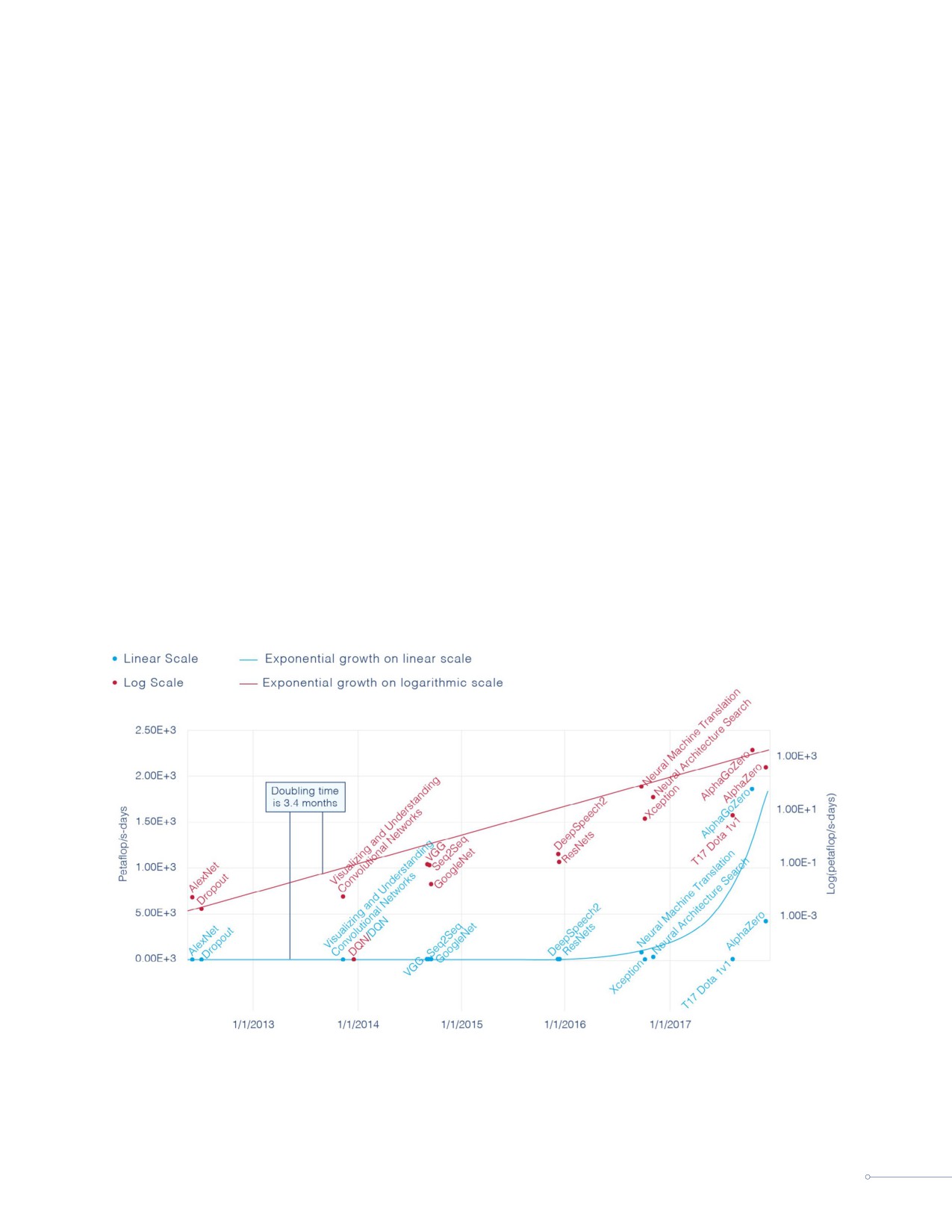
Compute Required
Compute Required to Train Largest Deep Learning Models (2012-2017)
to Train Largest
Deep Learning
Models (2012-2017)
Source: OpenAI, AI and Compute (May 16, 2018), https://openai.com/blog/ai-and-compute/
A “petaflop/s-day” is a measure of compute that consists of performing 10^15 floating point operations
per second for one day.
GPT-3 and more recent models are not represented here because they are too large to fit on this scale.
p
186
CHAPTER 11
•
Diversity. The growing divide between “haves” and “have nots” in AI will exacerbate the
well-documented lack of diversity in the field,7 limiting the field’s collective ability to
build equitable, inclusive systems.
•
Research Focus. American technology firms are accountable to their shareholders and
will logically not invest in areas of national security importance or make uncertain bets
on fundamental research that does not hold commercial or economic benefit for the
company.8 While return-focused investments can lead to applications that contribute
to the public good or benefit government work, there are gaps. ML and the underlying
algorithms were in exactly this position two decades ago—seemingly without
commercial promise—only to be sustained by federal research dollars until computing
power and an overabundance of data transformed the discipline.9 A recent study found
that 82% of the algorithms in use today originated from federally funded non-profits
and universities, compared to just 18% that originated from private companies.10
•
Competition. The rising cost of developing cutting-edge ML models and high
likelihood of acquisition by leading technology companies means AI startups have
narrowing paths to growth in the United States.11 Lack of competition undermines
the industry’s ability to innovate and be globally competitive in the research and
development of AI.
•
Regional Divergence. The clustering of technology firms in regions like Silicon Valley
drives innovation by expediting knowledge sharing and sharpening domestic rivalry.12
However, this trend has benefited some regions and demographics more than others.13
More than 90% of U.S. innovation sector job creation occurred in just five major coastal
cities between 2005 and 2017.14 This divergence concentrates gains from technological
progress in just a few regions and misses out on latent innovation potential in the rest of
the country.
The federal government holds the responsibility to reverse these trends. It must step in
and step up to provide strategic direction and sustained resources, as both a funder and
consumer of technology.15 It must break the mold of standard scientific research funding.
The outcomes of technology innovation, which generate greatest value when translated
into fieldable solutions, are driven by multi-sector contributions and a culture of risk
acceptance. The status quo at federal agencies and research entities is insufficient to
make these big bets and propel promising technology concepts from laboratory to field.
A passive national approach that relies too heavily on the private sector to drive innovation
and determine research agendas—and that presumes commercial innovation can simply
“spin-in” to become government applications—will not win this strategic competition, nor
will it fully capitalize on the transformative potential of AI. The United States—through
government leadership in partnership with industry and academia—must increase the
diversity, competitiveness, and accessibility of its AI innovation environment. That begins
with a substantial infusion of new R&D dollars.
p
187
ACCELERATING AI INNOVATION
“The United States—through
government leadership in
partnership with industry and
academia—must increase the
diversity, competitiveness, and
accessibility of its AI innovation
environment.”
Scale and coordinate federal AI R&D funding. A bold, integrated push for long-term
Recommendation
investments in AI R&D will foster nationwide AI innovation and drive breakthroughs. An
infusion of sustained resources, guided by a comprehensive strategy and distributed
through a diversity of mechanisms, will enable U.S. researchers to push the boundaries of
the field by supporting a wide range of AI approaches and novel applications of AI to other
fields. Specifically, the United States should:
•
Establish a National Technology Foundation (NTF). A new, independent organization
would complement successful existing organizations, such as the NSF and DARPA,
by providing the means to more aggressively move science into engineering. The NTF
would drive technology progress at a national level by focusing on generating value at
intermediate levels of technical maturity, prioritizing use-inspired concepts, establishing
infrastructure for experimentation and testing, and supporting commercialization of
successful outcomes. This requires an organization that is structured to accept higher
levels of risk and empowered to make big bets on innovative ideas and people.
•
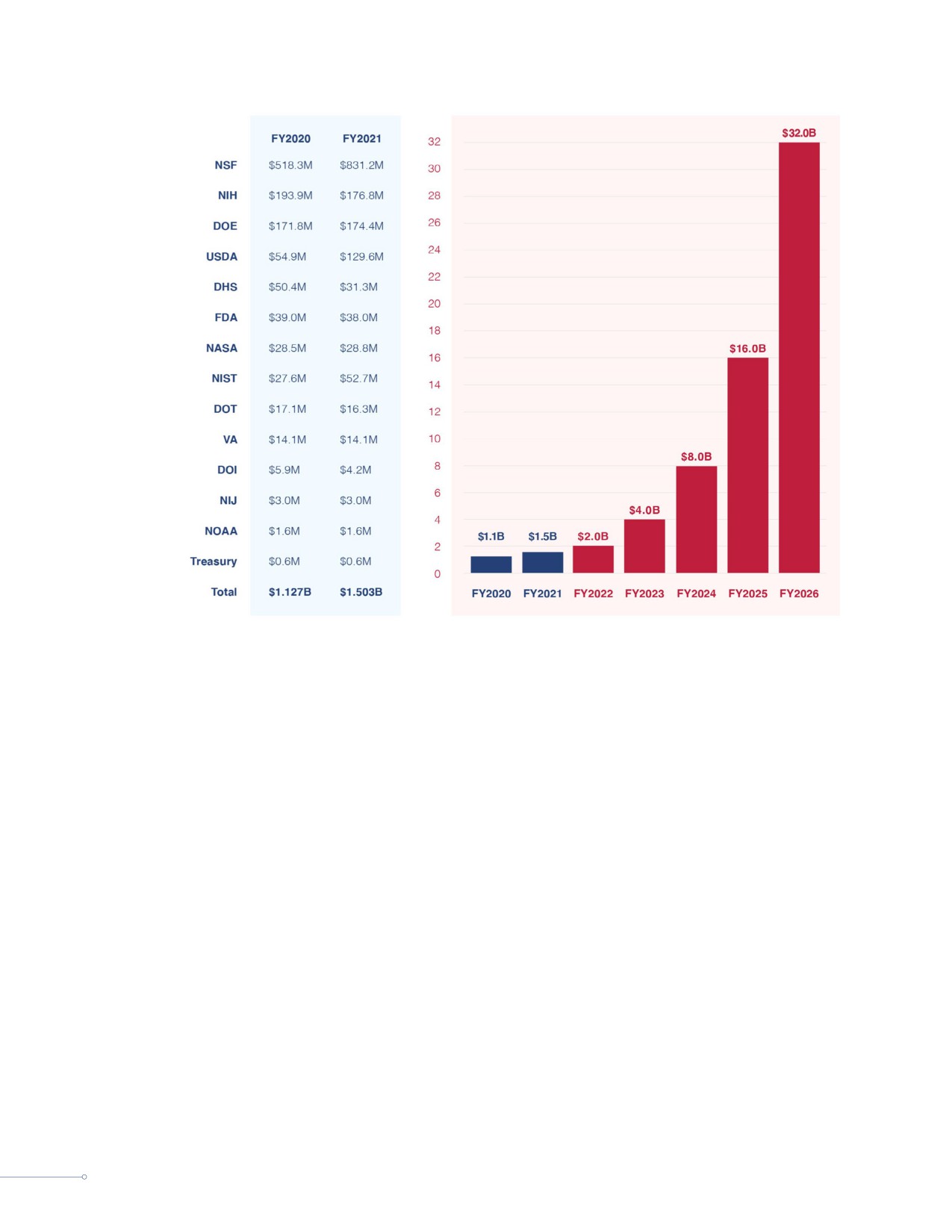
Increase federal funding for non-defense AI R&D at compounding levels, doubling
annually to reach $32 billion per year by Fiscal Year 2026. This would bring AI
spending to a level near to federal spending on biomedical research.16 Overall, the
government should spend at least 1% of GDP on R&D to reinforce a base of innovation
across scientific fields.17 Additional funding should strengthen basic and applied
research, expand fellowship programs, support research infrastructure, and cover
several agencies, with an emphasis on:
o National Technology Foundation (proposed)
o Department of Energy
o National Science Foundation
o National Institutes of Health
o National Institute of Standards and Technology
o National Aeronautics and Space Administration
p
188
CHAPTER 11
AI R&D
Investment Levels.
DHS - Department of Homeland Security
NIST - National Institute of Standards and
DOE - Department of Energy
Technology
DOI - Department of the Interior
NOAA - National Oceanic and Atmospheric
DOT - Department of Transportation
Administration
FDA - Food and Drug Administration
NSF - National Science Foundation
NASA - National Aeronautics and Space
Treasury - Treasury/Financial Crimes
Administration
Enforcement Network
NIH - National Institutes of Health
USDA - U.S. Department of Agriculture
NIJ - National Institute of Justice
VA - Department of Veterans Affairs
Source: The Networking & Information Technology Research & Development Program, Supplement to The
President’s FY2021 Budget, National Science & Technology Council (Aug. 14, 2020), https://www.nitrd.gov/
pubs/FY2021-NITRD-Supplement.pdf.
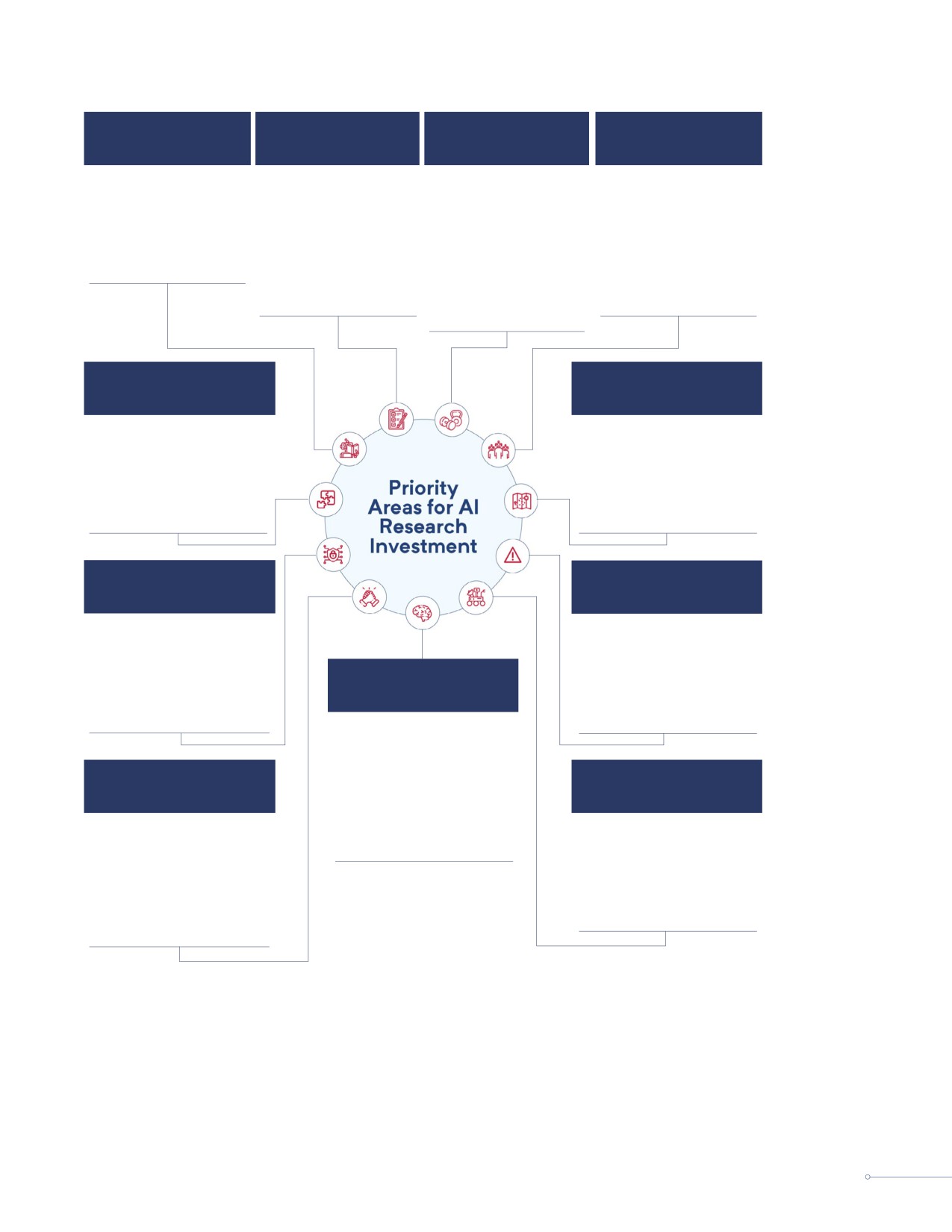
• Prioritize funding for key areas of AI R&D. Amplified federal funding should prioritize
AI R&D investments in areas critical to advance technology that will underpin future
national security and economic stability, supporting areas that may not receive
significant private-sector investment. Coordinated through the newly established
National AI Initiative,18 investments should reflect a portfolio approach, focused
on advancing basic science, solving specific challenge problems, and facilitating
commercialization breakthroughs.
p
189
ACCELERATING AI INNOVATION
Priority Areas
Test and evaluation,
Novel machine-learning
Complex multi-agent
for AI Research
verification and
Robust and resilient AI
(ML) directions
scenarios
Investment.
validation (TEVV)
Further non-traditional
Develop a better
Cultivate methods that
Advance the understanding
approaches to supervised
understanding of how
can overcome adverse
of interacting cohorts of
ML in an unsupervised or
to characterize the
conditions, including
AI systems, including
semi-supervised manner
performance of an AI-
multiple classes of
research into adversarial
as well as the transfer of
system, including improved
adversarial attacks, and
vulnerabilities and
learning from one task or
methods to predict AI-
advance approaches
mitigations, along with the
domain to another.
system behavior in system-
that enable assessment
application of game theory
of-systems contexts and
of types and levels of
to varied and complex
new environments.
vulnerability, immunity, and
scenarios.
fairness.
Integrated AI, modeling,
Advanced
simulation, and design
scene understanding
Progress the use of simulations
Evolve perceptual models to
as sources of data and
incorporate multi-source and
scenarios for training and
multi-modal information to
testing AI systems, and use AI
support enhanced actionable
to serve as a generative design
awareness and insight across
engine in scientific discovery
a range of complex, dynamic
and engineering.
environments and scenarios.
Preserving personal privacy
AI system risk assessment
Assure privacy protection in
Advance capabilities to support
data use for AI development
risk assessment, including
and operation through
standard methods and
advancements in anonymity
metrics for evaluating degrees
Toward more general
techniques and technologies
of auditability, traceability,
artificial intelligence
such as multi-party federated
interpretability, explainability,
learning.
and reliability.
Research challenges and
mysteries of human intellect,
including the ability to
learn in an unsupervised
Enhanced human-AI
manner, amass and apply
AI autonomous systems
interaction and teaming
commonsense, build causal
models, exercise self-
Progress the understanding
Advance a system’s ability
awareness, and generalize
of human-AI complementarity,
to accomplish goals
knowledge.
methods for augmenting human
independently, or with minimal
reasoning, fluid handoffs in
supervision from human
mixed-initiative systems, and
operators in environments
AI technology’s perception
that are complex and
of human intention and
unpredictable.
communications.
p
190
CHAPTER 11
• Triple the number of National AI Research Institutes. The government should triple
the current number of federally funded national AI research institutes across a range of
regions and research areas.19 This would increase training and research opportunities
for students and academic faculty, national lab researchers, and non-profit research
organizations.
• Invest in talent that will transform the field. In parallel, NSF or the proposed NTF
should invest in top AI researchers and interdisciplinary teams, launching grant awards
that make big bets on the people and the out-of-the-box ideas that could lead to
unexpected breakthroughs.
“Democratized access to compute
environments, data, and testing
facilities will provide researchers
beyond leading industry players
and elite universities the ability
to pursue progress on the cutting
edge of AI.”
Expand access to AI resources through a National AI Research Infrastructure. Democratized
Recommendation
access to compute environments, data, and testing facilities will provide researchers
beyond leading industry players and elite universities the ability to pursue progress on
the cutting edge of AI. It will strengthen the foundation of American AI innovation by
supporting more equitable growth of the field, expanding AI expertise across the country,
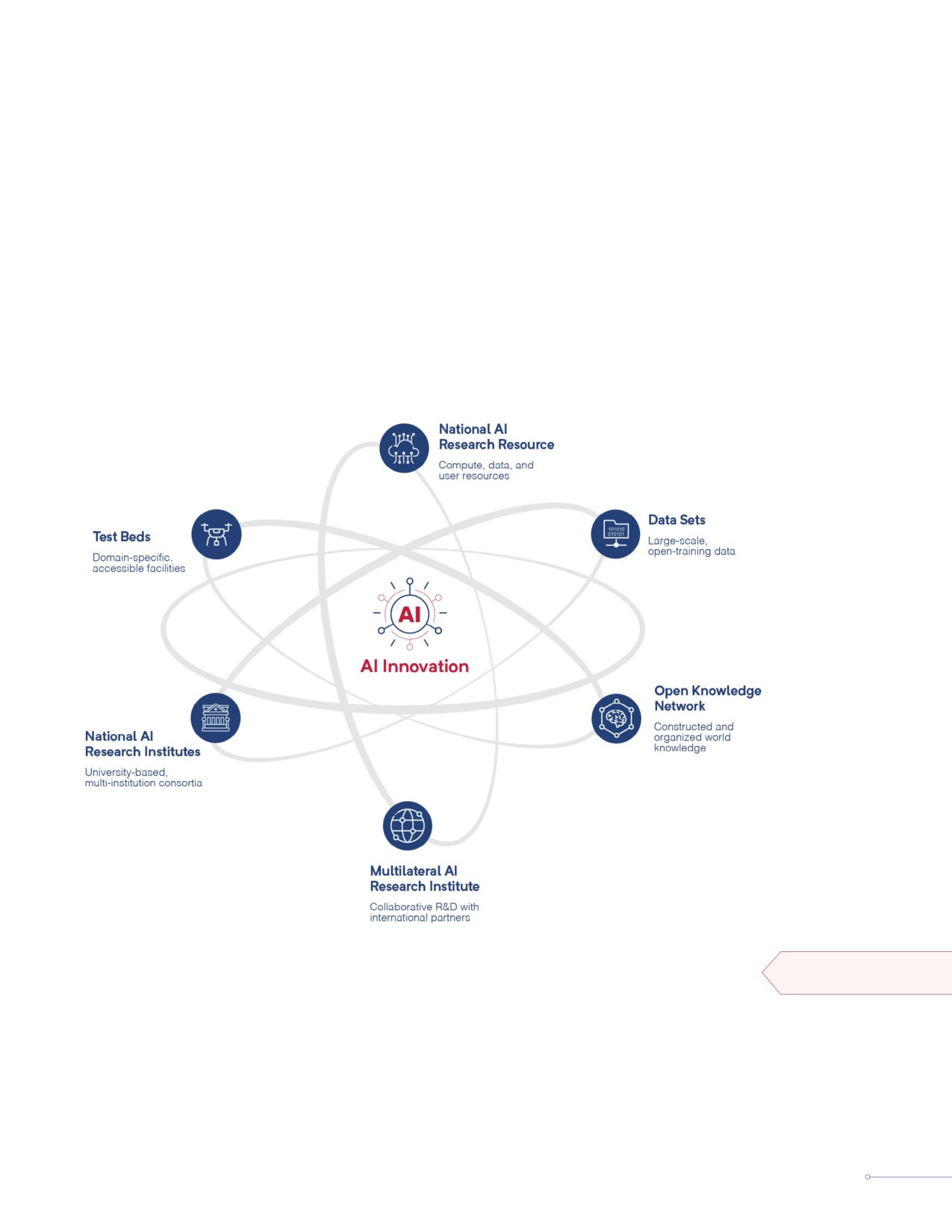
and applying AI to a broader range of fields. This national infrastructure should have five
main elements:
• A National AI Research Resource (NAIRR).20 To bridge the “compute divide,”21 the
NAIRR would provide verified researchers and students subsidized access to scalable
compute resources, co-located with AI-ready government and non-government
data sets, educational tools, and user support. It should be created as a public-private
partnership, leveraging a federation of cloud platforms.22
• A set of domain-specific AI R&D test beds. Sponsored by various federal agencies,
these would provide accessible facilities, establish benchmarking standards, and build
communities of discovery around AI application areas that are in the public interest.
p
191
ACCELERATING AI INNOVATION
• Large-scale, open training data. This should include curation, hosting, and maintenance
of complex data sets; incentives to the private sector and academia to share data sets; and
funding for teams of data engineers and scientists to unlock public data currently held by
the government for use by the AI research community.
• An open knowledge network. Coordinated by the Office of Science and Technology
Policy, such a resource would enable use of constructed and organized world knowledge to
develop AI systems that operate effectively and efficiently.23
• A Multilateral AI Research Institute. To foster collaborative R&D with researchers from key
allies and partners (described further in Chapter 15 of this report).
These resources would work in complement to each other, providing a virtuous cycle of data,
experimentation, testing, and knowledge-building that would fuel innovation and application of
AI to a wide range of challenge problems and fields of study.
National AI
Research
Infrastructure.
Leverage both sides of the public-private partnership. U.S. leadership in technologies like AI
Recommendation
depends upon closer public-private collaboration and a shared sense of responsibility for
U.S. global competitiveness. To promote innovation and accelerate the growth of globally
competitive firms in strategic emerging sectors, the government should:
• Create markets for AI and other strategic technologies. The application of AI across
government agencies can save taxpayer dollars and improve the quality of public
p
192
CHAPTER 11
services. Some applications can be adopted directly from the private sector, while
others are unique to the government mission. By accelerating AI adoption across
federal agencies, the government can drive additional commercial investment in AI
applications that benefit national security and the public good.24
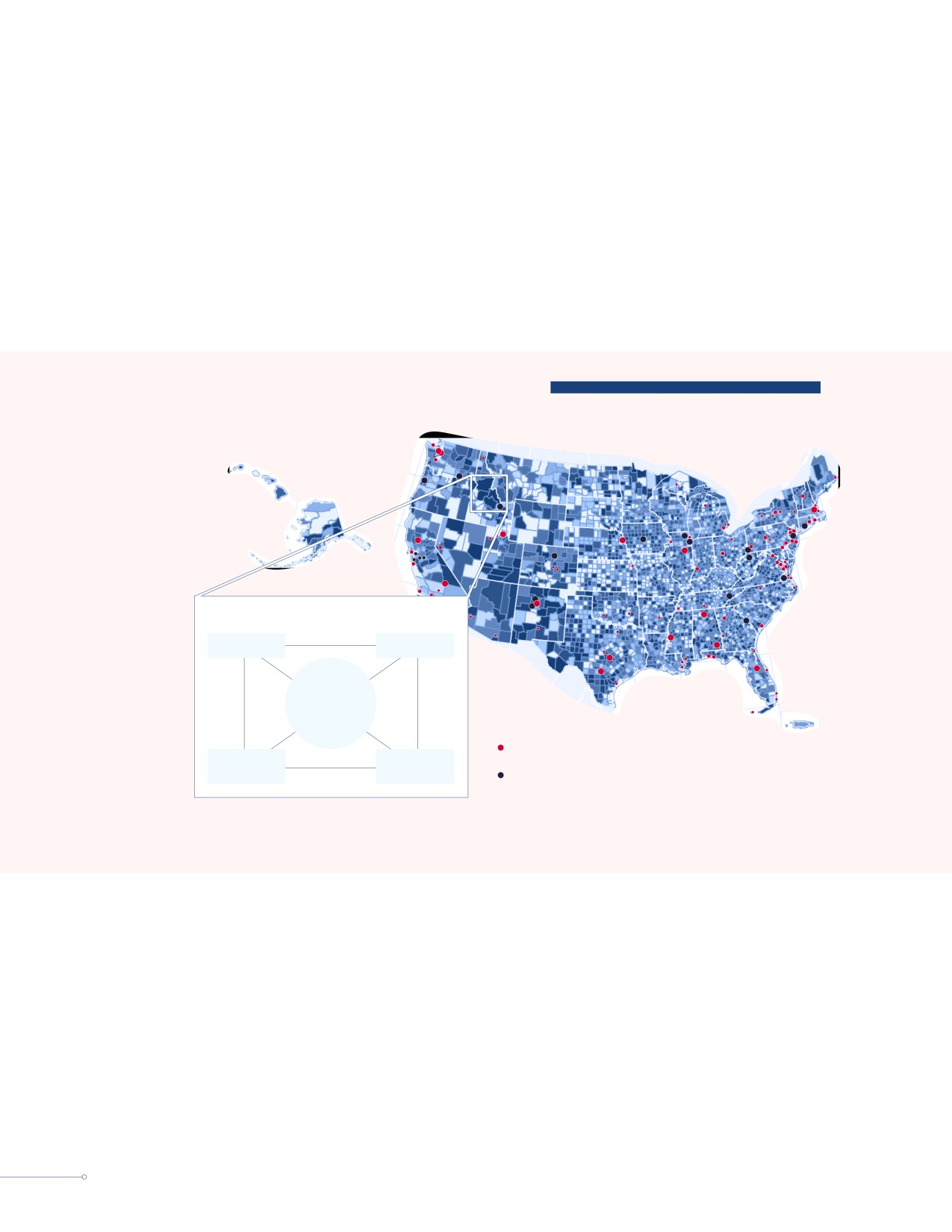
• Form a network of regional innovation clusters focused on strategic emerging
technologies. The government should designate regional innovation clusters focused
on strategic emerging technologies like AI to foster the growth of small companies
in sectors that are critical to overall U.S. competitiveness. Established through a
competitive bid process, the clusters would offer participants from industry and
academia tax incentives, research grants, and access to federal R&D resources.
Regional
Cluster Strength* by County, 2017
0.00%
med=47.30%
100%
Innovation
Clusters.
Example Cluster Organization
Firm 1
Firm 2
Technology
Research Center
KEY:
DOD Laboratories and Centers
Research
Federal R&D
Institution
Resource
DOE National Laboratories
*Cluster strength is the percent of traded employment in a region with high employment specialization. This is one of many important factors to consider
when selecting locations for regional innovation clusters.
Image source: U.S. Cluster Mapping Project, Institute for Strategy and Competitiveness, Harvard
Business School. Data source: U.S. Census Bureau.
The private sector should:
• Privately fund an AI competitiveness consortium. Private firms should establish a
non-profit organization with $1 billion in funding over five years to broaden AI research
opportunities and support AI skills and education. This donation-funded organization
would focus on fostering economic opportunity through resources for AI research and
AI skills training. Such corporate social responsibility spending to promote AI education
and entrepreneurship would help bridge the gap between digital “haves” and “have
nots.”
p
193
ACCELERATING AI INNOVATION
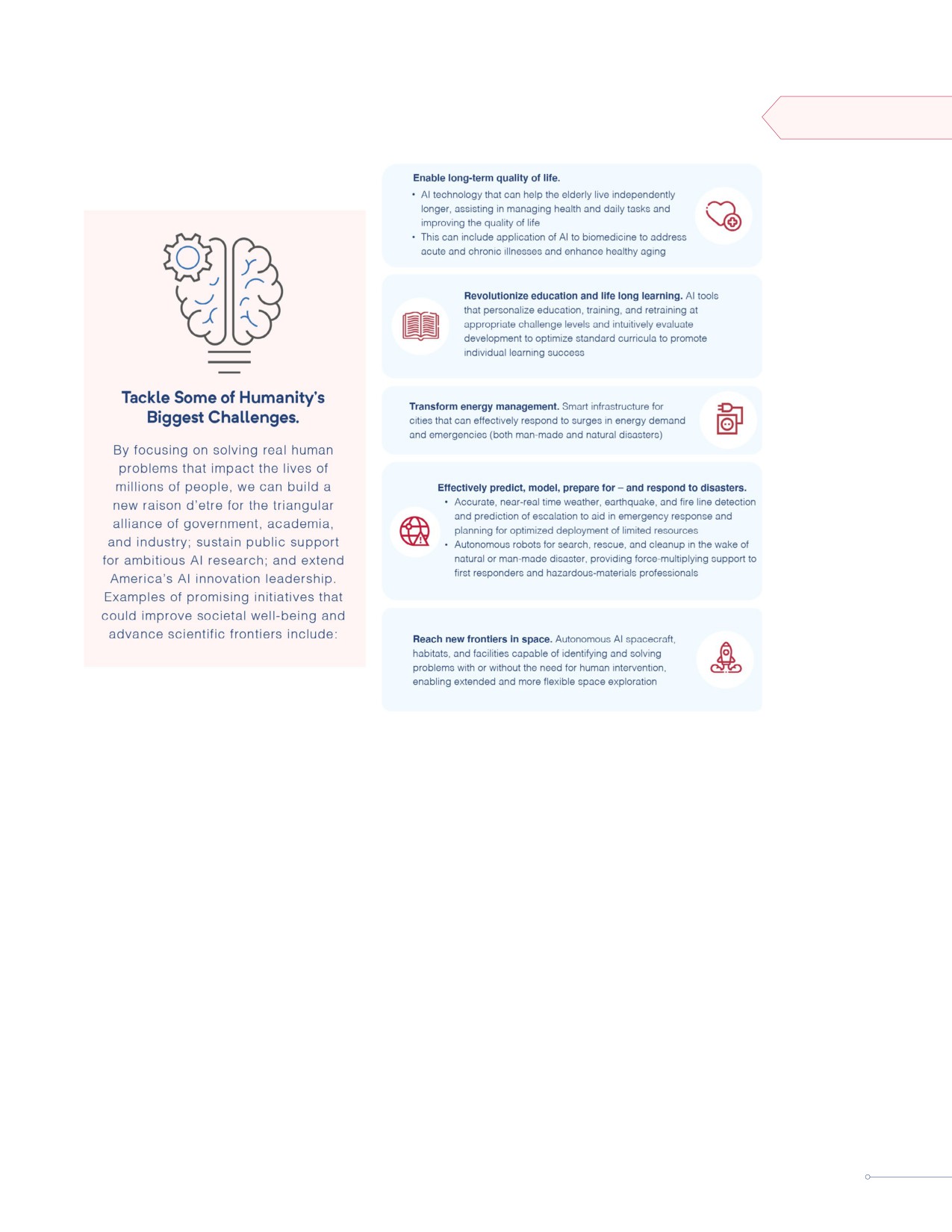
Tackle some of humanity’s biggest challenges.
Recommendation
Tackle Some of
Humanity’s Biggest
Challenge.
“By focusing on solving real
human problems that impact the
lives of millions of people, we can
build a new raison d’etre for the
triangular alliance of government,
academia, and industry ...”
p
194
CHAPTER 11
Chapter 11 - Endnotes
1 A 2020 analysis of arXiv papers on AI found private-sector basic AI research to be thematically
narrower than the broader corpus of AI publications, focusing on deep learning and computational
infrastructure to support deep learning. Furthermore, the study found that elite academic institutions
that collaborate more closely with industry had a similar narrowing of thematic concentration,
leading to a tilting of the U.S. AI research environment away from the diversity still preserved in
arxiv.org/pdf/2009.10385.pdf. Increasing specialization of hardware achieved through industry
investments has further prioritized commercial use cases, making it costly to pursue approaches
outside the mainstream. Sara Hooker, The Hardware Lottery, ArXiv (Sept. 21, 2020), https://arxiv.org/
pdf/2009.06489.pdf.
2 The Trump Administration’s proposed budget for non-defense AI R&D in Fiscal Year 2021 was
$1.5 billion, a growth from the just under $1 billion spent in Fiscal Year 2020. The Networking &
Information Technology Research & Development Program, Supplement to The President’s FY2021
pubs/FY2021-NITRD-Supplement.pdf. The National AI Initiative Act of 2020 included in the National
Defense Authorization Act for 2021 included authorization for additional investments in AI R&D at the
National Science Foundation (NSF), Department of Energy (DOE), National Institute of Standards and
Technology (NIST), and the National Oceanic and Atmospheric Administration (NOA A). See Pub. L.
116 -283, William M. (Mac) Thornberry National Defense Authorization Act for Fiscal Year 2021, 134
Stat. 3388 (2021).
3 OpenAI estimates that since 2012, the amount of compute used in the largest AI training runs is
doubling every 3.4 months. See Dario Amodei & Danny Hernandez, AI and Compute, OpenAI (May
16, 2018), https://openai.com/blog/ai-and-compute/. Based on projections by OpenAI, at the current
rate of increasing costs of model training, “in 4 years, training the largest model will cost more than
launching a rocket into orbit.” Yaroslav Bulatov, Large-scale AI and Sharing of Models, Medium (July
20, 2019), https://yaroslavvb.medium.com/large-scale-ai-and-sharing-of-models-4622ba59ec18. For
efforts that involve robotics or real-world applications, development requires additional resources in
terms of complex modeling and simulation capabilities for training algorithms as well as specialized
facilities for experimentation.
4 A recent study found that from 2004 to 2018, 131 AI professors left universities for industry and
90 adopted a dual affiliation while maintaining part-time positions at a university. The study also
documented the adverse effect that these departures had on AI startups of students from these
universities. Michael Gofman & Zhao Jin, Artificial Intelligence, Education, and Entrepreneurship,
SSRN at 2 (Oct. 26, 2020), https://papers.ssrn.com/sol3/papers.cfm?abstract_id=3449440. High
salaries in the commercial sector pull researchers from academic tracks—in 2019, 57% of AI/ML
PhD graduates in North America went to industry versus staying in academia for post-doc, research,
or faculty appointments. Stuart Zweben & Betsy Bizot, 2019 Taulbee Survey, Computing Research
Association at 11 (May 2020), https://cra.org/wp-content/uploads/2020/05/2019-Taulbee-Survey.pdf.
5 For example, NSF, which provides 85% of federal funding for computer science, funded $188 million
in core AI research in 2019 but did not have room in the budget to fund another $178 million worth of
highly rated proposals. This was an improvement from 2018, when they funded $165 million but left
$185 million of highly rated work unfunded. Furthermore, NSF (in partnership with the Department of
Agriculture) funded seven National AI Research Institutes in 2020 but was unable to fund the more
than 30 that were judged worthy of supporting; NSF presentation to NSCAI (January 2020).
6 The time computer science faculty can spend holding concurrent appointments in industry has
increased from 20% to up to 50% to 80%, which has implications on their academic responsibilities
including recruitment of students and development of coursework and seminars, as well as the
possible consequence of aligning graduate-student work to industry’s needs over high-impact
basic research. Shwetak Patel, et al., Evolving Academia/Industry Relations in Computing Research,
Computing Community Consortium at 3 (June 2019), https://cra.org/ccc/wp-content/uploads/
sites/2/2019/06/Evolving-AcademiaIndustry-Relations-in-Computing-Research.pdf.
7 The annual Taulbee study that tracks the field of computer science (CS) found that women make
up 21.0% of CS bachelor degree graduates and 20.3% of CS doctoral graduates, and domestic
underrepresented minorities make up 14.7% of CS bachelor degree graduates and only 3.1% of
doctoral graduates. Stuart Zweben & Betsy Bizot, 2019 Taulbee Survey, Computing Research
Association at 4, 5, 22 (May 2020), https://cra.org/wp-content/uploads/2020/05/2019-Taulbee-Survey.
pdf. A trend toward narrowing participation in the field holds the potential to worsen this state. See
Nur Ahmed & Muntasir Wahed, The De-democratization of AI: Deep Learning and the Compute Divide
in Artificial Intelligence Research, ArXiv (Oct. 22, 2020), https://arxiv.org/abs/2010.15581.
p
195
ACCELERATING AI INNOVATION
8 See, e.g., Joel Klinger, et al., A Narrowing of AI Research?, ArXiv (Nov. 18, 2020), https://arxiv.org/
pdf/2009.06489.pdf.
9 From the very outset of the field, the federal government had a hand in fostering research. The Air
Force, via RAND, supported the work of Herbert Simon and Allen Newell, who in 1956 created the first
successful AI computer program, the Logic Theorist. Mariana Mazzucato, The Entrepreneurial State:
Debunking Public vs. Private Sector Myths, Anthem Press (2013). The Defense Advanced Research
Projects Agency (DARPA) (then ARPA) funded the work of Charles Rosen, who developed the first
self-navigating robot, “Shakey,” in 1972. Shakey the Robot, DARPA (last accessed Dec. 30, 2020),
https://www.darpa.mil/about-us/timeline/shakey-the-robot. Reinforcement learning, the approach on
which many of today’s commercial applications are based, was sustained through the “AI Winter”
of the 1990s by NSF’s support of Andrew Barto; NSCAI staff engagement with NSF (Aug. 8, 2019).
DARPA’s 30 years of funding for research on image understanding created the foundation for
autonomous driving capabilities. DARPAtv, DARPA Artificial Intelligence Colloquium Opening Video,
by DARPA in the mid-2000s led to the development of the first artificially intelligent assistant, which
eventually became Siri. DARPAtv, DARPA and AI: Visionary Pioneer and Advocate, YouTube (Dec. 7,
2018), https://www.youtube.com/watch?v=ri5gOjYgLns.
10 Neil C. Thompson, et al., Building the Algorithm Commons: Who Discovered the Algorithms
onlinelibrary.wiley.com/doi/epdf/10.1002/gsj.1393.
11 For example, non-elite universities and AI startups have difficulty affording the cost of compute
resources and data for training sophisticated ML models. Nur Ahmed & Muntasir Wahed, The De-
democratization of AI: Deep Learning and the Compute Divide in Artificial Intelligence Research,
arXiv (Oct. 22, 2020), https://arxiv.org/abs/2010.15581. Ninety percent of Silicon Valley AI startups
were purchased by large technology companies between 2013 and 2018. Ryan Kottenstette, Silicon
Valley Companies Are Undermining the Impact of Artificial Intelligence, TechCrunch (March 15,
artificial-intelligence/. These same companies dominate U.S. patent lists, excluding adoption patents.
com/2020/02/01/winning-ai-race/id=118431/.
12 Michael Porter, Clusters and the New Economics of Competition, Harvard Business Review (Nov.-
Dec. 1998), https://hbr.org/1998/11/clusters-and-the-new-economics-of-competition.
13 William R. Kerr & Frederic Robert-Nicoud, Tech Clusters, Journal of Economic Perspectives at 63
(Summer 2020), https://pubs.aeaweb.org/doi/pdfplus/10.1257/jep.34.3.50.
14 Specifically, Seattle, Boston, San Francisco, San Diego, and San Jose. Robert D. Atkinson, et al.,
The Case for Growth Centers: How to Spread Tech Innovation Across America, Brookings (Dec. 9,
america/.
15 The NSF and other government agencies are doing admirable work, with the resources available,
to encourage diverse research and create economies of scale for AI innovation, but they will not
produce a strategic effect at the current level of effort, which is set against the backdrop of an
overall decline in federal investment in R&D. Other notable recent federal initiatives include DARPA’s
Artificial Intelligence Exploration Program, which fast tracks funding for awards up to $1 million to
explore feasibility of new AI concepts within an 18-month timeframe; and NSF’s National AI Research
Institutes effort, which in 2020 funded seven multi-institution, university-based research institutes at
$4 million per year for five years and plans to launch another eight in 2021. Artificial Intelligence at
NSF, NSF (Aug. 26, 2020), https://www.nsf.gov/cise/ai.jsp.
16 Funding for the National Institutes of Health (NIH) has grown from $30 billion in 2010 to $41 billion
what-we-do/budget.
p
196
CHAPTER 11
Chapter 11 - Endnotes
17 In 1953, the U.S. spent 0.72% of its GDP on R&D. In 1957, when the then-Soviet Union launched
Sputnik, it had grown to 1.3%. R&D spending peaked at 1.86% in 1964. In 2017, it declined below
1953 levels to 0.61%. Federal R&D Budget Dashboard, American Association for the Advancement
of Science (last accessed Jan. 14, 2021), https://www.aaas.org/programs/r-d-budget-and-policy/
federal-rd-budget-dashboard.
18 The National AI Initiative Act of 2020 included in the National Defense Authorization Act for Fiscal
Year 2021 creates a structure for a more strategic approach to harnessing AI through establishment
of a National AI Initiative Office within the Office of Science and Technology Policy and associated
advisory group and interagency construct. See Pub. L. 116-283, William M. (Mac) Thornberry National
Defense Authorization Act for Fiscal Year 2021, 134 Stat. 3388 (2021).
19 The NSF awarded grants for the first national AI research institutes in 2020, supporting seven
university-based, multi-institution consortia organized around fundamental and applied areas of AI
research, and plans to fund a second round of institutes in 2021, coordinating support not only with
interagency partners but also with private sector stakeholders to launch eight additional institutes.
Artificial Intelligence at NSF, NSF (Aug. 26, 2020), https://www.nsf.gov/cise/ai.jsp.
20 Acting on a recommendation NSCAI issued in our First Quarter Recommendations, Congress has
taken the first step to establish the NAIRR in the Fiscal Year 2021 National Defense Authorization Act,
creating a task force to develop a roadmap for a future NAIRR. The result of this effort will be due to
Congress 18 months after appointment of task force members. See Pub. L. 116-283, William M. (Mac)
Thornberry National Defense Authorization Act for Fiscal Year 2021, 134 Stat. 3388 (2021); see also
First Quarter Recommendations, NSCAI at 12 (March 2020), https://www.nscai.gov/previous-reports/.
21 Since the explosion of deep learning in 2012 and accompanying growth in use of specialized
hardware for AI computing, there has arisen what some have termed the “compute divide”—a
disparity in access between large technology companies and elite universities and middle- and
lower-tier universities to the resources necessary for cutting-edge AI research. Nur Ahmed & Muntasir
Wahed, The De-democratization of AI: Deep Learning and the Compute Divide in Artificial Intelligence
Research, ArXiv (Oct. 22, 2020), https://arxiv.org/abs/2010.15581.
p
197
ACCELERATING AI INNOVATION
22 This approach could build on successful models such as the COVID-19 High Performance
cloudbank.org/).
23 This would build on prior work undertaken by the Networking and Information Technology Research
and Development (NITRD) Program Big Data Interagency Working Group. Open Knowledge Network:
www.nitrd.gov/pubs/Open-Knowledge-Network-Workshop-Report-2018.pdf. It would also build
upon ongoing efforts through NSF’s Convergence Accelerator track on Open Knowledge Networks.
NSF Convergence Accelerator Awards Bring Together Scientists, Businesses, Nonprofits to Benefit
Workers, NSF (Sept. 20, 2019), https://www.nsf.gov/news/special_reports/announcements/091019.jsp.
24 Congress took an important step in the Consolidated Appropriations Act, 2021 by calling on
the General Services Administration to create a five-year program to be known as the ‘‘AI Center
of Excellence’’ (AI CoE) to “facilitate the adoption of artificial intelligence technologies in the
Federal Government,” among other duties. The AI CoE can help bridge discrete efforts across
federal agencies to create a sizable market for government-specific AI applications. See Rules
Committee Print 116-68, Text of the House Amendment to Senate Amendment to H.R. 133, U.S.
House Committee on Rules at 378-81 (Dec. 11, 2020), https://rules.house.gov/sites/democrats.rules.
house.gov/files/BILLS-116HR133SA-RCP-116-68.pdf (referring specifically to section 103 of the
Consolidated Appropriations Act, 2021). In addition, the Defense Innovation Unit (DIU) is playing a
role in creating markets at the intersection of AI and other strategic technologies through its project-
based approach. Focus areas include AI applications for space systems, advanced diagnostics,
semiconductors/advanced hardware, and other critical technologies identified by NSCAI in Chapter
16 of this report. DIU’s experience indicates that creating a market for strategic technologies begins
with the Department of Defense (DoD) and other government agencies pursuing an approach that is
(a) contractually flexible, (b) aligned with firms’ technological development plans, and (c) generating
financial incentives through opportunities to scale production. DIU Making Transformative Impact Five
making-transformative-impact-five-years-in/.
p
198
CHAPTER 12
Chapter 12:
Intellectual Property
p
199

INTELLECTUAL PROPERTY
Intellectual Property Policy
is a National Security Priority
Issue Executive Order
on IP for AI and
Emerging Technologies.
Develop Plan to Reform
Assess “IP
and Establish IP Policies
Considerations.”
and Regimes.
Integrate into
Propose Executive and
National Security,
Legislative Actions.
Economic, and
Technology
Competitiveness
Strategies.
p
200
CHAPTER 12
China is both leveraging and exploiting intellectual property (IP)
policies as a critical tool within its national strategies for emerging
technologies. The United States has failed to similarly recognize
the importance of IP in securing its own national security, economic
interests, and technology competitiveness. The U.S. has not
developed comprehensive IP policies to incentivize investments1
in and protect the creation of artificial intelligence (AI) and other
emerging technologies.2 The consequence of this policy void—
which includes legal uncertainties created by current U.S. patent
eligibility and patentability doctrine, the lack of an effective response
to China’s domestic and geopolitical strategies centered on its IP
institutions,3 and the lack of effective data protection policies—is
that the U.S. could lose its prime position in IP global leadership.
At the same time, by strengthening its IP regimes,4 China is poised
to “fill the void” left by weakened U.S. IP protections, particularly
for patents, as the U.S. has lost its “comparative advantage in
securing stable and effective property rights in new technological
innovation.”5 This stark policy asymmetry has multiple significant
domestic and international implications for the U.S.
First, U.S. courts have severely restricted what types of computer-implemented and
biotech-related inventions can be protected under U.S. patent law.6 Critical AI and biotech-
related inventions have been denied patent protection since 2010.7 Facing uncertainty
in obtaining and retaining patent protection, inventors pursue trade secret protection.
Trade secrets do not readily promote innovation markets, because trade secrets, unlike
patents, do not contribute to accessible technical knowledge in the public domain.8 While
these impacts might not be immediate, the long-term effects on AI and other emerging
technology developments and competitiveness are concerning.9
p
201
INTELLECTUAL PROPERTY
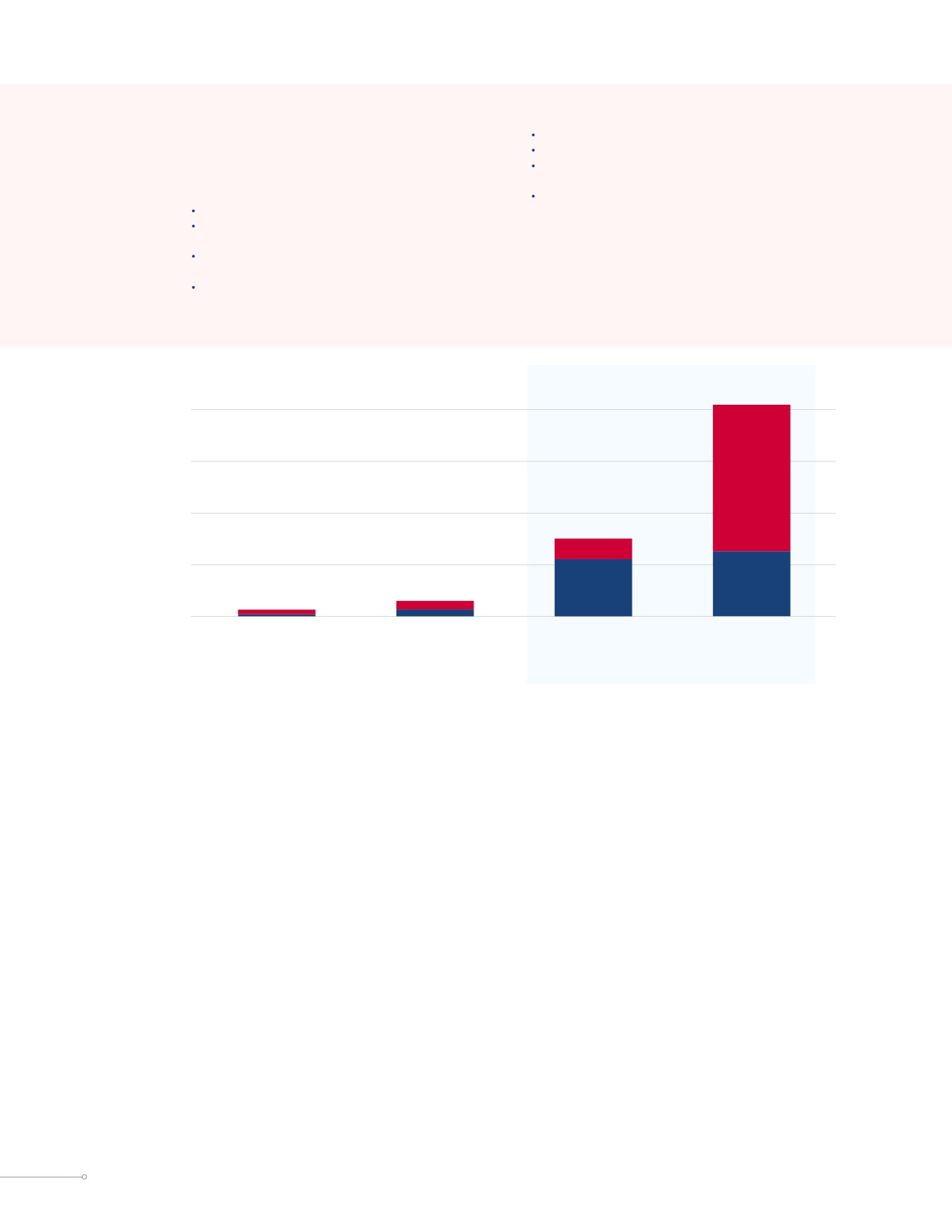
Second, China has met its strategic policy goal of increasing the quantity of its patent
applications and issued patents, creating the narrative that it has “won” the innovation
race. In 2019, the total number of “invention” patent applications filed at the China National
Intellectual Property Administration (CNIPA) was approximately three times as many as
utility patent applications filed at the U.S. Patent and Trademark Office (USPTO).10 China
also led the world in international patent applications under the Patent Cooperation Treaty
(PCT) system of the World Intellectual Property Organization (WIPO).11 Critically, China is
now frequently identified as the current leader in domestic patent application filings for
AI inventions.12 Globally, AI patent applications originating from China outnumber those
originating from the United States, especially in recent years.13
“The U.S. has not developed
comprehensive IP policies to
incentivize investments in and
protect the creation of AI and
other emerging technologies.
The consequence of this
policy void ... is that the U.S.
could lose its prime position in
IP global leadership.”
p
202
CHAPTER 12
China IP Trends.
China’s National IP Regimes for AI
Patent filings are incentivized by:
and Emerging Technologies
Patent subsidies
Rewards for granted patents
National 13th Five-Year Plan for the Development of
Patent quotas set by provincial or municipal
Strategic Emerging Industries articulates IP-related
governments
goals for emerging technologies:
Preferential treatment in government procurement
Revising the Patent Law and Copyright Law
processes for companies with Chinese IP
Strengthening IP rights protections through rapid
rights protection centers
Patent protection is increased through preliminary
Developing strategic advancement plans for IP
injunctions for patent infringement, increases in
rights of emerging technologies
punitive damages for IP infringement (allows for
Improving overseas IP rights and supporting
quintuple damages for willful infringement), and
companies involved in overseas M&A
specialized IP courts with efficient resolution and low
litigation costs.
US: 621,000
China: 1,400,000
US: 456,000
China: 241,000
US: 57,840
US: 2,163
China: 58,990
China: 5,708
Self-declared
2019 PCT
2009 Domestic
2019 Domestic
5G Standard-
Filings
Patent Office
Patent Office
Essential Patents
Filings
Filings
CSET Translation of National 13th Five-Year Plan for the Development of Strategic Emerging Industries,
Central Committee of the Communist Party of China and the PRC State Council (Published Nov. 29,
2016)
(translation by CSET on Dec.
9,
five-year-plan-for-the-development-of-strategic-emerging-industries//; Eric Warner, Patenting and
Innovation in China: Incentives, Policy, and Outcomes, RAND at 17-18 (Nov. 2014), https://apps.dtic.
mil/dtic/tr/fulltext/u2/a619128.pdf; Trademarks and Patents in China: The Impact of Non-Market Factors
sites/default/files/documents/USPTO-TrademarkPatentsInChina.pdf; Ryan Davis,
4 Things to Know
About China’s Revised Patent Law, Law 360 (Nov. 5, 2020), https://www.law360.com/articles/1326419/;
Justice Tao Kaiyuan, China’s Commitment to Strengthening IP Judicial Protection and Creating a Bright
article_0004.html.
Note: The self-declared 5G standard-essential patent numbers are as of February 2020 and represent
the combined total from the two companies that are the largest filers in each country. For the United
States, 2,163 represents the 1,293 applications filed from Qualcomm and 870 filed from Intel. For China,
5,708 represents the 3,147 filed from Huawei and 2,561 filed from ZTE. This number also represents the
standard-essential patents filed, not the number of patents granted. See Jed John Ikoba, Huawei Has
Filed the Most 5G Patents Globally as of February 2020 - Report, Gizmochina (June 2, 2020), https://www.
gizmochina.com/2020/06/02/huawei-has-the-most-5g-standard-essential-patents-globally/;
China
Becomes Top Filer of International Patents in 2019 Amid Robust Growth for WIPO’s IP Services, Treaties
article_0005.html; For the domestic patent office filings, according to the China National Intellectual
Property Administration (CNIPA), “the number of invention patent applications it received increased by
more than 500 percent between 2009 and 2019, from 241,000 to 1.4 million (although, interestingly, there
was a 9 percent decrease from 2018 to 2019). In comparison the number of patent applications at the
p
203
INTELLECTUAL PROPERTY
USPTO increased by only 35% (from 456,000 to 621,000) over the same period. Hence, while in 2009
U.S. patent applications outnumbers Chinese applications by almost two-to-one, by 2019, the ratio had
completely reversed. Most of the Chinese patenting increase can be attributed to applications filed by
domestic applicants. Out of the 1.4 million CNIPA applications in 2019, domestic sources filed almost
90 percent (compared to 48 percent of USPTO applications).” See Patrick Thomas & Dewey Murdick,
Patents and Artificial Intelligence: A Primer, Center for Security and Emerging Technology at 10 (Sept.
2020), https://cset.georgetown.edu/wp-content/uploads/CSET-Patents-and-Artificial-Intelligence.pdf.
In 2019, there were also almost two million utility model applications in China. Id at n. 17.
“China has met its strategic
policy goal of increasing the
quantity of its patent applications
and issued patents, creating the
narrative that it has “won” the
innovation race.”
Third, regardless of quality concerns,14 China’s prolific patent application filings may further
hurt U.S. innovators by creating a vast reservoir of “prior art” (the term in patent law for
the worldwide scientific and technical knowledge by which an invention is evaluated to
determine if it is new). This dramatically increases the quantity of prior art that must be
reviewed in examining a patent application. As a result, the patent examination process
at the USPTO will become increasingly difficult, if not onerous. At the same time, U.S.
inventors may find it more difficult to obtain patents because they must show that their
inventions are not disclosed in the prior art publications anywhere in the world, including
in the Chinese-language patent applications filed in China and internationally.15 As Chinese
patents come to dominate prior art searches by patent offices throughout the world, the
current dominance of U.S. patents in worldwide prior art searches will erode.16
Fourth, and consistent with China’s extensive patent application filings, China’s companies
have been identifying too many patents as “standard-essential” in standards development
organizations, alleging that these patents must be practiced to comply with a technical
standard.17 Although standard development organizations require patent owners to self-
identify patents that may be deemed essential in future standards, these organizations
leave final essentiality determinations to private companies negotiating licenses or, if
there is a dispute, to courts.18 This practice of “overdeclaring” standard-essential patents
(SEPs) furthers China’s global narrative that it has “won” the race to such standardized
p
204
CHAPTER 12
technologies as 5G, prompting other countries to adopt China’s technologies in their own
communications infrastructures.19 A worrisome result may be that U.S. companies must
pay billions in royalties to China’s companies or face claims and resulting litigation that
they willfully infringed on Chinese company patent rights.20
Fifth, the lack of explicit legal protections for data or express policies on data ownership may
hinder innovation and collaboration, particularly as technologies evolve.21 The absence of
data protection regimes may disincentivize parties from making necessary investments to
develop data sets that are critical for machine learning (ML) and AI systems.22 Additionally,
the absence of data governance policies (such as contracting best practices) for IP-type
protections or ownership rules could undermine the willingness of companies to enter
into the public-private partnerships that are crucial for creating cutting-edge technological
innovations.23 This could also create challenges for U.S. collaboration with allies and other
partners in vital AI R&D where data rights or ownership claims come into question.24
Lastly, as further evidence that China views IP as essential in its domestic economic
development, China continues to pervasively steal American IP-protected technological
advances through varied means like cyber hacking of businesses and research institutes,
technological espionage, blackmail, and illicit technology transfer.25
“China continues to pervasively
steal American IP-protected
technological advances through
varied means like cyber hacking
of businesses and research
institutes, technological
espionage, blackmail, and illicit
technology transfer.”
p
205
INTELLECTUAL PROPERTY
The IP Policy Void.
The U.S. Government needs to address these vulnerabilities resulting from the lack of
comprehensive IP policies. Currently, the U.S. Government does not efficiently utilize IP
policy as a tool to support national strategies for national security, economic interests,
and technology competitiveness in AI and emerging technologies. The majority of the
United States Government’s coordinated IP policy efforts are focused on IP enforcement
and preventing IP theft.26 The U.S., however, lacks an agency or interagency entity that is
empowered to both develop and execute national IP policies that support and integrate with
national strategies. As a result, the United States lacks cohesive, legislatively mandated AI
and emerging-technology IP policies that are integrated into national strategy frameworks
to address, for example, global competition from countries like China.
America’s IP laws and institutions must be considered as critical components for
safeguarding U.S. national security interests, including advancing economic prosperity
and technology competitiveness. The United States must, at a minimum, articulate and
develop national IP reforms and policies with the goal of incentivizing, expanding, and
protecting AI and emerging technologies, at home and abroad. Such policies should
be developed and proposed via the Executive Branch with a process that integrates
the disparate departments and agencies that serve important roles in promoting U.S.
innovation. The Executive Branch should:
“America’s IP laws and
institutions must be considered
as critical components for
safeguarding U.S. national
security interests, including
advancing economic
prosperity and technology
competitiveness.”
p
206
CHAPTER 12
Develop and implement national IP policies to incentivize, expand, and protect AI and
Recommendation
emerging technologies. The President should issue an executive order to recognize IP
as a national priority and require the development of a comprehensive plan to reform
and create IP policies and regimes that further national security, economic interests,
and technology competitiveness strategies. The Commission recommends that the
executive order direct the Vice President, as chair of the Technology Competitiveness
Council (TCC), or otherwise as chair of an interagency task force, to oversee this effort.
The executive order should direct the Secretary of Commerce—in coordination with the
Under Secretary of Commerce for Intellectual Property and the Director of the USPTO27—
to develop proposals to reform and establish new IP policies and regimes, as needed, to
incentivize, expand, and protect AI and emerging technologies. The plan should include
proposals for executive and legislative actions for IP policy changes to achieve these
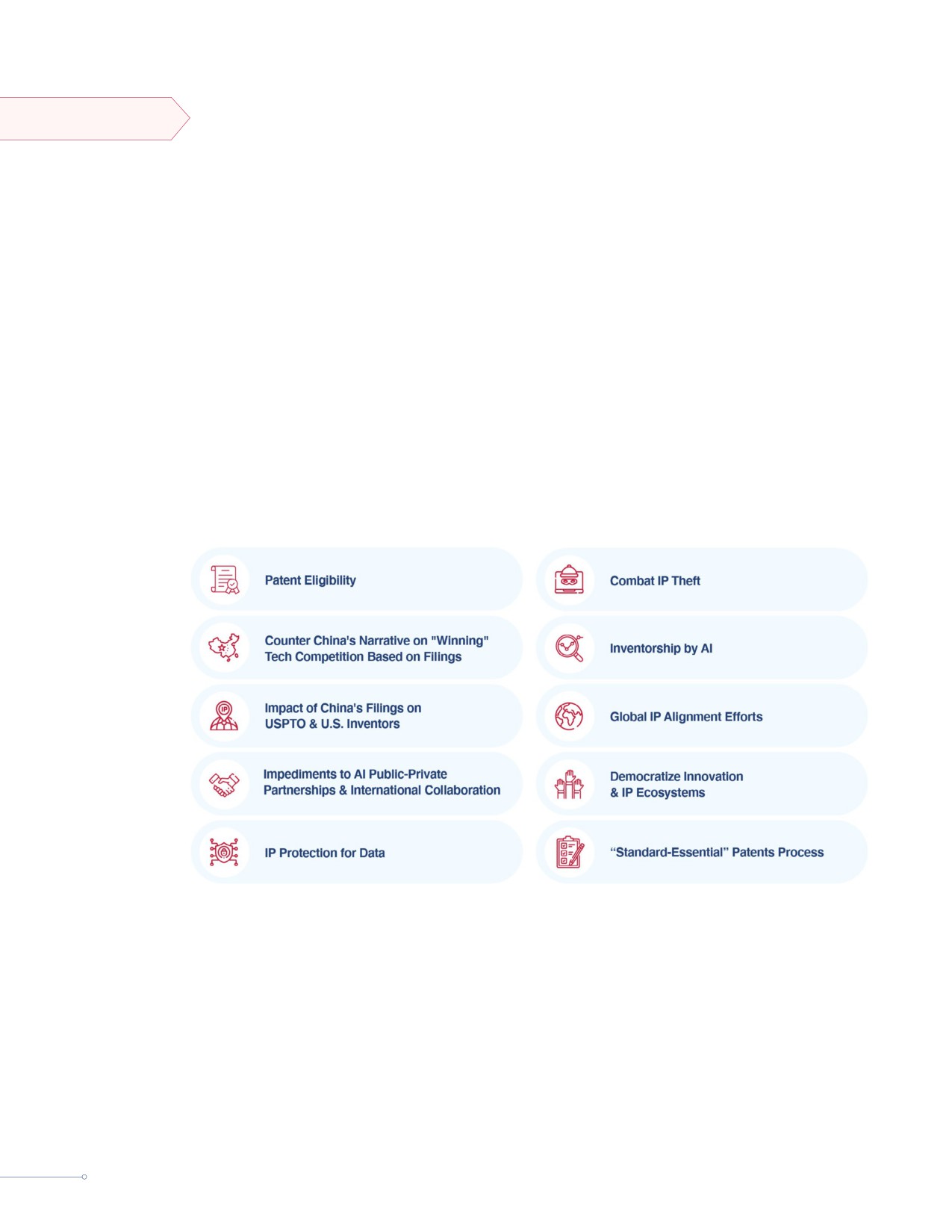
objectives and should be accompanied by an assessment of a non-exhaustive list of “IP
considerations.”28 The Executive Order should direct the Vice President to assess which
IP policies, regimes, and reform proposals from the Secretary of Commerce should be
integrated into national security, economic, and technology competitiveness strategies
and empower the Secretary of Commerce to facilitate implementation of such proposals.
National Intellectual
Property
Considerations.
p
207
INTELLECTUAL PROPERTY
Chapter 12 - Endnotes
1 Advances in emerging technologies require significant investments. These investments are partly
public, but advances also require extensive private investments.
2 Technologies critical to national security interests include AI and biotechnology. NSCAI proposes an
initial list of emerging technologies key to U.S. national competitiveness in Chapter 16 of this report.
3 CSET translation of National 13th Five-Year Plan for the Development of Strategic Emerging
Industries, Central People’s Government of the People’s Republic of China at 59 (Nov. 29, 2016)
(translation by CSET on Dec. 9, 2019), https://cset.georgetown.edu/research/national-13th-five-
year-plan-for-the-development-of-strategic-emerging-industries/. China continues to make extensive
reforms to its IP regimes in furtherance of its innovation and industrial competitiveness goals. See
Mark Cohen, IPO’s Comments on Recent Patent Legislation: Untangling a Complex Web, China IPR
blog (Dec. 15, 2020), https://chinaipr.com/2020/12/15/ipos-comments-on-recent-patent-legislation-
untangling-a-complex-web/.
4 China’s actions include ensuring that AI and associated technologies are eligible for patent
protection, increasing damages awards for patent infringement, continuing to issue preliminary
injunctions for infringement of valid patents, and creating specialized IP courts with more efficient
resolution of IP cases. See Kevin Madigan & Adam Mossoff, Turning Gold into Lead: How Patent
Eligibility Doctrine Is Undermining U.S. Leadership in Innovation, George Mason Law Review at 943-
Turning Gold Into Lead]; Ryan Davis, 4 Things to Know About China’s Revised Patent Law, Law 360
(Nov. 5, 2020), https://www.law360.com/articles/1326419/; Liaoteng Wang et. al., A Comparative
Look at Patent Subject Matter Eligibility Standards: China Versus the United States, IP Watchdog
eligibility-standards-china-versus-united-states/id=122339/; Erick Robinson, Everything You Need to
com/designs/everything-you-need-know-about-chinas-new-preliminary-injunction-rules; Justice Tao
Kaiyuan, China’s Commitment to Strengthening IP Judicial Protection and Creating a Bright Future for
IP Rights, World Intellectual Property Organization, WIPO Magazine (June 2019), https://www.wipo.int/
wipo_magazine/en/2019/03/article_0004.html.
5 See Turning Gold Into Lead, at 955.
6 See Turning Gold Into Lead. In January 2019, the United States Patent & Trademark Office (USPTO)
published initial patent eligibility guidance that applies during examination of patent applications at
the USPTO, which arguably decreased uncertainty as to patent eligibility determinations during the
patent application examination and granting process. However, the United States Court of Appeals for
the Federal Circuit, the appellate court with jurisdiction of appeals from patent cases, held that it is
not bound by the Guidance. See Cleveland Clinic Found. v. True Health Diagnostics LLC, 760 F. App’x
at 1013, 1020 (Fed. Cir. 2019) (non-precedential); In re Rudy, 956 F.3d 1379, 1383 (Fed. Cir. 2020)
(precedential) (citing Cleveland Clinic Found., 760 F. App’x at 1021).
7 Athena Diagnostics v. Mayo Collaborative Services, 915 F.3d 743 (Fed. Cir. 2019), rehearing en banc
denied 927 F.3d 1333 (Fed. Cir. 2019) (method of diagnosing certain, previously undiagnosable,
patients suffering from the neurological disorder myasthenia gravis using MuSK autoantibodies); The
Cleveland Clinic Found. v. True Health Diagnostics LLC, 760 F. App’x 1013 (Fed. Cir. 2019) (method
of assessing the risk a patient has cardiovascular disease by analyzing the level of a certain enzyme
in a patient’s blood); Roche Molecular Systems, Inc. v. Cepheid, 905 F.3d 1363 (Fed. Cir. 2018)
(DNA primers used in a method to detect the pathogenic bacterium Mycobacterium tuberculosis);
Ariosa Diagnostics, Inc. v. Sequenom, Inc., 788 F.3d 1371 (Fed. Cir. 2015), cert. denied, 136 S. Ct.
2511 (2016) (method of diagnosing fetal characteristics based on paternally inherited DNA found
in a mother’s bloodstream without creating a major health risk for the fetus); PUREPREDICTIVE,
Inc. v. H20.AI, Inc., No. 17-cv-03049-WHO, 2017 WL 3721480 (N.D. Cal. Aug. 29, 2017) (predictive
analytics); Power Analytics Corp. v. Operation Tech., Inc., No. 16-cv-01955 JAK (FFMx), 2017 WL
5468179 (C.D. Cal. July 13, 2017) (“computer simulation techniques with real-time system monitoring
and prediction of electrical system performance”).
p
208
CHAPTER 12
Chapter 12 - Endnotes
8 See Crash Course on Patents: What Is a Patent and Why Is It Useful, Ius mentis (last accessed Dec.
details of the invention, other inventors can license this invention or think of enhancements or design
around the disclosure); Steven Hoffman & Calla Simeone, Trade Secret Protection & the COVID-19
Cure: Observations on Federal Policy-Making & Potential Impact on Biomedical Advances, JDSupra
(discussing implications of uncertainty in patent eligibility on use of trade secrets for biomedical
advances).
9 Surveys and industry reports demonstrate that investment has already shifted away from patent-
intensive industries. See Mark F. Schultz, The Importance of an Effective and Reliable Patent System
to Investment in Critical Technologies, Alliance for U.S. Startups and Investors for Jobs at 24-37 (July
32a4/1596467617939/USIJ+Full+Report_Final_2020.pdf.
10 Patrick Thomas & Dewey Murdick, Patents and Artificial Intelligence: A Primer, Center for Security
and Emerging Technology at 10 (Sept. 2020), https://cset.georgetown.edu/wp-content/uploads/
CSET-Patents-and-Artificial-Intelligence.pdf [hereinafter CSET, A Primer]; U.S. Patent Statistics Chart
us_stat.htm.
11 See CSET, A Primer at 11; Aaron Wininger, China Surpasses U.S. to Become Top Filer of PCT
natlawreview.com/article/china-surpasses-us-to-become-top-filer-pct-international-patent-
applications-2019. China is on pace to continue being the top PCT filer in 2020. See Aaron Wininger,
China 2020 H1 Patent Data Indicates China Likely to Remain Top International Filer in 2020, National
Law Review (July 11, 2020), https://www.natlawreview.com/article/china-2020-h1-patent-data-
indicates-china-likely-to-remain-top-international-filer.
html?id=did-you-know/ai-innovators; George Leopold, China Dominates AI Patent Filings, Enterprise
AI (Aug. 31, 2020), https://www.enterpriseai.news/2020/08/31/china-dominates-ai-patent-filings/;
CSET, A Primer.
13 CSET, A Primer at 9, 12, n. 23.
14 Trademarks and Patents in China: The Impact of Non-Market Factors on Filing Trends and IP
TrademarkPatentsInChina.pdf; Jonathan Putnam, et al., Innovative Output in China, SSRN at 32 (Aug.
2020) (pending revision), https://papers.ssrn.com/sol3/papers.cfm?abstract_id=3760816.
15 Jeanne Suchodolski, et al., Innovation Warfare, North Carolina Journal of Law & Technology at
201 (Dec. 7, 2020), https://ncjolt.org/articles/volume-22/volume-22-issue-2/innovation-warfare/
[hereinafter Innovation Warfare].
16 Rob Sterne, How China Will Fundamentally Change the Global IP System, IP Watchdog (July 24,
2019), https://www.ipwatchdog.com/2019/07/24/china-changing-global-ip-system/id=111613/.
17 Over-declaration is already present in 5G. See Matthew Noble, et al., Determining Which
media/pdfs/news/articles/2019/determining-which-companies-are-leading-the-5g-race.
pdf?la=en&hash=8ABA5A7173EEE8FFA612E070C0EA4B4F53CC50DE; Meeting the China Challenge:
A New American Strategy for Technology Competition, Working Group on Science and Technology
in U.S.-China Relations at 27, 29 (Nov. 16, 2020), https://china.ucsd.edu/_files/meeting-the-china-
challenge_2020_report.pdf [hereinafter Meeting the China Challenge].
18 IEEE SA Standards Board Bylaws, IEEE Standards Association (last accessed Jan. 15, 2020),
https://standards.ieee.org/about/policies/bylaws/sect6-7.html#loa.
p
209
INTELLECTUAL PROPERTY
research/16547-5-g-technological-leadership; Innovation Warfare, at 201, n.130 (China’s firms
recognize the strategic importance of standard-setting activities and that participation in those forums
provides the legal means to both access and influence developing technologies).
20 Because standard-essential patents (SEPs) may reach into the hundreds of thousands for
technologies, licensing fees carry significant economic repercussions. See 5G Technological
technological-leadership (“[P]atent counting might have negative consequences on firms working in
the US innovation economy … if judges or regulators rely on simple counts of total patents as a metric
for determining the value of patent portfolios. The failure to account for differences in patent quality
risks overcompensating some patent holders, namely those with less valuable technologies, but
undercompensating those that have developed breakthrough innovation.”); Andrei Iancu, Director of
USPTO, Remarks at the Center for The Protection of Intellectual Property 2020 Fall Conference (Oct.
www.greyb.com/5g-patents/#The-State-of-Declared-5G-Patents; Cody M. Akins, Overdeclaration
uploads/2020/02/Akins.Printer.pdf.
21 Mitchell Smith, A Comparison of the Legal Protection of Databases in the United States and EU:
cfm?abstract_id=1613451; Daniel J. Gervais, Exploring the Interfaces Between Big Data and
Intellectual Property Law, Journal of Intellectual Property, Information Technology and Electronic
Commerce Law (2019), https://scholarship.law.vanderbilt.edu/faculty-publications/1095.
22 In the USPTO report surveying stakeholders for perspectives on IP policy for AI, “[c]ommenters
were nearly equally divided between the view that new intellectual property rights were necessary
to address AI inventions and the belief that the current U.S. IP framework was adequate to address
AI inventions. Generally, however, commenters who did not see the need for new forms of IP rights
suggested that developments in AI technology should be monitored to ensure needs were keeping
pace with AI technology developments. The majority of opinions requesting new IP rights focused on
the need to protect the data associated with AI, particularly ML.” Public Views on Artificial Intelligence
and Intellectual Property Policy, USPTO at 15 (Oct. 2020), https://www.uspto.gov/sites/default/files/
documents/USPTO_AI-Report_2020-10-07.pdf.
23 Thomas E. Ayers, Changing How We Buy Weapons Will Benefit Industry, Government
commentary/2019/11/20/changing-how-we-buy-weapons-will-benefit-industry-government-and-
taxpayers/ (discussing the tension between Air Force and vendors over IP protection).
24 See also the Chapter 15 Blueprint for Action.
25 Meeting the China Challenge, at 4, 16.
26 Annual Intellectual Property Report to Congress, U.S. Intellectual Property Enforcement Coordinator
Intellectual-Property-Report.pdf (providing an overview of IP responsibilities across the United States
government).
27 Other Executive Branch departments and agencies, and the U.S. Copyright Office, should resource
and support the Secretary of Commerce in these efforts.
28 A non-exhaustive list of IP considerations should include patent eligibility doctrine, countering
China’s narrative on “winning” AI innovation based on patent application filings, the impact of China’s
patent application filings on USPTO’s examination process and U.S. inventors, impediments in IP
contractual system to public-private partnerships and international collaboration, IP protections
for data, combatting IP theft, AI inventorship, global IP alignment, democratizing innovation and IP
ecosystems, and SEPs process.
p
210
CHAPTER 13
Chapter 13: Microelectronics
p
211

MICROELECTRONICS
Rebuilding U.S.
Microelectronics Leadership
Stay Two Generations
Multiple Sources
Ahead in
of Domestic
Microelectronics
Cutting-Edge
Manufacturing
National
Microelectronics
Strategy
Double Down on
Tax Credits and
Microelectronics R&D
Grants for U.S.
Fabrication
Facilities
p
212
CHAPTER 13
U.S. leadership in microelectronics is critical to overall U.S.
leadership in artificial intelligence
(AI). Several assessments
underpin this argument:
• Hardware is a foundational element of the AI stack alongside data, algorithms, and
talent.1
• Exponential increases in computational power have driven the last decade of progress
in machine learning (ML).2
• Afer decades leading the microelectronics industry, the United States will soon source
roughly 90% of all high-volume, leading-edge integrated-circuit production from
countries in East Asia.3 This means the United States is almost entirely reliant on foreign
sources for production of the cutting-edge semiconductors critical for defense systems
and industry more broadly, leaving the U.S. supply chain vulnerable to disruption by
foreign government action or natural disaster.
• Specialized hardware, novel packaging techniques such as heterogeneous integration
and 3D stacking, and new types of devices will drive future AI developments as
traditional architectures of silicon-based chipsets encounter diminishing marginal
performance improvements.4
• Demand for trusted microelectronics will only grow as the military and Intelligence
Community (IC) continue to incorporate AI into mission-critical systems.5
“... the United States is almost
entirely reliant on foreign sources
for production of the cutting-
edge semiconductors critical for
defense systems and industry
more broadly, leaving the U.S.
supply chain vulnerable to
disruption by foreign government
action or natural disaster.”
p
213
MICROELECTRONICS
U.S. leadership in semiconductors has long been taken for granted based on America’s
advantage as a pioneer of the microelectronics industry. Gradually, however, the United
States has been losing its edge. Although American universities and firms remain global
leaders in the key areas of semiconductor R&D and chip design, the semiconductor
industry is now highly globalized and competitive. Taiwan Semiconductor Manufacturing
Corporation
(TSMC) leads the world in semiconductor contract manufacturing, and
Samsung in South Korea is also producing state-of-the-art logic chips.6 TSMC also leads in
the production of ARM-based chips, which is becoming the predominant chip architecture
for mobile devices, servers, and other key applications of emerging technologies.7 In
a bid to catch up and achieve chip self-sufficiency, China is pursuing unprecedented
state-funded efforts to forge a world-leading semiconductor industry by 2030. Although
China is behind firms headquartered in Taiwan, South Korea, and the U.S. in terms of chip
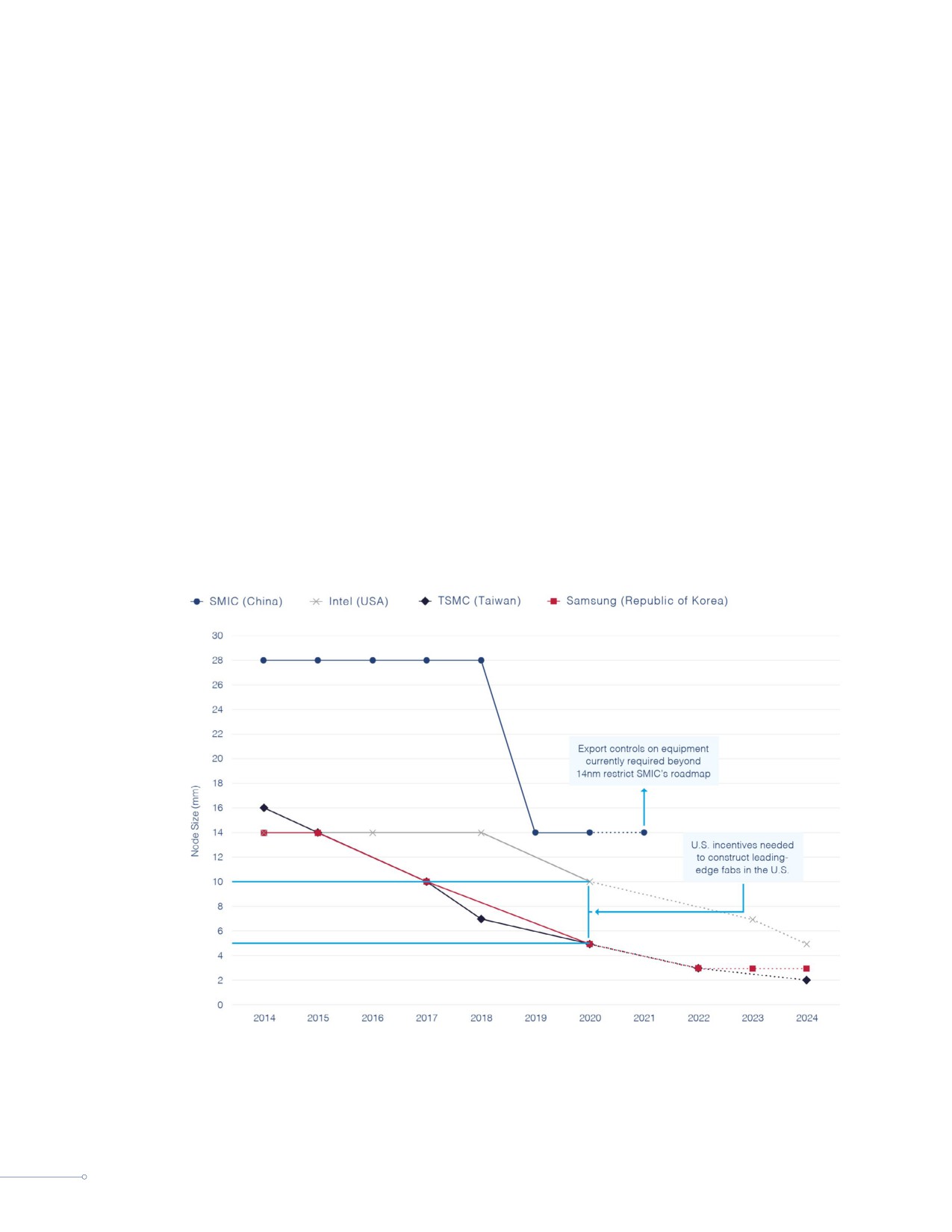
manufacturing, it is advancing quickly.8 Meanwhile, Intel, the leading U.S. manufacturer,
remains competitive in chip design but has faced manufacturing setbacks for leading-edge
chips and may fall further behind its rivals in Taiwan and South Korea. Current projections
put the firm two generations or more behind the cutting-edge node by 2022.9 These and
other concerning trends indicate that America’s leadership in microelectronics is eroding,
especially in manufacturing, assembly, testing, and packaging.10
The dependency of the United States on semiconductor imports, particularly from Taiwan,
creates a strategic vulnerability for both its economy and military to adverse foreign
government action, natural disaster, and other events that can disrupt the supply chains for
electronics. Despite tremendous expertise in microelectronics research, development, and
innovation across the country, the United States is constrained by a lack of domestically-
located semiconductor fabrication facilities, especially for state-of-the-art semiconductors.
If current trends continue, the United States will soon be unable to catch up in fabrication,
and could eventually also be outpaced in microelectronics design. If a potential adversary
bests the United States in semiconductors over the long term or suddenly cuts off U.S.
access to cutting-edge chips entirely, it could gain the upper hand in every domain of
warfare. Focusing the efforts of the U.S. Government, industry, and academia to develop
domestic microelectronics fabrication facilities will reduce dependence on imports,
preserve leadership in technological innovation, support job creation, improve national
security and balance of trade, and enhance the technological superiority and readiness of
the military, which is an important consumer of advanced microelectronics.
p
214
CHAPTER 13
“Despite tremendous
expertise in microelectronics
research, development, and
innovation across the country,
the United States is limited by
a lack of domestically-
located semiconductor
fabrication facilities ...”
State-of-the-Art
State-of-the-Art Semiconductor Manufacturing by Firm: 2014-2024
Semiconductor
Manufacturing by
Firm: 2014-2024.
Node size for 2021-2024 are projections and reflect firm roadmaps
Node size reflects estimated first year of mass production
No roadmap displayed beyond 2021 for SMIC due to export control restrictions on materials currently
required for production beyond 14 nm
p
215
MICROELECTRONICS
To regain U.S. leadership in microelectronics, the Executive Branch should finalize and
implement a national microelectronics leadership strategy. Additionally, Congress should
create a 40% refundable tax credit for domestic fabrication investments by firms from the
United States and its allies and appropriate an additional $12 billion over the next five years
for microelectronics research, development, and infrastructure. Together these efforts
will enable the U.S. government, private sector, and academia to rise to the challenge of
rebuilding U.S. semiconductor superiority.
Objective: Stay two generations ahead of China in state-of-the-art microelectronics and
maintain multiple sources of cutting-edge microelectronics fabrication in the United States.
The United States should focus the attention and resources necessary for long-term
competition in microelectronics by adopting an overarching national objective: to stay two
generations ahead of potential adversaries in state-of-the-art microelectronics while also
maintaining multiple sources of cutting-edge microelectronics fabrication inside the United
States.11 While the United States has historically led China by at least two generations in
semiconductor design and fabrication, this has not been an explicit policy goal. And while
China has not been able to surpass the United States, other nations such as Taiwan and
South Korea now clearly lead the U.S. in state-of-the-art semiconductor manufacturing.
This leaves the U.S. reliant on foreign sources for critical inputs to defense systems and
U.S. industry more broadly. Yet the United States retains a strong position in segments of
the global value chain for semiconductors, such as design, electronic design automation
tools, and semiconductor manufacturing equipment (SME).12 Therefore, an objective to
rebuild microelectronics leadership should be stated plainly to concentrate national support
across government, industry, and academia on regaining leadership in sectors such as
semiconductor fabrication where the United States has fallen behind and also to track
progress over time against a clear yardstick. To achieve this objective, the Commission
recommends focusing action along three fronts:
• Implementing a national microelectronics strategy;
• Revitalizing domestic microelectronics fabrication by incentivizing multiple cutting-
edge domestic fabrication facilities; and
• Ramping up microelectronics research.
In addition to these efforts to promote U.S. microelectronics leadership, the United
States and its allies should utilize targeted export controls on high-end semiconductor
manufacturing equipment, described in Chapter 14 of this report, to protect existing
technical advantages and slow the advancement of China’s semiconductor industry.
p
216
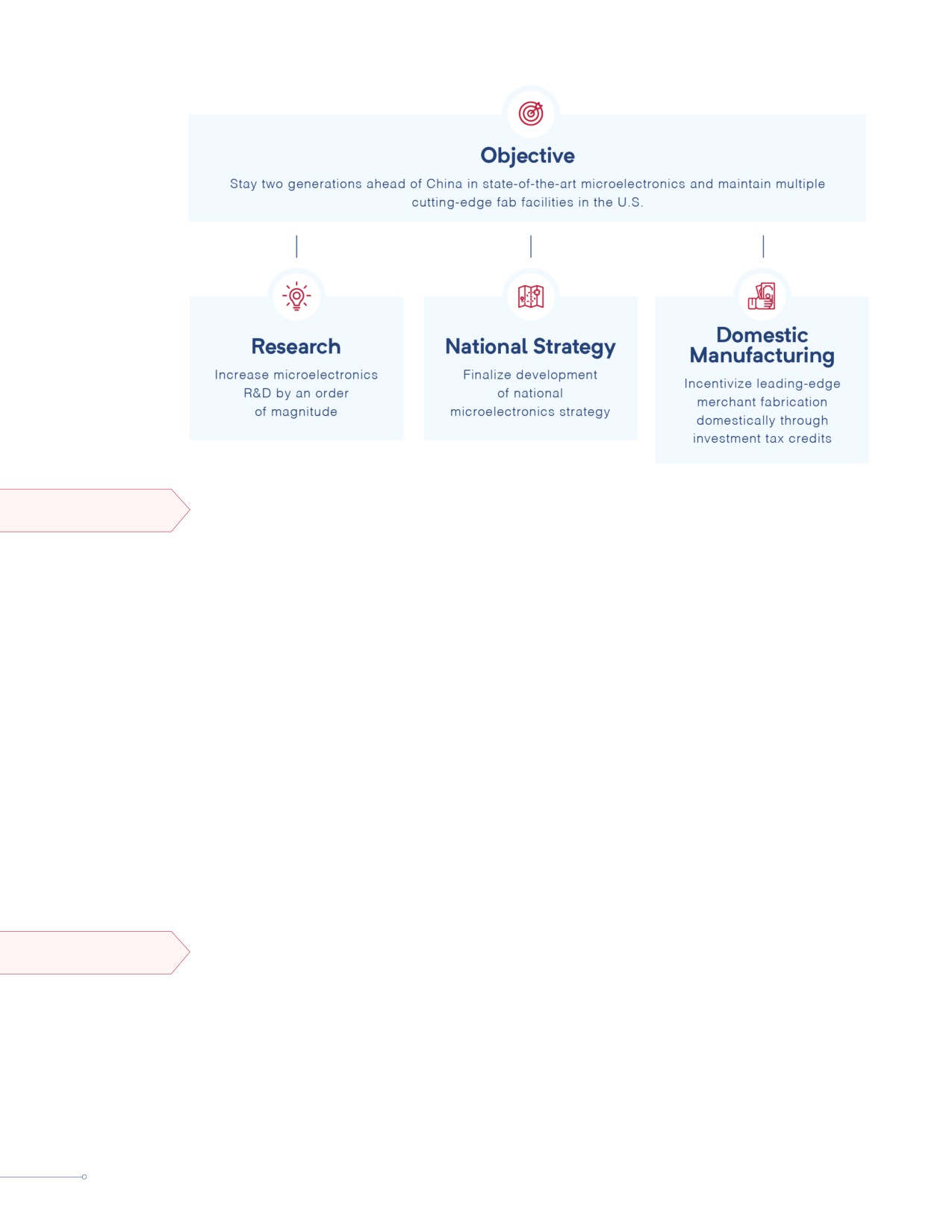
CHAPTER 13
U.S. leadership in
microelectronics is
essential to overall
U.S. leadership
in AI.
Implement the National Microelectronics Strategy. The United States lacks a national
Recommendation
microelectronics strategy to coordinate semiconductor policy, funding, and incentives
within the Executive Branch and externally with industry and academia. A truly national
strategy would build on this Commission’s work as well as previous studies conducted
by the United States government or on its behalf. It would also integrate the disparate
approaches of the Departments of State, Defense, Energy, Commerce, and Treasury, and
other relevant agencies, to promote domestic R&D and semiconductor manufacturing
expertise while preventing the illicit transfer of technology to competitors. Finally, it would
be updated on a consistent basis to foster a coordinated approach and adapt to shifting
challenges to microelectronics innovation, competitiveness, and supply chain integrity.
In line with the Commission’s recommendations, the Fiscal Year 2021 National Defense
Authorization Act (NDAA) creates a subcommittee of the National Science and Technology
Council (NSTC), consisting of senior government officials, to develop a National Strategy
on Microelectronics Research and oversee its implementation.13 However, for this key
effort to be successful, it should be prioritized by the White House by requiring the NSTC
subcommittee to submit the National Microelectronics Strategy to the President within 270
days.
Revitalize domestic microelectronics fabrication. The Commission concludes that the United
Recommendation
States is overly dependent upon globally diversified supply chains for microelectronics,
including imports from potential adversaries. Furthermore, as a result of gaps in the U.S.
industrial base, the risks are increasing that the United States could lose access to trusted,
assured, and state-of-the-art semiconductors for national security use cases. Despite
these concerns, the Commission has been encouraged by a number of developments
over the past year to revitalize the domestic fabrication of state-of-the-art microelectronics.
p
217
MICROELECTRONICS
“... the United States could lose
access to trusted, assured, and
state-of-the-art semiconductors
for national security use cases.”
Examples include TSMC’s decision to develop an advanced facility in the United States
and Intel’s publicly stated interest in working with the United States government to develop
a commercial U.S. foundry.14 However, these are only initial steps, and more must be done
by the U.S. government to reach an end state where multiple firms are fabricating state-
of-the-art chips domestically. Without several U.S.-based fabrication facilities, both U.S.
industry and U.S. national security face risks from competitive pressures and supply chain
shortages. The most significant recent development has been the inclusion of several
semiconductor-related provisions from the “CHIPS for America Act” in the Fiscal Year
2021 National Defense Authorization Act (NDAA).15 However, these programs require
sufficient appropriations to succeed, and they did not receive appropriated funding in
Fiscal Year 2021, which leaves congressional priorities unclear. Further congressional
action to establish refundable investment tax credits and set the conditions for the domestic
production of advanced microelectronics will be important to enable the United States to
remain two generations ahead of China. Specifically, the U.S. government should:
• Incentivize domestic leading-edge merchant fabrication through refundable
investment tax credits. Although introduced as part of the CHIPS for America Act,
Congress has not yet passed legislation establishing a 40% refundable investment tax
credit for semiconductor facilities and equipment.16 Existing U.S. incentives reduce the
cost of foundry construction attributable to capital expenses, operating expenses, and
taxes by just 10% to 15%. A credit of this magnitude is needed to make the United States
a competitive market for semiconductor manufacturing, as other leading semiconductor
manufacturing nations such as South Korea, Taiwan, and Singapore offer 25% to 30%
cost reduction, roughly double what the United States currently offers.17 This gap in
incentives is one driving factor behind the lack of an advanced logic merchant foundry
in the United States. Closing the incentive gap and broadening it to include companies
from allied countries will incentivize U.S. firms to construct facilities domestically while
also attracting foreign firms such as TSMC and Samsung. Additionally, increasing
demand in the United States for high-end SME will create new business opportunities
for SME manufacturers from allied countries, particularly Japan and the Netherlands,
which could increase their governments’ willingness to align their export control
policies with strict U.S. policies prohibiting the export of such equipment to China.18
p
218
CHAPTER 13
“... other leading semiconductor
manufacturing nations such
as South Korea, Taiwan,
and Singapore offer 25 to 30
percent cost reduction, roughly
double what the United States
currently offers.”
Double-down on federally funded microelectronics research. Each succeeding generation
Recommendation
of chips using traditional architectures of silicon-based transistors faces diminishing
marginal gains to performance as they reach the limits imposed by the laws of physics.
As a result, the relative advantage the United States has enjoyed by staying roughly two
generations ahead of potential adversaries in the design phase of developing cutting-
edge hardware could decrease over time as the gap between hardware generations
narrows. Therefore, the United States must look to heterogeneous integration and other
novel hardware improvements in the medium term to continue out-innovating competitors.
Over the longer term, the United States must also continue its portfolio approach to future
microelectronics pathways by investing in new materials and entirely new hardware
approaches, such as quantum and neuromorphic computing. Broad-based investments
and incentives will also be important to maintain leadership in other areas of U.S. strength
related to semiconductor manufacturing, including electronic design automation tools and
SME.
Four primary research arms of the United States government focused on both medium-
and long-term microelectronics breakthroughs are the Department of Energy, Defense
Advanced Research Projects Agency (DARPA), National Science Foundation (NSF), and
the Department of Commerce, primarily through engagement with industry. Their suite of
existing programs, such as DARPA’s Electronics Resurgence Initiative, is targeting the
right research areas but must expand by an order of magnitude to achieve the necessary
breakthroughs and maintain U.S. competitiveness. Additional funding should support
not only research projects, but also the capital-intensive underlying infrastructure for
microelectronics development, including the National Semiconductor Technology Center
and advanced packaging prototyping activities authorized in the Fiscal Year 2021 NDAA. In
particular, advances in packaging will be critical to future improvements in semiconductor
p
219
MICROELECTRONICS
capabilities as firms reach physical limits for two-dimensional transistor density.19 The
government should:
• Double down on federal research funding to lead the next generation of
microelectronics. The Commission recommends substantially increasing the United
States government’s full range of research efforts focused on microelectronics.
Congress should appropriate an additional $1.1 billion for semiconductor research
and $1 billion for the Advanced Packaging National Manufacturing Program in Fiscal
Year 2022. Building on these investments, these funding levels should continue for
five years, for a total investment of roughly $12 billion. These amounts are consistent
with the funding levels introduced, but not yet appropriated, in the CHIPS for America
Act20 and the American Foundries Act of 2020.21 In line with the existing focus areas
of these programs and the Commission’s prior recommendations, the funding should
be applied to developing infrastructure and pursuing breakthroughs in promising areas
such as next-generation tools beyond extreme ultraviolet lithography, 3D chip stacking,
photonics, carbon nanotubes, gallium nitride transistors, domain-specific hardware
architectures, electronic design automation, and cryogenic computing.
“... advances in packaging will
be critical to future
improvements in semiconductor
capabilities as firms reach
physical limits for two-
dimensional transistor density.”
p
220
CHAPTER 13
Chapter 13 - Endnotes
1 Dave Martinez, et al., Artificial Intelligence: Short History, Present Developments, and Future
Outlook, MIT at 27, n. 10 (Jan. 2019), https://www.ll.mit.edu/sites/default/files/publication/doc/2019-
09/Artificial%20Intelligence%20Short%20History%2C%20Present%20Developments%2C%20and%20
Future%20Outlook%20-%20Final%20Report%20-%20Martinez.pdf (citing Andrew Moore, et al.,
The AI Stack: A Blueprint for Developing and Deploying Artificial Intelligence, International Society
for Optics and Photonics, Ground/Air Multisensor Interoperability, Integration, and Networking for
Persistent ISR IX [2018]).
2 Recent machine learning (ML) breakthroughs have relied heavily on computing power, and the
amount of compute used in the largest AI training runs has been increasing exponentially since 2012.
Girish Sastry, et al., Addendum: Compute Used in Older Headline Results, OpenAI (Nov. 7, 2019),
https://openai.com/blog/ai-and-compute/#addendum.
3 Michaela Platzer, et al., Semiconductors: U.S. Industry, Global Competition, and Federal Policy,
Congressional Research Service at 12 (Oct. 26, 2020), https://crsreports.congress.gov/product/pdf/R/
R46581.
4 Sara Hooker, The Hardware Lottery, arXiv (Sept. 21, 2020), https://arxiv.org/pdf/2009.06489.pdf.
5 Gaurav Batra, et al., Artificial Intelligence Hardware: New Opportunities for Semiconductor
our-insights/artificial-intelligence-hardware-new-opportunities-for-semiconductor-companies.
6 Taiwan Semiconductor Manufacturing Corporation (TSMC) has already begun producing 5nm state-
of-the-art logic chips and aims to produce 3nm chips by the end of 2021. Samsung is also producing
5nm chips. Intel does not anticipate producing 7nm chips in-house until at least 2022 and may
outsource manufacturing to TSMC. Firms in China are producing 12 nm chips. Richard Waters, Intel
Looks to New Chief’s Technical Skills to Plot Rebound, Financial Times (Jan. 14, 2021), https://www.
ft.com/content/51f63b07-aeb8-4961-9ce9-c1f7a4e326f0; Mark Lapedus, China Speeds Up Advanced
speeds-up-advanced-chip-development/; 5nm Technology, TSMC (last accessed Jan. 16, 2021),
https://www.tsmc.com/english/dedicatedFoundry/technology/logic/l_5nm; Debby Wu, TSMC’s $28
Billion Spending Blitz Ignites a Global Chip Rally, Bloomberg (Jan. 14, 2021), https://www.bloomberg.
com/news/articles/2021-01-14/tsmc-profit-beats-expectations-as-chipmaker-widens-tech-lead; Anton
Shilov, Samsung Foundry Update: 5nm SoCs in Production, HPC Shipments to Expand in Q4, Tom’s
Hardware (Nov. 1, 2020), https://www.tomshardware.com/news/samsung-foundry-update-5nm-socs-
in-production-hpc-shipments-to-expand-in-q4.
7 ARM and TSMC Announce Multi-Year Agreement to Collaborate on 7nm FinFET Process Technology
news/39433/arm-tsmc-7nm-finfet.html.
8 Michaela D. Platzer, et al., Semiconductors: U.S. Industry, Global Competition, and Federal Policy,
Congressional Research Service at 2, 25, 27 (Oct. 26, 2020), https://crsreports.congress.gov/product/
pdf/R/R46581.
9 Ian King, Intel ‘Stunning Failure’ Heralds End of Era for U.S. Chip Sector, Bloomberg (July 24, 2020),
s-chip-sector.
p
221
MICROELECTRONICS
10 Michaela D. Platzer, et al., Semiconductors: U.S. Industry, Global Competition, and Federal Policy,
Congressional Research Service (Oct. 26, 2020), https://crsreports.congress.gov/product/pdf/R/R46581.
11 The Commission’s previous reports offered a range of initial recommendations to expand access
to trusted semiconductors, increase microelectronics R&D funding, control the export of high-end
semiconductor manufacturing equipment to adversaries, and reshore leading-edge fabrication facilities.
12 John VerWey, The Health and Competitiveness of the U.S. Semiconductor Manufacturing Equipment
Industry, U.S. International Trade Commission: Office of Industries Working Paper (July 1, 2019), http://
dx.doi.org/10.2139/ssrn.3413951.
13 See Pub. L. 116-283, sec. 9906, William M. (Mac) Thornberry National Defense Authorization Act for
Fiscal Year 2021, 134 Stat. 3388 (2021).
14 Stephen Nellis, Phoenix Okays Development Deal with TSMC for $12 Billion Chip Factory, Reuters (Nov.
18, 2020), https://www.reuters.com/article/us-tsmc-arizona/phoenix-okays-development-deal-with-tsmc-
for-12-billion-chip-factory-idUSKBN27Y30E; Asa Fitch, et al., Trump and Chip Makers Including Intel Seek
Semiconductor Self-Sufficiency, Wall Street Journal (May 11, 2020), https://www.wsj.com/articles/trump-
and-chip-makers-including-intel-seek-semiconductor-self-sufficiency-11589103002.
15 See Pub. L. 116-283, William M. (Mac) Thornberry National Defense Authorization Act for Fiscal
Year 2021, 134 Stat. 3388 (2021). These provisions authorize several programs the Commission has
previously identified as essential to U.S. microelectronics leadership. In particular, the provisions would
require drafting a National Microelectronics Leadership Strategy, establishing a National Semiconductor
Technology Center, and creating an incubator for semiconductor startup firms and an Advanced
Packaging National Manufacturing Institute, all of which align with previous recommendations from the
Commission.
16 This incentive would reduce a semiconductor firm’s tax bill by 40% on semiconductor manufacturing
equipment and facilities through 2024, followed by reduced tax credit rates of 30% and 20% respectively,
through 2025 and 2026
17 Antonio Varas, et al., Government Incentives and US Competitiveness in Semiconductor Manufacturing,
BCG and SIA (Sept. 2020), https://web-assets.bcg.com/27/cf/9fa28eeb43649ef8674fe764726d/bcg-
government-incentives-and-us-competitiveness-in-semiconductor-manufacturing-sep-2020.pdf.
18 See Chapter 14 of this report for additional details on export controls on SME.
19 Heterogeneous Integration Roadmap: Chapter 1: HIR Overview and Executive Summary, IEEE
Electronics Packaging Society (Oct. 2019), https://eps.ieee.org/images/files/HIR_2019/HIR1_ch01_
overview.pdf.
20 See S. 3933 and H.R. 7178, Creating Helpful Incentives to Produce Semiconductors (CHIPS) for America
Act, 116th Congress (2020).
21 See S. 4130, American Foundries Act of 2020, 116th Congress (2020).
p
222
CHAPTER 14
Chapter 14:
Technology
Protection
p
223

TECHNOLOGY PROTECTION
Improving U.S. Technology
Protection Capabilities
Enhance
Regulatory
Capacity
Utilize Targeted
Increase
Export Controls
Investment
Screening
Disclosures
Strengthen
Preserve U.S.
Research
Innovation
Protections
Advantages
p
224
CHAPTER 14
America’s ability to out-innovate competitors is the dominant
component of any U.S. strategy for technology leadership.
Promoting research, entrepreneurship, and talent development
remain the key ingredients of success. However, as the margin
of U.S. technological advantage narrows and foreign efforts to
acquire American know-how and technology increase, the United
States must also reexamine how it can protect ideas, hardware,
companies, and its values.
The United States confronts sustained threats from state-directed technology transfer and
theft targeting artificial intelligence (AI) and other cutting-edge, dual-use technologies
and basic research. China poses the most significant challenge. The Chinese Communist
Party (CCP) has embarked on a multi-pronged campaign of licit and illicit technology
transfer to become a “science and technology superpower” by 2050.1 The campaign
deliberately targets U.S. critical sectors, companies, and research institutions.2 China’s
theft of U.S. technology—be it through circumventing export controls, commercial deals
with U.S. companies to access intellectual property (IP), or espionage—costs the United
States $300 billion to $600 billion per year.3 And that only captures immediate losses, not
the ongoing damage to the U.S. economy over time. China simultaneously exploits open
research environments through cyber-enabled intrusion, talent recruitment programs, and
manipulated research partnerships.4 In effect, China is using American taxpayers’ dollars
to fund its military and economic modernization.
“China’s thef of U.S.
technology—be it through
circumventing export controls,
commercial deals with U.S.
companies to access intellectual
property, or espionage—costs
the United States $300-$600
billion per year.”
p
225
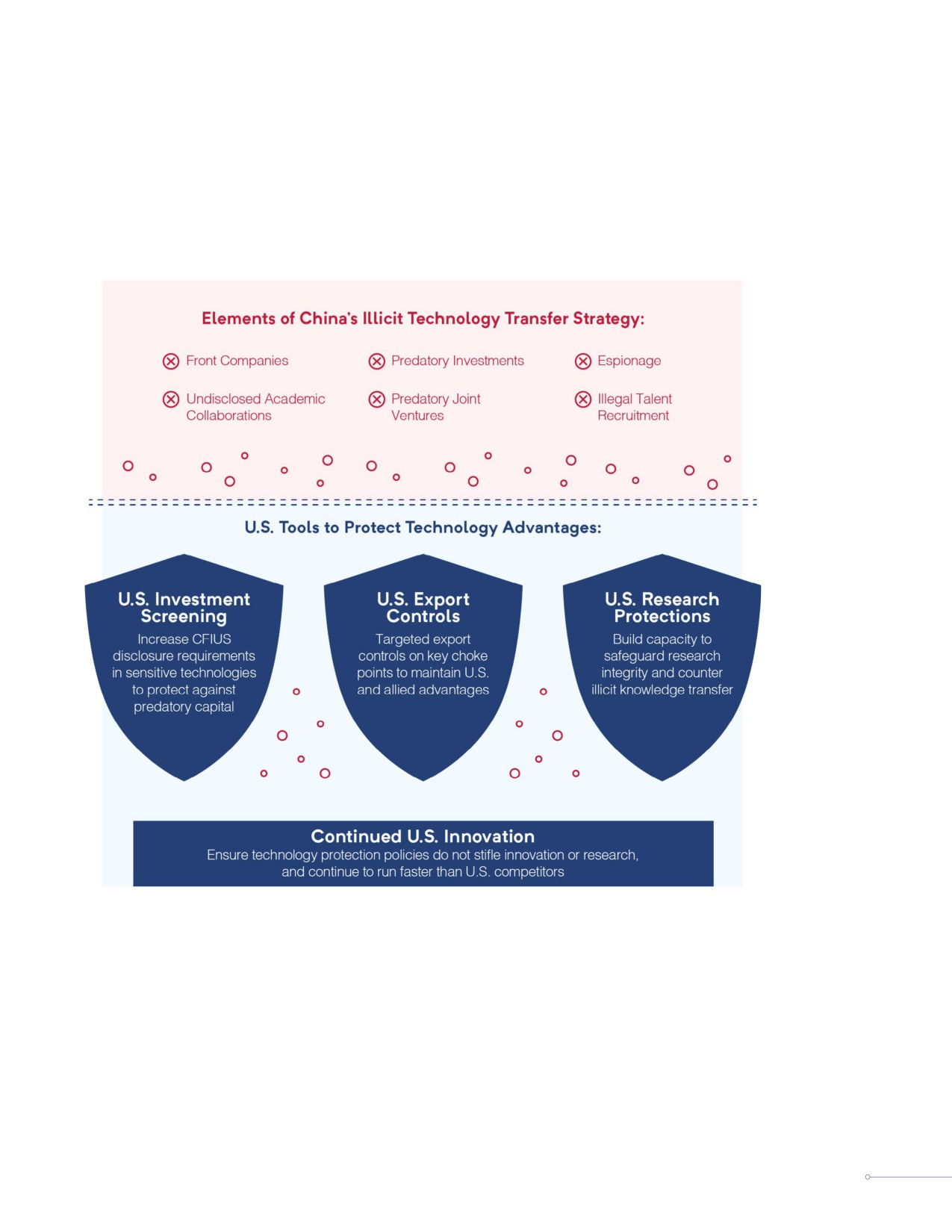
TECHNOLOGY PROTECTION
Russia also poses a significant illicit technology transfer threat, particularly as it relates
to technologies with defense applications. Although the Russian government’s efforts to
steal U.S. technology and IP do not operate at the same scale of comparable CCP efforts,
Russia nonetheless is an aggressive and capable collector of technologies. It is likely
to pose continued technology transfer threats over the coming decade, utilizing existing
commercial and academic entities, as well as traditional and cyber espionage.5
Protect.
Modernizing Export Controls and Investment Screening.
How the United States designs policies to limit the movement of commercial goods or
capital in the interests of national security will be one of the defining challenges of the next
decade, as dual-use commercial technologies become increasingly important to national
security. Export controls can and should be utilized not only to prevent the transfer of
particularly sensitive equipment to strategic competitors, but also to slow competitors’
efforts to develop indigenous industries in sensitive technologies with defense applications.
p
226
CHAPTER 14
If executed properly, export controls that slow competitors can sustain existing U.S.
defense advantages over long periods of time. For instance, U.S. export controls on jet
engine technology have stymied Chinese government-led efforts to produce a modern jet
engine domestically for use in military aircraft for nearly 30 years.6
“How the United States designs
policies to limit the movement of
commercial goods or capital in
the interests of national security
will be one of the defining
challenges of the next decade ...”
However, as currently designed and utilized, U.S. export controls and investment screening
procedures are imperfect instruments for the AI competition. As a policy matter, investment
screening and export controls were designed for a different era, when the distinction
between civil and military technologies was clearer and there was little overlap between
the economies of the United States and its competitors. Both conditions have changed.
AI is dual-use and the emerging technology economies of the United States and China
are deeply interconnected, which makes it extremely difficult to design controls that are
feasible, maximize strategic impact, and minimize economic costs. While these tradeoffs
are not new, they are becoming more extreme, as the dual-use nature of AI means many
of its individual components most critical to national security are also commonplace in the
commercial sector.
Meanwhile, U.S. regulatory capacity has not kept pace with technical developments,
as the Departments of Commerce, Treasury, and State all lack sufficient technical and
analytical capacity to effectively design and efficiently enforce technology protection
policies on dual-use emerging technologies. Congress has taken some important steps
in recent years to adapt technology protection regimes to challenges posed by emerging
technologies, most notably the Export Control Reform Act of 2018 (ECRA) and the Foreign
Investment Risk Review Modernization Act of 2018 (FIRRMA).7 However, more than two
years after their passage, implementation of key aspects of both laws remains unfinished,
hindering enforcement and confounding the affected industries.8
p
227
TECHNOLOGY PROTECTION
These conditions present policymakers with a difficult choice between under-protection,
which will give competitors unacceptable levels of access to sensitive technologies,
and over-protection, which has the potential to stifle innovation and harm overall U.S.
competitiveness. Effective controls must target choke points that impose significant
trickle-down strategic costs on competitors but minimal economic costs on U.S. industry.
But such choke points are increasingly elusive.
Clearly state overarching principles to guide future U.S. dual-use technology protection
Recommendation
policies. The United States must take a smarter and more predictable approach to applying
technology protection policies to AI. The government should state that future technology
protection policies will be guided by four overarching principles:
• U.S. technology controls must not supplant investment and innovation.
• U.S. strategies to promote and protect U.S. technology leadership must be integrated.
• The United States must be judicious in applying export controls to AI-related
technologies, targeting discrete choke points and coordinating policies with allies.
• The United States must broaden investment screening on AI-related technologies.
“The United States must
be judicious in applying
export controls to AI-related
technologies, targeting discrete
chokepoints and coordinating
policies with allies.”
On a technical level, AI poses particular challenges to control regimes given its dual-
use, widespread, and largely open-source nature. Moreover, it builds on a host of
other technologies. Given the ubiquitous nature of AI, export controls on AI algorithms
carry substantial risk—improperly defined controls could inadvertently restrict the
export of significant numbers of commercial products and cause substantial harm
to the U.S. technology industry. While some AI algorithms are clearly candidates for
export controls, such as those meant for use in battlefield applications, such software
is largely already controlled under the Commerce Control List.9 Data is also a potential
p
228
CHAPTER 14
target for controls—especially sensitive bulk data—but effective data controls face similar
challenges to AI algorithms.10 Looking across the AI stack, the hardware component of the
AI stack contains the most viable targets for traditional export controls.
Build regulatory capacity and fully implement ECRA and FIRRMA. The United States must
Recommendation
also take steps to improve its capacity to design and implement effective technology
protection policies. In the near term, the Departments of Commerce, Treasury, and State
must ensure they have sufficient quantities of technically proficient personnel focused
on technology protection policies and better utilize external advisory boards staffed with
technical experts in designing policies. The Department of Commerce must also finalize
its initial list of
“emerging” and “foundational” technologies that must be controlled, as
mandated by ECRA more than two years ago, and work to comprehensively adapt U.S.
export control lists to address modern technology-focused security challenges.11 Doing
so is a critical step to implementing both ECRA and FIRRMA. Finally, departments
and agencies should consider efforts to expedite and automate export licensing and
Committee on Foreign Investment in the United States (CFIUS) filing proceedings, which
could improve the effectiveness and reduce the economic costs of these regimes.12
Require investors from U.S. competitors to disclose transactions in a broader set of
Recommendation
sensitive technologies to CFIUS. The United States must amend CFIUS’ authorities and
procedures to enable it to better address modern challenges associated with sensitive,
dual-use technologies. Specifically, it must enhance its ability to monitor investments from
competitors in critical U.S. technology industries to prevent theft of IP and ensure that
the United States retains control of sensitive technologies. U.S. competitors are investing
heavily in U.S. AI firms. From 2010 to 2017, China-based investors poured more than
$1.3 billion into U.S. AI startups, and AI remains among the top technology areas for
venture capital investment in the United States by China-based firms.13 However, the U.S.
government has limited insight into these transactions. CFIUS is responsible for screening
foreign investments for national security risks, but it only requires firms to disclose
investments when the U.S. firm produces an export-controlled good—which very few AI
firms do.14 Therefore, many firms based in the U.S. competitor countries that invest in U.S.
AI companies have no obligation to report their investments to CFIUS. While CFIUS has
broad authority to unwind such transactions, it currently has no visibility before they are
consummated—creating a significant technology transfer risk.
CFIUS should increase disclosure requirements for investments in sensitive technologies
by firms from China and Russia. Congress should mandate that all investments originating
from “countries of special concern,” to include China and Russia, in national security-
relevant applications of AI and other “sensitive technologies” as defined by CFIUS, must
be disclosed to allow CFIUS the opportunity to review them prior to the completion of the
transaction. This list of sensitive technologies should be distinct and broader than the list of
“emerging” and “foundational” technologies required under ECRA and include industries
key to U.S. national security that face persistent threats from adversarial capital, specifically
p
229
TECHNOLOGY PROTECTION
national security-relevant applications of AI, semiconductors, telecommunications
equipment, quantum computing, and biotechnology, as well as other sectors identified in
Made in China 2025. De-linking investment screening from export controls acknowledges
that these two tools can and should be applied in different ways, permitting more expansive
investment screening while maintaining targeted export controls focused on choke points.
Limiting the scope of the mandatory filing requirements for this broader set of technologies
to firms only from select U.S. competitors would prevent over-regulation and preserve
the free flow of capital, increase insight into China’s and Russia’s investments in critical
technologies, deter state-sponsored IP theft, and preserve U.S. leadership in AI for national
security purposes.15
“CFIUS should increase
disclosure requirements
for investments in sensitive
technologies for firms from
China and Russia.”
Utilize targeted export controls on key semiconductor manufacturing equipment (SME).
Recommendation
Where possible, the United States should use export controls to prevent competitors
from obtaining AI capabilities that would grant them strategic or military advantages.
The primary U.S. export control target to constrain competitors’ AI capabilities should be
sophisticated SME necessary to manufacture high-end chips. SME is a critical choke point
and an attractive target for export controls for the following reasons:
• Advanced AI is increasingly dependent on high-end computing capabilities16;
• China relies on international firms for its supply of high-end semiconductors; and
• SME manufacturing is specialized and dominated by the United States and its allies.
p
230
CHAPTER 14
“The primary U.S. export control
target to constrain competitors’
AI capabilities should be
sophisticated semiconductor
manufacturing equipment (SME)
necessary to manufacture high-
end chips.”
China is the only U.S. competitor attempting to cultivate a domestic, cutting-edge
microelectronics fabrication industry capable of producing advanced chips at scale.
Slowing the growth of China’s high-end semiconductor manufacturing ability would set
back its attempts to build a cutting-edge microelectronics industry capable of fabricating
chips most useful for advanced applications of AI for defense. Coupled with the efforts
to promote U.S. semiconductor leadership outlined in Chapter 13 of this report, this will
further the Commission’s proposed U.S. policy goal of remaining two generations ahead
of China in cutting-edge microelectronics design and fabrication. However, controls on
general-purpose semiconductors are unlikely to be effective given the larger number of
countries capable of producing such chips. If implemented unilaterally, such controls
could harm the U.S. semiconductor industry.
Align the export control policies of the United States, the Netherlands, and Japan regarding
Recommendation
SME. The sophisticated photolithography tools needed to produce chips at the 16nm
node and below, particularly extreme ultraviolet (EUV) and argon fluoride (ArF) immersion
lithography tools, are the most complex and expensive type of SME. These tools are even
more specialized than SME writ large, and the United States, the Netherlands, and Japan
control the entire market.17 The Departments of State and Commerce should work with
the governments of the Netherlands and Japan to align the export licensing processes
of all three countries regarding high-end SME, particularly EUV and ArF immersion
lithography equipment, toward a policy of presumptive denial of licenses for exports of
such equipment to China. This would slow China’s efforts to domestically produce 7nm or
5nm chips at scale and constrain China’s semiconductor production capability of chips
at any node at or below 16nm—which the Commission assesses to be most useful for
advanced AI applications—by limiting the capability of Chinese firms to repair or replace
existing equipment.18
p
231
TECHNOLOGY PROTECTION
Utilize targeted end-use export controls and reporting requirements to prevent use of high-
Recommendation
end U.S. AI chips in human rights violations. The United States must take steps to prevent
and deter U.S. firms from wittingly or unwittingly enabling uses of AI that violate human
rights. List-based controls are ill-suited for this task given the commercial nature of most
AI equipment, as the vast majority of its uses are legitimate. However, end-use and end-
user export controls could be more effective. Although end-use controls are unlikely to
prevent the transfer of strategic technologies to U.S. competitors determined to obtain
them, they could prevent or deter U.S. firms from allowing certain key pieces of equipment,
particularly high-end chips, to be utilized in malicious AI applications. Reporting revealing
that U.S.-made chips are powering a supercomputer in Xinjiang, China, used for mass
surveillance of Uyghur populations and that firms in China have filed patents for facial
recognition specifically targeting Uyghurs illustrates the need to more closely monitor how
high-end U.S. enabling hardware is utilized.19
“The United States must take
steps to prevent and deter
U.S. firms from wittingly or
unwittingly enabling uses of AI
which violate human rights.”
The Department of Commerce should prohibit the export of specific, high-performing AI
chips for use in mass-surveillance applications, compel U.S. firms that export such chips
to certify that the buyer will not utilize them to facilitate human rights abuses, and require
that firms submit quarterly reports to Commerce listing all such chip sales to China. This
would not constitute a licensing requirement that would introduce uncertainty and cause
delays, but rather a self-certification and semi-regular report from industry. Such an action
would demonstrate the U.S. commitment to ethical and responsible uses of AI, promote
ethical behavior among U.S. firms, and make it harder for bad actors to utilize advanced
U.S. chips for nefarious purposes.20
p
232
CHAPTER 14
“China’s campaign to exploit
U.S.-based research violates
the research community’s core
principles of integrity, openness,
accountability, and fairness.”
Strengthening Research Protection.
The U.S. research enterprise should be protected as a national asset. China’s campaign to
exploit U.S.-based research violates the research community’s core principles of integrity,
openness, accountability, and fairness.21 U.S. response measures to counter the actions of
China’s government are nascent.22 There is a need for more technically versed intelligence
collection and analysis on threats to the science and technology sector and a need to
disseminate that information more broadly.23 Government agencies, law enforcement, and
research institutions need ready access to tools and resources to conduct nuanced risk
assessment and build transparency around specific threats and tactics. The government
and research institutions share responsibility for protecting core values and countering
malicious activities. Responses should be coordinated with like-minded allies and partners
to reinforce norms around openness of fundamental research, research integrity, and
protection of IP.
Strengthening the integrity of the research process will support the foundations of open
research. However, if not approached thoughtfully, U.S. policy actions to counter technology
transfer could harm U.S. competitiveness and global scientific progress. Countering the
CCP’s actions does not require severing most ties between research communities in China
and the United States. The United States benefits from collaboration by staying connected
with cutting-edge work in China and welcoming their PhD-level top talent24 that comes to
study at U.S. universities and remains in the United States at rates of 85% to 90% after
graduating.25
Build capacity to protect the integrity of the U.S. research environment. Congress should start
Recommendation
by passing the Academic Research Protection Act (ARPA) and establishing a government-
sponsored center of excellence on research security.26 The ARPA legislation would create
a dedicated National Commission on Research Protection, improve dissemination of
open-source intelligence relating to foreign threats, and facilitate the sharing of studies
and practices between government and research organizations.
p
233
TECHNOLOGY PROTECTION
Coordinate research protection efforts internationally with allies and partners. China’s
Recommendation
efforts to acquire foreign technology extend far beyond the United States.27 The Office of
Science and Technology Policy, the Department of State, and the Department of Justice
should coordinate with allies and partners to further information-sharing on detrimental
academic collaboration with entities affiliated with China’s People’s Liberation Army
(PLA) and develop multilateral responses to mitigate the harm from these actions. Such
diplomacy should seek to reinforce global norms around commitment to open fundamental
research, as formalized in the United States in National Security Decision Directive 189.28
The United States should strive to build a coalition committed to this principle and to
research integrity, sidelining those who do not abide by the values that underpin innovation
and global science cooperation.
“The United States should strive
to build a coalition committed
to this principle and to research
integrity, sidelining those who
do not abide by the values that
underpin innovation and global
science cooperation.”
Bolster cybersecurity support for research institutions. Protection of research data and
Recommendation
IP from cyber-enabled theft is perhaps the most important measure and the most
easily achieved layer of security. This is particularly salient for AI, when theft of training
data or trained models essentially provides access to a final product. Federal grant-
making agencies should ease the ability of research institutions to maintain a baseline
level of cybersecurity by issuing clear guidance, establishing incentives, and sharing
state-of-the-art best practices and resources.
Agencies such as the Department of Homeland Security (DHS) and FBI should
increase support to information-sharing constructs and provide timely and actionable
alerts on cyber threats and intrusions.29 In addition, the government should broker
commercial cloud credits for universities to support secure data storage for research
groups and laboratories conducting research known to be of high interest to foreign
adversaries.
p
234
CHAPTER 14
Counter foreign talent recruitment programs. China’s national plan for AI development
Recommendation
directs use of foreign talent recruitment programs as a means to create a “high ground”
for China’s AI experts.30 These problematic programs have received increasing attention
in recent years. Rather than offering legitimate competition for scientific talent through
attractive job offers, many are constructed in a manner that contradicts U.S. norms of
research integrity, violates rules around disclosure, and creates vectors for technology
transfer.31
The programs often employ a model of “part-time” recruitment, in which participants retain
positions in the United States while accepting an affiliation with an institution in China.32
This often involves signing contracts that create conflicts through requirements to attribute
patents to an institution in China, even if the research was conducted with U.S. funding.
Participants often train other talent recruitment program members and replicate U.S.-
funded work at an institution in China.
We commend recent action by Congress to limit the detrimental impact of these programs
by mandating standardized disclosure requirements for federally funded research that
will require comprehensive disclosure of conflicts of interest, conflicts of commitment,
and all outside and foreign support.33 This should be strengthened by a standardization
and unification of grant application and documentation processes in machine-readable
formats. Together, these measures would enable effective oversight, automated fraud
“Disclosure and grant
standardization should be
complemented with mandated
and resourced compliance
operations at each research
funding agency—creating a
layer of accountability to enforce
disclosure policies and deter
bad actors.”
p
235
TECHNOLOGY PROTECTION
detection, and data sharing across the federal research funding agencies. Disclosure and
grant standardization should be complemented with mandated and resourced compliance
operations at each research funding agency—creating a layer of accountability to enforce
disclosure policies and deter bad actors.
Strengthen visa vetting to limit problematic research collaborations. Some U.S. universities
Recommendation
and researchers are unknowingly entering into collaborative research arrangements with
researchers from universities in China with close ties to the PLA and conducting research
that directly contributes to China’s military and security capabilities.34 China’s military-
civilian fusion strategy and pursuit of technological leadership has been supported by a
push from PLA-affiliated research institutions to send personnel abroad. Visiting scholars
or students have been found to downplay ties to the military or deliberately obscure
affiliation by using alternate names for their home institutions.35
The United States should guard against the entrance of researchers with problematic
affiliations through implementation of a special review process for visa applications from
advanced-degree students and researchers with ties to research institutions affiliated with
foreign military and intelligence organizations of designated countries of concern.36 This
should be accompanied by adequate resources to enable heightened review and paired
with penalties that ban entry to visa applicants found to have intentionally not disclosed or
improperly disclosed their military and intelligence affiliations.
p
236
CHAPTER 14
Chapter 14 - Endnotes
1 Outline of the National Innovation-Driven Development Strategy, Central Committee of the
Communist Party of China and the PRC State Council (May 19, 2016) (translation by CSET on Dec. 11,
strategy/.
2 Deputy Assistant Attorney General Adam S. Hickey of the National Security Division Delivers
Remarks at the Fifth National Conference on CFIUS and Team Telecom, U.S. Department of Justice
hickey-national-security-division-delivers-0.
3 China Theft of Technology is Biggest Law Enforcement Threat to U.S., FBI Says, The Guardian (Feb.
(quoting William Evanina, director of the National Counterintelligence and Security Center).
4 A recent JASON study on the issue found that “[a]ctions of the Chinese government and its
institutions that are not in accord with U.S. values of science ethics have raised concerns about
foreign influence in the U.S. academic sector . . . there are problems with respect to research
transparency, lack of reciprocity in collaborations and consortia, and reporting of commitments and
potential conflicts of interest, related to these actions.” JASON, Fundamental Research Security,
MITRE Corporation at 39 (Dec. 2019), https://www.nsf.gov/news/special_reports/jasonse13curity/JSR-
19-2IFundamentalResearchSecurity_12062019FINAL.pdf.
5 In 2018 the U.S. National Counterintelligence and Security Center stated: “The threat to U.S.
technology from Russia will continue over the coming years as Moscow attempts to bolster an
economy struggling with endemic corruption, state control, and a loss of talent departing for jobs
abroad.” Foreign Economic Espionage in Cyberspace, National Counterintelligence and Security
Center at 8 (2018), https://s3-us-west-2.amazonaws.com/cyberscoop-media/wp-content/uploads/201
8/07/26114025/2018ForeignEconomic-Espionage-Pub_FINAL.pdf.
6 Robert Farley & J. Tyler Lovell, China’s Air Force Is Being Held Back by Its Terrible Jet Engines, The
National Interest (April 3, 2020) https://nationalinterest.org/blog/buzz/chinas-air-force-being-held-
back-its-terrible-jet-engines-140252.
7 See Pub. L. 115-232, Title XVII, Subtitle B, 132 Stat. 1636, 2208, as amended by Pub. L. 116-6,
Division H, Title II, Section 205 Consolidated Appropriations Act, 2019, 133 Stat. 13, 476; Pub. L. 115-
232, Title XVII, Subtitle A, 132 Stat. 1636, 2174.
8 Of particular note, ECRA requires the Department of Commerce to identify “emerging and
foundational technologies that are essential to the national security of the United States” that are
not otherwise controlled, but to date Commerce has not identified a single technology under this
provision. This has left gaps in the U.S. approach to protecting its advantages in high-tech sectors,
including AI, and created uncertainty for industry. See Pub. L. 115-232, Title XVII, Subtitle B, 132
Stat. 1636, 2208, as amended by Pub. L. 116-6, Division H, Title II, Section 205 Consolidated
Appropriations Act, 2019, 133 Stat. 13, 476.
9 Carrick Flynn, Recommendations on Export Controls for Artificial Intelligence, Center for Security
and Emerging Technology (Feb. 6, 2020), https://cset.georgetown.edu/research/recommendations-
on-export-controls-for-artificial-intelligence/.
10 There is also room to work with allies and partners to create standards for securely transferring key
data sets and limiting their distribution to certain trusted nations; see Chapter 15 of this report for
additional details on this topic.
11 See Chris Darby, et al., Mitigating Economic Impacts of the COVID-19 Pandemic and Preserving
nscai.gov/white-papers/covid-19-white-papers/.
12 The Chapter 14 Blueprint for Action contains more details on this recommendation.
p
237
TECHNOLOGY PROTECTION
13 Chinese venture capital investment in the U.S. increased substantially after 2014 but has stalled
since 2018. Nevertheless, AI remains one of the top sectors for Chinese venture capital investment in
the U.S. Michael Brown & Pavneet Singh, China’s Technology Transfer Strategy, Defense Innovation
Unit Experimental (Jan. 2018), https://admin.govexec.com/media/diux_chinatechnologytransferstudy_
jan_2018_(1).pdf; Adam Lysenko, et al., Disruption: US-China Venture Capital in a New Era of
Disruption_US+China+VC_January2020.pdf; Mercedes Ruehl, et al., Chinese State-Backed Funds
content/745abeca-561d-484d-acd9-ad1caedf9e9e.
14 As a result, CFIUS disclosure requirements disproportionately impact investments from U.S. allies;
of the 94 mandatory CFIUS filings in 2019, 14 were from Japan, 12 were from Canada, 11 were from
the U.K., and only three were from China. Annual Report to Congress, CFIUS at 33-36 (2019), https://
home.treasury.gov/system/files/206/CFIUS-Public-Annual-Report-CY-2019.pdf.
15 This would require an amendment to CFIUS’ authorizing legislation, the draft text of which can be
found in the Legislative Text Appendix of this report. Specifically, it would amend Section 721(a) of
the Defense Production Act of 1950 (as amended and codified in 50 USC § 4565[a]) and grant the
Department of the Treasury new authorities to alter mandatory filing requirements and define a list of
“sensitive technologies” distinct from export control lists.
16 OpenAI estimates that since 2012, the amount of compute used in the largest AI training runs is
doubling every 3.4 months. See Dario Amodei & Danny Hernandez, AI and Compute, OpenAI (May
16, 2018), https://openai.com/blog/ai-and-compute/.
17 The Dutch firm ASML has a monopoly on EUV lithography tools, which are the most advanced type,
and ArF immersion lithography tools are only produced by ASML and the Japanese firm Nikon.
18 The Wassenaar Arrangement lists lithography equipment capable of making chips with features of
45nm or below as a controlled item. However, because the Wassenaar Arrangement is not binding,
states parties are not obligated to comply with this as a legal restriction. See List of Dual-Use Goods
List-of-DU-Goods-and-Technologies-and-Munitions-List-Dec-18-1.pdf.
19 Paul Mozur & Don Clark, China’s Surveillance State Sucks Up Data. U.S. Tech Is Key to Sorting It,
New York Times (Nov. 24, 2020), https://www.nytimes.com/2020/11/22/technology/china-intel-nvidia-
xinjiang.html; Leo Kelion, Huawei Patent Mentions Use of Uighur-spotting Tech, BBC (Jan. 13, 2021),
https://www.bbc.com/news/technology-55634388. Reporting indicates firms in China may be in the
process of altering these patents to remove references to specific ethnic groups.
20 This action would build on recent State Department guidance regarding best practices for
transactions linked to foreign government end-users for products or services with surveillance
capabilities. See U.S. Department of State Guidance on Implementing the “UN Guiding Principles”
for Transactions Linked to Foreign Government End-Users for Products or Services with Surveillance
Capabilities, U.S. Department of State (Sept. 30, 2020), https://www.state.gov/key-topics-bureau-of-
democracy-human-rights-and-labor/due-diligence-guidance/.
news/special_reports/jasonsecurity/JSR-19-2IFundamentalResearchSecurity_12062019FINAL.pdf.
22 Promising efforts have been initiated through the National Counterintelligence Task Force and the
Office of Science and Technology Policy’s Joint Committee on Research Environments, as well as
among universities, to build communities of interest to share best practices and conduct internal
audits around disclosure policies and cybersecurity. See National Science and Technology Council,
Academic Security and Counter Exploitation Program launched by the Texas A&M University System,
Academic Security and Counter Exploitation Program, Texas A&M University (last accessed Jan. 11,
2021), https://asce.tamus.edu/.
23 Chapter 5 of this report recommends that the Intelligence Community (IC) should prioritize
and accelerate collection of scientific and technical intelligence to better understand adversary
capabilities and intentions.
p
238
CHAPTER 14
Chapter 14 - Endnotes
24 The Commission supports measures to strengthen the ability of the United States to attract and
retain top AI talent coming from China and elsewhere. See Chapter 10 of this report.
25 Remco Zwetsloot, U.S.-China STEM Talent “Decoupling,” Johns Hopkins Applied Physics
Laboratory at 13 (2020), https://www.jhuapl.edu/assessing-us-china-technology-connections/
dist/407b0211ec49299608551326041488d4.pdf.
gov/bill/116th-congress/house-bill/8346. The legislation sought to establish a National Commission on
Research Protection; establish an open-source intelligence clearinghouse relating to foreign threats
to academic research overseen by the Director of National Intelligence (DNI); improve guidance from
the Departments of State and Commerce to ensure academic institutions are meeting export-control
responsibilities; and develop a Federal Bureau of Investigation (FBI) outreach strategy on threats to
the academic community.
27 Notably, two-thirds of overseas professional associations that transfer technology to China are
located outside the United States, mainly distributed among U.S. allies and partners. Ryan Fedasiuk
& Emily Weinstein, Overseas Professionals and Technology Transfer to China, Center for Security
and Emerging Technology at 11 (July 2020), https://cset.georgetown.edu/research/overseas-
professionals-and-technology-transfer-to-china/.
28 The directive defines fundamental research as “Basic and applied research in science and
engineering, the results of which ordinarily are published and shared broadly within the scientific
community, as distinguished from proprietary research and from industrial development, design,
production, and product utilization, the results of which ordinarily are restricted for proprietary or
national security reasons.” National Policy on the Transfer of Scientific, Technical, and Engineering
Information, Executive Office of the President (Sept. 21, 1985), https://fas.org/irp/offdocs/nsdd/nsdd-
189.htm.
29 Such as the Research and Education Networks Information and Sharing Analysis Center (REN-
ISAC). REN-ISAC (last accessed Jan. 2, 2021), https://www.ren-isac.net/.
30 William C. Hannas & Huey-meei Chang, China’s Access to Foreign AI Technology, Center for
Security and Emerging Technology at 9-10 (Sept. 2019), https://cset.georgetown.edu/wp-content/
uploads/CSET_China_Access_To_Foreign_AI_Technology.pdf.
p
239
TECHNOLOGY PROTECTION
31 The Office of Science and Technology Policy defines foreign government talent recruitment
programs as “an effort directly or indirectly organized, managed, or funded by a foreign government
to recruit science and technology professionals or students (regardless of citizenship or national
origin).” Enhancing the Security and Integrity of America’s Research Enterprise, White House Office of
Science and Technology Policy at 18 (July 2020), https://trumpwhitehouse.archives.gov/wp-content/
uploads/2020/07/Enhancing-the-Security-and-Integrity-of-Americas-Research-Enterprise.pdf.
32 David Zweig & Siqin Kang, America Challenges China’s National Talent Programs,
Center for Strategic and International Studies at 5 (May 2020), https://csis-website-prod.
s3.amazonaws.com/s3fs-public/publication/20505_zweig_AmericaChallenges_v6_FINAL.
pdf?bTLm4WdtG93lAVmxLdlWsgkgeNQDQUAv.
33 See Pub. L. 116-283, sec. 223, William M. (Mac) Thornberry National Defense Authorization Act for
Fiscal Year 2021, 134 Stat. 3388 (2021).
34 Glen Tiffert, Global Engagement: Rethinking Risk in the Research Enterprise, The Hoover Institution
full_0818.pdf. A subsequent study of a larger database of research papers conducted by Nature
identified more than 12,000 papers from the years 2015 to 2019 that were co-authored by researchers
in the U.S. and at one of China’s “Seven Sons” universities. Furthermore, Nature found that “among
those, 499 authors had a dual affiliation with a U.S. institution and a Seven Sons university and were
listed on papers declaring grant funding from the NIH or the U.S. National Science Foundation.” Nidhi
Subbaraman, US Investigations of Chinese Scientists Expand Focus to Military Ties, Nature (Sept. 9,
2020), https://www.nature.com/articles/d41586-020-02515-x.
35 Alex Joske, Picking Flowers, Making Honey: The Chinese Military’s Collaboration with Foreign
Universities, Australian Strategic Policy Institute (Oct. 2018), https://www.aspi.org.au/report/picking-
flowers-making-honey.
36 The Commission recommends this as an update to Presidential Proclamation 10043 that suspends
F or J visas to study or conduct research for Chinese nationals affiliated with the Chinese government
military-civil fusion strategy. 85 Fed. Reg. 34353, Suspension of Entry as Nonimmigrants of Certain
Students and Researchers from the People’s Republic of China, Executive Office of the President
entry-as-nonimmigrants-of-certain-students-and-researchers-from-the-peoples-republic.
p
240