Physics For Scientists And Engineers 6E - part 314
S E C T I O N 3 9 . 4 • Consequences of the Special Theory of Relativity
1253
At the Active Figures link
at http://www.pse6.com, you
can observe the bouncing of
the light pulse for various
speeds of the train.
Einstein’s thought experiment demonstrates that two observers can disagree on the
simultaneity of two events.
This disagreement, however, depends on the transit
time of light to the observers and, therefore, does not demonstrate the deeper
meaning of relativity. In relativistic analyses of high-speed situations, relativity shows
that simultaneity is relative even when the transit time is subtracted out. In fact, all of
the relativistic effects that we will discuss from here on will assume that we are ignoring
differences caused by the transit time of light to the observers.
Time Dilation
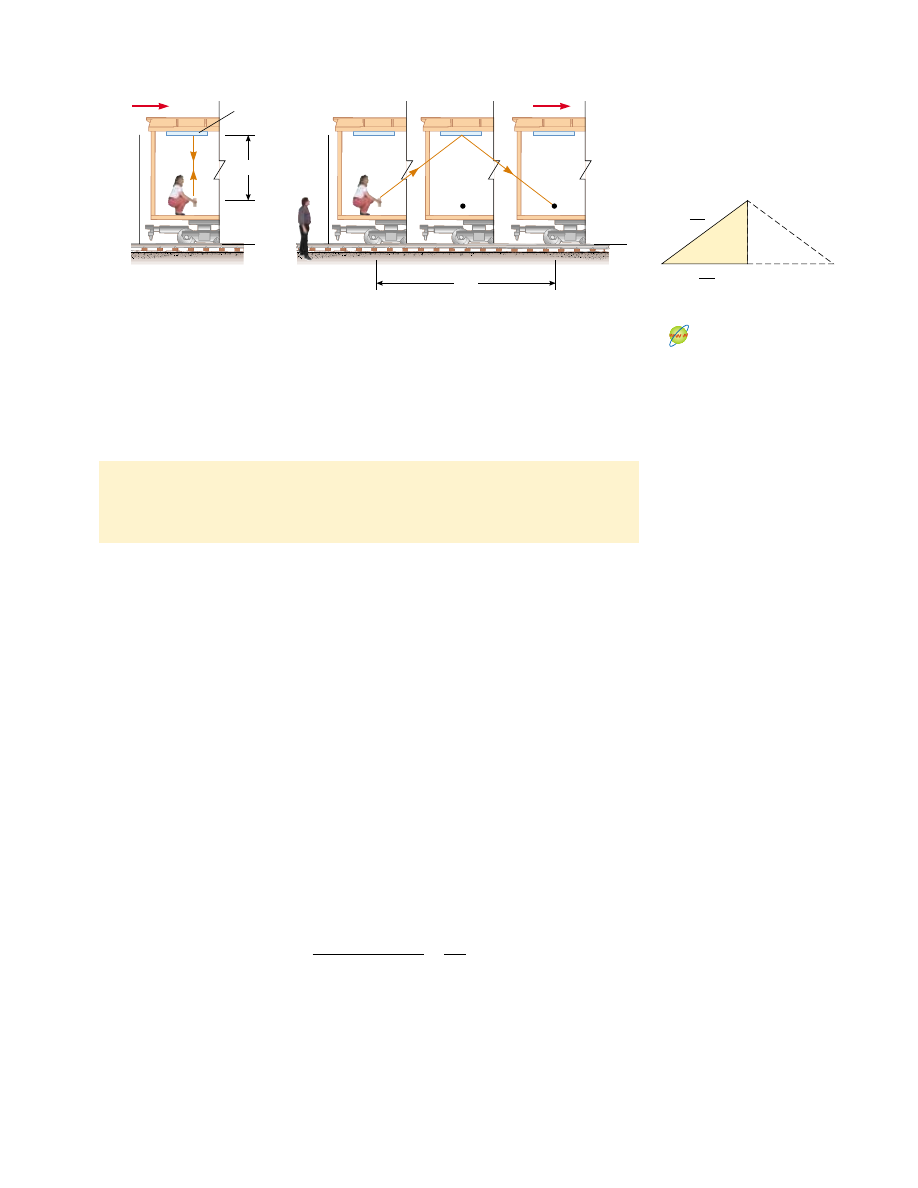
We can illustrate the fact that observers in different inertial frames can measure
different time intervals between a pair of events by considering a vehicle moving to the
right with a speed v, such as the boxcar shown in Figure 39.6a. A mirror is fixed to the
ceiling of the vehicle, and observer O" at rest in the frame attached to the vehicle holds
a flashlight a distance d below the mirror. At some instant, the flashlight emits a pulse of
light directed toward the mirror (event 1), and at some later time after reflecting from
the mirror, the pulse arrives back at the flashlight (event 2). Observer O" carries a clock
and uses it to measure the time interval 't
p
between these two events. (The subscript p
stands for proper, as we shall see in a moment.) Because the light pulse has a speed c, the
time interval required for the pulse to travel from O" to the mirror and back is
(39.5)
Now consider the same pair of events as viewed by observer O in a second frame, as
shown in Figure 39.6b. According to this observer, the mirror and flashlight are moving to
the right with a speed v, and as a result the sequence of events appears entirely different.
By the time the light from the flashlight reaches the mirror, the mirror has moved to the
right a distance v 't/2, where 't is the time interval required for the light to travel from
O" to the mirror and back to O" as measured by O. In other words, O concludes that,
because of the motion of the vehicle, if the light is to hit the mirror, it must leave the
'
t
p
!
distance traveled
speed
!
2d
c
two events that are simultaneous in one reference frame are in general not
simultaneous in a second frame moving relative to the first. That is, simultaneity is
not an absolute concept but rather one that depends on the state of motion of
the observer.
v
O
′
O
′
O
′
x
′
O
y
′
v
∆t
(b)
d
v
∆t
2
c
∆t
2
(c)
v
Mirror
y
′
x
′
d
O
′
(a)
Active Figure 39.6 (a) A mirror is fixed to a moving vehicle, and a light pulse is sent
out by observer O" at rest in the vehicle. (b) Relative to a stationary observer O standing
alongside the vehicle, the mirror and O" move with a speed v. Note that what observer
O measures for the distance the pulse travels is greater than 2d. (c) The right triangle
for calculating the relationship between 't and 't
p
.
In other words,